Q & A on Geometric Isomerism
ORGANIC CHEMISTRY II
(assignment 2)
PRESENTATION
BY
GROUP SIX
LECTURER; DR.KAYONDO ISAAC
GROUP MEMBERS
GROUP SIX
1. NSUBUGA SWAIBU VU-BPC-2411-0043-DAY
2. WADWOGO CHURCH SILAS VU-BPC-2411-1406-DAY
3. NAMBI AISHA VU-BPC-2411-1373-DAY
4. MUHEREZA CRISPUS VU-BPC-2411-0069-DAY
5. MUHEIRWE BROLYNE VU-BPC-2411-0201-DAY
Questions
1. Define geometric (cis-trans) isomerism.
2. How does restricted rotation around double bonds give rise to
geometric isomers?
3. Explain the E/Z notation in stereochemistry.
4. Discuss examples of geometric isomerism in alkenes.
5. How does geometric isomerism influence drug potency?
Questions
6. Explain why fumaric acid and maleic acid have different properties.
7. Discuss the stereochemistry of cyclic compounds in relation to cis-trans
isomerism.
8. How do steric and electronic effects control stability of geometric isomers?
9. Why are trans-isomers generally more stable than cis-isomers?
10. Discuss the pharmaceutical importance of geometric isomerism with
examples.
1. Define geometric (cis-trans) isomerism.
Geometric isomerism; also known as cis-trans isomerism, is a type
of stereoisomerism where molecules have the same molecular
formula and connectivity of atoms but differ in the spatial
arrangement of atoms due to restricted rotation around a bond .
It mostly occurs in alkenes and cyclic compounds
Key Characteristics of geometrical isomerism
Same molecular formula.
Same connectivity (constitution)
Different 3D orientation in space
Results from restricted rotation
Common in alkenes (C=C) and cyclic compounds
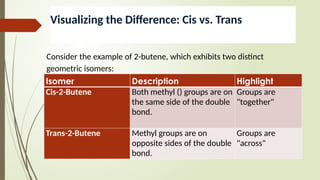
Isomer Description Highlight
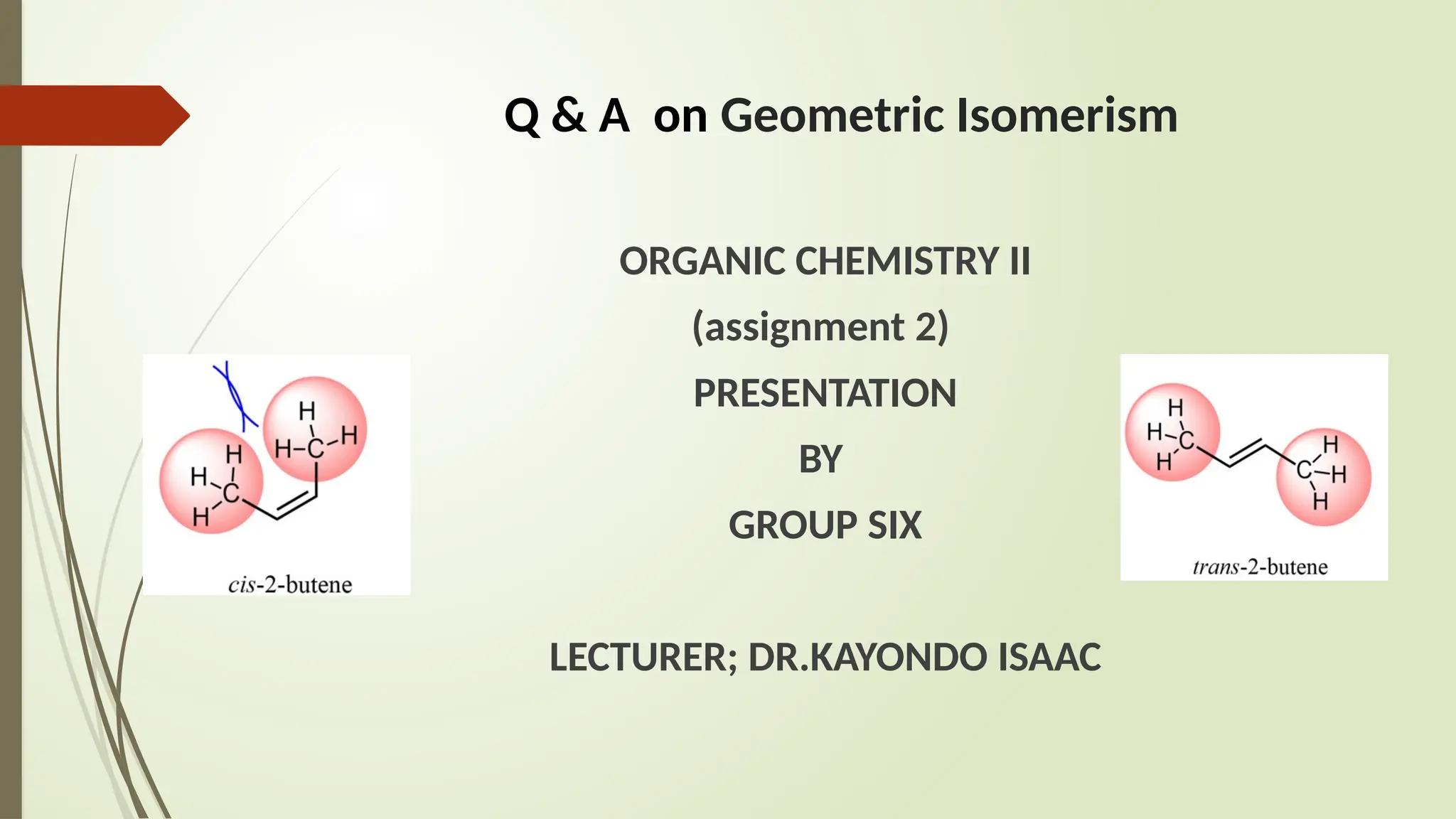
Cis-2-Butene Both methyl () groups are on
the same side of the double
bond.
Groups are
"together"
Trans-2-Butene Methyl groups are on
opposite sides of the double
bond.
Groups are
"across"
Consider the example of 2-butene, which exhibits two distinct
geometric isomers:
Visualizing the Difference: Cis vs. Trans
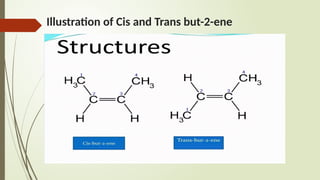
Illustration of Cis and Trans but-2-ene
2. How does restricted rotation around double bonds give rise to
geometric isomers?
 Restricted rotation occurs around double bonds and cyclic compounds
.
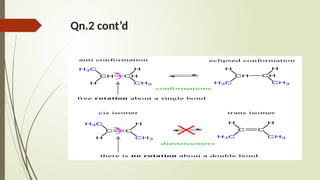
 Restricted rotation around double bonds gives rise to geometric
isomers by locking substituents into fixed spatial positions, preventing
them from interconverting at room temperature
How restricted Rotation occurs;
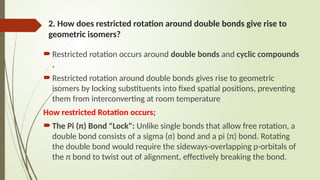
 The Pi (π) Bond "Lock": Unlike single bonds that allow free rotation, a
double bond consists of a sigma (σ) bond and a pi (π) bond. Rotating
the double bond would require the sideways-overlapping p-orbitals of
the π bond to twist out of alignment, effectively breaking the bond.
Question two cont’d
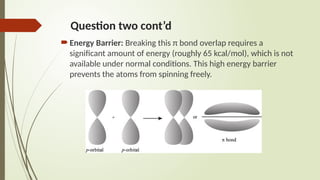
Energy Barrier: Breaking this π bond overlap requires a
significant amount of energy (roughly 65 kcal/mol), which is not
available under normal conditions. This high energy barrier
prevents the atoms from spinning freely.
Question two cont’d
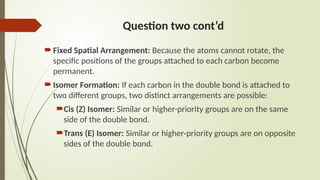
Fixed Spatial Arrangement: Because the atoms cannot rotate, the
specific positions of the groups attached to each carbon become
permanent.
Isomer Formation: If each carbon in the double bond is attached to
two different groups, two distinct arrangements are possible:
Cis (Z) Isomer: Similar or higher-priority groups are on the same
side of the double bond.
Trans (E) Isomer: Similar or higher-priority groups are on opposite
sides of the double bond.
Qn.2 cont’d
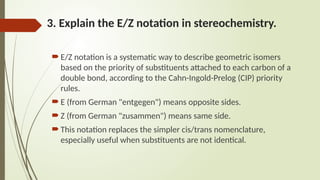
3. Explain the E/Z notation in stereochemistry.
 E/Z notation is a systematic way to describe geometric isomers
based on the priority of substituents attached to each carbon of a
double bond, according to the Cahn-Ingold-Prelog (CIP) priority
rules.
 E (from German "entgegen") means opposite sides.
 Z (from German "zusammen") means same side.
 This notation replaces the simpler cis/trans nomenclature,
especially useful when substituents are not identical.
Qn.3 cont’d
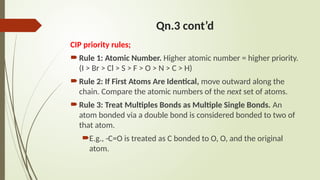
CIP priority rules;
Rule 1: Atomic Number. Higher atomic number = higher priority.
(I > Br > Cl > S > F > O > N > C > H)
Rule 2: If First Atoms Are Identical, move outward along the
chain. Compare the atomic numbers of the next set of atoms.
Rule 3: Treat Multiples Bonds as Multiple Single Bonds. An
atom bonded via a double bond is considered bonded to two of
that atom.
E.g., -C=O is treated as C bonded to O, O, and the original
atom.
Qn.3 cont’d
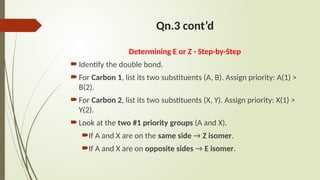
Determining E or Z - Step-by-Step
Identify the double bond.
For Carbon 1, list its two substituents (A, B). Assign priority: A(1) >
B(2).
For Carbon 2, list its two substituents (X, Y). Assign priority: X(1) >
Y(2).
Look at the two #1 priority groups (A and X).
If A and X are on the same side → Z isomer.
If A and X are on opposite sides → E isomer.
Qn.3 cont’d
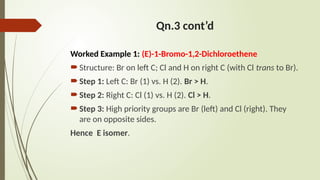
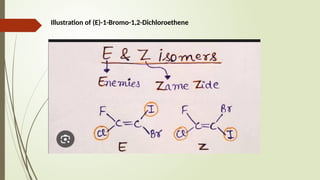
Worked Example 1: (E)-1-Bromo-1,2-Dichloroethene
Structure: Br on left C; Cl and H on right C (with Cl trans to Br).
Step 1: Left C: Br (1) vs. H (2). Br > H.
Step 2: Right C: Cl (1) vs. H (2). Cl > H.
Step 3: High priority groups are Br (left) and Cl (right). They
are on opposite sides.
Hence E isomer.
Illustration of (E)-1-Bromo-1,2-Dichloroethene
4. Discuss examples of geometric isomerism in alkenes.
Geometric isomerism (also known as cis-trans or E-Z
isomerism) occurs in alkenes because the carbon-carbon
double bond (C=C) restricts rotation. This rigidity allows for
different spatial arrangements of substituent groups. For this
to occur, each carbon atom of the double bond must be
attached to two different groups.
These isomers have different boiling points, densities, and
reactivities.
Qn.4 cont’d
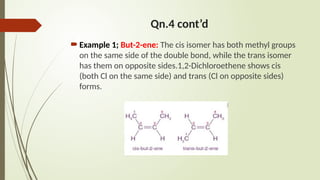
Example 1; But-2-ene: The cis isomer has both methyl groups
on the same side of the double bond, while the trans isomer
has them on opposite sides.1,2-Dichloroethene shows cis
(both Cl on the same side) and trans (Cl on opposite sides)
forms.
Qn.4 cont’d
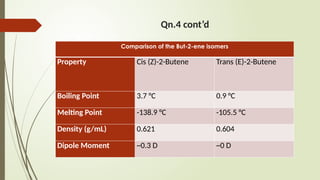
Comparison of the But-2-ene isomers
Property Cis (Z)-2-Butene Trans (E)-2-Butene
Boiling Point 3.7 °C 0.9 °C
Melting Point -138.9 °C -105.5 °C
Density (g/mL) 0.621 0.604
Dipole Moment ~0.3 D ~0 D
Qn. 4 Cont’d
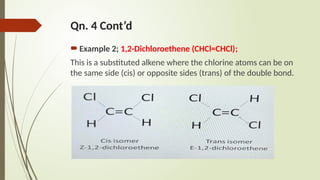
Example 2; 1,2-Dichloroethene (CHCl=CHCl);
This is a substituted alkene where the chlorine atoms can be on
the same side (cis) or opposite sides (trans) of the double bond.
Qn. 4 Cont’d
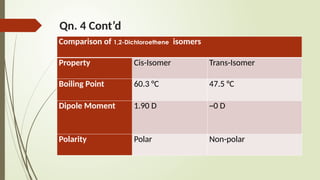
Comparison of 1,2-Dichloroethene isomers
Property Cis-Isomer Trans-Isomer
Boiling Point 60.3 °C 47.5 °C
Dipole Moment 1.90 D ~0 D
Polarity Polar Non-polar
5. How does geometric isomerism influence drug
potency?
Geometric isomerism significantly influences drug potency
because the different spatial arrangements of atoms in an isomer
affect how effectively a drug can bind to its specific biological
target (e.g., enzyme or receptor).
Geometric isomers can have significant different biological activities
and potencies because receptor binding often depends on the
spatial orientation of functional groups.
Qn. 5 Cont’d
Key impacts of geometrical on drug potency and action:
Specific Binding: Biological targets, such as enzymes and receptors, are
highly specific and often only one geometric isomer (eutomer) will fit
properly into the binding site, much like a lock and key. The other
isomer (distomer) may be inactive or significantly less active.
Varying Activity: This difference in binding affinity means one isomer is
potent while the other may have minimal or no therapeutic effect. For
example, the cis-isomer of the chemotherapy drug cisplatin binds
effectively to DNA and is a potent anticancer agent, whereas the trans-
isomer (transplatin) is largely ineffective.
Qn. 5 Cont’d
Different Pharmacokinetics: Geometric isomers often exhibit different
pharmacokinetic properties, including absorption, distribution,
metabolism, and excretion rates. These variations affect the
concentration of the active isomer that actually reaches the target site
in the body, thus influencing its overall potency and duration of
action.
Toxicity and Side Effects: The less potent or inactive isomer might
interact with different biological targets, leading to unintended and
potentially harmful side effects or toxicity. For instance, one isomer of
thalidomide was an effective sedative, while its other isomer was a
teratogen causing severe birth defects.
6. Explain why fumaric acid and maleic acid have
different properties.
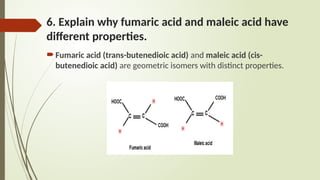
Fumaric acid (trans-butenedioic acid) and maleic acid (cis-
butenedioic acid) are geometric isomers with distinct properties.
Qn. 6 Cont’d
Maleic acid, with both carboxyl groups on the same side, forms
stronger intramolecular hydrogen bonds and is more soluble in
water.
Fumaric acid with carboxyl groups on opposite side so they cannot
reach other hence forming intermolecular hydrogen bonds with
surrounding molecules ,this results in formation of a very stable
extensive 3D lattice .
Fumaric acid is less soluble but more thermally stable, showing
how geometric differences influence physical and chemical
behavior.
Qn.6 cont’d
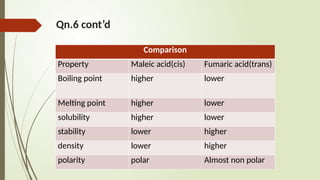
Comparison
Property Maleic acid(cis) Fumaric acid(trans)
Boiling point higher lower
Melting point higher lower
solubility higher lower
stability lower higher
density lower higher
polarity polar Almost non polar
Qn.7 Discuss the stereochemistry of cyclic
compounds in relation to cis-trans isomerism.
 In cyclic compounds, geometric isomerism arises because ring structures
restrict rotation.
 Stereochemistry of cyclic compounds introduces specific geometric constraints
that define cis and trans isomerism, which are a type of diastereomer.
 Unlike the free rotation of C-C single bonds in acyclic compounds, the ring
structure restricts rotation, locking substituents into fixed positions relative to
the plane of the ring.
 Cis-isomers have substituents on the same side of the ring plane.
 Trans-isomers have substituents on opposite sides. This leads to differences in
shape, polarity, and reactivity.
Qn.7 cont’d
Stereochemistry in Common Ring Sizes
The size and flexibility of the ring significantly impact the stable
conformations and the relative stability of
the cis and trans isomers.
Three and Four-Membered Rings: These small rings are rigid and
largely planar due to high ring strain. The differentiation
between cis and trans is clear and the substituents maintain their
relative positions consistently.
Qn.7 cont’d
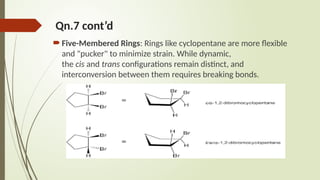
Five-Membered Rings: Rings like cyclopentane are more flexible
and "pucker" to minimize strain. While dynamic,
the cis and trans configurations remain distinct, and
interconversion between them requires breaking bonds.
Qn.7 cont’d
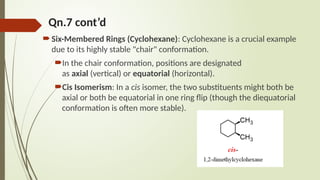
Six-Membered Rings (Cyclohexane): Cyclohexane is a crucial example
due to its highly stable "chair" conformation.
In the chair conformation, positions are designated
as axial (vertical) or equatorial (horizontal).
Cis Isomerism: In a cis isomer, the two substituents might both be
axial or both be equatorial in one ring flip (though the diequatorial
conformation is often more stable).
Qn.7 cont’d
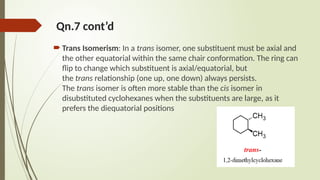
 Trans Isomerism: In a trans isomer, one substituent must be axial and
the other equatorial within the same chair conformation. The ring can
flip to change which substituent is axial/equatorial, but
the trans relationship (one up, one down) always persists.
The trans isomer is often more stable than the cis isomer in
disubstituted cyclohexanes when the substituents are large, as it
prefers the diequatorial positions
8.How do steric and electronic effects control
stability of geometric isomers?
Stability of geometric isomers is controlled by:
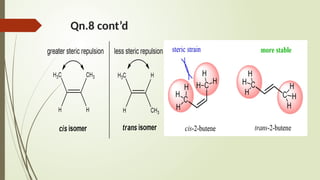
1. Steric effects (Bulkiness and repulsion): Bulky groups repel each
other (van der Waals repulsion).
In Cis Isomers: Bulky groups are forced close together on the same
side. Cis isomers often have higher steric strain due to bulky groups
being closer to each other they repel, leading to lower stability
compared to trans where they are far apart
In Trans Isomers: Bulky groups are far apart on opposite sides,
so Low steric strain ad thus increased stabilty.
Qn.8 cont’d
Qn.8 cont’d
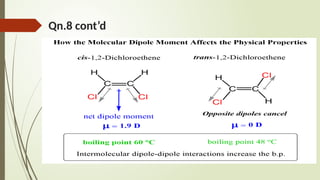
2. Electronic effects(dipole moments); : Polar bonds (e.g., C-Cl, C=O)
create dipoles. Molecular stability is affected by how these add up.
In Cis Isomers: Bond dipoles often add together, creating a larger
net molecular dipole. This can lead to stronger dipole-dipole
repulsions within the molecule.
In Trans Isomers: Bond dipoles often cancel each other out,
resulting in a near-zero net dipole moment. Lower polarity means
lower energy and greater stability.
 Trans isomers can better minimize dipole moments and electronic
repulsions, typically resulting in higher stability.
Qn.8 cont’d
9. Why Trans-Isomers Are Generally More Stable
Than Cis-Isomers
They have less steric hindrance due to substituents being farther
apart.
Their dipole moments may cancel, reducing overall molecular
energy.
Cis-isomers experience more repulsion from bulky groups and strain.
10. Pharmaceutical Importance of Geometric
Isomerism with Examples
Geometric isomerism is crucial in the pharmaceutical industry
because different isomers can have vastly different biological
effects, efficacy, and toxicity profiles. This difference in spatial
arrangement (cis/same side vs. trans/opposite side) impacts
how molecules interact with biological targets and their
metabolic fate within the body.
Qn.10 cont’d
Importance in the Pharmaceutical Industry
1. Varying Pharmacological Activity: Different isomers can exhibit
distinct pharmacological activities. One isomer may be highly
effective for a specific condition, while another is inactive or has a
different effect entirely.
2. Differences in Toxicity: A major safety concern is that an isomer
might be toxic while its counterpart is therapeutic. This
necessitates the rigorous analysis and separation of isomers during
drug development.
Qn.10 cont’d
3. Distinct Pharmacokinetic Properties: Isomers can differ in
their absorption, distribution, metabolism, and excretion (ADME)
within the body. This affects the drug's bioavailability, half-life,
and required dosage.
4. Target Receptor Binding Affinity: The specific 3D shape of a
molecule influences its ability to bind to target receptors or
enzymes. Minor spatial variations due to isomerism can
significantly alter binding affinity and selectivity.
Qn.10 cont’d
5. Regulatory Requirements: Regulatory agencies like the FDA
and EMA require thorough characterization and safety
assessments of all isomers present in a drug formulation. This
has led to the development of single-isomer drugs.
6. "Chiral Switch" for Safer Drugs: Many existing drugs, originally
marketed as a mixture of isomers (racemic mixture), have
undergone a "chiral switch" to single-isomer formulations,
resulting in safer and more effective medications.
Qn.10 cont’d
7. Metabolic Pathways: Different isomers can be processed
through different metabolic pathways, potentially leading to
varied or unexpected metabolites, which also need to be
assessed for safety.
8. Formulation and Stability: The physical properties of isomers,
such as solubility and stability, can vary, which impacts how a
drug is formulated and administered.
Qn.10 cont’d
9. Product Differentiation and Patent Extension: From a
commercial perspective, developing a single-isomer version of
an existing drug can offer opportunities for new patents and
market exclusivity.
10. Structure-Activity Relationship (SAR) Studies: Understanding
how geometric changes affect biological activity is crucial for
rational drug design, allowing chemists to design more effective
compounds.
Qn.10 cont’d
Examples in Medicine
1. Thalidomide: The most cited example. The R-isomer was a
mild sedative, while the S-isomer was a potent teratogen,
causing severe birth defects in the 1950s and 60s.
2. Cisplatin vs. Transplatin: In coordination chemistry,
the cis isomer, cisplatin, is a widely used anticancer drug;
the trans isomer, transplatin, is inactive.
Qn.10 cont’d
3. Diethylstilbestrol (DES): This synthetic estrogen mimic has
significantly different potencies between its isomers;
the trans isomer is 14 times more potent than the cis isomer.
4. Fumaric Acid and Maleic Acid: These are a classic pair of
geometric isomers (trans and cis, respectively) with different
physical properties (e.g., melting points and solubilities) and
biological roles.
References
Brunton, L. L., Hilal-Dandan, R., & Knollmann, B. C. (Eds.).
(2018). Goodman & Gilman’s: The pharmacological basis of
therapeutics (13th ed.). McGraw-Hill Education.
Eliel, E. L., & Wilen, S. H. (1994). Stereochemistry of organic
compounds. Wiley.
Klein, D. R. (2017). Organic chemistry (3rd ed.). Wiley
McMurry, J. (2016). Organic chemistry (9th ed.). Cengage Learning.
Smith, M. B. (2020). March’s advanced organic chemistry:
Reactions, mechanisms, and structure (8th ed.). Wiley.
GROUP SIX- ASSIGNMENT- for  learners 2-1.pptx

GROUP SIX- ASSIGNMENT- for learners 2-1.pptx

  • 1.
    Q & Aon Geometric Isomerism ORGANIC CHEMISTRY II (assignment 2) PRESENTATION BY GROUP SIX LECTURER; DR.KAYONDO ISAAC
  • 2.
    GROUP MEMBERS GROUP SIX 1.NSUBUGA SWAIBU VU-BPC-2411-0043-DAY 2. WADWOGO CHURCH SILAS VU-BPC-2411-1406-DAY 3. NAMBI AISHA VU-BPC-2411-1373-DAY 4. MUHEREZA CRISPUS VU-BPC-2411-0069-DAY 5. MUHEIRWE BROLYNE VU-BPC-2411-0201-DAY
  • 3.
    Questions 1. Define geometric(cis-trans) isomerism. 2. How does restricted rotation around double bonds give rise to geometric isomers? 3. Explain the E/Z notation in stereochemistry. 4. Discuss examples of geometric isomerism in alkenes. 5. How does geometric isomerism influence drug potency?
  • 4.
    Questions 6. Explain whyfumaric acid and maleic acid have different properties. 7. Discuss the stereochemistry of cyclic compounds in relation to cis-trans isomerism. 8. How do steric and electronic effects control stability of geometric isomers? 9. Why are trans-isomers generally more stable than cis-isomers? 10. Discuss the pharmaceutical importance of geometric isomerism with examples.
  • 5.
    1. Define geometric(cis-trans) isomerism. Geometric isomerism; also known as cis-trans isomerism, is a type of stereoisomerism where molecules have the same molecular formula and connectivity of atoms but differ in the spatial arrangement of atoms due to restricted rotation around a bond . It mostly occurs in alkenes and cyclic compounds
  • 6.
    Key Characteristics ofgeometrical isomerism Same molecular formula. Same connectivity (constitution) Different 3D orientation in space Results from restricted rotation Common in alkenes (C=C) and cyclic compounds
  • 7.
    Isomer Description Highlight Cis-2-ButeneBoth methyl () groups are on the same side of the double bond. Groups are "together" Trans-2-Butene Methyl groups are on opposite sides of the double bond. Groups are "across" Consider the example of 2-butene, which exhibits two distinct geometric isomers: Visualizing the Difference: Cis vs. Trans
  • 8.
    Illustration of Cisand Trans but-2-ene
  • 9.
    2. How doesrestricted rotation around double bonds give rise to geometric isomers?  Restricted rotation occurs around double bonds and cyclic compounds .  Restricted rotation around double bonds gives rise to geometric isomers by locking substituents into fixed spatial positions, preventing them from interconverting at room temperature How restricted Rotation occurs;  The Pi (π) Bond "Lock": Unlike single bonds that allow free rotation, a double bond consists of a sigma (σ) bond and a pi (π) bond. Rotating the double bond would require the sideways-overlapping p-orbitals of the π bond to twist out of alignment, effectively breaking the bond.
  • 10.
    Question two cont’d EnergyBarrier: Breaking this π bond overlap requires a significant amount of energy (roughly 65 kcal/mol), which is not available under normal conditions. This high energy barrier prevents the atoms from spinning freely.
  • 11.
    Question two cont’d FixedSpatial Arrangement: Because the atoms cannot rotate, the specific positions of the groups attached to each carbon become permanent. Isomer Formation: If each carbon in the double bond is attached to two different groups, two distinct arrangements are possible: Cis (Z) Isomer: Similar or higher-priority groups are on the same side of the double bond. Trans (E) Isomer: Similar or higher-priority groups are on opposite sides of the double bond.
  • 12.
  • 13.
    3. Explain theE/Z notation in stereochemistry.  E/Z notation is a systematic way to describe geometric isomers based on the priority of substituents attached to each carbon of a double bond, according to the Cahn-Ingold-Prelog (CIP) priority rules.  E (from German "entgegen") means opposite sides.  Z (from German "zusammen") means same side.  This notation replaces the simpler cis/trans nomenclature, especially useful when substituents are not identical.
  • 14.
    Qn.3 cont’d CIP priorityrules; Rule 1: Atomic Number. Higher atomic number = higher priority. (I > Br > Cl > S > F > O > N > C > H) Rule 2: If First Atoms Are Identical, move outward along the chain. Compare the atomic numbers of the next set of atoms. Rule 3: Treat Multiples Bonds as Multiple Single Bonds. An atom bonded via a double bond is considered bonded to two of that atom. E.g., -C=O is treated as C bonded to O, O, and the original atom.
  • 15.
    Qn.3 cont’d Determining Eor Z - Step-by-Step Identify the double bond. For Carbon 1, list its two substituents (A, B). Assign priority: A(1) > B(2). For Carbon 2, list its two substituents (X, Y). Assign priority: X(1) > Y(2). Look at the two #1 priority groups (A and X). If A and X are on the same side → Z isomer. If A and X are on opposite sides → E isomer.
  • 16.
    Qn.3 cont’d Worked Example1: (E)-1-Bromo-1,2-Dichloroethene Structure: Br on left C; Cl and H on right C (with Cl trans to Br). Step 1: Left C: Br (1) vs. H (2). Br > H. Step 2: Right C: Cl (1) vs. H (2). Cl > H. Step 3: High priority groups are Br (left) and Cl (right). They are on opposite sides. Hence E isomer.
  • 17.
  • 18.
    4. Discuss examplesof geometric isomerism in alkenes. Geometric isomerism (also known as cis-trans or E-Z isomerism) occurs in alkenes because the carbon-carbon double bond (C=C) restricts rotation. This rigidity allows for different spatial arrangements of substituent groups. For this to occur, each carbon atom of the double bond must be attached to two different groups. These isomers have different boiling points, densities, and reactivities.
  • 19.
    Qn.4 cont’d Example 1;But-2-ene: The cis isomer has both methyl groups on the same side of the double bond, while the trans isomer has them on opposite sides.1,2-Dichloroethene shows cis (both Cl on the same side) and trans (Cl on opposite sides) forms.
  • 20.
    Qn.4 cont’d Comparison ofthe But-2-ene isomers Property Cis (Z)-2-Butene Trans (E)-2-Butene Boiling Point 3.7 °C 0.9 °C Melting Point -138.9 °C -105.5 °C Density (g/mL) 0.621 0.604 Dipole Moment ~0.3 D ~0 D
  • 21.
    Qn. 4 Cont’d Example2; 1,2-Dichloroethene (CHCl=CHCl); This is a substituted alkene where the chlorine atoms can be on the same side (cis) or opposite sides (trans) of the double bond.
  • 22.
    Qn. 4 Cont’d Comparisonof 1,2-Dichloroethene isomers Property Cis-Isomer Trans-Isomer Boiling Point 60.3 °C 47.5 °C Dipole Moment 1.90 D ~0 D Polarity Polar Non-polar
  • 23.
    5. How doesgeometric isomerism influence drug potency? Geometric isomerism significantly influences drug potency because the different spatial arrangements of atoms in an isomer affect how effectively a drug can bind to its specific biological target (e.g., enzyme or receptor). Geometric isomers can have significant different biological activities and potencies because receptor binding often depends on the spatial orientation of functional groups.
  • 24.
    Qn. 5 Cont’d Keyimpacts of geometrical on drug potency and action: Specific Binding: Biological targets, such as enzymes and receptors, are highly specific and often only one geometric isomer (eutomer) will fit properly into the binding site, much like a lock and key. The other isomer (distomer) may be inactive or significantly less active. Varying Activity: This difference in binding affinity means one isomer is potent while the other may have minimal or no therapeutic effect. For example, the cis-isomer of the chemotherapy drug cisplatin binds effectively to DNA and is a potent anticancer agent, whereas the trans- isomer (transplatin) is largely ineffective.
  • 25.
    Qn. 5 Cont’d DifferentPharmacokinetics: Geometric isomers often exhibit different pharmacokinetic properties, including absorption, distribution, metabolism, and excretion rates. These variations affect the concentration of the active isomer that actually reaches the target site in the body, thus influencing its overall potency and duration of action. Toxicity and Side Effects: The less potent or inactive isomer might interact with different biological targets, leading to unintended and potentially harmful side effects or toxicity. For instance, one isomer of thalidomide was an effective sedative, while its other isomer was a teratogen causing severe birth defects.
  • 26.
    6. Explain whyfumaric acid and maleic acid have different properties. Fumaric acid (trans-butenedioic acid) and maleic acid (cis- butenedioic acid) are geometric isomers with distinct properties.
  • 27.
    Qn. 6 Cont’d Maleicacid, with both carboxyl groups on the same side, forms stronger intramolecular hydrogen bonds and is more soluble in water. Fumaric acid with carboxyl groups on opposite side so they cannot reach other hence forming intermolecular hydrogen bonds with surrounding molecules ,this results in formation of a very stable extensive 3D lattice . Fumaric acid is less soluble but more thermally stable, showing how geometric differences influence physical and chemical behavior.
  • 28.
    Qn.6 cont’d Comparison Property Maleicacid(cis) Fumaric acid(trans) Boiling point higher lower Melting point higher lower solubility higher lower stability lower higher density lower higher polarity polar Almost non polar
  • 29.
    Qn.7 Discuss thestereochemistry of cyclic compounds in relation to cis-trans isomerism.  In cyclic compounds, geometric isomerism arises because ring structures restrict rotation.  Stereochemistry of cyclic compounds introduces specific geometric constraints that define cis and trans isomerism, which are a type of diastereomer.  Unlike the free rotation of C-C single bonds in acyclic compounds, the ring structure restricts rotation, locking substituents into fixed positions relative to the plane of the ring.  Cis-isomers have substituents on the same side of the ring plane.  Trans-isomers have substituents on opposite sides. This leads to differences in shape, polarity, and reactivity.
  • 30.
    Qn.7 cont’d Stereochemistry inCommon Ring Sizes The size and flexibility of the ring significantly impact the stable conformations and the relative stability of the cis and trans isomers. Three and Four-Membered Rings: These small rings are rigid and largely planar due to high ring strain. The differentiation between cis and trans is clear and the substituents maintain their relative positions consistently.
  • 31.
    Qn.7 cont’d Five-Membered Rings:Rings like cyclopentane are more flexible and "pucker" to minimize strain. While dynamic, the cis and trans configurations remain distinct, and interconversion between them requires breaking bonds.
  • 32.
    Qn.7 cont’d Six-Membered Rings(Cyclohexane): Cyclohexane is a crucial example due to its highly stable "chair" conformation. In the chair conformation, positions are designated as axial (vertical) or equatorial (horizontal). Cis Isomerism: In a cis isomer, the two substituents might both be axial or both be equatorial in one ring flip (though the diequatorial conformation is often more stable).
  • 33.
    Qn.7 cont’d  TransIsomerism: In a trans isomer, one substituent must be axial and the other equatorial within the same chair conformation. The ring can flip to change which substituent is axial/equatorial, but the trans relationship (one up, one down) always persists. The trans isomer is often more stable than the cis isomer in disubstituted cyclohexanes when the substituents are large, as it prefers the diequatorial positions
  • 34.
    8.How do stericand electronic effects control stability of geometric isomers? Stability of geometric isomers is controlled by: 1. Steric effects (Bulkiness and repulsion): Bulky groups repel each other (van der Waals repulsion). In Cis Isomers: Bulky groups are forced close together on the same side. Cis isomers often have higher steric strain due to bulky groups being closer to each other they repel, leading to lower stability compared to trans where they are far apart In Trans Isomers: Bulky groups are far apart on opposite sides, so Low steric strain ad thus increased stabilty.
  • 35.
  • 36.
    Qn.8 cont’d 2. Electroniceffects(dipole moments); : Polar bonds (e.g., C-Cl, C=O) create dipoles. Molecular stability is affected by how these add up. In Cis Isomers: Bond dipoles often add together, creating a larger net molecular dipole. This can lead to stronger dipole-dipole repulsions within the molecule. In Trans Isomers: Bond dipoles often cancel each other out, resulting in a near-zero net dipole moment. Lower polarity means lower energy and greater stability.  Trans isomers can better minimize dipole moments and electronic repulsions, typically resulting in higher stability.
  • 37.
  • 38.
    9. Why Trans-IsomersAre Generally More Stable Than Cis-Isomers They have less steric hindrance due to substituents being farther apart. Their dipole moments may cancel, reducing overall molecular energy. Cis-isomers experience more repulsion from bulky groups and strain.
  • 39.
    10. Pharmaceutical Importanceof Geometric Isomerism with Examples Geometric isomerism is crucial in the pharmaceutical industry because different isomers can have vastly different biological effects, efficacy, and toxicity profiles. This difference in spatial arrangement (cis/same side vs. trans/opposite side) impacts how molecules interact with biological targets and their metabolic fate within the body.
  • 40.
    Qn.10 cont’d Importance inthe Pharmaceutical Industry 1. Varying Pharmacological Activity: Different isomers can exhibit distinct pharmacological activities. One isomer may be highly effective for a specific condition, while another is inactive or has a different effect entirely. 2. Differences in Toxicity: A major safety concern is that an isomer might be toxic while its counterpart is therapeutic. This necessitates the rigorous analysis and separation of isomers during drug development.
  • 41.
    Qn.10 cont’d 3. DistinctPharmacokinetic Properties: Isomers can differ in their absorption, distribution, metabolism, and excretion (ADME) within the body. This affects the drug's bioavailability, half-life, and required dosage. 4. Target Receptor Binding Affinity: The specific 3D shape of a molecule influences its ability to bind to target receptors or enzymes. Minor spatial variations due to isomerism can significantly alter binding affinity and selectivity.
  • 42.
    Qn.10 cont’d 5. RegulatoryRequirements: Regulatory agencies like the FDA and EMA require thorough characterization and safety assessments of all isomers present in a drug formulation. This has led to the development of single-isomer drugs. 6. "Chiral Switch" for Safer Drugs: Many existing drugs, originally marketed as a mixture of isomers (racemic mixture), have undergone a "chiral switch" to single-isomer formulations, resulting in safer and more effective medications.
  • 43.
    Qn.10 cont’d 7. MetabolicPathways: Different isomers can be processed through different metabolic pathways, potentially leading to varied or unexpected metabolites, which also need to be assessed for safety. 8. Formulation and Stability: The physical properties of isomers, such as solubility and stability, can vary, which impacts how a drug is formulated and administered.
  • 44.
    Qn.10 cont’d 9. ProductDifferentiation and Patent Extension: From a commercial perspective, developing a single-isomer version of an existing drug can offer opportunities for new patents and market exclusivity. 10. Structure-Activity Relationship (SAR) Studies: Understanding how geometric changes affect biological activity is crucial for rational drug design, allowing chemists to design more effective compounds.
  • 45.
    Qn.10 cont’d Examples inMedicine 1. Thalidomide: The most cited example. The R-isomer was a mild sedative, while the S-isomer was a potent teratogen, causing severe birth defects in the 1950s and 60s. 2. Cisplatin vs. Transplatin: In coordination chemistry, the cis isomer, cisplatin, is a widely used anticancer drug; the trans isomer, transplatin, is inactive.
  • 46.
    Qn.10 cont’d 3. Diethylstilbestrol(DES): This synthetic estrogen mimic has significantly different potencies between its isomers; the trans isomer is 14 times more potent than the cis isomer. 4. Fumaric Acid and Maleic Acid: These are a classic pair of geometric isomers (trans and cis, respectively) with different physical properties (e.g., melting points and solubilities) and biological roles.
  • 47.
    References Brunton, L. L.,Hilal-Dandan, R., & Knollmann, B. C. (Eds.). (2018). Goodman & Gilman’s: The pharmacological basis of therapeutics (13th ed.). McGraw-Hill Education. Eliel, E. L., & Wilen, S. H. (1994). Stereochemistry of organic compounds. Wiley. Klein, D. R. (2017). Organic chemistry (3rd ed.). Wiley McMurry, J. (2016). Organic chemistry (9th ed.). Cengage Learning. Smith, M. B. (2020). March’s advanced organic chemistry: Reactions, mechanisms, and structure (8th ed.). Wiley.