Geometric
Isomerism
Geometric Isomerism
• Geometric Isomerism results from restriction
in rotation about double bond in acyclic
compound or about single bond in cyclic
compound.
RESTRICTION
• The carbon atom of double bonded molecule
are sp2 hybridized since it consists of one σ
and one π bond therefore presence of π bond
blocks the molecule in
• one position and rotation around double bond
is not possible because rotation will break the
molecule.
• This restriction of rotation of carbon to carbon
double bond is responsible for geometric
isomerism, while in cyclic compound this
restriction lies in carbon to carbon single bond
because rotation will break the ring
• Types of Geometrical Isomerism
1. Cis
2. Trans
Cis Isomerism
• The geometrical Isomer in which two similar
groups are on same sides of double bond is
called as cis isomer.
• Cis is a Latin word which means on this side.
Trans Isomers
• The geometrical isomerism in which two
similar groups are on opposite side of double
bond is called
• Trans isomer. Trans is a Latin word which
mean across
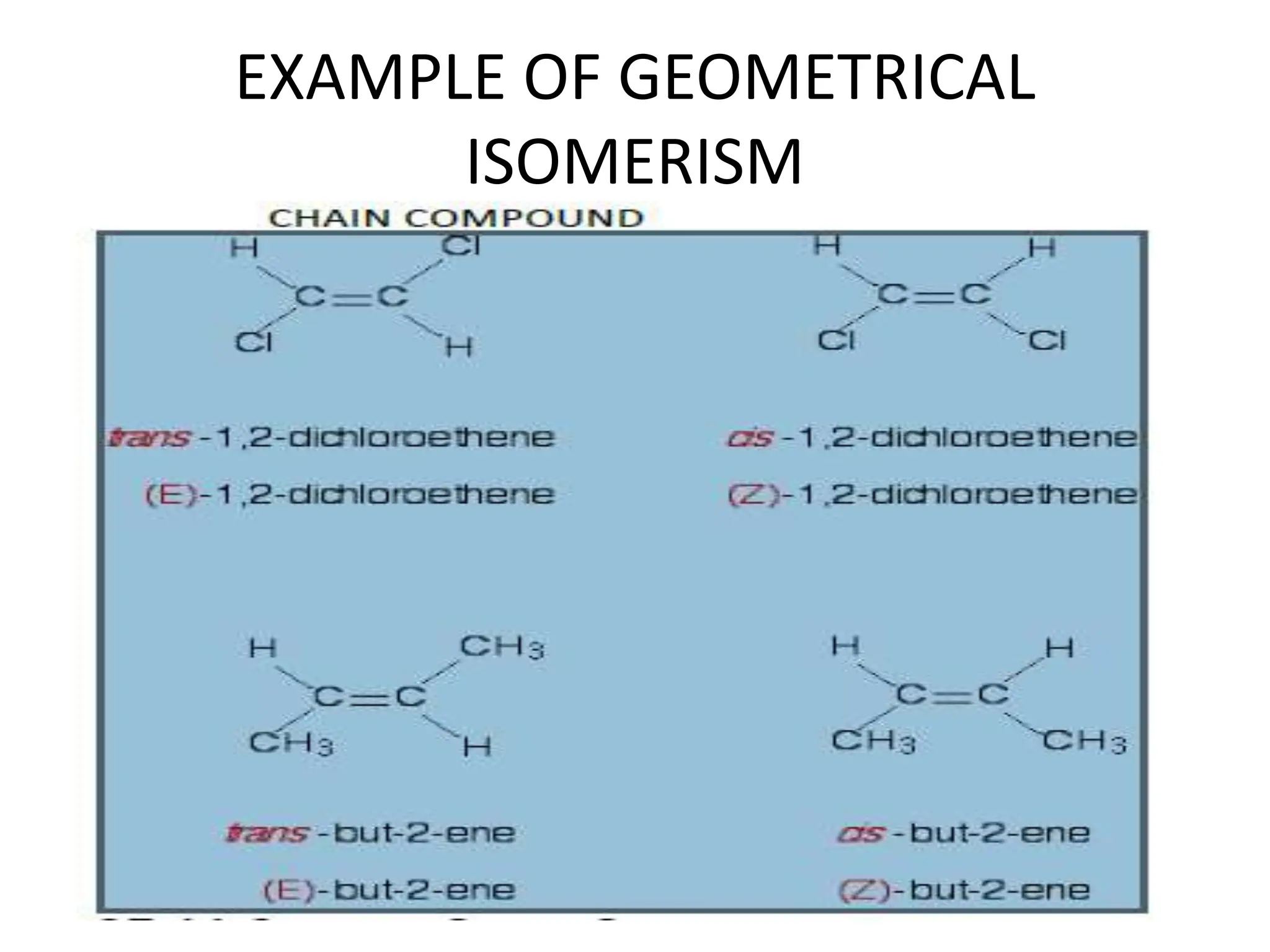
EXAMPLE OF GEOMETRICAL
ISOMERISM
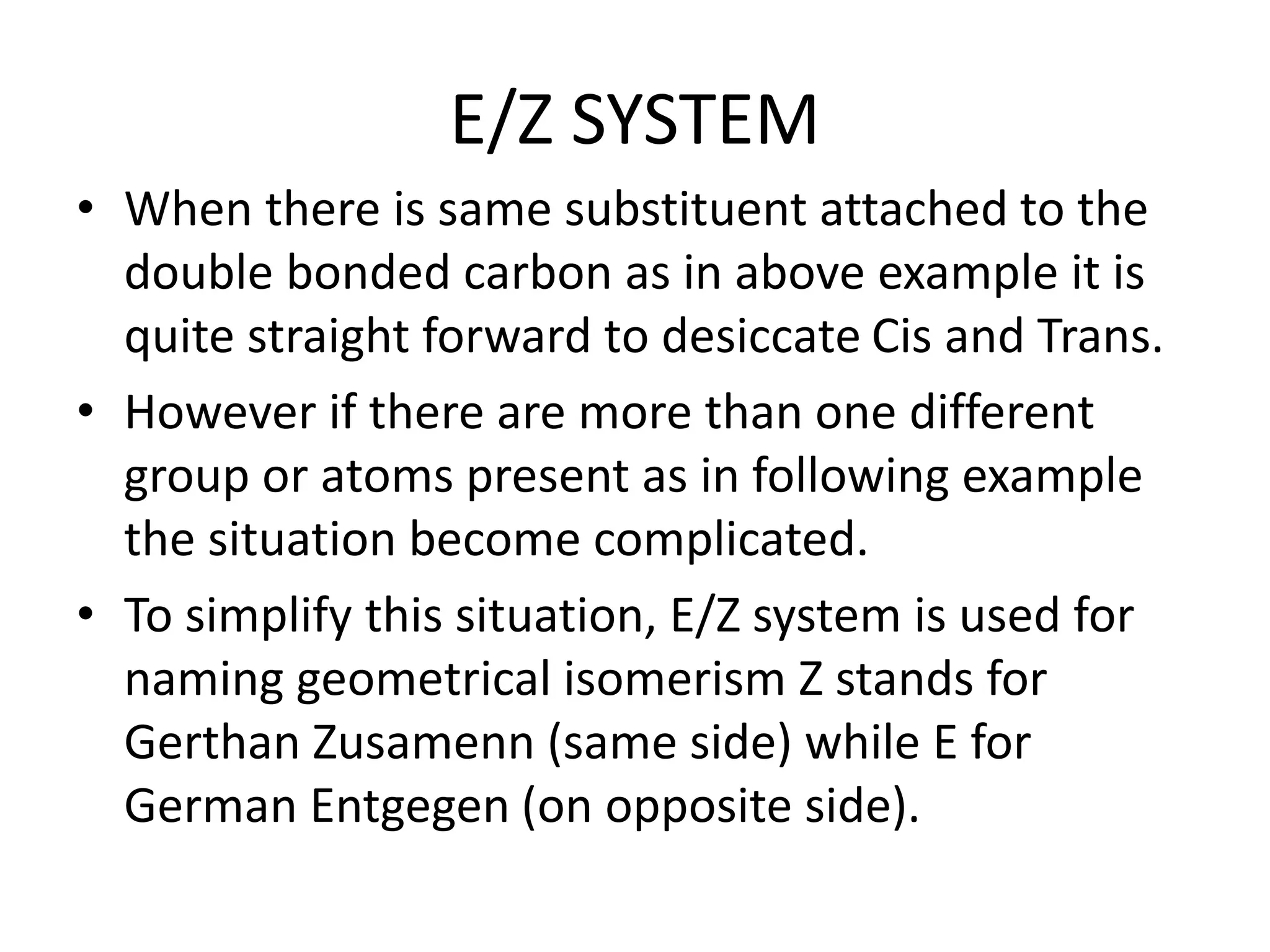
E/Z SYSTEM
• When there is same substituent attached to the
double bonded carbon as in above example it is
quite straight forward to desiccate Cis and Trans.
• However if there are more than one different
group or atoms present as in following example
the situation become complicated.
• To simplify this situation, E/Z system is used for
naming geometrical isomerism Z stands for
Gerthan Zusamenn (same side) while E for
German Entgegen (on opposite side).
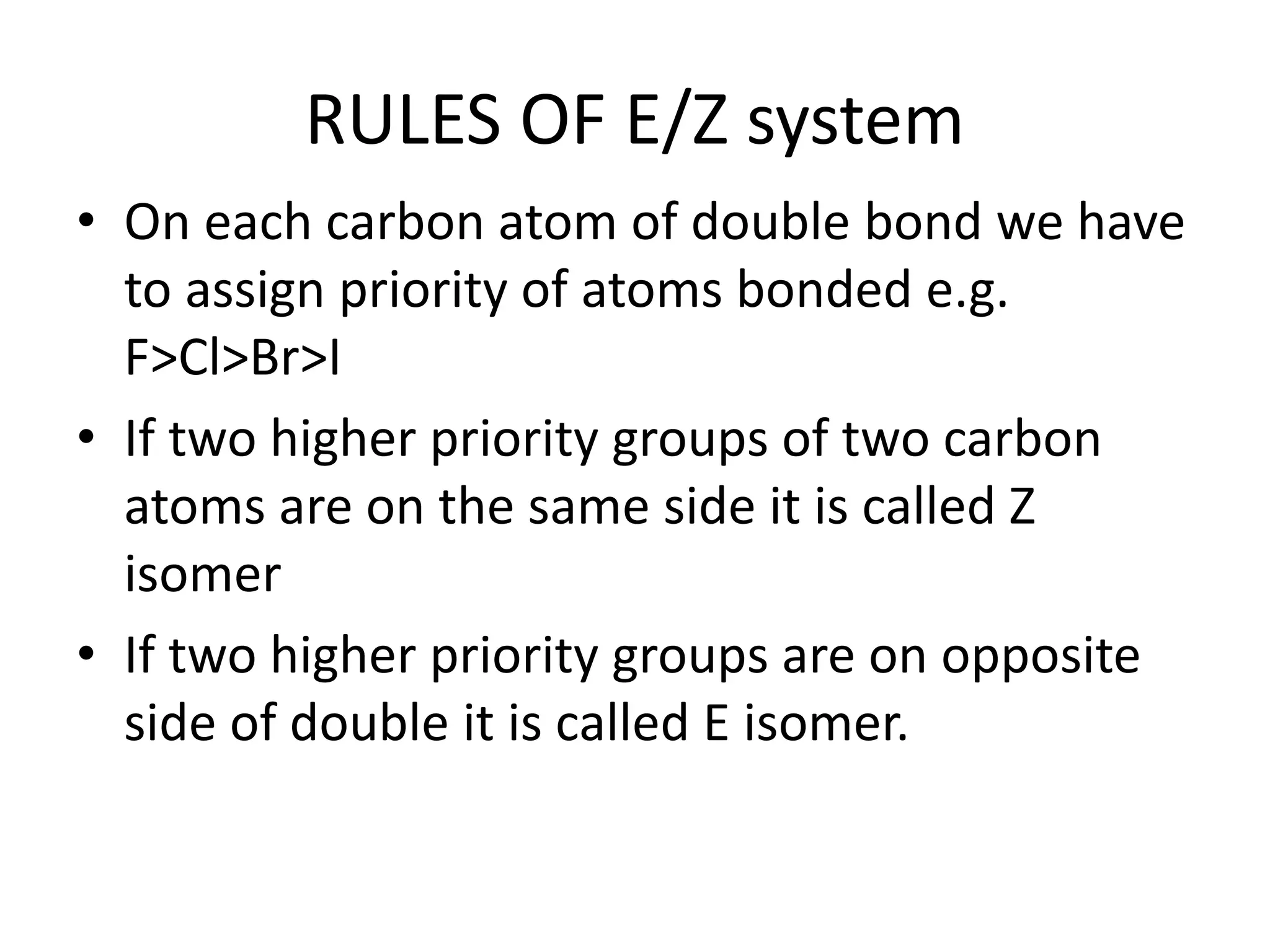
RULES OF E/Z system
• On each carbon atom of double bond we have
to assign priority of atoms bonded e.g.
F>Cl>Br>I
• If two higher priority groups of two carbon
atoms are on the same side it is called Z
isomer
• If two higher priority groups are on opposite
side of double it is called E isomer.
• Now let’s look on cyclic compound, we can
use this E/Z system for a cyclic compound,
when two or more
• than two groups are attached to a ring e.g.
PROPERTIES OF GEOMETRICAL
ISOMERISM
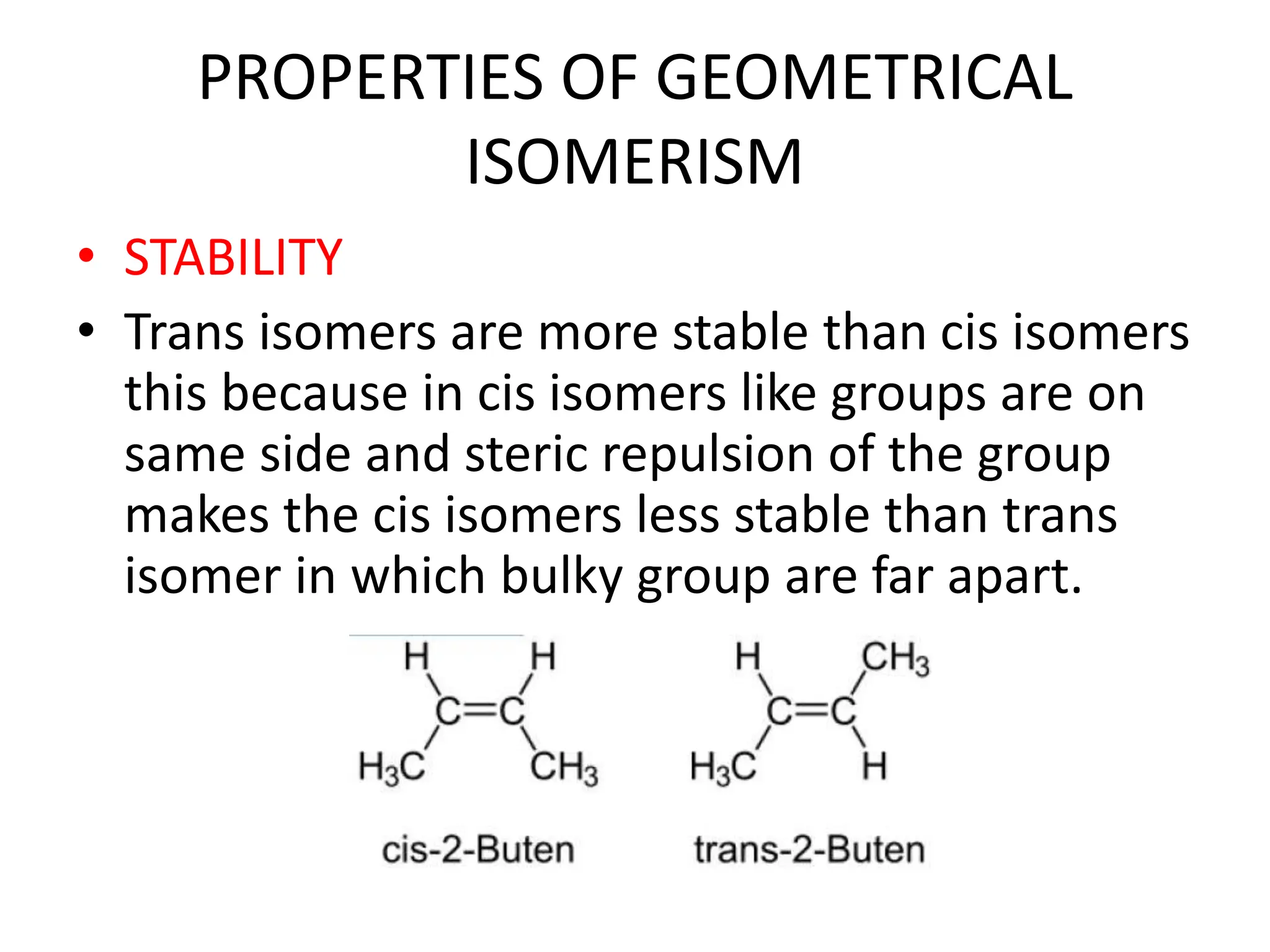
• STABILITY
• Trans isomers are more stable than cis isomers
this because in cis isomers like groups are on
same side and steric repulsion of the group
makes the cis isomers less stable than trans
isomer in which bulky group are far apart.
INTER-CONVERSION
• Conversion of cis into Trans or vice versa is
only possible, if either isomer is heated to
high temperature or it absorbs light. The heat
supplies energy 62 calories/mole to break pi-
bond so that rotation about the σ bond is
possible on cooling reformation take place
giving a mixture of cis and trams.
PHYSICAL AND CHEMICAL
BEHAVIOR
• Geometrical isomerism differs in all physical
properties and some chemical properties.
SEPARATION
• They can be separated by conventional
technique like fractional distillation and gas
chromatography etc.
The end

Geometric isomerism.pptx organic chemistry

  • 1.
  • 2.
    Geometric Isomerism • GeometricIsomerism results from restriction in rotation about double bond in acyclic compound or about single bond in cyclic compound.
  • 3.
    RESTRICTION • The carbonatom of double bonded molecule are sp2 hybridized since it consists of one σ and one π bond therefore presence of π bond blocks the molecule in • one position and rotation around double bond is not possible because rotation will break the molecule.
  • 4.
    • This restrictionof rotation of carbon to carbon double bond is responsible for geometric isomerism, while in cyclic compound this restriction lies in carbon to carbon single bond because rotation will break the ring • Types of Geometrical Isomerism 1. Cis 2. Trans
  • 6.
    Cis Isomerism • Thegeometrical Isomer in which two similar groups are on same sides of double bond is called as cis isomer. • Cis is a Latin word which means on this side.
  • 7.
    Trans Isomers • Thegeometrical isomerism in which two similar groups are on opposite side of double bond is called • Trans isomer. Trans is a Latin word which mean across
  • 8.
  • 10.
    E/Z SYSTEM • Whenthere is same substituent attached to the double bonded carbon as in above example it is quite straight forward to desiccate Cis and Trans. • However if there are more than one different group or atoms present as in following example the situation become complicated. • To simplify this situation, E/Z system is used for naming geometrical isomerism Z stands for Gerthan Zusamenn (same side) while E for German Entgegen (on opposite side).
  • 11.
    RULES OF E/Zsystem • On each carbon atom of double bond we have to assign priority of atoms bonded e.g. F>Cl>Br>I • If two higher priority groups of two carbon atoms are on the same side it is called Z isomer • If two higher priority groups are on opposite side of double it is called E isomer.
  • 13.
    • Now let’slook on cyclic compound, we can use this E/Z system for a cyclic compound, when two or more • than two groups are attached to a ring e.g.
  • 14.
    PROPERTIES OF GEOMETRICAL ISOMERISM •STABILITY • Trans isomers are more stable than cis isomers this because in cis isomers like groups are on same side and steric repulsion of the group makes the cis isomers less stable than trans isomer in which bulky group are far apart.
  • 15.
    INTER-CONVERSION • Conversion ofcis into Trans or vice versa is only possible, if either isomer is heated to high temperature or it absorbs light. The heat supplies energy 62 calories/mole to break pi- bond so that rotation about the σ bond is possible on cooling reformation take place giving a mixture of cis and trams.
  • 16.
    PHYSICAL AND CHEMICAL BEHAVIOR •Geometrical isomerism differs in all physical properties and some chemical properties.
  • 17.
    SEPARATION • They canbe separated by conventional technique like fractional distillation and gas chromatography etc.
  • 18.