Analysis of
and strain in
human bone
1
By
Nabapallab Deka
Structural Engineering
Civil Engineering Department
NIT Silchar
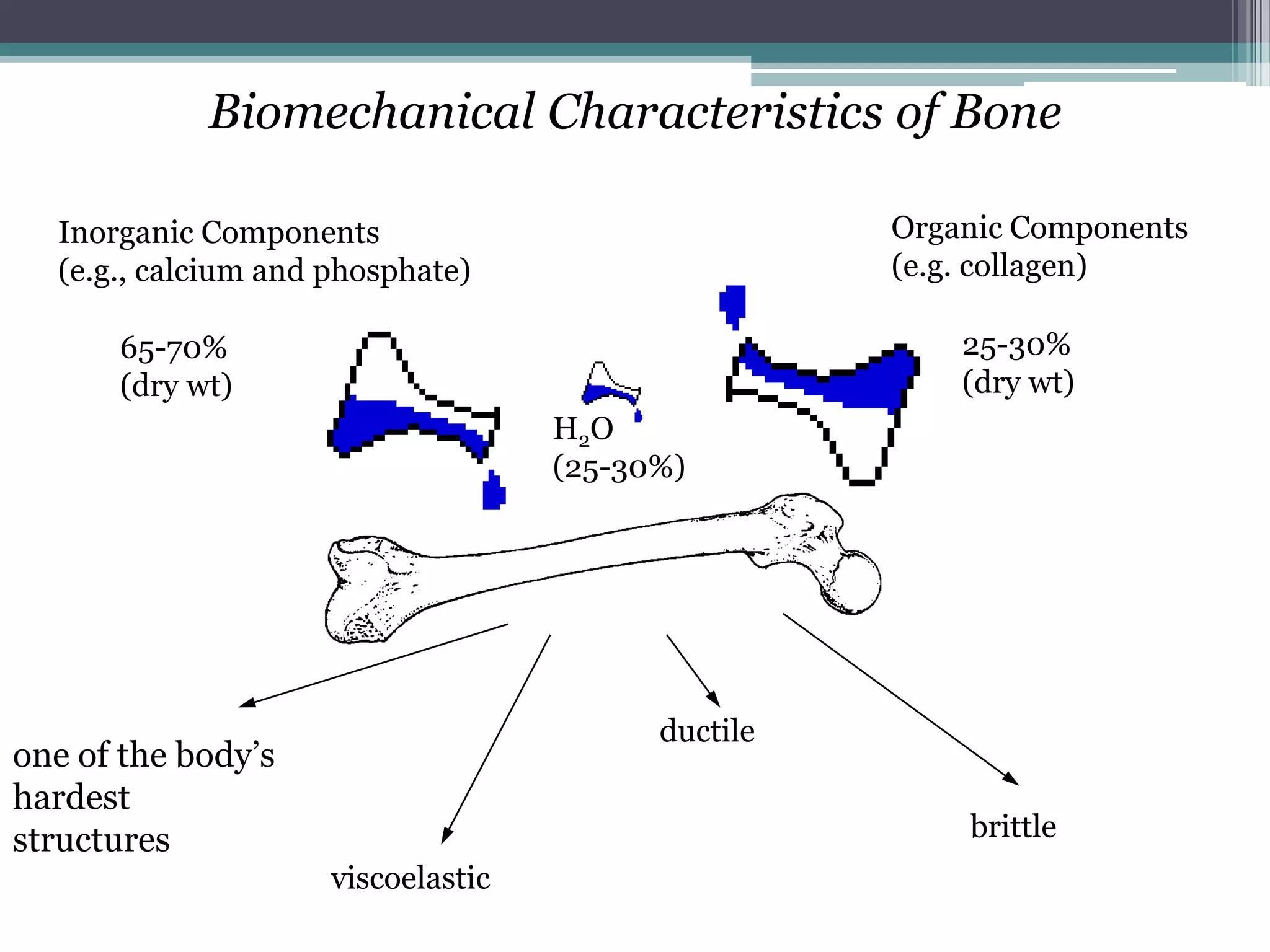
Organic Components
(e.g. collagen)
Inorganic Components
(e.g., calcium and phosphate)
65-70%
(dry wt)
H2O
(25-30%)
one of the body’s
hardest
structures
viscoelastic
ductile
brittle
Biomechanical Characteristics of Bone
25-30%
(dry wt)
Strength and Stiffness of Bone Tissue
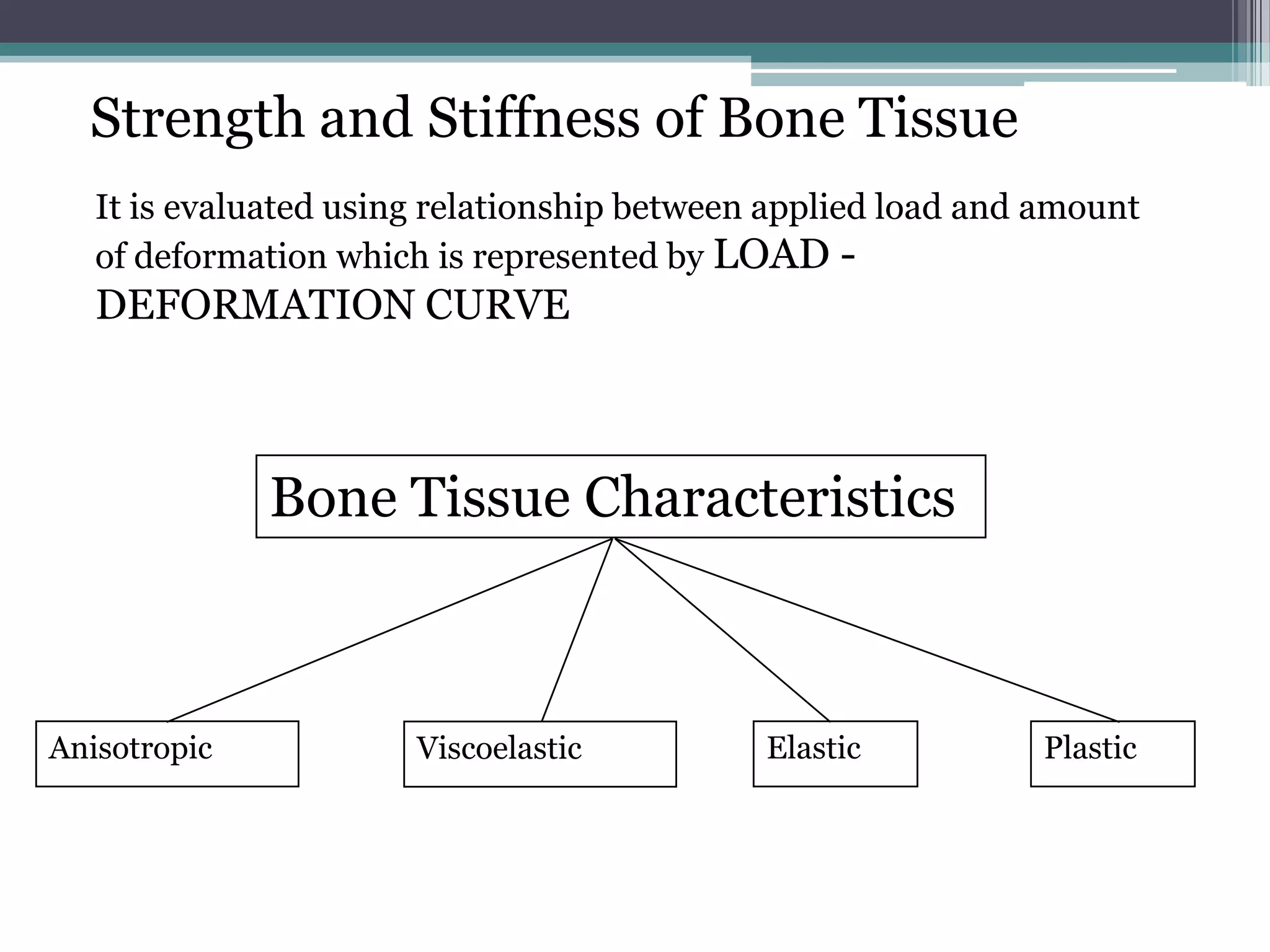
It is evaluated using relationship between applied load and amount
of deformation which is represented by LOAD -
DEFORMATION CURVE
Bone Tissue Characteristics
Anisotropic Viscoelastic Elastic Plastic
Properties of Bone
 An organic material, bone can often be considered in the same way
as man-made engineering materials.
 Factors affecting properties include:
Age
Gender
Location in the body
Temperature
Mineral content
Amount of water present
Disease, e.g. osteoporosis.
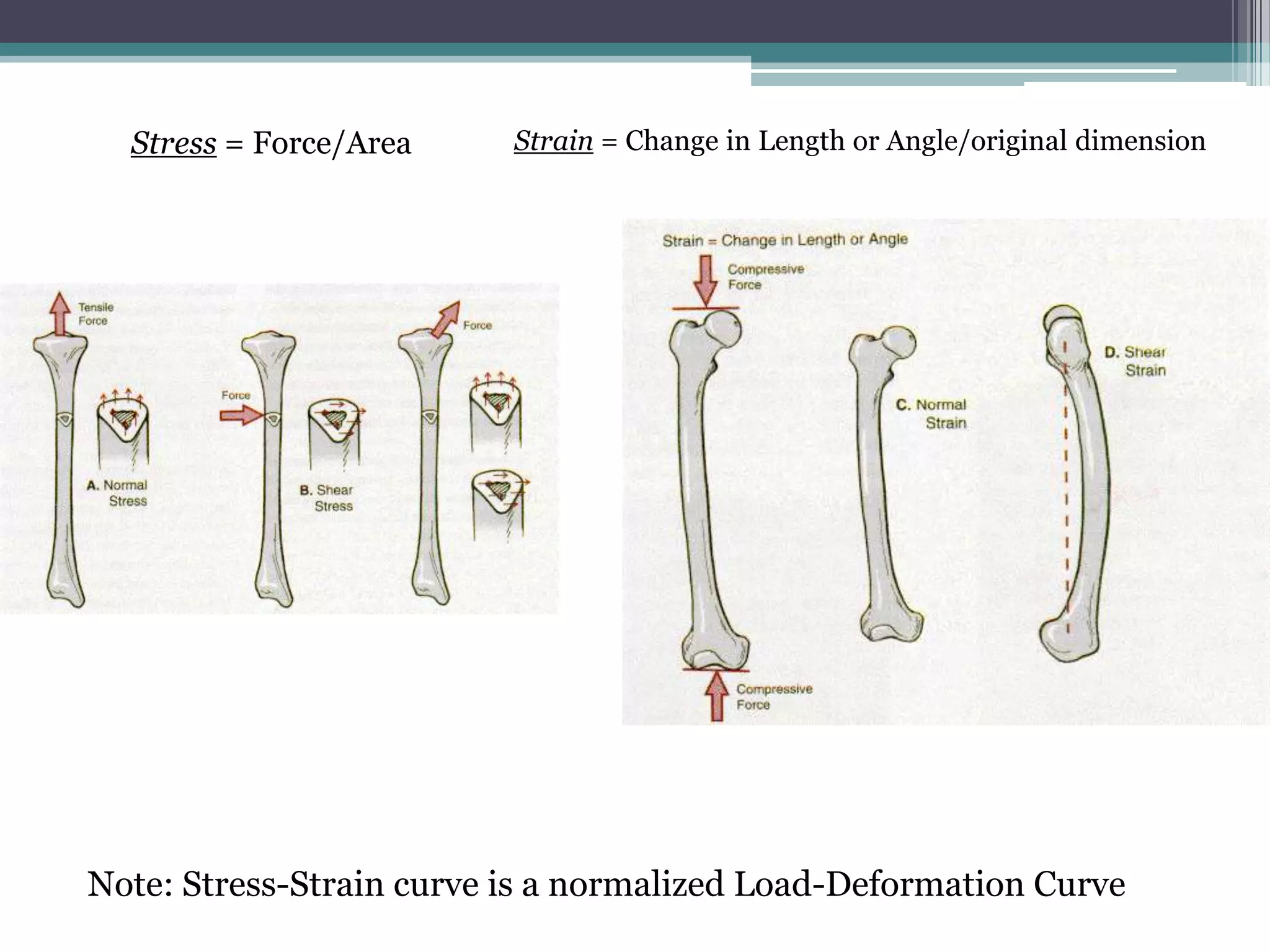
Stress = Force/Area Strain = Change in Length or Angle/original dimension
Note: Stress-Strain curve is a normalized Load-Deformation Curve
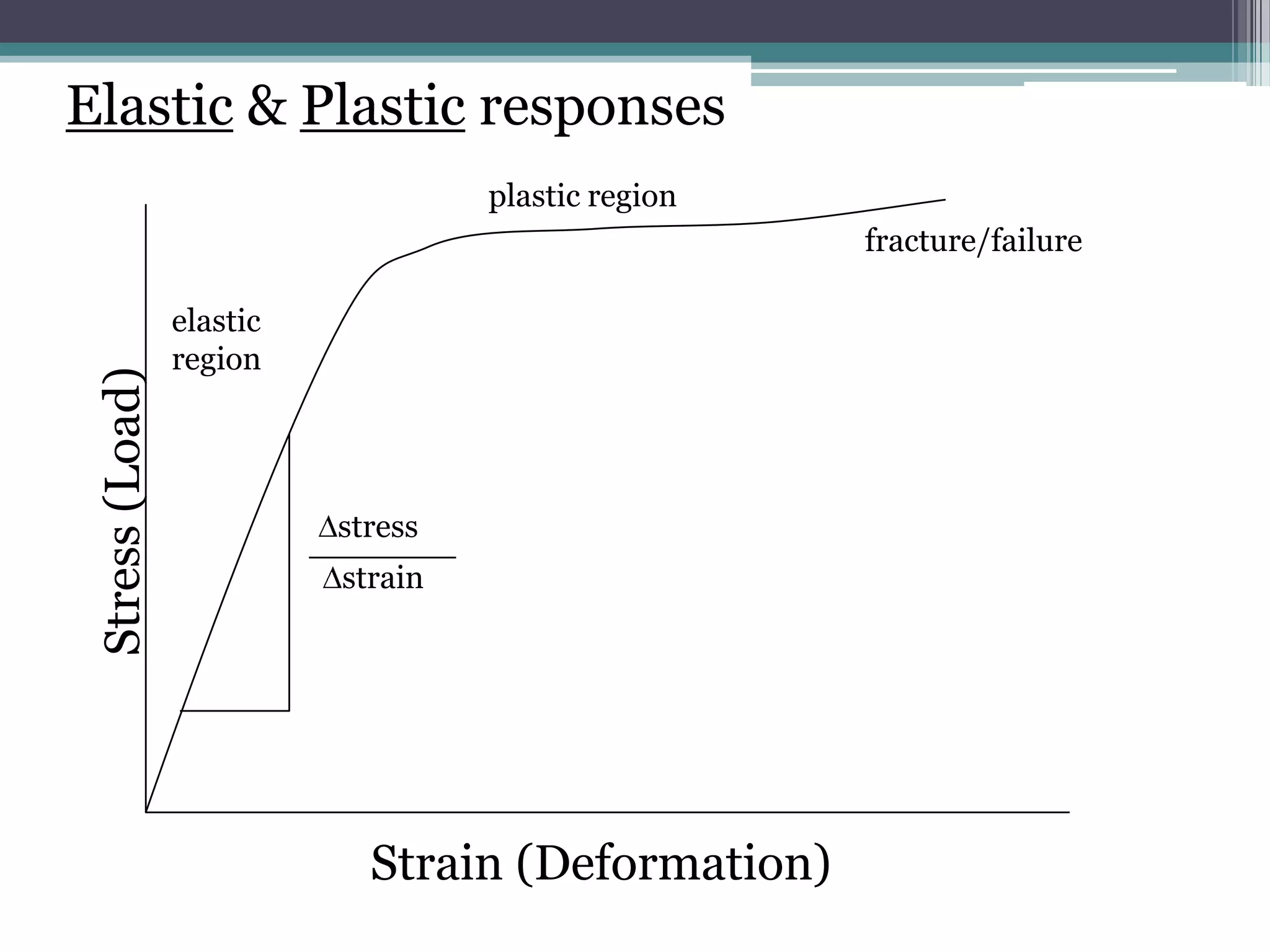
elastic
region
plastic region
fracture/failure
Stress(Load)
Strain (Deformation)
stress
strain
Elastic & Plastic responses
Elastic Biomaterials (Bone)
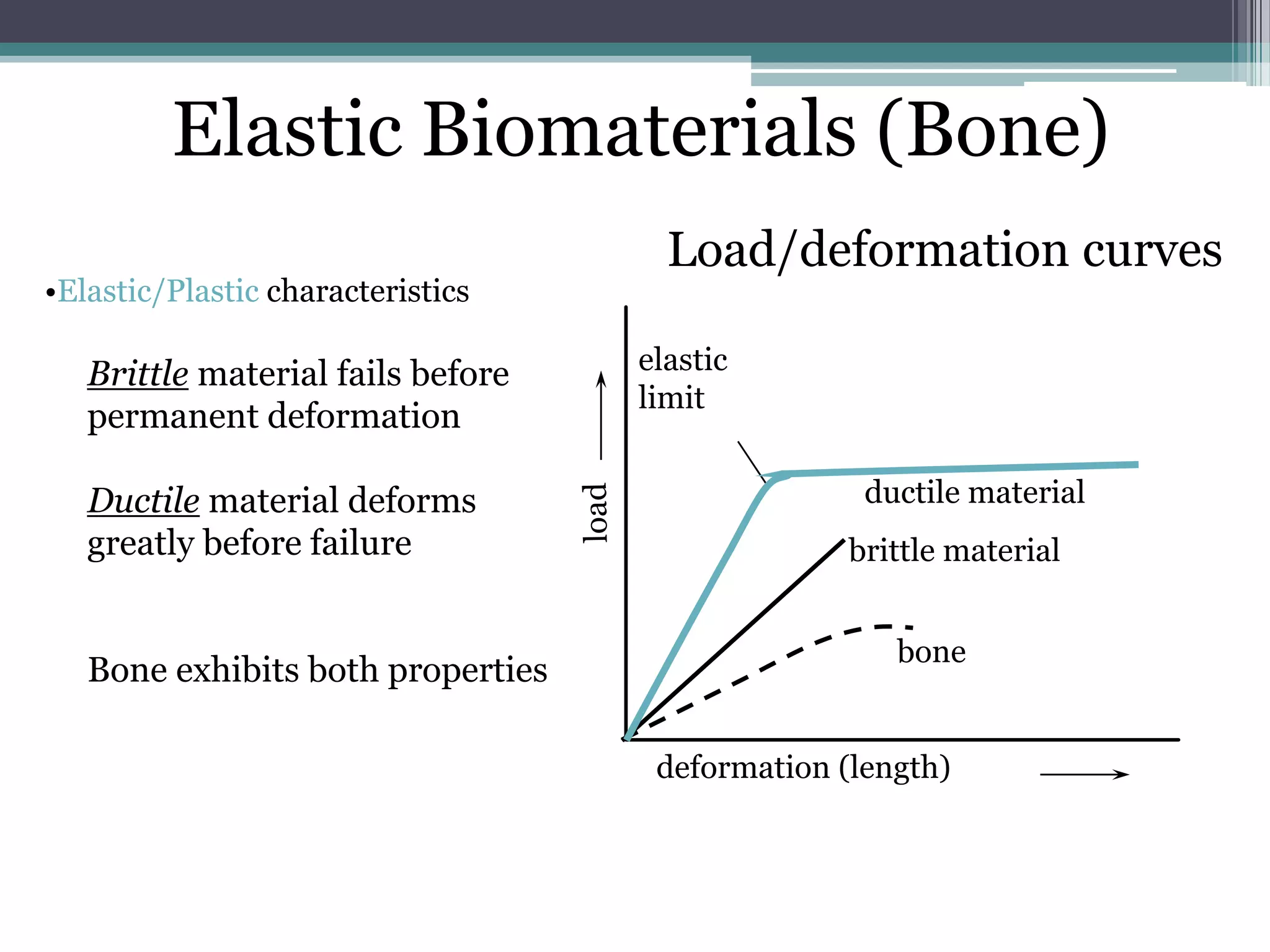
•Elastic/Plastic characteristics
Brittle material fails before
permanent deformation
Ductile material deforms
greatly before failure
Bone exhibits both properties
Load/deformation curves
deformation (length)
ductile material
elastic
limit
bone
brittle material
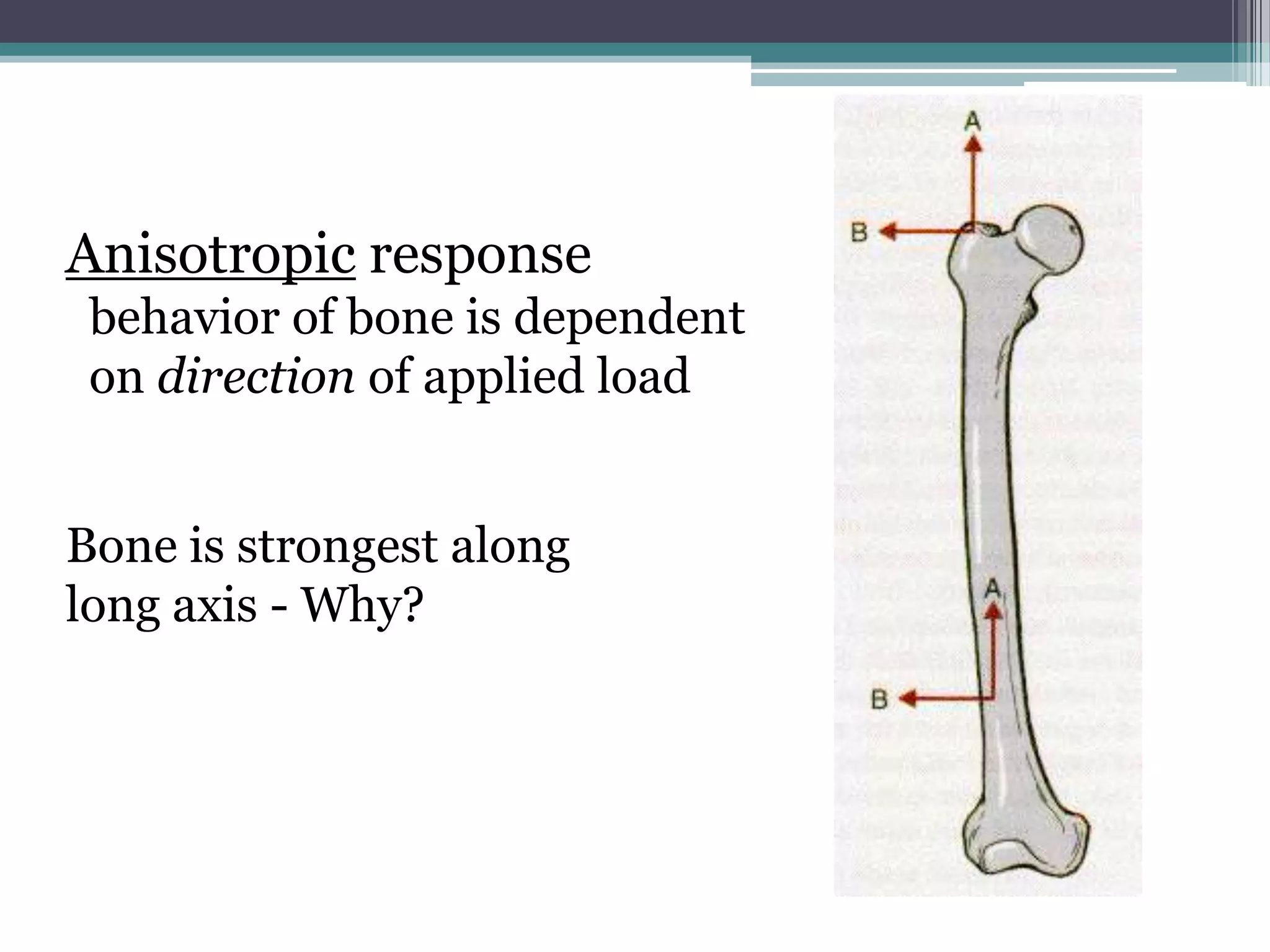
Anisotropic response
behavior of bone is dependent
on direction of applied load
Bone is strongest along
long axis - Why?
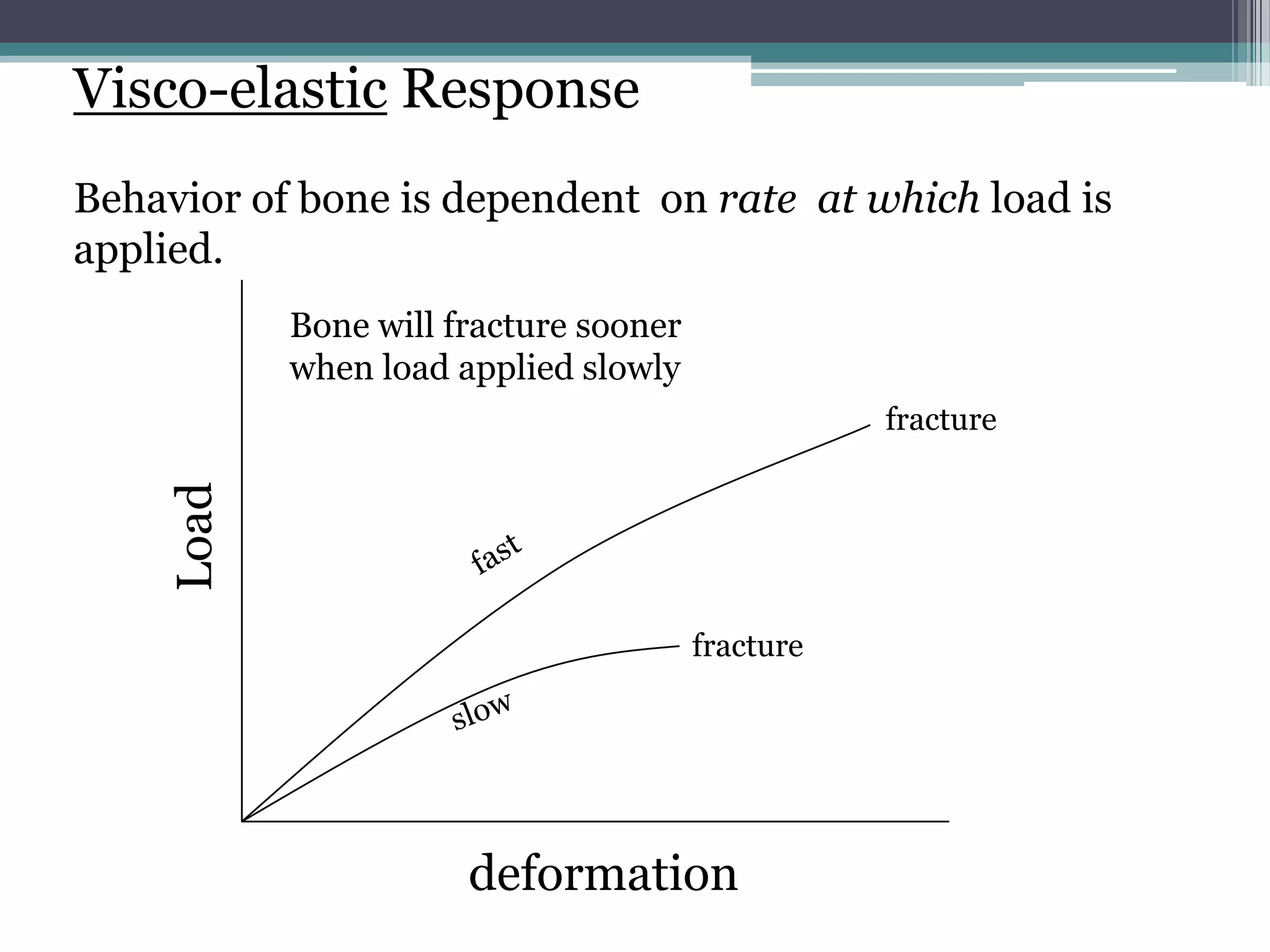
fracture
fracture
Load
deformation
Visco-elastic Response
Behavior of bone is dependent on rate at which load is
applied.
Bone will fracture sooner
when load applied slowly
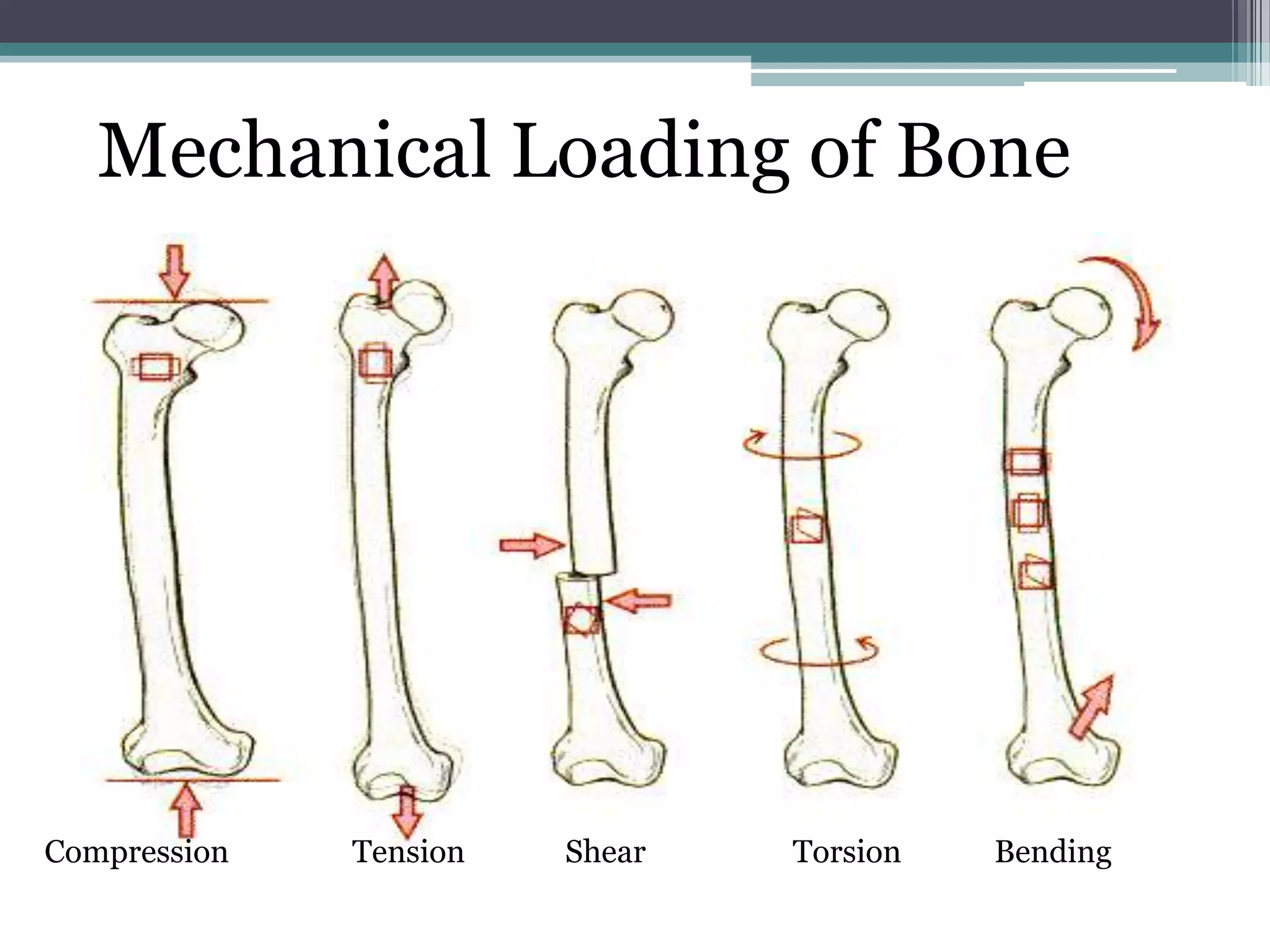
Compression Tension Shear Torsion Bending
Mechanical Loading of Bone
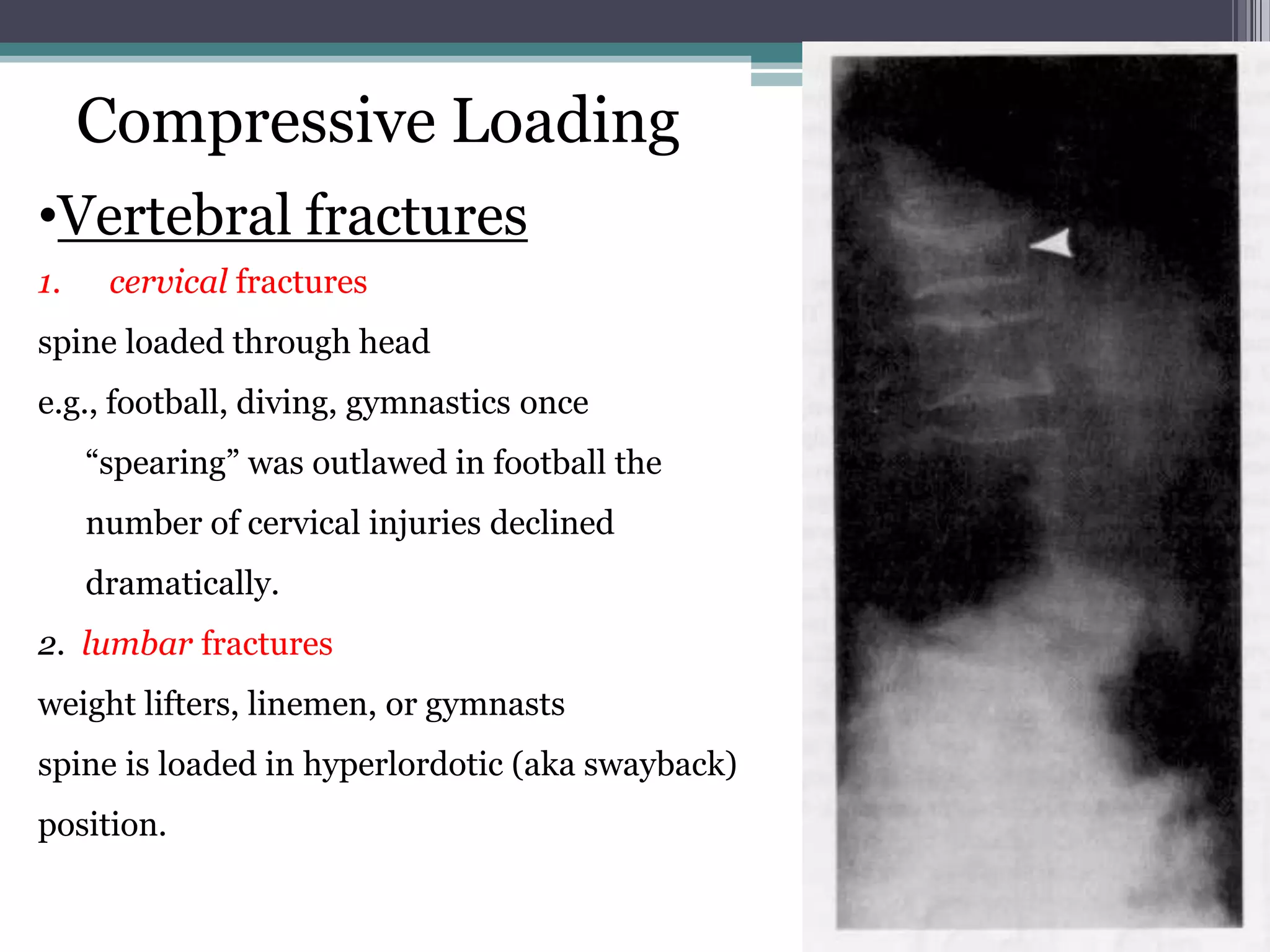
•Vertebral fractures
1. cervical fractures
spine loaded through head
e.g., football, diving, gymnastics once
“spearing” was outlawed in football the
number of cervical injuries declined
dramatically.
2. lumbar fractures
weight lifters, linemen, or gymnasts
spine is loaded in hyperlordotic (aka swayback)
position.
Compressive Loading
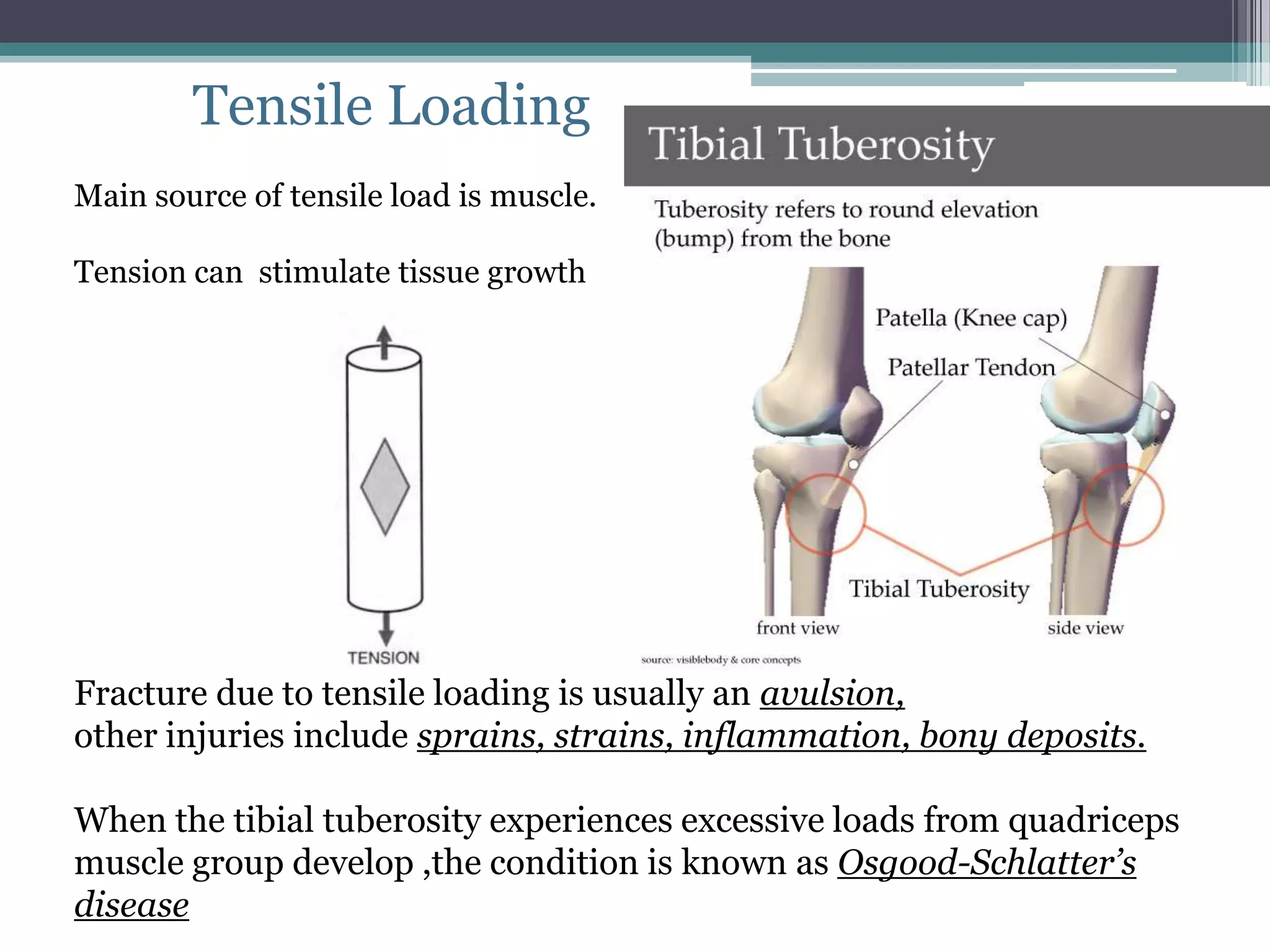
Tensile Loading
Main source of tensile load is muscle.
Tension can stimulate tissue growth
Fracture due to tensile loading is usually an avulsion,
other injuries include sprains, strains, inflammation, bony deposits.
When the tibial tuberosity experiences excessive loads from quadriceps
muscle group develop ,the condition is known as Osgood-Schlatter’s
disease
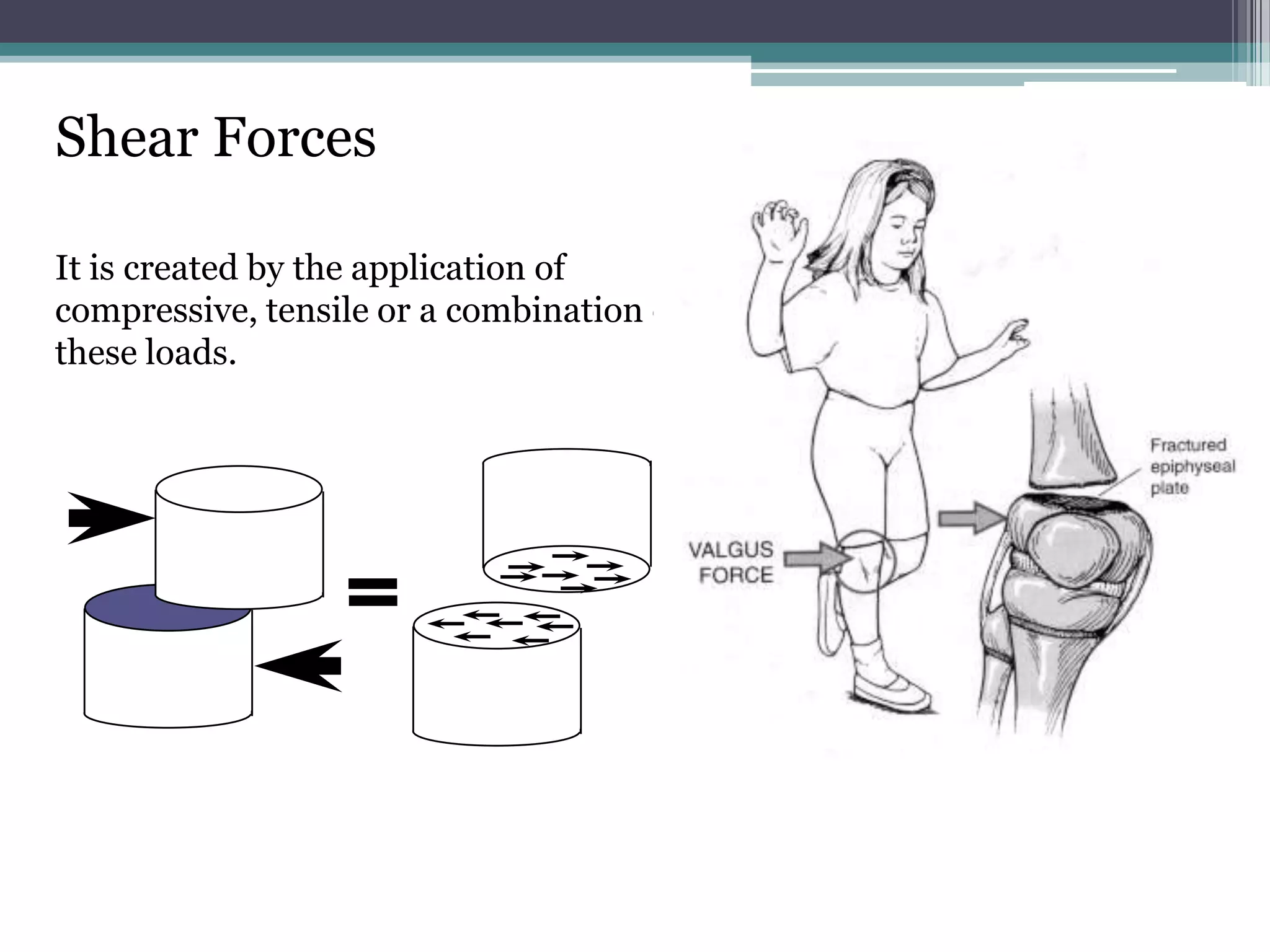
Shear Forces
It is created by the application of
compressive, tensile or a combination of
these loads.
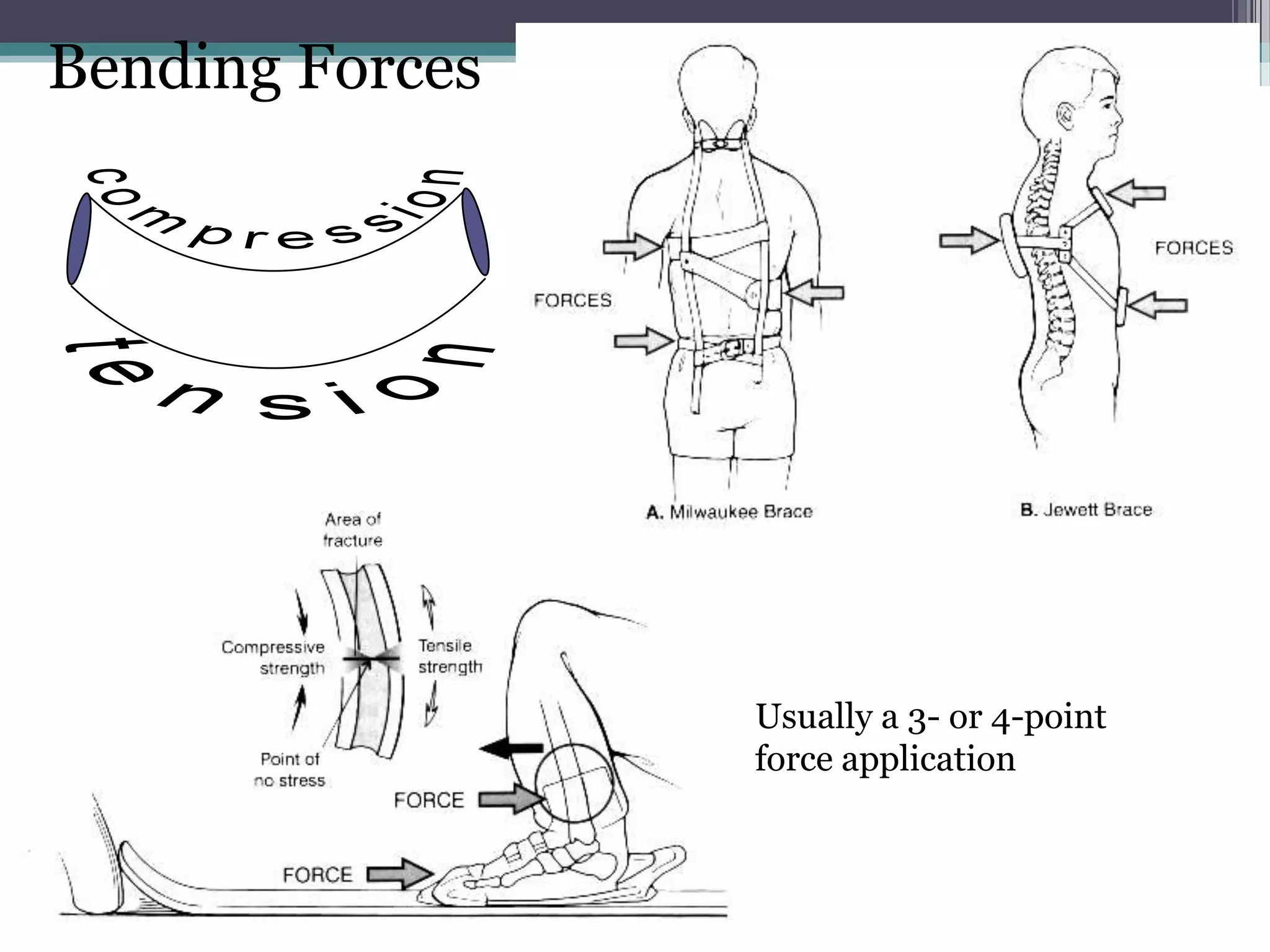
Usually a 3- or 4-point
force application
Bending Forces
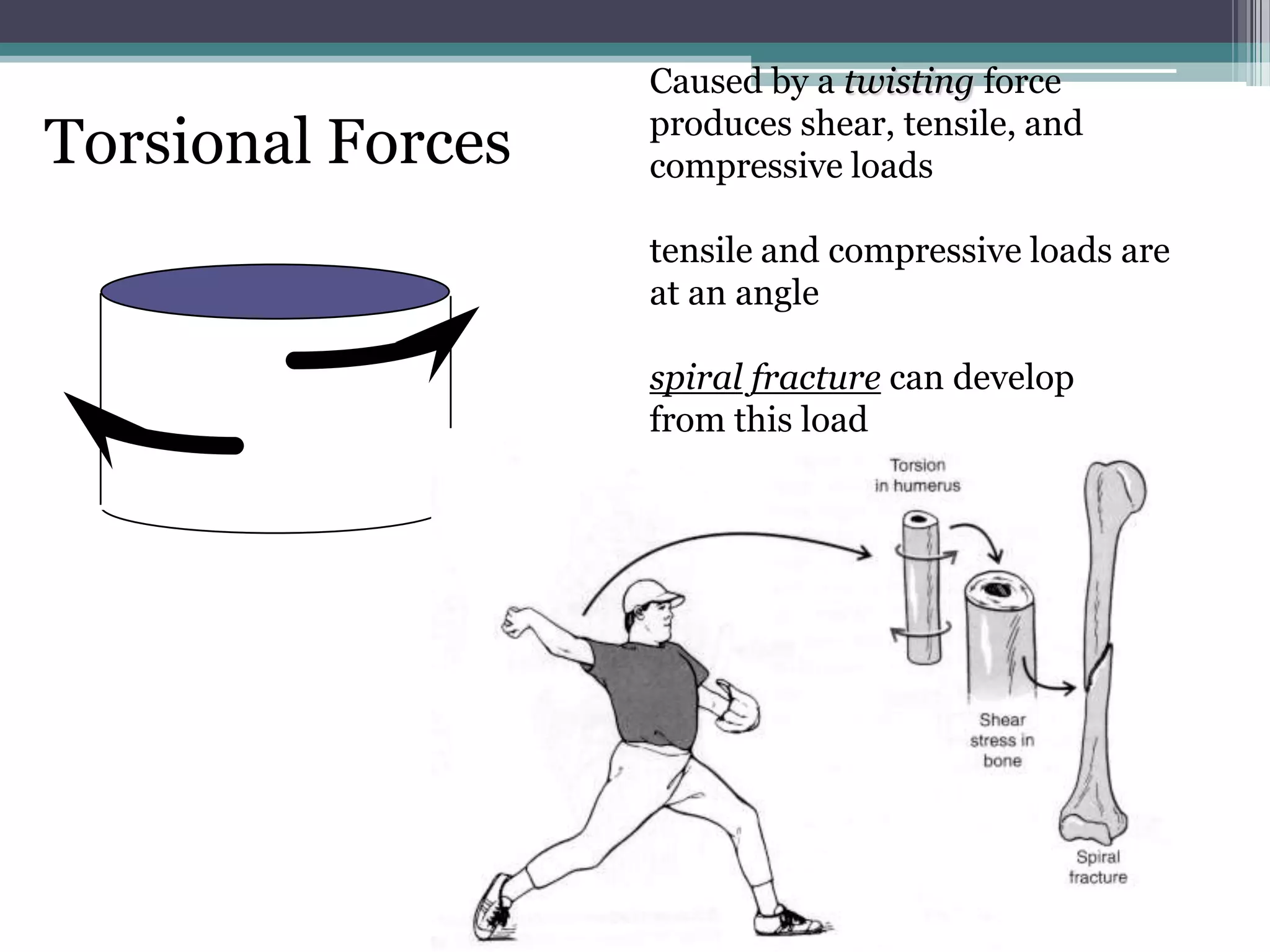
Torsional Forces
Caused by a twisting force
produces shear, tensile, and
compressive loads
tensile and compressive loads are
at an angle
spiral fracture can develop
from this load
Modulus
Bone can be considered to consist primarily of collagen fibres and an inorganic
matrix, and so on a simple level it can be analysed as a fibre composite.
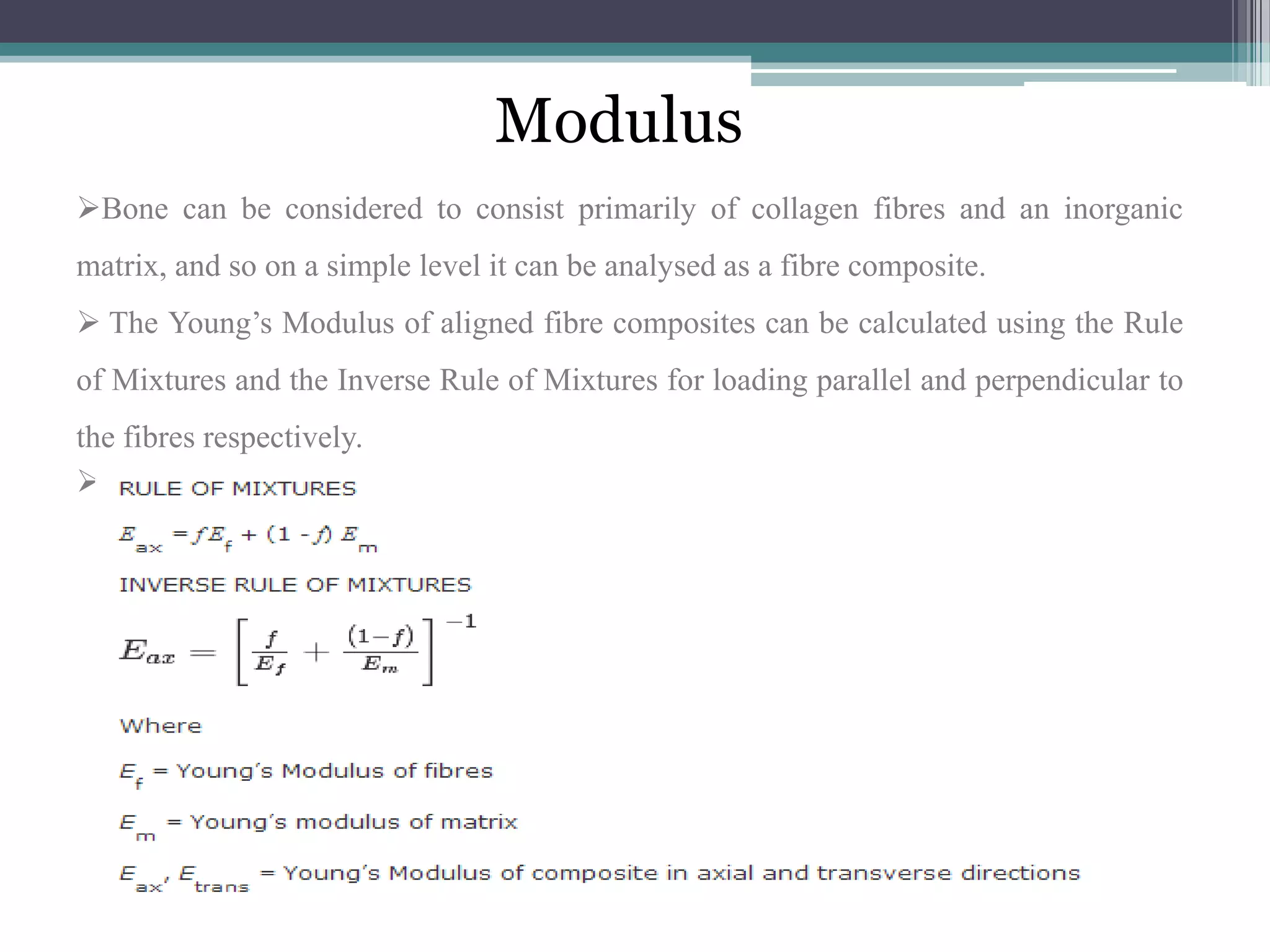
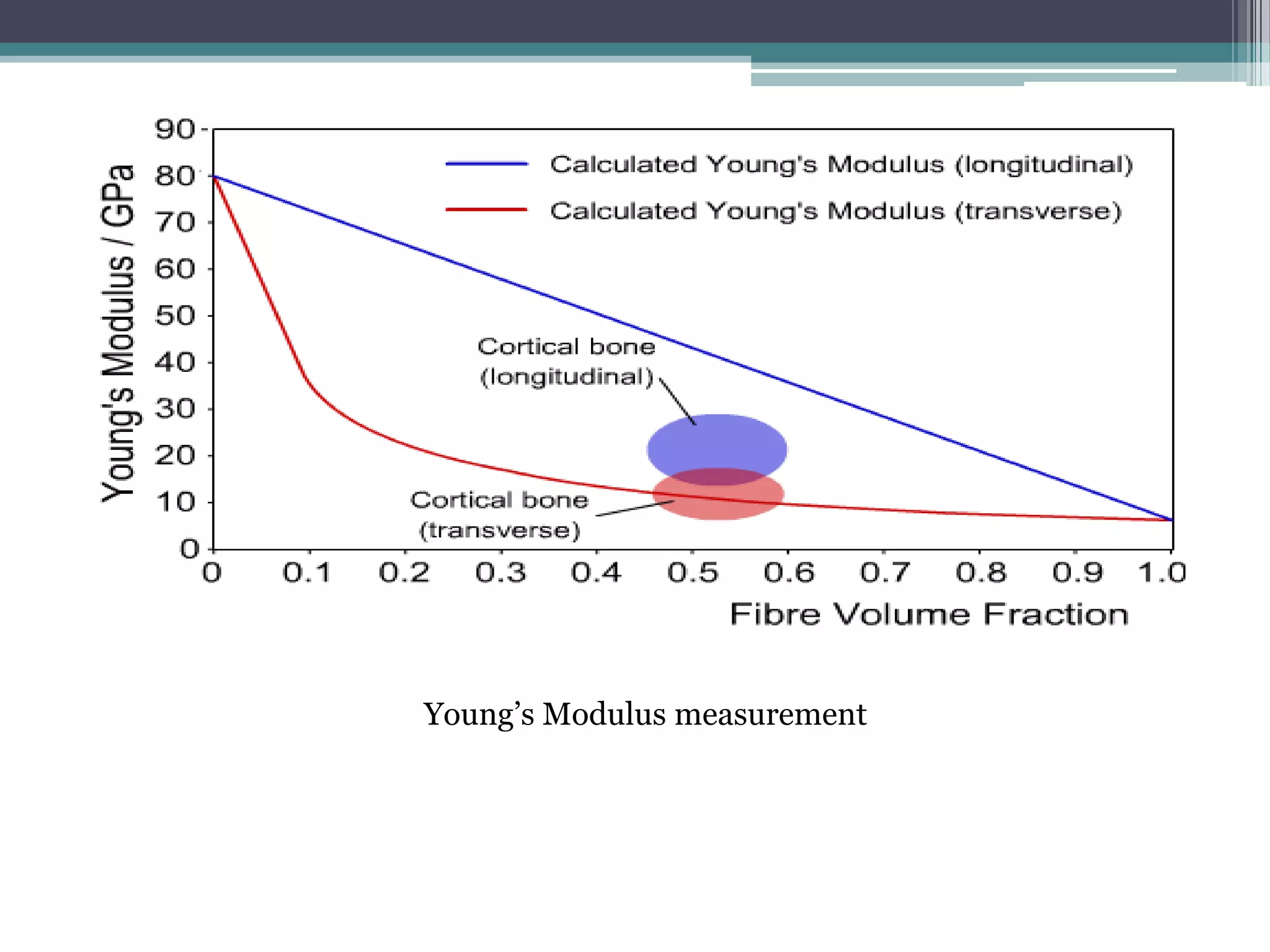
 The Young’s Modulus of aligned fibre composites can be calculated using the Rule
of Mixtures and the Inverse Rule of Mixtures for loading parallel and perpendicular to
the fibres respectively.

Young’s Modulus measurement
Observations
 For the transverse direction, the composite model closely agrees with
experimental values. However, in the longitudinal direction the difference is
large.
 A better approximation would be to model it as a two level composite.
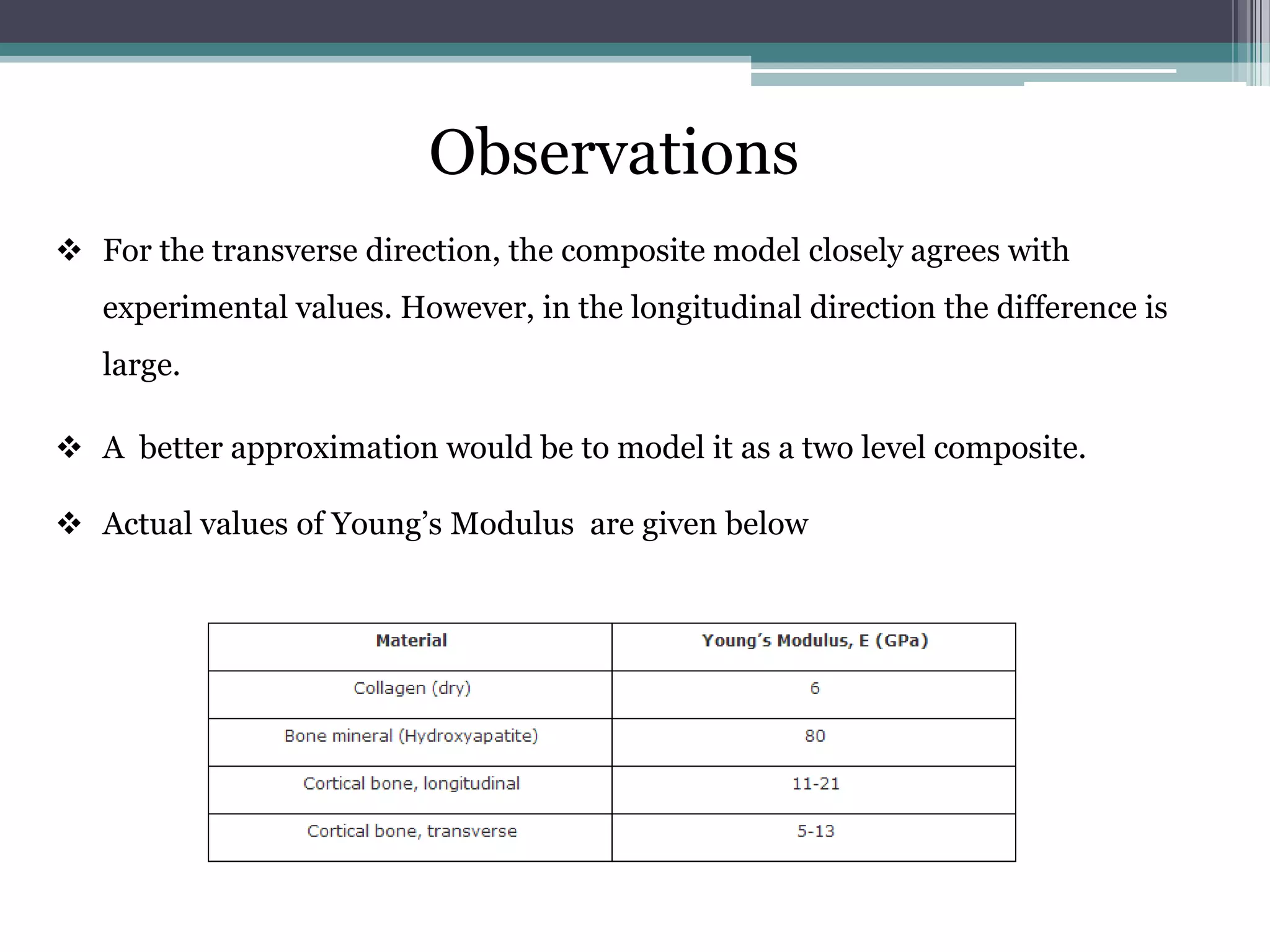
 Actual values of Young’s Modulus are given below
Tensile and Compressive Strength
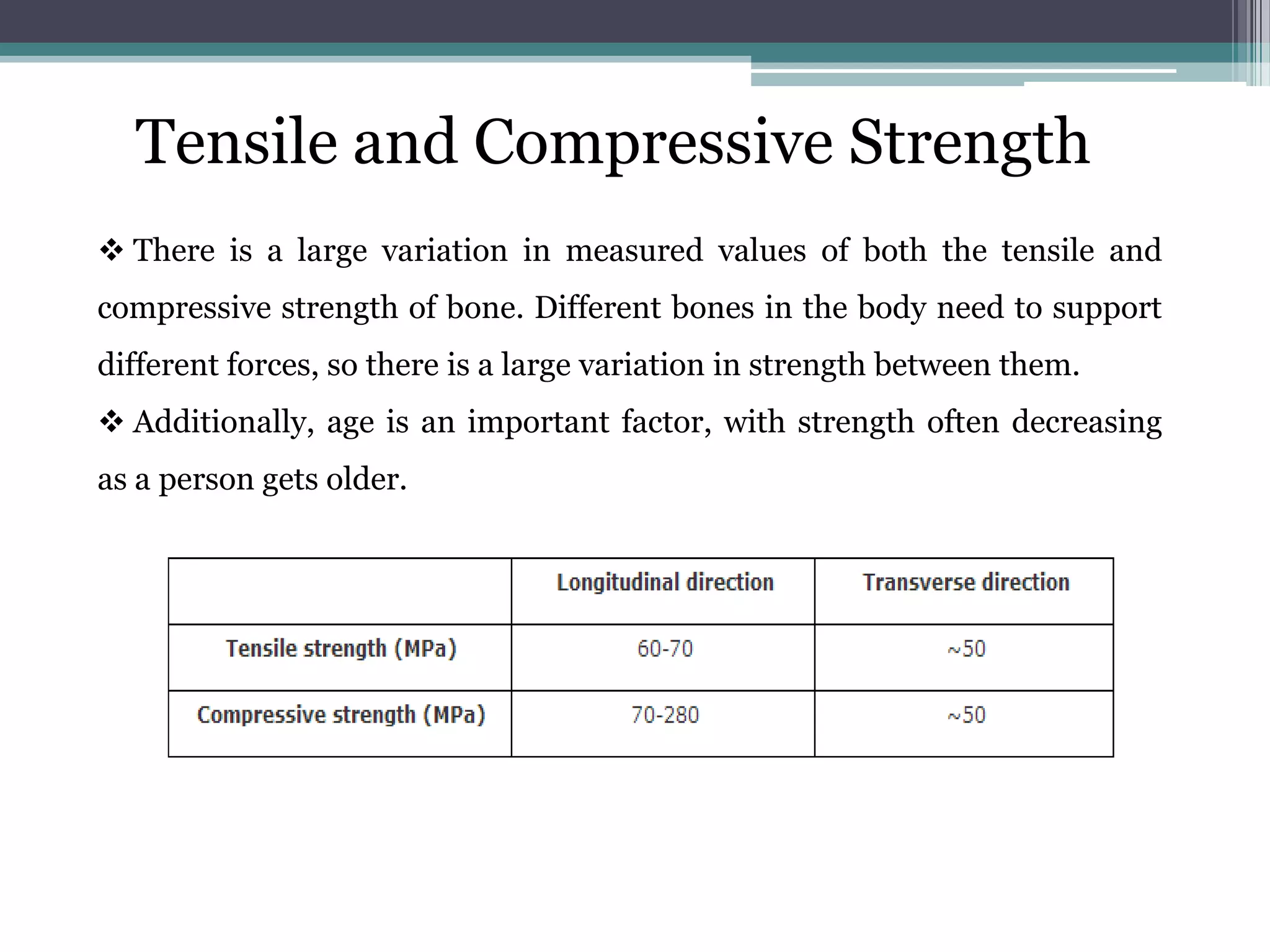
 There is a large variation in measured values of both the tensile and
compressive strength of bone. Different bones in the body need to support
different forces, so there is a large variation in strength between them.
 Additionally, age is an important factor, with strength often decreasing
as a person gets older.
Elasticity
 Bone mineral is a ceramic material and exhibits normal Hook’s
elastic behaviour, i.e. a linear stress-strain relationship.
 In contrast, collagen is a polymer that exhibits a J-shaped stress-
strain curve.
Typical stress-strain curves for compact bone, tested in tension or
compression in the wet condition, are approximately a straight line.
Bone generally has a maximum total elongation of only 0.5 - 3%, and
therefore is classified as a brittle rather than a ductile solid.
21

Introduction to Analysis of strain and strain in Human bone

  • 1.
    Analysis of and strainin human bone 1 By Nabapallab Deka Structural Engineering Civil Engineering Department NIT Silchar
  • 2.
    Organic Components (e.g. collagen) InorganicComponents (e.g., calcium and phosphate) 65-70% (dry wt) H2O (25-30%) one of the body’s hardest structures viscoelastic ductile brittle Biomechanical Characteristics of Bone 25-30% (dry wt)
  • 3.
    Strength and Stiffnessof Bone Tissue It is evaluated using relationship between applied load and amount of deformation which is represented by LOAD - DEFORMATION CURVE Bone Tissue Characteristics Anisotropic Viscoelastic Elastic Plastic
  • 4.
    Properties of Bone An organic material, bone can often be considered in the same way as man-made engineering materials.  Factors affecting properties include: Age Gender Location in the body Temperature Mineral content Amount of water present Disease, e.g. osteoporosis.
  • 5.
    Stress = Force/AreaStrain = Change in Length or Angle/original dimension Note: Stress-Strain curve is a normalized Load-Deformation Curve
  • 6.
  • 7.
    Elastic Biomaterials (Bone) •Elastic/Plasticcharacteristics Brittle material fails before permanent deformation Ductile material deforms greatly before failure Bone exhibits both properties Load/deformation curves deformation (length) ductile material elastic limit bone brittle material
  • 8.
    Anisotropic response behavior ofbone is dependent on direction of applied load Bone is strongest along long axis - Why?
  • 9.
    fracture fracture Load deformation Visco-elastic Response Behavior ofbone is dependent on rate at which load is applied. Bone will fracture sooner when load applied slowly
  • 10.
    Compression Tension ShearTorsion Bending Mechanical Loading of Bone
  • 11.
    •Vertebral fractures 1. cervicalfractures spine loaded through head e.g., football, diving, gymnastics once “spearing” was outlawed in football the number of cervical injuries declined dramatically. 2. lumbar fractures weight lifters, linemen, or gymnasts spine is loaded in hyperlordotic (aka swayback) position. Compressive Loading
  • 12.
    Tensile Loading Main sourceof tensile load is muscle. Tension can stimulate tissue growth Fracture due to tensile loading is usually an avulsion, other injuries include sprains, strains, inflammation, bony deposits. When the tibial tuberosity experiences excessive loads from quadriceps muscle group develop ,the condition is known as Osgood-Schlatter’s disease
  • 13.
    Shear Forces It iscreated by the application of compressive, tensile or a combination of these loads.
  • 14.
    Usually a 3-or 4-point force application Bending Forces
  • 15.
    Torsional Forces Caused bya twisting force produces shear, tensile, and compressive loads tensile and compressive loads are at an angle spiral fracture can develop from this load
  • 16.
    Modulus Bone can beconsidered to consist primarily of collagen fibres and an inorganic matrix, and so on a simple level it can be analysed as a fibre composite.  The Young’s Modulus of aligned fibre composites can be calculated using the Rule of Mixtures and the Inverse Rule of Mixtures for loading parallel and perpendicular to the fibres respectively. 
  • 17.
  • 18.
    Observations  For thetransverse direction, the composite model closely agrees with experimental values. However, in the longitudinal direction the difference is large.  A better approximation would be to model it as a two level composite.  Actual values of Young’s Modulus are given below
  • 19.
    Tensile and CompressiveStrength  There is a large variation in measured values of both the tensile and compressive strength of bone. Different bones in the body need to support different forces, so there is a large variation in strength between them.  Additionally, age is an important factor, with strength often decreasing as a person gets older.
  • 20.
    Elasticity  Bone mineralis a ceramic material and exhibits normal Hook’s elastic behaviour, i.e. a linear stress-strain relationship.  In contrast, collagen is a polymer that exhibits a J-shaped stress- strain curve. Typical stress-strain curves for compact bone, tested in tension or compression in the wet condition, are approximately a straight line. Bone generally has a maximum total elongation of only 0.5 - 3%, and therefore is classified as a brittle rather than a ductile solid.
  • 21.

Editor's Notes

  • #7 elastic thru 3%deformationplastic response leads to fracturingStrength defined by failure pointStiffness defined as the slope of the elastic portion of the curve
  • #19 This difference occurs because the composite model of the microstructure of bone is highly simplified, since the collagen fibres are not aligned parallel to the axis of the osteons, and the bone mineral exists as discrete crystals, rather than forming a continuous matrix.