BANGLADESH UNIVERSITY OF HEALTH SCIENCE
Department of Biomedical Engineering
BIOMECHANICS
Course Code: 04041110
Lecture 08: SOFT TISSUE MECHANICS
Date: 13/08/2023
Course Teacher: Tohfatul Jinan
Lecturer
Department of Biomedical Engineering and Medical Physics
BUHS
1
Pseudo Elasticity
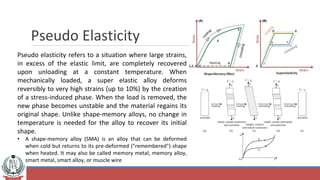
Pseudo elasticity refers to a situation where large strains,
in excess of the elastic limit, are completely recovered
upon unloading at a constant temperature. When
mechanically loaded, a super elastic alloy deforms
reversibly to very high strains (up to 10%) by the creation
of a stress-induced phase. When the load is removed, the
new phase becomes unstable and the material regains its
original shape. Unlike shape-memory alloys, no change in
temperature is needed for the alloy to recover its initial
shape.
• A shape-memory alloy (SMA) is an alloy that can be deformed
when cold but returns to its pre-deformed ("remembered") shape
when heated. It may also be called memory metal, memory alloy,
smart metal, smart alloy, or muscle wire
Soft connective tissues
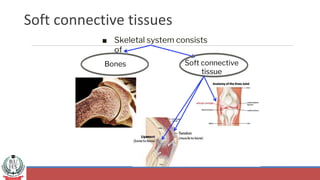
■ Skeletal system consists
of -
Soft connective
tissue
Bones
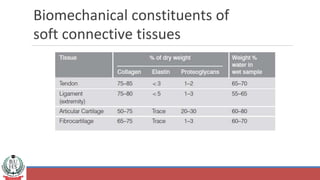
Biomechanical constituents of
soft connective tissues
Collagen
■ Main structural protein
■ Most abundant protein in mammals, making up from 25% to 35% of the whole-body protein content.
■ Depending upon the degree of mineralization, collagen tissues may be rigid (bone), compliant (tendon),
or have a gradient from rigid to compliant (cartilage).
■ Collagen, in the form of elongated fibrils, is mostly found in fibrous tissues such as tendons, ligaments
and skin. It is also abundant in corneas, cartilage, bones, blood vessels, the gut, intervertebral discs and
the dentin in teeth.
■ So far 28 types of collagen have been identified. However, 90% of the collagen in human body is type I.
Common types of collagen
Type I: skin, tendon, vascular ligature, organs, bone (main
component of the organic part of bone)
Type II: cartilage (main collagenous component of cartilage)
Type III: reticulate (main component of reticular fibers),
commonly found alongside type I.
Type IV: formsbasal lamina, the epithelium-secreted
layer of the basement membrane.
Type V: cell surfaces, hair and placenta
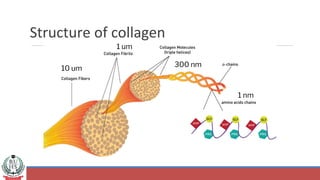
Structure of collagen
10 um
1 um
300 nm
1 nm
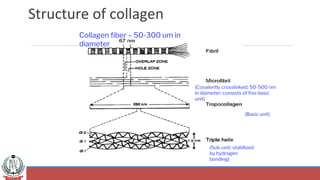
Structure of collagen
(Sub-unit; stabilized
by hydrogen
bonding)
(Covalently crosslinked; 50-500 nm
in diameter; consists of five basic
unit)
(Basic unit)
Collagen fiber – 50-300 um in
diameter
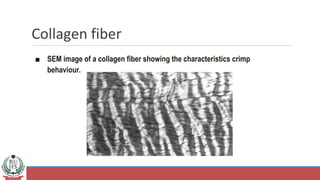
Collagen fiber
■ SEM image of a collagen fiber showing the characteristics crimp
behaviour.
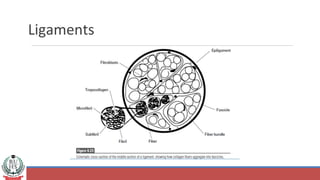
Ligaments
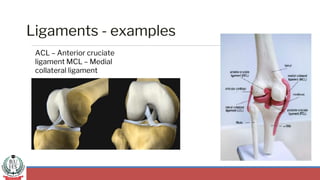
Ligaments - examples
ACL – Anterior cruciate
ligament MCL – Medial
collateral ligament
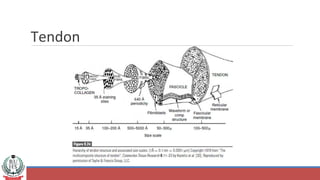
Tendon
Fiber alignment in ligament and
tendon
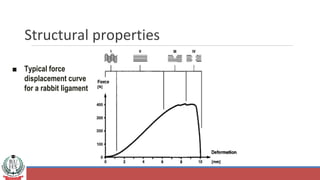
Structural properties
■ Typical force
displacement curve
for a rabbit ligament
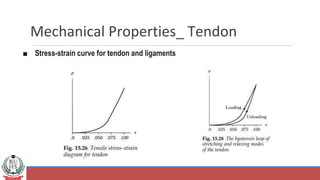
Mechanical Properties_ Tendon
■ Stress-strain curve for tendon and ligaments
Mechanical Properties _ Ligaments
The mechanical role of ligaments is to transmit forces from one bone to another. Ligaments
also have a stabilizing role for the skeletal joints. The composition and structure of ligaments
depend upon their function and position within the body. Like tendons they are composite
materials containing crimped collagen fibers surrounded by ground substance. As compared
to tendons, they often contain a greater proportion of elastic fibers that accounts for their
higher extensibility but lower strength and stiffness. The mechanical properties of ligaments
are qualitatively similar to those of tendons. Like tendons, they are viscoelastic and exhibit
hysteresis, but deform elastically up to strains of about €y= 0:25 (about five times as much as
the yield strain of tendons) and stresses of about σy = 5 MPa. They rupture at a stress of
about 20 Mpa
Tendons and ligaments are tough materials and do not rupture easily. Most common
damages to tendons and ligaments occur at their junctions with bones.
Viscoelasticity
■ In materials science and continuum mechanics, viscoelasticity is the
property of materials that exhibit both viscous and elastic
characteristics when undergoing deformation.
■ Viscous materials, like water, resist shear flow and strain linearly with time
when a stress is applied. Elastic materials strain when stretched and
immediately return to their original state once the stress is removed.
■ Viscoelastic materials have elements of both of these properties and, as
such, exhibit time-dependent strain. Whereas elasticity is usually the result
of bond stretching along crystallographic planes in an ordered solid,
viscosity is the result of the diffusion of atoms or molecules inside an
amorphous material.

Lecture 8_Soft connective tissue (1).pptx

  • 1.
    BANGLADESH UNIVERSITY OFHEALTH SCIENCE Department of Biomedical Engineering BIOMECHANICS Course Code: 04041110 Lecture 08: SOFT TISSUE MECHANICS Date: 13/08/2023 Course Teacher: Tohfatul Jinan Lecturer Department of Biomedical Engineering and Medical Physics BUHS 1
  • 2.
    Pseudo Elasticity Pseudo elasticityrefers to a situation where large strains, in excess of the elastic limit, are completely recovered upon unloading at a constant temperature. When mechanically loaded, a super elastic alloy deforms reversibly to very high strains (up to 10%) by the creation of a stress-induced phase. When the load is removed, the new phase becomes unstable and the material regains its original shape. Unlike shape-memory alloys, no change in temperature is needed for the alloy to recover its initial shape. • A shape-memory alloy (SMA) is an alloy that can be deformed when cold but returns to its pre-deformed ("remembered") shape when heated. It may also be called memory metal, memory alloy, smart metal, smart alloy, or muscle wire
  • 3.
    Soft connective tissues ■Skeletal system consists of - Soft connective tissue Bones
  • 4.
  • 5.
    Collagen ■ Main structuralprotein ■ Most abundant protein in mammals, making up from 25% to 35% of the whole-body protein content. ■ Depending upon the degree of mineralization, collagen tissues may be rigid (bone), compliant (tendon), or have a gradient from rigid to compliant (cartilage). ■ Collagen, in the form of elongated fibrils, is mostly found in fibrous tissues such as tendons, ligaments and skin. It is also abundant in corneas, cartilage, bones, blood vessels, the gut, intervertebral discs and the dentin in teeth. ■ So far 28 types of collagen have been identified. However, 90% of the collagen in human body is type I.
  • 6.
    Common types ofcollagen Type I: skin, tendon, vascular ligature, organs, bone (main component of the organic part of bone) Type II: cartilage (main collagenous component of cartilage) Type III: reticulate (main component of reticular fibers), commonly found alongside type I. Type IV: formsbasal lamina, the epithelium-secreted layer of the basement membrane. Type V: cell surfaces, hair and placenta
  • 7.
    Structure of collagen 10um 1 um 300 nm 1 nm
  • 8.
    Structure of collagen (Sub-unit;stabilized by hydrogen bonding) (Covalently crosslinked; 50-500 nm in diameter; consists of five basic unit) (Basic unit) Collagen fiber – 50-300 um in diameter
  • 9.
    Collagen fiber ■ SEMimage of a collagen fiber showing the characteristics crimp behaviour.
  • 10.
  • 11.
    Ligaments - examples ACL– Anterior cruciate ligament MCL – Medial collateral ligament
  • 12.
  • 13.
    Fiber alignment inligament and tendon
  • 14.
    Structural properties ■ Typicalforce displacement curve for a rabbit ligament
  • 15.
    Mechanical Properties_ Tendon ■Stress-strain curve for tendon and ligaments
  • 16.
    Mechanical Properties _Ligaments The mechanical role of ligaments is to transmit forces from one bone to another. Ligaments also have a stabilizing role for the skeletal joints. The composition and structure of ligaments depend upon their function and position within the body. Like tendons they are composite materials containing crimped collagen fibers surrounded by ground substance. As compared to tendons, they often contain a greater proportion of elastic fibers that accounts for their higher extensibility but lower strength and stiffness. The mechanical properties of ligaments are qualitatively similar to those of tendons. Like tendons, they are viscoelastic and exhibit hysteresis, but deform elastically up to strains of about €y= 0:25 (about five times as much as the yield strain of tendons) and stresses of about σy = 5 MPa. They rupture at a stress of about 20 Mpa Tendons and ligaments are tough materials and do not rupture easily. Most common damages to tendons and ligaments occur at their junctions with bones.
  • 17.
    Viscoelasticity ■ In materialsscience and continuum mechanics, viscoelasticity is the property of materials that exhibit both viscous and elastic characteristics when undergoing deformation. ■ Viscous materials, like water, resist shear flow and strain linearly with time when a stress is applied. Elastic materials strain when stretched and immediately return to their original state once the stress is removed. ■ Viscoelastic materials have elements of both of these properties and, as such, exhibit time-dependent strain. Whereas elasticity is usually the result of bond stretching along crystallographic planes in an ordered solid, viscosity is the result of the diffusion of atoms or molecules inside an amorphous material.