PACKING MATERIAL TESTING
PLASTICS
There is a wide range of properties to be considered
while selecting plastic materials for a particular purpose.
The tests for plastic packages can be classified into three
broad groups.
Physical Properties
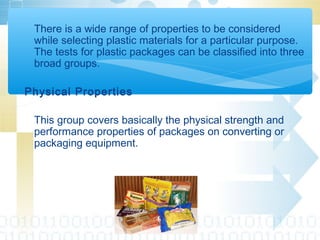
This group covers basically the physical strength and
performance properties of packages on converting or
packaging equipment.
∗ Thickness
∗ Tensile & elongation
∗ Heat seal strength
∗ Bond strength
∗ Hot tack
∗ Shrinkage
∗ Flex resistance co-efficient of friction
∗ Pin holes
∗ De-lamination
∗ Identification
∗ Leakage test
∗ Dart impact
∗ Seam strength
∗ Environmental stress crack resistance
∗ Closure leakage test
∗ Adhesion test
∗ Torque test
The different Physical properties are
Physico-chemical Properties
These properties include transmission properties like
permeability to gases, water vapours, odours, and
extractability test.
Optical Properties
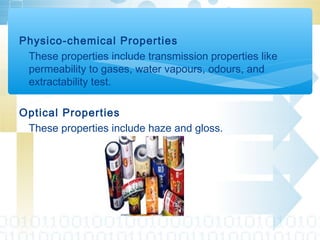
These properties include haze and gloss.
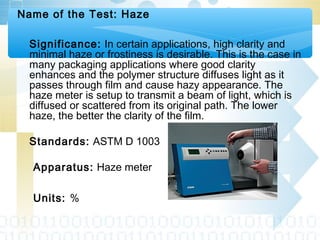
Name of the Test: Haze
Significance: In certain applications, high clarity and
minimal haze or frostiness is desirable. This is the case in
many packaging applications where good clarity
enhances and the polymer structure diffuses light as it
passes through film and cause hazy appearance. The
haze meter is setup to transmit a beam of light, which is
diffused or scattered from its original path. The lower
haze, the better the clarity of the film.
Standards: ASTM D 1003
Apparatus: Haze meter
Units: %
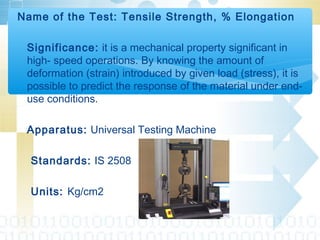
Name of the Test: Tensile Strength, % Elongation
Significance: it is a mechanical property significant in
high- speed operations. By knowing the amount of
deformation (strain) introduced by given load (stress), it is
possible to predict the response of the material under end-
use conditions.
Apparatus: Universal Testing Machine
Standards: IS 2508
Units: Kg/cm2
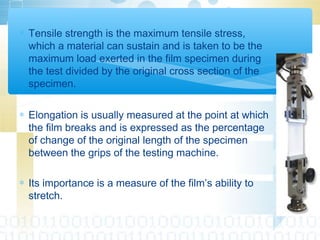
∗ Tensile strength is the maximum tensile stress,
which a material can sustain and is taken to be the
maximum load exerted in the film specimen during
the test divided by the original cross section of the
specimen.
∗ Elongation is usually measured at the point at which
the film breaks and is expressed as the percentage
of change of the original length of the specimen
between the grips of the testing machine.
∗ Its importance is a measure of the film’s ability to
stretch.
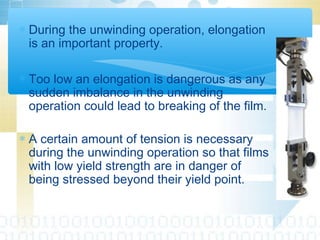
∗ During the unwinding operation, elongation
is an important property.
∗ Too low an elongation is dangerous as any
sudden imbalance in the unwinding
operation could lead to breaking of the film.
∗ A certain amount of tension is necessary
during the unwinding operation so that films
with low yield strength are in danger of
being stressed beyond their yield point.
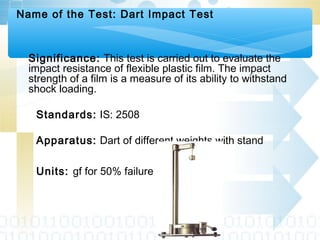
Name of the Test: Dart Impact Test
Significance: This test is carried out to evaluate the
impact resistance of flexible plastic film. The impact
strength of a film is a measure of its ability to withstand
shock loading.
Standards: IS: 2508
Apparatus: Dart of different weights with stand
Units: gf for 50% failure
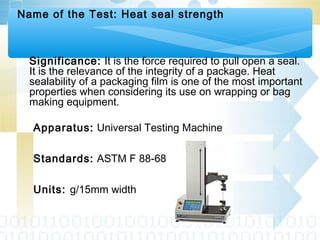
Name of the Test: Heat seal strength
Significance: It is the force required to pull open a seal.
It is the relevance of the integrity of a package. Heat
sealability of a packaging film is one of the most important
properties when considering its use on wrapping or bag
making equipment.
Apparatus: Universal Testing Machine
Standards: ASTM F 88-68
Units: g/15mm width
It is directly related to:
∗ Dwell Time
∗ Temp.
∗ Pressure
∗ Seal Contamination
∗ Thickness variation
∗ MFI
∗ Type of sealant layer
∗ Type of sealing process (Impulse/ High
frequency/ Ultrasonic)
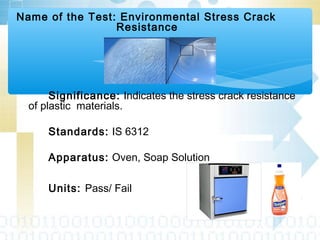
Name of the Test: Environmental Stress Crack
Resistance
Significance: Indicates the stress crack resistance
of plastic materials.
Standards: IS 6312
Apparatus: Oven, Soap Solution
Units: Pass/ Fail
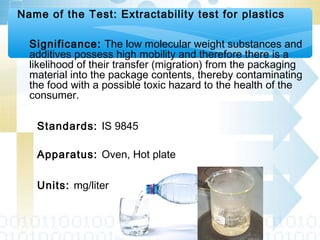
Name of the Test: Extractability test for plastics
Significance: The low molecular weight substances and
additives possess high mobility and therefore there is a
likelihood of their transfer (migration) from the packaging
material into the package contents, thereby contaminating
the food with a possible toxic hazard to the health of the
consumer.
Standards: IS 9845
Apparatus: Oven, Hot plate
Units: mg/liter
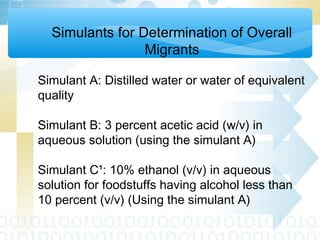
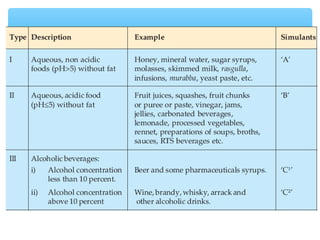
Simulants for Determination of Overall
Migrants
Simulant A: Distilled water or water of equivalent
quality
Simulant B: 3 percent acetic acid (w/v) in
aqueous solution (using the simulant A)
Simulant C¹: 10% ethanol (v/v) in aqueous
solution for foodstuffs having alcohol less than
10 percent (v/v) (Using the simulant A)
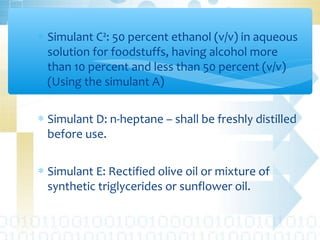
∗ Simulant C²: 50 percent ethanol (v/v) in aqueous
solution for foodstuffs, having alcohol more
than 10 percent and less than 50 percent (v/v)
(Using the simulant A)
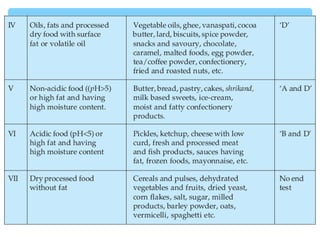
∗ Simulant D: n-heptane – shall be freshly distilled
before use.
∗ Simulant E: Rectified olive oil or mixture of
synthetic triglycerides or sunflower oil.
Plastics, in addition to the basic polymers derived from
the petroleum industry, also contain some chemical
components or additives, which are added in a small
amount during manufacture and processing to impart
desired properties to the polymer or to aid in their
processing. These may be:
∗ Anti-oxidants
∗ Anti-blocking agents
∗ Anti-static agents,
∗ stabilisers,
∗ plasticizers,
∗ pigments,
∗ fillers,
∗ antislip agents
The plastic packaging materials may also contain small
amounts of monomers, oligomers, catalysts,
polymerisation residues etc. These substances are
generally low molecular weight components.
The polymers themselves, being of very high molecular
weight, are inert and of limited solubility in aqueous and
fatty systems and are unlikely to be transferred into food.
Even if fragments were accidentally swallowed, they
would not react with body fluids present in the digestive
system.
The low molecular weight substances and additives
possess high mobility and therefore there is a likelihood
of their transfer (migration) from the packaging material
into the package contents, thereby contaminating the
food with a possible toxic hazard to the health of the
consumer.
For regulating the use of plastics in food packaging,
most of the countries have formulated standards
and codes for the manufacture and use of plastic
materials in contact with foodstuffs, suitable to
conditions and situations in the country.
In our country, the Bureau of Indian Standards (BIS)
has also formulated standards to regulate the
positive list of constituents and their specifications
for each of the plastics for its safe use in contact
with foodstuffs, pharmaceuticals and drinking
water.
Limits
∗ In general, the limits of overall migration are
specified as 10 mg/dm² or/and 60 mg/litre, in food
simulants for different types of materials as per IS.
∗ Apart from the overall migration of plastic
constituents in food simulants, there should not be
any colour migration into the simulant, apparent to
the naked eye.
∗ If the colour migrated is clearly visible, such
materials are not suitable for food contact
applications, even though the extractive value is
within the limit.
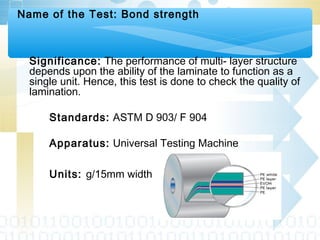
Name of the Test: Bond strength
Significance: The performance of multi- layer structure
depends upon the ability of the laminate to function as a
single unit. Hence, this test is done to check the quality of
lamination.
Standards: ASTM D 903/ F 904
Apparatus: Universal Testing Machine
Units: g/15mm width
The test indicates:
• Reliability of continuing adhesion during packaging, sealing
and storage
• The influence of oils / solvents
• The adhesive used
• The quantity of adhesive
• Affinity to moisture
• Excess solvent retention
• Climatic conditions
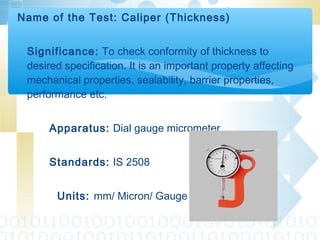
Name of the Test: Caliper (Thickness)
Significance: To check conformity of thickness to
desired specification. It is an important property affecting
mechanical properties, sealability, barrier properties,
performance etc.
Apparatus: Dial gauge micrometer
Standards: IS 2508
Units: mm/ Micron/ Gauge
Name of the Test:
Water Vapour Transmission Rate
Significance: Most important property for moisture
sensitive products. It decides shelf-life of the products and
is directly proportional to thickness. This property varies
from polymer to polymer depending upon the thickness of
the film.
Standards: IS 1060/ ASTM E- 98/ ASTM F 1249
Apparatus: Dish Method/Lassy/ MOCON/Systech
Units: g/m2/24hrs at 38+ 1°C, 90+ 2 % RH
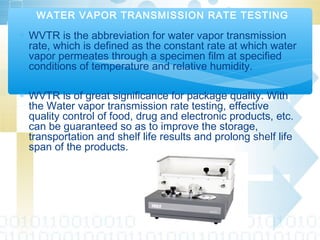
∗ WVTR is the abbreviation for water vapor transmission
rate, which is defined as the constant rate at which water
vapor permeates through a specimen film at specified
conditions of temperature and relative humidity.
∗ WVTR is of great significance for package quality. With
the Water vapor transmission rate testing, effective
quality control of food, drug and electronic products, etc.
can be guaranteed so as to improve the storage,
transportation and shelf life results and prolong shelf life
span of the products.
WATER VAPOR TRANSMISSION RATE TESTING
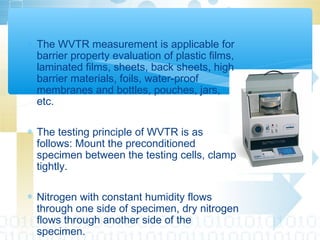
∗ The WVTR measurement is applicable for
barrier property evaluation of plastic films,
laminated films, sheets, back sheets, high
barrier materials, foils, water-proof
membranes and bottles, pouches, jars,
etc.
∗ The testing principle of WVTR is as
follows: Mount the preconditioned
specimen between the testing cells, clamp
tightly.
∗ Nitrogen with constant humidity flows
through one side of specimen, dry nitrogen
flows through another side of the
specimen.
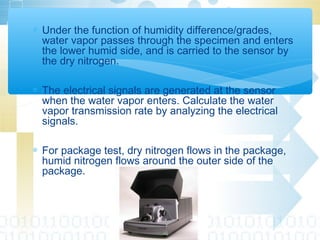
∗ Under the function of humidity difference/grades,
water vapor passes through the specimen and enters
the lower humid side, and is carried to the sensor by
the dry nitrogen.
∗ The electrical signals are generated at the sensor
when the water vapor enters. Calculate the water
vapor transmission rate by analyzing the electrical
signals.
∗ For package test, dry nitrogen flows in the package,
humid nitrogen flows around the outer side of the
package.
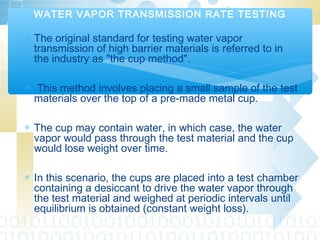
∗ The original standard for testing water vapor
transmission of high barrier materials is referred to in
the industry as "the cup method".
∗ This method involves placing a small sample of the test
materials over the top of a pre-made metal cup.
∗ The cup may contain water, in which case, the water
vapor would pass through the test material and the cup
would lose weight over time.
∗ In this scenario, the cups are placed into a test chamber
containing a desiccant to drive the water vapor through
the test material and weighed at periodic intervals until
equilibrium is obtained (constant weight loss).
WATER VAPOR TRANSMISSION RATE TESTING
∗ Alternatively, the cup may contain a desiccant, be placed
in a test chamber with water vapor (high humidity); in this
case, the moisture pick-up by the desiccant is weighed
until equilibrium.
∗ These methods were developed over many years and
are now a standard ASTM Method (1).
∗ The cup method has always had several major
shortcomings.
∗ It is a very tedious method and the results are very
operator dependent.
∗ Secondly, it will take a very long time to measure very
high barrier materials as they will take a long time to
come to equilibrium; furthermore, the results obtained on
very high barrier materials may not be very accurate.
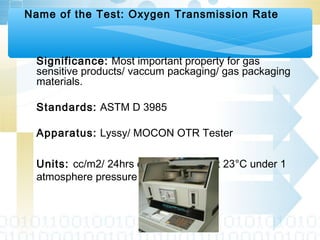
Name of the Test: Oxygen Transmission Rate
Significance: Most important property for gas
sensitive products/ vaccum packaging/ gas packaging
materials.
Standards: ASTM D 3985
Apparatus: Lyssy/ MOCON OTR Tester
Units: cc/m2/ 24hrs or ml/m2/24hrs at 23°C under 1
atmosphere pressure
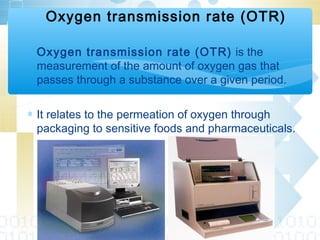
∗ Oxygen transmission rate (OTR) is the
measurement of the amount of oxygen gas that
passes through a substance over a given period.
∗ It relates to the permeation of oxygen through
packaging to sensitive foods and pharmaceuticals.
Oxygen transmission rate (OTR)
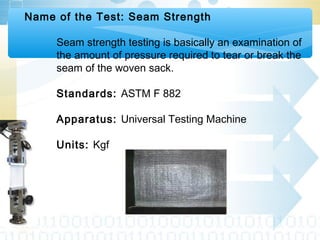
Name of the Test: Seam Strength
Seam strength testing is basically an examination of
the amount of pressure required to tear or break the
seam of the woven sack.
Standards: ASTM F 882
Apparatus: Universal Testing Machine
Units: Kgf
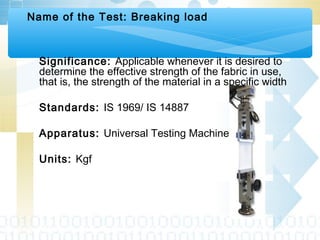
Name of the Test: Breaking load
Significance: Applicable whenever it is desired to
determine the effective strength of the fabric in use,
that is, the strength of the material in a specific width
Standards: IS 1969/ IS 14887
Apparatus: Universal Testing Machine
Units: Kgf

Pm testing plastics

  • 1.
  • 2.
    There is awide range of properties to be considered while selecting plastic materials for a particular purpose. The tests for plastic packages can be classified into three broad groups. Physical Properties This group covers basically the physical strength and performance properties of packages on converting or packaging equipment.
  • 3.
    ∗ Thickness ∗ Tensile& elongation ∗ Heat seal strength ∗ Bond strength ∗ Hot tack ∗ Shrinkage ∗ Flex resistance co-efficient of friction ∗ Pin holes ∗ De-lamination ∗ Identification ∗ Leakage test ∗ Dart impact ∗ Seam strength ∗ Environmental stress crack resistance ∗ Closure leakage test ∗ Adhesion test ∗ Torque test The different Physical properties are
  • 4.
    Physico-chemical Properties These propertiesinclude transmission properties like permeability to gases, water vapours, odours, and extractability test. Optical Properties These properties include haze and gloss.
  • 5.
    Name of theTest: Haze Significance: In certain applications, high clarity and minimal haze or frostiness is desirable. This is the case in many packaging applications where good clarity enhances and the polymer structure diffuses light as it passes through film and cause hazy appearance. The haze meter is setup to transmit a beam of light, which is diffused or scattered from its original path. The lower haze, the better the clarity of the film. Standards: ASTM D 1003 Apparatus: Haze meter Units: %
  • 6.
    Name of theTest: Tensile Strength, % Elongation Significance: it is a mechanical property significant in high- speed operations. By knowing the amount of deformation (strain) introduced by given load (stress), it is possible to predict the response of the material under end- use conditions. Apparatus: Universal Testing Machine Standards: IS 2508 Units: Kg/cm2
  • 7.
    ∗ Tensile strengthis the maximum tensile stress, which a material can sustain and is taken to be the maximum load exerted in the film specimen during the test divided by the original cross section of the specimen. ∗ Elongation is usually measured at the point at which the film breaks and is expressed as the percentage of change of the original length of the specimen between the grips of the testing machine. ∗ Its importance is a measure of the film’s ability to stretch.
  • 8.
    ∗ During theunwinding operation, elongation is an important property. ∗ Too low an elongation is dangerous as any sudden imbalance in the unwinding operation could lead to breaking of the film. ∗ A certain amount of tension is necessary during the unwinding operation so that films with low yield strength are in danger of being stressed beyond their yield point.
  • 9.
    Name of theTest: Dart Impact Test Significance: This test is carried out to evaluate the impact resistance of flexible plastic film. The impact strength of a film is a measure of its ability to withstand shock loading. Standards: IS: 2508 Apparatus: Dart of different weights with stand Units: gf for 50% failure
  • 10.
    Name of theTest: Heat seal strength Significance: It is the force required to pull open a seal. It is the relevance of the integrity of a package. Heat sealability of a packaging film is one of the most important properties when considering its use on wrapping or bag making equipment. Apparatus: Universal Testing Machine Standards: ASTM F 88-68 Units: g/15mm width
  • 11.
    It is directlyrelated to: ∗ Dwell Time ∗ Temp. ∗ Pressure ∗ Seal Contamination ∗ Thickness variation ∗ MFI ∗ Type of sealant layer ∗ Type of sealing process (Impulse/ High frequency/ Ultrasonic)
  • 12.
    Name of theTest: Environmental Stress Crack Resistance Significance: Indicates the stress crack resistance of plastic materials. Standards: IS 6312 Apparatus: Oven, Soap Solution Units: Pass/ Fail
  • 13.
    Name of theTest: Extractability test for plastics Significance: The low molecular weight substances and additives possess high mobility and therefore there is a likelihood of their transfer (migration) from the packaging material into the package contents, thereby contaminating the food with a possible toxic hazard to the health of the consumer. Standards: IS 9845 Apparatus: Oven, Hot plate Units: mg/liter
  • 14.
    Simulants for Determinationof Overall Migrants Simulant A: Distilled water or water of equivalent quality Simulant B: 3 percent acetic acid (w/v) in aqueous solution (using the simulant A) Simulant C¹: 10% ethanol (v/v) in aqueous solution for foodstuffs having alcohol less than 10 percent (v/v) (Using the simulant A)
  • 15.
    ∗ Simulant C²:50 percent ethanol (v/v) in aqueous solution for foodstuffs, having alcohol more than 10 percent and less than 50 percent (v/v) (Using the simulant A) ∗ Simulant D: n-heptane – shall be freshly distilled before use. ∗ Simulant E: Rectified olive oil or mixture of synthetic triglycerides or sunflower oil.
  • 18.
    Plastics, in additionto the basic polymers derived from the petroleum industry, also contain some chemical components or additives, which are added in a small amount during manufacture and processing to impart desired properties to the polymer or to aid in their processing. These may be: ∗ Anti-oxidants ∗ Anti-blocking agents ∗ Anti-static agents, ∗ stabilisers, ∗ plasticizers, ∗ pigments, ∗ fillers, ∗ antislip agents
  • 19.
    The plastic packagingmaterials may also contain small amounts of monomers, oligomers, catalysts, polymerisation residues etc. These substances are generally low molecular weight components. The polymers themselves, being of very high molecular weight, are inert and of limited solubility in aqueous and fatty systems and are unlikely to be transferred into food. Even if fragments were accidentally swallowed, they would not react with body fluids present in the digestive system. The low molecular weight substances and additives possess high mobility and therefore there is a likelihood of their transfer (migration) from the packaging material into the package contents, thereby contaminating the food with a possible toxic hazard to the health of the consumer.
  • 20.
    For regulating theuse of plastics in food packaging, most of the countries have formulated standards and codes for the manufacture and use of plastic materials in contact with foodstuffs, suitable to conditions and situations in the country. In our country, the Bureau of Indian Standards (BIS) has also formulated standards to regulate the positive list of constituents and their specifications for each of the plastics for its safe use in contact with foodstuffs, pharmaceuticals and drinking water.
  • 21.
    Limits ∗ In general,the limits of overall migration are specified as 10 mg/dm² or/and 60 mg/litre, in food simulants for different types of materials as per IS. ∗ Apart from the overall migration of plastic constituents in food simulants, there should not be any colour migration into the simulant, apparent to the naked eye. ∗ If the colour migrated is clearly visible, such materials are not suitable for food contact applications, even though the extractive value is within the limit.
  • 22.
    Name of theTest: Bond strength Significance: The performance of multi- layer structure depends upon the ability of the laminate to function as a single unit. Hence, this test is done to check the quality of lamination. Standards: ASTM D 903/ F 904 Apparatus: Universal Testing Machine Units: g/15mm width
  • 23.
    The test indicates: •Reliability of continuing adhesion during packaging, sealing and storage • The influence of oils / solvents • The adhesive used • The quantity of adhesive • Affinity to moisture • Excess solvent retention • Climatic conditions
  • 24.
    Name of theTest: Caliper (Thickness) Significance: To check conformity of thickness to desired specification. It is an important property affecting mechanical properties, sealability, barrier properties, performance etc. Apparatus: Dial gauge micrometer Standards: IS 2508 Units: mm/ Micron/ Gauge
  • 25.
    Name of theTest: Water Vapour Transmission Rate Significance: Most important property for moisture sensitive products. It decides shelf-life of the products and is directly proportional to thickness. This property varies from polymer to polymer depending upon the thickness of the film. Standards: IS 1060/ ASTM E- 98/ ASTM F 1249 Apparatus: Dish Method/Lassy/ MOCON/Systech Units: g/m2/24hrs at 38+ 1°C, 90+ 2 % RH
  • 26.
    ∗ WVTR isthe abbreviation for water vapor transmission rate, which is defined as the constant rate at which water vapor permeates through a specimen film at specified conditions of temperature and relative humidity. ∗ WVTR is of great significance for package quality. With the Water vapor transmission rate testing, effective quality control of food, drug and electronic products, etc. can be guaranteed so as to improve the storage, transportation and shelf life results and prolong shelf life span of the products. WATER VAPOR TRANSMISSION RATE TESTING
  • 27.
    ∗ The WVTRmeasurement is applicable for barrier property evaluation of plastic films, laminated films, sheets, back sheets, high barrier materials, foils, water-proof membranes and bottles, pouches, jars, etc. ∗ The testing principle of WVTR is as follows: Mount the preconditioned specimen between the testing cells, clamp tightly. ∗ Nitrogen with constant humidity flows through one side of specimen, dry nitrogen flows through another side of the specimen.
  • 28.
    ∗ Under thefunction of humidity difference/grades, water vapor passes through the specimen and enters the lower humid side, and is carried to the sensor by the dry nitrogen. ∗ The electrical signals are generated at the sensor when the water vapor enters. Calculate the water vapor transmission rate by analyzing the electrical signals. ∗ For package test, dry nitrogen flows in the package, humid nitrogen flows around the outer side of the package.
  • 29.
    ∗ The originalstandard for testing water vapor transmission of high barrier materials is referred to in the industry as "the cup method". ∗ This method involves placing a small sample of the test materials over the top of a pre-made metal cup. ∗ The cup may contain water, in which case, the water vapor would pass through the test material and the cup would lose weight over time. ∗ In this scenario, the cups are placed into a test chamber containing a desiccant to drive the water vapor through the test material and weighed at periodic intervals until equilibrium is obtained (constant weight loss). WATER VAPOR TRANSMISSION RATE TESTING
  • 30.
    ∗ Alternatively, thecup may contain a desiccant, be placed in a test chamber with water vapor (high humidity); in this case, the moisture pick-up by the desiccant is weighed until equilibrium. ∗ These methods were developed over many years and are now a standard ASTM Method (1). ∗ The cup method has always had several major shortcomings. ∗ It is a very tedious method and the results are very operator dependent. ∗ Secondly, it will take a very long time to measure very high barrier materials as they will take a long time to come to equilibrium; furthermore, the results obtained on very high barrier materials may not be very accurate.
  • 31.
    Name of theTest: Oxygen Transmission Rate Significance: Most important property for gas sensitive products/ vaccum packaging/ gas packaging materials. Standards: ASTM D 3985 Apparatus: Lyssy/ MOCON OTR Tester Units: cc/m2/ 24hrs or ml/m2/24hrs at 23°C under 1 atmosphere pressure
  • 32.
    ∗ Oxygen transmissionrate (OTR) is the measurement of the amount of oxygen gas that passes through a substance over a given period. ∗ It relates to the permeation of oxygen through packaging to sensitive foods and pharmaceuticals. Oxygen transmission rate (OTR)
  • 33.
    Name of theTest: Seam Strength Seam strength testing is basically an examination of the amount of pressure required to tear or break the seam of the woven sack. Standards: ASTM F 882 Apparatus: Universal Testing Machine Units: Kgf
  • 34.
    Name of theTest: Breaking load Significance: Applicable whenever it is desired to determine the effective strength of the fabric in use, that is, the strength of the material in a specific width Standards: IS 1969/ IS 14887 Apparatus: Universal Testing Machine Units: Kgf