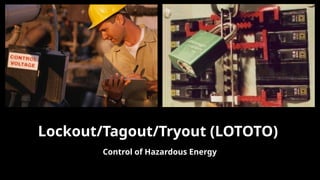
Lockout/Tagout/Tryout (LOTOTO)
Control of Hazardous Energy
2
https://www.youtube.com/watch?v=kVGiiEo
Jrv4
PRE
TRAINING
ASSESSMENT
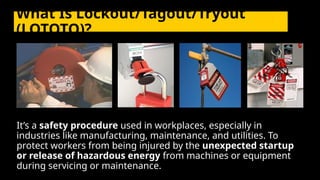
What Is Lockout/Tagout/Tryout
(LOTOTO)?
It’s a safety procedure used in workplaces, especially in
industries like manufacturing, maintenance, and utilities. To
protect workers from being injured by the unexpected startup
or release of hazardous energy from machines or equipment
during servicing or maintenance.
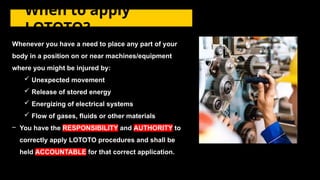
Whenever you have a need to place any part of your
body in a position on or near machines/equipment
where you might be injured by:
 Unexpected movement
 Release of stored energy
 Energizing of electrical systems
 Flow of gases, fluids or other materials
– You have the RESPONSIBILITY and AUTHORITY to
correctly apply LOTOTO procedures and shall be
held ACCOUNTABLE for that correct application.
When to apply
LOTOTO?
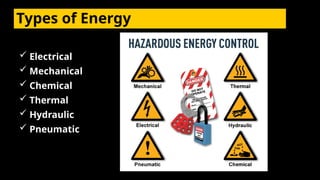
Types of Energy
 Electrical
 Mechanical
 Chemical
 Thermal
 Hydraulic
 Pneumatic
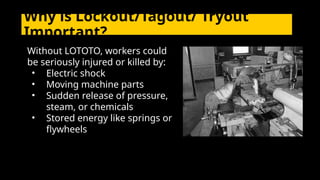
Without LOTOTO, workers could
be seriously injured or killed by:
• Electric shock
• Moving machine parts
• Sudden release of pressure,
steam, or chemicals
• Stored energy like springs or
flywheels
Why is Lockout/Tagout/ Tryout
Important?
8
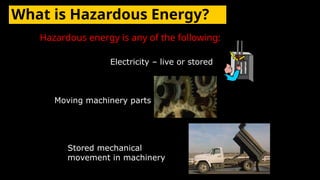
What is Hazardous Energy?
Hazardous energy is any of the following:
Electricity – live or stored
Moving machinery parts
Stored mechanical
movement in machinery
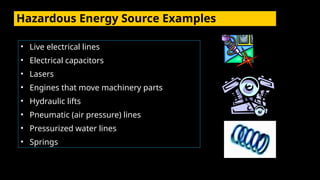
Hazardous Energy Source Examples
• Live electrical lines
• Electrical capacitors
• Lasers
• Engines that move machinery parts
• Hydraulic lifts
• Pneumatic (air pressure) lines
• Pressurized water lines
• Springs
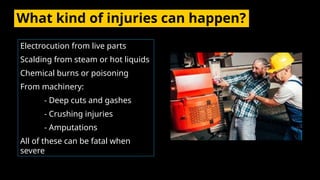
What kind of injuries can happen?
Electrocution from live parts
Scalding from steam or hot liquids
Chemical burns or poisoning
From machinery:
- Deep cuts and gashes
- Crushing injuries
- Amputations
All of these can be fatal when
severe
12
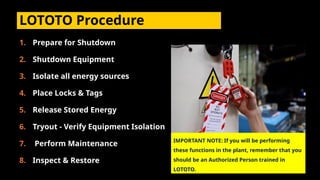
LOTOTO Procedure
1. Prepare for Shutdown
2. Shutdown Equipment
3. Isolate all energy sources
4. Place Locks & Tags
5. Release Stored Energy
6. Tryout - Verify Equipment Isolation
7. Perform Maintenance
8. Inspect & Restore
IMPORTANT NOTE: If you will be performing
these functions in the plant, remember that you
should be an Authorized Person trained in
LOTOTO.
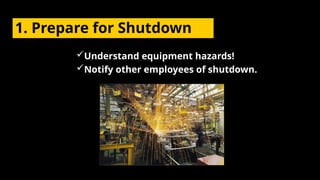
1. Prepare for Shutdown
Understand equipment hazards!
Notify other employees of shutdown.
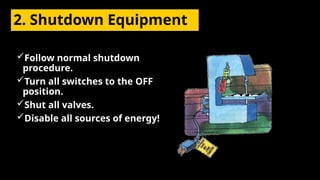
2. Shutdown Equipment
Follow normal shutdown
procedure.
Turn all switches to the OFF
position.
Shut all valves.
Disable all sources of energy!
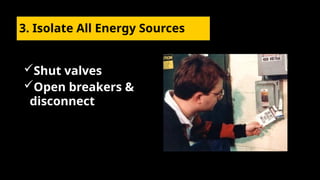
3. Isolate All Energy Sources
Shut valves
Open breakers &
disconnect
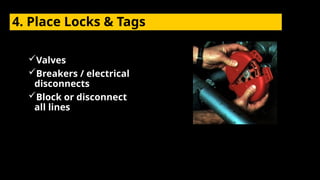
4. Place Locks & Tags
Valves
Breakers / electrical
disconnects
Block or disconnect
all lines
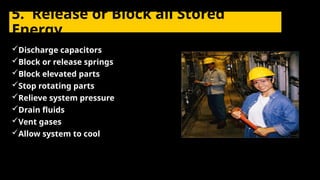
5. Release or Block all Stored
Energy
Discharge capacitors
Block or release springs
Block elevated parts
Stop rotating parts
Relieve system pressure
Drain fluids
Vent gases
Allow system to cool
6. Try out - Verify Equipment Isolation
• Check all other workers are clear of the
equipment.
• Check locking devices securely placed.
• Check isolation.
• Attempt normal startup.
• Return Controls to OFF/Neutral.
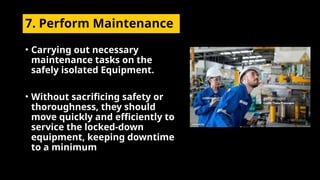
7. Perform Maintenance
• Carrying out necessary
maintenance tasks on the
safely isolated Equipment.
• Without sacrificing safety or
thoroughness, they should
move quickly and efficiently to
service the locked-down
equipment, keeping downtime
to a minimum
8. Inspect & Restore
• After the scheduled
maintenance is complete,
equipment needs to be
restored by undoing the LOTO
operation by connecting back
to its energy sources.
• Before removing LOTO devices
thoroughly inspect the
machine and ensure the area is
clear.
• Finally notify the impacted
employees that the machine is
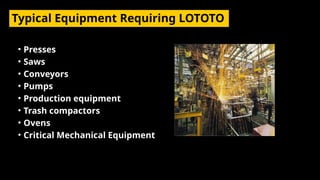
Typical Equipment Requiring LOTOTO
• Presses
• Saws
• Conveyors
• Pumps
• Production equipment
• Trash compactors
• Ovens
• Critical Mechanical Equipment
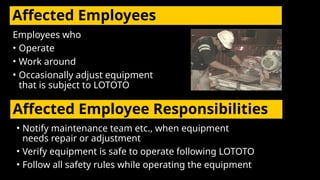
Affected Employees
Employees who
• Operate
• Work around
• Occasionally adjust equipment
that is subject to LOTOTO
Affected Employee Responsibilities
• Notify maintenance team etc., when equipment
needs repair or adjustment
• Verify equipment is safe to operate following LOTOTO
• Follow all safety rules while operating the equipment
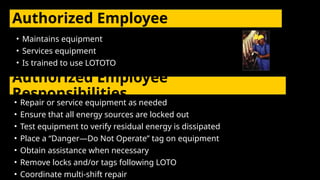
Authorized Employee
• Maintains equipment
• Services equipment
• Is trained to use LOTOTO
Authorized Employee
Responsibilities
• Repair or service equipment as needed
• Ensure that all energy sources are locked out
• Test equipment to verify residual energy is dissipated
• Place a “Danger—Do Not Operate” tag on equipment
• Obtain assistance when necessary
• Remove locks and/or tags following LOTO
• Coordinate multi-shift repair
Training Requirements
• Authorized employees – Initially and At least Annually
• Affected employees – Initially
• Authorized and affected – Whenever changes are made to jobs or
procedures
• Authorized and affected – when program deficiencies are noted
Company Responsibilities
• Ensure de-energization of equipment
• Ensure employee awareness
• Provide appropriate levels of training
• Review program effectiveness
• Maintain and revise program
• Administer appropriate disciplinary actions – EHS
Disciplinary matrix
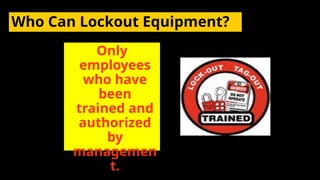
Who Can Lockout Equipment?
Only
employees
who have
been
trained and
authorized
by
managemen
t.
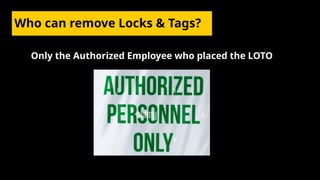
Who can remove Locks & Tags?
Only the Authorized Employee who placed the LOTO
LOTOTO Placard
• LOTOTO placards provide necessary
information to workers who may be
affected by the repair or maintenance.
– LOTOTO Master Placard: help to map
out the appropriate way to control
energy to the parts of the machine
that will need servicing.
• Even if you aren’t actually performing
LOTOTO, you’ll need the information in
placards when you are working around
the equipment.
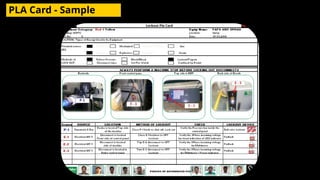
• LOTO master placard:
– Located on or adjacent to the machine
– Shows types of Energy in that machine
– Describes where it located
– Points out how to disconnect
– Specifies lockout devices to be used
– Specifies verification of lockout
– Points who are all authorized
PLA Card - Sample
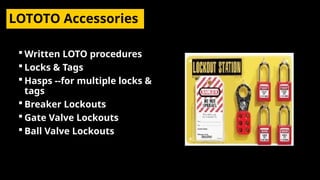
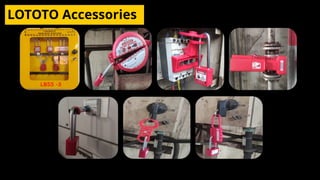
LOTOTO Accessories
 Written LOTO procedures
 Locks & Tags
 Hasps --for multiple locks &
tags
 Breaker Lockouts
 Gate Valve Lockouts
 Ball Valve Lockouts
32
LOTOTO Accessories
Locks
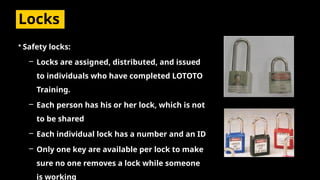
• Safety locks:
– Locks are assigned, distributed, and issued
to individuals who have completed LOTOTO
Training.
– Each person has his or her lock, which is not
to be shared
– Each individual lock has a number and an ID
– Only one key are available per lock to make
sure no one removes a lock while someone
is working
Locks
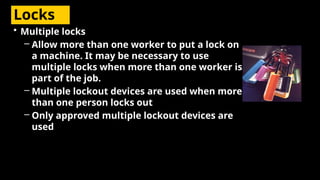
• Multiple locks
– Allow more than one worker to put a lock on
a machine. It may be necessary to use
multiple locks when more than one worker is
part of the job.
– Multiple lockout devices are used when more
than one person locks out
– Only approved multiple lockout devices are
used
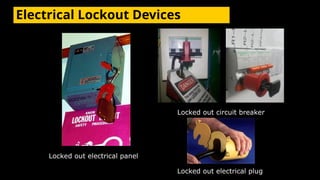
Electrical Lockout Devices
Locked out electrical panel
Locked out circuit breaker
Locked out electrical plug
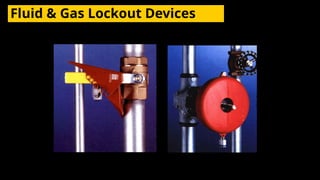
Fluid & Gas Lockout Devices
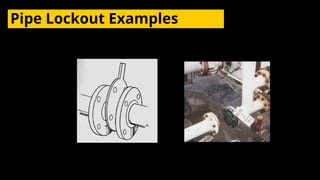
Pipe Lockout Examples
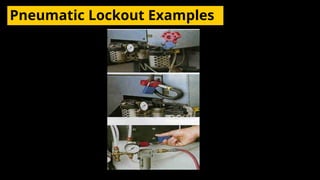
Pneumatic Lockout Examples
Tags
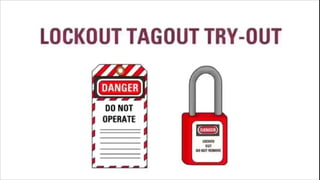
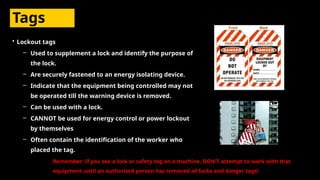
• Lockout tags
– Used to supplement a lock and identify the purpose of
the lock.
– Are securely fastened to an energy isolating device.
– Indicate that the equipment being controlled may not
be operated till the warning device is removed.
– Can be used with a lock.
– CANNOT be used for energy control or power lockout
by themselves
– Often contain the identification of the worker who
placed the tag.
Remember: If you see a lock or safety tag on a machine, DON’T attempt to work with that
equipment until an authorized person has removed all locks and danger tags!
Lockout-Tagout-Tryout Protects YOU!
ALWAYS Use Proper
Lockout – Tagout -
Tryout Procedures
They are for your
protection!!!
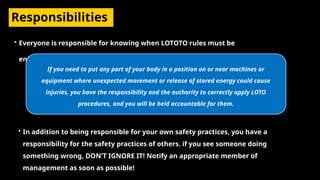
Responsibilities
• Everyone is responsible for knowing when LOTOTO rules must be
enforced.
If you need to put any part of your body in a position on or near machines or
equipment where unexpected movement or release of stored energy could cause
injuries, you have the responsibility and the authority to correctly apply LOTO
procedures, and you will be held accountable for them.
• In addition to being responsible for your own safety practices, you have a
responsibility for the safety practices of others. if you see someone doing
something wrong, DON’T IGNORE IT! Notify an appropriate member of
management as soon as possible!
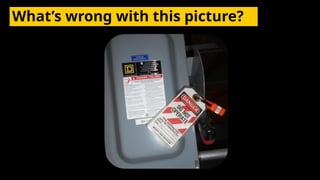
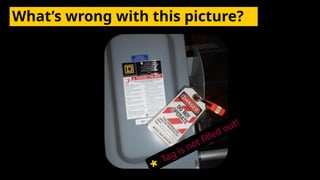
What’s wrong with this picture?
Tag is not filled out!
POST
TRAINING
ASSESSMENT
TRAINING
FEEDBACK
THANK YOU

LOTOTO Training Module Train the Tr.pptx

  • 1.
  • 2.
  • 3.
  • 4.
    What Is Lockout/Tagout/Tryout (LOTOTO)? It’sa safety procedure used in workplaces, especially in industries like manufacturing, maintenance, and utilities. To protect workers from being injured by the unexpected startup or release of hazardous energy from machines or equipment during servicing or maintenance.
  • 5.
    Whenever you havea need to place any part of your body in a position on or near machines/equipment where you might be injured by:  Unexpected movement  Release of stored energy  Energizing of electrical systems  Flow of gases, fluids or other materials – You have the RESPONSIBILITY and AUTHORITY to correctly apply LOTOTO procedures and shall be held ACCOUNTABLE for that correct application. When to apply LOTOTO?
  • 6.
    Types of Energy Electrical  Mechanical  Chemical  Thermal  Hydraulic  Pneumatic
  • 7.
    Without LOTOTO, workerscould be seriously injured or killed by: • Electric shock • Moving machine parts • Sudden release of pressure, steam, or chemicals • Stored energy like springs or flywheels Why is Lockout/Tagout/ Tryout Important?
  • 8.
  • 9.
    What is HazardousEnergy? Hazardous energy is any of the following: Electricity – live or stored Moving machinery parts Stored mechanical movement in machinery
  • 10.
    Hazardous Energy SourceExamples • Live electrical lines • Electrical capacitors • Lasers • Engines that move machinery parts • Hydraulic lifts • Pneumatic (air pressure) lines • Pressurized water lines • Springs
  • 11.
    What kind ofinjuries can happen? Electrocution from live parts Scalding from steam or hot liquids Chemical burns or poisoning From machinery: - Deep cuts and gashes - Crushing injuries - Amputations All of these can be fatal when severe
  • 12.
  • 13.
    LOTOTO Procedure 1. Preparefor Shutdown 2. Shutdown Equipment 3. Isolate all energy sources 4. Place Locks & Tags 5. Release Stored Energy 6. Tryout - Verify Equipment Isolation 7. Perform Maintenance 8. Inspect & Restore IMPORTANT NOTE: If you will be performing these functions in the plant, remember that you should be an Authorized Person trained in LOTOTO.
  • 14.
    1. Prepare forShutdown Understand equipment hazards! Notify other employees of shutdown.
  • 15.
    2. Shutdown Equipment Follownormal shutdown procedure. Turn all switches to the OFF position. Shut all valves. Disable all sources of energy!
  • 16.
    3. Isolate AllEnergy Sources Shut valves Open breakers & disconnect
  • 17.
    4. Place Locks& Tags Valves Breakers / electrical disconnects Block or disconnect all lines
  • 18.
    5. Release orBlock all Stored Energy Discharge capacitors Block or release springs Block elevated parts Stop rotating parts Relieve system pressure Drain fluids Vent gases Allow system to cool
  • 19.
    6. Try out- Verify Equipment Isolation • Check all other workers are clear of the equipment. • Check locking devices securely placed. • Check isolation. • Attempt normal startup. • Return Controls to OFF/Neutral.
  • 20.
    7. Perform Maintenance •Carrying out necessary maintenance tasks on the safely isolated Equipment. • Without sacrificing safety or thoroughness, they should move quickly and efficiently to service the locked-down equipment, keeping downtime to a minimum
  • 21.
    8. Inspect &Restore • After the scheduled maintenance is complete, equipment needs to be restored by undoing the LOTO operation by connecting back to its energy sources. • Before removing LOTO devices thoroughly inspect the machine and ensure the area is clear. • Finally notify the impacted employees that the machine is
  • 22.
    Typical Equipment RequiringLOTOTO • Presses • Saws • Conveyors • Pumps • Production equipment • Trash compactors • Ovens • Critical Mechanical Equipment
  • 23.
    Affected Employees Employees who •Operate • Work around • Occasionally adjust equipment that is subject to LOTOTO Affected Employee Responsibilities • Notify maintenance team etc., when equipment needs repair or adjustment • Verify equipment is safe to operate following LOTOTO • Follow all safety rules while operating the equipment
  • 24.
    Authorized Employee • Maintainsequipment • Services equipment • Is trained to use LOTOTO Authorized Employee Responsibilities • Repair or service equipment as needed • Ensure that all energy sources are locked out • Test equipment to verify residual energy is dissipated • Place a “Danger—Do Not Operate” tag on equipment • Obtain assistance when necessary • Remove locks and/or tags following LOTO • Coordinate multi-shift repair
  • 25.
    Training Requirements • Authorizedemployees – Initially and At least Annually • Affected employees – Initially • Authorized and affected – Whenever changes are made to jobs or procedures • Authorized and affected – when program deficiencies are noted
  • 26.
    Company Responsibilities • Ensurede-energization of equipment • Ensure employee awareness • Provide appropriate levels of training • Review program effectiveness • Maintain and revise program • Administer appropriate disciplinary actions – EHS Disciplinary matrix
  • 27.
    Who Can LockoutEquipment? Only employees who have been trained and authorized by managemen t.
  • 28.
    Who can removeLocks & Tags? Only the Authorized Employee who placed the LOTO
  • 29.
    LOTOTO Placard • LOTOTOplacards provide necessary information to workers who may be affected by the repair or maintenance. – LOTOTO Master Placard: help to map out the appropriate way to control energy to the parts of the machine that will need servicing. • Even if you aren’t actually performing LOTOTO, you’ll need the information in placards when you are working around the equipment. • LOTO master placard: – Located on or adjacent to the machine – Shows types of Energy in that machine – Describes where it located – Points out how to disconnect – Specifies lockout devices to be used – Specifies verification of lockout – Points who are all authorized
  • 30.
    PLA Card -Sample
  • 31.
    LOTOTO Accessories  WrittenLOTO procedures  Locks & Tags  Hasps --for multiple locks & tags  Breaker Lockouts  Gate Valve Lockouts  Ball Valve Lockouts
  • 32.
  • 33.
    Locks • Safety locks: –Locks are assigned, distributed, and issued to individuals who have completed LOTOTO Training. – Each person has his or her lock, which is not to be shared – Each individual lock has a number and an ID – Only one key are available per lock to make sure no one removes a lock while someone is working
  • 34.
    Locks • Multiple locks –Allow more than one worker to put a lock on a machine. It may be necessary to use multiple locks when more than one worker is part of the job. – Multiple lockout devices are used when more than one person locks out – Only approved multiple lockout devices are used
  • 35.
    Electrical Lockout Devices Lockedout electrical panel Locked out circuit breaker Locked out electrical plug
  • 36.
    Fluid & GasLockout Devices
  • 37.
  • 38.
  • 39.
    Tags • Lockout tags –Used to supplement a lock and identify the purpose of the lock. – Are securely fastened to an energy isolating device. – Indicate that the equipment being controlled may not be operated till the warning device is removed. – Can be used with a lock. – CANNOT be used for energy control or power lockout by themselves – Often contain the identification of the worker who placed the tag. Remember: If you see a lock or safety tag on a machine, DON’T attempt to work with that equipment until an authorized person has removed all locks and danger tags!
  • 40.
    Lockout-Tagout-Tryout Protects YOU! ALWAYSUse Proper Lockout – Tagout - Tryout Procedures They are for your protection!!!
  • 41.
    Responsibilities • Everyone isresponsible for knowing when LOTOTO rules must be enforced. If you need to put any part of your body in a position on or near machines or equipment where unexpected movement or release of stored energy could cause injuries, you have the responsibility and the authority to correctly apply LOTO procedures, and you will be held accountable for them. • In addition to being responsible for your own safety practices, you have a responsibility for the safety practices of others. if you see someone doing something wrong, DON’T IGNORE IT! Notify an appropriate member of management as soon as possible!

  • 42.
    What’s wrong withthis picture?
  • 43.
    What’s wrong withthis picture? Tag is not filled out!
  • 44.
  • 45.
  • 46.