This document provides an overview of reverse osmosis systems, including:
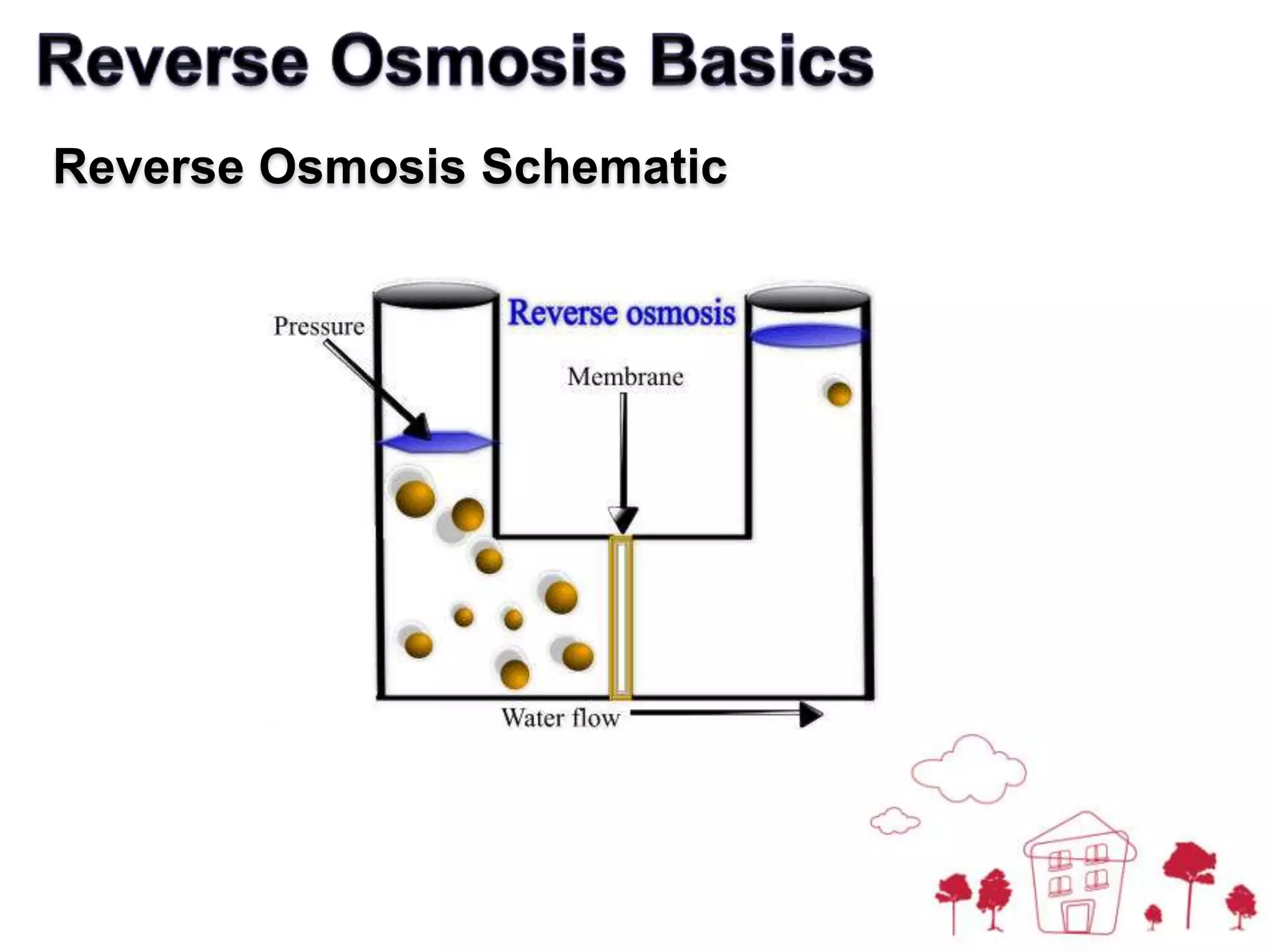
- Osmosis is the natural process by which water moves through a semi-permeable membrane from an area of high water concentration to low. Reverse osmosis forces water through a membrane from a low to high concentration area using pressure.
- Reverse osmosis membranes filter out dissolved ions and particles as small as 0.0001 microns to produce purified water. Factors like temperature, pressure, and contaminants affect production rates.
- Proper maintenance of pre-filters, post-filters, and membranes is required to maximize system performance and lifespan. Troubleshooting guidance addresses common issues like low flow rates or continuous running.
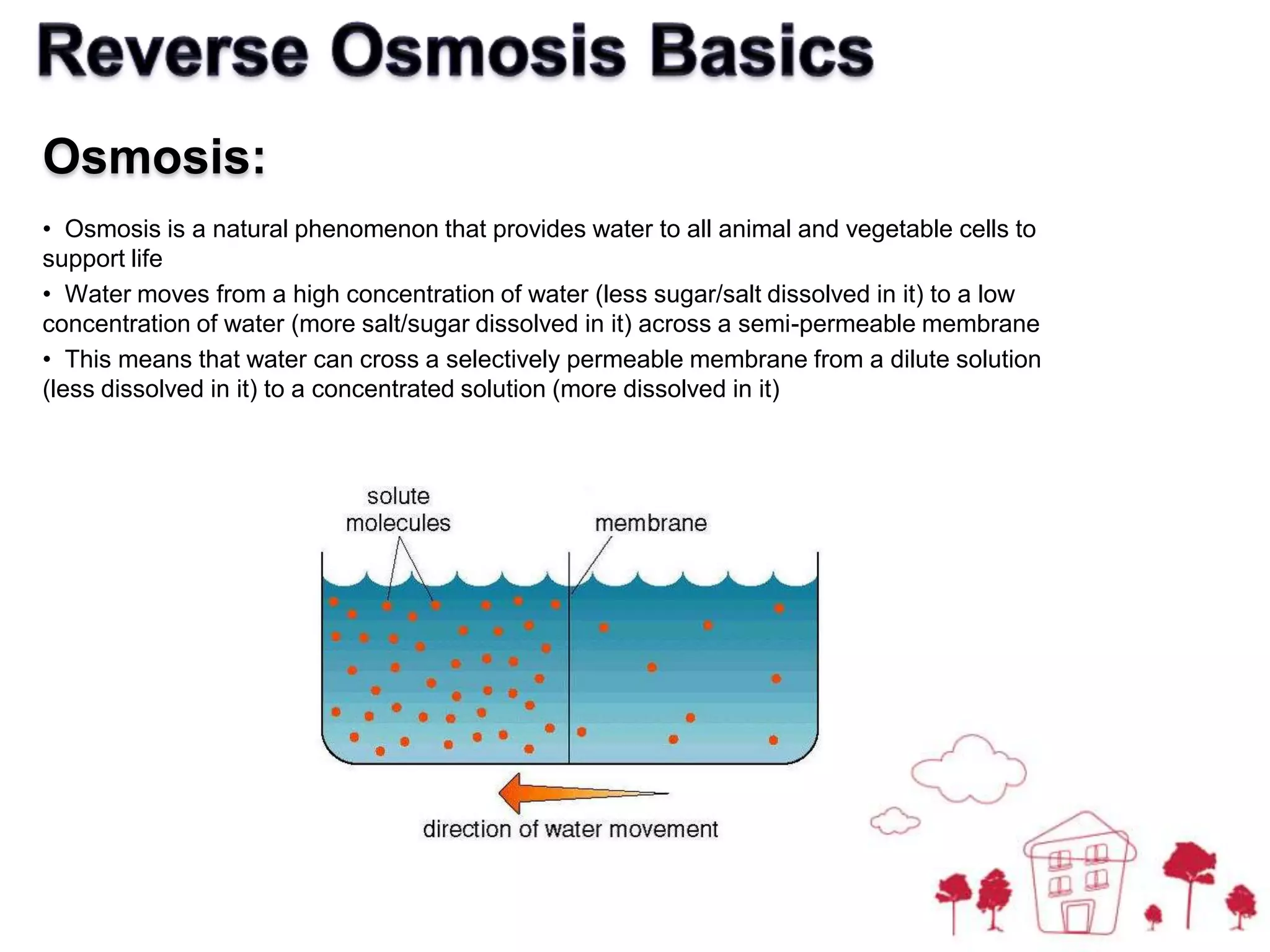
TroubleshootingReverseOsmosis BasicsOsmosis: Osmosis is a natural phenomenon that provides water to all animal and vegetable cells to support life
10.
Watermoves from a high concentration of water (less sugar/salt dissolved in it) to a low concentration of water (more salt/sugar dissolved in it) across a semi-permeable membrane
11.
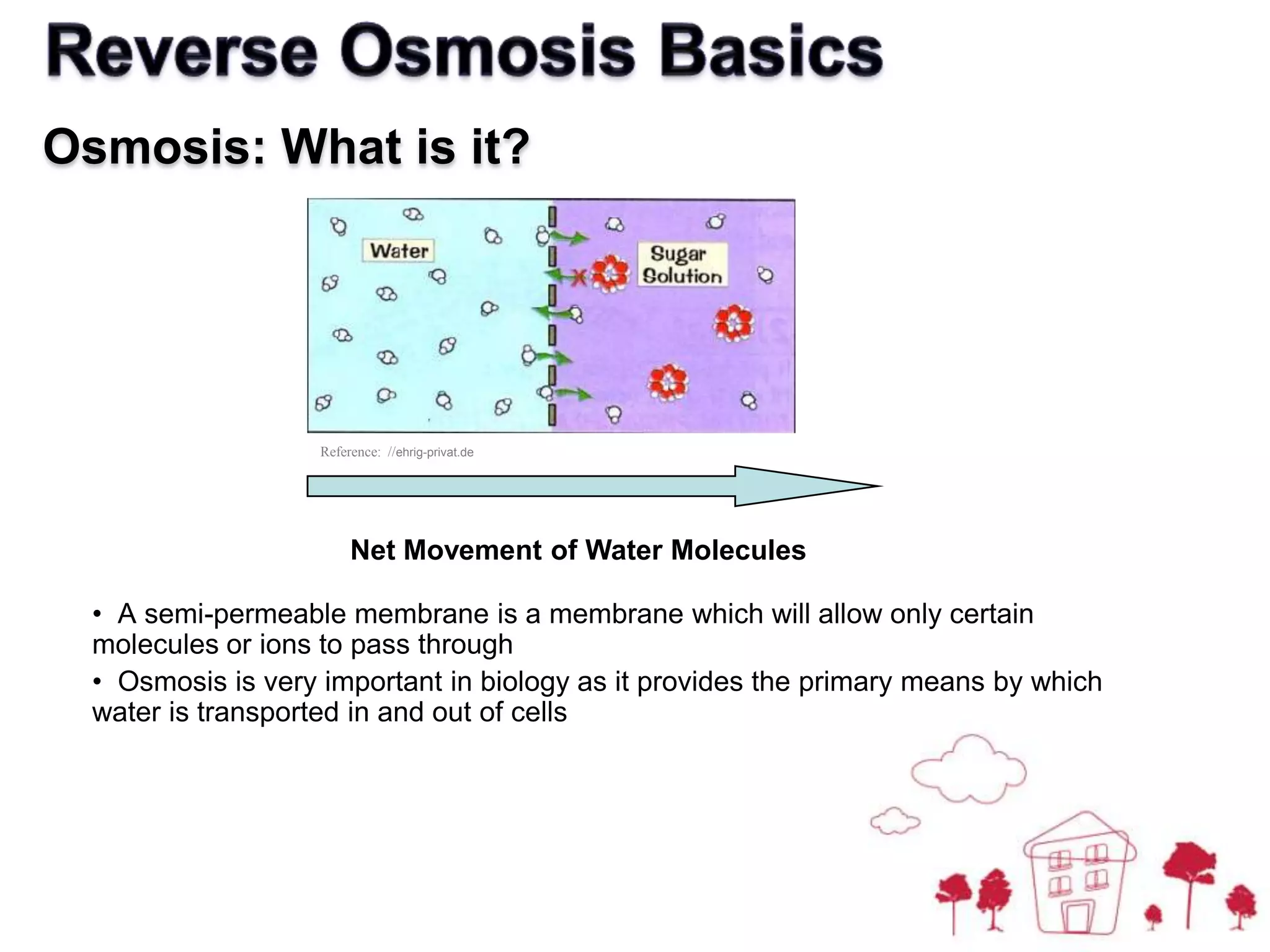
Thismeans that water can cross a selectively permeable membrane from a dilute solution (less dissolved in it) to a concentrated solution (more dissolved in it)Reverse Osmosis BasicsOsmosis: What is it?Reference: //ehrig-privat.de A semi-permeable membrane is a membrane which will allow only certain molecules or ions to pass through
12.
Osmosisis very important in biology as it provides the primary means by which water is transported in and out of cellsNet Movement of Water Molecules
Waterpasses from a more concentrated solution to a less concentrated solution
15.
Toaccomplish this a force or pressure MUST be applied
16.
ROrequires 1 psi of pressure for every 100 ppm of TDS
17.
ROis used to remove dissolved solids from water but it can also improve taste, odor & color of water
18.
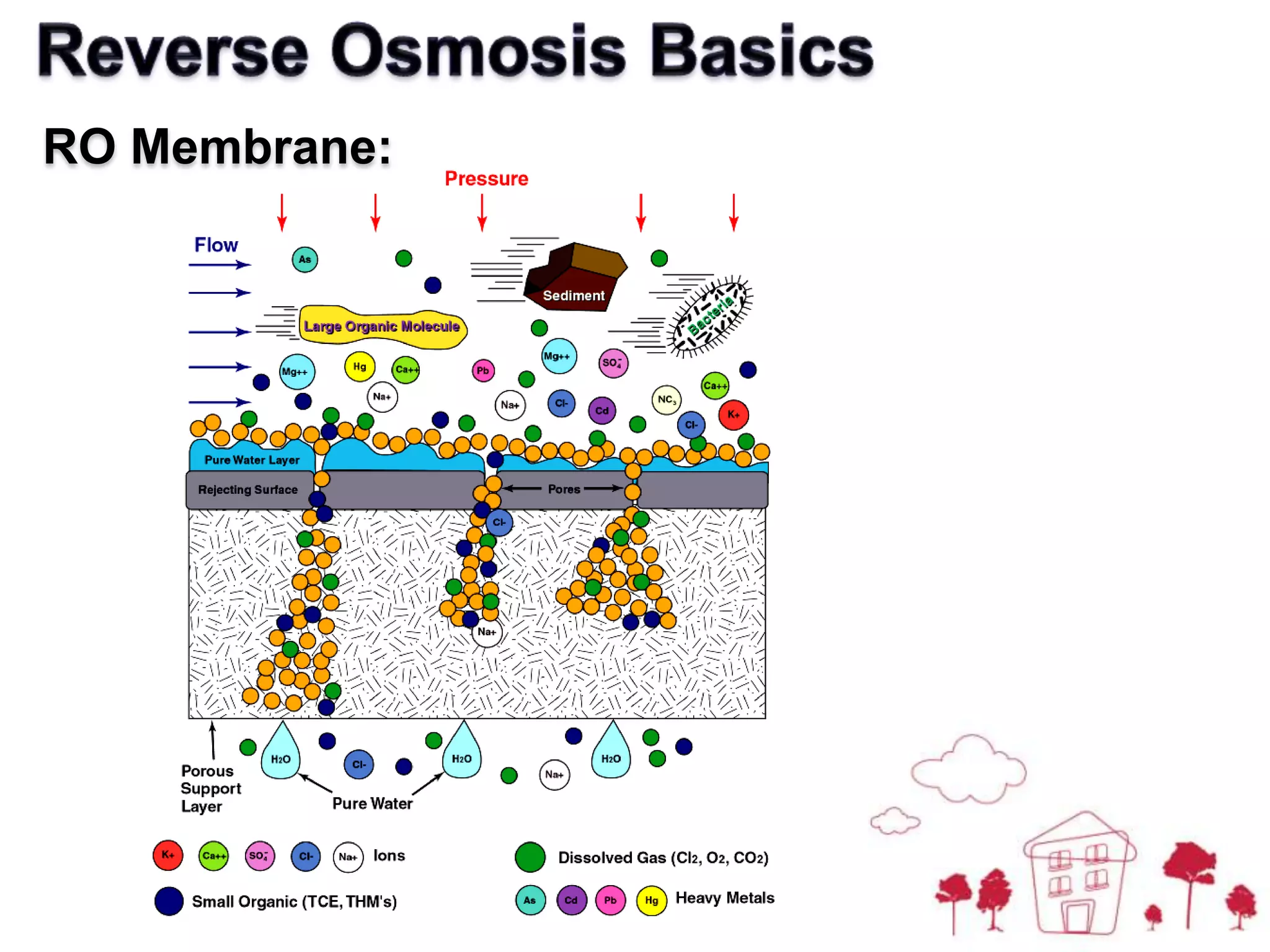
ROmembranes have the capability to remove particles as small as ions i.e. magnesium ions or sodium ions
19.
ROmembrane will reject most compounds based largely on size
20.
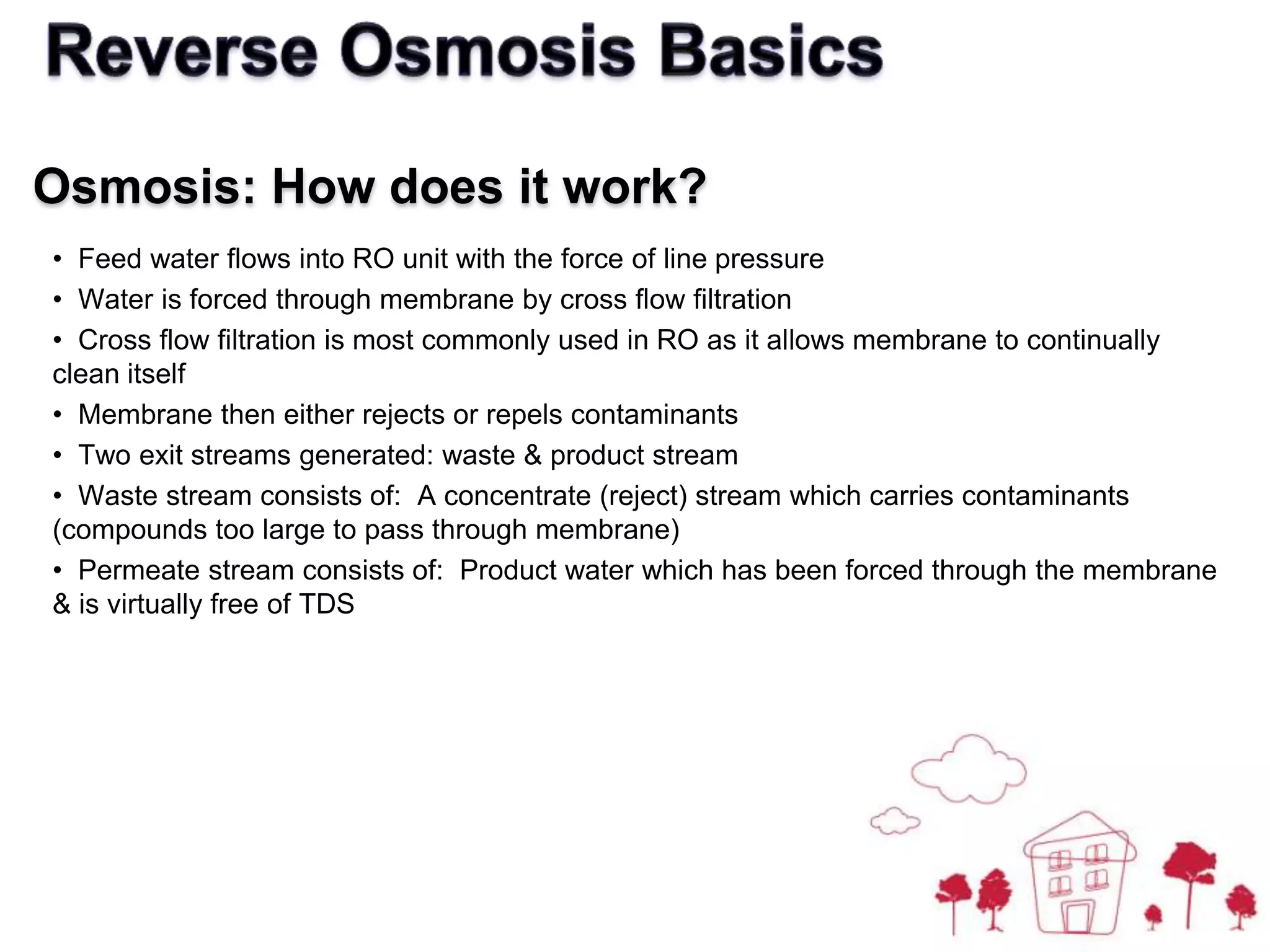
Dissolvedions, such as salts, carry an electric charge and will also be rejected by membraneReverse Osmosis BasicsOsmosis: How does it work? Feed water flows into RO unit with the force of line pressure
21.
Wateris forced through membrane by cross flow filtration
22.
Crossflow filtration is most commonly used in RO as it allows membrane to continually clean itself
23.
Membranethen either rejects or repels contaminants
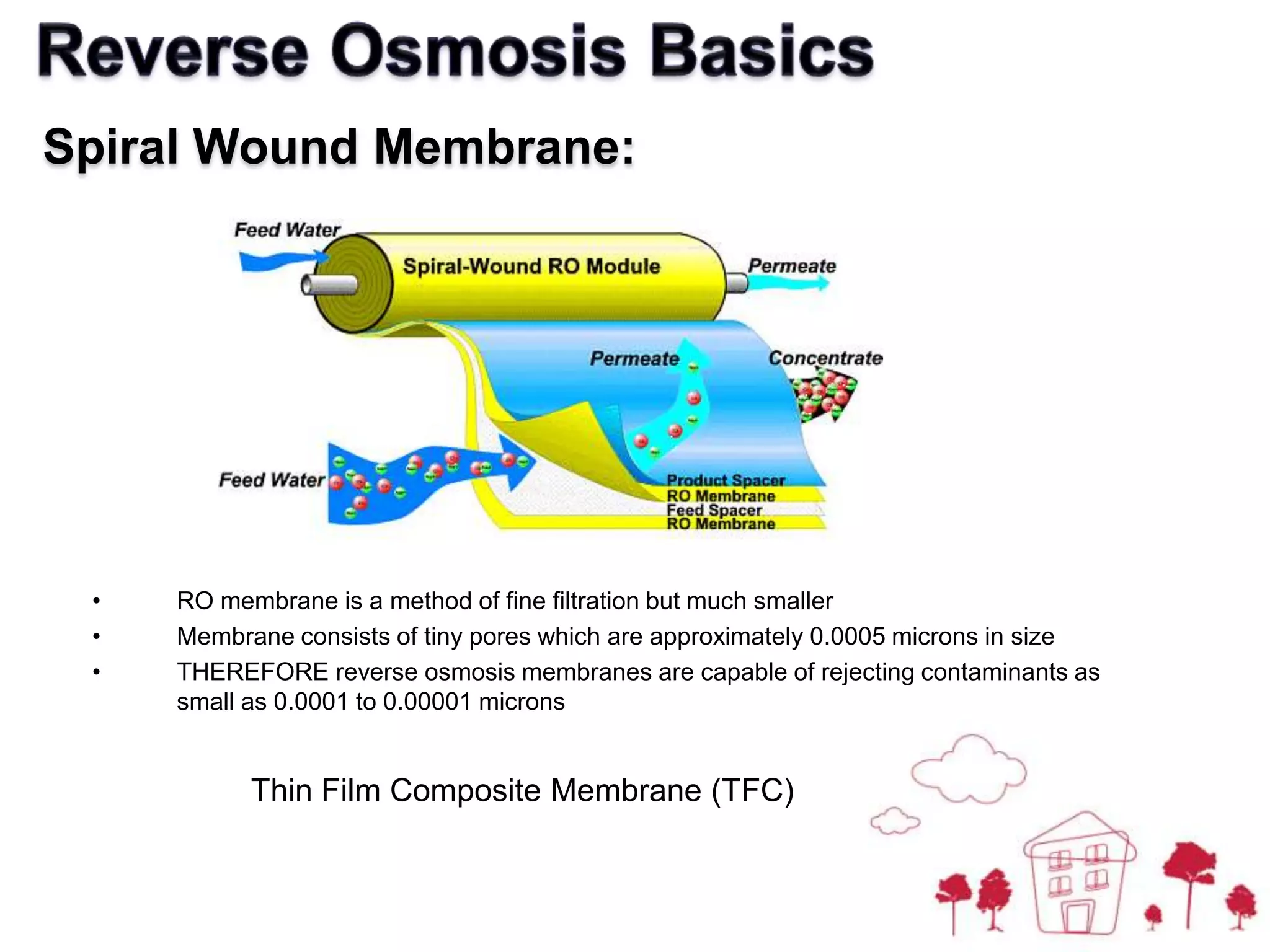
Wastestream consists of: A concentrate (reject) stream which carries contaminants (compounds too large to pass through membrane)
26.
Permeatestream consists of: Product water which has been forced through the membrane & is virtually free of TDSReverse Osmosis BasicsReverse Osmosis Schematic
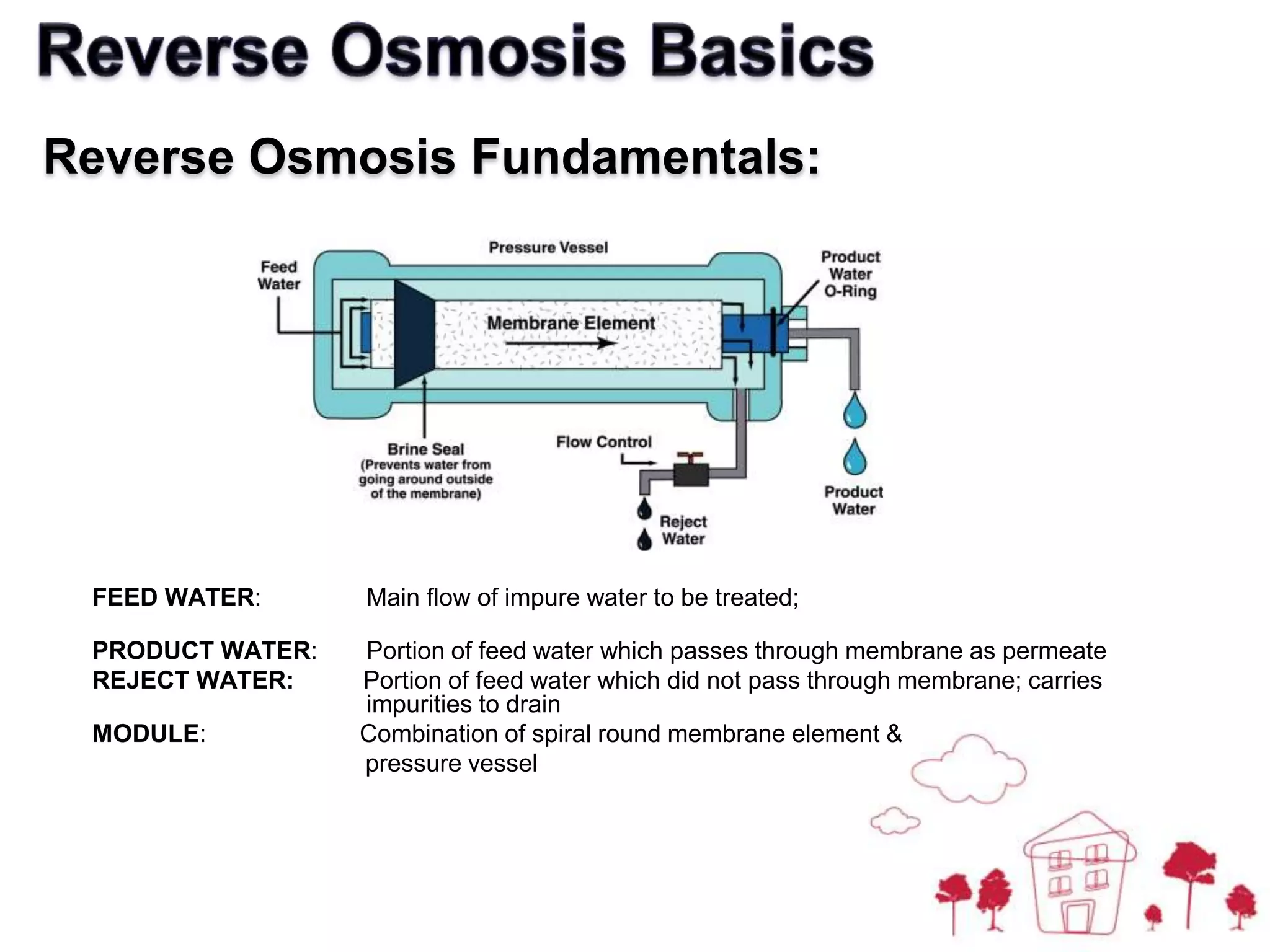
Reverse Osmosis BasicsReverseOsmosis Fundamentals:FEED WATER: Main flow of impure water to be treated; PRODUCT WATER: Portion of feed water which passes through membrane as permeateREJECT WATER: Portion of feed water which did not pass through membrane; carries impurities to drainMODULE: Combination of spiral round membrane element & pressure vessel
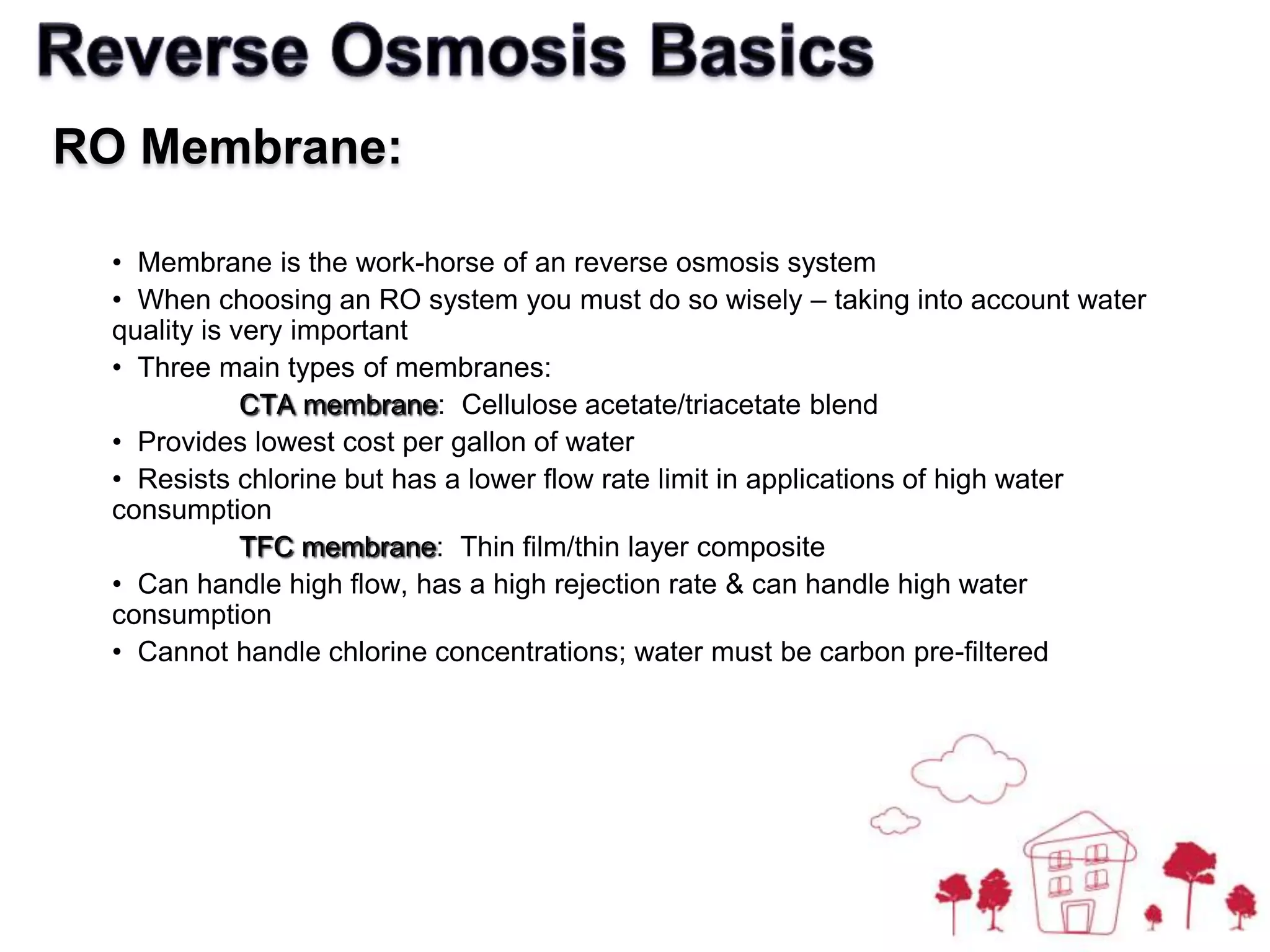
Whenchoosing an RO system you must do so wisely – taking into account water quality is very important
34.
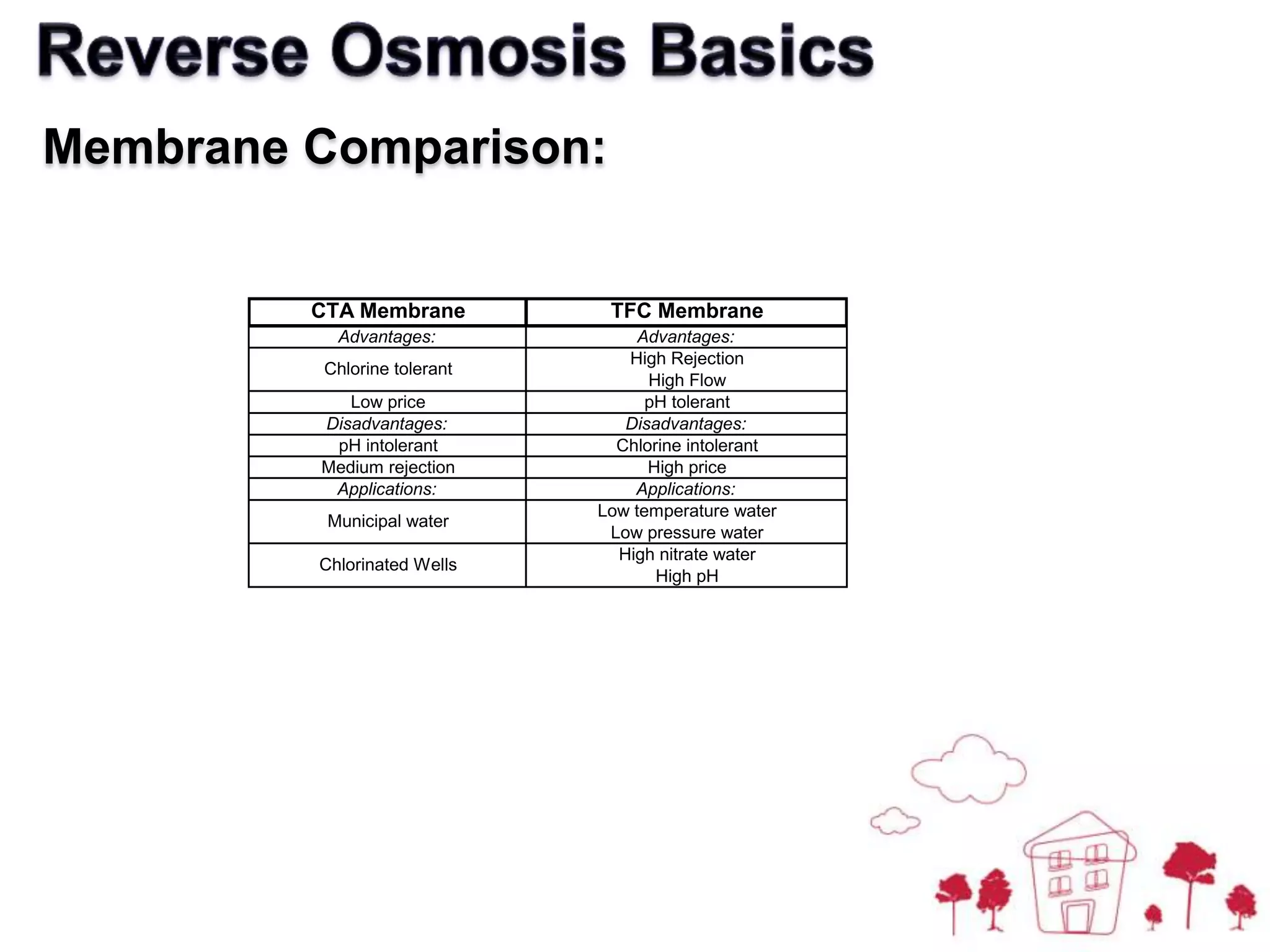
Threemain types of membranes:CTA membrane: Cellulose acetate/triacetate blend Provides lowest cost per gallon of water
35.
Resistschlorine but has a lower flow rate limit in applications of high water consumptionTFC membrane: Thin film/thin layer composite Can handle high flow, has a high rejection rate & can handle high water consumption
36.
Cannothandle chlorine concentrations; water must be carbon pre-filteredReverse Osmosis BasicsMembrane Comparison:
37.
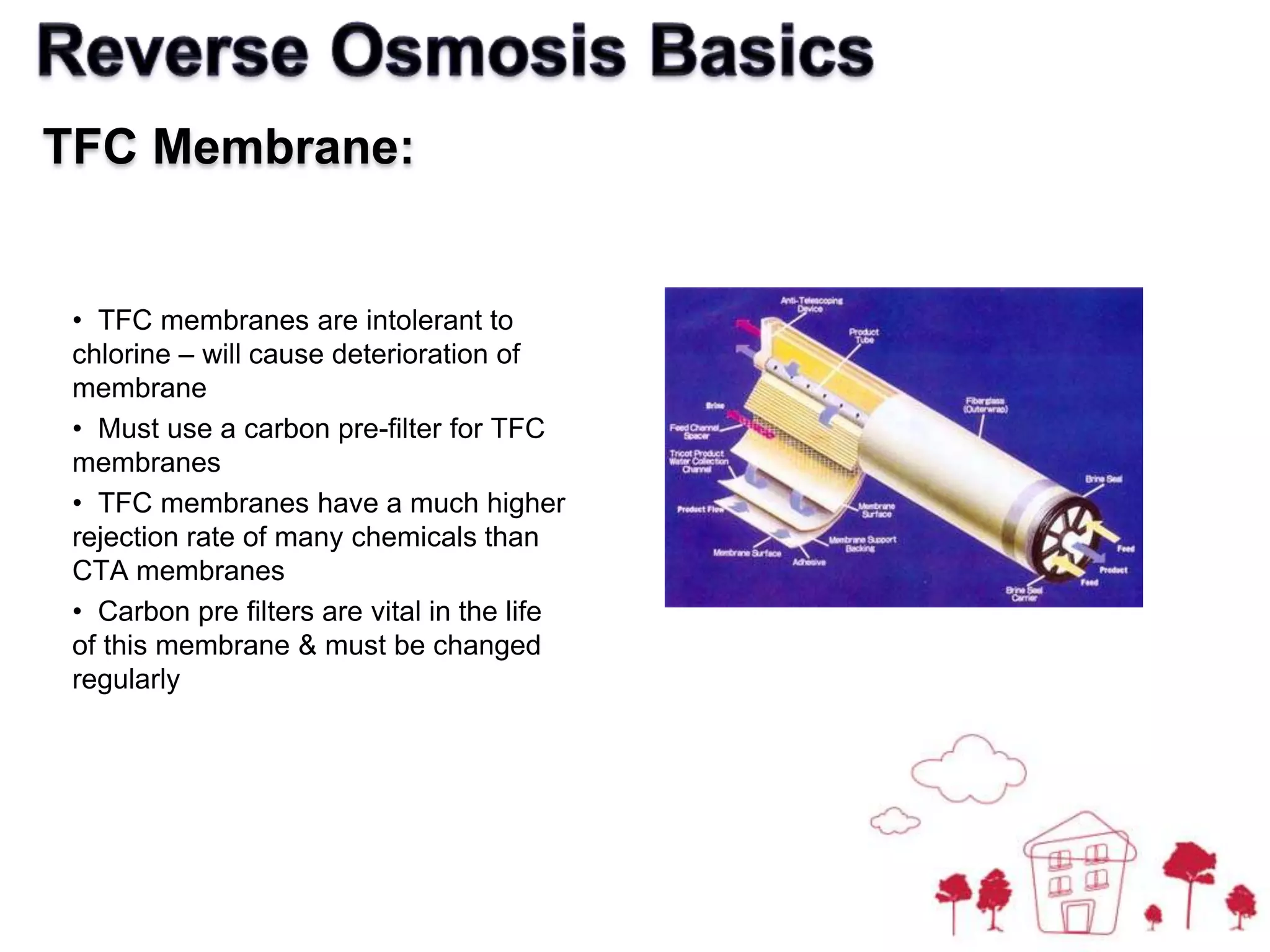
Reverse Osmosis BasicsTFCMembrane: TFC membranes are intolerant to chlorine – will cause deterioration of membrane
TFCmembranes have a much higher rejection rate of many chemicals than CTA membranes
40.
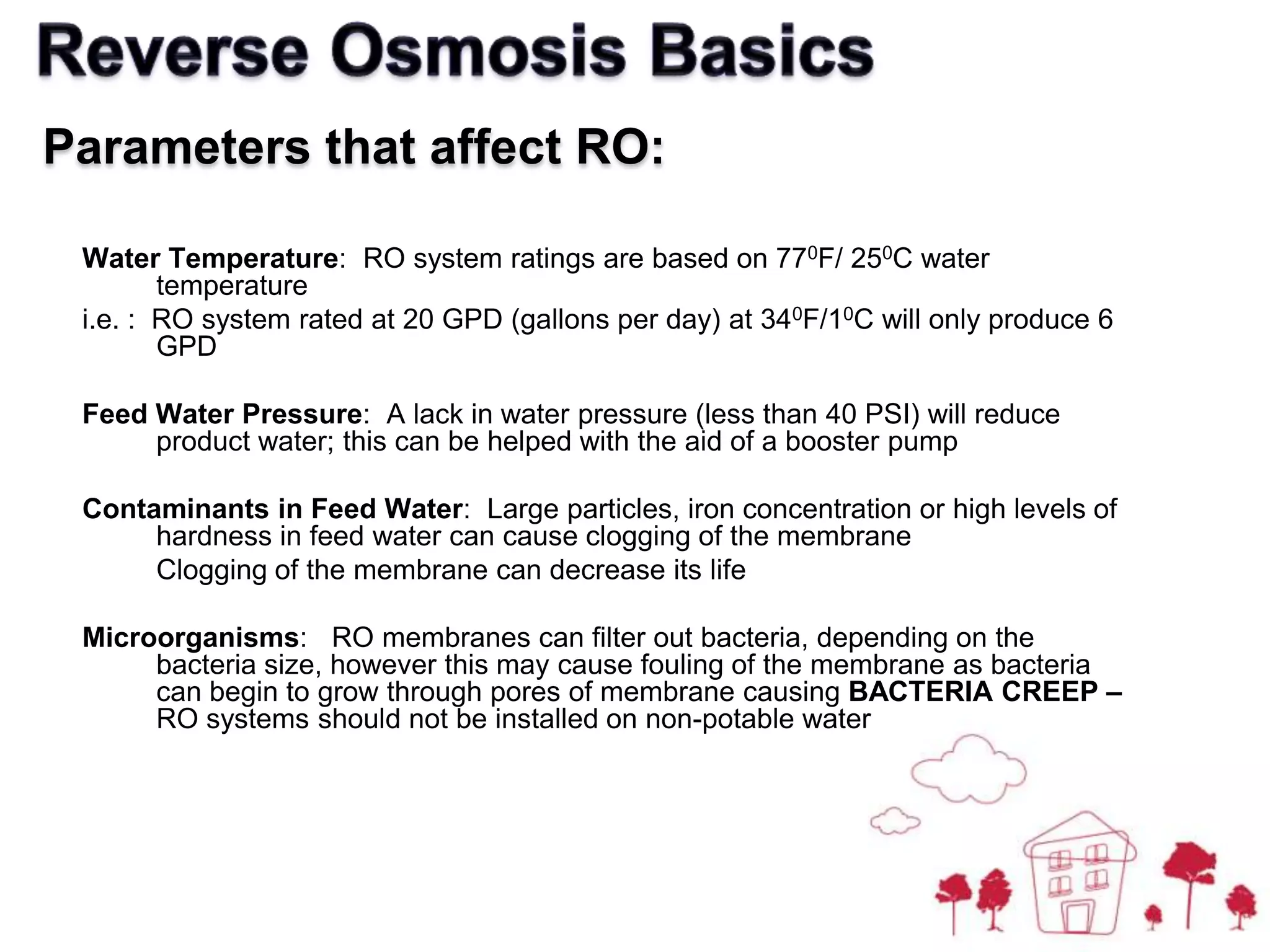
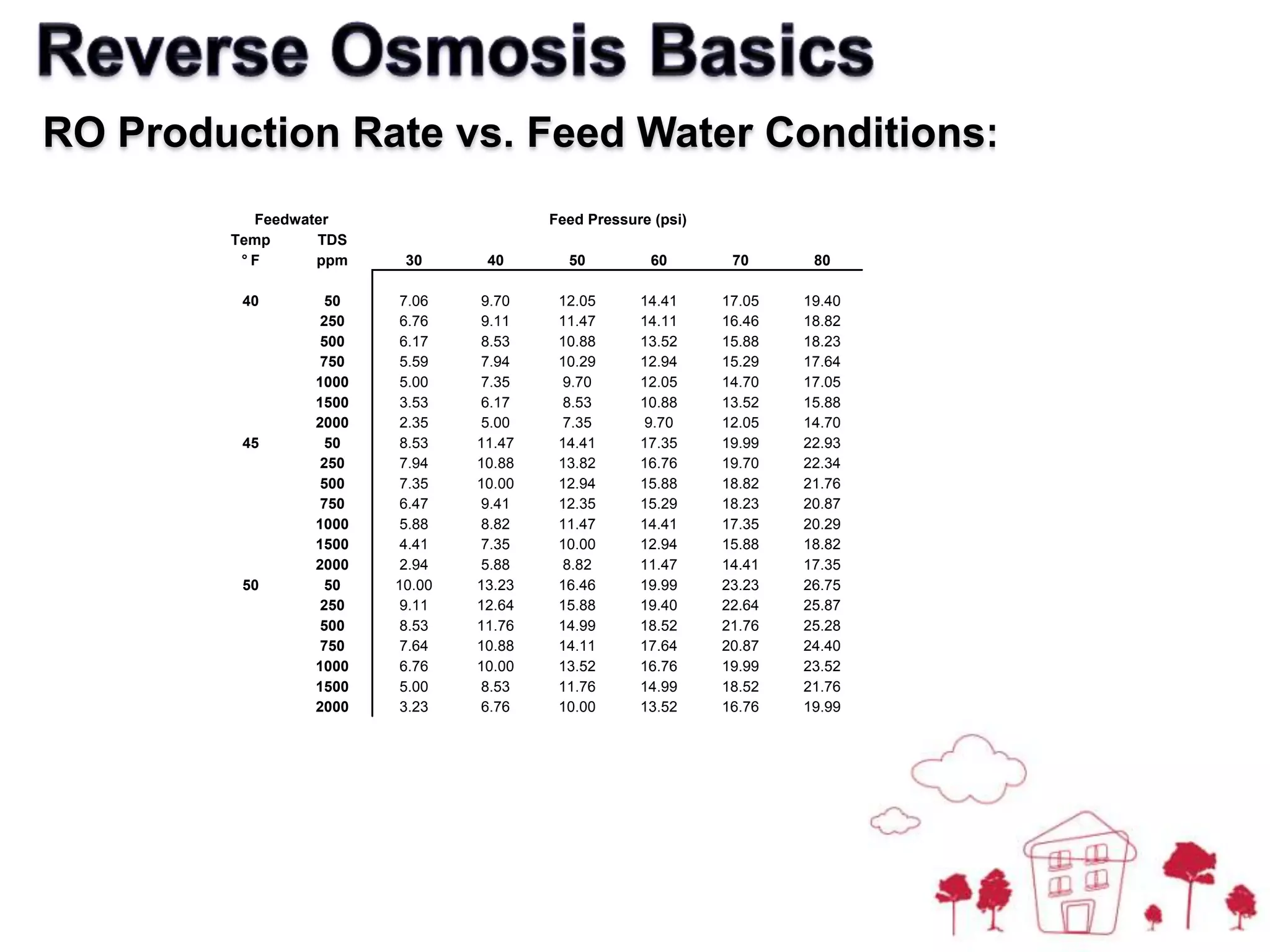
Carbonpre filters are vital in the life of this membrane & must be changed regularlyReverse Osmosis BasicsParameters that affect RO:Water Temperature: RO system ratings are based on 770F/ 250C water temperaturei.e. : RO system rated at 20 GPD (gallons per day) at 340F/10C will only produce 6 GPDFeed Water Pressure: A lack in water pressure (less than 40 PSI) will reduce product water; this can be helped with the aid of a booster pumpContaminants in Feed Water: Large particles, iron concentration or high levels of hardness in feed water can cause clogging of the membrane Clogging of the membrane can decrease its lifeMicroorganisms: RO membranes can filter out bacteria, depending on the bacteria size, however this may cause fouling of the membrane as bacteria can begin to grow through pores of membrane causing BACTERIA CREEP – RO systems should not be installed on non-potable water
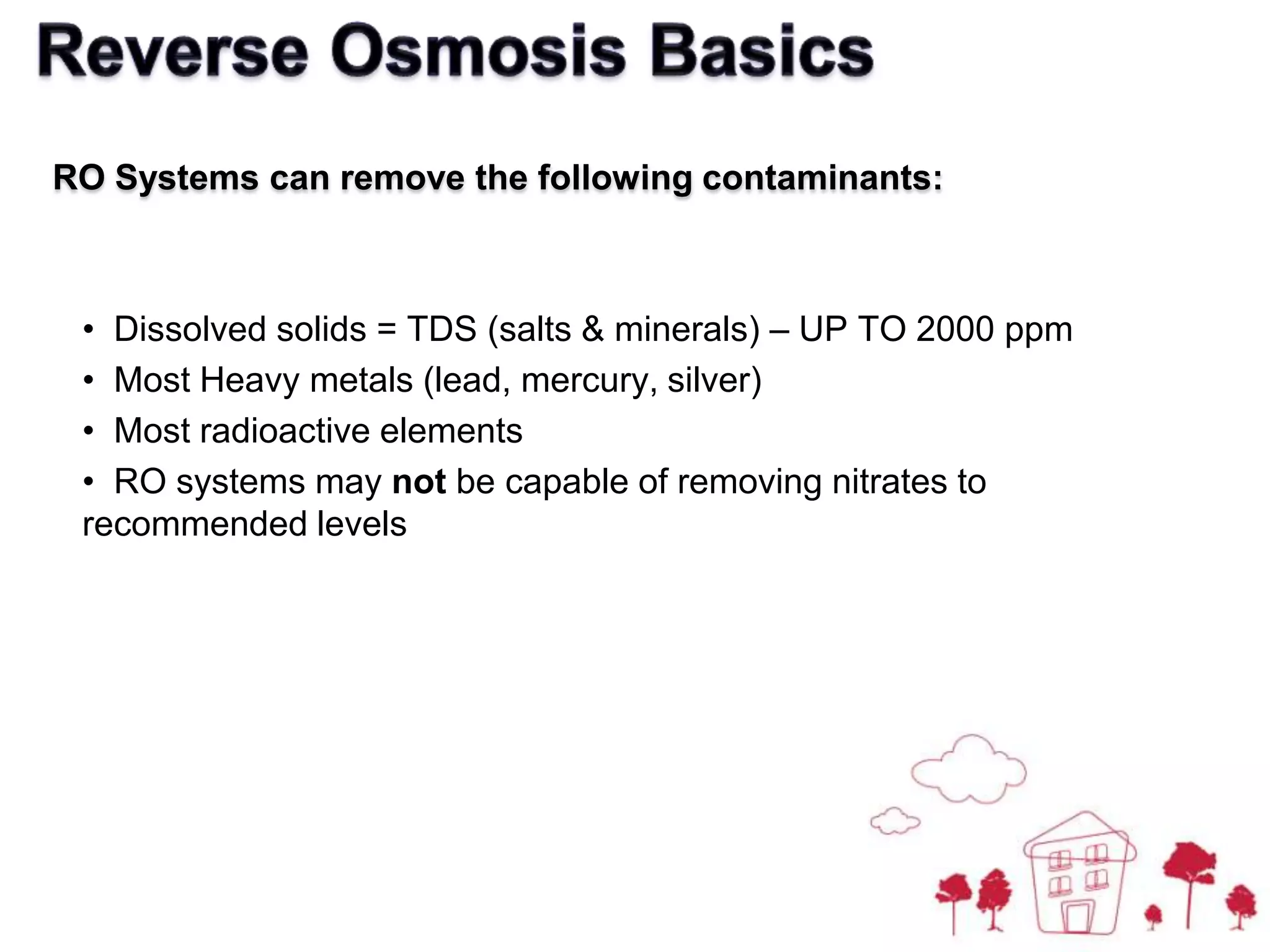
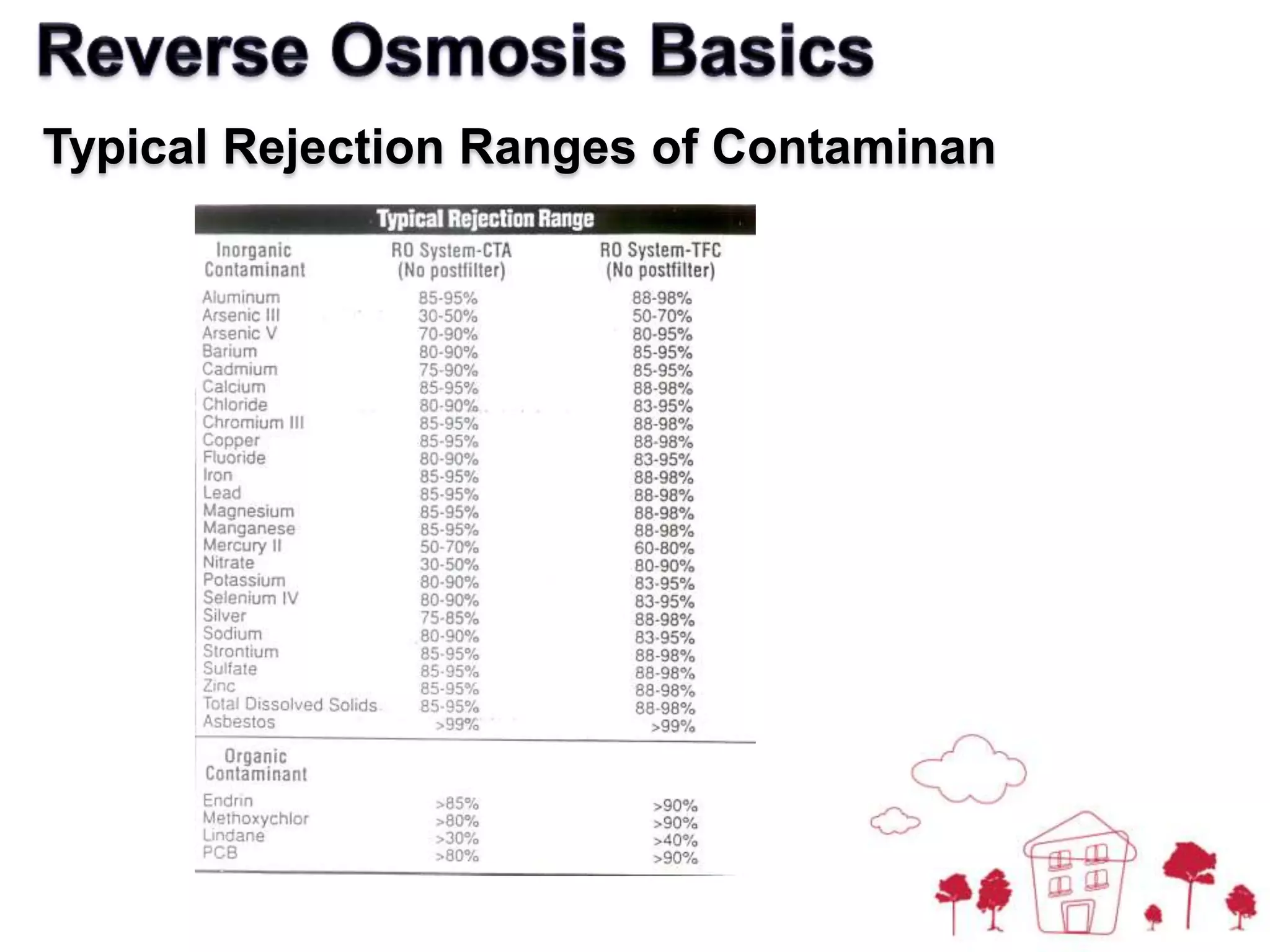
ROsystems may not be capable of removing nitrates to recommended levelsReverse Osmosis BasicsTypical Rejection Ranges of Contaminants:
46.
Reverse Osmosis BasicsROTreated Water: RO systems will remove up to 97% (depending on parameters) of salts in water bringing it closer to a level of ‘pure water’
47.
Thepurer the water, the more aggressive it will be with materials it comes in contact with
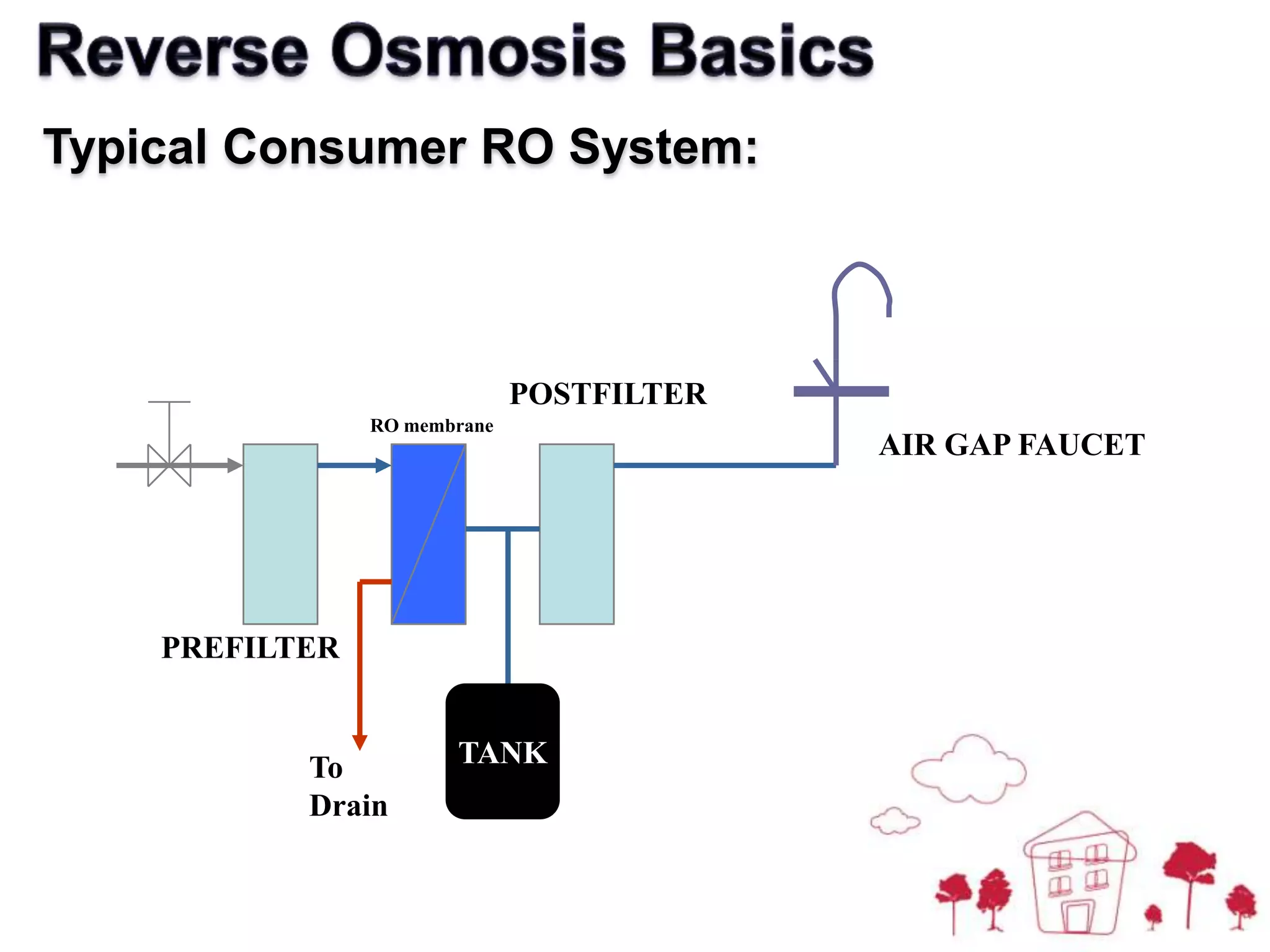
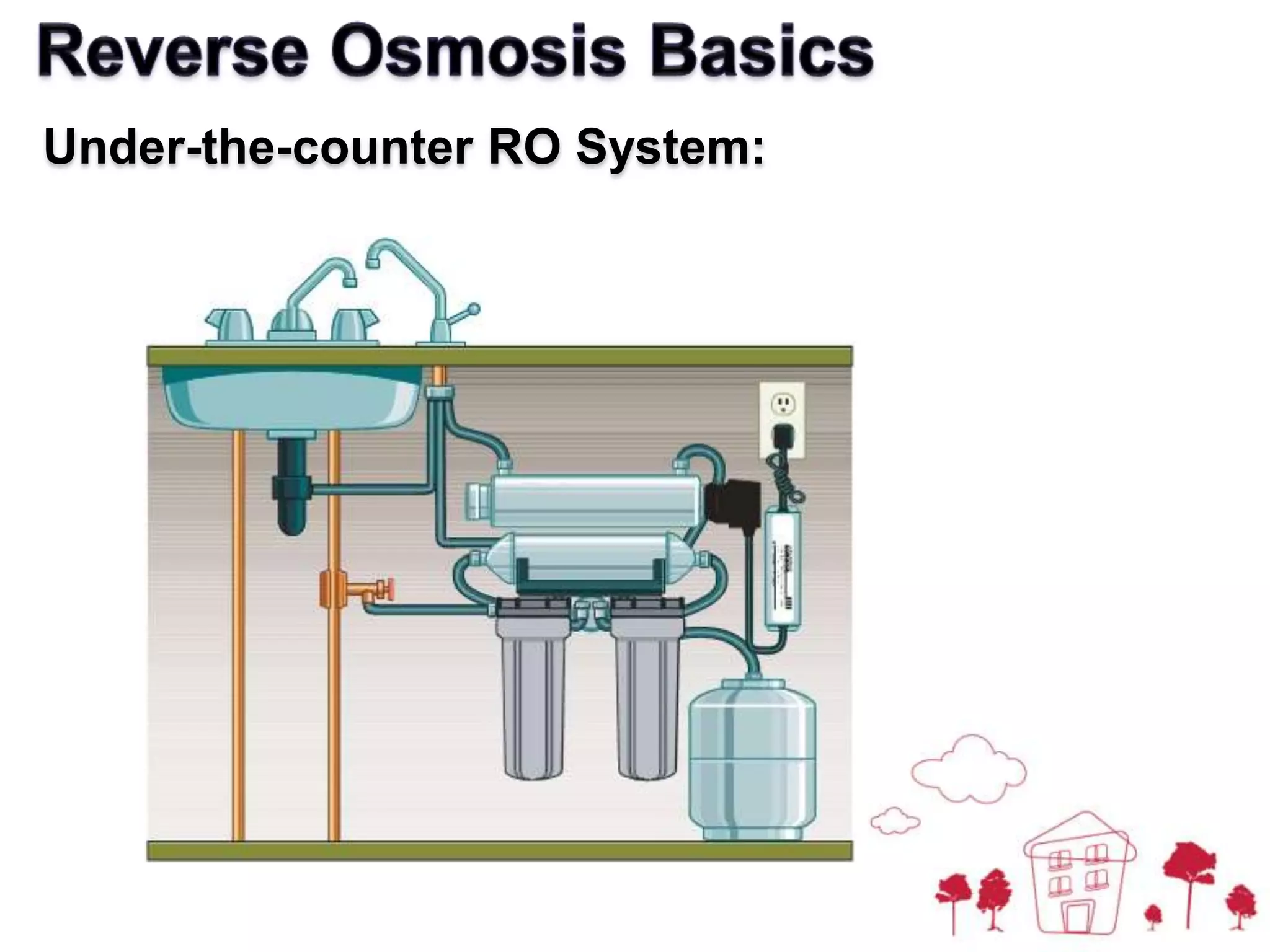
It’srecommended NEVER to use copper piping on RO water Reverse Osmosis BasicsTypical Consumer RO System:POSTFILTERRO membraneAIR GAP FAUCETPREFILTERTANKToDrain
Reverse Osmosis BasicsAir-GapFaucets: ‘Air gap’ faucet is a plumbing device designed to provide a siphon break for an under-sink reverse osmosis unit
52.
Itis a valve used to isolate one part of a water system from the drain
53.
Airgaps are designed to prevent backflow by incorporating a “backflow prevention” method called an ‘air gap’
54.
Purposeof an air gap faucet is to assure that no water from a stopped-up sink can possibly be forced backward into your reverse osmosis system unit via its drain connection
55.
Someplumbing codes do enforce the use of an Air Gap faucetReverse Osmosis BasicsRO System Maintenance:When to Replace Pre-filters:When to Replace Post-filters:Every 6 months for normal installations.
56.
After a BoilWater Advisory (BWA)Every 6 months, depending on water conditions.Noticeable decrease in water production indicates that the prefilter should be changed.After microbiological contamination, such as in a Boil Water Advisory (BWA)
57.
Reverse Osmosis BasicsROSystem Maintenance:When to Replace the Membrane Typically, every 18 months to 3 years
58.
Test usinga TDS (total dissolved solids) meter. Replace a membrane below 80% TDS reduction.
59.
Thiswill depend on influent water quality, usage, pre & post filter maintenance
60.
Maintainfilters, lengthen life of membrane!!!Reverse Osmosis BasicsTroubleshooting:Q: I have an RO system & there is water coming out the back of the faucet. What’s wrong?A:You probably have an air gap style faucet. What is most likely happening is there may be a clog or kink in the RO drain line causing water to come through the hole at the back of the faucetQ:What if my hardness level is more than 7 gpg?A:The hardness level of your water will tend to foul the membrane of the system.Q:Is it true that RO systems waste a lot of water? A:With some RO systems it take as much as 10 gallons of water to produce one gallon. This is an extreme case but most ‘high quality’ systems will have a 3:1 ratioQ:Should you use copper tubing with RO systems?A:NO. RO systems reduce up to 97% of TDS in water. The aggressiveness of the purified water toward materials it comes in contact with is a function of its purity. The better the purity the higher its aggressiveness.
61.
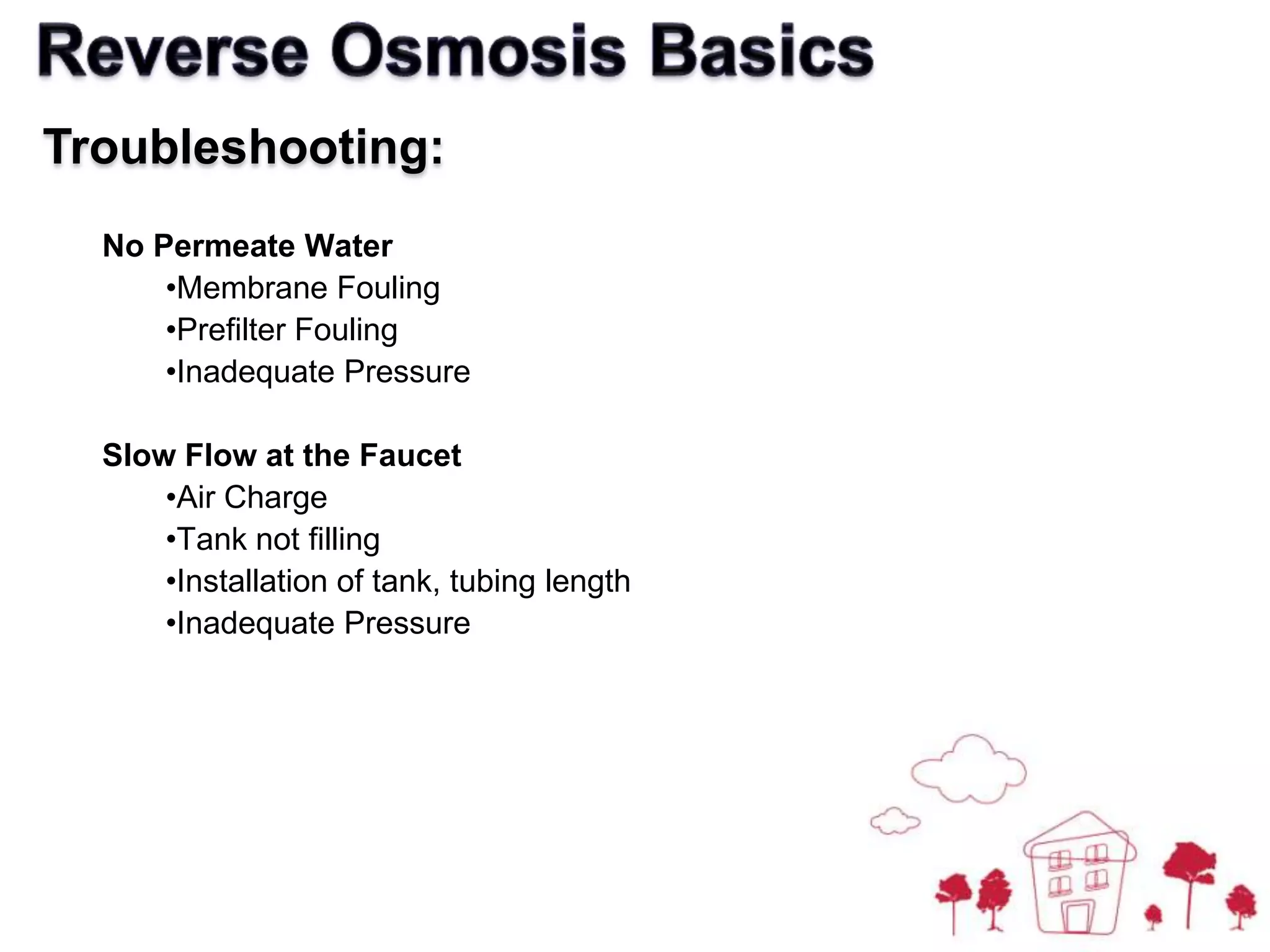
Reverse Osmosis BasicsTroubleshooting:Q: My RO continues to run. What is wrong?A: Shut off valve could be defective ORA: Check the storage tank; it might not have enough air in it. The tank should have 7 lbs of air in it when empty. Too much air will cause an RO to shut off permanently Q: I have installed my RO but am not getting much water from faucet. I do hear water running. What is wrong?A: For a residential system it takes a long time to product RO water. Faucet needs to be in ‘off’ position & then the tank will fill slowly. If a system is rated at 30 USGPM then it will take one full day to produce that 30 USGPM. The water you hear running is the reject stream going to drain.Q: My RO system seems to work but when I want to get 3 gallons of water at once I can’t get anything. Is this normal?A: Most RO systems come with a 3-4 gallon storage tank.
Inadequate PressureReverse OsmosisBasicsQuick Connect Fittings: RO systems cannot be installed using copper piping as product water is slightly aggressive
68.
Plastictubing is most commonly used in RO installations
69.
Pipeconnections are accomplished using Quick Connect Fittings
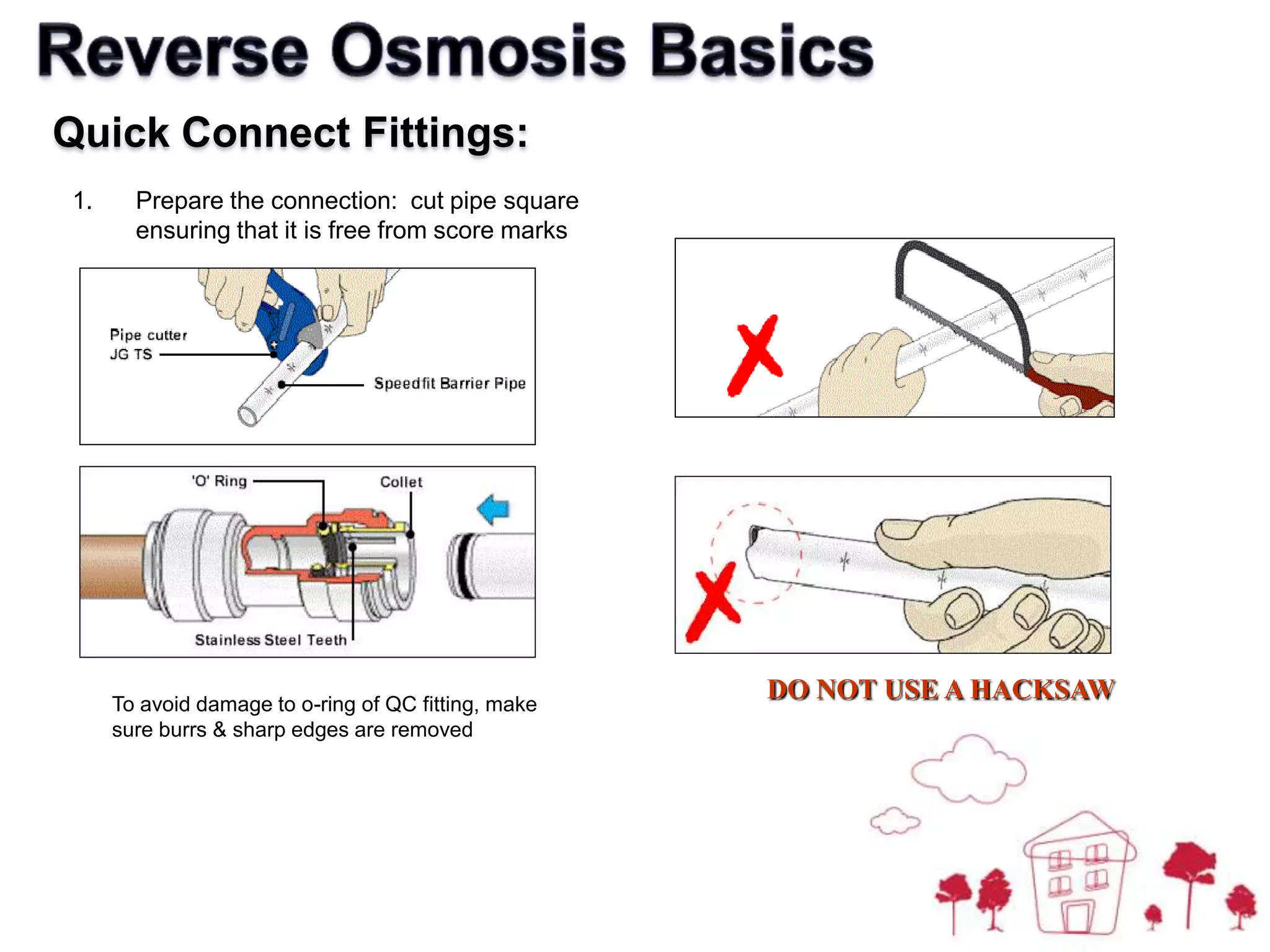
Simplycut tube square & insert into QCfitting to accomplish a secure connectionReverse Osmosis BasicsQuick Connect Fittings:Prepare the connection: cut pipe square ensuring that it is free from score marksDO NOT USE A HACKSAWTo avoid damage to o-ring of QCfitting, makesure burrs & sharp edges are removed