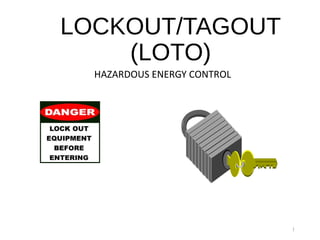
LOCKOUT/TAGOUT
(LOTO)
HAZARDOUS ENERGY CONTROL
1
OBJECTIVE
1910.147
• To protect employees from hazards associated
with the unexpected energizing, start up of
electrical or mechanical equipment, or release
of stored energy
2
RESPONSIBILITIES OF EMPLOYERS
• Develop LOTO procedures for specific pieces of
equipment
• Certify annual audits are performed for all
equipment-specific procedures
• Identify authorized and affected employees and
create an authorization list on the basis of
equipment type
• Ensure employees attend and complete required
training
3
DEFINITIONS
• Affected employee – Uses the equipment that is
being worked on
• Authorized employee – a person who physically
locks out or tags out machines or equipment in
order to perform servicing or maintenance on
machines or equipment
4
DEFINITIONS
• Energy source – source of electrical, mechanical,
hydraulic, pneumatic, chemical, thermal, or other
energy, including stored or gravitational energy
• Hot Tap – Repair, maintenance and service
activities which involves welding on equipment
under pressure without the interruption of service.
• Lockout – placing the lock
• Lockout device –a lock, blind flange, bolted slip
blind, gravitational block.
5
DEFINITIONS
• Tagout – placing a tagout device
• Tagout device – the tag
7
TRAINING
• Employees who participate in LOTO must be
trained prior to participation
8
2 LEVELS OF TRAINING
1“Affected” Employee
2“Authorized” Employee
9
TRAINING FOR “AUTHORIZED”
EMPLOYEE
Training will include:
• Applicable hazardous energy sources
• Type and magnitude of energy available in the
workplace
• Methods and means necessary for energy isolation
and control
10
TRAINING FOR “AFFECTED” EMPLOYEE
Training will include:
• The purpose and use of energy control procedures
• Prohibition relating to attempts to restart or
reenergize machines or equipment which have
been locked or tagged out
• Authority to place a tag (“Do Not Use”)
11
RETRAINING
• When there is a change in the LOTO program
• Whenever job changes or changes in equipment
present a new hazard
• Whenever procedures are not followed
12
HAZARDOUS ENERGY
• Electrical
• Mechanical
• Stored energy
• Gravitational
• Chemical
• Fuel
• Thermal
13
Requirements for
Lockout/Tagout Devices
14
must be singularly identifiedmust be singularly identified
must be the only devices used for controllingmust be the only devices used for controlling
hazardous energyhazardous energy
must meet the following requirementsmust meet the following requirements.
Durable
Lockout and tagout devices must:
• Withstand the environment to which they are
exposed for the duration of the expected exposure
• Must be constructed and printed so that they do
not deteriorate or become illegible, especially
when used in corrosive (acid and alkali chemicals)
or wet environments.
15
Standardized
Both lockout and tagout devices must:
• Be standardized according to either color, shape, or
size
• Be standardized according to print and format.
16
Substantial
Lockout and tagout devices must:
• Be substantial enough to minimize early or
accidental removal
• Locks must be substantial to prevent removal
except by excessive force of special tools such as
bolt cutters or other metal cutting tools
• The tag means of attachment must be non-
reusable, attachable by hand, self-locking and non-
releasable, with a minimum unlocking strength of
no less than 50 pounds
17
An energy-isolating device is considered capable of
being locked out if it meets one of the following
requirements:
• It is designed with a hasp to which a lock can be
attached;
• It is designed with any other integral part through
which a lock can be affixed;
• It has a locking mechanism built into it; or
• It can be locked without dismantling, rebuilding, or
replacing the energy isolating device or permanently
altering its energy control capability.
19
Capable of being locked out
BASIC PROCEDURES
• No person shall attempt to start, energize or use a
machine or equipment that has been locked or
tagged
• LOTO shall be used prior to beginning work on any
type of equipment (if the task will expose employee’s to
potential energy)
• If a maintenance procedure for the machine is not
written, one must be written to identify and
isolate potential sources of energy prior to
beginning work
• See Appendix A
20
BASIC PROCEDURES
• A pre-job Safety Analysis will be conducted with all
affected employees prior to implementing the
LOTO procedure
• All hazardous energy is to be identified as to type,
magnitude & how to control
• Employees are not to apply locks/tags to any
equipment they are not qualified to work on
21
BASIC PROCEDURES
The standard does not apply in the following
situations:
•While servicing or maintaining cord and plugcord and plug
connectedconnected electrical equipment.equipment.
• The hazards must be controlled by unplugging the
equipment from the energy source
• The plug must be under the exclusive control of the
employee performing the service and/or
maintenance.
22
APPLYING THE LOCK
AND/OR TAG
• Authorized personnel are to affix lockout or tagout
devices to energy isolating device(s)
• Lockout devices must “hold” the energy isolating
device in a “safe” or “off” position
• Tagout devices shall be placed in such a manner
that they clearly indicate that the operation or
movement of the energy isolating device is
prohibited
23
BEFORE THE SHUTDOWN
• All locks/tags shall have the authorized person’s
name, date and reason for the isolation
permanently affixed
• Notify all affected employees that LOTO is to be
used
24
SHUT DOWN
• Shut the equipment down using normal shutdown
procedures for the piece of equipment
25
ISOLATE THE POWER SOURCE
• De-activate the energy isolating device(s)
• Control circuit devices, I.E. push buttons, selector
switches and interlocks cannot be used as the sole
means of isolating the equipment
• Stored non-electrical energy shall be blocked or
relieved
26
• Only qualified persons may work on or near live
energized circuits
• Working on or near live energized circuits is only
approved when de-energizing creates a greater
hazard or equipment is due to operations
limitations
27
ISOLATE THE POWER
SOURCE
RELEASE OF RESIDUAL
(STORED) ENERGY
• Residual energy must be bled, blocked,
repositioned, grounded or otherwise restrained.
Some examples are:
• Capacitors
• Springs
• Hydraulic systems
• Rotating flywheels
• Air, gas, steam or water pressure
28
VERIFY ISOLATION
• First, check that no personnel are exposed
• Operate the start button or other means to insure
the equipment will not start
• Return operating control(s) to “neutral” or “off”
positions after verification of isolation
• Using testing equipment, test the circuit elements
and electrical parts of equipment
• Machine or equipment is now ready to be worked
on
29
RESTORING EQUIPMENT
Check around machine to insure all non-essential
items been removed from the area and equipment
components are operationally intact. Replace all
guards, remove tools, clean up area
Give notification to employees and insure they are
safely positioned
Remove lockout/tagout device(s)
Notify affected employees that work is complete
and the machine is ready for normal use
30
REMOVAL OF LOCK/TAGS
• Can only be done by the employee who placed
them
31
REMOVAL OF LOCK/TAGS
• If employee leaves the facility, you must:
• Make every effort to locate employee
• Remove employee’s lock after insuring all tools are
removed, guards are in place and all employees are
safely positioned
• Immediately contact the employee & notify him/her
that their lock & tag has been removed
32
SHIFT OR PERSONNEL CHANGES
• Locks that are in place at shift change must be
replaced by the oncoming shift before the first
shift can remove their locks
33
WHEN A LOCKOUT DEVICE
CANNOT BE USED
• You must demonstrate that tagout alone will
provide a level of safety equivalent to using a lock
• A tag used without a lock shall be supplemented
with at least one other safety measure that
obtains equivalent safety as if using a lock, I.E.
removal of a circuit element, blocking a controlling
switch or opening an extra disconnecting device
• DO NOT USE THIS AS A COP-OUT-Check valves
34
EQUIPMENT NOT
LOCKABLE
• Whenever replacement, major repair, renovation,
modification or revamp of a machine or equipment
is performed and when new machines are installed
they shall be capable of accepting a lockout device
35
37
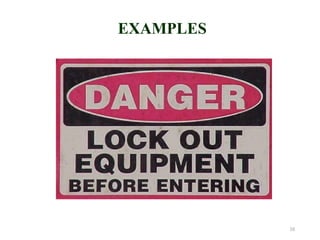
EXAMPLES
38
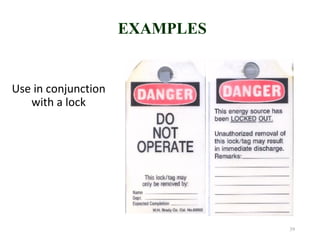
EXAMPLES
Use in conjunction
with a lock
39
EXAMPLES
40
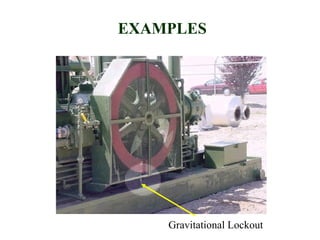
Gravitational Lockout
EXAMPLES
41
Gravitational Lockout
EXAMPLES
42
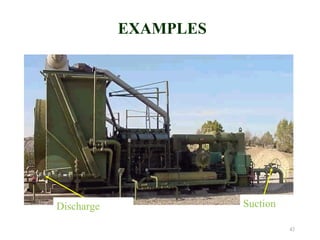
SuctionDischarge
EXAMPLES
43
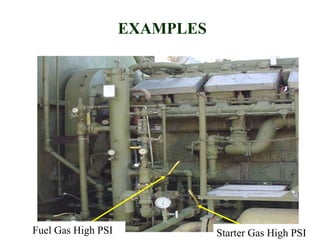
Fuel Gas High PSI Starter Gas High PSI
EXAMPLES
44
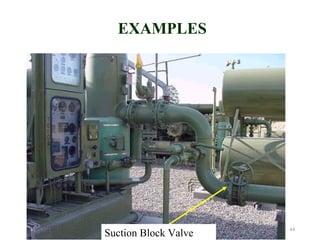
Suction Block Valve
EXAMPLES
45
Dump Block Valve
EXAMPLES
46
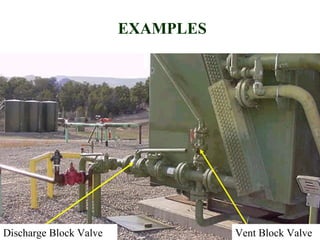
Discharge Block Valve Vent Block Valve
EXAMPLES
47
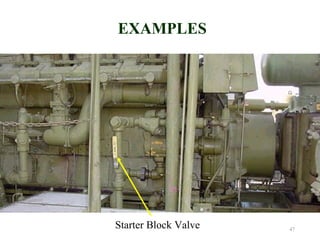
Starter Block Valve
EXAMPLES
48
Suction Valve
EXAMPLES
49
Push To Start Valve
Press after closing starter valve to bleed residual pressure from start
EXAMPLES
51
Vent or Blow Down Valve-
Caution – Remember multiple units
can be tied into vent system and/or
vent system could be pressurized
EXAMPLES
53

Lockout/Tagout

  • 1.
  • 2.
    OBJECTIVE 1910.147 • To protectemployees from hazards associated with the unexpected energizing, start up of electrical or mechanical equipment, or release of stored energy 2
  • 3.
    RESPONSIBILITIES OF EMPLOYERS •Develop LOTO procedures for specific pieces of equipment • Certify annual audits are performed for all equipment-specific procedures • Identify authorized and affected employees and create an authorization list on the basis of equipment type • Ensure employees attend and complete required training 3
  • 4.
    DEFINITIONS • Affected employee– Uses the equipment that is being worked on • Authorized employee – a person who physically locks out or tags out machines or equipment in order to perform servicing or maintenance on machines or equipment 4
  • 5.
    DEFINITIONS • Energy source– source of electrical, mechanical, hydraulic, pneumatic, chemical, thermal, or other energy, including stored or gravitational energy • Hot Tap – Repair, maintenance and service activities which involves welding on equipment under pressure without the interruption of service. • Lockout – placing the lock • Lockout device –a lock, blind flange, bolted slip blind, gravitational block. 5
  • 6.
    DEFINITIONS • Tagout –placing a tagout device • Tagout device – the tag 7
  • 7.
    TRAINING • Employees whoparticipate in LOTO must be trained prior to participation 8
  • 8.
    2 LEVELS OFTRAINING 1“Affected” Employee 2“Authorized” Employee 9
  • 9.
    TRAINING FOR “AUTHORIZED” EMPLOYEE Trainingwill include: • Applicable hazardous energy sources • Type and magnitude of energy available in the workplace • Methods and means necessary for energy isolation and control 10
  • 10.
    TRAINING FOR “AFFECTED”EMPLOYEE Training will include: • The purpose and use of energy control procedures • Prohibition relating to attempts to restart or reenergize machines or equipment which have been locked or tagged out • Authority to place a tag (“Do Not Use”) 11
  • 11.
    RETRAINING • When thereis a change in the LOTO program • Whenever job changes or changes in equipment present a new hazard • Whenever procedures are not followed 12
  • 12.
    HAZARDOUS ENERGY • Electrical •Mechanical • Stored energy • Gravitational • Chemical • Fuel • Thermal 13
  • 13.
    Requirements for Lockout/Tagout Devices 14 mustbe singularly identifiedmust be singularly identified must be the only devices used for controllingmust be the only devices used for controlling hazardous energyhazardous energy must meet the following requirementsmust meet the following requirements.
  • 14.
    Durable Lockout and tagoutdevices must: • Withstand the environment to which they are exposed for the duration of the expected exposure • Must be constructed and printed so that they do not deteriorate or become illegible, especially when used in corrosive (acid and alkali chemicals) or wet environments. 15
  • 15.
    Standardized Both lockout andtagout devices must: • Be standardized according to either color, shape, or size • Be standardized according to print and format. 16
  • 16.
    Substantial Lockout and tagoutdevices must: • Be substantial enough to minimize early or accidental removal • Locks must be substantial to prevent removal except by excessive force of special tools such as bolt cutters or other metal cutting tools • The tag means of attachment must be non- reusable, attachable by hand, self-locking and non- releasable, with a minimum unlocking strength of no less than 50 pounds 17
  • 17.
    An energy-isolating deviceis considered capable of being locked out if it meets one of the following requirements: • It is designed with a hasp to which a lock can be attached; • It is designed with any other integral part through which a lock can be affixed; • It has a locking mechanism built into it; or • It can be locked without dismantling, rebuilding, or replacing the energy isolating device or permanently altering its energy control capability. 19 Capable of being locked out
  • 18.
    BASIC PROCEDURES • Noperson shall attempt to start, energize or use a machine or equipment that has been locked or tagged • LOTO shall be used prior to beginning work on any type of equipment (if the task will expose employee’s to potential energy) • If a maintenance procedure for the machine is not written, one must be written to identify and isolate potential sources of energy prior to beginning work • See Appendix A 20
  • 19.
    BASIC PROCEDURES • Apre-job Safety Analysis will be conducted with all affected employees prior to implementing the LOTO procedure • All hazardous energy is to be identified as to type, magnitude & how to control • Employees are not to apply locks/tags to any equipment they are not qualified to work on 21
  • 20.
    BASIC PROCEDURES The standarddoes not apply in the following situations: •While servicing or maintaining cord and plugcord and plug connectedconnected electrical equipment.equipment. • The hazards must be controlled by unplugging the equipment from the energy source • The plug must be under the exclusive control of the employee performing the service and/or maintenance. 22
  • 21.
    APPLYING THE LOCK AND/ORTAG • Authorized personnel are to affix lockout or tagout devices to energy isolating device(s) • Lockout devices must “hold” the energy isolating device in a “safe” or “off” position • Tagout devices shall be placed in such a manner that they clearly indicate that the operation or movement of the energy isolating device is prohibited 23
  • 22.
    BEFORE THE SHUTDOWN •All locks/tags shall have the authorized person’s name, date and reason for the isolation permanently affixed • Notify all affected employees that LOTO is to be used 24
  • 23.
    SHUT DOWN • Shutthe equipment down using normal shutdown procedures for the piece of equipment 25
  • 24.
    ISOLATE THE POWERSOURCE • De-activate the energy isolating device(s) • Control circuit devices, I.E. push buttons, selector switches and interlocks cannot be used as the sole means of isolating the equipment • Stored non-electrical energy shall be blocked or relieved 26
  • 25.
    • Only qualifiedpersons may work on or near live energized circuits • Working on or near live energized circuits is only approved when de-energizing creates a greater hazard or equipment is due to operations limitations 27 ISOLATE THE POWER SOURCE
  • 26.
    RELEASE OF RESIDUAL (STORED)ENERGY • Residual energy must be bled, blocked, repositioned, grounded or otherwise restrained. Some examples are: • Capacitors • Springs • Hydraulic systems • Rotating flywheels • Air, gas, steam or water pressure 28
  • 27.
    VERIFY ISOLATION • First,check that no personnel are exposed • Operate the start button or other means to insure the equipment will not start • Return operating control(s) to “neutral” or “off” positions after verification of isolation • Using testing equipment, test the circuit elements and electrical parts of equipment • Machine or equipment is now ready to be worked on 29
  • 28.
    RESTORING EQUIPMENT Check aroundmachine to insure all non-essential items been removed from the area and equipment components are operationally intact. Replace all guards, remove tools, clean up area Give notification to employees and insure they are safely positioned Remove lockout/tagout device(s) Notify affected employees that work is complete and the machine is ready for normal use 30
  • 29.
    REMOVAL OF LOCK/TAGS •Can only be done by the employee who placed them 31
  • 30.
    REMOVAL OF LOCK/TAGS •If employee leaves the facility, you must: • Make every effort to locate employee • Remove employee’s lock after insuring all tools are removed, guards are in place and all employees are safely positioned • Immediately contact the employee & notify him/her that their lock & tag has been removed 32
  • 31.
    SHIFT OR PERSONNELCHANGES • Locks that are in place at shift change must be replaced by the oncoming shift before the first shift can remove their locks 33
  • 32.
    WHEN A LOCKOUTDEVICE CANNOT BE USED • You must demonstrate that tagout alone will provide a level of safety equivalent to using a lock • A tag used without a lock shall be supplemented with at least one other safety measure that obtains equivalent safety as if using a lock, I.E. removal of a circuit element, blocking a controlling switch or opening an extra disconnecting device • DO NOT USE THIS AS A COP-OUT-Check valves 34
  • 33.
    EQUIPMENT NOT LOCKABLE • Wheneverreplacement, major repair, renovation, modification or revamp of a machine or equipment is performed and when new machines are installed they shall be capable of accepting a lockout device 35
  • 34.
  • 35.
  • 36.
    Use in conjunction witha lock 39 EXAMPLES
  • 37.
  • 38.
  • 39.
  • 40.
    43 Fuel Gas HighPSI Starter Gas High PSI EXAMPLES
  • 41.
  • 42.
  • 43.
    46 Discharge Block ValveVent Block Valve EXAMPLES
  • 44.
  • 45.
  • 46.
    49 Push To StartValve Press after closing starter valve to bleed residual pressure from start EXAMPLES
  • 47.
    51 Vent or BlowDown Valve- Caution – Remember multiple units can be tied into vent system and/or vent system could be pressurized EXAMPLES
  • 48.

Editor's Notes

  • #41 This is Gravitational