Solving Rational Equations
Solving Rational Inequalities
Rational Functions
Chapter 2
Leonard Jay L. Panal
Mathematics Department
Mindanao State University Main Campus
Marawi City
nard.001jay@gmail.com
November 4, 2024
L. Panal MATH 001 - General Mathematics
Solving Rational Equations
Solving Rational Inequalities
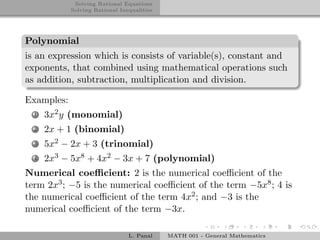
Polynomial
is an expression which is consists of variable(s), constant and
exponents, that combined using mathematical operations such
as addition, subtraction, multiplication and division.
Examples:
1 3x2y (monomial)
2 2x + 1 (binomial)
3 5x2 − 2x + 3 (trinomial)
4 2x3 − 5x8 + 4x2 − 3x + 7 (polynomial)
Numerical coefficient: 2 is the numerical coefficient of the
term 2x3; −5 is the numerical coefficient of the term −5x8; 4 is
the numerical coefficient of the term 4x2; and −3 is the
numerical coefficient of the term −3x.
L. Panal MATH 001 - General Mathematics
Solving Rational Equations
Solving Rational Inequalities
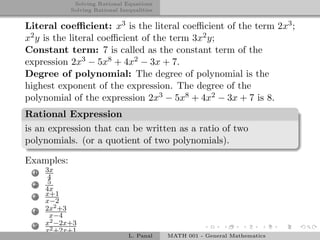
Literal coefficient: x3 is the literal coefficient of the term 2x3;
x2y is the literal coefficient of the term 3x2y;
Constant term: 7 is called as the constant term of the
expression 2x3 − 5x8 + 4x2 − 3x + 7.
Degree of polynomial: The degree of polynomial is the
highest exponent of the expression. The degree of the
polynomial of the expression 2x3 − 5x8 + 4x2 − 3x + 7 is 8.
Rational Expression
is an expression that can be written as a ratio of two
polynomials. (or a quotient of two polynomials).
Examples:
1 3x
4
2 5
4x
3 x+1
x−2
4 2x2+3
x−4
5 x2−2x+3
x2+2x+1
L. Panal MATH 001 - General Mathematics
Solving Rational Equations
Solving Rational Inequalities
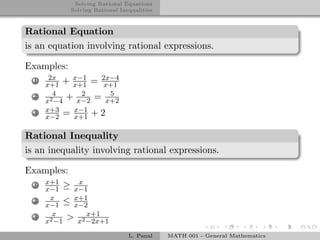
Rational Equation
is an equation involving rational expressions.
Examples:
1 2x
x+1 + x−1
x+1 = 2x−4
x+1
2 4
x2−4
+ 2
x−2 = 5
x+2
3 x+3
x−2 = x−1
x+1 + 2
Rational Inequality
is an inequality involving rational expressions.
Examples:
1 x+1
x−1 ≥ x
x−1
2 x
x−1 ≤ x+1
x−2
3 x
x2−1
> x+1
x2−2x+1
L. Panal MATH 001 - General Mathematics
Solving Rational Equations
Solving Rational Inequalities
Polynomial Function
is function p(x) that can be written in the form
p(x) =
anxn +a(n−1)x(n−1) +a(n−2)x(n−2) +a(n−3)x(n−3) +...+a1x+a0,
where a0, a1, ..., an ∈ R, an ̸= 0, and n is a positive integer (it
means that there is no negative and no fraction). Each addend
of the sum is a term of the polynomial function. The constants
a0, a1, ..., an are called the coefficients. The leading term
(term with highest exponent) is anxn. The leading
coefficient (coefficient of the leading term) is an. The
constant term (term with no variable) is a0.
L. Panal MATH 001 - General Mathematics
Solving Rational Equations
Solving Rational Inequalities
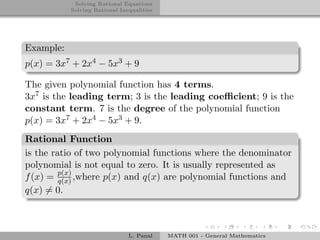
Example:
p(x) = 3x7 + 2x4 − 5x3 + 9
The given polynomial function has 4 terms.
3x7 is the leading term; 3 is the leading coefficient; 9 is the
constant term. 7 is the degree of the polynomial function
p(x) = 3x7 + 2x4 − 5x3 + 9.
Rational Function
is the ratio of two polynomial functions where the denominator
polynomial is not equal to zero. It is usually represented as
f(x) = p(x)
q(x) ,where p(x) and q(x) are polynomial functions and
q(x) ̸= 0.
L. Panal MATH 001 - General Mathematics
Solving Rational Equations
Solving Rational Inequalities
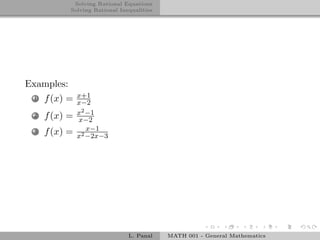
Examples:
1 f(x) = x+1
x−2
2 f(x) = x2−1
x−2
3 f(x) = x−1
x2−2x−3
L. Panal MATH 001 - General Mathematics
Solving Rational Equations
Solving Rational Inequalities
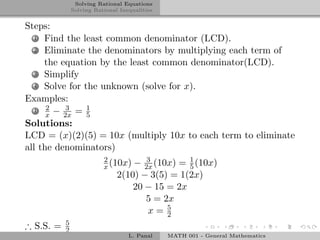
Steps:
1 Find the least common denominator (LCD).
2 Eliminate the denominators by multiplying each term of
the equation by the least common denominator(LCD).
3 Simplify
4 Solve for the unknown (solve for x).
Examples:
1 2
x − 3
2x = 1
5
Solutions:
LCD = (x)(2)(5) = 10x (multiply 10x to each term to eliminate
all the denominators)
2
x(10x) − 3
2x(10x) = 1
5(10x)
2(10) − 3(5) = 1(2x)
20 − 15 = 2x
5 = 2x
x = 5
2
∴ S.S. = 5
2
L. Panal MATH 001 - General Mathematics
Solving Rational Equations
Solving Rational Inequalities
1 x+3
x−2 = x−1
x+1 + 2
Solutions:
LCD = (x − 2)(x + 1)
(x − 2)(x + 1)[x+3
x−2] = [x−1
x+1 ](x − 2)(x + 1) + 2(x − 2)(x + 1)
(x + 1)(x + 3) = (x − 1)(x − 2) + 2(x − 2)(x + 1)
x2 + 4x + 3 = (x2 − 3x + 2) + 2(x2 − x − 2)
x2 + 4x + 3 = (x2 − 3x + 2) + (2x2 − 2x − 4)
x2 + 4x + 3 = 3x2 − 5x − 2
3x2 − 6x − 2 − x2 − 4x − 3 = 0
2x2 − 9x − 5 = 0
(2x + 1)(x − 5) = 0
2x + 1 = 0 ; x − 5 = 0
x = −1
2 ; x = 5
∴ S.S. = −1
2 , 5
L. Panal MATH 001 - General Mathematics
Solving Rational Equations
Solving Rational Inequalities
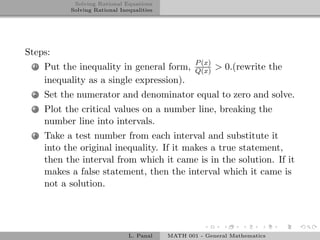
Steps:
1 Put the inequality in general form, P(x)
Q(x) > 0.(rewrite the
inequality as a single expression).
2 Set the numerator and denominator equal to zero and solve.
3 Plot the critical values on a number line, breaking the
number line into intervals.
4 Take a test number from each interval and substitute it
into the original inequality. If it makes a true statement,
then the interval from which it came is in the solution. If it
makes a false statement, then the interval which it came is
not a solution.
L. Panal MATH 001 - General Mathematics
Solving Rational Equations
Solving Rational Inequalities
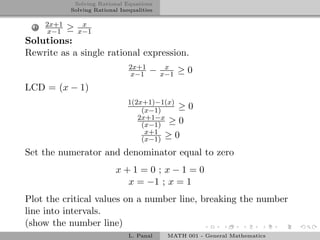
1 2x+1
x−1 ≥ x
x−1
Solutions:
Rewrite as a single rational expression.
2x+1
x−1 − x
x−1 ≥ 0
LCD = (x − 1)
1(2x+1)−1(x)
(x−1) ≥ 0
2x+1−x
(x−1) ≥ 0
x+1
(x−1) ≥ 0
Set the numerator and denominator equal to zero
x + 1 = 0 ; x − 1 = 0
x = −1 ; x = 1
Plot the critical values on a number line, breaking the number
line into intervals.
(show the number line)
L. Panal MATH 001 - General Mathematics
Solving Rational Equations
Solving Rational Inequalities
Test Points:
x ≤ −1 ; (−∞, −1]
Let x = −2
2x+1
x−1 ≥ x
x−1
2(−2)+1
(−2)−1 ≥ (−2)
(−2)−1
−4+1
−3 ≥ −2
−3
−3
−3 ≥ −2
−3
1 ≥ −2
−3 is true.
so (−∞, −1] is a solution set.
L. Panal MATH 001 - General Mathematics
Solving Rational Equations
Solving Rational Inequalities
Test Points:
−1 ≤ x < 1 ; [−1, 1)
Let x = 0
2x+1
x−1 ≥ x
x−1
2(0)+1
(0)−1 ≥ (0)
(0)−1
1
−1 ≥ 0
−1 ≥ 0 is false.
[−1, 1) is not a solution set.
L. Panal MATH 001 - General Mathematics
Solving Rational Equations
Solving Rational Inequalities
Test Points:
x > 1 ; (1, +∞)
Let x = 2
2x+1
x−1 ≥ x
x−1
2(2)+1
(2)−1 ≥ (2)
(2)−1
5
1 ≥ (2)
1
5 ≥ 2 is true.
So, (1, +∞) is a solution set.
∴ S.S. = (−∞, −1] ∪ (1, +∞)
L. Panal MATH 001 - General Mathematics
Solving Rational Equations
Solving Rational Inequalities
1 x
x−1 ≤ x+1
x+2
Solutions:
x
x−1 − x+1
x+2 ≤ 0
LCD = (x − 1)(x + 2)
x(x+2)−(x+1)(x−1)
(x−1)(x+2) ≤ 0
(x2+2x)−(x2−1)
(x−1)(x+2) ≤ 0
x2+2x−x2−1)
(x−1)(x+2) ≤ 0
2x+1
(x−1)(x+2) ≤ 0
Set the numerator and denominator equal to zero
2x + 1 = 0 ; (x − 1)(x + 2) = 0
2x = −1 ; x − 1 = 0 ; x + 2 = 0
x = −1
2 ; x = 1 ; x = −2
Plot the critical values on a number line, breaking the number
line into intervals.(show the number line)
L. Panal MATH 001 - General Mathematics
Solving Rational Equations
Solving Rational Inequalities
Test Points:
x < −2 ; (−∞, −2)
Let x = −3
(−3)
(−3)−1 ≤ (−3)+1
(−3)+2
(−3)
−4 ≤ −2
−1
(3)
4 ≤ 2 is true.
So (−∞, −2) is a solution set.
L. Panal MATH 001 - General Mathematics
Solving Rational Equations
Solving Rational Inequalities
Test Points:
−2 < x ≤ −1
2 ; (−2, −1
2]
Let x = −1
(−1)
(−1)−1 ≤ (−1)+1
(−1)+2
(−1)
−2 ≤ 0
1
1
2 ≤ 0
1
1
2 ≤ 0 is false.
So (−2, −1
2] is not a solution set.
L. Panal MATH 001 - General Mathematics
Solving Rational Equations
Solving Rational Inequalities
Test Points:
−1
2 ≤ x < 1 ; [−1
2, 1)
Let x = 0
(0)
0−1 ≤ 0+1
0+2
0
−1 ≤ 1
2
0 ≤ 1
2 is true.
So [−1
2, 1) is a solution set.
L. Panal MATH 001 - General Mathematics
Solving Rational Equations
Solving Rational Inequalities
Test Points:
x > 1 ; (1, ∞)
Let x = 2
(2)
(2)−1 ≤ (2)+1
(2)+2
2
1 ≤ 3
4
2 ≤ 3
4 is false.
(1, ∞) is not a solution set.
∴ S.S. = (−∞, −2) ∪ [−1
2, 1)
L. Panal MATH 001 - General Mathematics

Rational Function############# Rational function

  • 1.
    Solving Rational Equations SolvingRational Inequalities Rational Functions Chapter 2 Leonard Jay L. Panal Mathematics Department Mindanao State University Main Campus Marawi City nard.001jay@gmail.com November 4, 2024 L. Panal MATH 001 - General Mathematics
  • 2.
    Solving Rational Equations SolvingRational Inequalities Polynomial is an expression which is consists of variable(s), constant and exponents, that combined using mathematical operations such as addition, subtraction, multiplication and division. Examples: 1 3x2y (monomial) 2 2x + 1 (binomial) 3 5x2 − 2x + 3 (trinomial) 4 2x3 − 5x8 + 4x2 − 3x + 7 (polynomial) Numerical coefficient: 2 is the numerical coefficient of the term 2x3; −5 is the numerical coefficient of the term −5x8; 4 is the numerical coefficient of the term 4x2; and −3 is the numerical coefficient of the term −3x. L. Panal MATH 001 - General Mathematics
  • 3.
    Solving Rational Equations SolvingRational Inequalities Literal coefficient: x3 is the literal coefficient of the term 2x3; x2y is the literal coefficient of the term 3x2y; Constant term: 7 is called as the constant term of the expression 2x3 − 5x8 + 4x2 − 3x + 7. Degree of polynomial: The degree of polynomial is the highest exponent of the expression. The degree of the polynomial of the expression 2x3 − 5x8 + 4x2 − 3x + 7 is 8. Rational Expression is an expression that can be written as a ratio of two polynomials. (or a quotient of two polynomials). Examples: 1 3x 4 2 5 4x 3 x+1 x−2 4 2x2+3 x−4 5 x2−2x+3 x2+2x+1 L. Panal MATH 001 - General Mathematics
  • 4.
    Solving Rational Equations SolvingRational Inequalities Rational Equation is an equation involving rational expressions. Examples: 1 2x x+1 + x−1 x+1 = 2x−4 x+1 2 4 x2−4 + 2 x−2 = 5 x+2 3 x+3 x−2 = x−1 x+1 + 2 Rational Inequality is an inequality involving rational expressions. Examples: 1 x+1 x−1 ≥ x x−1 2 x x−1 ≤ x+1 x−2 3 x x2−1 > x+1 x2−2x+1 L. Panal MATH 001 - General Mathematics
  • 5.
    Solving Rational Equations SolvingRational Inequalities Polynomial Function is function p(x) that can be written in the form p(x) = anxn +a(n−1)x(n−1) +a(n−2)x(n−2) +a(n−3)x(n−3) +...+a1x+a0, where a0, a1, ..., an ∈ R, an ̸= 0, and n is a positive integer (it means that there is no negative and no fraction). Each addend of the sum is a term of the polynomial function. The constants a0, a1, ..., an are called the coefficients. The leading term (term with highest exponent) is anxn. The leading coefficient (coefficient of the leading term) is an. The constant term (term with no variable) is a0. L. Panal MATH 001 - General Mathematics
  • 6.
    Solving Rational Equations SolvingRational Inequalities Example: p(x) = 3x7 + 2x4 − 5x3 + 9 The given polynomial function has 4 terms. 3x7 is the leading term; 3 is the leading coefficient; 9 is the constant term. 7 is the degree of the polynomial function p(x) = 3x7 + 2x4 − 5x3 + 9. Rational Function is the ratio of two polynomial functions where the denominator polynomial is not equal to zero. It is usually represented as f(x) = p(x) q(x) ,where p(x) and q(x) are polynomial functions and q(x) ̸= 0. L. Panal MATH 001 - General Mathematics
  • 7.
    Solving Rational Equations SolvingRational Inequalities Examples: 1 f(x) = x+1 x−2 2 f(x) = x2−1 x−2 3 f(x) = x−1 x2−2x−3 L. Panal MATH 001 - General Mathematics
  • 8.
    Solving Rational Equations SolvingRational Inequalities Steps: 1 Find the least common denominator (LCD). 2 Eliminate the denominators by multiplying each term of the equation by the least common denominator(LCD). 3 Simplify 4 Solve for the unknown (solve for x). Examples: 1 2 x − 3 2x = 1 5 Solutions: LCD = (x)(2)(5) = 10x (multiply 10x to each term to eliminate all the denominators) 2 x(10x) − 3 2x(10x) = 1 5(10x) 2(10) − 3(5) = 1(2x) 20 − 15 = 2x 5 = 2x x = 5 2 ∴ S.S. = 5 2 L. Panal MATH 001 - General Mathematics
  • 9.
    Solving Rational Equations SolvingRational Inequalities 1 x+3 x−2 = x−1 x+1 + 2 Solutions: LCD = (x − 2)(x + 1) (x − 2)(x + 1)[x+3 x−2] = [x−1 x+1 ](x − 2)(x + 1) + 2(x − 2)(x + 1) (x + 1)(x + 3) = (x − 1)(x − 2) + 2(x − 2)(x + 1) x2 + 4x + 3 = (x2 − 3x + 2) + 2(x2 − x − 2) x2 + 4x + 3 = (x2 − 3x + 2) + (2x2 − 2x − 4) x2 + 4x + 3 = 3x2 − 5x − 2 3x2 − 6x − 2 − x2 − 4x − 3 = 0 2x2 − 9x − 5 = 0 (2x + 1)(x − 5) = 0 2x + 1 = 0 ; x − 5 = 0 x = −1 2 ; x = 5 ∴ S.S. = −1 2 , 5 L. Panal MATH 001 - General Mathematics
  • 10.
    Solving Rational Equations SolvingRational Inequalities Steps: 1 Put the inequality in general form, P(x) Q(x) > 0.(rewrite the inequality as a single expression). 2 Set the numerator and denominator equal to zero and solve. 3 Plot the critical values on a number line, breaking the number line into intervals. 4 Take a test number from each interval and substitute it into the original inequality. If it makes a true statement, then the interval from which it came is in the solution. If it makes a false statement, then the interval which it came is not a solution. L. Panal MATH 001 - General Mathematics
  • 11.
    Solving Rational Equations SolvingRational Inequalities 1 2x+1 x−1 ≥ x x−1 Solutions: Rewrite as a single rational expression. 2x+1 x−1 − x x−1 ≥ 0 LCD = (x − 1) 1(2x+1)−1(x) (x−1) ≥ 0 2x+1−x (x−1) ≥ 0 x+1 (x−1) ≥ 0 Set the numerator and denominator equal to zero x + 1 = 0 ; x − 1 = 0 x = −1 ; x = 1 Plot the critical values on a number line, breaking the number line into intervals. (show the number line) L. Panal MATH 001 - General Mathematics
  • 12.
    Solving Rational Equations SolvingRational Inequalities Test Points: x ≤ −1 ; (−∞, −1] Let x = −2 2x+1 x−1 ≥ x x−1 2(−2)+1 (−2)−1 ≥ (−2) (−2)−1 −4+1 −3 ≥ −2 −3 −3 −3 ≥ −2 −3 1 ≥ −2 −3 is true. so (−∞, −1] is a solution set. L. Panal MATH 001 - General Mathematics
  • 13.
    Solving Rational Equations SolvingRational Inequalities Test Points: −1 ≤ x < 1 ; [−1, 1) Let x = 0 2x+1 x−1 ≥ x x−1 2(0)+1 (0)−1 ≥ (0) (0)−1 1 −1 ≥ 0 −1 ≥ 0 is false. [−1, 1) is not a solution set. L. Panal MATH 001 - General Mathematics
  • 14.
    Solving Rational Equations SolvingRational Inequalities Test Points: x > 1 ; (1, +∞) Let x = 2 2x+1 x−1 ≥ x x−1 2(2)+1 (2)−1 ≥ (2) (2)−1 5 1 ≥ (2) 1 5 ≥ 2 is true. So, (1, +∞) is a solution set. ∴ S.S. = (−∞, −1] ∪ (1, +∞) L. Panal MATH 001 - General Mathematics
  • 15.
    Solving Rational Equations SolvingRational Inequalities 1 x x−1 ≤ x+1 x+2 Solutions: x x−1 − x+1 x+2 ≤ 0 LCD = (x − 1)(x + 2) x(x+2)−(x+1)(x−1) (x−1)(x+2) ≤ 0 (x2+2x)−(x2−1) (x−1)(x+2) ≤ 0 x2+2x−x2−1) (x−1)(x+2) ≤ 0 2x+1 (x−1)(x+2) ≤ 0 Set the numerator and denominator equal to zero 2x + 1 = 0 ; (x − 1)(x + 2) = 0 2x = −1 ; x − 1 = 0 ; x + 2 = 0 x = −1 2 ; x = 1 ; x = −2 Plot the critical values on a number line, breaking the number line into intervals.(show the number line) L. Panal MATH 001 - General Mathematics
  • 16.
    Solving Rational Equations SolvingRational Inequalities Test Points: x < −2 ; (−∞, −2) Let x = −3 (−3) (−3)−1 ≤ (−3)+1 (−3)+2 (−3) −4 ≤ −2 −1 (3) 4 ≤ 2 is true. So (−∞, −2) is a solution set. L. Panal MATH 001 - General Mathematics
  • 17.
    Solving Rational Equations SolvingRational Inequalities Test Points: −2 < x ≤ −1 2 ; (−2, −1 2] Let x = −1 (−1) (−1)−1 ≤ (−1)+1 (−1)+2 (−1) −2 ≤ 0 1 1 2 ≤ 0 1 1 2 ≤ 0 is false. So (−2, −1 2] is not a solution set. L. Panal MATH 001 - General Mathematics
  • 18.
    Solving Rational Equations SolvingRational Inequalities Test Points: −1 2 ≤ x < 1 ; [−1 2, 1) Let x = 0 (0) 0−1 ≤ 0+1 0+2 0 −1 ≤ 1 2 0 ≤ 1 2 is true. So [−1 2, 1) is a solution set. L. Panal MATH 001 - General Mathematics
  • 19.
    Solving Rational Equations SolvingRational Inequalities Test Points: x > 1 ; (1, ∞) Let x = 2 (2) (2)−1 ≤ (2)+1 (2)+2 2 1 ≤ 3 4 2 ≤ 3 4 is false. (1, ∞) is not a solution set. ∴ S.S. = (−∞, −2) ∪ [−1 2, 1) L. Panal MATH 001 - General Mathematics