28.3 Fascism in Italy
LEQ: How and why did fascism rise in
Italy?
Following World
War I, Italy was
in chaos.
• Peasants seized land.
• Workers went on strike
or seized factories.
• Returning veterans
faced unemployment.
• Trade declined.
• Taxes rose.
• The government split
into feuding factions.
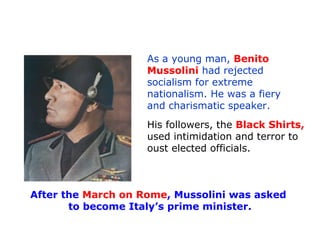
As a young man, Benito
Mussolini had rejected
socialism for extreme
nationalism. He was a fiery
and charismatic speaker.
His followers, the Black Shirts,
used intimidation and terror to
oust elected officials.
After the March on Rome, Mussolini was asked
to become Italy’s prime minister.
• Suppressed rival
parties
• Muzzled the press
• Rigged elections
• Replaced elected
officials with his
supporters
By 1925, Mussolini
had taken the title
“The Leader” and
ruled Italy as a
dictator. He:
Mussolini preserved capitalism, but took control
of the state. He favored the wealthy at the
expense of the workers.
• Men were urged to be selfless
warriors fighting for Italy.
• Women were pushed out of
paying jobs to bear more
children.
• Children were taught to obey
strict military discipline.
To Fascists,
the glorious
state was
all-important.
Mussolini built the first totalitarian state in which
he regulated every aspect of the peoples’ lives.
• Fascism encouraged extreme nationalism and
loyalty to the state.
• It glorified violence, war, and discipline.
• It aggressively pursued foreign expansion.
• totalitarian state – a one-party dictatorship that regulates
every aspect of the lives of
its citizens
• fascism – any centralized, authoritarian government that is
not communist whose policies glorify the state over the
individual and are destructive to basic human rights
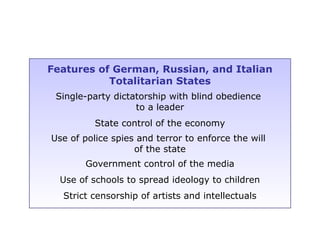
Features of German, Russian, and Italian
Totalitarian States
Single-party dictatorship with blind obedience
to a leader
State control of the economy
Use of police spies and terror to enforce the will
of the state
Government control of the media
Use of schools to spread ideology to children
Strict censorship of artists and intellectuals
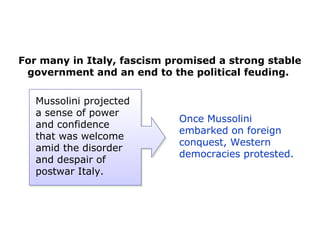
For many in Italy, fascism promised a strong stable
government and an end to the political feuding.
Once Mussolini
embarked on foreign
conquest, Western
democracies protested.
Mussolini projected
a sense of power
and confidence
that was welcome
amid the disorder
and despair of
postwar Italy.
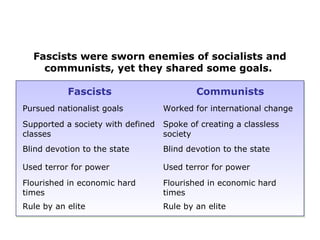
Fascists Communists
Pursued nationalist goals Worked for international change
Supported a society with defined
classes
Spoke of creating a classless
society
Blind devotion to the state Blind devotion to the state
Used terror for power Used terror for power
Flourished in economic hard
times
Flourished in economic hard
times
Rule by an elite Rule by an elite
Fascists were sworn enemies of socialists and
communists, yet they shared some goals.
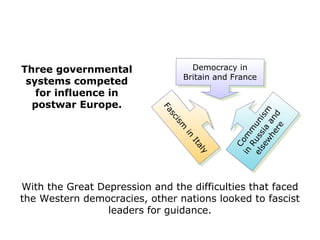
With the Great Depression and the difficulties that faced
the Western democracies, other nations looked to fascist
leaders for guidance.
Three governmental
systems competed
for influence in
postwar Europe.
Democracy in
Britain and France
Fascism
in
Italy
Com
m
unism
in
Russia
and
elsew
here
The fascists, led by Mussolini, took advantage of
Italy’s postwar turmoil to seize control of the nation.
LEQ: How and why did fascism rise in Italy?

28 3 facism in italy

  • 1.
  • 2.
    LEQ: How andwhy did fascism rise in Italy?
  • 3.
    Following World War I,Italy was in chaos. • Peasants seized land. • Workers went on strike or seized factories. • Returning veterans faced unemployment. • Trade declined. • Taxes rose. • The government split into feuding factions.
  • 4.
    As a youngman, Benito Mussolini had rejected socialism for extreme nationalism. He was a fiery and charismatic speaker. His followers, the Black Shirts, used intimidation and terror to oust elected officials. After the March on Rome, Mussolini was asked to become Italy’s prime minister.
  • 5.
    • Suppressed rival parties •Muzzled the press • Rigged elections • Replaced elected officials with his supporters By 1925, Mussolini had taken the title “The Leader” and ruled Italy as a dictator. He:
  • 6.
    Mussolini preserved capitalism,but took control of the state. He favored the wealthy at the expense of the workers. • Men were urged to be selfless warriors fighting for Italy. • Women were pushed out of paying jobs to bear more children. • Children were taught to obey strict military discipline. To Fascists, the glorious state was all-important.
  • 7.
    Mussolini built thefirst totalitarian state in which he regulated every aspect of the peoples’ lives. • Fascism encouraged extreme nationalism and loyalty to the state. • It glorified violence, war, and discipline. • It aggressively pursued foreign expansion. • totalitarian state – a one-party dictatorship that regulates every aspect of the lives of its citizens • fascism – any centralized, authoritarian government that is not communist whose policies glorify the state over the individual and are destructive to basic human rights
  • 8.
    Features of German,Russian, and Italian Totalitarian States Single-party dictatorship with blind obedience to a leader State control of the economy Use of police spies and terror to enforce the will of the state Government control of the media Use of schools to spread ideology to children Strict censorship of artists and intellectuals
  • 9.
    For many inItaly, fascism promised a strong stable government and an end to the political feuding. Once Mussolini embarked on foreign conquest, Western democracies protested. Mussolini projected a sense of power and confidence that was welcome amid the disorder and despair of postwar Italy.
  • 10.
    Fascists Communists Pursued nationalistgoals Worked for international change Supported a society with defined classes Spoke of creating a classless society Blind devotion to the state Blind devotion to the state Used terror for power Used terror for power Flourished in economic hard times Flourished in economic hard times Rule by an elite Rule by an elite Fascists were sworn enemies of socialists and communists, yet they shared some goals.
  • 11.
    With the GreatDepression and the difficulties that faced the Western democracies, other nations looked to fascist leaders for guidance. Three governmental systems competed for influence in postwar Europe. Democracy in Britain and France Fascism in Italy Com m unism in Russia and elsew here
  • 12.
    The fascists, ledby Mussolini, took advantage of Italy’s postwar turmoil to seize control of the nation. LEQ: How and why did fascism rise in Italy?

Editor's Notes

  • #5 Benito Mussolini – Fascist leader of Italy Black Shirts – Fascist party militants March on Rome – a rally of tens of thousands of Fascists who marched on Rome in 1922 to demand government changes