DISEASES OF LENS
LENS
• Transparent, biconvex
• Diam : 9mm, thick: 4mm,
• Radius of curvature –
Ant :10mm , Post : 6mm
• Ref. index : 1.39
• Total diopteric power : +16 to
+20 D
• Lens is held by suspensory
ligaments – zonules of zinn
• STRUCTURE
1. Lens capsule :
-smooth, homogenous, highly elastic( no true elastic tissue)
- thickest(14u)- ant & post surface just central to insertion of
zonular fibres
-thinnest(3-4u)- posterior pole
2. Lens epithelium:
- single layer
-cuboidal cells
-no corresponding posterior epithelium
3. Lens substance : cortex & nucleus
-embryonic nucleus: 1st 3 months of fetal life
- fetal nucleus: 3-8 months of fetal life
- infantile nucleus- upto puberty
- adult nucleus- rest of life
Lens Anatomy
Lens transparency
• Avascularity of the lens
• Characteristic of lens fibre:
- Tightly-packed nature of lens cells
- Narrow lens fibre membranes
- Loss of organelles
• Lens proteins-MTP 26 or Aquaporin 0
• Pump mechanism of lens fibre membranes that regulate
the electrolyte and water balance in the lens, maintaining
relative dehydration
• Auto-oxidation and high concentration of reduced
glutathione in the lens
Differential diagnosis
Painless, progressive
diminution of vision
• Cataract
• Primary open angle glaucoma
• Diabetic retinopathy
• Corneal dystrophies and degenerations
• Age related macular degeneration
• Retinitis pigmentosa
Cataract
• Development of any opacity in the lens or its capsule
either due to formation of opaque lens fibres (congenital
& developmental cataracts) or due to degenerative
process leading to opacification of normally formed
transparent lens fibres (acquired cataract)
• Major cause of blindness worldwide
• Classification-
-Etiological
-Morphological
Etiological classification
I. Congenital and Developmental cataract
II. Acquired cataract
• Senile cataract
• Traumatic cataract (blunt, penetrating, radiation,
electric shock, glass blowers, infra-red)
• Complicated cataract (uveitis-induced)
• Metabolic cataract (Diabetes - snowflake, Wilson’s
disease-sunflower)
• Drug induced cataract- corticosteroids, miotics
• Cataract associated with syndromes
Morphological classification
• Capsular cataract
-Anterior
-Posterior
• Subcapsular cataract
-Anterior
-Posterior
• Cortical cataract
• Nuclear cataract
• Polar cataract
Congenital & developmental
cataracts
• When the disturbance in the normal growth of lens
occurs before birth, the child is born with a congenital
cataract. Therefore, limited to either embryonic or foetal
nucleus.
• Developmental cataract may occur from infancy to
adolescence. Therefore, involve infantile or adult
nucleus, deeper parts of cortex or capsule.
ETIOLOGY
• Idiopathic
• Heredity-
-lnherited cases without systemic disorders- AD
-Inherited cases with systemic disorders include:
• Chromosomal disorders (trisomy 21)
• Skeletal disorders (Stickler syndrome)
• Central nervous system disorders (cerebro-oculo-facial
syndrome)
• Renal system disorders (Lowe's syndrome)
• Maternal factors include:
1. Malnutrition during pregnancy
2. Infections-Rubella,Toxoplasmosis,CMV
3. Drugs ingestion-thalidomide, corticosteroids
4. Radiation exposure
• Common familial cataracts include:
• Cataracta pulverulenta
• Zonular cataract (also occurs as nonfamilial)
• Coronary cataract and total soft cataract (may
also occur due to rubella).
• Foetal or infantile factors
1. Deficient oxygenation (anoxia)
2. Birth trauma
3. Metabolic disorders- galactosemia, galactokinase
deficiency and neonatal hypoglycemia
4. Cataracts associated with other congenital anomalies-
Down's syndrome, Lowe's syndrome, myotonia
dystrophica and congenital icthyosis
5. Ocular diseases associated with developmental
cataract-PHPV, aniridia anterior chamber cleavage
syndrome, ROP,microphthalmos
6. Malnutrition
CLINICAL TYPES
• Congenital capsular cataracts 1. Anterior capsular cataract
2. Posterior capsular cataract
• Polar cataracts 1. Anterior polar cataract
2. Posterior polar cataract
• Congenital nuclear cataracts 1. Cataracta pulverulenta
2. Lamellar cataract
3. Sutural and axial cataract
4. Total nuclear cataract
• Generalized cataracts 1. Coronary cataract
2. Blue dot cataract
3. Total congenital cataract
4. Congenital membranous cataract
Congenital capsular cataract
Anterior capsular cataracts are nonaxial,
stationary and visually insignificant.
Posterior capsular cataracts are rare and can be
associated with persistent hyaloid artery
remnants.
Anterior Polar Cataract
•Dense, usually circular and well-
defined opacity on the anterior
pole of the lens
•d/t delayed development of AC
•d/t corneal perforation
•May protrude slightly into the
anterior chamber like a small
pyramid
Posterior Polar Cataract
•Dense, usually circular and
well-defined opacity on
the posterior pole of the lens
•Usually symmetric; may be
misdiagnosed as posterior
subcapsular cataract
•2 forms-
1.)stationary
2.)progressive-onion whorl appearance
Mittendorf Dot
•An embryological
remnant of the hyaloid artery that is
attached to the posterior surface of
the lens
• appears as a small punctate opacity
•The lens may also have a
corkscrew "tail" of hyaloid artery
remnant attached to it
Cataracta centralis pulverulenta
•Embryonic nuclear cataract
•Hollow sphere of
punctate opacities involving
the fetal nucleus
•Subtle "bull's eye" may be
noted with ophthalmoscope
retro-illumination
•Usually bilateral
Zonular/Lamellar Cataract
• M/C Congenital cataract
presenting with visual
impairment
• Etiology-
• Genetic pattern-AD
• Environmental form is
associated with:
• vitamin D deficiency
• hypocalcaemia
• maternal rubella infection (7th
and 8th week of gestation)
Zonular/Lamellar Cataract
• occurs in zone of foetal
nucleus surrounding
embryonic nucleus
•Usually B/L,severe
visual defects
•Spokes of a wheel
(riders) seen towards the
equator
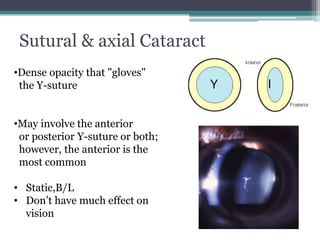
Sutural & axial Cataract
•Dense opacity that "gloves"
the Y-suture
•May involve the anterior
or posterior Y-suture or both;
however, the anterior is the
most common
• Static,B/L
• Don’t have much effect on
vision
Total Nuclear Cataract
• Involves the embryonic and foetal nucleus and infantile
nucleus
• Dense chalky white central opacity impairing vision
• Bilateral
• Non-progressive
Coronary Cataract
•Single or multiple
finger- or bowling pin-shaped
opacities that ring the
peripheral cortex
•Often associated with
cerulean cataracts
Cerulean Cataract/Blue dot cataract
•Small, bluish punctate opacities
of the peripheral cortex
(anterior, posterior or both)
•Often associated with
other cataract types
•May exhibit sectoral
distribution but tends to
be symmetric OU
Epicapsular stars
•Small light brown or tan
dots or star-shaped deposits
on the anterior capsule
• single or multiple
• unilateral or bilateral
•Are remnants of the tunica
vasculosa lentis
Total congential Membranous
Evaluation
• HISTORY
-Family history
-Growth & development history with milestones
• EXAMINATION
-Vision
-Visual function-fixation behaviour,fixation
preference,objection to occlusion,VEP
-Retinoscopy
Assessment of visual acuity
• <3yrs-Look for-
CSMF(central steady maintaining fixation)
Resistance to closure of eye
• 3-6yrs-
-Illiterate E chart
-Landolt acuity card
-Teller acuity card
-Keeler acuity card
• >6yrs- Snellen’s chart
• SLIT LAMP EXAMINATION—
-Morphology of the cataract and its laterality
-Corneal diameter & clarity
-Iris configuration AC depth
-Lens position
• Fundus exam. If possible or B-scan
• Examination of immediate family of the affected child
• Check for strabismus and nystagmus
• Check IOP
Ophthalmic Evaluation
Visual Significance : Concept of “ functional cataract ”
• Assessment of red reflex
( before and after dilatation )
• k/c/o Bruckner test
• For detection of visual axis
opacities,strabismus,refractive errors and retinal
abnormalities
• To assess density and morphology of cataract
Ophthalmic Evaluation
Poor Prognostic Indicators
Ocular alignment and motility Strabismus
Manifest latent nystagmus
Anterior segment HCD, dysgenesis- anirdia,corneal
dystrophy,anterior cleavage
syndromes ,lens anomalies-
microspherophakia
Posterior segment Choroideremia , RP , PHPV, vitreo
retinal degenerations – Wagner’s
Ophthalmic Evaluation – EUA
• Axial length for prognosis / IOL calculation
• Keratometry
• Morphological evaluation of cataract with slit lamp
under EUA whenever possible
• B scan to assess posterior segment
Laboratory Evaluation
• Urine
- reducing substance
- amino acids
- microscopy
- protein
• RBC galactokinase
• Antibody titres – TORCH , VDRL
• Serum
- calcium, phosphorus, alkaline phosphatase,
ceruloplasmin
Surgery -indications
• Visually significant cataract-U/L or B/L
• U/L dense cataracts
• Central and >3mm
• Cataract with Strabismus
• Cataract with nystagmus or unsteady fixation
• One eye operated in a binocular cataract
Timing of surgery
• Visually significant B/L congenital -6 weeks of age (Each
eye one week apart- to prevent amblyopia)
• U/L visually significant cataract -4-6 weeks
• B/L cataract detected later-surgery as soon as
possible.First on the worse eye.
• Increased rates of post-op glaucoma in first 4 weeks of
life
Power of IOL
• Myopic shift with growing age-undercorrect
DAHAN’S criteria
• <2 years-undercorrect by 20%
• 2-8 years-undercorrect by 10%
Axial length (mm) IOL power
17 25
18 24
19 23
20 21
21 19
Lens material
• Single piece PMMA,preferably heparin coated
• Hydrophobic –uveal biocompatibility,reduced PCO
• IOL size -<2 yrs , 10-10.5 mm IOL
- >2 yrs , 12-13.5 mm IOL d/t elastic nature of the capsule
Surgical techniques
• Needling and aspiration-obsolete
• Lensectomy - < 2 yrs
• Lensectomy with PPC,Anterior vitrectomy(AV),IOL- >2
yrs but <6-7 YRS
• Lens aspiration with Primary Posterior Capsulotomy(PPC)
and IOL - >7 YRS
• Lens aspiration with IOL- >9-10 YRS
Correction of paediatric aphakia
• >2 yrs – PC-IOL implantation
• <2 yrs-
-Left aphakic
-Extended wear contact lens
-In B/L cases, spectacles are prescribed
• Children with JIA,PFV,microcornea,microphthalmos are
left aphakic
Post-op rehabilitation
• Glasses-B/L aphakia,residual correction
• Contact lens-U/L aphakia
• Secondary IOL- if myopic shift is >7D or contact lens not
viable option
Amblyopia Mx
• Occlusion theraphy of sound eye
• Spectacles >4 months age
• Bifocals >3 years age
Thank You

catarcact-ug1 2.pptx

  • 1.
  • 2.
    LENS • Transparent, biconvex •Diam : 9mm, thick: 4mm, • Radius of curvature – Ant :10mm , Post : 6mm • Ref. index : 1.39 • Total diopteric power : +16 to +20 D • Lens is held by suspensory ligaments – zonules of zinn
  • 3.
    • STRUCTURE 1. Lenscapsule : -smooth, homogenous, highly elastic( no true elastic tissue) - thickest(14u)- ant & post surface just central to insertion of zonular fibres -thinnest(3-4u)- posterior pole 2. Lens epithelium: - single layer -cuboidal cells -no corresponding posterior epithelium 3. Lens substance : cortex & nucleus -embryonic nucleus: 1st 3 months of fetal life - fetal nucleus: 3-8 months of fetal life - infantile nucleus- upto puberty - adult nucleus- rest of life
  • 6.
  • 7.
    Lens transparency • Avascularityof the lens • Characteristic of lens fibre: - Tightly-packed nature of lens cells - Narrow lens fibre membranes - Loss of organelles • Lens proteins-MTP 26 or Aquaporin 0 • Pump mechanism of lens fibre membranes that regulate the electrolyte and water balance in the lens, maintaining relative dehydration • Auto-oxidation and high concentration of reduced glutathione in the lens
  • 8.
    Differential diagnosis Painless, progressive diminutionof vision • Cataract • Primary open angle glaucoma • Diabetic retinopathy • Corneal dystrophies and degenerations • Age related macular degeneration • Retinitis pigmentosa
  • 9.
    Cataract • Development ofany opacity in the lens or its capsule either due to formation of opaque lens fibres (congenital & developmental cataracts) or due to degenerative process leading to opacification of normally formed transparent lens fibres (acquired cataract) • Major cause of blindness worldwide • Classification- -Etiological -Morphological
  • 10.
    Etiological classification I. Congenitaland Developmental cataract II. Acquired cataract • Senile cataract • Traumatic cataract (blunt, penetrating, radiation, electric shock, glass blowers, infra-red) • Complicated cataract (uveitis-induced) • Metabolic cataract (Diabetes - snowflake, Wilson’s disease-sunflower) • Drug induced cataract- corticosteroids, miotics • Cataract associated with syndromes
  • 11.
    Morphological classification • Capsularcataract -Anterior -Posterior • Subcapsular cataract -Anterior -Posterior • Cortical cataract • Nuclear cataract • Polar cataract
  • 12.
    Congenital & developmental cataracts •When the disturbance in the normal growth of lens occurs before birth, the child is born with a congenital cataract. Therefore, limited to either embryonic or foetal nucleus. • Developmental cataract may occur from infancy to adolescence. Therefore, involve infantile or adult nucleus, deeper parts of cortex or capsule.
  • 13.
    ETIOLOGY • Idiopathic • Heredity- -lnheritedcases without systemic disorders- AD -Inherited cases with systemic disorders include: • Chromosomal disorders (trisomy 21) • Skeletal disorders (Stickler syndrome) • Central nervous system disorders (cerebro-oculo-facial syndrome) • Renal system disorders (Lowe's syndrome)
  • 14.
    • Maternal factorsinclude: 1. Malnutrition during pregnancy 2. Infections-Rubella,Toxoplasmosis,CMV 3. Drugs ingestion-thalidomide, corticosteroids 4. Radiation exposure • Common familial cataracts include: • Cataracta pulverulenta • Zonular cataract (also occurs as nonfamilial) • Coronary cataract and total soft cataract (may also occur due to rubella).
  • 15.
    • Foetal orinfantile factors 1. Deficient oxygenation (anoxia) 2. Birth trauma 3. Metabolic disorders- galactosemia, galactokinase deficiency and neonatal hypoglycemia 4. Cataracts associated with other congenital anomalies- Down's syndrome, Lowe's syndrome, myotonia dystrophica and congenital icthyosis 5. Ocular diseases associated with developmental cataract-PHPV, aniridia anterior chamber cleavage syndrome, ROP,microphthalmos 6. Malnutrition
  • 16.
    CLINICAL TYPES • Congenitalcapsular cataracts 1. Anterior capsular cataract 2. Posterior capsular cataract • Polar cataracts 1. Anterior polar cataract 2. Posterior polar cataract • Congenital nuclear cataracts 1. Cataracta pulverulenta 2. Lamellar cataract 3. Sutural and axial cataract 4. Total nuclear cataract • Generalized cataracts 1. Coronary cataract 2. Blue dot cataract 3. Total congenital cataract 4. Congenital membranous cataract
  • 17.
    Congenital capsular cataract Anteriorcapsular cataracts are nonaxial, stationary and visually insignificant. Posterior capsular cataracts are rare and can be associated with persistent hyaloid artery remnants.
  • 18.
    Anterior Polar Cataract •Dense,usually circular and well- defined opacity on the anterior pole of the lens •d/t delayed development of AC •d/t corneal perforation •May protrude slightly into the anterior chamber like a small pyramid
  • 19.
    Posterior Polar Cataract •Dense,usually circular and well-defined opacity on the posterior pole of the lens •Usually symmetric; may be misdiagnosed as posterior subcapsular cataract •2 forms- 1.)stationary 2.)progressive-onion whorl appearance
  • 20.
    Mittendorf Dot •An embryological remnantof the hyaloid artery that is attached to the posterior surface of the lens • appears as a small punctate opacity •The lens may also have a corkscrew "tail" of hyaloid artery remnant attached to it
  • 21.
    Cataracta centralis pulverulenta •Embryonicnuclear cataract •Hollow sphere of punctate opacities involving the fetal nucleus •Subtle "bull's eye" may be noted with ophthalmoscope retro-illumination •Usually bilateral
  • 22.
    Zonular/Lamellar Cataract • M/CCongenital cataract presenting with visual impairment • Etiology- • Genetic pattern-AD • Environmental form is associated with: • vitamin D deficiency • hypocalcaemia • maternal rubella infection (7th and 8th week of gestation)
  • 23.
    Zonular/Lamellar Cataract • occursin zone of foetal nucleus surrounding embryonic nucleus •Usually B/L,severe visual defects •Spokes of a wheel (riders) seen towards the equator
  • 24.
    Sutural & axialCataract •Dense opacity that "gloves" the Y-suture •May involve the anterior or posterior Y-suture or both; however, the anterior is the most common • Static,B/L • Don’t have much effect on vision
  • 26.
    Total Nuclear Cataract •Involves the embryonic and foetal nucleus and infantile nucleus • Dense chalky white central opacity impairing vision • Bilateral • Non-progressive
  • 27.
    Coronary Cataract •Single ormultiple finger- or bowling pin-shaped opacities that ring the peripheral cortex •Often associated with cerulean cataracts
  • 28.
    Cerulean Cataract/Blue dotcataract •Small, bluish punctate opacities of the peripheral cortex (anterior, posterior or both) •Often associated with other cataract types •May exhibit sectoral distribution but tends to be symmetric OU
  • 29.
    Epicapsular stars •Small lightbrown or tan dots or star-shaped deposits on the anterior capsule • single or multiple • unilateral or bilateral •Are remnants of the tunica vasculosa lentis
  • 30.
  • 31.
    Evaluation • HISTORY -Family history -Growth& development history with milestones • EXAMINATION -Vision -Visual function-fixation behaviour,fixation preference,objection to occlusion,VEP -Retinoscopy
  • 32.
    Assessment of visualacuity • <3yrs-Look for- CSMF(central steady maintaining fixation) Resistance to closure of eye • 3-6yrs- -Illiterate E chart -Landolt acuity card -Teller acuity card -Keeler acuity card • >6yrs- Snellen’s chart
  • 33.
    • SLIT LAMPEXAMINATION— -Morphology of the cataract and its laterality -Corneal diameter & clarity -Iris configuration AC depth -Lens position • Fundus exam. If possible or B-scan • Examination of immediate family of the affected child • Check for strabismus and nystagmus • Check IOP
  • 34.
    Ophthalmic Evaluation Visual Significance: Concept of “ functional cataract ” • Assessment of red reflex ( before and after dilatation ) • k/c/o Bruckner test • For detection of visual axis opacities,strabismus,refractive errors and retinal abnormalities • To assess density and morphology of cataract
  • 35.
    Ophthalmic Evaluation Poor PrognosticIndicators Ocular alignment and motility Strabismus Manifest latent nystagmus Anterior segment HCD, dysgenesis- anirdia,corneal dystrophy,anterior cleavage syndromes ,lens anomalies- microspherophakia Posterior segment Choroideremia , RP , PHPV, vitreo retinal degenerations – Wagner’s
  • 36.
    Ophthalmic Evaluation –EUA • Axial length for prognosis / IOL calculation • Keratometry • Morphological evaluation of cataract with slit lamp under EUA whenever possible • B scan to assess posterior segment
  • 37.
    Laboratory Evaluation • Urine -reducing substance - amino acids - microscopy - protein • RBC galactokinase • Antibody titres – TORCH , VDRL • Serum - calcium, phosphorus, alkaline phosphatase, ceruloplasmin
  • 38.
    Surgery -indications • Visuallysignificant cataract-U/L or B/L • U/L dense cataracts • Central and >3mm • Cataract with Strabismus • Cataract with nystagmus or unsteady fixation • One eye operated in a binocular cataract
  • 39.
    Timing of surgery •Visually significant B/L congenital -6 weeks of age (Each eye one week apart- to prevent amblyopia) • U/L visually significant cataract -4-6 weeks • B/L cataract detected later-surgery as soon as possible.First on the worse eye. • Increased rates of post-op glaucoma in first 4 weeks of life
  • 40.
    Power of IOL •Myopic shift with growing age-undercorrect DAHAN’S criteria • <2 years-undercorrect by 20% • 2-8 years-undercorrect by 10% Axial length (mm) IOL power 17 25 18 24 19 23 20 21 21 19
  • 41.
    Lens material • Singlepiece PMMA,preferably heparin coated • Hydrophobic –uveal biocompatibility,reduced PCO • IOL size -<2 yrs , 10-10.5 mm IOL - >2 yrs , 12-13.5 mm IOL d/t elastic nature of the capsule
  • 42.
    Surgical techniques • Needlingand aspiration-obsolete • Lensectomy - < 2 yrs • Lensectomy with PPC,Anterior vitrectomy(AV),IOL- >2 yrs but <6-7 YRS • Lens aspiration with Primary Posterior Capsulotomy(PPC) and IOL - >7 YRS • Lens aspiration with IOL- >9-10 YRS
  • 43.
    Correction of paediatricaphakia • >2 yrs – PC-IOL implantation • <2 yrs- -Left aphakic -Extended wear contact lens -In B/L cases, spectacles are prescribed • Children with JIA,PFV,microcornea,microphthalmos are left aphakic
  • 44.
    Post-op rehabilitation • Glasses-B/Laphakia,residual correction • Contact lens-U/L aphakia • Secondary IOL- if myopic shift is >7D or contact lens not viable option
  • 45.
    Amblyopia Mx • Occlusiontheraphy of sound eye • Spectacles >4 months age • Bifocals >3 years age
  • 46.