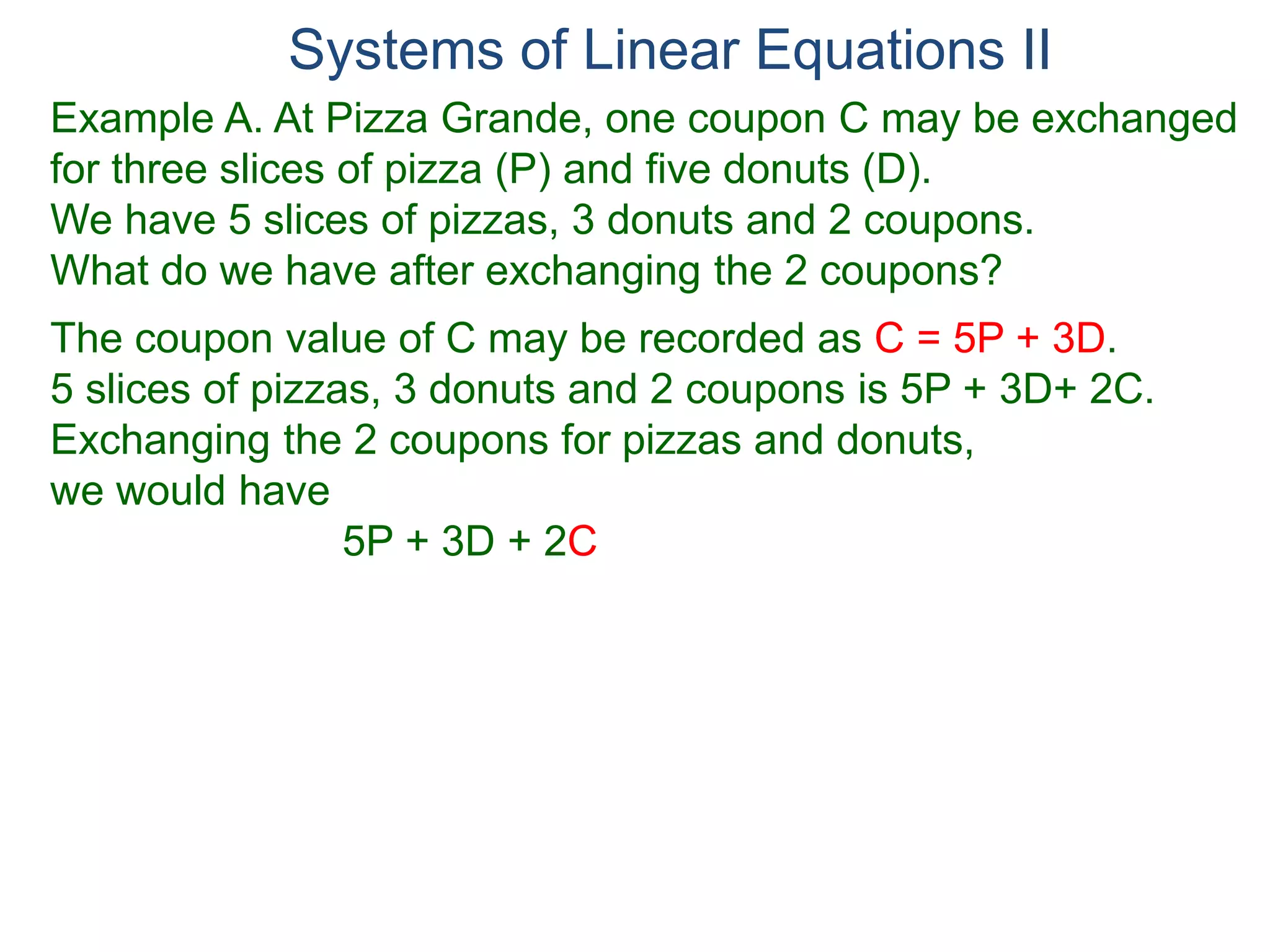
Systems of Linear Equations II
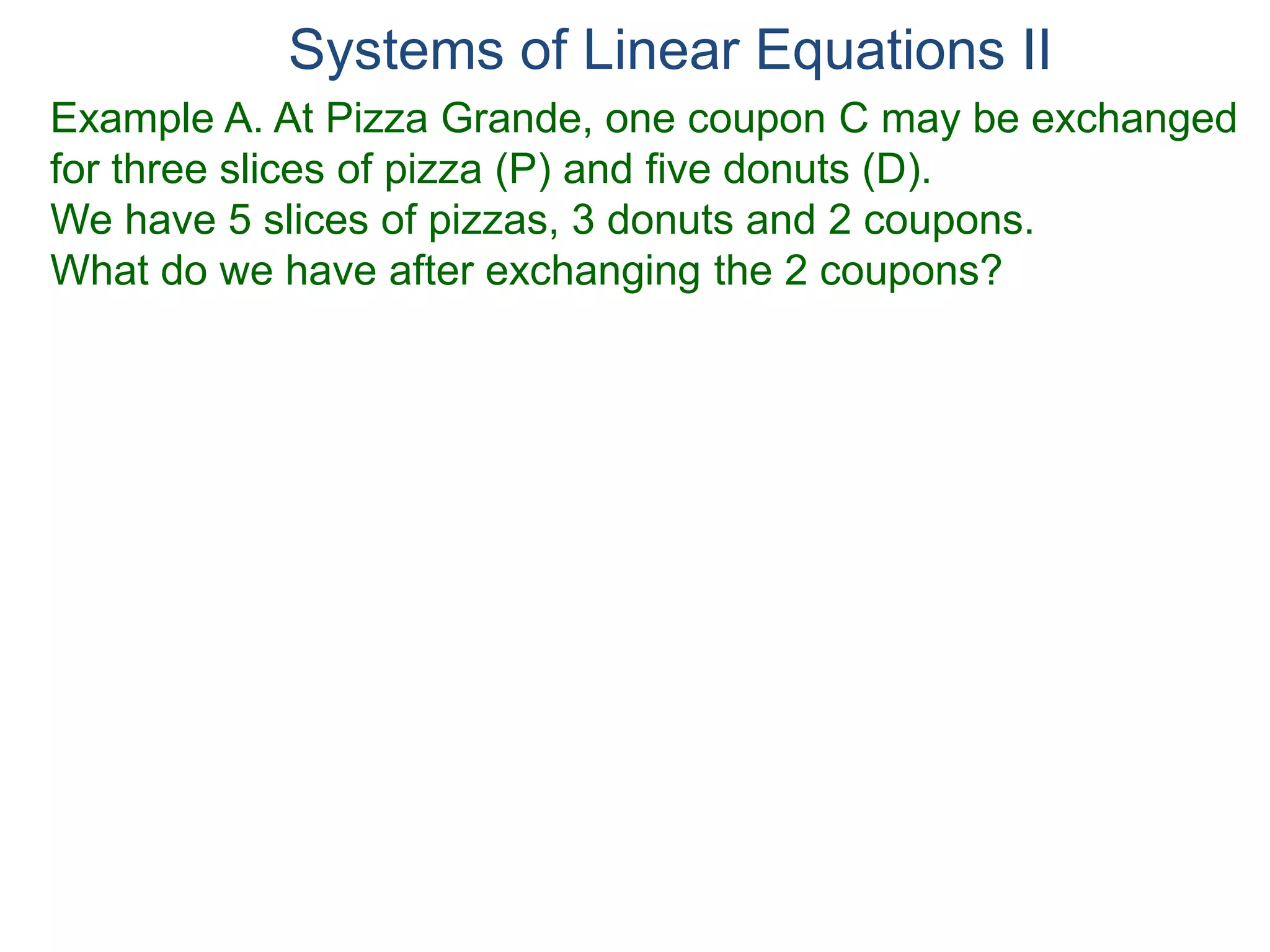
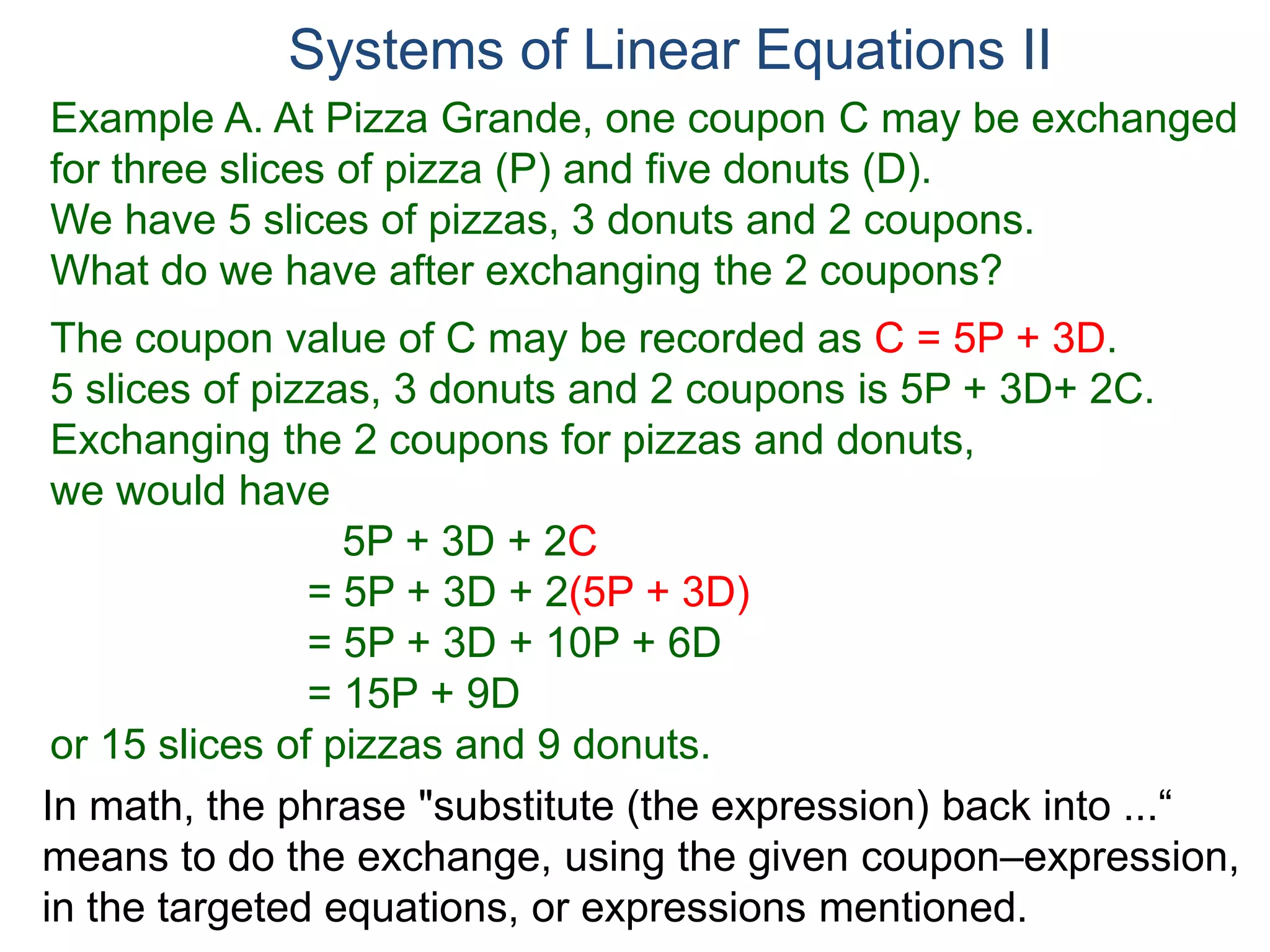
Example A. At Pizza Grande, one coupon C may be exchanged
for three slices of pizza (P) and five donuts (D).
We have 5 slices of pizzas, 3 donuts and 2 coupons.
What do we have after exchanging the 2 coupons?
Systems of Linear Equations II
Example A. At Pizza Grande, one coupon C may be exchanged
for three slices of pizza (P) and five donuts (D).
We have 5 slices of pizzas, 3 donuts and 2 coupons.
What do we have after exchanging the 2 coupons?
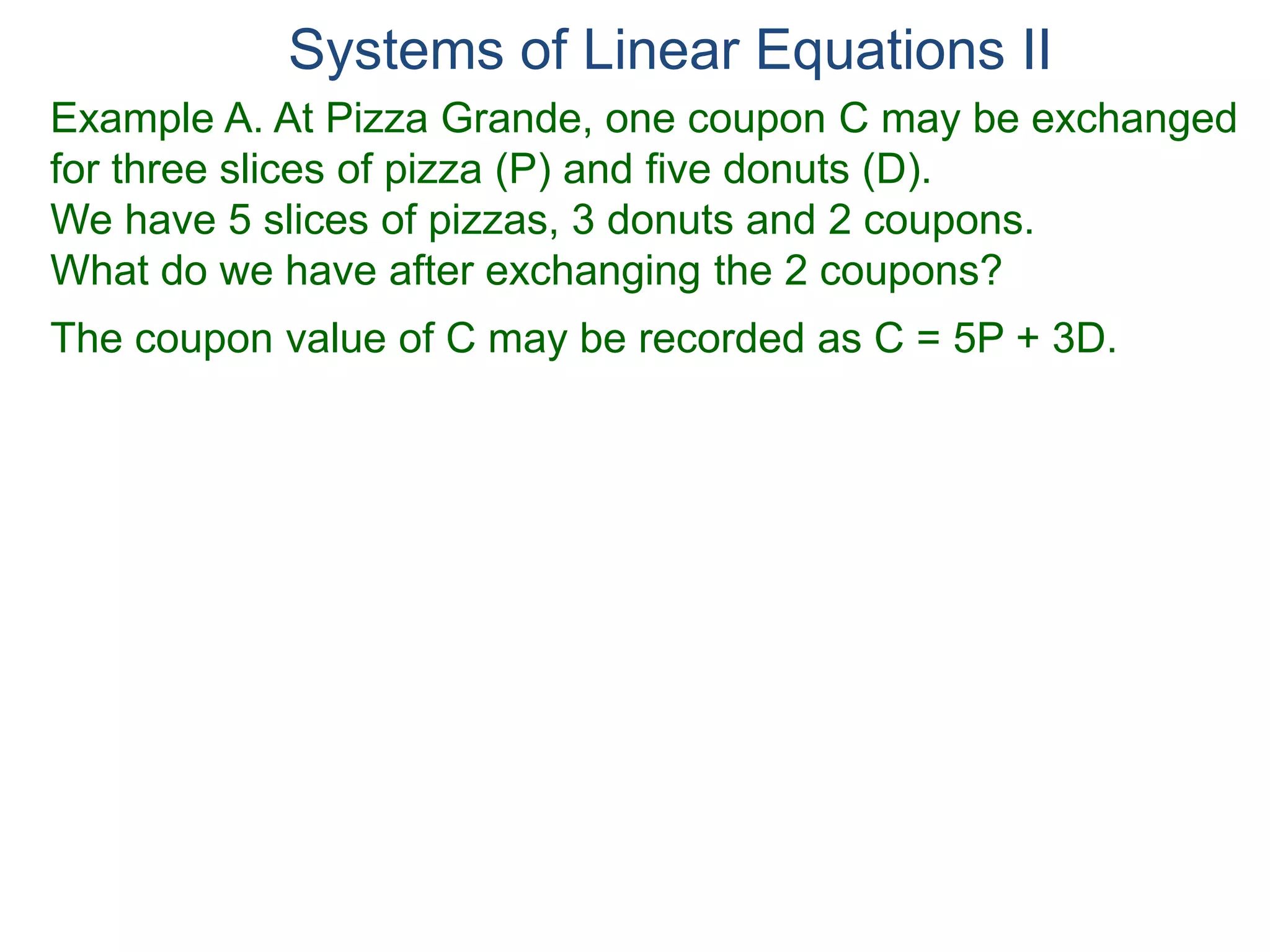
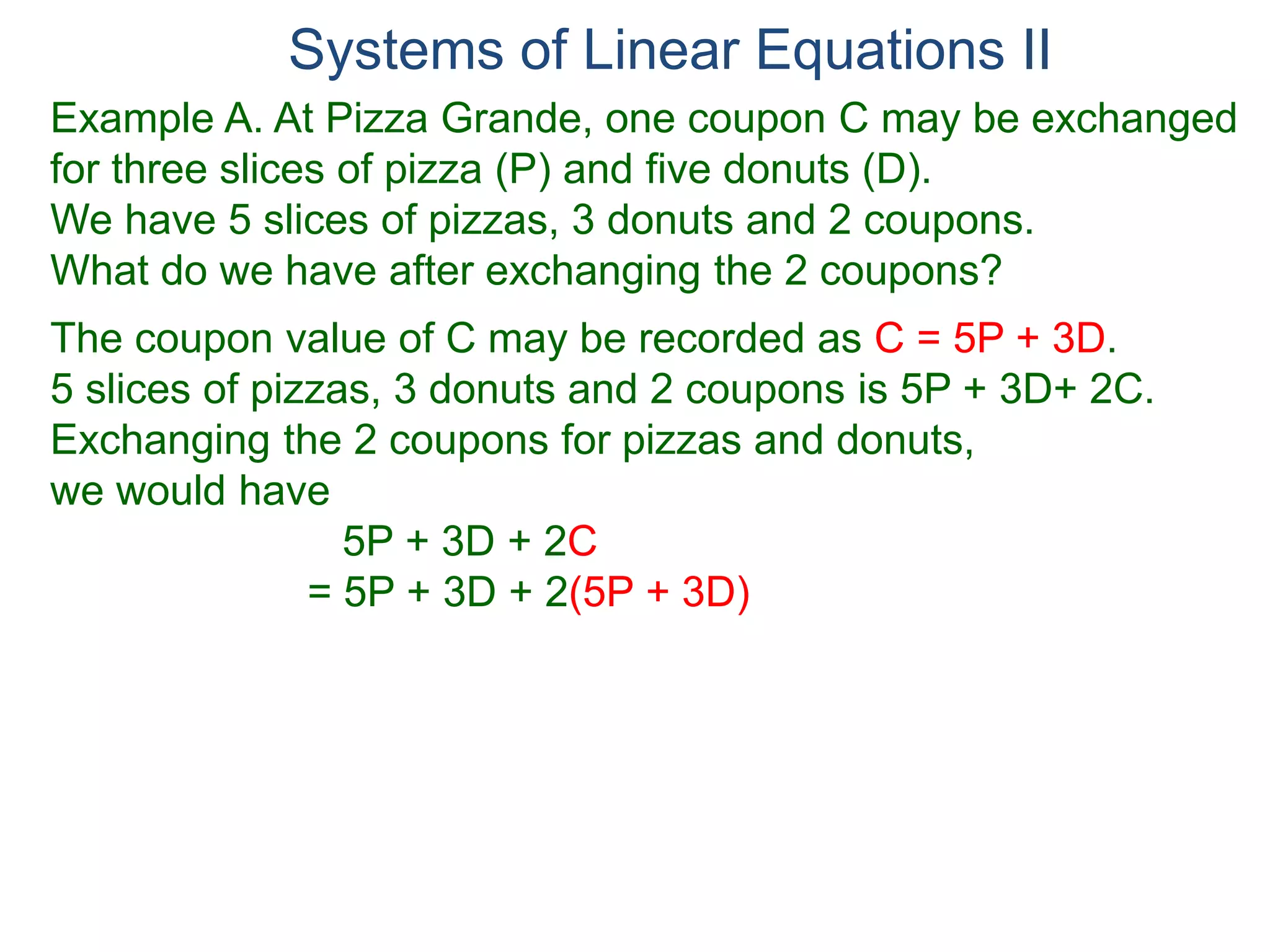
The coupon value of C may be recorded as C = 5P + 3D.
Systems of Linear Equations II
Example A. At Pizza Grande, one coupon C may be exchanged
for three slices of pizza (P) and five donuts (D).
We have 5 slices of pizzas, 3 donuts and 2 coupons.
What do we have after exchanging the 2 coupons?
The coupon value of C may be recorded as C = 5P + 3D.
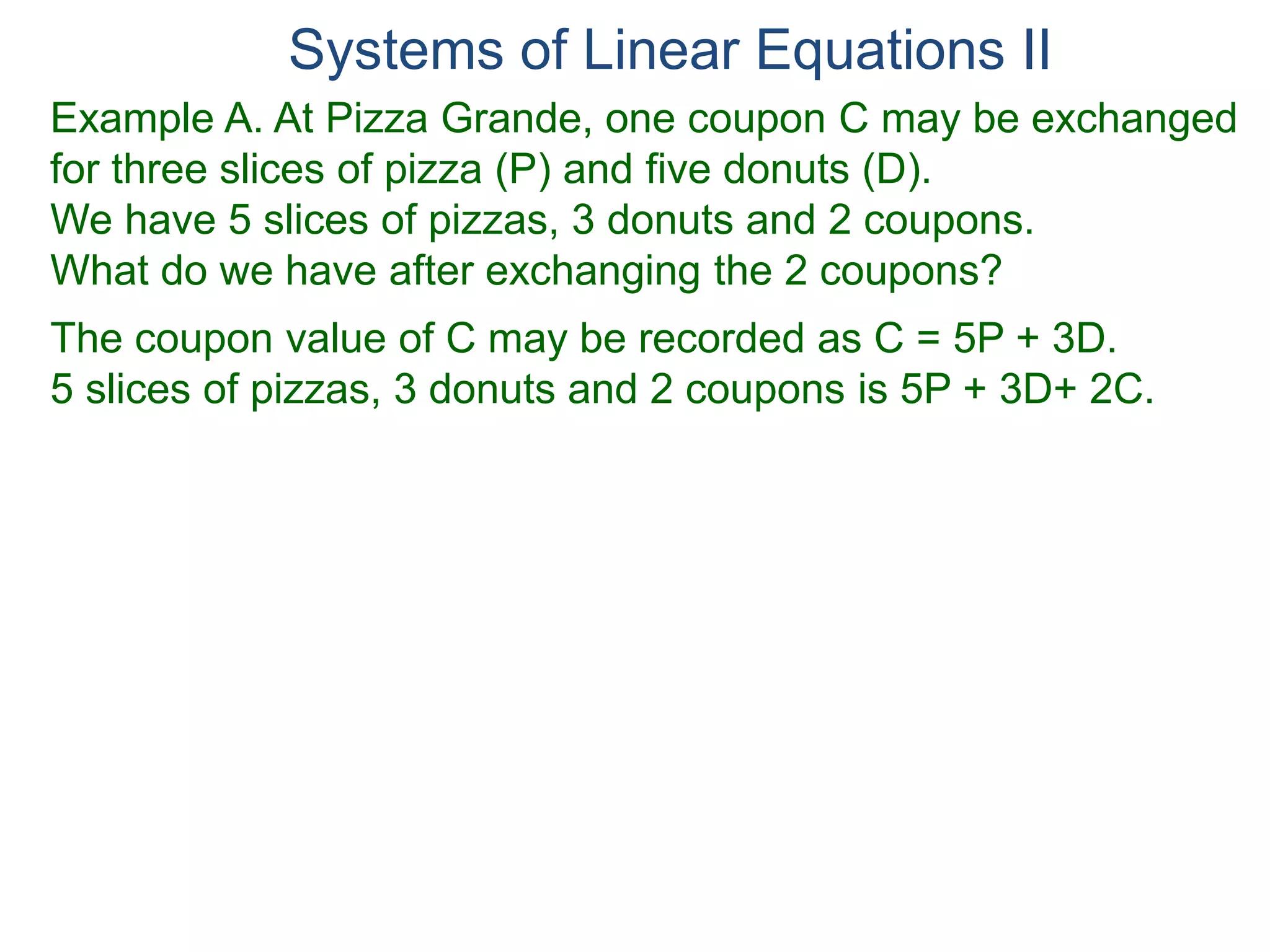
5 slices of pizzas, 3 donuts and 2 coupons is 5P + 3D+ 2C.
Systems of Linear Equations II
Example A. At Pizza Grande, one coupon C may be exchanged
for three slices of pizza (P) and five donuts (D).
We have 5 slices of pizzas, 3 donuts and 2 coupons.
What do we have after exchanging the 2 coupons?
The coupon value of C may be recorded as C = 5P + 3D.
5 slices of pizzas, 3 donuts and 2 coupons is 5P + 3D+ 2C.
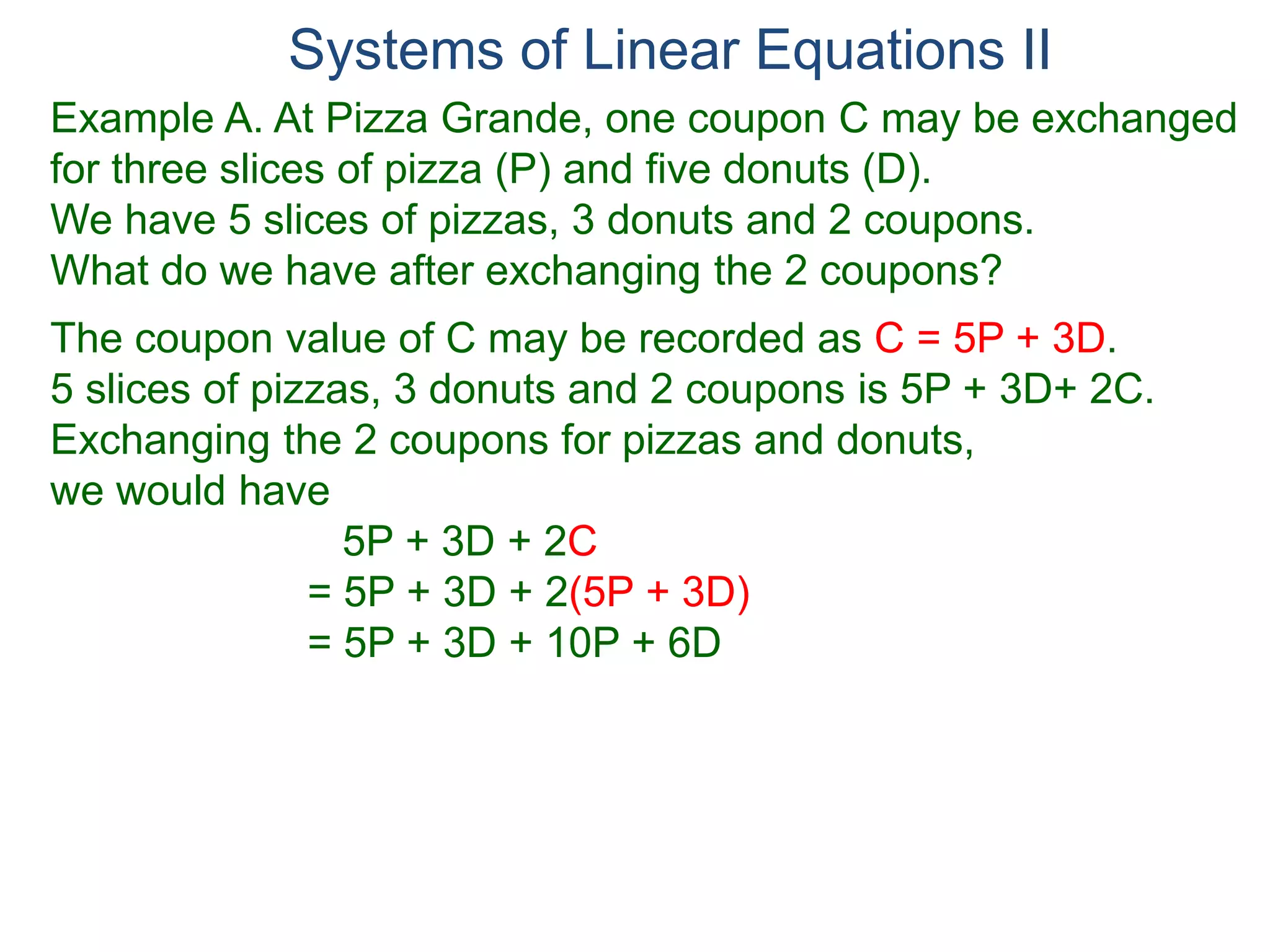
Exchanging the 2 coupons for pizzas and donuts,
we would have
5P + 3D + 2C
Systems of Linear Equations II
Example A. At Pizza Grande, one coupon C may be exchanged
for three slices of pizza (P) and five donuts (D).
We have 5 slices of pizzas, 3 donuts and 2 coupons.
What do we have after exchanging the 2 coupons?
The coupon value of C may be recorded as C = 5P + 3D.
5 slices of pizzas, 3 donuts and 2 coupons is 5P + 3D+ 2C.
Exchanging the 2 coupons for pizzas and donuts,
we would have
5P + 3D + 2C
= 5P + 3D + 2(5P + 3D)
Systems of Linear Equations II
Example A. At Pizza Grande, one coupon C may be exchanged
for three slices of pizza (P) and five donuts (D).
We have 5 slices of pizzas, 3 donuts and 2 coupons.
What do we have after exchanging the 2 coupons?
The coupon value of C may be recorded as C = 5P + 3D.
5 slices of pizzas, 3 donuts and 2 coupons is 5P + 3D+ 2C.
Exchanging the 2 coupons for pizzas and donuts,
we would have
5P + 3D + 2C
= 5P + 3D + 2(5P + 3D)
= 5P + 3D + 10P + 6D
Systems of Linear Equations II
Example A. At Pizza Grande, one coupon C may be exchanged
for three slices of pizza (P) and five donuts (D).
We have 5 slices of pizzas, 3 donuts and 2 coupons.
What do we have after exchanging the 2 coupons?
The coupon value of C may be recorded as C = 5P + 3D.
5 slices of pizzas, 3 donuts and 2 coupons is 5P + 3D+ 2C.
Exchanging the 2 coupons for pizzas and donuts,
we would have
5P + 3D + 2C
= 5P + 3D + 2(5P + 3D)
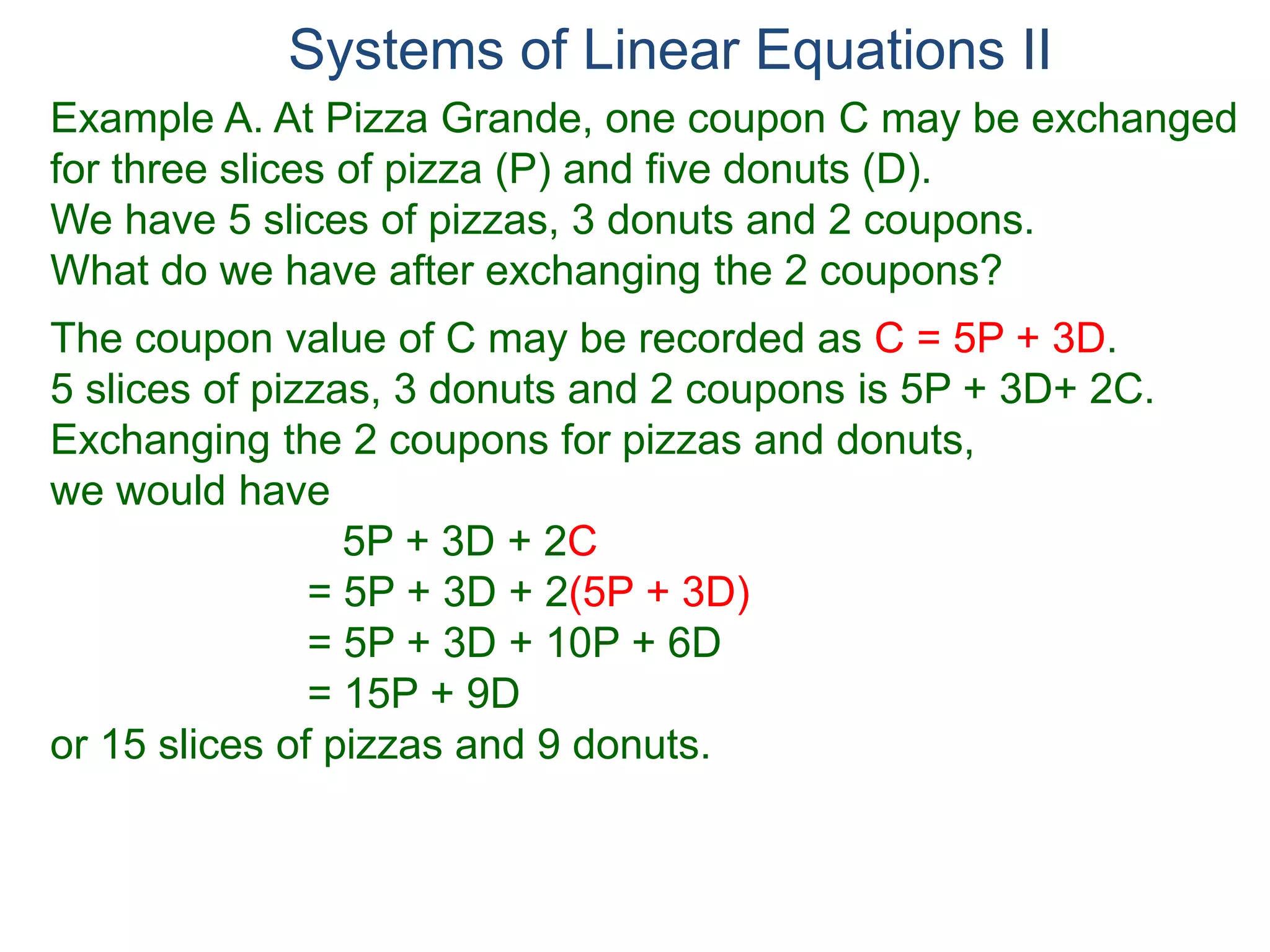
= 5P + 3D + 10P + 6D
= 15P + 9D
or 15 slices of pizzas and 9 donuts.
In math, the phrase "substitute (the expression) back into ...“
means to do the exchange, using the given coupon–expression,
in the targeted equations, or expressions mentioned.
Systems of Linear Equations II
Example A. At Pizza Grande, one coupon C may be exchanged
for three slices of pizza (P) and five donuts (D).
We have 5 slices of pizzas, 3 donuts and 2 coupons.
What do we have after exchanging the 2 coupons?
The coupon value of C may be recorded as C = 5P + 3D.
5 slices of pizzas, 3 donuts and 2 coupons is 5P + 3D+ 2C.
Exchanging the 2 coupons for pizzas and donuts,
we would have
5P + 3D + 2C
= 5P + 3D + 2(5P + 3D)
= 5P + 3D + 10P + 6D
= 15P + 9D
or 15 slices of pizzas and 9 donuts.
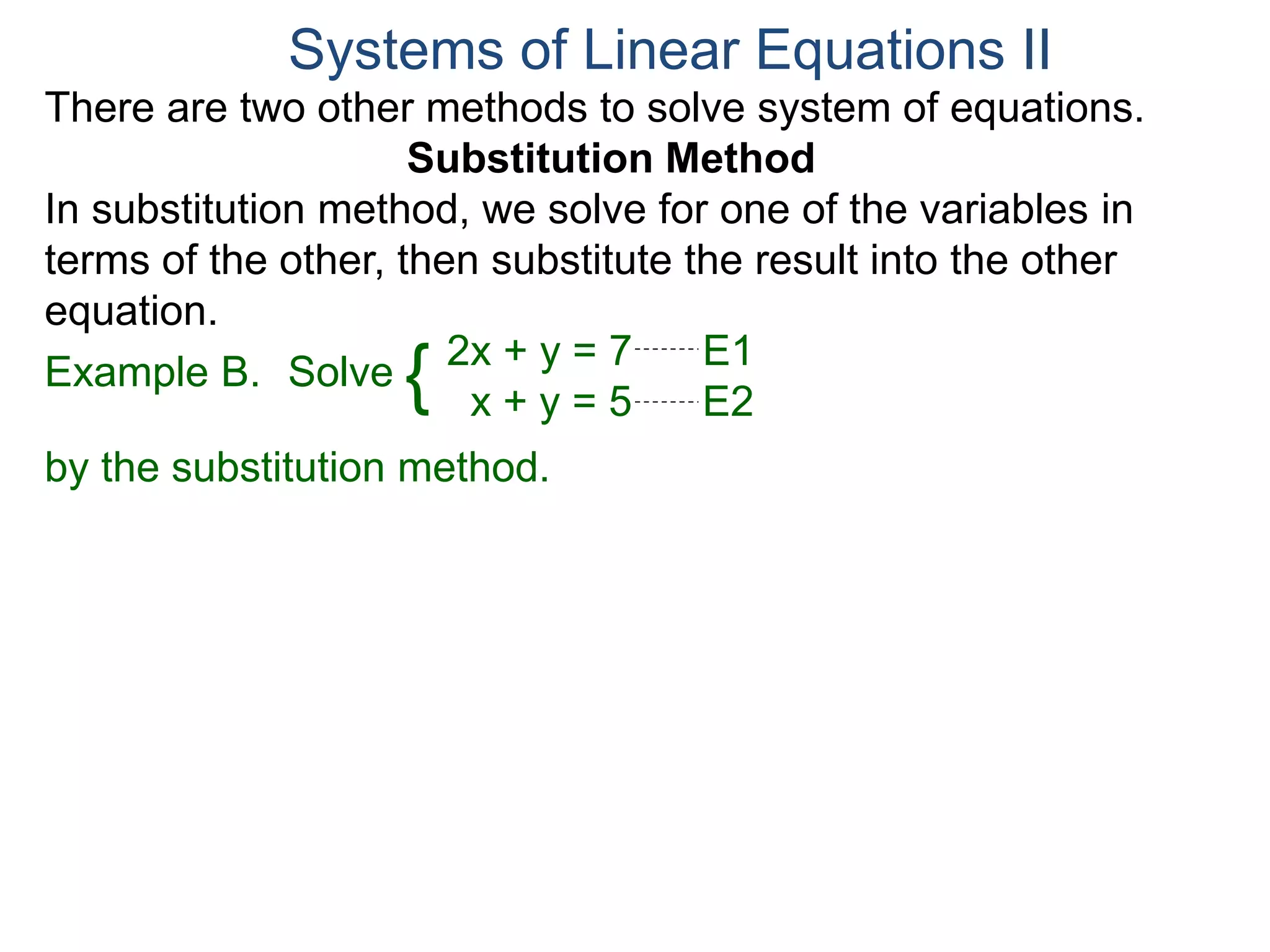
There are two other methods to solve system of equations.
Systems of Linear Equations II
There are two other methods to solve system of equations.
Substitution Method
Systems of Linear Equations II
There are two other methods to solve system of equations.
Substitution Method
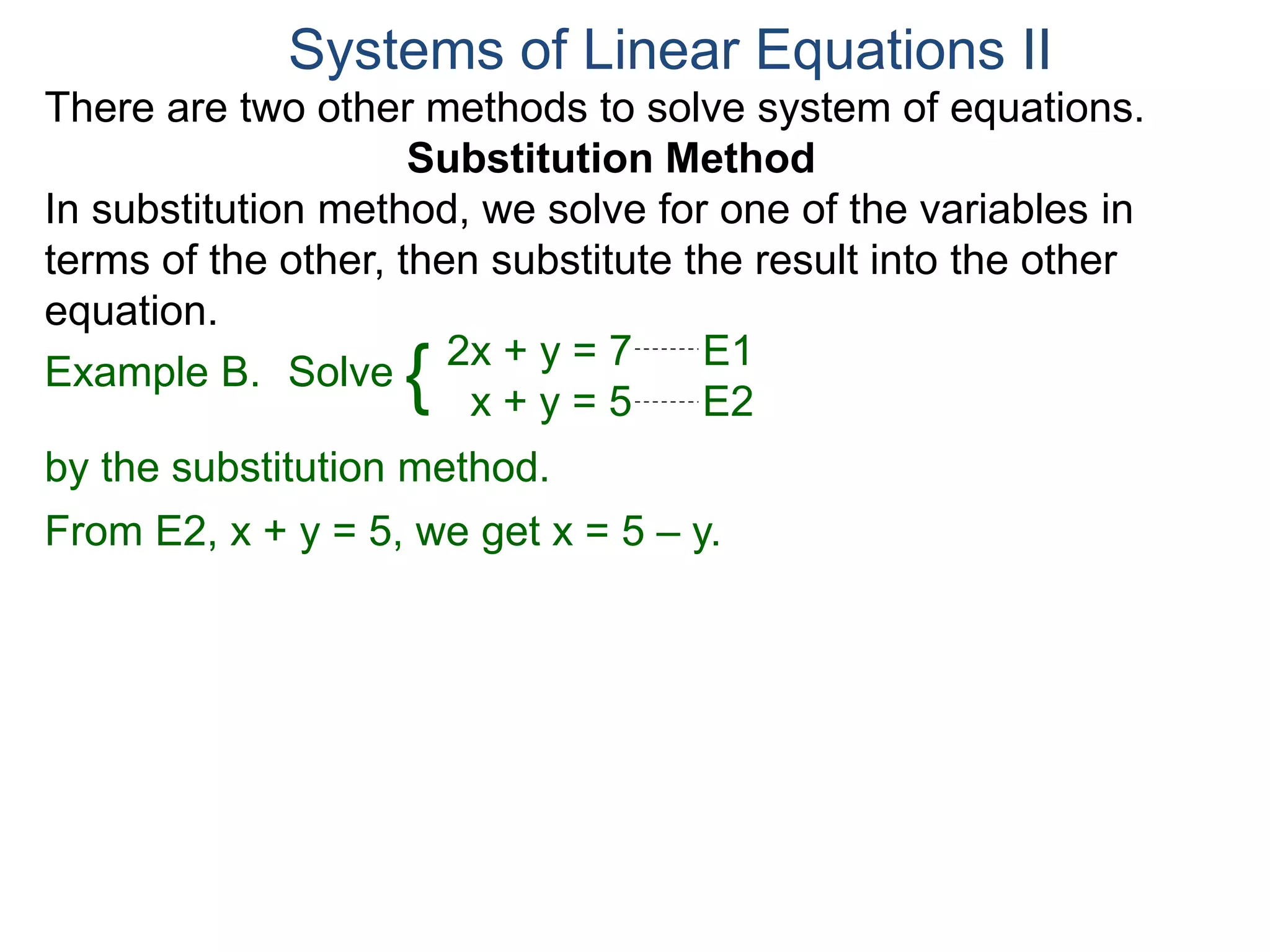
In substitution method, we solve for one of the variables in
terms of the other, then substitute the result into the other
equation.
Systems of Linear Equations II
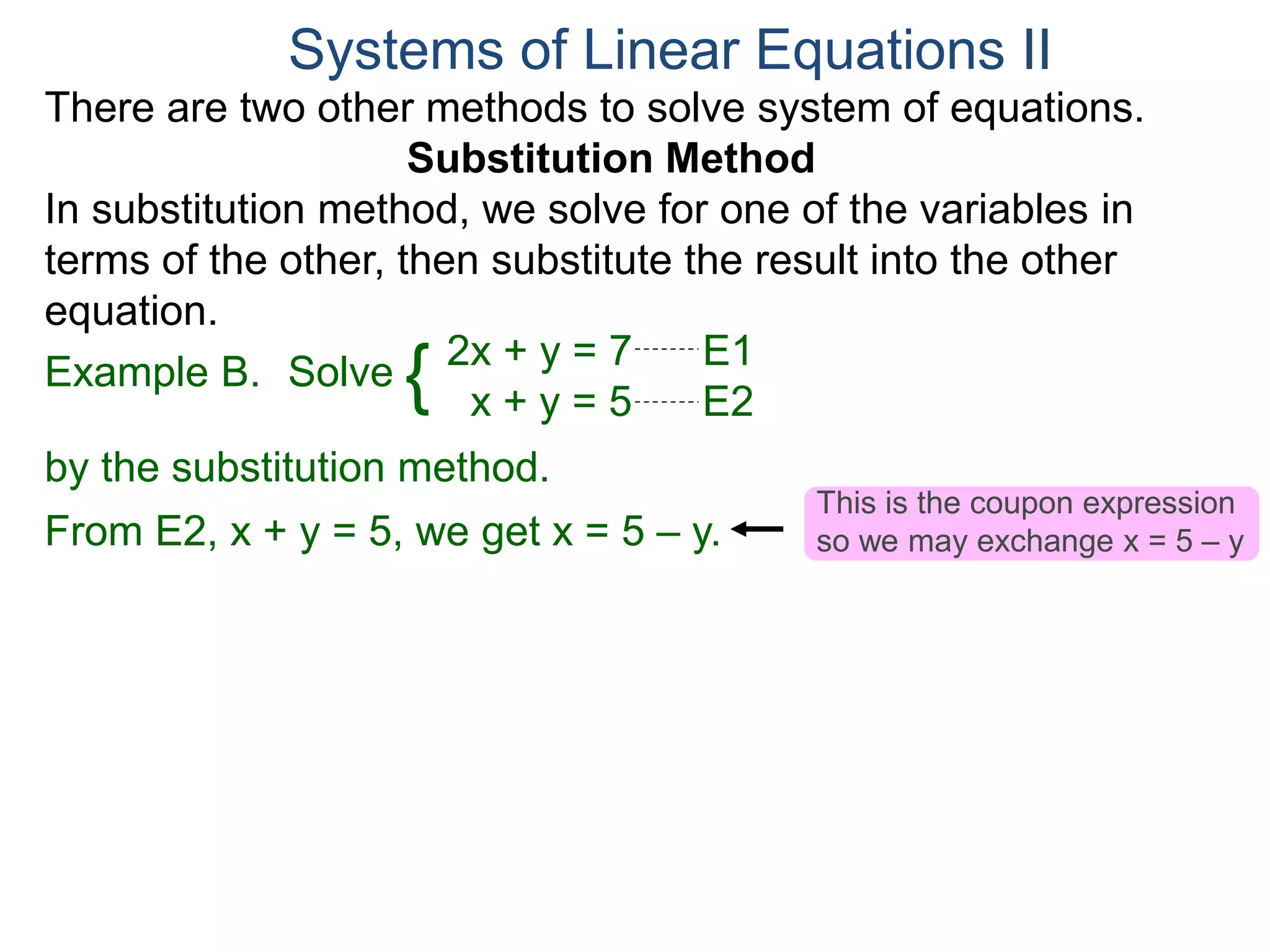
2x + y = 7 E1
x + y = 5 E2
Solve
by the substitution method.
Systems of Linear Equations II
Example B. {
There are two other methods to solve system of equations.
Substitution Method
In substitution method, we solve for one of the variables in
terms of the other, then substitute the result into the other
equation.
2x + y = 7 E1
x + y = 5 E2
Solve
by the substitution method.
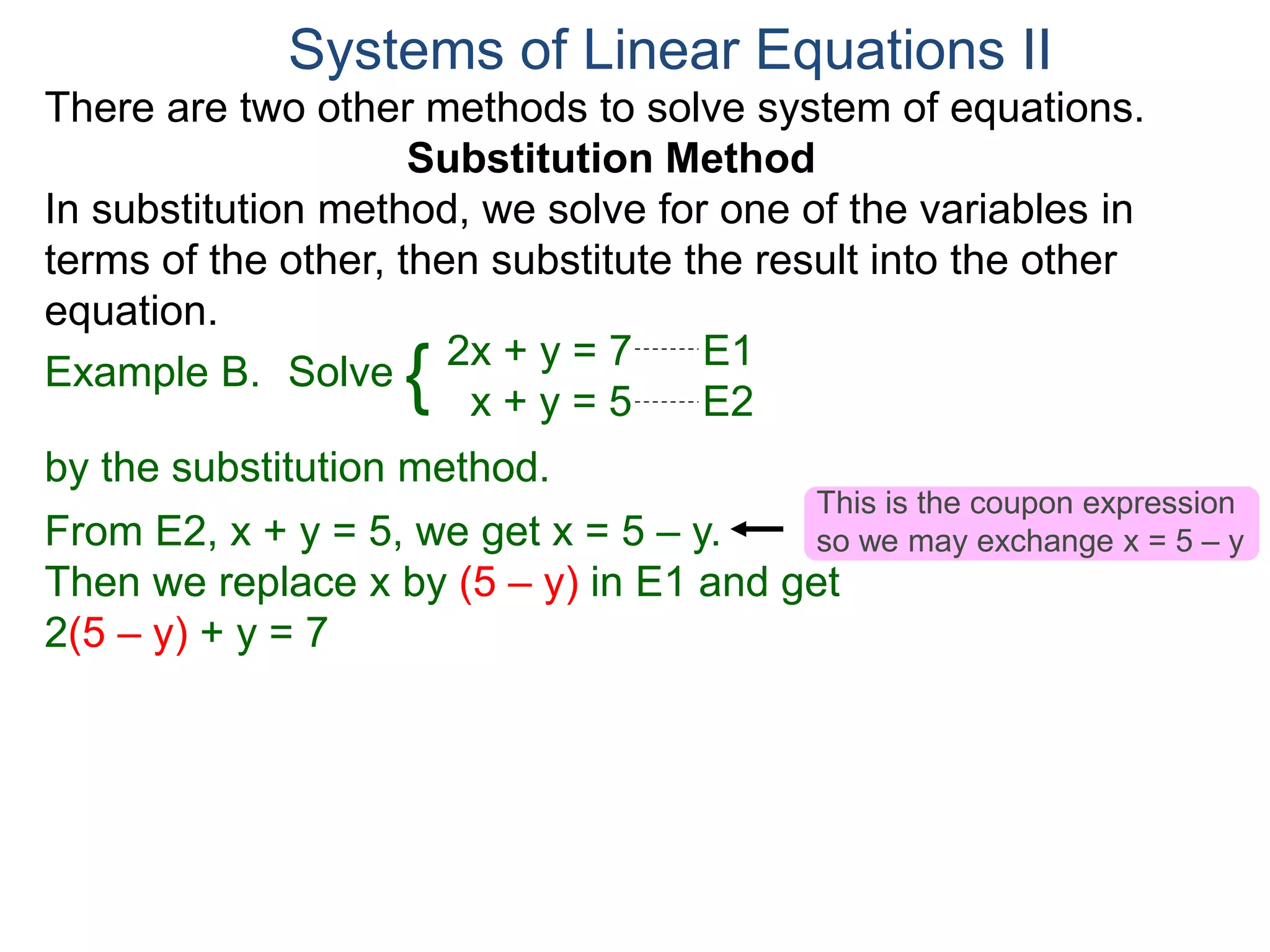
From E2, x + y = 5, we get x = 5 – y.
Systems of Linear Equations II
Example B. {
There are two other methods to solve system of equations.
Substitution Method
In substitution method, we solve for one of the variables in
terms of the other, then substitute the result into the other
equation.
2x + y = 7 E1
x + y = 5 E2
Solve
by the substitution method.
From E2, x + y = 5, we get x = 5 – y.
Systems of Linear Equations II
Example B. {
There are two other methods to solve system of equations.
Substitution Method
In substitution method, we solve for one of the variables in
terms of the other, then substitute the result into the other
equation.
This is the coupon expression
so we may exchange x = 5 – y
2x + y = 7 E1
x + y = 5 E2
Solve
by the substitution method.
From E2, x + y = 5, we get x = 5 – y.
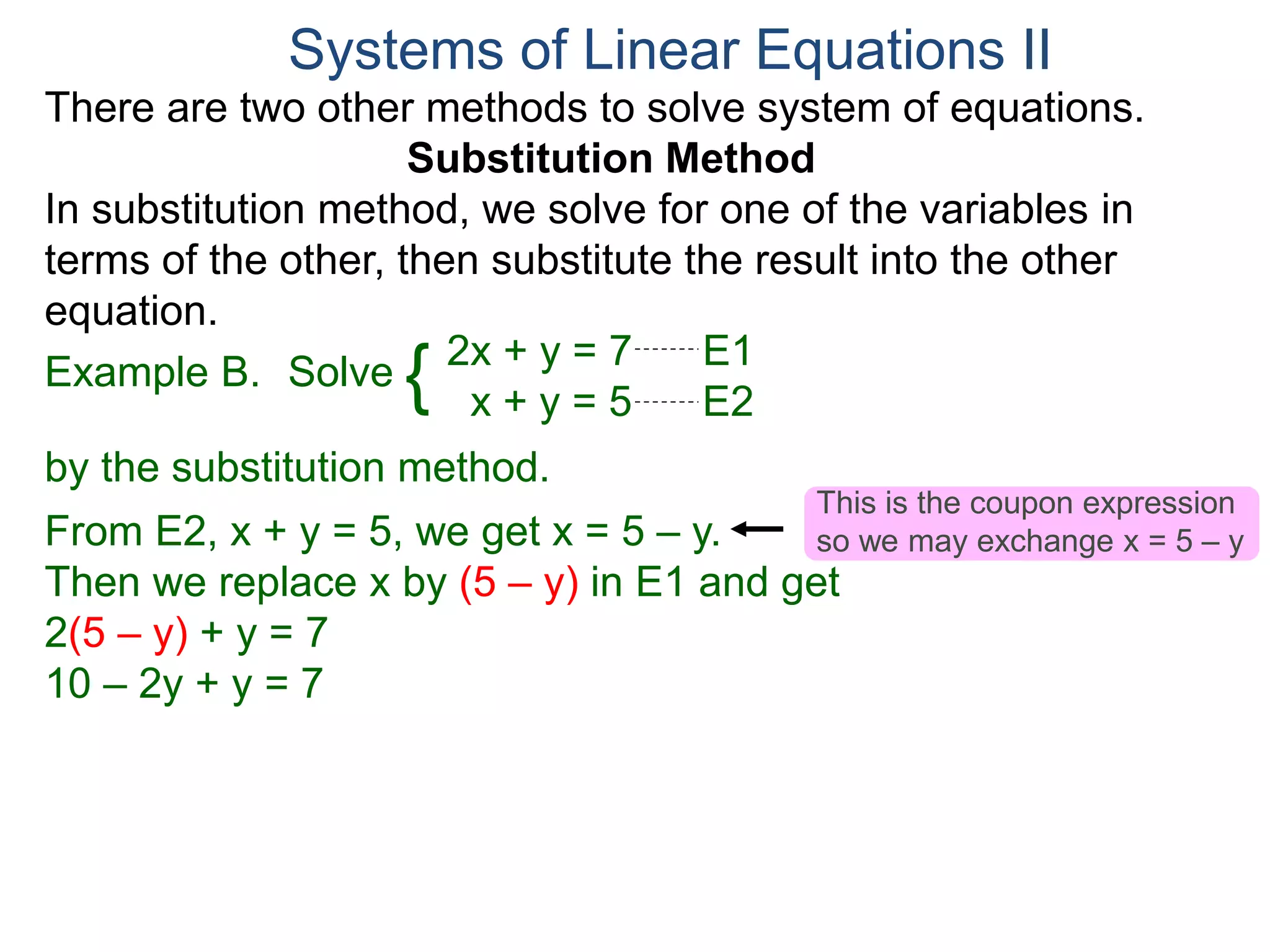
Then we replace x by (5 – y) in E1 and get
2(5 – y) + y = 7
Systems of Linear Equations II
Example B. {
There are two other methods to solve system of equations.
Substitution Method
In substitution method, we solve for one of the variables in
terms of the other, then substitute the result into the other
equation.
This is the coupon expression
so we may exchange x = 5 – y
2x + y = 7 E1
x + y = 5 E2
Solve
by the substitution method.
From E2, x + y = 5, we get x = 5 – y.
Then we replace x by (5 – y) in E1 and get
2(5 – y) + y = 7
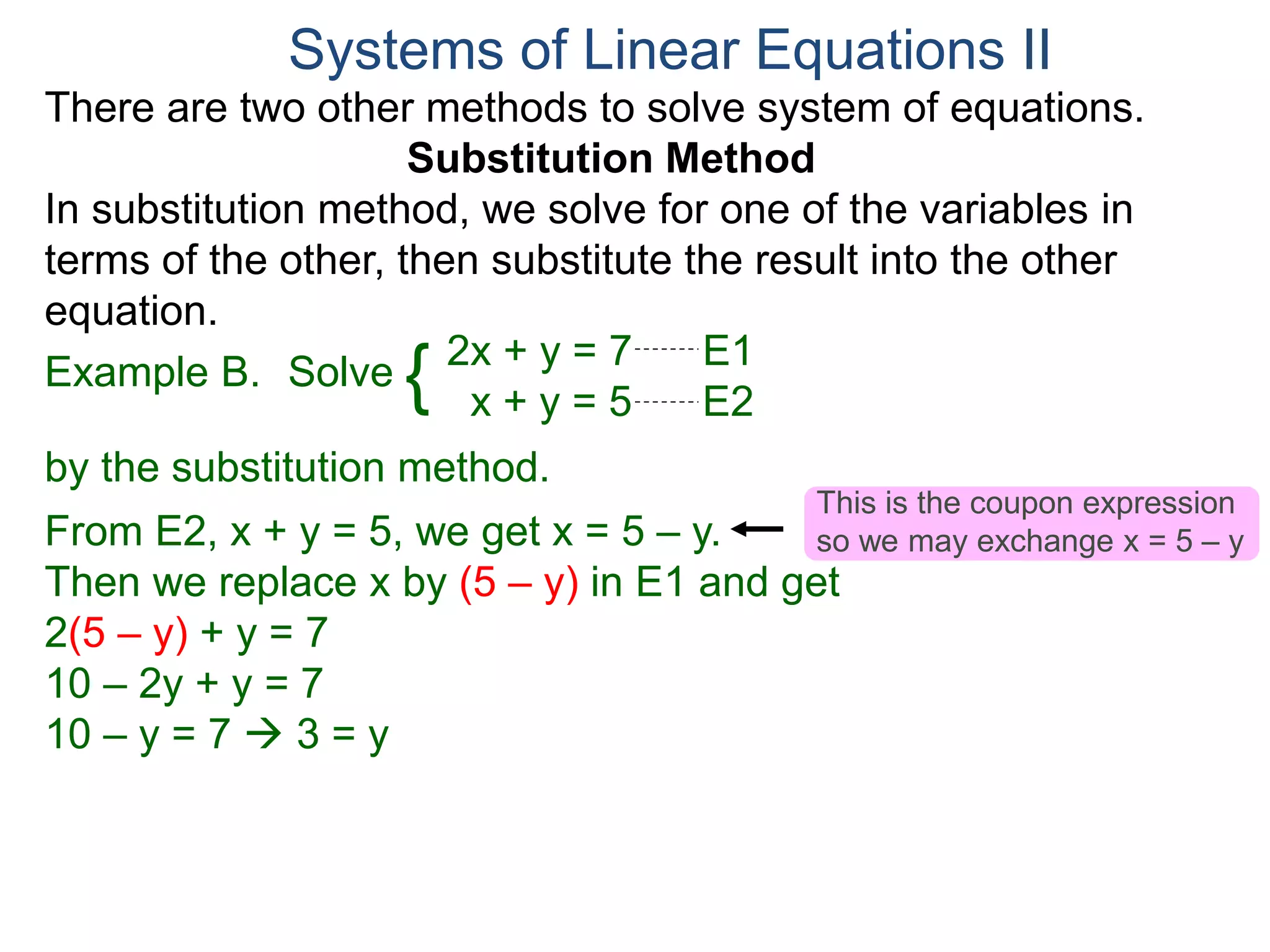
10 – 2y + y = 7
Systems of Linear Equations II
Example B. {
There are two other methods to solve system of equations.
Substitution Method
In substitution method, we solve for one of the variables in
terms of the other, then substitute the result into the other
equation.
This is the coupon expression
so we may exchange x = 5 – y
2x + y = 7 E1
x + y = 5 E2
Solve
by the substitution method.
From E2, x + y = 5, we get x = 5 – y.
Then we replace x by (5 – y) in E1 and get
2(5 – y) + y = 7
10 – 2y + y = 7
10 – y = 7  3 = y
Systems of Linear Equations II
Example B. {
There are two other methods to solve system of equations.
Substitution Method
In substitution method, we solve for one of the variables in
terms of the other, then substitute the result into the other
equation.
This is the coupon expression
so we may exchange x = 5 – y
2x + y = 7 E1
x + y = 5 E2
Solve
by the substitution method.
From E2, x + y = 5, we get x = 5 – y.
Then we replace x by (5 – y) in E1 and get
2(5 – y) + y = 7
10 – 2y + y = 7
10 – y = 7  3 = y
Systems of Linear Equations II
Example B. {
Put 3 = y back to E2 to find x, we get
x + 3 = 5
There are two other methods to solve system of equations.
Substitution Method
In substitution method, we solve for one of the variables in
terms of the other, then substitute the result into the other
equation.
This is the coupon expression
so we may exchange x = 5 – y
2x + y = 7 E1
x + y = 5 E2
Solve
by the substitution method.
From E2, x + y = 5, we get x = 5 – y.
Then we replace x by (5 – y) in E1 and get
2(5 – y) + y = 7
10 – 2y + y = 7
10 – y = 7  3 = y
Systems of Linear Equations II
Example B. {
Put 3 = y back to E2 to find x, we get
x + 3 = 5  x = 2
Therefore the solution is (2, 3)
There are two other methods to solve system of equations.
Substitution Method
In substitution method, we solve for one of the variables in
terms of the other, then substitute the result into the other
equation.
This is the coupon expression
so we may exchange x = 5 – y
We use the substitution method when it's easy to solve for
one of the variable in terms of the other.
Systems of Linear Equations II
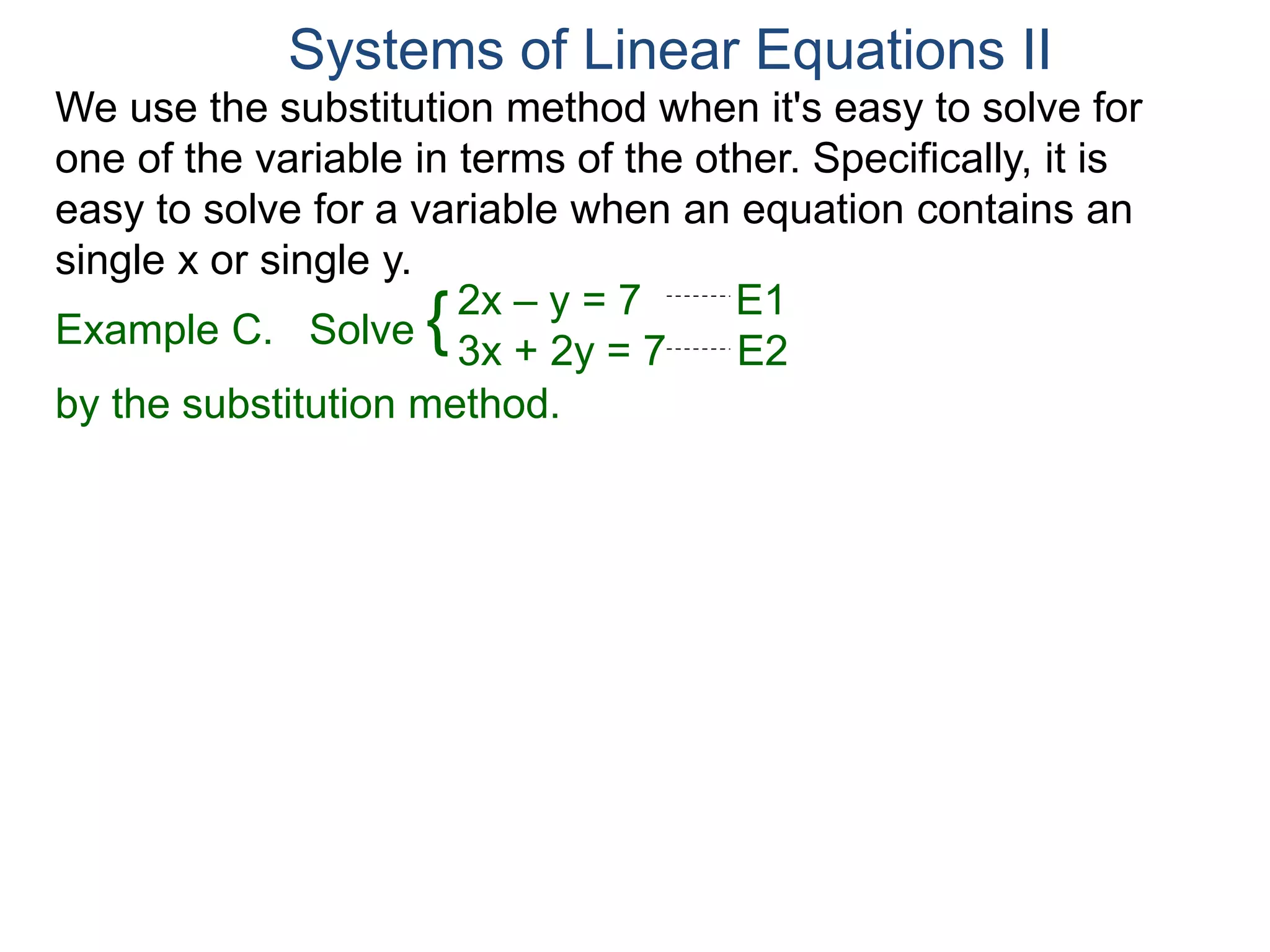
We use the substitution method when it's easy to solve for
one of the variable in terms of the other. Specifically, it is
easy to solve for a variable when an equation contains an
single x or single y.
Systems of Linear Equations II
We use the substitution method when it's easy to solve for
one of the variable in terms of the other. Specifically, it is
easy to solve for a variable when an equation contains an
single x or single y.
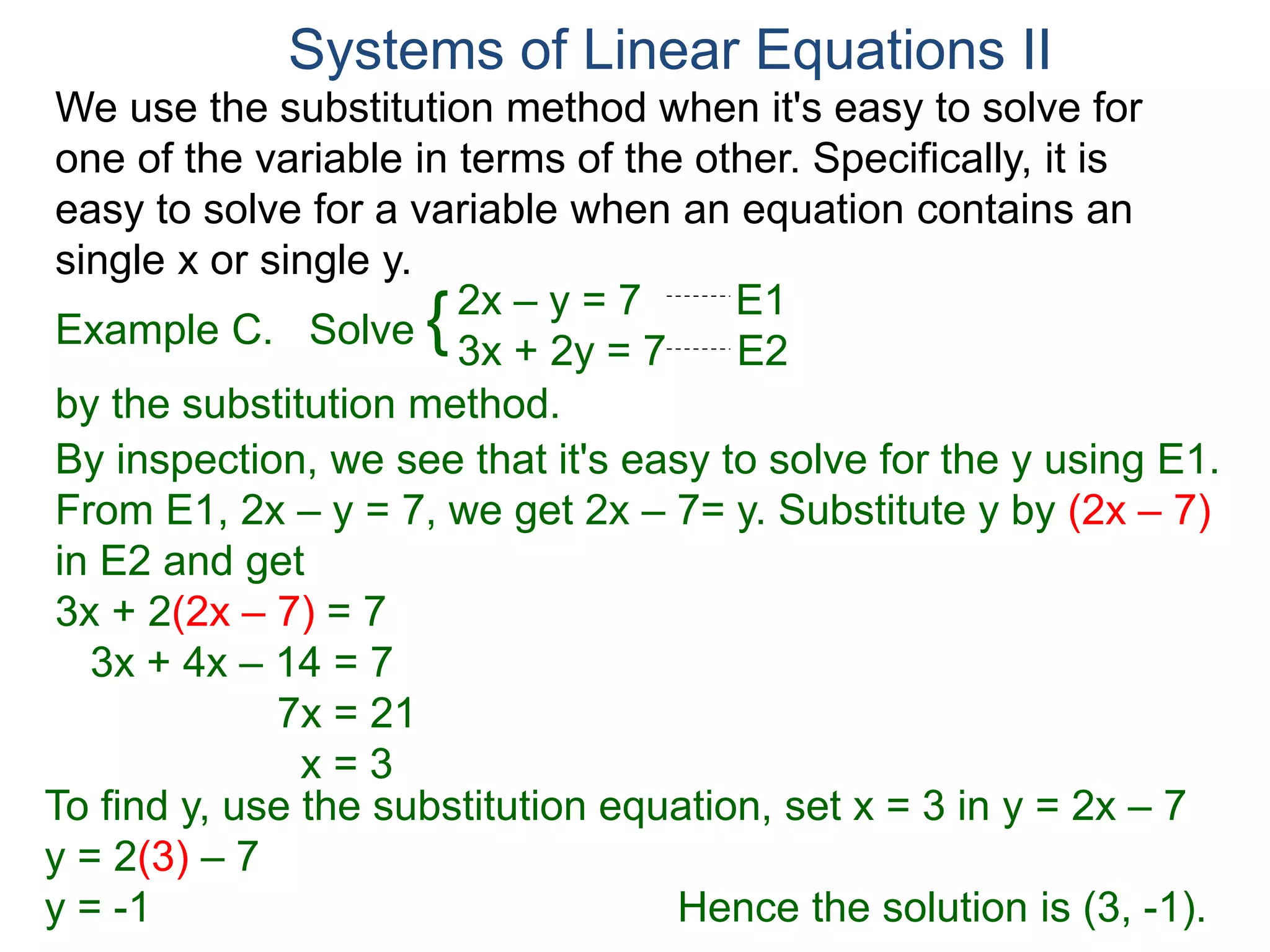
2x – y = 7 E1
3x + 2y = 7 E2
Solve
by the substitution method.
Systems of Linear Equations II
Example C. {
We use the substitution method when it's easy to solve for
one of the variable in terms of the other. Specifically, it is
easy to solve for a variable when an equation contains an
single x or single y.
2x – y = 7 E1
3x + 2y = 7 E2
Solve
by the substitution method.
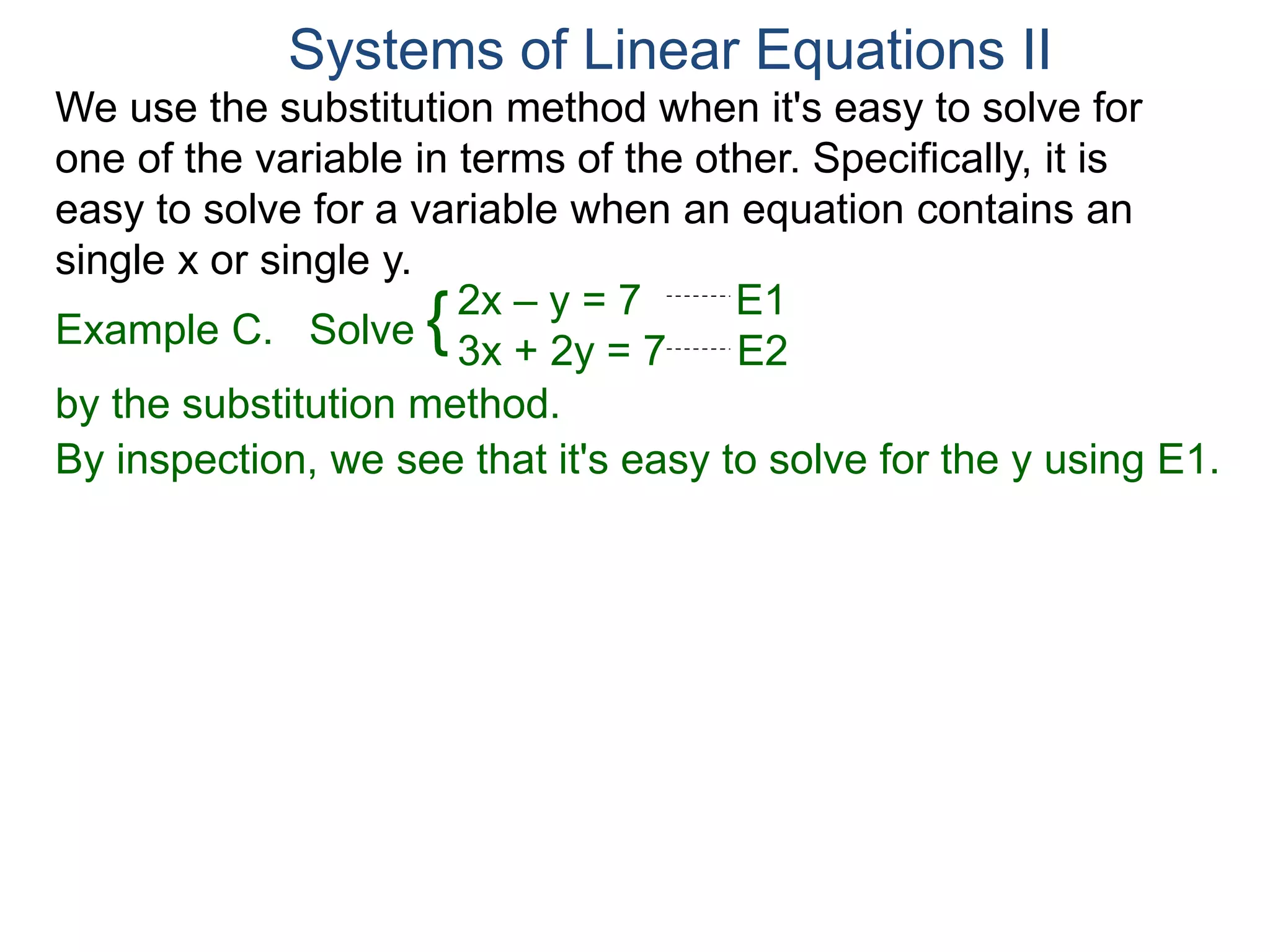
By inspection, we see that it's easy to solve for the y using E1.
Systems of Linear Equations II
Example C. {
We use the substitution method when it's easy to solve for
one of the variable in terms of the other. Specifically, it is
easy to solve for a variable when an equation contains an
single x or single y.
2x – y = 7 E1
3x + 2y = 7 E2
Solve
by the substitution method.
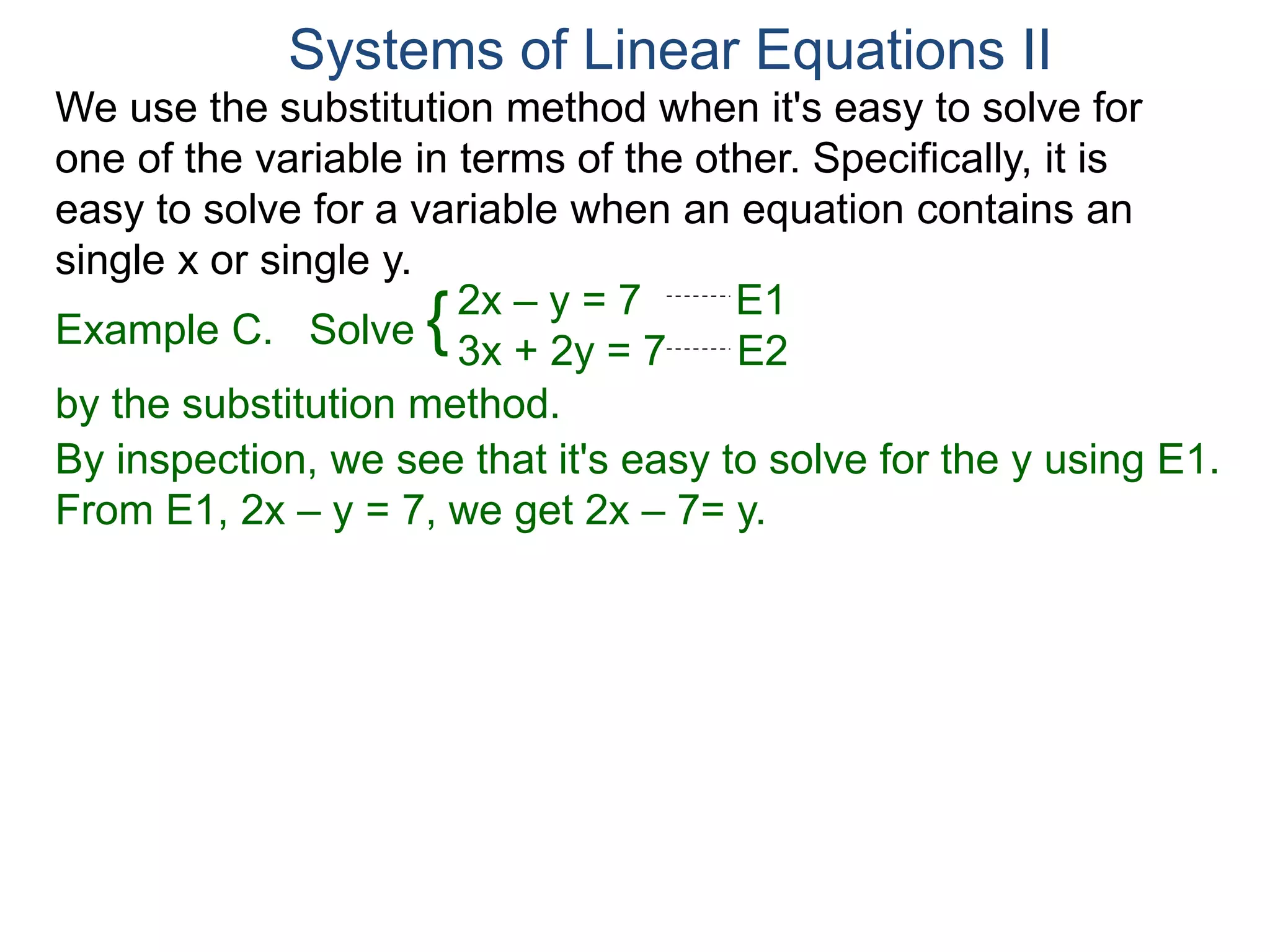
By inspection, we see that it's easy to solve for the y using E1.
From E1, 2x – y = 7, we get 2x – 7= y.
Systems of Linear Equations II
Example C. {
We use the substitution method when it's easy to solve for
one of the variable in terms of the other. Specifically, it is
easy to solve for a variable when an equation contains an
single x or single y.
2x – y = 7 E1
3x + 2y = 7 E2
Solve
by the substitution method.
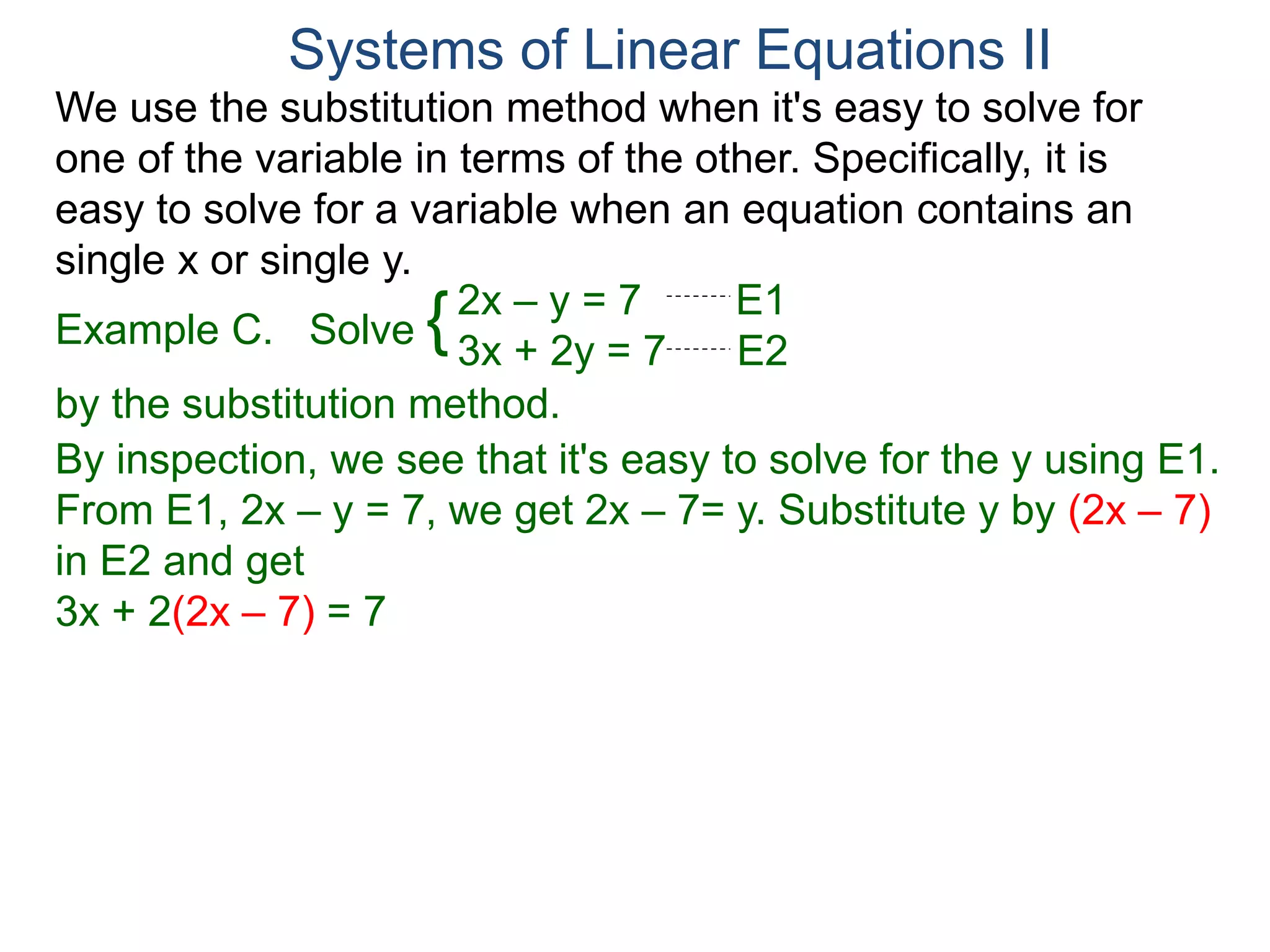
By inspection, we see that it's easy to solve for the y using E1.
From E1, 2x – y = 7, we get 2x – 7= y. Substitute y by (2x – 7)
in E2 and get
3x + 2(2x – 7) = 7
Systems of Linear Equations II
Example C. {
We use the substitution method when it's easy to solve for
one of the variable in terms of the other. Specifically, it is
easy to solve for a variable when an equation contains an
single x or single y.
2x – y = 7 E1
3x + 2y = 7 E2
Solve
by the substitution method.
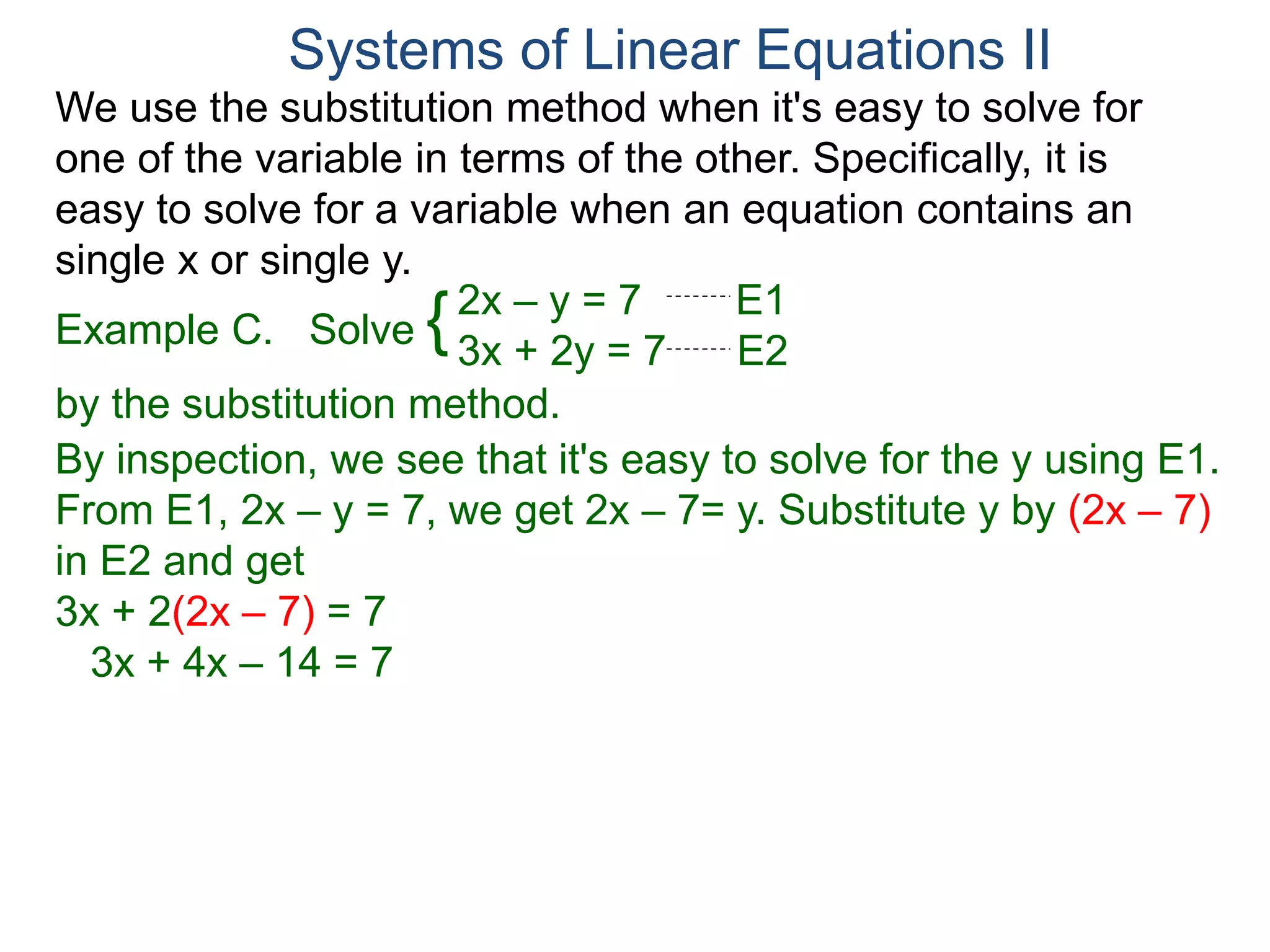
By inspection, we see that it's easy to solve for the y using E1.
From E1, 2x – y = 7, we get 2x – 7= y. Substitute y by (2x – 7)
in E2 and get
3x + 2(2x – 7) = 7
3x + 4x – 14 = 7
Systems of Linear Equations II
Example C. {
We use the substitution method when it's easy to solve for
one of the variable in terms of the other. Specifically, it is
easy to solve for a variable when an equation contains an
single x or single y.
2x – y = 7 E1
3x + 2y = 7 E2
Solve
by the substitution method.
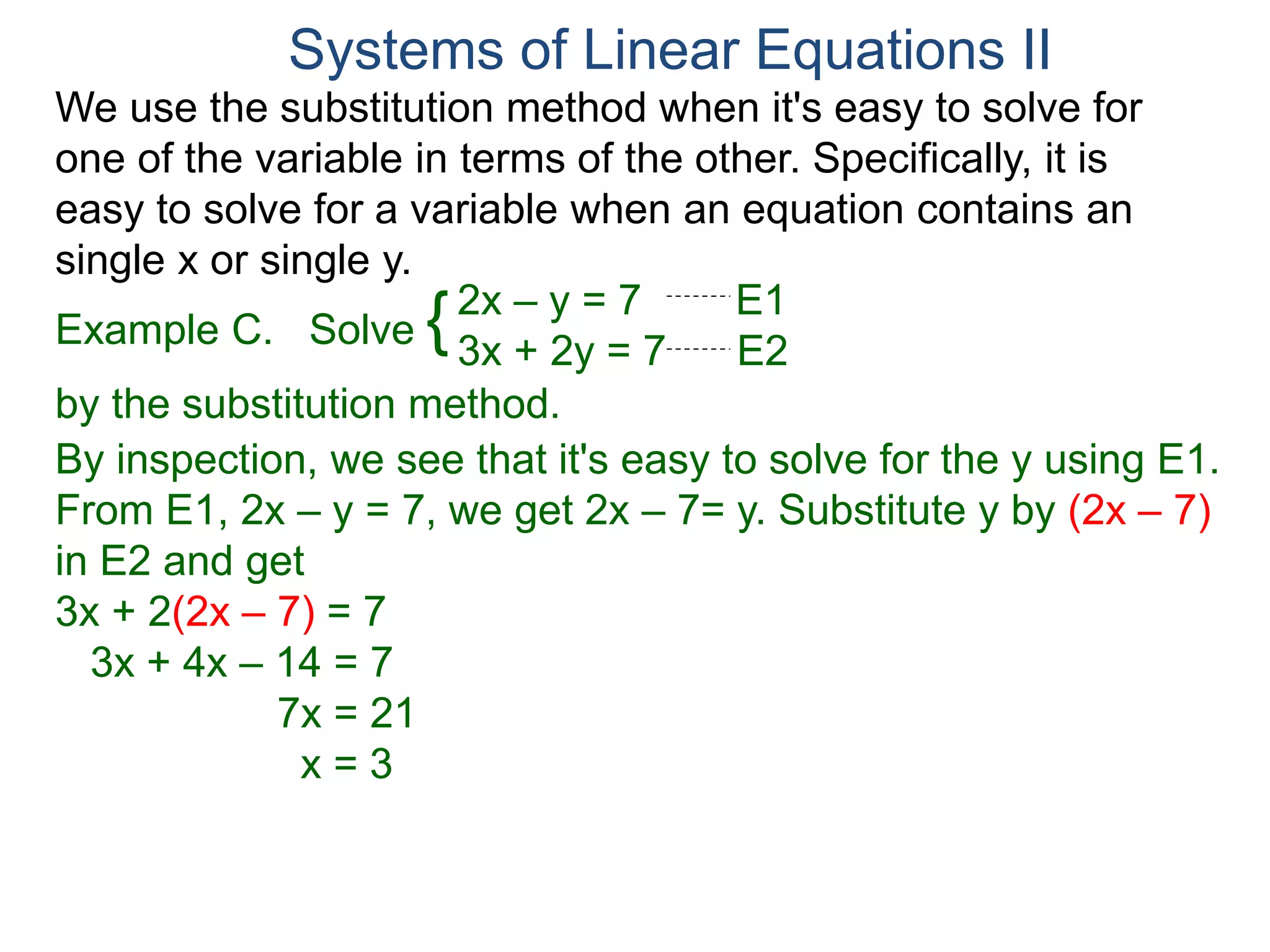
By inspection, we see that it's easy to solve for the y using E1.
From E1, 2x – y = 7, we get 2x – 7= y. Substitute y by (2x – 7)
in E2 and get
3x + 2(2x – 7) = 7
3x + 4x – 14 = 7
7x = 21
x = 3
Systems of Linear Equations II
Example C. {
We use the substitution method when it's easy to solve for
one of the variable in terms of the other. Specifically, it is
easy to solve for a variable when an equation contains an
single x or single y.
2x – y = 7 E1
3x + 2y = 7 E2
Solve
by the substitution method.
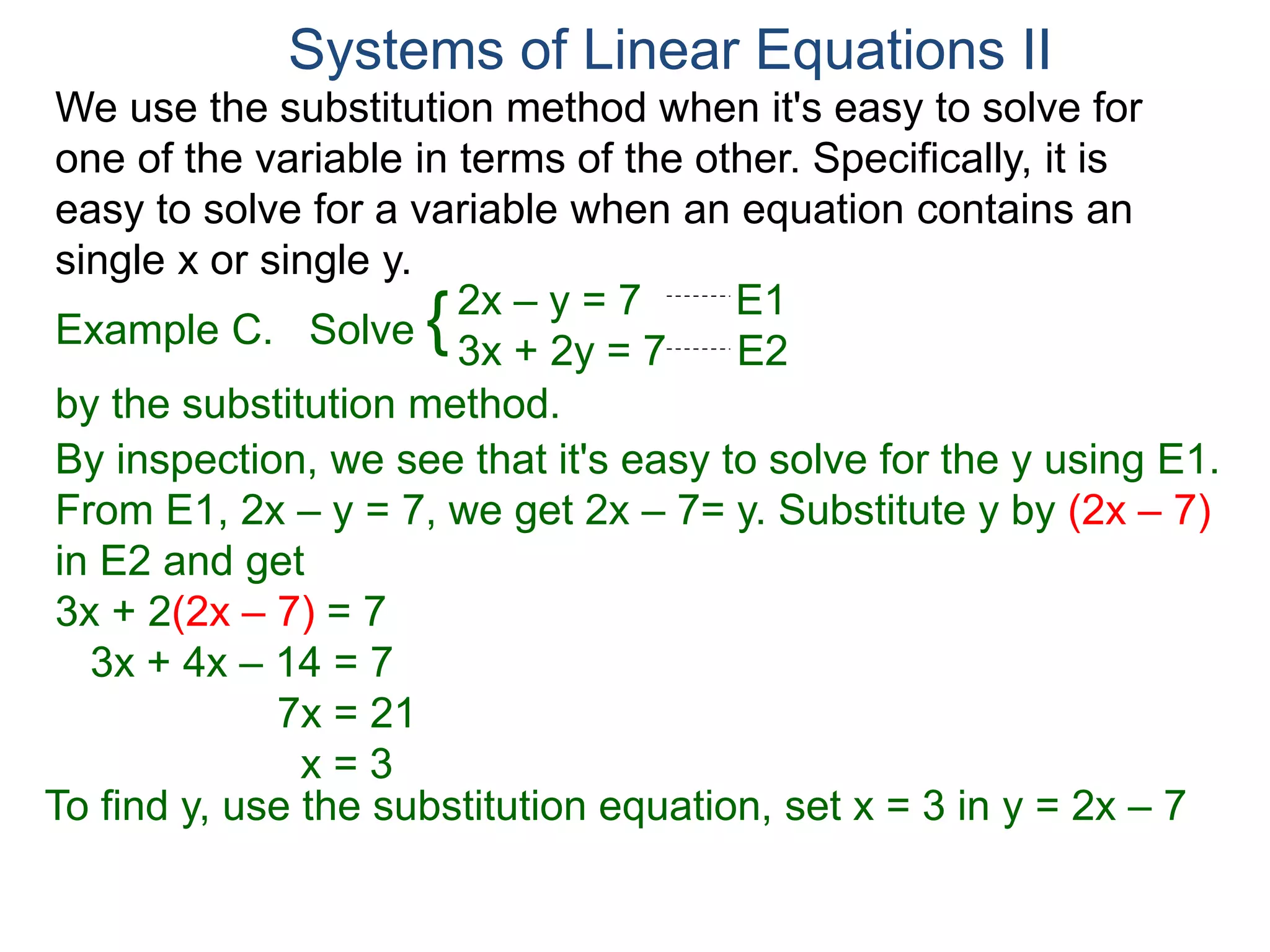
By inspection, we see that it's easy to solve for the y using E1.
From E1, 2x – y = 7, we get 2x – 7= y. Substitute y by (2x – 7)
in E2 and get
3x + 2(2x – 7) = 7
3x + 4x – 14 = 7
7x = 21
x = 3
Systems of Linear Equations II
Example C. {
To find y, use the substitution equation, set x = 3 in y = 2x – 7
We use the substitution method when it's easy to solve for
one of the variable in terms of the other. Specifically, it is
easy to solve for a variable when an equation contains an
single x or single y.
2x – y = 7 E1
3x + 2y = 7 E2
Solve
by the substitution method.
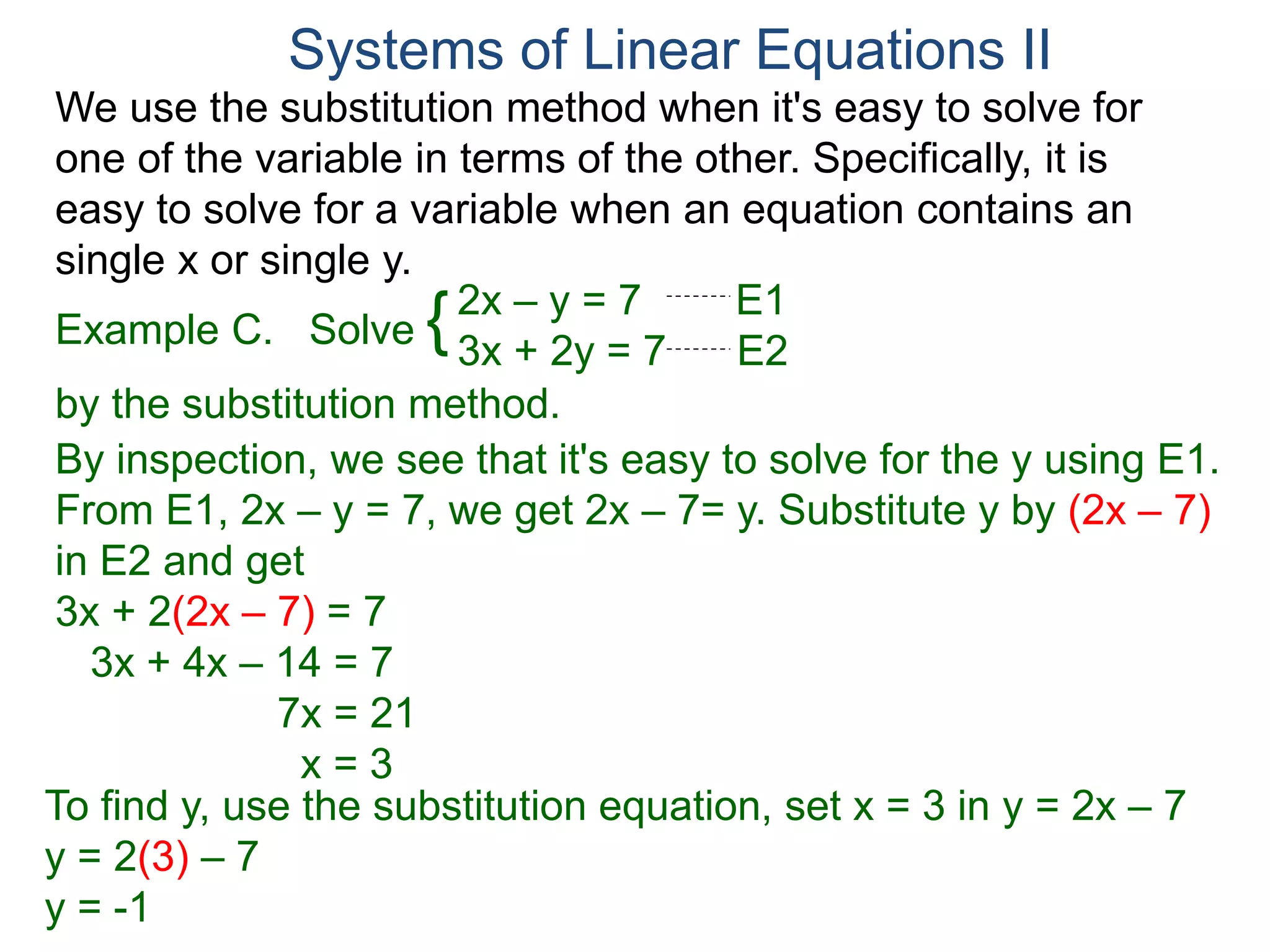
By inspection, we see that it's easy to solve for the y using E1.
From E1, 2x – y = 7, we get 2x – 7= y. Substitute y by (2x – 7)
in E2 and get
3x + 2(2x – 7) = 7
3x + 4x – 14 = 7
7x = 21
x = 3
Systems of Linear Equations II
Example C. {
To find y, use the substitution equation, set x = 3 in y = 2x – 7
y = 2(3) – 7
y = -1
We use the substitution method when it's easy to solve for
one of the variable in terms of the other. Specifically, it is
easy to solve for a variable when an equation contains an
single x or single y.
2x – y = 7 E1
3x + 2y = 7 E2
Solve
by the substitution method.
By inspection, we see that it's easy to solve for the y using E1.
From E1, 2x – y = 7, we get 2x – 7= y. Substitute y by (2x – 7)
in E2 and get
3x + 2(2x – 7) = 7
3x + 4x – 14 = 7
7x = 21
x = 3
Systems of Linear Equations II
Example C. {
To find y, use the substitution equation, set x = 3 in y = 2x – 7
y = 2(3) – 7
y = -1 Hence the solution is (3, -1).
Graphing Method
Systems of Linear Equations II
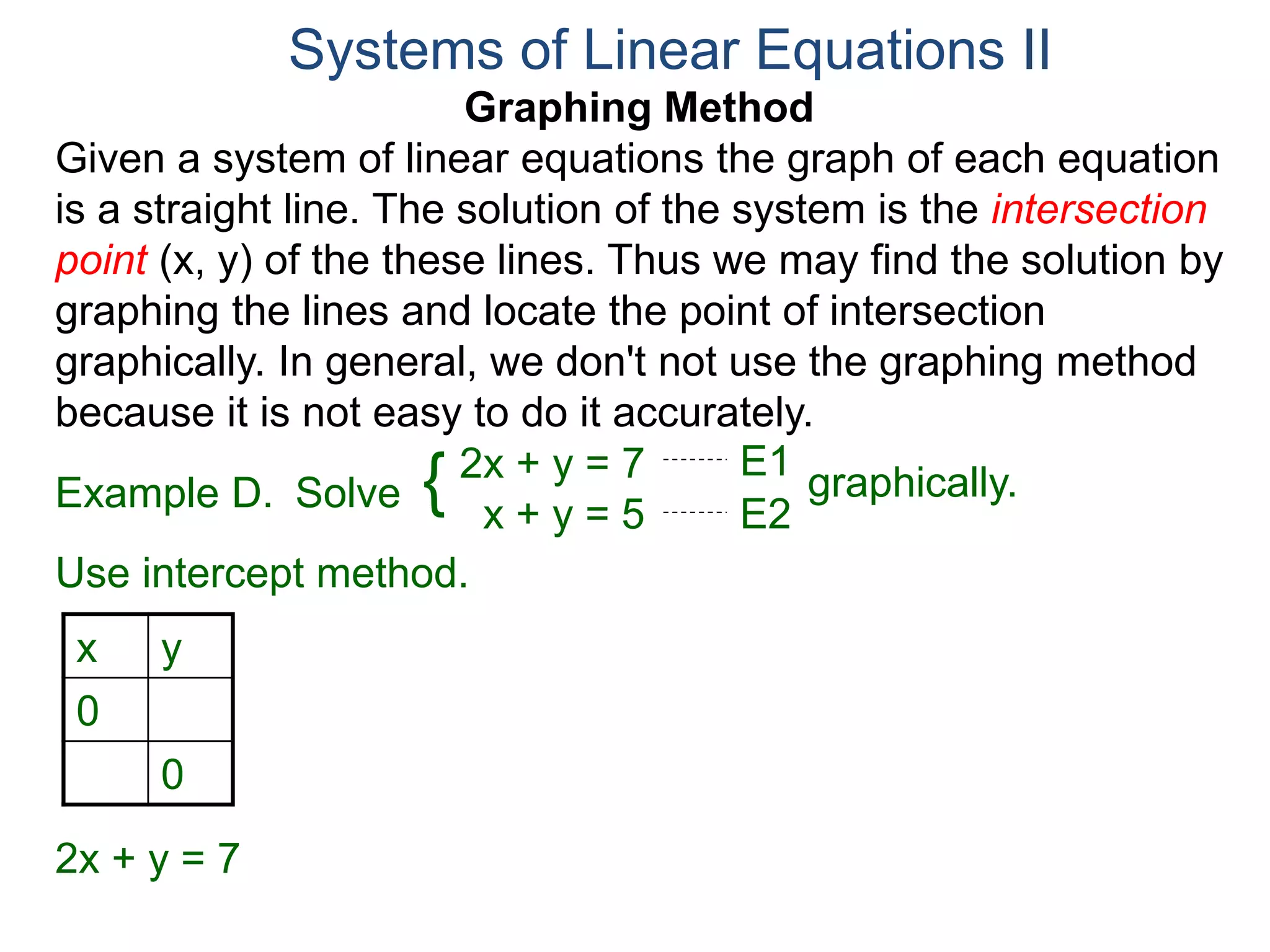
Graphing Method
Given a system of linear equations the graph of each equation
is a straight line.
Systems of Linear Equations II
Graphing Method
Given a system of linear equations the graph of each equation
is a straight line. The solution of the system is the intersection
point (x, y) of the these lines.
Systems of Linear Equations II
Graphing Method
Given a system of linear equations the graph of each equation
is a straight line. The solution of the system is the intersection
point (x, y) of the these lines. Thus we may find the solution by
graphing the lines and locate the point of intersection
graphically.
Systems of Linear Equations II
Graphing Method
Given a system of linear equations the graph of each equation
is a straight line. The solution of the system is the intersection
point (x, y) of the these lines. Thus we may find the solution by
graphing the lines and locate the point of intersection
graphically. In general, we don't not use the graphing method
because it is not easy to do it accurately.
Systems of Linear Equations II
Graphing Method
Given a system of linear equations the graph of each equation
is a straight line. The solution of the system is the intersection
point (x, y) of the these lines. Thus we may find the solution by
graphing the lines and locate the point of intersection
graphically. In general, we don't not use the graphing method
because it is not easy to do it accurately.
Systems of Linear Equations II
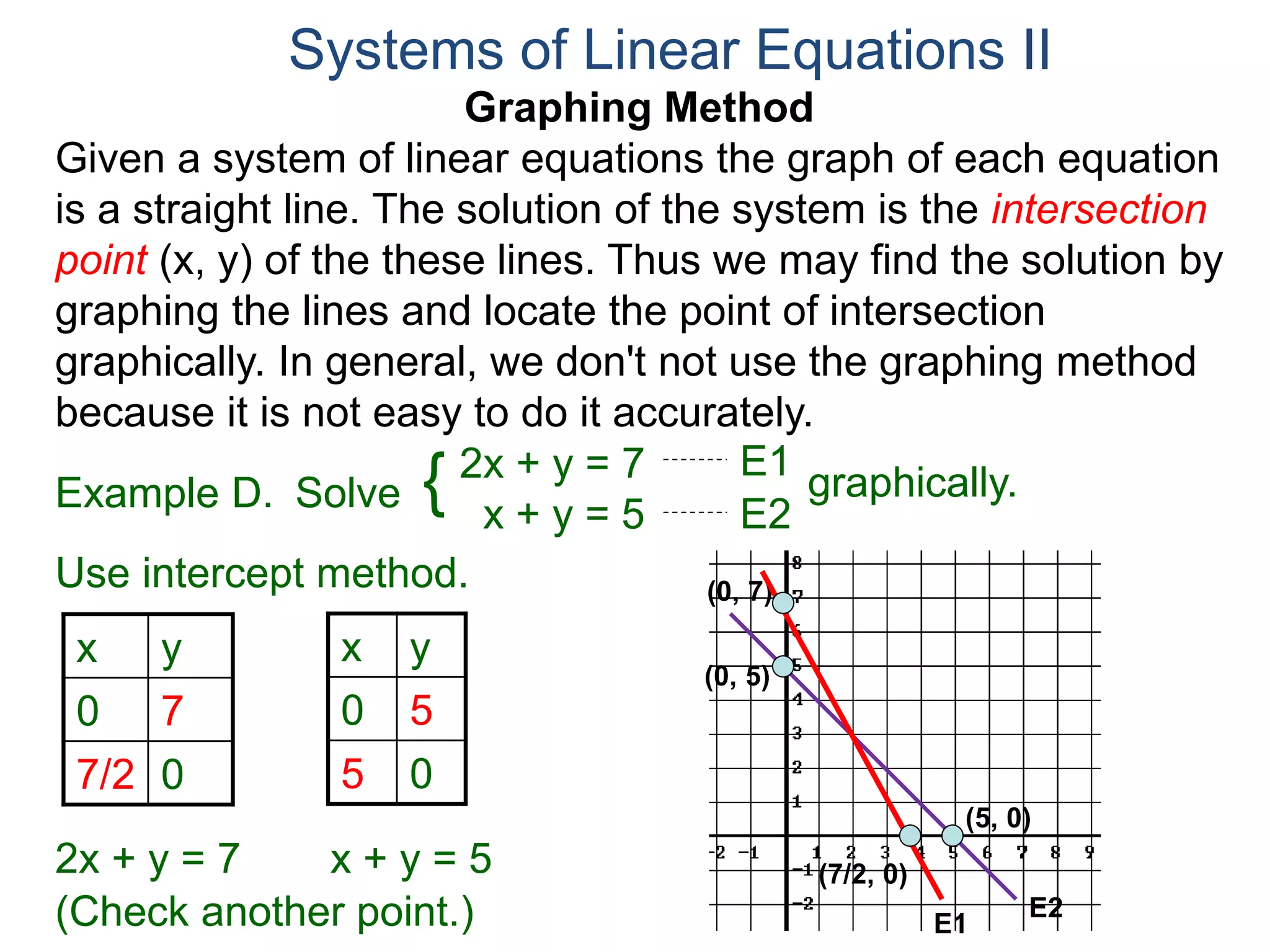
2x + y = 7
x + y = 5
Solve graphically.{ E1
E2
Example D.
Graphing Method
Given a system of linear equations the graph of each equation
is a straight line. The solution of the system is the intersection
point (x, y) of the these lines. Thus we may find the solution by
graphing the lines and locate the point of intersection
graphically. In general, we don't not use the graphing method
because it is not easy to do it accurately.
Systems of Linear Equations II
2x + y = 7
x + y = 5
Solve graphically.{ E1
E2
Example D.
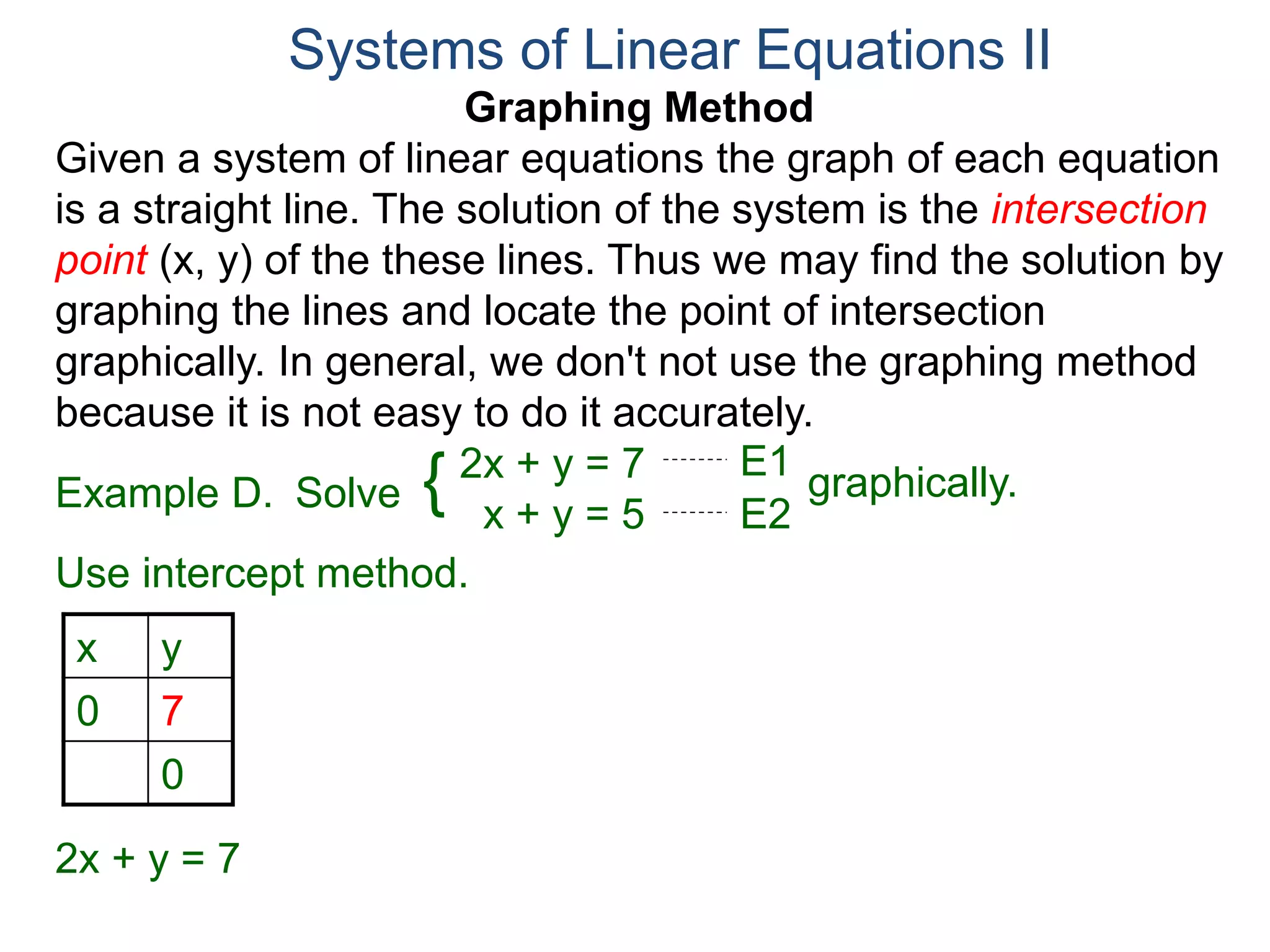
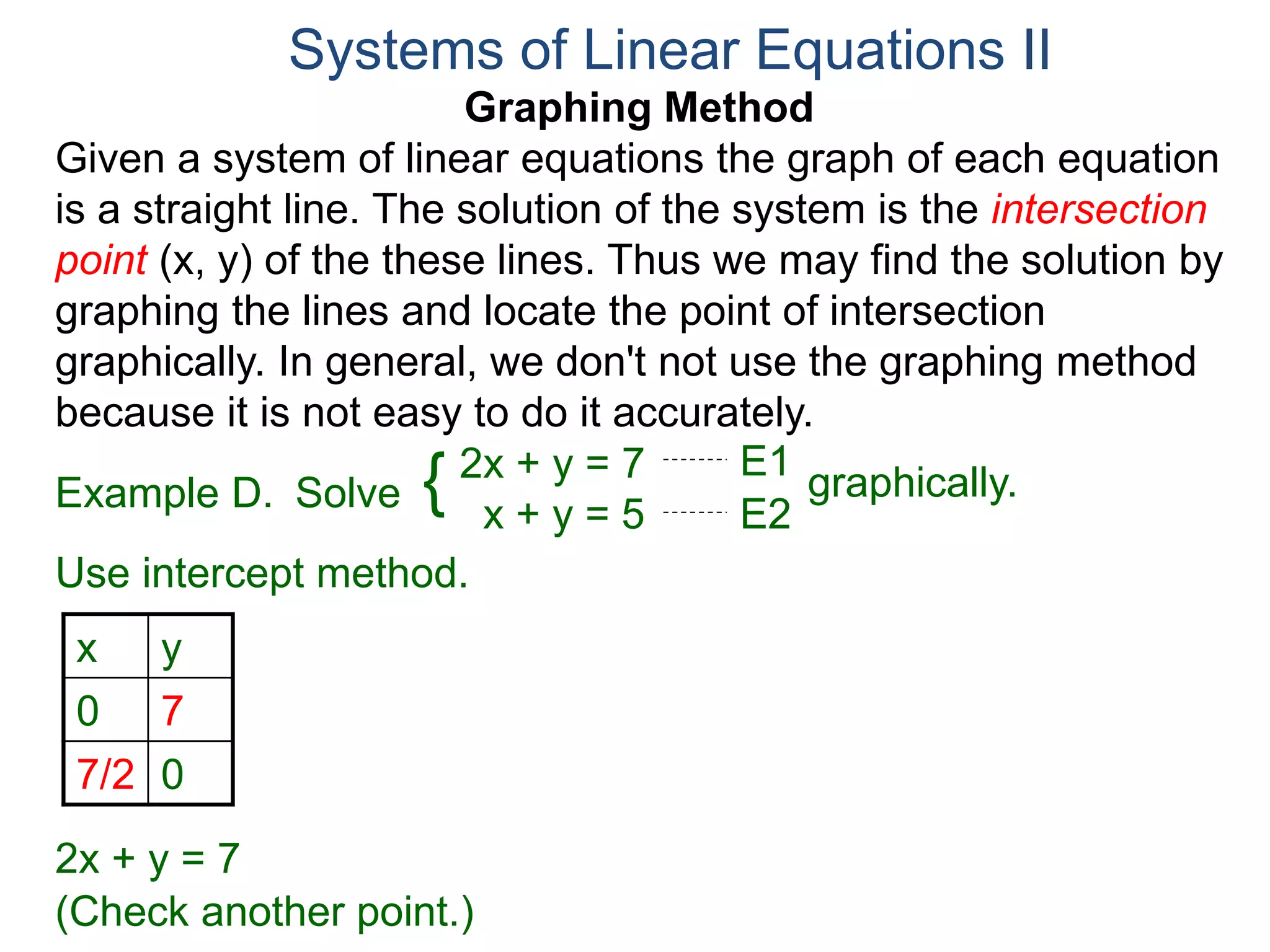
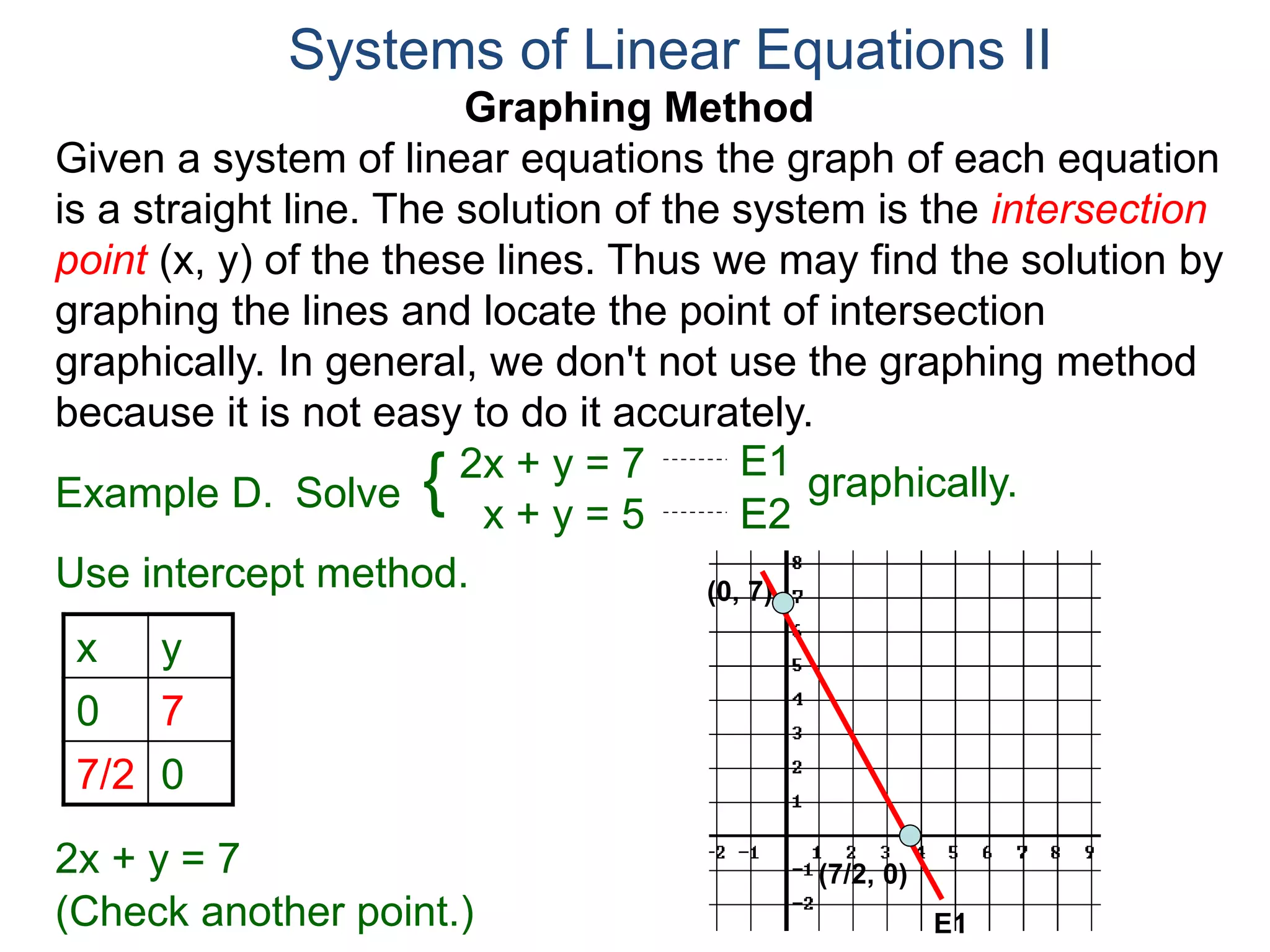
Use intercept method.
Graphing Method
Given a system of linear equations the graph of each equation
is a straight line. The solution of the system is the intersection
point (x, y) of the these lines. Thus we may find the solution by
graphing the lines and locate the point of intersection
graphically. In general, we don't not use the graphing method
because it is not easy to do it accurately.
Systems of Linear Equations II
2x + y = 7
x + y = 5
Solve graphically.{ E1
E2
Example D.
Use intercept method.
x y
0
0
2x + y = 7
Graphing Method
Given a system of linear equations the graph of each equation
is a straight line. The solution of the system is the intersection
point (x, y) of the these lines. Thus we may find the solution by
graphing the lines and locate the point of intersection
graphically. In general, we don't not use the graphing method
because it is not easy to do it accurately.
Systems of Linear Equations II
2x + y = 7
x + y = 5
Solve graphically.{ E1
E2
Example D.
Use intercept method.
x y
0 7
0
2x + y = 7
Graphing Method
Given a system of linear equations the graph of each equation
is a straight line. The solution of the system is the intersection
point (x, y) of the these lines. Thus we may find the solution by
graphing the lines and locate the point of intersection
graphically. In general, we don't not use the graphing method
because it is not easy to do it accurately.
Systems of Linear Equations II
2x + y = 7
x + y = 5
Solve graphically.{ E1
E2
Example D.
Use intercept method.
x y
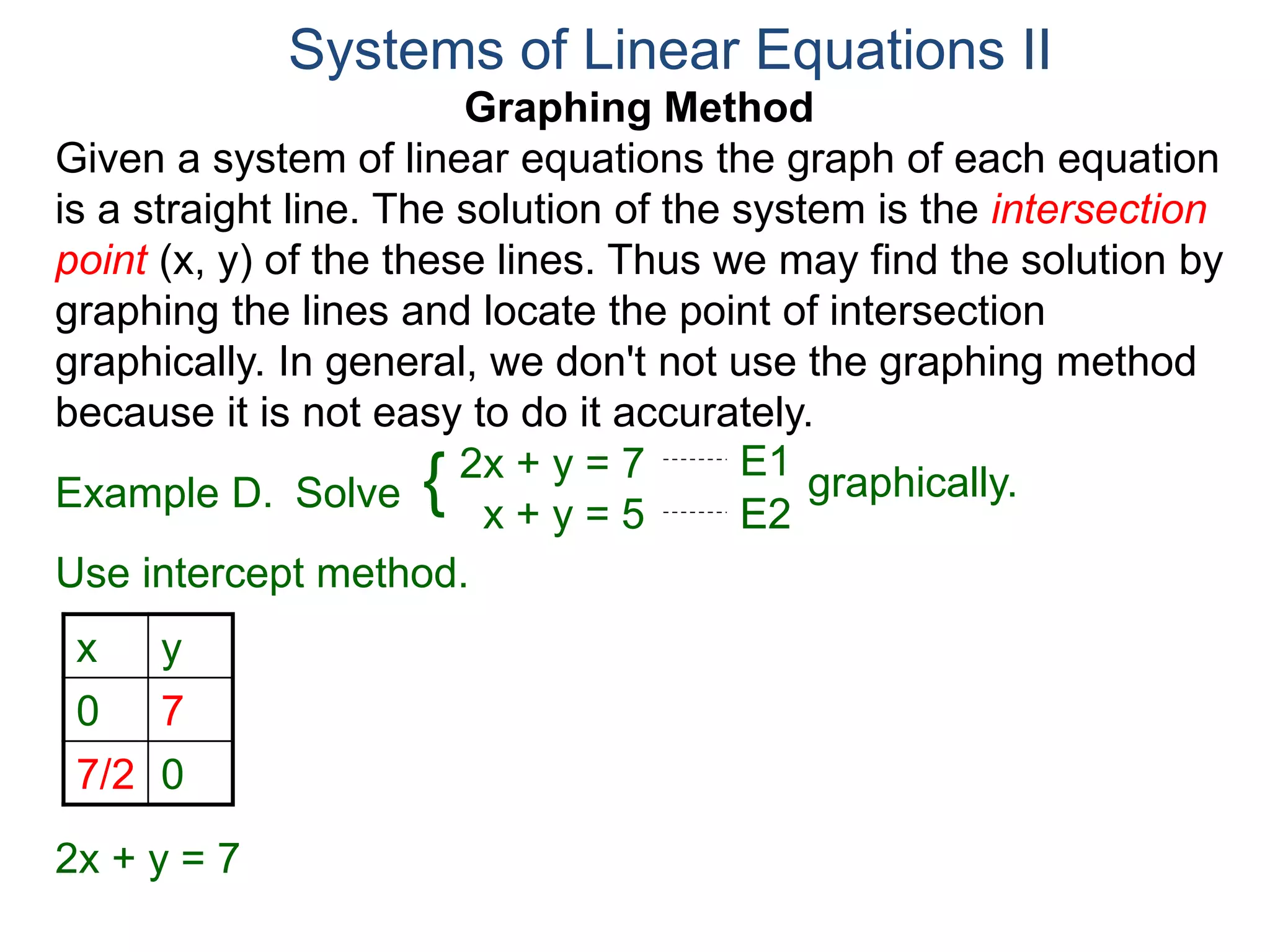
0 7
7/2 0
2x + y = 7
E2
Graphing Method
Given a system of linear equations the graph of each equation
is a straight line. The solution of the system is the intersection
point (x, y) of the these lines. Thus we may find the solution by
graphing the lines and locate the point of intersection
graphically. In general, we don't not use the graphing method
because it is not easy to do it accurately.
Systems of Linear Equations II
2x + y = 7
x + y = 5
Solve graphically.{ E1
E2
Example D.
Use intercept method.
x y
0 7
7/2 0
2x + y = 7
E2
(Check another point.)
Graphing Method
Given a system of linear equations the graph of each equation
is a straight line. The solution of the system is the intersection
point (x, y) of the these lines. Thus we may find the solution by
graphing the lines and locate the point of intersection
graphically. In general, we don't not use the graphing method
because it is not easy to do it accurately.
Systems of Linear Equations II
2x + y = 7
x + y = 5
Solve graphically.{ E1
E2
Example D.
Use intercept method.
x y
0 7
7/2 0
2x + y = 7
E1
E2
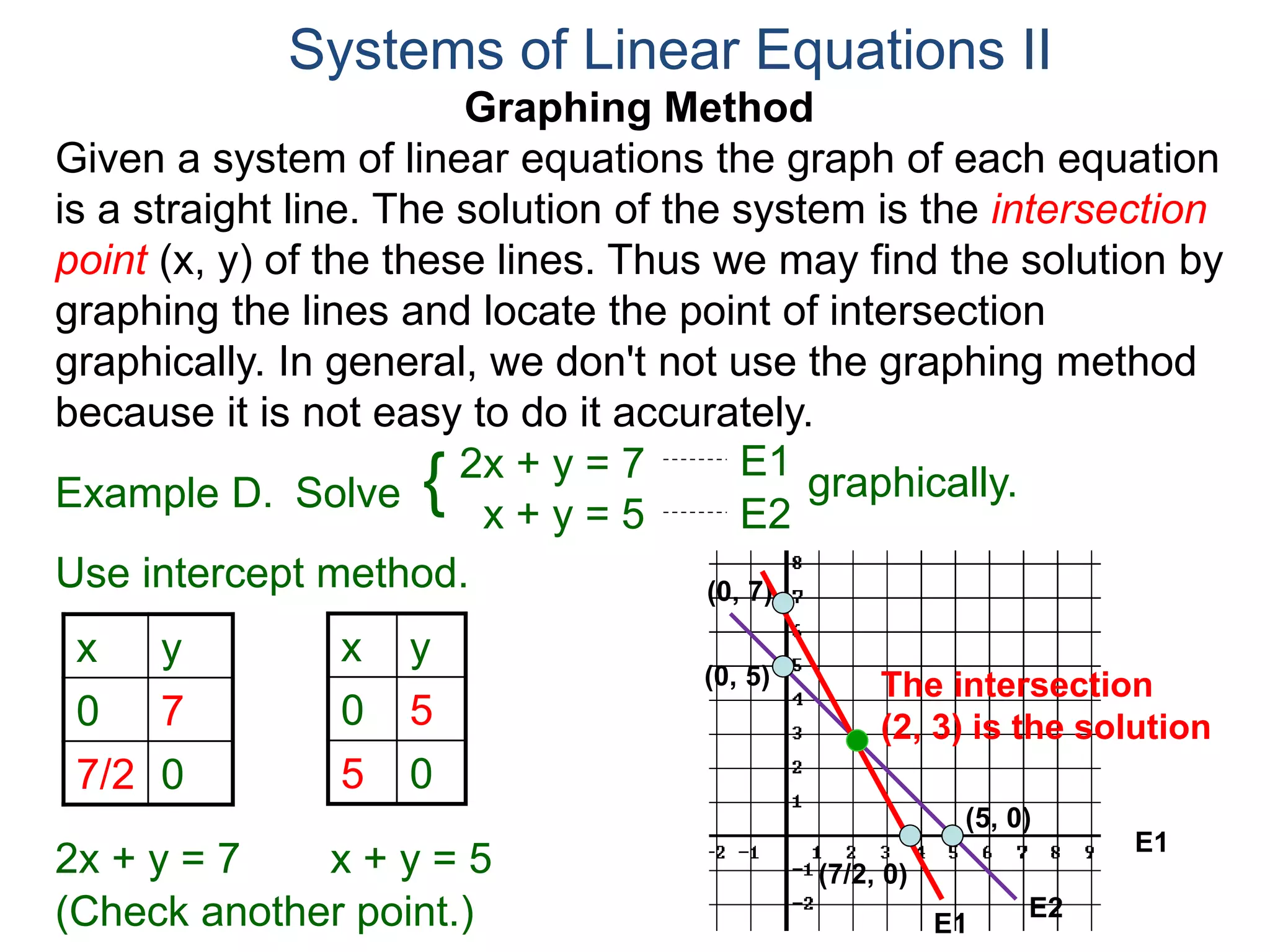
(0, 7)
(7/2, 0)
E1(Check another point.)
Graphing Method
Given a system of linear equations the graph of each equation
is a straight line. The solution of the system is the intersection
point (x, y) of the these lines. Thus we may find the solution by
graphing the lines and locate the point of intersection
graphically. In general, we don't not use the graphing method
because it is not easy to do it accurately.
Systems of Linear Equations II
2x + y = 7
x + y = 5
Solve graphically.{ E1
E2
Example D.
Use intercept method.
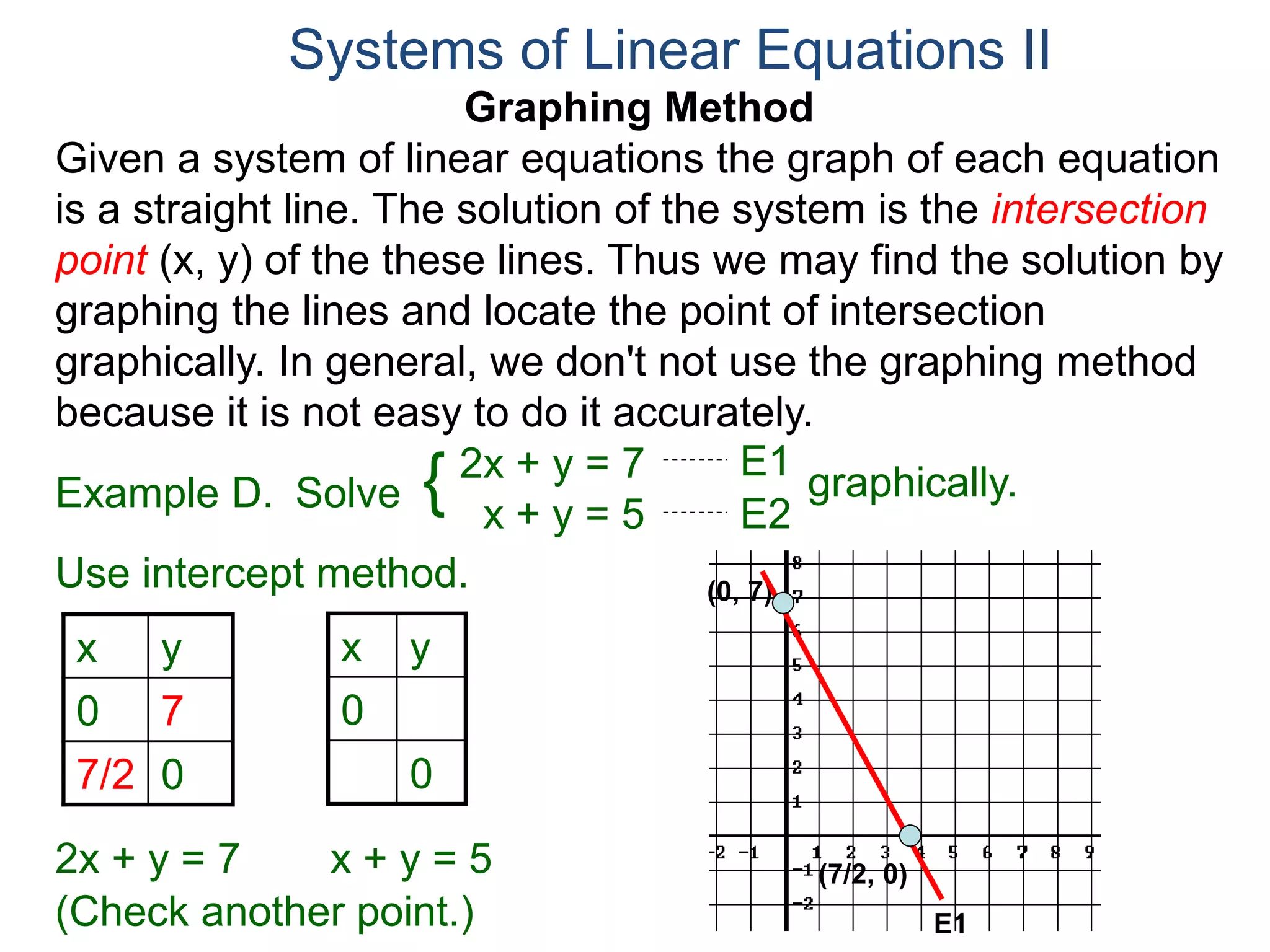
x + y = 5
x y
0 7
7/2 0
2x + y = 7
x y
0
0
(0, 7)
(7/2, 0)
E1(Check another point.)
Graphing Method
Given a system of linear equations the graph of each equation
is a straight line. The solution of the system is the intersection
point (x, y) of the these lines. Thus we may find the solution by
graphing the lines and locate the point of intersection
graphically. In general, we don't not use the graphing method
because it is not easy to do it accurately.
Systems of Linear Equations II
2x + y = 7
x + y = 5
Solve graphically.{ E1
E2
Example D.
Use intercept method.
x y
0 7
7/2 0
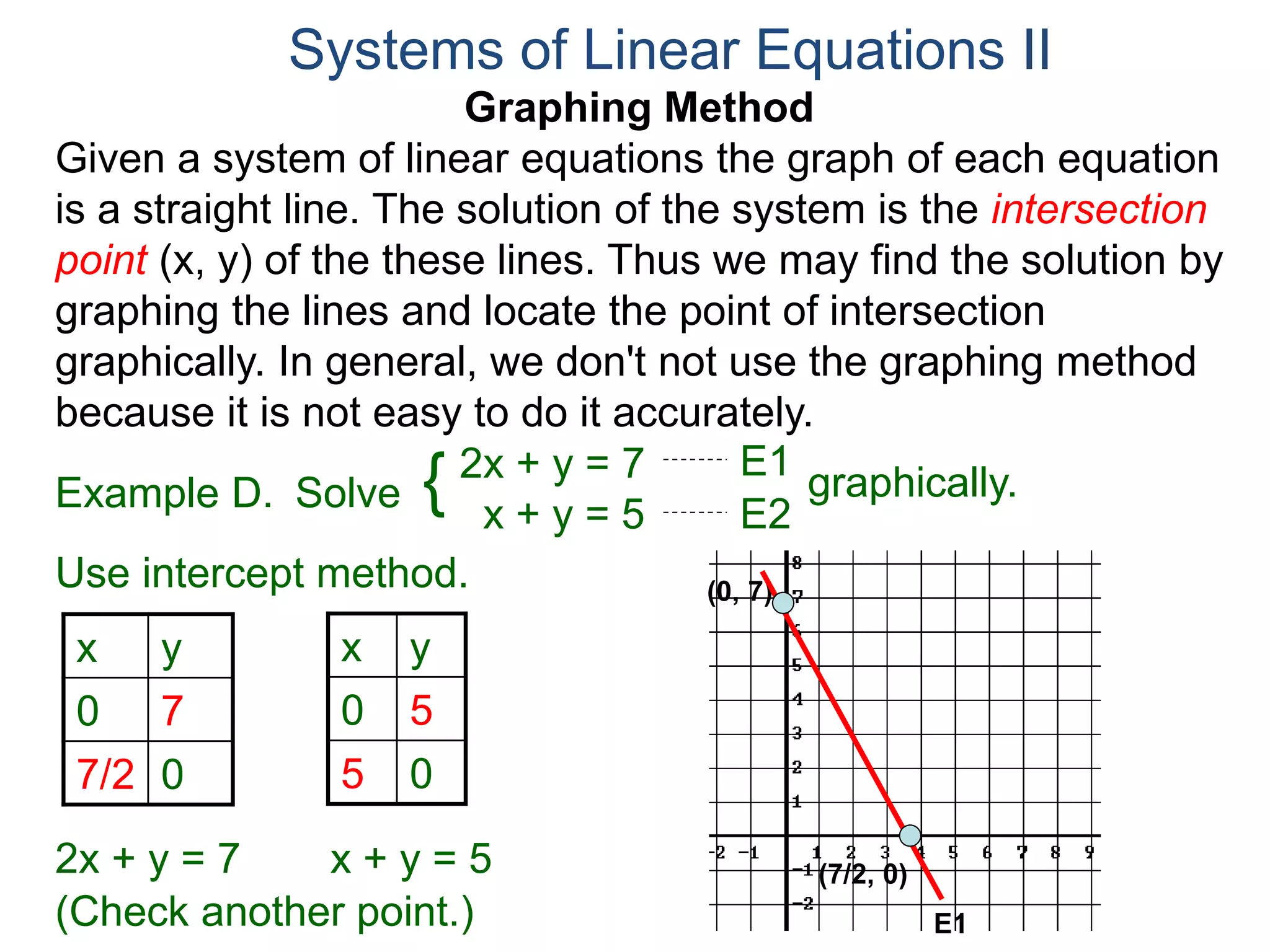
2x + y = 7 x + y = 5
x y
0 5
5 0
(0, 7)
(7/2, 0)
E1(Check another point.)
Graphing Method
Given a system of linear equations the graph of each equation
is a straight line. The solution of the system is the intersection
point (x, y) of the these lines. Thus we may find the solution by
graphing the lines and locate the point of intersection
graphically. In general, we don't not use the graphing method
because it is not easy to do it accurately.
Systems of Linear Equations II
2x + y = 7
x + y = 5
Solve graphically.{ E1
E2
Example D.
Use intercept method.
x y
0 7
7/2 0
2x + y = 7
(0, 7)
(7/2, 0)
(0, 5)
(5, 0)
E2
x + y = 5
x y
0 5
5 0
E1(Check another point.)
Graphing Method
Given a system of linear equations the graph of each equation
is a straight line. The solution of the system is the intersection
point (x, y) of the these lines. Thus we may find the solution by
graphing the lines and locate the point of intersection
graphically. In general, we don't not use the graphing method
because it is not easy to do it accurately.
Systems of Linear Equations II
2x + y = 7
x + y = 5
Solve graphically.{ E1
E2
Example D.
Use intercept method.
x y
0 7
7/2 0
2x + y = 7
(0, 7)
(7/2, 0)
(0, 5)
(5, 0)
The intersection
(2, 3) is the solution
E1
E2
x + y = 5
x y
0 5
5 0
E1(Check another point.)
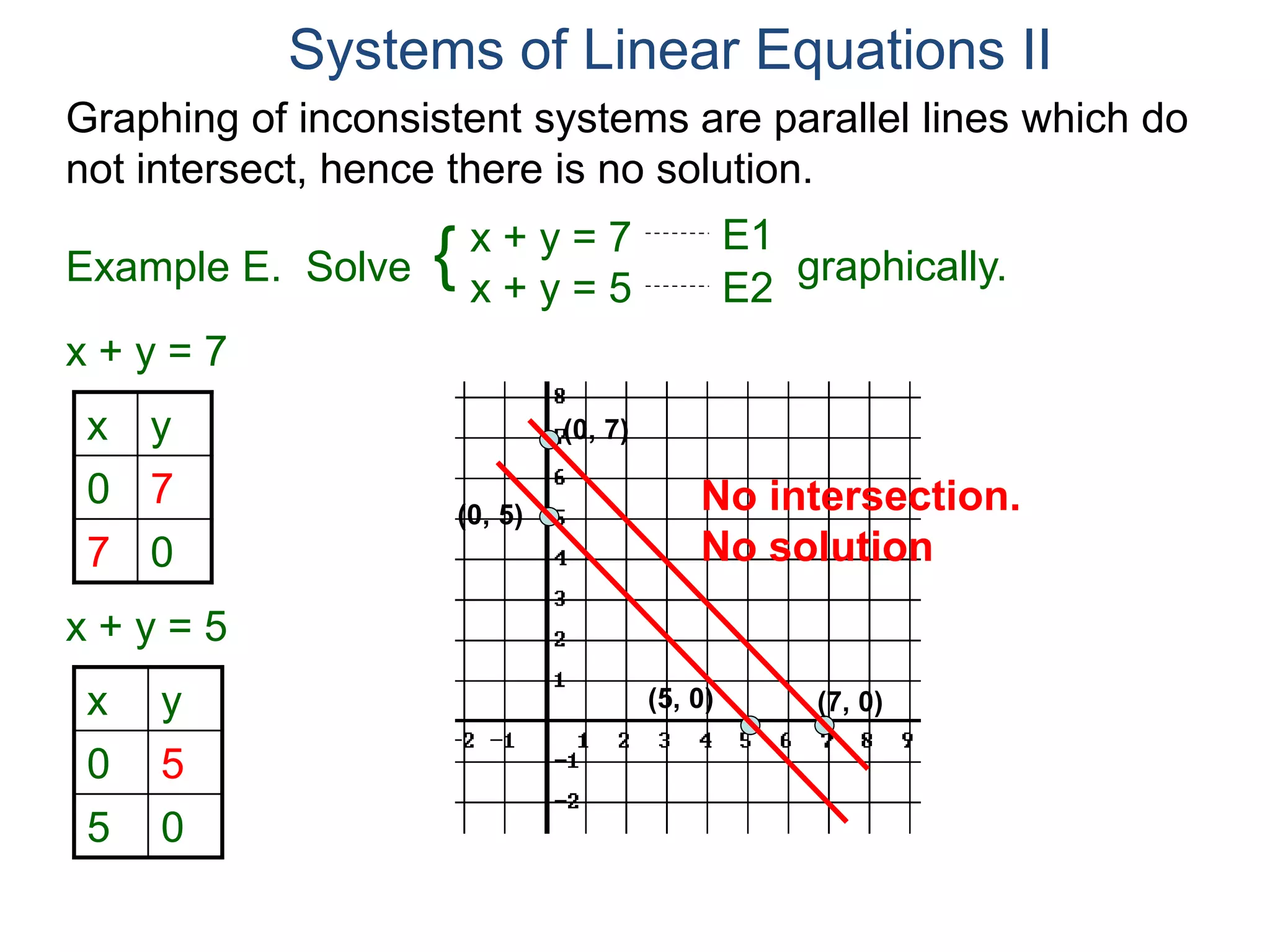
Graphing of inconsistent systems are parallel lines which do
not intersect, hence there is no solution.
Systems of Linear Equations II
Graphing of inconsistent systems are parallel lines which do
not intersect, hence there is no solution.
Systems of Linear Equations II
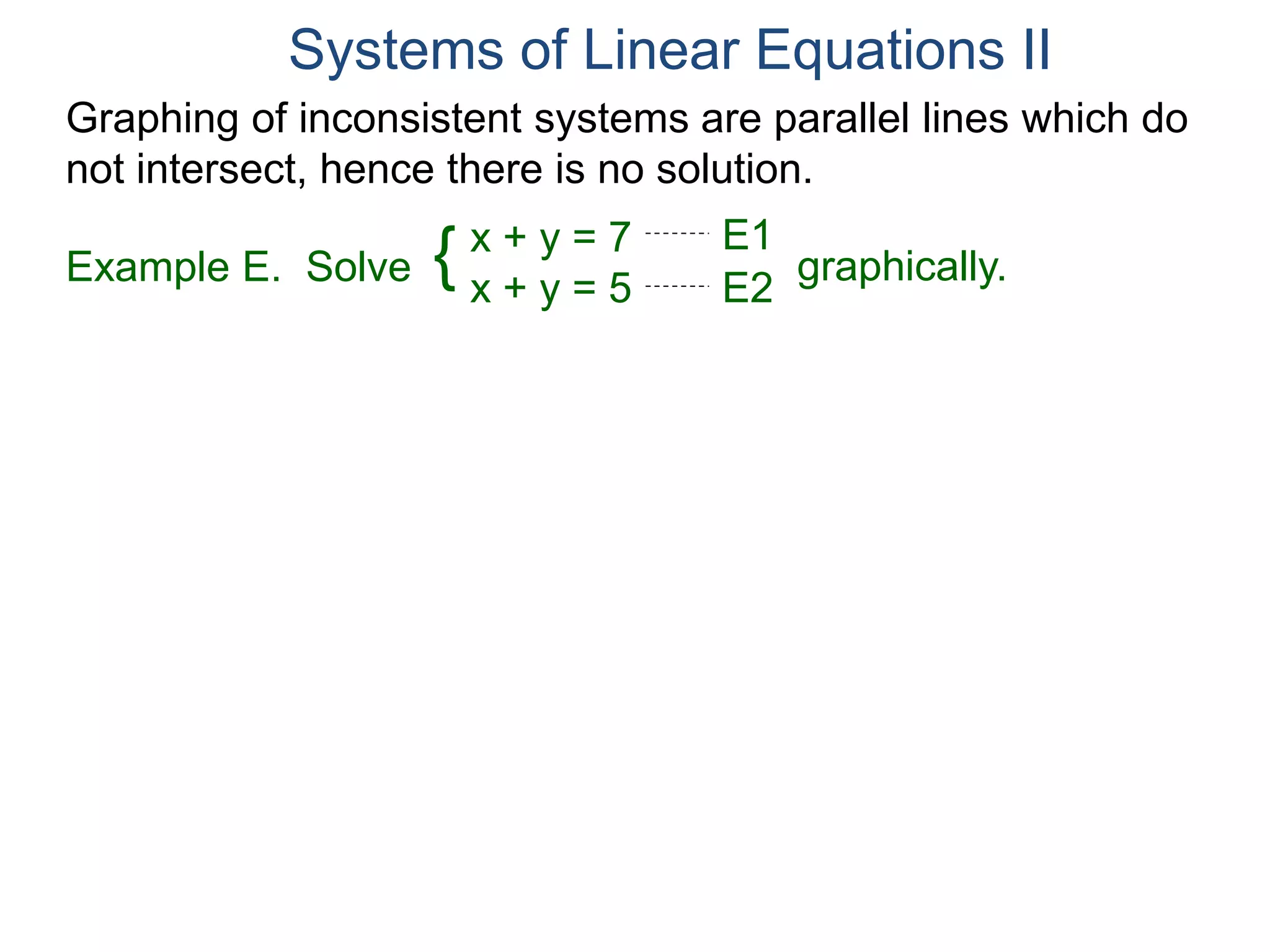
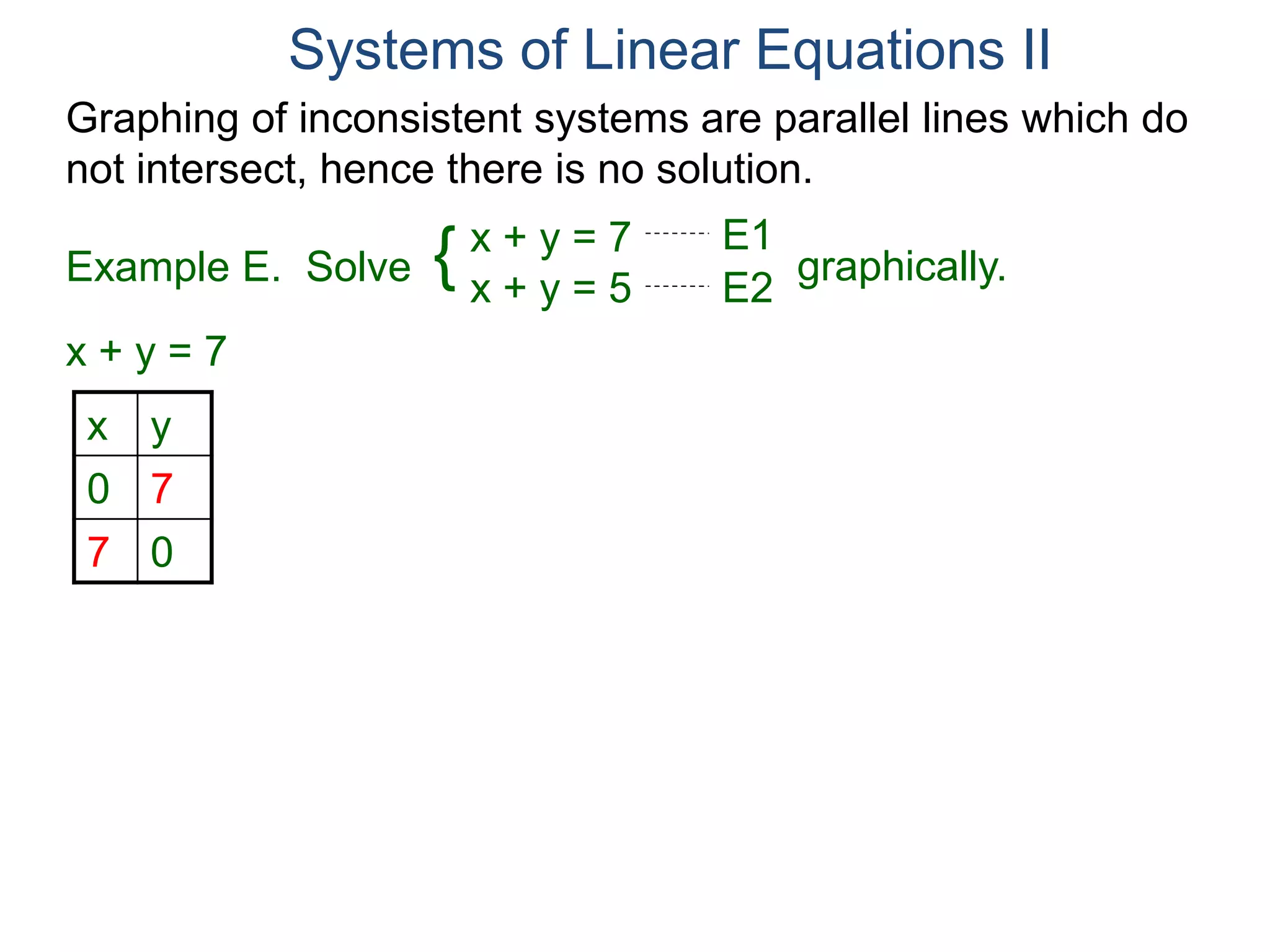
x + y = 7
x + y = 5
Solve graphically.{ E1
E2
Example E.
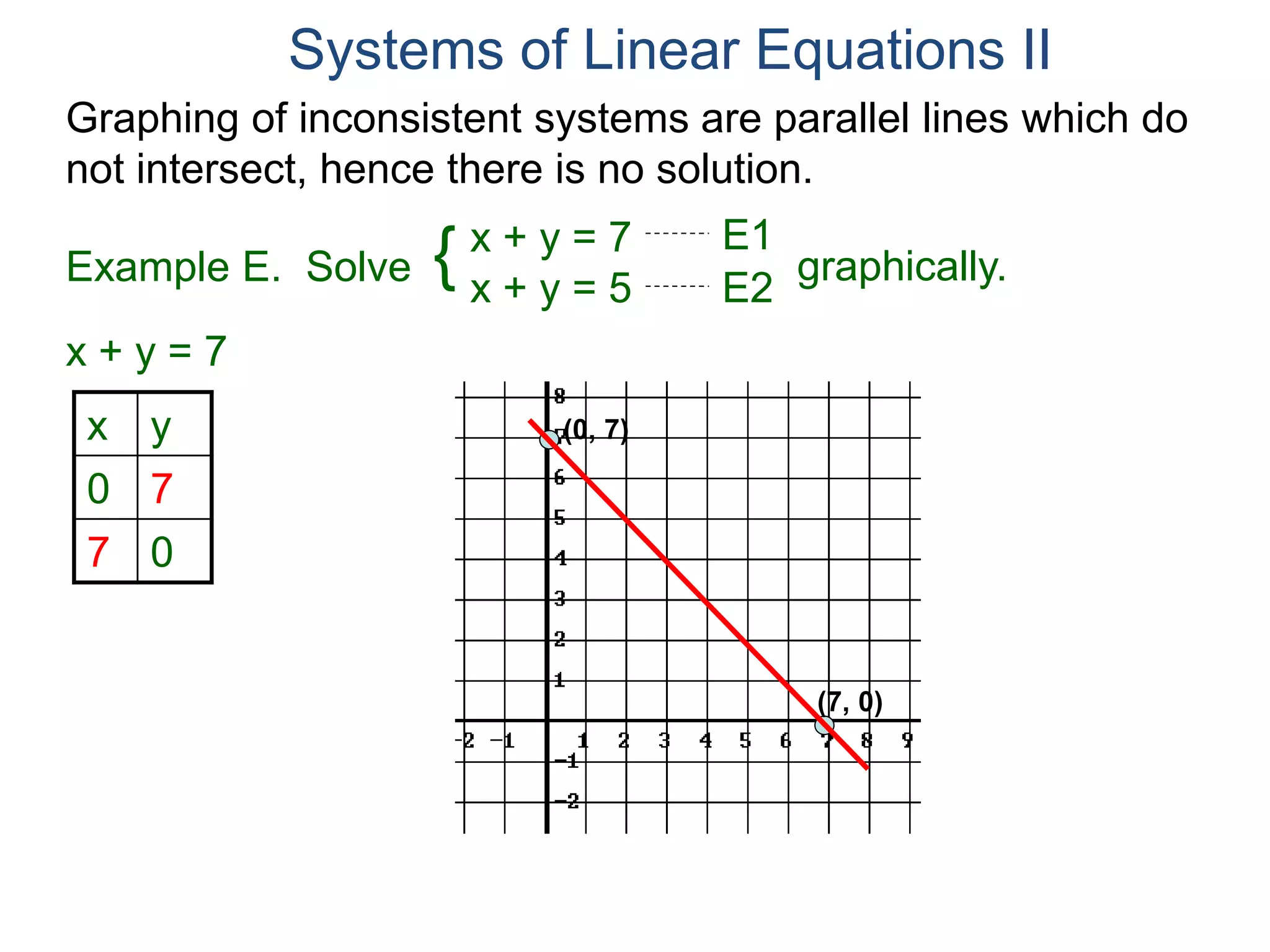
Graphing of inconsistent systems are parallel lines which do
not intersect, hence there is no solution.
x + y = 7
x y
0 7
7 0
Systems of Linear Equations II
x + y = 7
x + y = 5
Solve graphically.{ E1
E2
Example E.
Graphing of inconsistent systems are parallel lines which do
not intersect, hence there is no solution.
x + y = 7
x y
0 7
7 0
(0, 7)
(7, 0)
Systems of Linear Equations II
x + y = 7
x + y = 5
Solve graphically.{ E1
E2
Example E.
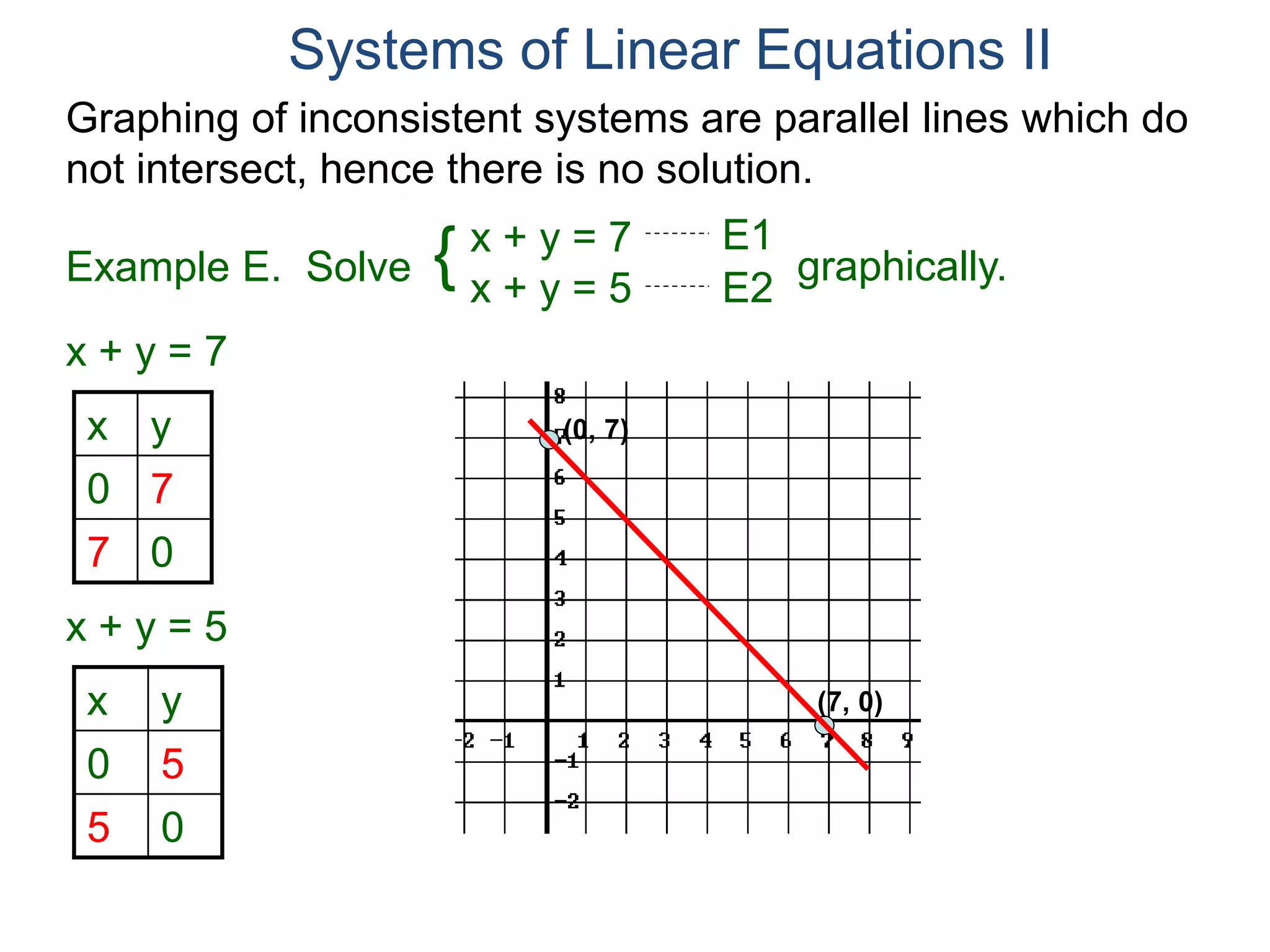
Graphing of inconsistent systems are parallel lines which do
not intersect, hence there is no solution.
x + y = 7
x y
0 7
7 0
x y
0 5
5 0
(0, 7)
(7, 0)
Systems of Linear Equations II
x + y = 7
x + y = 5
Solve graphically.{ E1
E2
Example E.
x + y = 5
Graphing of inconsistent systems are parallel lines which do
not intersect, hence there is no solution.
x + y = 7
x y
0 7
7 0
x y
0 5
5 0
(0, 7)
(7, 0)
(0, 5)
(5, 0)
Systems of Linear Equations II
x + y = 7
x + y = 5
Solve graphically.{ E1
E2
Example E.
x + y = 5
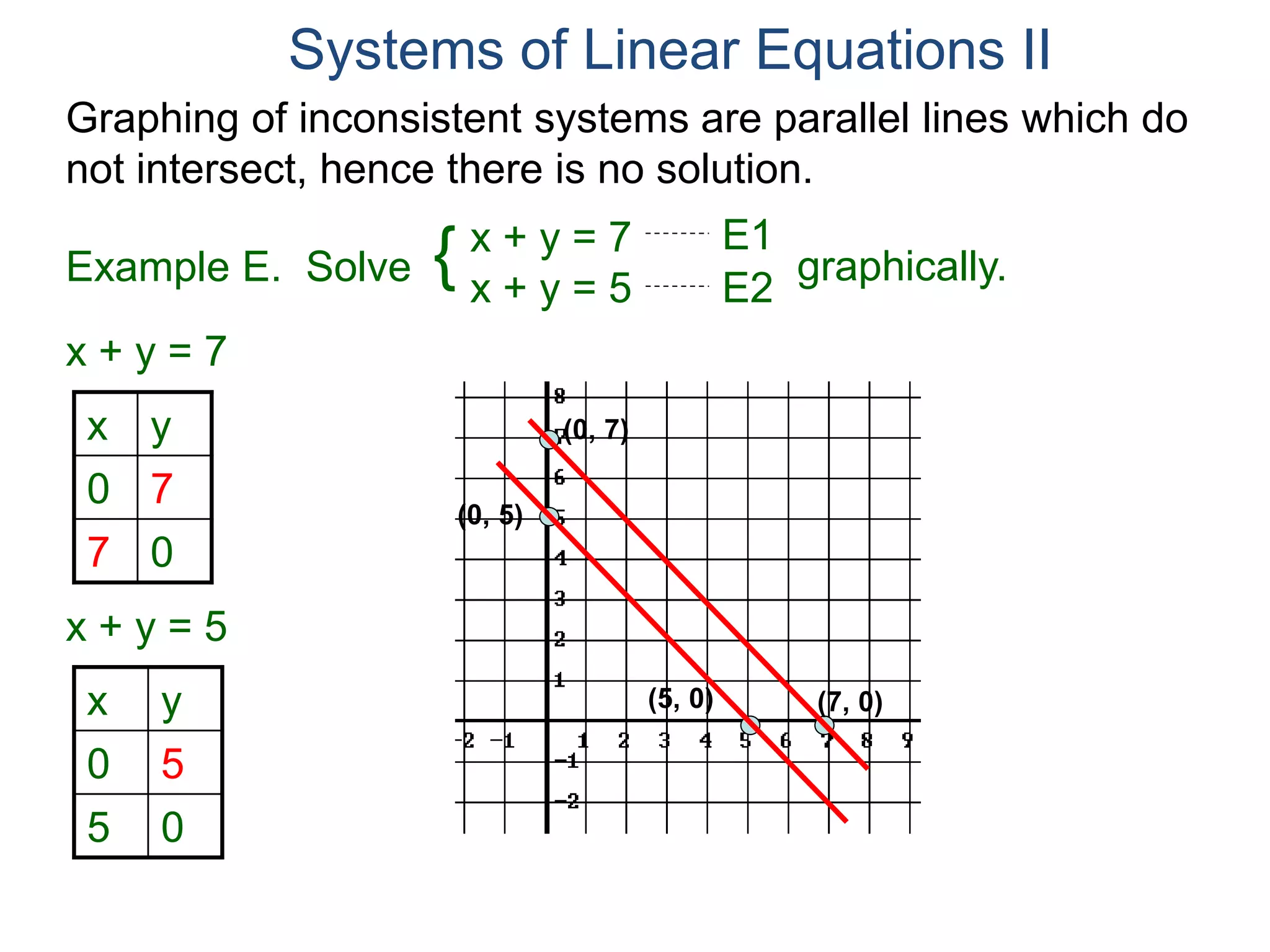
Graphing of inconsistent systems are parallel lines which do
not intersect, hence there is no solution.
x + y = 7
x y
0 7
7 0
x y
0 5
5 0
(0, 7)
(7, 0)
(0, 5)
(5, 0)
No intersection.
No solution
Systems of Linear Equations II
x + y = 7
x + y = 5
Solve graphically.{ E1
E2
Example E.
x + y = 5
Graphs of dependent systems are identical lines, hence every
point on the line is a solution.
Systems of Linear Equations II
Graphs of dependent systems are identical lines, hence every
point on the line is a solution.
Systems of Linear Equations II
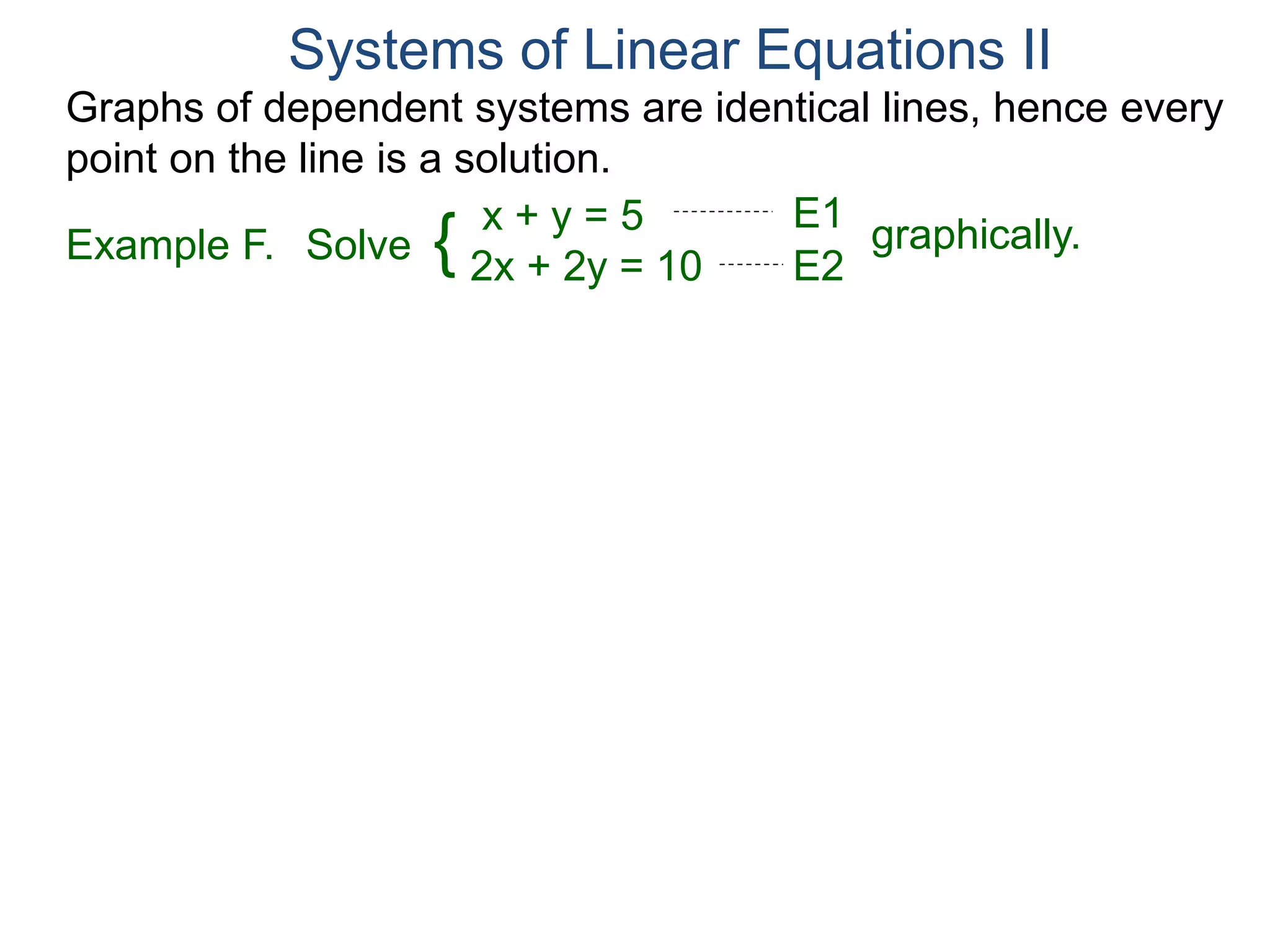
x + y = 5
2x + 2y = 10
Solve graphically.{
E1
E2Example F.
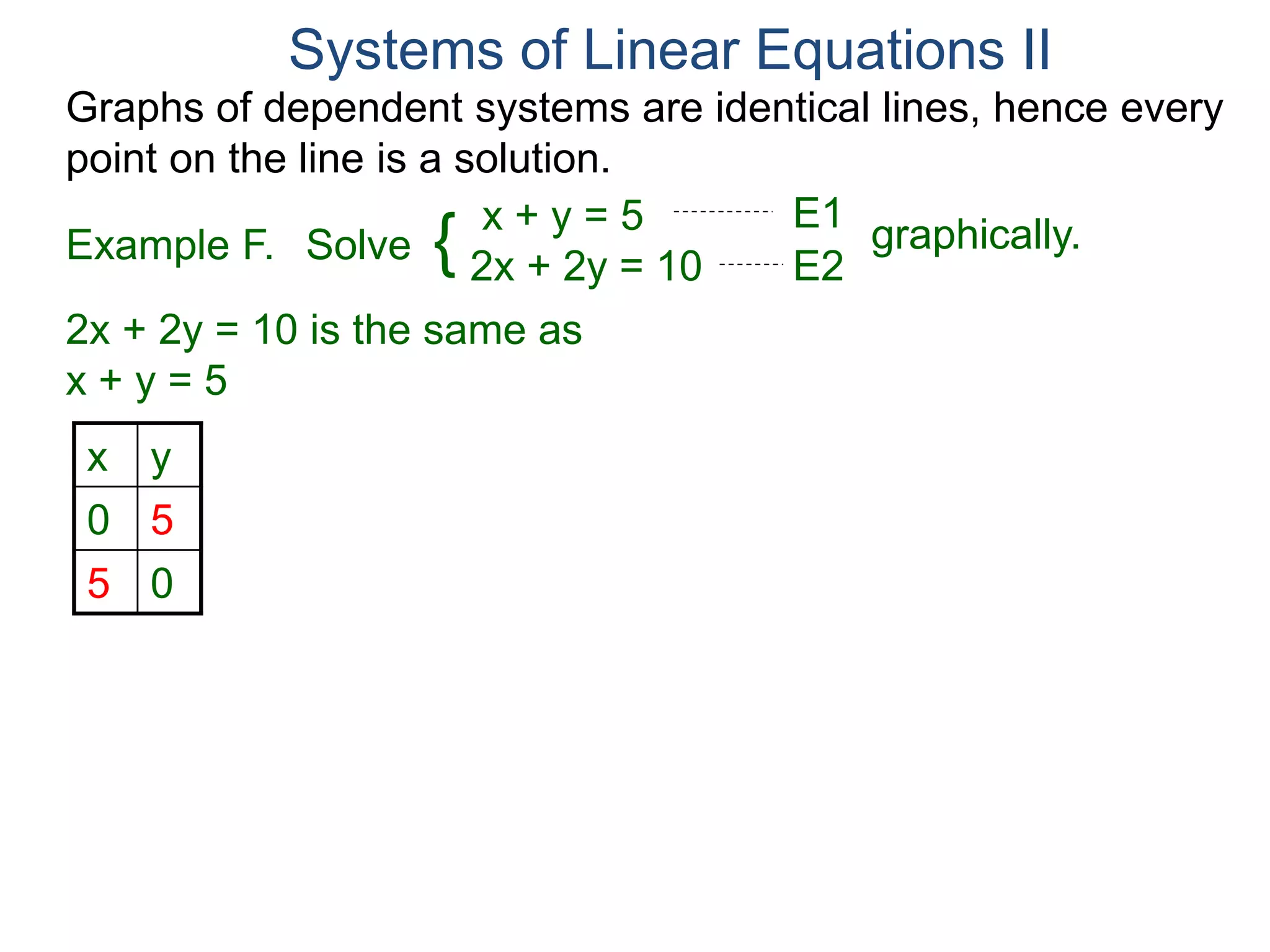
Graphs of dependent systems are identical lines, hence every
point on the line is a solution.
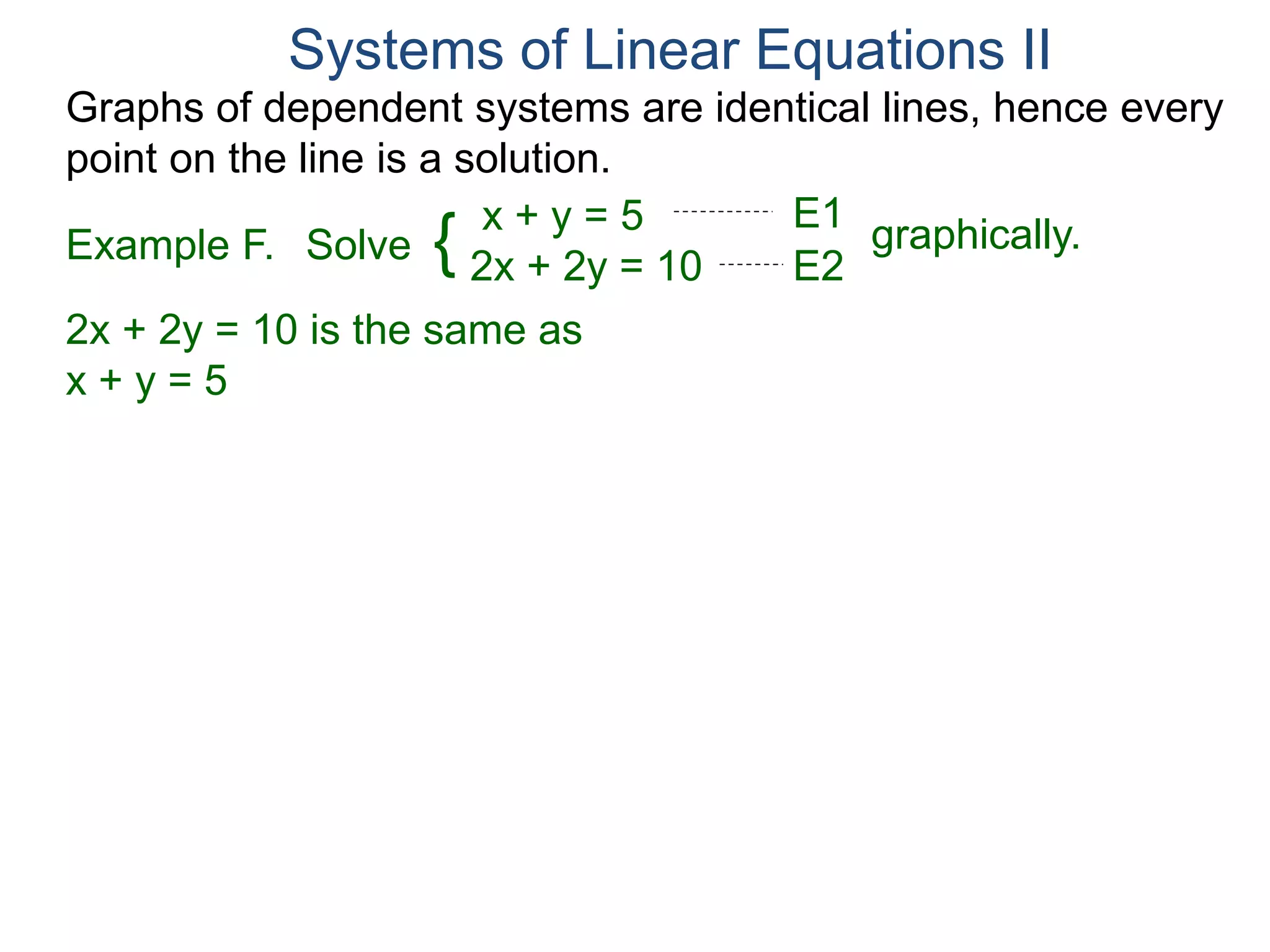
2x + 2y = 10 is the same as
x + y = 5
Systems of Linear Equations II
x + y = 5
2x + 2y = 10
Solve graphically.{
E1
E2Example F.
Graphs of dependent systems are identical lines, hence every
point on the line is a solution.
2x + 2y = 10 is the same as
x + y = 5
x y
0 5
5 0
Systems of Linear Equations II
x + y = 5
2x + 2y = 10
Solve graphically.{
E1
E2Example F.
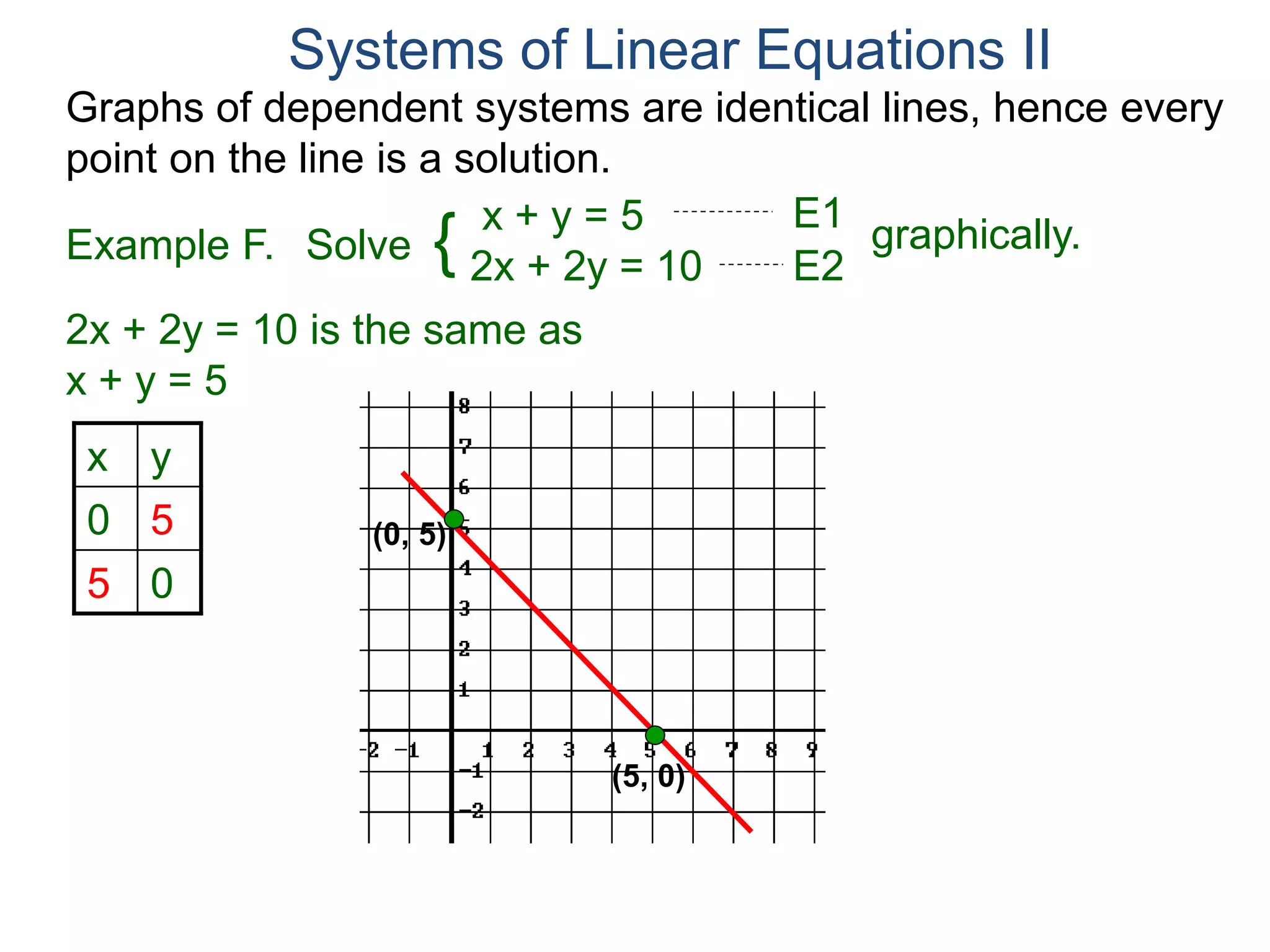
Graphs of dependent systems are identical lines, hence every
point on the line is a solution.
2x + 2y = 10 is the same as
x + y = 5
x y
0 5
5 0
(5, 0)
(0, 5)
Systems of Linear Equations II
x + y = 5
2x + 2y = 10
Solve graphically.{
E1
E2Example F.
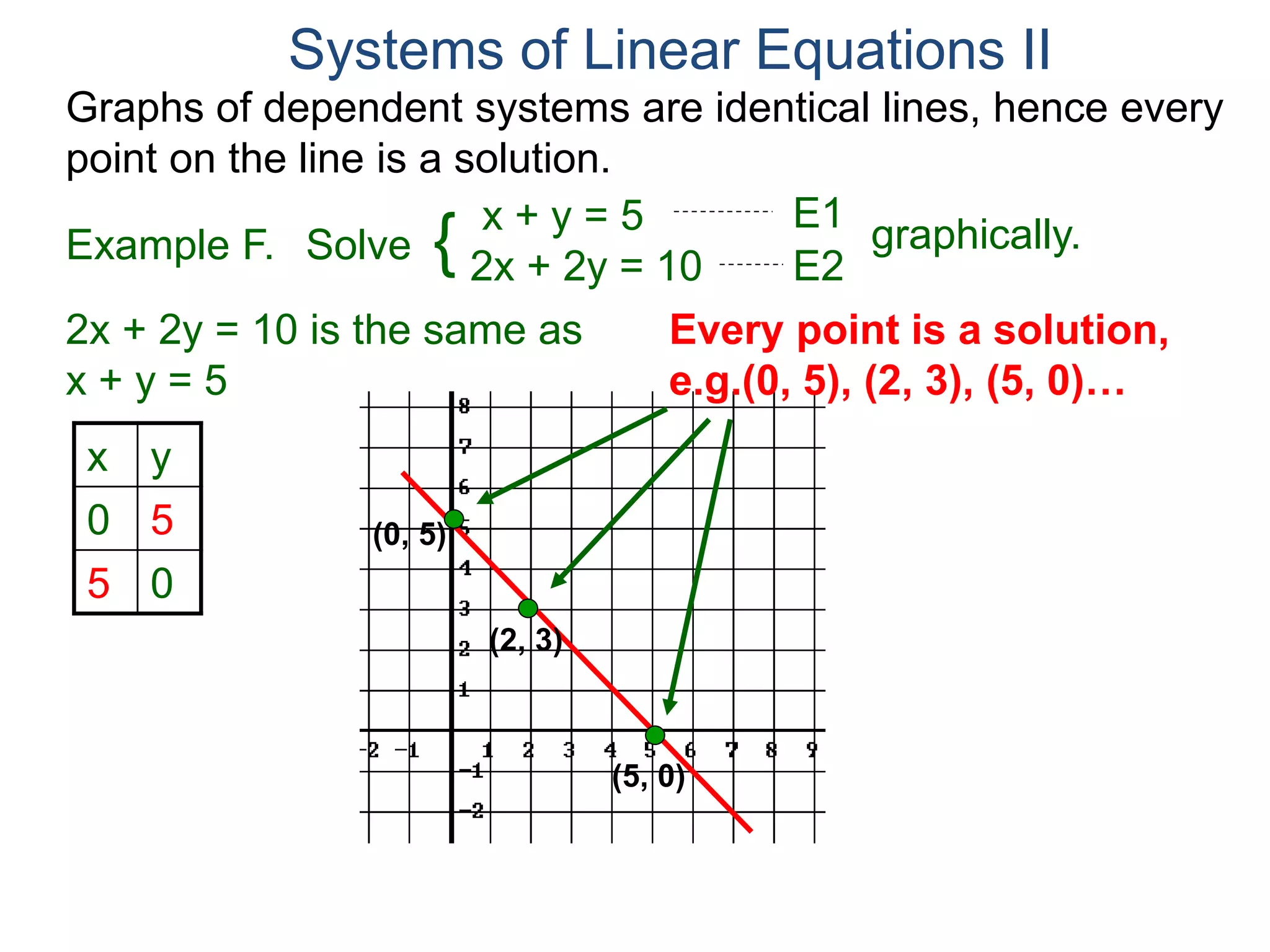
Graphs of dependent systems are identical lines, hence every
point on the line is a solution.
2x + 2y = 10 is the same as
x + y = 5
x y
0 5
5 0
(5, 0)
(0, 5)
Every point is a solution,
e.g.(0, 5), (2, 3), (5, 0)…
(2, 3)
Systems of Linear Equations II
x + y = 5
2x + 2y = 10
Solve graphically.{
E1
E2Example F.
Systems of Linear Equations II
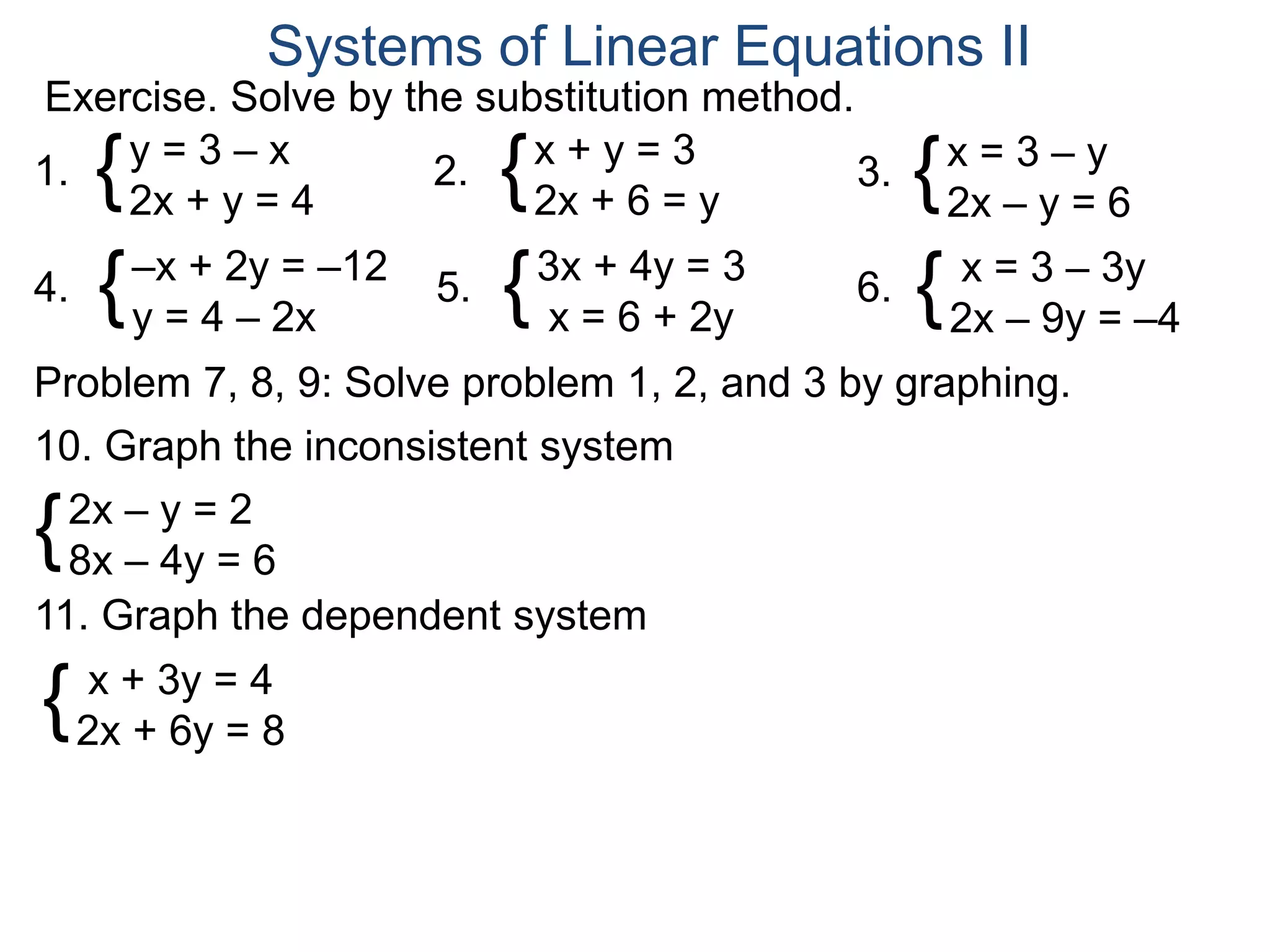
4. {–x + 2y = –12
y = 4 – 2x
Exercise. Solve by the substitution method.
1. {y = 3 – x
2x + y = 4
2. 3. {x = 3 – y
2x – y = 6
{x + y = 3
2x + 6 = y
5. {3x + 4y = 3
x = 6 + 2y
6. { x = 3 – 3y
2x – 9y = –4
10. Graph the inconsistent system
{ x + 3y = 4
2x + 6y = 8
{2x – y = 2
8x – 4y = 6
Problem 7, 8, 9: Solve problem 1, 2, and 3 by graphing.
11. Graph the dependent system

7 system of linear equations ii x

  • 1.
    Systems of LinearEquations II
  • 2.
    Systems of LinearEquations II Example A. At Pizza Grande, one coupon C may be exchanged for three slices of pizza (P) and five donuts (D). We have 5 slices of pizzas, 3 donuts and 2 coupons. What do we have after exchanging the 2 coupons?
  • 3.
    Systems of LinearEquations II Example A. At Pizza Grande, one coupon C may be exchanged for three slices of pizza (P) and five donuts (D). We have 5 slices of pizzas, 3 donuts and 2 coupons. What do we have after exchanging the 2 coupons? The coupon value of C may be recorded as C = 5P + 3D.
  • 4.
    Systems of LinearEquations II Example A. At Pizza Grande, one coupon C may be exchanged for three slices of pizza (P) and five donuts (D). We have 5 slices of pizzas, 3 donuts and 2 coupons. What do we have after exchanging the 2 coupons? The coupon value of C may be recorded as C = 5P + 3D. 5 slices of pizzas, 3 donuts and 2 coupons is 5P + 3D+ 2C.
  • 5.
    Systems of LinearEquations II Example A. At Pizza Grande, one coupon C may be exchanged for three slices of pizza (P) and five donuts (D). We have 5 slices of pizzas, 3 donuts and 2 coupons. What do we have after exchanging the 2 coupons? The coupon value of C may be recorded as C = 5P + 3D. 5 slices of pizzas, 3 donuts and 2 coupons is 5P + 3D+ 2C. Exchanging the 2 coupons for pizzas and donuts, we would have 5P + 3D + 2C
  • 6.
    Systems of LinearEquations II Example A. At Pizza Grande, one coupon C may be exchanged for three slices of pizza (P) and five donuts (D). We have 5 slices of pizzas, 3 donuts and 2 coupons. What do we have after exchanging the 2 coupons? The coupon value of C may be recorded as C = 5P + 3D. 5 slices of pizzas, 3 donuts and 2 coupons is 5P + 3D+ 2C. Exchanging the 2 coupons for pizzas and donuts, we would have 5P + 3D + 2C = 5P + 3D + 2(5P + 3D)
  • 7.
    Systems of LinearEquations II Example A. At Pizza Grande, one coupon C may be exchanged for three slices of pizza (P) and five donuts (D). We have 5 slices of pizzas, 3 donuts and 2 coupons. What do we have after exchanging the 2 coupons? The coupon value of C may be recorded as C = 5P + 3D. 5 slices of pizzas, 3 donuts and 2 coupons is 5P + 3D+ 2C. Exchanging the 2 coupons for pizzas and donuts, we would have 5P + 3D + 2C = 5P + 3D + 2(5P + 3D) = 5P + 3D + 10P + 6D
  • 8.
    Systems of LinearEquations II Example A. At Pizza Grande, one coupon C may be exchanged for three slices of pizza (P) and five donuts (D). We have 5 slices of pizzas, 3 donuts and 2 coupons. What do we have after exchanging the 2 coupons? The coupon value of C may be recorded as C = 5P + 3D. 5 slices of pizzas, 3 donuts and 2 coupons is 5P + 3D+ 2C. Exchanging the 2 coupons for pizzas and donuts, we would have 5P + 3D + 2C = 5P + 3D + 2(5P + 3D) = 5P + 3D + 10P + 6D = 15P + 9D or 15 slices of pizzas and 9 donuts.
  • 9.
    In math, thephrase "substitute (the expression) back into ...“ means to do the exchange, using the given coupon–expression, in the targeted equations, or expressions mentioned. Systems of Linear Equations II Example A. At Pizza Grande, one coupon C may be exchanged for three slices of pizza (P) and five donuts (D). We have 5 slices of pizzas, 3 donuts and 2 coupons. What do we have after exchanging the 2 coupons? The coupon value of C may be recorded as C = 5P + 3D. 5 slices of pizzas, 3 donuts and 2 coupons is 5P + 3D+ 2C. Exchanging the 2 coupons for pizzas and donuts, we would have 5P + 3D + 2C = 5P + 3D + 2(5P + 3D) = 5P + 3D + 10P + 6D = 15P + 9D or 15 slices of pizzas and 9 donuts.
  • 10.
    There are twoother methods to solve system of equations. Systems of Linear Equations II
  • 11.
    There are twoother methods to solve system of equations. Substitution Method Systems of Linear Equations II
  • 12.
    There are twoother methods to solve system of equations. Substitution Method In substitution method, we solve for one of the variables in terms of the other, then substitute the result into the other equation. Systems of Linear Equations II
  • 13.
    2x + y= 7 E1 x + y = 5 E2 Solve by the substitution method. Systems of Linear Equations II Example B. { There are two other methods to solve system of equations. Substitution Method In substitution method, we solve for one of the variables in terms of the other, then substitute the result into the other equation.
  • 14.
    2x + y= 7 E1 x + y = 5 E2 Solve by the substitution method. From E2, x + y = 5, we get x = 5 – y. Systems of Linear Equations II Example B. { There are two other methods to solve system of equations. Substitution Method In substitution method, we solve for one of the variables in terms of the other, then substitute the result into the other equation.
  • 15.
    2x + y= 7 E1 x + y = 5 E2 Solve by the substitution method. From E2, x + y = 5, we get x = 5 – y. Systems of Linear Equations II Example B. { There are two other methods to solve system of equations. Substitution Method In substitution method, we solve for one of the variables in terms of the other, then substitute the result into the other equation. This is the coupon expression so we may exchange x = 5 – y
  • 16.
    2x + y= 7 E1 x + y = 5 E2 Solve by the substitution method. From E2, x + y = 5, we get x = 5 – y. Then we replace x by (5 – y) in E1 and get 2(5 – y) + y = 7 Systems of Linear Equations II Example B. { There are two other methods to solve system of equations. Substitution Method In substitution method, we solve for one of the variables in terms of the other, then substitute the result into the other equation. This is the coupon expression so we may exchange x = 5 – y
  • 17.
    2x + y= 7 E1 x + y = 5 E2 Solve by the substitution method. From E2, x + y = 5, we get x = 5 – y. Then we replace x by (5 – y) in E1 and get 2(5 – y) + y = 7 10 – 2y + y = 7 Systems of Linear Equations II Example B. { There are two other methods to solve system of equations. Substitution Method In substitution method, we solve for one of the variables in terms of the other, then substitute the result into the other equation. This is the coupon expression so we may exchange x = 5 – y
  • 18.
    2x + y= 7 E1 x + y = 5 E2 Solve by the substitution method. From E2, x + y = 5, we get x = 5 – y. Then we replace x by (5 – y) in E1 and get 2(5 – y) + y = 7 10 – 2y + y = 7 10 – y = 7  3 = y Systems of Linear Equations II Example B. { There are two other methods to solve system of equations. Substitution Method In substitution method, we solve for one of the variables in terms of the other, then substitute the result into the other equation. This is the coupon expression so we may exchange x = 5 – y
  • 19.
    2x + y= 7 E1 x + y = 5 E2 Solve by the substitution method. From E2, x + y = 5, we get x = 5 – y. Then we replace x by (5 – y) in E1 and get 2(5 – y) + y = 7 10 – 2y + y = 7 10 – y = 7  3 = y Systems of Linear Equations II Example B. { Put 3 = y back to E2 to find x, we get x + 3 = 5 There are two other methods to solve system of equations. Substitution Method In substitution method, we solve for one of the variables in terms of the other, then substitute the result into the other equation. This is the coupon expression so we may exchange x = 5 – y
  • 20.
    2x + y= 7 E1 x + y = 5 E2 Solve by the substitution method. From E2, x + y = 5, we get x = 5 – y. Then we replace x by (5 – y) in E1 and get 2(5 – y) + y = 7 10 – 2y + y = 7 10 – y = 7  3 = y Systems of Linear Equations II Example B. { Put 3 = y back to E2 to find x, we get x + 3 = 5  x = 2 Therefore the solution is (2, 3) There are two other methods to solve system of equations. Substitution Method In substitution method, we solve for one of the variables in terms of the other, then substitute the result into the other equation. This is the coupon expression so we may exchange x = 5 – y
  • 21.
    We use thesubstitution method when it's easy to solve for one of the variable in terms of the other. Systems of Linear Equations II
  • 22.
    We use thesubstitution method when it's easy to solve for one of the variable in terms of the other. Specifically, it is easy to solve for a variable when an equation contains an single x or single y. Systems of Linear Equations II
  • 23.
    We use thesubstitution method when it's easy to solve for one of the variable in terms of the other. Specifically, it is easy to solve for a variable when an equation contains an single x or single y. 2x – y = 7 E1 3x + 2y = 7 E2 Solve by the substitution method. Systems of Linear Equations II Example C. {
  • 24.
    We use thesubstitution method when it's easy to solve for one of the variable in terms of the other. Specifically, it is easy to solve for a variable when an equation contains an single x or single y. 2x – y = 7 E1 3x + 2y = 7 E2 Solve by the substitution method. By inspection, we see that it's easy to solve for the y using E1. Systems of Linear Equations II Example C. {
  • 25.
    We use thesubstitution method when it's easy to solve for one of the variable in terms of the other. Specifically, it is easy to solve for a variable when an equation contains an single x or single y. 2x – y = 7 E1 3x + 2y = 7 E2 Solve by the substitution method. By inspection, we see that it's easy to solve for the y using E1. From E1, 2x – y = 7, we get 2x – 7= y. Systems of Linear Equations II Example C. {
  • 26.
    We use thesubstitution method when it's easy to solve for one of the variable in terms of the other. Specifically, it is easy to solve for a variable when an equation contains an single x or single y. 2x – y = 7 E1 3x + 2y = 7 E2 Solve by the substitution method. By inspection, we see that it's easy to solve for the y using E1. From E1, 2x – y = 7, we get 2x – 7= y. Substitute y by (2x – 7) in E2 and get 3x + 2(2x – 7) = 7 Systems of Linear Equations II Example C. {
  • 27.
    We use thesubstitution method when it's easy to solve for one of the variable in terms of the other. Specifically, it is easy to solve for a variable when an equation contains an single x or single y. 2x – y = 7 E1 3x + 2y = 7 E2 Solve by the substitution method. By inspection, we see that it's easy to solve for the y using E1. From E1, 2x – y = 7, we get 2x – 7= y. Substitute y by (2x – 7) in E2 and get 3x + 2(2x – 7) = 7 3x + 4x – 14 = 7 Systems of Linear Equations II Example C. {
  • 28.
    We use thesubstitution method when it's easy to solve for one of the variable in terms of the other. Specifically, it is easy to solve for a variable when an equation contains an single x or single y. 2x – y = 7 E1 3x + 2y = 7 E2 Solve by the substitution method. By inspection, we see that it's easy to solve for the y using E1. From E1, 2x – y = 7, we get 2x – 7= y. Substitute y by (2x – 7) in E2 and get 3x + 2(2x – 7) = 7 3x + 4x – 14 = 7 7x = 21 x = 3 Systems of Linear Equations II Example C. {
  • 29.
    We use thesubstitution method when it's easy to solve for one of the variable in terms of the other. Specifically, it is easy to solve for a variable when an equation contains an single x or single y. 2x – y = 7 E1 3x + 2y = 7 E2 Solve by the substitution method. By inspection, we see that it's easy to solve for the y using E1. From E1, 2x – y = 7, we get 2x – 7= y. Substitute y by (2x – 7) in E2 and get 3x + 2(2x – 7) = 7 3x + 4x – 14 = 7 7x = 21 x = 3 Systems of Linear Equations II Example C. { To find y, use the substitution equation, set x = 3 in y = 2x – 7
  • 30.
    We use thesubstitution method when it's easy to solve for one of the variable in terms of the other. Specifically, it is easy to solve for a variable when an equation contains an single x or single y. 2x – y = 7 E1 3x + 2y = 7 E2 Solve by the substitution method. By inspection, we see that it's easy to solve for the y using E1. From E1, 2x – y = 7, we get 2x – 7= y. Substitute y by (2x – 7) in E2 and get 3x + 2(2x – 7) = 7 3x + 4x – 14 = 7 7x = 21 x = 3 Systems of Linear Equations II Example C. { To find y, use the substitution equation, set x = 3 in y = 2x – 7 y = 2(3) – 7 y = -1
  • 31.
    We use thesubstitution method when it's easy to solve for one of the variable in terms of the other. Specifically, it is easy to solve for a variable when an equation contains an single x or single y. 2x – y = 7 E1 3x + 2y = 7 E2 Solve by the substitution method. By inspection, we see that it's easy to solve for the y using E1. From E1, 2x – y = 7, we get 2x – 7= y. Substitute y by (2x – 7) in E2 and get 3x + 2(2x – 7) = 7 3x + 4x – 14 = 7 7x = 21 x = 3 Systems of Linear Equations II Example C. { To find y, use the substitution equation, set x = 3 in y = 2x – 7 y = 2(3) – 7 y = -1 Hence the solution is (3, -1).
  • 32.
    Graphing Method Systems ofLinear Equations II
  • 33.
    Graphing Method Given asystem of linear equations the graph of each equation is a straight line. Systems of Linear Equations II
  • 34.
    Graphing Method Given asystem of linear equations the graph of each equation is a straight line. The solution of the system is the intersection point (x, y) of the these lines. Systems of Linear Equations II
  • 35.
    Graphing Method Given asystem of linear equations the graph of each equation is a straight line. The solution of the system is the intersection point (x, y) of the these lines. Thus we may find the solution by graphing the lines and locate the point of intersection graphically. Systems of Linear Equations II
  • 36.
    Graphing Method Given asystem of linear equations the graph of each equation is a straight line. The solution of the system is the intersection point (x, y) of the these lines. Thus we may find the solution by graphing the lines and locate the point of intersection graphically. In general, we don't not use the graphing method because it is not easy to do it accurately. Systems of Linear Equations II
  • 37.
    Graphing Method Given asystem of linear equations the graph of each equation is a straight line. The solution of the system is the intersection point (x, y) of the these lines. Thus we may find the solution by graphing the lines and locate the point of intersection graphically. In general, we don't not use the graphing method because it is not easy to do it accurately. Systems of Linear Equations II 2x + y = 7 x + y = 5 Solve graphically.{ E1 E2 Example D.
  • 38.
    Graphing Method Given asystem of linear equations the graph of each equation is a straight line. The solution of the system is the intersection point (x, y) of the these lines. Thus we may find the solution by graphing the lines and locate the point of intersection graphically. In general, we don't not use the graphing method because it is not easy to do it accurately. Systems of Linear Equations II 2x + y = 7 x + y = 5 Solve graphically.{ E1 E2 Example D. Use intercept method.
  • 39.
    Graphing Method Given asystem of linear equations the graph of each equation is a straight line. The solution of the system is the intersection point (x, y) of the these lines. Thus we may find the solution by graphing the lines and locate the point of intersection graphically. In general, we don't not use the graphing method because it is not easy to do it accurately. Systems of Linear Equations II 2x + y = 7 x + y = 5 Solve graphically.{ E1 E2 Example D. Use intercept method. x y 0 0 2x + y = 7
  • 40.
    Graphing Method Given asystem of linear equations the graph of each equation is a straight line. The solution of the system is the intersection point (x, y) of the these lines. Thus we may find the solution by graphing the lines and locate the point of intersection graphically. In general, we don't not use the graphing method because it is not easy to do it accurately. Systems of Linear Equations II 2x + y = 7 x + y = 5 Solve graphically.{ E1 E2 Example D. Use intercept method. x y 0 7 0 2x + y = 7
  • 41.
    Graphing Method Given asystem of linear equations the graph of each equation is a straight line. The solution of the system is the intersection point (x, y) of the these lines. Thus we may find the solution by graphing the lines and locate the point of intersection graphically. In general, we don't not use the graphing method because it is not easy to do it accurately. Systems of Linear Equations II 2x + y = 7 x + y = 5 Solve graphically.{ E1 E2 Example D. Use intercept method. x y 0 7 7/2 0 2x + y = 7 E2
  • 42.
    Graphing Method Given asystem of linear equations the graph of each equation is a straight line. The solution of the system is the intersection point (x, y) of the these lines. Thus we may find the solution by graphing the lines and locate the point of intersection graphically. In general, we don't not use the graphing method because it is not easy to do it accurately. Systems of Linear Equations II 2x + y = 7 x + y = 5 Solve graphically.{ E1 E2 Example D. Use intercept method. x y 0 7 7/2 0 2x + y = 7 E2 (Check another point.)
  • 43.
    Graphing Method Given asystem of linear equations the graph of each equation is a straight line. The solution of the system is the intersection point (x, y) of the these lines. Thus we may find the solution by graphing the lines and locate the point of intersection graphically. In general, we don't not use the graphing method because it is not easy to do it accurately. Systems of Linear Equations II 2x + y = 7 x + y = 5 Solve graphically.{ E1 E2 Example D. Use intercept method. x y 0 7 7/2 0 2x + y = 7 E1 E2 (0, 7) (7/2, 0) E1(Check another point.)
  • 44.
    Graphing Method Given asystem of linear equations the graph of each equation is a straight line. The solution of the system is the intersection point (x, y) of the these lines. Thus we may find the solution by graphing the lines and locate the point of intersection graphically. In general, we don't not use the graphing method because it is not easy to do it accurately. Systems of Linear Equations II 2x + y = 7 x + y = 5 Solve graphically.{ E1 E2 Example D. Use intercept method. x + y = 5 x y 0 7 7/2 0 2x + y = 7 x y 0 0 (0, 7) (7/2, 0) E1(Check another point.)
  • 45.
    Graphing Method Given asystem of linear equations the graph of each equation is a straight line. The solution of the system is the intersection point (x, y) of the these lines. Thus we may find the solution by graphing the lines and locate the point of intersection graphically. In general, we don't not use the graphing method because it is not easy to do it accurately. Systems of Linear Equations II 2x + y = 7 x + y = 5 Solve graphically.{ E1 E2 Example D. Use intercept method. x y 0 7 7/2 0 2x + y = 7 x + y = 5 x y 0 5 5 0 (0, 7) (7/2, 0) E1(Check another point.)
  • 46.
    Graphing Method Given asystem of linear equations the graph of each equation is a straight line. The solution of the system is the intersection point (x, y) of the these lines. Thus we may find the solution by graphing the lines and locate the point of intersection graphically. In general, we don't not use the graphing method because it is not easy to do it accurately. Systems of Linear Equations II 2x + y = 7 x + y = 5 Solve graphically.{ E1 E2 Example D. Use intercept method. x y 0 7 7/2 0 2x + y = 7 (0, 7) (7/2, 0) (0, 5) (5, 0) E2 x + y = 5 x y 0 5 5 0 E1(Check another point.)
  • 47.
    Graphing Method Given asystem of linear equations the graph of each equation is a straight line. The solution of the system is the intersection point (x, y) of the these lines. Thus we may find the solution by graphing the lines and locate the point of intersection graphically. In general, we don't not use the graphing method because it is not easy to do it accurately. Systems of Linear Equations II 2x + y = 7 x + y = 5 Solve graphically.{ E1 E2 Example D. Use intercept method. x y 0 7 7/2 0 2x + y = 7 (0, 7) (7/2, 0) (0, 5) (5, 0) The intersection (2, 3) is the solution E1 E2 x + y = 5 x y 0 5 5 0 E1(Check another point.)
  • 48.
    Graphing of inconsistentsystems are parallel lines which do not intersect, hence there is no solution. Systems of Linear Equations II
  • 49.
    Graphing of inconsistentsystems are parallel lines which do not intersect, hence there is no solution. Systems of Linear Equations II x + y = 7 x + y = 5 Solve graphically.{ E1 E2 Example E.
  • 50.
    Graphing of inconsistentsystems are parallel lines which do not intersect, hence there is no solution. x + y = 7 x y 0 7 7 0 Systems of Linear Equations II x + y = 7 x + y = 5 Solve graphically.{ E1 E2 Example E.
  • 51.
    Graphing of inconsistentsystems are parallel lines which do not intersect, hence there is no solution. x + y = 7 x y 0 7 7 0 (0, 7) (7, 0) Systems of Linear Equations II x + y = 7 x + y = 5 Solve graphically.{ E1 E2 Example E.
  • 52.
    Graphing of inconsistentsystems are parallel lines which do not intersect, hence there is no solution. x + y = 7 x y 0 7 7 0 x y 0 5 5 0 (0, 7) (7, 0) Systems of Linear Equations II x + y = 7 x + y = 5 Solve graphically.{ E1 E2 Example E. x + y = 5
  • 53.
    Graphing of inconsistentsystems are parallel lines which do not intersect, hence there is no solution. x + y = 7 x y 0 7 7 0 x y 0 5 5 0 (0, 7) (7, 0) (0, 5) (5, 0) Systems of Linear Equations II x + y = 7 x + y = 5 Solve graphically.{ E1 E2 Example E. x + y = 5
  • 54.
    Graphing of inconsistentsystems are parallel lines which do not intersect, hence there is no solution. x + y = 7 x y 0 7 7 0 x y 0 5 5 0 (0, 7) (7, 0) (0, 5) (5, 0) No intersection. No solution Systems of Linear Equations II x + y = 7 x + y = 5 Solve graphically.{ E1 E2 Example E. x + y = 5
  • 55.
    Graphs of dependentsystems are identical lines, hence every point on the line is a solution. Systems of Linear Equations II
  • 56.
    Graphs of dependentsystems are identical lines, hence every point on the line is a solution. Systems of Linear Equations II x + y = 5 2x + 2y = 10 Solve graphically.{ E1 E2Example F.
  • 57.
    Graphs of dependentsystems are identical lines, hence every point on the line is a solution. 2x + 2y = 10 is the same as x + y = 5 Systems of Linear Equations II x + y = 5 2x + 2y = 10 Solve graphically.{ E1 E2Example F.
  • 58.
    Graphs of dependentsystems are identical lines, hence every point on the line is a solution. 2x + 2y = 10 is the same as x + y = 5 x y 0 5 5 0 Systems of Linear Equations II x + y = 5 2x + 2y = 10 Solve graphically.{ E1 E2Example F.
  • 59.
    Graphs of dependentsystems are identical lines, hence every point on the line is a solution. 2x + 2y = 10 is the same as x + y = 5 x y 0 5 5 0 (5, 0) (0, 5) Systems of Linear Equations II x + y = 5 2x + 2y = 10 Solve graphically.{ E1 E2Example F.
  • 60.
    Graphs of dependentsystems are identical lines, hence every point on the line is a solution. 2x + 2y = 10 is the same as x + y = 5 x y 0 5 5 0 (5, 0) (0, 5) Every point is a solution, e.g.(0, 5), (2, 3), (5, 0)… (2, 3) Systems of Linear Equations II x + y = 5 2x + 2y = 10 Solve graphically.{ E1 E2Example F.
  • 61.
    Systems of LinearEquations II 4. {–x + 2y = –12 y = 4 – 2x Exercise. Solve by the substitution method. 1. {y = 3 – x 2x + y = 4 2. 3. {x = 3 – y 2x – y = 6 {x + y = 3 2x + 6 = y 5. {3x + 4y = 3 x = 6 + 2y 6. { x = 3 – 3y 2x – 9y = –4 10. Graph the inconsistent system { x + 3y = 4 2x + 6y = 8 {2x – y = 2 8x – 4y = 6 Problem 7, 8, 9: Solve problem 1, 2, and 3 by graphing. 11. Graph the dependent system