Linear equation in two variable:
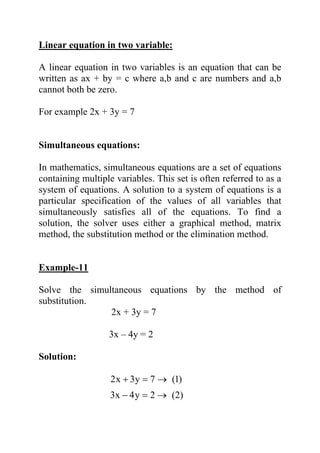
A linear equation in two variables is an equation that can be
written as ax + by = c where a,b and c are numbers and a,b
cannot both be zero.
For example 2x + 3y = 7
Simultaneous equations:
In mathematics, simultaneous equations are a set of equations
containing multiple variables. This set is often referred to as a
system of equations. A solution to a system of equations is a
particular specification of the values of all variables that
simultaneously satisfies all of the equations. To find a
solution, the solver uses either a graphical method, matrix
method, the substitution method or the elimination method.
Example-11
Solve the simultaneous equations by the method of
substitution.
2x + 3y = 7
3x – 4y = 2
Solution:
2x 3y 7 ( )
3x 4y 2 (2)
+ = → 
− = →
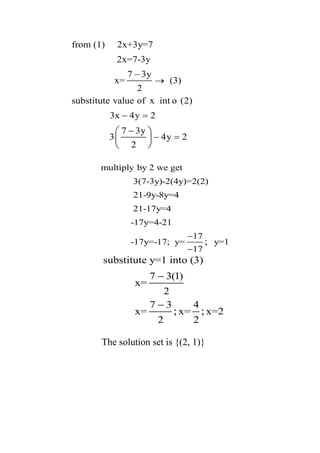
from (1) 2x+3y=7
2x=7-3y
7 3y
x= (3)
2
substitute value of x int o (2)
3x 4y 2
7 3y
3 4y 2
2
−
→
− =
−
− =
 
 
 
multiply by 2 we get
3(7-3y)-2(4y)=2(2)
21-9y-8y=4
21-17y=4
-17y=4-21
17
-17y=-17; y= y=1
17
;
−
−
substitute y=1 into (3)
7 3(1)
x=
2
7 3 4
x= x= x=2
2 2
; ;
−
−
The solution set is {(2, 1)}
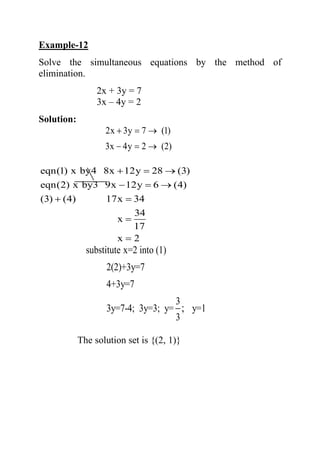
Example-12
Solve the simultaneous equations by the method of
elimination.
2x + 3y = 7
3x – 4y = 2
Solution:
2x 3y 7 ( )
3x 4y 2 (2)
+ = → 
− = →
eqn(1) x by4 8x 12y 28 (3)
eqn(2) x by3 9x 12y 6 (4)
(3) (4) 17x 34
34
x
17
x 2
+ = →
− = →
+ =
=
=
substitute x=2 into (1)
2(2)+3y=7
4+3y=7
3
3y=7-4; 3y=3; y= y=1
3
;
The solution set is {(2, 1)}
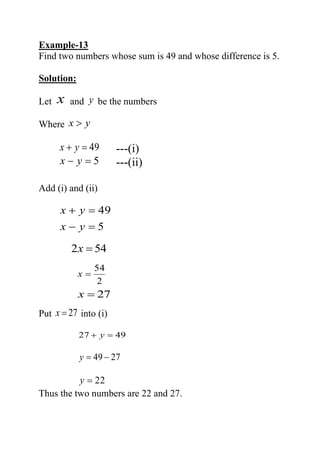
Example-13
Find two numbers whose sum is 49 and whose difference is 5.
Solution:
Let x and y be the numbers
Where yx 
49=+ yx ---(i)
5=− yx ---(ii)
Add (i) and (ii)
5
49
=−
=+
yx
yx
542 =x
2
54
=x
27=x
Put 27=x into (i)
4927 =+ y
2749 −=y
22=y
Thus the two numbers are 22 and 27.
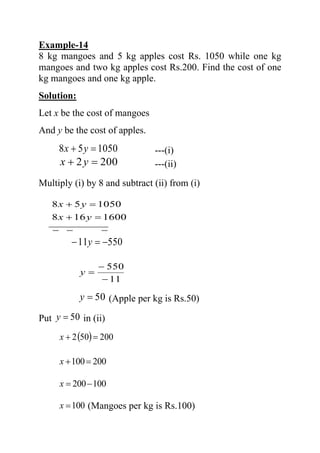
Example-14
8 kg mangoes and 5 kg apples cost Rs. 1050 while one kg
mangoes and two kg apples cost Rs.200. Find the cost of one
kg mangoes and one kg apple.
Solution:
Let x be the cost of mangoes
And y be the cost of apples.
105058 =+ yx ---(i)
2002 =+ yx ---(ii)
Multiply (i) by 8 and subtract (ii) from (i)
−−−
=+
=+
1600168
105058
yx
yx
55011 −=− y
11
550
−
−
=y
50=y (Apple per kg is Rs.50)
Put 50=y in (ii)
( ) 200502 =+x
200100=+x
100200−=x
100=x (Mangoes per kg is Rs.100)
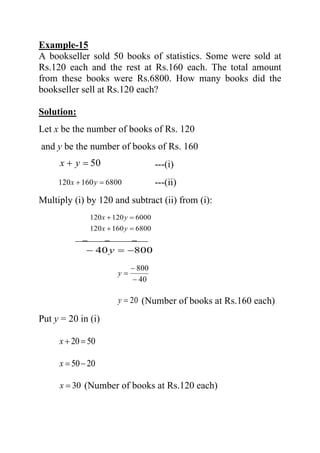
Example-15
A bookseller sold 50 books of statistics. Some were sold at
Rs.120 each and the rest at Rs.160 each. The total amount
from these books were Rs.6800. How many books did the
bookseller sell at Rs.120 each?
Solution:
Let x be the number of books of Rs. 120
and y be the number of books of Rs. 160
50=+ yx ---(i)
6800160120 =+ yx ---(ii)
Multiply (i) by 120 and subtract (ii) from (i):
6000120120 =+ yx
6800160120 =+ yx
− − −
80040 −=− y
40
800
−
−
=y
20=y (Number of books at Rs.160 each)
Put y = 20 in (i)
5020=+x
2050−=x
30=x (Number of books at Rs.120 each)

Linear equation in two variable

  • 2.
    Linear equation intwo variable: A linear equation in two variables is an equation that can be written as ax + by = c where a,b and c are numbers and a,b cannot both be zero. For example 2x + 3y = 7 Simultaneous equations: In mathematics, simultaneous equations are a set of equations containing multiple variables. This set is often referred to as a system of equations. A solution to a system of equations is a particular specification of the values of all variables that simultaneously satisfies all of the equations. To find a solution, the solver uses either a graphical method, matrix method, the substitution method or the elimination method. Example-11 Solve the simultaneous equations by the method of substitution. 2x + 3y = 7 3x – 4y = 2 Solution: 2x 3y 7 ( ) 3x 4y 2 (2) + = →  − = →
  • 3.
    from (1) 2x+3y=7 2x=7-3y 73y x= (3) 2 substitute value of x int o (2) 3x 4y 2 7 3y 3 4y 2 2 − → − = − − =       multiply by 2 we get 3(7-3y)-2(4y)=2(2) 21-9y-8y=4 21-17y=4 -17y=4-21 17 -17y=-17; y= y=1 17 ; − − substitute y=1 into (3) 7 3(1) x= 2 7 3 4 x= x= x=2 2 2 ; ; − − The solution set is {(2, 1)}
  • 4.
    Example-12 Solve the simultaneousequations by the method of elimination. 2x + 3y = 7 3x – 4y = 2 Solution: 2x 3y 7 ( ) 3x 4y 2 (2) + = →  − = → eqn(1) x by4 8x 12y 28 (3) eqn(2) x by3 9x 12y 6 (4) (3) (4) 17x 34 34 x 17 x 2 + = → − = → + = = = substitute x=2 into (1) 2(2)+3y=7 4+3y=7 3 3y=7-4; 3y=3; y= y=1 3 ; The solution set is {(2, 1)}
  • 5.
    Example-13 Find two numberswhose sum is 49 and whose difference is 5. Solution: Let x and y be the numbers Where yx  49=+ yx ---(i) 5=− yx ---(ii) Add (i) and (ii) 5 49 =− =+ yx yx 542 =x 2 54 =x 27=x Put 27=x into (i) 4927 =+ y 2749 −=y 22=y Thus the two numbers are 22 and 27.
  • 6.
    Example-14 8 kg mangoesand 5 kg apples cost Rs. 1050 while one kg mangoes and two kg apples cost Rs.200. Find the cost of one kg mangoes and one kg apple. Solution: Let x be the cost of mangoes And y be the cost of apples. 105058 =+ yx ---(i) 2002 =+ yx ---(ii) Multiply (i) by 8 and subtract (ii) from (i) −−− =+ =+ 1600168 105058 yx yx 55011 −=− y 11 550 − − =y 50=y (Apple per kg is Rs.50) Put 50=y in (ii) ( ) 200502 =+x 200100=+x 100200−=x 100=x (Mangoes per kg is Rs.100)
  • 7.
    Example-15 A bookseller sold50 books of statistics. Some were sold at Rs.120 each and the rest at Rs.160 each. The total amount from these books were Rs.6800. How many books did the bookseller sell at Rs.120 each? Solution: Let x be the number of books of Rs. 120 and y be the number of books of Rs. 160 50=+ yx ---(i) 6800160120 =+ yx ---(ii) Multiply (i) by 120 and subtract (ii) from (i): 6000120120 =+ yx 6800160120 =+ yx − − − 80040 −=− y 40 800 − − =y 20=y (Number of books at Rs.160 each) Put y = 20 in (i) 5020=+x 2050−=x 30=x (Number of books at Rs.120 each)