March 31, 2011   Samantha Billingsley

SOLVING SYSTEMS OF
EQUATIONS
Solving systems of equations

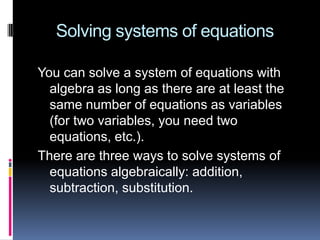
You can solve a system of equations with
  algebra as long as there are at least the
  same number of equations as variables
  (for two variables, you need two
  equations, etc.).
There are three ways to solve systems of
  equations algebraically: addition,
  subtraction, substitution.
Solving by addition

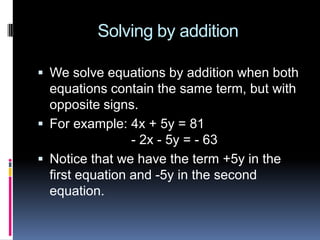
 We solve equations by addition when both
  equations contain the same term, but with
  opposite signs.
 For example: 4x + 5y = 81
                 - 2x - 5y = - 63
 Notice that we have the term +5y in the
  first equation and -5y in the second
  equation.
Solving by addition

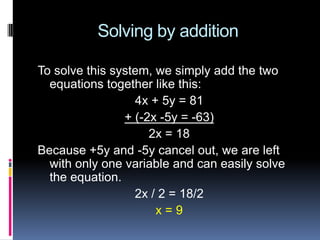
To solve this system, we simply add the two
  equations together like this:
                  4x + 5y = 81
                + (-2x -5y = -63)
                     2x = 18
Because +5y and -5y cancel out, we are left
  with only one variable and can easily solve
  the equation.
                  2x / 2 = 18/2
                      x=9
Solving by addition

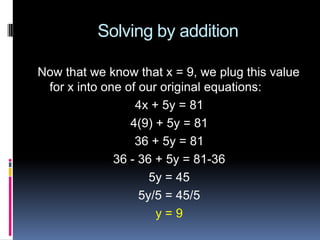
Now that we know that x = 9, we plug this value
 for x into one of our original equations:
                  4x + 5y = 81
                 4(9) + 5y = 81
                  36 + 5y = 81
              36 - 36 + 5y = 81-36
                     5y = 45
                   5y/5 = 45/5
                      y=9
Solving by addition

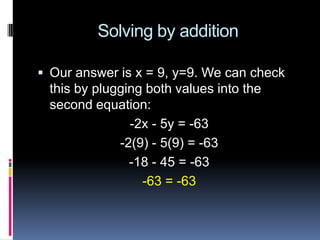
 Our answer is x = 9, y=9. We can check
 this by plugging both values into the
 second equation:
               -2x - 5y = -63
             -2(9) - 5(9) = -63
               -18 - 45 = -63
                 -63 = -63
Practice

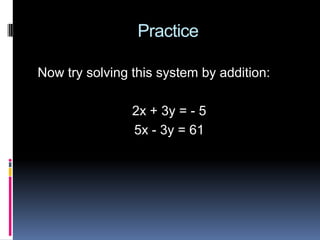
Now try solving this system by addition:

                2x + 3y = - 5
                5x - 3y = 61
Solution

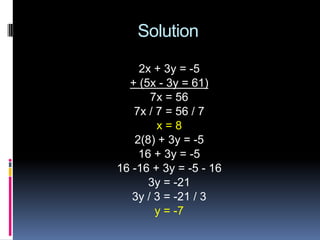
    2x + 3y = -5
  + (5x - 3y = 61)
       7x = 56
   7x / 7 = 56 / 7
        x=8
   2(8) + 3y = -5
    16 + 3y = -5
16 -16 + 3y = -5 - 16
      3y = -21
   3y / 3 = -21 / 3
        y = -7
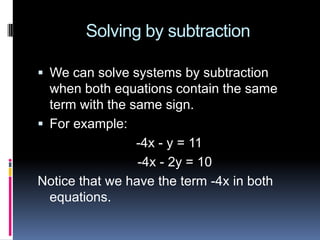
Solving by subtraction

 We can solve systems by subtraction
  when both equations contain the same
  term with the same sign.
 For example:
                 -4x - y = 11
                 -4x - 2y = 10
Notice that we have the term -4x in both
  equations.
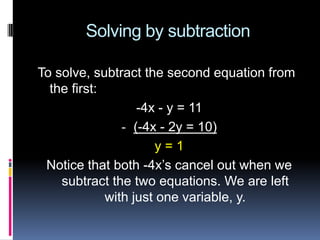
Solving by subtraction

To solve, subtract the second equation from
  the first:
                   -4x - y = 11
                - (-4x - 2y = 10)
                      y=1
 Notice that both -4x’s cancel out when we
    subtract the two equations. We are left
             with just one variable, y.
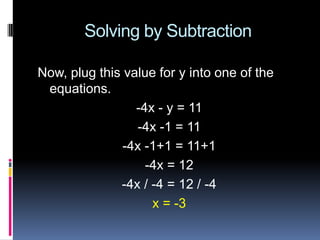
Solving by Subtraction

Now, plug this value for y into one of the
 equations.
                 -4x - y = 11
                  -4x -1 = 11
               -4x -1+1 = 11+1
                   -4x = 12
              -4x / -4 = 12 / -4
                    x = -3
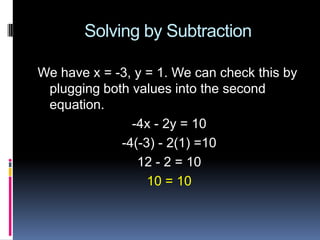
Solving by Subtraction

We have x = -3, y = 1. We can check this by
 plugging both values into the second
 equation.
               -4x - 2y = 10
             -4(-3) - 2(1) =10
                12 - 2 = 10
                  10 = 10
Practice

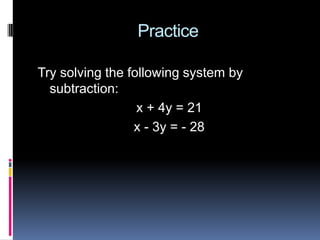
Try solving the following system by
  subtraction:
                  x + 4y = 21
                 x - 3y = - 28
Solution

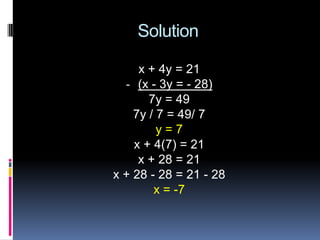
     x + 4y = 21
  - (x - 3y = - 28)
       7y = 49
    7y / 7 = 49/ 7
         y=7
    x + 4(7) = 21
     x + 28 = 21
x + 28 - 28 = 21 - 28
        x = -7
Solving by substitution

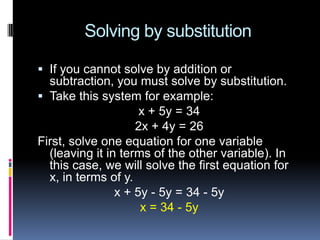
 If you cannot solve by addition or
  subtraction, you must solve by substitution.
 Take this system for example:
                     x + 5y = 34
                    2x + 4y = 26
First, solve one equation for one variable
  (leaving it in terms of the other variable). In
  this case, we will solve the first equation for
  x, in terms of y.
                x + 5y - 5y = 34 - 5y
                     x = 34 - 5y
Solving by substitution
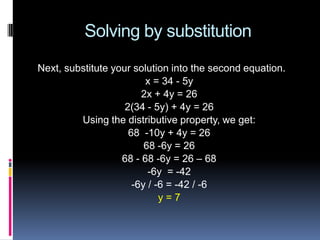
Next, substitute your solution into the second equation.
                         x = 34 - 5y
                        2x + 4y = 26
                    2(34 - 5y) + 4y = 26
         Using the distributive property, we get:
                     68 -10y + 4y = 26
                         68 -6y = 26
                   68 - 68 -6y = 26 – 68
                          -6y = -42
                      -6y / -6 = -42 / -6
                             y=7
Solving by substitution

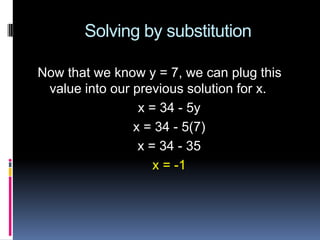
Now that we know y = 7, we can plug this
 value into our previous solution for x.
                 x = 34 - 5y
                x = 34 - 5(7)
                 x = 34 - 35
                    x = -1
Solving by substitution

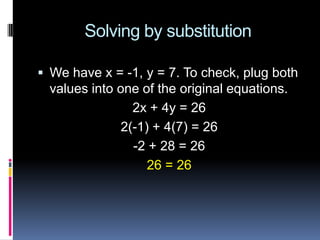
 We have x = -1, y = 7. To check, plug both
  values into one of the original equations.
                 2x + 4y = 26
               2(-1) + 4(7) = 26
                 -2 + 28 = 26
                    26 = 26
Practice

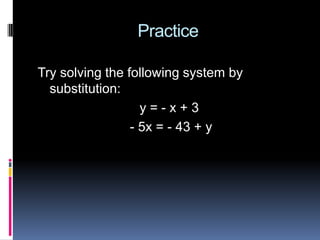
Try solving the following system by
  substitution:
                   y=-x+3
                 - 5x = - 43 + y
Solution

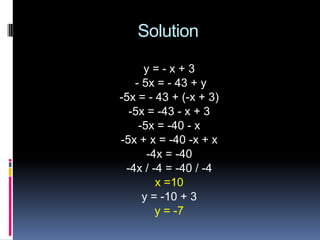
     y=-x+3
   - 5x = - 43 + y
-5x = - 43 + (-x + 3)
  -5x = -43 - x + 3
    -5x = -40 - x
-5x + x = -40 -x + x
      -4x = -40
 -4x / -4 = -40 / -4
        x =10
     y = -10 + 3
        y = -7
Review


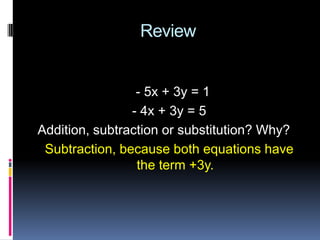
                 - 5x + 3y = 1
                - 4x + 3y = 5
Addition, subtraction or substitution? Why?
 Subtraction, because both equations have
                 the term +3y.
Review

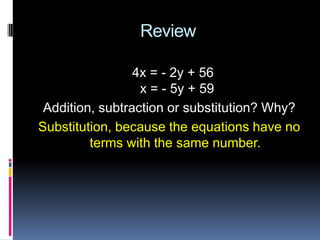
                 4x = - 2y + 56
                  x = - 5y + 59
 Addition, subtraction or substitution? Why?
Substitution, because the equations have no
         terms with the same number.
Review

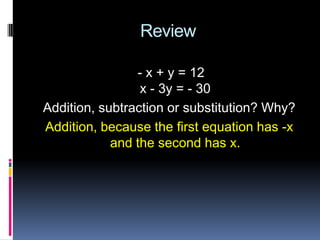
                - x + y = 12
                 x - 3y = - 30
Addition, subtraction or substitution? Why?
Addition, because the first equation has -x
            and the second has x.
THE END

Solving systems of equations

  • 1.
    March 31, 2011 Samantha Billingsley SOLVING SYSTEMS OF EQUATIONS
  • 2.
    Solving systems ofequations You can solve a system of equations with algebra as long as there are at least the same number of equations as variables (for two variables, you need two equations, etc.). There are three ways to solve systems of equations algebraically: addition, subtraction, substitution.
  • 3.
    Solving by addition We solve equations by addition when both equations contain the same term, but with opposite signs.  For example: 4x + 5y = 81 - 2x - 5y = - 63  Notice that we have the term +5y in the first equation and -5y in the second equation.
  • 4.
    Solving by addition Tosolve this system, we simply add the two equations together like this: 4x + 5y = 81 + (-2x -5y = -63) 2x = 18 Because +5y and -5y cancel out, we are left with only one variable and can easily solve the equation. 2x / 2 = 18/2 x=9
  • 5.
    Solving by addition Nowthat we know that x = 9, we plug this value for x into one of our original equations: 4x + 5y = 81 4(9) + 5y = 81 36 + 5y = 81 36 - 36 + 5y = 81-36 5y = 45 5y/5 = 45/5 y=9
  • 6.
    Solving by addition Our answer is x = 9, y=9. We can check this by plugging both values into the second equation: -2x - 5y = -63 -2(9) - 5(9) = -63 -18 - 45 = -63 -63 = -63
  • 7.
    Practice Now try solvingthis system by addition: 2x + 3y = - 5 5x - 3y = 61
  • 8.
    Solution 2x + 3y = -5 + (5x - 3y = 61) 7x = 56 7x / 7 = 56 / 7 x=8 2(8) + 3y = -5 16 + 3y = -5 16 -16 + 3y = -5 - 16 3y = -21 3y / 3 = -21 / 3 y = -7
  • 9.
    Solving by subtraction We can solve systems by subtraction when both equations contain the same term with the same sign.  For example: -4x - y = 11 -4x - 2y = 10 Notice that we have the term -4x in both equations.
  • 10.
    Solving by subtraction Tosolve, subtract the second equation from the first: -4x - y = 11 - (-4x - 2y = 10) y=1 Notice that both -4x’s cancel out when we subtract the two equations. We are left with just one variable, y.
  • 11.
    Solving by Subtraction Now,plug this value for y into one of the equations. -4x - y = 11 -4x -1 = 11 -4x -1+1 = 11+1 -4x = 12 -4x / -4 = 12 / -4 x = -3
  • 12.
    Solving by Subtraction Wehave x = -3, y = 1. We can check this by plugging both values into the second equation. -4x - 2y = 10 -4(-3) - 2(1) =10 12 - 2 = 10 10 = 10
  • 13.
    Practice Try solving thefollowing system by subtraction: x + 4y = 21 x - 3y = - 28
  • 14.
    Solution x + 4y = 21 - (x - 3y = - 28) 7y = 49 7y / 7 = 49/ 7 y=7 x + 4(7) = 21 x + 28 = 21 x + 28 - 28 = 21 - 28 x = -7
  • 15.
    Solving by substitution If you cannot solve by addition or subtraction, you must solve by substitution.  Take this system for example: x + 5y = 34 2x + 4y = 26 First, solve one equation for one variable (leaving it in terms of the other variable). In this case, we will solve the first equation for x, in terms of y. x + 5y - 5y = 34 - 5y x = 34 - 5y
  • 16.
    Solving by substitution Next,substitute your solution into the second equation. x = 34 - 5y 2x + 4y = 26 2(34 - 5y) + 4y = 26 Using the distributive property, we get: 68 -10y + 4y = 26 68 -6y = 26 68 - 68 -6y = 26 – 68 -6y = -42 -6y / -6 = -42 / -6 y=7
  • 17.
    Solving by substitution Nowthat we know y = 7, we can plug this value into our previous solution for x. x = 34 - 5y x = 34 - 5(7) x = 34 - 35 x = -1
  • 18.
    Solving by substitution We have x = -1, y = 7. To check, plug both values into one of the original equations. 2x + 4y = 26 2(-1) + 4(7) = 26 -2 + 28 = 26 26 = 26
  • 19.
    Practice Try solving thefollowing system by substitution: y=-x+3 - 5x = - 43 + y
  • 20.
    Solution y=-x+3 - 5x = - 43 + y -5x = - 43 + (-x + 3) -5x = -43 - x + 3 -5x = -40 - x -5x + x = -40 -x + x -4x = -40 -4x / -4 = -40 / -4 x =10 y = -10 + 3 y = -7
  • 21.
    Review - 5x + 3y = 1 - 4x + 3y = 5 Addition, subtraction or substitution? Why? Subtraction, because both equations have the term +3y.
  • 22.
    Review 4x = - 2y + 56 x = - 5y + 59 Addition, subtraction or substitution? Why? Substitution, because the equations have no terms with the same number.
  • 23.
    Review - x + y = 12 x - 3y = - 30 Addition, subtraction or substitution? Why? Addition, because the first equation has -x and the second has x.
  • 24.