Population Dynamics SQA HIGHER BIOLOGY Unit 3: Control and Regulation
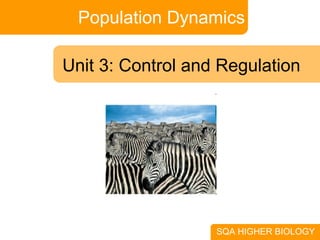
What affects  population  size?
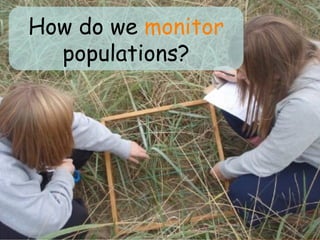
How do we  monitor  populations?
What  population changes  can be seen here?
Learning Content Regulation of plant and animal populations: Population fluctuations: the relative stability of populations, despite short-term oscillations in number. Factors influencing population change. Density-independent factors to include temperature and rainfall. Density-dependent factors to include disease, food supply, predation and competition. Monitoring populations. The need to monitor wild populations. Succession and climax in plant communities.
Regulation of Populations What is a population? What is meant by… birth rate death rate population dynamics population density carrying capacity dynamic equilibrium
Factors What is meant by reproductive potential and environmental resistance? Explain the difference between ‘density-independent’ and ‘density-dependent’ factors. Outline examples of each type of factor. Complete the Density Worksheet. What is the link between population dynamics and homeostasis?
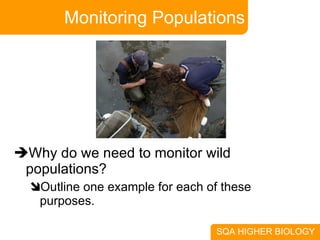
Monitoring Populations Why do we need to monitor wild populations? Outline one example for each of these purposes.
Succession
Succession What is plant succession? What is a pioneer community? Can you think of examples of these? What is the climax community? What is primary succession? What is secondary succession? What causes succession? What are the characteristics of a climax community? How do these differ in a pioneer community?
Succession What is the difference between ‘climatic’ and ‘edaphic’ climax communities? How do humans affect succession? How does intensive grazing affect succession?
Congratulations You've reached the end of the  Higher course!!

Population Dynamics

  • 1.
    Population Dynamics SQAHIGHER BIOLOGY Unit 3: Control and Regulation
  • 2.
    What affects population size?
  • 3.
    How do we monitor populations?
  • 4.
    What populationchanges can be seen here?
  • 5.
    Learning Content Regulationof plant and animal populations: Population fluctuations: the relative stability of populations, despite short-term oscillations in number. Factors influencing population change. Density-independent factors to include temperature and rainfall. Density-dependent factors to include disease, food supply, predation and competition. Monitoring populations. The need to monitor wild populations. Succession and climax in plant communities.
  • 6.
    Regulation of PopulationsWhat is a population? What is meant by… birth rate death rate population dynamics population density carrying capacity dynamic equilibrium
  • 7.
    Factors What ismeant by reproductive potential and environmental resistance? Explain the difference between ‘density-independent’ and ‘density-dependent’ factors. Outline examples of each type of factor. Complete the Density Worksheet. What is the link between population dynamics and homeostasis?
  • 8.
    Monitoring Populations Whydo we need to monitor wild populations? Outline one example for each of these purposes.
  • 9.
  • 10.
    Succession What isplant succession? What is a pioneer community? Can you think of examples of these? What is the climax community? What is primary succession? What is secondary succession? What causes succession? What are the characteristics of a climax community? How do these differ in a pioneer community?
  • 11.
    Succession What isthe difference between ‘climatic’ and ‘edaphic’ climax communities? How do humans affect succession? How does intensive grazing affect succession?
  • 12.
    Congratulations You've reachedthe end of the Higher course!!