Genetics
Definition
DNA.
Chromosomes
Genes
Inheritance
    Mitosis and Meiosis
    Intoduction
    Mono Hybrid
    Di Hybrid
    Co dominance
    Sex determination and Sex linked Genes
Mutation
Natural Selection
Artificial Selection
Definitions
• Genetics is the science of heredity, dealing with
  resemblances and differences of related organisms
  resulting from the interaction of their genes and the
  environment.
• Most of our characteristics as humans are determined
  by our genes as they interact with the environment.
• Being products of sexual reproduction we obtain
  characteristics from both of our parent. These
  characteristics are coded by our parents’ genes, which
  they transfer to us via gametes. This is called
  inheritance.
DNA
• “Short for deoxyribonucleic acid. The nucleic acid that is the genetic
  material determining the makeup of all living cells and many
  viruses. It consists of two long strands of nucleotides linked
  together in a structure resembling a ladder twisted into a spiral.” –
  thefreedictionary.com
• deoxyribonucleic acid: an extremely long macromolecule that is the
  main component of chromosomes and is the material that transfers
  genetic characteristics in all life forms, constructed of two
  nucleotide strands coiled around each other in a ladder-like
  arrangement with the sidepieces composed of alternating
  phosphate and deoxyribose units and the rungs composed of the
  purine and pyrimidine bases adenine, guanine, cytosine, and
  thymine: the genetic information of DNA is encoded in the
  sequence of the bases and is transcribed as the strands unwind and
  replicate. dictionary.reference.com
DNA
• DNA consists of a series of bases which can form a code.
• Three bases form a specific sub-code and codes for a specific
  amino acid. This group of three bases is call a Codon.
Chromosomes
• A structure within the cell [nucleus] that bears the genetic
  material as a threadlike linear strand of DNA bonded to
  various proteins in the nucleus of eukaryotic cells. biology-
  online.org
• A long thread- like structure containing one molecule of DNA
  and binding proteins.
Chromosomes
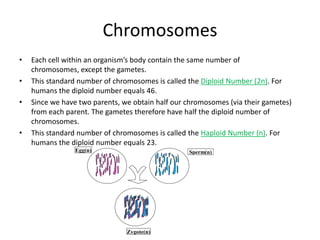
•   Each cell within an organism’s body contain the same number of
    chromosomes, except the gametes.
•   This standard number of chromosomes is called the Diploid Number (2n). For
    humans the diploid number equals 46.
•   Since we have two parents, we obtain half our chromosomes (via their gametes)
    from each parent. The gametes therefore have half the diploid number of
    chromosomes.
•   This standard number of chromosomes is called the Haploid Number (n). For
    humans the diploid number equals 23.
                 Egg(n)                           Sperm(n)


                                Zygote(n)
Genes
• A unit of heredity that is transferred from a parent to
  offspring and is held to determine some characteristic of
  the...: "proteins coded directly by genes.“ -
  dictionary.reference.com (dr.com)
• A distinct sequence of nucleotides forming part of a
  chromosome. - dr.com
• The Section of a DNA which codes for a specific type of
  characteristic or protein.
Meiosis and Mitosis
• In order for an organism to grow, develop and
  multiply cells must divide.
• There are two main types of cell division:
  Mitosis and Meiosis.
• Mitosis is used for growth, repair and asexual
  multiplication(reproduction).
• Meiosis is used for sexual reproduction.
Meiosis and Mitosis
• Mitosis
  – Purpose:
      The purpose of mitosis is to create new body cells for
      growth and repair.
  – Properties
    • Two new cells are produced.
    • Identical number of chromosomes as the parent cell.
Meiosis and Mitosis
• Mitosis
Meiosis and Mitosis
• Meiosis
  – Purpose:
      The purpose of meiosis is to create gametes (sex cells)
      for sexual reproduction.
  – Properties
    • Four new cells are produced.
    • Half the number of chromosomes as the parent cell.
Meiosis and Mitosis
• Meiosis
Introduction to Inheritance
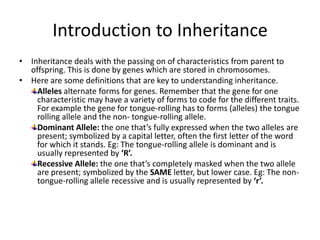
• Inheritance deals with the passing on of characteristics from parent to
  offspring. This is done by genes which are stored in chromosomes.
• Here are some definitions that are key to understanding inheritance.
    Alleles alternate forms for genes. Remember that the gene for one
    characteristic may have a variety of forms to code for the different traits.
    For example the gene for tongue-rolling has to forms (alleles) the tongue
    rolling allele and the non- tongue-rolling allele.
    Dominant Allele: the one that’s fully expressed when the two alleles are
    present; symbolized by a capital letter, often the first letter of the word
    for which it stands. Eg: The tongue-rolling allele is dominant and is
    usually represented by ‘R’.
    Recessive Allele: the one that’s completely masked when the two allele
    are present; symbolized by the SAME letter, but lower case. Eg: The non-
    tongue-rolling allele recessive and is usually represented by ‘r’.
Introduction to Inheritance
Now remember that each individual has two genes for each for
every characteristic.
 Homozygous: an individual has a pair of two of the same allele.
 Eg: RR or rr.
 Heterozygous: an individual has a pair of two different alleles. Eg:
 Rr.
 Genotype: the organism’s actual genetic make-up. Eg: For tongue
 rolling there are three(3) possible genotypes – RR (Homozygous
 Dominant), Rr (Heterozygous) and rr (Homozygous Recessive)?
 Phenotype: the organism’s physically expressed traits as an
 interaction between its genotype and the environment – what it
 looks like, etc; how the genes are expressed. Eg: The ability to roll
 one’s tongue – RR = tongue rolling; Rr = tongue rolling; and rr =
 non-tongue rolling.
Introduction to Inheritance
• Inheritance has two basic phases:
  i. Meiosis: the passing of one of each type of gene to
      the gametes.
  ii. Fertilization: the meeting of one gene from each
      parent to form a total of two of type.
• Though thousands of genes are passed on, it is very
  difficulty to study them all at the same time. So few
  genes are considered at a time.
• Mono hybrid crosses deals with the consideration of
  the inheritance of a single gene.
• Di hybrid crosses deals with the consideration of the
  inheritance of a two genes.
Introduction to Inheritance
• The diagram below shows one of the possible
  inheritance of the tongue-rolling gene.
    Parents’ Genotype             Gametes                   Offspring’s Genotype
                        Meiosis             Fertilization

          RR                        R


                                                                    Rr

                                    R
           Rr
                                     r
Mono-Hybrid to Inheritance
• Crosses are used to determines the possible
  genotypes and phenotypes of offspring or
  even parents.
• They are usually done with a flow chart or
  Punnett square.
• Example & Exercises.
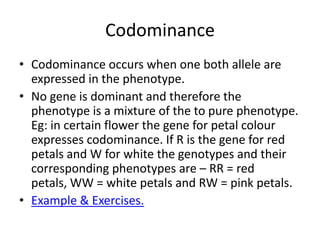
Codominance
• Codominance occurs when one both allele are
  expressed in the phenotype.
• No gene is dominant and therefore the
  phenotype is a mixture of the to pure phenotype.
  Eg: in certain flower the gene for petal colour
  expresses codominance. If R is the gene for red
  petals and W for white the genotypes and their
  corresponding phenotypes are – RR = red
  petals, WW = white petals and RW = pink petals.
• Example & Exercises.
Di-Hybrid to Inheritance
• Example & Exercises.
Sex Determination and Sex Linked
                Genes
• Sex is determined by the pair of sex chromosomes called the X and
  Y chromosome pair.
• XX = Female and XY = Male.
• The Y chromosome is shorter than the X and carries less genes so
  some genes on the X has no matching genes on the Y.
• Males therefore carry only one gene for some genes found on the Y.
• Haemophilia is a gene found on the X but not the Y. Males therefore
  carry one gene for haemophilia.
• Whereas females can be haemophiliac(hh), Non- Haemophiliac(HH)
  or Heterozygous (Hh) (carrier); males can only be haemophiliac(h-),
  Non- Haemophiliac(H-).
• Example & Exercises.
Mutation
• A Mutation occurs when a DNA gene is damaged or changed in such a way
  as to alter the genetic message carried by that gene.A Mutagen is an
  agent of substance that can bring about a permanent alteration to the
  physical composition of a DNA gene such that the genetic message is
  changed.
• Once the gene has been damaged or changed the mRNA transcribed from
  that gene will now carry an altered message.
• The polypeptide made by translating the altered mRNA will now contain a
  different sequence of amino acids. The function of the protein made by
  folding this polypeptide will probably be changed or lost. In this example,
  the enzyme that is catalyzing the production of flower color pigment has
  been altered in such a way it no longer catalyzes the production of the red
  pigment.
• No product (red pigment) is produced by the altered protein.
• In subtle or very obvious ways, the phenotype of the organism carrying
  the mutation will be changed. In this case the flower, without the pigment
  is no longer red.
Mutation
Mutagens
• Chemical Mutagens change the sequence of bases in a DNA gene in a number of ways; mimic the
   correct nucleotide bases in a DNA molecule, but fail to base pair correctly during DNA replication.
• remove parts of the nucleotide (such as the amino group on adenine), again causing improper base
   pairing during DNA replication.
• add hydrocarbon groups to various nucleotides, also causing incorrect base pairing during DNA
   replication.
• Radiation High energy radiation from a radioactive material or from X-rays is absorbed by the
   atoms in water molecules surrounding the DNA. This energy is transferred to the electrons which
   then fly away from the atom. Left behind is a free radical, which is a highly dangerous and highly
   reactive molecule that attacks the DNA molecule and alters it in many ways.
   Radiation can also cause double strand breaks in the DNA molecule, which the cell's repair
   mechanisms cannot put right.
• Sunlight contains ultraviolet radiation (the component that causes a suntan) which, when absorbed
   by the DNA causes a cross link to form between certain adjacent bases. In most normal cases the
   cells can repair this damage, but unrepaired dimers of this sort cause the replicating system to skip
   over the mistake leaving a gap, which is supposed to be filled in later.
   Unprotected exposure to UV radiation by the human skin can cause serious damage and may lead
   to skin cancer and extensive skin tumors.
• Spontaneous mutations occur without exposure to any obvious mutagenic agent. Sometimes DNA
   nucleotides shift without warning to a different chemical form (know as an isomer) which in turn
   will form a different series of hydrogen bonds with it's partner. This leads to mistakes at the time of
   DNA replication.
Artificial Selection
• Artificial selection is the intentional reproduction of individuals in a
  population that have desirable traits. In organisms that reproduce
  sexually, two adults that possess a desired trait — such as two
  parent plants that are tall — are bred together. In this example, the
  mechanisms of heredity dictate that the next generation will consist
  of more tall plants than previous generations. If artificial selection is
  continued, all of the population will ultimately be tall. Also called
  selective breeding, artificial selection is perhaps best understood as
  a contrast to natural selection, where the random forces of nature
  determine which individuals survive and reproduce. In both cases,
  the outcome is the same: a population changes over time, so that
  certain traits become more common.
Artificial Selection
What are some examples of artificial selection?
•  Teosinte (left) and its modern
   descendent, corn, a product
   of artificial selection
•  Artificial selection has generated untold diversity in both plants and animals. In agriculture, superior strains of
   corn, wheat, and soybeans have resulted from careful breeding. The Brassicas described by Paul Williams in the
   video are great examples of artificial selection. Cabbage, broccoli, cauliflower, Brussels sprouts, collards, and kale
   are all members of the same species, Brassica oleracea. Gardeners have cultivated flowers such as roses and
   orchids, carefully manipulating heredity to produce the “perfect” hybrid.
•  A variety of vegetables of theBrassica oleracea species
•  Some consider domesticated animals to be the ultimate products of artificial selection. Thoroughbred racehorses
   are one example of artificial selection of animals. The meats we eat are the result of the careful selective breeding
   of cows, pigs, sheep, and chickens. Our pets are a far cry from their “wild” ancestors. Cats and dogs, which were
   originally domesticated for pest control, hunting, or shepherding, eventually were bred to become companion
   animals. A glance at a group of dogs — all of the species Canis familiaris — reveals an astounding diversity of body
   type, size, and coloration.
•  There can be a down side to artificial selection. Because this process essentially removes variation in a
   population, selectively bred organisms can be especially susceptible to diseases or changes in the environment
   that would not be a problem for a natural population. Inbreeding — the mating of closely related individuals — is
   also a problem. In dogs, this has resulted in breeds that have health issues ranging from decreased life span to hip
   dysplasia.

Genetics

  • 1.
    Genetics Definition DNA. Chromosomes Genes Inheritance Mitosis and Meiosis Intoduction Mono Hybrid Di Hybrid Co dominance Sex determination and Sex linked Genes Mutation Natural Selection Artificial Selection
  • 2.
    Definitions • Genetics isthe science of heredity, dealing with resemblances and differences of related organisms resulting from the interaction of their genes and the environment. • Most of our characteristics as humans are determined by our genes as they interact with the environment. • Being products of sexual reproduction we obtain characteristics from both of our parent. These characteristics are coded by our parents’ genes, which they transfer to us via gametes. This is called inheritance.
  • 3.
    DNA • “Short fordeoxyribonucleic acid. The nucleic acid that is the genetic material determining the makeup of all living cells and many viruses. It consists of two long strands of nucleotides linked together in a structure resembling a ladder twisted into a spiral.” – thefreedictionary.com • deoxyribonucleic acid: an extremely long macromolecule that is the main component of chromosomes and is the material that transfers genetic characteristics in all life forms, constructed of two nucleotide strands coiled around each other in a ladder-like arrangement with the sidepieces composed of alternating phosphate and deoxyribose units and the rungs composed of the purine and pyrimidine bases adenine, guanine, cytosine, and thymine: the genetic information of DNA is encoded in the sequence of the bases and is transcribed as the strands unwind and replicate. dictionary.reference.com
  • 4.
    DNA • DNA consistsof a series of bases which can form a code. • Three bases form a specific sub-code and codes for a specific amino acid. This group of three bases is call a Codon.
  • 7.
    Chromosomes • A structurewithin the cell [nucleus] that bears the genetic material as a threadlike linear strand of DNA bonded to various proteins in the nucleus of eukaryotic cells. biology- online.org • A long thread- like structure containing one molecule of DNA and binding proteins.
  • 8.
    Chromosomes • Each cell within an organism’s body contain the same number of chromosomes, except the gametes. • This standard number of chromosomes is called the Diploid Number (2n). For humans the diploid number equals 46. • Since we have two parents, we obtain half our chromosomes (via their gametes) from each parent. The gametes therefore have half the diploid number of chromosomes. • This standard number of chromosomes is called the Haploid Number (n). For humans the diploid number equals 23. Egg(n) Sperm(n) Zygote(n)
  • 9.
    Genes • A unitof heredity that is transferred from a parent to offspring and is held to determine some characteristic of the...: "proteins coded directly by genes.“ - dictionary.reference.com (dr.com) • A distinct sequence of nucleotides forming part of a chromosome. - dr.com • The Section of a DNA which codes for a specific type of characteristic or protein.
  • 10.
    Meiosis and Mitosis •In order for an organism to grow, develop and multiply cells must divide. • There are two main types of cell division: Mitosis and Meiosis. • Mitosis is used for growth, repair and asexual multiplication(reproduction). • Meiosis is used for sexual reproduction.
  • 11.
    Meiosis and Mitosis •Mitosis – Purpose: The purpose of mitosis is to create new body cells for growth and repair. – Properties • Two new cells are produced. • Identical number of chromosomes as the parent cell.
  • 12.
  • 14.
    Meiosis and Mitosis •Meiosis – Purpose: The purpose of meiosis is to create gametes (sex cells) for sexual reproduction. – Properties • Four new cells are produced. • Half the number of chromosomes as the parent cell.
  • 15.
  • 17.
    Introduction to Inheritance •Inheritance deals with the passing on of characteristics from parent to offspring. This is done by genes which are stored in chromosomes. • Here are some definitions that are key to understanding inheritance. Alleles alternate forms for genes. Remember that the gene for one characteristic may have a variety of forms to code for the different traits. For example the gene for tongue-rolling has to forms (alleles) the tongue rolling allele and the non- tongue-rolling allele. Dominant Allele: the one that’s fully expressed when the two alleles are present; symbolized by a capital letter, often the first letter of the word for which it stands. Eg: The tongue-rolling allele is dominant and is usually represented by ‘R’. Recessive Allele: the one that’s completely masked when the two allele are present; symbolized by the SAME letter, but lower case. Eg: The non- tongue-rolling allele recessive and is usually represented by ‘r’.
  • 18.
    Introduction to Inheritance Nowremember that each individual has two genes for each for every characteristic. Homozygous: an individual has a pair of two of the same allele. Eg: RR or rr. Heterozygous: an individual has a pair of two different alleles. Eg: Rr. Genotype: the organism’s actual genetic make-up. Eg: For tongue rolling there are three(3) possible genotypes – RR (Homozygous Dominant), Rr (Heterozygous) and rr (Homozygous Recessive)? Phenotype: the organism’s physically expressed traits as an interaction between its genotype and the environment – what it looks like, etc; how the genes are expressed. Eg: The ability to roll one’s tongue – RR = tongue rolling; Rr = tongue rolling; and rr = non-tongue rolling.
  • 19.
    Introduction to Inheritance •Inheritance has two basic phases: i. Meiosis: the passing of one of each type of gene to the gametes. ii. Fertilization: the meeting of one gene from each parent to form a total of two of type. • Though thousands of genes are passed on, it is very difficulty to study them all at the same time. So few genes are considered at a time. • Mono hybrid crosses deals with the consideration of the inheritance of a single gene. • Di hybrid crosses deals with the consideration of the inheritance of a two genes.
  • 20.
    Introduction to Inheritance •The diagram below shows one of the possible inheritance of the tongue-rolling gene. Parents’ Genotype Gametes Offspring’s Genotype Meiosis Fertilization RR R Rr R Rr r
  • 21.
    Mono-Hybrid to Inheritance •Crosses are used to determines the possible genotypes and phenotypes of offspring or even parents. • They are usually done with a flow chart or Punnett square. • Example & Exercises.
  • 22.
    Codominance • Codominance occurswhen one both allele are expressed in the phenotype. • No gene is dominant and therefore the phenotype is a mixture of the to pure phenotype. Eg: in certain flower the gene for petal colour expresses codominance. If R is the gene for red petals and W for white the genotypes and their corresponding phenotypes are – RR = red petals, WW = white petals and RW = pink petals. • Example & Exercises.
  • 23.
    Di-Hybrid to Inheritance •Example & Exercises.
  • 24.
    Sex Determination andSex Linked Genes • Sex is determined by the pair of sex chromosomes called the X and Y chromosome pair. • XX = Female and XY = Male. • The Y chromosome is shorter than the X and carries less genes so some genes on the X has no matching genes on the Y. • Males therefore carry only one gene for some genes found on the Y. • Haemophilia is a gene found on the X but not the Y. Males therefore carry one gene for haemophilia. • Whereas females can be haemophiliac(hh), Non- Haemophiliac(HH) or Heterozygous (Hh) (carrier); males can only be haemophiliac(h-), Non- Haemophiliac(H-). • Example & Exercises.
  • 25.
    Mutation • A Mutationoccurs when a DNA gene is damaged or changed in such a way as to alter the genetic message carried by that gene.A Mutagen is an agent of substance that can bring about a permanent alteration to the physical composition of a DNA gene such that the genetic message is changed. • Once the gene has been damaged or changed the mRNA transcribed from that gene will now carry an altered message. • The polypeptide made by translating the altered mRNA will now contain a different sequence of amino acids. The function of the protein made by folding this polypeptide will probably be changed or lost. In this example, the enzyme that is catalyzing the production of flower color pigment has been altered in such a way it no longer catalyzes the production of the red pigment. • No product (red pigment) is produced by the altered protein. • In subtle or very obvious ways, the phenotype of the organism carrying the mutation will be changed. In this case the flower, without the pigment is no longer red.
  • 26.
    Mutation Mutagens • Chemical Mutagenschange the sequence of bases in a DNA gene in a number of ways; mimic the correct nucleotide bases in a DNA molecule, but fail to base pair correctly during DNA replication. • remove parts of the nucleotide (such as the amino group on adenine), again causing improper base pairing during DNA replication. • add hydrocarbon groups to various nucleotides, also causing incorrect base pairing during DNA replication. • Radiation High energy radiation from a radioactive material or from X-rays is absorbed by the atoms in water molecules surrounding the DNA. This energy is transferred to the electrons which then fly away from the atom. Left behind is a free radical, which is a highly dangerous and highly reactive molecule that attacks the DNA molecule and alters it in many ways. Radiation can also cause double strand breaks in the DNA molecule, which the cell's repair mechanisms cannot put right. • Sunlight contains ultraviolet radiation (the component that causes a suntan) which, when absorbed by the DNA causes a cross link to form between certain adjacent bases. In most normal cases the cells can repair this damage, but unrepaired dimers of this sort cause the replicating system to skip over the mistake leaving a gap, which is supposed to be filled in later. Unprotected exposure to UV radiation by the human skin can cause serious damage and may lead to skin cancer and extensive skin tumors. • Spontaneous mutations occur without exposure to any obvious mutagenic agent. Sometimes DNA nucleotides shift without warning to a different chemical form (know as an isomer) which in turn will form a different series of hydrogen bonds with it's partner. This leads to mistakes at the time of DNA replication.
  • 27.
    Artificial Selection • Artificialselection is the intentional reproduction of individuals in a population that have desirable traits. In organisms that reproduce sexually, two adults that possess a desired trait — such as two parent plants that are tall — are bred together. In this example, the mechanisms of heredity dictate that the next generation will consist of more tall plants than previous generations. If artificial selection is continued, all of the population will ultimately be tall. Also called selective breeding, artificial selection is perhaps best understood as a contrast to natural selection, where the random forces of nature determine which individuals survive and reproduce. In both cases, the outcome is the same: a population changes over time, so that certain traits become more common.
  • 28.
    Artificial Selection What aresome examples of artificial selection? • Teosinte (left) and its modern descendent, corn, a product of artificial selection • Artificial selection has generated untold diversity in both plants and animals. In agriculture, superior strains of corn, wheat, and soybeans have resulted from careful breeding. The Brassicas described by Paul Williams in the video are great examples of artificial selection. Cabbage, broccoli, cauliflower, Brussels sprouts, collards, and kale are all members of the same species, Brassica oleracea. Gardeners have cultivated flowers such as roses and orchids, carefully manipulating heredity to produce the “perfect” hybrid. • A variety of vegetables of theBrassica oleracea species • Some consider domesticated animals to be the ultimate products of artificial selection. Thoroughbred racehorses are one example of artificial selection of animals. The meats we eat are the result of the careful selective breeding of cows, pigs, sheep, and chickens. Our pets are a far cry from their “wild” ancestors. Cats and dogs, which were originally domesticated for pest control, hunting, or shepherding, eventually were bred to become companion animals. A glance at a group of dogs — all of the species Canis familiaris — reveals an astounding diversity of body type, size, and coloration. • There can be a down side to artificial selection. Because this process essentially removes variation in a population, selectively bred organisms can be especially susceptible to diseases or changes in the environment that would not be a problem for a natural population. Inbreeding — the mating of closely related individuals — is also a problem. In dogs, this has resulted in breeds that have health issues ranging from decreased life span to hip dysplasia.