Inheritance &
Variation
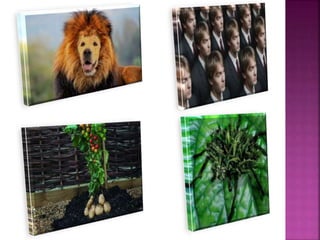
Genetics is the branch of biology which
deals with heredity & variation.
Heredity is defined as transmission of
characters from one generation to next or
from parents to offsprings*
*offsprings are organisms produced by sexual reproduction,
clones are individuals produced by asexual reproduction.
Variations are the differences between
parents & offsprings, among the offsprings
& among individuals of same species.
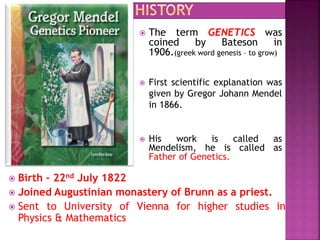
 The term GENETICS was
coined by Bateson in
1906.(greek word genesis – to grow)
 First scientific explanation was
given by Gregor Johann Mendel
in 1866.
 His work is called as
Mendelism, he is called as
Father of Genetics.
 Birth – 22nd July 1822
 Joined Augustinian monastery of Brunn as a priest.
 Sent to University of Vienna for higher studies in
Physics & Mathematics
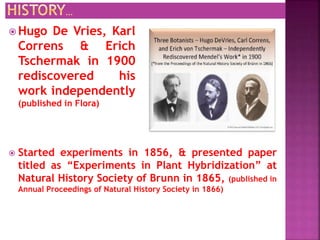
 Started experiments in 1856, & presented paper
titled as “Experiments in Plant Hybridization” at
Natural History Society of Brunn in 1865, (published in
Annual Proceedings of Natural History Society in 1866)
 Hugo De Vries, Karl
Correns & Erich
Tschermak in 1900
rediscovered his
work independently
(published in Flora)
 Character -- feature of an organism
 Trait – inherited character& its selectable
variant.
 Factor – unit of heredity, a particle present in
the organism responsible for inheritance &
expression of a character.
 Gene – a particular segment of DNA in the
organism responsible for the inheritance &
expression of a character. (Johannsen)
 Alleles or Allelomorphs – they are two (or
more) alternative forms of a gene(factor),
they occupy same identical loci on homologous
chromosomes. (Bateson)
 Dominant – it is an allele that expresses its
trait even in the presence of alternative
allele.
 Recessive – it is the allele that is not
expressed in the presence of alternative
allele.
 Phenotype – external appearance of an
individual for any trait is called phenotype.
 Genotype – genetic constitution of an
individual with respect to a single character or
set of characters.
 Homozygous – An individual possessing similar
alleles for a particular trait. (pure)
 Heterozygous – An individual possessing
dissimilar alleles for a particular trait. (hybrid)
 Pure line – An individual or group of
individuals that is homozygous or true
breeding for one or more traits.
 Hybrid – heterozygous individual produced
from any cross involving pure parents having
one or more contrasting traits.
F1 generation – the progeny (offsprings)
produced from the cross is called first filial
or F1 generation. (filial – greek word filin=son)
 F2 generation – the second generation
produced by selfing (interbreeding) of F1
generation offspringsis called Second filial or
F2 generation.
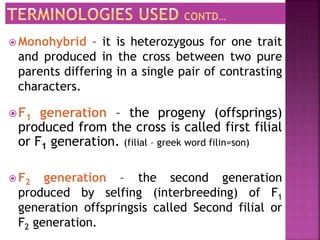
 Monohybrid – it is heterozygous for one trait
and produced in the cross between two pure
parents differing in a single pair of contrasting
characters.
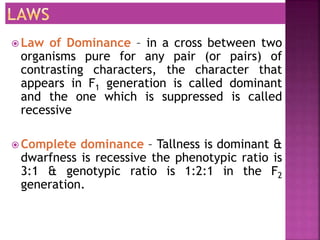
 Law of Dominance – in a cross between two
organisms pure for any pair (or pairs) of
contrasting characters, the character that
appears in F1 generation is called dominant
and the one which is suppressed is called
recessive
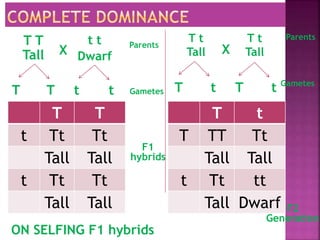
 Complete dominance – Tallness is dominant &
dwarfness is recessive the phenotypic ratio is
3:1 & genotypic ratio is 1:2:1 in the F2
generation.
X
T T
Tall
t t
Dwarf
Parents
T t
T t Gametes
F1
hybrids
T t
Tall
T t
Tall
X
ON SELFING F1 hybrids
T T
t t
F2
Generation
T T
t Tt Tt
Tall Tall
t Tt Tt
Tall Tall
Parents
Gametes
T t
T TT Tt
Tall Tall
t Tt tt
Tall Dwarf
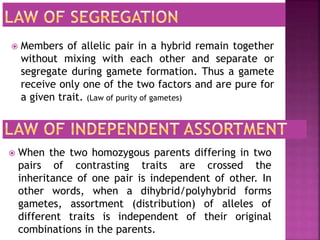
 Members of allelic pair in a hybrid remain together
without mixing with each other and separate or
segregate during gamete formation. Thus a gamete
receive only one of the two factors and are pure for
a given trait. (Law of purity of gametes)
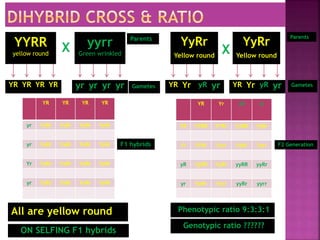
 When the two homozygous parents differing in two
pairs of contrasting traits are crossed the
inheritance of one pair is independent of other. In
other words, when a dihybrid/polyhybrid forms
gametes, assortment (distribution) of alleles of
different traits is independent of their original
combinations in the parents.
X
YYRR
yellow round
yyrr
Green wrinkled
Parents
Gametes
F1 hybrids
YyRr
Yellow round
X
ON SELFING F1 hybrids
YR yr
F2 Generation
YR YR YR YR
yr YyRr YyRr YyRr YyRr
Yr YyRr YyRr YyRr YyRr
yr YyRr YyRr YyRr YyRr
Parents
Gametes
YR YR YR YR yr yr yr yr
All are yellow round
Yr yR YR yr
Yr yR
YR Yr yR yr
YR YYRR YYRr YyRR YyRr
Yr YYRr Yyrr YyRr Yyrr
yR YyRR YyRr yyRR yyRr
yr YyRr Yyrr yyRr yyrr
YyRr
Yellow round
Phenotypic ratio 9:3:3:1
Genotypic ratio ??????
Occurs between alleles of same gene.
(Incomplete dominance, Codominance & Multiple alleles)
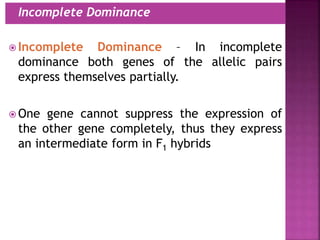
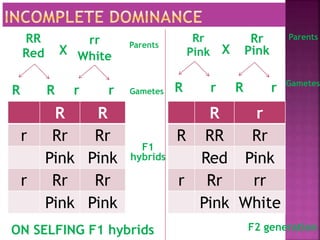
 Incomplete Dominance – In incomplete
dominance both genes of the allelic pairs
express themselves partially.
 One gene cannot suppress the expression of
the other gene completely, thus they express
an intermediate form in F1 hybrids
 Incomplete Dominance
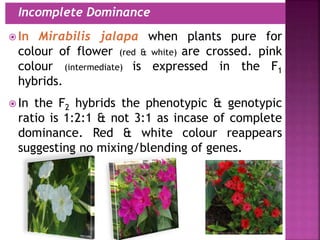
 In Mirabilis jalapa when plants pure for
colour of flower (red & white) are crossed. pink
colour (intermediate) is expressed in the F1
hybrids.
 In the F2 hybrids the phenotypic & genotypic
ratio is 1:2:1 & not 3:1 as incase of complete
dominance. Red & white colour reappears
suggesting no mixing/blending of genes.
 Incomplete Dominance
X
RR
Red
rr
White
Parents
R r
R r Gametes
F1
hybrids
Rr
Pink
Rr
Pink
X
ON SELFING F1 hybrids
R R
r r
R R
r Rr Rr
Pink Pink
r Rr Rr
Pink Pink
Parents
Gametes
R r
R RR Rr
Red Pink
r Rr rr
Pink White
F2 generation
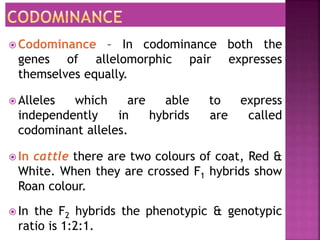
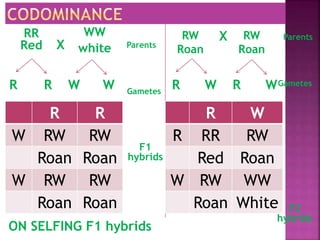
 Codominance – In codominance both the
genes of allelomorphic pair expresses
themselves equally.
 Alleles which are able to express
independently in hybrids are called
codominant alleles.
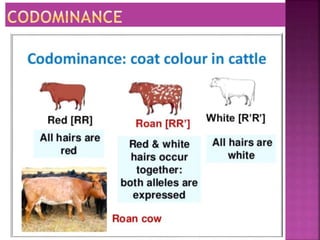
 In cattle there are two colours of coat, Red &
White. When they are crossed F1 hybrids show
Roan colour.
 In the F2 hybrids the phenotypic & genotypic
ratio is 1:2:1.
 The difference in incomplete dominance &
codominance is that in incomplete dominance
the intermediate form appears and in
codominance it does not appear (F2 generation)
both the genes express equally.
X
RR
Red
WW
white
R W
R W
X
ON SELFING F1 hybrids
R R
W W
RW
Roan
RW
Roan
R R
W RW RW
Roan Roan
W RW RW
Roan Roan
R W
R RR RW
Red Roan
W RW WW
Roan White
Parents
Gametes
F1
hybrids
F2
hybrids
Parents
Gametes
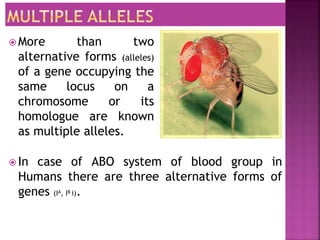
 More than two
alternative forms (alleles)
of a gene occupying the
same locus on a
chromosome or its
homologue are known
as multiple alleles.
 In case of ABO system of blood group in
Humans there are three alternative forms of
genes (IA, IB i).
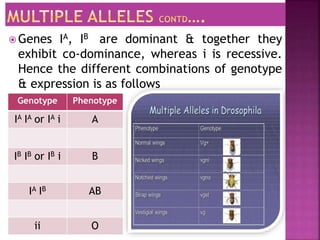
Genotype Phenotype
IA IA or IA i A
IB IB or IB i B
IA IB AB
ii O
 Genes IA, IB are dominant & together they
exhibit co-dominance, whereas i is recessive.
Hence the different combinations of genotype
& expression is as follows
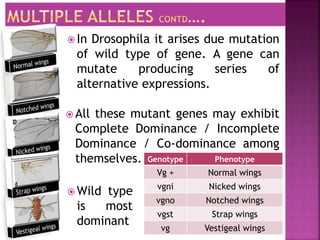
 In Drosophila it arises due mutation
of wild type of gene. A gene can
mutate producing series of
alternative expressions.
 All these mutant genes may exhibit
Complete Dominance / Incomplete
Dominance / Co-dominance among
themselves.
 Wild type
is most
dominant
Genotype Phenotype
Vg + Normal wings
vgni Nicked wings
vgno Notched wings
vgst Strap wings
vg Vestigeal wings
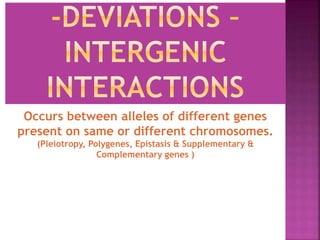
Occurs between alleles of different genes
present on same or different chromosomes.
(Pleiotropy, Polygenes, Epistasis & Supplementary &
Complementary genes )
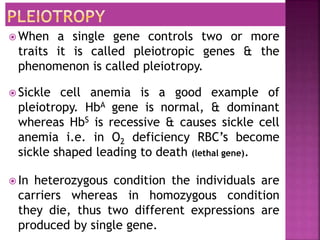
 When a single gene controls two or more
traits it is called pleiotropic genes & the
phenomenon is called pleiotropy.
 Sickle cell anemia is a good example of
pleiotropy. HbA gene is normal, & dominant
whereas HbS is recessive & causes sickle cell
anemia i.e. in O2 deficiency RBC’s become
sickle shaped leading to death (lethal gene).
 In heterozygous condition the individuals are
carriers whereas in homozygous condition
they die, thus two different expressions are
produced by single gene.
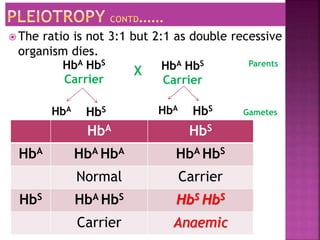
 The ratio is not 3:1 but 2:1 as double recessive
organism dies.
HbA HbS
Carrier
X
HbA
F2
hybrids
Parents
Gametes
HbA HbS
HbA HbA HbA HbA HbS
Normal Carrier
HbS HbA HbS HbS HbS
Carrier Anaemic
HbA HbS
Carrier
HbS HbA
HbS
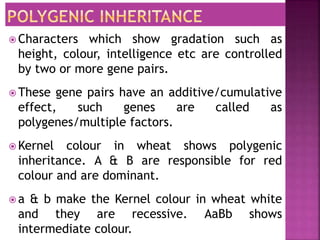
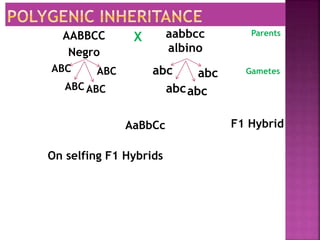
 Characters which show gradation such as
height, colour, intelligence etc are controlled
by two or more gene pairs.
 These gene pairs have an additive/cumulative
effect, such genes are called as
polygenes/multiple factors.
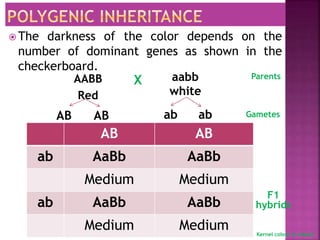
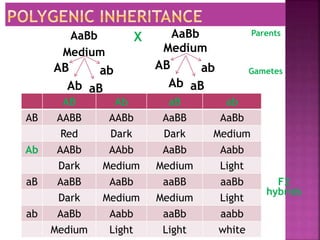
 Kernel colour in wheat shows polygenic
inheritance. A & B are responsible for red
colour and are dominant.
 a & b make the Kernel colour in wheat white
and they are recessive. AaBb shows
intermediate colour.
 The darkness of the color depends on the
number of dominant genes as shown in the
checkerboard.
AABB
Red
X
AB
Parents
Gametes
aabb
white
AB ab ab
F1
hybrids
Kernel colour in wheat
AB AB
ab AaBb AaBb
Medium Medium
ab AaBb AaBb
Medium Medium
AaBb
Medium
X
F2
hybrids
Parents
Gametes
AB Ab aB ab
AB AABB AABb AaBB AaBb
Red Dark Dark Medium
Ab AABb AAbb AaBb Aabb
Dark Medium Medium Light
aB AaBB AaBb aaBB aaBb
Dark Medium Medium Light
ab AaBb Aabb aaBb aabb
Medium Light Light white
AaBb
Medium
AB ab
Ab aB
AB ab
Ab aB
AABBCC
Negro
X Parents
Gametes
aabbcc
albino
ABC ABC
ABC ABC
abc abc
abcabc
AaBbCc F1 Hybrid
On selfing F1 Hybrids
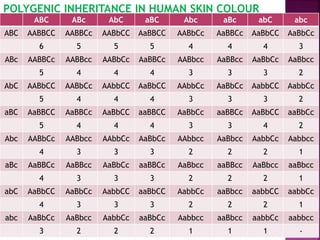
ABC ABc AbC aBC Abc aBc abC abc
ABC AABBCC AABBCc AABbCC AaBBCC AABbCc AaBBCc AaBbCC AaBbCc
6 5 5 5 4 4 4 3
ABc AABBCc AABBcc AABbCc AaBBCc AABbcc AaBBcc AaBbCc AaBbcc
5 4 4 4 3 3 3 2
AbC AABbCC AABbCc AAbbCC AaBbCC AAbbCc AaBbCc AabbCC AabbCc
5 4 4 4 3 3 3 2
aBC AaBBCC AaBBCc AaBbCC aaBBCC AaBbCc aaBBCc AaBbCC aaBbCc
5 4 4 4 3 3 4 2
Abc AABbCc AABbcc AAbbCc AaBbCc AAbbcc AaBbcc AabbCc Aabbcc
4 3 3 3 2 2 2 1
aBc AaBBCc AaBBcc AaBbCc aaBBCc AaBbcc aaBBcc AaBbcc aaBbcc
4 3 3 3 2 2 2 1
abC AaBbCC AaBbCc AabbCC aaBbCC AabbCc aaBbcc aabbCC aabbCc
4 3 3 3 2 2 2 1
abc AaBbCc AaBbcc AabbCc aaBbCc Aabbcc aaBbcc aabbCc aabbcc
3 2 2 2 1 1 1 -
POLYGENIC INHERITANCE IN HUMAN SKIN COLOUR
 Assignment 8
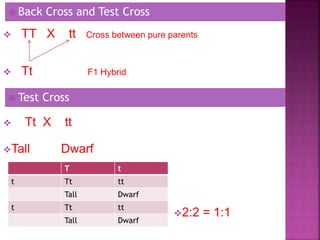
T t
t Tt tt
Tall Dwarf
t Tt tt
Tall Dwarf
 Tt X tt
Tall Dwarf
 Back Cross and Test Cross
 TT X tt Cross between pure parents
 Tt F1 Hybrid
 Test Cross
2:2 = 1:1
 A homozygous tall Pea plant which is also
homozygous for red colour of flower is
crossed with a dwarf Pea plant producing
white flowers. Find the proportion of
offspring produced in the F2 generation of
this cross by checker board method.
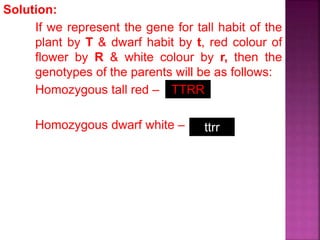
Solution:
If we represent the gene for tall habit of the
plant by T & dwarf habit by t, red colour of
flower by R & white colour by r, then the
genotypes of the parents will be as follows:
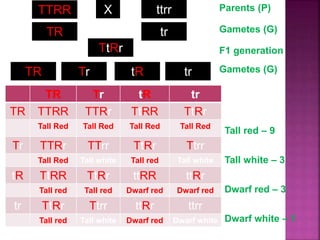
Homozygous tall red –
Homozygous dwarf white –
TTRR
ttrr
Parents (P)
TTRR ttrr
X
Gametes (G)
TR tr
F1 generation
TtRr
TR Tr tR tr Gametes (G)
TR Tr tR tr
TR TTRR TTRr TtRR TtRr
Tall Red Tall Red Tall Red Tall Red
Tr TTRr TTrr TtRr Ttrr
Tall Red Tall white Tall red Tall white
tR TtRR TtRr ttRR ttRr
Tall red Tall red Dwarf red Dwarf red
tr TtRr Ttrr ttRr ttrr
Tall red Tall white Dwarf red Dwarf white
Tall red – 9
Tall white – 3
Dwarf red – 3
Dwarf white – 1
In Garden Peas, Yellow seed colour (Y) is dominant over
green (y) & round seed (R) is dominant over wrinkled seed
(r). The two character pairs segregate independently. A
pure yellow wrinkled variety is crossed with pure green
round variety. What will be the appearance of F1? Give the
F2 phenotypic ratio.
In Pea plant, inflated pod (I) is dominant over constricted
pods (i) and round seed (R) is dominant over wrinkled
seed (r). A homozygous Pea plant with inflated pods and
round seeds was crossed with the homozygous pea plant
having constricted pods & wrinkled seeds. Find out the
proportion of the offspring produced in the F2 generation of
this cross by checker board method.
DHC
A pea plant homozygous for axillary (A) & red flowers (R)
is crossed with another plant homozygous for terminal (a)
& white flowers (r). Find out the proportion of the off-
springs in F2 generation. Mention its phenotypic ratio.
 A homozygous tall pea plant with red flowers was
crossed with a short plant with white flowers & F2
generation was raised. What will be the proportion of tall
plants & short plants in F2 generation?. Explain.
 A homozygous pea plant with inflated pods & round
seeds was crossed with a plant with constricted pods &
wrinkled seeds. Calculate the ratio of plants with round
seeds & those with wrinkled seeds.
DHC
12:4
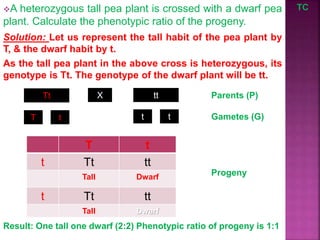
A heterozygous tall pea plant is crossed with a dwarf pea
plant. Calculate the phenotypic ratio of the progeny.
TC
Solution: Let us represent the tall habit of the pea plant by
T, & the dwarf habit by t.
As the tall pea plant in the above cross is heterozygous, its
genotype is Tt. The genotype of the dwarf plant will be tt.
Parents (P)
Tt tt
X
Gametes (G)
T
T t
t Tt tt
Tall Dwarf
t Tt tt
Tall Dwarf
t t t
Progeny
Result: One tall one dwarf (2:2) Phenotypic ratio of progeny is 1:1
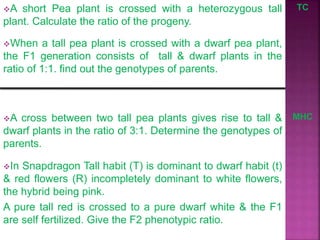
A short Pea plant is crossed with a heterozygous tall
plant. Calculate the ratio of the progeny.
When a tall pea plant is crossed with a dwarf pea plant,
the F1 generation consists of tall & dwarf plants in the
ratio of 1:1. find out the genotypes of parents.
TC
A cross between two tall pea plants gives rise to tall &
dwarf plants in the ratio of 3:1. Determine the genotypes of
parents.
MHC
In Snapdragon Tall habit (T) is dominant to dwarf habit (t)
& red flowers (R) incompletely dominant to white flowers,
the hybrid being pink.
A pure tall red is crossed to a pure dwarf white & the F1
are self fertilized. Give the F2 phenotypic ratio.
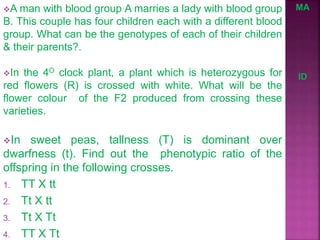
A man with blood group A marries a lady with blood group
B. This couple has four children each with a different blood
group. What can be the genotypes of each of their children
& their parents?.
MA
In the 4O clock plant, a plant which is heterozygous for
red flowers (R) is crossed with white. What will be the
flower colour of the F2 produced from crossing these
varieties.
ID
In sweet peas, tallness (T) is dominant over
dwarfness (t). Find out the phenotypic ratio of the
offspring in the following crosses.
1. TT X tt
2. Tt X tt
3. Tt X Tt
4. TT X Tt

Genetic_basis_of_Inheritance.pptx

  • 1.
  • 3.
    Genetics is thebranch of biology which deals with heredity & variation. Heredity is defined as transmission of characters from one generation to next or from parents to offsprings* *offsprings are organisms produced by sexual reproduction, clones are individuals produced by asexual reproduction. Variations are the differences between parents & offsprings, among the offsprings & among individuals of same species.
  • 4.
     The termGENETICS was coined by Bateson in 1906.(greek word genesis – to grow)  First scientific explanation was given by Gregor Johann Mendel in 1866.  His work is called as Mendelism, he is called as Father of Genetics.  Birth – 22nd July 1822  Joined Augustinian monastery of Brunn as a priest.  Sent to University of Vienna for higher studies in Physics & Mathematics
  • 5.
     Started experimentsin 1856, & presented paper titled as “Experiments in Plant Hybridization” at Natural History Society of Brunn in 1865, (published in Annual Proceedings of Natural History Society in 1866)  Hugo De Vries, Karl Correns & Erich Tschermak in 1900 rediscovered his work independently (published in Flora)
  • 6.
     Character --feature of an organism  Trait – inherited character& its selectable variant.  Factor – unit of heredity, a particle present in the organism responsible for inheritance & expression of a character.  Gene – a particular segment of DNA in the organism responsible for the inheritance & expression of a character. (Johannsen)  Alleles or Allelomorphs – they are two (or more) alternative forms of a gene(factor), they occupy same identical loci on homologous chromosomes. (Bateson)
  • 7.
     Dominant –it is an allele that expresses its trait even in the presence of alternative allele.  Recessive – it is the allele that is not expressed in the presence of alternative allele.  Phenotype – external appearance of an individual for any trait is called phenotype.  Genotype – genetic constitution of an individual with respect to a single character or set of characters.
  • 8.
     Homozygous –An individual possessing similar alleles for a particular trait. (pure)  Heterozygous – An individual possessing dissimilar alleles for a particular trait. (hybrid)  Pure line – An individual or group of individuals that is homozygous or true breeding for one or more traits.  Hybrid – heterozygous individual produced from any cross involving pure parents having one or more contrasting traits.
  • 9.
    F1 generation –the progeny (offsprings) produced from the cross is called first filial or F1 generation. (filial – greek word filin=son)  F2 generation – the second generation produced by selfing (interbreeding) of F1 generation offspringsis called Second filial or F2 generation.  Monohybrid – it is heterozygous for one trait and produced in the cross between two pure parents differing in a single pair of contrasting characters.
  • 10.
     Law ofDominance – in a cross between two organisms pure for any pair (or pairs) of contrasting characters, the character that appears in F1 generation is called dominant and the one which is suppressed is called recessive  Complete dominance – Tallness is dominant & dwarfness is recessive the phenotypic ratio is 3:1 & genotypic ratio is 1:2:1 in the F2 generation.
  • 11.
    X T T Tall t t Dwarf Parents Tt T t Gametes F1 hybrids T t Tall T t Tall X ON SELFING F1 hybrids T T t t F2 Generation T T t Tt Tt Tall Tall t Tt Tt Tall Tall Parents Gametes T t T TT Tt Tall Tall t Tt tt Tall Dwarf
  • 12.
     Members ofallelic pair in a hybrid remain together without mixing with each other and separate or segregate during gamete formation. Thus a gamete receive only one of the two factors and are pure for a given trait. (Law of purity of gametes)  When the two homozygous parents differing in two pairs of contrasting traits are crossed the inheritance of one pair is independent of other. In other words, when a dihybrid/polyhybrid forms gametes, assortment (distribution) of alleles of different traits is independent of their original combinations in the parents.
  • 13.
    X YYRR yellow round yyrr Green wrinkled Parents Gametes F1hybrids YyRr Yellow round X ON SELFING F1 hybrids YR yr F2 Generation YR YR YR YR yr YyRr YyRr YyRr YyRr yr YyRr YyRr YyRr YyRr Yr YyRr YyRr YyRr YyRr yr YyRr YyRr YyRr YyRr Parents Gametes YR YR YR YR yr yr yr yr All are yellow round Yr yR YR yr Yr yR YR Yr yR yr YR YYRR YYRr YyRR YyRr Yr YYRr Yyrr YyRr Yyrr yR YyRR YyRr yyRR yyRr yr YyRr Yyrr yyRr yyrr YyRr Yellow round Phenotypic ratio 9:3:3:1 Genotypic ratio ??????
  • 14.
    Occurs between allelesof same gene. (Incomplete dominance, Codominance & Multiple alleles)
  • 15.
     Incomplete Dominance– In incomplete dominance both genes of the allelic pairs express themselves partially.  One gene cannot suppress the expression of the other gene completely, thus they express an intermediate form in F1 hybrids  Incomplete Dominance
  • 16.
     In Mirabilisjalapa when plants pure for colour of flower (red & white) are crossed. pink colour (intermediate) is expressed in the F1 hybrids.  In the F2 hybrids the phenotypic & genotypic ratio is 1:2:1 & not 3:1 as incase of complete dominance. Red & white colour reappears suggesting no mixing/blending of genes.  Incomplete Dominance
  • 17.
    X RR Red rr White Parents R r R rGametes F1 hybrids Rr Pink Rr Pink X ON SELFING F1 hybrids R R r r R R r Rr Rr Pink Pink r Rr Rr Pink Pink Parents Gametes R r R RR Rr Red Pink r Rr rr Pink White F2 generation
  • 18.
     Codominance –In codominance both the genes of allelomorphic pair expresses themselves equally.  Alleles which are able to express independently in hybrids are called codominant alleles.  In cattle there are two colours of coat, Red & White. When they are crossed F1 hybrids show Roan colour.  In the F2 hybrids the phenotypic & genotypic ratio is 1:2:1.
  • 20.
     The differencein incomplete dominance & codominance is that in incomplete dominance the intermediate form appears and in codominance it does not appear (F2 generation) both the genes express equally.
  • 21.
    X RR Red WW white R W R W X ONSELFING F1 hybrids R R W W RW Roan RW Roan R R W RW RW Roan Roan W RW RW Roan Roan R W R RR RW Red Roan W RW WW Roan White Parents Gametes F1 hybrids F2 hybrids Parents Gametes
  • 22.
     More thantwo alternative forms (alleles) of a gene occupying the same locus on a chromosome or its homologue are known as multiple alleles.  In case of ABO system of blood group in Humans there are three alternative forms of genes (IA, IB i).
  • 23.
    Genotype Phenotype IA IAor IA i A IB IB or IB i B IA IB AB ii O  Genes IA, IB are dominant & together they exhibit co-dominance, whereas i is recessive. Hence the different combinations of genotype & expression is as follows
  • 24.
     In Drosophilait arises due mutation of wild type of gene. A gene can mutate producing series of alternative expressions.  All these mutant genes may exhibit Complete Dominance / Incomplete Dominance / Co-dominance among themselves.  Wild type is most dominant Genotype Phenotype Vg + Normal wings vgni Nicked wings vgno Notched wings vgst Strap wings vg Vestigeal wings
  • 25.
    Occurs between allelesof different genes present on same or different chromosomes. (Pleiotropy, Polygenes, Epistasis & Supplementary & Complementary genes )
  • 26.
     When asingle gene controls two or more traits it is called pleiotropic genes & the phenomenon is called pleiotropy.  Sickle cell anemia is a good example of pleiotropy. HbA gene is normal, & dominant whereas HbS is recessive & causes sickle cell anemia i.e. in O2 deficiency RBC’s become sickle shaped leading to death (lethal gene).  In heterozygous condition the individuals are carriers whereas in homozygous condition they die, thus two different expressions are produced by single gene.
  • 27.
     The ratiois not 3:1 but 2:1 as double recessive organism dies. HbA HbS Carrier X HbA F2 hybrids Parents Gametes HbA HbS HbA HbA HbA HbA HbS Normal Carrier HbS HbA HbS HbS HbS Carrier Anaemic HbA HbS Carrier HbS HbA HbS
  • 28.
     Characters whichshow gradation such as height, colour, intelligence etc are controlled by two or more gene pairs.  These gene pairs have an additive/cumulative effect, such genes are called as polygenes/multiple factors.  Kernel colour in wheat shows polygenic inheritance. A & B are responsible for red colour and are dominant.  a & b make the Kernel colour in wheat white and they are recessive. AaBb shows intermediate colour.
  • 29.
     The darknessof the color depends on the number of dominant genes as shown in the checkerboard. AABB Red X AB Parents Gametes aabb white AB ab ab F1 hybrids Kernel colour in wheat AB AB ab AaBb AaBb Medium Medium ab AaBb AaBb Medium Medium
  • 30.
    AaBb Medium X F2 hybrids Parents Gametes AB Ab aBab AB AABB AABb AaBB AaBb Red Dark Dark Medium Ab AABb AAbb AaBb Aabb Dark Medium Medium Light aB AaBB AaBb aaBB aaBb Dark Medium Medium Light ab AaBb Aabb aaBb aabb Medium Light Light white AaBb Medium AB ab Ab aB AB ab Ab aB
  • 31.
    AABBCC Negro X Parents Gametes aabbcc albino ABC ABC ABCABC abc abc abcabc AaBbCc F1 Hybrid On selfing F1 Hybrids
  • 32.
    ABC ABc AbCaBC Abc aBc abC abc ABC AABBCC AABBCc AABbCC AaBBCC AABbCc AaBBCc AaBbCC AaBbCc 6 5 5 5 4 4 4 3 ABc AABBCc AABBcc AABbCc AaBBCc AABbcc AaBBcc AaBbCc AaBbcc 5 4 4 4 3 3 3 2 AbC AABbCC AABbCc AAbbCC AaBbCC AAbbCc AaBbCc AabbCC AabbCc 5 4 4 4 3 3 3 2 aBC AaBBCC AaBBCc AaBbCC aaBBCC AaBbCc aaBBCc AaBbCC aaBbCc 5 4 4 4 3 3 4 2 Abc AABbCc AABbcc AAbbCc AaBbCc AAbbcc AaBbcc AabbCc Aabbcc 4 3 3 3 2 2 2 1 aBc AaBBCc AaBBcc AaBbCc aaBBCc AaBbcc aaBBcc AaBbcc aaBbcc 4 3 3 3 2 2 2 1 abC AaBbCC AaBbCc AabbCC aaBbCC AabbCc aaBbcc aabbCC aabbCc 4 3 3 3 2 2 2 1 abc AaBbCc AaBbcc AabbCc aaBbCc Aabbcc aaBbcc aabbCc aabbcc 3 2 2 2 1 1 1 - POLYGENIC INHERITANCE IN HUMAN SKIN COLOUR
  • 33.
  • 34.
    T t t Tttt Tall Dwarf t Tt tt Tall Dwarf  Tt X tt Tall Dwarf  Back Cross and Test Cross  TT X tt Cross between pure parents  Tt F1 Hybrid  Test Cross 2:2 = 1:1
  • 36.
     A homozygoustall Pea plant which is also homozygous for red colour of flower is crossed with a dwarf Pea plant producing white flowers. Find the proportion of offspring produced in the F2 generation of this cross by checker board method.
  • 37.
    Solution: If we representthe gene for tall habit of the plant by T & dwarf habit by t, red colour of flower by R & white colour by r, then the genotypes of the parents will be as follows: Homozygous tall red – Homozygous dwarf white – TTRR ttrr
  • 38.
    Parents (P) TTRR ttrr X Gametes(G) TR tr F1 generation TtRr TR Tr tR tr Gametes (G) TR Tr tR tr TR TTRR TTRr TtRR TtRr Tall Red Tall Red Tall Red Tall Red Tr TTRr TTrr TtRr Ttrr Tall Red Tall white Tall red Tall white tR TtRR TtRr ttRR ttRr Tall red Tall red Dwarf red Dwarf red tr TtRr Ttrr ttRr ttrr Tall red Tall white Dwarf red Dwarf white Tall red – 9 Tall white – 3 Dwarf red – 3 Dwarf white – 1
  • 40.
    In Garden Peas,Yellow seed colour (Y) is dominant over green (y) & round seed (R) is dominant over wrinkled seed (r). The two character pairs segregate independently. A pure yellow wrinkled variety is crossed with pure green round variety. What will be the appearance of F1? Give the F2 phenotypic ratio. In Pea plant, inflated pod (I) is dominant over constricted pods (i) and round seed (R) is dominant over wrinkled seed (r). A homozygous Pea plant with inflated pods and round seeds was crossed with the homozygous pea plant having constricted pods & wrinkled seeds. Find out the proportion of the offspring produced in the F2 generation of this cross by checker board method. DHC A pea plant homozygous for axillary (A) & red flowers (R) is crossed with another plant homozygous for terminal (a) & white flowers (r). Find out the proportion of the off- springs in F2 generation. Mention its phenotypic ratio.
  • 41.
     A homozygoustall pea plant with red flowers was crossed with a short plant with white flowers & F2 generation was raised. What will be the proportion of tall plants & short plants in F2 generation?. Explain.  A homozygous pea plant with inflated pods & round seeds was crossed with a plant with constricted pods & wrinkled seeds. Calculate the ratio of plants with round seeds & those with wrinkled seeds. DHC 12:4
  • 42.
    A heterozygous tallpea plant is crossed with a dwarf pea plant. Calculate the phenotypic ratio of the progeny. TC Solution: Let us represent the tall habit of the pea plant by T, & the dwarf habit by t. As the tall pea plant in the above cross is heterozygous, its genotype is Tt. The genotype of the dwarf plant will be tt. Parents (P) Tt tt X Gametes (G) T T t t Tt tt Tall Dwarf t Tt tt Tall Dwarf t t t Progeny Result: One tall one dwarf (2:2) Phenotypic ratio of progeny is 1:1
  • 43.
    A short Peaplant is crossed with a heterozygous tall plant. Calculate the ratio of the progeny. When a tall pea plant is crossed with a dwarf pea plant, the F1 generation consists of tall & dwarf plants in the ratio of 1:1. find out the genotypes of parents. TC A cross between two tall pea plants gives rise to tall & dwarf plants in the ratio of 3:1. Determine the genotypes of parents. MHC In Snapdragon Tall habit (T) is dominant to dwarf habit (t) & red flowers (R) incompletely dominant to white flowers, the hybrid being pink. A pure tall red is crossed to a pure dwarf white & the F1 are self fertilized. Give the F2 phenotypic ratio.
  • 44.
    A man withblood group A marries a lady with blood group B. This couple has four children each with a different blood group. What can be the genotypes of each of their children & their parents?. MA In the 4O clock plant, a plant which is heterozygous for red flowers (R) is crossed with white. What will be the flower colour of the F2 produced from crossing these varieties. ID In sweet peas, tallness (T) is dominant over dwarfness (t). Find out the phenotypic ratio of the offspring in the following crosses. 1. TT X tt 2. Tt X tt 3. Tt X Tt 4. TT X Tt