Antistatic Finish
Neel Manve
B.Tech Textile technology
Veermata Jijabai Technological Institute, Mumbai.
Textile finishing
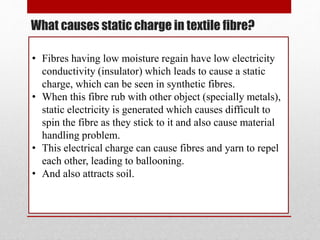
What causes static charge in textile fibre?
• Fibres having low moisture regain have low electricity
conductivity (insulator) which leads to cause a static
charge, which can be seen in synthetic fibres.
• When this fibre rub with other object (specially metals),
static electricity is generated which causes difficult to
spin the fibre as they stick to it and also cause material
handling problem.
• This electrical charge can cause fibres and yarn to repel
each other, leading to ballooning.
• And also attracts soil.
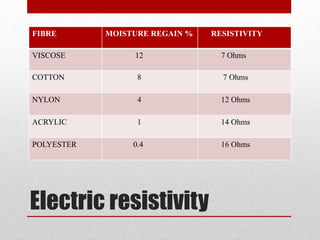
Electric resistivity
FIBRE MOISTURE REGAIN % RESISTIVITY
VISCOSE 12 7 Ohms
COTTON 8 7 Ohms
NYLON 4 12 Ohms
ACRYLIC 1 14 Ohms
POLYESTER 0.4 16 Ohms
Anti static property can be brought by-
I. By reducing the charge.
II. By increasing the surface conductivity.
III. By making the fibre hydrophilic.
Types of antistatic finish-
• Non durable
• Durable
NON DURABLE FINISH
Non- durable antistatic agents are
preferred for fiber and yarn
processing finishes since ease of
removal is important.
• Esters of phosphoric acid
• Quaternary ammonium
compounds
• Non-ionic compounds such as
ethoxylated fatty esters, alcohol
and alkyl amines
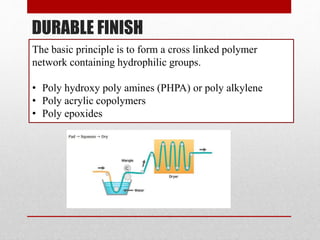
DURABLE FINISH
The basic principle is to form a cross linked polymer
network containing hydrophilic groups.
• Poly hydroxy poly amines (PHPA) or poly alkylene
• Poly acrylic copolymers
• Poly epoxides
Applications:
Although antistatic finishes applied after dyeing or
printing is more common with hydrophobic fibres, fabrics
made from cotton, rayon and wool may also be antistatic
treated depending on the intended use. The textile products
that are treated with antistatic finishes includes –
a) Carpets for computer room.
b) Upholstery fabrics and airbags for automobiles.
c) Conveyor belts.
d) Filtration fabrics.
e) Airmail bags, parachutes.
f) Fabrics for hospital operating rooms and
g) Protective clothing for work with flammable gases,
liquids and powdered solids
Thank you!

Antistatic finish in textile

  • 1.
    Antistatic Finish Neel Manve B.TechTextile technology Veermata Jijabai Technological Institute, Mumbai. Textile finishing
  • 2.
    What causes staticcharge in textile fibre? • Fibres having low moisture regain have low electricity conductivity (insulator) which leads to cause a static charge, which can be seen in synthetic fibres. • When this fibre rub with other object (specially metals), static electricity is generated which causes difficult to spin the fibre as they stick to it and also cause material handling problem. • This electrical charge can cause fibres and yarn to repel each other, leading to ballooning. • And also attracts soil.
  • 3.
    Electric resistivity FIBRE MOISTUREREGAIN % RESISTIVITY VISCOSE 12 7 Ohms COTTON 8 7 Ohms NYLON 4 12 Ohms ACRYLIC 1 14 Ohms POLYESTER 0.4 16 Ohms
  • 5.
    Anti static propertycan be brought by- I. By reducing the charge. II. By increasing the surface conductivity. III. By making the fibre hydrophilic. Types of antistatic finish- • Non durable • Durable
  • 6.
    NON DURABLE FINISH Non-durable antistatic agents are preferred for fiber and yarn processing finishes since ease of removal is important. • Esters of phosphoric acid • Quaternary ammonium compounds • Non-ionic compounds such as ethoxylated fatty esters, alcohol and alkyl amines
  • 7.
    DURABLE FINISH The basicprinciple is to form a cross linked polymer network containing hydrophilic groups. • Poly hydroxy poly amines (PHPA) or poly alkylene • Poly acrylic copolymers • Poly epoxides
  • 8.
    Applications: Although antistatic finishesapplied after dyeing or printing is more common with hydrophobic fibres, fabrics made from cotton, rayon and wool may also be antistatic treated depending on the intended use. The textile products that are treated with antistatic finishes includes – a) Carpets for computer room. b) Upholstery fabrics and airbags for automobiles. c) Conveyor belts. d) Filtration fabrics. e) Airmail bags, parachutes. f) Fabrics for hospital operating rooms and g) Protective clothing for work with flammable gases, liquids and powdered solids
  • 9.