QUEUES
Unit 1.2
Intro
2
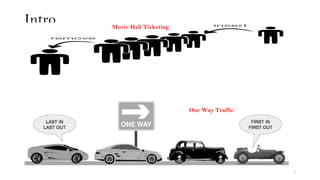
Movie Hall Ticketing
One Way Traffic
Intro
• Queue is a linear list of elements in which deletion of an element can
take place at one end, called the front and insertion can take place at
the other end, called the rear.
• The first element in a queue will be the first one to be removed from
the list.
• Queues are also called FIFO (First In First Out) i.e. the data
item stored first will be accessed first
3
Queue Representation
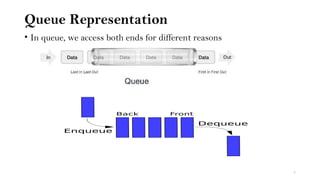
• In queue, we access both ends for different reasons
4
Applications of queue
• Serving requests on a single shared resource, like a printer, CPU task
scheduling etc.
• In real life, Call Center phone systems will use Queues, to hold
people calling them in an order, until a service representative is free.
• Handling of interrupts in real-time systems. The interrupts are
handled in the same order as they arrive, First come first served.
5
The queue as an ADT
• A queue q of type T is a finite sequence of elements with the
operations
• MakeEmpty(q): To make q as an empty queue
• IsEmpty(q): To check whether the queue q is empty. Return true if q is
empty, return false otherwise.
• IsFull(q): To check whether the queue q is full. Return true in q is full,
return false otherwise.
• Enqueue(q, x): To insert an item x at the rear of the queue, if and only if
q is not full.
• Dequeue(q): To delete an item from the front of the queue q if and only if
q is not empty.
• Traverse (q): To read entire queue that is display the content of the queue.
6
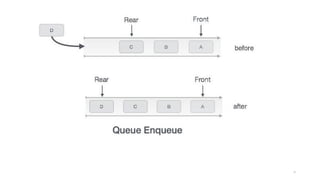
Enqueue Operation
• Queue maintains two data pointers, front and rear
• The following steps should be taken to enqueue(insert) data into
queue –
• Step 1 – Check if queue is full
• Step 2 – if queue is full
produce overflow error and exit
else
increment rear pointer to point next empty space
and add data element to the queue location, where rear is
pointing
• Step 3 - return success
7
8
Implementation of enqueue()
int enqueue(int data) {
if(isfull())
return 0;
rear = rear + 1;
queue[rear] = data;
return 1;
}
9
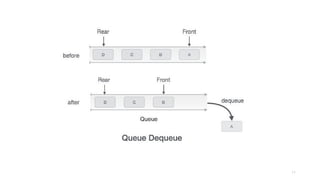
Dequeue Operation
• Accessing data from queue is a process of two steps
• Access the data from where front is pointing
• And remove the data after access
• The following steps are taken to perform dequeue operation
• Step 1 – Check if queue is empty
• Step 2 – if queue is empty
produce underflow error and exit
else
access data where front is pointing, increment front pointer
to point next available data element
• Step 3 – return success.
10
11
Implementation of dequeue()
int dequeue() {
if(isempty()) {
return 0;
}
int data = queue[front];
front = front + 1;
return data;
}
12
Implementation of queue
• There are two techniques for implementing the queue:
• Array implementation of queue (static memory allocation)
• Linear array implementation (Linear Queue)
• Circular array Implementation (Circular queue)
• Linked list implementation of queue (dynamic memory allocation)
13
Array implementation of queue
• The easies way of implementing a queue is by using an Array.
• Initially head(FRONT) and the tail(REAR) of the queue points at the
first index of the array.
• As we add elements to the queue, we can either move tail before
adding another item or we can move the tail after adding the item,
while the head remains at the first index.
14
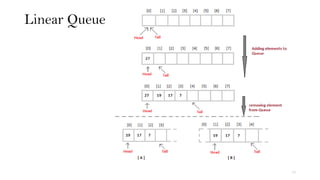
Linear Queue
15
Linear Queue
Insertion of an item in queue Deletion of an item from queue
1. Initialize front=0 and rear=-1
if rear>=MAXSIZE-1
print “queue overflow” and return
else
set rear=rear+1
queue[rear]=item
2. end
1. if rear<front
print “queue is empty” and return
else
item=queue[front++]
2. end
16
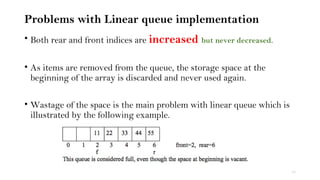
Problems with Linear queue implementation
• Both rear and front indices are increased but never decreased.
• As items are removed from the queue, the storage space at the
beginning of the array is discarded and never used again.
• Wastage of the space is the main problem with linear queue which is
illustrated by the following example.
17
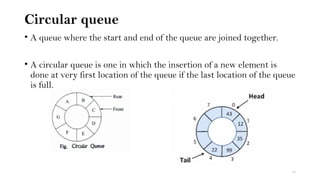
Circular queue
• A queue where the start and end of the queue are joined together.
• A circular queue is one in which the insertion of a new element is
done at very first location of the queue if the last location of the queue
is full.
18
19
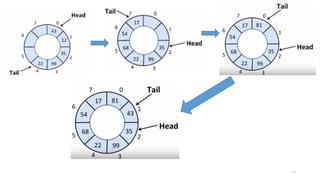
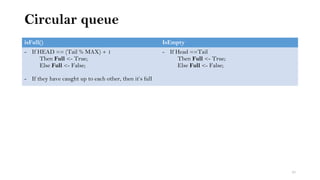
Circular queue
isFull() IsEmpty
- If HEAD == (Tail % MAX) + 1
Then Full <- True;
Else Full <- False;
- If they have caught up to each other, then it’s full
- If Head ==Tail
Then Full <- True;
Else Full <- False;
20
Circular queue
Enqueue operation Dequeue operation
Step 1. start
Step 2. if (front == (rear+1)%max)
Print error “circular queue overflow “
Step 3. else{
rear = (rear+1)%max
Q[rear] = element;
}
Step 4. stop
Step 1. start
Step 2. if isEmpty() == True
Print error “Queue is Empty“
Step 3. else{
element = Q[front]
front = (front + 1) % max
}
Step 4. stop
21
References
• https://www.cs.cmu.edu/~adamchik/15-121/lectures/Stacks%20and%20Queues/Stacks%20and%20Queu
• http://www.tutorialspoint.com/data_structures_algorithms/dsa_queue.htm
• http://www.studytonight.com/data-structures/queue-data-structure
• https://www.youtube.com/watch?v=g9su-lnW2Ks
• https://www.youtube.com/watch?v=ia__kyuwGag
• https://www.quora.com/What-is-a-circular-queue
• http://basicdatastructures.blogspot.com/2007/12/circular-queue-data-structure.html
• http://btechsmartclass.com/DS/U2_T10.html
• http://scanftree.com/Data_Structure/circular-queue
• http://btechsmartclass.com/DS/U2_T10.html
22

Queue AS an ADT (Abstract Data Type)

  • 1.
  • 2.
  • 3.
    Intro • Queue isa linear list of elements in which deletion of an element can take place at one end, called the front and insertion can take place at the other end, called the rear. • The first element in a queue will be the first one to be removed from the list. • Queues are also called FIFO (First In First Out) i.e. the data item stored first will be accessed first 3
  • 4.
    Queue Representation • Inqueue, we access both ends for different reasons 4
  • 5.
    Applications of queue •Serving requests on a single shared resource, like a printer, CPU task scheduling etc. • In real life, Call Center phone systems will use Queues, to hold people calling them in an order, until a service representative is free. • Handling of interrupts in real-time systems. The interrupts are handled in the same order as they arrive, First come first served. 5
  • 6.
    The queue asan ADT • A queue q of type T is a finite sequence of elements with the operations • MakeEmpty(q): To make q as an empty queue • IsEmpty(q): To check whether the queue q is empty. Return true if q is empty, return false otherwise. • IsFull(q): To check whether the queue q is full. Return true in q is full, return false otherwise. • Enqueue(q, x): To insert an item x at the rear of the queue, if and only if q is not full. • Dequeue(q): To delete an item from the front of the queue q if and only if q is not empty. • Traverse (q): To read entire queue that is display the content of the queue. 6
  • 7.
    Enqueue Operation • Queuemaintains two data pointers, front and rear • The following steps should be taken to enqueue(insert) data into queue – • Step 1 – Check if queue is full • Step 2 – if queue is full produce overflow error and exit else increment rear pointer to point next empty space and add data element to the queue location, where rear is pointing • Step 3 - return success 7
  • 8.
  • 9.
    Implementation of enqueue() intenqueue(int data) { if(isfull()) return 0; rear = rear + 1; queue[rear] = data; return 1; } 9
  • 10.
    Dequeue Operation • Accessingdata from queue is a process of two steps • Access the data from where front is pointing • And remove the data after access • The following steps are taken to perform dequeue operation • Step 1 – Check if queue is empty • Step 2 – if queue is empty produce underflow error and exit else access data where front is pointing, increment front pointer to point next available data element • Step 3 – return success. 10
  • 11.
  • 12.
    Implementation of dequeue() intdequeue() { if(isempty()) { return 0; } int data = queue[front]; front = front + 1; return data; } 12
  • 13.
    Implementation of queue •There are two techniques for implementing the queue: • Array implementation of queue (static memory allocation) • Linear array implementation (Linear Queue) • Circular array Implementation (Circular queue) • Linked list implementation of queue (dynamic memory allocation) 13
  • 14.
    Array implementation ofqueue • The easies way of implementing a queue is by using an Array. • Initially head(FRONT) and the tail(REAR) of the queue points at the first index of the array. • As we add elements to the queue, we can either move tail before adding another item or we can move the tail after adding the item, while the head remains at the first index. 14
  • 15.
  • 16.
    Linear Queue Insertion ofan item in queue Deletion of an item from queue 1. Initialize front=0 and rear=-1 if rear>=MAXSIZE-1 print “queue overflow” and return else set rear=rear+1 queue[rear]=item 2. end 1. if rear<front print “queue is empty” and return else item=queue[front++] 2. end 16
  • 17.
    Problems with Linearqueue implementation • Both rear and front indices are increased but never decreased. • As items are removed from the queue, the storage space at the beginning of the array is discarded and never used again. • Wastage of the space is the main problem with linear queue which is illustrated by the following example. 17
  • 18.
    Circular queue • Aqueue where the start and end of the queue are joined together. • A circular queue is one in which the insertion of a new element is done at very first location of the queue if the last location of the queue is full. 18
  • 19.
  • 20.
    Circular queue isFull() IsEmpty -If HEAD == (Tail % MAX) + 1 Then Full <- True; Else Full <- False; - If they have caught up to each other, then it’s full - If Head ==Tail Then Full <- True; Else Full <- False; 20
  • 21.
    Circular queue Enqueue operationDequeue operation Step 1. start Step 2. if (front == (rear+1)%max) Print error “circular queue overflow “ Step 3. else{ rear = (rear+1)%max Q[rear] = element; } Step 4. stop Step 1. start Step 2. if isEmpty() == True Print error “Queue is Empty“ Step 3. else{ element = Q[front] front = (front + 1) % max } Step 4. stop 21
  • 22.
    References • https://www.cs.cmu.edu/~adamchik/15-121/lectures/Stacks%20and%20Queues/Stacks%20and%20Queu • http://www.tutorialspoint.com/data_structures_algorithms/dsa_queue.htm •http://www.studytonight.com/data-structures/queue-data-structure • https://www.youtube.com/watch?v=g9su-lnW2Ks • https://www.youtube.com/watch?v=ia__kyuwGag • https://www.quora.com/What-is-a-circular-queue • http://basicdatastructures.blogspot.com/2007/12/circular-queue-data-structure.html • http://btechsmartclass.com/DS/U2_T10.html • http://scanftree.com/Data_Structure/circular-queue • http://btechsmartclass.com/DS/U2_T10.html 22