
DataTypes in mysql
Mrs.G.Chandraprabha,M.Sc.,M.Phil
.,
Assistant Professor,
Department of IT,
V.V.V college for Women,
Virudhunagar
Introduction
A data type is an attribute that
specifies the type of data that the object can
hold: integer data, character data,
monetary data, date and time data, binary
strings, and so on.
SQL Server supplies a set of
system data types that define all
the types of data that can be used
with SQL Server.
Their types,
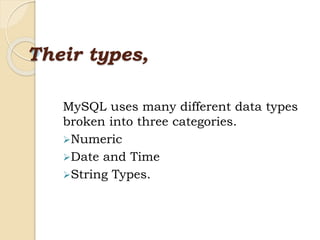
MySQL uses many different data types
broken into three categories.
Numeric
Date and Time
String Types.
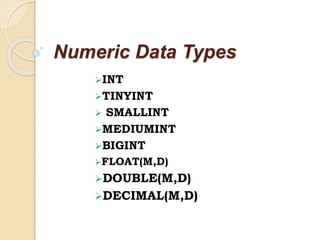
Numeric Data Types
INT
TINYINT
 SMALLINT
MEDIUMINT
BIGINT
FLOAT(M,D)
DOUBLE(M,D)
DECIMAL(M,D)
Numeric Data Types
INT − A normal-sized integer that can be
signed or unsigned. If signed, the
allowable range is from -2147483648 to
2147483647. If unsigned, the allowable
range is from 0 to 4294967295. You can
specify a width of up to 11 digits.
TINYINT − A very small integer that can
be signed or unsigned. If signed, the
allowable range is from -128 to 127. If
unsigned, the allowable range is from 0 to
255. You can specify a width of up to 4
digits.
Cont……
SMALLINT − A small integer that can be
signed or unsigned. If signed, the
allowable range is from -32768 to
32767. If unsigned, the allowable range
is from 0 to 65535. You can specify a
width of up to 5 digits.
MEDIUMINT − A medium-sized integer
that can be signed or unsigned. If
signed, the allowable range is from -
8388608 to 8388607. If unsigned, the
allowable range is from 0 to 16777215.
You can specify a width of up to 9 digits.
Cont….
BIGINT − A large integer that can be signed or
unsigned. If signed, the allowable range is from -
9223372036854775808 to 9223372036854775807.
If unsigned, the allowable range is from 0 to
18446744073709551615. You can specify a width
of up to 20 digits.
FLOAT(M,D) − A floating-point number that
cannot be unsigned. You can define the display
length (M) and the number of decimals (D). This
is not required and will default to 10,2, where 2
is the number of decimals and 10 is the total
number of digits (including decimals). Decimal
precision can go to 24 places for a FLOAT.
Cont…..
DOUBLE(M,D) − A double precision floating-point
number that cannot be unsigned. You can define the
display length (M) and the number of decimals (D).
This is not required and will default to 16,4, where 4
is the number of decimals. Decimal precision can go
to 53 places for a DOUBLE. REAL is a synonym for
DOUBLE.
DECIMAL(M,D) − An unpacked floating-point
number that cannot be unsigned. In the unpacked
decimals, each decimal corresponds to one byte.
Defining the display length (M) and the number of
decimals (D) is required. NUMERIC is a synonym for
DECIMAL.
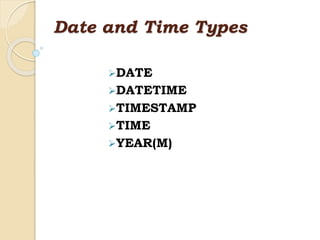
Date and Time Types
DATE
DATETIME
TIMESTAMP
TIME
YEAR(M)
Date and Time Types
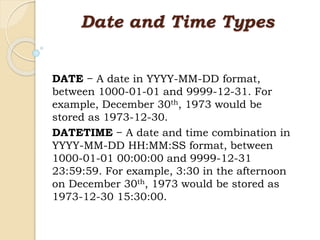
DATE − A date in YYYY-MM-DD format,
between 1000-01-01 and 9999-12-31. For
example, December 30th, 1973 would be
stored as 1973-12-30.
DATETIME − A date and time combination in
YYYY-MM-DD HH:MM:SS format, between
1000-01-01 00:00:00 and 9999-12-31
23:59:59. For example, 3:30 in the afternoon
on December 30th, 1973 would be stored as
1973-12-30 15:30:00.
Cont……
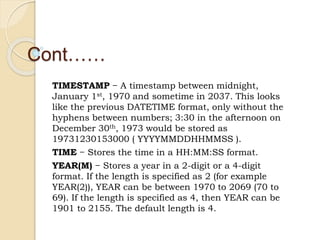
TIMESTAMP − A timestamp between midnight,
January 1st, 1970 and sometime in 2037. This looks
like the previous DATETIME format, only without the
hyphens between numbers; 3:30 in the afternoon on
December 30th, 1973 would be stored as
19731230153000 ( YYYYMMDDHHMMSS ).
TIME − Stores the time in a HH:MM:SS format.
YEAR(M) − Stores a year in a 2-digit or a 4-digit
format. If the length is specified as 2 (for example
YEAR(2)), YEAR can be between 1970 to 2069 (70 to
69). If the length is specified as 4, then YEAR can be
1901 to 2155. The default length is 4.
String Types
CHAR(M)
VARCHAR(M)
BLOB or TEXT
TINYBLOB or TINYTEXT
MEDIUMBLOB or MEDIUMTEXT
LONGBLOB or LONGTEXT
ENUM
String Types
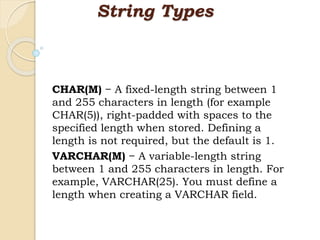
CHAR(M) − A fixed-length string between 1
and 255 characters in length (for example
CHAR(5)), right-padded with spaces to the
specified length when stored. Defining a
length is not required, but the default is 1.
VARCHAR(M) − A variable-length string
between 1 and 255 characters in length. For
example, VARCHAR(25). You must define a
length when creating a VARCHAR field.
Cont…….
BLOB or TEXT − A field with a maximum length of
65535 characters. BLOBs are "Binary Large Objects"
and are used to store large amounts of binary data,
such as images or other types of files. Fields defined
as TEXT also hold large amounts of data. The
difference between the two is that the sorts and
comparisons on the stored data are case sensitive on
BLOBs and are not case sensitive in TEXT fields.
You do not specify a length with BLOB or TEXT.
TINYBLOB or TINYTEXT − A BLOB or TEXT column
with a maximum length of 255 characters. You do not
specify a length with TINYBLOB or TINYTEXT.
Cont……
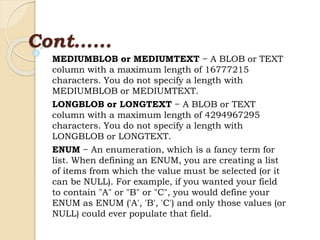
MEDIUMBLOB or MEDIUMTEXT − A BLOB or TEXT
column with a maximum length of 16777215
characters. You do not specify a length with
MEDIUMBLOB or MEDIUMTEXT.
LONGBLOB or LONGTEXT − A BLOB or TEXT
column with a maximum length of 4294967295
characters. You do not specify a length with
LONGBLOB or LONGTEXT.
ENUM − An enumeration, which is a fancy term for
list. When defining an ENUM, you are creating a list
of items from which the value must be selected (or it
can be NULL). For example, if you wanted your field
to contain "A" or "B" or "C", you would define your
ENUM as ENUM ('A', 'B', 'C') and only those values (or
NULL) could ever populate that field.
Mysql datatypes

Mysql datatypes

  • 1.
    DataTypes in mysql Mrs.G.Chandraprabha,M.Sc.,M.Phil ., AssistantProfessor, Department of IT, V.V.V college for Women, Virudhunagar
  • 2.
    Introduction A data typeis an attribute that specifies the type of data that the object can hold: integer data, character data, monetary data, date and time data, binary strings, and so on. SQL Server supplies a set of system data types that define all the types of data that can be used with SQL Server.
  • 3.
    Their types, MySQL usesmany different data types broken into three categories. Numeric Date and Time String Types.
  • 4.
    Numeric Data Types INT TINYINT SMALLINT MEDIUMINT BIGINT FLOAT(M,D) DOUBLE(M,D) DECIMAL(M,D)
  • 5.
    Numeric Data Types INT− A normal-sized integer that can be signed or unsigned. If signed, the allowable range is from -2147483648 to 2147483647. If unsigned, the allowable range is from 0 to 4294967295. You can specify a width of up to 11 digits. TINYINT − A very small integer that can be signed or unsigned. If signed, the allowable range is from -128 to 127. If unsigned, the allowable range is from 0 to 255. You can specify a width of up to 4 digits.
  • 6.
    Cont…… SMALLINT − Asmall integer that can be signed or unsigned. If signed, the allowable range is from -32768 to 32767. If unsigned, the allowable range is from 0 to 65535. You can specify a width of up to 5 digits. MEDIUMINT − A medium-sized integer that can be signed or unsigned. If signed, the allowable range is from - 8388608 to 8388607. If unsigned, the allowable range is from 0 to 16777215. You can specify a width of up to 9 digits.
  • 7.
    Cont…. BIGINT − Alarge integer that can be signed or unsigned. If signed, the allowable range is from - 9223372036854775808 to 9223372036854775807. If unsigned, the allowable range is from 0 to 18446744073709551615. You can specify a width of up to 20 digits. FLOAT(M,D) − A floating-point number that cannot be unsigned. You can define the display length (M) and the number of decimals (D). This is not required and will default to 10,2, where 2 is the number of decimals and 10 is the total number of digits (including decimals). Decimal precision can go to 24 places for a FLOAT.
  • 8.
    Cont….. DOUBLE(M,D) − Adouble precision floating-point number that cannot be unsigned. You can define the display length (M) and the number of decimals (D). This is not required and will default to 16,4, where 4 is the number of decimals. Decimal precision can go to 53 places for a DOUBLE. REAL is a synonym for DOUBLE. DECIMAL(M,D) − An unpacked floating-point number that cannot be unsigned. In the unpacked decimals, each decimal corresponds to one byte. Defining the display length (M) and the number of decimals (D) is required. NUMERIC is a synonym for DECIMAL.
  • 9.
    Date and TimeTypes DATE DATETIME TIMESTAMP TIME YEAR(M)
  • 10.
    Date and TimeTypes DATE − A date in YYYY-MM-DD format, between 1000-01-01 and 9999-12-31. For example, December 30th, 1973 would be stored as 1973-12-30. DATETIME − A date and time combination in YYYY-MM-DD HH:MM:SS format, between 1000-01-01 00:00:00 and 9999-12-31 23:59:59. For example, 3:30 in the afternoon on December 30th, 1973 would be stored as 1973-12-30 15:30:00.
  • 11.
    Cont…… TIMESTAMP − Atimestamp between midnight, January 1st, 1970 and sometime in 2037. This looks like the previous DATETIME format, only without the hyphens between numbers; 3:30 in the afternoon on December 30th, 1973 would be stored as 19731230153000 ( YYYYMMDDHHMMSS ). TIME − Stores the time in a HH:MM:SS format. YEAR(M) − Stores a year in a 2-digit or a 4-digit format. If the length is specified as 2 (for example YEAR(2)), YEAR can be between 1970 to 2069 (70 to 69). If the length is specified as 4, then YEAR can be 1901 to 2155. The default length is 4.
  • 12.
    String Types CHAR(M) VARCHAR(M) BLOB orTEXT TINYBLOB or TINYTEXT MEDIUMBLOB or MEDIUMTEXT LONGBLOB or LONGTEXT ENUM
  • 13.
    String Types CHAR(M) −A fixed-length string between 1 and 255 characters in length (for example CHAR(5)), right-padded with spaces to the specified length when stored. Defining a length is not required, but the default is 1. VARCHAR(M) − A variable-length string between 1 and 255 characters in length. For example, VARCHAR(25). You must define a length when creating a VARCHAR field.
  • 14.
    Cont……. BLOB or TEXT− A field with a maximum length of 65535 characters. BLOBs are "Binary Large Objects" and are used to store large amounts of binary data, such as images or other types of files. Fields defined as TEXT also hold large amounts of data. The difference between the two is that the sorts and comparisons on the stored data are case sensitive on BLOBs and are not case sensitive in TEXT fields. You do not specify a length with BLOB or TEXT. TINYBLOB or TINYTEXT − A BLOB or TEXT column with a maximum length of 255 characters. You do not specify a length with TINYBLOB or TINYTEXT.
  • 15.
    Cont…… MEDIUMBLOB or MEDIUMTEXT− A BLOB or TEXT column with a maximum length of 16777215 characters. You do not specify a length with MEDIUMBLOB or MEDIUMTEXT. LONGBLOB or LONGTEXT − A BLOB or TEXT column with a maximum length of 4294967295 characters. You do not specify a length with LONGBLOB or LONGTEXT. ENUM − An enumeration, which is a fancy term for list. When defining an ENUM, you are creating a list of items from which the value must be selected (or it can be NULL). For example, if you wanted your field to contain "A" or "B" or "C", you would define your ENUM as ENUM ('A', 'B', 'C') and only those values (or NULL) could ever populate that field.