 Queses:
 Array and list representation,
 Operations (traversal, insertion and deletion)
 Priority queues and Deques:
 Array and List representations
QUEUES
CONCEPT OF QUEUES
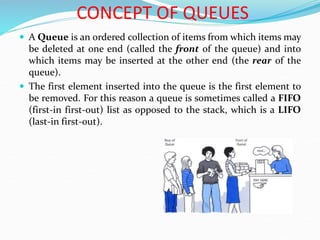
 A Queue is an ordered collection of items from which items may
be deleted at one end (called the front of the queue) and into
which items may be inserted at the other end (the rear of the
queue).
 The first element inserted into the queue is the first element to
be removed. For this reason a queue is sometimes called a FIFO
(first-in first-out) list as opposed to the stack, which is a LIFO
(last-in first-out).
Queue
items[MAXQUEUE-
1]
. .
. .
. .
items[2] C
items[1] B
items[0] A Front=0
Rear=2
Queue AS ABSTRACT DATA TYPE
A minimal set of operations on a queue is as follows:
1. create() — creates an empty queue, Q
2. add(i,Q) — adds the element i to the rear end of the
queue, Q and returns the new queue.
3. delete(Q) —takes out an element from the front end of
the queue and returns the resulting queue.
4. getFront(Q) — returns the element that is at the front
position of the queue.
5. Is_Empty(Q) — returns true if the queue is empty;
otherwise returns false
6. Is_Full(Q) — returns true if the queue is full; otherwise
returns false.
Insert an item A
 A new item (A) is inserted at the Rear of the queue
items[MAXQUEUE
-1]
. .
. .
items[3]
items[2]
items[1]
items[0] A Front=0,
Rear=0
Insert an item B
 A new item (B) is inserted at the Rear of the queue
items[MAXQUEUE
-1]
. .
. .
items[3]
items[2]
items[1] B Rear=1
items[0] A Front=0
Insert an item C
 A new item (C) is inserted at the Rear of the queue
items[MAXQUEUE
-1]
. .
. .
items[3]
items[2] C Rear=2
items[1] B
items[0] A Front=0
Insert an item D
 A new item (D) is inserted at the Rear of the queue
items[MAXQUEUE-
1]
. .
. .
items[3] D Rear=3
items[2] C
items[1] B
items[0] A Front=0
Insert Operation(Array)
QINSERT(QUEUE, N, FRONT, REAR, ITEM)
1. If FRONT = 1 and REAR =n , or FRONT = REAR + 1, then :
write OVERFLOW, and Return.
2. If FRONT = NULL, then:
Set FRONT := 1 and REAR := 1.
Else if REAR = n, then:
Set REAR := 1.
Else :
Set REAR := REAR + 1.
3. Set QUEUE[REAR]:= ITEM.
4. Return.
Delete A
 An item (A) is deleted from the Front of the queue
items[MAXQUEUE-1]
. .
. .
items[3] D Rear=3
items[2] C
items[1] B Front=1
items[0] A
Delete B
 An item (B) is deleted from the Front of the queue.
items[MAXQUEUE-1]
. .
. .
items[3] D Rear=3
items[2] C Front=2
items[1] B
items[0] A
Delete C
 An item (C) is deleted from the Front of the queue
items[MAXQUEUE-1]
. .
. .
items[3] D Front=Rear=3
items[2] C
items[1] B
items[0] A
Delete D
 An item (A) is deleted from the Front of the queue.
items[MAXQUEUE-1]
. .
items[3] D Front=Rear=-1
items[2] C
items[1] B
items[0] A
Delete Operation(Array)
QDELETE(QUEUE, N, FRONT, REAR, ITEM)
1. If FRONT = NULL then :
write: UNDERFLOW, and Return.
2. Set ITEM := QUEUE[FRONT].
3. If FRONT = REAR,
Set FRONT := NULL and REAR := NULL
Else if FRONT = N, then:
Set FRONT := 1.
Else :
Set FRONT := FRONT + 1.
4. Return.
Insert Operation(LL)
LINKQ_INSERT(INFO, LINK, FRONT, REAR, AVAIL, ITEM)
1. If AVAIL = NULL, then :
write OVERFLOW, and Exit.
2. Set NEW := AVAIL and AVAIL := LINK[AVAIL]
3. Set INFO[NEW]:= ITEM and LINK[NEW]=NULL
4. If (FRONT = NULL), FRONT := REAR := NEW
Else set LINK[REAR] := NEW and REAR := NEW
5. Exit
Delete Operation(LL)
LINKQ_DELETE(INFO, LINK, FRONT, REAR, AVAIL, ITEM)
1. If FRONT = NULL, then :
write UNDERFLOW, and Exit.
2. Set TEMP := FRONT
3. Set ITEM :=INFO[TEMP]
4. FRONT :=LINK[TEMP]
5. LINK[TEMP] = AVAIL and AVAIL = TEMP
6. Exit
Deques(double-ended queue)
 It is a double-ended queue.
 The elements can be added or deleted at either the front
end or the rear end, but no changes can be made elsewhere
in the list.
1. EnqueueFront()—adds elements at the front end of
the queue.
2. EnqueueRear()—adds elements at the rear end of the
queue
3. DequeueFront()—deletes elements from the front end
of the queue
4. DequeueRear()—deletes elements from the rear end
of the queue
deque ADT
Applications of deque - Deque is useful where the data to be
stored has to be ordered, compact storage is needed, and the
retrieval of data elements has to be faster.
Variations of deque We can have two variations of a deque:
1. input-restricted deque - the input-restricted deque allows
insertions only at one end.
2. output-restricted deque - The output-restricted deque
allows deletions fom only one end.
Priority Queue
 A priority queue is a collection of a finite number of prioritized
elements. Priority queues are those in which we can insert or
delete elements from any position based on some fundamental
ordering of the elements.
 Elements can be inserted in any order in a priority queue, but
when an element is removed from the priority queue, it is
always the one with the highest priority.
 In other words a priority queue is a collection of elements
where the elements are stored according to their priority
levels. The order in which the elements should be removed is
decided by the priority of the element
 The following rules are applied to maintain a priority
queue:
1. The element with a higher priority is processed before
any element of lower priority.
2. If there were elements with the same priority, then the
element added first in the queue would get processed
first.
 implementing job scheduling by the operating system
 simulation systems where the priority corresponds to
event times.
 A list of patients in an emergency room; each patient
might be given a ranking.
 A list of jobs carried out by a multitasking operating
system; each background job is given a priority level.
Application
Thank You

Queues.ppt

  • 1.
     Queses:  Arrayand list representation,  Operations (traversal, insertion and deletion)  Priority queues and Deques:  Array and List representations QUEUES
  • 2.
    CONCEPT OF QUEUES A Queue is an ordered collection of items from which items may be deleted at one end (called the front of the queue) and into which items may be inserted at the other end (the rear of the queue).  The first element inserted into the queue is the first element to be removed. For this reason a queue is sometimes called a FIFO (first-in first-out) list as opposed to the stack, which is a LIFO (last-in first-out).
  • 3.
    Queue items[MAXQUEUE- 1] . . . . .. items[2] C items[1] B items[0] A Front=0 Rear=2
  • 4.
    Queue AS ABSTRACTDATA TYPE A minimal set of operations on a queue is as follows: 1. create() — creates an empty queue, Q 2. add(i,Q) — adds the element i to the rear end of the queue, Q and returns the new queue. 3. delete(Q) —takes out an element from the front end of the queue and returns the resulting queue. 4. getFront(Q) — returns the element that is at the front position of the queue. 5. Is_Empty(Q) — returns true if the queue is empty; otherwise returns false 6. Is_Full(Q) — returns true if the queue is full; otherwise returns false.
  • 5.
    Insert an itemA  A new item (A) is inserted at the Rear of the queue items[MAXQUEUE -1] . . . . items[3] items[2] items[1] items[0] A Front=0, Rear=0
  • 6.
    Insert an itemB  A new item (B) is inserted at the Rear of the queue items[MAXQUEUE -1] . . . . items[3] items[2] items[1] B Rear=1 items[0] A Front=0
  • 7.
    Insert an itemC  A new item (C) is inserted at the Rear of the queue items[MAXQUEUE -1] . . . . items[3] items[2] C Rear=2 items[1] B items[0] A Front=0
  • 8.
    Insert an itemD  A new item (D) is inserted at the Rear of the queue items[MAXQUEUE- 1] . . . . items[3] D Rear=3 items[2] C items[1] B items[0] A Front=0
  • 9.
    Insert Operation(Array) QINSERT(QUEUE, N,FRONT, REAR, ITEM) 1. If FRONT = 1 and REAR =n , or FRONT = REAR + 1, then : write OVERFLOW, and Return. 2. If FRONT = NULL, then: Set FRONT := 1 and REAR := 1. Else if REAR = n, then: Set REAR := 1. Else : Set REAR := REAR + 1. 3. Set QUEUE[REAR]:= ITEM. 4. Return.
  • 10.
    Delete A  Anitem (A) is deleted from the Front of the queue items[MAXQUEUE-1] . . . . items[3] D Rear=3 items[2] C items[1] B Front=1 items[0] A
  • 11.
    Delete B  Anitem (B) is deleted from the Front of the queue. items[MAXQUEUE-1] . . . . items[3] D Rear=3 items[2] C Front=2 items[1] B items[0] A
  • 12.
    Delete C  Anitem (C) is deleted from the Front of the queue items[MAXQUEUE-1] . . . . items[3] D Front=Rear=3 items[2] C items[1] B items[0] A
  • 13.
    Delete D  Anitem (A) is deleted from the Front of the queue. items[MAXQUEUE-1] . . items[3] D Front=Rear=-1 items[2] C items[1] B items[0] A
  • 14.
    Delete Operation(Array) QDELETE(QUEUE, N,FRONT, REAR, ITEM) 1. If FRONT = NULL then : write: UNDERFLOW, and Return. 2. Set ITEM := QUEUE[FRONT]. 3. If FRONT = REAR, Set FRONT := NULL and REAR := NULL Else if FRONT = N, then: Set FRONT := 1. Else : Set FRONT := FRONT + 1. 4. Return.
  • 15.
    Insert Operation(LL) LINKQ_INSERT(INFO, LINK,FRONT, REAR, AVAIL, ITEM) 1. If AVAIL = NULL, then : write OVERFLOW, and Exit. 2. Set NEW := AVAIL and AVAIL := LINK[AVAIL] 3. Set INFO[NEW]:= ITEM and LINK[NEW]=NULL 4. If (FRONT = NULL), FRONT := REAR := NEW Else set LINK[REAR] := NEW and REAR := NEW 5. Exit
  • 16.
    Delete Operation(LL) LINKQ_DELETE(INFO, LINK,FRONT, REAR, AVAIL, ITEM) 1. If FRONT = NULL, then : write UNDERFLOW, and Exit. 2. Set TEMP := FRONT 3. Set ITEM :=INFO[TEMP] 4. FRONT :=LINK[TEMP] 5. LINK[TEMP] = AVAIL and AVAIL = TEMP 6. Exit
  • 17.
    Deques(double-ended queue)  Itis a double-ended queue.  The elements can be added or deleted at either the front end or the rear end, but no changes can be made elsewhere in the list.
  • 18.
    1. EnqueueFront()—adds elementsat the front end of the queue. 2. EnqueueRear()—adds elements at the rear end of the queue 3. DequeueFront()—deletes elements from the front end of the queue 4. DequeueRear()—deletes elements from the rear end of the queue deque ADT
  • 19.
    Applications of deque- Deque is useful where the data to be stored has to be ordered, compact storage is needed, and the retrieval of data elements has to be faster. Variations of deque We can have two variations of a deque: 1. input-restricted deque - the input-restricted deque allows insertions only at one end. 2. output-restricted deque - The output-restricted deque allows deletions fom only one end.
  • 20.
    Priority Queue  Apriority queue is a collection of a finite number of prioritized elements. Priority queues are those in which we can insert or delete elements from any position based on some fundamental ordering of the elements.  Elements can be inserted in any order in a priority queue, but when an element is removed from the priority queue, it is always the one with the highest priority.  In other words a priority queue is a collection of elements where the elements are stored according to their priority levels. The order in which the elements should be removed is decided by the priority of the element
  • 21.
     The followingrules are applied to maintain a priority queue: 1. The element with a higher priority is processed before any element of lower priority. 2. If there were elements with the same priority, then the element added first in the queue would get processed first.
  • 22.
     implementing jobscheduling by the operating system  simulation systems where the priority corresponds to event times.  A list of patients in an emergency room; each patient might be given a ranking.  A list of jobs carried out by a multitasking operating system; each background job is given a priority level. Application
  • 23.