
8.3 Population Ecology
What is meant by population
ecology?
 A branch of ecology that studies the structure
and dynamics of population.
 Population density – number of organism per
unit area of habitat
 Affected by abiotic and biotic factors, birth
rate, death rate, immigration and emigration.
 Direct counting – method to estimate the size
and density of population (impractical due to
the size of ecosystem, the number of plants
involved and the movement of the animal).
 Sampling technique – more practical way,
enable us to estimate the total population
size of the organism.
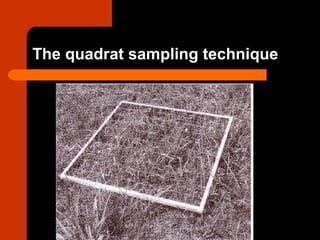
The quadrat sampling technique
 Used in estimating the size of plant
population and immobile animal.
 A quadrat – metal, wooden frame or PVC
pipe frame which form a square of a known
area (1 m2
).
 Placed randomly in an ecosystem where
sampling is carried out.
The quadrat sampling technique
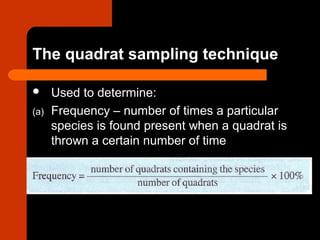
 Used to determine:
(a) Frequency – number of times a particular
species is found present when a quadrat is
thrown a certain number of time
The quadrat sampling technique
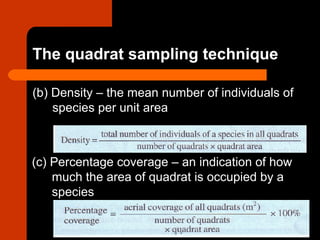
(b) Density – the mean number of individuals of
species per unit area
(c) Percentage coverage – an indication of how
much the area of quadrat is occupied by a
species
The quadrat sampling technique
The capture, mark, release and
recapture technique
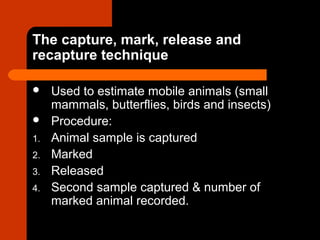
 Used to estimate mobile animals (small
mammals, butterflies, birds and insects)
 Procedure:
1. Animal sample is captured
2. Marked
3. Released
4. Second sample captured & number of
marked animal recorded.
 Population size of the animal in the area can
be estimated using the formula below:
The capture, mark, release and
recapture technique
The abiotic factors which influence the
distribution of an organism
 What are abiotic factors?
 How the abiotic factors influence the
distribution of an organism?
Exercise
 Do Focus Practice 8.3 on page 188 in the
textbook.

6626907 83-population-ecology

  • 1.
  • 2.
    What is meantby population ecology?  A branch of ecology that studies the structure and dynamics of population.  Population density – number of organism per unit area of habitat  Affected by abiotic and biotic factors, birth rate, death rate, immigration and emigration.
  • 3.
     Direct counting– method to estimate the size and density of population (impractical due to the size of ecosystem, the number of plants involved and the movement of the animal).  Sampling technique – more practical way, enable us to estimate the total population size of the organism.
  • 4.
    The quadrat samplingtechnique  Used in estimating the size of plant population and immobile animal.  A quadrat – metal, wooden frame or PVC pipe frame which form a square of a known area (1 m2 ).  Placed randomly in an ecosystem where sampling is carried out.
  • 5.
  • 6.
     Used todetermine: (a) Frequency – number of times a particular species is found present when a quadrat is thrown a certain number of time The quadrat sampling technique
  • 7.
    (b) Density –the mean number of individuals of species per unit area (c) Percentage coverage – an indication of how much the area of quadrat is occupied by a species The quadrat sampling technique
  • 8.
    The capture, mark,release and recapture technique  Used to estimate mobile animals (small mammals, butterflies, birds and insects)  Procedure: 1. Animal sample is captured 2. Marked 3. Released 4. Second sample captured & number of marked animal recorded.
  • 9.
     Population sizeof the animal in the area can be estimated using the formula below: The capture, mark, release and recapture technique
  • 10.
    The abiotic factorswhich influence the distribution of an organism  What are abiotic factors?  How the abiotic factors influence the distribution of an organism?
  • 11.
    Exercise  Do FocusPractice 8.3 on page 188 in the textbook.