Basic Computation/s
Part II
IV Drugs & IVF
Chapter 4
Interpretation/Calculating
Medication Dosages
 Ratio – is the relationship of two
quantities
 1:10 , 1:2500
 1/10 , 1/2500
Interpretation/Calculating
Medication Dosages
 RATIO
 e.g For every 20 students there is 1
teacher. The ratio of teacher to
students is 1 in 20 or 1:20 or 1/20
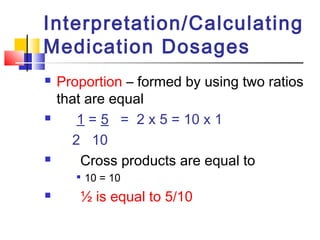
 Proportion – formed by using two ratios
that are equal
 1 = 5 = 2 x 5 = 10 x 1
2 10
 Cross products are equal to

10 = 10
 ½ is equal to 5/10
Interpretation/Calculating
Medication Dosages
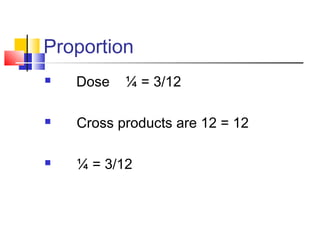
Proportion
 Dose ¼ = 3/12
 Cross products are 12 = 12
 ¼ = 3/12
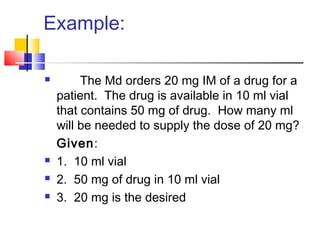
Example:
 The Md orders 20 mg IM of a drug for a
patient. The drug is available in 10 ml vial
that contains 50 mg of drug. How many ml
will be needed to supply the dose of 20 mg?
Given:
 1. 10 ml vial
 2. 50 mg of drug in 10 ml vial
 3. 20 mg is the desired
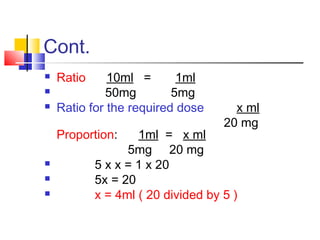
Cont.
 Ratio 10ml = 1ml
 50mg 5mg
 Ratio for the required dose x ml
20 mg
Proportion: 1ml = x ml
5mg 20 mg
 5 x x = 1 x 20
 5x = 20
 x = 4ml ( 20 divided by 5 )
Example/s:.
1. Ampicillin oral susp. 250mg/5ml . How
many ml would be measured into a
medication syringe to obtain a dose of
75mg of ampicillin?
Example/s
 2. Paracetamol 125mg/ 5ml. How many
ml would be measured into a
medication syringe to obtain 15 mg of
Paracetamol?
Example/s
 3. How many ml of Paracetamol IV
should be given to obtain a dose of
15mg in a 15kg-man, if a vial contains
300mg/2ml of Paracetamol?
Example/s
 4. A vial contains 250mg of tetracycline
HCl in a total of 2 ml of solution. How
many mg of tetracycline HCl are
contained in 0.6 ml of this solution?
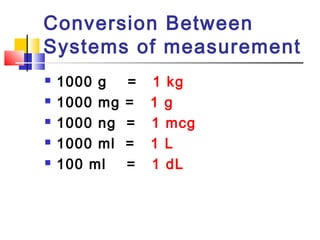
Conversion Between
Systems of measurement
 1000 g = 1 kg
 1000 mg = 1 g
 1000 ng = 1 mcg
 1000 ml = 1 L
 100 ml = 1 dL
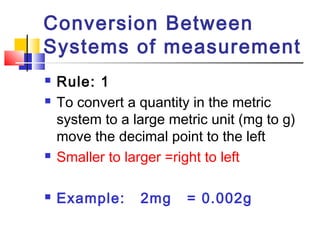
Conversion Between
Systems of measurement
 Rule: 1
 To convert a quantity in the metric
system to a large metric unit (mg to g)
move the decimal point to the left
 Smaller to larger =right to left
 Example: 2mg = 0.002g
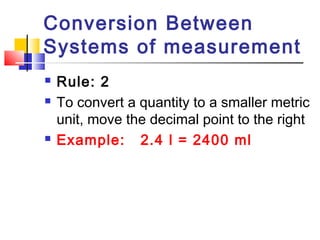
Conversion Between
Systems of measurement
 Rule: 2
 To convert a quantity to a smaller metric
unit, move the decimal point to the right
 Example: 2.4 l = 2400 ml
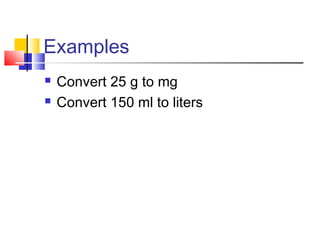
Examples
 Convert 25 g to mg
 Convert 150 ml to liters
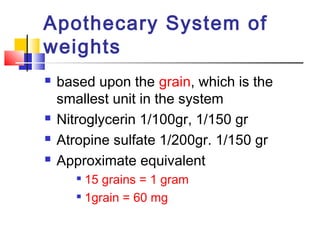
Apothecary System of
weights
 based upon the grain, which is the
smallest unit in the system
 Nitroglycerin 1/100gr, 1/150 gr
 Atropine sulfate 1/200gr. 1/150 gr
 Approximate equivalent

15 grains = 1 gram

1grain = 60 mg
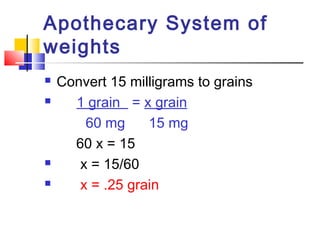
Apothecary System of
weights
 Convert 15 milligrams to grains
 1 grain = x grain
60 mg 15 mg
60 x = 15
 x = 15/60
 x = .25 grain
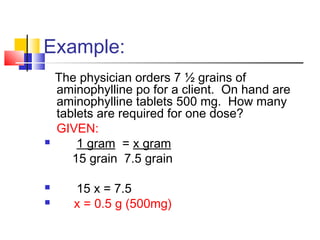
Example:
The physician orders 7 ½ grains of
aminophylline po for a client. On hand are
aminophylline tablets 500 mg. How many
tablets are required for one dose?
GIVEN:
 1 gram = x gram
15 grain 7.5 grain
 15 x = 7.5
 x = 0.5 g (500mg)
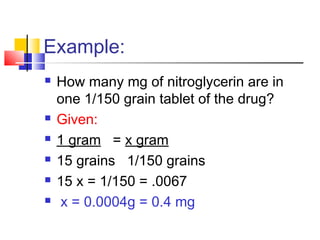
Example:
 How many mg of nitroglycerin are in
one 1/150 grain tablet of the drug?
 Given:
 1 gram = x gram
 15 grains 1/150 grains
 15 x = 1/150 = .0067
 x = 0.0004g = 0.4 mg
Calculation of Fractional
Doses:
 ratio and proportion
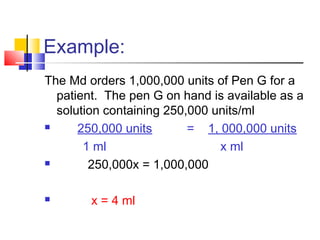
Example:
The Md orders 1,000,000 units of Pen G for a
patient. The pen G on hand is available as a
solution containing 250,000 units/ml
 250,000 units = 1, 000,000 units
1 ml x ml
 250,000x = 1,000,000
 x = 4 ml
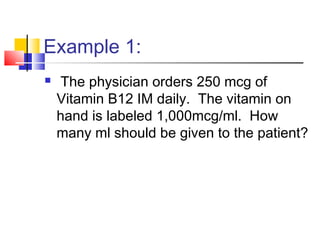
Example 1:
 The physician orders 250 mcg of
Vitamin B12 IM daily. The vitamin on
hand is labeled 1,000mcg/ml. How
many ml should be given to the patient?
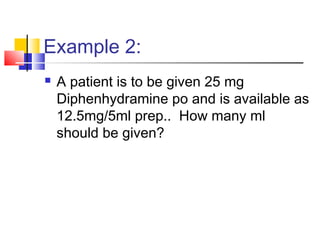
Example 2:
 A patient is to be given 25 mg
Diphenhydramine po and is available as
12.5mg/5ml prep.. How many ml
should be given?
Example 3:
 A medication order calls for 750 mg
calcium lactate to be given TID PO. On
hand are tablets of calcium lactate 0.5
g. How many tablets should be given
for each dose?
Calculation of Dosages
Based on Weight
 The physician orders thiabendazole
chewable tablets for a 110 pound child.
The recommended dosage is 20
mg/kg/dose. How many 500 mg tablets
should be given to this patient for each
dose.
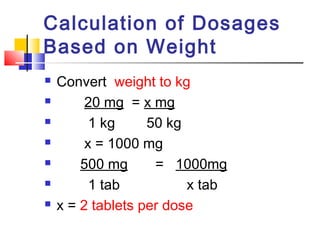
Calculation of Dosages
Based on Weight
 Convert weight to kg
 20 mg = x mg
 1 kg 50 kg
 x = 1000 mg
 500 mg = 1000mg
 1 tab x tab
 x = 2 tablets per dose
Example:
 The recommended dose of Meperidine
is 6mg/kg/day for pain. It is given every
4 to 6 hours. How many ml of Demerol
injection 50mg/ml should be
administered to a 33 pound child as a
single dose every 6 hours?
Cont.
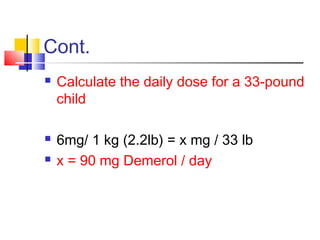
 Calculate the daily dose for a 33-pound
child
 6mg/ 1 kg (2.2lb) = x mg / 33 lb
 x = 90 mg Demerol / day
Cont.
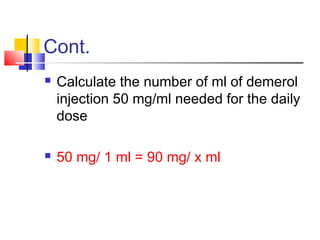
 Calculate the number of ml of demerol
injection 50 mg/ml needed for the daily
dose
 50 mg/ 1 ml = 90 mg/ x ml
Cont.
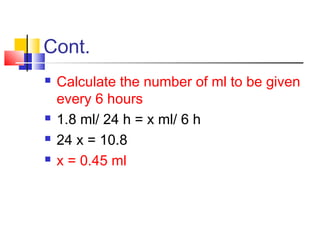
 Calculate the number of ml to be given
every 6 hours
 1.8 ml/ 24 h = x ml/ 6 h
 24 x = 10.8
 x = 0.45 ml
Calculations Involving
Intravenous Administration
 How long will it take to complete an IV
infusion of 1.5 L of D5 W being
administered at the rate of 45 drops
/min? The IV set is calibrated to deliver
15 drops/ml.
Calculations Involving
Intravenous Administration
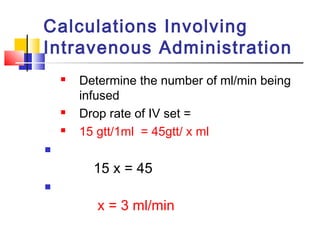
 Determine the number of ml/min being
infused
 Drop rate of IV set =
 15 gtt/1ml = 45gtt/ x ml

15 x = 45

x = 3 ml/min
Calculations Involving
Intravenous Administration
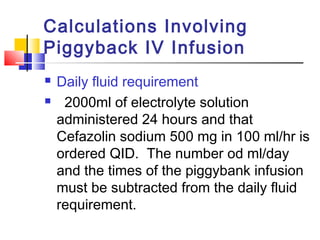
Calculate the number of ml/hour
3 ml/min. x 60 min/hr = 180/ hour
Calculations Involving
Intravenous Administration
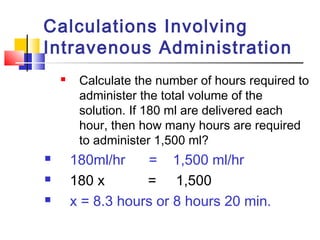
 Calculate the number of hours required to
administer the total volume of the
solution. If 180 ml are delivered each
hour, then how many hours are required
to administer 1,500 ml?
 180ml/hr = 1,500 ml/hr
 180 x = 1,500
 x = 8.3 hours or 8 hours 20 min.
Calculations Involving Piggyback
IV Infusion
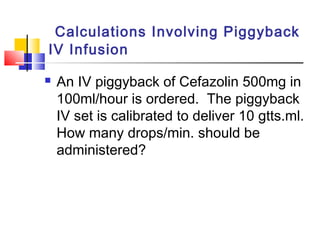
 An IV piggyback of Cefazolin 500mg in
100ml/hour is ordered. The piggyback
IV set is calibrated to deliver 10 gtts.ml.
How many drops/min. should be
administered?
Calculations Involving
Piggyback IV Infusion
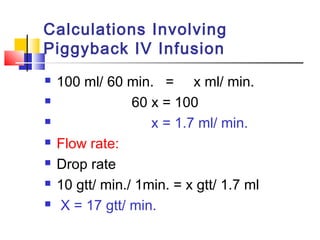
 100 ml/ 60 min. = x ml/ min.
 60 x = 100
 x = 1.7 ml/ min.
 Flow rate:
 Drop rate
 10 gtt/ min./ 1min. = x gtt/ 1.7 ml
 X = 17 gtt/ min.
Calculations Involving
Piggyback IV Infusion
 Daily fluid requirement
 2000ml of electrolyte solution
administered 24 hours and that
Cefazolin sodium 500 mg in 100 ml/hr is
ordered QID. The number od ml/day
and the times of the piggybank infusion
must be subtracted from the daily fluid
requirement.

12446567 basic-computations-2-iv-ivf

  • 1.
    Basic Computation/s Part II IVDrugs & IVF Chapter 4
  • 2.
    Interpretation/Calculating Medication Dosages  Ratio– is the relationship of two quantities  1:10 , 1:2500  1/10 , 1/2500
  • 3.
    Interpretation/Calculating Medication Dosages  RATIO e.g For every 20 students there is 1 teacher. The ratio of teacher to students is 1 in 20 or 1:20 or 1/20
  • 4.
     Proportion –formed by using two ratios that are equal  1 = 5 = 2 x 5 = 10 x 1 2 10  Cross products are equal to  10 = 10  ½ is equal to 5/10 Interpretation/Calculating Medication Dosages
  • 5.
    Proportion  Dose ¼= 3/12  Cross products are 12 = 12  ¼ = 3/12
  • 6.
    Example:  The Mdorders 20 mg IM of a drug for a patient. The drug is available in 10 ml vial that contains 50 mg of drug. How many ml will be needed to supply the dose of 20 mg? Given:  1. 10 ml vial  2. 50 mg of drug in 10 ml vial  3. 20 mg is the desired
  • 7.
    Cont.  Ratio 10ml= 1ml  50mg 5mg  Ratio for the required dose x ml 20 mg Proportion: 1ml = x ml 5mg 20 mg  5 x x = 1 x 20  5x = 20  x = 4ml ( 20 divided by 5 )
  • 8.
    Example/s:. 1. Ampicillin oralsusp. 250mg/5ml . How many ml would be measured into a medication syringe to obtain a dose of 75mg of ampicillin?
  • 9.
    Example/s  2. Paracetamol125mg/ 5ml. How many ml would be measured into a medication syringe to obtain 15 mg of Paracetamol?
  • 10.
    Example/s  3. Howmany ml of Paracetamol IV should be given to obtain a dose of 15mg in a 15kg-man, if a vial contains 300mg/2ml of Paracetamol?
  • 11.
    Example/s  4. Avial contains 250mg of tetracycline HCl in a total of 2 ml of solution. How many mg of tetracycline HCl are contained in 0.6 ml of this solution?
  • 12.
    Conversion Between Systems ofmeasurement  1000 g = 1 kg  1000 mg = 1 g  1000 ng = 1 mcg  1000 ml = 1 L  100 ml = 1 dL
  • 13.
    Conversion Between Systems ofmeasurement  Rule: 1  To convert a quantity in the metric system to a large metric unit (mg to g) move the decimal point to the left  Smaller to larger =right to left  Example: 2mg = 0.002g
  • 14.
    Conversion Between Systems ofmeasurement  Rule: 2  To convert a quantity to a smaller metric unit, move the decimal point to the right  Example: 2.4 l = 2400 ml
  • 15.
    Examples  Convert 25g to mg  Convert 150 ml to liters
  • 16.
    Apothecary System of weights based upon the grain, which is the smallest unit in the system  Nitroglycerin 1/100gr, 1/150 gr  Atropine sulfate 1/200gr. 1/150 gr  Approximate equivalent  15 grains = 1 gram  1grain = 60 mg
  • 17.
    Apothecary System of weights Convert 15 milligrams to grains  1 grain = x grain 60 mg 15 mg 60 x = 15  x = 15/60  x = .25 grain
  • 18.
    Example: The physician orders7 ½ grains of aminophylline po for a client. On hand are aminophylline tablets 500 mg. How many tablets are required for one dose? GIVEN:  1 gram = x gram 15 grain 7.5 grain  15 x = 7.5  x = 0.5 g (500mg)
  • 19.
    Example:  How manymg of nitroglycerin are in one 1/150 grain tablet of the drug?  Given:  1 gram = x gram  15 grains 1/150 grains  15 x = 1/150 = .0067  x = 0.0004g = 0.4 mg
  • 20.
  • 21.
    Example: The Md orders1,000,000 units of Pen G for a patient. The pen G on hand is available as a solution containing 250,000 units/ml  250,000 units = 1, 000,000 units 1 ml x ml  250,000x = 1,000,000  x = 4 ml
  • 22.
    Example 1:  Thephysician orders 250 mcg of Vitamin B12 IM daily. The vitamin on hand is labeled 1,000mcg/ml. How many ml should be given to the patient?
  • 23.
    Example 2:  Apatient is to be given 25 mg Diphenhydramine po and is available as 12.5mg/5ml prep.. How many ml should be given?
  • 24.
    Example 3:  Amedication order calls for 750 mg calcium lactate to be given TID PO. On hand are tablets of calcium lactate 0.5 g. How many tablets should be given for each dose?
  • 25.
    Calculation of Dosages Basedon Weight  The physician orders thiabendazole chewable tablets for a 110 pound child. The recommended dosage is 20 mg/kg/dose. How many 500 mg tablets should be given to this patient for each dose.
  • 26.
    Calculation of Dosages Basedon Weight  Convert weight to kg  20 mg = x mg  1 kg 50 kg  x = 1000 mg  500 mg = 1000mg  1 tab x tab  x = 2 tablets per dose
  • 27.
    Example:  The recommendeddose of Meperidine is 6mg/kg/day for pain. It is given every 4 to 6 hours. How many ml of Demerol injection 50mg/ml should be administered to a 33 pound child as a single dose every 6 hours?
  • 28.
    Cont.  Calculate thedaily dose for a 33-pound child  6mg/ 1 kg (2.2lb) = x mg / 33 lb  x = 90 mg Demerol / day
  • 29.
    Cont.  Calculate thenumber of ml of demerol injection 50 mg/ml needed for the daily dose  50 mg/ 1 ml = 90 mg/ x ml
  • 30.
    Cont.  Calculate thenumber of ml to be given every 6 hours  1.8 ml/ 24 h = x ml/ 6 h  24 x = 10.8  x = 0.45 ml
  • 31.
    Calculations Involving Intravenous Administration How long will it take to complete an IV infusion of 1.5 L of D5 W being administered at the rate of 45 drops /min? The IV set is calibrated to deliver 15 drops/ml.
  • 32.
    Calculations Involving Intravenous Administration Determine the number of ml/min being infused  Drop rate of IV set =  15 gtt/1ml = 45gtt/ x ml  15 x = 45  x = 3 ml/min
  • 33.
    Calculations Involving Intravenous Administration Calculatethe number of ml/hour 3 ml/min. x 60 min/hr = 180/ hour
  • 34.
    Calculations Involving Intravenous Administration Calculate the number of hours required to administer the total volume of the solution. If 180 ml are delivered each hour, then how many hours are required to administer 1,500 ml?  180ml/hr = 1,500 ml/hr  180 x = 1,500  x = 8.3 hours or 8 hours 20 min.
  • 35.
    Calculations Involving Piggyback IVInfusion  An IV piggyback of Cefazolin 500mg in 100ml/hour is ordered. The piggyback IV set is calibrated to deliver 10 gtts.ml. How many drops/min. should be administered?
  • 36.
    Calculations Involving Piggyback IVInfusion  100 ml/ 60 min. = x ml/ min.  60 x = 100  x = 1.7 ml/ min.  Flow rate:  Drop rate  10 gtt/ min./ 1min. = x gtt/ 1.7 ml  X = 17 gtt/ min.
  • 37.
    Calculations Involving Piggyback IVInfusion  Daily fluid requirement  2000ml of electrolyte solution administered 24 hours and that Cefazolin sodium 500 mg in 100 ml/hr is ordered QID. The number od ml/day and the times of the piggybank infusion must be subtracted from the daily fluid requirement.