POPULATION DYNAMICS
Population dynamics refers to how populations of a species change over
time.
A population is a group of individuals of the same species that
occupy a specific area over a certain period of time.
The different studies about population of organisms is known as
population ecology.
An ecologist is a scientist who studies how animals and plants
interact with their environment.
• Population density
• Spatial distribution patterns
• Population range
• Reproduction patterns
Population characteristics
Population Density
Population density =
number of density
unit area
A population density - the number of individuals occupying a
certain area.
Population density =
number of density
unit area
Computing for the population densities of organisms in previous slide.
Population B
Population density = 10 ducks
(4m) (2m)
= 10 ducks
8𝑚2
= 1.25 ducks
𝑚2
Population A
Population density = 20 ducks
(4m) (2m)
= 2.5 ducks
𝑚2
= low density
= high density
Spatial Distribution Pattern
Scientists classify dispersion patterns into 3 types:
1) Uniform dispersion
2) Clumped dispersion
3) Random dispersion
Dispersion – is the pattern of spacing among members of
population with in a specified area.
Types of dispersion patterns
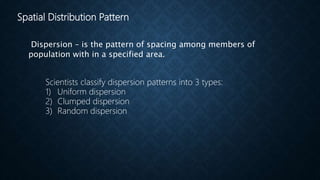
1. Uniform Distribution
It maintain defined territories.
Types of dispersion patterns
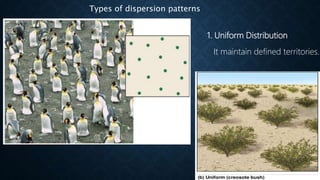
2. Clumped Distribution
- is when individuals in a
population are clustered
together, creating some
patches with many individuals
and some patches with no
individuals.
Types of dispersion patterns
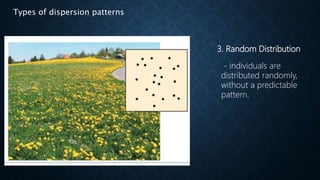
3. Random Distribution
- individuals are
distributed randomly,
without a predictable
pattern.
Other conditions can limit
population range such as:
• Amount of rainfall
• Sudden changes in
temperature
• Biotic factors like the
presence of predators and
competitors
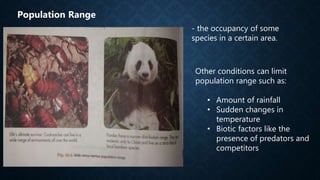
Population Range
- the occupancy of some
species in a certain area.
Reproduction Patterns
Some organisms produce many, small-sized offspring all at once, with
little or no parental care or protection. This kind of reproductive strategy
found among:
• Bacteria
• Algae
• insects
Other organisms tend to produce a small number of offspring with fairly
long life spans.
Example – mammals produce their young inside their womb to give
their optimum protection. After birth, the offspring will be nourished
and protected until they can live on their own.
LIMITING POPULATION GROWTH
Two categories or limiting factors
1. Density – independent factor
affect the population
regardless of its density. Usually
abiotic factor.
2. Density – dependent factor
- depend on the number of
members in a population. These
factors include exposure to
infectious diseases, predation
and competiton for food.
Limiting factors – any biotic and abiotic factor that restricts
the number of reproduction of organisms in an ecosystem.
All factors that limit
population size are
called environmental
resistance.
The number of
organisms that can be
supported by a given
environment refers to
its carrying capacity.
Population variables
• Birth rate
• Death rate
• Emigration
• immigration
Birth rate – refers to the number of individual births in a population in a
certain period of time.
Death rate – indicates the number or deaths in a certain population in a
given time.
If death rate is higher than
birth rate, population size
decreases.
If birth rate is higher than
death rate, population size
increases.
Immigration – refers to the movement of individual member of a
population into another group of population.
Emigration – happens when some members leave the group. For animals
a search for new food will cause them to migrate into a new home.
To compute the population change in an environment
Population change = (births + immigration ) – (deaths + emigration)
ECOSYSTEM STABILITY
An ecosystem is stable when it has the ability to maintain its
structure and function over long periods of time despite
disturbances.
To achieve stability, an ecosystem must fulfill two components:
1. Resistance – an ecosystem shows
resistance when its structure and
functions stay normal despite
changes in the environment.
2. Resilience – when it regain its
normal structure and function after
a disturbance.
Species richness – the number of different species that thrive in an
area, is a measurable quantity used by scientist to predict the
stability of ecosystems.
Keystone species – certain types of organisms which perform unique
functions in the ecosystem.
Examples:
Sharks
Alligators
cats
Thank you
Reference: Phoenix Publishing House
Exploring Life Through Science – The New Grade 10

Population dynamics

  • 1.
    POPULATION DYNAMICS Population dynamicsrefers to how populations of a species change over time. A population is a group of individuals of the same species that occupy a specific area over a certain period of time. The different studies about population of organisms is known as population ecology. An ecologist is a scientist who studies how animals and plants interact with their environment.
  • 2.
    • Population density •Spatial distribution patterns • Population range • Reproduction patterns Population characteristics
  • 3.
    Population Density Population density= number of density unit area A population density - the number of individuals occupying a certain area.
  • 5.
    Population density = numberof density unit area Computing for the population densities of organisms in previous slide. Population B Population density = 10 ducks (4m) (2m) = 10 ducks 8𝑚2 = 1.25 ducks 𝑚2 Population A Population density = 20 ducks (4m) (2m) = 2.5 ducks 𝑚2 = low density = high density
  • 6.
    Spatial Distribution Pattern Scientistsclassify dispersion patterns into 3 types: 1) Uniform dispersion 2) Clumped dispersion 3) Random dispersion Dispersion – is the pattern of spacing among members of population with in a specified area.
  • 7.
    Types of dispersionpatterns 1. Uniform Distribution It maintain defined territories.
  • 8.
    Types of dispersionpatterns 2. Clumped Distribution - is when individuals in a population are clustered together, creating some patches with many individuals and some patches with no individuals.
  • 9.
    Types of dispersionpatterns 3. Random Distribution - individuals are distributed randomly, without a predictable pattern.
  • 10.
    Other conditions canlimit population range such as: • Amount of rainfall • Sudden changes in temperature • Biotic factors like the presence of predators and competitors Population Range - the occupancy of some species in a certain area.
  • 11.
    Reproduction Patterns Some organismsproduce many, small-sized offspring all at once, with little or no parental care or protection. This kind of reproductive strategy found among: • Bacteria • Algae • insects Other organisms tend to produce a small number of offspring with fairly long life spans. Example – mammals produce their young inside their womb to give their optimum protection. After birth, the offspring will be nourished and protected until they can live on their own.
  • 13.
    LIMITING POPULATION GROWTH Twocategories or limiting factors 1. Density – independent factor affect the population regardless of its density. Usually abiotic factor. 2. Density – dependent factor - depend on the number of members in a population. These factors include exposure to infectious diseases, predation and competiton for food. Limiting factors – any biotic and abiotic factor that restricts the number of reproduction of organisms in an ecosystem.
  • 14.
    All factors thatlimit population size are called environmental resistance. The number of organisms that can be supported by a given environment refers to its carrying capacity.
  • 15.
    Population variables • Birthrate • Death rate • Emigration • immigration Birth rate – refers to the number of individual births in a population in a certain period of time. Death rate – indicates the number or deaths in a certain population in a given time. If death rate is higher than birth rate, population size decreases. If birth rate is higher than death rate, population size increases.
  • 16.
    Immigration – refersto the movement of individual member of a population into another group of population. Emigration – happens when some members leave the group. For animals a search for new food will cause them to migrate into a new home.
  • 17.
    To compute thepopulation change in an environment Population change = (births + immigration ) – (deaths + emigration)
  • 18.
    ECOSYSTEM STABILITY An ecosystemis stable when it has the ability to maintain its structure and function over long periods of time despite disturbances. To achieve stability, an ecosystem must fulfill two components: 1. Resistance – an ecosystem shows resistance when its structure and functions stay normal despite changes in the environment. 2. Resilience – when it regain its normal structure and function after a disturbance.
  • 20.
    Species richness –the number of different species that thrive in an area, is a measurable quantity used by scientist to predict the stability of ecosystems. Keystone species – certain types of organisms which perform unique functions in the ecosystem. Examples: Sharks Alligators cats
  • 21.
    Thank you Reference: PhoenixPublishing House Exploring Life Through Science – The New Grade 10