OPTICALOPTICAL
ILLUSIONSILLUSIONS
INDEXINDEX
 DEFINITION
 TYPES OF OPTICAL ILLUSIONS
 PERCIEVING OPTICAL ILLUSIONS-
1. Role of eye
2. Role of Brain
• FACTORS CAUSING OPTICAL
ILLUSIONS
• NATURAL OPTICAL ILLUSIONS
An optical illusion (also called a visual illusion)
is characterized by visually perceived images that
differ from objective reality. The information
gathered by the eye is processed in the brain to
give a percept that does not tally with a physical
measurement of the stimulus source.
DEFINITITONDEFINITITON
When we experience a visual illusion we may see
something that is not there or fail to see something
that is there or even see something that different
from what is there!
Because of this dissociation between perception and
reality, visual illusions demonstrate the ways in
which the brain can fail to recreate the physical
world. By studying these failings, we can learn
about the computational methods that the brain
uses to construct visual experience.
TYPES OF OPTICALTYPES OF OPTICAL
ILLUSIONSILLUSIONS
There are 3 main types of optical
illusions
 LITERAL OPTICAL ILLUSIONS
 PHYSIOLOGICAL OPTICAL
ILLUSIONS
 COGNITIVE OPTICAL ILLUSIONS
I. LITERAL OPTICAL ILLUSIONS
Literal optical illusions are those illusions that create images
that are different from the objects that make them.
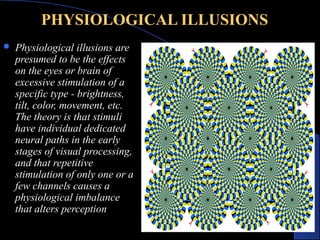
PHYSIOLOGICAL ILLUSIONS
 Physiological illusions are
presumed to be the effects
on the eyes or brain of
excessive stimulation of a
specific type - brightness,
tilt, color, movement, etc.
The theory is that stimuli
have individual dedicated
neural paths in the early
stages of visual processing,
and that repetitive
stimulation of only one or a
few channels causes a
physiological imbalance
that alters perception
III.III. COGNITIVE ILLUSIONSCOGNITIVE ILLUSIONS
Cognitive illusions are assumed to arise by interaction with in-built
assumptions or 'knowledge' of the world, leading to "unconscious
inferences", an idea first suggested in the 19th century. Cognitive
illusions are commonly divided into:
 AMBIGUOUS ILLUSIONS
 DISTORTING ILLUSIONS
PARADOX ILLUSIONS OR FICTION ILLUSIONS
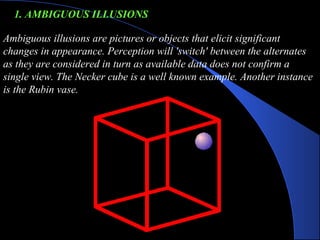
Ambiguous illusions are pictures or objects that elicit significant
changes in appearance. Perception will 'switch' between the alternates
as they are considered in turn as available data does not confirm a
single view. The Necker cube is a well known example. Another instance
is the Rubin vase.
 
1. AMBIGUOUS ILLUSIONS
RUBINVASEILLUSION 
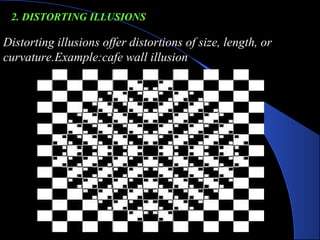
Distorting illusions offer distortions of size, length, or
curvature.Example:cafe wall illusion
2. DISTORTING ILLUSIONS
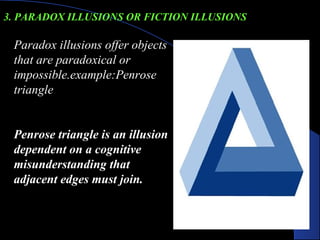
Paradox illusions offer objects
that are paradoxical or
impossible.example:Penrose
triangle
Penrose triangle is an illusion
dependent on a cognitive
misunderstanding that
adjacent edges must join.
 
3. PARADOX ILLUSIONS OR FICTION ILLUSIONS
PERCIEVINGPERCIEVING
OPTICAL ILLUSIONSOPTICAL ILLUSIONS
THE HUMAN EYETHE HUMAN EYE
STRUCTURE OF EYESTRUCTURE OF EYE
WALLS OF EYE
Tunica Fibrosa Tunica Vasculosa Retina
Sclera Cornea
choroid
Ciliary body
Iris
Photo-
receptor
cells
Bipolar cells
Ganglion cells
ConesRods
Optic nerve
VISUAL PERCEPTION
ROLE OF BRAINROLE OF BRAIN
 Retina isresponsible for converting light signals to neural signals.
 Optic nerve starts at a point in retina called the blind spot
 Optic chiasm:-the optic nerve meets here in the first part of the brain
 The OCCIPITAL LOBE located posterior in the brain deals with vision
FACTORS CAUSING OPTICALFACTORS CAUSING OPTICAL
ILLUSIONSILLUSIONS
Following are the factors causing optical
illusions
1.Colour
2.Eye Structure
3.Depth and distance
4.Past experience
5.Lines and curves
1) COLOUR
2) EYE STRUCTURE
1.Arrangement of rods and cones on retina
2.Peripheral vision
3) DEPTH AND DISTANCE
4) PAST EXPERIENCE
African tribe
5) LINES AND CURVES
NATURAL OPTICALNATURAL OPTICAL
ILLUSIONSILLUSIONS
RAINBOWS
Auroras are natural light displays in the sky, usually
observed at night, particularly in the polar zone. They
typically occur in the ionosphere
AURORAS
A mirage is a refraction phenomena in which the image of some object
appears displaced from its true position. A common example of a mirage
is the appearance of water some distance down the highway on a hot
summer day.
MIRAGE
SEEING ISSEEING IS
DECEIVINGDECEIVING
HOW MANY BLACK DOTS CAN YOU SEE IN THIS PICTURE
There are…..NONE
And….
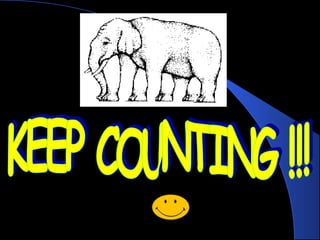
BY THE WAY, HOW MANY LEGSBY THE WAY, HOW MANY LEGS
DOES THIS ELEPHANT HAS?DOES THIS ELEPHANT HAS?
REFERENCESREFERENCES
Textbook of Medical Physiology by Arthur .C.
Guyton,John..E.Hall
Elements of chordate anatomy By Charles K.
Weichert
Biology textbook for class XII-NCERT
www.physorg.com
www.michaelbach.de
IMAGES: www.google.com

8594774 optical-illusions

  • 2.
  • 3.
    INDEXINDEX  DEFINITION  TYPESOF OPTICAL ILLUSIONS  PERCIEVING OPTICAL ILLUSIONS- 1. Role of eye 2. Role of Brain • FACTORS CAUSING OPTICAL ILLUSIONS • NATURAL OPTICAL ILLUSIONS
  • 4.
    An optical illusion(also called a visual illusion) is characterized by visually perceived images that differ from objective reality. The information gathered by the eye is processed in the brain to give a percept that does not tally with a physical measurement of the stimulus source. DEFINITITONDEFINITITON
  • 5.
    When we experiencea visual illusion we may see something that is not there or fail to see something that is there or even see something that different from what is there! Because of this dissociation between perception and reality, visual illusions demonstrate the ways in which the brain can fail to recreate the physical world. By studying these failings, we can learn about the computational methods that the brain uses to construct visual experience.
  • 6.
    TYPES OF OPTICALTYPESOF OPTICAL ILLUSIONSILLUSIONS There are 3 main types of optical illusions  LITERAL OPTICAL ILLUSIONS  PHYSIOLOGICAL OPTICAL ILLUSIONS  COGNITIVE OPTICAL ILLUSIONS
  • 7.
    I. LITERAL OPTICALILLUSIONS Literal optical illusions are those illusions that create images that are different from the objects that make them.
  • 8.
    PHYSIOLOGICAL ILLUSIONS  Physiologicalillusions are presumed to be the effects on the eyes or brain of excessive stimulation of a specific type - brightness, tilt, color, movement, etc. The theory is that stimuli have individual dedicated neural paths in the early stages of visual processing, and that repetitive stimulation of only one or a few channels causes a physiological imbalance that alters perception
  • 11.
    III.III. COGNITIVE ILLUSIONSCOGNITIVEILLUSIONS Cognitive illusions are assumed to arise by interaction with in-built assumptions or 'knowledge' of the world, leading to "unconscious inferences", an idea first suggested in the 19th century. Cognitive illusions are commonly divided into:  AMBIGUOUS ILLUSIONS  DISTORTING ILLUSIONS PARADOX ILLUSIONS OR FICTION ILLUSIONS
  • 12.
    Ambiguous illusions arepictures or objects that elicit significant changes in appearance. Perception will 'switch' between the alternates as they are considered in turn as available data does not confirm a single view. The Necker cube is a well known example. Another instance is the Rubin vase.   1. AMBIGUOUS ILLUSIONS
  • 13.
  • 14.
    Distorting illusions offerdistortions of size, length, or curvature.Example:cafe wall illusion 2. DISTORTING ILLUSIONS
  • 15.
    Paradox illusions offerobjects that are paradoxical or impossible.example:Penrose triangle Penrose triangle is an illusion dependent on a cognitive misunderstanding that adjacent edges must join.   3. PARADOX ILLUSIONS OR FICTION ILLUSIONS
  • 16.
  • 17.
  • 18.
    STRUCTURE OF EYESTRUCTUREOF EYE WALLS OF EYE Tunica Fibrosa Tunica Vasculosa Retina Sclera Cornea choroid Ciliary body Iris Photo- receptor cells Bipolar cells Ganglion cells ConesRods Optic nerve
  • 20.
  • 21.
    ROLE OF BRAINROLEOF BRAIN  Retina isresponsible for converting light signals to neural signals.  Optic nerve starts at a point in retina called the blind spot  Optic chiasm:-the optic nerve meets here in the first part of the brain  The OCCIPITAL LOBE located posterior in the brain deals with vision
  • 22.
    FACTORS CAUSING OPTICALFACTORSCAUSING OPTICAL ILLUSIONSILLUSIONS Following are the factors causing optical illusions 1.Colour 2.Eye Structure 3.Depth and distance 4.Past experience 5.Lines and curves
  • 23.
  • 24.
    2) EYE STRUCTURE 1.Arrangementof rods and cones on retina 2.Peripheral vision
  • 25.
    3) DEPTH ANDDISTANCE
  • 26.
  • 27.
  • 28.
  • 29.
  • 30.
    Auroras are naturallight displays in the sky, usually observed at night, particularly in the polar zone. They typically occur in the ionosphere AURORAS
  • 32.
    A mirage isa refraction phenomena in which the image of some object appears displaced from its true position. A common example of a mirage is the appearance of water some distance down the highway on a hot summer day. MIRAGE
  • 34.
  • 37.
    HOW MANY BLACKDOTS CAN YOU SEE IN THIS PICTURE
  • 38.
  • 39.
    BY THE WAY,HOW MANY LEGSBY THE WAY, HOW MANY LEGS DOES THIS ELEPHANT HAS?DOES THIS ELEPHANT HAS?
  • 41.
    REFERENCESREFERENCES Textbook of MedicalPhysiology by Arthur .C. Guyton,John..E.Hall Elements of chordate anatomy By Charles K. Weichert Biology textbook for class XII-NCERT www.physorg.com www.michaelbach.de IMAGES: www.google.com