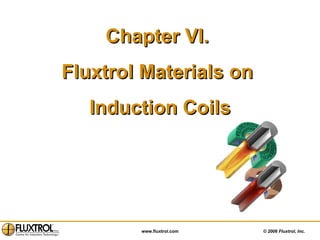
Chapter VI.  Fluxtrol Materials on  Induction Coils
Materials Manufactured  by Fluxtrol Inc. Fluxtrol Inc. is a world leading manufacturer of magnetodielectric materials for induction heating controllers Primary materials: Fluxtrol A Fluxtrol 50 Ferrotron 559H Fluxtrol Inc. also manufactures other standard and custom materials: Ferrotron 119 Fluxtrol 25 Custom materials Fluxtrol Inc. manufacturers a big variety of sizes and shapes. Special shapes may be made on request Materials in the Fluxtrol and Ferrotron families, which are designed primarily for induction heating, may be used in many other applications (as sensors, antennas etc.)
Fluxtrol Material Features  Fluxtrol and Ferrotron materials cover the whole frequency range used in induction heating Magnetic permeability is sufficient for induction heating applications All materials have excellent machinability and good mechanical strength; they may be used as structural components of the coil Ferrotron materials have good electrical strength and may withstand applied voltage up to several hundred volts Temperature resistance is high enough; in critical applications additional measures of thermal management may be used Losses may be removed by quenchant, by contact to the coil tubing, by special cooling plates or water channels machined directly into the material All materials are resistant to oil, hot water and polymer quenchants; small surface rusting may be prevented by etching or coating
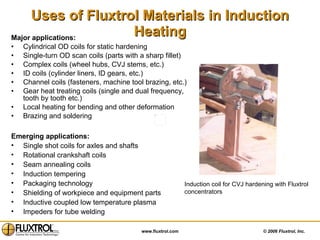
Uses of Fluxtrol Materials in Induction Heating Major applications: Cylindrical OD coils for static hardening Single-turn OD scan coils (parts with a sharp fillet) Complex coils (wheel hubs, CVJ stems, etc.) ID coils (cylinder liners, ID gears, etc.) Channel coils (fasteners, machine tool brazing, etc.) Gear heat treating coils (single and dual frequency, tooth by tooth etc.) Local heating for bending and other deformation Brazing and soldering  Emerging applications: Single shot coils for axles and shafts Rotational crankshaft coils  Seam annealing coils Induction tempering  Packaging technology Shielding of workpiece and equipment parts  Inductive coupled low temperature plasma Impeders for tube welding Induction coil for CVJ hardening with Fluxtrol concentrators
Properties of Fluxtrol and Ferrotron Materials
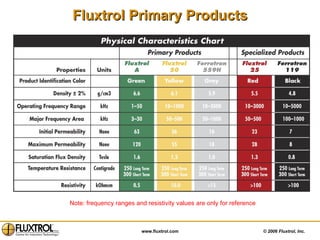
Fluxtrol Primary Products Note: frequency ranges and resistivity values are only for reference
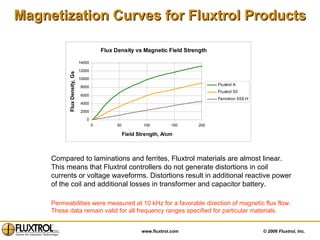
Magnetization Curves for Fluxtrol Products Compared to laminations and ferrites, Fluxtrol materials are almost linear. This means that Fluxtrol controllers do not generate distortions in coil currents or voltage waveforms. Distortions result in additional reactive power of the coil and additional losses in transformer and capacitor battery.  Permeabilities were measured at 10 kHz for a favorable direction of magnetic flux flow. These data remain valid for all frequency ranges specified for particular materials.
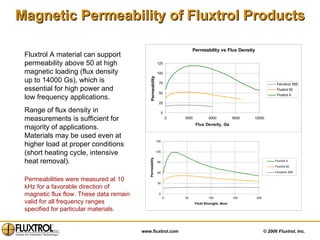
Magnetic Permeability of Fluxtrol Products Fluxtrol A material can support permeability above 50 at high magnetic loading (flux density up to 14000 Gs), which is essential for high power and low frequency applications.  Range of flux density in measurements is sufficient for majority of applications. Materials may be used even at higher load at proper conditions (short heating cycle, intensive heat removal). Permeabilities were measured at 10 kHz for a favorable direction of magnetic flux flow. These data remain valid for all frequency ranges specified for particular materials.
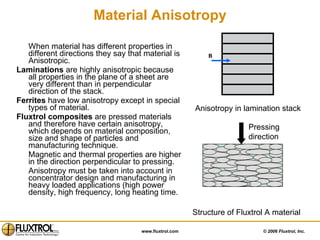
Material Anisotropy When material has different properties in different directions they say that material is Anisotropic. Laminations  are highly anisotropic because all properties in the plane of a sheet are very different than in perpendicular direction of the stack. Ferrites  have low anisotropy except in special types of material.  Fluxtrol composites  are pressed materials and therefore have certain anisotropy, which depends on material composition, size and shape of particles and manufacturing technique. Magnetic and thermal properties are higher in the direction perpendicular to pressing. Anisotropy must be taken into account in concentrator design and manufacturing in heavy loaded applications (high power density, high frequency, long heating time. Anisotropy in lamination stack Structure of Fluxtrol A material B  Pressing direction
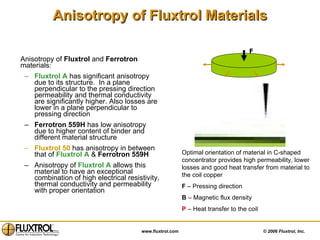
Anisotropy of Fluxtrol Materials Anisotropy of  Fluxtrol  and  Ferrotron  materials: Fluxtrol A  has significant anisotropy due to its structure.  In a plane perpendicular to the pressing direction  permeability and thermal conductivity are significantly higher. Also losses are lower in a plane perpendicular to pressing direction  Ferrotron 559H  has low anisotropy due to higher content of binder and different material structure  Fluxtrol 50  has anisotropy in between that of  Fluxtrol A  &  Ferrotron 559H Anisotropy of  Fluxtrol A  allows this material to have an exceptional combination of high electrical resistivity, thermal conductivity and permeability with proper orientation Optimal orientation of material in C-shaped concentrator provides high permeability, lower losses and good heat transfer from material to the coil copper F  – Pressing direction B  – Magnetic flux density P  – Heat transfer to the coil F
Optimal Cutting of Fluxtrol Material from Blank Stock As shown in Chapter 5, for the majority of applications, permeability values above 30-50 do not change the controller performance. Main reasons for optimal material orientation is control of the concentrator temperature, which depends on losses, heat removal conditions and duty cycle.  Material orientation is mostly essential for heavy loaded applications such as scanning or single-short hardening when concentrator losses are removing continuously by heat transfer to the copper in the process of heating. For these cases orientation  best  is strongly recommended with orientation N1 as a second choice. It is because the highest value of thermal conductivity is more important than slightly higher magnetic losses in the poles.  For short heating cycles such as contour gear hardening, orientation N2 is the second choice after  best  because of lower losses in the poles than in the case N1 and lower influence of thermal conductivity on concentrator temperature.   Pressing direction N1 N2 Min Min Max Losses Max Min Max Heat transfer (thermal conduct.) Best N2 N1 Orientation Parameter
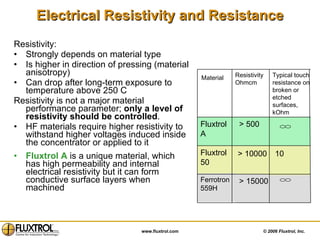
Electrical Resistivity and Resistance Resistivity:  Strongly depends on material type Is higher in direction of pressing (material anisotropy) Can drop after long-term exposure to temperature above 250 C Resistivity is not a major material performance parameter;  only a level of resistivity should be controlled . HF materials require higher resistivity to withstand higher voltages induced inside the concentrator or applied to it Fluxtrol A  is a unique material, which has high permeability and internal electrical resistivity but it can form conductive surface layers when machined Typical touch resistance on broken or etched surfaces, kOhm Fluxtrol  50  > 15000 > 10000 > 500 Resistivity Ohmcm Ferrotron 559H 10 Fluxtrol A Material
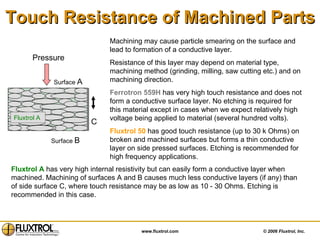
Touch Resistance of Machined Parts Machining may cause particle smearing on the surface and lead to formation of a conductive layer.  Resistance of this layer may depend on material type, machining method (grinding, milling, saw cutting etc.) and on machining direction. Ferrotron 559H  has very high touch resistance and does not form a conductive surface layer. No etching is required for this material except in cases when we expect relatively high voltage being applied to material (several hundred volts). Fluxtrol 50  has good touch resistance (up to 30 k Ohms) on broken and machined surfaces but forms a thin conductive layer on side pressed surfaces. Etching is recommended for high frequency applications.  Fluxtrol A  has very high internal resistivity but can easily form a conductive layer when machined. Machining of surfaces A and B causes much less conductive layers (if any) than of side surface C, where touch resistance may be as low as 10 - 30 Ohms. Etching is recommended in this case. Pressure Surface  A C Fluxtrol A Surface  B
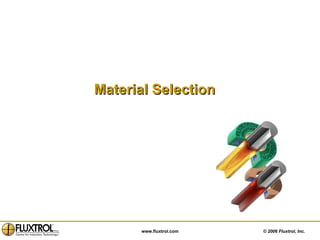
Material Selection
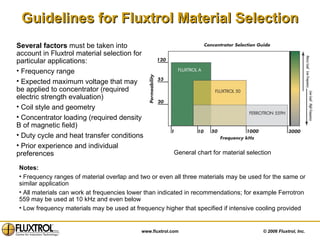
Guidelines for Fluxtrol Material Selection Several factors  must be taken into account in Fluxtrol material selection for particular applications: Frequency range Expected maximum voltage that may be applied to concentrator (required electric strength evaluation) Coil style and geometry Concentrator loading (required density B of magnetic field) Duty cycle and heat transfer conditions Prior experience and individual preferences General chart for material selection Notes: Frequency ranges of material overlap and two or even all three materials may be used for the same or similar application All materials can work at frequencies lower than indicated in recommendations; for example Ferrotron 559 may be used at 10 kHz and even below Low frequency materials may be used at frequency higher that specified if intensive cooling provided
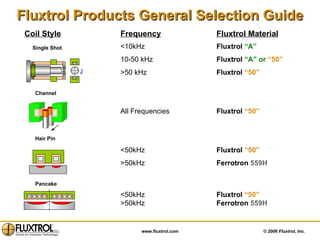
Fluxtrol Products General Selection Guide Coil Style Frequency Fluxtrol Material Single Shot Channel Hair Pin Pancake <10kHz Fluxtrol  “A” 10-50 kHz Fluxtrol  “A” or  “50” >50 kHz Fluxtrol  “50” All Frequencies Fluxtrol  “50” <50kHz Fluxtrol  “50” >50kHz Ferrotron   559H <50kHz Fluxtrol  “50” >50kHz Ferrotron   559H
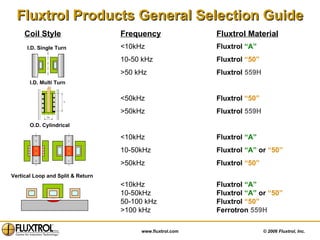
Fluxtrol Products General Selection Guide Vertical Loop and Split & Return <10kHz Fluxtrol  “A” 10-50 kHz Fluxtrol   “50” >50 kHz Fluxtrol  559H <50kHz Fluxtrol  “50” >50kHz Fluxtrol  559H <10kHz Fluxtrol  “A” 10-50kHz Fluxtrol  “A”  or  “50” >50kHz Fluxtrol  “50” <10kHz Fluxtrol  “A” 10-50kHz Fluxtrol  “A”  or  “50” 50-100 kHz Fluxtrol  “50” >100 kHz Ferrotron   559H Coil Style Frequency Fluxtrol Material I.D. Single Turn I.D. Multi Turn O.D. Cylindrical
Fluxtrol Materials Application Technique
To Etch Or Not To Etch? That Is The Question!   Main Goal:  To remove or modify conductive surface layer for better electrical resistance and electrical strength to applied voltage Additional possible benefits:   To prevent rusting To improve glue or coating adhesion Disadvantage: Additional chemical operation  Recommendations: Etching is always useful but in majority of applications not required Etching with Nitric or Chloric acids does not provide good results; it can damage material and the process is not safe Phosphoric acid may be used with success for etching and rust prevention Special iron-phosphoric agent CrysCoat 187 provides the bests results according to Fluxtrol Inc. experience Contact Fluxtrol Inc. for more information  Etching
Machining Fluxtrol materials may be machined using various methods (drilling, milling, turning, grinding, etc.)  No special tools required It is not necessary to use cooling or lubricating liquids General rules: Use sharp tools with slow feed and fast speed When drilling pay attention to chips removal from the drill bit; clogged bit channels can result in material breaking or incorrect dimensions Make pilot holes for drilling large bores  Drill material on strong support (wooden or plastic block) to avoid chipping at the exit Fluxtrol A  may give chipping on sharp edges due to layered structure. Machined surface may look different on different surfaces due to grain orientation. Ferrotron 559H  and  Fluxtrol 50  may be machined into parts having sharp angles and thin (less than 1 mm) areas
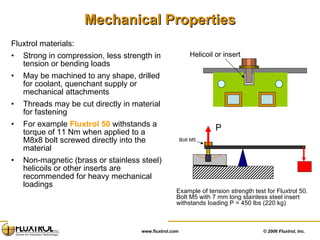
Mechanical Properties Fluxtrol materials: Strong in compression, less strength in tension or bending loads May be machined to any shape, drilled for coolant, quenchant supply or mechanical attachments Threads may be cut directly in material for fastening For example  Fluxtrol 50  withstands a torque of 11 Nm when applied to a M8x8 bolt screwed directly into the material  Non-magnetic (brass or stainless steel) helicoils or other inserts are recommended for heavy mechanical loadings Example of tension strength test for Fluxtrol 50. Bolt M5 with 7 mm long stainless steel insert withstands loading P = 450 lbs (220 kg) Helicoil or insert Bolt M5 P
Fluxtrol Material Coating Coating is not necessary for general applications  Some users apply paint or varnish for cosmetic reasons to concentrator together with the copper (whole coil) or separately Ceramic coating can protect against electric contact to the work piece, magnetic chips and radiation from hot part. Coating may be applied to the whole coil face. Two layers (pre-coating and final) are the best There are special requirements for a “clean” environment in some high frequency high tech applications (semiconductor industry, food packaging etc.). Special coatings for these purposes are available ( contact Fluxtrol Inc .). These coatings also increase electric strength of materials
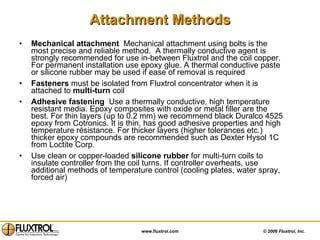
Attachment Methods Mechanical attachment  Mechanical attachment using bolts is the most precise and reliable method.  A thermally conductive agent is strongly recommended for use in-between Fluxtrol and the coil copper. For permanent installation use epoxy glue. A thermal conductive paste or silicone rubber may be used if ease of removal is required  Fasteners  must be isolated from Fluxtrol concentrator when it is attached to  multi-turn  coil Adhesive fastening  Use a thermally conductive, high temperature resistant media. Epoxy composites with oxide or metal filler are the best. For thin layers (up to 0.2 mm) we recommend black Duralco 4525 epoxy from Cotronics. It is thin, has good adhesive properties and high temperature résistance. For thicker layers (higher tolerances etc.) thicker epoxy compounds are recommended such as Dexter Hysol 1C from Loctite Corp.  Use clean or copper-loaded  silicone rubber  for multi-turn coils to insulate controller from the coil turns. If controller overheats, use additional methods of temperature control (cooling plates, water spray, forced air)
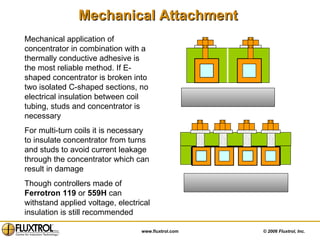
Mechanical Attachment   Mechanical application of concentrator in combination with a thermally conductive adhesive is the most reliable method. If E-shaped concentrator is broken into two isolated C-shaped sections, no electrical insulation between coil tubing, studs and concentrator is necessary For multi-turn coils it is necessary to insulate concentrator from turns and studs to avoid current leakage through the concentrator which can result in damage  Though controllers made of  Ferrotron   119  or  559H  can withstand applied voltage, electrical insulation is still recommended
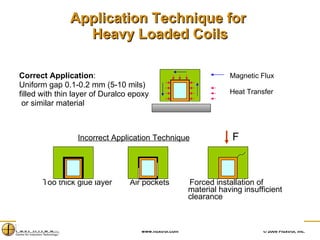
Application Technique for  Heavy Loaded Coils Correct Application : Uniform gap 0.1-0.2 mm (5-10 mils) filled with thin layer of Duralco epoxy or similar material   Too thick glue layer  Air pockets  Forced installation of    material having insufficient    clearance  Incorrect Application Technique F Magnetic Flux Heat Transfer
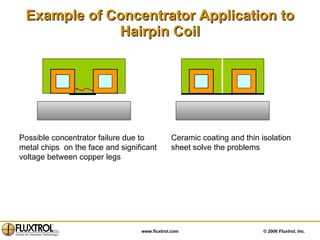
Example of Concentrator Application to Hairpin Coil Possible concentrator failure due to metal chips  on the face and significant voltage between copper legs Ceramic coating and thin isolation sheet solve the problems
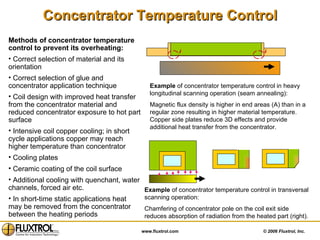
Concentrator Temperature Control Methods of concentrator temperature control to prevent its overheating: Correct selection of material and its orientation Correct selection of glue and concentrator application technique Coil design with improved heat transfer from the concentrator material and reduced concentrator exposure to hot part surface Intensive coil copper cooling; in short cycle applications copper may reach higher temperature than concentrator Cooling plates Ceramic coating of the coil surface Additional cooling with quenchant, water channels, forced air etc. In short-time static applications heat may be removed from the concentrator between the heating periods Example  of concentrator temperature control in heavy longitudinal scanning operation (seam annealing): Magnetic flux density is higher in end areas (A) than in a regular zone resulting in higher material temperature. Copper side plates reduce 3D effects and provide additional heat transfer from the concentrator.  A A Example  of concentrator temperature control in transversal scanning operation: Chamfering of concentrator pole on the coil exit side reduces absorption of radiation from the heated part (right).
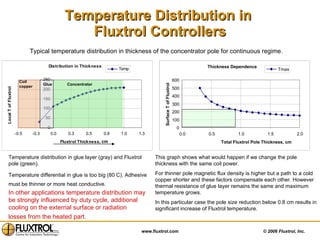
Temperature Distribution in  Fluxtrol Controllers Temperature distribution in glue layer (gray) and Fluxtrol pole (green). Temperature differential in glue is too big (80 C). Adhesive must be thinner or more heat conductive.   This graph shows what would happen if we change the pole thickness with the same coil power.  For thinner pole magnetic flux density is higher but a path to a cold copper shorter and these factors compensate each other. However thermal resistance of glue layer remains the same and maximum temperature grows. In this particular case the pole size reduction below 0.8 cm results in significant increase of Fluxtrol temperature.  Typical temperature distribution in thickness of the concentrator pole for continuous regime.  In other applications temperature distribution may be strongly influenced by duty cycle, additional cooling on the external surface or radiation losses from the heated part.   Coil copper Glue Concentrator cm Thickness Dependence 0 100 200 300 400 500 600 0.0 0.5 1.0 1.5 2.0 Total Fluxtrol Pole Thickness, cm Surface T of Fluxtrol Tmax , cm
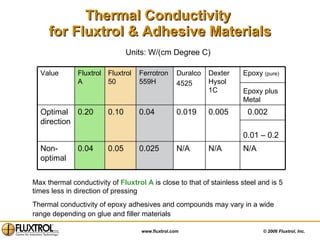
Thermal Conductivity  for Fluxtrol & Adhesive Materials Units: W/(cm Degree C) Max thermal conductivity of  Fluxtrol A  is close to that of stainless steel and is 5 times less in direction of pressing Thermal conductivity of epoxy adhesives and compounds may vary in a wide range depending on glue and filler materials   N/A 0.005 Dexter Hysol 1C N/A 0.019 Duralco 4525 N/A 0.025 0.05 0.04 Non-optimal  0.002 0.01 – 0.2 0.04 0.10 0.20 Optimal direction Epoxy  (pure) Epoxy plus Metal Ferrotron 559H Fluxtrol 50  Fluxtrol A Value
Maintenance of Coils with  Fluxtrol Concentrators In many applications Fluxtrol concentrators can work longer than copper Mechanical damage is one of the main factors causing coil failure and proper preventive measures must be taken  Visual control of Fluxtrol concentrators: Check concentrator integrity, attachment (loose parts, cracks in glue, mechanical damage) and insulation conditions when applicable Periodically clean concentrator from metallic chips and scale Restore damaged coating when applicable Dark surface may be due to smoke and quenchant residue buildup. Gently scratch the surface with knife or other sharp tool. Cleaned surface must have grey metallic color typical for a particular type of material Dark and crumbling surface shows that concentrator material was overheated. Concentrator must be replaced. If the coil lifetime is not sufficient, provide additional cooling or change the coil design In some applications, especially in installations with tube generators, sparking from a concentrator to the part or fixture may occur. If there is a ground protection, the generator turns OFF quickly however there might be small areas on the concentrator damaged by sparking. Remove damaged volumes with a sharp tool and eliminate a factor that caused sparking (too small gap, metal particles etc.). Concentrator can continue to work if damage was small.
Examples of Applications
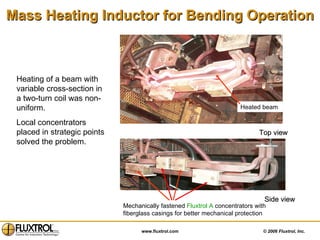
Mass Heating Inductor for Bending Operation Mechanically fastened  Fluxtrol A  concentrators with fiberglass casings for better mechanical protection  Side view Top view Heated beam Heating of a beam with variable cross-section in a two-turn coil was non-uniform. Local concentrators placed in strategic points solved the problem.
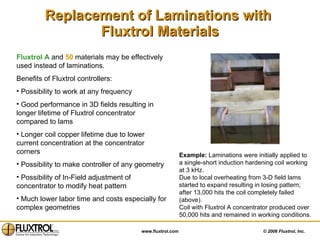
Replacement of Laminations with  Fluxtrol Materials Example:  Laminations were initially applied to a single-short induction hardening coil working at 3 kHz. Due to local overheating from 3-D field lams started to expand resulting in losing pattern; after 13,000 hits the coil completely failed (above). Coil with Fluxtrol A concentrator produced over 50,000 hits and remained in working conditions. Fluxtrol A  and  50  materials may be effectively used instead of laminations. Benefits of Fluxtrol controllers: Possibility to work at any frequency Good performance in 3D fields resulting in longer lifetime of Fluxtrol concentrator compared to lams  Longer coil copper lifetime due to lower current concentration at the concentrator corners Possibility to make controller of any geometry Possibility of In-Field adjustment of concentrator to modify heat pattern Much lower labor time and costs especially for complex geometries
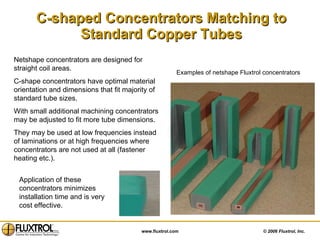
C-shaped Concentrators Matching to Standard Copper Tubes Netshape concentrators are designed for straight coil areas. C-shape concentrators have optimal material orientation and dimensions that fit majority of standard tube sizes. With small additional machining concentrators may be adjusted to fit more tube dimensions.  They may be used at low frequencies instead of laminations or at high frequencies where concentrators are not used at all (fastener heating etc.). Examples of netshape Fluxtrol concentrators  Application of these concentrators minimizes installation time and is very cost effective.
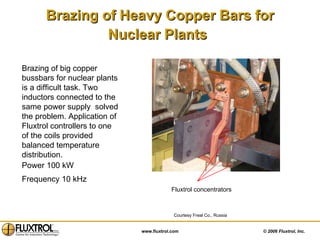
Brazing of Heavy Copper Bars for Nuclear Plants   Brazing of big copper bussbars for nuclear plants is a difficult task. Two inductors connected to the same power supply  solved the problem. Application of Fluxtrol controllers to one of the coils provided balanced temperature distribution.  Power 100 kW Frequency 10 kHz   Courtesy Freal Co., Russia Fluxtrol concentrators
Conclusions Magnetic flux controllers made of Fluxtrol and Ferrotron materials are used in a large variety of induction applications ranging from soldering of small conductors at 2 MHz, to food packaging, to automotive parts heat treating, to melting of special materials and inductively coupled plasma Due to unique combination of properties Fluxtrol materials are also used in electrophysics, material research and other special areas Magnetic flux controllers improve heating quality, boost production rate and coil lifetime, save energy and manufacturing costs Fluxtrol materials cover a whole frequency range of induction heating applications providing a variety of permeabilities from 7 to 120 Computer simulation gives a possibility to predict concentrator performance and optimize induction coil design Correct application technique is essential for effective use of Fluxtrol controllers especially in heavy loaded cases Fluxtrol Inc. provides extensive technical support to customers and continues to improve materials for magnetic flux control
Questions Is permeability of Fluxtrol A and 50 materials sufficient to provide the same heating intensity as laminations? Yes Losses in Fluxtrol materials may be removed by?  Quenchant, Coil Tubing, Cooling Plates, Channels / passages in the material  When a material has different properties in different directions it is said to be?  Anisotropic The Fluxtrol material with the highest level of Anisotropy is?  Fluxtrol “A” Permeability and thermal conductivity of Fluxtrol materials are highest in what direction?  In direction perpendicular to pressing direction during manufacturing What Fluxtrol material is most likely to develop a conductive surface layer after machining?  Fluxtrol “A” What is the best method for removing the conductive layer formed during machining?  Etching Other than removing conductive layers, etching also provides…?  Better surface area for adhesive bonding, Rust prevention Are lubricants and or coolants required for machining Fluxtrol materials?  No Can threads be cut directly into Fluxtrol materials?  Yes What is the recommended gap size for the application of adhesives when bonding Fluxtrol materials to coils?  0.1-0.2mm Click to scroll Questions and Answers

Chapter 6: Fluxtrol Materials on Induction Coils

  • 1.
    Chapter VI. Fluxtrol Materials on Induction Coils
  • 2.
    Materials Manufactured by Fluxtrol Inc. Fluxtrol Inc. is a world leading manufacturer of magnetodielectric materials for induction heating controllers Primary materials: Fluxtrol A Fluxtrol 50 Ferrotron 559H Fluxtrol Inc. also manufactures other standard and custom materials: Ferrotron 119 Fluxtrol 25 Custom materials Fluxtrol Inc. manufacturers a big variety of sizes and shapes. Special shapes may be made on request Materials in the Fluxtrol and Ferrotron families, which are designed primarily for induction heating, may be used in many other applications (as sensors, antennas etc.)
  • 3.
    Fluxtrol Material Features Fluxtrol and Ferrotron materials cover the whole frequency range used in induction heating Magnetic permeability is sufficient for induction heating applications All materials have excellent machinability and good mechanical strength; they may be used as structural components of the coil Ferrotron materials have good electrical strength and may withstand applied voltage up to several hundred volts Temperature resistance is high enough; in critical applications additional measures of thermal management may be used Losses may be removed by quenchant, by contact to the coil tubing, by special cooling plates or water channels machined directly into the material All materials are resistant to oil, hot water and polymer quenchants; small surface rusting may be prevented by etching or coating
  • 4.
    Uses of FluxtrolMaterials in Induction Heating Major applications: Cylindrical OD coils for static hardening Single-turn OD scan coils (parts with a sharp fillet) Complex coils (wheel hubs, CVJ stems, etc.) ID coils (cylinder liners, ID gears, etc.) Channel coils (fasteners, machine tool brazing, etc.) Gear heat treating coils (single and dual frequency, tooth by tooth etc.) Local heating for bending and other deformation Brazing and soldering Emerging applications: Single shot coils for axles and shafts Rotational crankshaft coils Seam annealing coils Induction tempering Packaging technology Shielding of workpiece and equipment parts Inductive coupled low temperature plasma Impeders for tube welding Induction coil for CVJ hardening with Fluxtrol concentrators
  • 5.
    Properties of Fluxtroland Ferrotron Materials
  • 6.
    Fluxtrol Primary ProductsNote: frequency ranges and resistivity values are only for reference
  • 7.
    Magnetization Curves forFluxtrol Products Compared to laminations and ferrites, Fluxtrol materials are almost linear. This means that Fluxtrol controllers do not generate distortions in coil currents or voltage waveforms. Distortions result in additional reactive power of the coil and additional losses in transformer and capacitor battery. Permeabilities were measured at 10 kHz for a favorable direction of magnetic flux flow. These data remain valid for all frequency ranges specified for particular materials.
  • 8.
    Magnetic Permeability ofFluxtrol Products Fluxtrol A material can support permeability above 50 at high magnetic loading (flux density up to 14000 Gs), which is essential for high power and low frequency applications. Range of flux density in measurements is sufficient for majority of applications. Materials may be used even at higher load at proper conditions (short heating cycle, intensive heat removal). Permeabilities were measured at 10 kHz for a favorable direction of magnetic flux flow. These data remain valid for all frequency ranges specified for particular materials.
  • 9.
    Material Anisotropy Whenmaterial has different properties in different directions they say that material is Anisotropic. Laminations are highly anisotropic because all properties in the plane of a sheet are very different than in perpendicular direction of the stack. Ferrites have low anisotropy except in special types of material. Fluxtrol composites are pressed materials and therefore have certain anisotropy, which depends on material composition, size and shape of particles and manufacturing technique. Magnetic and thermal properties are higher in the direction perpendicular to pressing. Anisotropy must be taken into account in concentrator design and manufacturing in heavy loaded applications (high power density, high frequency, long heating time. Anisotropy in lamination stack Structure of Fluxtrol A material B Pressing direction
  • 10.
    Anisotropy of FluxtrolMaterials Anisotropy of Fluxtrol and Ferrotron materials: Fluxtrol A has significant anisotropy due to its structure. In a plane perpendicular to the pressing direction permeability and thermal conductivity are significantly higher. Also losses are lower in a plane perpendicular to pressing direction Ferrotron 559H has low anisotropy due to higher content of binder and different material structure Fluxtrol 50 has anisotropy in between that of Fluxtrol A & Ferrotron 559H Anisotropy of Fluxtrol A allows this material to have an exceptional combination of high electrical resistivity, thermal conductivity and permeability with proper orientation Optimal orientation of material in C-shaped concentrator provides high permeability, lower losses and good heat transfer from material to the coil copper F – Pressing direction B – Magnetic flux density P – Heat transfer to the coil F
  • 11.
    Optimal Cutting ofFluxtrol Material from Blank Stock As shown in Chapter 5, for the majority of applications, permeability values above 30-50 do not change the controller performance. Main reasons for optimal material orientation is control of the concentrator temperature, which depends on losses, heat removal conditions and duty cycle. Material orientation is mostly essential for heavy loaded applications such as scanning or single-short hardening when concentrator losses are removing continuously by heat transfer to the copper in the process of heating. For these cases orientation best is strongly recommended with orientation N1 as a second choice. It is because the highest value of thermal conductivity is more important than slightly higher magnetic losses in the poles. For short heating cycles such as contour gear hardening, orientation N2 is the second choice after best because of lower losses in the poles than in the case N1 and lower influence of thermal conductivity on concentrator temperature. Pressing direction N1 N2 Min Min Max Losses Max Min Max Heat transfer (thermal conduct.) Best N2 N1 Orientation Parameter
  • 12.
    Electrical Resistivity andResistance Resistivity: Strongly depends on material type Is higher in direction of pressing (material anisotropy) Can drop after long-term exposure to temperature above 250 C Resistivity is not a major material performance parameter; only a level of resistivity should be controlled . HF materials require higher resistivity to withstand higher voltages induced inside the concentrator or applied to it Fluxtrol A is a unique material, which has high permeability and internal electrical resistivity but it can form conductive surface layers when machined Typical touch resistance on broken or etched surfaces, kOhm Fluxtrol 50 > 15000 > 10000 > 500 Resistivity Ohmcm Ferrotron 559H 10 Fluxtrol A Material
  • 13.
    Touch Resistance ofMachined Parts Machining may cause particle smearing on the surface and lead to formation of a conductive layer. Resistance of this layer may depend on material type, machining method (grinding, milling, saw cutting etc.) and on machining direction. Ferrotron 559H has very high touch resistance and does not form a conductive surface layer. No etching is required for this material except in cases when we expect relatively high voltage being applied to material (several hundred volts). Fluxtrol 50 has good touch resistance (up to 30 k Ohms) on broken and machined surfaces but forms a thin conductive layer on side pressed surfaces. Etching is recommended for high frequency applications. Fluxtrol A has very high internal resistivity but can easily form a conductive layer when machined. Machining of surfaces A and B causes much less conductive layers (if any) than of side surface C, where touch resistance may be as low as 10 - 30 Ohms. Etching is recommended in this case. Pressure Surface A C Fluxtrol A Surface B
  • 14.
  • 15.
    Guidelines for FluxtrolMaterial Selection Several factors must be taken into account in Fluxtrol material selection for particular applications: Frequency range Expected maximum voltage that may be applied to concentrator (required electric strength evaluation) Coil style and geometry Concentrator loading (required density B of magnetic field) Duty cycle and heat transfer conditions Prior experience and individual preferences General chart for material selection Notes: Frequency ranges of material overlap and two or even all three materials may be used for the same or similar application All materials can work at frequencies lower than indicated in recommendations; for example Ferrotron 559 may be used at 10 kHz and even below Low frequency materials may be used at frequency higher that specified if intensive cooling provided
  • 16.
    Fluxtrol Products GeneralSelection Guide Coil Style Frequency Fluxtrol Material Single Shot Channel Hair Pin Pancake <10kHz Fluxtrol “A” 10-50 kHz Fluxtrol “A” or “50” >50 kHz Fluxtrol “50” All Frequencies Fluxtrol “50” <50kHz Fluxtrol “50” >50kHz Ferrotron 559H <50kHz Fluxtrol “50” >50kHz Ferrotron 559H
  • 17.
    Fluxtrol Products GeneralSelection Guide Vertical Loop and Split & Return <10kHz Fluxtrol “A” 10-50 kHz Fluxtrol “50” >50 kHz Fluxtrol 559H <50kHz Fluxtrol “50” >50kHz Fluxtrol 559H <10kHz Fluxtrol “A” 10-50kHz Fluxtrol “A” or “50” >50kHz Fluxtrol “50” <10kHz Fluxtrol “A” 10-50kHz Fluxtrol “A” or “50” 50-100 kHz Fluxtrol “50” >100 kHz Ferrotron 559H Coil Style Frequency Fluxtrol Material I.D. Single Turn I.D. Multi Turn O.D. Cylindrical
  • 18.
  • 19.
    To Etch OrNot To Etch? That Is The Question! Main Goal: To remove or modify conductive surface layer for better electrical resistance and electrical strength to applied voltage Additional possible benefits: To prevent rusting To improve glue or coating adhesion Disadvantage: Additional chemical operation Recommendations: Etching is always useful but in majority of applications not required Etching with Nitric or Chloric acids does not provide good results; it can damage material and the process is not safe Phosphoric acid may be used with success for etching and rust prevention Special iron-phosphoric agent CrysCoat 187 provides the bests results according to Fluxtrol Inc. experience Contact Fluxtrol Inc. for more information Etching
  • 20.
    Machining Fluxtrol materialsmay be machined using various methods (drilling, milling, turning, grinding, etc.) No special tools required It is not necessary to use cooling or lubricating liquids General rules: Use sharp tools with slow feed and fast speed When drilling pay attention to chips removal from the drill bit; clogged bit channels can result in material breaking or incorrect dimensions Make pilot holes for drilling large bores Drill material on strong support (wooden or plastic block) to avoid chipping at the exit Fluxtrol A may give chipping on sharp edges due to layered structure. Machined surface may look different on different surfaces due to grain orientation. Ferrotron 559H and Fluxtrol 50 may be machined into parts having sharp angles and thin (less than 1 mm) areas
  • 21.
    Mechanical Properties Fluxtrolmaterials: Strong in compression, less strength in tension or bending loads May be machined to any shape, drilled for coolant, quenchant supply or mechanical attachments Threads may be cut directly in material for fastening For example Fluxtrol 50 withstands a torque of 11 Nm when applied to a M8x8 bolt screwed directly into the material Non-magnetic (brass or stainless steel) helicoils or other inserts are recommended for heavy mechanical loadings Example of tension strength test for Fluxtrol 50. Bolt M5 with 7 mm long stainless steel insert withstands loading P = 450 lbs (220 kg) Helicoil or insert Bolt M5 P
  • 22.
    Fluxtrol Material CoatingCoating is not necessary for general applications Some users apply paint or varnish for cosmetic reasons to concentrator together with the copper (whole coil) or separately Ceramic coating can protect against electric contact to the work piece, magnetic chips and radiation from hot part. Coating may be applied to the whole coil face. Two layers (pre-coating and final) are the best There are special requirements for a “clean” environment in some high frequency high tech applications (semiconductor industry, food packaging etc.). Special coatings for these purposes are available ( contact Fluxtrol Inc .). These coatings also increase electric strength of materials
  • 23.
    Attachment Methods Mechanicalattachment Mechanical attachment using bolts is the most precise and reliable method. A thermally conductive agent is strongly recommended for use in-between Fluxtrol and the coil copper. For permanent installation use epoxy glue. A thermal conductive paste or silicone rubber may be used if ease of removal is required Fasteners must be isolated from Fluxtrol concentrator when it is attached to multi-turn coil Adhesive fastening Use a thermally conductive, high temperature resistant media. Epoxy composites with oxide or metal filler are the best. For thin layers (up to 0.2 mm) we recommend black Duralco 4525 epoxy from Cotronics. It is thin, has good adhesive properties and high temperature résistance. For thicker layers (higher tolerances etc.) thicker epoxy compounds are recommended such as Dexter Hysol 1C from Loctite Corp. Use clean or copper-loaded silicone rubber for multi-turn coils to insulate controller from the coil turns. If controller overheats, use additional methods of temperature control (cooling plates, water spray, forced air)
  • 24.
    Mechanical Attachment Mechanical application of concentrator in combination with a thermally conductive adhesive is the most reliable method. If E-shaped concentrator is broken into two isolated C-shaped sections, no electrical insulation between coil tubing, studs and concentrator is necessary For multi-turn coils it is necessary to insulate concentrator from turns and studs to avoid current leakage through the concentrator which can result in damage Though controllers made of Ferrotron 119 or 559H can withstand applied voltage, electrical insulation is still recommended
  • 25.
    Application Technique for Heavy Loaded Coils Correct Application : Uniform gap 0.1-0.2 mm (5-10 mils) filled with thin layer of Duralco epoxy or similar material Too thick glue layer Air pockets Forced installation of material having insufficient clearance Incorrect Application Technique F Magnetic Flux Heat Transfer
  • 26.
    Example of ConcentratorApplication to Hairpin Coil Possible concentrator failure due to metal chips on the face and significant voltage between copper legs Ceramic coating and thin isolation sheet solve the problems
  • 27.
    Concentrator Temperature ControlMethods of concentrator temperature control to prevent its overheating: Correct selection of material and its orientation Correct selection of glue and concentrator application technique Coil design with improved heat transfer from the concentrator material and reduced concentrator exposure to hot part surface Intensive coil copper cooling; in short cycle applications copper may reach higher temperature than concentrator Cooling plates Ceramic coating of the coil surface Additional cooling with quenchant, water channels, forced air etc. In short-time static applications heat may be removed from the concentrator between the heating periods Example of concentrator temperature control in heavy longitudinal scanning operation (seam annealing): Magnetic flux density is higher in end areas (A) than in a regular zone resulting in higher material temperature. Copper side plates reduce 3D effects and provide additional heat transfer from the concentrator. A A Example of concentrator temperature control in transversal scanning operation: Chamfering of concentrator pole on the coil exit side reduces absorption of radiation from the heated part (right).
  • 28.
    Temperature Distribution in Fluxtrol Controllers Temperature distribution in glue layer (gray) and Fluxtrol pole (green). Temperature differential in glue is too big (80 C). Adhesive must be thinner or more heat conductive. This graph shows what would happen if we change the pole thickness with the same coil power. For thinner pole magnetic flux density is higher but a path to a cold copper shorter and these factors compensate each other. However thermal resistance of glue layer remains the same and maximum temperature grows. In this particular case the pole size reduction below 0.8 cm results in significant increase of Fluxtrol temperature. Typical temperature distribution in thickness of the concentrator pole for continuous regime. In other applications temperature distribution may be strongly influenced by duty cycle, additional cooling on the external surface or radiation losses from the heated part. Coil copper Glue Concentrator cm Thickness Dependence 0 100 200 300 400 500 600 0.0 0.5 1.0 1.5 2.0 Total Fluxtrol Pole Thickness, cm Surface T of Fluxtrol Tmax , cm
  • 29.
    Thermal Conductivity for Fluxtrol & Adhesive Materials Units: W/(cm Degree C) Max thermal conductivity of Fluxtrol A is close to that of stainless steel and is 5 times less in direction of pressing Thermal conductivity of epoxy adhesives and compounds may vary in a wide range depending on glue and filler materials N/A 0.005 Dexter Hysol 1C N/A 0.019 Duralco 4525 N/A 0.025 0.05 0.04 Non-optimal 0.002 0.01 – 0.2 0.04 0.10 0.20 Optimal direction Epoxy (pure) Epoxy plus Metal Ferrotron 559H Fluxtrol 50 Fluxtrol A Value
  • 30.
    Maintenance of Coilswith Fluxtrol Concentrators In many applications Fluxtrol concentrators can work longer than copper Mechanical damage is one of the main factors causing coil failure and proper preventive measures must be taken Visual control of Fluxtrol concentrators: Check concentrator integrity, attachment (loose parts, cracks in glue, mechanical damage) and insulation conditions when applicable Periodically clean concentrator from metallic chips and scale Restore damaged coating when applicable Dark surface may be due to smoke and quenchant residue buildup. Gently scratch the surface with knife or other sharp tool. Cleaned surface must have grey metallic color typical for a particular type of material Dark and crumbling surface shows that concentrator material was overheated. Concentrator must be replaced. If the coil lifetime is not sufficient, provide additional cooling or change the coil design In some applications, especially in installations with tube generators, sparking from a concentrator to the part or fixture may occur. If there is a ground protection, the generator turns OFF quickly however there might be small areas on the concentrator damaged by sparking. Remove damaged volumes with a sharp tool and eliminate a factor that caused sparking (too small gap, metal particles etc.). Concentrator can continue to work if damage was small.
  • 31.
  • 32.
    Mass Heating Inductorfor Bending Operation Mechanically fastened Fluxtrol A concentrators with fiberglass casings for better mechanical protection Side view Top view Heated beam Heating of a beam with variable cross-section in a two-turn coil was non-uniform. Local concentrators placed in strategic points solved the problem.
  • 33.
    Replacement of Laminationswith Fluxtrol Materials Example: Laminations were initially applied to a single-short induction hardening coil working at 3 kHz. Due to local overheating from 3-D field lams started to expand resulting in losing pattern; after 13,000 hits the coil completely failed (above). Coil with Fluxtrol A concentrator produced over 50,000 hits and remained in working conditions. Fluxtrol A and 50 materials may be effectively used instead of laminations. Benefits of Fluxtrol controllers: Possibility to work at any frequency Good performance in 3D fields resulting in longer lifetime of Fluxtrol concentrator compared to lams Longer coil copper lifetime due to lower current concentration at the concentrator corners Possibility to make controller of any geometry Possibility of In-Field adjustment of concentrator to modify heat pattern Much lower labor time and costs especially for complex geometries
  • 34.
    C-shaped Concentrators Matchingto Standard Copper Tubes Netshape concentrators are designed for straight coil areas. C-shape concentrators have optimal material orientation and dimensions that fit majority of standard tube sizes. With small additional machining concentrators may be adjusted to fit more tube dimensions. They may be used at low frequencies instead of laminations or at high frequencies where concentrators are not used at all (fastener heating etc.). Examples of netshape Fluxtrol concentrators Application of these concentrators minimizes installation time and is very cost effective.
  • 35.
    Brazing of HeavyCopper Bars for Nuclear Plants Brazing of big copper bussbars for nuclear plants is a difficult task. Two inductors connected to the same power supply solved the problem. Application of Fluxtrol controllers to one of the coils provided balanced temperature distribution. Power 100 kW Frequency 10 kHz Courtesy Freal Co., Russia Fluxtrol concentrators
  • 36.
    Conclusions Magnetic fluxcontrollers made of Fluxtrol and Ferrotron materials are used in a large variety of induction applications ranging from soldering of small conductors at 2 MHz, to food packaging, to automotive parts heat treating, to melting of special materials and inductively coupled plasma Due to unique combination of properties Fluxtrol materials are also used in electrophysics, material research and other special areas Magnetic flux controllers improve heating quality, boost production rate and coil lifetime, save energy and manufacturing costs Fluxtrol materials cover a whole frequency range of induction heating applications providing a variety of permeabilities from 7 to 120 Computer simulation gives a possibility to predict concentrator performance and optimize induction coil design Correct application technique is essential for effective use of Fluxtrol controllers especially in heavy loaded cases Fluxtrol Inc. provides extensive technical support to customers and continues to improve materials for magnetic flux control
  • 37.
    Questions Is permeabilityof Fluxtrol A and 50 materials sufficient to provide the same heating intensity as laminations? Yes Losses in Fluxtrol materials may be removed by? Quenchant, Coil Tubing, Cooling Plates, Channels / passages in the material When a material has different properties in different directions it is said to be? Anisotropic The Fluxtrol material with the highest level of Anisotropy is? Fluxtrol “A” Permeability and thermal conductivity of Fluxtrol materials are highest in what direction? In direction perpendicular to pressing direction during manufacturing What Fluxtrol material is most likely to develop a conductive surface layer after machining? Fluxtrol “A” What is the best method for removing the conductive layer formed during machining? Etching Other than removing conductive layers, etching also provides…? Better surface area for adhesive bonding, Rust prevention Are lubricants and or coolants required for machining Fluxtrol materials? No Can threads be cut directly into Fluxtrol materials? Yes What is the recommended gap size for the application of adhesives when bonding Fluxtrol materials to coils? 0.1-0.2mm Click to scroll Questions and Answers