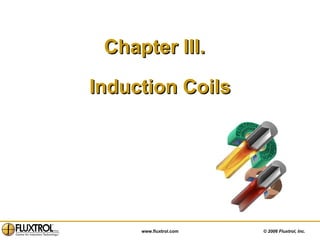
Chapter III.  Induction Coils
Requirements for Induction Coils They must: Meet specifications to temperature distribution  Have good electrical efficiency Have a satisfactory life time Provide desired production rate Have favorable parameters for efficient energy supply, such as high impedance and power factor Have low sensitivity to changes in the part dimensions and positioning in specified range Meet special requirements (quenchant supply, atmosphere, material handling, incorporation into the machine, etc.) Have reasonable cost In many cases magnetic flux controllers are required to achieve these goals Induction Coils are the work tools of induction installations. Cost Benefits
Advanced Induction Coil Design Advanced induction coils design includes: Detailed analysis of specifications, available equipment and environment Sometimes a “ Design For Induction Heating ” Strategy may be applied: Modification of heat pattern specs Part geometry modification  Part material change (if possible) Sequence of operations Coil style and heating process selection (scanning, single-shot, static etc.) Computer simulation for coil head optimization Analysis of benefits of magnetic flux controllers application  Coil engineering (design of coil head, leads, structural components, quenchant supply etc.) Advanced manufacturing techniques Tests in laboratory or industrial plant  for performance Final corrections if required Induction coils are essential components of the whole installation and their design and manufacturing quality are very important.
Example of Improved Design of Induction Coil Modern Addition:  But it is difficult to make a coil that fits or exceeds the modern customer expectations!  Magnetic flux control can play a key role in optimal coil design  Quote: “ It is difficult to make a coil that does not work at all” Anatoly Smirnov, old coil master, 1958 Example of coil optimization using flux controller Original induction coil for plastic coating application of stub shafts produced improper temperature distribution and was subjected to mechanical damage by parts. New potted coil (left) with local Fluxtrol controller and stainless steel protective cap provides excellent heat pattern control, coil mechanical strength and improved efficiency. Fluxtrol ring
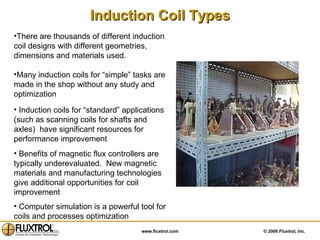
Induction Coil Types There are thousands of different induction coil designs with different geometries, dimensions and materials used. Many induction coils for “simple” tasks are made in the shop without any study and optimization Induction coils for “standard” applications (such as scanning coils for shafts and axles)  have significant resources for performance improvement  Benefits of magnetic flux controllers are typically underevaluated.  New magnetic materials and manufacturing technologies give additional opportunities for coil improvement  Computer simulation is a powerful tool for coils and processes optimization
Evolution from Transformer to Induction Coil Any induction coil may be considered as a “transformer” with a workpiece  as a short-circuited secondary winding.  Transformer with two layers of primary windings and short-circuited secondary (black) Transformer type of induction heating coil Multi-turn cylindrical coil with magnetic flux concentrator Single-turn cylindrical coil with magnetic flux concentrator c d b a
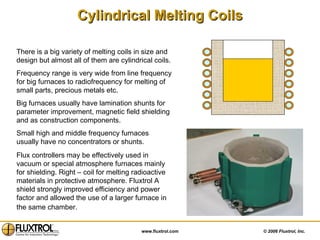
Cylindrical Melting Coils There is a big variety of melting coils in size and design but almost all of them are cylindrical coils. Frequency range is very wide from line frequency for big furnaces to radiofrequency for melting of small parts, precious metals etc. Big furnaces usually have lamination shunts for parameter improvement, magnetic field shielding and as construction components. Small high and middle frequency furnaces usually have no concentrators or shunts. Flux controllers may be effectively used in vacuum or special atmosphere furnaces mainly for shielding. Right – coil for melting radioactive materials in protective atmosphere. Fluxtrol A shield strongly improved efficiency and power factor and allowed the use of a larger furnace in the same chamber.
Cylindrical Multi-turn Forging Coil Multi-turn cylindrical or oval coils are used for heating billets, rods and slabs for forging. Typically they have thermal insulation (lining) to reduce heat loss and to protect winding  Application of external concentrators cannot improve parameters of long forging  coils. Lamination shunts are used sometimes at low frequency to provide rigid frame withstanding electrodynamic forces and to reduce strong external magnetic fields Local controllers may be used at the coil ends to control temperature distribution in the part and to protect handling mechanisms (rolls etc.) from unintended heating  Multi-turn forging induction coil Courtesy VNIITVCh, St. Petersburg, Russia
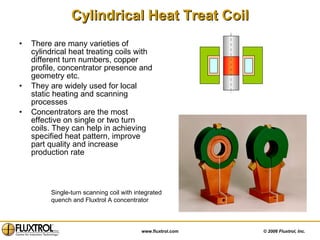
Cylindrical Heat Treat Coil There are many varieties of cylindrical heat treating coils with different turn numbers, copper profile, concentrator presence and geometry etc.  They are widely used for local static heating and scanning processes  Concentrators are the most effective on single or two turn coils. They can help in achieving specified heat pattern, improve part quality and increase production rate  Single-turn scanning coil with integrated quench and Fluxtrol A concentrator
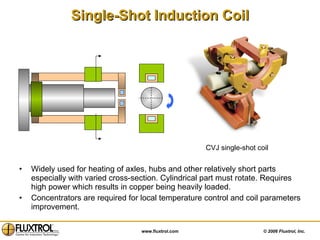
Single-Shot Induction Coil Widely used for heating of axles, hubs and other relatively short parts especially with varied cross-section. Cylindrical part must rotate. Requires high power which results in copper being heavily loaded. Concentrators are required for local temperature control and coil parameters improvement. CVJ single-shot coil
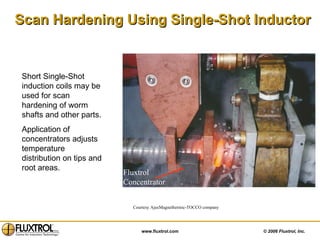
Scan Hardening Using Single-Shot Inductor Courtesy AjaxMagnethermic-TOCCO company Fluxtrol Concentrator Short Single-Shot induction coils may be used for scan hardening of worm shafts and other parts. Application of concentrators adjusts temperature distribution on tips and root areas.
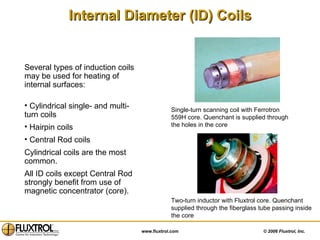
Internal Diameter (ID) Coils Single-turn scanning coil with Ferrotron 559H core. Quenchant is supplied through the holes in the core Two-turn inductor with Fluxtrol core. Quenchant supplied through the fiberglass tube passing inside the core Several types of induction coils may be used for heating of internal surfaces: Cylindrical single- and multi-turn coils Hairpin coils Central Rod coils Cylindrical coils are the most common.  All ID coils except Central Rod strongly benefit from use of magnetic concentrator (core).
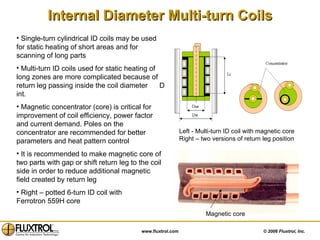
Internal Diameter Multi-turn Coils Left - Multi-turn ID coil with magnetic core  Right – two versions of return leg position Single-turn cylindrical ID coils may be used for static heating of short areas and for scanning of long parts Multi-turn ID coils used for static heating of long zones are more complicated because of return leg passing inside the coil diameter  D int.  Magnetic concentrator (core) is critical for improvement of coil efficiency, power factor and current demand. Poles on the concentrator are recommended for better parameters and heat pattern control It is recommended to make magnetic core of two parts with gap or shift return leg to the coil side in order to reduce additional magnetic field created by return leg Right – potted 6-turn ID coil with  Ferrotron 559H core Magnetic core
Example of I.D. Inductor with External Cooling Ring Quenchant inlet  External  cooling  of a part Coil copper cooling Fluxtrol core This multi-turn ID coil for surface hardening of a thin-wall part has an external cooling ring to control hardness depth. Quenchant is supplied through the magnetic core with outlet holes between the coil turns and in the end area of the core.
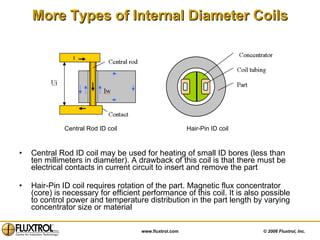
More Types of Internal Diameter Coils Central Rod ID coil may be used for heating of small ID bores (less than ten millimeters in diameter). A drawback of this coil is that there must be electrical contacts in current circuit to insert and remove the part Hair-Pin ID coil requires rotation of the part. Magnetic flux concentrator (core) is necessary for efficient performance of this coil. It is also possible to control power and temperature distribution in the part length by varying concentrator size or material Central Rod ID coil    Hair-Pin ID coil
Hair-Pin and Split-n-Return Coils Hair-Pin coils are widely used for scanning heating of flat surfaces. Concentrator strongly improves coil efficiency and power factor Split –and-Return coils can heat almost rectangular straight zone. May be used for static heating and for scanning mainly in longitudinal direction (tube seam annealing etc.) Concentrator is strongly recommended for these coils for heating zone control and parameter improvement This coil is slightly more efficient than Vertical Loop coil but is more bulky
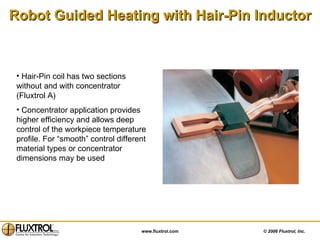
Robot Guided Heating with Hair-Pin Inductor Hair-Pin coil has two sections without and with concentrator (Fluxtrol A) Concentrator application provides higher efficiency and allows deep control of the workpiece temperature profile. For “smooth” control different material types or concentrator dimensions may be used
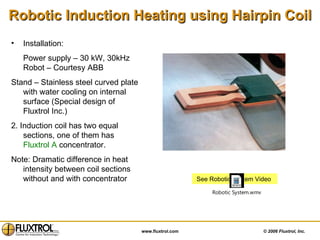
Robotic Induction Heating using Hairpin Coil Installation: Power supply – 30 kW, 30kHz Robot – Courtesy ABB Stand – Stainless steel curved plate with water cooling on internal surface (Special design of Fluxtrol Inc.) 2. Induction coil has two equal sections, one of them has  Fluxtrol A  concentrator.  Note: Dramatic difference in heat intensity between coil sections without and with concentrator See Robotic System Video
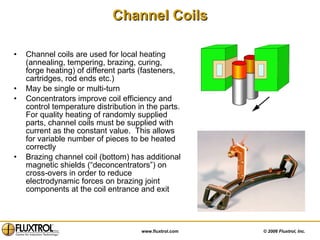
Channel Coils Channel coils are used for local heating (annealing, tempering, brazing, curing, forge heating) of different parts (fasteners, cartridges, rod ends etc.) May be single or multi-turn Concentrators improve coil efficiency and control temperature distribution in the parts. For quality heating of randomly supplied parts, channel coils must be supplied with current as the constant value.  This allows for variable number of pieces to be heated correctly Brazing channel coil (bottom) has additional magnetic shields (“deconcentrators”) on cross-overs in order to reduce electrodynamic forces on brazing joint components at the coil entrance and exit
Two-turn Channel Coil for Mass Heating Beam heating before bending operation Local Fluxtrol A concentrators with protective casings
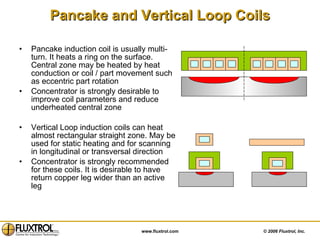
Pancake and Vertical Loop Coils Pancake induction coil is usually multi-turn. It heats a ring on the surface. Central zone may be heated by heat conduction or coil / part movement such as eccentric part rotation  Concentrator is strongly desirable to improve coil parameters and reduce underheated central zone Vertical Loop induction coils can heat almost rectangular straight zone. May be used for static heating and for scanning in longitudinal or transversal direction  Concentrator is strongly recommended for these coils. It is desirable to have return copper leg wider than an active leg
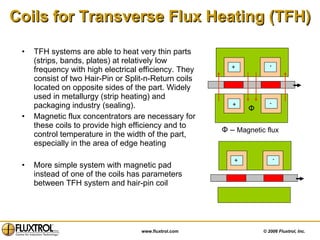
Coils for Transverse Flux Heating (TFH) TFH systems are able to heat very thin parts (strips, bands, plates) at relatively low frequency with high electrical efficiency. They consist of two Hair-Pin or Split-n-Return coils located on opposite sides of the part. Widely used in metallurgy (strip heating) and packaging industry (sealing). Magnetic flux concentrators are necessary for these coils to provide high efficiency and to control temperature in the width of the part, especially in the area of edge heating More simple system with magnetic pad instead of one of the coils has parameters between TFH system and hair-pin coil  Ф Ф  –  Magnetic flux + + . . + .
More Induction Coils Many induction coils have complex geometry, which may be composed of  several standard types.  This Horse-shoe induction coil was developed for an automotive aluminum heat exchanger in a brazing operation “tube to pipe”. It may be considered as a combination of half-cylindrical coil with two hair-pin coils. Magnetic controllers are critical for these coils in general and for this application particularly. They permit consistent joint quality with significant coil parameter improvement. Different joints may be brazed with the same coil copper by modifying controllers only.

CHAPTER 3: Induction Coil Design

  • 1.
    Chapter III. Induction Coils
  • 2.
    Requirements for InductionCoils They must: Meet specifications to temperature distribution Have good electrical efficiency Have a satisfactory life time Provide desired production rate Have favorable parameters for efficient energy supply, such as high impedance and power factor Have low sensitivity to changes in the part dimensions and positioning in specified range Meet special requirements (quenchant supply, atmosphere, material handling, incorporation into the machine, etc.) Have reasonable cost In many cases magnetic flux controllers are required to achieve these goals Induction Coils are the work tools of induction installations. Cost Benefits
  • 3.
    Advanced Induction CoilDesign Advanced induction coils design includes: Detailed analysis of specifications, available equipment and environment Sometimes a “ Design For Induction Heating ” Strategy may be applied: Modification of heat pattern specs Part geometry modification Part material change (if possible) Sequence of operations Coil style and heating process selection (scanning, single-shot, static etc.) Computer simulation for coil head optimization Analysis of benefits of magnetic flux controllers application Coil engineering (design of coil head, leads, structural components, quenchant supply etc.) Advanced manufacturing techniques Tests in laboratory or industrial plant for performance Final corrections if required Induction coils are essential components of the whole installation and their design and manufacturing quality are very important.
  • 4.
    Example of ImprovedDesign of Induction Coil Modern Addition: But it is difficult to make a coil that fits or exceeds the modern customer expectations! Magnetic flux control can play a key role in optimal coil design Quote: “ It is difficult to make a coil that does not work at all” Anatoly Smirnov, old coil master, 1958 Example of coil optimization using flux controller Original induction coil for plastic coating application of stub shafts produced improper temperature distribution and was subjected to mechanical damage by parts. New potted coil (left) with local Fluxtrol controller and stainless steel protective cap provides excellent heat pattern control, coil mechanical strength and improved efficiency. Fluxtrol ring
  • 5.
    Induction Coil TypesThere are thousands of different induction coil designs with different geometries, dimensions and materials used. Many induction coils for “simple” tasks are made in the shop without any study and optimization Induction coils for “standard” applications (such as scanning coils for shafts and axles) have significant resources for performance improvement Benefits of magnetic flux controllers are typically underevaluated. New magnetic materials and manufacturing technologies give additional opportunities for coil improvement Computer simulation is a powerful tool for coils and processes optimization
  • 6.
    Evolution from Transformerto Induction Coil Any induction coil may be considered as a “transformer” with a workpiece as a short-circuited secondary winding. Transformer with two layers of primary windings and short-circuited secondary (black) Transformer type of induction heating coil Multi-turn cylindrical coil with magnetic flux concentrator Single-turn cylindrical coil with magnetic flux concentrator c d b a
  • 7.
    Cylindrical Melting CoilsThere is a big variety of melting coils in size and design but almost all of them are cylindrical coils. Frequency range is very wide from line frequency for big furnaces to radiofrequency for melting of small parts, precious metals etc. Big furnaces usually have lamination shunts for parameter improvement, magnetic field shielding and as construction components. Small high and middle frequency furnaces usually have no concentrators or shunts. Flux controllers may be effectively used in vacuum or special atmosphere furnaces mainly for shielding. Right – coil for melting radioactive materials in protective atmosphere. Fluxtrol A shield strongly improved efficiency and power factor and allowed the use of a larger furnace in the same chamber.
  • 8.
    Cylindrical Multi-turn ForgingCoil Multi-turn cylindrical or oval coils are used for heating billets, rods and slabs for forging. Typically they have thermal insulation (lining) to reduce heat loss and to protect winding Application of external concentrators cannot improve parameters of long forging coils. Lamination shunts are used sometimes at low frequency to provide rigid frame withstanding electrodynamic forces and to reduce strong external magnetic fields Local controllers may be used at the coil ends to control temperature distribution in the part and to protect handling mechanisms (rolls etc.) from unintended heating Multi-turn forging induction coil Courtesy VNIITVCh, St. Petersburg, Russia
  • 9.
    Cylindrical Heat TreatCoil There are many varieties of cylindrical heat treating coils with different turn numbers, copper profile, concentrator presence and geometry etc. They are widely used for local static heating and scanning processes Concentrators are the most effective on single or two turn coils. They can help in achieving specified heat pattern, improve part quality and increase production rate Single-turn scanning coil with integrated quench and Fluxtrol A concentrator
  • 10.
    Single-Shot Induction CoilWidely used for heating of axles, hubs and other relatively short parts especially with varied cross-section. Cylindrical part must rotate. Requires high power which results in copper being heavily loaded. Concentrators are required for local temperature control and coil parameters improvement. CVJ single-shot coil
  • 11.
    Scan Hardening UsingSingle-Shot Inductor Courtesy AjaxMagnethermic-TOCCO company Fluxtrol Concentrator Short Single-Shot induction coils may be used for scan hardening of worm shafts and other parts. Application of concentrators adjusts temperature distribution on tips and root areas.
  • 12.
    Internal Diameter (ID)Coils Single-turn scanning coil with Ferrotron 559H core. Quenchant is supplied through the holes in the core Two-turn inductor with Fluxtrol core. Quenchant supplied through the fiberglass tube passing inside the core Several types of induction coils may be used for heating of internal surfaces: Cylindrical single- and multi-turn coils Hairpin coils Central Rod coils Cylindrical coils are the most common. All ID coils except Central Rod strongly benefit from use of magnetic concentrator (core).
  • 13.
    Internal Diameter Multi-turnCoils Left - Multi-turn ID coil with magnetic core Right – two versions of return leg position Single-turn cylindrical ID coils may be used for static heating of short areas and for scanning of long parts Multi-turn ID coils used for static heating of long zones are more complicated because of return leg passing inside the coil diameter D int. Magnetic concentrator (core) is critical for improvement of coil efficiency, power factor and current demand. Poles on the concentrator are recommended for better parameters and heat pattern control It is recommended to make magnetic core of two parts with gap or shift return leg to the coil side in order to reduce additional magnetic field created by return leg Right – potted 6-turn ID coil with Ferrotron 559H core Magnetic core
  • 14.
    Example of I.D.Inductor with External Cooling Ring Quenchant inlet External cooling of a part Coil copper cooling Fluxtrol core This multi-turn ID coil for surface hardening of a thin-wall part has an external cooling ring to control hardness depth. Quenchant is supplied through the magnetic core with outlet holes between the coil turns and in the end area of the core.
  • 15.
    More Types ofInternal Diameter Coils Central Rod ID coil may be used for heating of small ID bores (less than ten millimeters in diameter). A drawback of this coil is that there must be electrical contacts in current circuit to insert and remove the part Hair-Pin ID coil requires rotation of the part. Magnetic flux concentrator (core) is necessary for efficient performance of this coil. It is also possible to control power and temperature distribution in the part length by varying concentrator size or material Central Rod ID coil Hair-Pin ID coil
  • 16.
    Hair-Pin and Split-n-ReturnCoils Hair-Pin coils are widely used for scanning heating of flat surfaces. Concentrator strongly improves coil efficiency and power factor Split –and-Return coils can heat almost rectangular straight zone. May be used for static heating and for scanning mainly in longitudinal direction (tube seam annealing etc.) Concentrator is strongly recommended for these coils for heating zone control and parameter improvement This coil is slightly more efficient than Vertical Loop coil but is more bulky
  • 17.
    Robot Guided Heatingwith Hair-Pin Inductor Hair-Pin coil has two sections without and with concentrator (Fluxtrol A) Concentrator application provides higher efficiency and allows deep control of the workpiece temperature profile. For “smooth” control different material types or concentrator dimensions may be used
  • 18.
    Robotic Induction Heatingusing Hairpin Coil Installation: Power supply – 30 kW, 30kHz Robot – Courtesy ABB Stand – Stainless steel curved plate with water cooling on internal surface (Special design of Fluxtrol Inc.) 2. Induction coil has two equal sections, one of them has Fluxtrol A concentrator. Note: Dramatic difference in heat intensity between coil sections without and with concentrator See Robotic System Video
  • 19.
    Channel Coils Channelcoils are used for local heating (annealing, tempering, brazing, curing, forge heating) of different parts (fasteners, cartridges, rod ends etc.) May be single or multi-turn Concentrators improve coil efficiency and control temperature distribution in the parts. For quality heating of randomly supplied parts, channel coils must be supplied with current as the constant value. This allows for variable number of pieces to be heated correctly Brazing channel coil (bottom) has additional magnetic shields (“deconcentrators”) on cross-overs in order to reduce electrodynamic forces on brazing joint components at the coil entrance and exit
  • 20.
    Two-turn Channel Coilfor Mass Heating Beam heating before bending operation Local Fluxtrol A concentrators with protective casings
  • 21.
    Pancake and VerticalLoop Coils Pancake induction coil is usually multi-turn. It heats a ring on the surface. Central zone may be heated by heat conduction or coil / part movement such as eccentric part rotation Concentrator is strongly desirable to improve coil parameters and reduce underheated central zone Vertical Loop induction coils can heat almost rectangular straight zone. May be used for static heating and for scanning in longitudinal or transversal direction Concentrator is strongly recommended for these coils. It is desirable to have return copper leg wider than an active leg
  • 22.
    Coils for TransverseFlux Heating (TFH) TFH systems are able to heat very thin parts (strips, bands, plates) at relatively low frequency with high electrical efficiency. They consist of two Hair-Pin or Split-n-Return coils located on opposite sides of the part. Widely used in metallurgy (strip heating) and packaging industry (sealing). Magnetic flux concentrators are necessary for these coils to provide high efficiency and to control temperature in the width of the part, especially in the area of edge heating More simple system with magnetic pad instead of one of the coils has parameters between TFH system and hair-pin coil Ф Ф – Magnetic flux + + . . + .
  • 23.
    More Induction CoilsMany induction coils have complex geometry, which may be composed of several standard types. This Horse-shoe induction coil was developed for an automotive aluminum heat exchanger in a brazing operation “tube to pipe”. It may be considered as a combination of half-cylindrical coil with two hair-pin coils. Magnetic controllers are critical for these coils in general and for this application particularly. They permit consistent joint quality with significant coil parameter improvement. Different joints may be brazed with the same coil copper by modifying controllers only.