Effect of Spray Quenching Rate on Distortion
and Residual Stresses during Induction
Hardening of a Full-Float truck Axle
Zhichao (Charlie) Li, and B. Lynn Ferguson
DANTE SOFTWARE, Cleveland, OH 44130, USA
Valentin Nemkov, Robert Goldstein, and John Jackowski
Fluxtrol, Inc. 1399 Atlantic Blvd, Auburn Hills, MI 28326, USA
Greg Fett
Dana Corporation, 3939 Technology Drive, Maumee, OH43537,
USA

ASM HTS 2013, 27th Conference and Exposition
15 September – 18 September 2013, Indianapolis, Indiana, USA
Introduction
 Induction hardening involves multiple phenomena,
including: electromagnetic, thermal, metallurgical,
stress and deformation.
 Flux software (electromagnetic and thermal
capabilities) is coupled with DANTE (thermal, phase
transformation, stress and distortion capabilities).
 Case chosen for study is a full-float axle, dimensions
typical for axles manufactured and hardened by Dana
Corporation.
 This study is a follow-up of the work presented at HES
2013, Padua, Italy.
 Effect of spray quenching rate on residual stresses and
distortion.
Slide 2
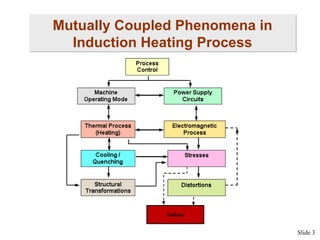
Mutually Coupled Phenomena in
Induction Heating Process

Slide 3
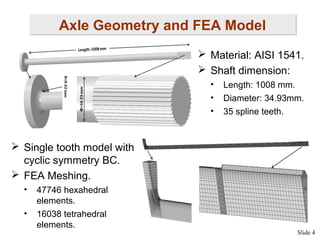
Axle Geometry and FEA Model
 Material: AISI 1541.
 Shaft dimension:
•
•
•

Length: 1008 mm.
Diameter: 34.93mm.
35 spline teeth.

 Single tooth model with
cyclic symmetry BC.
 FEA Meshing.
•
•

47746 hexahedral
elements.
16038 tetrahedral
elements.

Slide 4
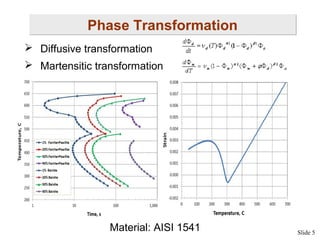
Phase Transformation
 Diffusive transformation
 Martensitic transformation

Material: AISI 1541

Slide 5
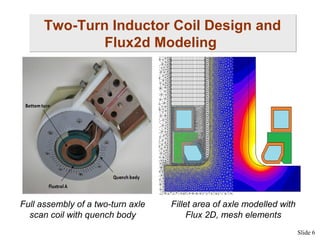
Two-Turn Inductor Coil Design and
Flux2d Modeling

Full assembly of a two-turn axle
scan coil with quench body

Fillet area of axle modelled with
Flux 2D, mesh elements
Slide 6
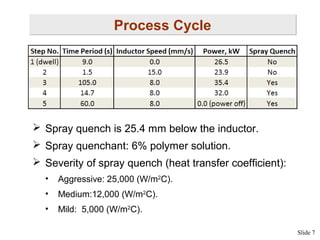
Process Cycle

 Spray quench is 25.4 mm below the inductor.
 Spray quenchant: 6% polymer solution.
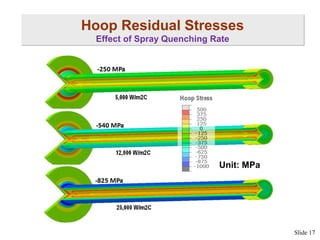
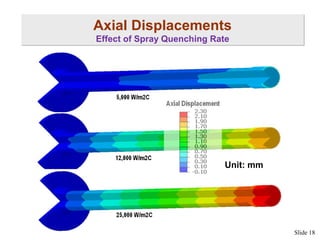
 Severity of spray quench (heat transfer coefficient):
•

Aggressive: 25,000 (W/m2C).

•

Medium:12,000 (W/m2C).

•

Mild: 5,000 (W/m2C).
Slide 7
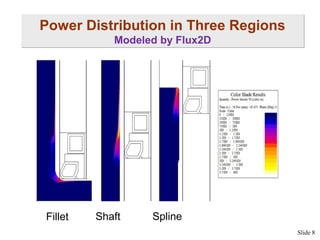
Power Distribution in Three Regions
Modeled by Flux2D

Fillet

Shaft

Spline
Slide 8
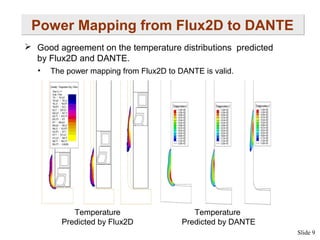
Power Mapping from Flux2D to DANTE
 Good agreement on the temperature distributions predicted
by Flux2D and DANTE.
•

The power mapping from Flux2D to DANTE is valid.

Temperature
Predicted by Flux2D

Temperature
Predicted by DANTE
Slide 9
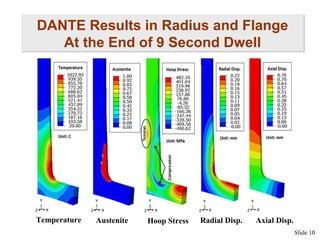
DANTE Results in Radius and Flange
At the End of 9 Second Dwell

Temperature

Austenite

Hoop Stress

Radial Disp.

Axial Disp.
Slide 10
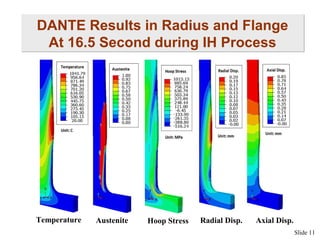
DANTE Results in Radius and Flange
At 16.5 Second during IH Process

Temperature

Austenite

Hoop Stress

Radial Disp.

Axial Disp.
Slide 11
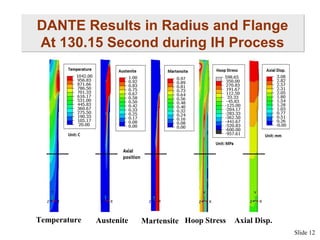
DANTE Results in Radius and Flange
At 130.15 Second during IH Process

Temperature

Austenite

Martensite Hoop Stress

Axial Disp.
Slide 12
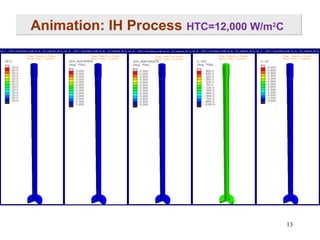
Animation: IH Process HTC=12,000 W/m2C

13
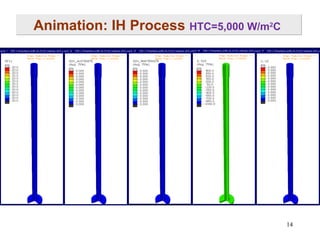
Animation: IH Process HTC=5,000 W/m2C

14
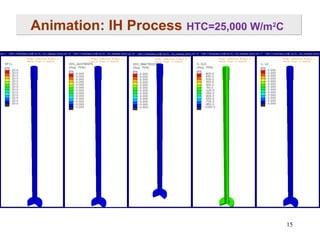
Animation: IH Process HTC=25,000 W/m2C

15
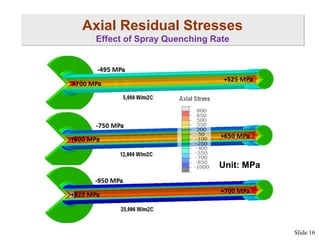
Axial Residual Stresses
Effect of Spray Quenching Rate

Unit: MPa

Slide 16
Hoop Residual Stresses
Effect of Spray Quenching Rate

Unit: MPa

Slide 17
Axial Displacements
Effect of Spray Quenching Rate

Unit: mm

Slide 18
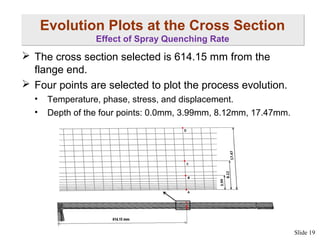
Evolution Plots at the Cross Section
Effect of Spray Quenching Rate

 The cross section selected is 614.15 mm from the
flange end.
 Four points are selected to plot the process evolution.
•
•

Temperature, phase, stress, and displacement.
Depth of the four points: 0.0mm, 3.99mm, 8.12mm, 17.47mm.

Slide 19
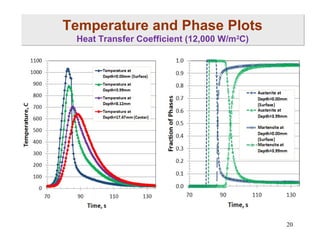
Temperature and Phase Plots
Heat Transfer Coefficient (12,000 W/m2C)

20
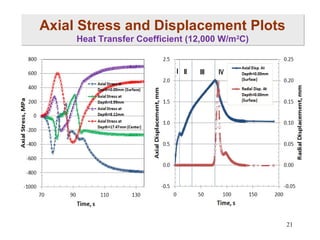
Axial Stress and Displacement Plots
Heat Transfer Coefficient (12,000 W/m2C)

21
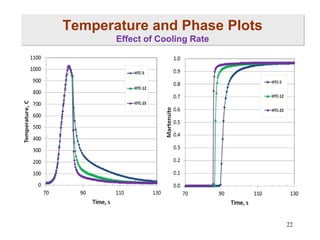
Temperature and Phase Plots
Effect of Cooling Rate

22
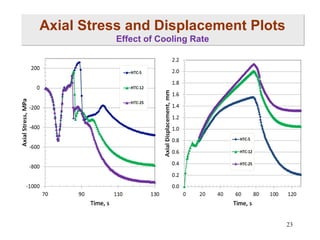
Axial Stress and Displacement Plots
Effect of Cooling Rate

23
Summary
 Electromagnetic modeling by Flux and thermal/stress
modeling by DANTE were successfully coupled.
 The effect of spray quenching severity on residual
stresses and distortion are predicted.
 Higher spray rate increases the magnitudes of surface
compression, core tension, as well as the length growth.
 The modelling procedure developed in this study is
promising for design optimization, in-process failure
prevention, and service property prediction.
 Next step: tempering process modeling; loading model
with residual stresses; comparing with low cycle and
high cycle fatigue life experiments.
24

Presentation on Effect of Spray Quenching Rate on Distortion and Residual Stresses during Induction Hardening of a Full-Float Truck Axle

  • 1.
    Effect of SprayQuenching Rate on Distortion and Residual Stresses during Induction Hardening of a Full-Float truck Axle Zhichao (Charlie) Li, and B. Lynn Ferguson DANTE SOFTWARE, Cleveland, OH 44130, USA Valentin Nemkov, Robert Goldstein, and John Jackowski Fluxtrol, Inc. 1399 Atlantic Blvd, Auburn Hills, MI 28326, USA Greg Fett Dana Corporation, 3939 Technology Drive, Maumee, OH43537, USA ASM HTS 2013, 27th Conference and Exposition 15 September – 18 September 2013, Indianapolis, Indiana, USA
  • 2.
    Introduction  Induction hardeninginvolves multiple phenomena, including: electromagnetic, thermal, metallurgical, stress and deformation.  Flux software (electromagnetic and thermal capabilities) is coupled with DANTE (thermal, phase transformation, stress and distortion capabilities).  Case chosen for study is a full-float axle, dimensions typical for axles manufactured and hardened by Dana Corporation.  This study is a follow-up of the work presented at HES 2013, Padua, Italy.  Effect of spray quenching rate on residual stresses and distortion. Slide 2
  • 3.
    Mutually Coupled Phenomenain Induction Heating Process Slide 3
  • 4.
    Axle Geometry andFEA Model  Material: AISI 1541.  Shaft dimension: • • • Length: 1008 mm. Diameter: 34.93mm. 35 spline teeth.  Single tooth model with cyclic symmetry BC.  FEA Meshing. • • 47746 hexahedral elements. 16038 tetrahedral elements. Slide 4
  • 5.
    Phase Transformation  Diffusivetransformation  Martensitic transformation Material: AISI 1541 Slide 5
  • 6.
    Two-Turn Inductor CoilDesign and Flux2d Modeling Full assembly of a two-turn axle scan coil with quench body Fillet area of axle modelled with Flux 2D, mesh elements Slide 6
  • 7.
    Process Cycle  Sprayquench is 25.4 mm below the inductor.  Spray quenchant: 6% polymer solution.  Severity of spray quench (heat transfer coefficient): • Aggressive: 25,000 (W/m2C). • Medium:12,000 (W/m2C). • Mild: 5,000 (W/m2C). Slide 7
  • 8.
    Power Distribution inThree Regions Modeled by Flux2D Fillet Shaft Spline Slide 8
  • 9.
    Power Mapping fromFlux2D to DANTE  Good agreement on the temperature distributions predicted by Flux2D and DANTE. • The power mapping from Flux2D to DANTE is valid. Temperature Predicted by Flux2D Temperature Predicted by DANTE Slide 9
  • 10.
    DANTE Results inRadius and Flange At the End of 9 Second Dwell Temperature Austenite Hoop Stress Radial Disp. Axial Disp. Slide 10
  • 11.
    DANTE Results inRadius and Flange At 16.5 Second during IH Process Temperature Austenite Hoop Stress Radial Disp. Axial Disp. Slide 11
  • 12.
    DANTE Results inRadius and Flange At 130.15 Second during IH Process Temperature Austenite Martensite Hoop Stress Axial Disp. Slide 12
  • 13.
    Animation: IH ProcessHTC=12,000 W/m2C 13
  • 14.
    Animation: IH ProcessHTC=5,000 W/m2C 14
  • 15.
    Animation: IH ProcessHTC=25,000 W/m2C 15
  • 16.
    Axial Residual Stresses Effectof Spray Quenching Rate Unit: MPa Slide 16
  • 17.
    Hoop Residual Stresses Effectof Spray Quenching Rate Unit: MPa Slide 17
  • 18.
    Axial Displacements Effect ofSpray Quenching Rate Unit: mm Slide 18
  • 19.
    Evolution Plots atthe Cross Section Effect of Spray Quenching Rate  The cross section selected is 614.15 mm from the flange end.  Four points are selected to plot the process evolution. • • Temperature, phase, stress, and displacement. Depth of the four points: 0.0mm, 3.99mm, 8.12mm, 17.47mm. Slide 19
  • 20.
    Temperature and PhasePlots Heat Transfer Coefficient (12,000 W/m2C) 20
  • 21.
    Axial Stress andDisplacement Plots Heat Transfer Coefficient (12,000 W/m2C) 21
  • 22.
    Temperature and PhasePlots Effect of Cooling Rate 22
  • 23.
    Axial Stress andDisplacement Plots Effect of Cooling Rate 23
  • 24.
    Summary  Electromagnetic modelingby Flux and thermal/stress modeling by DANTE were successfully coupled.  The effect of spray quenching severity on residual stresses and distortion are predicted.  Higher spray rate increases the magnitudes of surface compression, core tension, as well as the length growth.  The modelling procedure developed in this study is promising for design optimization, in-process failure prevention, and service property prediction.  Next step: tempering process modeling; loading model with residual stresses; comparing with low cycle and high cycle fatigue life experiments. 24