TEMPERATURE PREDICTION
AND THERMAL MANAGEMENT
 FOR COMPOSITE MAGNETIC
CONTROLLERS OF INDUCTION
         COILS
V. Nemkov, R. Goldstein, J. Jackowski, N. Vyshinskaya, C. Yakey
 Fluxtrol, Inc., 1388 Atlantic Blvd, Auburn Hills, Michigan 48326,
                                 USA
Overview
• Composite Magnetic Controllers for
  Induction Coils
• Specialty Material Fluxtrol 75
• Temperature Prediction via Computer
  Simulation
• Methods of Temperature Control
• Examples of Application
• Conclusions
Composite Materials for Magnetic
             Controllers
Fluxtrol magnetic composites are premium materials widely
used in induction devices due to excellent machinability, ability
to work in 3D field and at any frequency (even at 13.56 MHz)
Temperature prediction and management are very important
for reliable performance of inductors
Controller temperature depends upon its geometry,
magnetic losses, material thermal conductivity and
boundary conditions
New specialty material Fluxtrol 75 with high thermal
conductivity was recently developed in addition to three
main materials (Fluxtrol A, Fluxtrol 50 and Ferrotron 559)
Specialty Material Fluxtrol 75
        10000                                             80
                                                                   μ
                                                          70
        8000
                                                          60
        6000                                              50
B, Gs


                                                          40
        4000
                                                          30
        2000                                              20
                                              H, A/cm
                                                          10
                                                                                              B, Gs
           0                                               0
                0   20   40   60   80   100   120   140        0       2000   4000   6000   8000   10000


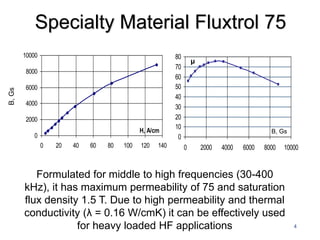
           Formulated for middle to high frequencies (30-400
        kHz), it has maximum permeability of 75 and saturation
        flux density 1.5 T. Due to high permeability and thermal
        conductivity (λ = 0.16 W/cmK) it can be effectively used
                    for heavy loaded HF applications                                                  4
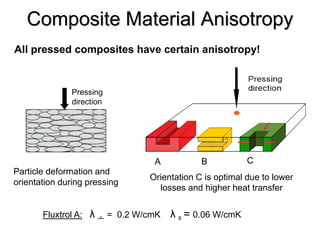
Composite Material Anisotropy
All pressed composites have certain anisotropy!


               Pressing
               direction


                                A           B           C
Particle deformation and
                               Orientation C is optimal due to lower
orientation during pressing
                                 losses and higher heat transfer


       Fluxtrol A: λ ᅩ = 0.2 W/cmK   λ ॥ = 0.06 W/cmK
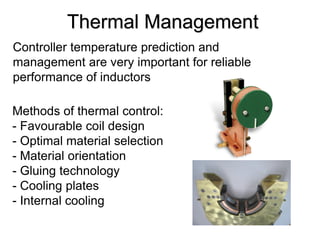
Thermal Management
Controller temperature prediction and
management are very important for reliable
performance of inductors

Methods of thermal control:
- Favourable coil design
- Optimal material selection
- Material orientation
- Gluing technology
- Cooling plates
- Internal cooling
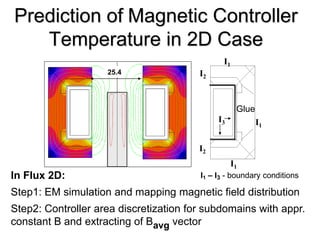
Prediction of Magnetic Controller
   Temperature in 2D Case
                                              I1
                    25.4                I2


                                                    Glue
                                             I3            I1

                                        I2
                                                   I1
In Flux 2D:                             I1 – I3 - boundary conditions

Step1: EM simulation and mapping magnetic field distribution
Step2: Controller area discretization for subdomains with appr.
constant B and extracting of Bavg vector
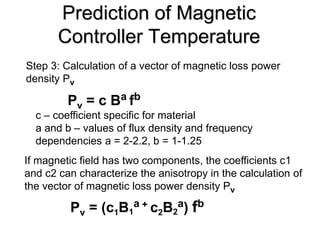
Prediction of Magnetic
       Controller Temperature
Step 3: Calculation of a vector of magnetic loss power
density Pv

         Pv = c B a fb
  c – coefficient specific for material
  a and b – values of flux density and frequency
  dependencies a = 2-2.2, b = 1-1.25
If magnetic field has two components, the coefficients c1
and c2 can characterize the anisotropy in the calculation of
the vector of magnetic loss power density Pv

         Pv = (c1B1a + c2B2a) fb
Prediction of Magnetic
        Controller Temperature
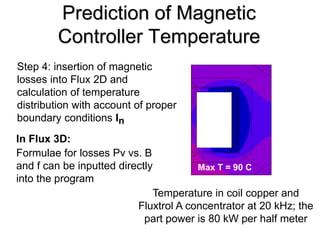
Step 4: insertion of magnetic
losses into Flux 2D and
calculation of temperature
distribution with account of proper
boundary conditions In
In Flux 3D:
Formulae for losses Pv vs. B
and f can be inputted directly         Max T = 90 C
into the program
                              Temperature in coil copper and
                          Fluxtrol A concentrator at 20 kHz; the
                            part power is 80 kW per half meter
Prediction of Magnetic
          Controller Temperature

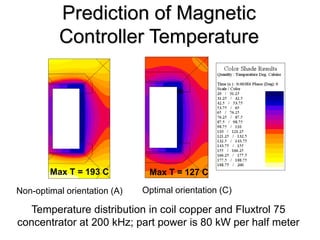
                                      III


        Max T = 193 C          Max T = 127 C

Non-optimal orientation (A)   Optimal orientation (C)

  Temperature distribution in coil copper and Fluxtrol 75
concentrator at 200 kHz; part power is 80 kW per half meter
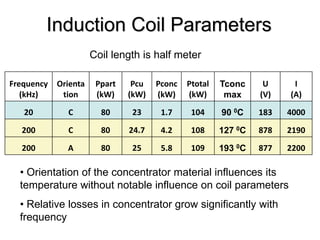
Induction Coil Parameters
                      Coil length is half meter

Frequency   Orienta    Ppart    Pcu   Pconc   Ptotal   Tconc     U     I
   (kHz)     tion      (kW)    (kW)   (kW)    (kW)      max     (V)   (A)

   20         C         80     23      1.7     104     90 0C    183   4000

  200         C         80     24.7    4.2     108     127 0C   878   2190

  200         A         80     25      5.8     109     193 0C   877   2200

  • Orientation of the concentrator material influences its
  temperature without notable influence on coil parameters
  • Relative losses in concentrator grow significantly with
  frequency
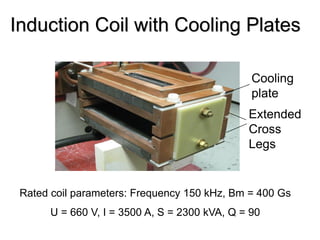
Induction Coil with Cooling Plates

                                                Cooling
                                                plate
                                               Extended
                                               Cross
                                               Legs


 Rated coil parameters: Frequency 150 kHz, Bm = 400 Gs
       U = 660 V, I = 3500 A, S = 2300 kVA, Q = 90
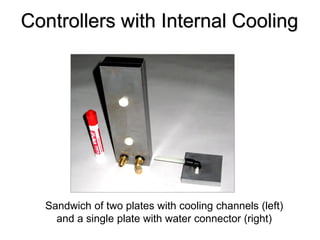
Controllers with Internal Cooling


  Sandwich of two plates with cooling channels (left)
    and a single plate with water connector (right)
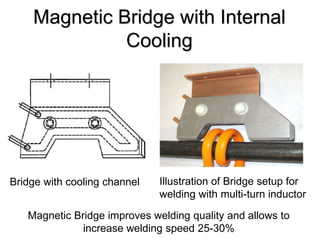
Magnetic Bridge with Internal
              Cooling


Bridge with cooling channel   Illustration of Bridge setup for
                              welding with multi-turn inductor

   Magnetic Bridge improves welding quality and allows to
              increase welding speed 25-30%
Summary
• Composite magnetic materials may be effectively
  used in the most challenging applications
• Computer simulation can predict the controller
  temperature with good accuracy
• Several methods of thermal management may be
  used to prevent controller overheating
• Internal cooling is one of the most effective
  methods
• More information about composite magnetic
  materials may be found @ www.fluxtrol.com

TEMPERATURE PREDICTION AND THERMAL MANAGEMENT FOR COMPOSITE MAGNETIC CONTROLLERS

  • 1.
    TEMPERATURE PREDICTION AND THERMALMANAGEMENT FOR COMPOSITE MAGNETIC CONTROLLERS OF INDUCTION COILS V. Nemkov, R. Goldstein, J. Jackowski, N. Vyshinskaya, C. Yakey Fluxtrol, Inc., 1388 Atlantic Blvd, Auburn Hills, Michigan 48326, USA
  • 2.
    Overview • Composite MagneticControllers for Induction Coils • Specialty Material Fluxtrol 75 • Temperature Prediction via Computer Simulation • Methods of Temperature Control • Examples of Application • Conclusions
  • 3.
    Composite Materials forMagnetic Controllers Fluxtrol magnetic composites are premium materials widely used in induction devices due to excellent machinability, ability to work in 3D field and at any frequency (even at 13.56 MHz) Temperature prediction and management are very important for reliable performance of inductors Controller temperature depends upon its geometry, magnetic losses, material thermal conductivity and boundary conditions New specialty material Fluxtrol 75 with high thermal conductivity was recently developed in addition to three main materials (Fluxtrol A, Fluxtrol 50 and Ferrotron 559)
  • 4.
    Specialty Material Fluxtrol75 10000 80 μ 70 8000 60 6000 50 B, Gs 40 4000 30 2000 20 H, A/cm 10 B, Gs 0 0 0 20 40 60 80 100 120 140 0 2000 4000 6000 8000 10000 Formulated for middle to high frequencies (30-400 kHz), it has maximum permeability of 75 and saturation flux density 1.5 T. Due to high permeability and thermal conductivity (λ = 0.16 W/cmK) it can be effectively used for heavy loaded HF applications 4
  • 5.
    Composite Material Anisotropy Allpressed composites have certain anisotropy! Pressing direction A B C Particle deformation and Orientation C is optimal due to lower orientation during pressing losses and higher heat transfer Fluxtrol A: λ ᅩ = 0.2 W/cmK λ ॥ = 0.06 W/cmK
  • 6.
    Thermal Management Controller temperatureprediction and management are very important for reliable performance of inductors Methods of thermal control: - Favourable coil design - Optimal material selection - Material orientation - Gluing technology - Cooling plates - Internal cooling
  • 7.
    Prediction of MagneticController Temperature in 2D Case I1 25.4 I2 Glue I3 I1 I2 I1 In Flux 2D: I1 – I3 - boundary conditions Step1: EM simulation and mapping magnetic field distribution Step2: Controller area discretization for subdomains with appr. constant B and extracting of Bavg vector
  • 8.
    Prediction of Magnetic Controller Temperature Step 3: Calculation of a vector of magnetic loss power density Pv Pv = c B a fb c – coefficient specific for material a and b – values of flux density and frequency dependencies a = 2-2.2, b = 1-1.25 If magnetic field has two components, the coefficients c1 and c2 can characterize the anisotropy in the calculation of the vector of magnetic loss power density Pv Pv = (c1B1a + c2B2a) fb
  • 9.
    Prediction of Magnetic Controller Temperature Step 4: insertion of magnetic losses into Flux 2D and calculation of temperature distribution with account of proper boundary conditions In In Flux 3D: Formulae for losses Pv vs. B and f can be inputted directly Max T = 90 C into the program Temperature in coil copper and Fluxtrol A concentrator at 20 kHz; the part power is 80 kW per half meter
  • 10.
    Prediction of Magnetic Controller Temperature III Max T = 193 C Max T = 127 C Non-optimal orientation (A) Optimal orientation (C) Temperature distribution in coil copper and Fluxtrol 75 concentrator at 200 kHz; part power is 80 kW per half meter
  • 11.
    Induction Coil Parameters Coil length is half meter Frequency Orienta Ppart Pcu Pconc Ptotal Tconc U I (kHz) tion (kW) (kW) (kW) (kW) max (V) (A) 20 C 80 23 1.7 104 90 0C 183 4000 200 C 80 24.7 4.2 108 127 0C 878 2190 200 A 80 25 5.8 109 193 0C 877 2200 • Orientation of the concentrator material influences its temperature without notable influence on coil parameters • Relative losses in concentrator grow significantly with frequency
  • 12.
    Induction Coil withCooling Plates Cooling plate Extended Cross Legs Rated coil parameters: Frequency 150 kHz, Bm = 400 Gs U = 660 V, I = 3500 A, S = 2300 kVA, Q = 90
  • 13.
    Controllers with InternalCooling Sandwich of two plates with cooling channels (left) and a single plate with water connector (right)
  • 14.
    Magnetic Bridge withInternal Cooling Bridge with cooling channel Illustration of Bridge setup for welding with multi-turn inductor Magnetic Bridge improves welding quality and allows to increase welding speed 25-30%
  • 15.
    Summary • Composite magneticmaterials may be effectively used in the most challenging applications • Computer simulation can predict the controller temperature with good accuracy • Several methods of thermal management may be used to prevent controller overheating • Internal cooling is one of the most effective methods • More information about composite magnetic materials may be found @ www.fluxtrol.com