Induction Heating
Principles
PRESENTATION
FC040K0068V1000UK
This document is property of CEIA which reserves all rights. Total or partial copying, modification and translation is forbidden
www.ceia-power.com
Main Applications of Induction Heating
¾ Hard (Silver) Brazing
¾ Tin Soldering
¾ Heat Treatment
(Hardening, Annealing, Tempering, …)
¾ Melting Applications (ferrous and non ferrous metal)
¾ Forging
This document is property of CEIA which reserves all rights. Total or partial copying, modification and translation is forbidden FC040K0068V1000UK
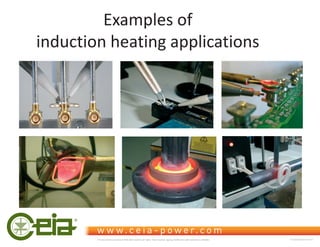
Examples of
induction heating applications
This document is property of CEIA which reserves all rights. Total or partial copying, modification and translation is forbidden FC040K0068V1000UK
Advantages of Induction
‡ Reduced Heating Time
‡ Localized Heating
‡ Efficient Energy Consumption
‡ Heating Process Controllable and Repeatable
‡ Improved Product Quality
‡ Safety for User
‡ Improving of the working condition
This document is property of CEIA which reserves all rights. Total or partial copying, modification and translation is forbidden FC040K0068V1000UK
Basics of Induction
‡ INDUCTIVE HEATING is based on the supply of
energy by means of electromagnetic induction.
‡ A coil, suitably dimensioned, placed close to the
metal parts to be heated, conducting high or
medium frequency alternated current, induces on
the work piece currents (eddy currents) whose
intensity can be controlled and modulated.
This document is property of CEIA which reserves all rights. Total or partial copying, modification and translation is forbidden FC040K0068V1000UK
Basics of induction
‡ The heating occurs without physical contact, it involves
only the metal parts to be treated and it is characterized
by a high efficiency transfer without loss of heat.
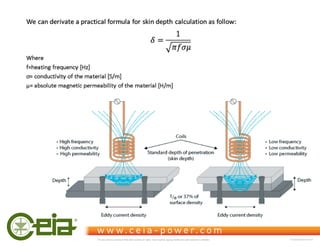
‡ The depth of penetration of the generated currents is
directly correlated to the working frequency of the
generator used; higher it is, much more the induced
currents concentrate on the surface. In this case, the
heating homogeneity on a relevant mass, can be obtained
due to the principle of thermal conduction which allows
the heating to be transferred in depth.
This document is property of CEIA which reserves all rights. Total or partial copying, modification and translation is forbidden FC040K0068V1000UK
Basics of Induction
The phenomenon of the electromagnetic induction is
therefore based on three physical principles, here below
explained:
1) Transfer of energy from the inductor to the piece to be
heated, by means of Electromagnetic Fields.
2) Transformation of the electric energy into heat due to
Joule effect. (P=I2R)
3) Transmission of the heat inside the mass by means of
Thermal Conduction.
This document is property of CEIA which reserves all rights. Total or partial copying, modification and translation is forbidden FC040K0068V1000UK
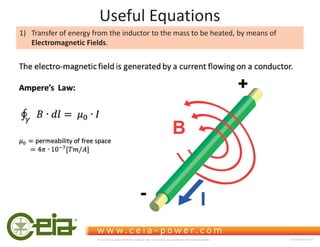
Useful Equations
1) Transfer of energy from the inductor to the mass to be heated, by means of
Electromagnetic Fields.
This document is property of CEIA which reserves all rights. Total or partial copying, modification and translation is forbidden FC040K0068V1000UK
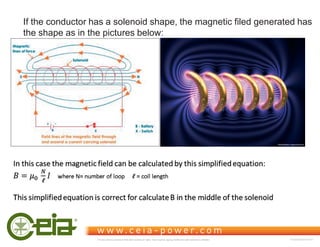
If the conductor has a solenoid shape, the magnetic filed generated has
the shape as in the pictures below:
This document is property of CEIA which reserves all rights. Total or partial copying, modification and translation is forbidden FC040K0068V1000UK
The Laplace Law states that the intensity of the magnetic field is reverse proportional to the square of the
distance.
In case of a single loop coil, the intensity of the magnetic flow at the point P, whose distance from the coil center is z,
Is given by the simplified equation:
0
5
10
15
20
25
30
35
0 1 2 3 4 5 6 7 8 9 10 11 12 13 14 15 16 17 18 19 20
B
[mT]
z = Coil Gap [mm]
Magnetic Field intensity vs. Coil distance
Coil = Ɍ 15mm
This document is property of CEIA which reserves all rights. Total or partial copying, modification and translation is forbidden FC040K0068V1000UK
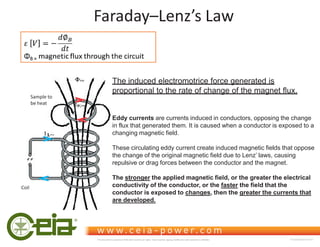
Faraday–Lenz’s Law
The induced electromotrice force generated is
proportional to the rate of change of the magnet flux.
Eddy currents are currents induced in conductors, opposing the change
in flux that generated them. It is caused when a conductor is exposed to a
changing magnetic field.
These circulating eddy current create induced magnetic fields that oppose
the change of the original magnetic field due to Lenz’ laws, causing
repulsive or drag forces between the conductor and the magnet.
The stronger the applied magnetic field, or the greater the electrical
conductivity of the conductor, or the faster the field that the
conductor is exposed to changes, then the greater the currents that
are developed.
Sample to
be heat
Coil
This document is property of CEIA which reserves all rights. Total or partial copying, modification and translation is forbidden FC040K0068V1000UK
The magnetic permeability of a material is the capability of this material to channel magnetic induction.
In fact, magnetic field H and magnetic induction field B are linked, in a given material, by the equation :
B = μ * H
where μ is the magnetic permeability of the material (in Henry/meter). μ=μ0 * μr
- μ0 is a universal constant, equal to ϰʋΎϭϬ-7 H/m
- μr depends on the material.
The materials can be classified in:
¾Diamagnetic (copper, gold, silver, aluminum oxide) μr чϭ
¾Paramagnetic (aluminum, titanium, molybdenum, stainless steel) μr шϭ
¾Ferromagnetic (carbon steel) μr  1
The magnetic permeability of ferromagnetic materials above the Curie temperature , ƐƵĚĚĞŶůLJĚƌŽƉĚŽǁŶƚŽʅr =1
Electro – Magnetic Features of Metals
Material Curie Temperature
[°C]
Cobalt 1115
Iron 770
Nickel 358
This document is property of CEIA which reserves all rights. Total or partial copying, modification and translation is forbidden FC040K0068V1000UK
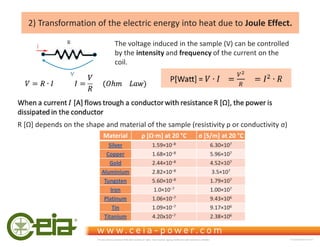
2) Transformation of the electric energy into heat due to Joule Effect.
The voltage induced in the sample (V) can be controlled
by the intensity and frequency of the current on the
coil.
Z΀ɏ΁ĚĞƉĞŶĚƐŽŶƚŚĞƐŚĂƉĞĂŶĚŵĂƚĞƌŝĂůŽĨƚŚĞƐĂŵƉůĞ;ƌĞƐŝƐƚŝǀŝƚLJʌŽƌĐŽŶĚƵĐƚŝǀŝƚLJʍ)
Material ʌ΀ɏͼŵ΁ĂƚϮϬ°C ʍ΀^ͬŵ΁ĂƚϮϬ°C
Silver 1.59×10оϴ 6.30×10⁷
Copper 1.68×10оϴ 5.96×10⁷
Gold 2.44×10оϴ 4.52×10⁷
Aluminium 2.82×10оϴ 3.5×10⁷
Tungsten 5.60×10оϴ 1.79×10⁷
Iron 1.0×10оϳ 1.00×10⁷
Platinum 1.06×10оϳ 9.43×10⁶
Tin 1.09×10оϳ 9.17×10⁶
Titanium 4.20x10оϳ 2.38×10⁶
This document is property of CEIA which reserves all rights. Total or partial copying, modification and translation is forbidden FC040K0068V1000UK
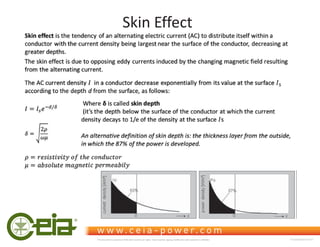
Skin Effect
This document is property of CEIA which reserves all rights. Total or partial copying, modification and translation is forbidden FC040K0068V1000UK
Frequecy
[Hz]
Steel
AISI 316
(ʅr =1)
Copper
Cu
(ʅr ~1)
Steel
AISI 420
(ʅr =2000)
100 43,32 6,68 0,83
1.000 13,70 2,11 0,26
10.000 4,33 0,67 0,08
100.000 1,37 0,21 0,026
200.000 0,97 0,15 0,019
1.000.000 0,43 0,067 0,008
Skin Depth
΀ŵŵ΁
Skin Depth Calculation
Calculation of skin depth at different frequency for magnetic and not-magnetic material
This document is property of CEIA which reserves all rights. Total or partial copying, modification and translation is forbidden FC040K0068V1000UK
0,00
0,01
0,10
1,00
10,00
100,00
1.000,00
1 10 100 1.000 10.000 100.000 1.000.000
Skin
depth
[mm]
Frequency [Hz]
Skin depth versus frequency
Low conductivity diamagnetic metal (AISI316)
Good conductivity diamagnetic metal (Cu)
Ferromagnetic metal (AISI420 - ur 2000)
This document is property of CEIA which reserves all rights. Total or partial copying, modification and translation is forbidden FC040K0068V1000UK
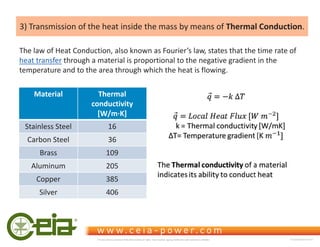
3) Transmission of the heat inside the mass by means of Thermal Conduction.
The law of Heat Conduction, also known as Fourier’s law, states that the time rate of
heat transfer through a material is proportional to the negative gradient in the
temperature and to the area through which the heat is flowing.
Material Thermal
conductivity
΀tͬŵͼ΁
Stainless Steel 16
Carbon Steel 36
Brass 109
Aluminum 205
Copper 385
Silver 406
This document is property of CEIA which reserves all rights. Total or partial copying, modification and translation is forbidden FC040K0068V1000UK
Structure and Hystory of Inductive Heating Generators
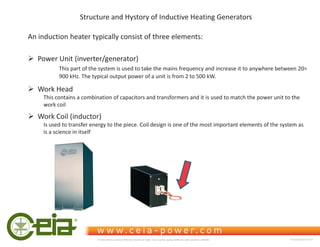
An induction heater typically consist of three elements:
¾ Power Unit (inverter/generator)
This part of the system is used to take the mains frequency and increase it to anywhere between 20÷
900 kHz. The typical output power of a unit is from 2 to 500 kW.
¾ Work Head
This contains a combination of capacitors and transformers and it is used to match the power unit to the
work coil
¾ Work Coil (inductor)
Is used to transfer energy to the piece. Coil design is one of the most important elements of the system as
is a science in itself
This document is property of CEIA which reserves all rights. Total or partial copying, modification and translation is forbidden FC040K0068V1000UK
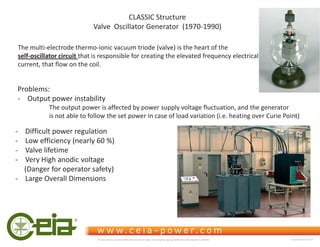
CLASSIC Structure
Valve Oscillator Generator (1970-1990)
The multi-electrode thermo-ionic vacuum triode (valve) is the heart of the
self-oscillator circuit that is responsible for creating the elevated frequency electrical
current, that flow on the coil.
Problems:
- Output power instability
The output power is affected by power supply voltage fluctuation, and the generator
is not able to follow the set power in case of load variation (i.e. heating over Curie Point)
- Difficult power regulation
- Low efficiency (nearly 60 %)
- Valve lifetime
- Very High anodic voltage
(Danger for operator safety)
- Large Overall Dimensions
This document is property of CEIA which reserves all rights. Total or partial copying, modification and translation is forbidden FC040K0068V1000UK
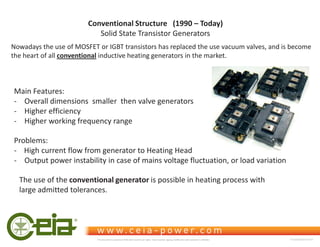
Conventional Structure (1990 – Today)
Solid State Transistor Generators
Nowadays the use of MOSFET or IGBT transistors has replaced the use vacuum valves, and is become
the heart of all conventional inductive heating generators in the market.
Problems:
- High current flow from generator to Heating Head
- Output power instability in case of mains voltage fluctuation, or load variation
Main Features:
- Overall dimensions smaller then valve generators
- Higher efficiency
- Higher working frequency range
The use of the conventional generator is possible in heating process with
large admitted tolerances.
This document is property of CEIA which reserves all rights. Total or partial copying, modification and translation is forbidden FC040K0068V1000UK
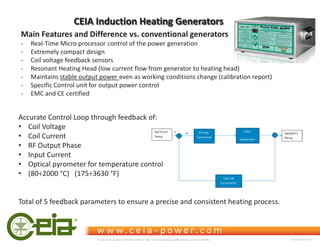
CEIA Induction Heating Generators
Main Features and Difference vs. conventional generators
- Real-Time Micro processor control of the power generation
- Extremely compact design
- Coil voltage feedback sensors
- Resonant Heating Head (low current flow from generator to heating head)
- Maintains stable output power even as working conditions change (calibration report)
- Specific Control unit for output power control
- EMC and CE certified
Accurate Control Loop through feedback of:
‡ Coil Voltage
‡ Coil Current
‡ RF Output Phase
‡ Input Current
‡ Optical pyrometer for temperature control
‡ (80÷2000 °C) (175÷3630 °F)
Total of 5 feedback parameters to ensure a precise and consistent heating process.
This document is property of CEIA which reserves all rights. Total or partial copying, modification and translation is forbidden FC040K0068V1000UK
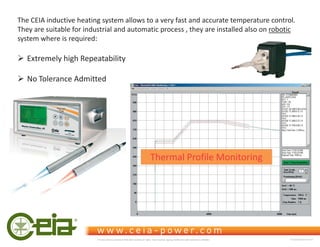
The CEIA inductive heating system allows to a very fast and accurate temperature control.
They are suitable for industrial and automatic process , they are installed also on robotic
system where is required:
¾ Extremely high Repeatability
¾ No Tolerance Admitted
Thermal Profile Monitoring
This document is property of CEIA which reserves all rights. Total or partial copying, modification and translation is forbidden FC040K0068V1000UK
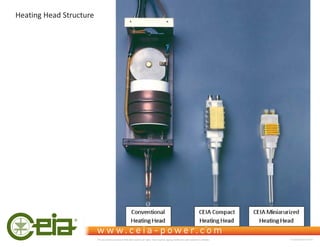
Heating Head Structure
This document is property of CEIA which reserves all rights. Total or partial copying, modification and translation is forbidden FC040K0068V1000UK
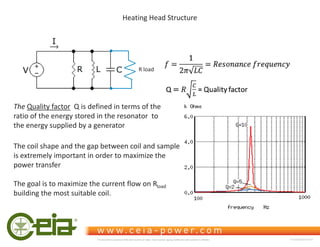
Heating Head Structure
The Quality factor Q is defined in terms of the
ratio of the energy stored in the resonator to
the energy supplied by a generator
The coil shape and the gap between coil and sample
is extremely important in order to maximize the
power transfer
The goal is to maximize the current flow on Rload
building the most suitable coil.
R load
This document is property of CEIA which reserves all rights. Total or partial copying, modification and translation is forbidden FC040K0068V1000UK
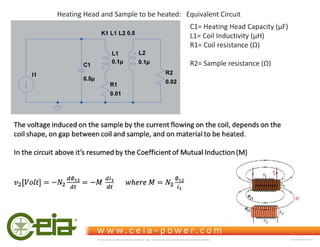
Heating Head and Sample to be heated: Equivalent Circuit
C1= Heating Head Capacity (ʅ)
L1= Coil Inductivity (ʅ,)
ZϭсŽŝůƌĞƐŝƐƚĂŶĐĞ;ɏͿ
ZϮс^ĂŵƉůĞƌĞƐŝƐƚĂŶĐĞ;ɏͿ
This document is property of CEIA which reserves all rights. Total or partial copying, modification and translation is forbidden FC040K0068V1000UK
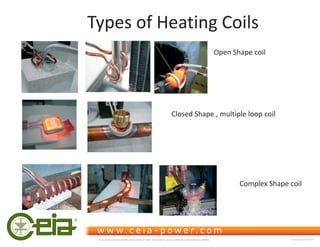
Types of Heating Coils
Open Shape coil
Closed Shape , multiple loop coil
Complex Shape coil
This document is property of CEIA which reserves all rights. Total or partial copying, modification and translation is forbidden FC040K0068V1000UK
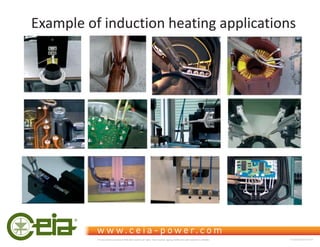
Example of induction heating applications
This document is property of CEIA which reserves all rights. Total or partial copying, modification and translation is forbidden FC040K0068V1000UK
Thank you for your attention
FC040K0068V1000UK
This document is property of CEIA which reserves all rights. Total or partial copying, modification and translation is forbidden
www.ceia-power.com

Ceia induction heatingprinciples_fc040k0068v1uk (2)

  • 1.
    Induction Heating Principles PRESENTATION FC040K0068V1000UK This documentis property of CEIA which reserves all rights. Total or partial copying, modification and translation is forbidden www.ceia-power.com
  • 2.
    Main Applications ofInduction Heating ¾ Hard (Silver) Brazing ¾ Tin Soldering ¾ Heat Treatment (Hardening, Annealing, Tempering, …) ¾ Melting Applications (ferrous and non ferrous metal) ¾ Forging This document is property of CEIA which reserves all rights. Total or partial copying, modification and translation is forbidden FC040K0068V1000UK
  • 3.
    Examples of induction heatingapplications This document is property of CEIA which reserves all rights. Total or partial copying, modification and translation is forbidden FC040K0068V1000UK
  • 4.
    Advantages of Induction ‡Reduced Heating Time ‡ Localized Heating ‡ Efficient Energy Consumption ‡ Heating Process Controllable and Repeatable ‡ Improved Product Quality ‡ Safety for User ‡ Improving of the working condition This document is property of CEIA which reserves all rights. Total or partial copying, modification and translation is forbidden FC040K0068V1000UK
  • 5.
    Basics of Induction ‡INDUCTIVE HEATING is based on the supply of energy by means of electromagnetic induction. ‡ A coil, suitably dimensioned, placed close to the metal parts to be heated, conducting high or medium frequency alternated current, induces on the work piece currents (eddy currents) whose intensity can be controlled and modulated. This document is property of CEIA which reserves all rights. Total or partial copying, modification and translation is forbidden FC040K0068V1000UK
  • 6.
    Basics of induction ‡The heating occurs without physical contact, it involves only the metal parts to be treated and it is characterized by a high efficiency transfer without loss of heat. ‡ The depth of penetration of the generated currents is directly correlated to the working frequency of the generator used; higher it is, much more the induced currents concentrate on the surface. In this case, the heating homogeneity on a relevant mass, can be obtained due to the principle of thermal conduction which allows the heating to be transferred in depth. This document is property of CEIA which reserves all rights. Total or partial copying, modification and translation is forbidden FC040K0068V1000UK
  • 7.
    Basics of Induction Thephenomenon of the electromagnetic induction is therefore based on three physical principles, here below explained: 1) Transfer of energy from the inductor to the piece to be heated, by means of Electromagnetic Fields. 2) Transformation of the electric energy into heat due to Joule effect. (P=I2R) 3) Transmission of the heat inside the mass by means of Thermal Conduction. This document is property of CEIA which reserves all rights. Total or partial copying, modification and translation is forbidden FC040K0068V1000UK
  • 8.
    Useful Equations 1) Transferof energy from the inductor to the mass to be heated, by means of Electromagnetic Fields. This document is property of CEIA which reserves all rights. Total or partial copying, modification and translation is forbidden FC040K0068V1000UK
  • 9.
    If the conductorhas a solenoid shape, the magnetic filed generated has the shape as in the pictures below: This document is property of CEIA which reserves all rights. Total or partial copying, modification and translation is forbidden FC040K0068V1000UK
  • 10.
    The Laplace Lawstates that the intensity of the magnetic field is reverse proportional to the square of the distance. In case of a single loop coil, the intensity of the magnetic flow at the point P, whose distance from the coil center is z, Is given by the simplified equation: 0 5 10 15 20 25 30 35 0 1 2 3 4 5 6 7 8 9 10 11 12 13 14 15 16 17 18 19 20 B [mT] z = Coil Gap [mm] Magnetic Field intensity vs. Coil distance Coil = Ɍ 15mm This document is property of CEIA which reserves all rights. Total or partial copying, modification and translation is forbidden FC040K0068V1000UK
  • 11.
    Faraday–Lenz’s Law The inducedelectromotrice force generated is proportional to the rate of change of the magnet flux. Eddy currents are currents induced in conductors, opposing the change in flux that generated them. It is caused when a conductor is exposed to a changing magnetic field. These circulating eddy current create induced magnetic fields that oppose the change of the original magnetic field due to Lenz’ laws, causing repulsive or drag forces between the conductor and the magnet. The stronger the applied magnetic field, or the greater the electrical conductivity of the conductor, or the faster the field that the conductor is exposed to changes, then the greater the currents that are developed. Sample to be heat Coil This document is property of CEIA which reserves all rights. Total or partial copying, modification and translation is forbidden FC040K0068V1000UK
  • 12.
    The magnetic permeabilityof a material is the capability of this material to channel magnetic induction. In fact, magnetic field H and magnetic induction field B are linked, in a given material, by the equation : B = μ * H where μ is the magnetic permeability of the material (in Henry/meter). μ=μ0 * μr - μ0 is a universal constant, equal to ϰʋΎϭϬ-7 H/m - μr depends on the material. The materials can be classified in: ¾Diamagnetic (copper, gold, silver, aluminum oxide) μr чϭ ¾Paramagnetic (aluminum, titanium, molybdenum, stainless steel) μr шϭ ¾Ferromagnetic (carbon steel) μr 1 The magnetic permeability of ferromagnetic materials above the Curie temperature , ƐƵĚĚĞŶůLJĚƌŽƉĚŽǁŶƚŽʅr =1 Electro – Magnetic Features of Metals Material Curie Temperature [°C] Cobalt 1115 Iron 770 Nickel 358 This document is property of CEIA which reserves all rights. Total or partial copying, modification and translation is forbidden FC040K0068V1000UK
  • 13.
    2) Transformation ofthe electric energy into heat due to Joule Effect. The voltage induced in the sample (V) can be controlled by the intensity and frequency of the current on the coil. Z΀ɏ΁ĚĞƉĞŶĚƐŽŶƚŚĞƐŚĂƉĞĂŶĚŵĂƚĞƌŝĂůŽĨƚŚĞƐĂŵƉůĞ;ƌĞƐŝƐƚŝǀŝƚLJʌŽƌĐŽŶĚƵĐƚŝǀŝƚLJʍ) Material ʌ΀ɏͼŵ΁ĂƚϮϬ°C ʍ΀^ͬŵ΁ĂƚϮϬ°C Silver 1.59×10оϴ 6.30×10⁷ Copper 1.68×10оϴ 5.96×10⁷ Gold 2.44×10оϴ 4.52×10⁷ Aluminium 2.82×10оϴ 3.5×10⁷ Tungsten 5.60×10оϴ 1.79×10⁷ Iron 1.0×10оϳ 1.00×10⁷ Platinum 1.06×10оϳ 9.43×10⁶ Tin 1.09×10оϳ 9.17×10⁶ Titanium 4.20x10оϳ 2.38×10⁶ This document is property of CEIA which reserves all rights. Total or partial copying, modification and translation is forbidden FC040K0068V1000UK
  • 14.
    Skin Effect This documentis property of CEIA which reserves all rights. Total or partial copying, modification and translation is forbidden FC040K0068V1000UK
  • 15.
    This document isproperty of CEIA which reserves all rights. Total or partial copying, modification and translation is forbidden FC040K0068V1000UK
  • 16.
    Frequecy [Hz] Steel AISI 316 (ʅr =1) Copper Cu (ʅr~1) Steel AISI 420 (ʅr =2000) 100 43,32 6,68 0,83 1.000 13,70 2,11 0,26 10.000 4,33 0,67 0,08 100.000 1,37 0,21 0,026 200.000 0,97 0,15 0,019 1.000.000 0,43 0,067 0,008 Skin Depth ΀ŵŵ΁ Skin Depth Calculation Calculation of skin depth at different frequency for magnetic and not-magnetic material This document is property of CEIA which reserves all rights. Total or partial copying, modification and translation is forbidden FC040K0068V1000UK
  • 17.
    0,00 0,01 0,10 1,00 10,00 100,00 1.000,00 1 10 1001.000 10.000 100.000 1.000.000 Skin depth [mm] Frequency [Hz] Skin depth versus frequency Low conductivity diamagnetic metal (AISI316) Good conductivity diamagnetic metal (Cu) Ferromagnetic metal (AISI420 - ur 2000) This document is property of CEIA which reserves all rights. Total or partial copying, modification and translation is forbidden FC040K0068V1000UK
  • 18.
    3) Transmission ofthe heat inside the mass by means of Thermal Conduction. The law of Heat Conduction, also known as Fourier’s law, states that the time rate of heat transfer through a material is proportional to the negative gradient in the temperature and to the area through which the heat is flowing. Material Thermal conductivity ΀tͬŵͼ΁ Stainless Steel 16 Carbon Steel 36 Brass 109 Aluminum 205 Copper 385 Silver 406 This document is property of CEIA which reserves all rights. Total or partial copying, modification and translation is forbidden FC040K0068V1000UK
  • 19.
    Structure and Hystoryof Inductive Heating Generators An induction heater typically consist of three elements: ¾ Power Unit (inverter/generator) This part of the system is used to take the mains frequency and increase it to anywhere between 20÷ 900 kHz. The typical output power of a unit is from 2 to 500 kW. ¾ Work Head This contains a combination of capacitors and transformers and it is used to match the power unit to the work coil ¾ Work Coil (inductor) Is used to transfer energy to the piece. Coil design is one of the most important elements of the system as is a science in itself This document is property of CEIA which reserves all rights. Total or partial copying, modification and translation is forbidden FC040K0068V1000UK
  • 20.
    CLASSIC Structure Valve OscillatorGenerator (1970-1990) The multi-electrode thermo-ionic vacuum triode (valve) is the heart of the self-oscillator circuit that is responsible for creating the elevated frequency electrical current, that flow on the coil. Problems: - Output power instability The output power is affected by power supply voltage fluctuation, and the generator is not able to follow the set power in case of load variation (i.e. heating over Curie Point) - Difficult power regulation - Low efficiency (nearly 60 %) - Valve lifetime - Very High anodic voltage (Danger for operator safety) - Large Overall Dimensions This document is property of CEIA which reserves all rights. Total or partial copying, modification and translation is forbidden FC040K0068V1000UK
  • 21.
    Conventional Structure (1990– Today) Solid State Transistor Generators Nowadays the use of MOSFET or IGBT transistors has replaced the use vacuum valves, and is become the heart of all conventional inductive heating generators in the market. Problems: - High current flow from generator to Heating Head - Output power instability in case of mains voltage fluctuation, or load variation Main Features: - Overall dimensions smaller then valve generators - Higher efficiency - Higher working frequency range The use of the conventional generator is possible in heating process with large admitted tolerances. This document is property of CEIA which reserves all rights. Total or partial copying, modification and translation is forbidden FC040K0068V1000UK
  • 22.
    CEIA Induction HeatingGenerators Main Features and Difference vs. conventional generators - Real-Time Micro processor control of the power generation - Extremely compact design - Coil voltage feedback sensors - Resonant Heating Head (low current flow from generator to heating head) - Maintains stable output power even as working conditions change (calibration report) - Specific Control unit for output power control - EMC and CE certified Accurate Control Loop through feedback of: ‡ Coil Voltage ‡ Coil Current ‡ RF Output Phase ‡ Input Current ‡ Optical pyrometer for temperature control ‡ (80÷2000 °C) (175÷3630 °F) Total of 5 feedback parameters to ensure a precise and consistent heating process. This document is property of CEIA which reserves all rights. Total or partial copying, modification and translation is forbidden FC040K0068V1000UK
  • 23.
    The CEIA inductiveheating system allows to a very fast and accurate temperature control. They are suitable for industrial and automatic process , they are installed also on robotic system where is required: ¾ Extremely high Repeatability ¾ No Tolerance Admitted Thermal Profile Monitoring This document is property of CEIA which reserves all rights. Total or partial copying, modification and translation is forbidden FC040K0068V1000UK
  • 24.
    Heating Head Structure Thisdocument is property of CEIA which reserves all rights. Total or partial copying, modification and translation is forbidden FC040K0068V1000UK
  • 25.
    Heating Head Structure TheQuality factor Q is defined in terms of the ratio of the energy stored in the resonator to the energy supplied by a generator The coil shape and the gap between coil and sample is extremely important in order to maximize the power transfer The goal is to maximize the current flow on Rload building the most suitable coil. R load This document is property of CEIA which reserves all rights. Total or partial copying, modification and translation is forbidden FC040K0068V1000UK
  • 26.
    Heating Head andSample to be heated: Equivalent Circuit C1= Heating Head Capacity (ʅ) L1= Coil Inductivity (ʅ,) ZϭсŽŝůƌĞƐŝƐƚĂŶĐĞ;ɏͿ ZϮс^ĂŵƉůĞƌĞƐŝƐƚĂŶĐĞ;ɏͿ This document is property of CEIA which reserves all rights. Total or partial copying, modification and translation is forbidden FC040K0068V1000UK
  • 27.
    Types of HeatingCoils Open Shape coil Closed Shape , multiple loop coil Complex Shape coil This document is property of CEIA which reserves all rights. Total or partial copying, modification and translation is forbidden FC040K0068V1000UK
  • 28.
    Example of inductionheating applications This document is property of CEIA which reserves all rights. Total or partial copying, modification and translation is forbidden FC040K0068V1000UK
  • 29.
    Thank you foryour attention FC040K0068V1000UK This document is property of CEIA which reserves all rights. Total or partial copying, modification and translation is forbidden www.ceia-power.com