By William Deming
 When heat isn’t added or subtracted, they
result in being compressed or expanding
 Air expands as you elevate your position in the
atmosphere
 Air expands as it cools and air compresses as it
warms
 Elevated terrains act as barriers to air flow
 Once air has moved to the leeward side of say a
mountain, most of it’s moisture has been lost.
This affect is why most areas may be cut off by
mountains yet be completely different on both
sides. Ex: wet and moist on the windward, and
then hot and dry on the leeward
 It is When masses of warm air and cold air
collide
 Cooler denser air acts as a barrier which the
warmer less dense air rises over.
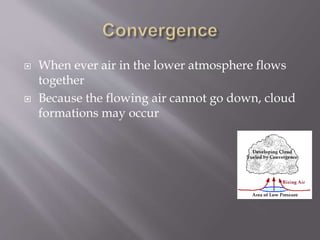
 When ever air in the lower atmosphere flows
together
 Because the flowing air cannot go down, cloud
formations may occur
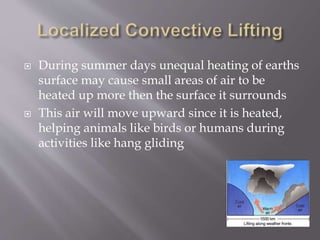
 During summer days unequal heating of earths
surface may cause small areas of air to be
heated up more then the surface it surrounds
 This air will move upward since it is heated,
helping animals like birds or humans during
activities like hang gliding
 Stable air resists vertical movement
 Unstable air rises freely
 Clouds formed from the forced movement of
this stable air are typically widespread and
have little chance of precipitation. Clouds of
unstable air typically tower and can cause
thunderstorms
 When water vapor in the air changes into a
liquid or a gas turning into a liquid state
 Ex: rain, dew, fog, or clouds
 Occurs when a vapor is cooled or compressed
to its’ saturation limit
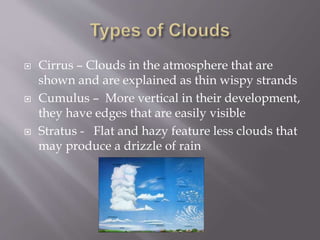
 Cirrus – Clouds in the atmosphere that are
shown and are explained as thin wispy strands
 Cumulus – More vertical in their development,
they have edges that are easily visible
 Stratus - Flat and hazy feature less clouds that
may produce a drizzle of rain
 Ex: Cirrus, Cirrostratus, and cirrocumulus –
6000 meters
 Not considered precipitation making clouds
 Altocumulus – 4000 meters
 A light snow or drizzle may happen with these
clouds
 Stratus, stratocumulus, and nimbostratus –
2000 meters
 May produce light precipitation
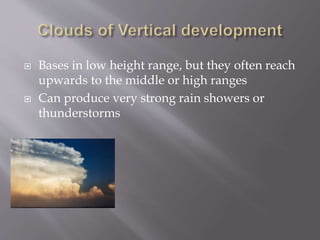
 Bases in low height range, but they often reach
upwards to the middle or high ranges
 Can produce very strong rain showers or
thunderstorms
 No physical difference between fog and a
cloud, just height
 Can form on cool nights where earths surface is
cooled very fast by radiation . Later in the night
a thin layer of air is cooled before dew point
and becomes denser, thus fog
 Cool air over warm water may evaporate and
help create saturation , when this meets cold
air, it condenses with warm air below
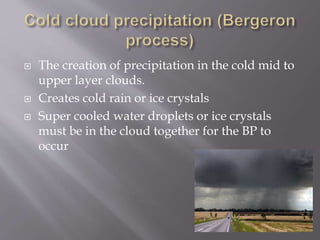
 The creation of precipitation in the cold mid to
upper layer clouds.
 Creates cold rain or ice crystals
 Super cooled water droplets or ice crystals
must be in the cloud together for the BP to
occur
 Water absorbing particles like salt can remove
the water vapor from the air and help create
large raindrops
 When these droplets move through a cloud,
they form together with smaller droplets.
 Rain – Requires a think layer of the atmosphere
that is above freezing and is caused by
condensation of water vapors turned into
droplets
 Snow – Forms in a motion of upward air near a
low pressure system where the temperature
must be below freezing
 Sleet – clear ice formed by a layer of air above
freezing temperatures that lays over a
subfreezing layer near the ground
 Glaze – occurs when freezing rain hits a surface
and creates a formation or sheet of ice around
or on an object
 Hail – A solid precipitation, which forms in
strong thunderstorms, mainly ones with very
strong updrafts
5Wdeming

5Wdeming

  • 1.
  • 2.
     When heatisn’t added or subtracted, they result in being compressed or expanding  Air expands as you elevate your position in the atmosphere  Air expands as it cools and air compresses as it warms
  • 3.
     Elevated terrainsact as barriers to air flow  Once air has moved to the leeward side of say a mountain, most of it’s moisture has been lost. This affect is why most areas may be cut off by mountains yet be completely different on both sides. Ex: wet and moist on the windward, and then hot and dry on the leeward
  • 4.
     It isWhen masses of warm air and cold air collide  Cooler denser air acts as a barrier which the warmer less dense air rises over.
  • 5.
     When everair in the lower atmosphere flows together  Because the flowing air cannot go down, cloud formations may occur
  • 6.
     During summerdays unequal heating of earths surface may cause small areas of air to be heated up more then the surface it surrounds  This air will move upward since it is heated, helping animals like birds or humans during activities like hang gliding
  • 7.
     Stable airresists vertical movement  Unstable air rises freely  Clouds formed from the forced movement of this stable air are typically widespread and have little chance of precipitation. Clouds of unstable air typically tower and can cause thunderstorms
  • 8.
     When watervapor in the air changes into a liquid or a gas turning into a liquid state  Ex: rain, dew, fog, or clouds  Occurs when a vapor is cooled or compressed to its’ saturation limit
  • 9.
     Cirrus –Clouds in the atmosphere that are shown and are explained as thin wispy strands  Cumulus – More vertical in their development, they have edges that are easily visible  Stratus - Flat and hazy feature less clouds that may produce a drizzle of rain
  • 10.
     Ex: Cirrus,Cirrostratus, and cirrocumulus – 6000 meters  Not considered precipitation making clouds
  • 11.
     Altocumulus –4000 meters  A light snow or drizzle may happen with these clouds
  • 12.
     Stratus, stratocumulus,and nimbostratus – 2000 meters  May produce light precipitation
  • 13.
     Bases inlow height range, but they often reach upwards to the middle or high ranges  Can produce very strong rain showers or thunderstorms
  • 14.
     No physicaldifference between fog and a cloud, just height  Can form on cool nights where earths surface is cooled very fast by radiation . Later in the night a thin layer of air is cooled before dew point and becomes denser, thus fog  Cool air over warm water may evaporate and help create saturation , when this meets cold air, it condenses with warm air below
  • 15.
     The creationof precipitation in the cold mid to upper layer clouds.  Creates cold rain or ice crystals  Super cooled water droplets or ice crystals must be in the cloud together for the BP to occur
  • 16.
     Water absorbingparticles like salt can remove the water vapor from the air and help create large raindrops  When these droplets move through a cloud, they form together with smaller droplets.
  • 17.
     Rain –Requires a think layer of the atmosphere that is above freezing and is caused by condensation of water vapors turned into droplets  Snow – Forms in a motion of upward air near a low pressure system where the temperature must be below freezing
  • 18.
     Sleet –clear ice formed by a layer of air above freezing temperatures that lays over a subfreezing layer near the ground  Glaze – occurs when freezing rain hits a surface and creates a formation or sheet of ice around or on an object  Hail – A solid precipitation, which forms in strong thunderstorms, mainly ones with very strong updrafts