PRECIPITATION
Now it’s raining here. At the same time snowfall occur
somewhere . What is the source of it. In a word , it is
precipitation .
What is precipitation?
Precipitation is any form of water that falls to the Earth's
surface.
It can be solid or liquid form. The type of precipitation that
falls to the ground depends upon the formation process
and the temperature of the environment between the cloud
and the surface.
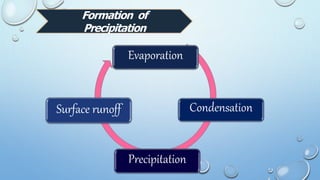
Evaporation
Condensation
Precipitation
Surface runoff
Formation of
Precipitation
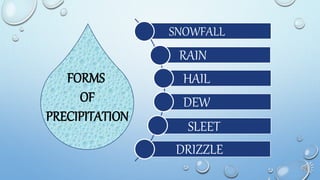
SNOWFALL
RAIN
HAIL
DEW
SLEET
DRIZZLE
FORMS
OF
PRECIPITATION
SNOWFALL
Snow forms when water vapor
turns directly into ice without
ever passing through a liquid
state. This happens as water
condenses around an ice crystal.
Density of freshly fallen snow
varies between 150-500 mm of snow required to equal 25mm of
liquid water.
RAIN
Raindrops fall to Earth when clouds become saturated, or filled with water
droplets . When a small water droplet bumps into a bigger one , it
condenses, or combines, with the
larger one. As this continues to
happen, the droplet gets heavier
and heavier. When the water
droplet becomes too heavy to
continue floating around in
the cloud, it falls to the ground.
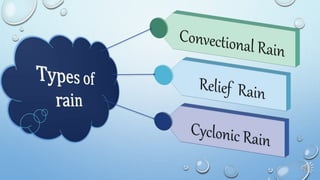
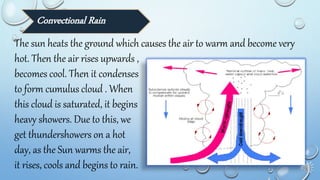
Convectional Rain
The sun heats the ground which causes the air to warm and become very
hot. Then the air rises upwards ,
becomes cool. Then it condenses
to form cumulus cloud . When
this cloud is saturated, it begins
heavy showers. Due to this, we
get thundershowers on a hot
day, as the Sun warms the air,
it rises, cools and begins to rain.
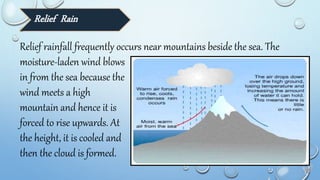
Relief Rain
Relief rainfall frequently occurs near mountains beside the sea. The
moisture-laden wind blows
in from the sea because the
wind meets a high
mountain and hence it is
forced to rise upwards. At
the height, it is cooled and
then the cloud is formed.
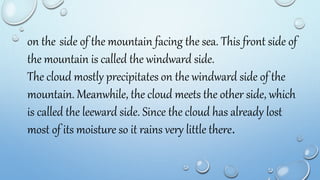
on the side of the mountain facing the sea. This front side of
the mountain is called the windward side.
The cloud mostly precipitates on the windward side of the
mountain. Meanwhile, the cloud meets the other side, which
is called the leeward side. Since the cloud has already lost
most of its moisture so it rains very little there.
There are two types of cyclonic
rain
Cyclonic Rain
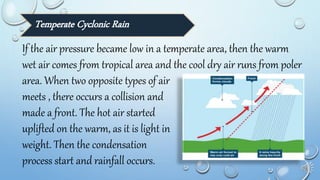
Temperate Cyclonic Rain
If the air pressure became low in a temperate area, then the warm
wet air comes from tropical area and the cool dry air runs from poler
area. When two opposite types of air
meets , there occurs a collision and
made a front. The hot air started
uplifted on the warm, as it is light in
weight. Then the condensation
process start and rainfall occurs.
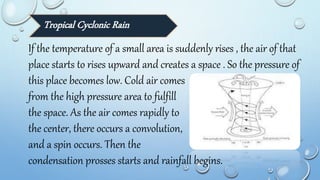
Tropical Cyclonic Rain
If the temperature of a small area is suddenly rises , the air of that
place starts to rises upward and creates a space . So the pressure of
this place becomes low. Cold air comes
from the high pressure area to fulfill
the space. As the air comes rapidly to
the center, there occurs a convolution,
and a spin occurs. Then the
condensation prosses starts and rainfall begins.
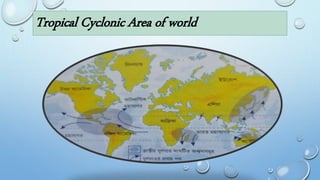
Tropical Cyclonic Area of world
HAIL
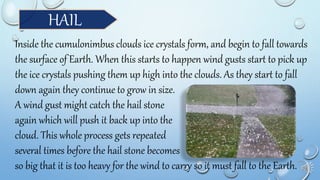
Inside the cumulonimbus clouds ice crystals form, and begin to fall towards
the surface of Earth. When this starts to happen wind gusts start to pick up
the ice crystals pushing them up high into the clouds. As they start to fall
down again they continue to grow in size.
A wind gust might catch the hail stone
again which will push it back up into the
cloud. This whole process gets repeated
several times before the hail stone becomes
so big that it is too heavy for the wind to carry so it must fall to the Earth.
DEW
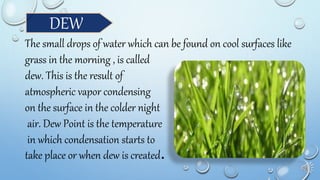
The small drops of water which can be found on cool surfaces like
grass in the morning , is called
dew. This is the result of
atmospheric vapor condensing
on the surface in the colder night
air. Dew Point is the temperature
in which condensation starts to
take place or when dew is created.
SLEET
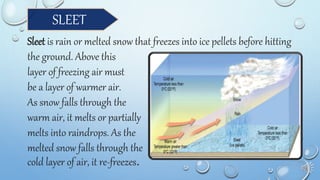
Sleet is rain or melted snow that freezes into ice pellets before hitting
the ground. Above this
layer of freezing air must
be a layer of warmer air.
As snow falls through the
warm air, it melts or partially
melts into raindrops. As the
melted snow falls through the
cold layer of air, it re-freezes.
DRIZZLE
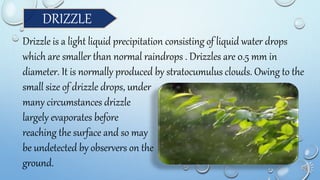
Drizzle is a light liquid precipitation consisting of liquid water drops
which are smaller than normal raindrops . Drizzles are 0.5 mm in
diameter. It is normally produced by stratocumulus clouds. Owing to the
small size of drizzle drops, under
many circumstances drizzle
largely evaporates before
reaching the surface and so may
be undetected by observers on the
ground.
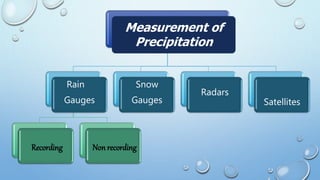
Rain
Gauges
Recording Non recording
Snow
Gauges
Radars
Satellites
Measurement of
Precipitation
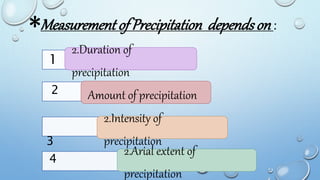
*Measurement of Precipitation dependson :
2.Duration of
precipitation
Amount of precipitation
2.Intensity of
precipitation
2.Arial extent of
precipitation
1
2
3
4
Importance of precipitation
Sometimes precipitation became distractive . But is has
an important role in cultivation. Agriculture it impossible
without precipitation.
Presented
by
Shuvra Pal

Precipitation

  • 2.
  • 3.
    Now it’s raininghere. At the same time snowfall occur somewhere . What is the source of it. In a word , it is precipitation .
  • 4.
    What is precipitation? Precipitationis any form of water that falls to the Earth's surface. It can be solid or liquid form. The type of precipitation that falls to the ground depends upon the formation process and the temperature of the environment between the cloud and the surface.
  • 5.
  • 6.
  • 7.
    SNOWFALL Snow forms whenwater vapor turns directly into ice without ever passing through a liquid state. This happens as water condenses around an ice crystal. Density of freshly fallen snow varies between 150-500 mm of snow required to equal 25mm of liquid water.
  • 8.
    RAIN Raindrops fall toEarth when clouds become saturated, or filled with water droplets . When a small water droplet bumps into a bigger one , it condenses, or combines, with the larger one. As this continues to happen, the droplet gets heavier and heavier. When the water droplet becomes too heavy to continue floating around in the cloud, it falls to the ground.
  • 10.
    Convectional Rain The sunheats the ground which causes the air to warm and become very hot. Then the air rises upwards , becomes cool. Then it condenses to form cumulus cloud . When this cloud is saturated, it begins heavy showers. Due to this, we get thundershowers on a hot day, as the Sun warms the air, it rises, cools and begins to rain.
  • 11.
    Relief Rain Relief rainfallfrequently occurs near mountains beside the sea. The moisture-laden wind blows in from the sea because the wind meets a high mountain and hence it is forced to rise upwards. At the height, it is cooled and then the cloud is formed.
  • 12.
    on the sideof the mountain facing the sea. This front side of the mountain is called the windward side. The cloud mostly precipitates on the windward side of the mountain. Meanwhile, the cloud meets the other side, which is called the leeward side. Since the cloud has already lost most of its moisture so it rains very little there.
  • 13.
    There are twotypes of cyclonic rain Cyclonic Rain
  • 14.
    Temperate Cyclonic Rain Ifthe air pressure became low in a temperate area, then the warm wet air comes from tropical area and the cool dry air runs from poler area. When two opposite types of air meets , there occurs a collision and made a front. The hot air started uplifted on the warm, as it is light in weight. Then the condensation process start and rainfall occurs.
  • 15.
    Tropical Cyclonic Rain Ifthe temperature of a small area is suddenly rises , the air of that place starts to rises upward and creates a space . So the pressure of this place becomes low. Cold air comes from the high pressure area to fulfill the space. As the air comes rapidly to the center, there occurs a convolution, and a spin occurs. Then the condensation prosses starts and rainfall begins.
  • 16.
  • 17.
    HAIL Inside the cumulonimbusclouds ice crystals form, and begin to fall towards the surface of Earth. When this starts to happen wind gusts start to pick up the ice crystals pushing them up high into the clouds. As they start to fall down again they continue to grow in size. A wind gust might catch the hail stone again which will push it back up into the cloud. This whole process gets repeated several times before the hail stone becomes so big that it is too heavy for the wind to carry so it must fall to the Earth.
  • 18.
    DEW The small dropsof water which can be found on cool surfaces like grass in the morning , is called dew. This is the result of atmospheric vapor condensing on the surface in the colder night air. Dew Point is the temperature in which condensation starts to take place or when dew is created.
  • 19.
    SLEET Sleet is rainor melted snow that freezes into ice pellets before hitting the ground. Above this layer of freezing air must be a layer of warmer air. As snow falls through the warm air, it melts or partially melts into raindrops. As the melted snow falls through the cold layer of air, it re-freezes.
  • 20.
    DRIZZLE Drizzle is alight liquid precipitation consisting of liquid water drops which are smaller than normal raindrops . Drizzles are 0.5 mm in diameter. It is normally produced by stratocumulus clouds. Owing to the small size of drizzle drops, under many circumstances drizzle largely evaporates before reaching the surface and so may be undetected by observers on the ground.
  • 21.
  • 22.
    *Measurement of Precipitationdependson : 2.Duration of precipitation Amount of precipitation 2.Intensity of precipitation 2.Arial extent of precipitation 1 2 3 4
  • 23.
    Importance of precipitation Sometimesprecipitation became distractive . But is has an important role in cultivation. Agriculture it impossible without precipitation.
  • 24.