Refraction of light
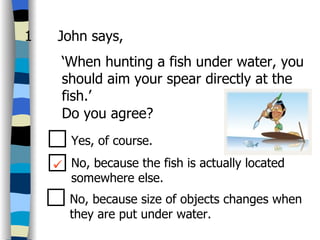
1   John says,
     ‘When hunting a fish under water, you
     should aim your spear directly at the
     fish.’
     Do you agree?
       Yes, of course.
     No, because the fish is actually located
      somewhere else.
       No, because size of objects changes when
       they are put under water.
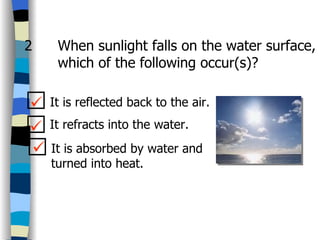
2    When sunlight falls on the water surface,
     which of the following occur(s)?

   It is reflected back to the air.

   It refracts into the water.

   It is absorbed by water and
    turned into heat.
Introduction
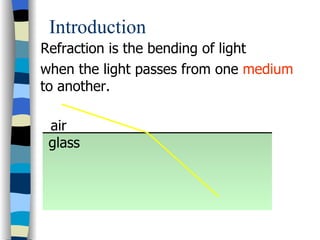
Refraction is the bending of light
when the light passes from one medium
to another.

 air
 glass
Introduction
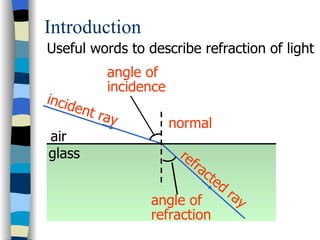
Useful words to describe refraction of light
               angle of
               incidence
incid
        ent
              ray
                           normal
air
glass                       re
                               f   ra
                                      c   te
                                               d
                                                   ra
                     angle of                         y
                     refraction
Introduction
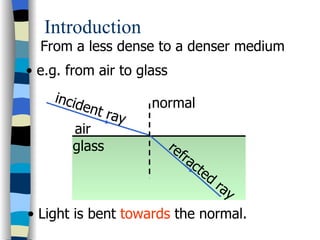
  From a less dense to a denser medium
• e.g. from air to glass
    incid               normal
            ent
                  ray
       air
       glass               re
                              f   ra
                                     c   te
                                              d
                                                  ra
                                                     y
• Light is bent towards the normal.
Introduction
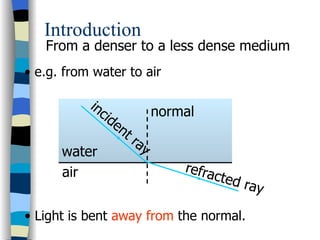
   From a denser to a less dense medium
• e.g. from water to air

           in
                cid               normal
                      en
                           tr
                             ay
      water
      air                             refra
                                              cted
                                                     ray

• Light is bent away from the normal.
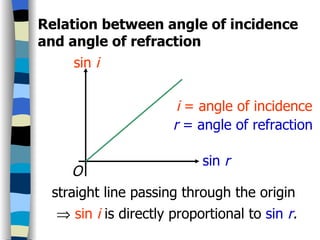
Relation between angle of incidence
and angle of refraction
     sin i


                       i = angle of incidence
                      r = angle of refraction

                           sin r
     O
 straight line passing through the origin
  ⇒ sin i is directly proportional to sin r.
Laws of refraction


Video                        Simulation
Laws of refraction
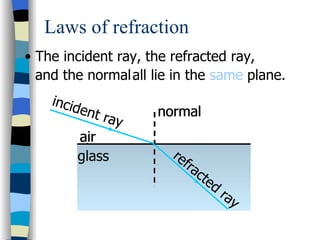
• The incident ray, the refracted ray,
  and the normal all lie in the same plane.
    incid
            ent         normal
                  ray
        air
        glass             re
        glass                fra
                                 ct
                                   ed
                                        ra
                                           y
Laws of refraction
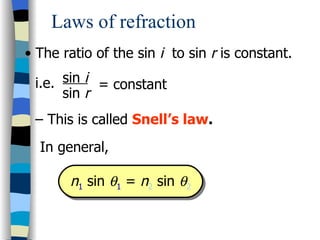
• The ratio of the sin i to sin r is constant.

 i.e. sin i = constant
      sin r
 – This is called Snell’s law.
  In general,

       n1 sin θ1 = n2 sin θ2
Refractive index
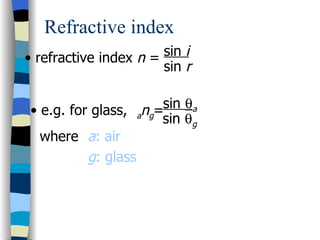
• refractive index n = sin i
                       sin r


• e.g. for glass, ang=sin θa
                      sin θg
  where a: air
          g: glass
Refractive index
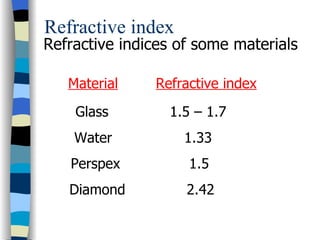
Refractive indices of some materials

   Material    Refractive index
    Glass        1.5 – 1.7
    Water          1.33
   Perspex          1.5
   Diamond          2.42
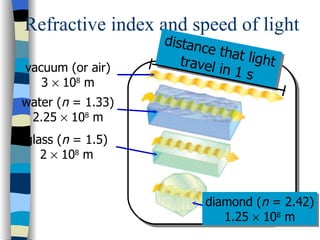
Refractive index and speed of light
                   distan
                          ce tha
                      travel     t light
vacuum (or air)              in 1 s
   3 × 10⁸ m
water (n = 1.33)
 2.25 × 10⁸ m
glass (n = 1.5)
   2 × 10⁸ m


                          diamond (n = 2.42)
                             1.25 × 10⁸ m
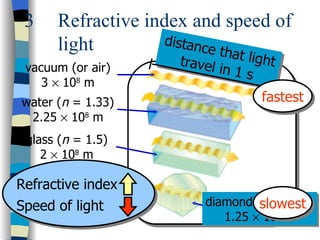
3    Refractive index and speed of
      light        distan
                          ce tha
                     travel      t light
 vacuum (or air)              in 1 s
    3 × 10⁸ m
water (n = 1.33)                     fastest
 2.25 × 10⁸ m
 glass (n = 1.5)
    2 × 10⁸ m

Refractive index
Speed of light                     n = 2.42)
                         diamond (slowest
                            1.25 × 10⁸ m
4   Examples of refraction of light

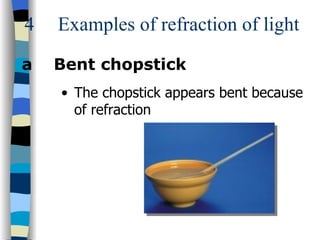
a   Bent chopstick
    • The chopstick appears bent because
      of refraction
4     Examples of refraction of light
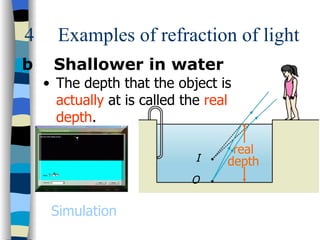
b    Shallower in water
    • The depth that the object is
      actually at is called the real
      depth.

                                    real
                             I     depth
                             O

     Simulation
4   Examples of refraction of light
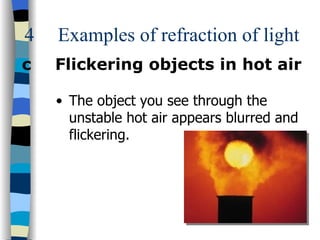
c   Flickering objects in hot air

    • The object you see through the
      unstable hot air appears blurred and
      flickering.
Example 3
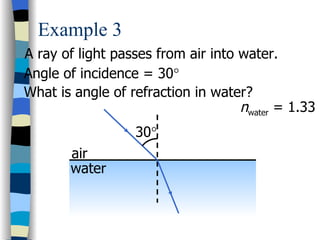
A ray of light passes from air into water.
Angle of incidence = 30°
What is angle of refraction in water?
                                    nwater = 1.33
                  30°
       air
       water
Example 3
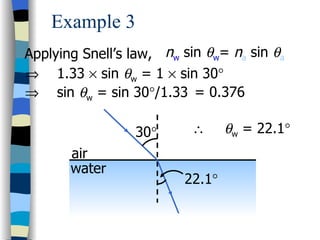
Applying Snell’s law, nw sin θw= na sin θa
⇒ 1.33 × sin θw = 1 × sin 30°
⇒ sin θw = sin 30°/1.33 = 0.376

                 30°       ∴     θw = 22.1°
       air
       water
                         22.1°
Example 4
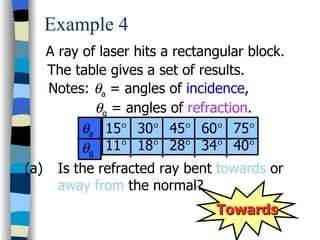
   A ray of laser hits a rectangular block.
   The table gives a set of results.
   Notes: θa = angles of incidence,
           θg = angles of refraction.
         θa 15° 30° 45° 60° 75°
         θg 11° 18° 28° 34° 40°
(a) Is the refracted ray bent towards or
     away from the normal?
                               Towards
Example 4
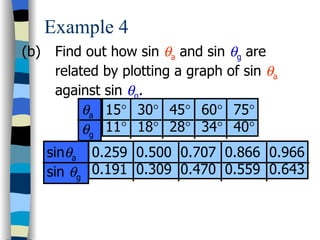
(b)    Find out how sin θa and sin θg are
       related by plotting a graph of sin θa
       against sin θg.
            θa 15° 30° 45° 60° 75°
            θg 11° 18° 28° 34° 40°
      sinθa 0.259 0.500 0.707 0.866 0.966
      sin θg 0.191 0.309 0.470 0.559 0.643
Example 4
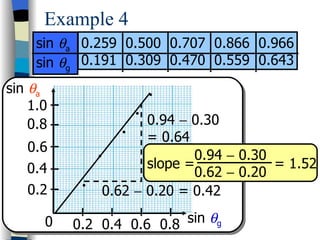
     sin θa 0.259 0.500 0.707 0.866 0.966
     sin θg 0.191 0.309 0.470 0.559 0.643
sin θa
    1.0
    0.8              0.94 − 0.30
                     = 0.64
   0.6
                            0.94 − 0.30
   0.4               slope =            = 1.52
                            0.62 − 0.20
   0.2        0.62 − 0.20 = 0.42

      0   0.2 0.4 0.6 0.8 sin θg
Example 4
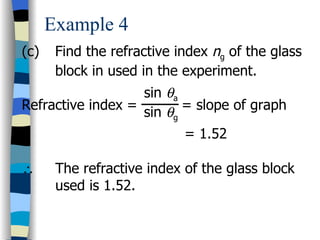
(c)    Find the refractive index ng of the glass
       block in used in the experiment.
                   sin θa
Refractive index =        = slope of graph
                   sin θg
                            = 1.52

∴      The refractive index of the glass block
       used is 1.52.
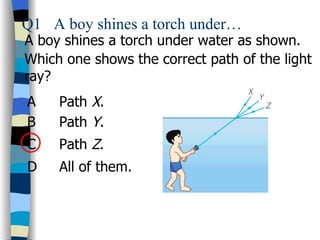
Q1 A boy shines a torch under…
A boy shines a torch under water as shown.
Which one shows the correct path of the light
ray?
A    Path X.
B    Path Y.
C    Path Z.
D    All of them.
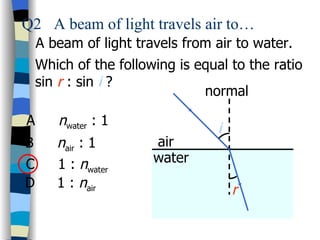
Q2 A beam of light travels air to…
    A beam of light travels from air to water.
    Which of the following is equal to the ratio
    sin r : sin i ?
                               normal

A      nwater : 1
                                  i
B      nair : 1        air
C      1 : nwater      water
D      1 : nair                       r
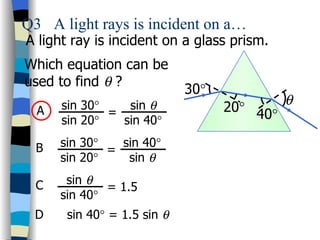
Q3 A light rays is incident on a…
A light ray is incident on a glass prism.
Which equation can be
used to find θ ?
                             30°
      sin 30°    sin θ             20° 40°
                                             θ
  A           =
      sin 20°   sin 40°

  B   sin 30°   sin 40°
              =
      sin 20°    sin θ

  C    sin θ
              = 1.5
      sin 40°
 D     sin 40° = 1.5 sin θ
Q4 True or false: When light is…

True or false: When light is incident on a
surface along the normal, only refraction
occurs; there is no reflection.

                                     (T/F)
Q5 Statements:...
   1st statement       2nd statement
Light is bent         Glass has a greater
towards the normal    refractive index than
when it passes from   air.
air to glass.


        true?                true?
       Yes             Yes
Q1 True or false: Light slows…

True or false: Light slows down when it enters
a material from air.
                                   (T/F)
Q2 True or false: The refractive…
True or false: The refractive index cannot be
smaller than 1.
                                       (T/F)
Q3 True or false: If light travel…

True or false: If light travel at the same speed
in all materials, refraction would still occur
when it passes from air to water.

                                       (T/F)
Q4 True or false: If the speed of…
True or false: If the speed of light in raindrop
is equal to that in air, there would be no
rainbows.
                                           (T/F)
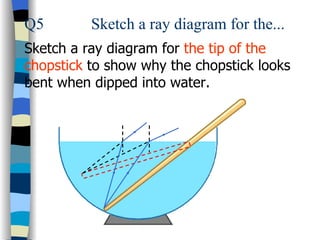
Q5        Sketch a ray diagram for the...
Sketch a ray diagram for the tip of the
chopstick to show why the chopstick looks
bent when dipped into water.

11 4 refraction-of_light

  • 1.
  • 2.
    1 John says, ‘When hunting a fish under water, you should aim your spear directly at the fish.’ Do you agree? Yes, of course.  No, because the fish is actually located somewhere else. No, because size of objects changes when they are put under water.
  • 3.
    2 When sunlight falls on the water surface, which of the following occur(s)?  It is reflected back to the air.  It refracts into the water.  It is absorbed by water and turned into heat.
  • 4.
    Introduction Refraction is thebending of light when the light passes from one medium to another. air glass
  • 5.
    Introduction Useful words todescribe refraction of light angle of incidence incid ent ray normal air glass re f ra c te d ra angle of y refraction
  • 6.
    Introduction Froma less dense to a denser medium • e.g. from air to glass incid normal ent ray air glass re f ra c te d ra y • Light is bent towards the normal.
  • 7.
    Introduction From a denser to a less dense medium • e.g. from water to air in cid normal en tr ay water air refra cted ray • Light is bent away from the normal.
  • 8.
    Relation between angleof incidence and angle of refraction sin i i = angle of incidence r = angle of refraction sin r O straight line passing through the origin ⇒ sin i is directly proportional to sin r.
  • 9.
  • 10.
    Laws of refraction •The incident ray, the refracted ray, and the normal all lie in the same plane. incid ent normal ray air glass re glass fra ct ed ra y
  • 11.
    Laws of refraction •The ratio of the sin i to sin r is constant. i.e. sin i = constant sin r – This is called Snell’s law. In general, n1 sin θ1 = n2 sin θ2
  • 12.
    Refractive index • refractiveindex n = sin i sin r • e.g. for glass, ang=sin θa sin θg where a: air g: glass
  • 13.
    Refractive index Refractive indicesof some materials Material Refractive index Glass 1.5 – 1.7 Water 1.33 Perspex 1.5 Diamond 2.42
  • 14.
    Refractive index andspeed of light distan ce tha travel t light vacuum (or air) in 1 s 3 × 10⁸ m water (n = 1.33) 2.25 × 10⁸ m glass (n = 1.5) 2 × 10⁸ m diamond (n = 2.42) 1.25 × 10⁸ m
  • 15.
    3 Refractive index and speed of light distan ce tha travel t light vacuum (or air) in 1 s 3 × 10⁸ m water (n = 1.33) fastest 2.25 × 10⁸ m glass (n = 1.5) 2 × 10⁸ m Refractive index Speed of light n = 2.42) diamond (slowest 1.25 × 10⁸ m
  • 16.
    4 Examples of refraction of light a Bent chopstick • The chopstick appears bent because of refraction
  • 17.
    4 Examples of refraction of light b Shallower in water • The depth that the object is actually at is called the real depth. real I depth O Simulation
  • 18.
    4 Examples of refraction of light c Flickering objects in hot air • The object you see through the unstable hot air appears blurred and flickering.
  • 19.
    Example 3 A rayof light passes from air into water. Angle of incidence = 30° What is angle of refraction in water? nwater = 1.33 30° air water
  • 20.
    Example 3 Applying Snell’slaw, nw sin θw= na sin θa ⇒ 1.33 × sin θw = 1 × sin 30° ⇒ sin θw = sin 30°/1.33 = 0.376 30° ∴ θw = 22.1° air water 22.1°
  • 21.
    Example 4 A ray of laser hits a rectangular block. The table gives a set of results. Notes: θa = angles of incidence, θg = angles of refraction. θa 15° 30° 45° 60° 75° θg 11° 18° 28° 34° 40° (a) Is the refracted ray bent towards or away from the normal? Towards
  • 22.
    Example 4 (b) Find out how sin θa and sin θg are related by plotting a graph of sin θa against sin θg. θa 15° 30° 45° 60° 75° θg 11° 18° 28° 34° 40° sinθa 0.259 0.500 0.707 0.866 0.966 sin θg 0.191 0.309 0.470 0.559 0.643
  • 23.
    Example 4 sin θa 0.259 0.500 0.707 0.866 0.966 sin θg 0.191 0.309 0.470 0.559 0.643 sin θa 1.0 0.8 0.94 − 0.30 = 0.64 0.6 0.94 − 0.30 0.4 slope = = 1.52 0.62 − 0.20 0.2 0.62 − 0.20 = 0.42 0 0.2 0.4 0.6 0.8 sin θg
  • 24.
    Example 4 (c) Find the refractive index ng of the glass block in used in the experiment. sin θa Refractive index = = slope of graph sin θg = 1.52 ∴ The refractive index of the glass block used is 1.52.
  • 25.
    Q1 A boyshines a torch under… A boy shines a torch under water as shown. Which one shows the correct path of the light ray? A Path X. B Path Y. C Path Z. D All of them.
  • 26.
    Q2 A beamof light travels air to… A beam of light travels from air to water. Which of the following is equal to the ratio sin r : sin i ? normal A nwater : 1 i B nair : 1 air C 1 : nwater water D 1 : nair r
  • 27.
    Q3 A lightrays is incident on a… A light ray is incident on a glass prism. Which equation can be used to find θ ? 30° sin 30° sin θ 20° 40° θ A = sin 20° sin 40° B sin 30° sin 40° = sin 20° sin θ C sin θ = 1.5 sin 40° D sin 40° = 1.5 sin θ
  • 28.
    Q4 True orfalse: When light is… True or false: When light is incident on a surface along the normal, only refraction occurs; there is no reflection. (T/F)
  • 29.
    Q5 Statements:... 1st statement 2nd statement Light is bent Glass has a greater towards the normal refractive index than when it passes from air. air to glass. true? true? Yes Yes
  • 30.
    Q1 True orfalse: Light slows… True or false: Light slows down when it enters a material from air. (T/F)
  • 31.
    Q2 True orfalse: The refractive… True or false: The refractive index cannot be smaller than 1. (T/F)
  • 32.
    Q3 True orfalse: If light travel… True or false: If light travel at the same speed in all materials, refraction would still occur when it passes from air to water. (T/F)
  • 33.
    Q4 True orfalse: If the speed of… True or false: If the speed of light in raindrop is equal to that in air, there would be no rainbows. (T/F)
  • 34.
    Q5 Sketch a ray diagram for the... Sketch a ray diagram for the tip of the chopstick to show why the chopstick looks bent when dipped into water.

Editor's Notes

  • #12 Also see Simulation program 3.1 in Physics at Work Multimedia CD-ROM 1.