Using Prime Factorization to
    Identify Perfect Squares
What is Prime Factorization?

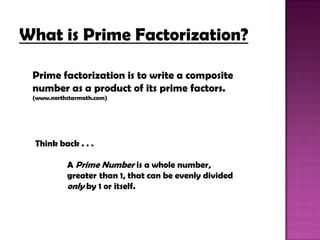
 Prime factorization is to write a composite
 number as a product of its prime factors.
 (www.northstarmath.com)


 Think back . . .

           A Prime Number is a whole number,
           greater than 1, that can be evenly divided
           only by 1 or itself.
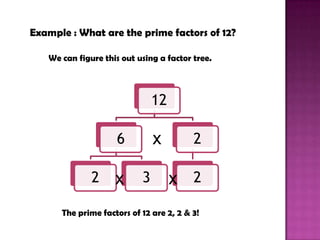
Example : What are the prime factors of 12?

   We can figure this out using a factor tree.


                               12

                     6         x         2

              2     x      3        x 2
      The prime factors of 12 are 2, 2 & 3!
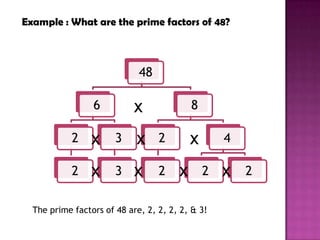
Example : What are the prime factors of 48?


                             48

                 6          x              8

            2    x     3    x     2        x       4

            2    x     3    x     2    x       2   x   2

  The prime factors of 48 are, 2, 2, 2, 2, & 3!
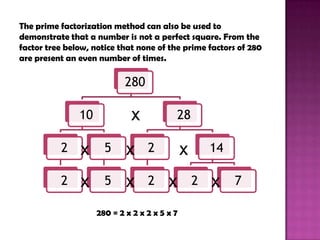
The prime factorization method can also be used to
demonstrate that a number is not a perfect square. From the
factor tree below, notice that none of the prime factors of 280
are present an even number of times.

                            280

               10            x            28

          2    x      5     x     2           x       14

          2    x      5     x     2     x         2   x    7

                    280 = 2 x 2 x 2 x 5 x 7
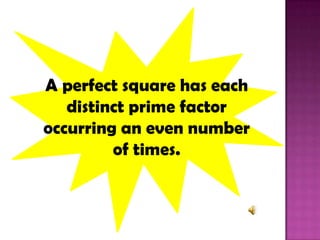
A perfect square has each
   distinct prime factor
occurring an even number
         of times.
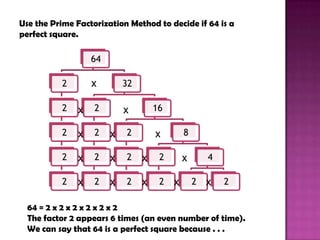
Use the Prime Factorization Method to decide if 64 is a
perfect square.

                   64

          2        x        32

          2    x   2        x        16

          2    x   2    x   2        x        8

          2    x   2    x   2    x    2       x       4

          2    x   2    x   2    x    2   x       2   x   2

  64 = 2 x 2 x 2 x 2 x 2 x 2
  The factor 2 appears 6 times (an even number of time).
  We can say that 64 is a perfect square because . . .
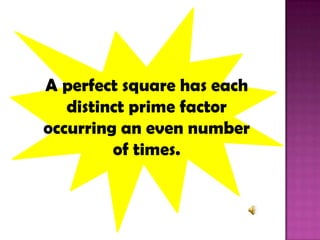
A perfect square has each
   distinct prime factor
occurring an even number
         of times.

Prime Factorization

  • 1.
    Using Prime Factorizationto Identify Perfect Squares
  • 2.
    What is PrimeFactorization? Prime factorization is to write a composite number as a product of its prime factors. (www.northstarmath.com) Think back . . . A Prime Number is a whole number, greater than 1, that can be evenly divided only by 1 or itself.
  • 3.
    Example : Whatare the prime factors of 12? We can figure this out using a factor tree. 12 6 x 2 2 x 3 x 2 The prime factors of 12 are 2, 2 & 3!
  • 4.
    Example : Whatare the prime factors of 48? 48 6 x 8 2 x 3 x 2 x 4 2 x 3 x 2 x 2 x 2 The prime factors of 48 are, 2, 2, 2, 2, & 3!
  • 5.
    The prime factorizationmethod can also be used to demonstrate that a number is not a perfect square. From the factor tree below, notice that none of the prime factors of 280 are present an even number of times. 280 10 x 28 2 x 5 x 2 x 14 2 x 5 x 2 x 2 x 7 280 = 2 x 2 x 2 x 5 x 7
  • 6.
    A perfect squarehas each distinct prime factor occurring an even number of times.
  • 7.
    Use the PrimeFactorization Method to decide if 64 is a perfect square. 64 2 x 32 2 x 2 x 16 2 x 2 x 2 x 8 2 x 2 x 2 x 2 x 4 2 x 2 x 2 x 2 x 2 x 2 64 = 2 x 2 x 2 x 2 x 2 x 2 The factor 2 appears 6 times (an even number of time). We can say that 64 is a perfect square because . . .
  • 8.
    A perfect squarehas each distinct prime factor occurring an even number of times.