500startups
       Lean UX Design Bootcamp


Enrique Allen, Rick Boardman, Miche Capone, Karl Dotter,
   Thomas Both, Laura Klein & Janice Fraser + more!
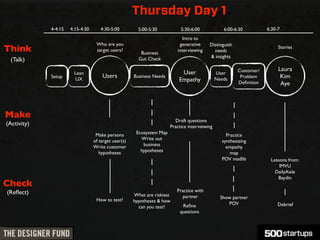
Thursday Day 1
             4-4:15   4:15-4:30      4:30-5:00          5:00-5:30           5:30-6:00             6:00-6:30         6:30-7
                                                                             Intro to
                                   Who are you                             generative     Distinguish
Think                              target users?
                                                         Business
                                                                          interviewing      needs
                                                                                                                         Stories
                                                                                          & insights
  (Talk)                                                Gut Check
                                                                                                        Customer/        Laura
                       Lean                                                 User               User
             Setup                    Users           Business Needs                                     Problem          Kim
                       UX                                                  Empathy             Needs
                                                                                                        Definition         Aye


Make                                                                     Draft questions
(Activity)                                                             Practice interviewing
                                   Make persona        Ecosystem Map                               Practice
                                  of target user(s)      Write out                               synthesizing
                                  Write customer          business                                 empathy
                                     hypotheses          hypotheses                                  map
                                                                                                 POV madlib          Lessons from:
                                                                                                                         IMVU
                                                                                                                       DailyAisle
                                                                                                                        Baydin
Check
(Reflect)                                                                  Practice with
                                                      What are riskiest     partner
                                   How to test?                                                  Show partner
                                                      hypotheses & how
                                                                            Refine                   POV                  Debrief
                                                        can you test?
                                                                           questions
Quick review of
artifacts we’ll create
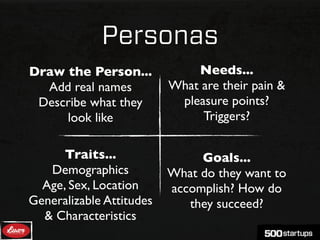
Personas
Draw the Person...            Needs...
  Add real names          What are their pain &
 Describe what they        pleasure points?
     look like                 Triggers?

      Traits...                Goals...
   Demographics           What do they want to
  Age, Sex, Location      accomplish? How do
Generalizable Attitudes      they succeed?
  & Characteristics
Personas
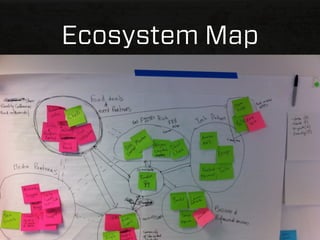
Ecosystem Map
Ecosystem Map
Interview Questions
Point of View:       [Insert User...(descriptive)] + Needs                              List of
[Insert Needs...(verb)] + Because + [Insert Insight...(compelling & surprising)]      hypotheses:

  •     “Tell me about the last time you...”                                       When you go through
                                                                                   the interview check off
  •     “Tell me about an experience you’ve had with...”                           if you validated any
                                                                                   assumptions
  •     “How did you feel when ____ happened?”

  •     “What were you feeling at that moment?”

  •     “Really, can you tell me why that matters?

  •     “Say more about that...I see... Do you know why you think that?

  •     “Okay. And that is important because...”
Point of View
      [User...(descriptive)]
       Needs
       [Needs...(verb)]
       Because
       [Insight...(compelling
           & surprising)]
Now a little soapbox
Design?


• What comes to mind
Jesse Schell on
       ‘Design’
“Anyone who makes decisions about how the product should
be is a designer*. Designer is a role, not a person. Almost
every developer on a team makes some decisions about how
the product will be, just through the act of creating the
product. These decisions are design decisions, and when you
make them, you are a designer. For this reason, no matter what
your role on a development team, an understanding of the
principles of design will make you better at what you do.”
The Right Lean UX
Design Method for
     the Job
“People cling to things like personas, user research, drawing
comics, etc.,” notes Dan Saffer. “In reality the best designers
have a toolbox of options, picking and choosing methods for
each project what makes sense for that particular project.”
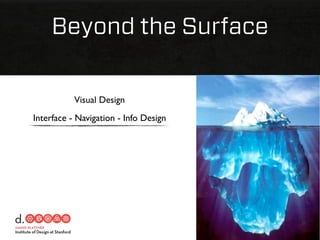
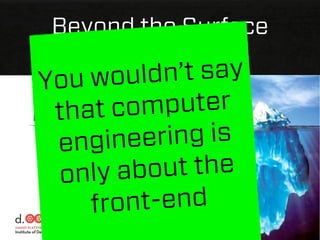
Beyond the Surface

           Visual Design
Interface - Navigation - Info Design
Beyond the Surface

 You w  ouldn  ’t say
  th at com   puter
           Visual Design
Interface - Navigation - Info Design


  e nginee   ring is
  o nly abo   ut the
      fron t-end
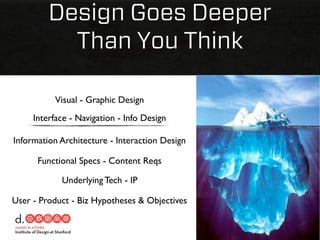
Design Goes Deeper
           Than You Think

          Visual - Graphic Design
     Interface - Navigation - Info Design

Information Architecture - Interaction Design

      Functional Specs - Content Reqs

            Underlying Tech - IP

User - Product - Biz Hypotheses & Objectives
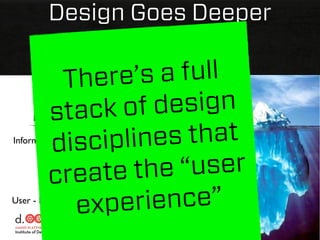
Design Goes Deeper
           Than You Think
          T here’s a full
             ck of d esign
          Visual - Graphic Design
         sta
     Interface - Navigation - Info Design


         dis cipline s that
Information Architecture - Interaction Design


         crea te the  “user
      Functional Specs - Content Reqs

            Underlying Tech - IP


           e xperie nce”
User - Product - Biz Hypotheses & Objectives
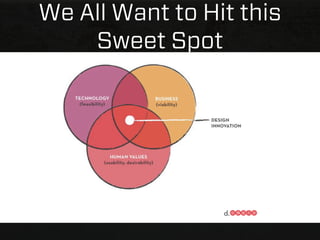
We All Want to Hit this
    Sweet Spot
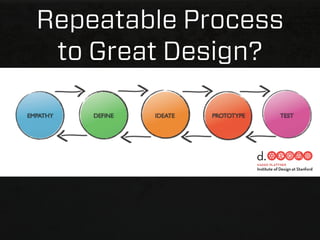
Repeatable Process
 to Great Design?
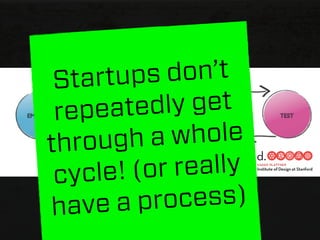
St artups  don’t
 rep eated  ly get
thro ugh a   whole
 cyc le! (or really
have   a pro cess)
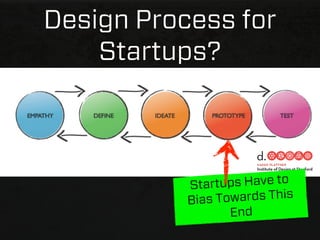
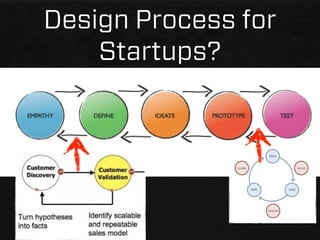
Design Process for
    Startups?


           Start ups Have to
           Bias T owards This
                   End
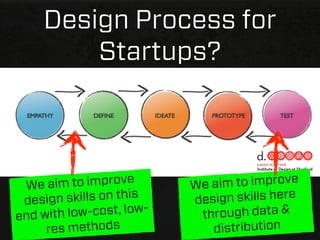
Design Process for
         Startups?


 We aim   to improve        We ai m to improve
 design  skills on this     desig n skills here
end with low  -cost, low-    thro ugh data &
     res methods               distribution
Design Process for
    Startups?
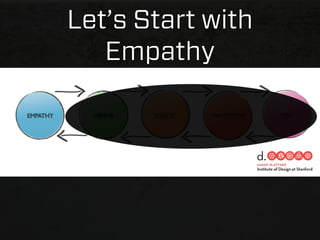
Let’s Start with
   Empathy
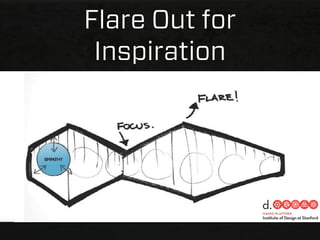
Flare Out for
 Inspiration
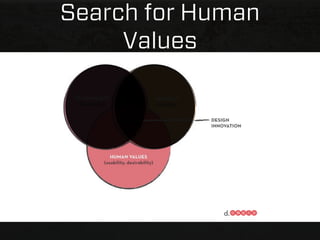
Search for Human
     Values
What is Empathy?

• em·pa·thy:     the intellectual identification
  with or vicarious experiencing of the
  feelings, thoughts, or attitudes of another
 •   you can think through the experience of another by
     understanding it completely

 •   you can feel what another is feeling by immersing
     yourself completely in an experience
Huh?


• Empathy is when you feel what the
  other person is feeling.You can
  mirror their expressions, their opinions,
  their hopes...
Why Empathy?

• to discover people’s explicit and implicit
  needs so that you can meet them through
  your designs
  •   Find meaning & stories

  •   Uncover latent needs

  •   The difference between what people say & do
Why Empathy?

“People care about their
problems (or pleasures ;) not
your F-ING solution”
- Dave McClure
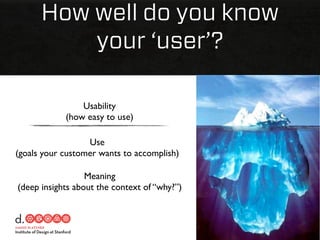
How well do you know
          your ‘user’?

                Usability
            (how easy to use)

                  Use
(goals your customer wants to accomplish)

                  Meaning
(deep insights about the context of “why?”)
Startup Examples of
     Empathy?
How to Find
            Empathy?

• First let’s start with who think your users
  are...
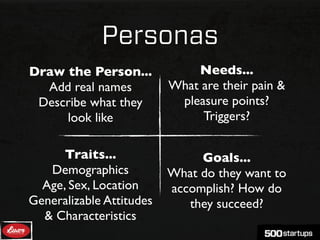
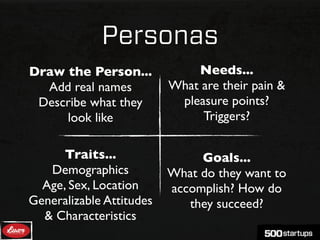
Personas
Draw the Person...            Needs...
  Add real names          What are their pain &
 Describe what they        pleasure points?
     look like                 Triggers?

      Traits...                Goals...
   Demographics           What do they want to
  Age, Sex, Location      accomplish? How do
Generalizable Attitudes      they succeed?
  & Characteristics
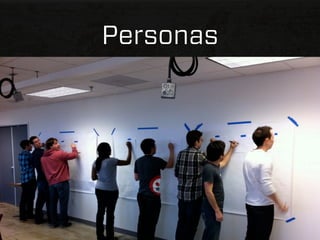
Do it now!


• Quickly break into teams you got 20
  minutes!
• Write out as many personas as possible!
Personas
Draw the Person...            Needs...
  Add real names          What are their pain &
 Describe what they        pleasure points?
     look like                 Triggers?

      Traits...                Goals...
   Demographics           What do they want to
  Age, Sex, Location      accomplish? How do
Generalizable Attitudes      they succeed?
  & Characteristics
How would you
    validate those
      personas?
• When you talk to users do they accurately
  fit any of your personas?
• Which personas are most valuable for your
  businesses in the short & long term?
Now time to zoom
  out from your
    personas
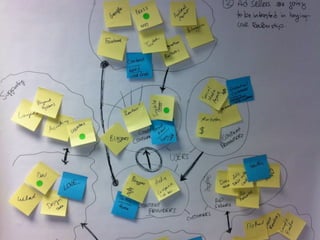
Ecosystem Map
Ecosystem Map
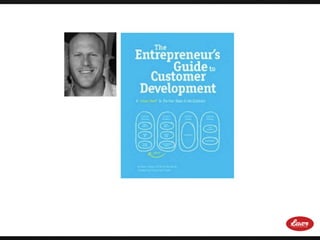
Entrepreneur’s Guide to
Customer Development
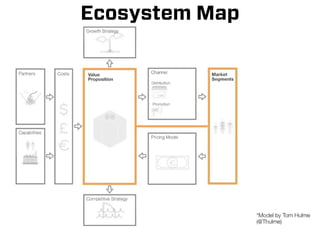
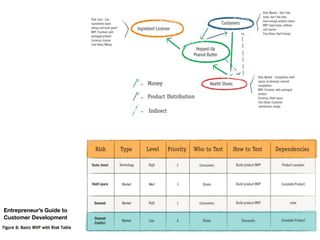
Ecosystem Map

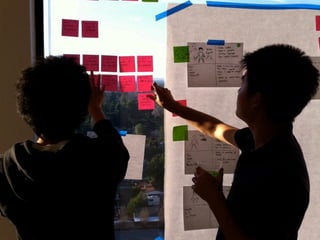
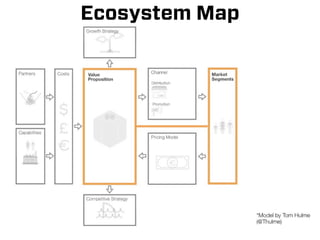
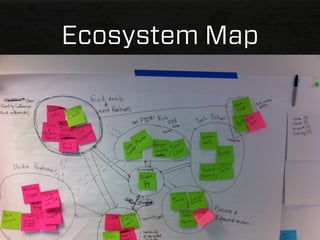
• Map out all the players in your ecosystem
  on Post-Its
• This could be BD relationships,
  competitors, platforms, channels
Ecosystem Map
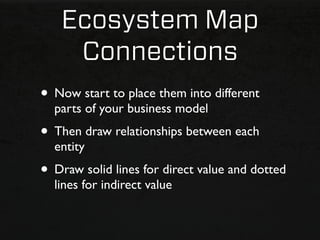
    Connections
• Now start to place them into different
  parts of your business model
• Then draw relationships between each
  entity
• Draw solid lines for direct value and dotted
  lines for indirect value
Ecosystem Map
    Assumptions
• This map shows you your assumptions
  about each player, now lets list them out
• Then highlight your most riskiest
  assumptions (tech, market, team)
• Which relationships in the ecosystem do
  you have any leverage, potential for high
  impact, unique advantage?
Ecosystem Value &
Growth Hypotheses
• Now circle relationships you want to focus
  on over the next 3 months to reduce risk
• Write unique value hypothesis statements
  for each player
• Write growth hypothesis statements for
  each player
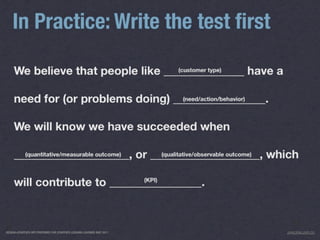
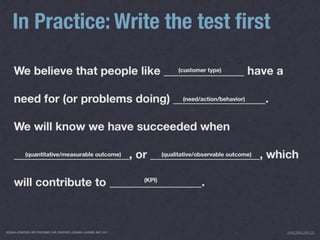
Value hypothesis
Tests whether a product or service really delivers value to
customers once they’re using it.

Example: We believe that people like....[eg persona/
ecosystem partner] have a need for...[eg action/behavior]
We know we will have created value if...[eg quantitative
measurable outcome or qualitative observable outcome]
which will contribute to our...[key performance indicator]
Growth hypothesis
Tests how new customers will discover a product or service eg
from early adopters to mass adoption.

Example: We believe that people like....[eg persona/
ecosystem partner] will want to share our product or
service when...[eg use case with motivation/ability/triggers]
We know we will be on track to grow if...[eg quantitative
measurable outcome or qualitative observable outcome]
which will contribute to our...[key performance indicator]
Test Your
      Hypotheses?

• How would you test these ecosystem
  hypotheses?
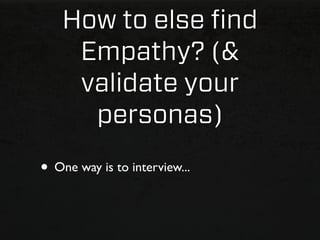
How to else find
     Empathy? (&
     validate your
      personas)
• One way is to interview...
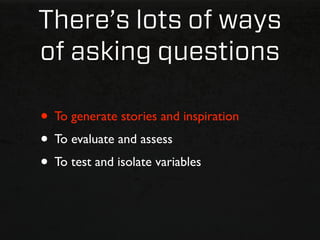
There’s lots of ways
of asking questions

• To generate stories and inspiration
• To evaluate and assess
• To test and isolate variables
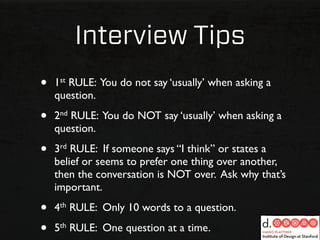
Interview Tips
•   1st RULE: You do not say ‘usually’ when asking a
    question.

•   2nd RULE: You do NOT say ‘usually’ when asking a
    question.

•   3rd RULE: If someone says “I think” or states a
    belief or seems to prefer one thing over another,
    then the conversation is NOT over. Ask why that’s
    important.

•   4th RULE: Only 10 words to a question.

•   5th RULE: One question at a time.
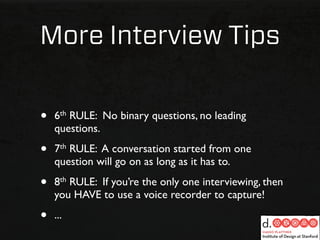
More Interview Tips

•   6th RULE: No binary questions, no leading
    questions.

•   7th RULE: A conversation started from one
    question will go on as long as it has to.

•   8th RULE: If you’re the only one interviewing, then
    you HAVE to use a voice recorder to capture!

•   ...
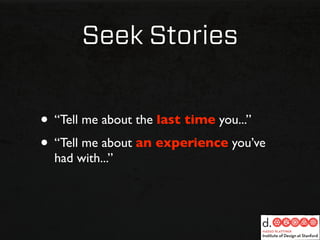
Seek Stories


• “Tell me about the last time you...”
• “Tell me about an experience you’ve
  had with...”
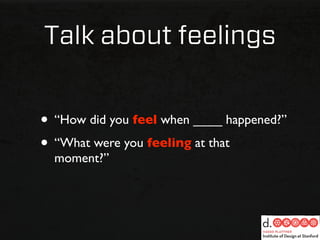
Talk about feelings


• “How did you feel when ____ happened?”
• “What were you feeling at that
  moment?”
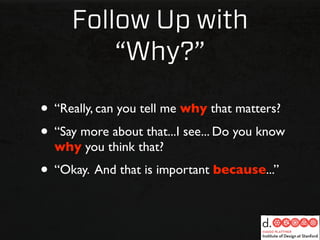
Follow Up with
         “Why?”

• “Really, can you tell me why that matters?
• “Say more about that...I see... Do you know
  why you think that?
• “Okay. And that is important because...”
Demo
Your Turn


• Draft questions that help you better
  understand your users without directly
  asking them about your product (5 min)
Interview Questions
Point of View:       [Insert User...(descriptive)] + Needs                              List of
[Insert Needs...(verb)] + Because + [Insert Insight...(compelling & surprising)]      hypotheses:

  •     “Tell me about the last time you...”                                       When you go through
                                                                                   the interview check off
  •     “Tell me about an experience you’ve had with...”                           if you validated any
                                                                                   assumptions
  •     “How did you feel when ____ happened?”

  •     “What were you feeling at that moment?”

  •     “Really, can you tell me why that matters?

  •     “Say more about that...I see... Do you know why you think that?

  •     “Okay. And that is important because...”
Find a partner


• Time permitting
• Interview them (10 min each)
Refine Questions


• Time Permitting
• Refine questions, look for categories & themes
  to dig deeper into (5 min)
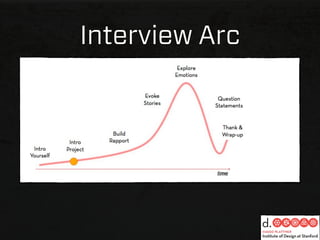
Interview Arc
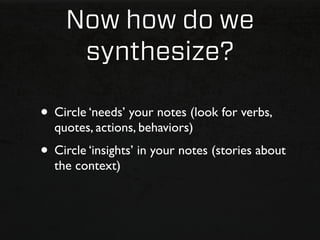
Now how do we
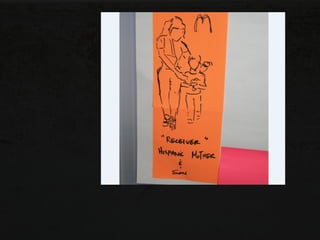
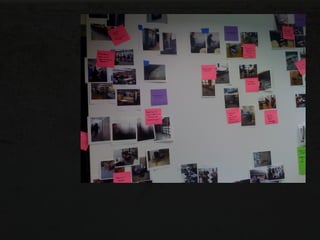
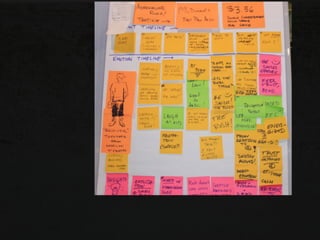
     synthesize?

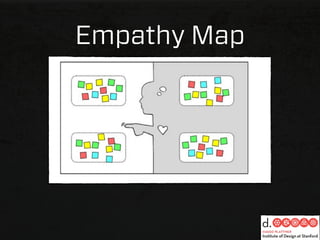
• Circle ‘needs’ your notes (look for verbs,
  quotes, actions, behaviors)
• Circle ‘insights’ in your notes (stories about
  the context)
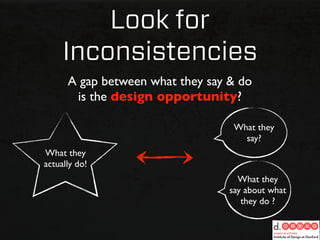
Look for
     Inconsistencies
      A gap between what they say & do
       is the design opportunity?

                                   What they
                                     say?
What they
actually do!
                                    What they
                                  say about what
                                     they do ?
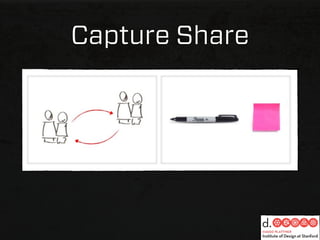
Capture Share
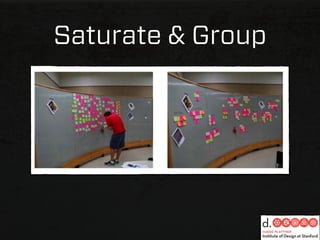
Saturate & Group
Empathy Map
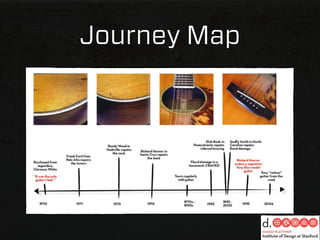
Journey Map
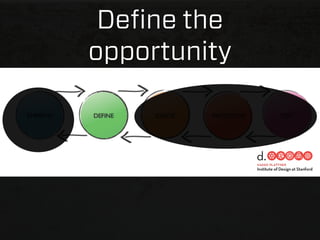
Define the
opportunity
Define


•   This actionable problem statement (often
    referred to as a POV) is the guiding statement that
    focuses on the insights that you uncovered from
    real users.
POV Madlib

• Go back to your persona & ecosystem
  players
• Describe your user + need + surprising
  insight
• Pick a user individually, divide and conquer
• 10 min!
Point of View
      [User...(descriptive)]
       Needs
       [Needs...(verb)]
       Because
       [Insight...(compelling
           & surprising)]
Find a partner


• Time permitting
• Share with your team (2 min each)
Don’t take my word for
  it- let’s introduce:

• @LauraKlein, usersknow.com,
 •   http://www.slideshare.net/LauraKlein1/building-
     empathy

• @KimSheBlue, dailyaisle.com
• @AyeMoah, baydin.com
Prep for tomorrow
• Refine your point of view(s) & prepare a
  question(s) to brainstorm?
  • How might we...[insert prompt]?
• Bring in any copies of any sketches,
  wireframes etc and prepare questions for
  mock interviews/testing
• Recruit remote users for Saturday & in-
  person users for Sunday
Debrief
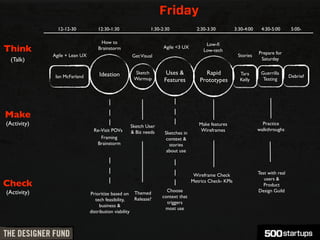
Friday
               12-12-30            12:30-1:30                1:30-2:30             2:30-3:30           3:30-4:00    4:30-5:00        5:00-

                                    How to                                             Low-fi
Think                              Brainstorm                      Agile <3 UX
                                                                                      Low-tech
                                                                                                                   Prepare for
             Agile + Lean UX                        Get Visual                                          Stories
  (Talk)                                                                                                            Saturday


                                   Ideation          Sketch         Uses &             Rapid             Tara       Guerrilla
              Ian McFarland                                                                                                         Debrief
                                                     Warmup        Features          Prototypes          Kelly       Testing


Make
(Activity)                                         Sketch User                      Make features                    Practice
                                 Re-Visit POVs                                       Wireframes                    walkthroughs
                                                   & Biz needs     Sketches in
                                    Framing                         context &
                                  Brainstorm                         stories
                                                                    about use


                                                                                  Wireframe Check                  Test with real
                                                                                                                      users &
Check                                                                            Metrics Check- KPIs
                                                                                                                      Product
(Activity)                                                          Choose                                         Design Guild
                               Prioritize based on Themed
                                                                  context that
                                  tech feasibility,   Release?
                                                                    triggers
                                    business &
                                                                   most use
                               distribution viability
Introducing Ian
      McFarland

• Group CTO at Digital Garage
• Former VP of Tech at Pivotal Labs
• @IMF
Now that you have
      a POV


• Let’s talk about   ideation
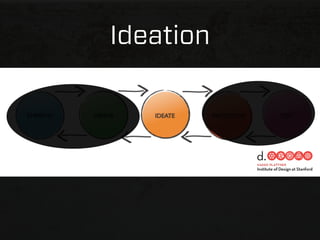
Ideation
What’s Ideation

•   Ideation is the process of idea generation. Mentally
    it represents a process of “going wide” in terms
    of concepts and outcomes. Ideation provides the
    fuel for building prototypes and driving innovative
    solutions.
Why Ideate

• Ideate in order to step beyond obvious
  solutions. We ideate to harness the
  collective perspectives and strengths of our
  teams. We ideate to create fluency
  (volume) and flexibility (variety) in our
  innovation options.
Examples of from
   Startups?
Bad Brainstorming
• Everyone thinks they already do it
• Not a regular meeting
• Not something you take “formal notes” at
• Not a presentation
• Shouldn’t feel like “work”
• It’s actually a tool that needs skill
How to Kill a
        Brainstorm
• The boss gets to speak first
• Everybody gets a turn
• Experts only please
• Do it off-site
• No silly stuff
• Write down everything
How NOT to
         Brainstorm

http://www.youtube.com/watch?v=ttWhK-NO4g8
How to Brainstorm

  http://www.youtube.com/watch?
 v=W1h5L_0rFz8&feature=related
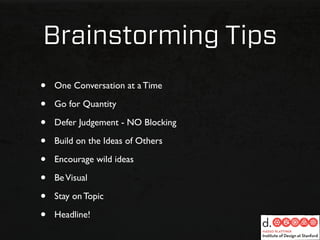
Brainstorming Tips
•   One Conversation at a Time

•   Go for Quantity

•   Defer Judgement - NO Blocking

•   Build on the Ideas of Others

•   Encourage wild ideas

•   Be Visual

•   Stay on Topic

•   Headline!
Ideation
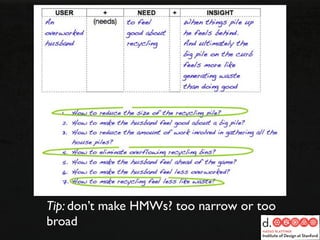
Tip: don’t make HMWs? too narrow or too
broad
Your Turn - Frame
  the Brainstorm

• From your POV...come up with a few “how
  might we...? statements
• How might we trigger [insert
  persona, POV] to do [insert verb,
  behavior]?
Find a partner


• Brainstorm 7min
• Cluster, group, & build on excitement
Switch with your
       partner

• Brainstorm 7min
• Cluster, group, & build on excitement
How do you
synthesize?
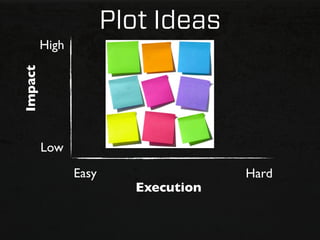
Plot Ideas
         High
Impact


         Low
                Easy                 Hard
                         Execution
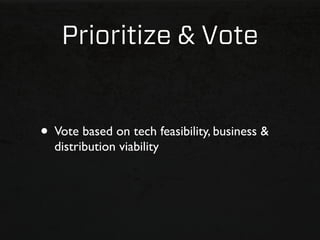
Prioritize & Vote


• Vote based on tech feasibility, business &
  distribution viability
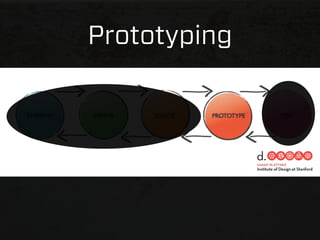
Prototyping
Let’s start with
          sketching

•   @karldotter, dojo.com

    •   http://www.slideshare.net/k4rl/sketching-leanux
Now let’s test your
   prototypes
Setup a scenario
   User:       [Insert description of interviewee (add if they fit your persona or POV)]
                                                                                             List of
   Tech/OS/Browser: [Insert tech savviness/usage level; OS; Browser]                       hypotheses:

                                                                                          When you go through
      Scenario 1:                                                                         the interview check off
          New user experience. e.g. User discovers link on Facebook                       if you validated any
          //Have interviewee login to Facebook and click on Fan page newsfeed             assumptions


      •      Goal/task 1

      •      Goal/task 2

      •      Goal/task 3


The Designer Fund
Setup a Scenario


• Get your prototype ready
• Draft a scenario (5 min)
Interview & Test


• Find a partner
• Brief them on your scenario & show them
  your prototype
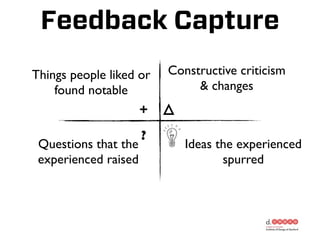
Feedback Capture
Things people liked or    Constructive criticism
    found notable              & changes
                    +
                      ?
 Questions that the          Ideas the experienced
 experienced raised                 spurred
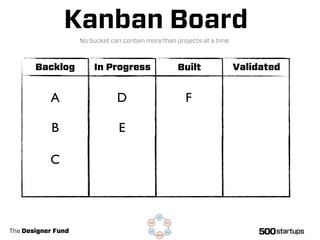
Kanban Board
                    No bucket can contain more than projects at a time


       Backlog          In Progress                 Built                Validated


           A                    D                      F

            B                    E

           C


The Designer Fund
Prep for tomorrow
•   http://www.slideshare.net/LauraKlein1/who-do-i-talk-to-
    now-diy-user-research-for-startups?

•   http://www.slideshare.net/rick/lean-ux-bootcamp-500-
    startups-intro-to-usability

• Pick questions, scenarios tools & do
    remote interview/test
• Pick questions, scenarios, & do in person
    interview/test
Stories to wrap up


• @theozero, highscorehouse.com
• @helloxander, getpunchd.com
• @enriqueallen, designerfund.com
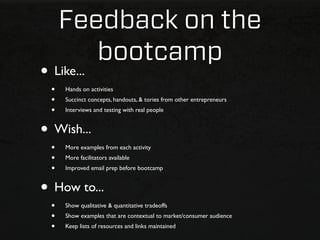
Feedback on the
         bootcamp
• Like...
  •   Hands on activities
  •   Succinct concepts, handouts, & tories from other entrepreneurs
  •   Interviews and testing with real people


• Wish...
  •   More examples from each activity
  •   More facilitators available
  •   Improved email prep before bootcamp


• How to...
  •   Show qualitative & quantitative tradeoffs
  •   Show examples that are contextual to market/consumer audience
  •   Keep lists of resources and links maintained
Appendix
500 Startups Lean UX Bootcamp

500 Startups Lean UX Bootcamp

  • 1.
    500startups Lean UX Design Bootcamp Enrique Allen, Rick Boardman, Miche Capone, Karl Dotter, Thomas Both, Laura Klein & Janice Fraser + more!
  • 2.
    Thursday Day 1 4-4:15 4:15-4:30 4:30-5:00 5:00-5:30 5:30-6:00 6:00-6:30 6:30-7 Intro to Who are you generative Distinguish Think target users? Business interviewing needs Stories & insights (Talk) Gut Check Customer/ Laura Lean User User Setup Users Business Needs Problem Kim UX Empathy Needs Definition Aye Make Draft questions (Activity) Practice interviewing Make persona Ecosystem Map Practice of target user(s) Write out synthesizing Write customer business empathy hypotheses hypotheses map POV madlib Lessons from: IMVU DailyAisle Baydin Check (Reflect) Practice with What are riskiest partner How to test? Show partner hypotheses & how Refine POV Debrief can you test? questions
  • 3.
  • 4.
    Personas Draw the Person... Needs... Add real names What are their pain & Describe what they pleasure points? look like Triggers? Traits... Goals... Demographics What do they want to Age, Sex, Location accomplish? How do Generalizable Attitudes they succeed? & Characteristics
  • 5.
  • 7.
  • 8.
  • 11.
    Interview Questions Point ofView: [Insert User...(descriptive)] + Needs List of [Insert Needs...(verb)] + Because + [Insert Insight...(compelling & surprising)] hypotheses: • “Tell me about the last time you...” When you go through the interview check off • “Tell me about an experience you’ve had with...” if you validated any assumptions • “How did you feel when ____ happened?” • “What were you feeling at that moment?” • “Really, can you tell me why that matters? • “Say more about that...I see... Do you know why you think that? • “Okay. And that is important because...”
  • 12.
    Point of View [User...(descriptive)] Needs [Needs...(verb)] Because [Insight...(compelling & surprising)]
  • 13.
    Now a littlesoapbox
  • 14.
  • 15.
    Jesse Schell on ‘Design’ “Anyone who makes decisions about how the product should be is a designer*. Designer is a role, not a person. Almost every developer on a team makes some decisions about how the product will be, just through the act of creating the product. These decisions are design decisions, and when you make them, you are a designer. For this reason, no matter what your role on a development team, an understanding of the principles of design will make you better at what you do.”
  • 16.
    The Right LeanUX Design Method for the Job “People cling to things like personas, user research, drawing comics, etc.,” notes Dan Saffer. “In reality the best designers have a toolbox of options, picking and choosing methods for each project what makes sense for that particular project.”
  • 17.
    Beyond the Surface Visual Design Interface - Navigation - Info Design
  • 18.
    Beyond the Surface You w ouldn ’t say th at com puter Visual Design Interface - Navigation - Info Design e nginee ring is o nly abo ut the fron t-end
  • 19.
    Design Goes Deeper Than You Think Visual - Graphic Design Interface - Navigation - Info Design Information Architecture - Interaction Design Functional Specs - Content Reqs Underlying Tech - IP User - Product - Biz Hypotheses & Objectives
  • 20.
    Design Goes Deeper Than You Think T here’s a full ck of d esign Visual - Graphic Design sta Interface - Navigation - Info Design dis cipline s that Information Architecture - Interaction Design crea te the “user Functional Specs - Content Reqs Underlying Tech - IP e xperie nce” User - Product - Biz Hypotheses & Objectives
  • 21.
    We All Wantto Hit this Sweet Spot
  • 22.
    Repeatable Process toGreat Design?
  • 23.
    St artups don’t rep eated ly get thro ugh a whole cyc le! (or really have a pro cess)
  • 24.
    Design Process for Startups? Start ups Have to Bias T owards This End
  • 25.
    Design Process for Startups? We aim to improve We ai m to improve design skills on this desig n skills here end with low -cost, low- thro ugh data & res methods distribution
  • 26.
  • 27.
  • 28.
    Flare Out for Inspiration
  • 29.
  • 30.
    What is Empathy? •em·pa·thy: the intellectual identification with or vicarious experiencing of the feelings, thoughts, or attitudes of another • you can think through the experience of another by understanding it completely • you can feel what another is feeling by immersing yourself completely in an experience
  • 31.
    Huh? • Empathy iswhen you feel what the other person is feeling.You can mirror their expressions, their opinions, their hopes...
  • 32.
    Why Empathy? • todiscover people’s explicit and implicit needs so that you can meet them through your designs • Find meaning & stories • Uncover latent needs • The difference between what people say & do
  • 33.
    Why Empathy? “People careabout their problems (or pleasures ;) not your F-ING solution” - Dave McClure
  • 34.
    How well doyou know your ‘user’? Usability (how easy to use) Use (goals your customer wants to accomplish) Meaning (deep insights about the context of “why?”)
  • 35.
  • 36.
    How to Find Empathy? • First let’s start with who think your users are...
  • 37.
    Personas Draw the Person... Needs... Add real names What are their pain & Describe what they pleasure points? look like Triggers? Traits... Goals... Demographics What do they want to Age, Sex, Location accomplish? How do Generalizable Attitudes they succeed? & Characteristics
  • 38.
    Do it now! •Quickly break into teams you got 20 minutes! • Write out as many personas as possible!
  • 39.
    Personas Draw the Person... Needs... Add real names What are their pain & Describe what they pleasure points? look like Triggers? Traits... Goals... Demographics What do they want to Age, Sex, Location accomplish? How do Generalizable Attitudes they succeed? & Characteristics
  • 40.
    How would you validate those personas? • When you talk to users do they accurately fit any of your personas? • Which personas are most valuable for your businesses in the short & long term?
  • 41.
    Now time tozoom out from your personas
  • 42.
  • 48.
  • 49.
  • 50.
    Ecosystem Map • Mapout all the players in your ecosystem on Post-Its • This could be BD relationships, competitors, platforms, channels
  • 51.
    Ecosystem Map Connections • Now start to place them into different parts of your business model • Then draw relationships between each entity • Draw solid lines for direct value and dotted lines for indirect value
  • 52.
    Ecosystem Map Assumptions • This map shows you your assumptions about each player, now lets list them out • Then highlight your most riskiest assumptions (tech, market, team) • Which relationships in the ecosystem do you have any leverage, potential for high impact, unique advantage?
  • 53.
    Ecosystem Value & GrowthHypotheses • Now circle relationships you want to focus on over the next 3 months to reduce risk • Write unique value hypothesis statements for each player • Write growth hypothesis statements for each player
  • 54.
    Value hypothesis Tests whethera product or service really delivers value to customers once they’re using it. Example: We believe that people like....[eg persona/ ecosystem partner] have a need for...[eg action/behavior] We know we will have created value if...[eg quantitative measurable outcome or qualitative observable outcome] which will contribute to our...[key performance indicator]
  • 55.
    Growth hypothesis Tests hownew customers will discover a product or service eg from early adopters to mass adoption. Example: We believe that people like....[eg persona/ ecosystem partner] will want to share our product or service when...[eg use case with motivation/ability/triggers] We know we will be on track to grow if...[eg quantitative measurable outcome or qualitative observable outcome] which will contribute to our...[key performance indicator]
  • 56.
    Test Your Hypotheses? • How would you test these ecosystem hypotheses?
  • 57.
    How to elsefind Empathy? (& validate your personas) • One way is to interview...
  • 58.
    There’s lots ofways of asking questions • To generate stories and inspiration • To evaluate and assess • To test and isolate variables
  • 59.
    Interview Tips • 1st RULE: You do not say ‘usually’ when asking a question. • 2nd RULE: You do NOT say ‘usually’ when asking a question. • 3rd RULE: If someone says “I think” or states a belief or seems to prefer one thing over another, then the conversation is NOT over. Ask why that’s important. • 4th RULE: Only 10 words to a question. • 5th RULE: One question at a time.
  • 60.
    More Interview Tips • 6th RULE: No binary questions, no leading questions. • 7th RULE: A conversation started from one question will go on as long as it has to. • 8th RULE: If you’re the only one interviewing, then you HAVE to use a voice recorder to capture! • ...
  • 61.
    Seek Stories • “Tellme about the last time you...” • “Tell me about an experience you’ve had with...”
  • 62.
    Talk about feelings •“How did you feel when ____ happened?” • “What were you feeling at that moment?”
  • 63.
    Follow Up with “Why?” • “Really, can you tell me why that matters? • “Say more about that...I see... Do you know why you think that? • “Okay. And that is important because...”
  • 64.
  • 65.
    Your Turn • Draftquestions that help you better understand your users without directly asking them about your product (5 min)
  • 66.
    Interview Questions Point ofView: [Insert User...(descriptive)] + Needs List of [Insert Needs...(verb)] + Because + [Insert Insight...(compelling & surprising)] hypotheses: • “Tell me about the last time you...” When you go through the interview check off • “Tell me about an experience you’ve had with...” if you validated any assumptions • “How did you feel when ____ happened?” • “What were you feeling at that moment?” • “Really, can you tell me why that matters? • “Say more about that...I see... Do you know why you think that? • “Okay. And that is important because...”
  • 67.
    Find a partner •Time permitting • Interview them (10 min each)
  • 68.
    Refine Questions • TimePermitting • Refine questions, look for categories & themes to dig deeper into (5 min)
  • 69.
  • 70.
    Now how dowe synthesize? • Circle ‘needs’ your notes (look for verbs, quotes, actions, behaviors) • Circle ‘insights’ in your notes (stories about the context)
  • 71.
    Look for Inconsistencies A gap between what they say & do is the design opportunity? What they say? What they actually do! What they say about what they do ?
  • 72.
  • 73.
  • 74.
  • 75.
  • 76.
  • 77.
    Define • This actionable problem statement (often referred to as a POV) is the guiding statement that focuses on the insights that you uncovered from real users.
  • 78.
    POV Madlib • Goback to your persona & ecosystem players • Describe your user + need + surprising insight • Pick a user individually, divide and conquer • 10 min!
  • 79.
    Point of View [User...(descriptive)] Needs [Needs...(verb)] Because [Insight...(compelling & surprising)]
  • 80.
    Find a partner •Time permitting • Share with your team (2 min each)
  • 81.
    Don’t take myword for it- let’s introduce: • @LauraKlein, usersknow.com, • http://www.slideshare.net/LauraKlein1/building- empathy • @KimSheBlue, dailyaisle.com • @AyeMoah, baydin.com
  • 82.
    Prep for tomorrow •Refine your point of view(s) & prepare a question(s) to brainstorm? • How might we...[insert prompt]? • Bring in any copies of any sketches, wireframes etc and prepare questions for mock interviews/testing • Recruit remote users for Saturday & in- person users for Sunday
  • 83.
  • 84.
    Friday 12-12-30 12:30-1:30 1:30-2:30 2:30-3:30 3:30-4:00 4:30-5:00 5:00- How to Low-fi Think Brainstorm Agile <3 UX Low-tech Prepare for Agile + Lean UX Get Visual Stories (Talk) Saturday Ideation Sketch Uses & Rapid Tara Guerrilla Ian McFarland Debrief Warmup Features Prototypes Kelly Testing Make (Activity) Sketch User Make features Practice Re-Visit POVs Wireframes walkthroughs & Biz needs Sketches in Framing context & Brainstorm stories about use Wireframe Check Test with real users & Check Metrics Check- KPIs Product (Activity) Choose Design Guild Prioritize based on Themed context that tech feasibility, Release? triggers business & most use distribution viability
  • 85.
    Introducing Ian McFarland • Group CTO at Digital Garage • Former VP of Tech at Pivotal Labs • @IMF
  • 87.
    Now that youhave a POV • Let’s talk about ideation
  • 88.
  • 89.
    What’s Ideation • Ideation is the process of idea generation. Mentally it represents a process of “going wide” in terms of concepts and outcomes. Ideation provides the fuel for building prototypes and driving innovative solutions.
  • 90.
    Why Ideate • Ideatein order to step beyond obvious solutions. We ideate to harness the collective perspectives and strengths of our teams. We ideate to create fluency (volume) and flexibility (variety) in our innovation options.
  • 91.
  • 92.
    Bad Brainstorming • Everyonethinks they already do it • Not a regular meeting • Not something you take “formal notes” at • Not a presentation • Shouldn’t feel like “work” • It’s actually a tool that needs skill
  • 93.
    How to Killa Brainstorm • The boss gets to speak first • Everybody gets a turn • Experts only please • Do it off-site • No silly stuff • Write down everything
  • 94.
    How NOT to Brainstorm http://www.youtube.com/watch?v=ttWhK-NO4g8
  • 95.
    How to Brainstorm http://www.youtube.com/watch? v=W1h5L_0rFz8&feature=related
  • 96.
    Brainstorming Tips • One Conversation at a Time • Go for Quantity • Defer Judgement - NO Blocking • Build on the Ideas of Others • Encourage wild ideas • Be Visual • Stay on Topic • Headline!
  • 100.
  • 101.
    Tip: don’t makeHMWs? too narrow or too broad
  • 102.
    Your Turn -Frame the Brainstorm • From your POV...come up with a few “how might we...? statements • How might we trigger [insert persona, POV] to do [insert verb, behavior]?
  • 103.
    Find a partner •Brainstorm 7min • Cluster, group, & build on excitement
  • 104.
    Switch with your partner • Brainstorm 7min • Cluster, group, & build on excitement
  • 105.
  • 111.
    Plot Ideas High Impact Low Easy Hard Execution
  • 112.
    Prioritize & Vote •Vote based on tech feasibility, business & distribution viability
  • 113.
  • 114.
    Let’s start with sketching • @karldotter, dojo.com • http://www.slideshare.net/k4rl/sketching-leanux
  • 115.
    Now let’s testyour prototypes
  • 116.
    Setup a scenario User: [Insert description of interviewee (add if they fit your persona or POV)] List of Tech/OS/Browser: [Insert tech savviness/usage level; OS; Browser] hypotheses: When you go through Scenario 1: the interview check off New user experience. e.g. User discovers link on Facebook if you validated any //Have interviewee login to Facebook and click on Fan page newsfeed assumptions • Goal/task 1 • Goal/task 2 • Goal/task 3 The Designer Fund
  • 117.
    Setup a Scenario •Get your prototype ready • Draft a scenario (5 min)
  • 118.
    Interview & Test •Find a partner • Brief them on your scenario & show them your prototype
  • 119.
    Feedback Capture Things peopleliked or Constructive criticism found notable & changes + ? Questions that the Ideas the experienced experienced raised spurred
  • 120.
    Kanban Board No bucket can contain more than projects at a time Backlog In Progress Built Validated A D F B E C The Designer Fund
  • 121.
    Prep for tomorrow • http://www.slideshare.net/LauraKlein1/who-do-i-talk-to- now-diy-user-research-for-startups? • http://www.slideshare.net/rick/lean-ux-bootcamp-500- startups-intro-to-usability • Pick questions, scenarios tools & do remote interview/test • Pick questions, scenarios, & do in person interview/test
  • 122.
    Stories to wrapup • @theozero, highscorehouse.com • @helloxander, getpunchd.com • @enriqueallen, designerfund.com
  • 123.
    Feedback on the bootcamp • Like... • Hands on activities • Succinct concepts, handouts, & tories from other entrepreneurs • Interviews and testing with real people • Wish... • More examples from each activity • More facilitators available • Improved email prep before bootcamp • How to... • Show qualitative & quantitative tradeoffs • Show examples that are contextual to market/consumer audience • Keep lists of resources and links maintained
  • 124.