Exploring UX Techniques and
Practices
When should they be applied?

Let s practice!


Ariadna Font


UX Lead @Vivisimo, an IBM Company

@quicola #leanux #agile2012          ariadna.font.cat
The Goals

  THEORY:

  •  Learn more about what Lean UX techniques you
     can apply at different development stages

  PRACTICE

  •  Collaborative design session 

  •  Focus on delivering an MVP fast with user-driven
     design/development
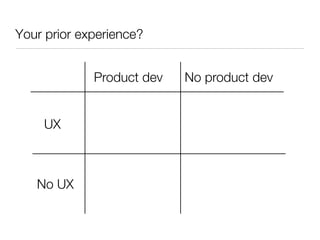
Your prior experience?


             Product dev
   No product dev


     UX


   No UX
What s UX (User Experience)?

•  How do people feel about (using) a product / site 

•  User-Centered design and development

•  Experiential, affective aspects of human-computer
  interaction

•  Perceptions of utility, easy of use and efficiency

•  Subjective in nature

•  Dynamic, it changes overtime
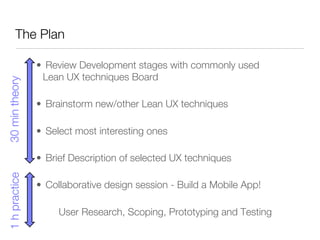
The Plan

                 •  Review Development stages with commonly used
                   Lean UX techniques Board
30 min theory


                 •  Brainstorm new/other Lean UX techniques

                 •  Select most interesting ones 

                 •  Brief Description of selected UX techniques
1 h practice


                 •  Collaborative design session - Build a Mobile App!

                     
User Research, Scoping, Prototyping and Testing
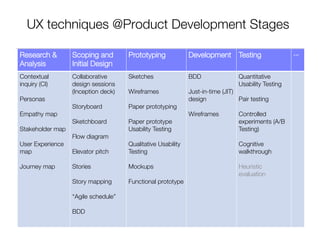
UX techniques @Product Development Stages

Research &         Scoping and         Prototyping
            Development
 Testing
                     …
                                                                                                         
Analysis
          Initial Design
Contextual         Collaborative       Sketches
               BDD
                 Quantitative
inquiry (CI)
      design sessions     
                       
                    Usability Testing

                  (Inception deck)
   Wireframes
             Just-in-time (JIT)   
Personas
          
                   
                       design
              Pair testing

                  Storyboard 
        Paper prototyping
      
                    
Empathy map
       
                   
                       Wireframes
          Controlled

                  Sketchboard
        Paper prototype                              experiments (A/B
Stakeholder map
   
                   Usability Testing
                           Testing)

                  Flow diagram
       
                                            
User Experience    
                   Qualitative Usability                        Cognitive
map
               Elevator pitch
     Testing
                                     walkthrough


Journey map
       Stories
            Mockups
                                     Heuristic


                                            evaluation

                  Story mapping
      Functional prototype


                   “Agile schedule”
                   
                   BDD
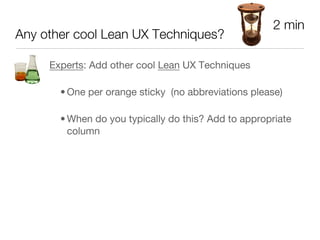
2 min
Any other cool Lean UX Techniques?

     Experts: Add other cool Lean UX Techniques 

       • One per orange sticky (no abbreviations please)

       • When do you typically do this? Add to appropriate
         column
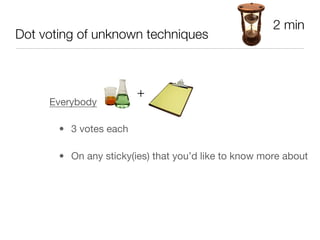
2 min
Dot voting of unknown techniques


                           +
     Everybody 

         •  3 votes each        

         •  On any sticky(ies) that you’d like to know more about
15 min
Briefly describe new techniques


     Need volunteers for orange stikies
     

     (See template on handout/next slide)
2 min
Brief Description Template

1.  Lean UX Technique name & primary development stage
    (when do people do this?)

2.  Brief description 

3.  Who does it?

4.  Key benefits (or why should anyone do this?)

5.  Challenges (problems you might run into)
UX Techniques Briefly Explained
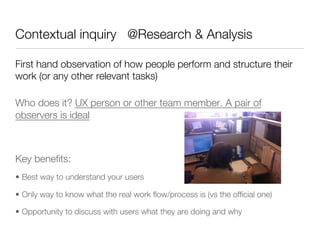
Contextual inquiry @Research & Analysis

First hand observation of how people perform and structure their
work (or any other relevant tasks)

Who does it? UX person or other team member. A pair of
observers is ideal


Key benefits:
•  Best way to understand your users

•  Only way to know what the real work flow/process is (vs the official one)

•  Opportunity to discuss with users what they are doing and why
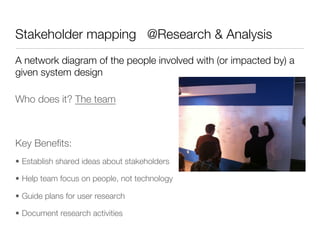
Stakeholder mapping @Research & Analysis
A network diagram of the people involved with (or impacted by) a
given system design

Who does it? The team


Key Benefits:
•  Establish shared ideas about stakeholders

•  Help team focus on people, not technology

•  Guide plans for user research

•  Document research activities
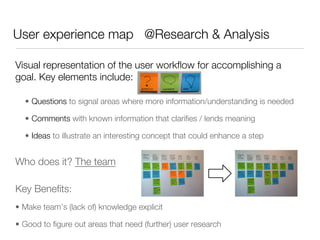
User experience map @Research & Analysis

Visual representation of the user workflow for accomplishing a
goal. Key elements include:


    •  Questions to signal areas where more information/understanding is needed

    •  Comments with known information that clarifies / lends meaning 

    •  Ideas to illustrate an interesting concept that could enhance a step


Who does it? The team

Key Benefits:
•  Make team’s (lack of) knowledge explicit 

•  Good to figure out areas that need (further) user research
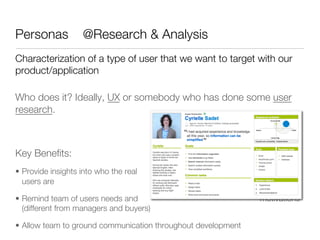
Personas            @Research & Analysis
Characterization of a type of user that we want to target with our
product/application

Who does it? Ideally, UX or somebody who has done some user
research.


Key Benefits:
•  Provide insights into who the real
   users are

•  Remind team of users needs and                               motivations
   (different from managers and buyers) 

•  Allow team to ground communication throughout development
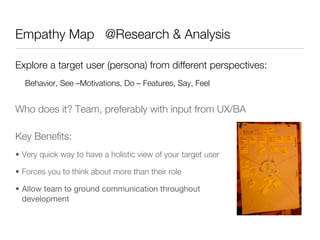
Empathy Map @Research & Analysis

Explore a target user (persona) from different perspectives:
  Behavior, See –Motivations, Do – Features, Say, Feel


Who does it? Team, preferably with input from UX/BA

Key Benefits:
•  Very quick way to have a holistic view of your target user

•  Forces you to think about more than their role

•  Allow team to ground communication throughout
   development
Elevator Pitch @Scoping

Short summary used to quickly and simply define a product and its
value proposition.
•  For [target customer]
                                                          Who does it? The Team
•  who [statement of the need or opportunity]

•  the [product name]
                                    Key Benefits:
•  is a [product category]
                               •    Provides Business
                                                               relevance and context
•  that [key benefit, compelling reason to buy].
                                                          •    Forces to agree on killer
•  Unlike [primary competitive alternative]
                   feature(s)

•  our product [statement of primary differentiation].
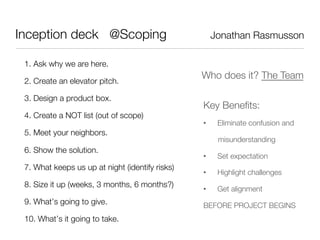
Inception deck @Scoping                                Jonathan Rasmusson

 1. Ask why we are here.
                                                  Who does it? The Team
 2. Create an elevator pitch.

 3. Design a product box.
                                                  Key Benefits:
 4. Create a NOT list (out of scope)
                                                  •     Eliminate confusion and
 5. Meet your neighbors.
                                                        misunderstanding
 6. Show the solution.
                                                  •     Set expectation
 7. What keeps us up at night (identify risks)
                                                  •     Highlight challenges
 8. Size it up (weeks, 3 months, 6 months?)
                                                  •     Get alignment
 9. What’s going to give.
                        BEFORE PROJECT BEGINS
 10. What’s it going to take.
User stories @Scoping

Software system requirement formulated in one or two sentences
in everyday or business language that makes explicit the user’s
need. Example:
           As a [type of user] !

           I want to [perform some task] !

           so that I can [reach some goal]!


Who does this? The team (dev, tester, doc or UX)
Key Benefits:
  •  Provides a thinking template; token for a conversation

  •  Description of why the product needs to do what it does
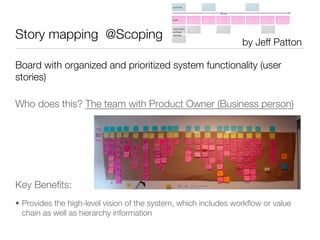
Story mapping @Scoping
                                                                 by Jeff Patton

Board with organized and prioritized system functionality (user
stories)

Who does this? The team with Product Owner (Business person)


Key Benefits:
•  Provides the high-level vision of the system, which includes workflow or value
   chain as well as hierarchy information
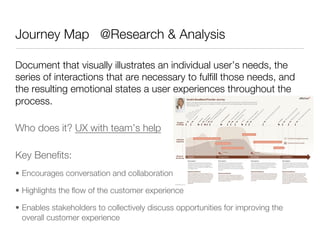
Journey Map @Research & Analysis

Document that visually illustrates an individual user’s needs, the
series of interactions that are necessary to fulfill those needs, and
the resulting emotional states a user experiences throughout the
process. 

Who does it? UX with team’s help

Key Benefits:
•  Encourages conversation and collaboration

•  Highlights the flow of the customer experience

•  Enables stakeholders to collectively discuss opportunities for improving the
   overall customer experience
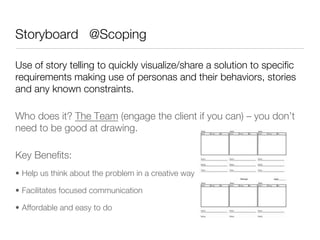
Storyboard @Scoping

Use of story telling to quickly visualize/share a solution to specific
requirements making use of personas and their behaviors, stories
and any known constraints.

Who does it? The Team (engage the client if you can) – you don’t
need to be good at drawing. 

Key Benefits:
•  Help us think about the problem in a creative way

•  Facilitates focused communication 

•  Affordable and easy to do
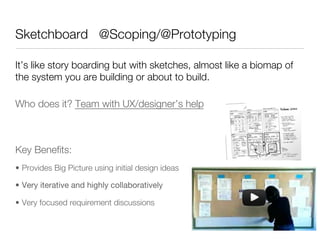
Sketchboard @Scoping/@Prototyping

It’s like story boarding but with sketches, almost like a biomap of
the system you are building or about to build.

Who does it? Team with UX/designer’s help


Key Benefits:
•  Provides Big Picture using initial design ideas

•  Very iterative and highly collaboratively

•  Very focused requirement discussions
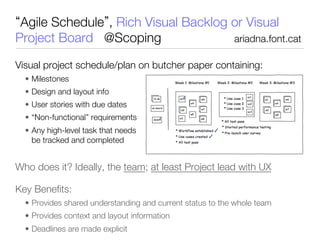
Agile Schedule , Rich Visual Backlog or Visual
Project Board @Scoping                ariadna.font.cat


Visual project schedule/plan on butcher paper containing:
    •  Milestones
    •  Design and layout info
    •  User stories with due dates
    •  “Non-functional” requirements
    •  Any high-level task that needs                                        to
       be tracked and completed


Who does it? Ideally, the team; at least Project lead with UX 


Key Benefits:
    •  Provides shared understanding and current status to the whole team
    •  Provides context and layout information
    •  Deadlines are made explicit
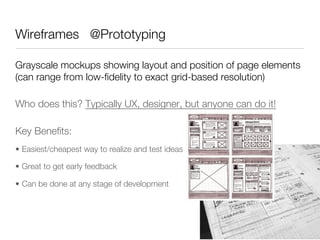
Wireframes @Prototyping

Grayscale mockups showing layout and position of page elements
(can range from low-fidelity to exact grid-based resolution)

Who does this? Typically UX, designer, but anyone can do it!

Key Benefits:
•  Easiest/cheapest way to realize and test ideas

•  Great to get early feedback

•  Can be done at any stage of development
Behavior-driven development (BDD) @Development
A set of techniques to use in conversations which help the team
explore the intended behavior of the system and the problems it
solves, then carry the conversations and language into the code.
      Given some initial context (the given)!
      When an event occurs!
      Then some outcomes should occur


Who does it? Ideally a threesome (dev, tester and business)

Key Benefits:
•  Deliberately discovering key misunderstandings and uncertainty
•  Makes it easier for technical and business people to communicate
•  Accelerates learning
Just-in-time (JIT) design @Development

Designing and implementing what you know the team needs right
now, not worrying about future issues until absolutely necessary
(last responsible moment). The opposite of Big Design Up Front
(BDUF).

Who does it? Designer or UX expert"


Key Benefits:
•  Quick and as low-fidelity as possible

•  Focuses on high-value high-priority functionality

•  Saves time wasted on irrelevant designs (YAGNI – you ain’t going to need it)
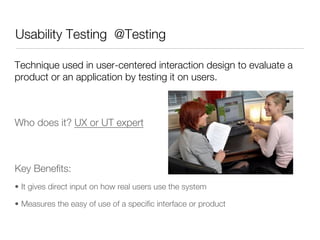
Usability Testing @Testing

Technique used in user-centered interaction design to evaluate a
product or an application by testing it on users. 


Who does it? UX or UT expert


Key Benefits:
•  It gives direct input on how real users use the system

•  Measures the easy of use of a specific interface or product
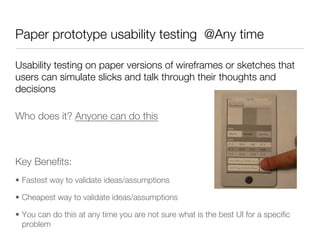
Paper prototype usability testing @Any time

Usability testing on paper versions of wireframes or sketches that
users can simulate slicks and talk through their thoughts and
decisions

Who does it? Anyone can do this


Key Benefits:
•  Fastest way to validate ideas/assumptions

•  Cheapest way to validate ideas/assumptions

•  You can do this at any time you are not sure what is the best UI for a specific
   problem
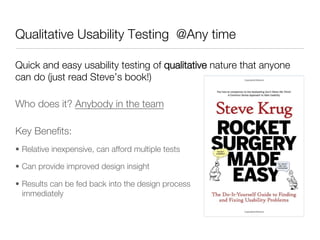
Qualitative Usability Testing @Any time

Quick and easy usability testing of qualitative nature that anyone
can do (just read Steve’s book!)

Who does it? Anybody in the team

Key Benefits:
•  Relative inexpensive, can afford multiple tests

•  Can provide improved design insight                insight

•  Results can be fed back into the design process
   immediately
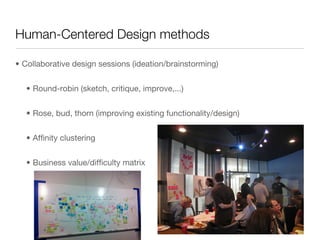
Human-Centered Design methods

•  Collaborative design sessions (ideation/brainstorming)


   •  Round-robin (sketch, critique, improve,...)


   •  Rose, bud, thorn (improving existing functionality/design)


   •  Affinity clustering


   •  Business value/difficulty matrix
The Goals

  THEORY:

  •  Learn more about what Lean UX techniques you
     can apply at different development stages

  PRACTICE

  •  Collaborative design session 

  •  Focus on delivering an MVP fast with user-driven
     design/development
Let s Practice!

Collaborative Design Session
Challenge


         Develop a Mobile App that helps
        promote networking and interaction 
         between all conference attendees
2 min
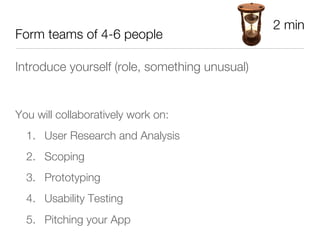
Form teams of 4-6 people

Introduce yourself (role, something unusual)


You will collaboratively work on:
    1.  User Research and Analysis
    2.  Scoping
    3.  Prototyping 
    4.  Usability Testing
    5.  Pitching your App
10 min
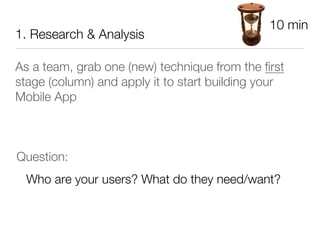
1. Research & Analysis

As a team, grab one (new) technique from the first
stage (column) and apply it to start building your
Mobile App


Question: 
    Who are your users? What do they need/want?
10 min
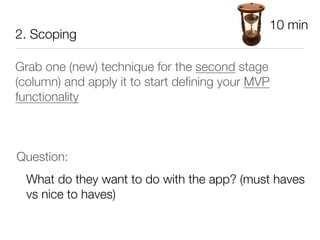
2. Scoping

Grab one (new) technique for the second stage
(column) and apply it to start defining your MVP
functionality


Question: 
    What do they want to do with the app? (must haves
    vs nice to haves)
15 min
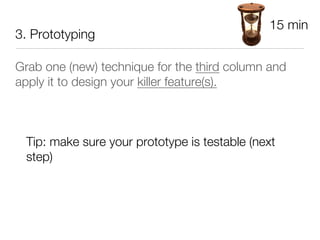
3. Prototyping

Grab one (new) technique for the third column and
apply it to design your killer feature(s).


    Tip: make sure your prototype is testable (next
    step)
10 min
4. Usability Testing

Now let s test your paper prototype!

Question:
 Can somebody outside your team use it? 
    •  Recruit user(s) from other teams
    •  Do they know what they can do? and how to
     do it?
    •  Are there any big usability issues that would
     prevent your MVP from being broadly adopted?
10 min
5. Pitch it!

Show it to other teams


Question:
    Does anybody outside your team want to buy it?
The Goals

  THEORY:

  •  Learn more about what Lean UX techniques you
     can apply at different development stages

  PRACTICE

  •  Collaborative design session 

  •  Focus on delivering an MVP fast with user-driven
     design/development
Retrospective

•  What was your favorite part of the session?

•  What was your least favorite part?

•  Will you be able to take something you learned in this
  session back to your work/life? (if so, what?) 

•  Any final thoughts or questions?
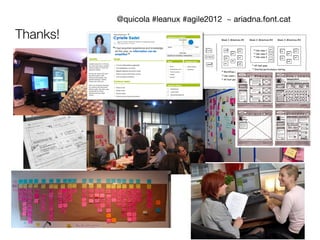
@quicola #leanux #agile2012 ~ ariadna.font.cat

Thanks!

Exploring UX Practices 4 Product Development Agile2012

  • 1.
    Exploring UX Techniquesand Practices When should they be applied? Let s practice! Ariadna Font UX Lead @Vivisimo, an IBM Company @quicola #leanux #agile2012 ariadna.font.cat
  • 2.
    The Goals THEORY: •  Learn more about what Lean UX techniques you can apply at different development stages PRACTICE •  Collaborative design session •  Focus on delivering an MVP fast with user-driven design/development
  • 3.
    Your prior experience? Product dev No product dev UX No UX
  • 4.
    What s UX(User Experience)? •  How do people feel about (using) a product / site •  User-Centered design and development •  Experiential, affective aspects of human-computer interaction •  Perceptions of utility, easy of use and efficiency •  Subjective in nature •  Dynamic, it changes overtime
  • 5.
    The Plan •  Review Development stages with commonly used Lean UX techniques Board 30 min theory •  Brainstorm new/other Lean UX techniques •  Select most interesting ones •  Brief Description of selected UX techniques 1 h practice •  Collaborative design session - Build a Mobile App! User Research, Scoping, Prototyping and Testing
  • 6.
    UX techniques @ProductDevelopment Stages Research & Scoping and Prototyping Development Testing … Analysis Initial Design Contextual Collaborative Sketches BDD Quantitative inquiry (CI) design sessions Usability Testing (Inception deck) Wireframes Just-in-time (JIT) Personas design Pair testing Storyboard Paper prototyping Empathy map Wireframes Controlled Sketchboard Paper prototype experiments (A/B Stakeholder map Usability Testing Testing) Flow diagram User Experience Qualitative Usability Cognitive map Elevator pitch Testing walkthrough Journey map Stories Mockups Heuristic evaluation Story mapping Functional prototype “Agile schedule” BDD
  • 7.
    2 min Any othercool Lean UX Techniques? Experts: Add other cool Lean UX Techniques • One per orange sticky (no abbreviations please) • When do you typically do this? Add to appropriate column
  • 8.
    2 min Dot votingof unknown techniques + Everybody •  3 votes each •  On any sticky(ies) that you’d like to know more about
  • 9.
    15 min Briefly describenew techniques Need volunteers for orange stikies (See template on handout/next slide)
  • 10.
    2 min Brief DescriptionTemplate 1.  Lean UX Technique name & primary development stage (when do people do this?) 2.  Brief description 3.  Who does it? 4.  Key benefits (or why should anyone do this?) 5.  Challenges (problems you might run into)
  • 11.
  • 12.
    Contextual inquiry @Research& Analysis First hand observation of how people perform and structure their work (or any other relevant tasks) Who does it? UX person or other team member. A pair of observers is ideal Key benefits: •  Best way to understand your users •  Only way to know what the real work flow/process is (vs the official one) •  Opportunity to discuss with users what they are doing and why
  • 13.
    Stakeholder mapping @Research& Analysis A network diagram of the people involved with (or impacted by) a given system design Who does it? The team Key Benefits: •  Establish shared ideas about stakeholders •  Help team focus on people, not technology •  Guide plans for user research •  Document research activities
  • 14.
    User experience map@Research & Analysis Visual representation of the user workflow for accomplishing a goal. Key elements include: •  Questions to signal areas where more information/understanding is needed •  Comments with known information that clarifies / lends meaning •  Ideas to illustrate an interesting concept that could enhance a step Who does it? The team Key Benefits: •  Make team’s (lack of) knowledge explicit •  Good to figure out areas that need (further) user research
  • 15.
    Personas @Research & Analysis Characterization of a type of user that we want to target with our product/application Who does it? Ideally, UX or somebody who has done some user research. Key Benefits: •  Provide insights into who the real users are •  Remind team of users needs and motivations (different from managers and buyers) •  Allow team to ground communication throughout development
  • 16.
    Empathy Map @Research& Analysis Explore a target user (persona) from different perspectives: Behavior, See –Motivations, Do – Features, Say, Feel Who does it? Team, preferably with input from UX/BA Key Benefits: •  Very quick way to have a holistic view of your target user •  Forces you to think about more than their role •  Allow team to ground communication throughout development
  • 17.
    Elevator Pitch @Scoping Shortsummary used to quickly and simply define a product and its value proposition. •  For [target customer] Who does it? The Team •  who [statement of the need or opportunity] •  the [product name] Key Benefits: •  is a [product category] •  Provides Business relevance and context •  that [key benefit, compelling reason to buy]. •  Forces to agree on killer •  Unlike [primary competitive alternative] feature(s) •  our product [statement of primary differentiation].
  • 18.
    Inception deck @Scoping Jonathan Rasmusson 1. Ask why we are here. Who does it? The Team 2. Create an elevator pitch. 3. Design a product box. Key Benefits: 4. Create a NOT list (out of scope) •  Eliminate confusion and 5. Meet your neighbors. misunderstanding 6. Show the solution. •  Set expectation 7. What keeps us up at night (identify risks) •  Highlight challenges 8. Size it up (weeks, 3 months, 6 months?) •  Get alignment 9. What’s going to give. BEFORE PROJECT BEGINS 10. What’s it going to take.
  • 19.
    User stories @Scoping Softwaresystem requirement formulated in one or two sentences in everyday or business language that makes explicit the user’s need. Example: As a [type of user] ! I want to [perform some task] ! so that I can [reach some goal]! Who does this? The team (dev, tester, doc or UX) Key Benefits: •  Provides a thinking template; token for a conversation •  Description of why the product needs to do what it does
  • 20.
    Story mapping @Scoping by Jeff Patton Board with organized and prioritized system functionality (user stories) Who does this? The team with Product Owner (Business person) Key Benefits: •  Provides the high-level vision of the system, which includes workflow or value chain as well as hierarchy information
  • 21.
    Journey Map @Research& Analysis Document that visually illustrates an individual user’s needs, the series of interactions that are necessary to fulfill those needs, and the resulting emotional states a user experiences throughout the process. Who does it? UX with team’s help Key Benefits: •  Encourages conversation and collaboration •  Highlights the flow of the customer experience •  Enables stakeholders to collectively discuss opportunities for improving the overall customer experience
  • 22.
    Storyboard @Scoping Use ofstory telling to quickly visualize/share a solution to specific requirements making use of personas and their behaviors, stories and any known constraints. Who does it? The Team (engage the client if you can) – you don’t need to be good at drawing. Key Benefits: •  Help us think about the problem in a creative way •  Facilitates focused communication •  Affordable and easy to do
  • 23.
    Sketchboard @Scoping/@Prototyping It’s likestory boarding but with sketches, almost like a biomap of the system you are building or about to build. Who does it? Team with UX/designer’s help Key Benefits: •  Provides Big Picture using initial design ideas •  Very iterative and highly collaboratively •  Very focused requirement discussions
  • 24.
    Agile Schedule ,Rich Visual Backlog or Visual Project Board @Scoping ariadna.font.cat Visual project schedule/plan on butcher paper containing: •  Milestones •  Design and layout info •  User stories with due dates •  “Non-functional” requirements •  Any high-level task that needs to be tracked and completed Who does it? Ideally, the team; at least Project lead with UX Key Benefits: •  Provides shared understanding and current status to the whole team •  Provides context and layout information •  Deadlines are made explicit
  • 25.
    Wireframes @Prototyping Grayscale mockupsshowing layout and position of page elements (can range from low-fidelity to exact grid-based resolution) Who does this? Typically UX, designer, but anyone can do it! Key Benefits: •  Easiest/cheapest way to realize and test ideas •  Great to get early feedback •  Can be done at any stage of development
  • 26.
    Behavior-driven development (BDD)@Development A set of techniques to use in conversations which help the team explore the intended behavior of the system and the problems it solves, then carry the conversations and language into the code. Given some initial context (the given)! When an event occurs! Then some outcomes should occur Who does it? Ideally a threesome (dev, tester and business) Key Benefits: •  Deliberately discovering key misunderstandings and uncertainty •  Makes it easier for technical and business people to communicate •  Accelerates learning
  • 27.
    Just-in-time (JIT) design@Development Designing and implementing what you know the team needs right now, not worrying about future issues until absolutely necessary (last responsible moment). The opposite of Big Design Up Front (BDUF). Who does it? Designer or UX expert" Key Benefits: •  Quick and as low-fidelity as possible •  Focuses on high-value high-priority functionality •  Saves time wasted on irrelevant designs (YAGNI – you ain’t going to need it)
  • 28.
    Usability Testing @Testing Techniqueused in user-centered interaction design to evaluate a product or an application by testing it on users. Who does it? UX or UT expert Key Benefits: •  It gives direct input on how real users use the system •  Measures the easy of use of a specific interface or product
  • 29.
    Paper prototype usabilitytesting @Any time Usability testing on paper versions of wireframes or sketches that users can simulate slicks and talk through their thoughts and decisions Who does it? Anyone can do this Key Benefits: •  Fastest way to validate ideas/assumptions •  Cheapest way to validate ideas/assumptions •  You can do this at any time you are not sure what is the best UI for a specific problem
  • 30.
    Qualitative Usability Testing@Any time Quick and easy usability testing of qualitative nature that anyone can do (just read Steve’s book!) Who does it? Anybody in the team Key Benefits: •  Relative inexpensive, can afford multiple tests •  Can provide improved design insight insight •  Results can be fed back into the design process immediately
  • 31.
    Human-Centered Design methods • Collaborative design sessions (ideation/brainstorming) •  Round-robin (sketch, critique, improve,...) •  Rose, bud, thorn (improving existing functionality/design) •  Affinity clustering •  Business value/difficulty matrix
  • 32.
    The Goals THEORY: •  Learn more about what Lean UX techniques you can apply at different development stages PRACTICE •  Collaborative design session •  Focus on delivering an MVP fast with user-driven design/development
  • 33.
  • 34.
    Challenge Develop a Mobile App that helps promote networking and interaction between all conference attendees
  • 35.
    2 min Form teamsof 4-6 people Introduce yourself (role, something unusual) You will collaboratively work on: 1.  User Research and Analysis 2.  Scoping 3.  Prototyping 4.  Usability Testing 5.  Pitching your App
  • 36.
    10 min 1. Research& Analysis As a team, grab one (new) technique from the first stage (column) and apply it to start building your Mobile App Question: Who are your users? What do they need/want?
  • 37.
    10 min 2. Scoping Grabone (new) technique for the second stage (column) and apply it to start defining your MVP functionality Question: What do they want to do with the app? (must haves vs nice to haves)
  • 38.
    15 min 3. Prototyping Grabone (new) technique for the third column and apply it to design your killer feature(s). Tip: make sure your prototype is testable (next step)
  • 39.
    10 min 4. UsabilityTesting Now let s test your paper prototype! Question: Can somebody outside your team use it? •  Recruit user(s) from other teams •  Do they know what they can do? and how to do it? •  Are there any big usability issues that would prevent your MVP from being broadly adopted?
  • 40.
    10 min 5. Pitchit! Show it to other teams Question: Does anybody outside your team want to buy it?
  • 41.
    The Goals THEORY: •  Learn more about what Lean UX techniques you can apply at different development stages PRACTICE •  Collaborative design session •  Focus on delivering an MVP fast with user-driven design/development
  • 42.
    Retrospective •  What wasyour favorite part of the session? •  What was your least favorite part? •  Will you be able to take something you learned in this session back to your work/life? (if so, what?) •  Any final thoughts or questions?
  • 43.
    @quicola #leanux #agile2012~ ariadna.font.cat Thanks!