Managing
Anger
Part 2
Presented By: Tim Ervin, LCPC
Counseling for Solutions, LLC
Arlington Heights, IL. 60005

50 Ways for Anger Management

1
Training Topics
What is really behind anger: Triggers and signs

How the brain works
Cognitive distortions
The cycle of acceptance
When is anger considered to be a problem and
how far could it affect general health?

50 Ways for Anger Management

2
Training Topics
The Johari model
Assertive management and setting realistic boundaries

Problem solving techniques
Using clean language
Fitting in the transactional analysis mode

50 Ways for Anger Management

3
Training Topics
Acknowledging psychological contracts
Breathing and deep relaxation techniques

Cognitive restructuring techniques
The rational emotive theory
Emotional freedom techniques

50 Ways for Anger Management

4
Training Topics
Integrated personal development
Humor and energy psychology

When is it healthy to be angry
Glasser’s ‘Choice Theory’
Fisher’s process of personal change

Self-help script for anger management

50 Ways for Anger Management

5
“Believe it is possible to solve your problems.
Tremendous things happen to the believer.

So believe the answer will come. It will.”

Norman Vincent Peale
American Author

50 Ways for Anger Management

6
10. Use Clean Language
Clean Language is a communications
methodology, developed by David J Grove, a
New Zealand 'Counseling Psychologist', during
the 1980s and 1990s.

50 Ways for Anger Management

7
Use Clean Language
Clean Language offers helpful techniques to all
professional communicators because they are aligned
closely with modern 'enabling' principles of empathy
and understanding, as opposed to traditional
'manipulative‘ methods of influencing or persuading
others and projecting self-interest.

50 Ways for Anger Management

8
Use Clean Language
Clean Language attempts to enable our thinking
(or more particularly the other person's thinking if
viewed from the questioner's viewpoint) to be as
pure and clear as possible so that clarity of
awareness, understanding, decision-making and
human relations are optimized.

50 Ways for Anger Management

9
Clean Language Principles
You are advised to do the following:
Listen very attentively
Keep your opinions and advice to yourself when
possible
Ask questions to explore a person's metaphors (or
everyday statements).

50 Ways for Anger Management

10
Clean Language Principles
Ask questions about the positive aspects of a
person's experience.
Ask about the things that the person wants
(more of).
Focus on the positives.

50 Ways for Anger Management

11
Clean Language Examples
1. What outcome would you like to have?
(Establishing a desired outcome.)
2. What would a convenient resolution be (for that
desired outcome to happen, checking the conditions
needed)
3. Can this resolution, happen? (Checking that the
communication partners have confidence that it can
be achieved.)

50 Ways for Anger Management

12
“Never talk defeat. Use words like hope, belief,
faith, victory.”

Norman Vincent Peale
American Author

50 Ways for Anger Management

13
11. Fit into the Transactional
Analysis Mode
This is Eric Berne’s theory that verbal
communication, particularly face to face, is at
the centre of human social relationships and
psychoanalysis.

50 Ways for Anger Management

14
Transactional Analysis
Berne also said that each person is made up of
three symbolic alter ego states:
The “Parent” is our 'Taught' concept of life
The “Adult” is our 'Thought' concept of life
The “Child” is our 'Felt' concept of life

50 Ways for Anger Management

15
Transactional Analysis
The “Parent”: Nurturing (positive), Spoiling
(negative), Controlling (positive) and Critical
(negative).
 The “Adult”: when you use an attentive,
interested, nonthreatening tone.

50 Ways for Anger Management

16
Transactional Analysis
The “Child”: Co-operative (positive), Compliant/Resistant (negative).
Spontaneous (positive) and Immature (negative).
To ease tension, you need to use complementary tones as such:

Parent- Child : Child-Parent
Parent – Adult : Adult - Parent

50 Ways for Anger Management

17
Transactional Analysis
Or Idealistically: Adult – Adult
If a Parent Versus Parent or Child versus Child transactions occur, there is
a reason for anger to surge where most probably either or both parties
will be upset.

50 Ways for Anger Management

18
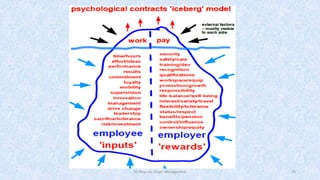
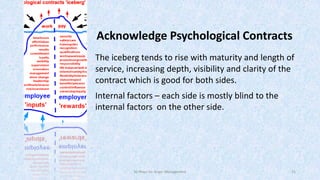
12. Acknowledge Psychological Contracts
These are unwritten commitments between two
parties in a relationship (work, marriage, friendship,
family, etc.). Parts of the expectations are spelled out
or discussed and seem to be clear but unexplored
areas of this contract could result in outrage or
suppressed anger.

50 Ways for Anger Management

19
50 Ways for Anger Management

20
Acknowledge Psychological Contracts
The iceberg tends to rise with maturity and length of
service, increasing depth, visibility and clarity of the
contract which is good for both sides.
Internal factors – each side is mostly blind to the
internal factors on the other side.

50 Ways for Anger Management

21
13. Avoiding
Avoiding is a conflict resolution technique. It’s
when somebody is not willing to engage in an
argument. Other forms could be retreating or
postponing a decision on a problem. It’s rarely the
best choice for solving problems.

50 Ways for Anger Management

22
14. Smoothing
Smoothing or accommodating is a
conflict resolution technique where a
person lays weight primarily on areas
of agreement; “Let’s cool down and
get the mission done”.

50 Ways for Anger Management

23
15. Compromising
Compromising is a conflict resolution
technique that results in pleasing both sides
by practically taking a midway solution.

50 Ways for Anger Management

24
16. Forcing
Forcing is a conflict resolution technique often
used in crises, when and if you have the
required authority. You enforce a particular
resolution to the problem, whether
counterparts agree or not.

50 Ways for Anger Management

25
17. Collaboration
Collaborating is a conflict resolution technique
where a person can jug up several ideas and
knit out a whole new idea to resolve the
problem. This form of resolution requires
creativity and good networking with people
involved in the situation.

50 Ways for Anger Management

26
18. Confronting
Conflict resolution could also require confronting
or problem solving. Professor Richard Nelson-Jones’

procedure called this CUDSAIR. This stands for:

Confront, Understand, Define, Search, Agree, I
mplement and Review to make sure anger will
not resurface.

50 Ways for Anger Management

27
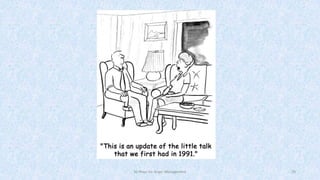
19. Focus on the Present
Get your feet on the ground and be solutionoriented by focusing on the present. Bringing
pains from the past or fears from the future can
be distracting and overwhelming to you and
others.

50 Ways for Anger Management

28
50 Ways for Anger Management

29
20. Choose Your Battles
Conflicts can be draining to your time and energy.
So it’s important to consider whether the issue is
really worth your attention. If you pick your battles
rather than fighting over every little thing, others
will take you more seriously when you are upset.

50 Ways for Anger Management

30
21. Be Willing to Forgive
It's unrealistic to expect everyone to behave
exactly as you want at all times. Think of
forgiveness as releasing yourself from the bitter
and painful feelings that consume your positive
energy. Think of yourself as strong and capable of
lightly bearing with people’s weaknesses.

50 Ways for Anger Management

31
“Anger makes you smaller, while forgiveness
forces you to grow beyond what you were.”

Cherie Carter- Scott
Human Development Pioneer

50 Ways for Anger Management

32
22. Know When to Let Something Go
When you are unable to come to an
agreement, agree to disagree. It takes two
people to keep a fight going on. If the
discussion is going nowhere, you can choose to
disengage and move on.

50 Ways for Anger Management

33
23. Perform a Reality Check
When you start getting upset about something, pause for a second to think
about the situation. Ask yourself:
What am I really angry about?
Does this issue influence other important factors in my life?
 Is it really worth getting angry about?

50 Ways for Anger Management

34
Perform a Reality Check
Is it worth ruining the rest of my day?
What is the most effective response to this
situation?
Is there anything I can do about it?
Is taking action worth my time?

50 Ways for Anger Management

35
“It is your conviction which compels you;
that is, choice compels choice.”

Epictetus
Greek Philosopher

50 Ways for Anger Management

36
24. Set Realistic Tolerance Boundaries
Look at the way you think. Talk to people
around you about your expectations and lifestandards that you wish to compromise. See if
your feet are on the ground and make sure you
are not asking for more than what you can get.

50 Ways for Anger Management

37
25. Run Away When Necessary
If you note any ‘Communication Blockers’
discontinue the dialogue and retreat -physicallyimmediately. Taking into consideration that you
will re-tackle the problem again when the air gets
cleared.

50 Ways for Anger Management

38
Run Away When Necessary
Avoid people, places, and situations that bring out
your worst.

50 Ways for Anger Management

39
26. Suppressing and Recreating Anger
Suppress your anger and redirect it to come up
with a more constructive behavior.
The trick is if you suppress anger without
redirecting it; because this could intensify
and/or cause passive-aggressive behaviors or
even diseases.

50 Ways for Anger Management

40
Suppressing and Recreating Anger
Try to turn anger into something positive like many
artists who get their original inspiration from
suppressed feelings. So don’t resist the temptation
of writing a diary, painting, singing, or playing an
instrument. Some are even triggered by anger to
make unique inventions.

50 Ways for Anger Management

41
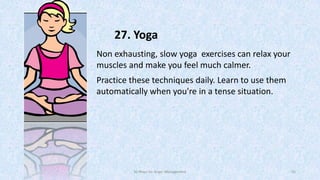
27. Yoga
Non exhausting, slow yoga exercises can relax your
muscles and make you feel much calmer.
Practice these techniques daily. Learn to use them
automatically when you're in a tense situation.

50 Ways for Anger Management

42
28. Breathe
Simple relaxation tools, such as deep breathing
and relaxing imagery, can help calm down
angry feelings. Breathe deeply, from your
diaphragm; breathing from your chest won't
relax you. Picture your breath coming up from
your "gut."

50 Ways for Anger Management

43
Breathe
Slowly repeat a calm word or phrase such as “I
am okay”, “relax”, “take it easy”… Repeat these
to yourself while breathing deeply.

50 Ways for Anger Management

44
Breathe
Try the 4 – 2 – 8 Breathing Exercise:
Count till 4: Deep, slow breath in (inhale)
Count till 2: While holding your breath

Exhale Slowly: Counting till 8

50 Ways for Anger Management

45
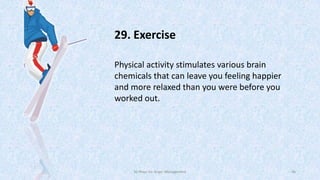
29. Exercise
Physical activity stimulates various brain
chemicals that can leave you feeling happier
and more relaxed than you were before you
worked out.

50 Ways for Anger Management

46
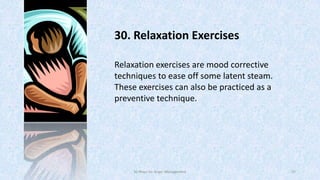
30. Relaxation Exercises
Relaxation exercises are mood corrective
techniques to ease off some latent steam.
These exercises can also be practiced as a
preventive technique.

50 Ways for Anger Management

47
Relaxation Exercises
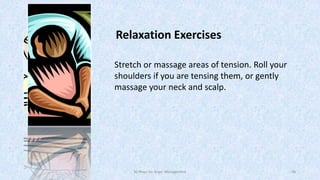
Stretch or massage areas of tension. Roll your
shoulders if you are tensing them, or gently
massage your neck and scalp.

50 Ways for Anger Management

48

50 ways for_anger_management-part 2

  • 1.
    Managing Anger Part 2 Presented By:Tim Ervin, LCPC Counseling for Solutions, LLC Arlington Heights, IL. 60005 50 Ways for Anger Management 1
  • 2.
    Training Topics What isreally behind anger: Triggers and signs How the brain works Cognitive distortions The cycle of acceptance When is anger considered to be a problem and how far could it affect general health? 50 Ways for Anger Management 2
  • 3.
    Training Topics The Joharimodel Assertive management and setting realistic boundaries Problem solving techniques Using clean language Fitting in the transactional analysis mode 50 Ways for Anger Management 3
  • 4.
    Training Topics Acknowledging psychologicalcontracts Breathing and deep relaxation techniques Cognitive restructuring techniques The rational emotive theory Emotional freedom techniques 50 Ways for Anger Management 4
  • 5.
    Training Topics Integrated personaldevelopment Humor and energy psychology When is it healthy to be angry Glasser’s ‘Choice Theory’ Fisher’s process of personal change Self-help script for anger management 50 Ways for Anger Management 5
  • 6.
    “Believe it ispossible to solve your problems. Tremendous things happen to the believer. So believe the answer will come. It will.” Norman Vincent Peale American Author 50 Ways for Anger Management 6
  • 7.
    10. Use CleanLanguage Clean Language is a communications methodology, developed by David J Grove, a New Zealand 'Counseling Psychologist', during the 1980s and 1990s. 50 Ways for Anger Management 7
  • 8.
    Use Clean Language CleanLanguage offers helpful techniques to all professional communicators because they are aligned closely with modern 'enabling' principles of empathy and understanding, as opposed to traditional 'manipulative‘ methods of influencing or persuading others and projecting self-interest. 50 Ways for Anger Management 8
  • 9.
    Use Clean Language CleanLanguage attempts to enable our thinking (or more particularly the other person's thinking if viewed from the questioner's viewpoint) to be as pure and clear as possible so that clarity of awareness, understanding, decision-making and human relations are optimized. 50 Ways for Anger Management 9
  • 10.
    Clean Language Principles Youare advised to do the following: Listen very attentively Keep your opinions and advice to yourself when possible Ask questions to explore a person's metaphors (or everyday statements). 50 Ways for Anger Management 10
  • 11.
    Clean Language Principles Askquestions about the positive aspects of a person's experience. Ask about the things that the person wants (more of). Focus on the positives. 50 Ways for Anger Management 11
  • 12.
    Clean Language Examples 1.What outcome would you like to have? (Establishing a desired outcome.) 2. What would a convenient resolution be (for that desired outcome to happen, checking the conditions needed) 3. Can this resolution, happen? (Checking that the communication partners have confidence that it can be achieved.) 50 Ways for Anger Management 12
  • 13.
    “Never talk defeat.Use words like hope, belief, faith, victory.” Norman Vincent Peale American Author 50 Ways for Anger Management 13
  • 14.
    11. Fit intothe Transactional Analysis Mode This is Eric Berne’s theory that verbal communication, particularly face to face, is at the centre of human social relationships and psychoanalysis. 50 Ways for Anger Management 14
  • 15.
    Transactional Analysis Berne alsosaid that each person is made up of three symbolic alter ego states: The “Parent” is our 'Taught' concept of life The “Adult” is our 'Thought' concept of life The “Child” is our 'Felt' concept of life 50 Ways for Anger Management 15
  • 16.
    Transactional Analysis The “Parent”:Nurturing (positive), Spoiling (negative), Controlling (positive) and Critical (negative).  The “Adult”: when you use an attentive, interested, nonthreatening tone. 50 Ways for Anger Management 16
  • 17.
    Transactional Analysis The “Child”:Co-operative (positive), Compliant/Resistant (negative). Spontaneous (positive) and Immature (negative). To ease tension, you need to use complementary tones as such: Parent- Child : Child-Parent Parent – Adult : Adult - Parent 50 Ways for Anger Management 17
  • 18.
    Transactional Analysis Or Idealistically:Adult – Adult If a Parent Versus Parent or Child versus Child transactions occur, there is a reason for anger to surge where most probably either or both parties will be upset. 50 Ways for Anger Management 18
  • 19.
    12. Acknowledge PsychologicalContracts These are unwritten commitments between two parties in a relationship (work, marriage, friendship, family, etc.). Parts of the expectations are spelled out or discussed and seem to be clear but unexplored areas of this contract could result in outrage or suppressed anger. 50 Ways for Anger Management 19
  • 20.
    50 Ways forAnger Management 20
  • 21.
    Acknowledge Psychological Contracts Theiceberg tends to rise with maturity and length of service, increasing depth, visibility and clarity of the contract which is good for both sides. Internal factors – each side is mostly blind to the internal factors on the other side. 50 Ways for Anger Management 21
  • 22.
    13. Avoiding Avoiding isa conflict resolution technique. It’s when somebody is not willing to engage in an argument. Other forms could be retreating or postponing a decision on a problem. It’s rarely the best choice for solving problems. 50 Ways for Anger Management 22
  • 23.
    14. Smoothing Smoothing oraccommodating is a conflict resolution technique where a person lays weight primarily on areas of agreement; “Let’s cool down and get the mission done”. 50 Ways for Anger Management 23
  • 24.
    15. Compromising Compromising isa conflict resolution technique that results in pleasing both sides by practically taking a midway solution. 50 Ways for Anger Management 24
  • 25.
    16. Forcing Forcing isa conflict resolution technique often used in crises, when and if you have the required authority. You enforce a particular resolution to the problem, whether counterparts agree or not. 50 Ways for Anger Management 25
  • 26.
    17. Collaboration Collaborating isa conflict resolution technique where a person can jug up several ideas and knit out a whole new idea to resolve the problem. This form of resolution requires creativity and good networking with people involved in the situation. 50 Ways for Anger Management 26
  • 27.
    18. Confronting Conflict resolutioncould also require confronting or problem solving. Professor Richard Nelson-Jones’ procedure called this CUDSAIR. This stands for: Confront, Understand, Define, Search, Agree, I mplement and Review to make sure anger will not resurface. 50 Ways for Anger Management 27
  • 28.
    19. Focus onthe Present Get your feet on the ground and be solutionoriented by focusing on the present. Bringing pains from the past or fears from the future can be distracting and overwhelming to you and others. 50 Ways for Anger Management 28
  • 29.
    50 Ways forAnger Management 29
  • 30.
    20. Choose YourBattles Conflicts can be draining to your time and energy. So it’s important to consider whether the issue is really worth your attention. If you pick your battles rather than fighting over every little thing, others will take you more seriously when you are upset. 50 Ways for Anger Management 30
  • 31.
    21. Be Willingto Forgive It's unrealistic to expect everyone to behave exactly as you want at all times. Think of forgiveness as releasing yourself from the bitter and painful feelings that consume your positive energy. Think of yourself as strong and capable of lightly bearing with people’s weaknesses. 50 Ways for Anger Management 31
  • 32.
    “Anger makes yousmaller, while forgiveness forces you to grow beyond what you were.” Cherie Carter- Scott Human Development Pioneer 50 Ways for Anger Management 32
  • 33.
    22. Know Whento Let Something Go When you are unable to come to an agreement, agree to disagree. It takes two people to keep a fight going on. If the discussion is going nowhere, you can choose to disengage and move on. 50 Ways for Anger Management 33
  • 34.
    23. Perform aReality Check When you start getting upset about something, pause for a second to think about the situation. Ask yourself: What am I really angry about? Does this issue influence other important factors in my life?  Is it really worth getting angry about? 50 Ways for Anger Management 34
  • 35.
    Perform a RealityCheck Is it worth ruining the rest of my day? What is the most effective response to this situation? Is there anything I can do about it? Is taking action worth my time? 50 Ways for Anger Management 35
  • 36.
    “It is yourconviction which compels you; that is, choice compels choice.” Epictetus Greek Philosopher 50 Ways for Anger Management 36
  • 37.
    24. Set RealisticTolerance Boundaries Look at the way you think. Talk to people around you about your expectations and lifestandards that you wish to compromise. See if your feet are on the ground and make sure you are not asking for more than what you can get. 50 Ways for Anger Management 37
  • 38.
    25. Run AwayWhen Necessary If you note any ‘Communication Blockers’ discontinue the dialogue and retreat -physicallyimmediately. Taking into consideration that you will re-tackle the problem again when the air gets cleared. 50 Ways for Anger Management 38
  • 39.
    Run Away WhenNecessary Avoid people, places, and situations that bring out your worst. 50 Ways for Anger Management 39
  • 40.
    26. Suppressing andRecreating Anger Suppress your anger and redirect it to come up with a more constructive behavior. The trick is if you suppress anger without redirecting it; because this could intensify and/or cause passive-aggressive behaviors or even diseases. 50 Ways for Anger Management 40
  • 41.
    Suppressing and RecreatingAnger Try to turn anger into something positive like many artists who get their original inspiration from suppressed feelings. So don’t resist the temptation of writing a diary, painting, singing, or playing an instrument. Some are even triggered by anger to make unique inventions. 50 Ways for Anger Management 41
  • 42.
    27. Yoga Non exhausting,slow yoga exercises can relax your muscles and make you feel much calmer. Practice these techniques daily. Learn to use them automatically when you're in a tense situation. 50 Ways for Anger Management 42
  • 43.
    28. Breathe Simple relaxationtools, such as deep breathing and relaxing imagery, can help calm down angry feelings. Breathe deeply, from your diaphragm; breathing from your chest won't relax you. Picture your breath coming up from your "gut." 50 Ways for Anger Management 43
  • 44.
    Breathe Slowly repeat acalm word or phrase such as “I am okay”, “relax”, “take it easy”… Repeat these to yourself while breathing deeply. 50 Ways for Anger Management 44
  • 45.
    Breathe Try the 4– 2 – 8 Breathing Exercise: Count till 4: Deep, slow breath in (inhale) Count till 2: While holding your breath Exhale Slowly: Counting till 8 50 Ways for Anger Management 45
  • 46.
    29. Exercise Physical activitystimulates various brain chemicals that can leave you feeling happier and more relaxed than you were before you worked out. 50 Ways for Anger Management 46
  • 47.
    30. Relaxation Exercises Relaxationexercises are mood corrective techniques to ease off some latent steam. These exercises can also be practiced as a preventive technique. 50 Ways for Anger Management 47
  • 48.
    Relaxation Exercises Stretch ormassage areas of tension. Roll your shoulders if you are tensing them, or gently massage your neck and scalp. 50 Ways for Anger Management 48