Prepared By:
Syeda Zonaira
1
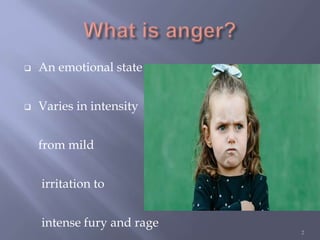
 An emotional state
 Varies in intensity
from mild
irritation to
intense fury and rage
2
3
4
5
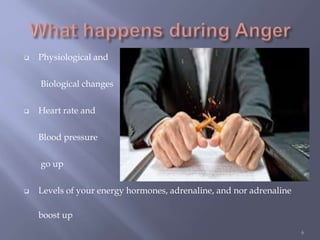
 Physiological and
Biological changes
 Heart rate and
Blood pressure
go up
 Levels of your energy hormones, adrenaline, and nor adrenaline
boost up
6
7
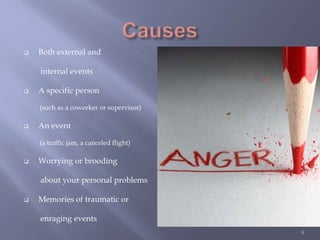
 Both external and
internal events
 A specific person
(such as a coworker or supervisor)
 An event
(a traffic jam, a canceled flight)
 Worrying or brooding
about your personal problems
 Memories of traumatic or
enraging events
8
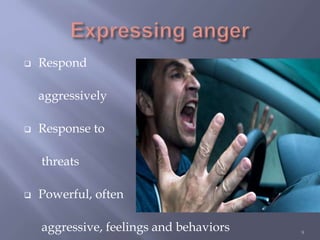
 Respond
aggressively
 Response to
threats
 Powerful, often
aggressive, feelings and behaviors 9
10
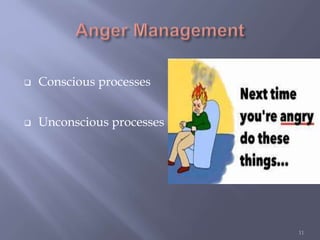
 Conscious processes
 Unconscious processes
11
12
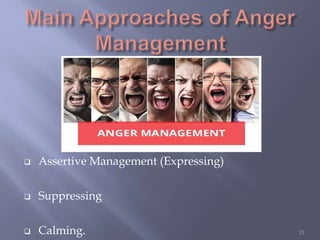
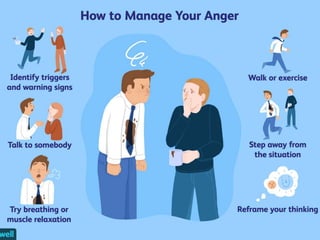
 Assertive Management (Expressing)
 Suppressing
 Calming. 13
14
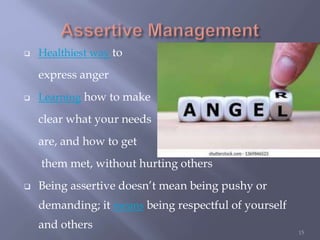
 Healthiest way to
express anger
 Learning how to make
clear what your needs
are, and how to get
them met, without hurting others
 Being assertive doesn’t mean being pushy or
demanding; it means being respectful of yourself
and others
15
 Anger can be suppressed, and then converted or
redirected
 This happens when you hold in your anger,
stop thinking about it, and focus on something
positive
 The aim is to inhibit or suppress your anger and
convert it into more constructive behavior
16
The danger in this type of response is that
 if it isn’t allowed outward expression, your anger can
turn inward—on yourself
Anger turned inward may cause
 hypertension
 high blood pressure
 depression.
17
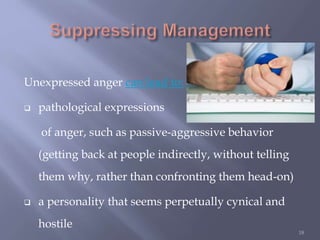
Unexpressed anger can lead to:
 pathological expressions
of anger, such as passive-aggressive behavior
(getting back at people indirectly, without telling
them why, rather than confronting them head-on)
 a personality that seems perpetually cynical and
hostile
18
People who are constantly putting others
down, criticizing everything, and making
cynical comments
 haven’t learned how to constructively express
their anger
 they aren’t likely to have many successful
relationships
19
20
21
22
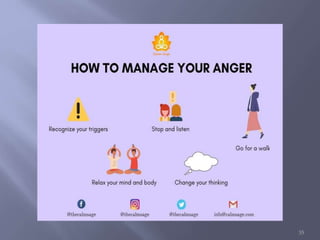
 Finally, you can calm down inside
 Not just controlling your outward behavior,
but also controlling your internal responses
 taking steps to lower your heart rate
 calm yourself down
 let the feelings subside
23
24
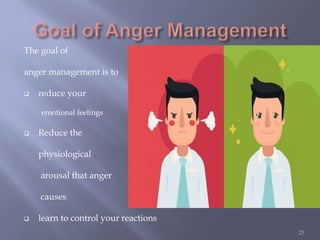
The goal of
anger management is to
 reduce your
emotional feelings
 Reduce the
physiological
arousal that anger
causes
 learn to control your reactions
25
26
There are psychological tests that measure
 the intensity of angry feelings
 how prone to anger you are
 how well you handle it
If you find yourself acting in ways that seem
 out of control
 frightening
27
28
 One cause may be genetic or physiological
 Another may be socio-cultural
 Research has also found that family
background plays a role. Typically, people who

are easily angered come from families that are
disruptive, chaotic, and not skilled at emotional
communications
29
Relaxation
Simple relaxation tools, such as
 deep breathing and relaxing
 Breathe deeply, from your diaphragm;
breathing from your chest won’t relax you.
Picture your breath coming up from your
“gut.”
30

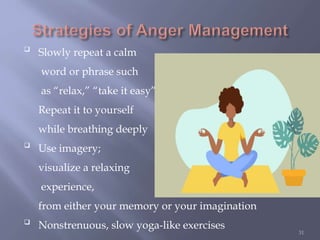
Slowly repeat a calm
word or phrase such
as “relax,” “take it easy”
Repeat it to yourself
while breathing deeply

Use imagery;
visualize a relaxing
experience,
from either your memory or your imagination

Nonstrenuous, slow yoga-like exercises
31
Cognitive restructuring
 Simply put, this means changing the way you
think
 Try replacing anger thoughts with more
rational ones
 For instance, instead of telling yourself, “oh,
it’s awful, it’s terrible, everything’s ruined,” tell
yourself, “it’s frustrating, and it’s
understandable that I’m upset about it, but it’s
not the end of the world and getting angry is
not going to fix it anyhow”
32
33
 Be careful of words like “never” or “always”
when talking about yourself or someone else
“This !&*%@ machine never works,” or “you’re
always forgetting things” are not just
inaccurate, they also serve to make you feel
that your anger is justified and that there’s no
way to solve the problem. They also alienate
and humiliate people who might otherwise be
willing to work with you on a solution 34
35
 Remind yourself that getting angry is not going to
fix anything, that it won’t make you feel better
(and may actually make you feel worse)
 Logic defeats anger, because anger, even when it’s
justified, can quickly become irrational
 So use cold hard logic on yourself. Remind
yourself that the world is “not out to get you,”
you’re just experiencing some of the rough spots of
daily life
36
37
 As part of their cognitive restructuring, angry
people need to become aware of their demanding
nature and translate their expectations into desires
 In other words, saying, “I would like” something
is healthier than saying, “I demand” or “I must
have” something
 When you’re unable to get what you want, you
will experience the normal reactions—frustration,
disappointment, hurt—but not anger
38
39
 Problem solving
 Focus on how you handle and face the problem
 Make a plan, and check your progress along
the way
 Resolve to give it your best, but also not to
punish yourself if an answer doesn’t come
right away
40
 If you can approach it with your best intentions
and efforts and make a serious attempt to face it
head-on, you will be less likely to lose patience and
fall into all-or-nothing thinking, even if the
problem does not get solved right away
41
 Better communication
 Angry people tend to jump to—and act on—conclusions,
and some of those conclusions can be very inaccurate
 The first thing to do if you’re in a heated discussion is slow
down and think through your responses
 Don’t say the first thing that comes into your head, but slow
down and think carefully about what you want to say
 At the same time, listen carefully to what the other person is
saying and take your time before answering
42
43
 Listen, too, to what is underlying the anger
 For instance, you like a certain amount of freedom
and personal space, and your “significant other”
wants more connection and closeness. If he or she
starts complaining about your activities, don’t
retaliate by painting your partner as a jailer, a
warden, or an albatross around your neck
 It’s natural to get defensive when you’re criticized,
but don’t fight back
44
 Instead, listen to what’s underlying the words: the
message that this person might feel neglected and
unloved
 It may take a lot of patient questioning on your
part, and it may require some breathing space, but
don’t let your anger—or a partner’s—let a
discussion spin out of control
 Keeping your cool can keep the situation from
becoming a disastrous one 45
 The underlying message of highly angry people is
“things oughta go my way!”
 Angry people tend to feel that they are morally
right, that any blocking or changing of their plans
is an unbearable indignity and that they
should NOT have to suffer this way. Maybe other
people do, but not them!
 When you feel that urge, picture yourself as a
supreme ruler, who owns the streets and stores
and office space, striding alone and having your
way in all situations while others defer to you
46
47
 Changing your environment
 Give yourself a break
 Make sure you have some “personal time”
scheduled for times of the day that you know
are particularly stressful
48
49
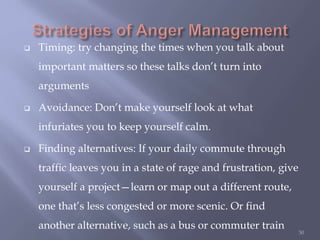
 Timing: try changing the times when you talk about
important matters so these talks don’t turn into
arguments
 Avoidance: Don’t make yourself look at what
infuriates you to keep yourself calm.
 Finding alternatives: If your daily commute through
traffic leaves you in a state of rage and frustration, give
yourself a project—learn or map out a different route,
one that’s less congested or more scenic. Or find
another alternative, such as a bus or commuter train
50
 If you feel that your anger is really out of control, if
it is having an impact on your relationships and on
important parts of your life, you might consider
counseling to learn how to handle it better
 With counseling, psychologists say, a highly angry
person can move closer to a middle range of anger
in about 8 to 10 weeks, depending on the
circumstances and the techniques used.
51
52
53
 Life will be filled with frustration, pain, loss, and
the unpredictable actions of others
 You can’t change that; but you can change the way
you let such events affect you
 Controlling your angry responses can keep them
from making you even more unhappy in the long
run 54
55
56
57
58

Anger Management.pptx

  • 1.
  • 2.
     An emotionalstate  Varies in intensity from mild irritation to intense fury and rage 2
  • 3.
  • 4.
  • 5.
  • 6.
     Physiological and Biologicalchanges  Heart rate and Blood pressure go up  Levels of your energy hormones, adrenaline, and nor adrenaline boost up 6
  • 7.
  • 8.
     Both externaland internal events  A specific person (such as a coworker or supervisor)  An event (a traffic jam, a canceled flight)  Worrying or brooding about your personal problems  Memories of traumatic or enraging events 8
  • 9.
     Respond aggressively  Responseto threats  Powerful, often aggressive, feelings and behaviors 9
  • 10.
  • 11.
     Conscious processes Unconscious processes 11
  • 12.
  • 13.
     Assertive Management(Expressing)  Suppressing  Calming. 13
  • 14.
  • 15.
     Healthiest wayto express anger  Learning how to make clear what your needs are, and how to get them met, without hurting others  Being assertive doesn’t mean being pushy or demanding; it means being respectful of yourself and others 15
  • 16.
     Anger canbe suppressed, and then converted or redirected  This happens when you hold in your anger, stop thinking about it, and focus on something positive  The aim is to inhibit or suppress your anger and convert it into more constructive behavior 16
  • 17.
    The danger inthis type of response is that  if it isn’t allowed outward expression, your anger can turn inward—on yourself Anger turned inward may cause  hypertension  high blood pressure  depression. 17
  • 18.
    Unexpressed anger canlead to:  pathological expressions of anger, such as passive-aggressive behavior (getting back at people indirectly, without telling them why, rather than confronting them head-on)  a personality that seems perpetually cynical and hostile 18
  • 19.
    People who areconstantly putting others down, criticizing everything, and making cynical comments  haven’t learned how to constructively express their anger  they aren’t likely to have many successful relationships 19
  • 20.
  • 21.
  • 22.
  • 23.
     Finally, youcan calm down inside  Not just controlling your outward behavior, but also controlling your internal responses  taking steps to lower your heart rate  calm yourself down  let the feelings subside 23
  • 24.
  • 25.
    The goal of angermanagement is to  reduce your emotional feelings  Reduce the physiological arousal that anger causes  learn to control your reactions 25
  • 26.
  • 27.
    There are psychologicaltests that measure  the intensity of angry feelings  how prone to anger you are  how well you handle it If you find yourself acting in ways that seem  out of control  frightening 27
  • 28.
  • 29.
     One causemay be genetic or physiological  Another may be socio-cultural  Research has also found that family background plays a role. Typically, people who are easily angered come from families that are disruptive, chaotic, and not skilled at emotional communications 29
  • 30.
    Relaxation Simple relaxation tools,such as  deep breathing and relaxing  Breathe deeply, from your diaphragm; breathing from your chest won’t relax you. Picture your breath coming up from your “gut.” 30
  • 31.
     Slowly repeat acalm word or phrase such as “relax,” “take it easy” Repeat it to yourself while breathing deeply  Use imagery; visualize a relaxing experience, from either your memory or your imagination  Nonstrenuous, slow yoga-like exercises 31
  • 32.
    Cognitive restructuring  Simplyput, this means changing the way you think  Try replacing anger thoughts with more rational ones  For instance, instead of telling yourself, “oh, it’s awful, it’s terrible, everything’s ruined,” tell yourself, “it’s frustrating, and it’s understandable that I’m upset about it, but it’s not the end of the world and getting angry is not going to fix it anyhow” 32
  • 33.
  • 34.
     Be carefulof words like “never” or “always” when talking about yourself or someone else “This !&*%@ machine never works,” or “you’re always forgetting things” are not just inaccurate, they also serve to make you feel that your anger is justified and that there’s no way to solve the problem. They also alienate and humiliate people who might otherwise be willing to work with you on a solution 34
  • 35.
  • 36.
     Remind yourselfthat getting angry is not going to fix anything, that it won’t make you feel better (and may actually make you feel worse)  Logic defeats anger, because anger, even when it’s justified, can quickly become irrational  So use cold hard logic on yourself. Remind yourself that the world is “not out to get you,” you’re just experiencing some of the rough spots of daily life 36
  • 37.
  • 38.
     As partof their cognitive restructuring, angry people need to become aware of their demanding nature and translate their expectations into desires  In other words, saying, “I would like” something is healthier than saying, “I demand” or “I must have” something  When you’re unable to get what you want, you will experience the normal reactions—frustration, disappointment, hurt—but not anger 38
  • 39.
  • 40.
     Problem solving Focus on how you handle and face the problem  Make a plan, and check your progress along the way  Resolve to give it your best, but also not to punish yourself if an answer doesn’t come right away 40
  • 41.
     If youcan approach it with your best intentions and efforts and make a serious attempt to face it head-on, you will be less likely to lose patience and fall into all-or-nothing thinking, even if the problem does not get solved right away 41
  • 42.
     Better communication Angry people tend to jump to—and act on—conclusions, and some of those conclusions can be very inaccurate  The first thing to do if you’re in a heated discussion is slow down and think through your responses  Don’t say the first thing that comes into your head, but slow down and think carefully about what you want to say  At the same time, listen carefully to what the other person is saying and take your time before answering 42
  • 43.
  • 44.
     Listen, too,to what is underlying the anger  For instance, you like a certain amount of freedom and personal space, and your “significant other” wants more connection and closeness. If he or she starts complaining about your activities, don’t retaliate by painting your partner as a jailer, a warden, or an albatross around your neck  It’s natural to get defensive when you’re criticized, but don’t fight back 44
  • 45.
     Instead, listento what’s underlying the words: the message that this person might feel neglected and unloved  It may take a lot of patient questioning on your part, and it may require some breathing space, but don’t let your anger—or a partner’s—let a discussion spin out of control  Keeping your cool can keep the situation from becoming a disastrous one 45
  • 46.
     The underlyingmessage of highly angry people is “things oughta go my way!”  Angry people tend to feel that they are morally right, that any blocking or changing of their plans is an unbearable indignity and that they should NOT have to suffer this way. Maybe other people do, but not them!  When you feel that urge, picture yourself as a supreme ruler, who owns the streets and stores and office space, striding alone and having your way in all situations while others defer to you 46
  • 47.
  • 48.
     Changing yourenvironment  Give yourself a break  Make sure you have some “personal time” scheduled for times of the day that you know are particularly stressful 48
  • 49.
  • 50.
     Timing: trychanging the times when you talk about important matters so these talks don’t turn into arguments  Avoidance: Don’t make yourself look at what infuriates you to keep yourself calm.  Finding alternatives: If your daily commute through traffic leaves you in a state of rage and frustration, give yourself a project—learn or map out a different route, one that’s less congested or more scenic. Or find another alternative, such as a bus or commuter train 50
  • 51.
     If youfeel that your anger is really out of control, if it is having an impact on your relationships and on important parts of your life, you might consider counseling to learn how to handle it better  With counseling, psychologists say, a highly angry person can move closer to a middle range of anger in about 8 to 10 weeks, depending on the circumstances and the techniques used. 51
  • 52.
  • 53.
  • 54.
     Life willbe filled with frustration, pain, loss, and the unpredictable actions of others  You can’t change that; but you can change the way you let such events affect you  Controlling your angry responses can keep them from making you even more unhappy in the long run 54
  • 55.
  • 56.
  • 57.
  • 58.