Time Management
and
Goal Setting
for Academic Coaching
Goal Setting in Academic Coaching
Coach’s Expectations and Responsibilities
1. Partner with you in achieving your academic goals and provide a comfortable,
encouraging environment for the discussion of goals of plans that is free of
judgment
2. To actively listen and provide feedback in the goal setting and planning process
3. Provide information about study skills, time management, test taking, and
adjusting to college expectations that will help you in achieving your goals
4. Help connect you with campus resources
Student’s Expectations and Responsibilities
1. Understand coaching as a collaborative process that will encourage you to take
responsibility for setting and accomplishing your goals.
2. Keep in contact with your coach about academic setbacks and triumphs
3. Come prepared for each meeting
4. Make and keep regular appointments with your coach
Helping students to set goals:
1. Gives them a purpose that motivates them to do well in classes
2. Helps them to prioritize demands on their time
3. Supports them in becoming independent learners
Helping students to set goals:
1. Gives them a purpose that motivates them to do well in classes
2. Helps them to prioritize demands on their time
3. Supports them in becoming independent learners
Fixes the “Someday” problem….
Someday, I will write that book…
Someday, I will graduate from college...
Helping students to set goals:
1. Gives them a purpose that motivates them to do well in classes
2. Helps them to prioritize demands on their time
3. Supports them in becoming independent learners
Fixes the “Someday” problem….
Someday, I will write that book…
Someday, I will graduate from college...
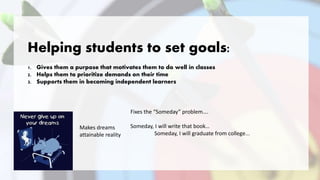
Makes dreams
attainable reality
Effective Goal Setting
Most students have the goal of succeeding in college and
graduating, but if they have no plan in place, the goal is
not effective.
Example: The gym in January
An unrealistic goal can even cause us
to give up completely…
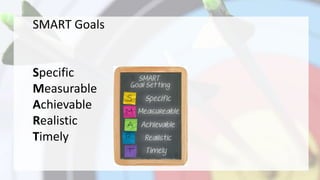
SMART Goals
Specific
Measurable
Achievable
Realistic
Timely
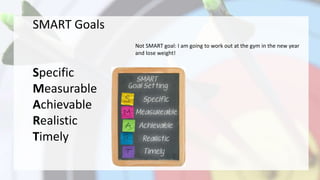
SMART Goals
Specific
Measurable
Achievable
Realistic
Timely
Not SMART goal: I am going to work out at the gym in the new year
and lose weight!
SMART Goals
Specific
Measurable
Achievable
Realistic
Timely
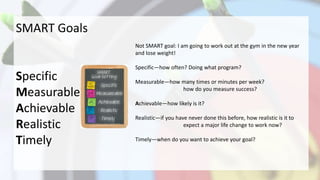
Not SMART goal: I am going to work out at the gym in the new year
and lose weight!
Specific—how often? Doing what program?
Measurable—how many times or minutes per week?
how do you measure success?
Achievable—how likely is it?
Realistic—if you have never done this before, how realistic is it to
expect a major life change to work now?
Timely—when do you want to achieve your goal?
SMART Goals
Specific
Measurable
Achievable
Realistic
Timely
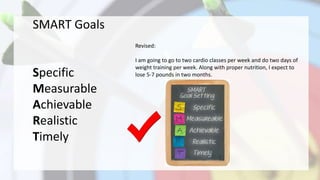
Revised:
I am going to go to two cardio classes per week and do two days of
weight training per week. Along with proper nutrition, I expect to
lose 5-7 pounds in two months.
Activity:
Set a SMART goal for yourself!
Share it with someone else
Time Management is Self Management
• The main reason for managing time is to provide structure
and balance among all of the things you need and want to
do.
• Managing time provides a road map to accomplish
academic and personal goals.
• College requires that students learn new and different time
management skills from high school.
Important! Go to Class!
Attendance
Studies have shown that, especially in the sciences, students
that never or rarely miss class are more likely to receive a B
or better in their courses (75% of the students who attended
95% or more of their classes received a B or better)
Weekly Schedule
Encourage students to:
Put all of your class meeting times, regular work schedule,
and meetings / practices
Plan out times to study, read, review notes, and prepare
for your classes
Keep in mind the times of the day when you are most
effective.
Activity:
It is late Saturday night; you look at what is coming up for next
week, and see the following items. As a group, prioritize and rank the
most important (1) to least important (20) factoring in time sensitive
deadlines as needed. The week you are dealing with is Sunday-
Friday. (Sun, Mon, Tues, Wed, Thur, Fri). Use the weekly planner to
get an idea of the available time. AFTER ranking the importance of
these items, schedule your week so that you may accomplish as much
as possible, within reason; remember, you will need to sleep and eat
at some point!
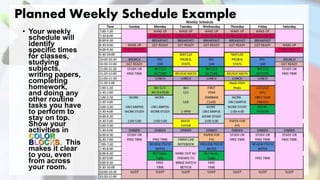
• Your weekly
schedule will
identify
specific times
for classes,
studying
subjects,
writing papers,
completing
homework,
and doing any
other routine
tasks you have
to perform to
stay on top.
Show your
activities in
COLOR
BLOCKS. This
makes it clear
to you, even
from across
your room.
Planned Weekly Schedule Example
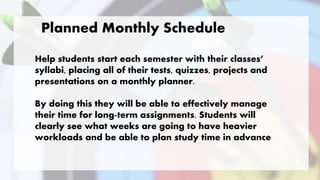
Help students start each semester with their classes’
syllabi, placing all of their tests, quizzes, projects and
presentations on a monthly planner.
By doing this they will be able to effectively manage
their time for long-term assignments. Students will
clearly see what weeks are going to have heavier
workloads and be able to plan study time in advance
Planned Monthly Schedule
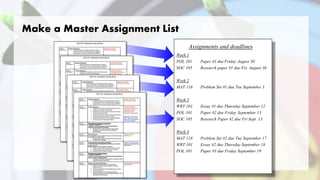
Assignments and deadlines
Week 1
POL 101 Paper #1 due Friday August 30
SOC 105 Research paper #1 due Fri. August 30
Week 2
MAT 118 Problem Set #1 due Tue September 3
Week 3
WRT 101 Essay #1 due Thursday September 12
POL 101 Paper #2 due Friday September 13
SOC 105 Research Paper #2 due Fri Sept. 13
Week 4
MAT 118 Problem Set #2 due Tue September 17
WRT 101 Essay #2 due Thursday September 18
POL 101 Paper #3 due Friday September 19
Make a Master Assignment List
Every student is different. Most need help
to manage time.
Use the different tools available to
help students manage time to reach
their goals!

Time management and goal setting

  • 1.
  • 2.
    Goal Setting inAcademic Coaching Coach’s Expectations and Responsibilities 1. Partner with you in achieving your academic goals and provide a comfortable, encouraging environment for the discussion of goals of plans that is free of judgment 2. To actively listen and provide feedback in the goal setting and planning process 3. Provide information about study skills, time management, test taking, and adjusting to college expectations that will help you in achieving your goals 4. Help connect you with campus resources Student’s Expectations and Responsibilities 1. Understand coaching as a collaborative process that will encourage you to take responsibility for setting and accomplishing your goals. 2. Keep in contact with your coach about academic setbacks and triumphs 3. Come prepared for each meeting 4. Make and keep regular appointments with your coach
  • 3.
    Helping students toset goals: 1. Gives them a purpose that motivates them to do well in classes 2. Helps them to prioritize demands on their time 3. Supports them in becoming independent learners
  • 4.
    Helping students toset goals: 1. Gives them a purpose that motivates them to do well in classes 2. Helps them to prioritize demands on their time 3. Supports them in becoming independent learners Fixes the “Someday” problem…. Someday, I will write that book… Someday, I will graduate from college...
  • 5.
    Helping students toset goals: 1. Gives them a purpose that motivates them to do well in classes 2. Helps them to prioritize demands on their time 3. Supports them in becoming independent learners Fixes the “Someday” problem…. Someday, I will write that book… Someday, I will graduate from college... Makes dreams attainable reality
  • 6.
    Effective Goal Setting Moststudents have the goal of succeeding in college and graduating, but if they have no plan in place, the goal is not effective. Example: The gym in January
  • 7.
    An unrealistic goalcan even cause us to give up completely…
  • 8.
  • 9.
    SMART Goals Specific Measurable Achievable Realistic Timely Not SMARTgoal: I am going to work out at the gym in the new year and lose weight!
  • 10.
    SMART Goals Specific Measurable Achievable Realistic Timely Not SMARTgoal: I am going to work out at the gym in the new year and lose weight! Specific—how often? Doing what program? Measurable—how many times or minutes per week? how do you measure success? Achievable—how likely is it? Realistic—if you have never done this before, how realistic is it to expect a major life change to work now? Timely—when do you want to achieve your goal?
  • 11.
    SMART Goals Specific Measurable Achievable Realistic Timely Revised: I amgoing to go to two cardio classes per week and do two days of weight training per week. Along with proper nutrition, I expect to lose 5-7 pounds in two months.
  • 12.
    Activity: Set a SMARTgoal for yourself! Share it with someone else
  • 13.
    Time Management isSelf Management • The main reason for managing time is to provide structure and balance among all of the things you need and want to do. • Managing time provides a road map to accomplish academic and personal goals. • College requires that students learn new and different time management skills from high school.
  • 14.
    Important! Go toClass! Attendance Studies have shown that, especially in the sciences, students that never or rarely miss class are more likely to receive a B or better in their courses (75% of the students who attended 95% or more of their classes received a B or better)
  • 15.
    Weekly Schedule Encourage studentsto: Put all of your class meeting times, regular work schedule, and meetings / practices Plan out times to study, read, review notes, and prepare for your classes Keep in mind the times of the day when you are most effective.
  • 16.
    Activity: It is lateSaturday night; you look at what is coming up for next week, and see the following items. As a group, prioritize and rank the most important (1) to least important (20) factoring in time sensitive deadlines as needed. The week you are dealing with is Sunday- Friday. (Sun, Mon, Tues, Wed, Thur, Fri). Use the weekly planner to get an idea of the available time. AFTER ranking the importance of these items, schedule your week so that you may accomplish as much as possible, within reason; remember, you will need to sleep and eat at some point!
  • 17.
    • Your weekly schedulewill identify specific times for classes, studying subjects, writing papers, completing homework, and doing any other routine tasks you have to perform to stay on top. Show your activities in COLOR BLOCKS. This makes it clear to you, even from across your room. Planned Weekly Schedule Example
  • 18.
    Help students starteach semester with their classes’ syllabi, placing all of their tests, quizzes, projects and presentations on a monthly planner. By doing this they will be able to effectively manage their time for long-term assignments. Students will clearly see what weeks are going to have heavier workloads and be able to plan study time in advance Planned Monthly Schedule
  • 19.
    Assignments and deadlines Week1 POL 101 Paper #1 due Friday August 30 SOC 105 Research paper #1 due Fri. August 30 Week 2 MAT 118 Problem Set #1 due Tue September 3 Week 3 WRT 101 Essay #1 due Thursday September 12 POL 101 Paper #2 due Friday September 13 SOC 105 Research Paper #2 due Fri Sept. 13 Week 4 MAT 118 Problem Set #2 due Tue September 17 WRT 101 Essay #2 due Thursday September 18 POL 101 Paper #3 due Friday September 19 Make a Master Assignment List
  • 20.
    Every student isdifferent. Most need help to manage time. Use the different tools available to help students manage time to reach their goals!