Eyal Buks


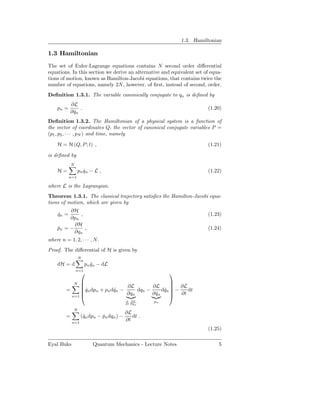
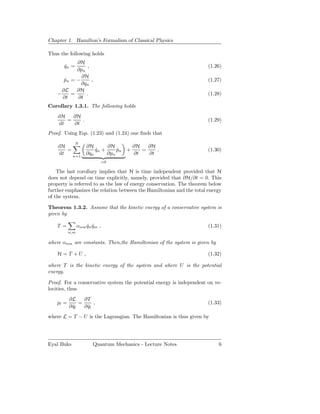
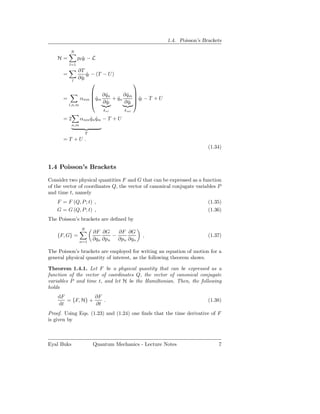
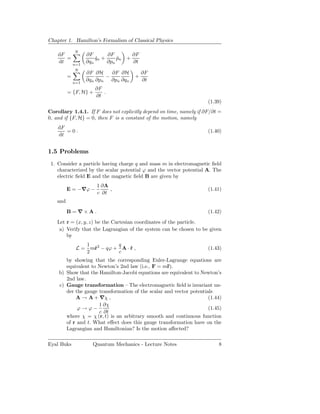
Quantum Mechanics - Lecture
Notes
December 23, 2012


Technion
Preface


The dynamics of a quantum system is governed by the celebrated Schrödinger
equation
        d
    i     |ψ = H |ψ ,                                                      (0.1)
       dt
             √
where i = −1 and = 1.05457266 × 10⁻³⁴ J s is Planck’s h-bar constant.
However, what is the meaning of the symbols |ψ and H? The answers will
be given in the first part of the course (chapters 1-4), which reviews several
physical and mathematical concepts that are needed to formulate the theory
of quantum mechanics. We will learn that |ψ in Eq. (0.1) represents the
ket-vector state of the system and H represents the Hamiltonian operator.
The operator H is directly related to the Hamiltonian function in classical
physics, which will be defined in the first chapter. The ket-vector state and
its physical meaning will be introduced in the second chapter. Chapter 3
reviews the position and momentum operators, whereas chapter 4 discusses
dynamics of quantum systems. The second part of the course (chapters 5-7)
is devoted to some relatively simple quantum systems including a harmonic
oscillator, spin, hydrogen atom and more. In chapter 8 we will study quantum
systems in thermal equilibrium. The third part of the course (chapters 9-13)
is devoted to approximation methods such as perturbation theory, semiclas-
sical and adiabatic approximations. Light and its interaction with matter are
the subjects of chapter 14-15. Finally, systems of identical particles will be
discussed in chapter 16 and open quantum systems in chapter 17. Most of
the material in these lecture notes is based on the textbooks [1, 2, 3, 4, 6, 7].
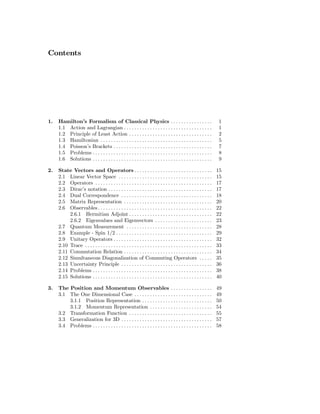
Contents


1.   Hamilton’s Formalism of Classical Physics . . . . . . . . . . . . . . . .                                       1
     1.1 Action and Lagrangian . . . . . . . . . . . . . . . . . . . . . . . . . . . . . . . . . .                   1
     1.2 Principle of Least Action . . . . . . . . . . . . . . . . . . . . . . . . . . . . . . . .                   2
     1.3 Hamiltonian . . . . . . . . . . . . . . . . . . . . . . . . . . . . . . . . . . . . . . . . . . .           5
     1.4 Poisson’s Brackets . . . . . . . . . . . . . . . . . . . . . . . . . . . . . . . . . . . . . .              7
     1.5 Problems . . . . . . . . . . . . . . . . . . . . . . . . . . . . . . . . . . . . . . . . . . . . . .        8
     1.6 Solutions . . . . . . . . . . . . . . . . . . . . . . . . . . . . . . . . . . . . . . . . . . . . . .       9

2.   State Vectors and Operators . . . . . . . . . . . . . . . . . . . . . . . . . . . . . .                        15
     2.1 Linear Vector Space . . . . . . . . . . . . . . . . . . . . . . . . . . . . . . . . . . . .                15
     2.2 Operators . . . . . . . . . . . . . . . . . . . . . . . . . . . . . . . . . . . . . . . . . . . . .        17
     2.3 Dirac’s notation . . . . . . . . . . . . . . . . . . . . . . . . . . . . . . . . . . . . . . . .           17
     2.4 Dual Correspondence . . . . . . . . . . . . . . . . . . . . . . . . . . . . . . . . . . .                  18
     2.5 Matrix Representation . . . . . . . . . . . . . . . . . . . . . . . . . . . . . . . . . .                  20
     2.6 Observables . . . . . . . . . . . . . . . . . . . . . . . . . . . . . . . . . . . . . . . . . . . .        22
          2.6.1 Hermitian Adjoint . . . . . . . . . . . . . . . . . . . . . . . . . . . . . . . .                   22
          2.6.2 Eigenvalues and Eigenvectors . . . . . . . . . . . . . . . . . . . . . .                            23
     2.7 Quantum Measurement . . . . . . . . . . . . . . . . . . . . . . . . . . . . . . . . .                      28
     2.8 Example - Spin 1/2 . . . . . . . . . . . . . . . . . . . . . . . . . . . . . . . . . . . . .               29
     2.9 Unitary Operators . . . . . . . . . . . . . . . . . . . . . . . . . . . . . . . . . . . . . .              32
     2.10 Trace . . . . . . . . . . . . . . . . . . . . . . . . . . . . . . . . . . . . . . . . . . . . . . . . .   33
     2.11 Commutation Relation . . . . . . . . . . . . . . . . . . . . . . . . . . . . . . . . . .                  34
     2.12 Simultaneous Diagonalization of Commuting Operators . . . . .                                             35
     2.13 Uncertainty Principle . . . . . . . . . . . . . . . . . . . . . . . . . . . . . . . . . . .               36
     2.14 Problems . . . . . . . . . . . . . . . . . . . . . . . . . . . . . . . . . . . . . . . . . . . . . .      38
     2.15 Solutions . . . . . . . . . . . . . . . . . . . . . . . . . . . . . . . . . . . . . . . . . . . . . .     40

3.   The Position and Momentum Observables . . . . . . . . . . . . . . . .                                          49
     3.1 The One Dimensional Case . . . . . . . . . . . . . . . . . . . . . . . . . . . . . .                       49
         3.1.1 Position Representation . . . . . . . . . . . . . . . . . . . . . . . . . . .                        50
         3.1.2 Momentum Representation . . . . . . . . . . . . . . . . . . . . . . . .                              54
     3.2 Transformation Function . . . . . . . . . . . . . . . . . . . . . . . . . . . . . . . .                    55
     3.3 Generalization for 3D . . . . . . . . . . . . . . . . . . . . . . . . . . . . . . . . . . .                57
     3.4 Problems . . . . . . . . . . . . . . . . . . . . . . . . . . . . . . . . . . . . . . . . . . . . . .       58
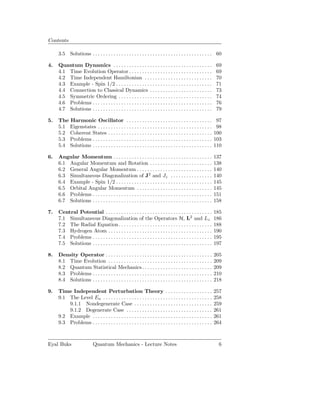
Contents

     3.5 Solutions . . . . . . . . . . . . . . . . . . . . . . . . . . . . . . . . . . . . . . . . . . . . . . 60

4.   Quantum Dynamics . . . . . . . . . . . . . . . . . . . . . . . . . . . . . . . . . . . . . .                69
     4.1 Time Evolution Operator . . . . . . . . . . . . . . . . . . . . . . . . . . . . . . . .                 69
     4.2 Time Independent Hamiltonian . . . . . . . . . . . . . . . . . . . . . . . . . .                        70
     4.3 Example - Spin 1/2 . . . . . . . . . . . . . . . . . . . . . . . . . . . . . . . . . . . . .            71
     4.4 Connection to Classical Dynamics . . . . . . . . . . . . . . . . . . . . . . . .                        73
     4.5 Symmetric Ordering . . . . . . . . . . . . . . . . . . . . . . . . . . . . . . . . . . . .              74
     4.6 Problems . . . . . . . . . . . . . . . . . . . . . . . . . . . . . . . . . . . . . . . . . . . . . .    76
     4.7 Solutions . . . . . . . . . . . . . . . . . . . . . . . . . . . . . . . . . . . . . . . . . . . . . .   79

5.   The Harmonic Oscillator . . . . . . . . . . . . . . . . . . . . . . . . . . . . . . . . .                    97
     5.1 Eigenstates . . . . . . . . . . . . . . . . . . . . . . . . . . . . . . . . . . . . . . . . . . . .      98
     5.2 Coherent States . . . . . . . . . . . . . . . . . . . . . . . . . . . . . . . . . . . . . . . .         100
     5.3 Problems . . . . . . . . . . . . . . . . . . . . . . . . . . . . . . . . . . . . . . . . . . . . . .    103
     5.4 Solutions . . . . . . . . . . . . . . . . . . . . . . . . . . . . . . . . . . . . . . . . . . . . . .   110

6.   Angular Momentum . . . . . . . . . . . . . . . . . . . . . . . . . . . . . . . . . . . . . .                137
     6.1 Angular Momentum and Rotation . . . . . . . . . . . . . . . . . . . . . . . .                           138
     6.2 General Angular Momentum . . . . . . . . . . . . . . . . . . . . . . . . . . . . .                      140
     6.3 Simultaneous Diagonalization of J2 and Jz . . . . . . . . . . . . . . . .                               140
     6.4 Example - Spin 1/2 . . . . . . . . . . . . . . . . . . . . . . . . . . . . . . . . . . . . .            145
     6.5 Orbital Angular Momentum . . . . . . . . . . . . . . . . . . . . . . . . . . . . .                      145
     6.6 Problems . . . . . . . . . . . . . . . . . . . . . . . . . . . . . . . . . . . . . . . . . . . . . .    151
     6.7 Solutions . . . . . . . . . . . . . . . . . . . . . . . . . . . . . . . . . . . . . . . . . . . . . .   158

7.   Central Potential . . . . . . . . . . . . . . . . . . . . . . . . . . . . . . . . . . . . . . . . .         185
     7.1 Simultaneous Diagonalization of the Operators H, L2 and Lz                                              186
     7.2 The Radial Equation . . . . . . . . . . . . . . . . . . . . . . . . . . . . . . . . . . . .             188
     7.3 Hydrogen Atom . . . . . . . . . . . . . . . . . . . . . . . . . . . . . . . . . . . . . . . .           190
     7.4 Problems . . . . . . . . . . . . . . . . . . . . . . . . . . . . . . . . . . . . . . . . . . . . . .    195
     7.5 Solutions . . . . . . . . . . . . . . . . . . . . . . . . . . . . . . . . . . . . . . . . . . . . . .   197

8.   Density Operator . . . . . . . . . . . . . . . . . . . . . . . . . . . . . . . . . . . . . . . . .          205
     8.1 Time Evolution . . . . . . . . . . . . . . . . . . . . . . . . . . . . . . . . . . . . . . . .          209
     8.2 Quantum Statistical Mechanics . . . . . . . . . . . . . . . . . . . . . . . . . . .                     209
     8.3 Problems . . . . . . . . . . . . . . . . . . . . . . . . . . . . . . . . . . . . . . . . . . . . . .    210
     8.4 Solutions . . . . . . . . . . . . . . . . . . . . . . . . . . . . . . . . . . . . . . . . . . . . . .   218

9.   Time Independent Perturbation Theory . . . . . . . . . . . . . . . . . .                                    257
     9.1 The Level En . . . . . . . . . . . . . . . . . . . . . . . . . . . . . . . . . . . . . . . . . .        258
         9.1.1 Nondegenerate Case . . . . . . . . . . . . . . . . . . . . . . . . . . . . . .                    259
         9.1.2 Degenerate Case . . . . . . . . . . . . . . . . . . . . . . . . . . . . . . . . .                 261
     9.2 Example . . . . . . . . . . . . . . . . . . . . . . . . . . . . . . . . . . . . . . . . . . . . . .     261
     9.3 Problems . . . . . . . . . . . . . . . . . . . . . . . . . . . . . . . . . . . . . . . . . . . . . .    264


Eyal Buks                   Quantum Mechanics - Lecture Notes                                                     6
Contents

       9.4 Solutions . . . . . . . . . . . . . . . . . . . . . . . . . . . . . . . . . . . . . . . . . . . . . . 269

10. Time-Dependent Perturbation Theory . . . . . . . . . . . . . . . . . . . .                                   291
    10.1 Time Evolution . . . . . . . . . . . . . . . . . . . . . . . . . . . . . . . . . . . . . . . .          291
    10.2 Perturbation Expansion . . . . . . . . . . . . . . . . . . . . . . . . . . . . . . . . .                292
    10.3 The Operator O (t) = u† (t, t0 ) u (t, t0 ) . . . . . . . . . . . . . . . . . . . . .
                                           0                                                                     293
    10.4 Transition Probability . . . . . . . . . . . . . . . . . . . . . . . . . . . . . . . . . . .            294
         10.4.1 The Stationary Case . . . . . . . . . . . . . . . . . . . . . . . . . . . . . .                  296
         10.4.2 The Near-Resonance Case . . . . . . . . . . . . . . . . . . . . . . . . .                        297
         10.4.3 H1 is Separable . . . . . . . . . . . . . . . . . . . . . . . . . . . . . . . . . .              298
    10.5 Problems . . . . . . . . . . . . . . . . . . . . . . . . . . . . . . . . . . . . . . . . . . . . . .    298
    10.6 Solutions . . . . . . . . . . . . . . . . . . . . . . . . . . . . . . . . . . . . . . . . . . . . . .   300

11. WKB Approximation . . . . . . . . . . . . . . . . . . . . . . . . . . . . . . . . . . . . .                  303
    11.1 WKB Wavefunction . . . . . . . . . . . . . . . . . . . . . . . . . . . . . . . . . . . .                303
    11.2 Turning Point . . . . . . . . . . . . . . . . . . . . . . . . . . . . . . . . . . . . . . . . . .       306
    11.3 Bohr-Sommerfeld Quantization Rule . . . . . . . . . . . . . . . . . . . . . .                           310
    11.4 Tunneling . . . . . . . . . . . . . . . . . . . . . . . . . . . . . . . . . . . . . . . . . . . . .     312
    11.5 Problems . . . . . . . . . . . . . . . . . . . . . . . . . . . . . . . . . . . . . . . . . . . . . .    313
    11.6 Solutions . . . . . . . . . . . . . . . . . . . . . . . . . . . . . . . . . . . . . . . . . . . . . .   313

12. Path Integration . . . . . . . . . . . . . . . . . . . . . . . . . . . . . . . . . . . . . . . . . .         321
    12.1 Charged Particle in Electromagnetic Field . . . . . . . . . . . . . . . . .                             321
    12.2 Classical Limit . . . . . . . . . . . . . . . . . . . . . . . . . . . . . . . . . . . . . . . . .       325
    12.3 Aharonov-Bohm Effect . . . . . . . . . . . . . . . . . . . . . . . . . . . . . . . . . .                 326
         12.3.1 Two-slit Interference . . . . . . . . . . . . . . . . . . . . . . . . . . . . . .                328
         12.3.2 Gauge Invariance . . . . . . . . . . . . . . . . . . . . . . . . . . . . . . . . .               329
    12.4 One Dimensional Path Integrals . . . . . . . . . . . . . . . . . . . . . . . . . .                      331
         12.4.1 One Dimensional Free Particle . . . . . . . . . . . . . . . . . . . . .                          332
         12.4.2 Expansion Around the Classical Path . . . . . . . . . . . . . . .                                333
         12.4.3 One Dimensional Harmonic Oscillator . . . . . . . . . . . . . . .                                335
    12.5 Semiclassical Limit . . . . . . . . . . . . . . . . . . . . . . . . . . . . . . . . . . . . .           339
    12.6 Problems . . . . . . . . . . . . . . . . . . . . . . . . . . . . . . . . . . . . . . . . . . . . . .    340
    12.7 Solutions . . . . . . . . . . . . . . . . . . . . . . . . . . . . . . . . . . . . . . . . . . . . . .   341

13. Adiabatic Approximation . . . . . . . . . . . . . . . . . . . . . . . . . . . . . . . . .                    349
    13.1 Momentary Diagonalization . . . . . . . . . . . . . . . . . . . . . . . . . . . . . .                   349
    13.2 Gauge Transformation . . . . . . . . . . . . . . . . . . . . . . . . . . . . . . . . . .                351
    13.3 Adiabatic Limit . . . . . . . . . . . . . . . . . . . . . . . . . . . . . . . . . . . . . . . .         351
    13.4 The Case of Two Dimensional Hilbert Space . . . . . . . . . . . . . . .                                 352
    13.5 Transition Probability . . . . . . . . . . . . . . . . . . . . . . . . . . . . . . . . . . .            354
         13.5.1 The Case of Two Dimensional Hilbert Space . . . . . . . . .                                      355
    13.6 Slow and Fast Coordinates . . . . . . . . . . . . . . . . . . . . . . . . . . . . . . .                 358
    13.7 Problems . . . . . . . . . . . . . . . . . . . . . . . . . . . . . . . . . . . . . . . . . . . . . .    361
    13.8 Solutions . . . . . . . . . . . . . . . . . . . . . . . . . . . . . . . . . . . . . . . . . . . . . .   361


Eyal Buks                     Quantum Mechanics - Lecture Notes                                                   7
Contents

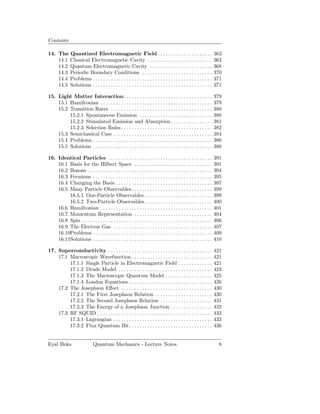
14. The Quantized Electromagnetic Field . . . . . . . . . . . . . . . . . . . . .                                   363
    14.1 Classical Electromagnetic Cavity . . . . . . . . . . . . . . . . . . . . . . . . .                         363
    14.2 Quantum Electromagnetic Cavity . . . . . . . . . . . . . . . . . . . . . . . .                             368
    14.3 Periodic Boundary Conditions . . . . . . . . . . . . . . . . . . . . . . . . . . .                         370
    14.4 Problems . . . . . . . . . . . . . . . . . . . . . . . . . . . . . . . . . . . . . . . . . . . . . .       371
    14.5 Solutions . . . . . . . . . . . . . . . . . . . . . . . . . . . . . . . . . . . . . . . . . . . . . .      371

15. Light Matter Interaction . . . . . . . . . . . . . . . . . . . . . . . . . . . . . . . . . .                    379
    15.1 Hamiltonian . . . . . . . . . . . . . . . . . . . . . . . . . . . . . . . . . . . . . . . . . . .          379
    15.2 Transition Rates . . . . . . . . . . . . . . . . . . . . . . . . . . . . . . . . . . . . . . .             380
         15.2.1 Spontaneous Emission . . . . . . . . . . . . . . . . . . . . . . . . . . . .                        380
         15.2.2 Stimulated Emission and Absorption . . . . . . . . . . . . . . . .                                  381
         15.2.3 Selection Rules . . . . . . . . . . . . . . . . . . . . . . . . . . . . . . . . . . .               382
    15.3 Semiclassical Case . . . . . . . . . . . . . . . . . . . . . . . . . . . . . . . . . . . . . .             384
    15.4 Problems . . . . . . . . . . . . . . . . . . . . . . . . . . . . . . . . . . . . . . . . . . . . . .       386
    15.5 Solutions . . . . . . . . . . . . . . . . . . . . . . . . . . . . . . . . . . . . . . . . . . . . . .      386

16. Identical Particles . . . . . . . . . . . . . . . . . . . . . . . . . . . . . . . . . . . . . . . .             391
    16.1 Basis for the Hilbert Space . . . . . . . . . . . . . . . . . . . . . . . . . . . . . .                    391
    16.2 Bosons . . . . . . . . . . . . . . . . . . . . . . . . . . . . . . . . . . . . . . . . . . . . . . . .     394
    16.3 Fermions . . . . . . . . . . . . . . . . . . . . . . . . . . . . . . . . . . . . . . . . . . . . . .       395
    16.4 Changing the Basis . . . . . . . . . . . . . . . . . . . . . . . . . . . . . . . . . . . . .               397
    16.5 Many Particle Observables . . . . . . . . . . . . . . . . . . . . . . . . . . . . . . .                    399
         16.5.1 One-Particle Observables . . . . . . . . . . . . . . . . . . . . . . . . . .                        399
         16.5.2 Two-Particle Observables . . . . . . . . . . . . . . . . . . . . . . . . . .                        400
    16.6 Hamiltonian . . . . . . . . . . . . . . . . . . . . . . . . . . . . . . . . . . . . . . . . . . .          401
    16.7 Momentum Representation . . . . . . . . . . . . . . . . . . . . . . . . . . . . . .                        404
    16.8 Spin . . . . . . . . . . . . . . . . . . . . . . . . . . . . . . . . . . . . . . . . . . . . . . . . . .   406
    16.9 The Electron Gas . . . . . . . . . . . . . . . . . . . . . . . . . . . . . . . . . . . . . .               407
    16.10Problems . . . . . . . . . . . . . . . . . . . . . . . . . . . . . . . . . . . . . . . . . . . . . .       409
    16.11Solutions . . . . . . . . . . . . . . . . . . . . . . . . . . . . . . . . . . . . . . . . . . . . . .      410

17. Superconductivity . . . . . . . . . . . . . . . . . . . . . . . . . . . . . . . . . . . . . . . .               421
    17.1 Macroscopic Wavefunction . . . . . . . . . . . . . . . . . . . . . . . . . . . . . . .                     421
         17.1.1 Single Particle in Electromagnetic Field . . . . . . . . . . . . .                                  421
         17.1.2 Drude Model . . . . . . . . . . . . . . . . . . . . . . . . . . . . . . . . . . . .                 423
         17.1.3 The Macroscopic Quantum Model . . . . . . . . . . . . . . . . . .                                   425
         17.1.4 London Equations . . . . . . . . . . . . . . . . . . . . . . . . . . . . . . . .                    426
    17.2 The Josephson Effect . . . . . . . . . . . . . . . . . . . . . . . . . . . . . . . . . . .                  430
         17.2.1 The First Josephson Relation . . . . . . . . . . . . . . . . . . . . . .                            430
         17.2.2 The Second Josephson Relation . . . . . . . . . . . . . . . . . . . .                               431
         17.2.3 The Energy of a Josephson Junction . . . . . . . . . . . . . . . .                                  432
    17.3 RF SQUID . . . . . . . . . . . . . . . . . . . . . . . . . . . . . . . . . . . . . . . . . . . .           432
         17.3.1 Lagrangian . . . . . . . . . . . . . . . . . . . . . . . . . . . . . . . . . . . . . .              433
         17.3.2 Flux Quantum Bit . . . . . . . . . . . . . . . . . . . . . . . . . . . . . . . .                    436


Eyal Buks                     Quantum Mechanics - Lecture Notes                                                      8
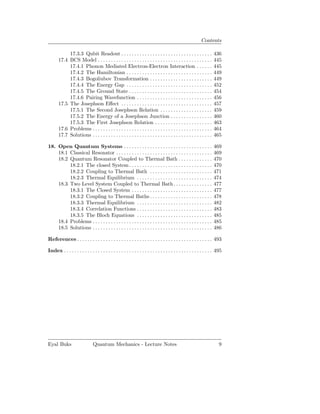
Contents

            17.3.3 Qubit Readout . . . . . . . . . . . . . . . . . . . . . . . . . . . . . . . . . . .               436
       17.4 BCS Model . . . . . . . . . . . . . . . . . . . . . . . . . . . . . . . . . . . . . . . . . . . .        445
            17.4.1 Phonon Mediated Electron-Electron Interaction . . . . . .                                         445
            17.4.2 The Hamiltonian . . . . . . . . . . . . . . . . . . . . . . . . . . . . . . . . .                 449
            17.4.3 Bogoliubov Transformation . . . . . . . . . . . . . . . . . . . . . . . .                         449
            17.4.4 The Energy Gap . . . . . . . . . . . . . . . . . . . . . . . . . . . . . . . . .                  452
            17.4.5 The Ground State . . . . . . . . . . . . . . . . . . . . . . . . . . . . . . . .                  454
            17.4.6 Pairing Wavefunction . . . . . . . . . . . . . . . . . . . . . . . . . . . . .                    456
       17.5 The Josephson Effect . . . . . . . . . . . . . . . . . . . . . . . . . . . . . . . . . . .                457
            17.5.1 The Second Josephson Relation . . . . . . . . . . . . . . . . . . . .                             459
            17.5.2 The Energy of a Josephson Junction . . . . . . . . . . . . . . . .                                460
            17.5.3 The First Josephson Relation . . . . . . . . . . . . . . . . . . . . . .                          463
       17.6 Problems . . . . . . . . . . . . . . . . . . . . . . . . . . . . . . . . . . . . . . . . . . . . . .     464
       17.7 Solutions . . . . . . . . . . . . . . . . . . . . . . . . . . . . . . . . . . . . . . . . . . . . . .    465

18. Open Quantum Systems . . . . . . . . . . . . . . . . . . . . . . . . . . . . . . . . . .                         469
    18.1 Classical Resonator . . . . . . . . . . . . . . . . . . . . . . . . . . . . . . . . . . . . .               469
    18.2 Quantum Resonator Coupled to Thermal Bath . . . . . . . . . . . . .                                         470
         18.2.1 The closed System . . . . . . . . . . . . . . . . . . . . . . . . . . . . . . . .                    470
         18.2.2 Coupling to Thermal Bath . . . . . . . . . . . . . . . . . . . . . . . .                             471
         18.2.3 Thermal Equilibrium . . . . . . . . . . . . . . . . . . . . . . . . . . . . .                        474
    18.3 Two Level System Coupled to Thermal Bath . . . . . . . . . . . . . . .                                      477
         18.3.1 The Closed System . . . . . . . . . . . . . . . . . . . . . . . . . . . . . . .                      477
         18.3.2 Coupling to Thermal Baths . . . . . . . . . . . . . . . . . . . . . . . .                            478
         18.3.3 Thermal Equilibrium . . . . . . . . . . . . . . . . . . . . . . . . . . . . .                        482
         18.3.4 Correlation Functions . . . . . . . . . . . . . . . . . . . . . . . . . . . . .                      483
         18.3.5 The Bloch Equations . . . . . . . . . . . . . . . . . . . . . . . . . . . . .                        485
    18.4 Problems . . . . . . . . . . . . . . . . . . . . . . . . . . . . . . . . . . . . . . . . . . . . . .        485
    18.5 Solutions . . . . . . . . . . . . . . . . . . . . . . . . . . . . . . . . . . . . . . . . . . . . . .       486

References . . . . . . . . . . . . . . . . . . . . . . . . . . . . . . . . . . . . . . . . . . . . . . . . . . . . 493

Index . . . . . . . . . . . . . . . . . . . . . . . . . . . . . . . . . . . . . . . . . . . . . . . . . . . . . . . . . 495


Eyal Buks                      Quantum Mechanics - Lecture Notes                                                         9
1. Hamilton’s Formalism of Classical Physics


In this chapter the Hamilton’s formalism of classical physics is introduced,
with a special emphasis on the concepts that are needed for quantum me-
chanics.


1.1 Action and Lagrangian
Consider a classical physical system having N degrees of freedom. The clas-
sical state of the system can be described by N independent coordinates qn ,
where n = 1, 2, · · · , N . The vector of coordinates is denoted by

    Q = (q1 , q2 , · · · , qN ) .                                      (1.1)

Consider the case where the vector of coordinates takes the value Q1 at time
t1 and the value Q2 at a later time t2 > t1 , namely
    Q (t1 ) = Q1 ,                                                     (1.2)
    Q (t2 ) = Q2 .                                                     (1.3)
The action S associated with the evolution of the system from time t1 to
time t2 is defined by
           t2

    S=          dt L ,                                                 (1.4)
         t1

where L is the Lagrangian function of the system. In general, the Lagrangian
                                                   ˙
is a function of the coordinates Q, the velocities Q and time t, namely

             ˙
    L = L Q, Q; t         ,                                            (1.5)

where
    ˙
    Q = (q1 , q2 , · · · , qN ) ,
         ˙ ˙               ˙                                           (1.6)

and where overdot denotes time derivative. The time evolution of Q, in turn,
depends of the trajectory taken by the system from point Q1 at time t1
Chapter 1. Hamilton’s Formalism of Classical Physics


                       Q
              Q2


              Q1
                                                              t
                        t1                       t2

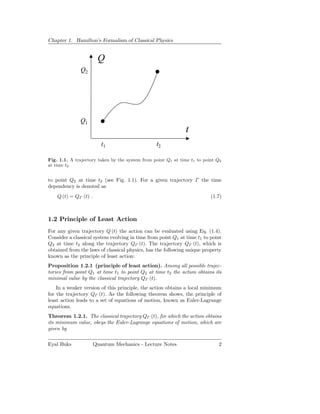
Fig. 1.1. A trajectory taken by the system from point Q1 at time t1 to point Q2
at time t2 .


to point Q2 at time t2 (see Fig. 1.1). For a given trajectory Γ the time
dependency is denoted as
    Q (t) = QΓ (t) .                                                      (1.7)


1.2 Principle of Least Action
For any given trajectory Q (t) the action can be evaluated using Eq. (1.4).
Consider a classical system evolving in time from point Q1 at time t1 to point
Q2 at time t2 along the trajectory QΓ (t). The trajectory QΓ (t), which is
obtained from the laws of classical physics, has the following unique property
known as the principle of least action:
Proposition 1.2.1 (principle of least action). Among all possible trajec-
tories from point Q1 at time t1 to point Q2 at time t2 the action obtains its
minimal value by the classical trajectory QΓ (t).
    In a weaker version of this principle, the action obtains a local minimum
for the trajectory QΓ (t). As the following theorem shows, the principle of
least action leads to a set of equations of motion, known as Euler-Lagrange
equations.
Theorem 1.2.1. The classical trajectory QΓ (t), for which the action obtains
its minimum value, obeys the Euler-Lagrange equations of motion, which are
given by

Eyal Buks           Quantum Mechanics - Lecture Notes                        2
1.2. Principle of Least Action

     d ∂L      ∂L
             =     ,                                                             (1.8)
     dt ∂ qn
          ˙    ∂qn
where n = 1, 2, · · · , N.

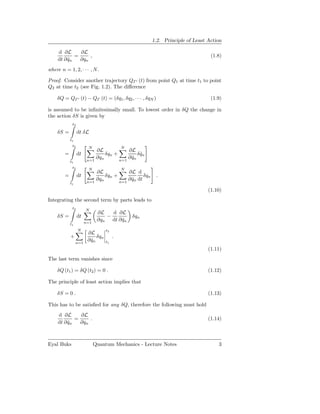
Proof. Consider another trajectory QΓ ′ (t) from point Q1 at time t1 to point
Q2 at time t2 (see Fig. 1.2). The difference

    δQ = QΓ ′ (t) − QΓ (t) = (δq1 , δq2 , · · · , δqN )                          (1.9)

is assumed to be infinitesimally small. To lowest order in δQ the change in
the action δS is given by
             t2

    δS =          dt δL
            t1
             t2         N                   N
                            ∂L            ∂L
        =         dt            δqn +          δ qn
                                                 ˙
                        n=1
                            ∂qn       n=1
                                          ∂ qn
                                            ˙
            t1
             t2         N                   N
                            ∂L            ∂L d
        =         dt            δqn +             δqn     .
                        n=1
                            ∂qn       n=1
                                          ∂ qn dt
                                            ˙
            t1
                                                                                (1.10)
Integrating the second term by parts leads to
             t2        N
                              ∂L   d ∂L
    δS =          dt             −              δqn
                       n=1
                              ∂qn dt ∂ qn
                                       ˙
            t1
                  N                t2
                        ∂L
            +                δqn        .
                 n=1
                        ∂ qn
                          ˙        t1
                                                                                (1.11)
The last term vanishes since

    δQ (t1 ) = δQ (t2 ) = 0 .                                                   (1.12)

The principle of least action implies that

    δS = 0 .                                                                    (1.13)

This has to be satisfied for any δQ, therefore the following must hold
     d ∂L      ∂L
             =     .                                                            (1.14)
     dt ∂ qn
          ˙    ∂qn


Eyal Buks                    Quantum Mechanics - Lecture Notes                      3
Chapter 1. Hamilton’s Formalism of Classical Physics


                        Q
               Q2


                                        Γ

                                          Γ’
               Q1
                                                                   t
                          t1                        t2

Fig. 1.2. The classical trajectory QΓ (t) and the trajectory QΓ ′ (t).


    In what follows we will assume for simplicity that the kinetic energy T of
                                                                  ˙
the system can be expressed as a function of the velocities Q only (namely,
it does not explicitly depend on the coordinates Q). The components of the
generalized force Fn , where n = 1, 2, · · · , N , are derived from the potential
energy U of the system as follows
             ∂U   d ∂U
    Fn = −      +        .                                                (1.15)
             ∂qn dt ∂ qn
                      ˙
When the potential energy can be expressed as a function of the coordinates
                                                          ˙
Q only (namely, when it is independent on the velocities Q), the system is
said to be conservative. For that case, the Lagrangian can be expressed in
terms of T and U as
    L=T −U .                                                              (1.16)
Example 1.2.1. Consider a point particle having mass m moving in a one-
dimensional potential U (x). The Lagrangian is given by
                 mx2
                   ˙
    L=T −U =         − U (x) .                                            (1.17)
                  2
From the Euler-Lagrange equation
    d ∂L      ∂L
           =       ,                                                      (1.18)
    dt ∂ x
         ˙    ∂x
one finds that
            ∂U
    m¨ = −
      x          .                                                        (1.19)
             ∂x

Eyal Buks              Quantum Mechanics - Lecture Notes                       4
1.3. Hamiltonian

1.3 Hamiltonian
The set of Euler-Lagrange equations contains N second order differential
equations. In this section we derive an alternative and equivalent set of equa-
tions of motion, known as Hamilton-Jacobi equations, that contains twice the
number of equations, namely 2N, however, of first, instead of second, order.
Definition 1.3.1. The variable canonically conjugate to qn is defined by
             ∂L
    pn =          .                                                     (1.20)
             ∂ qn
               ˙
Definition 1.3.2. The Hamiltonian of a physical system is a function of
the vector of coordinates Q, the vector of canonical conjugate variables P =
(p1 , p2 , · · · , pN ) and time, namely

    H = H (Q, P ; t) ,                                                  (1.21)

is defined by
             N
    H=            pn qn − L ,
                     ˙                                                  (1.22)
           n=1

where L is the Lagrangian.
Theorem 1.3.1. The classical trajectory satisfies the Hamilton-Jacobi equa-
tions of motion, which are given by
         ∂H
    qn =
    ˙        ,                                                          (1.23)
         ∂pn
           ∂H
    pn = −
    ˙          ,                                                        (1.24)
           ∂qn
where n = 1, 2, · · · , N.
Proof. The differential of H is given by
                  N
    dH = d             pn qn − dL
                          ˙
                 n=1
                                                        
              N                                  
                                                 
         =     qn dpn + pn dqn − ∂L dqn − ∂L dqn  − ∂L dt
               ˙            ˙
                                  ∂qn      ∂ qn
                                             ˙
                                                ˙ 
           n=1                                    ∂t
                                          d ∂L      pn
                                          dt ∂ qn
                                               ˙

              N
                                          ∂L
         =         (qn dpn − pn dqn ) −
                    ˙        ˙               dt .
             n=1
                                          ∂t
                                                                        (1.25)

Eyal Buks                 Quantum Mechanics - Lecture Notes                  5
Chapter 1. Hamilton’s Formalism of Classical Physics

Thus the following holds
            ∂H
       qn =
       ˙         ,                                                    (1.26)
            ∂pn
              ∂H
       pn = −
       ˙           ,                                                  (1.27)
              ∂qn
      ∂L    ∂H
    −     =     .                                                     (1.28)
      ∂t    ∂t
Corollary 1.3.1. The following holds
    dH   ∂H
       =    .                                                         (1.29)
    dt   ∂t
Proof. Using Eqs. (1.23) and (1.24) one finds that
              N
    dH               ∂H       ∂H       ∂H   ∂H
       =                 qn +
                         ˙        pn +
                                  ˙       =    .                      (1.30)
    dt   n=1
                     ∂qn      ∂pn      ∂t   ∂t
                               =0

    The last corollary implies that H is time independent provided that H
does not depend on time explicitly, namely, provided that ∂H/∂t = 0. This
property is referred to as the law of energy conservation. The theorem below
further emphasizes the relation between the Hamiltonian and the total energy
of the system.

Theorem 1.3.2. Assume that the kinetic energy of a conservative system is
given by

    T =          αnm qn qm ,
                     ˙ ˙                                              (1.31)
           n,m

where αnm are constants. Then,the Hamiltonian of the system is given by

    H =T +U ,                                                         (1.32)

where T is the kinetic energy of the system and where U is the potential
energy.

Proof. For a conservative system the potential energy is independent on ve-
locities, thus
           ∂L     ∂T
    pl =        =      ,                                              (1.33)
           ∂ ql
             ˙    ∂ ql
                    ˙
where L = T − U is the Lagrangian. The Hamiltonian is thus given by


Eyal Buks               Quantum Mechanics - Lecture Notes                 6
1.4. Poisson’s Brackets

          N
    H=          pl ql − L
                   ˙
          l=1
                ∂T
      =              ql − (T − U )
                     ˙
                ∂ ql
                  ˙
            l
                                            
                       ∂q˙n      ∂ qm 
                                    ˙ 
                      
      =           αnm qm
                        ˙    + qn
                               ˙        ql − T + U
                                         ˙
                       ∂ ql
                          ˙       ∂ ql 
                                     ˙
          l,n,m
                              δnl     δ ml

      =2          αnm qn qm − T + U
                      ˙ ˙
            n,m

                      T
      = T +U .
                                                                        (1.34)


1.4 Poisson’s Brackets

Consider two physical quantities F and G that can be expressed as a function
of the vector of coordinates Q, the vector of canonical conjugate variables P
and time t, namely
    F = F (Q, P ; t) ,                                                  (1.35)
    G = G (Q, P ; t) ,                                                  (1.36)
The Poisson’s brackets are defined by
                  N
                          ∂F ∂G    ∂F ∂G
    {F, G} =                     −               ,                      (1.37)
                  n=1
                          ∂qn ∂pn ∂pn ∂qn

The Poisson’s brackets are employed for writing an equation of motion for a
general physical quantity of interest, as the following theorem shows.

Theorem 1.4.1. Let F be a physical quantity that can be expressed as a
function of the vector of coordinates Q, the vector of canonical conjugate
variables P and time t, and let H be the Hamiltonian. Then, the following
holds
    dF            ∂F
       = {F, H} +    .                                                  (1.38)
    dt            ∂t
Proof. Using Eqs. (1.23) and (1.24) one finds that the time derivative of F
is given by


Eyal Buks                 Quantum Mechanics - Lecture Notes                 7
Chapter 1. Hamilton’s Formalism of Classical Physics

              N
    dF              ∂F       ∂F       ∂F
       =                qn +
                        ˙        pn +
                                 ˙
    dt   n=1
                    ∂qn      ∂pn      ∂t
              N
                    ∂F ∂H    ∂F ∂H         ∂F
          =                −          +
              n=1
                    ∂qn ∂pn ∂pn ∂qn        ∂t
                       ∂F
          = {F, H} +      .
                       ∂t
                                                                     (1.39)
Corollary 1.4.1. If F does not explicitly depend on time, namely if ∂F/∂t =
0, and if {F, H} = 0, then F is a constant of the motion, namely
    dF
       =0.                                                           (1.40)
    dt


1.5 Problems
 1. Consider a particle having charge q and mass m in electromagnetic field
    characterized by the scalar potential ϕ and the vector potential A. The
    electric field E and the magnetic field B are given by
                        1 ∂A
          E = −∇ϕ −          ,                                       (1.41)
                        c ∂t
    and
          B=∇×A.                                                     (1.42)
    Let r = (x, y, z) be the Cartesian coordinates of the particle.
     a) Verify that the Lagrangian of the system can be chosen to be given
        by
                    1 2        q
               L=     m˙ − qϕ + A · r ,
                       r            ˙                                (1.43)
                    2          c
       by showing that the corresponding Euler-Lagrange equations are
       equivalent to Newton’s 2nd law (i.e., F = m¨).
                                                   r
    b) Show that the Hamilton-Jacobi equations are equivalent to Newton’s
       2nd law.
    c) Gauge transformation — The electromagnetic field is invariant un-
       der the gauge transformation of the scalar and vector potentials
           A → A + ∇χ ,                                              (1.44)
                     1 ∂χ
            ϕ → ϕ−                                                   (1.45)
                     c ∂t
       where χ = χ (r, t) is an arbitrary smooth and continuous function
       of r and t. What effect does this gauge transformation have on the
       Lagrangian and Hamiltonian? Is the motion affected?

Eyal Buks             Quantum Mechanics - Lecture Notes                  8
1.6. Solutions


                            L               C


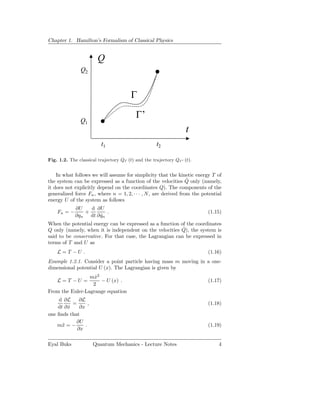
Fig. 1.3. LC resonator.


 2. Consider an LC resonator made of a capacitor having capacitance C in
    parallel with an inductor having inductance L (see Fig. 1.3). The state
    of the system is characterized by the coordinate q , which is the charge
    stored by the capacitor.
     a) Find the Euler-Lagrange equation of the system.
     b) Find the Hamilton-Jacobi equations of the system.
     c) Show that {q, p} = 1 .
 3. Show that Poisson brackets satisfy the following relations
           {qj , qk } = 0 ,                                           (1.46)
           {pj , pk } = 0 ,                                           (1.47)
           {qj , pk } = δ jk ,                                        (1.48)
            {F, G} = − {G, F } ,                                      (1.49)
            {F, F } = 0 ,                                             (1.50)
            {F, K} = 0 if K constant or F depends only on t ,         (1.51)
        {E + F, G} = {E, G} + {F, G} ,                                (1.52)
          {E, F G} = {E, F } G + F {E, G} .                           (1.53)
 4. Show that the Lagrange equations are coordinate invariant.
 5. Consider a point particle having mass m moving in a 3D central po-
    tential, namely a potential V (r) that depends only on the distance
    r = x2 + y 2 + z 2 from the origin. Show that the angular momentum
    L = r × p is a constant of the motion.


1.6 Solutions

 1. The Lagrangian of the system (in Gaussian units) is taken to be given
    by
           1           q
        L = m˙ 2 − qϕ + A · r .
             r              ˙                                         (1.54)
           2           c


Eyal Buks           Quantum Mechanics - Lecture Notes                     9
Chapter 1. Hamilton’s Formalism of Classical Physics

    a) The Euler-Lagrange equation for the coordinate x is given by

             d ∂L     ∂L
                    =    ,                                                  (1.55)
             dt ∂ x
                  ˙   ∂x
       where
             d ∂L          q    ∂Ax    ∂Ax    ∂Ax    ∂Ax
                    = m¨ +
                       x            +x
                                     ˙     +y
                                            ˙     +z
                                                   ˙                    ,   (1.56)
             dt ∂ x
                  ˙        c     ∂t     ∂x     ∂y     ∂z

       and
             ∂L      ∂ϕ q           ∂Ax    ∂Ay    ∂Az
                = −q    +       x
                                ˙       +y
                                         ˙     +z
                                                ˙             ,             (1.57)
             ∂x      ∂x   c          ∂x     ∂x     ∂x

       thus
                   ∂ϕ q ∂Ax
           m¨ = −q
            x         −
                   ∂x   c ∂t
                          qEx
                                                                 
                                                                 
                                                                 
                                                                 
                                                                 
                    q  ∂Ay     ∂Ax            ∂Ax ∂Az            
                   + y ˙     −           −z
                                           ˙       −               ,
                    c   ∂x     ∂y             ∂z   ∂x           
                                                                  
                                                                 
                           (∇ ×A)z                 (∇ ×A)y       
                                                                 
                                      (˙ ×(∇×A))x
                                       r

                                                                            (1.58)
       or
                          q
             m¨ = qEx +
              x             (˙ × B)x .
                             r                                              (1.59)
                          c
       Similar equations are obtained for y and z in the same way. These 3
                                          ¨     ¨
       equations can be written in a vector form as

                       1
             m¨ = q E + r × B
              r          ˙            .                                     (1.60)
                       c

    b) The variable vector canonically conjugate to the coordinates vector
       r is given by
                  ∂L       q
             p=      = m˙ + A .
                        r                                                   (1.61)
                  ∂r
                   ˙       c
       The Hamiltonian is thus given by


Eyal Buks           Quantum Mechanics - Lecture Notes                          10
1.6. Solutions

            H = p·r−L
                  ˙
                          1      q
               = r · p − m˙ − A + qϕ
                 ˙           r
                          2      c
                 1 2
               = m˙ + qϕ
                     r
                 2
                          2
                   p− q A
                       c
               =            + qϕ .
                     2m
                                                                    (1.62)
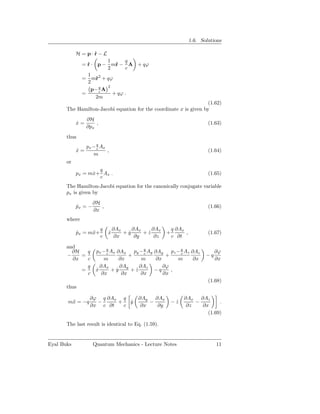
       The Hamilton-Jacobi equation for the coordinate x is given by
                 ∂H
            x=
            ˙        ,                                                      (1.63)
                 ∂px
       thus
                 px − q Ax
                      c
            x=
            ˙              ,                                                (1.64)
                    m
       or
                    q
            px = mx+ Ax .
                  ˙                                                         (1.65)
                    c
       The Hamilton-Jacobi equation for the canonically conjugate variable
       px is given by
                     ∂H
            px = −
            ˙           ,                                                   (1.66)
                     ∂x
       where
                         q       ∂Ax    ∂Ax    ∂Ax        q ∂Ax
            px = m¨+
            ˙     x          x
                             ˙       +y
                                      ˙     +z
                                             ˙        +         ,           (1.67)
                         c        ∂x     ∂y     ∂z        c ∂t

       and
         ∂H   q       px − q Ax ∂Ax py − q Ay ∂Ay
                           c                c        pz − q Az ∂Az
                                                          c                     ∂ϕ
       −    =                         +            +                       −q
         ∂x   c           m       ∂x       m   ∂x       m       ∂x              ∂x
              q         ∂Ax       ∂Ay     ∂Az     ∂ϕ
            =         x
                      ˙      +y ˙      +z
                                        ˙     −q     ,
              c          ∂x        ∂x      ∂x     ∂x
                                                                            (1.68)
       thus

                  ∂ϕ q ∂Ax q              ∂Ay   ∂Ax            ∂Ax ∂Az
       m¨ = −q
        x           −     +   y
                              ˙               −           −z
                                                           ˙       −        .
                  ∂x c ∂t   c              ∂x    ∂y             ∂z   ∂x
                                                                       (1.69)

       The last result is identical to Eq. (1.59).


Eyal Buks            Quantum Mechanics - Lecture Notes                          11
Chapter 1. Hamilton’s Formalism of Classical Physics

     c) Clearly, the fields E and B, which are given by Eqs. (1.41) and (1.42)
        respectively, are unchanged since
                   ∂χ         ∂ (∇χ)
              ∇           −          =0,                               (1.70)
                   ∂t            ∂t
        and
              ∇ × (∇χ) = 0 .                                           (1.71)
        Thus, even though both L and H are modified, the motion, which
        depends on E and B only, is unaffected.
 2. The kinetic energy in this case T = Lq 2 /2 is the energy stored in the
                                           ˙
    inductor, and the potential energy U = q 2 /2C is the energy stored in the
    capacitor.
     a) The Lagrangian is given by
                               Lq 2
                                 ˙    q2
              L=T −U =              −    .                             (1.72)
                                2     2C
        The Euler-Lagrange equation for the coordinate q is given by
               d ∂L     ∂L
                      =    ,                                           (1.73)
               dt ∂ q
                    ˙   ∂q
        thus
                     q
              L¨ +
               q       =0.                                             (1.74)
                     C
       This equation expresses the requirement that the voltage across the
       capacitor is the same as the one across the inductor.
    b) The canonical conjugate momentum is given by
                   ∂L
              p=      = Lq ,
                         ˙                                             (1.75)
                   ∂q
                    ˙
        and the Hamiltonian is given by
                                p2   q2
              H = pq − L =
                   ˙               +    .                              (1.76)
                                2L 2C
        Hamilton-Jacobi equations read
                p
              q=
              ˙                                                        (1.77)
                L
                  q
              p=− ,
              ˙                                                        (1.78)
                  C
        thus
                     q
              L¨ +
               q       =0.                                             (1.79)
                     C

Eyal Buks               Quantum Mechanics - Lecture Notes                  12
1.6. Solutions

     c) Using the definition (1.37) one has
                            ∂q ∂p ∂q ∂p
               {q, p} =          −      =1.                               (1.80)
                            ∂q ∂p ∂p ∂q
 3. All these relations are easily proven using the definition (1.37).
                     ˙
 4. Let L = L Q, Q; t be a Lagrangian of a system, where Q = (q1 , q2 , · · · )
                                     ˙
    is the vector of coordinates, Q = (q1 , q2 , · · · ) is the vector of veloci-
                                           ˙ ˙
    ties, and where overdot denotes time derivative. Consider the coordinates
    transformation

          xa = xa (q1 , q2 , ..., t) ,                                    (1.81)

    where a = 1, 2, · · · . The following holds
                 ∂xa      ∂xa
          xa =
          ˙          qb +
                     ˙        ,                                           (1.82)
                 ∂qb       ∂t
    where the summation convention is being used, namely, repeated indices
    are summed over. Moreover
          ∂L    ∂L ∂xb    ∂L ∂ xb
                                ˙
              =         +          ,                                      (1.83)
          ∂qa   ∂xb ∂qa   ∂ xb ∂qa
                            ˙
    and
          d      ∂L         d    ∂L ∂ xb˙
                        =                    .                            (1.84)
          dt     ∂ qa
                   ˙        dt   ∂ xb ∂ qa
                                   ˙    ˙

    As can be seen from Eq. (1.82), one has
          ∂ xb
            ˙    ∂xb
               =     .                                                    (1.85)
          ∂ qa
            ˙    ∂qa
    Thus, using Eqs. (1.83) and (1.84) one finds

          d      ∂L         ∂L    d ∂L ∂xb
                        −       =
          dt     ∂ qa
                   ˙        ∂qa   dt ∂ xb ∂qa
                                        ˙
                                  ∂L ∂xb     ∂L ∂ xb˙
                                −          −
                                  ∂xb ∂qa    ∂ xb ∂qa
                                               ˙
                                    d ∂L          ∂L    ∂xb
                                =             −
                                   dt ∂ xb˙      ∂xb    ∂qa
                                   d ∂xb         ∂ xb
                                                   ˙    ∂L
                                +             −              .
                                   dt ∂qa        ∂qa    ∂ xb
                                                          ˙
                                                                          (1.86)

    As can be seen from Eq. (1.82), the second term vanishes since

Eyal Buks               Quantum Mechanics - Lecture Notes                     13
Chapter 1. Hamilton’s Formalism of Classical Physics

          ∂ xb
            ˙     ∂ 2 xb      ∂ 2 xb   d      ∂xb
               =         qc +
                         ˙           =                ,
          ∂qa    ∂qa ∂qc      ∂t∂qa    dt     ∂qa

   thus
          d    ∂L          ∂L    d    ∂L          ∂L ∂xb
                       −       =              −           .                (1.87)
          dt   ∂ qa
                 ˙         ∂qa   dt   ∂ xb
                                        ˙         ∂xb ∂qa

    The last result shows that if the coordinate transformation is reversible,
    namely if det (∂xb /∂qa ) = 0 then Lagrange equations are coordinate
    invariant.
 5. The angular momentum L is given by
                                   
                            x y ˆ
                            ˆ ˆ z
        L = r × p = det  x y z  ,                                    (1.88)
                           px py pz

   where r = (x, y, z) is the position vector and where p = (px , py , pz ) is the
   momentum vector. The Hamiltonian is given by

               p2
         H=       + V (r) .                                                (1.89)
               2m
   Using
         {xi , pj } = δ ij ,                                               (1.90)
                Lz = xpy − ypx ,                                           (1.91)
   one finds that
           p2 , Lz = p2 , Lz + p2 , Lz + p2 , Lz
                      x         y         z
                      = p2 , xpy − p2 , ypx
                          x            y
                      = −2px py + 2py px
                      =0,
                                                                           (1.92)
   and
           r2 , Lz = x2 , Lz + y 2 , Lz + z 2 , Lz
                      = −y x2 , px + y 2 , py x
                      =0.
                                                                           (1.93)
   Thus f r2 , Lz = 0 for arbitrary smooth function f r2 , and con-
   sequently {H, Lz } = 0. In a similar way one can show that {H, Lx } =
   {H, Ly } = 0, and therefore H, L2 = 0.


Eyal Buks               Quantum Mechanics - Lecture Notes                      14
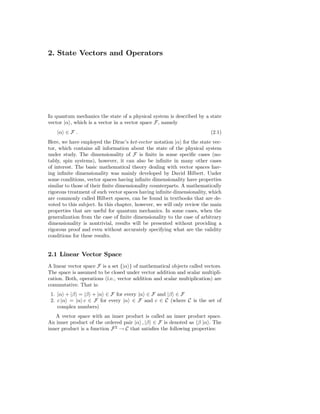
2. State Vectors and Operators


In quantum mechanics the state of a physical system is described by a state
vector |α , which is a vector in a vector space F, namely
    |α ∈ F .                                                             (2.1)
Here, we have employed the Dirac’s ket-vector notation |α for the state vec-
tor, which contains all information about the state of the physical system
under study. The dimensionality of F is finite in some specific cases (no-
tably, spin systems), however, it can also be infinite in many other cases
of interest. The basic mathematical theory dealing with vector spaces hav-
ing infinite dimensionality was mainly developed by David Hilbert. Under
some conditions, vector spaces having infinite dimensionality have properties
similar to those of their finite dimensionality counterparts. A mathematically
rigorous treatment of such vector spaces having infinite dimensionality, which
are commonly called Hilbert spaces, can be found in textbooks that are de-
voted to this subject. In this chapter, however, we will only review the main
properties that are useful for quantum mechanics. In some cases, when the
generalization from the case of finite dimensionality to the case of arbitrary
dimensionality is nontrivial, results will be presented without providing a
rigorous proof and even without accurately specifying what are the validity
conditions for these results.


2.1 Linear Vector Space
A linear vector space F is a set {|α } of mathematical objects called vectors.
The space is assumed to be closed under vector addition and scalar multipli-
cation. Both, operations (i.e., vector addition and scalar multiplication) are
commutative. That is:
 1. |α + |β = |β + |α ∈ F for every |α ∈ F and |β ∈ F
 2. c |α = |α c ∈ F for every |α ∈ F and c ∈ C (where C is the set of
    complex numbers)
   A vector space with an inner product is called an inner product space.
An inner product of the ordered pair |α , |β ∈ F is denoted as β |α . The
inner product is a function F 2 → C that satisfies the following properties:
Chapter 2. State Vectors and Operators

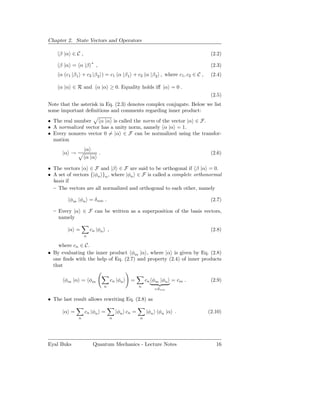
     β |α ∈ C ,                                                              (2.2)
                      ∗
     β |α = α |β          ,                                                  (2.3)
     α (c1 |β 1 + c2 |β 2 ) = c1 α |β 1 + c2 α |β 2 , where c1 , c2 ∈ C ,    (2.4)

     α |α ∈ R and α |α ≥ 0. Equality holds iff |α = 0 .
                                                                             (2.5)
Note that the asterisk in Eq. (2.3) denotes complex conjugate. Below we list
some important definitions and comments regarding inner product:
• The real number    α |α is called the norm of the vector |α ∈ F.
• A normalized vector has a unity norm, namely α |α = 1.
• Every nonzero vector 0 = |α ∈ F can be normalized using the transfor-
  mation
                  |α
      |α →              .                                                    (2.6)
                   α |α

• The vectors |α ∈ F and |β ∈ F are said to be orthogonal if β |α = 0.
• A set of vectors {|φn }n , where |φn ∈ F is called a complete orthonormal
  basis if
  — The vectors are all normalized and orthogonal to each other, namely

         φm |φn = δ nm .                                                     (2.7)

  — Every |α ∈ F can be written as a superposition of the basis vectors,
    namely

        |α =          cn |φn ,                                               (2.8)
                  n

    where cn ∈ C.
• By evaluating the inner product φm |α , where |α is given by Eq. (2.8)
  one finds with the help of Eq. (2.7) and property (2.4) of inner products
  that

       φm |α = φm                 cn |φn   =         cn φm |φn = cm .        (2.9)
                              n                  n
                                                        =δnm

• The last result allows rewriting Eq. (2.8) as

      |α =        cn |φn =            |φn cn =       |φn φn |α .            (2.10)
              n                   n              n


Eyal Buks              Quantum Mechanics - Lecture Notes                       16
2.3. Dirac’s notation

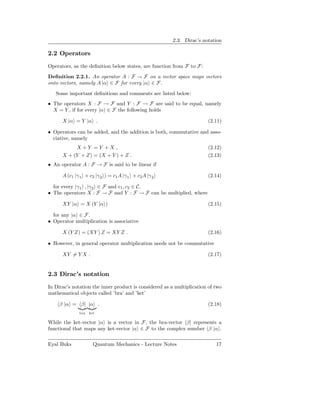
2.2 Operators
Operators, as the definition below states, are function from F to F:
Definition 2.2.1. An operator A : F → F on a vector space maps vectors
onto vectors, namely A |α ∈ F for every |α ∈ F.

   Some important definitions and comments are listed below:
• The operators X : F → F and Y : F → F are said to be equal, namely
  X = Y , if for every |α ∈ F the following holds

      X |α = Y |α .                                                    (2.11)

• Operators can be added, and the addition is both, commutative and asso-
  ciative, namely
           X +Y = Y +X ,                                               (2.12)
      X + (Y + Z) = (X + Y ) + Z .                                     (2.13)
• An operator A : F → F is said to be linear if

      A (c1 |γ 1 + c2 |γ 2 ) = c1 A |γ 1 + c2 A |γ 2                   (2.14)

  for every |γ 1 , |γ 2 ∈ F and c1 , c2 ∈ C.
• The operators X : F → F and Y : F → F can be multiplied, where

      XY |α = X (Y |α )                                                (2.15)

  for any |α ∈ F.
• Operator multiplication is associative

      X (Y Z) = (XY ) Z = XY Z .                                       (2.16)

• However, in general operator multiplication needs not be commutative

      XY = Y X .                                                       (2.17)


2.3 Dirac’s notation
In Dirac’s notation the inner product is considered as a multiplication of two
mathematical objects called ’bra’ and ’ket’

     β |α = β| |α .                                                    (2.18)
              bra   ket

While the ket-vector |α is a vector in F, the bra-vector β| represents a
functional that maps any ket-vector |α ∈ F to the complex number β |α .

Eyal Buks             Quantum Mechanics - Lecture Notes                    17
Chapter 2. State Vectors and Operators

While the multiplication of a bra-vector on the left and a ket-vector on the
right represents inner product, the outer product is obtained by reversing the
order

    Aαβ = |α β| .                                                          (2.19)

The outer product Aαβ is clearly an operator since for any |γ ∈ F the object
Aαβ |γ is a ket-vector

    Aαβ |γ = (|β α|) |γ = |β α |γ ∈ F .                                    (2.20)
                                    ∈C

Moreover, according to property (2.4), Aαβ is linear since for every |γ 1 , |γ 2 ∈
F and c1 , c2 ∈ C the following holds
    Aαβ (c1 |γ 1 + c2 |γ 2 ) = |α β| (c1 |γ 1 + c2 |γ 2 )
                             = |α (c1 β |γ 1 + c2 β |γ 2 )
                             = c1 Aαβ |γ 1 + c2 Aαβ |γ 2 .
                                                                           (2.21)
   With Dirac’s notation Eq. (2.10) can be rewritten as


    |α =           |φn φn | |α .                                           (2.22)
               n

Since the above identity holds for any |α ∈ F one concludes that the quantity
in brackets is the identity operator, which is denoted as 1, namely

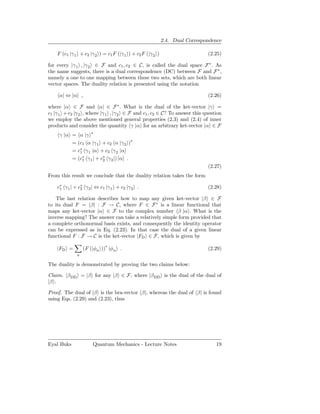
    1=        |φn φn | .                                                   (2.23)
          n

This result, which is called the closure relation, implies that any complete
orthonormal basis can be used to express the identity operator.


2.4 Dual Correspondence

As we have mentioned above, the bra-vector β| represents a functional map-
ping any ket-vector |α ∈ F to the complex number β |α . Moreover, since
the inner product is linear [see property (2.4) above], such a mapping is linear,
namely for every |γ 1 , |γ 2 ∈ F and c1 , c2 ∈ C the following holds

     β| (c1 |γ 1 + c2 |γ 2 ) = c1 β |γ 1 + c2 β |γ 2 .                     (2.24)

The set of linear functionals from F to C, namely, the set of functionals F : F
→ C that satisfy


Eyal Buks             Quantum Mechanics - Lecture Notes                        18
2.4. Dual Correspondence

    F (c1 |γ 1 + c2 |γ 2 ) = c1 F (|γ 1 ) + c2 F (|γ 2 )                     (2.25)

for every |γ 1 , |γ 2 ∈ F and c1 , c2 ∈ C, is called the dual space F ∗ . As
the name suggests, there is a dual correspondence (DC) between F and F ∗ ,
namely a one to one mapping between these two sets, which are both linear
vector spaces. The duality relation is presented using the notation

     α| ⇔ |α ,                                                               (2.26)

where |α ∈ F and α| ∈ F ∗ . What is the dual of the ket-vector |γ =
c1 |γ 1 + c2 |γ 2 , where |γ 1 , |γ 2 ∈ F and c1 , c2 ∈ C? To answer this question
we employ the above mentioned general properties (2.3) and (2.4) of inner
products and consider the quantity γ |α for an arbitrary ket-vector |α ∈ F
     γ |α = α |γ ∗
          = (c1 α |γ 1 + c2 α |γ 2 )∗
          = c∗ γ 1 |α + c2 γ 2 |α
             1
          = (c∗ γ 1 | + c∗ γ 2 |) |α .
              1          2
                                                                             (2.27)
From this result we conclude that the duality relation takes the form

    c∗ γ 1 | + c∗ γ 2 | ⇔ c1 |γ 1 + c2 |γ 2 .
     1          2                                                            (2.28)

    The last relation describes how to map any given ket-vector |β ∈ F
to its dual F = β| : F → C, where F ∈ F ∗ is a linear functional that
maps any ket-vector |α ∈ F to the complex number β |α . What is the
inverse mapping? The answer can take a relatively simple form provided that
a complete orthonormal basis exists, and consequently the identity operator
can be expressed as in Eq. (2.23). In that case the dual of a given linear
functional F : F → C is the ket-vector |FD ∈ F, which is given by

    |FD =         (F (|φn ))∗ |φn .                                          (2.29)
              n

The duality is demonstrated by proving the two claims below:

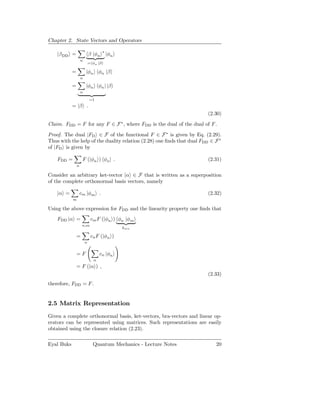
Claim. |β DD = |β for any |β ∈ F, where |β DD is the dual of the dual of
|β .

Proof. The dual of |β is the bra-vector β|, whereas the dual of β| is found
using Eqs. (2.29) and (2.23), thus


Eyal Buks             Quantum Mechanics - Lecture Notes                         19
Chapter 2. State Vectors and Operators

                                      ∗
    |β DD =                 β |φn         |φn
                    n
                            = φn |β

            =           |φn φn |β
                    n

            =           |φn φn | |β
                    n

                            =1
            = |β .
                                                                        (2.30)

Claim. FDD = F for any F ∈ F ∗ , where FDD is the dual of the dual of F .

Proof. The dual |FD ∈ F of the functional F ∈ F ∗ is given by Eq. (2.29).
Thus with the help of the duality relation (2.28) one finds that dual FDD ∈ F ∗
of |FD is given by

    FDD =            F (|φn ) φn | .                                    (2.31)
                n

Consider an arbitrary ket-vector |α ∈ F that is written as a superposition
of the complete orthonormal basis vectors, namely

    |α =            cm |φm .                                            (2.32)
            m

Using the above expression for FDD and the linearity property one finds that
    FDD |α =                 cm F (|φn ) φn |φm
                    n,m
                                                δmn

                =            cn F (|φn )
                        n


                =F                 cn |φn
                               n
                = F (|α ) ,
                                                                        (2.33)
therefore, FDD = F .


2.5 Matrix Representation
Given a complete orthonormal basis, ket-vectors, bra-vectors and linear op-
erators can be represented using matrices. Such representations are easily
obtained using the closure relation (2.23).

Eyal Buks                     Quantum Mechanics - Lecture Notes            20
2.5. Matrix Representation

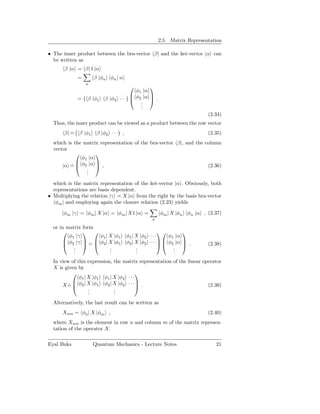
• The inner product between the bra-vector β| and the ket-vector |α can
  be written as
       β |α = β| 1 |α
             =       β |φn φn | α
                 n
                                              
                                         φ1 |α
                                              
             =   β |φ1   β |φ2   · · ·  φ2 |α  .
                                           .
                                           .
                                           .
                                                                         (2.34)
  Thus, the inner product can be viewed as a product between the row vector
       β| = β |φ1
          ˙           β |φ2 · · · ,                                      (2.35)
  which is the matrix representation of the bra-vector β|, and the column
  vector
                   
              φ1 |α
                   
      |α =  φ2 |α  ,
          ˙                                                         (2.36)
                .
                .
                .
  which is the matrix representation of the ket-vector |α . Obviously, both
  representations are basis dependent.
• Multiplying the relation |γ = X |α from the right by the basis bra-vector
   φm | and employing again the closure relation (2.23) yields

      φm |γ = φm | X |α = φm | X1 |α =               φm | X |φn φn |α , (2.37)
                                                 n

  or in matrix form
                                                           
         φ1 |γ      φ1 | X |φ1        φ1 | X |φ2 · · ·    φ1 |α
       φ2 |γ   φ2 | X |φ1          φ2 | X |φ2 · · ·  φ2 |α  .
              =                                                    (2.38)
           .
           .             .
                         .                 .
                                           .                .
                                                            .
           .             .                 .                .
  In view of this expression, the matrix representation of the linear operator
  X is given by
                                        
              φ1 | X |φ1 φ1 | X |φ2 · · ·
                                        
      X =  φ2 | X |φ1 φ2 | X |φ2 · · · .
         ˙                                                              (2.39)
                   .
                   .          .
                              .
                   .          .
  Alternatively, the last result can be written as
      Xnm = φn | X |φm ,                                                 (2.40)
  where Xnm is the element in row n and column m of the matrix represen-
  tation of the operator X.

Eyal Buks            Quantum Mechanics - Lecture Notes                      21
Chapter 2. State Vectors and Operators

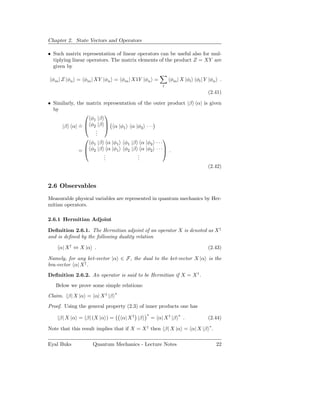
• Such matrix representation of linear operators can be useful also for mul-
  tiplying linear operators. The matrix elements of the product Z = XY are
  given by

 φm | Z |φn = φm | XY |φn = φm | X1Y |φn =                φm | X |φl φl | Y |φn .
                                                      l
                                                                           (2.41)

• Similarly, the matrix representation of the outer product |β α| is given
  by
                       
                  φ1 |β
                       
     |β α| =  φ2 |β  α |φ1 α |φ2 · · ·
              ˙
                    .
                    .
                    .
                                                 
                  φ1 |β α |φ1 φ1 |β α |φ2 · · ·
                                                 
              =  φ2 |β α |φ1 φ2 |β α |φ2 · · · .
                        .
                        .              .
                                       .
                        .              .
                                                                    (2.42)


2.6 Observables
Measurable physical variables are represented in quantum mechanics by Her-
mitian operators.

2.6.1 Hermitian Adjoint

Definition 2.6.1. The Hermitian adjoint of an operator X is denoted as X †
and is defined by the following duality relation

    α| X † ⇔ X |α .                                                        (2.43)

Namely, for any ket-vector |α ∈ F, the dual to the ket-vector X |α is the
bra-vector α| X † .
Definition 2.6.2. An operator is said to be Hermitian if X = X † .
   Below we prove some simple relations:
                             ∗
Claim. β| X |α = α| X † |β
Proof. Using the general property (2.3) of inner products one has
                                             ∗                 ∗
    β| X |α = β| (X |α ) =       α| X † |β       = α| X † |β       .       (2.44)

Note that this result implies that if X = X † then β| X |α = α| X |β ∗ .

Eyal Buks          Quantum Mechanics - Lecture Notes                          22
2.6. Observables

               †
Claim. X †         =X

Proof. For any |α , |β ∈ F the following holds
                                ∗ ∗                 ∗              †
       β| X |α =      β| X |α         = α| X † |β       = β| X †       |α ,        (2.45)
           †
thus X †       = X.

Claim. (XY )† = Y † X †

Proof. Applying XY on an arbitrary ket-vector |α ∈ F and employing the
duality correspondence yield

    XY |α = X (Y |α ) ⇔               α| Y † X † = α| Y † X † ,                    (2.46)

thus

    (XY )† = Y † X † .                                                             (2.47)

Claim. If X = |β α| then X † = |α β|

Proof. By applying X on an arbitrary ket-vector |γ ∈ F and employing the
duality correspondence one finds that

    X |γ = (|β α|) |γ = |β ( α |γ ) ⇔ ( α |γ )∗ β| = γ |α β| = γ| X † ,
                                                                (2.48)

where X † = |α β|.

2.6.2 Eigenvalues and Eigenvectors

Each operator is characterized by its set of eigenvalues, which is defined
below:

Definition 2.6.3. A number an ∈ C is said to be an eigenvalue of an op-
erator A : F → F if for some nonzero ket-vector |an ∈ F the following
holds

    A |an = an |an .                                                               (2.49)

The ket-vector |an is then said to be an eigenvector of the operator A with
an eigenvalue an .

   The set of eigenvectors associated with a given eigenvalue of an operator
A is called eigensubspace and is denoted as

    Fn = {|an ∈ F such that A |an = an |an } .                                     (2.50)

Eyal Buks               Quantum Mechanics - Lecture Notes                             23
Chapter 2. State Vectors and Operators

Clearly, Fn is closed under vector addition and scalar multiplication, namely
c1 |γ 1 + c2 |γ 2 ∈ Fn for every |γ 1 , |γ 2 ∈ Fn and for every c1 , c2 ∈ C. Thus,
the set Fn is a subspace of F. The dimensionality of Fn (i.e., the minimum
number of vectors that are needed to span Fn ) is called the level of degeneracy
gn of the eigenvalue an , namely

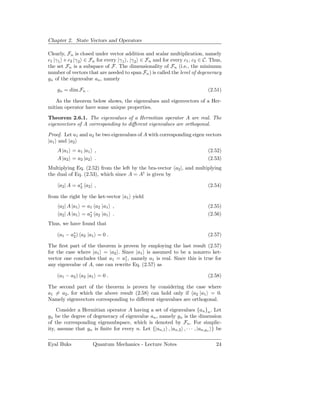
    gn = dim Fn .                                                          (2.51)

   As the theorem below shows, the eigenvalues and eigenvectors of a Her-
mitian operator have some unique properties.

Theorem 2.6.1. The eigenvalues of a Hermitian operator A are real. The
eigenvectors of A corresponding to different eigenvalues are orthogonal.

Proof. Let a1 and a2 be two eigenvalues of A with corresponding eigen vectors
|a1 and |a2
    A |a1 = a1 |a1 ,                                                       (2.52)
    A |a2 = a2 |a2 .                                                       (2.53)
Multiplying Eq. (2.52) from the left by the bra-vector a2 |, and multiplying
the dual of Eq. (2.53), which since A = A† is given by

     a2 | A = a∗ a2 | ,
               2                                                           (2.54)

from the right by the ket-vector |a1 yield
     a2 | A |a1 = a1 a2 |a1 ,                                              (2.55)
     a2 | A |a1 = a∗ a2 |a1 .
                   2                                                       (2.56)
Thus, we have found that

    (a1 − a∗ ) a2 |a1 = 0 .
           2                                                               (2.57)

The first part of the theorem is proven by employing the last result (2.57)
for the case where |a1 = |a2 . Since |a1 is assumed to be a nonzero ket-
vector one concludes that a1 = a∗ , namely a1 is real. Since this is true for
                                 1
any eigenvalue of A, one can rewrite Eq. (2.57) as

    (a1 − a2 ) a2 |a1 = 0 .                                                (2.58)

The second part of the theorem is proven by considering the case where
a1 = a2 , for which the above result (2.58) can hold only if a2 |a1 = 0.
Namely eigenvectors corresponding to different eigenvalues are orthogonal.

    Consider a Hermitian operator A having a set of eigenvalues {an }n . Let
gn be the degree of degeneracy of eigenvalue an , namely gn is the dimension
of the corresponding eigensubspace, which is denoted by Fn . For simplic-
ity, assume that gn is finite for every n. Let {|an,1 , |an,2 , · · · , |an,gn } be

Eyal Buks            Quantum Mechanics - Lecture Notes                         24
2.6. Observables

an orthonormal basis of the eigensubspace Fn , namely an,i′ |an,i = δ ii′ .
Constructing such an orthonormal basis for Fn can be done by the so-called
Gram-Schmidt process. Moreover, since eigenvectors of A corresponding to
different eigenvalues are orthogonal, the following holds

     an′ ,i′ |an,i = δ nn′ δ ii′ ,                                                    (2.59)

In addition, all the ket-vectors |an,i are eigenvectors of A

    A |an,i = an |an,i .                                                              (2.60)

Projectors. Projector operators are useful for expressing the properties of
an observable.
Definition 2.6.4. An Hermitian operator P is called a projector if P 2 = P .
Claim. The only possible eigenvalues of a projector are 0 and 1.

Proof. Assume that |p is an eigenvector of P with an eigenvalue p, namely
P |p = p |p . Applying the operator P on both sides and using the fact that
P 2 = P yield P |p = p2 |p , thus p (1 − p) |p = 0, therefore since |p is
assumed to be nonzero, either p = 0 or p = 1.

   A projector is said to project any given vector onto the eigensubspace
corresponding to the eigenvalue p = 1.
   Let {|an,1 , |an,2 , · · · , |an,gn } be an orthonormal basis of an eigensub-
space Fn corresponding to an eigenvalue of an observable A. Such an ortho-
normal basis can be used to construct a projection Pn onto Fn , which is given
by
             gn
    Pn =            |an,i an,i | .                                                    (2.61)
             i=1

                                  †
Clearly, Pn is a projector since Pn = Pn and since
               gn                                      gn
     2
    Pn   =             |an,i an,i |an,i′   an,i′ | =         |an,i an,i | = Pn .      (2.62)
             i,i′ =1                                   i=1
                                 δii′

Moreover, it is easy to show using the orthonormality relation (2.59) that the
following holds

    Pn Pm = Pm Pn = Pn δ nm .                                                         (2.63)

    For linear vector spaces of finite dimensionality, it can be shown that the
set {|an,i }n,i forms a complete orthonormal basis of eigenvectors of a given
Hermitian operator A. The generalization of this result for the case of ar-
bitrary dimensionality is nontrivial, since generally such a set needs not be

Eyal Buks                   Quantum Mechanics - Lecture Notes                            25
Chapter 2. State Vectors and Operators

complete. On the other hand, it can be shown that if a given Hermitian oper-
ator A satisfies some conditions (e.g., A needs to be completely continuous)
then completeness is guarantied. For all Hermitian operators of interest for
this course we will assume that all such conditions are satisfied. That is, for
any such Hermitian operator A there exists a set of ket vectors {|an,i }, such
that:
 1. The set is orthonormal, namely

          an′ ,i′ |an,i = δ nn′ δ ii′ ,                                               (2.64)

 2. The ket-vectors |an,i are eigenvectors, namely

          A |an,i = an |an,i ,                                                        (2.65)

    where an ∈ R.
 3. The set is complete, namely closure relation [see also Eq. (2.23)] is satis-
    fied
                        gn
          1=                 |an,i an,i | =        Pn ,                               (2.66)
                 n   i=1                       n

    where
                   gn
          Pn =          |an,i an,i |                                                  (2.67)
                 i=1

    is the projector onto eigen subspace Fn with the corresponding eigenvalue
    an .
    The closure relation (2.66) can be used to express the operator A in terms
of the projectors Pn
                             gn                                gn
    A = A1 =                      A |an,i an,i | =        an         |an,i an,i | ,   (2.68)
                     n i=1                           n         i=1

that is

    A=         an Pn .                                                                (2.69)
           n

   The last result is very useful when dealing with a function f (A) of the
operator A. The meaning of a function of an operator can be understood in
terms of the Taylor expansion of the function

    f (x) =          fm xm ,                                                          (2.70)
               m


Eyal Buks                    Quantum Mechanics - Lecture Notes                           26
2.6. Observables

where
           1 dm f
    fm =          .                                                     (2.71)
           m! dxm
With the help of Eqs. (2.63) and (2.69) one finds that
    f (A) =          fm Am
                m
                                           m

           =         fm            an Pn
                m              n

           =         fm        am Pn
                                n
                m          n

           =              fm am Pn ,
                              n
                n     m

                       f (an )

                                                                        (2.72)
thus

    f (A) =          f (an ) Pn .                                       (2.73)
                n

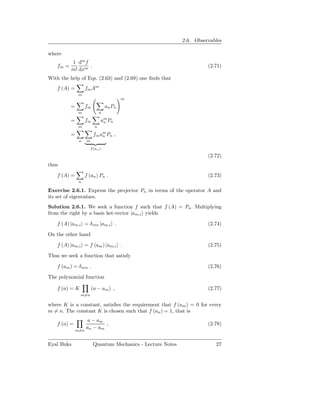
Exercise 2.6.1. Express the projector Pn in terms of the operator A and
its set of eigenvalues.
Solution 2.6.1. We seek a function f such that f (A) = Pn . Multiplying
from the right by a basis ket-vector |am,i yields

    f (A) |am,i = δ mn |am,i .                                          (2.74)

On the other hand

    f (A) |am,i = f (am ) |am,i .                                       (2.75)

Thus we seek a function that satisfy

    f (am ) = δ mn .                                                    (2.76)

The polynomial function

    f (a) = K             (a − am ) ,                                   (2.77)
                m=n

where K is a constant, satisfies the requirement that f (am ) = 0 for every
m = n. The constant K is chosen such that f (an ) = 1, that is
                      a − am
    f (a) =                  ,                                          (2.78)
                     an − am
               m=n


Eyal Buks                 Quantum Mechanics - Lecture Notes                27
Chapter 2. State Vectors and Operators

Thus, the desired expression is given by
               A − am
    Pn =               .                                                (2.79)
           m=n
               an − am


2.7 Quantum Measurement

Consider a measurement of a physical variable denoted as A(c) performed on
a quantum system. The standard textbook description of such a process is
described below. The physical variable A(c) is represented in quantum me-
chanics by an observable, namely by a Hermitian operator, which is denoted
as A. The correspondence between the variable A(c) and the operator A will
be discussed below in chapter 4. As we have seen above, it is possible to con-
struct a complete orthonormal basis made of eigenvectors of the Hermitian
operator A having the properties given by Eqs. (2.64), (2.65) and (2.66). In
that basis, the vector state |α of the system can be expressed as
                        gn
    |α = 1 |α =              an,i |α |an,i .                            (2.80)
                    n i=1

Even when the state vector |α is given, quantum mechanics does not gener-
ally provide a deterministic answer to the question: what will be the outcome
of the measurement. Instead it predicts that:
 1. The possible results of the measurement are the eigenvalues {an } of the
    operator A.
 2. The probability pn to measure the eigen value an is given by
                             gn
         pn = α| Pn |α =           | an,i |α |2 .                       (2.81)
                             i=1

    Note that the state vector |α is assumed to be normalized.
 3. After a measurement of A with an outcome an the state vector collapses
    onto the corresponding eigensubspace and becomes

                    Pn |α
         |α →                .                                          (2.82)
                    α| Pn |α

   It is easy to show that the probability to measure something is unity
provided that |α is normalized:


         pn =       α| Pn |α = α|            Pn |α = 1 .                (2.83)
     n          n                        n


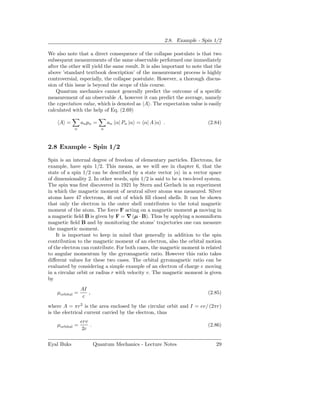
Eyal Buks            Quantum Mechanics - Lecture Notes                     28
2.8. Example - Spin 1/2

We also note that a direct consequence of the collapse postulate is that two
subsequent measurements of the same observable performed one immediately
after the other will yield the same result. It is also important to note that the
above ’standard textbook description’ of the measurement process is highly
controversial, especially, the collapse postulate. However, a thorough discus-
sion of this issue is beyond the scope of this course.
    Quantum mechanics cannot generally predict the outcome of a specific
measurement of an observable A, however it can predict the average, namely
the expectation value, which is denoted as A . The expectation value is easily
calculated with the help of Eq. (2.69)

     A =         an pn =        an α| Pn |α = α| A |α .                   (2.84)
            n               n


2.8 Example - Spin 1/2

Spin is an internal degree of freedom of elementary particles. Electrons, for
example, have spin 1/2. This means, as we will see in chapter 6, that the
state of a spin 1/2 can be described by a state vector |α in a vector space
of dimensionality 2. In other words, spin 1/2 is said to be a two-level system.
The spin was first discovered in 1921 by Stern and Gerlach in an experiment
in which the magnetic moment of neutral silver atoms was measured. Silver
atoms have 47 electrons, 46 out of which fill closed shells. It can be shown
that only the electron in the outer shell contributes to the total magnetic
moment of the atom. The force F acting on a magnetic moment µ moving in
a magnetic field B is given by F = ∇ (µ · B). Thus by applying a nonuniform
magnetic field B and by monitoring the atoms’ trajectories one can measure
the magnetic moment.
    It is important to keep in mind that generally in addition to the spin
contribution to the magnetic moment of an electron, also the orbital motion
of the electron can contribute. For both cases, the magnetic moment is related
to angular momentum by the gyromagnetic ratio. However this ratio takes
different values for these two cases. The orbital gyromagnetic ratio can be
evaluated by considering a simple example of an electron of charge e moving
in a circular orbit or radius r with velocity v. The magnetic moment is given
by
                 AI
    µorbital =      ,                                                     (2.85)
                  c
where A = πr2 is the area enclosed by the circular orbit and I = ev/ (2πr)
is the electrical current carried by the electron, thus
                 erv
    µorbital =       .                                                    (2.86)
                  2c


Eyal Buks                Quantum Mechanics - Lecture Notes                    29
Chapter 2. State Vectors and Operators

This result can be also written as
              µ
    µorbital = B L ,                                                    (2.87)

where L = me vr is the orbital angular momentum, and where
            e
    µB =                                                                (2.88)
           2me c
is the Bohr’s magneton constant. The proportionality factor µB / is the
orbital gyromagnetic ratio. In vector form and for a more general case of
orbital motion (not necessarily circular) the orbital gyromagnetic relation is
given by
                 µB
    µorbital =         L.                                               (2.89)

    On the other hand, as was first shown by Dirac, the gyromagnetic ratio
for the case of spin angular momentum takes twice this value
              2µB
    µspin =         S.                                                  (2.90)

Note that we follow here the convention of using the letter L for orbital
angular momentum and the letter S for spin angular momentum.
    The Stern-Gerlach apparatus allows measuring any component of the
magnetic moment vector. Alternatively, in view of relation (2.90), it can be
said that any component of the spin angular momentum S can be measured.
The experiment shows that the only two possible results of such a measure-
ment are + /2 and − /2. As we have seen above, one can construct a com-
plete orthonormal basis to the vector space made of eigenvectors of any given
observable. Choosing the observable Sz = S · ˆ for this purpose we construct
                                               z
a basis made of two vectors {|+; ˆ , |−; ˆ }. Both vectors are eigenvectors of
                                 z       z
Sz

    Sz |+; ˆ =
           z           |+; ˆ ,
                           z                                            (2.91)
                   2
    Sz |−; ˆ = − |−; ˆ .
           z           z                                                (2.92)
                 2
In what follow we will use the more compact notation
    |+ = |+; ˆ ,
             z                                                          (2.93)
    |− = |−; ˆ .
             z                                                          (2.94)
The orthonormality property implied that
     + |+ = − |− = 1 ,                                                  (2.95)
     − |+ = 0 .                                                         (2.96)
The closure relation in the present case is expressed as

Eyal Buks                Quantum Mechanics - Lecture Notes                 30
2.8. Example - Spin 1/2

    |+ +| + |− −| = 1 .                                                 (2.97)

In this basis any ket-vector |α can be written as

    |α = |+ + |α + |− − |α .                                            (2.98)

The closure relation (2.97) and Eqs. (2.91) and (2.92) yield

    Sz =       (|+ +| − |− −|)                                          (2.99)
           2
It is useful to define also the operators S+ and S−
    S+ = |+ −| ,                                                       (2.100)
    S− = |− +| .                                                       (2.101)
In chapter 6 we will see that the x and y components of S are given by

    Sx =       (|+ −| + |− +|) ,                                       (2.102)
           2
    Sy =     (−i |+ −| + i |− +|) .                                  (2.103)
           2
All these ket-vectors and operators have matrix representation, which for the
basis {|+; ˆ , |−; ˆ } is given by
           z       z
                1
    |+ =
       ˙             ,                                                 (2.104)
                0
                0
    |− =
       ˙             ,                                                 (2.105)
                1
                    01
    Sx =
       ˙                   ,                                           (2.106)
            2       10
                    0 −i
    Sy =
       ˙                       ,                                       (2.107)
            2       i 0
                    1 0
    Sz =
       ˙                       ,                                       (2.108)
            2       0 −1
                    01
    S+ =
       ˙                   ,                                           (2.109)
                    00
                    00
    S− =
       ˙                   .                                           (2.110)
                    10

Exercise 2.8.1. Given that the state vector of a spin 1/2 is |+; ˆ calculate
                                                                 z
(a) the expectation values Sx and Sz (b) the probability to obtain a value
of + /2 in a measurement of Sx .

Solution 2.8.1. (a) Using the matrix representation one has


Eyal Buks                  Quantum Mechanics - Lecture Notes               31
Chapter 2. State Vectors and Operators

                                            01       1
     Sx = +| Sx |+ =                   10                    =0,             (2.111)
                               2            10       0
                                            1 0          1
     Sz = +| Sz |+ =               10                            =       .   (2.112)
                               2            0 −1         0           2
(b) First, the eigenvectors of the operator Sx are found by solving the equa-
tion Sx |α = λ |α , which is done by diagonalization of the matrix represen-
tation of Sx . The relation Sx |α = λ |α for the two eigenvectors is written
in a matrix form as
                   1
                   √                   1
                                       √
             01     2                   2
                   1       =           1    ,                                (2.113)
        2    10    √
                    2
                               2       √
                                        2
                   1
                   √                     1
                                         √
            01      2                     2
                     1     =−              1     .                           (2.114)
    2       10    − √2             2    − √2

That is, in ket notation

    Sx |±; x = ± |±; x ,
           ˆ         ˆ                                                       (2.115)
                2
where the eigenvectors of Sx are given by
            1
    |±; x = √ (|+ ± |− ) .
        ˆ                                                                    (2.116)
             2
Using this result the probability p+ is easily calculated
                                                             2
                           1                                         1
    p+ = | + |+; x |2 = +| √ (|+ + |− )
                 ˆ                                               =     .     (2.117)
                            2                                        2


2.9 Unitary Operators

Unitary operators are useful for transforming from one orthonormal basis to
another.

Definition 2.9.1. An operator U is said to be unitary if U † = U −1 , namely
if U U † = U † U = 1.

   Consider two observables A and B, and two corresponding complete and
orthonormal bases of eigenvectors
    A |an = an |an , am |an = δ nm ,                     |an an | = 1 ,      (2.118)
                                                     n

    B |bn = bn |bn , bm |bn = δ nm ,                     |bn bn | = 1 .      (2.119)
                                                     n

The operator U, which is given by

Eyal Buks                Quantum Mechanics - Lecture Notes                       32
2.10. Trace

    U=             |bn an | ,                                                    (2.120)
           n

transforms each of the basis vector |an to the corresponding basis vector |bn

    U |an = |bn .                                                                (2.121)

It is easy to show that the operator U is unitary

    U †U =           |an bn |bm am | =              |an an | = 1 .               (2.122)
               n,m                             n
                                δnm

The matrix elements of U in the basis {|an } are given by

     an | U |am = an |bm ,                                                       (2.123)

and those of U † by

     an | U † |am = bn |am .

Consider a ket vector

    |α =            |an an |α ,                                                  (2.124)
               n

which can be represented as a column vector in the basis {|an }. The nth
element of such a column vector is an |α . The operator U can be employed
for finding the corresponding column vector representation of the same ket-
vector |α in the other basis {|bn }

     bn |α =              bn |am am |α =              an | U † |am am |α .       (2.125)
                     m                          m

Similarly, Given an operator X the relation between the matrix elements
 an | X |am in the basis {|an } to the matrix elements bn | X |bm in the
basis {|bn } is given by
     bn | X |bm =               bn |ak ak | X |al al |bm
                          k,l

                      =         an | U † |ak ak | X |al al | U |am .
                          k,l
                                                                                 (2.126)


2.10 Trace
Given an operator X and an orthonormal and complete basis {|an }, the
trace of X is given by

Eyal Buks                  Quantum Mechanics - Lecture Notes                         33
Chapter 2. State Vectors and Operators

    Tr (X) =              an | X |an .                               (2.127)
                   n

It is easy to show that Tr (X) is independent on basis, as is shown below:
    Tr (X) =              an | X |an
                   n

              =           an |bk bk | X |bl bl |an
                  n,k,l

              =           bl |an an |bk       bk | X |bl
                  n,k,l

              =           bl |bk bk | X |bl
                  k,l
                           δkl

              =           bk | X |bk .
                   k
                                                                     (2.128)
The proof of the following relation

    Tr (XY ) = Tr (Y X) ,                                            (2.129)

is left as an exercise.


2.11 Commutation Relation
The commutation relation of the operators A and B is defined as

    [A, B] = AB − BA .                                               (2.130)

As an example, the components Sx , Sy and Sz of the spin angular momentum
operator, satisfy the following commutation relations

    [Si , Sj ] = i εijk Sk ,                                         (2.131)

where
             
              0          i, j, k are not all different
    εijk   =   1 i, j, k is an even permutation of x, y, z           (2.132)
             
               −1 i, j, k is an odd permutation of x, y, z

is the Levi-Civita symbol. Equation (2.131) employs the Einstein’s conven-
tion, according to which if an index symbol appears twice in an expression,
it is to be summed over all its allowed values. Namely, the repeated index k
should be summed over the values x, y and z:

    εijk Sk = εijx Sx + εijy Sy + εijz Sz .                          (2.133)

Eyal Buks                  Quantum Mechanics - Lecture Notes                 34
2.12. Simultaneous Diagonalization of Commuting Operators

Moreover, the following relations hold
     2    2    2           1   2
    Sx = Sy = Sz =                 ,                                       (2.134)
                           4
                           3 2
    S2 = Sx + Sy + Sz =
          2    2    2
                                .                                  (2.135)
                           4
   The relations below, which are easy to prove using the above definition,
are very useful for evaluating commutation relations
        [F, G] = − [G, F ] ,                                               (2.136)
        [F, F ] = 0 ,                                                      (2.137)
    [E + F, G] = [E, G] + [F, G] ,                                         (2.138)
      [E, F G] = [E, F ] G + F [E, G] .                                    (2.139)


2.12 Simultaneous Diagonalization of Commuting
Operators

Consider an observable A having a set of eigenvalues {an }. Let gn be the
degree of degeneracy of eigenvalue an , namely gn is the dimension of the
corresponding eigensubspace, which is denoted by Fn . Thus the following
holds

    A |an,i = an |an,i ,                                                   (2.140)

where i = 1, 2, · · · , gn , and

     an′ ,i′ |an,i = δ nn′ δ ii′ .                                         (2.141)

The set of vectors {|an,1 , |an,2 , · · · , |an,gn } forms an orthonormal basis for
the eigensubspace Fn . The closure relation can be written as
                 gn
    1=                |an,i an,i | =       Pn ,                            (2.142)
           n i=1                       n

where
            gn
    Pn =          |an,i an,i | .                                           (2.143)
            i=1

   Now consider another observable B, which is assumed to commute with
A, namely [A, B] = 0.

Claim. The operator B has a block diagonal matrix in the basis {|an,i },
namely am,j | B |an,i = 0 for n = m.


Eyal Buks                 Quantum Mechanics - Lecture Notes                     35
Chapter 2. State Vectors and Operators

Proof. Multiplying Eq. (2.140) from the left by am,j | B yields

       am,j | BA |an,i = an am,j | B |an,i .                            (2.144)

On the other hand, since [A, B] = 0 one has

       am,j | BA |an,i = am,j | AB |an,i = am am,j | B |an,i ,          (2.145)

thus

    (an − am ) am,j | B |an,i = 0 .                                     (2.146)

    For a given n, the gn × gn matrix an,i′ | B |an,i is Hermitian, namely
                                   ∗
 an,i′ | B |an,i = an,i | B |an,i′ . Thus, there exists a unitary transformation
Un , which maps Fn onto Fn , and which diagonalizes the block of B in the
subspace Fn . Since Fn is an eigensubspace of A, the block matrix of A in the
new basis remains diagonal (with the eigenvalue an ). Thus, we conclude that
a complete and orthonormal basis of common eigenvectors of both operators
A and B exists. For such a basis, which is denoted as {|n, m }, the following
holds
    A |n, m = an |n, m ,                                                (2.147)
    B |n, m = bm |n, m .                                                (2.148)


2.13 Uncertainty Principle

Consider a quantum system in a state |n, m , which is a common eigenvector
of the commuting observables A and B. The outcome of a measurement of
the observable A is expected to be an with unity probability, and similarly,
the outcome of a measurement of the observable B is expected to be bm
with unity probability. In this case it is said that there is no uncertainty
corresponding to both of these measurements.

Definition 2.13.1. The variance in a measurement of a given observable A
of a quantum system in a state |α is given by (∆A)2 , where ∆A = A− A ,
namely

       (∆A)2 = A2 − 2A A + A           2
                                           = A2 − A    2
                                                           ,            (2.149)

where
        A = α| A |α ,                                                   (2.150)
       A2 = α| A2 |α .                                                  (2.151)


Eyal Buks             Quantum Mechanics - Lecture Notes                      36
2.13. Uncertainty Principle

Example 2.13.1. Consider a spin 1/2 system in a state |α = |+; ˆ . Using
                                                               z
Eqs. (2.99), (2.102) and (2.134) one finds that

     (∆Sz )2 = Sz − Sz
                2                 2
                                      =0,                                  (2.152)
                                          1
     (∆Sx )2 = Sx − Sx
                2                 2
                                      =       2
                                                  .                        (2.153)
                                          4
   The last example raises the question: can one find a state |α for which
the variance in the measurements of both Sz and Sx vanishes? According to
the uncertainty principle the answer is no.
Theorem 2.13.1. The uncertainty principle - Let A and B be two observ-
ables. For any ket-vector |α the following holds

            2                 1
     (∆A)       (∆B)2 ≥         | [A, B] |2 .                              (2.154)
                              4
Proof. Applying the Schwartz inequality [see Eq. (2.166)], which is given by

     u |u v |v ≥ | u |v |2 ,                                               (2.155)

for the ket-vectors
    |u = ∆A |α ,                                                           (2.156)
    |v = ∆B |α ,                                                           (2.157)
and exploiting the fact that (∆A)† = ∆A and (∆B)† = ∆B yield

     (∆A)2      (∆B)2 ≥ | ∆A∆B |2 .                                        (2.158)

The term ∆A∆B can be written as
                1           1
    ∆A∆B =        [∆A, ∆B] + [∆A, ∆B]+ ,                                   (2.159)
                2           2
where
     [∆A, ∆B] = ∆A∆B − ∆B∆A ,                                              (2.160)
    [∆A, ∆B]+ = ∆A∆B + ∆B∆A .                                              (2.161)
While the term [∆A, ∆B] is anti-Hermitian, whereas the term [∆A, ∆B]+ is
Hermitian, namely
  ([∆A, ∆B])† = (∆A∆B − ∆B∆A)† = ∆B∆A − ∆A∆B = − [∆A, ∆B] ,
                †
  [∆A, ∆B]+         = (∆A∆B + ∆B∆A)† = ∆B∆A + ∆A∆B = [∆A, ∆B]+ .
In general, the following holds

                          ∗            α| X |α ∗     if X is Hermitian
    α| X |α = α| X † |α       =                                          , (2.162)
                                      − α| X |α ∗ if X is anti-Hermitian

Eyal Buks             Quantum Mechanics - Lecture Notes                        37
Chapter 2. State Vectors and Operators

thus
                   1           1
       ∆A∆B =        [∆A, ∆B] + [∆A, ∆B]+ ,                            (2.163)
                   2           2
                         ∈I                  ∈R

and consequently
                     1                 1                       2
    | ∆A∆B |2 =        | [∆A, ∆B] |2 +           [∆A, ∆B]+         .   (2.164)
                     4                 4
Finally, with the help of the identity [∆A, ∆B] = [A, B] one finds that
              2                1
       (∆A)       (∆B)2 ≥        | [A, B] |2 .                         (2.165)
                               4


2.14 Problems
 1. Derive the Schwartz inequality

        | u |v | ≤      u |u      v |v ,                               (2.166)

    where |u and |v are any two vectors of a vector space F.
 2. Derive the triangle inequality:

            ( u| + v|) (|u + |v ) ≤        u |u +     v |v .           (2.167)

 3. Show that if a unitary operator U can be written in the form U = 1+iǫF ,
    where ǫ is a real infinitesimally small number, then the operator F is
    Hermitian.
 4. A Hermitian operator A is said to be positive-definite if, for any vector
    |u , u| A |u ≥ 0. Show that the operator A = |a a| is Hermitian and
    positive-definite.
 5. Show that if A is a Hermitian positive-definite operator then the following
    hold

        | u| A |v | ≤     u| A |u      v| A |v .                       (2.168)

 6. Find the expansion of the operator (A − λB)−1 in a power series in λ ,
    assuming that the inverse A−1 of A exists.
 7. The derivative of an operator A (λ) which depends explicitly on a para-
    meter λ is defined to be
         dA (λ)       A (λ + ǫ) − A (λ)
                = lim                   .                              (2.169)
          dλ      ǫ→0         ǫ
    Show that
          d        dA     dB
            (AB) =    B+A    .                                         (2.170)
         dλ        dλ     dλ

Eyal Buks            Quantum Mechanics - Lecture Notes                     38
2.14. Problems

 8. Show that
         d            dA −1
           A−1 = −A−1    A .                                                 (2.171)
        dλ            dλ
 9. Let |u and |v be two vectors of finite norm. Show that

        Tr (|u v|) = v |u .                                                  (2.172)

10. If A is any linear operator, show that A† A is a positive-definite Her-
    mitian operator whose trace is equal to the sum of the square moduli of
    the matrix elements of A in any arbitrary representation. Deduce that
    Tr A† A = 0 is true if and only if A = 0.
11. Show that if A and B are two positive-definite observables, then Tr (AB) ≥
    0.
12. Show that for any two operators A and L
                                  1               1
       eL Ae−L = A + [L, A] +        [L, [L, A]] + [L, [L, [L, A]]] + · · · . (2.173)
                                  2!              3!
13. Show that if A and B are two operators satisfying the relation [[A, B] , A] =
    0 , then the relation

        [Am , B] = mAm−1 [A, B]                                              (2.174)

    holds for all positive integers m .
14. Show that

        eA eB = eA+B e(1/2)[A,B] ,                                           (2.175)

    provided that [[A, B] , A] = 0 and [[A, B] , B] = 0.
15. Proof Kondo’s identity
                             β
             −βH       −βH
         A, e      =e            eλH [H, A] e−λH dλ ,                        (2.176)
                             0

    where A and H are any two operators and β is real.
16. Show that Tr (XY ) = Tr (Y X).
17. Consider the two normalized spin 1/2 states |α and |β . The operator
    A is defined as

        A = |α α| − |β β| .                                                  (2.177)

    Find the eigenvalues of the operator A.
18. A molecule is composed of six identical atoms A1 , A2 , . . . , A6 which
    form a regular hexagon. Consider an electron, which can be localized on
    each of the atoms. Let |ϕn be the state in which it is localized on the
    nth atom (n = 1, 2, · · · , 6). The electron states will be confined to the

Eyal Buks           Quantum Mechanics - Lecture Notes                             39
Chapter 2. State Vectors and Operators

   space spanned by the states |ϕn , which is assumed to be orthonormal.
   The Hamiltonian of the system is given by

          H = H0 + W .                                                         (2.178)

   The eigenstates of H0 are the six states |ϕn , with the same eigenvalue
   E0 . The operator W is described by
          W |ϕ1 = −a |ϕ2 − a |ϕ6 ,
          W |ϕ2 = −a |ϕ3 − a |ϕ1 ,
                  .
                  .
                  .
          W |ϕ6 = −a |ϕ1 − a |ϕ5 .
                                                                               (2.179)
   Find the eigenvalues and eigen vectors of H. Clue: Consider a solution of
   the form
                  6
          |k =         eikn |ϕn .                                              (2.180)
                 n=1


2.15 Solutions

 1. Let

          |γ = |u + λ |v ,                                                     (2.181)

   where λ ∈ C. The requirement γ |γ ≥ 0 leads to

          u |u + λ u |v + λ∗ v |u + |λ|2 v |v ≥ 0 .                            (2.182)

   By choosing

                  v |u
          λ=−          ,                                                       (2.183)
                  v |v

   one has
                                                              2
                       v |u            u |v            v |u
          u |u −              u |v −          v |u +              v |v ≥ 0 ,   (2.184)
                       v |v            v |v            v |v

   thus

          | u |v | ≤      u |u      v |v .                                     (2.185)


Eyal Buks                Quantum Mechanics - Lecture Notes                         40
2.15. Solutions

 2. The following holds
          ( u| + v|) (|u + |v ) = u |u + v |v + 2 Re ( u |v )
                                ≤ u |u + v |v + 2 | u |v | .
                                                                                   (2.186)
   Thus, using Schwartz inequality one has
          ( u| + v|) (|u + |v ) ≤ u |u + v |v + 2               u |u     v |v
                                                                2
                                    =      u |u +        v |v       .
                                                                                   (2.187)
 3. Since
       1 = U † U = 1 − iǫF † (1 + iǫF ) = 1 + iǫ F − F † + O ǫ2 , (2.188)
    one has F = F † .
                        †
 4. In general, (|β α|) = |α β|, thus clearly the operator A is Hermitian.
    Moreover it is positive-definite since for every |u the following holds
          u| A |u = u |a a |u = | a |u |2 ≥ 0 .                                    (2.189)
 5. Let
                          v| A |u
          |γ = |u −               |v .
                          v| A |v
   Since A is Hermitian and positive-definite the following holds
          0 ≤ γ| A |γ
                          u| A |v                     v| A |u
            =    u| −               v| A |u −                 |v
                          v| A |v                     v| A |v
                             | u| A |v |2 | u| A |v |2 | u| A |v |2
            = u| A |u −                  −            +             ,
                               v| A |v      v| A |v      v| A |v
                                                                                   (2.190)
   thus
          | u| A |v | ≤      u| A |u     v| A |v .                                 (2.191)
    Note that this result allows easy proof of the following: Under the same
    conditions (namely, A is a Hermitian positive-definite operator) Tr (A) =
    0 if and only if A = 0.
 6. The expansion is given by
                                                −1
          (A − λB)−1 = A 1 − λA−1 B
                                           −1
                          = 1 − λA−1 B          A−1
                                                          2              3
                          = 1 + λA−1 B + λA−1 B               + λA−1 B       + · · · A−1 .
                                                                                   (2.192)


Eyal Buks               Quantum Mechanics - Lecture Notes                               41
Chapter 2. State Vectors and Operators

 7. By definition:
     d            A (λ + ǫ) B (λ + ǫ) − A (λ) B (λ)
       (AB) = lim
    dλ        ǫ→0                 ǫ
                  (A (λ + ǫ) − A (λ)) B (λ)       A (λ + ǫ) (B (λ + ǫ) − B (λ))
            = lim                           + lim
              ǫ→0             ǫ               ǫ→0               ǫ
              dA        dB
            =     B+A       .
               dλ       dλ
                                                                        (2.193)
 8. Taking the derivative of both sides of the identity 1 = AA−1 on has
                   dA −1   dA−1
        0=            A +A      ,                                                      (2.194)
                   dλ       dλ
    thus
            d            dA −1
              A−1 = −A−1    A .                                                        (2.195)
           dλ            dλ
 9. Let {|n } be a complete orthonormal basis, namely

                   |n n| = 1 .                                                         (2.196)
           n

    In this basis

      Tr (|u v|) =                   n |u v |n = v|                 |n n| |u = v |u . (2.197)
                            n                                   n

                                                                         †
10. The operator A† A is Hermitian since A† A = A† A, and positive-
    definite since the norm of A |u is nonnegative for every |u , thus one
    has u| A† A |u ≥ 0. Moreover, using a complete orthonormal basis {|n }
    one has
        Tr A† A =                     n| A† A |n
                                 n

                        =             n| A† |m m| A |n
                            n,m

                        =            | m| A |n |2 .
                            n,m
                                                                                       (2.198)
               ′
11. Let {|b } be a complete orthonormal basis made of eigenvectors of B
    (i.e., B |b′ = b′ |b′ ). Using this basis for evaluating the trace one has

        Tr (AB) =                    b′ | AB |b′ =         b′ b′ | A |b′ ≥ 0 .         (2.199)
                            b′                        b′   ≥0       ≥0


Eyal Buks                 Quantum Mechanics - Lecture Notes                                42
2.15. Solutions

12. Let f (s) = esL Ae−sL , where s is real. Using Taylor expansion one has

                          1 df              1 d2 f
        f (1) = f (0) +                 +                  +··· ,            (2.200)
                          1! ds   s=0       2! ds2   s=0

    thus
                          1 df              1 d2 f
        eL Ae−L = A +                   +                  +··· ,            (2.201)
                          1! ds   s=0       2! ds2   s=0

    where
         df
            = LesL Ae−sL − esL Ae−sL L = [L, f (s)] ,                        (2.202)
         ds
       d2 f      df
          2
            = L,      = [L, [L, f (s)]] ,                                    (2.203)
        ds        ds
    therefore
                                  1               1
       eL Ae−L = A + [L, A] +        [L, [L, A]] + [L, [L, [L, A]]] + · · · . (2.204)
                                  2!              3!
13. The identity clearly holds for the case m = 1. Moreover, assuming it
    holds for m, namely assuming that

        [Am , B] = mAm−1 [A, B] ,                                            (2.205)

    one has
           Am+1 , B = A [Am , B] + [A, B] Am
                    = mAm [A, B] + [A, B] Am .
                                                                             (2.206)
    It is easy to show that if [[A, B] , A] = 0 then [[A, B] , Am ] = 0, thus one
    concludes that

           Am+1 , B = (m + 1) Am [A, B] .                                    (2.207)

14. Define the function f (s) = esA esB , where s is real. The following holds
           df
              = AesA esB + esA BesB
           ds
              = A + esA Be−sA esA esB


    Using Eq. (2.174) one has


Eyal Buks           Quantum Mechanics - Lecture Notes                             43
Chapter 2. State Vectors and Operators
                       ∞
           sA            (sA)m
        e       B=             B
                     m=0
                           m!
                       ∞
                         sm (BAm + [Am , B])
                 =
                     m=0
                                m!
                       ∞
                         sm BAm + mAm−1 [A, B]
                 =
                     m=0
                                  m!
                                    ∞            m−1
                                       (sA)
                 = BesA + s                     [A, B]
                                   m=1
                                       (m − 1)!
                 = BesA + sesA [A, B] ,
                                                                        (2.208)
    thus
           df
              = AesA esB + BesA esB + sesA [A, B] esB
           ds
              = (A + B + [A, B] s) f (s) .
                                                                        (2.209)
    The above differential equation can be easily integrated since [[A, B] , A] =
    0 and [[A, B] , B] = 0. Thus
                                        s2
        f (s) = e(A+B)s e[A,B]           2   .                          (2.210)

    For s = 1 one gets

        eA eB = eA+B e(1/2)[A,B] .                                      (2.211)

15. Define
        f (β) ≡ A, e−βH ,                                               (2.212)
                              β
                     −βH
           g (β) ≡ e              eλH [H, A] e−λH dλ .                  (2.213)
                             0

    Clearly, f (0) = g (0) = 0 . Moreover, the following holds
           df
              = −AHe−βH + He−βH A = −Hf + [H, A] e−βH ,                 (2.214)
           dβ
           dg
              = −Hg + [H, A] e−βH ,                                     (2.215)
           dβ
    namely, both functions satisfy the same differential equation. Therefore
    f = g.
16. Using a complete orthonormal basis {|n } one has


Eyal Buks                  Quantum Mechanics - Lecture Notes                 44
2.15. Solutions

          Tr (XY ) =         n| XY |n
                       n

                   =         n| X |m m| Y |n
                       n,m

                   =         m| Y |n n| X |m
                       n,m

                   =         m| Y X |m
                       m
                   = Tr (Y X) .
                                                                      (2.216)
                                                             +
    Note that using this result it is easy to show that Tr (U XU ) = Tr (X)
    , provided that U is a unitary operator.
17. Clearly A is Hermitian, namely A† = A, thus the two eigenvalues λ1
    and λ2 are expected to be real. Since the trace of an operator is basis
    independent, the following must hold

          Tr (A) = λ1 + λ2 ,                                          (2.217)

    and

          Tr A2 = λ2 + λ2 .
                   1    2                                             (2.218)

    On the other hand, with the help of Eq. (2.172) one finds that

          Tr (A) = Tr (|α α|) − Tr (|β β|) = 0 ,                      (2.219)

    and
    Tr A2 = Tr (|α α |α α|) + Tr (|β β |β β|) − Tr (|α α |β β|) − Tr (|β β |α α|)
          = 2 − α |β Tr (|α β|) − β |α Tr (|β α|)
              = 2 1 − | α |β |2 ,
                                                                                 (2.220)
    thus

          λ± = ± 1 − | α |β |2 .                                      (2.221)

    Alternatively, this problem can also be solved as follows. In general, the
    state |β can be decomposed into a parallel to and a perpendicular to |α
    terms, namely

          |β = a |α + c |γ ,                                          (2.222)

    where a, c ∈ C, the vector |γ is orthogonal to |α , namely γ |α = 0, and
    in addition |γ is assumed to be normalized, namely γ |γ = 1. Since |β

Eyal Buks              Quantum Mechanics - Lecture Notes                   45
Chapter 2. State Vectors and Operators

    is normalized one has |a|2 + |c|2 = 1. The matrix representation of A in
    the orthonormal basis {|α , |γ } is given by
                                                      2
                 α| A |α      α| A |γ              |c| −ac∗        ˆ
          A=
           ˙                                 =                    ≡A.            (2.223)
                 γ| A |α      γ| A |γ              −a∗ c − |c|2

    Thus,

             ˆ
          Tr A = 0 ,                                                             (2.224)

    and

          Det A = − |c|2 |c|2 + |a|2 = − 1 − | α |β |2
              ˆ                                                         ,        (2.225)

    therefore the eigenvalues are

          λ± = ± 1 − | α |β |2 .                                                 (2.226)

18. Following the clue, we seek a solution to the eigenvalue equation

          H |k = Em |k ,                                                         (2.227)

    where
                  6
          |k =         eikn |ϕn .                                                (2.228)
                 n=1

    thus
                                  6
         H |k = E0 |k − a             eikn       ϕ(n−1)′ + ϕ(n+1)′      = E |k , (2.229)
                                n=1

    where n′ is the modulus of n divided by 6 (e.g., 1′ = 1, 0′ = 6, 7′ = 1).
    A solution is obtained if

          e6ik = 1 ,                                                             (2.230)

    or
                 mπ
          km =      ,                                                            (2.231)
                  3
    where m = 1, 2, · · · , 6. The corresponding eigen vectors are denoted as
                      6
          |km =           eikm n |ϕn ,                                           (2.232)
                  n=1

    and the following holds

Eyal Buks                 Quantum Mechanics - Lecture Notes                          46
2.15. Solutions

                               6                                   6
   H |km = E0 |km − aeikm           eikm (n−1) ϕ(n−1)′ − ae−ikm         eikm (n+1) ϕ(n+1)′
                              n=1                                 n=1
            = (E0 − 2a cos km ) |km ,
                                                                                    (2.233)
   thus

       H |km = Em |k ,                                                    (2.234)

   where

       Em = E0 − 2a cos km .                                              (2.235)


Eyal Buks           Quantum Mechanics - Lecture Notes                          47
3. The Position and Momentum Observables


Consider a point particle moving in a 3 dimensional space. We first treat
the system classically. The position of the particle is described using the
Cartesian coordinates qx , qy and qz . Let
           ∂L
    pj =                                                                    (3.1)
           ∂ qj
             ˙
be the canonically conjugate variable to the coordinate qj , where j ∈ {x, y, z}
and where L is the Lagrangian. As we have seen in exercise 4 of set 1, the
following Poisson’s brackets relations hold
    {qj , qk } = 0 ,                                                        (3.2)
    {pj , pk } = 0 ,                                                        (3.3)
    {qj , pk } = δ jk .                                                     (3.4)
    In quantum mechanics, each of the 6 variables qx , qy , qz , px , py and pz is
represented by an Hermitian operator, namely by an observable. It is postu-
lated that the commutation relations between each pair of these observables
is related to the corresponding Poisson’s brackets according to the rule
              1
    {, } →      [, ] .                                                      (3.5)
             i
Namely the following is postulated to hold
    [qj , qk ] = 0 ,                                                        (3.6)
    [pj , pk ] = 0 ,                                                        (3.7)
    [qj , pk ] = i δ jk .                                                   (3.8)
Note that here we use the same notation for a classical variable and its
quantum observable counterpart. In this chapter we will derive some results
that are solely based on Eqs. (3.6), (3.7) and (3.8).


3.1 The One Dimensional Case
In this section, which deals with the relatively simple case of a one dimen-
sional motion of a point particle, we employ the less cumbersome notation
Chapter 3. The Position and Momentum Observables

x and p for the observables qx and px . The commutation relation between
these operators is given by [see Eq. (3.8)]

    [x, p] = i .                                                         (3.9)

The uncertainty principle (2.154) employed for x and p yields
                                 2
            2
     (∆x)       (∆px )2 ≥            .                                 (3.10)
                                 4

3.1.1 Position Representation

Let x′ be an eigenvalue of the observable x, and let |x′ be the corresponding
eigenvector, namely

    x |x′ = x′ |x′ .                                                   (3.11)

Note that x′ ∈ R since x is Hermitian. As we will see below transformation
between different eigenvectors |x′ can be performed using the translation
operator J (∆x ).

Definition 3.1.1. The translation operator is given by

                         i∆x p
    J (∆x ) = exp −                  ,                                 (3.12)

where ∆x ∈ R.

   Recall that in general the meaning of a function of an operator can be
understood in terms of the Taylor expansion of the function, that is, for the
present case
                ∞                        n
                    1        i∆x p
    J (∆x ) =            −                   .                         (3.13)
                n=0
                    n!

It is easy to show that J (∆x ) is unitary

    J † (∆x ) = J (−∆x ) = J −1 (∆x ) .                                (3.14)

Moreover, the following composition property holds

    J (∆x1 ) J (∆x2 ) = J (∆x1 + ∆x2 ) .                               (3.15)

Theorem 3.1.1. Let x′ be an eigenvalue of the observable x, and let |x′ be
the corresponding eigenvector. Then the ket-vector J (∆x ) |x′ is a normalized
eigenvector of x with an eigenvalue x′ + ∆x .


Eyal Buks            Quantum Mechanics - Lecture Notes                     50
3.1. The One Dimensional Case

Proof. With the help of Eq. (3.77), which is given by
                     dB
    [x, B (p)] = i      ,                                                          (3.16)
                     dp
and which is proven in exercise 1 of set 3, one finds that
                         ∆x
    [x, J (∆x )] = i        J (∆x ) .                                              (3.17)
                         i
Using this result one has

 xJ (∆x ) |x′ = ([x, J (∆x )] + J (∆x ) x) |x′ = (x′ + ∆x ) J (∆x ) |x′ , (3.18)

thus the ket-vector J (∆x ) |x′ is an eigenvector of x with an eigenvalue x′ +
∆x . Moreover, J (∆x ) |x′ is normalized since J is unitary.
   In view of the above theorem we will in what follows employ the notation

    J (∆x ) |x′ = |x′ + ∆x .                                                       (3.19)

An important consequence of the last result is that the spectrum of eigenval-
ues of the operator x is continuous and contains all real numbers. This point
will be further discussed below.
    The position wavefunction ψα (x′ ) of a state vector |α is defined as:

    ψα (x′ ) = x′ |α .                                                             (3.20)

Given the wavefunction ψα (x′ ) of state vector |α , what is the wavefunction
of the state O |α , where O is an operator? We will answer this question below
for some cases:
 1. The operator O = x. In this case

         x′ | x |α = x′ x′ |α = x′ ψα (x′ ) ,                                      (3.21)

    namely, the desired wavefunction is obtained by multiplying ψα (x′ ) by
    x′ .
 2. The operator O is a function A (x) of the operator x. Let

        A (x) =          an xn .                                                   (3.22)
                     n

    be the Taylor expansion of A (x). Exploiting the fact that x is Hermitian
    one finds that

         x′ | A (x) |α =           an x′ | xn |α =       an x′n x′ |α = A (x′ ) ψα (x′ ) .
                             n                       n
                                     x′n x′ |
                                                                                   (3.23)


Eyal Buks                Quantum Mechanics - Lecture Notes                             51
Chapter 3. The Position and Momentum Observables

 3. The operator O = J (∆x ). In this case

           x′ | J (∆x ) |α = x′ | J † (−∆x ) |α = x′ − ∆x |α = ψα (x′ − ∆x ) .
                                                                         (3.24)

 4. The operator O = p. In view of Eq. (3.12), the following holds

                             ip∆x                   i∆x
        J (−∆x ) = exp                 =1+                p + O (∆x )2    ,         (3.25)

    thus
                                               i∆x
           x′ | J (−∆x ) |α = ψα (x′ ) +                 x′ | p |α + O (∆x )2   .   (3.26)

    On the other hand, according to Eq. (3.24) also the following holds

           x′ | J (−∆x ) |α = ψα (x′ + ∆x ) .                                       (3.27)

    Equating the above two expressions for x′ | J (−∆x ) |α yields

                            ψα (x′ + ∆x ) − ψα (x′ )
           x′ | p |α = −i                            + O (∆x ) .                    (3.28)
                                     ∆x
    Thus, in the limit ∆x → 0 one has
                            dψα
           x′ | p |α = −i       .                                                   (3.29)
                            dx′
   To mathematically understand the last result, consider the differential
operator

    ˜                  d
    J (−∆x ) = exp ∆x
                      dx
                                                     2
                             d   1              d
               = 1 + ∆x        +       ∆x                +··· .
                            dx 2!              dx
                                                                                    (3.30)
In view of the Taylor expansion of an arbitrary function f (x)
                                     df   (∆x )2 d2 f
    f (x0 + ∆x ) = f (x0 ) + ∆x         +             +···
                                     dx     2! dx2
                                 d
                  = exp ∆x             f
                                dx         x=x0
                    ˜
                  = J (−∆x ) f             ,
                                    x=x0
                                                                                    (3.31)
                                ˜
one can argue that the operator J (−∆x ) generates translation.

Eyal Buks             Quantum Mechanics - Lecture Notes                                52
3.1. The One Dimensional Case

    As we have pointed out above, the spectrum (i.e., the set of all eigen-
values) of x is continuous. On the other hand, in the discussion in chapter
2 only the case of an observable having discrete spectrum has been consid-
ered. Rigorous mathematical treatment of the case of continuous spectrum
is nontrivial mainly because typically the eigenvectors in such a case cannot
be normalized. However, under some conditions one can generalize some of
the results given in chapter 2 for the case of an observable having a continu-
ous spectrum. These generalization is demonstrated below for the case of the
position operator x:
 1. The closure relation (2.23) is written in terms of the eigenvectors |x′ as
         ∞

             dx′ |x′ x′ | = 1 ,                                                                        (3.32)
       −∞

    namely, the discrete sum is replaced by an integral.
 2. With the help of Eq. (3.32) an arbitrary ket-vector can be written as
                ∞                                    ∞
                         ′   ′     ′
        |α =        dx |x         x |α =                      dx′ ψα (x′ ) |x′ ,                       (3.33)
               −∞                                   −∞

    and the inner product between a ket-vector |α and a bra-vector β| as
                     ∞                                              ∞

         β |α =              ′
                         dx β |x       ′        ′
                                                x |α =                      dx′ ψ ∗ (x′ ) ψα (x′ ) .
                                                                                  β                    (3.34)
                    −∞                                             −∞

 3. The normalization condition reads
                             ∞
                                                          2
        1 = α |α =               dx′ |ψα (x′ )| .                                                      (3.35)
                          −∞

 4. The orthonormality relation (2.64) is written in the present case as

         x′′ |x′ = δ (x′ − x′′ ) .                                                                     (3.36)

    Note that the above orthonormality relation (3.36) is consistent with
    the closure relation (3.32). This can be seen by evaluating the operator
    12 = 1 × 1 using Eqs. (3.32) and (3.36)
                ∞            ∞                                                   ∞
         2           ′            ′′       ′′        ′′        ′        ′
        1 =         dx           dx |x              x |x            x|=              dx′ |x′ x′ | ,    (3.37)
              −∞         −∞                     δ(x′ −x′′ )                    −∞


    thus, as expected 12 = 1.

Eyal Buks                Quantum Mechanics - Lecture Notes                                                53
Chapter 3. The Position and Momentum Observables

 5. In a measurement of the observable x, the quantity
                                2                2
        f (x′ ) = | x′ |α | = |ψα (x′ )|                                     (3.38)

    represents the probability density to find the particle at the point x = x′ .
 6. That is, the probability to find the particle in the interval (x1 , x2 ) is given
    by
                          x2
        p(x1 ,x2 ) =           dx′ f (x′ ) .                                 (3.39)
                         x1

    This can be rewritten as

        p(x1 ,x2 ) = α| P(x1 ,x2 ) |α ,                                      (3.40)

    where the projection operator P(x1 ,x2 ) is given by
                          x2
        P(x1 ,x2 ) =           dx′ |x′ x′ | .                                (3.41)
                         x1

    The operator P(x1 ,x2 ) is considered to be a projection operator since for
    every x0 ∈ (x1 , x2 ) the following holds
                                 x2
        P(x1 ,x2 ) |x0 =              dx′ |x′ x′ |x0 = |x0 .                 (3.42)
                                x1
                                               δ(x′ −x0 )

 7. Any realistic measurement of a continuous variable such as position is
    subjected to finite resolution. Assuming that a particle has been mea-
    sured to be located in the interval (x′ − δ x /2, x′ + δ x /2), where δ x is the
    resolution of the measuring device, the collapse postulate implies that
    the state of the system undergoes the following transformation
                       P(x′ −δx /2,x′ +δx /2) |α
        |α →                                        .                        (3.43)
                       α| P(x′ −δx /2,x′ +δx /2) |α
 8. Some observables have a mixed spectrum containing both a discrete and
    continuous subsets. An example of such a mixed spectrum is the set of
    eigenvalues of the Hamiltonian operator of a potential well of finite depth.

3.1.2 Momentum Representation

Let p′ be an eigenvalue of the observable p, and let |p′ be the corresponding
eigenvector, namely

    p |p′ = p′ |p .                                                          (3.44)

Note that p′ ∈ R since p is Hermitian. Similarly to the case of the position
observable, the closure relation is written as

Eyal Buks                Quantum Mechanics - Lecture Notes                       54
3.2. Transformation Function

      dp′ |p′ p′ | = 1 ,                                                                        (3.45)

and the orthonormality relation as

    p′′ |p′ = δ (p′ − p′′ ) .                                                                   (3.46)

   The momentum wavefunction φα (p′ ) of a given state |α is defined as

    φα (p′ ) = p′ |α .                                                                          (3.47)

The probability density to measure a momentum value of p = p′ is
            2                        2
    |φα (p′ )| = | p′ |α | .                                                                    (3.48)

Any ket-vector can be decomposed into momentum eigenstates as
            ∞                                         ∞
                    ′    ′       ′
    |α =        dp |p          p |α =                     dp′ φα (p′ ) |p′ .                    (3.49)
           −∞                                       −∞

The inner product between a ket-vector |α and a bra-vector β| can be
expressed as
                ∞                                              ∞

    β |α =                ′
                        dp β |p          ′      ′
                                              p |α =               dp′ φ∗ (p′ ) φα (p′ ) .
                                                                        β                       (3.50)
             −∞                                               −∞

The normalization condition reads
                         ∞
                                                      2
    1 = α |α =                 dp′ |φα (p′ )| .                                                 (3.51)
                        −∞


3.2 Transformation Function

What is the relation between the position wavefunction ψα (x′ ) and its mo-
mentum counterpart φα (p′ )?

Claim. The transformation function x′ |p′ is given by

               1                             ip′ x′
    x′ |p′ = √   exp                                      .                                     (3.52)
              2π
Proof. On one hand, according to Eq. (3.44)

    x′ | p |p′ = p′ x′ |p′ ,                                                                    (3.53)


Eyal Buks                     Quantum Mechanics - Lecture Notes                                    55
Chapter 3. The Position and Momentum Observables

and on the other hand, according to Eq. (3.29)
                              ∂
       x′ | p |p′ = −i           x′ |p′ ,                                              (3.54)
                             ∂x′
thus
                              ∂
    p′ x′ |p′ = −i               x′ |p′ .                                              (3.55)
                             ∂x′
The general solution of this differential equation is
                                ip′ x′
       x′ |p′ = N exp                      ,                                           (3.56)

where N is a normalization constant. To determine the constant N we employ
Eqs. (3.36) and (3.45):
        δ (x′ − x′′ )
       = x′ |x′′
       =    dp′ x′ |p′ p′ |x′′
            ∞
                                   ip′ (x′ − x′′ )
       =        dp′ |N |2 exp
           −∞
                     ∞

                         dkeik(x −x ) .
                 2              ′  ′′
       = |N |
                  −∞

                         2πδ(x′ −x′′ )
                                                                                       (3.57)
Thus, by choosing N to be real one finds that
                  1                  ip′ x′
       x′ |p′ = √   exp                         .                                      (3.58)
                 2π
   The last result together with Eqs. (3.32) and (3.45) yield
                                                                ∞      ip′ x′
                                    ∞                            dp′ e    φα (p′ )
                                                              −∞
    ψα (x′ ) = x′ |α =                   dp′ x′ |p′   p′ |α =       √              ,   (3.59)
                                                                       2π
                                 −∞
                                                                ∞         ip′ x′
                                   ∞                             dx′ e−   ψα (x′ )
                                                              −∞
       φα (p′ ) = p′ |α =                dx′ p′ |x′   x′ |α =         √            . (3.60)
                                                                       2π
                                 −∞

That is, transformations relating ψα (x′ ) and φα (p′ ) are the direct and inverse
Fourier transformations.

Eyal Buks                   Quantum Mechanics - Lecture Notes                             56
3.3. Generalization for 3D

3.3 Generalization for 3D
According to Eq. (3.6) the observables qx , qy and qz commute with each
other, hence, a simultaneous diagonalization is possible. Denoting the com-
mon eigenvectors as

    |r′ = qx , qy , qz ,
           ′    ′    ′
                                                                          (3.61)

one has
    qx |r′ = qx qx , qy , qz ,
              ′  ′    ′    ′
                                                                          (3.62)
          ′        ′    ′    ′    ′
    qy |r =       qy   qx , qy , qz   ,                                   (3.63)
          ′        ′    ′    ′    ′
    qz |r =       qz   qx , qy , qz   .                                   (3.64)
The closure relation is written as
              ∞   ∞    ∞

    1=                     dx′ dy ′ dz ′ |r′ r′ | ,                       (3.65)
          −∞ −∞ −∞

and the orthonormality relation as

     r′ |r′′ = δ (r′ − r′′ ) .                                            (3.66)

   Similarly, according to Eq. (3.7) the observables px , py and pz commute
with each other, hence, a simultaneous diagonalization is possible. Denoting
the common eigenvectors as

    |p′ = p′ , p′ , p′ ,
           x y z                                                          (3.67)

one has
    px |p′ = p′ p′ , p′ , p′ ,
              x x y z                                                     (3.68)
          ′
    py |p =       p′
                   y   p′ , p′ , p′
                        x y z             ,                               (3.69)
          ′
    pz |p =       p′
                   z   px , p′ , p′
                        ′
                             y z          .                               (3.70)
The closure relation is written as
              ∞   ∞    ∞

    1=                     dp′ dp′ dp′ |p′ p′ | ,
                             x   y   z                                    (3.71)
          −∞ −∞ −∞

and the orthonormality relation as

     p′ |p′′ = δ (p′ − p′′ ) .                                            (3.72)

   The translation operator in three dimensions can be expressed as
                            i∆ · p
    J (∆) = exp −                             ,                           (3.73)


Eyal Buks                  Quantum Mechanics - Lecture Notes                 57
Chapter 3. The Position and Momentum Observables

where ∆ = (∆x , ∆y , ∆z ) ∈ R3 , and where

    J (∆) |r′ = |r′ + ∆ .                                              (3.74)

The generalization of Eq. (3.52) for three dimensions is

                     1              ip′ · r′
     r′ |p′ =                 exp                  .                   (3.75)
                (2π )3/2


3.4 Problems

 1. Show that
                        dA
        [p, A (x)] = −i     ,                                          (3.76)
                        dx
                       dB
        [x, B (p)] = i    ,                                            (3.77)
                       dp
    where A (x) is a differentiable function of x and B (p) is a differentiable
    function of p.
 2. Show that the mean value of x in a state described by the wavefunction
    ψ (x), namely
                +∞

         x =         dxψ∗ (x) xψ (x) ,                                 (3.78)
                −∞

    is equal to the value of a for which the expression
                  +∞

        F (a) ≡          dxψ∗ (x + a) x2 ψ (x + a)                     (3.79)
                  −∞

    obtains a minimum, and that this minimum has the value

        Fmin = (∆x)2 = x2 − x
                                           2
                                               .                       (3.80)

 3. Consider a Gaussian wave packet, whose x space wavefunction is given
    by

                          1          x′2
        ψα (x′ ) =       √ exp ikx′ − 2                .               (3.81)
                     π1/4 d          2d

    Calculate
     a) (∆x)2        (∆p)2
    b) p′ |α


Eyal Buks                Quantum Mechanics - Lecture Notes                58
3.4. Problems

 4. Show that the state |α with wave function
                     √
                   1/ 2a for |x| ≤ a
        x′ |α =                                                                 (3.82)
                      0 for |x| > a

    the uncertainty in momentum is infinity.
 5. Show that
                  ∞
                                 d
        p = −i        dx′ |x′       x′ | .                                      (3.83)
                                dx′
                 −∞

 6. Show that
           1                     ip′ · (r′ − r′′ )
                   d3 p′ exp                         = δ (r′ − r′′ ) .          (3.84)
        (2π )3

 7. Find eigenvectors and corresponding eigenvalues of the operator

        O = p + Kx ,                                                            (3.85)

    where K is a real constant, p is the momentum operator, which is the
    canonically conjugate to the position operator x. Calculate the wavefunc-
    tion of the eigenvectors.
 8. Let |α be the state vector of a point particle having mass m that moves
    in one dimension along the x axis. The operator pα is defined by the
    following requirements: (1) pα is Hermitian (i.e. p† = pα ) (2) [x, pα ] = 0
                                                       α
    (i.e. pα commutes with the position operator x) and (3)

         α| (p − pα )2 |α = min α| (p − O)2 |α ,                                (3.86)
                                O

    where p is the momentum operator (i.e. the minimum value of the quan-
    tity α| (p − O)2 |α is obtained when the operator O is chosen to be
    pα ).
     a) Calculate the matrix elements x′ | pα |x′′ of the operator pα in the
          position representation.
     b) The operator P is the difference between the ’true’ momentum op-
          erator and pα

            P = p − pα .                                                        (3.87)

        Calculate the variance (∆P)2 with respect to the state |α

              (∆P)2 = α| P 2 |α − α| P |α
                                                     2
                                                         .                      (3.88)


Eyal Buks             Quantum Mechanics - Lecture Notes                            59
Chapter 3. The Position and Momentum Observables

    c) Use your results to prove the uncertainty relation (3.10)
                                      2
             (∆x)2       (∆p)2 ≥          .                           (3.89)
                                     4
       where

             (∆x)2 = α| x2 |α − α| x |α           2
                                                      ,               (3.90)

       and where

             (∆p)2 = α| p2 |α − α| p |α           2
                                                      .               (3.91)


3.5 Solutions
 1. The commutator [x, p] = i is a constant, thus the relation (2.174) can
    be employed
                                          dxm
       [p, xm ] = −i mxm−1 = −i               ,                       (3.92)
                                           dx
                                      m
                                   dp
       [x, pm ] = i mpm−1 = i          .                              (3.93)
                                    dp
   This holds for any m, thus, for any differentiable function A (x) of x and
   for any differentiable function B (p) of p one has
                       dA
       [p, A (x)] = −i     ,                                          (3.94)
                       dx
                      dB
       [x, B (p)] = i    .                                            (3.95)
                      dp
 2. The following holds
                 +∞

       F (a) =        dxψ∗ (x + a) x2 ψ (x + a)
                 −∞
                 +∞
                                              2
             =        dx′ ψ∗ (x′ ) (x′ − a) ψ (x′)
                 −∞

             = (x − a)2
             = x2 − 2a x + a2 .
                                                                      (3.96)
   The requirement
        dF
           =0                                                         (3.97)
        da

Eyal Buks             Quantum Mechanics - Lecture Notes                  60
3.5. Solutions

   leads to −2 x + 2a = 0, or a = x . At that point one has
                      2                                     2
       Fmin = (x − x ) = x2 − x                                  .                   (3.98)

 3. The following hold
                    +∞

         x =              dx′ ψ∗ (x′ ) x′ ψα (x′ )
                               α
                    −∞
                                +∞
                      1                           x′2
                =                   dx′ exp −               x′
                    π1/2 d                        d2
                               −∞
                =0,
                                                                                     (3.99)

                     +∞

         x  2
                 =            dx′ ψ∗ (x′ ) x′2 ψα (x′ )
                                   α
                     −∞
                                   +∞
                          1                           x′2
                 =                    dx′ exp −              x′2
                     π1/2 d                           d2
                                −∞

                         d3 π1/2
                          1
                 =
                   π1/2 d 2
                   d2
                 =    ,
                   2
                                                                                    (3.100)

                              +∞
                                                dψα
         p = −i                  dx′ ψ∗ (x′ )
                                      α
                                                dx′
                         −∞
                                   +∞
                          i                           x′2               x′
                =−                      dx′ exp −                ik −
                     π1/2 d                           d2                d2
                                 −∞
                          i
                =−               ikdπ1/2
                  π1/2 d
                = k,
                                                                                    (3.101)


Eyal Buks                     Quantum Mechanics - Lecture Notes                         61
Chapter 3. The Position and Momentum Observables

                                 +∞
                             2                          d2 ψα
        p   2
                = (−i )                dx′ ψ∗ (x′ )
                                            α
                                                        dx′2
                             −∞
                                              +∞
                                                                                                   2
                             2     1                                 x′2                      x′           1
                = (−i )                           dx′ exp −                            ik −            −
                                 π1/2 d                              d2                       d2           d2
                                          −∞
                                   1              1      √ 2d4 k2 + d2
                = (−i )2                      −         d π
                                 π1/2 d           2             d4
                         2                    1
                = ( k)           1+                2    ,
                                        2 (dk)
                                                                                                             (3.102)
    a) thus

                                                   d2                              1                             2
                (∆x)2            (∆p)2 =                 ( k)2 1 +                     2      − ( k)2        =        .
                                                   2                         2 (dk)                              4
                                                                                                             (3.103)

    b) Using Eq. (3.60) one has
                       1               ip′ x′
           p′ |α = √         dx′ exp −                                       ψα (x′ )
                      2π
                                                        ∞
                             1     1                        ip′                                        x′2
                        = √          √    dx′ exp      ik −                                    x′ −
                             2π π1/4 d                                                                 2d2
                                       −∞
                             √
                               d        ( k − p′ )2 d2
                        =       √ exp −                   .
                          π 1/4             2 2
                                                                                                             (3.104)
 4. The momentum wavefunction is found using Eq. (3.60)
                                   ∞
                ′  1                                        ip′ x′
       φα (p ) = √                      dx′ exp −                          x′ |α
                  2π
                                 −∞
                                   a
                        1                                   ip′ x′
                    = √                  dx′ exp −
                       4πa
                                   −a
                                          ′
                          a sin ap
                    =         ap′
                                   .
                         π
                                                                                                             (3.105)
   The momentum wavefunction φα (p′ ) is normalizable, however, the inte-
   grals for evaluating both p and p2 do not converge.

Eyal Buks               Quantum Mechanics - Lecture Notes                                                            62
3.5. Solutions

 5. Using Eqs. (3.29) and (3.32) one has
                   ∞

        p |α =         dx′ |x′ x′ | p |α
                  −∞
                           ∞
                                          d
              = −i             dx′ |x′       x′ |α ,
                                         dx′
                       −∞
                                                                                    (3.106)
   thus, since |α is an arbitrary ket vector, the following holds
                   ∞
                                    d
        p = −i         dx′ |x′         x′ | .                                       (3.107)
                                   dx′
                  −∞

 6. With the help of Eqs. (3.66), (3.71) and (3.75) one finds that
        δ (r′ − r′′ ) = r′ |r′′
                       =       d3 p′ r′ |p′ p′ |r′′

                               1                     ip′ · (r′ − r′′ )
                       =                 d3 p′ exp                       .
                           (2π )3
                                                                                    (3.108)
 7. Using the identity (2.173), which is given by
                                         1               1
       eL Ae−L = A + [L, A] +               [L, [L, A]] + [L, [L, [L, A]]] + · · · . (3.109)
                                         2!              3!
   and the identity (3.76), which is given by
                           dg
        [g (x) , p] = i       ,                                                     (3.110)
                           dx
   one finds that

                                dg i          dg   i                  dg
   eg(x) pe−g(x) = A+i            +   g (x) ,    +    g (x) , g (x) ,               +· · · .
                                dx 2!         dx   3!                 dx
                                                                                    (3.111)

   Choosing g (x) to be given by

                  Kx2
        g (x) =                                                                     (3.112)
                  2i
   yields

        UpU † = A + Kx = O ,                                                        (3.113)

Eyal Buks              Quantum Mechanics - Lecture Notes                                 63
Chapter 3. The Position and Momentum Observables

   where the unitary operator U is given by
                  iKx2
       U = e−      2        .

   Thus, the vectors |ψ (p′ ) , which are define as

       |ψ (p′ ) = U |p′ ,                                                (3.114)

   where |p′ is an eigenvector of p with eigenvalue p′ (i.e. p |p′ = p′ |p′ ),
   are eigenvectors of O, and the following holds

       O |ψ (p′ ) = p′ |ψ (p′ ) .                                        (3.115)

   With the help of Eq. (3.52), which is given by
                         1    ip′ x′
        x′ |p′ = √          e        ,                                   (3.116)
                         2π
   one finds that the wavefunction ψ (x′ ; p′ ) = x′ |ψ (p′ ) of the state
   |ψ (p′ ) is given by
                                iKx′2
       ψ (x′ ; p′ ) = e−          2     x′ |p′
                          1   i                   ′2
                                         p′ x′ − Kx
                      = √   e                     2
                                                       .
                         2π
                                                                         (3.117)
 8. With the help of Eq. (3.32) one finds that
                  ∞             ∞

       pα =           dx′           dx′′ |x′ x′ | pα |x′′ x′′ | .        (3.118)
              −∞         −∞

   The requirement [x, pα ] = 0 implies that
         ∞         ∞
              ′
             dx        dx′′ |x′ x′ | pα |x′′ (x′ − x′′ ) x′′ | = 0 ,     (3.119)
       −∞         −∞

   hence x′ | pα |x′′ = 0 unless x′ = x′′ . Thus by using the notation

        x′ | pα |x′′ = φα (x′ ) δ (x′ − x′′ ) ,                          (3.120)

   the operator pα can be expressed as
                  ∞

       pα =           dx′ |x′ φα (x′ ) x′ | .                            (3.121)
              −∞

   The requirement that pα is Hermitian implies that φα (x′ ) is real.

Eyal Buks                Quantum Mechanics - Lecture Notes                   64
3.5. Solutions

    a) With the help of Eq. (3.83), which is given by
                          ∞
                                             d
            p = −i            dx′ |x′           x′ | ,                                       (3.122)
                                            dx′
                       −∞

       one finds that
                          ∞
                                                         d
            p − pα =           dx′ |x′             −i       − φα (x′ )      x′ | ,           (3.123)
                                                        dx′
                        −∞

       hence in terms of the wavefunction ψα (x′ ) = x′ |α of |α one has
                                    ∞
                                                               d
            (p − pα ) |α =                 dx′ |x′       −i       − φα (x′ ) ψα (x′ )
                                                              dx′
                                   −∞
                                    ∞
                                                                        d logψα
                               =           dx′ |x′ ψα (x′ ) −i                  − φα (x′ )     .
                                                                           dx′
                                   −∞
                                                                                             (3.124)
       Similarly
                                   ∞
                                                              d logψ∗
            α| (p − pα ) =             dx′ ψ∗ (x′ ) i
                                            α
                                                                     α
                                                                       − φ∗ (x′ )
                                                                          α            x′ | , (3.125)
                                                                 dx′
                               −∞

       and thus
              α| (p − pα )2 |α
                  ∞
                                                                    2
                                           d logψ α
             =        dx′ ρ (x′ ) i                 + φα (x′ )          .
                                              dx′
                 −∞
                                                                                             (3.126)
       where
                                       2
            ρ (x′ ) = |ψα (x′ )| .                                                           (3.127)

       The minimum value is obtained when (recall that φα (x′ ) is required
       to be real)
                         d logψα d logψ∗α
           φα (x′ ) =           −
                      2i    dx′     dx′
                               d log ψα
                                     ψ∗    α
                      =                        ,
                          2i       dx′
                                                                                             (3.128)
       and thus


Eyal Buks             Quantum Mechanics - Lecture Notes                                            65
Chapter 3. The Position and Momentum Observables

                                  d log ψα
                                        ψ∗
            x′ | pα |x′′ =                   α
                                                 δ (x′ − x′′ ) .                       (3.129)
                             2i        dx′
       Note: Comparing this result with the expression for the current den-
       sity J associated with the state |α [see Eq. (4.174)] yields the fol-
       lowing relation
                             dψα
            J=     Im ψ∗   α
                m             dx′
                    ′
                ρ (x )       d logψα d logψ∗ α
              =                      −
                  m 2i          dx′     dx′
                ρ (x′ )
              =         φ (x′ ) .
                  m α
                                                                    (3.130)
    b) As can be seen from Eqs. (3.123) and (3.128) the following holds
                    ∞
                                                   
                                                 ψα
                                     d   1 d log ψ∗  ′
            P =i        dx′ |x′ − ′ +            α
                                                      x| ,          (3.131)
                                    dx   2 dx′
                  −∞

       hence                  ∞
                                                    dψα 1               dψα dψ∗
            α| P |α = i            dx′ −ψ∗
                                         α              +          ψ∗
                                                                    α       −   α
                                                                                  ψ
                                                    dx′   2             dx′   dx′ α
                             −∞
                                   ∞
                        i                             dψα dψ∗
                     =−                 dx′ ψ∗
                                             α            +   α
                                                                ψ
                         2                            dx′   dx′ α
                                  −∞
                                   ∞
                             i                dρ (x′ )
                     =−                 dx′
                              2                dx′
                                  −∞
                     =0,
                                                                                       (3.132)
       thus [see Eqs. (3.126) and (3.128)]
             (∆P)2 = α| P 2 |α
                                        ∞
                                   2                                               2
                                                           d logψα d logψ∗α
                      =                      dx′ ρ (x′ )          +
                             2                                dx′     dx′
                                    −∞
                                     ∞
                                   2                                       2
                                                            d logρ (x′ )
                      =                      dx′ ρ (x′ )                       .
                             2                                  dx′
                                    −∞
                                                                    (3.133)
       Note that the result α| P |α = 0 implies that pα and p have the
       same expectation value, i.e. α| pα |α = α| p |α . On the other hand,


Eyal Buks          Quantum Mechanics - Lecture Notes                                       66
3.5. Solutions

       contrary to p, the operator pα commutes with the position operator
       x.
    c) Using the relation α| pα |α = α| p |α one finds that
        (∆p)2 − (∆pα )2 = α| p2 |α − α| p2 |α α

                                             = α| (p − pα )2 |α + α| ppα + pα p − 2p2 |α
                                                                                    α
                            = α| P 2 |α + α| ppα + pα p − 2p2 |α .
                                                            α
                                                                (3.134)
       As can be see from Eq. (3.128), the following holds
                       ∞
                                                    d logψα
            pα =               dx′ |x′ Im                          x′ | ,                        (3.135)
                                                       dx′
                      −∞

       thus
           α| ppα + pα p − 2p2 |α
                              α
                       α|p x′                      x′ |p|α
                                                                                    
              ∞             |
                          ψ∗    +                    ψα                     d logψα             d logψα
        = 2     dx′ ρ     α
                                                                − 2 Im                Im
                                                                               dx′                  dx′
             −∞
       =0,
                                                                                                   (3.136)
       and therefore
            (∆p)2 = α| P 2 |α + (∆pα )2
                           ≥ α| P 2 |α
                                              ∞
                                         2                                        2
                                                                 d logρ (x′ )
                           =                      dx′ ρ (x′ )                         .
                                 2                                   dx′
                                         −∞
                                                                     (3.137)
       For general real functions f (x′ ) , g (x′ ) : R → R the Schwartz in-
       equality (2.166) implies that
            ∞                            2         ∞                        ∞
                  ′        ′         ′                   ′         ′   2                     2
                dx f (x ) g (x )              ≤        dx (f (x ))              dx′ (g (x′ )) . (3.138)
        −∞                                        −∞                     −∞

       Implementing this inequality for the functions
          f (x′ ) = ρ (x′ ) (x′ − x ) ,                                                          (3.139)
                            d logρ (x′ )
          g (x′ ) = ρ (x′ )              ,                                                       (3.140)
                                dx′
       where
                       ∞

            x =            dx′ ρ (x′ ) x′
                      −∞


Eyal Buks              Quantum Mechanics - Lecture Notes                                             67
Chapter 3. The Position and Momentum Observables

       is the expectation value of x, yields

                                                                                                            2
                                                             ∞
                                                                   ′        ′    ′            d logρ(x′ )
        ∞
                                                 2
                                                                 dx ρ (x ) (x − x )               dx′
               ′         ′       d logρ (x′ )            −∞
            dx ρ (x )                                ≥                                                          ,
                                     dx′                                        (∆x)2
       −∞
                                                                                                    (3.141)

       where
                                     ∞
                     2                                             2
             (∆x)            =           dx′ ρ (x′ ) (x′ − x )                                      (3.142)
                                 −∞

       is the variance of x. By integrating by parts one finds that
             ∞                                                          ∞
                     ′           ′    d logρ (x′ )
                                         ′                                                        dρ (x′ )
                   dx ρ (x ) (x − x )              =                        dx′ (x′ − x )
                                          dx′                                                      dx′
            −∞                                                         −∞
                                                                            ∞

                                                                  =−            dx′ ρ (x′ )
                                                                        −∞
                                                                  = −1 .
                                                                     (3.143)
       Combining these results [see Eqs. (3.137) and (3.141)] lead to
                                                     2
             (∆x)2           (∆p)2 ≥                     .                                          (3.144)
                                                 2


Eyal Buks                Quantum Mechanics - Lecture Notes                                                  68
4. Quantum Dynamics


The time evolution of a state vector |α is postulated to be given by the
Schrödinger equation
        d |α
    i        = H |α ,                                                       (4.1)
         dt
where the Hermitian operator H = H† is the Hamiltonian of the system.
The Hamiltonian operator is the observable corresponding to the classical
Hamiltonian function that we have studied in chapter 1. The time evolution
produced by Eq. (4.1) is unitary, as is shown below:
Claim. The norm α |α is time independent.
Proof. Since H = H† , the dual of the Schrödinger equation (4.1) is given by
          d α|
    −i         = α| H .                                                     (4.2)
           dt
Using this one has
 d α |α          d α|                d |α    1
        =                 |α + α|         =    (− α| H |α + α| H |α ) = 0 . (4.3)
   dt             dt                  dt    i


4.1 Time Evolution Operator
The time evolution operator u (t, t0 ) relates the state vector at time |α (t0 )
with its value |α (t) at time t:

    |α (t) = u (t, t0 ) |α (t0 ) .                                          (4.4)

Claim. The time evolution operator satisfies the Schrödinger equation (4.1).
Proof. Expressing the Schrödinger equation (4.1) in terms of Eq. (4.4)
        d
    i      u (t, t0 ) |α (t0 ) = Hu (t, t0 ) |α (t0 ) ,                     (4.5)
        dt
and noting that |α (t0 ) is t independent yield
Chapter 4. Quantum Dynamics

            d
    i          u (t, t0 ) |α (t0 ) = Hu (t, t0 ) |α (t0 ) .                   (4.6)
            dt

Since this holds for any |α (t0 ) one concludes that

         du (t, t0 )
    i                = Hu (t, t0 ) .                                          (4.7)
            dt
   This results leads to the following conclusion:

Claim. The time evolution operator is unitary.

Proof. Using Eq. (4.7) one finds that
    d u† u      du du†
           = u†    +    u
      dt        dt   dt
              1 †
           =     u Hu − u† Hu
             i
           =0.
                                                                              (4.8)
                                                    †
Furthermore, for t = t0 clearly u (t0 , t0 ) = u (t0 , t0 ) = 1. Thus, one concludes
that u† u = 1 for any time, namely u is unitary.


4.2 Time Independent Hamiltonian

A special case of interest is when the Hamiltonian is time independent. In
this case the solution of Eq. (4.7) is given by

                              iH (t − t0 )
    u (t, t0 ) = exp −                       .                                (4.9)

The operator u (t, t0 ) takes a relatively simple form in the basis of eigenvectors
of the Hamiltonian H. Denoting these eigenvectors as |an,i , where the index
i is added to account for possible degeneracy, and denoting the corresponding
eigenenergies as En one has

    H |an,i = En |an,i ,                                                     (4.10)

where

        an′ ,i′ |an,i = δ nn′ δ ii′ .                                        (4.11)

By using the closure relation, which is given by
                 gn
    1=                |an,i an,i | ,                                         (4.12)
             n i=1


Eyal Buks                  Quantum Mechanics - Lecture Notes                     70
4.3. Example - Spin 1/2

and Eq. (4.9) one finds that
                           iH (t − t0 )
    u (t, t0 ) = exp −                    1
                     gn
                                    iH (t − t0 )
              =            exp −                    |an,i an,i |
                   n i=1
                      gn
                                    iEn (t − t0 )
              =            exp −                     |an,i an,i | .
                   n i=1
                                                                               (4.13)
Using this results the state vector |α (t) can be written as
    |α (t) = u (t, t0 ) |α (t0 )
                    gn
                                   iEn (t − t0 )
            =             exp −                     an,i |α (t0 ) |an,i .
                  n i=1
                                                                               (4.14)
   Note that if the system is initially in an eigenvector of the Hamiltonian
with eigenenergy En , then according to Eq. (4.14)

                          iEn (t − t0 )
    |α (t) = exp −                        |α (t0 ) .                           (4.15)

However, the phase factor multiplying |α (t0 ) has no effect on any mea-
surable physical quantity of the system, that is, the system’s properties are
time independent. This is why the eigenvectors of the Hamiltonian are called
stationary states.


4.3 Example - Spin 1/2

In classical mechanics, the potential energy U of a magnetic moment µ in a
magnetic field B is given by

    U = −µ · B .                                                               (4.16)

The magnetic moment of a spin 1/2 is given by [see Eq. (2.90)]
              2µB
    µspin =         S,                                                         (4.17)

where S is the spin angular momentum vector and where
            e
    µB =                                                                       (4.18)
           2me c


Eyal Buks                Quantum Mechanics - Lecture Notes                        71
Chapter 4. Quantum Dynamics

is the Bohr’s magneton (note that the electron charge is taken to be negative
e < 0). Based on these relations we hypothesize that the Hamiltonian of a
spin 1/2 in a magnetic field B is given by
             e
     H=−        S·B.                                                   (4.19)
           me c
   Assume the case where
    B = Bˆ ,
         z                                                              (4.20)
where B is a constant. For this case the Hamiltonian is given by
    H = ωSz ,                                                           (4.21)
where
         |e| B
    ω=                                                                  (4.22)
          me c
is the so-called Larmor frequency. In terms of the eigenvectors of the operator
Sz

   Sz |± = ± |± ,                                                   (4.23)
              2
where the compact notation |± stands for the states |±; ˆ , one has
                                                        z
                ω
    H |± = ±       |± ,                                               (4.24)
                2
namely the states |± are eigenstates of the Hamiltonian. Equation (4.13) for
the present case reads
                    iωt               iωt
    u (t, 0) = e−    2    |+ +| + e    2    |− −| .                     (4.25)
Exercise 4.3.1. Consider spin 1/2 in magnetic field given by B = Bˆ, where
                                                                    z
B is a constant. Given that |α (0) = |+; x at time t = 0 calculate (a) the
                                         ˆ
probability p± (t) to measure Sx = ± /2 at time t; (b) the expectation value
 Sx (t) at time t.
Solution 4.3.1. Recall that [see Eq. (2.102)]
            1
    |±; x = √ (|+ ± |− )
        ˆ                                                               (4.26)
             2
(a) Using Eq. (4.25) one finds
    p± (t) = | ±; x| u (t, 0) |α (0) |2
                  ˆ
                                                                       2
                 1              iωt         iωt
            =      ( +| ± −|) e− 2 |+ +| + e 2 |− −| (|+ + |− )
                 2
                                       2
                 1 − iωt iωt
            =      e 2 ±e 2                 ,
                 2
                                                                        (4.27)

Eyal Buks                 Quantum Mechanics - Lecture Notes                 72
4.4. Connection to Classical Dynamics

thus
                        ωt
    p+ (t) = cos2                 ,                                            (4.28)
                         2
                        ωt
    p− (t) = sin2                 .                                            (4.29)
                        2
(b)Using the results for p+ and p− one has

       Sx =        (p+ − p− )
               2
                             ωt                ωt
           =        cos2              − sin2
               2             2                 2
           =       cos (ωt) .
               2
                                                                               (4.30)


4.4 Connection to Classical Dynamics
In chapter 1 we have found that in classical physics, the dynamics of a variable
A(c) is governed by Eq. (1.38), which is given by

       dA(c)                 ∂A(c)
             = A(c) , H(c) +       .                                           (4.31)
        dt                    ∂t
We seek a quantum analogy to this equation. To that end, we derive an
equation of motion for the expectation value A of the observable A that
corresponds to the classical variable A(c) . In general, the expectation value
can be expressed as

A = α (t)| A |α (t) = α (t0 )| u† (t, t0 ) Au (t, t0 ) |α (t0 ) = α (t0 )| A(H) |α (t0 ) ,
                                                                              (4.32)

where u is the time evolution operator and

    A(H) = u† (t, t0 ) Au (t, t0 ) .                                           (4.33)

The operator A(H) is called the Heisenberg representation of A. We first
derive an equation of motion for the operator A(H) . By using Eq. (4.7) one
finds that the following holds
     du     1
         = Hu ,                                                                (4.34)
      dt   i
    du†        1
         = − u† H ,                                                            (4.35)
     dt       i
therefore

Eyal Buks                  Quantum Mechanics - Lecture Notes                      73
Chapter 4. Quantum Dynamics

    dA(H)   du†           du      ∂A
          =     Au + u† A    + u†    u
     dt      dt           dt      ∂t
             1                         ∂A
          =     −u† HAu + u† AHu + u†      u
            i                           ∂t
             1                                  ∂A
          =     −u† Huu† Au + u† Auu† Hu + u†       u
            i                                   ∂t
             1                             ∂A(H)
          =     −H(H) A(H) + A(H) H(H) +          .
            i                                ∂t
                                                                        (4.36)
Thus, we have found that

    dA(H)    1               ∂A(H)
          =    A(H) , H(H) +       .                                    (4.37)
     dt     i                 ∂t
Furthermore, the desired equation of motion for A is found using Eqs. (4.32)
and (4.37)

    d A    1                    ∂A
        =    [A, H] +                 .                                 (4.38)
     dt   i                     ∂t

We see that the Poisson’s brackets in the classical equation of motion (4.31)
for the classical variable A(c) are replaced by a commutation relation in the
quantum counterpart equation of motion (4.38) for the expectation value A
              1
    {, } →      [, ] .                                                  (4.39)
             i
    Note that for the case where the Hamiltonian is time independent, namely
for the case where the time evolution operator is given by Eq. (4.9), u com-
mutes with H, namely [u, H] = 0, and consequently

    H(H) = u† Hu = H .                                                  (4.40)


4.5 Symmetric Ordering

What is in general the correspondence between a classical variable and its
quantum operator counterpart? Consider for example the system of a point
particle moving in one dimension. Let x(c) be the classical coordinate and let
p(c) be the canonically conjugate momentum. As we have done in chapter 3,
the quantum observables corresponding to x(c) and p(c) are the Hermitian
operators x and p. The commutation relation [x, p] is derived from the cor-
responding Poisson’s brackets x(c) , p(c) according to the rule

              1
    {, } →      [, ] ,                                                  (4.41)
             i

Eyal Buks                Quantum Mechanics - Lecture Notes                 74
4.5. Symmetric Ordering

namely

      x(c) , p(c) = 1 → [x, p] = i .                                                (4.42)

    However, what is the quantum operator corresponding to a general func-
tion A x(c) , p(c) of x(c) and p(c) ? This question raises the issue of order-
ing. As an example, let A x(c) , p(c) = x(c) p(c) . Classical variables obviously
commute, therefore x(c) p(c) = p(c) x(c) . However, this is not true for quantum
operators xp = px. Moreover, it is clear that both operators xp and px cannot
be considered as observables since they are not Hermitian
    (xp)† = px = xp ,                                                               (4.43)
          †
    (px) = xp = px .                                                                (4.44)
    A better candidate to serve as the quantum operator corresponding to the
classical variables x(c) p(c) is the operator (xp + px) /2, which is obtained from
x(c) p(c) by a procedure called symmetric ordering. A general transformation
that produces a symmetric ordered observable A (x, p) that corresponds to
a given general function A x(c) , p(c) of the classical variable x(c) and its
canonical conjugate p(c) is given below
                          ∞    ∞

    A (x, p) =                     A x(c) , p(c) Υ dx(c) dp(c) ,
                      −∞ −∞
                                                                                    (4.45)
where
                           ∞    ∞
              1                           (c)     (c)
                                    e (η(x −x)+ξ(p −p)) dηdξ .
                                     i
    Υ =               2                                                             (4.46)
          (2π )
                          −∞ −∞

This transformation is called the Weyl transformation. The identity
     ∞
                ′  ′′
         dkeik(x −x ) = 2πδ (x′ − x′′ ) ,                                           (4.47)
   −∞

implies that
     1            i
                      η(x(c) −x)
              e                    dη = δ x(c) − x      ,                           (4.48)
    2π
     1            i
                      ξ(p(c) −p)
              e                    dξ = δ p(c) − p      .                           (4.49)
    2π
At first glance these relations may lead to the (wrong) conclusion that the
term Υ equals to δ x(c) − x δ p(c) − p , however, this is incorrect since x
and p are non-commuting operators.

Eyal Buks                      Quantum Mechanics - Lecture Notes                       75
Chapter 4. Quantum Dynamics

4.6 Problems
 1. Consider spin 1/2 in magnetic field given by B = Bˆ, where B is a
                                                             z
    constant. At time t = 0 the system is in the state |+; x . Calculate Sx ,
                                                           ˆ
     Sy and Sz as a function of time t.
 2. Consider a point particle having mass m moving in one dimension under
    the influence of the potential V (x). Let |ψn be a normalized eigenvector
    of the Hamiltonian of the system with eigenvalue En . Show that the cor-
    responding wavefunction ψn (x′ ) in the coordinate representation satisfies
    the following equation
              2
               d2 ψn (x′ )
        −                  + V (x′ ) ψ n (x′ ) = En ψn (x′ ) .          (4.50)
             2m dx′2
 3. Consider the Hamiltonian operator
                  p2
        H=           + V (r) ,                                          (4.51)
                  2m
   where r = (x, y, z) is the vector of position operators, p = (px , py , pz )
   is the vector of canonical conjugate operators, and the mass m is a con-
   stant. Let |ψn be a normalizable eigenvector of the Hamiltonian H with
   eigenvalue En . Show that
            ψn | p |ψn = 0 .                                            (4.52)
 4. Show that in the p representation the Schrödinger equation
             d |α
        i         = H |α ,                                              (4.53)
              dt
   where H is the Hamiltonian
                  p2
        H=           + V (r) ,                                          (4.54)
                  2m
   can be transformed into the integro-differential equation
             d       p2
        i       φα =    φ +        dp′ U (p − p′ ) φα ,                 (4.55)
             dt      2m α
   where φα = φα (p′ , t) = p′ |α is the momentum wave function and
   where
                                              i
        U (p) = (2π )−3          drV (r) exp − p · r       .            (4.56)

 5. Consider a particle of mass m in a scalar potential energy V (r). Prove
    Ehrenfest’s theorem
             d2
        m        r = − ∇V (r) .                                         (4.57)
             dt2

Eyal Buks              Quantum Mechanics - Lecture Notes                    76
4.6. Problems

 6. Show that if the potential energy V (r) can be written as a sum of func-
    tions of a single coordinate, V (r) = V1 (x1 ) + V2 (x2 ) + V3 (x3 ), then the
    time-independent Schrödinger equation can be decomposed into a set of
    one-dimensional equations of the form

        d2 ψi (xi ) 2m
                   + 2 [Ei − Vi (xi )] ψi (xi ) = 0 ,                      (4.58)
           dx2i

    where i ∈ {1, 2, 3}, with ψ (r) = ψ1 (x1 ) ψ2 (x2 ) ψ3 (x3 ) and E = E1 +
    E2 + E3 .
 7. Show that, in one-dimensional problems, the energy spectrum of the
    bound states is always non-degenerate.
 8. Let ψn (x) (n = 1, 2, 3, · · · ) be the eigen-wave-functions of a one-
    dimensional Schrödinger equation with eigen-energies En placed in order
    of increasing magnitude (E1 < E2 < · · · . ). Show that between any two
    consecutive zeros of ψn (x), ψn+1 (x) has at least one zero.
 9. What conclusions can be drawn about the parity of the eigen-functions
    of the one-dimensional Schrödinger equation

        d2 ψ (x) 2m
                + 2 (E − V (x)) ψ (x) = 0                                  (4.59)
          dx2
    if the potential energy is an even function of x , namely V (x) = V (−x).
10. Show that the first derivative of the time-independent wavefunction is
    continuous even at points where V (x) has a finite discontinuity.
11. A particle having mass m is confined by a one dimensional potential given
    by

                    −W if |x| ≤ a
        Vs (x) =                  ,                                        (4.60)
                     0 if |x| > a

    where a > 0 and W > 0 are real constants. Show that the particle has
    at least one bound state (i.e., a state having energy E < 0 ).
12. Consider a particle having mass m confined in a potential well given by

                   0    if 0 ≤ x ≤ a
        V (x) =                        .                                   (4.61)
                   ∞ if x < 0 or x > a

    The eigen energies are denoted by En and the corresponding eigen states
    are denoted by |ϕn , where n = 1, 2, · · · (as usual, the states are num-
    bered in increasing order with respect to energy). The state of the system
    at time t = 0 is given by

        |Ψ (0) = a1 |ϕ1 + a2 |ϕ2 + a3 |ϕ3 .                                (4.62)

    (a) The energy E of the system is measured at time t = 0 . What is the
    probability to measure a value smaller than 3π 2 2 / ma2 ? (b) Calculate


Eyal Buks            Quantum Mechanics - Lecture Notes                         77
Chapter 4. Quantum Dynamics

    the standard deviation ∆E =       E 2 − E 2 at time t = 0 . (c) the same
    as (b), however for any time t > 0 . (d) The energy was measured at
    time t and the value of 2π2 2 / ma2 was found. The energy is measured
    again at later time t0 > t . Calculate E and ∆E at time t0 .
13. Consider a point particle having mass m in a one dimensional potential
    given by

        V (x) = −αδ (x) ,                                               (4.63)

    where δ (x) is the delta function. The value of the parameter α suddenly
    changes from α1 at times t < 0 to the value α2 at times t > 0. Both
    α1 and α2 are positive real numbers. Given that the particle was in the
    ground state at times t < 0, what is the probability p that the particle
    will remain bounded at t > 0?
14. Consider a point particle having mass m in a one dimensional potential
    given by

                    −αδ (x) |x| < a
        V (x) =                     ,                                   (4.64)
                      ∞ |x| ≥ a

    where δ (x) is the delta function and α is a constant. Let E0 be the energy
    of the ground state. Under what conditions E0 < 0?
15. Thomas-Reiche-Kuhn sum rule - Let
              p2
        H=       + V (r)                                                (4.65)
              2m
    be the Hamiltonian of a particle of mass m moving in a potential V (r).
    Show that
                                          2
             (Ek − El ) | k| x |l |2 =        ,                         (4.66)
                                         2m
         k

    where the sum is taken over all energy eigen-states of the particle (where
    H |k = Ek |k ), and x is the x component of the position vector operator
    r (the Thomas-Reiche-Kuhn sum rule).
16. A particle having mass m is confined in a one dimensional potential well
    given by

                    0 0<x<a
        V (x) =              .
                    ∞   else

     a) At time t = 0 the position was measured and the result was x = a/2.
        The resolution of the position measurement is ∆x , where ∆x << a.
        After time τ 1 the energy was measured. Calculate the probability pn
        to measure that the energy of the system is En , where En are the
        eigen energies of the particle in the well, and where n = 1, 2, · · · .

Eyal Buks            Quantum Mechanics - Lecture Notes                      78
4.7. Solutions

    b) Assume that the result of the measurement in the previous section
        was E2 . At a later time τ 2 > τ 1 the momentum p of the particle
        was measured. Calculate the expectation value p .
17. A particle having mass m is in the ground state of an infinite potential
    well of width a, which is given by

                    0 0<x<a
        V1 (x) =             .                                           (4.67)
                    ∞   else

    At time t = 0 the potential suddenly changes and becomes

                    0 0 < x < 2a
        V2 (x) =                 ,                                       (4.68)
                    ∞    else

    namely the width suddenly becomes 2a. (a) Find the probability p to
    find the particle in the ground state of the new well. (b) Calculate the
    expectation value of the energy H before and after the change in the
    potential.
18. The continuity equation - Consider a point particle having mass m
    and charge q placed in an electromagnetic field. Show that
        dρ
           + ∇J = 0 ,                                                    (4.69)
        dt
    where

        ρ = ψψ∗                                                          (4.70)

    is the probability density, ψ (x′ ) is the wavefunction,

                                qρ
        J=       Im (ψ∗ ∇ψ) −      A                                     (4.71)
             m                  mc
    is the current density, and A is the electromagnetic vector potential.
19. Calculate the Weyl transformation A (x, p) of the classical variable A x(c) , p(c) =
    p(c) x(c) .
20. Invert Eq. (4.45), i.e. express the variable A x(c) , p(c) as a function of
    the operator A (x, p).


4.7 Solutions

 1. The operators Sx , Sy and Sz are given by Eqs. (2.102), (2.103) and (2.99)
    respectively. The Hamiltonian is given by Eq. (4.21). Using Eqs. (4.38)
    and (2.131) one has


Eyal Buks           Quantum Mechanics - Lecture Notes                        79
Chapter 4. Quantum Dynamics

      d Sx    ω
            =   [Sx , Sz ] = −ω Sy ,                                           (4.72)
         dt   i
       d Sy   ω
            =   [Sy , Sz ] = ω Sx ,                                            (4.73)
         dt   i
       d Sz   ω
            =   [Sz , Sz ] = 0 ,                                               (4.74)
         dt   i
   where
                   |e| B
       ω=                .                                                     (4.75)
                   me c
   At time t = 0 the system is in state
                1
       |+; x = √ (|+ + |− ) ,
           ˆ                                                                   (4.76)
                 2
   thus
          Sx (t = 0) =               ( +| + −|) (|+ −| + |− +|) (|+ + |− ) =       .
                                 4                                             2
          Sy (t = 0) =               ( +| + −|) (−i |+ −| + i |− +|) (|+ + |− ) = 0 .
                                 4
          Sz (t = 0) =   ( +| + −|) (|+ +| − |− −|) (|+ + |− ) = 0 .
                      4
   The solution is easily found to be given by

          Sx (t) =               cos (ωt) ,                                    (4.77)
                             2

          Sy (t) =               sin (ωt) ,                                    (4.78)
                           2
          Sz       (t) = 0 .                                                   (4.79)
 2. The Hamiltonian operator H is given by
                   p2
       H=             + V (x) .                                                (4.80)
                   2m
   Multiplying the relation
       H |ψn = En |ψn                                                          (4.81)
   from the left by x′ | yields [see Eqs. (3.23) and (3.29)]
               2
             d2 ψn (x′ )
       −                 + V (x′ ) ψ n (x′ ) = En ψn (x′ ) ,                   (4.82)
           2m dx′2
   where
       ψn (x′ ) = x′ |ψn                                                       (4.83)
   is the wavefunction in the coordinate representation.

Eyal Buks                    Quantum Mechanics - Lecture Notes                         80
4.7. Solutions

 3. Using [x, px ] = [y, py ] = [z, pz ] = i one finds that
                       p2
          [H, r] =        ,r
                       2m
                       1
                    =      p2 , x , p2 , y , p2 , z
                             x       y        z
                      2m
                    =        (px , py , pz )
                        im
                    =        p.
                        im
                                                                                               (4.84)
    Thus
                                 im
              ψn | p |ψn =              ψn | [H, r] |ψn
                                 im
                             =          ψn | (Hr − rH) |ψn
                                 imEn
                             =             ψn | (r − r) |ψn
                             =0.
                                                                                               (4.85)
 4. Multiplying Eq. (4.53) from the left by the bra p′ | and inserting the
    closure relation

          1=         dp′′ |p′′ p′′ |                                                           (4.86)

    yields
               dφα (p′ )
          i              =         dp′′ p′ | H |p′′ φα (p′′ ) .                                (4.87)
                 dt
    The following hold

              p′ | p2 |p′′ = p′2 δ (p′ − p′′ ) ,                                               (4.88)

    and

     p′ | V (r) |p′′ =            dr′      dr′′ p′ |r′ r′ | V (r) |r′′ r′′ |p′′

                                                                   ip′ · r′                                 ip′′ · r′′
                         = (2π )−3             dr′   dr′′ exp −                 V (r′ ) δ (r′ − r′′ ) exp

                                                           i (p′ − p′′ ) · r′
                         = (2π )−3             dr′ exp −                         V (r′ )

                         = U (p′ − p′′ ) ,
                                                                                                                 (4.89)

Eyal Buks                 Quantum Mechanics - Lecture Notes                                        81
Chapter 4. Quantum Dynamics

   thus the momentum wave functionφα (p′ ) satisfies the following equation
                 dφα   p′2
         i           =     φ +        dp′′ U (p′ − p′′ ) φα .             (4.90)
                  dt   2m α
 5. The Hamiltonian is given by
                   p2
         H=           + V (r) .                                           (4.91)
                   2m
   Using Eq. (4.38) one has
         d x    1            1                              px
             =    [x, H] =                     x, p2
                                                   x    =      ,          (4.92)
          dt   i           i 2m                             m
   and
         d px    1
              =    [px , V (r)] ,                                         (4.93)
          dt    i
   or with the help of Eq. (3.76)
         d px              ∂V
              =−                  .                                       (4.94)
          dt               ∂x
   This together with Eq. (4.92) yield
                 d2 x        ∂V
         m            =−              .                                   (4.95)
                  dt2        ∂x
    Similar equations are obtained for y and z , which together yield Eq.
    (4.57).
 6. Substituting a solution having the form
         ψ (r) = ψ1 (x1 ) ψ2 (x2 ) ψ3 (x3 )                               (4.96)
   into the time-independent Schrödinger equation, which is given by
                        2m
         ∇2 ψ (r) +      2
                             [E − V (r)] ψ (r) = 0 ,                      (4.97)

   and dividing by ψ (r) yield
             3
                      1 d2 ψi (xi ) 2m                          2m
                                   − 2 Vi (xi )         =−           E.   (4.98)
         i=1
                   ψi (xi ) dx2
                              i
                                                                 2


   In the sum, the ith term (i ∈ {1, 2, 3}) depends only on xi , thus each
   term must be a constant
             1 d2 ψi (xi ) 2m             2m
                     2    − 2 Vi (xi ) = − 2 Ei ,                         (4.99)
         ψ i (xi ) dxi
   where E1 + E2 + E3 = E.

Eyal Buks               Quantum Mechanics - Lecture Notes                    82
4.7. Solutions

 7. Consider two eigen-wave-functions ψ1 (x) and ψ2 (x) having the same
    eigenenergy E. The following holds
          d2 ψ1 2m
               + 2 (E − V (x)) ψ 1 = 0 ,                              (4.100)
           dx2
          d2 ψ2 2m
               + 2 (E − V (x)) ψ 2 = 0 ,                              (4.101)
           dx2
   thus
          1 d2 ψ1   1 d2 ψ2
                  =         ,                                         (4.102)
          ψ 1 dx2   ψ2 dx2
   or
             d2 ψ1      d2 ψ2    d        dψ1     dψ
        ψ2       2
                   − ψ1     2
                              =      ψ2       − ψ1 2    =0,           (4.103)
              dx         dx     dx         dx      dx
   therefore
             dψ1     dψ
        ψ2       − ψ1 2 = C ,                                         (4.104)
              dx      dx
   where C is a constant. However, for bound states

           lim ψ (x) = 0 ,                                            (4.105)
        x→±∞

   thus C = 0, and consequently
          1 dψ1    1 dψ2
                 =       .                                            (4.106)
          ψ 1 dx   ψ2 dx
   Integrating the above equation yields

        log ψ1 = log ψ2 + α ,                                         (4.107)

   where α is a constant. Therefore

        ψ1 = eα ψ 2 ,                                                 (4.108)

    and therefore ψ2 is just proportional to ψ1 (both represent the same
    physical state).
 8. Consider two eigen-wave-functions ψn (x) and ψn+1 (x) with En < En+1 .
    As we saw in the previous exercise, the spectrum is non-degenerate. More-
    over, the Schrödinger equation

          d2 ψ 2m
              + 2 (E − V (x)) ψ = 0 ,                                 (4.109)
          dx2
   which the eigen-wave-functions satisfy, is real. Therefore given that ψ (x)
   is a solution with a given eigenenergy E, then also ψ ∗ (x) is a solution

Eyal Buks            Quantum Mechanics - Lecture Notes                     83
Chapter 4. Quantum Dynamics

    with the same E. Therefore, all eigen-wave-functions can be chosen to be
    real (i.e., by the transformation ψ (x) → (ψ (x) + ψ∗ (x)) /2). We have
               d2 ψn 2m
                     + 2 (En − V (x)) ψn = 0 ,                     (4.110)
                dx2
        d2 ψn+1 2m
                 + 2 (En+1 − V (x)) ψn+1 = 0 .                     (4.111)
           dx2
    By multiplying the first Eq. by ψn+1 , the second one by ψn , and sub-
    tracting one has

                 d2 ψn      d2 ψn+1 2m
          ψn+1         − ψn        + 2 (En − En+1 ) ψn ψ n+1 = 0 ,                 (4.112)
                  dx2         dx2
    or
          d          dψn     dψ           2m
              ψn+1       − ψn n+1     +       2
                                                  [En − En+1 ] ψn ψn+1 = 0 . (4.113)
         dx           dx      dx

    Let x1 and x2 be two consecutive zeros of ψn (x) (i.e., ψn (x1 ) =
    ψn (x2 ) = 0). Integrating from x1 to x2 yields
                                    x2
                                                                      x2
                         dψn+1
          ψn+1 dψn − ψn                  =
                                              2m
                                                      (En+1 − En )         dxψ n ψn+1 .
                 dx       dx                      2
                                                                     x1
                           =0        x1                   >0
                                                                                   (4.114)

    Without lost of generality, assume that ψn (x) > 0 in the range (x1 , x2 ).
    Since ψn (x) is expected to be continuous, the following must hold
          dψn
                        >0,                                                        (4.115)
           dx    x=x1
          dψn
                        <0.                                                        (4.116)
           dx    x=x2

    As can be clearly seen from Eq. (4.114), the assumption that ψn+1 (x) > 0
    in the entire range (x1 , x2 ) leads to contradiction. Similarly, the possibil-
    ity that ψn+1 (x) < 0 in the entire range (x1 , x2 ) is excluded. Therefore,
    ψn+1 must have at least one zero in this range.
 9. Clearly if ψ (x) is an eigen function with energy E, also ψ (−x) is an
    eigen function with the same energy. Consider two cases: (i) The level E
    is non-degenerate. In this case ψ (x) = cψ (−x), where c is a constant.
    Normalization requires that |c|2 = 1. Moreover, since the wavefunctions
    can be chosen to be real, the following holds: ψ (x) = ±ψ (−x). (ii) The
    level E is degenerate. In this case every superposition of ψ (x) and ψ (−x)
    can be written as a superposition of an odd eigen function ψodd (x) and
    an even one ψ even (x), which are defined by


Eyal Buks               Quantum Mechanics - Lecture Notes                                 84
4.7. Solutions

         ψodd (x) = ψ (x) − ψ (−x) ,                                               (4.117)
         ψeven (x) = ψ (x) + ψ (−x) .                                              (4.118)
10. The time-independent Schrödinger equation reads

         d2 ψ (x) 2m
                 + 2 (E − V (x)) ψ (x) = 0 .                                       (4.119)
           dx2
   Assume V (x) has a finite discontinuity at x = x0 . Integrating the
   Schrödinger equation in the interval (x0 − ε, x0 + ε) yields
                                              x0 +ε
                      x0 +ε
             dψ (x)               2m
                              =       2
                                                  (V (x) − E) ψ (x) = 0 .          (4.120)
              dx      x0 −ε
                                          x0 −ε

    In the limit ε → 0 the right hand side vanishes (assuming ψ (x) is
    bounded). Therefore dψ (x) /dx is continuous at x = x0 .
11. Since Vs (−x) = Vs (x) the ground state wavefunction is expected to be
    an even function of x. Consider a solution having an energy E and a
    wavefunction of the form
                
                 Ae−γx         if x > a
        ψ (x) = B cos (kx) if − a ≤ x ≤ a ,                        (4.121)
                
                     Aeγx      if x < −a

   where
               √
                −2mE
         γ=                   ,                                                    (4.122)

   and

                   2m (W + E)
         k=                               .                                        (4.123)

   Requiring that both ψ (x) and dψ (x) /dx are continuous at x = a yields

         Ae−γa = B cos (ka) ,                                                      (4.124)

   and

         −γAe−γa = −kB sin (ka) ,                                                  (4.125)

   or in a matrix form
               A           0
         C            =           ,                                                (4.126)
               B           0

   where


Eyal Buks                 Quantum Mechanics - Lecture Notes                            85
Chapter 4. Quantum Dynamics

                 e−γa − cos (ka)
         C=                                       .                                  (4.127)
                −γe−γa k sin (ka)

    A nontrivial solution exists iff Det (C) = 0, namely iff
         γ
           = tan (ka) .                                                              (4.128)
         k
    This condition can be rewritten using Eqs. (4.122) and (4.123) and the
    dimensionless parameters
         K = ka ,                                                                    (4.129)
              √
               2mW
         K0 =      a,                                                                (4.130)
    as
                                                                         2
                             1        1                         K
         cos2 K =              2  =                   2    =                 .       (4.131)
                        1 + tan K   1+ γ                        K0
                                        k

    Note, however, that according to Eq. (4.128) tan K > 0. Thus, Eq. (4.128)
    is equivalent to the set of equations
                  K
         |cos K| =   ,                                                               (4.132)
                 K0
         tan K > 0 .                                                                 (4.133)
    This set has at least one solution (this can be seen by plotting the func-
    tions |cos K| and K/K0 ).
12. Final answers: (a) |a1 |2 + |a2 |2 . (b)

                                3                      3                     2
              π2 2                       2                      2
         ∆E =                        |an |   n4   −         |an |   n2           .   (4.134)
              2ma2             n=1                    n=1

    (c) The same as at t = 0. (d) E = 2π2 2 / ma2 , ∆E = 0.
13. The Schrödinger equation for the wavefunction ψ (x) is given by

          d2   2m
              + 2 E ψ (x) = 0 .                                                      (4.135)
          dx2
    The boundary conditions at x = 0 are
                            ψ 0+ = ψ 0− ,                                            (4.136)
                +               −
       dψ (0 ) dψ (0 )    2
              −        = − ψ (0) ,                                                   (4.137)
          dx     dx       a0
    where
                    2
         a0 =           .                                                            (4.138)
                mα

Eyal Buks                   Quantum Mechanics - Lecture Notes                            86
4.7. Solutions

   Due to symmetry V (x) = V (−x) the solutions are expected to have
   definite symmetry (even ψ (x) = ψ (−x) or odd ψ (x) = −ψ (−x)). For
   the ground state, which is expected to have even symmetry, we consider
   a wavefunction having the form

       ψ (x) = Ae−κ|x| ,                                                           (4.139)

   where A is a normalization constants and where
          √
             −2mE
      κ=            .                                                              (4.140)

   The parameter κ is real for E < 0. This even wavefunction satisfies the
   Schrödinger equation for x = 0 and the boundary condition (4.136). The
   condition (4.137) leads to a single solution for the energy of the ground
   state
                 mα2
       E=−           .                                                             (4.141)
                 2 2
   Thus the normalized wavefunction of the ground state ψ0 (x) is given by

                          mα                mα
       ψ0,α (x) =           2
                                    exp −    2
                                                 |x|       .                       (4.142)

   The probability p that the particle will remain bounded is given by
                 ∞                                     2
       p=            ψ∗ 1 (x) ψ0,α2 (x) dx
                      0,α
                −∞
                                    ∞                                   2
               4m2 α1 α2                        m (α1 + α2 )
           =         4
                                        exp −              2
                                                               x   dx
                                0
                 4α1 α2
           =               .
               (α1 + α2 )2
                                                                                   (4.143)
14. The Schrödinger equation for the wavefunction ψ (x) is given by

          d2  2m
             + 2 (E − V ) ψ (x) = 0 .                                              (4.144)
         dx2

   The boundary conditions imposed upon ψ (x) by the potential are
                         ψ (±a) = 0 ,                                              (4.145)
                         ψ 0+ = ψ 0− ,                                             (4.146)
        dψ (0+ ) dψ (0− )    2
                −         = − ψ (0) ,                                              (4.147)
          dx       dx        a0
   where

Eyal Buks                Quantum Mechanics - Lecture Notes                             87
Chapter 4. Quantum Dynamics
                2
       a0 =         .                                                  (4.148)
               mα
   Due to symmetry V (x) = V (−x) the solutions are expected to have
   definite symmetry (even ψ (x) = ψ (−x) or odd ψ (x) = −ψ (−x)). For
   the ground state, which is expected to have even symmetry, we consider
   a wavefunction having the form

                     A sinh (κ (x − a)) x > 0
       ψ (x) =                                ,                        (4.149)
                    −A sinh (κ (x + a)) x < 0

   where A is a normalization constants and where
          √
             −2mE0
      κ=             .                                                 (4.150)

   The parameter κ is real for E0 < 0. This even wavefunction satisfies Eq.
   (4.144) for x = 0 and the boundary conditions (4.145) and (4.146). The
   condition (4.147) reads

       κa0 = tanh (κa) .                                               (4.151)

   Nontrivial (κ = 0) real solution exists only when a > a0 , thus E0 < 0 iff
                        2
       a > a0 =             .                                          (4.152)
                    mα
15. Using Eq. (4.37) one has

        dx(H)    1
              =    x(H) , H ,                                          (4.153)
         dt     i
   therefore

             dx(H)       1                        i (Ek − El )
        k|         |l =    k| x(H) H − Hx(H) |l =              k| x(H) |l .
              dt        i
                                                                      (4.154)

   Integrating yields

                                                  i (Ek − El ) t
        k| x(H) (t) |l = k| x(H) (t = 0) |l exp                    .   (4.155)

   Using this result one has


Eyal Buks               Quantum Mechanics - Lecture Notes                  88
4.7. Solutions

                  (Ek − El ) | k| x |l |2
             k
                                              2
        =         (Ek − El ) k| x(H) |l
             k

        =         (Ek − El ) k| x(H) |l l| x(H) |k
             k
                             dx(H)                               dx(H)
        =               k|         |l l| x(H) |k − k| x(H) |l l|       |k
             2i               dt                                  dt
                  k
                                        dx(H)         dx(H)
        =               l| x(H) |k k|         |l − l|       |k k| x(H) |l
             2i                          dt            dt
                  k
                            dx(H) dx(H) (H)
        =         l| x(H)        −     x |l .
             2i              dt    dt
                                                                                 (4.156)
   Using again Eq. (4.37) one has
                                            (H)
        dx(H)    1            px
              =    x(H) , H =    ,                                               (4.157)
         dt     i              m
   therefore
             (Ek − El ) | k| x |l |2 =                l| x(H) , p(H) |l
                                                                 x
                                            2im
         k

                                        =         i
                                            2im
                                              2
                                        =         .
                                            2m
                                                                                 (4.158)
16. The wavefunctions of the normalized eigenstates are given by

                       2     nπx
       ψn (x) =          sin     ,                                               (4.159)
                       a      a
   and the corresponding eigenenergies are
                  π2 2 n2
       En =               .                                                      (4.160)
                   2ma2
    a) The wavefunction after the measurement is a normalized wavepacket
       centered at x = a/2 and having a width ∆x
                             √1    x−   a
                                           ≤      ∆x
             ψ (x) =          ∆x        2          2    .                        (4.161)
                              0         else
       Thus in the limit ∆x << a

Eyal Buks              Quantum Mechanics - Lecture Notes                             89
Chapter 4. Quantum Dynamics

                             a                        2
                                                                ∆x 2 nπ
             pn =                dxψ∗ (x) ψ (x)
                                    n                     ≃2       sin   .   (4.162)
                         0                                       a     2
        Namely, pn = 0 for all even n, and the probability of all energies with
        odd n is equal.
     b) Generally, for every bound state in one dimension p = 0 [see Eq.
        (4.52)].
17. For a well of width a the wavefunctions of the normalized eigenstates are
    given by

                             2     nπx
        ψ(a) (x) =
         n                     sin     ,                                     (4.163)
                             a      a
    and the corresponding eigenenergies are
                       2 2 2
         (a)            π n
        En =                .                                                (4.164)
                       2ma2
    (a) The probability is given by
                   a                                  2
                             (a)         (2a)                  32
        p=             dxψ1 (x) ψ1              (x)       =        .         (4.165)
               0                                              9π 2
                                                                       (a)
    (b) For times t < 0 it is given that H = E1 . Immediately after the
    change (t = 0+ ) the wavefunction remains unchanged. A direct evaluation
                                                                    (a)
    of H using the new Hamiltonian yields the same result H = E1 as for
    t < 0. At later times t > 0 the expectation value H remains unchanged
    due to energy conservation.
18. The Schrödinger equation is given by
            d |α
        i        = H |α ,                                                    (4.166)
             dt
    where the Hamiltonian is given by [see Eq. (1.62)]
                                 2
           p− q A
              c
        H=                           + qϕ .                                  (4.167)
            2m
    Multiplying from the left by x′ | yields
            dψ    1      q                       2
        i      =    −i ∇− A                           ψ + qϕψ ,              (4.168)
            dt   2m      c
    where

        ψ = ψ (x′ ) = x′ |α .                                                (4.169)

    Multiplying Eq. (4.168) by ψ∗ , and subtracting the complex conjugate of
    Eq. (4.168) multiplied by ψ yields

Eyal Buks                Quantum Mechanics - Lecture Notes                       90
4.7. Solutions

            dρ    1         q                          2             q    2
       i       =    ψ∗ −i ∇− A                             ψ − ψ i ∇− A       ψ∗   ,   (4.170)
            dt   2m         c                                        c

   where

       ρ = ψψ∗                                                                         (4.171)

   is the probability density. Moreover, the following holds
                      q   2          q    2
            ψ∗ −i ∇− A ψ − ψ i ∇− A ψ∗
                      c              c
                        q 2 2 i q      i q
          = ψ∗ − 2 ∇2 +     A +    ∇A+     A∇ ψ
                        c       c       c
                         q 2 2 i q      i q
            −ψ − 2 ∇2 +     A −    ∇A−      A∇ ψ ∗
                         c       c       c
          =−      2
                       ψ ∗ ∇2 ψ − ψ∇2 ψ∗
             i q ∗
            +    (ψ ∇Aψ + ψ∗ A∇ψ + ψ∇Aψ∗ + ψA∇ψ∗ )
              c
                                    i q
          = − 2 ∇ (ψ∗ ∇ψ − ψ∇ψ∗ ) +     ∇ (ψ∗ Aψ + ψAψ∗ ) .
                                     c
                                                                                       (4.172)
   Thus, Eq. (4.170) can be written as

          dρ
             + ∇J = 0 ,                                                                (4.173)
          dt
   where
                                           qρ
       J=             Im (ψ∗ ∇ψ) −            A.                                       (4.174)
                m                          mc
19. Using Eq. (4.45) one has

                      1                                       (c)     (c)
                                              p(c) x(c) e [η(x −x)+ξ(p −p)] dηdξdx(c) dp(c) .
                                                         i
  A (x, p) =              2
                 (2π )
                                                                                       (4.175)

   With the help of Eq. (2.175), which is given by

       eA eB = eA+B e(1/2)[A,B] ,                                                      (4.176)

   one has
            i
                ηx − i ξp            i
                                         (ηx+ξp) − 2 12 ηξ[x,p]
       e−         e           = e−               e                ,                    (4.177)

   thus


Eyal Buks                 Quantum Mechanics - Lecture Notes                                91
Chapter 4. Quantum Dynamics

                   1                               (c) (c) i ηξ
                                    p(c) x(c) e (ηx +ξp ) e 2 e− ηx e− ξp dηdξdx(c) dp(c)
                                               i                i     i
   A (x, p) =
                (2π )2
                   1                                 (c) ξ    (c)
                                    p(c) x(c) e [(η(x + 2 )+ξp )] e− ηx e− ξp dηdξdx(c) dp(c) .
                                               i                    i     i
              =
                (2π )2
                                                                                                 (4.178)
   Changing the integration variable
                         ξ
       x(c) = x(c)′ −      ,                                                         (4.179)
                         2
   one has
                   1                               ξ
                                                       e (ηx +ξp ) e− ηx e− ξp dηdξdx(c)′ dp(c)
                                                        i   (c)′ (c) i     i
   A (x, p) =                       p(c) x(c)′ −
                (2π )2                             2
                   1                               ξ           η(x(c)′ −x)
                                                                             e ξ(p −p) dηdξdx(c)′ dp(c) .
                                                           i                  i   (c)
              =                     p(c) x(c)′ −       e
                (2π )2                             2
                                                                                                    (4.180)
   Using the identity
          ∞
                     ′  ′′
              dkeik(x −x ) = 2πδ (x′ − x′′ ) ,                                       (4.181)
      −∞

   one finds that
        1
              e η(x −x) dη = δ x(c)′ − x ,
                i   (c)′
                                                                                     (4.182)
       2π
         1
               e ξ(p −p) dξ = δ p(c) − p ,
                  i  (c)
                                                                                     (4.183)
        2π
   thus


Eyal Buks             Quantum Mechanics - Lecture Notes                                   92
4.7. Solutions

               1                           ξ                               1
                                                e ξ(p −p) dξdx(c)′ dp(c)         e η(x −x) dη
                                                   i    (c)                       i   (c)′
    A (x, p) =                 p(c) x(c)′ −
              2π                           2                              2π
               1                           ξ
                                                e ξ(p −p) dξdx(c)′ dp(c) δ x(c)′ − x
                                                   i    (c)
            =             p(c) x(c)′ −
              2π                           2
               1                   ξ
                                        e ξ(p −p) dξdp(c)
                                          i     (c)
            =         p(c) x −
              2π                   2
                           1              (c)               1          ξ i (c)
                                   e ξ(p −p) dξ −                  p(c) e ξ(p −p) dξdp(c)
                                     i
            = p(c) xdp(c)
                          2π                              2π           2
                    1         (c) ξ i ξ(p(c) −p)           (c)
            = px −           p      e                dξdp
                   2π             2
                                         i
                                           ξ (p(c) −p)
                    1             (c) ∂e
            = px −              p                       dξdp(c)
                   2π 2i                   ∂p(c)
                                     ∂      1
                                                      dξe ξ(p −p) .
                                                          i    (c)
            = px −     dp(c) p(c) (c)
                   2i              ∂p 2π
                                                 δ(p(c) −p)

                                                                                     (4.184)
    Integration by parts yields
                                   ∂p(c)
        A (x, p) = px −                    δ p(c) − p dp(c)
                          2i       ∂p(c)
                 = px −
                        2i
                        [x, p]
                 = px +
                          2
                   xp + px
                 =          .
                      2
                                                                           (4.185)
                                                              (c)    (c)
20. Below we derive an expression for the variable A x , p          in terms
    of the matrix elements of the operator A (x, p) in the basis of position
    eigenvectors |x′ . To that end we begin by evaluating the matrix element
            ′′                ′′
      x′ − x2 A (x, p) x′ + x2 using Eqs. (4.178), (3.19) and (4.182)


Eyal Buks           Quantum Mechanics - Lecture Notes                          93
Chapter 4. Quantum Dynamics

                       x′′               x′′
             x′ −          A (x, p) x′ +
                        2                 2
               1                                               ξ
                                      A x(c) , p(c) e [(η(x + 2 )+ξp )]
                                                     i     (c)      (c)
        =
            (2π )2
                            x′′ − i ηx − i ξp ′ x′′
            × x′ −              e     e      x +                    dηdξdx(c) dp(c)
                             2                   2
                 1                                             ξ         −iη                                 x′ − x2
                                                                                                                     ′′

                                      A x(c) , p(c) e [(η(x + 2 )+ξp )] e
                                                     i     (c)      (c)
        =
            (2π )2
                            x′′ ′ x′′
            × x′ −              x +   + ξ dηdξdx(c) dp(c)
                             2      2
             1                                                  (c) ′
                      A x(c) , p(c) e− x p dx(c) dp(c) e [η(x −x )] dη
                                         i ′′ (c)          i
        =      2
          (2π )
           1                         i ′′ (c)
        =          A x(c) , p(c) e− x p dx(c) dp(c) δ x(c) − x′
          2π
           1                    i ′′ (c)
        =        A x′ , p(c) e− x p dp(c) .
          2π
                                                                                                        i
                                                                                                            x′′ p′
   Applying the inverse Fourier transform, i.e. multiplying by e                                                     and
   integrating over x′′ yields
                            x′′               x′′             i
                                                                  x′′ p′
                     x′ −       A (x, p) x′ +             e                dx′′
                             2                 2
             1                                     i
                                                       x′′ (p′ −p(c) )
        =              A x′ , p(c) dp(c)       e                            dx′′ ,
            2π
                                                                                                              (4.186)
   thus with the help of Eq. (4.183) one finds the desired inversion of Eq.
   (4.45) is given by
                                      x′′               x′′                       i
                                                                                      x′′ p′
       A (x′ , p′ ) =          x′ −       A (x, p) x′ +                      e                 dx′′ .         (4.187)
                                       2                 2
   Note that A (x′ , p′ ), which appears on the left hand side of the above
   equation (4.187) is a classical variable, whereas A (x, p) on the right hand
   side is the corresponding quantum operator. A useful relations can be
   obtained by integrating A (x′ , p′ ) over p′ . With the help of Eq. (4.182)
   one finds that
                                           x′′                x′′    i ′′ ′
          A (x′ , p′ ) dp′ = dx′′ x′ −          A (x, p) x′ +      e x p dp′
                                            2                  2
                           = 2π x′ | A (x, p) |x′ .
                                                                         (4.188)
   Another useful relations can be obtained by integrating A (x′ , p′ ) over
   x′ .With the help of Eqs. (3.52) and (4.183) one finds that

Eyal Buks               Quantum Mechanics - Lecture Notes                                                                 94
4.7. Solutions

                                        x′′               x′′  i ′′ ′
     A (x′ , p′ ) dx′ =          x′ −       A (x, p) x′ +     e x p dx′′ dx′
                                         2                 2
                                             x′′ ′′ ′′                           x′′                                  i
                                                                                                                          x′′ p′
                    =                   x′ −     |p p | A (x, p) |p′′′ p′′′ x′ +                                  e                dx′′ dx′ dp′′ dp′′′
                                              2                                   2
                           1                   i
                                                   x′ (p′′ −p′′′ )       i x′′
                                                                                 (−p′′ −p′′′ ) p′′ | A (x, p) |p′′′ e i x′′ p′ dx′′ dx′ dp′′ dp′′′
                    =                      e                         e      2
                          2π
                                                        i x′′
                    =             δ (p′′ − p′′′ ) e        2    (−p′′ −p′′′ ) p′′ | A (x, p) |p′′′ e i x′′ p′ dx′′ dp′′ dp′′′

                                                           i
                                                               x′′ (p′ −p′′ )
                    =           p′′ | A (x, p) |p′′ e                            dx′′ dp′′

                    = 2π          p′′ | A (x, p) |p′′ δ (p′ − p′′ ) dp′′

                    = 2π       p′ | A (x, p) |p′ .
                                                                                                                                                (4.189)


Eyal Buks           Quantum Mechanics - Lecture Notes                                                      95
5. The Harmonic Oscillator


Consider a particle of mass m in a parabolic potential well
           1
    U (x) = mω2 x2 ,
           2
where the angular frequency ω is a constant. The classical equation of motion
for the coordinate x is given by [see Eq. (1.19)]
              ∂U
    m¨ = −
     x           = −mω 2 x .                                              (5.1)
              ∂x
It is convenient to introduce the complex variable α, which is given by
         1           i
    α=        x+       x
                       ˙   ,                                              (5.2)
         x0          ω
where x0 is a constant having dimension of length. Using Eq. (5.1) one finds
that
         1           i         1         i 2
    α=
    ˙         x+
              ˙        x
                       ¨   =        x−
                                    ˙      ω x   = −iωα .                 (5.3)
         x0          ω         x0        ω
The solution is given by

    α = α0 e−iωt ,                                                        (5.4)

where α0 = α (t = 0). Thus, x and x oscillate in time according to
                                  ˙
    x = x0 Re α0 e−iωt ,                                                  (5.5)
                       −iωt
    x = x0 ω Im α0 e
    ˙                          .                                          (5.6)
   The Hamiltonian is given by [see Eq. (1.34)]

         p2   mω 2 x2
    H=      +         .                                                   (5.7)
         2m     2
In quantum mechanics the variables x and p are regarded as operators satis-
fying the following commutation relations [see Eq. (3.9)]

    [x, p] = xp − px = i .                                                (5.8)
Chapter 5. The Harmonic Oscillator

5.1 Eigenstates

The annihilation and creation operators are defined as

            mω            ip
    a=             x+           ,                                       (5.9)
            2             mω

            mω            ip
    a† =            x−              .                                  (5.10)
            2             mω
The inverse transformation is given by

    x=              a + a† ,                                           (5.11)
            2mω

           m ω
    p=i           −a + a† .                                            (5.12)
             2
The following holds
                 i
     a, a† =       ([p, x] − [x, p]) = 1 ,                             (5.13)
                2
The number operator, which is defined as

    N = a† a,                                                          (5.14)

can be expressed in terms of the Hamiltonian
    N = a† a
        mω         ip           ip
      =       x−          x+
         2         mω          mω
        mω      p2          i [x, p]
      =              + x2 +
         2    m2 ω2           mω
               2        2 2
         1    p     mω x         1
      =          +            −
          ω 2m         2         2
         H    1
      =      − .
          ω 2
                                                                       (5.15)
Thus, the Hamiltonian can be written as

                      1
    H= ω N+                .                                           (5.16)
                      2

The operator N is Hermitian, i.e. N = N † , therefore its eigenvalues are
expected to be real. Let {|n } be the set of eigenvectors of N and let {n} be
the corresponding set of eigenvalues

Eyal Buks             Quantum Mechanics - Lecture Notes                   98
5.1. Eigenstates

      N |n = n |n .                                                     (5.17)

According to Eq. (5.16) the eigenvectors of N are also eigenvectors of H

      H |n = En |n ,                                                    (5.18)

where the eigenenergies En are given by

                      1
      En = ω n +            .                                           (5.19)
                      2

Theorem 5.1.1. Let |n be a normalized eigenvector of the operator N with
eigenvalue n. Then (i) the vector

      |n + 1 = (n + 1)−1/2 a† |n                                        (5.20)

is a normalized eigenvector of the operator N with eigenvalue n + 1; (ii) the
vector

      |n − 1 = n−1/2 a |n                                               (5.21)

is a normalized eigenvector of the operator N with eigenvalue n − 1

Proof. Using the commutation relations
      N, a† = a† a, a† = a† ,                                           (5.22)
                  †
       [N, a] = a , a a = −a ,                                          (5.23)
one finds that

      N a† |n =   N, a† + a† N |n = (n + 1) a† |n ,                     (5.24)

and

      N a |n = ([N, a] + aN ) |n = (n − 1) a |n .                       (5.25)

Thus, the vector a† |n , which is proportional to |n + 1 , is an eigenvector of
the operator N with eigenvalue n + 1 and the vector a |n , which is propor-
tional to |n − 1 , is an eigenvector of the operator N with eigenvalue n − 1.
Normalization is verified as follows

   n + 1 |n + 1 = (n + 1)−1 n| aa† |n = (n + 1)−1 n| a, a† + a† a |n = 1 ,
                                                                    (5.26)

and

      n − 1 |n − 1 = n−1 n| a† a |n = 1 .                               (5.27)


Eyal Buks             Quantum Mechanics - Lecture Notes                     99
Chapter 5. The Harmonic Oscillator

   As we have seen from the above theorem the following hold
           √
    a |n = n |n − 1 ,                                                   (5.28)
           √
   a† |n = n + 1 |n + 1 .                                               (5.29)

Claim. The spectrum (i.e. the set of eigenvalues) of N are the nonnegative
integers {0, 1, 2, · · · }.

Proof. First, note that since the operator N is positive-definite the eigenval-
ues are necessarily non negative

    n = n| a† a |n ≥ 0 .                                                (5.30)

On the other hand, according to Eq. (5.28), if n is an eigenvalue also n − 1
is an eigenvalue, unless n = 0. For the later case according to Eq. (5.28)
a |0 = 0. Therefore, n must be an integer, since otherwise one reaches a
contradiction with the requirement that n ≥ 0.

    According to exercise 6 of set 4, in one-dimensional problems the energy
spectrum of the bound states is always non-degenerate. Therefore, one con-
cludes that all eigenvalues of N are non-degenerate. Therefore, the closure
relation can be written as
         ∞
    1=         |n n| .                                                  (5.31)
         n=0

Furthermore, using Eq. (5.29) one can express the state |n in terms of the
ground state |0 as
                 n
         a†
    |n = √ |0 .                                                         (5.32)
           n!


5.2 Coherent States

As can be easily seen from Eqs. (5.11), (5.12), (5.28) and (5.29), all energy
eigenstates |n have vanishing position and momentum expectation values
     n| x |n = 0 ,                                                      (5.33)
     n| p |n = 0 .                                                      (5.34)
Clearly these states don’t oscillate in phase space as classical harmonic os-
cillators do. Can one find quantum states having dynamics that resembles
classical harmonic oscillators?


Eyal Buks            Quantum Mechanics - Lecture Notes                    100
5.2. Coherent States

Definition 5.2.1. Consider an harmonic oscillator having ground state |0 .
A coherent state |α with a complex parameter α is defined by

    |α = D (α) |0 ,                                                      (5.35)

where

    D (α) = exp αa† − α∗ a ,                                             (5.36)

is the displacement operator.

   In the set of problems at the end of this chapter the following results are
obtained:
• The displacement operator is unitary D† (α) D (α) = D (α) D† (α) = 1.
• The coherent state |α is an eigenvector of the operator a with an eigenvalue
  α, namely

        a |α = α |α .                                                    (5.37)

• For any function f a, a† having a power series expansion the following
  holds

        D† (α) f a, a† D (α) = f a + α, a† + α∗ .                        (5.38)

• The displacement operator satisfies the following relations
                              |α|2   †   ∗    |α|2   ∗     †
              D (α) = e− 2 eαa e−α a = e 2 e−α a eαa ,                   (5.39)
                         √ mω α−α∗                ∗   ∗2 −α2
                               √    x − √m ω α+α p α 4
                                          i   √
              D (α) = e          2   e          2   e        ,           (5.40)
                                 ′∗     ∗ ′
                             αα − α α
        D (α) D (α′ ) = exp                  D (α + α′ ) .               (5.41)
                                    2
• Coherent state expansion in the basis of number states
                          ∞
               −
                   |α|2       αn
        |α = e       2        √ |n .                                     (5.42)
                          n=0  n!

• The following expectation values hold


Eyal Buks                 Quantum Mechanics - Lecture Notes                101
Chapter 5. The Harmonic Oscillator

             H      α    = α| H |α = ω |α|2 + 1/2                             ,                             (5.43)

       α| H2 |α =                2 2
                                 ω       |α|4 + 2 |α|2 + 1/4              ,                                 (5.44)

            ∆Hα =                 α| (∆H)2 |α = ω |α| ,                                                     (5.45)
                                      2
                x   α    = α| x |α =     Re (α) ,                                                           (5.46)
                                      mω
                                    √
                p   α    = α| p |α = 2 mω Im (α) ,                                                          (5.47)

            ∆xα =                 α| (∆x)2 |α =                  ,                                          (5.48)
                                                             2mω
                                                              mω
            ∆pα =                 α| (∆p)2 |α =                  ,                                          (5.49)
                                                              2
       ∆xα ∆pα =    .                                                                                       (5.50)
                  2
• The wave function of a coherent state is given by
   ψα (x′ ) = x′ |α
                                                                                             2
                             α∗2 − α2             mω       1/4                    x′ − x α                  x′
            = exp                                                exp −                           +i p   α          .
                                 4                π                                 2∆xα
                                                                                                            (5.51)
• The following closure relation holds
            1
      1=                   |α α| d2 α ,                                                                     (5.52)
            π

  where d2 α denotes infinitesimal area in the α complex plane, namely d2 α =
  d {Re α} d {Im α}.
   Given that at time t = 0 the oscillator is in a coherent state with para-
meter α0 , namely |ψ (t = 0) = |α0 , the time evolution can be found with
the help of Eqs. (4.14), (5.19) and (5.42)
                                 ∞
                        |α0 |2                    iEn t      αn
    |ψ (t) = e−           2            exp −                 √ 0 |n
                                 n=0                          n!
                                              ∞
                                     |α0 |2                   αn
            = e−iωt/2 e−               2          exp (−iωnt) √ 0 |n
                                              n=0              n!
                                              ∞                  n
                                     |α0 |2       α0 e−iωt
            = e−iωt/2 e−               2             √               |n
                                          n=0          n!
            = e−iωt/2 α =                α0 e−iωt      .
                                                                                                            (5.53)


Eyal Buks                    Quantum Mechanics - Lecture Notes                                                   102
5.3. Problems

In view of Eqs. (5.43), (5.45) (5.48) and (5.49), we see from this results that
 H α , ∆Hα , ∆xα and ∆pα are all time independent. On the other hand, as
can be seen from Eqs. (5.46) and (5.47) the following holds
                          2
     x   α   = α| x |α =     Re α0 e−iωt ,                                       (5.54)
                          mω
                        √
     p   α   = α| p |α = 2 mω Im α0 e−iωt .                                      (5.55)
These results show that indeed, x α and p α have oscillatory time depen-
dence identical to the dynamics of the position and momentum of a classical
harmonic oscillator [compare with Eqs. (5.5) and (5.6)].


5.3 Problems

 1. Calculate the wave functions ψn (x′ ) = x′ |n of the number states |n
    of a harmonic oscillator.
 2. Show that
                              ∞
                                            tn
         exp 2Xt − t2 =            Hn (X)      ,                                 (5.56)
                             n=0
                                            n!

    where Hn (X) is the Hermite polynomial of order n, which is defined by
                                                     n
                            X2               d                   X2
         Hn (X) = exp                  X−                exp −        .          (5.57)
                            2               dX                   2

 3. Show that for the state |n of a harmonic oscillator
                                             2
                                        1
             (∆x)2    (∆p)2 = n +                2
                                                     .                           (5.58)
                                        2

 4. Consider a free particle in one dimension having mass m. Express the
    Heisenberg operator x(H) (t) in terms x(H) (0) and p(H) (0). At time t = 0
    the system in in the state |ψ0 . Express the variance (∆x)2 (t) at time
    t, where ∆x = x − x , in terms of the following expectation values at
    time t = 0
                x0 = ψ0 | x |ψ0 ,                                                (5.59)
                p0 = ψ0 | p |ψ0 ,                                                (5.60)
             (xp)0 = ψ0 | xp |ψ0 ,                                               (5.61)
         (∆x)2 = ψ0 | (x − x0 )2 |ψ0 ,
             0                                                                   (5.62)
         (∆p)2
                                   2
             0    = ψ0 | (p − p0 ) |ψ0 .                                         (5.63)
 5. Consider a harmonic oscillator of angular frequency ω and mass m.


Eyal Buks              Quantum Mechanics - Lecture Notes                           103
Chapter 5. The Harmonic Oscillator

     a) Express the Heisenberg picture x(H) (t) and p(H) (t) in terms x(H) (0)
         and p(H) (0).
     b) Calculate the following commutators p(H) (t1 ) , x(H) (t2 ) , p(H) (t1 ) , p(H) (t2 )
         and x(H) (t1 ) , x(H) (t2 ) .
 6. Consider a particle having mass m confined by a one dimensional poten-
    tial V (x), which is given by
                    mω2 2
        V (x) =      2 x       x>0
                                   ,                                           (5.64)
                        ∞      x≤0

    where ω is a constant.
     a) Calculate the eigenenergies of the system.
     b) Calculate the expectation values x2 of all energy eigenstates of the
        particle.
 7. Calculate the possible energy values of a particle in the potential given
    by

                  mω2 2
        V (x) =      x + αx .                                                  (5.65)
                   2
 8. A particle is in the ground state of harmonic oscillator with potential
    energy

                  mω2 2
        V (x) =      x .                                                       (5.66)
                   2
    Find the probability p to find the particle in the classically forbidden
    region.
 9. Consider a particle having mass m in a potential V given by
                            mω2 z 2
                                      −a ≤ x ≤   a
                                                     and −   a
                                                                 ≤y≤   a
        V (x, y, z) =         2        2         2           2         2   ,   (5.67)
                              ∞                      else

    where ω and a are positive real constants. Find the eigen energies of the
    system.
10. Consider an harmonic oscillator having angular resonance frequency ω 0 .
    At time t = 0 the system’s state is given by
                     1
        |α (t = 0) = √ (|0 + |1 ) ,                                            (5.68)
                      2
    where the states |0 and |1 are the ground and first excited states, re-
    spectively, of the oscillator. Calculate as a function of time t the following
    quantities:
     a) x
     b) p
     c) x2

Eyal Buks            Quantum Mechanics - Lecture Notes                           104
5.3. Problems

    d) ∆x∆p
11. Harmonic oscillator having angular resonance frequency ω is in state
                      1
        |ψ (t = 0) = √ (|0 + |n )                                                       (5.69)
                       2
    at time t = 0, where |0 is the ground state and |n is the eigenstate
    with eigenenergy ω (n + 1/2) (n is a non zero integer). Calculate the
    expectation value x for time t ≥ 0.
12. Consider a harmonic oscillator having mass m and angular resonance
    frequency ω . At time t = 0 the system’s state is given by |ψ(0) = c0 |0 +
    c1 |1 , where |n are the eigenstates with energies En = ω (n + 1/2).
                                                                                    1
    Given that H = ω, |ψ(0) is normalized, and x (t = 0) =                          2     mω ,
    calculate x (t) at times t > 0.
13. Show that
                     |α|2       †      ∗            |α|2      ∗    †
        D (α) = e−     2    eαa e−α        a
                                               =e     2    e−α a eαa .                  (5.70)

14. Show that the displacement operator D (α) is unitary.
15. Show that
                         ∞
                  |α|2       αn
        |α = e−     2        √ |n .                                                     (5.71)
                         n=0  n!

16. Show that the coherent state |α is an eigenvector of the operator a with
    an eigenvalue α, namely

        a |α = α |α .                                                                   (5.72)

17. Show that
                        mω α − α∗
        D (α) = exp           √ x
                               2
                            i   α + α∗                             α∗2 − α2
                  × exp − √       √ p exp                                     .
                           m ω     2                                   4
                                                                                        (5.73)
18. Show that for any function f a, a† having a power series expansion the
    following holds

        D† (α) f a, a† D (α) = f a + α, a† + α∗ .                                       (5.74)

19. Show that the following holds for a coherent state |α :
     a) α| H |α = ω |α|2 + 1/2 .
    b) α| H2 |α =         2 2
                            ω       |α|4 + 2 |α|2 + 1/4 .


Eyal Buks            Quantum Mechanics - Lecture Notes                                    105
Chapter 5. The Harmonic Oscillator

     c)      α| (∆H)2 |α = ω |α|.
                              2
    d) x     α   = α| x |α =     Re (α).
                            √ mω
     e) p   α    = α| p |α = 2 mω Im (α).
                               2
     f) ∆xα =           α| (∆x) |α =      2mω .

    g) ∆pα =            α| (∆p)2 |α =        mω
                                             2 .
20. Consider a harmonic oscillator of mass m and angular resonance fre-
    quency ω. The Hamiltonian is given by

                 p2  1
          H=        + mω 2 x2 .                                                  (5.75)
                 2m 2
    The system at time t is in a normalized state |α , which is an eigenvector
    of the annihilation operator a, thus

          a |α = α |α ,                                                          (5.76)

    where the eigenvalue α is a complex number. At time t > 0 the energy of
    the system is measured. What are the possible results En and what are
    the corresponding probabilities pn (t)?
21. Show that the wave function of a coherent state is given by
    ψα (x′ ) = x′ |α
                                                                      2
                         α∗2 − α2       mω    1/4            x− x α                  x
                = exp                               exp −                 +i p   α       .
                             4          π                     2∆xα
                                                                                 (5.77)
22. Show that
                                   αα′∗ − α∗ α′
          D (α) D (α′ ) = exp                        D (α + α′ ) .               (5.78)
                                        2
23. Show that the following closure relation holds
                 1
          1=             |α α| d2 α ,                                            (5.79)
                 π

    where d2 α denotes infinitesimal area in the α complex plane, namely
    d2 α = d {Re α} d {Im α}.
24. Calculate the inner product between two coherent states |α and |β ,
    where α, β ∈ C.
25. A one dimensional potential acting on a particle having mass m is given
    by
                  1
          V1 (x) = mω 2 x2 + βmω 2 x .                                           (5.80)
                  2

Eyal Buks               Quantum Mechanics - Lecture Notes                            106
5.3. Problems

    a) Calculate the Heisenberg representation of the position operator
       x(H) (t) and its canonically conjugate operator p(H) (t).
    b) Given that the particle at time t = 0 is in the state |0 , where the
       state |0 is the ground state of the potential
                    1
            V1 (x) = mω2 x2 .                                          (5.81)
                    2
        Calculate the expectation value x at later times t > 0.
26. A particle having mass m is in the ground state of the one-dimensional
    potential well V1 (x) = (1/2) mω 2 (x − ∆x )2 for times t < 0 . At time
    t = 0 the potential suddenly changes and becomes V2 (x) = (1/2) mω 2 x2 .
     a) Calculate the expectation value x at times t > 0.
     b) Calculate the variance (∆x)2 at times t > 0 , where ∆x = x − x .
     c) The energy of the particle is measured at time t > 0 . What are the
        possible results and what are the probabilities to obtain any of these
        results.
27. Consider a particle having mass m in the ground state of the potential
    well Va (x) = (1/2) mω2 x2 for times t < 0 . At time t = 0 the potential
    suddenly changes and becomes Vb (x) = gx . (a) Calculate the expecta-
    tion value x at times t > 0 . (b) Calculate the variance (∆x)2 at
    times t > 0 , where ∆x = x − x .
28. Consider a particle of mass m in a potential of a harmonic oscillator
    having angular frequency ω. The operator S (r) is defined as
                       r 2        2
        S (r) = exp      a − a†        ,                               (5.82)
                       2
    where r is a real number, and a and a† are the annihilation and creation
    operators respectively. The operator T is defined as

        T = S (r) aS † (r) .                                           (5.83)

    a) Find an expression for the operator T of the form T = Aa + Ba† ,
       where both A and B are constants.
    b) The vector state |r is defined as

            |r = S † (r) |0 ,                                          (5.84)

        where |0 is the ground state of the harmonic oscillator. Calculate
        the expectation values r| x |r of the operator x (displacement) and
        the expectation value r| p |r of the operator p (momentum).
     c) Calculate the variance (∆x)2 of x and the variance (∆p)2 of p.
29. Consider one dimensional motion of a particle having mass m. The Hamil-
    tonian is given by


Eyal Buks             Quantum Mechanics - Lecture Notes                   107
Chapter 5. The Harmonic Oscillator

       H = ω 0 a† a + ω1 a† a† aa ,                                  (5.85)

   where
                   mω 0          ip
       a=                  x+         ,                              (5.86)
                    2           mω0

   is the annihilation operator, x is the coordinate and p is its canonical
   conjugate momentum. The frequencies ω 0 and ω 1 are both positive.
    a) Calculate the eigenenergies of the system.
    b) Let |0 be the ground state of the system. Calculate
          i. 0|x|0
         ii. 0|p|0
                    2
        iii. 0| (∆x) |0
        iv.    0| (∆p)2 |0
30. The Hamiltonian of a system is given by

       H = ǫN ,                                                      (5.87)

   where the real non-negative parameter ǫ has units of energy, and where
   the operator N is given by

       N = b† b .                                                    (5.88)

   The following holds
       b† b + bb† = 1 ,                                              (5.89)
               b2 = 0 ,                                              (5.90)
                   2
              b†       =0.                                           (5.91)
                                                              2
    a) Find the eigenvalues of H. Clue: show first that N = N .
    b) Let |0 be the ground state of the system, which is assumed to be
       non-degenerate. Define the two states
           |+ = A+ 1 + b† |0 ,                                  (5.92a)
           |− = A− 1 − b† |0 ,                                    (5.92b)
       where the real non-negative numbers A+ and A− are normalization
       constants. Calculate A+ and A− . Clue: show first that b† |0 is an
       eigenvector of N .
    c) At time t = 0 the system is in the state

              |α (t = 0) = |+ ,                                      (5.93)

       Calculate the probability p (t) to find the system in the state |− at
       time t > 0.


Eyal Buks                 Quantum Mechanics - Lecture Notes            108
5.3. Problems

31. Normal ordering - Let f a, a† be a function of the annihilation a and
    creation a† operators. The normal ordering of f a, a† , which is denoted
    by : f a, a† : places the a operators on the right and the a† operators
    on the left. Some examples are given below
         : aa† : = a† a ,                                                  (5.94)
         : a† a : = a† a ,                                                 (5.95)
                  n            n
         : a† a       : = a†       an .                                    (5.96)
    Normal ordering is linear, i.e. : f + g :=: f : + : g :. Show that the projec-
    tion operator Pn = |n n|, where |n is an eigenvector of the Hamiltonian
    of a harmonic oscillator, can be expressed as
                1        n
        Pn =       : a† exp −a† a an : .                              (5.97)
                n!
32. Consider a harmonic oscillator of angular frequency ω and mass m. A
    time dependent force is applied f (t). The function f (t) is assumed to
    vanish f (t) → 0 in the limit t → ±∞. Given that the oscillator was
    initially in its ground state |0 at t → −∞ calculate the probability pn
    to find the oscillator in the number state |n in the limit t → ∞.
33. The operator D is defined by
               ∞

        D=         dx′ |x′ −x′ | ,                                         (5.98)
             −∞

    where |x′ is an eigenvector of the position operator x having eigenvalue
    x′ , i.e. x |x′ = x′ |x′ . Express the operator D as a function of the number
    operator N = a† a.
34. Consider a system having Hamiltonian H given by
                                          k
        H = ωa† a + ω 1 a† a                  ,                            (5.99)
                      †
    where a and a are the annihilation and creation operators, both ω and
    ω 1 are positive, and where k is integer. At initial time t = 0 the state
    of the system is an eigenstate of the operator a with eigenvalue α, i.e.
    |ψ (t = 0) = |α c , where a |α c = α |α c .
     a) Find a general expression for the state of the system |ψ (t) at time
         t > 0.
     b) Evaluate |ψ (t) at time t = 2π/ω 1 .
     c) Evaluate |ψ (t) at time t = π/ω1 .
     d) Evaluate |ψ (t) at time t = π/2ω 1 for the case where k is even.
35. Consider two normalized coherent states |α and |β , where α, β ∈ C.
    The operator A is defined as
        A = |α α| − |β β| .                                               (5.100)
    Find the eigenvalues of the operator A.


Eyal Buks                 Quantum Mechanics - Lecture Notes                   109
Chapter 5. The Harmonic Oscillator

5.4 Solutions

 1. The Hamiltonian is given by

                p2   mω2 x2
       H=          +        .
                2m     2
   Using Eqs. (3.21), (3.29), (5.9) and (5.10) one has
                                  −1/2                       dψn
           x′ | a |n = 2x2
                         0                  x′ ψn (x′ ) + x2
                                                           0          ,   (5.101)
                                                             dx′
                                  −1/2                       dψ
          x′ | a† |n = 2x2
                         0                  x′ ψn (x′ ) − x2 n
                                                           0          ,   (5.102)
                                                             dx′
   where

       x0 =             .                                                 (5.103)
                   mω
   For the ground state |0 , according to Eq. (5.28), a |0 = 0, thus

                             dψ0
       x′ ψ0 (x′ ) + x2
                      0          =0.                                      (5.104)
                             dx′
   The solution is given by
                                                     2
                                       1    x′
       ψ0 (x′ ) = A0 exp −                                ,               (5.105)
                                       2    x0

   where the normalization constant A0 is found from the requirement
            ∞
                         2
                |ψ0 (x′ )| dx = 1 ,                                       (5.106)
          −∞

   thus
                  ∞                         2
                                       x
       |A0 |2         exp −                      dx = 1 .                 (5.107)
                 −∞                    x0
                                √
                                 πx0

   Choosing A0 to be real leads to
                                                              2
                            1                    1       x′
       ψ0 (x′ ) =               1/2
                                      exp −                       .       (5.108)
                      π1/4 x0                    2       x0

   All other wavefunctions are found using Eqs. (5.32) and (5.102)


Eyal Buks               Quantum Mechanics - Lecture Notes                    110
5.4. Solutions
                                                        n
                         1                       d
       ψn (x′ ) =            √        x′ − x2
                                            0               ψ0 (x′ )
                    (2x0 )n/2 n!                dx′
                                                                n                               2
                         1        1                      d                           1     x′
               =         √                   x′ − x2
                                                   0                exp −                           .
                    π 1/4 2n n! n+1/2
                               x0                       dx′                          2     x0
                                                                                                (5.109)
   Using the notation
                                                   n
                         X2               d                     X2
       Hn (X) = exp                 X−                 exp −                   ,                (5.110)
                         2               dX                     2
   the expression for ψn (x′ ) can be rewritten as
                             ′2          ′
                          x         x
                 exp − 2x2 Hn x0
            ′                0
       ψn (x ) =            1/2 √ n
                                              .                                                 (5.111)
                    π 1/4 x0     2 n!
   The term Hn (X), which is called the Hermite polynomial of order n, is
   calculated below for some low values of n
       H0 (X) = 1 ,                                                                             (5.112)
       H1 (X) = 2X ,                                                                            (5.113)
       H2 (X) = 4X 2 − 2 ,                                                                      (5.114)
       H3 (X) = 8X 3 − 12X ,                                                                    (5.115)
       H4 (X) = 16X 4 − 48X 2 + 12 .                                                            (5.116)
 2. The relation (5.56), which is a Taylor expansion of the function f (t) =
    exp 2Xt − t2 around the point t = 0, implies that
                    dn
       Hn (X) =         exp 2Xt − t2               .                                            (5.117)
                    dtn                      t=0

   The identity 2Xt − t2 = X 2 − (X − t)2 yields
                                  dn
       Hn (X) = exp X 2               exp − (X − t)2                   .                        (5.118)
                                  dtn                          t=0

   Moreover, using the relation
        d                      d
           exp − (X − t)2 = −    exp − (X − t)2                            ,                    (5.119)
        dt                    dX
   one finds that
                                     dn
       Hn (X) = exp X 2 (−1)n            exp − (X − t)2
                                    dX n                                           t=0
                                     dn
                = exp X 2     (−1)n      exp −X 2 .
                                    dX n
                                                                                                (5.120)

Eyal Buks            Quantum Mechanics - Lecture Notes                                              111
Chapter 5. The Harmonic Oscillator

   Note that for an arbitrary function g (X) the following holds

                        d                    d
         − exp X 2        exp −X 2 g = 2X −                      g,             (5.121)
                       dX                   dX

   and
               X2             d                X2                      d
         exp            X−         exp −                g = 2X −           g,   (5.122)
               2             dX                2                      dX

   thus
                                                   n
                           X2              d                    X2
         Hn (X) = exp              X−                   exp −         .         (5.123)
                           2              dX                    2

 3. With the help of Eqs. (5.9), (5.10), (5.11), (5.12) and (5.13) one finds
           n| x |n = 0 ,                                                        (5.124)
          n| x2 |n =     n| aa† + a† a |n =     (2n + 1) ,                      (5.125)
                     2mω                    2mω
           n| p |n = 0 ,                                                        (5.126)
                     m ω                    m ω
          n| p2 |n =     n| aa† + a† a |n =     (2n + 1) ,                      (5.127)
                       2                     2
   thus
                                           2
                                      1
          (∆x)2       (∆p)2 = n +              2
                                                    .
                                      2

 4. The Hamiltonian is given by

               p2
         H=       .                                                             (5.128)
               2m
   Using Eqs. (4.37) and (5.8) one finds that

          dx(H)    1               p(H) (H) (H)   p(H)
                =    x(H) , H(H) =      x ,p    =      ,                        (5.129)
           dt     i                im              m
   and
          dp(H)    1 (H) (H)
                =    p ,H    =0.                                                (5.130)
           dt     i
   The solution is thus
                                 1 (H)
         x(H) (t) = x(H) (0) +     p (0) t .                                    (5.131)
                                 m
   With the help of Eq. (5.131) one finds that


Eyal Buks              Quantum Mechanics - Lecture Notes                           112
5.4. Solutions

          (∆x)2 (t) = x2 (t) − ( x (t))2
                                                            2
                                                1 (H)
                          = ψ0 | x(H) (0) +       p (0) t       |ψ0
                                                m
                                                                        2
                                             1 (H)
                              −      ψ0 | x(H) (0) +
                                               p (0) t |ψ0
                                             m
                                   t2         2t
                          = (∆x)2 + 2 (∆p)2 + ((xp)0 − x0 p0 ) .
                                0         0
                                   m          m
                                                                               (5.132)
 5. The Hamiltonian is given by

                p2   mω2 x2
         H=        +        .                                                  (5.133)
                2m     2
   Using Eqs. (4.37) and (5.8) one finds that

         dx(H)    1               p(H)
               =    x(H) , H(H) =      ,                                       (5.134)
          dt     i                 m
   and
         dp(H)    1 (H) (H)
               =    p ,H    = −mω2 x(H) .                                      (5.135)
          dt     i
    a) The solutions of the above equations are given by

                                                  sin (ωt) (H)
               x(H) (t) = x(H) (0) cos (ωt) +             p (0) ,              (5.136)
                                                    mω
         and

               p(H) (t) = p(H) (0) cos (ωt) − mω sin (ωt) x(H) (0) .           (5.137)

    b) Using the expressions for x(H) (t) and p(H) (t) and Eq. (5.8) one finds
       that
               p(H) (t1 ) , x(H) (t2 )

               = − (cos (ωt1 ) cos (ωt2 ) + sin (ωt1 ) sin (ωt2 )) x(H) (0) , p(H) (0)
               = −i cos (ω (t1 − t2 )) ,
                                                                               (5.138)
                   (H)            (H)
                  p      (t1 ) , p      (t2 )

            = mω (cos (ωt1 ) sin (ωt2 ) − sin (ωt1 ) cos (ωt2 )) x(H) (0) , p(H) (0)
            = −i mω sin (ω (t1 − t2 )) ,
                                                                               (5.139)

Eyal Buks                Quantum Mechanics - Lecture Notes                          113
Chapter 5. The Harmonic Oscillator

         and
                 x(H) (t1 ) , x(H) (t2 )
                  1
            =           (cos (ωt1 ) sin (ωt2 ) − sin (ωt1 ) cos (ωt2 )) x(H) (0) , p(H) (0)
                mω
                     i
             =−           sin (ω (t1 − t2 )) .
                   mω
                                                                                     (5.140)
 6. Due to the infinite barrier for x ≤ 0 the wavefunction must vanish at
    x = 0. This condition is satisfied by the wavefunction of all number
    states |n with odd value of n (the states |n are eigenstates of the ’regu-
    lar’ harmonic oscillator with potential V (x) = mω 2 /2 x2 ). These wave-
    functions obviously satisfy the Schrödinger equation for x > 0.
     a) Thus the possible energy values are Ek = ω (2k + 3/2) where k =
         0, 1, 2, · · · .
     b) The corresponding normalized wavefunctions are given by
                               √
               ˜ k (x) =         2ψ2k+1 (x) x > 0
              ψ                                        ,                             (5.141)
                                      0        x≤0

         where ψn (x) is the wavefunction of the number states |n . Thus for
         a given k
                                ∞
                                                        2
                x   2
                            =          ˜
                                    dx ψ k (x) x2
                        k
                                0
                                    ∞
                                                                 2
                            =2          dx ψ2k+1 (x) x2
                                    0
                                    ∞
                                                                 2
                            =           dx ψ2k+1 (x) x2
                                −∞

                            = 2k + 1| x2 |2k + 1 ,
                                                                                   (5.142)
         thus with the help of Eq. (5.125) one finds that
                                                3
                x2      k
                            =            2k +               .                      (5.143)
                                mω              2
 7. The potential can be written as
                        mω2     α                   2            α2
         V (x) =            x+                          −             .            (5.144)
                         2     mω 2                             2mω 2
    This describes a harmonic oscillator centered at x0 = −α/mω 2 having
    angular resonance frequency ω. The last constant term represents energy
    shift. Thus, the eigenenergies are given by

Eyal Buks                    Quantum Mechanics - Lecture Notes                         114
5.4. Solutions

        En = ω (n + 1/2) − α2 /2mω2 ,                                        (5.145)

    where n = 0, 1, 2, · · · .
 8. In the classically forbidden region V (x) > E0 = ω/2, namely |x| > x0
    where

        x0 =             .                                                   (5.146)
                  mω
    Using Eq. (5.108) one finds
                  ∞
                                      2
        p=2           |ψ0 (x)| dx
                 x0
                              ∞                      2
                 2                              x
           =                      exp −                  dx
               π1/2 x0       x0                 x0
           = 1 − erf (1)
           = 0.157 .
                                                                             (5.147)
 9. The answer is [see Eqs. (4.160) and (5.19)]

                         π2       2
                                       n2 + n2
                                        x    y          1
        Enx ,ny ,nz =                     2
                                               + ω nz +           ,          (5.148)
                                      2ma               2

    where nx and ny are positive integers and nz is a nonnegative integer.
10. With the help of Eq. (4.14) one has
                  1  iω0 t
        |α (t) = √ e− 2 |0 + e−iω0 t |1                       .              (5.149)
                   2
    Moreover, the following hold

               x=                         a + a† ,                           (5.150)
                         2mω0
                       m ω0
                p=i         −a + a† ,                                        (5.151)
                        2
                   √
            a |n = n |n − 1 ,                                                (5.152)
                   √
           a† |n = n + 1 |n + 1 ,                                            (5.153)
           a, a† = 1 ,                                                       (5.154)
    thus
     a)


Eyal Buks                Quantum Mechanics - Lecture Notes                      115
Chapter 5. The Harmonic Oscillator


                x =                 α (t)| a + a† |α (t)
                           2mω 0
                                 1
                 =                  0| + eiω0 t 1| a + a†              |0 + e−iω0 t |1
                           2mω 0 2
                                 1 iω0 t
                 =                 e     + e−iω0 t
                           2mω 0 2

                 =                 cos (ω 0 t) .
                           2mω 0
                                                                                         (5.155)
    b)
                    m ω0
                p =i      α (t)| −a + a† |α (t)
                     2
                    m ω0 1
                 =i          0| + eiω0 t 1| −a + a†                        |0 + e−iω0 t |1
                     2 2
                    m ω0
                 =−       sin (ω 0 t) .
                      2
                                                                                         (5.156)
    c)
                                                    2
                x2 =               α (t)| a + a†        |α (t)
                       2mω 0
                                                         2
                   =               α (t)| a2 + a†            + a, a† + 2a† a |α (t)
                       2mω 0
                                          1
                   =                1+2
                       2mω 0              2

                   =           .
                       mω 0
                                                                                         (5.157)
    d) Similarly
                      m ω0                2
                p2 = −      α (t)| −a + a† |α (t)
                        2
                      m ω0                 2
                   =−       α (t)| a2 + a† − a, a† − 2a† a |α (t)
                        2
                   = m ω0 ,
                                                                 (5.158)
         thus
                                     cos2 (ω 0 t)            sin2 (ω0 t)
            ∆x∆p =             1−                   1−
                                          2                       2
                                      1 2
                       =       2+       sin (2ω 0 t) .
                           2          4
                                                                                         (5.159)


Eyal Buks              Quantum Mechanics - Lecture Notes                                     116
5.4. Solutions

11. The state |ψ (t) is given by

                    1      iE0 t                               iEn t
          |ψ (t) = √ exp −                        |0 + exp −           |n   ,      (5.160)
                     2
    where
                             1
          En = ω n +                ,                                              (5.161)
                             2
    thus, using

          x=             a + a† ,                                                  (5.162)
                  2mω
    and
                 √
           a |n = n |n − 1 ,                                                       (5.163)
                 √
          a† |n = n + 1 |n + 1 ,                                                   (5.164)
    one finds that x (t) = 0 if n > 1, and for n = 1

          x (t) =                  ψ (t)| a + a† |ψ (t)
                        2mω

                 =               cos (ωt) .
                        2mω
                                                                                   (5.165)
12. Since H = ω and |ψ(0) is normalized one has

               2       2     1
          |c0 | = |c1 | =      ,                                                   (5.166)
                             2
    thus |ψ(0) can be written as

                        1
          |ψ(0) =         |0 + eiθ |1         ,                                    (5.167)
                        2
    where θ is real. Given that at time t = 0

                         1
          x (t = 0) =                   ,                                          (5.168)
                         2       mω
    one finds using the identities

               x=        a + a† ,                                                  (5.169)
                   2mω
                 √
           a |n = n |n − 1 ,                                                       (5.170)
                 √
          a† |n = n + 1 |n + 1 ,                                                   (5.171)


Eyal Buks               Quantum Mechanics - Lecture Notes                             117
Chapter 5. The Harmonic Oscillator

    that
                  √
                      2
        cos θ =         .                                                                (5.172)
                     2
    Using this result one can evaluate p (t = 0), where

                  m ω
        p=i           −a + a† ,                                                          (5.173)
                   2
    thus
                                                                   √
                             m ω                                m ω 2
       p (t = 0) =               sin θ = ±                            = ±mω x (t = 0) . (5.174)
                              2                                  2 2
    Using these results together with Eq. (5.136) yields
                     1
           x (t) =                   (cos (ωt) ± sin (ωt))
                     2       mω
                                                          π
                =                 cos ωt ∓                      .
                         2mω                              4
                                                                                         (5.175)
13. According to identity (2.175), which states that
                                 1                               1
        eA+B = eA eB e− 2 [A,B] = eB eA e 2 [A,B] ,                                      (5.176)

    provided that

        [A, [A, B]] = [B, [A, B]] = 0 ,                                                  (5.177)

    one finds with the help of Eq. (5.13) that
        D (α) = exp αa† − α∗ a
                         |α|2         †       ∗
               = e−        2    eαa e−α           a
                      |α|2        ∗           †
               =e       2    e−α a eαa .
                                                                                         (5.178)
14. Using Eq. (5.178) one has
                          |α|2            †       ∗            |α|2     ∗     †
        D† (α) = e−         2    e−αa eα              a
                                                          =e     2    eα a e−αa ,        (5.179)

    thus

        D† (α) D (α) = D (α) D† (α) = 1 .                                                (5.180)


Eyal Buks                Quantum Mechanics - Lecture Notes                                  118
5.4. Solutions

15. Using Eqs. (5.35), (5.28) and (5.29) one finds that
                     |α|2          †           ∗                 |α|2      †
        |α = e−        2    eαa e−α                a
                                                       |0 = e−     2    eαa |0
                              ∞
                     |α|2       αn
              = e−     2        √ |n .
                            n=0  n!
                                                                                                     (5.181)
16. Using Eqs. (5.42) and (5.28) one has
                                   ∞
                       |α|2        αn
        a |α = e−        2         √ a |n
                               n=0  n!
                                       ∞
                      −
                            |α|2                   αn−1
               = αe           2                             |n − 1
                                   n=1             (n − 1)!
               = α |α .
                                                                                                     (5.182)
17. Using Eqs. (5.36), (5.9) and (5.10) one has

                                       mω                                   1
        D (α) = exp                       (α − α∗ ) x − i                      (α + α∗ ) p      ,    (5.183)
                                       2                                  2 mω

    thus with the help of Eqs. (2.175) and (5.8) the desired result is obtained

                       mω α − α∗
        D (α) = exp         √ x
                             2
                         i  α + α∗                                             α∗2 − α2
               × exp − √      √ p exp                                                     .
                        m ω    2                                                   4
                                                                                                     (5.184)

18. Using the operator identity (2.173)
                                                       1               1
       eL Ae−L = A + [L, A] +                             [L, [L, A]] + [L, [L, [L, A]]] + · · · , (5.185)
                                                       2!              3!
    and the definition (5.36)

        D (α) = exp αa† − α∗ a ,                                                                     (5.186)

    one finds that

         D† (α) aD (α) = a + α ,                                                                     (5.187)
          †      †                         †            ∗
        D (α) a D (α) = a + α .                                                                      (5.188)

    Exploiting the unitarity of D (α)


Eyal Buks               Quantum Mechanics - Lecture Notes                                               119
Chapter 5. The Harmonic Oscillator

          D (α) D† (α) = 1

    it is straightforward to show that for any function f a, a† having a
    power series expansion the following holds

          D† (α) f a, a† D (α) = f a + α, a† + α∗                   (5.189)

    (e.g., D† a2 D = D† aDD† aD = (a + α)2 ).
19. Using Eq. (5.74) and the following identities
                              1
          H = ω a† a +            ,                                 (5.190)
                              2

           x=           a + a† ,                                    (5.191)
                 2mω
                  m ω
          p=i            −a + a† ,                                  (5.192)
                    2
    all these relations are easily obtained.
20. Expressing the state |α in the basis of eigenvectors of the Hamiltonian
    |n
                  ∞
          |α =         cn |n ,                                      (5.193)
                 n=0

    using

          a |α = α |α ,                                             (5.194)

    and
                   √
          a |n =    n |n − 1 ,                                      (5.195)

    one finds
           ∞                          ∞
                  √
                cn n |n − 1 = α             cn |n ,                 (5.196)
          n=0                         n=0

    thus
                        α
          cn+1 = √         cn ,                                     (5.197)
                       n+1
    therefore
                      ∞
                       αn
          |α = A       √ |n .                                       (5.198)
                   n=0  n!

    The normalization constant A is found by

Eyal Buks                 Quantum Mechanics - Lecture Notes            120
5.4. Solutions
                                         n
                         ∞        |α|2                          2
        1 = |A|2                                  2
                                             = |A| e|α| .                                                (5.199)
                        n=0
                                   n!

    Choosing A to be real yields
                       |α|2
        A = e−           2    ,                                                                          (5.200)

    thus
                       |α|2   αn
        cn = e−          2    √ .                                                                        (5.201)
                               n!
    Note that this result is identical to Eq. (5.42), thus |α is a coherent
    state. The possible results of the measurement are

                                   1
        En = ω n +                       ,                                                               (5.202)
                                   2

    and the corresponding probabilities, which are time independent, are
    given by
                                                        n
                                             2
                                                 |α|2
                              2
        pn (t) = |cn | = e−|α|                              .                                            (5.203)
                                                  n!
21. Using the relations
                      2
           x   α   =     Re (α) ,                                                                        (5.204)
                      mω
                    √
           p   α   = 2 mω Im (α) ,                                                                       (5.205)
    Eq. (5.73) can be written as

                                  i p    αx                     i x       αp          α∗2 − α2
        D (α) = exp                              exp −                          exp                    . (5.206)
                                                                                          4

    Using Eqs. (3.12) and (3.19) one finds that

                       i x    αp
        exp −                          |x′ = |x′ + x            α     ,

    thus
                                         i p     αx                       i x   αp          α∗2 − α2
           x′ |α = x′ | exp                             exp −                         exp                 |0
                                                                                                4
                                                                            ′
                                   α∗2 − α2                         i p   αx
                       = exp                          exp                         x′ − x    α   |0 .
                                       4
                                                                                                         (5.207)

Eyal Buks                     Quantum Mechanics - Lecture Notes                                                121
Chapter 5. The Harmonic Oscillator

    Using Eq. (5.108) the wavefunction of the ground state is given by
                                                                             2
                       1      1         x′
           x′ |0 =          √    exp −                                                ,                            (5.208)
                     (2π)1/4 ∆xα       2∆xα

    where

         ∆xα =                 ,                                                                                   (5.209)
                     2mω
    thus
                                                                                                              2
                                                                                            x′ − x α
                            ∗2         2                            ′       exp −            2∆xα
                           α     −α                   i p       αx
        x′ |α = exp                            exp                                           √
                                 4                                               (2π)1/4      ∆xα
                                                                                                      2
                           α∗2 − α2             mω        1/4                    x− x α                                x
               = exp                                            exp −                                     +i p     α       .
                               4                π                                 2∆xα
                                                                                                                   (5.210)
22. Using Eqs. (5.36) and (2.175) this relation is easily obtained.
23. With the help of Eq. (5.42) one has

           1                               1               1                                      2
                  |α α| d2 α =                     |n m| √                                e−|α| αn α∗m d2 α .
           π                               π   n,m        n!m!
                                                                                                                   (5.211)

    Employing polar coordinates in the complex plane α = ρeiθ , where ρ is
    non-negative real and θ is real, leads to
                                                                        ∞                                 2π
    1                  2   1                       1                              n+m+1 −ρ2
               |α α| d α =                 |n m| √                          dρρ               e                dθeiθ(n−m)
    π                      π           n,m        n!m!
                                                                        0                                 0

                                                                                                                  2πδnm
                                                          ∞
                                                     2                            2
                               =        |n n|                 dρρ2n+1 e−ρ
                                   n
                                                     n!
                                                          0
                                             1
                               =        |n n| Γ (n + 1)
                                   n
                                             n!
                                                              =n!

                               =        |n n|
                                   n
                               =1.
                                                                                                                    (5.212)


Eyal Buks              Quantum Mechanics - Lecture Notes                                                               122
5.4. Solutions

24. Using Eqs. (5.35) and (5.41) one finds that
        β |α = 0| D† (β) D (α) |0
             = 0| D (−β) D (α) |0
                     −βα∗ + β ∗ α
             = exp                       0| D (−β + α) |0
                           2
                     −βα + β ∗ α
                         ∗
             = exp                       0 |α − β .
                           2
                                                                           (5.213)
   Thus, with the help of Eq. (5.42) one has
                       −βα∗ + β ∗ α           |α−β|2
        β |α = exp                       e−      2
                           2
                            2        2
                         |α|   |β|
              = exp −        −     + αβ ∗
                          2     2

                         |α − β|2
              = exp −             + i Im (αβ ∗ )        .
                            2
                                                                           (5.214)
25. The following holds
                 1             1
       V1 (x) = mω2 (x + β)2 − mω 2 β 2
                 2             2
                 1    2 ′2 1  2 2
              = mω x − mω β ,
                 2         2
                                                                           (5.215)
   where

       x′ = x + β .                                                        (5.216)

    a) Thus, using Eqs. (5.136) and (5.137) together with the relations
           x′(H) (t) = x(H) (t) + β ,                               (5.217)
            p(H) (t) = p′(H) (t) ,                                  (5.218)
       one finds
                                                       sin (ωt) (H)
            x(H) (t) = x(H) (0) + β cos (ωt) +                 p (0) − β , (5.219)
                                                         mω

            p(H) (t) = p(H) (0) cos (ωt) − mω sin (ωt) x(H) (0) + β      . (5.220)

    b) For this case at time t = 0
            x(H) (0) = 0 ,                                                 (5.221)

             p(H) (0) = 0 ,                                                (5.222)


Eyal Buks          Quantum Mechanics - Lecture Notes                          123
Chapter 5. The Harmonic Oscillator

        thus

               x(H) (t) = β (cos (ωt) − 1) .                           (5.223)

26. The state of the system at time t = 0 is given by
                                           i∆x
        |ψ (t = 0) = exp −                       p |0 ,                (5.224)

    where |0 is the ground state of the potential V2 . In general a coherent
    state with parameter α can be written as

                 mω α − α∗         i  α + α∗                   α∗2 − α2
 |α = exp             √ x exp − √       √ p exp                           |0 .
                       2          m ω    2                         4
                                                                       (5.225)

    a) Thus |ψ (t = 0) = |α0 , where

                          mω
             α 0 = ∆x        .                                         (5.226)
                          2
        The time evolution of a coherent state is given by

             |ψ (t) = e−iωt/2 α = α0 e−iωt                ,            (5.227)

        and the following holds

                              2
               x (t) =           Re α0 e−iωt = ∆x cos (ωt) ,           (5.228)
                              mω
    b) According to Eq. (5.48)

               (∆x)2 (t) =                       .                     (5.229)
                                       2mω
     c) In general a coherent state can be expanded in the basis of number
        states |n
                          2                αn
             |α = e−|α|       /2
                                           √ |n ,                      (5.230)
                                       n    n!

        thus the probability to measure energy En = ω (N + 1/2) at time t
        is given by

                               e−|α0 | α2n
                                                     2                     n
                                   2    0    1        mω∆2
                                                         x        mω∆2x
            Pn = | n|ψ (t) | =             =    exp −                      .
                                   n!        n!        2           2
                                                                     (5.231)


Eyal Buks            Quantum Mechanics - Lecture Notes                    124
5.4. Solutions

27. At time t = 0 the following holds
                x =0,                                              (5.232)
                p =0,                                              (5.233)
           (∆x)2 = x2 =         ,                                  (5.234)
                           2mω
                            mω
        (∆p)2 = p2 =            .                                  (5.235)
                            2
    Moreover, to calculate xp it is convenient to use

               x=          a + a† ,                                (5.236)
                      2mω
                       m ω
                p=i         −a + a† ,                              (5.237)
                        2
           a, a† = 1 ,                                             (5.238)
    thus at time t = 0

           xp = i       0| aa† − a† a |0 = i       .               (5.239)
                    2                          2
    The Hamiltonian for times t > 0 is given by

               p2
        H=        + gx .                                           (5.240)
               2m
    Using the Heisenberg equation of motion for the operators x and x2 one
    finds
        dx(H)       1
               =       x(H) , H ,                                  (5.241)
          dt       i
        dp(H)       1
               =       p(H) , H ,                                  (5.242)
          dt       i
        dx2(H)      1
               =       x2 , H ,
                        (H)                                        (5.243)
          dt       i
    or using [x, p] = i
           dx(H)   p(H)
                 =      ,                                          (5.244)
            dt      m
           dp(H)
                 = −g ,                                            (5.245)
            dt
           dx2
             (H)   1                     1
                 =     x p + p(H) x(H) =   2x(H) p(H) − i      ,   (5.246)
            dt     m (H) (H)             m
    thus

        p(H) (t) = p(H) (0) − gt ,                                 (5.247)


Eyal Buks               Quantum Mechanics - Lecture Notes             125
Chapter 5. The Harmonic Oscillator

                                        p(H) (0) t gt2
          x(H) (t) = x(H) (0) +                   −    ,                                (5.248)
                                           m        2m

                        i t     2 t
    x2 (t) = x2 (0) −       +          x (t′ ) p(H) (t′ ) dt′
     (H)      (H)
                         m     m 0 (H)
                        i t     2 t                p(H) (0) t′ gt′2
             = x2 (0) −
                (H)         +           x(H) (0) +             −         p(H) (0) − gt′ dt′
                         m     m 0                       m        2m
                        i t
             = x2 (0) −
                (H)
                         m
                 2 t                        p2 (0) t′ gt′2
                                             (H)                                         p(H) (0) gt′2 g 2 t′3
               +        x(H) (0) p(H) (0) +             −      p(H) (0) − x(H) (0) gt′ −              +                        dt′
                 m 0                            m           2m                                m         2m
                                  i t
             = x2 (0) −
                (H)
                                   m
                    2                                   p2 (0) t2
                                                         (H)              p(H) (0) gt3 x(H) (0) gt2 p(H) (0) gt3 g2 t4
                  +        x(H) (0) p(H) (0) t +                      −               −            −            +          .
                    m                                       2m                6m            2           3m        8m
                                                                                                                         (5.249)
    Using the initial conditions Eqs. (5.232), (5.233), (5.234), (5.235) and
    (5.239) one finds

                          gt2
          x (t) = −           ,                                                         (5.250)
                          2m

                  2g 2 t4
          x (t)       =   ,                                                             (5.251)
                   4m2
          p (t) = −gt ,                                                                 (5.252)
                                                                  2       2 4
                                      i t   2      i t   ωt   g t
           x2 (t) =               −       +            +    +                   ,       (5.253)
                          2mω          m    m       2    4    8m
    and

                                                                      ωt2
          (∆x)2 (t) = x2 (t) − x (t)                2
                                                        =         +       =     1 + ω 2 t2 .
                                                            2mω       2m    2mω
                                                                                    (5.254)

28. Using the operator identity (2.173), which is given by
                                            1               1
      eL Oe−L = O + [L, O] +                   [L, [L, O]] + [L, [L, [L, O]]] + · · · , (5.255)
                                            2!              3!
    for the operators
          O=a,                                                                          (5.256)
             r 2                  2
          L=   a − a†                   ,                                               (5.257)
             2

Eyal Buks                 Quantum Mechanics - Lecture Notes                                 126
5.4. Solutions

   and the relations
                     a, a† = 1 ,                                           (5.258)
                      [L, O] = ra† ,                                       (5.259)
                 [L, [L, O]] = r2 a ,                                      (5.260)
            [L, [L, [L, O]]] = r3 a† ,                                     (5.261)
       [L, [L, [L, [L, O]]]] = r4 a ,                                      (5.262)
   etc., one finds

                    r 2 r4                       r3
       T = 1+          +    +···         a+ r+      +···    a† + · · · ,   (5.263)
                    2!   4!                      3!

    a) Thus

            T = Aa + Ba† ,                                                 (5.264)

       where
           A = cosh r ,                                                    (5.265)
           B = sinh r .                                                    (5.266)
    b) Using the relations

            x=       a + a† ,                                              (5.267)
                2mω
                 m ω
           p=i        −a + a† .                                            (5.268)
                  2
       one finds
            r| x |r =              0| S (r) a + a† S † (r) |0
                           2mω

                     =              0| T |0 + 0| T † |0
                           2mω
                     =0,
                                                                           (5.269)
                            m ω
            r| p |r = i         0| S (r) −a + a† S † (r) |0
                             2

                     =             − 0| T |0 + 0| T † |0
                           2mω
                     =0.
                                                                        (5.270)
    c) Note that S (r) is unitary, namely S † (r) S (r) = 1, since the operator
                2
       a2 − a† is anti Hermitian. Thus


Eyal Buks           Quantum Mechanics - Lecture Notes                         127
Chapter 5. The Harmonic Oscillator

              r| x2 |r =         0| S (r) a + a†   a + a† S † (r) |0
                           2mω
                      =          0| S (r) a + a† S † (r) S (r) a + a† S † (r) |0
                           2mω
                                              2
                      =          0| T + T † |0
                        2mω
                         (A + B)2                  2
                      =              0| a + a†         |0
                           2mω
                         (cosh r + sinh r)2
                      =
                               2mω
                         e2r
                      =      ,
                        2mω
                                                                          (5.271)
       and
                           m ω                   2
              r| p2 |r =        0| S (r) a − a† S † (r) |0
                            2
                           m ω              2
                      =         0| T − T † |0
                            2
                           m ω (A − B)2             2
                      =                   0| a − a† |0
                                 2
                           m ω (cosh r − sinh r)2
                      =
                                     2
                           m ωe−2r
                      =             .
                              2
                                                                          (5.272)
       Thus
                          e2r
                 (∆x)2 =       ,                                          (5.273)
                         2mω
                         m ωe−2r
                 (∆p)2 =         ,                                        (5.274)
                             2
             (∆x) (∆p) =  .                                               (5.275)
                        2
29. Using the commutation relation

        a, a† = 1 ,                                                       (5.276)

   one finds

       H = ω0N + ω1 N 2 − N ,                                             (5.277)

   where

       N = a† a                                                           (5.278)

   is the number operator.

Eyal Buks           Quantum Mechanics - Lecture Notes                         128
5.4. Solutions

     a) The eigenvectors of N
                N |n = n |n ,                                        (5.279)
        (where n = 0, 1, · · · ) are also eigenvectors of H and the following
        holds
                H |n = En |n ,                                       (5.280)
        where
                En =     ω0 n + ω1 n2 − n      .                     (5.281)
        Note that
            En+1 − En
                            = ω 0 + 2ω 1 n ,                         (5.282)

       thus En+1 > En .
    b) Using the relations
                   x=              a† + a ,                          (5.283)
                           2mω 0
                            m ω0 †
                    p=i          a −a ,                              (5.284)
                             2
                  x2 =      a† a† + aa + 2N + 1 ,                    (5.285)
                      2mω 0
                      m ω0
                 p2 =       −a† a† − aa + 2N + 1 ,                   (5.286)
                      √ 2
              a |n = n |n − 1 ,                                      (5.287)
                      √
             a† |n = n + 1 |n + 1 ,                                  (5.288)
        one finds
          i. 0|x|0 = 0
         ii. 0|p|0 = 0
        iii. 0| (∆x)2 |0 = 2mω0
        iv.      0| (∆p)2 |0 =   m ω0
                                  2
30. The proof of the clue is:
            2
        N       = b† bb† b = b† 1 − b† b b = N .                     (5.289)
    Moreover, N is Hermitian, thus N is a projector.
    a) Let |n be the eigenvectors of N and n the corresponding real eigen-
       values (N is Hermitian)
                N |n = n |n .                                        (5.290)
        Using the clue one finds that n2 = n, thus the possible values of n
        are 0 (ground state) and 1 (excited state). Thus, the eigenvalues of
        H are 0 and ǫ.

Eyal Buks              Quantum Mechanics - Lecture Notes                 129
Chapter 5. The Harmonic Oscillator

    b) To verify the statement in the clue we calculate

            N b† |0 = b† bb† |0 = b† (1 − N ) |0 = b† |0 ,                  (5.291)

       thus the state b† |0 is indeed an eigenvector of N with eigenvalue 1
       (excited state). In what follows we use the notation

            |1 = b† |0 .                                                    (5.292)

       Note that |1 is normalized since

            1|1 = 0| bb† |0 = 0| (1 − N ) |0 = 0|0 = 1 .                    (5.293)

       Moreover, since |0 and |1 are eigenvectors of an Hermitian operator
       with different eigenvalues they must be orthogonal to each other

            0|1 = 0 .                                                       (5.294)

       Using Eqs. (5.292), (5.293) and (5.294) one finds
           +|+ = 2 |A+ |2 ,                                                 (5.295)
                            2
            −|− = 2 |A− | .                                       (5.296)
       choosing the normalization constants to be non-negative real num-
       bers lead to
                       1
            A+ = A− = √ .                                                   (5.297)
                        2

    c) Using N 2 = N one finds
                                  ∞                     n
                  iHt                1        iHt
           exp −       = 1+               −
                                 n=1
                                     n!
                                      ∞                     n
                                       1          iǫt
                           = 1+N              −
                                   n=1
                                       n!
                                              ∞                         n
                                                 1                iǫt
                           = 1+N      −1 +                   −
                                             n=0
                                                 n!
                                                            iǫt
                           = 1 + N −1 + exp −                           .

                                                                            (5.298)
       Thus


Eyal Buks          Quantum Mechanics - Lecture Notes                           130
5.4. Solutions
                                                              2
                                           iHt
             p0 (t) =        −| exp −              |+
                                                                                                 2
                            1                             iǫt
                     =        ( 0| − 1|) 1 + N −1 + exp −                           (|0 + |1 )
                            4
                                                      2
                       1            iǫt
                     =    1 − exp −
                       4
                             ǫt
                     = sin2       .
                             2
                                                                                         (5.299)
31. The closure relation (5.31) can be written as
               ∞
        1=           |n m| δ n,m .                                                       (5.300)
             n,m=0

    With the help of Eq. (5.32) together with the relation
                    n
        1     d
                        ςm          = δ n,m ,                                            (5.301)
        n!    dς              ς=0

    which is obtained using the Taylor power expansion series of the function
    ς m , one finds that
               ∞
        1=           |n m| δ n,m
             n,m=0
               ∞                                          n
                      1                          d
         =         √ √ |n m|                                  ςm
             n,m=0  n! m!                        dς                   ς=0
               ∞            † n                           n
                        a                 am     d
         =                        |0 0|                       ςm
             n,m=0
                         n!               m!     dς                   ς=0
                ∞           † n    d n                    ∞
                        a          dς                     am ς m
         =                                 |0 0|
               n=0
                              n!                      m=0
                                                           m!
                                                                            ς=0
                 d      †
         = exp a                  |0 0| exp (aς)                  .
                 dς                                   ς=0
                                                                                         (5.302)

    Denote the normal ordering representation of the operator |0 0| by Z,
    i.e.

        |0 0| = : Z : .                                                                  (5.303)

    For general functions f , g and h of the operators a and a† it is easy to
    show that the following holds

Eyal Buks               Quantum Mechanics - Lecture Notes                                   131
Chapter 5. The Harmonic Oscillator

         : f g : =: gf : ,                                                              (5.304)

         : f gh : =: f hg : ,                                                           (5.305)
   and

         : f (: g : ) : = : f g : .                                                     (5.306)

   Thus
                           d
         1 = exp a†                     : Z : exp (aς)
                           dς                                 ς=0
                    d          †
          = : exp a                         Z exp (aς)             :
                    dς                                       ς=0
                                   d
          = : exp a†                        exp (aς) Z             :
                                   dς                        ς=0
                          d             n
                       a† dς                (aς)m
          = :                                     Z           :
                 n,m
                         n!                   m!
                                                        ς=0
                                        d n
                       † n              dς  m                am
          = :          a                       ς                Z:
                n,m
                                        n!                   m!
                                                       ς=0

                                             δn,m
                           †
          = : exp a a Z :
          = : exp a† a ( : Z : ) : ,
                                                                                        (5.307)
   and therefore

         |0 0| = : exp −a† a : .                                                        (5.308)

   Using again Eq. (5.32) one finds that
                                   1               n                          n
         Pn = |n n| =                 : a†             exp −a† a         a†       : .   (5.309)
                                   n!
32. The Hamiltonian H, which is given by

                p2   mω2 x2
         H=        +        + xf (t) ,                                                  (5.310)
                2m     2
   can be expressed in terms of the annihilation a and creation a† operators
   [see Eqs. (5.11) and (5.12)] as

                                    1
         H = ω a† a +                       + f (t)                    a + a†      .    (5.311)
                                    2                        2mω


Eyal Buks              Quantum Mechanics - Lecture Notes                                   132
5.4. Solutions

    The Heisenberg equation of motion for the operator a is given by [see
    Eq. (4.37)]

        da                       1
           = −iωa − i               f (t) .                                               (5.312)
        dt                     2m ω
    The solution of this first order differential equation is given by
                                                           t
                                              1
                                                               dt′ e−iω(t−t ) f (t′ ) ,
                                                                            ′
        a (t) = e−iω(t−t0 ) a (t0 ) − i                                                   (5.313)
                                            2m ω          t0

    where the initial time t0 will be taken below to be −∞. The Heisenberg
    operator a† (t) is found from the Hermitian conjugate of the last result.
    Let Pn (t) be the Heisenberg representation of the projector |n n|. The
    probability pn (t) to find the oscillator in the number state |n at time t
    is given by

        pn (t) = 0| Pn (t) |0 .                                                           (5.314)

    To evaluate pn (t) it is convenient to employ the normal ordering repre-
    sentation of the operator Pn (5.97). In normal ordering the first term of
    Eq. (5.313), which is proportional to a (t0 ) does not contribute to pn (t)
    since a (t0 ) |0 = 0 and also 0| a† (t0 ) = 0. To evaluate pn = pn (t → ∞)
    the integral in the second term of Eq. (5.313) is evaluate from t0 = −∞
    to t = +∞. Thus one finds that
                e−µ µn
        pn =           ,                                                                  (5.315)
                  n!
    where
                           ∞                      2
                  1                    ′
        µ=                     dt′ eiωt f (t′ )       .                                   (5.316)
                2m ω    −∞

33. As can be seen from the definition of D, the following holds
                        ∞
            ′
         x | D |ψ =         dx′′ x′ |x′′ −x′′ |ψ
                       −∞
                    = −x′ |ψ ,
                                                                                          (5.317)
    thus the wave function of D |ψ is ψ (−x′ ) given that the wave function
    of |ψ is ψ (x′ ). For the wavefunctions ϕn (x′ ) = x′ |n of the number
    states |n , which satisfy N |n = n |n , the following holds

                        −ϕn (x′ ) n odd
        ϕn (−x′ ) =                     ,                                                 (5.318)
                        ϕn (x′ ) n even

Eyal Buks              Quantum Mechanics - Lecture Notes                                     133
Chapter 5. The Harmonic Oscillator

    thus
                   − |n n odd
        D |n =                ,                                                       (5.319)
                    |n n even

    or D |n = (−1)n |n ,thus, the operator D can be expressed as a function
    of N

        D = eiπN .                                                                    (5.320)

34. Initially, the system is in a coherent state given by Eq. (5.42)
                                                   ∞
                                           |α|2        αn
        |ψ (t = 0) = |α       c   = e−       2         √ |n .                         (5.321)
                                                   n=0  n!

    The notation |α     c    is used to label coherent states satisfying a |α            c   =
    α |α c .
                                                            k
     a) Since a† a commutes with a† a , the time evolution operator is given
        by [see Eq. (4.9)]

                                     iHt                    k
                                               = e−iω1 (a a) t e−iωa at ,
                                                         †          †
            u (t) = exp −                                                             (5.322)

        thus
            |ψ (t) = u (t) |ψ (t = 0)
                                                                         ∞
                               †  k             |α|                  2
                                                                             αn
                     = e−iω1 (a a) t e−iωa at e− 2
                                          †
                                                                             √ |n
                                                                         n=0  n!
                                                                ∞            n
                                           k
                            −iω1 (a† a) t − |α|
                                                        2           αe−iωt
                     =e                       2e                     √           |n
                                                       n=0             n!
                                      ∞            −iωt n
                              |α|2             αe
                     = e−       2               √               e−iφn |n ,
                                     n=0          n!
                                                                                      (5.323)
        where

            φn = ω 1 tnk .                                                            (5.324)

     b) At time t = 2π/ω 1 the phase factor φn is given by φn = 2πnk , thus

            e−iφn = 1 ,                                                               (5.325)

        and therefore
                 2π                        2πiω
             ψ               = αe−          ω1          .                             (5.326)
                 ω1                                 c


Eyal Buks             Quantum Mechanics - Lecture Notes                                  134
5.4. Solutions

     c) At time t = π/ω1 the phase factor φn is given by φn = πnk . Using
        the fact that
                                          0 n is even
              mod nk , 2 =                            ,                                              (5.327)
                                          1 n is odd

          one has
                          n
              e−iφn = (−1) ,                                                                         (5.328)

          and therefore                                                    n
                                                                 πiω

                       π                     2
                                                   ∞     αe− ω1
                                        − |α|
                 ψ                =e        2              √                   (−1)n |n
                       ω1                        n=0         n!
                                                − πiω
                                  = −αe           ω1         .
                                                         c
                                                                 (5.329)
    d) At time t = π/2ω 1 the phase factor φn is given by φn = (π/2) nk .
       For the case where k is even one has
                                          0 n is even
              mod nk , 4 =                            ,                                              (5.330)
                                          1 n is odd

          thus
                                 1 n is even
              e−iφn =                        ,                                                       (5.331)
                                 −i n is odd

          and therefore
                                                                  πiω       n
                        π                      2
                                                   ∞         αe− 2ω1
                                         − |α|
                 ψ                 =e        2                 √                e−iφn |n .           (5.332)
                       2ω 1                        n=0           n!

          This state can be expressed as a superposition of two coherent states

                      π             1  iπ     πiω                               iπ        πiω
            ψ                    = √ e− 4 αe− 2ω1                          + e 4 −αe− 2ω1           . (5.333)
                     2ω 1            2                                 c                        c

35. Let {λn } be the set of eigenvalues of A. Clearly A is Hermitian, namely
    A† = A, thus the eigenvalues λn are expected to be real. Since the trace
    of an operator is basis independent, the following must hold

          Tr (A) =              λn ,                                                                 (5.334)
                        n

    and

          Tr A2 =                λ2 .
                                  n                                                                  (5.335)
                            n


Eyal Buks                   Quantum Mechanics - Lecture Notes                                            135
Chapter 5. The Harmonic Oscillator

   On the other hand, with the help of Eq. (2.172) one finds that

         Tr (A) = Tr (|α α|) − Tr (|β β|) = 0 ,                    (5.336)

   and
         Tr A2 = Tr (|α α |α α|) + Tr (|β β |β β|)
                 − Tr (|α α |β β|) − Tr (|β β |α α|)
               = 2 − α |β Tr (|α β|) − β |α Tr (|β α|)
                = 2 1 − | α |β |2   .
                                                                   (5.337)
   Clearly, A cannot have more than two nonzero eigenvalues, since the
   dimensionality of the subspace spanned by the vectors {|α , |β } is at
   most 2, and therefore A has three eigenvalues 0, λ+ and λ− , where [see
   Eq. (5.214)]

         λ± = ± 1 − | α |β |2 = ± 1 − e−|α−β| .
                                                  2
                                                                   (5.338)


Eyal Buks           Quantum Mechanics - Lecture Notes                 136
6. Angular Momentum


Consider a point particle moving in three dimensional space. The orbital
angular momentum L is given by
                              
                      x y ˆ
                      ˆ ˆ z
   L = r × p = det  x y z  ,
                      px py pz
where r = (x, y, z) is the position vector and where p = (px , py , pz ) is the
momentum vector. In classical physics the following holds:
Claim.
    {Li , Lj } = εijk Lk ,                                                (6.1)
where
             
              0          i, j, k are not all different
    εijk   =   1 i, j, k is an even permutation of x, y, z .              (6.2)
             
               −1 i, j, k is an odd permutation of x, y, z
Proof. Clearly, Eq. (6.1) holds for the case i = j. Using Eq. (1.48), which
reads
    {xi , pj } = δ ij ,                                                   (6.3)
one has
    {Lx , Ly } = {ypz − zpy , zpx − xpz }
               = {ypz , zpx } + {zpy , xpz }
               = y {pz , z} px + x {z, pz } py
               = −ypx + xpy
               = Lz .
                                                                          (6.4)
In a similar way one finds that {Ly , Lz } = Lx and {Lz , Lx } = Ly . These
results together with Eq. (1.49) complete the proof.
   Using the rule (4.41) {, } → (1/i ) [, ] one concludes that in quantum
mechanics the following holds:
    [Li , Lj ] = i εijk Lk .                                              (6.5)
Chapter 6. Angular Momentum

6.1 Angular Momentum and Rotation
We have seen before that the unitary operator u (t, t0 ) is the generator of time
evolution [see Eq. (4.4)]. Similarly, we have seen that the unitary operator
                             i∆ · p
    J (∆) = exp −                                                                                   (6.6)

[see Eq. (3.73)] is the generator of linear translations:

    J (∆) |r′ = |r′ + ∆ .                                                                           (6.7)

Below we will see that one can define a unitary operator that generates ro-
tations.
Exercise 6.1.1. Show that
                           
            x                 x
     †     y  Dˆ (φ) = Rˆ  y  ,
   Dˆ (φ)
    z            z        z                                                                         (6.8)
            z                 z
where
                             iφLz
    Dˆ (φ) = exp −
     z                                ,                                                             (6.9)

and where
                          
           cos φ − sin φ 0
    Rˆ =  sin φ cos φ 0  .
     z                                                                                             (6.10)
             0      0 1

Solution 6.1.1. Equation (6.8) is made of 3 identities:
     †
    Dˆ (φ) xDˆ (φ) = x cos φ − y sin φ ,
     z       z                                                                                     (6.11)
     †
    Dˆ (φ) yDˆ (φ)
     z       z              = x sin φ + y cos φ ,                                                  (6.12)
     †
    Dˆ (φ) zDˆ (φ)
     z       z              =z.                                                                    (6.13)
As an example, we prove below the first one. Using the identity (2.173), which
is given by
                                      1               1
    eL Ae−L = A + [L, A] +               [L, [L, A]] + [L, [L, [L, A]]] + · · · ,                  (6.14)
                                      2!              3!
one has
    †
   Dˆ (φ) xDˆ (φ)
    z       z
                                      2                                 3
          iφ                1    iφ                           1    iφ
= x+           [Lz , x] +                 [Lz , [Lz , x]] +                 [Lz , [Lz , [Lz , x]]] + · · · .
                            2!                                3!
                                                                                                   (6.15)

Eyal Buks                   Quantum Mechanics - Lecture Notes                                         138
6.1. Angular Momentum and Rotation

Furthermore with the help of
          Lz = xpy − ypx ,                                                     (6.16)
    [xi , pj ] = i δ ij ,                                                      (6.17)
one finds that
                      [Lz , x] = −y [px , x] = i y ,
                                                       2
                [Lz , [Lz , x]] = i x [py , y] = − (i ) x ,
          [Lz , [Lz , [Lz , x]]] = − (i )2 [Lz , x] = − (i )3 y ,
                                          4
    [Lz , [Lz , [Lz , [Lz , x]]]] = (i ) x ,
                                    .
                                    .
                                    .                                          (6.18)
thus
     †                           φ2 φ4                              φ3
    Dˆ (φ) xDˆ (φ) = x 1 −
     z       z                       +      +···       −y φ−           + ···
                                  2!    4!                          3!
                       = x cos φ − y sin φ .
                                                                               (6.19)
The other 2 identities in Eq. (6.8) can be proven in a similar way.

     The matrix Rˆ [see Eq. (6.10)] represents a geometrical rotation around
                   z
the z axis with angle φ. Therefore, in view of the above result, we refer to the
operator Dˆ (φ) as the generator of rotation around the z axis with angle φ.
             z
It is straightforward to generalize the above results and to show that rotation
around an arbitrary unit vector n axis with angle φ is given by
                                   ˆ

                         iφL · n
                               ˆ
    Dn (φ) = exp −
     ˆ                                .                                        (6.20)

   In view of Eq. (3.73), it can be said that linear momentum p generates
translations. Similarly, in view of the above equation (6.20), angular momen-
tum L generates rotation. However, there is an important distinction between
these two types of geometrical transformations. On one hand, according to
Eq. (3.7) the observables px , py and pz commute with each other, and con-
sequently translation operators with different translation vectors commute

    [J (∆1 ) , J (∆2 )] = 0 .                                                  (6.21)

On the other hand, as can be seen from Eq. (6.5), different components of L do
not commute and therefore rotation operators Dn (φ) with different rotations
                                                  ˆ
axes n need not commute. Both the above results, which were obtained from
      ˆ
commutation relations between quantum operators, demonstrate two well
known geometrical facts: (i) different linear translations commute, whereas
(ii) generally, different rotations do not commute.

Eyal Buks              Quantum Mechanics - Lecture Notes                         139
Chapter 6. Angular Momentum

6.2 General Angular Momentum
Elementary particles carry angular momentum in two different forms. The
first one is the above discussed orbital angular momentum, which is com-
monly labeled as L. This contribution L = r × p has a classical analogue,
which was employed above to derive the commutation relations (6.5) from
the corresponding Poisson’s brackets relations. The other form of angular
momentum is spin, which is commonly labeled as S. Contrary to the orbital
angular momentum, the spin does not have any classical analogue. In a gen-
eral discussion on angular momentum in quantum mechanics the label J is
commonly employed.
     L - orbital angular momentum
     S - spin angular momentum
     J - general angular momentum
    In the discussion below we derive some properties of angular momentum
in quantum mechanics, where our only assumption is that the components of
the angular momentum vector of operators J = (Jx , Jy , Jz ) obey the following
commutation relations
    [Ji , Jj ] = i εijk Jk .                                            (6.22)
Namely, we assume that Eq. (6.5), which was obtained from the corresponding
Poisson’s brackets relations for the case of orbital angular momentum holds
for general angular momentum.


6.3 Simultaneous Diagonalization of J2 and Jz
As we have seen in chapter 2, commuting operators can be simultaneously
diagonalized. In this section we seek such simultaneous diagonalization of the
operators J2 and Jz , where
    J2 = Jx + Jy + Jz .
          2    2    2
                                                                        (6.23)
As is shown by the claim below, these operators commute.
Claim. The following holds
     J2 , Jx = J2 , Jy = J2 , Jz = 0 .                                  (6.24)
Proof. Using Eq. (6.22) one finds that
     J2 , Jz = Jx , Jz + Jy , Jz
                 2         2

             = i (−Jx Jy − Jy Jx + Jy Jx + Jx Jy ) = 0 .
                                                                        (6.25)
In a similar way one can show that J2 , Jx = J2 , Jy = 0.

Eyal Buks              Quantum Mechanics - Lecture Notes                   140
6.3. Simultaneous Diagonalization of J2 and Jz

   The common eigenvectors of the operators J2 and Jz are labeled as |a, b ,
and the corresponding eigenvalues are labeled as a 2 and b respectively
    J2 |a, b = a 2 |a, b ,                                             (6.26)
    Jz |a, b = b |a, b .                                               (6.27)
   Recall that we have shown in chapter 5 for the case of harmonic oscillator
that the ket-vectors a |n and a† |n are eigenvectors of the number operator
N provided that |n is an eigenvector of N. Somewhat similar claim can
be made regrading the current problem under consideration of simultaneous
diagonalization of J2 and Jz :

Theorem 6.3.1. Let |a, b be a normalized simultaneous eigenvector of the
operators J2 and Jz with eigenvalues 2 a and b respectively, i.e.
      J2 |a, b = a 2 |a, b ,                                           (6.28)
      Jz |a, b = b |a, b ,                                             (6.29)
     a, b |a, b = 1 .                                                  (6.30)
Then (i) the vector

    |a, b + 1 ≡   −1
                       [a − b (b + 1)]−1/2 J+ |a, b                    (6.31)

where

    J+ = Jx + iJy ,                                                    (6.32)

is a normalized simultaneous eigenvector of the operators J2 and Jz with
eigenvalues 2 a and (b + 1) respectively, namely
    J2 |a, b + 1 = a 2 |a, b + 1 ,                                     (6.33)
    Jz |a, b + 1 = (b + 1) |a, b + 1 .                                 (6.34)
(ii) The vector

    |a, b − 1 ≡   −1
                       [a − b (b − 1)]−1/2 J− |a, b                    (6.35)

where

    J− = Jx − iJy ,                                                    (6.36)

is a normalized simultaneous eigenvector of the operators J2 and Jz with
eigenvalues 2 a and (b − 1) respectively, namely
    J2 |a, b − 1 = a 2 |a, b − 1 ,                                     (6.37)
    Jz |a, b − 1 = (b − 1) |a, b − 1 .                                 (6.38)


Eyal Buks              Quantum Mechanics - Lecture Notes                 141
Chapter 6. Angular Momentum

Proof. The following holds
                                            
                                        
      J2 (J± |a, b ) =  J2 , J± + J± J2  |a, b = a    2
                                                            (J± |a, b ) .   (6.39)
                              0

Similarly

      Jz (J± |a, b ) = ([Jz , J± ] + J± Jz ) |a, b ,                        (6.40)

where

      [Jz , J± ] = [Jz , Jx ± iJy ] = (iJy ± Jx ) = ± J± ,                  (6.41)

thus

      Jz (J± |a, b ) = (b ± 1) (J± |a, b ) .                                (6.42)

Using the following relations
       †
      J+ J+ = J− J+
            = (Jx − iJy ) (Jx + iJy )
               2     2
            = Jx + Jy + i [Jx , Jy ]
             = J2 − Jz − Jz ,
                     2

                                                                            (6.43)

       †
      J− J− = J+ J−
            = (Jx + iJy ) (Jx − iJy )
               2     2
            = Jx + Jy + i [Jy , Jx ]
             = J2 − Jz + Jz ,
                     2

                                                                            (6.44)
one finds that
              †
       a, b| J+ J+ |a, b = a, b| J2 |a, b − a, b| Jz (Jz + ) |a, b
                         = 2 [a − b (b + 1)] ,
                                                                            (6.45)
and
              †
       a, b| J− J− |a, b = a, b| J2 |a, b − a, b| Jz (Jz − ) |a, b
                         = 2 [a − b (b − 1)] .
                                                                            (6.46)
Thus the states |a, b + 1 and |a, b − 1 are both normalized.

Eyal Buks               Quantum Mechanics - Lecture Notes                     142
6.3. Simultaneous Diagonalization of J2 and Jz

    What are the possible values of b? Recall that we have shown in chapter 5
for the case of harmonic oscillator that the eigenvalues of the number operator
N must be nonnegative since the operator N is positive-definite. Below we
employ a similar approach to show that:

Claim. b2 ≤ a
             2      2
Proof. Both Jx and Jy are positive-definite, therefore
            2    2
     a, b| Jx + Jy |a, b ≥ 0 .                                                (6.47)

On the other hand, Jx + Jy = J2 − Jz , therefore a − b2 ≥ 0.
                    2    2         2


   As we did in chapter 5 for the case of the possible eigenvalues n of the
number operator N , also in the present case the requirement b2 ≤ a restricts
the possible values that b can take:

Claim. For a given value of a the possible values of b are {−bmax , −bmax + 1, · · · , bmax − 1, bmax }
where a = bmax (bmax + 1). Moreover, the possible values of bmax are 0, 1/2, 1, 3/2, 2, · · · .

Proof. There must be a maximum value bmax for which

     J+ |a, bmax = 0 .                                                        (6.48)

Thus, also
      †
     J+ J+ |a, bmax = 0                                                       (6.49)

holds. With the help of Eq. (6.43) this can be written as

      J2 − Jz − Jz |a, bmax = [a − bmax (bmax + 1)]
            2                                              2
                                                               |a, bmax = 0 . (6.50)

Since |a, bmax = 0 one has

     a − bmax (bmax + 1) = 0 ,                                                (6.51)

or

     a = bmax (bmax + 1) .                                                    (6.52)

In a similar way with the help of Eq. (6.44) one can show that there exists a
minimum value bmin for which

     a = bmin (bmin − 1) .                                                    (6.53)

From the last two equations one finds that

     bmax (bmax + 1) = bmin (bmin − 1) ,                                      (6.54)

or

Eyal Buks            Quantum Mechanics - Lecture Notes                          143
Chapter 6. Angular Momentum

    (bmax + bmin ) (bmax − bmin + 1) = 0 .                             (6.55)
Thus, since bmax − bmin + 1 > 0 one finds that
    bmin = −bmax .                                                     (6.56)
   The formal solutions of Eqs. (6.52) and (6.53) are given by
            1 1√
    bmax = − ±       1 + 4a ,                                          (6.57)
            2 2
and
           1 1√
    bmin = ∓      1 + 4a .                                             (6.58)
           2 2
Furthermore, a is an eigenvalue of a positive-definite operator J2 , therefore
a ≥ 0. Consequently, the only possible solutions for which bmax ≥ bmin are
              1 1√
    bmax = − +         1 + 4a ≥ 0 ,                                    (6.59)
              2 2
and
            1 1√
    bmin = −         1 + 4a = −bmax ≤ 0 .                              (6.60)
            2 2
That is, for a given value of a, both bmax and bmin are uniquely de-
termined. The value bmin is obtained by successively applying the oper-
ator J− to the state |a, bmax an integer number of times, and therefore
bmax − bmin = 2bmax must be an integer. Consequently, the possible values of
bmax are 0, 1/2, 1, 3/2, · · · .
   We now change the notation |a, b for the simultaneous eigenvectors to
the more common notation |j, m , where
    j = bmax ,                                                         (6.61)
    m=b.                                                               (6.62)
Our results can be summarized by the following relations
    J2 |j, m = j (j + 1) 2 |j, m ,                                     (6.63)
    Jz |j, m = m |j, m ,                                               (6.64)
    J+ |j, m =      j (j + 1) − m (m + 1) |j, m + 1 ,                  (6.65)
    J− |j, m =      j (j + 1) − m (m − 1) |j, m − 1 ,                  (6.66)
where the possible values j can take are
           1    3
    j = 0, , 1, , · · · ,                                       (6.67)
           2    2
and for each given j, the quantum number m can take any of the 2j + 1
possible values
    m = −j, −j + 1, · · · , j − 1, j .                                 (6.68)


Eyal Buks             Quantum Mechanics - Lecture Notes                  144
6.5. Orbital Angular Momentum

6.4 Example - Spin 1/2

The vector space of a spin 1/2 system is the subspace spanned by the ket-
vectors |j = 1/2, m = −1/2 and |j = 1/2, m = 1/2 . In this subspace the
spin angular momentum is labeled using the letter S, as we have discussed
above. The matrix representation of some operators of interest in this basis
can be easily found with the help of Eqs. (6.63), (6.64), (6.65) and (6.66):

           3 2      10
    S2 =
       ˙                       ,                                           (6.69)
            4       01

                   1 0
    Sz =
       ˙                   ≡           σz ,                                (6.70)
           2       0 −1            2

                    01
    S+ =
       ˙                   ,                                               (6.71)
                    00
                    00
    S− =
       ˙                   .                                               (6.72)
                    10
The above results for S+ and S− together with the identities
          S+ + S−
    Sx =           ,                                                       (6.73)
             2
          S+ − S−
    Sy =           ,                                                       (6.74)
             2i
can be used to find the matrix representation of Sx and Sy
                    01
    Sx =
       ˙                   ≡           σx ,                                (6.75)
               2    10             2
                    0 −i
    Sy =
       ˙                       ≡           σy .                            (6.76)
               2    i 0                2
The matrices σ x , σy and σz are called Pauli’s matrices, and are related to
the corresponding spin angular momentum operators by the relation

    Sk = σk .
       ˙                                                                   (6.77)
         2


6.5 Orbital Angular Momentum

As we have discussed above, orbital angular momentum L = r × p refers to
spatial motion. For this case the states |l, m (here, the letter l is used instead
of j since we are dealing with orbital angular momentum) can be described
using wave functions. In this section we calculate these wave functions. For
this purpose it is convenient to employ the transformation from Cartesian to
spherical coordinates

Eyal Buks                  Quantum Mechanics - Lecture Notes                  145
Chapter 6. Angular Momentum

      x = r sin θ cos φ ,                                                         (6.78)
      y = r sin θ sin φ ,                                                         (6.79)
      x = r cos θ ,                                                               (6.80)
where
      r≥0,                                                                        (6.81)
      0≤θ≤π,                                                                      (6.82)
      0 ≤ φ ≤ 2π .                                                                (6.83)

Exercise 6.5.1. Show that:
 1.
                                   ∂
           r′ | Lz |α = −i           x′ |α .                                      (6.84)
                                  ∂φ
 2.
                                                ∂           ∂
           r′ | L± |α = −i exp (±iφ) ±i            − cot θ          r′ |α .       (6.85)
                                                ∂θ         ∂φ
 3.
                                     1 ∂2         1 ∂              ∂
           r′ | L2 |α = −     2
                                      2     2 + sin θ ∂θ   sin θ        r′ |α .   (6.86)
                                   sin θ ∂φ                        ∂θ
Solution 6.5.1. Using the relations
                             
                     x y ˆ
                     ˆ ˆ z
   L = r × p = det  x y z  ,                                                    (6.87)
                     px py pz

       r′ | r |α = r′ r′ |α ,                                                     (6.88)

       r′ | p |α = ∇ r′ |α ,                                                      (6.89)
                 i
[see Eqs. (3.21) and (3.29)] one finds that
                            ∂     ∂
       r′ | Lx |α =       y    −z    ψα (r′ ) ,                                   (6.90)
                      i     ∂z    ∂y
                            ∂      ∂
       r′ | Ly |α =       z    −x    ψα (r′ ) ,                                   (6.91)
                      i     ∂x    ∂z
                             ∂     ∂
       r′ | Lz |α =       x    −y    ψα (r′ ) ,                                   (6.92)
                      i     ∂y    ∂x
where

      ψα (r′ ) = r′ |α .                                                          (6.93)

Eyal Buks                 Quantum Mechanics - Lecture Notes                         146
6.5. Orbital Angular Momentum

The inverse transformation is given by
         r=        x2 + y 2 + z 2 ,                                         (6.94)
                       z
    cos θ =                        ,                                        (6.95)
                   x2 + y 2 + z 2
              x
    cot φ =     .                                                           (6.96)
              y
 1. The following holds
          ∂   ∂x ∂       ∂y ∂     ∂z ∂
            =        +          +
         ∂φ   ∂φ ∂x ∂φ ∂y ∂φ ∂z
                             ∂                  ∂
            = −r sin θ sin φ    + r sin θ cos φ
                             ∂x                 ∂y
                  ∂        ∂
            = −y     +x       ,
                 ∂x       ∂y
                                                                            (6.97)
    thus using Eq. (6.92) one has

                                ∂
          r′ | Lz |α = −i         ψ (r′ ) .                                 (6.98)
                               ∂φ α

 2. Using Eqs. (6.90) and (6.91) together with the relation L+ = Lx + iLy
    one has
        i ′            i ′
           r | L+ |α =    r | Lx + iLy |α
                               ∂     ∂        ∂        ∂
                           =    y −z     + iz    − ix        ψα (r′ )
                              ∂z     ∂y       ∂x       ∂z
                                 ∂     ∂                  ∂
                           = z i   −        − i (x + iy)      ψα (r′ )
                                 ∂x ∂y                    ∂z
                                 ∂     ∂                  ∂
                           = z i   −        − ir sin θeiφ     ψα (r′ ) .
                                 ∂x ∂y                    ∂z
                                                                            (6.99)
    Thus, by using the identity
         ∂    ∂x ∂     ∂y ∂      ∂z ∂
            =        +         +
         ∂θ   ∂θ ∂x ∂θ ∂y ∂θ ∂z
                            ∂          ∂                     ∂
            = r cos θ cos φ    + sin φ           − r sin θ      ,
                            ∂x         ∂y                    ∂z
                                                                           (6.100)
    or
                   ∂                  ∂          ∂           ∂
         r sin θ      = r cos θ cos φ    + sin φ       −        ,          (6.101)
                   ∂z                 ∂x         ∂y          ∂θ

Eyal Buks                Quantum Mechanics - Lecture Notes                    147
Chapter 6. Angular Momentum

    one finds that
    i ′                ∂   ∂                            ∂      ∂      ∂
       r | L+ |α = z i   −                   − ieiφ cot θ x+y      −        ψα (r′ )
                       ∂x ∂y                           ∂x      ∂y     ∂θ
                                         ∂                      ∂        ∂
                   = i z − eiφ x cot θ      − z + ieiφ y cot θ    + ieiφ     ψα (r′ )
                                        ∂x                     ∂y        ∂θ
                                                                                         
                                                    ∂                                 ∂    ∂
                   = eiφ i cot θ ze−iφ tan θ − x     − cot θ ze−iφ tan θ + iy      + i  ψ α (r′ )
                                                    ∂x                               ∂y    ∂θ
                                            x−iy                                   x−iy
                                      ∂      ∂         ∂
                   = eiφ     cot θ y     −x      +i      ψα (r′ )
                                     ∂x      ∂y       ∂θ
                               ∂           ∂
                   = eiφ     i    − cot θ     ψα (r′ ) .
                               ∂θ         ∂φ
                                                                                                                 (6.102)
                                              ′
    In a similar way one evaluates r | L− |α . Both results can be expressed
    as
                                                   ∂           ∂
           r′ | L± |α = −i exp (±iφ) ±i               − cot θ        ψα (r′ ) .       (6.103)
                                                   ∂θ         ∂φ
 3. Using the result of the previous section one has
                  1 ′
     r′ | Lx |α =    r | (L+ + L− ) |α
                  2
                  i              ∂       ∂                  ∂     ∂
                =     eiφ cot θ      −i       + e−iφ cot θ     +i                     ψα (r′ )
                   2            ∂φ      ∂θ                  ∂φ    ∂θ
                                 ∂           ∂
                = i cos φ cot θ      + sin φ     ψα (r′ ) .
                                ∂φ           ∂θ
                                                                                      (6.104)
    Similarly
                                             ∂         ∂
           r′ | Ly |α = i     sin φ cot θ      − cos φ          ψα (r′ ) ,            (6.105)
                                            ∂φ         ∂θ
    thus
    r′ | L2 |α = r′ | L2 + L2 + L2 |α
                       x    y    z
                                                            2                                     2
                       2                   ∂          ∂                            ∂         ∂             ∂2
                =−           cos φ cot θ      + sin φ           + sin φ cot θ        − cos φ          +       ψα (r′ )
                                           ∂φ         ∂θ                          ∂φ         ∂θ           ∂φ2
                       2                ∂2          ∂      ∂2
                =−          1 + cot2 θ    2 + cot θ ∂θ +        ψ α (r′ )
                                       ∂φ                 ∂θ 2
                       2      1 ∂2        1 ∂           ∂
                =−                    +           sin θ        ψα (r′ ) .
                            sin2 θ ∂φ2 sin θ ∂θ         ∂θ
                                                                                                               (6.106)


Eyal Buks             Quantum Mechanics - Lecture Notes                                   148
6.5. Orbital Angular Momentum

Spherical Harmonics. The above exercise allows translating the relations
(6.63) and (6.64), which are given by
    L2 |l, m = l (l + 1) 2 |l, m ,                                                     (6.107)
    Lz |l, m = m |l, m ,                                                               (6.108)
into differential equations for the corresponding wavefunctions
           1 ∂2       1 ∂                        ∂
    −              +                     sin θ          ψα (r′ ) = l (l + 1) ψα (r′ ) , (6.109)
         sin2 θ ∂φ2 sin θ ∂θ                     ∂θ
                                                      ∂
                                                 −i     ψ (r′ ) = mψα (r′ ) ,          (6.110)
                                                      ∂φ α
where

    m = −l, −l + 1, · · · , l − 1, l .                                                 (6.111)

We seek solutions having the form

    ψα (r′ ) = f (r) Ylm (θ, φ) .                                                      (6.112)

We require that both f (r) and Ylm (θ, φ) are normalized
          ∞

    1=        drr2 |f (r)|2 ,                                                          (6.113)
         0
          π               2π

    1=        dθ sin θ         dφ |Ylm (θ, φ)|2 .                                      (6.114)
         0                0

These normalization requirements guarantee that the total wavefunction is
normalized
             ∞        ∞         ∞
                                                  2
    1=           dx       dy        dz |ψα (r′ )| .                                    (6.115)
         −∞       −∞           −∞

Substituting into Eqs. (6.109) and (6.110) yields
                                ∂
           1 ∂2       1 ∂ sin θ ∂θ
    −              +                                  Ylm = l (l + 1) Ylm ,            (6.116)
         sin2 θ ∂φ2 sin θ   ∂θ
                                                  ∂ m
                                            −i     Y = mYlm .                          (6.117)
                                                 ∂φ l
The functions Ylm (θ, φ) are called spherical harmonics
   In the previous section, which discusses the case of general angular mo-
mentum, we have seen that the quantum number m can take any half integer
value 0, 1/2, 1, 3/2, · · · [see Eq. (6.67)]. Recall that the only assumption em-
ployed in order to obtain this result was the commutation relations (6.22).

Eyal Buks                     Quantum Mechanics - Lecture Notes                            149
Chapter 6. Angular Momentum

However, as is shown by the claim below, only integer values are allowed for
the case of orbital angular momentum. In view of this result, one may argue
that the existence of spin, which corresponds to half integer values, is in fact
predicted by the commutation relations (6.22) only.

Claim. The variable m must be an integer.

Proof. Consider a solution having the form

    Ylm (θ, φ) = Flm (θ) eimφ .                                         (6.118)

Clearly, Eq. (6.117) is satisfied. The requirement

    Ylm (θ, φ) = Ylm (θ, φ + 2π) ,                                      (6.119)

namely, the requirement that Ylm (θ, φ) is continuos, leads to

    e2πim = 1 ,                                                         (6.120)

thus m must be an integer.

   The spherical harmonics Ylm (θ, φ) can be obtained by solving Eqs. (6.116)
and (6.117). However, we will employ an alternative approach, in which in
the first step we find the spherical harmonics Yll (θ, φ) by solving the equation

    L+ |l, l = 0 ,                                                      (6.121)

which is of first order [contrary to Eq. (6.116), which is of the second order].
Using the identity (6.85), which is given by

                               ∂          ∂
     r′ | L+ |α = −i eiφ i        − cot θ      r′ |α ,                  (6.122)
                               ∂θ         ∂φ

one has
      ∂
         − l cot θ Fll (θ) = 0 .                                        (6.123)
      ∂θ

The solution is given by

    Fll (θ) = Cl (sin θ)l ,                                             (6.124)

where Cl is a normalization constant. Thus, Yll is given by

    Yll (θ, φ) = Cl (sin θ)l eilφ .                                     (6.125)

In the second step we employ the identity (6.66), which is given by

    J− |j, m =       j (j + 1) − m (m − 1) |j, m − 1 ,                  (6.126)

Eyal Buks             Quantum Mechanics - Lecture Notes                     150
6.6. Problems

and Eq. (6.85), which is given by

                                          ∂          ∂
     r′ | L± |α = −i exp (±iφ) ±i            − cot θ       r′ |α ,          (6.127)
                                          ∂θ         ∂φ

to derive the following recursive relation

              ∂
    e−iφ −       − m cot θ Ylm (θ, φ) =        l (l + 1) − m (m − 1)Ylm−1 (θ, φ) ,
              ∂θ
                                                                            (6.128)

which allows finding Ylm (θ, φ) for all possible values of m provided that
Yll (θ, φ) is given. The normalized spherical harmonics are found using this
method to be given by

                   (−1)l    2l + 1 (l + m)! imφ               dl−m
    Ylm (θ, φ) =                           e    (sin θ)−m          l−m
                                                                       (sin θ)2l .
                    2l l!     4π (l − m)!                 d (cos θ)
                                                                          (6.129)

As an example, closed form expressions for the cases l = 0 and l = 1 are
given below
                    1
     Y00 (θ, φ) = √      ,                                                  (6.130)
                    4π
                        3
    Y1±1 (θ, φ) = ∓        sin θe±iφ ,                                      (6.131)
                       8π
                      3
     Y10 (θ, φ) =        cos θ .                                            (6.132)
                     4π


6.6 Problems

 1. Let Rˆ (where i ∈ {x, y, z} ) be the 3×3 rotation matrices (as defined in
          ı
    the lecture). Show that for infinitesimal angle φ the following holds

        [Rx (φ) , Ry (φ)] = 1 − Rˆ φ2 ,
          ˆ        ˆ             z                                          (6.133)

    where

        [Rx (φ) , Ry (φ)] = Rx (φ) Ry (φ) − Ry (φ) Rx (φ) .
          ˆ        ˆ         ˆ      ˆ        ˆ      ˆ                       (6.134)

 2. Show that
               iJz φ              iJz φ
        exp            Jx exp −             = Jx cos φ − Jy sin φ .         (6.135)


Eyal Buks              Quantum Mechanics - Lecture Notes                       151
Chapter 6. Angular Momentum

 3. The components of the Pauli matrix vector σ are given by:

                 01                0 −i              1 0
        σx =           , σy =               , σz =             .             (6.136)
                 10                i 0               0 −1

    a) Show that

             (σ · a) (σ · b) = a · b + iσ · (a × b) ,                        (6.137)

       where a and b are vector operators which commute with σ , but not
       necessarily commute with each other.
    b) Show that

                      iσ · nφ
                           ˆ                φ             φ
             exp −                = 1 cos     − iσ · n sin ,
                                                     ˆ                       (6.138)
                         2                  2             2

        where n is a unit vector and where 1 is the 2 × 2 identity matrix.
                ˆ
 4. Find the eigenvectors and eigenvalues of the matrix σ · n (ˆ is a unit
                                                                ˆ n
    vector).
 5. Consider an electron in a state in which the component of its spin along
    the z axis is + /2 . What is the probability that the component of the spin
    along an axis z ′ , which makes an angle θ with the z axis, will measured
    to be + /2 or − /2 . What is the average value of the component of the
    spin along this axis?
 6. The 2 × 2 matrix U is given by

               1 + iα (σ · n)
                           ˆ
        U=                    ,                                              (6.139)
               1 − iα (σ · n)
                           ˆ

    where

        σ = σ x x + σ y y + σz ˆ
                ˆ       ˆ      z                                             (6.140)

    is the Pauli vector matrix,

        n = nx x + ny y + nz ˆ
        ˆ      ˆ      ˆ      z                                               (6.141)

    is a unit vector, i.e. n · n = 1, and nx , ny , nz and α are all real parameters.
                           ˆ ˆ
                                                            1
    Note that generally for a matrix or an operator A ≡ A−1 .
     a) show that U is unitary.
     b) Show that

             dU   2i (σ · n)
                          ˆ
                =            U.                                              (6.142)
             dα    1 + α2
     c) Calculate U by solving the differential equation in the previous sec-
        tion.


Eyal Buks             Quantum Mechanics - Lecture Notes                          152
6.6. Problems

 7. A particle is located in a box, which is divided into a left and right
    sections. The corresponding vector states are denoted as |L and |R
    respectively. The Hamiltonian of the system is given by

        H = EL |L L| + ER |R R| + ∆ (|L R| + |R L|) .                  (6.143)

    The particle at time t = 0 is in the left section

        |ψ (t = 0) = |L .                                              (6.144)

    Calculate the probability pR (t) to find the particle in the state |R at
    time t.
 8. A magnetic field given by

        B (t) = B0ˆ + B1 (ˆ cos (ω 1 t) + y sin (ω1 t))
                  z       x               ˆ                            (6.145)

    is applied to a spin 1/2 particle. At time t = 0 the state is given by

        |α (t = 0) = |+; ˆ .
                         z                                             (6.146)

    Calculate the probability P+− (t) to find the system in the state |−; ˆz
    at time t > 0.
 9. Find the time evolution of the state vector of a spin 1/2 particle in
    a magnetic field along the z direction with time dependent magnitude
    B (t) = B (t) ˆ.
                  z
10. A magnetic field given by B = B cos (ωt) z , where B is a constant, is
                                              ˆ
    applied to a spin 1/2. At time t = 0 the spin is in state |ψ (t) , which
    satisfies

        Sx |ψ (t = 0) =       |ψ (t = 0) ,                             (6.147)
                          2
    Calculate the expectation value Sz at time t ≥ 0.
11. Consider a spin 1/2 particle. The time dependent Hamiltonian is given
    by
                 4ωSz
        H=−              ,                                             (6.148)
               1 + (ωt)2

    where ω is a real non-negative constant and Sz is the z component of the
    angular momentum operator. Calculate the time evolution operator u of
    the system.
12. Consider a spin 1/2 particle in an eigenstate of the operator S · n with
                                                                      ˆ
    eigenvalue + /2 , where S is the vector operator of angular momentum
    and where n is a unit vector. The angle between the unit vector n and
                ˆ                                                      ˆ
    the z axis is θ . Calculate the expectation values
     a) Sz


Eyal Buks           Quantum Mechanics - Lecture Notes                        153
Chapter 6. Angular Momentum

    b)    (∆Sz )2
13. An ensemble of spin 1/2 particles are in a normalized state
         |ψ = α |+ + β |− ,
    where the states |+ and |− are the eigenstates of Sz (the z component
    of the angular momentum operator). At what direction the magnetic field
    should be aligned in a Stern-Gerlach experiment in order for the beam
    not to split.
14. Consider a spin 1/2 particle having gyromagnetic ratio γ in a magnetic
    field given by B (t) u . The unit vector is given by
                        ˆ
         u = (sin θ cos ϕ, sin θ sin ϕ, cos θ) ,
         ˆ                                                             (6.149)
    where θ, ϕ are angles in spherical coordinates. The field intensity is given
    by
                
                 0     t<0
       B (t) = B0 0 < t < τ .                                           (6.150)
                
                    0   t>τ
    At times t < 0 the spin was in state |+ , namely in eigenstate of Sz with
    positive eigenvalue. Calculate the probability P− (t) to find the spin in
    state |− at time t , where t > τ .
15. Consider a spin 1/2 particle. The Hamiltonian is given by
         H = ωSx ,                                                     (6.151)
    where ω is a Larmor frequency and where Sx is the x component of the
    angular momentum operator. The z component of the angular momen-
    tum is measured at the times tn = nT /N where n = 0, 1, 2, · · · , N , N is
    integer and T is the time of the last measurement.
     a) Find the matrix representation of the time evolution operator u (t)
        in the basis of |±; ˆ states.
                            z
     b) What is the probability psame to get the same result in all N + 1
        measurements. Note that the initial state of the particle is unknown.
     c) For a fixed T calculate the limit lim psame .
                                               N→∞
16. Consider a spin 1/2 particle. No external magnetic field is applied. Three
    measurements are done one after the other. In the first one the z com-
    ponent of the angular momentum is measured, in the second one the
    component along the direction u is measured and in the third measure-
                                    ˆ
    ment, again the z component is measured. The unit vector u is described
                                                                ˆ
    using the angles θ and ϕ
         u = (sin θ cos ϕ, sin θ sin ϕ, cos θ) .
         ˆ                                                             (6.152)
    Calculate the probability psame to have the same result in the 1st and
    3rd measurements.

Eyal Buks             Quantum Mechanics - Lecture Notes                    154
6.6. Problems

17. Let µ (t) be the expectation value of the magnetic moment associated
    with spin 1/2 particle (µ = γS , where S is the angular momentum and
    γ is the gyromagnetic ratio). Show that in the presence of a time varying
    magnetic field B (t) the following holds

          d
             µ (t) = γ µ (t) × B (t) .                                         (6.153)
          dt
18. The Hamiltonian of an electron of mass m, charge q, spin 1/2, placed in
    electromagnetic field described by the vector potential A (r, t) and the
    scalar potential ϕ (r, t), can be written as [see Eq. (1.62)]
                         2
             p − qA
                 c                      q
          H=                 + qϕ −        σ·B,                                (6.154)
               2m                      2mc
    where B =∇×A. Show that this Hamiltonian can also be written as
                1      q               2
          H=      σ· p− A                  + qϕ .                              (6.155)
               2m      c
19. Show that

          j, m| (∆Jx )2 + (∆Jy )2 |j, m =           2
                                                        j 2 + j − m2 .         (6.156)

20. Find the condition under which the Hamiltonian of a charged particle in
    a magnetic field
                1   q          2
          H=      p− A             .                                           (6.157)
               2m   c
    can be written as
                1 2   q        q2
          H=      p −    p·A+      A2 .                                        (6.158)
               2m     mc      2mc2
21. Consider a point particle having mass m and charge q moving under the
    influence of electric field E and magnetic field B, which are related to
    the scalar potential ϕ and to the vector potential A by
                        1 ∂A
          E = −∇ϕ −          ,                                                 (6.159)
                        c ∂t
    and

          B=∇×A.                                                               (6.160)

    Find the coordinates representation of the time-independent Schrödinger
    equation H |α = E |α .


Eyal Buks           Quantum Mechanics - Lecture Notes                             155
Chapter 6. Angular Momentum

22. A particle of mass m and charge e interacts with a vector potential
        Ax = Az = 0 ,                                                (6.161)
        Ay = Bx .                                                    (6.162)
    Calculate the ground state energy. Clue: Consider a wave function of the
    form

        ψ (x, y, z) = χ (x) exp (iky y) exp (ikz z) .                (6.163)

23. Find the energy spectrum of a charged particle having mass m and charge
    q moving in uniform and time-independent magnetic field B = Bˆ and  z
    electric field E = Eˆ.
                        x
24. Consider a particle having mass m and charge e moving in xy plane under
    the influence of the potential U (y) = 1 mω 2 y 2 . A uniform and time-
                                            2    0
    independent magnetic field given by B = Bˆ is applied perpendicularly
                                                z
    to the xy plane. Calculate the eigenenergies of the particle.
25. Consider a particle with charge q and mass µ confined to move on a circle
    of radius a in the xy plane, but is otherwise free. A uniform and time
    independent magnetic field B is applied in the z direction.
     a) Find the eigenenergies.
     b) Calculate the current Jm for each of the eigenstates of the system.
26. The Hamiltonian of a non isotropic rigid rotator is given by

              L2
               x     L2
                      y   L2
        H=        +      + z ,                                       (6.164)
             2Ixy   2Ixy  2Iz
    where L is the vector angular momentum operator. At time t = 0 the
    state of the system is described by the wavefunction

        ψ (θ, φ) = A sin θ cos φ ,                                   (6.165)

    where θ, φ are angles in spherical coordinates and A is a normalization
    constant. Calculate the expectation value Lz at time t > 0 .
27. The eigenstates of the angular momentum operators L2 and Lz with
    l = 1 and m = −1, 0, 1 are denoted as |1, −1 , |1, 0 and |1, 1 .
     a) Write the 3 × 3 matrix of the operator Lx in this l = 1 subspace.
                                                                     √
     b) Calculate the expectation value Lx for the state 1 |1, 1 + 2 |1, 0 + |1, −1 .
                                                           2
                                                          1
      c) The same as the previous section for the state √2 [|1, 1 − |1, −1 ].
     d) Write the 3 × 3 matrix representation in this basis of the rotation
         operator at angle φ around the z axis.
      e) The same as in the previous section for an infinitesimal rotation with
         angle dφ around the x axis.
28. Consider a particle of mass m in a 3D harmonic potential
                       1
        V (x, y, z, ) = mω 2 x2 + y 2 + z 2 .                        (6.166)
                       2

Eyal Buks            Quantum Mechanics - Lecture Notes                    156
6.6. Problems

    The state vector |ψ of the particle satisfy
        ax |ψ = αx |ψ ,                                                    (6.167)
        ay |ψ = αy |ψ ,                                                    (6.168)
        az |ψ = αz |ψ ,                                                    (6.169)
    where αx , αy and αz are complex and ax , ay and az are annihilation
    operators
                 mω          ipx
        ax =            x+          ,                                      (6.170)
                 2           mω
                 mω          ipy
        ay =            y+          ,                                      (6.171)
                 2           mω
                 mω          ipz
        az =            z+         ,                                       (6.172)
                 2           mω
    Let L be the vector operator of the orbital angular momentum.
     a) Calculate Lz .
     b) Calculate ∆Lz .
29. A rigid rotator is prepared in a state
        |α = A (|1, 1 − |1, −1 ) ,                                         (6.173)
    where A is a normalization constant, and where the symbol |l, m denotes
    an angular momentum state with quantum numbers l and m. Calculate
     a) Lx .
     b) (∆Lx )2 .
30. The Hamiltonian of a top is given by
               L2 + L2
                x    y  L2
        H=             + z ,                                               (6.174)
                 2I1    2I2
    where L is the angular momentum vector operator. Let |ψ0 be the
    ground state of the system.
     a) Calculate the quantity Az (φ), which is defined as
                                   iLz φ             iLz φ
            Az (φ) = ψ 0 | exp             H exp −           |ψ0 .         (6.175)

    b) Calculate the quantity Ax (φ), which is defined as
                                   iLx φ             iLx φ
            Ax (φ) = ψ0 | exp              H exp −           |ψ0 .         (6.176)

31. The wavefunction of a point particle is given by
        ψ (r) = (x + y + 2z) f (r) ,                                       (6.177)

    where f (r) is a function of the radial coordinate r =      x2 + y 2 + z 2 .

Eyal Buks             Quantum Mechanics - Lecture Notes                        157
Chapter 6. Angular Momentum

     a) In a measurement of L2 what are the possible outcomes and the
        corresponding probabilities.
    b) The same for a measurement of Lz .
32. Consider a system comprising of two spin 1/2 particles.
     a) Show that

             S2 , Sz = 0 ,                                                  (6.178)

       where S = S1 + S2 , Sz = S1z + S2z and where S1 and S2 are the an-
       gular momentum vector operators of the first and second spin repet-
       itively, i.e. S1 = (S1x , S1y , S1z ) and S2 = (S2x , S2y , S2z ).
    b) Find an orthonormal basis of common eigenvectors of S2 and Sz
       [recall that the existence of such a basis is guaranteed by the result
       of the previous section S2 , Sz = 0, see Eqs. (2.147) and (2.148)].


6.7 Solutions

 1. By cyclic permutation of
                               
                cos φ − sin φ 0
       Rˆ =  sin φ cos φ 0  ,
         z                                                                  (6.179)
                  0      0    1

   one has
                             
              1 0        0
       Rx =  0 cos φ − sin φ  ,
        ˆ                                                                   (6.180)
              0 sin φ cos φ
                             
              cos φ 0 − sin φ
       Ry =  0 1
        ˆ                0  .                                              (6.181)
              sin φ 0 cos φ
   On one hand
          1 − [Rx (φ) , Ry (φ)]
                 ˆ       ˆ
                                                                       
                     1             −1 + cos2 φ sin φ − sin φ cos φ
        =      1 − cos2 φ               1          sin φ cos φ − sin φ 
            sin φ − sin φ cos φ sin φ cos φ − sin φ          1
                  2
                       
             1 −φ 0
        =  φ2 1 0  + O φ3 .
             0 0 1
                                                                            (6.182)
   On the other hand


Eyal Buks          Quantum Mechanics - Lecture Notes                           158
6.7. Solutions
                                                                 
                         cos φ2 − sin φ2            0       1 −φ2 0
        Rˆ φ2
         z           =  sin φ2 cos φ2              0  =  φ2 1 0  + O φ3 , (6.183)
                            0      0                1       0 0 1

   thus

        1 − [Rx (φ) , Ry (φ)] = Rˆ φ2 + O φ3 .
              ˆ        ˆ         z                                                         (6.184)

 2. Using the identity (2.173), which is given by
                                             1               1
       eL Ae−L = A + [L, A] +                   [L, [L, A]] + [L, [L, [L, A]]] + · · · , (6.185)
                                             2!              3!
   and the commutation relations (6.22), which are given by

        [Ji , Jj ] = i εijk Jk ,                                                           (6.186)

   one has
                     iJz φ                        iJz φ
            exp                    Jx exp −
                                                        2
                     iφ                    1     iφ
          = Jx +          [Jz , Jx ] +                      [Jz , [Jz , Jx ]]
                                           2!
                              3
                1     iφ
            +                     [Jz , [Jz , [Jz , Jx ]]] + · · ·
                3!
                      1 2                 1
          = Jx 1 −      φ + · · · − Jy φ − φ3 + · · ·
                     2!                   3!
            Jx cos φ − Jy sin φ .
                                                                                           (6.187)
 3. The components of the Pauli matrix vector σ are given by:

                     01                     0 −i                      1 0
        σx =                  , σy =                  , σz =                    .          (6.188)
                     10                     i 0                       0 −1

    a) The following holds
                        az   ax − iay
          σ·a=                                                    ,                        (6.189)
                     ax + iay −az
                                 bz   bx − iby
             σ·b =                                            ,                            (6.190)
                              bx + iby −bz
        thus


Eyal Buks                 Quantum Mechanics - Lecture Notes                                   159
Chapter 6. Angular Momentum

                               az bz + (ax − iay ) (bx + iby ) az (bx − iby ) − (ax − iay ) bz
         (σ · a) (σ · b) =
                               (ax + iay ) bz − az (bx + iby ) az bz + (ax + iay ) (bx − iby )
                                    10
                         = a·b
                                    01
                                                   01
                             +i (ay bz − az by )
                                                   10
                                                   0 −i
                             +i (az bx − ax bz )
                                                   i 0
                                                   1 0
                             +i (ax by − ay bx )
                                                   0 −1
                         = a · b + iσ · (a × b) .
                                                                                         (6.191)
    b) Using (a) one has

             (σ · n)2 = 1 ,
                  ˆ                                                            (6.192)

        thus with the help of the Taylor expansion of the functions cos (x)
        and sin (x) one finds
                    iσ · nφ
                         ˆ            σ · nφ
                                          ˆ            σ · nφ
                                                           ˆ
            exp −             = cos           − i sin
                       2                 2                2
                                      φ             φ
                              = 1 cos − iσ · n sin .
                                              ˆ
                                      2             2
                                                                    (6.193)
 4. In spherical coordinates the unit vectors n is expressed as
                                              ˆ

         n = (cos ϕ sin θ, sin ϕ sin θ, cos θ) ,
         ˆ                                                                     (6.194)

   thus
                      cos θ sin θe−iϕ
         σ·n=
           ˆ                                .                                  (6.195)
                    sin θeiϕ − cos θ

   The eigen values λ+ and λ− are found solving

         λ+ + λ− = Tr (σ · n) = 0 ,
                           ˆ                                                   (6.196)

   and

         λ+ λ− = Det (σ · n) = −1 ,
                          ˆ                                                    (6.197)

   thus

         λ± = ±1 .                                                             (6.198)

   The normalized eigenvectors can be chosen to be given by

Eyal Buks             Quantum Mechanics - Lecture Notes                            160
6.7. Solutions

                   cos θ exp − iϕ
                       2         2
        |+ =
           ˙                                 ,                                   (6.199)
                    sin θ exp iϕ
                        2      2
                   − sin θ exp − iϕ
                         2        2
        |− =
           ˙                                     .                               (6.200)
                    cos θ exp iϕ
                         2     2

 5. Using Eq. (6.199) one finds the probability p+ to measure + /2 is given
    by
                                                      2
                          cos θ exp − iϕ                           θ
        p+ =       10         2         2                 = cos2     ,           (6.201)
                           sin θ exp iϕ
                               2      2                            2

   and the probability p− to measure − /2 is

                                 θ
        p− = 1 − p+ = sin2         .                                             (6.202)
                                 2
   The average value of the component of the spin along z ′ axis is thus

                   θ        θ
            cos2     − sin2       =         cos θ .                              (6.203)
        2          2        2           2

 6. In general, note that all smooth functions of the matrix (σ · n) commute,
                                                                  ˆ
    a fact that greatly simplifies the calculations.
     a) The following holds
                     1
                              = 1 + iα (σ · n) + [iα (σ · n)]2 + · · · ,
                                            ˆ             ˆ                      (6.204)
               1 − iα (σ · n)
                           ˆ

        thus
                                  †
                      1
                                       = 1 − iα (σ · n) + [(−i) α (σ · n)]2 + · · ·
                                                     ˆ                 ˆ
                1 − iα (σ · n)
                            ˆ
                                                  1
                                       =                   ,
                                            1 + iα (σ · n)
                                                        ˆ
                                                                                 (6.205)
        therefore
                        1 + iα (σ · n) 1 − iα (σ · n)
                                    ˆ              ˆ
            UU† =                                     =1,                        (6.206)
                        1 − iα (σ · n) 1 + iα (σ · n)
                                    ˆ              ˆ

       and similarly U † U = 1.
    b) Exploiting again the fact that all smooth functions of the matrix
       (σ · n) commute and using Eq. (6.192) one has
            ˆ


Eyal Buks               Quantum Mechanics - Lecture Notes                             161
Chapter 6. Angular Momentum

             dU    [1 − iα (σ · n)] (σ · n) + [1 + iα (σ · n)] (σ · n)
                                ˆ        ˆ                 ˆ        ˆ
                =i                                  2
             dα                     [1 − iα (σ · n)]
                                                 ˆ
                         2 (σ · n)
                                ˆ
                  =i
                     [1 − iα (σ · n)]2
                                  ˆ
                                 2 (σ · n)
                                        ˆ              1 + iα (σ · n)
                                                                   ˆ
                  =i
                     [1 − iα (σ · n)] [1 + iα (σ · n)] 1 − iα (σ · n)
                                  ˆ                ˆ               ˆ
                    2i (σ · n)
                            ˆ
                  =            U.
                      1 + α2
                                                                         (6.207)
    c) By integration one has
                                           α
                                                 dα′
             U = U0 exp 2i (σ · n)
                                ˆ
                                       0       1 + α′2
                  U0 exp 2i (σ · n) tan−1 α ,
                                 ˆ
                                                                   (6.208)
         where U0 is a the matrix U at α = 0. With the help of Eq. (6.138)
         one thus finds that

             U = U0 1 cos 2 tan−1 α + iσ · n sin 2 tan−1 α
                                           ˆ                        ,    (6.209)

         Using the identities
                             1 − α2
             cos 2 tan−1 α =        ,                                    (6.210)
                             1 + α2
                               2α
             sin 2 tan−1 α =        ,                                    (6.211)
                             1 + α2
         and assuming U0 = 1 one finds that

                  1 − α2            2α
             U=        2
                         + iσ · n
                                ˆ        .                               (6.212)
                  1+α             1 + α2
 7. In terms of Pauli matrices

         H=Ea σ0 + ∆σx + Ed σz ,
          ˙                                                              (6.213)

   where
                EL + ER        EL − ER
         Ea =           , Ed =         ,                                 (6.214)
                   2              2
   and
                 10              01                 1 0
         σ0 =          , σx =          , σz =              .             (6.215)
                 01              10                 0 −1

   Using Eq. (6.138), which is given by

                 iσ · nφ
                      ˆ            φ             φ
         exp −             = cos     − iσ · n sin ,
                                            ˆ                            (6.216)
                    2              2             2

Eyal Buks             Quantum Mechanics - Lecture Notes                     162
6.7. Solutions

   the time evolution operator u (t) can be calculated
                           iHt
       u (t) = exp −

                           iEa σ 0 t              i (∆σ x + Ed σz ) t
            = exp −                     exp −

                                                             2
                                                iσ · n ∆2 + Ed t
                           iEa t                     ˆ
            = exp −                exp −                                ,

                                                                                   (6.217)
   where
                      (∆, 0, Ed )
       σ·n=σ·
         ˆ                      2
                                  ,                                                (6.218)
                       ∆2 + Ed

   thus

                                             2
                                       ∆2 + Ed t                                 2
                                                                         t ∆2 + Ed
                 iEa t                                  ∆σ x + Ed σz
u (t) = exp −               cos                    −i             2
                                                                     sin                 .
                                                          ∆2 + Ed
                                                                                   (6.219)

   The probability pR (t) is thus given by
       pR (t) = | R| u (t) |ψ (t = 0) |2
                = | R| u (t) |L |2
                                                            EL −ER 2
                           ∆2               2
                                                t ∆2 +         2
                =                        sin                            .
                            EL −ER 2
                    ∆2 +       2
                                                                                   (6.220)
 8. The Hamiltonian is given by

       H = ω 0 Sz + ω1 (cos (ωt) Sx + sin (ωt) Sy ) ,                              (6.221)

   where
            |e| B0
       ω0 =        ,                                                               (6.222)
             me c
            |e| B1
       ω1 =        .                                                               (6.223)
             me c
   The matrix representation in the basis {|+ , |− } (where |+ = |+; ˆ
                                                                     z
   and |− = |−; ˆ ) is found using Eqs. (6.70), (6.75) and (6.76)
                z

                       ω0      ω 1 exp (−iωt)
       H=
        ˙                                               .                          (6.224)
            2    ω 1 exp (iωt)       −ω 0


Eyal Buks            Quantum Mechanics - Lecture Notes                                163
Chapter 6. Angular Momentum

   The Schrödinger equation is given by
             d
         i      |α = H |α .                                                                               (6.225)
             dt
   It is convenient to express the general solution as
                                                       iωt                            iωt
         |α (t) = b+ (t) exp −                                |+ + b− (t) exp                      |− .   (6.226)
                                                        2                              2
   Substituting into the Schrödinger equation yields
                                   iωt
                     d         e− 2 0                    b+
                 i                  iωt
                     dt          0 e 2                   b−
                                                               iωt
                 1         ω 0 ω 1 e−iωt                     e− 2 0             b+
         =                                                                            ,
                 2        ω1 eiωt −ω0                             iωt
                                                               0 e 2            b−
                                                                                                          (6.227)
   or
                 iω        −e−
                                   iωt
                                    2        0           b+
                                                                          iωt
                                                                      e− 2 0                  ˙
                                                                                              b+
                                             iωt                +          iωt
                                                                                              ˙−
                  2          0           e    2          b−             0 e 2                 b
                                                                iωt
                 −i          ω 0 ω1 e−iωt                     e− 2 0             b+
         =                                                                                .
                           ω 1 eiωt −ω 0
                                                                   iωt
                 2                                              0 e 2            b−
                                                                                                          (6.228)
   By multiplying from the left by
                 iωt
             e    2        0
                          − iωt
                 0 e         2


   one has
         iω          −1 0           b+                  ˙
                                                        b+           −i   ω0 ω1               b+
                                                 +      ˙−     =                                     ,    (6.229)
          2          0 1            b−                  b            2    ω 1 −ω0             b−
   or
                 ˙
                 b+                      b+
         i       ˙−        =                       ,                                                      (6.230)
                 b             2         b−

   where
                          ∆ω ω 1
              =                               = ∆ωσ z + ω 1 σ x ,                                         (6.231)
                          ω 1 −∆ω

   and

         ∆ω = ω 0 − ω .                                                                                   (6.232)

Eyal Buks                      Quantum Mechanics - Lecture Notes                                             164
6.7. Solutions

   At time t = 0
             b+ (0)           1
                         =          .                                                     (6.233)
             b− (0)           0

   The time evolution is found using Eq. (6.138)
             b+ (t)               i t       b+ (0)
                        = exp −
             b− (t)                2        b− (0)
                                                                                 
                            cos θ − i √∆ω sin θ 2     −i √ ω21 sin θ 2                1
                                        ω2 +(∆ω)           ω1 +(∆ω)
                        =                1                                                ,
                               −i √ ω21 sin θ 2    cos θ + i √∆ω sin θ                0
                                            ω1 +(∆ω)             2    ω1 +(∆ω)2

                                                                                          (6.234)
   where

                  ω 2 + (∆ω)2 t
                    1
         θ=                             .                                                 (6.235)
                          2
   The probability is thus given by

                             ω21
                                                   ω2 + (∆ω)2 t
                                                    1
         P+− (t) =        2 + (∆ω)2
                                    sin2                          .                       (6.236)
                         ω1                            2

 9. The Schrödinger equation is given by
             d |α
         i        = H |α ,                                                                (6.237)
              dt
   where

         H = ωSz ,                                                                        (6.238)

   and
                      |e| B (t)
         ω (t) =                .                                                         (6.239)
                        me c
   In the basis of the eigenvectors of Sz one has

         |α = c+ |+ + c− |− ,                                                             (6.240)

   and

         i (c+ |+ + c− |− ) = ωSz (c+ |+ + c− |− ) ,
            ˙       ˙                                                                     (6.241)

   where

         Sz |± = ± |± ,                                                                   (6.242)
                  2

Eyal Buks                 Quantum Mechanics - Lecture Notes                                     165
Chapter 6. Angular Momentum

   thus one gets 2 decoupled equations
                iω
       c+ = −
       ˙           c+ ,                                                                          (6.243)
                 2
             iω
      c− =
       ˙         c− .                                                                            (6.244)
              2
   The solution is given by
                                         t
                                 i
       c± (t) = c± (0) exp ∓                 ω (t′ ) dt′
                                 2   0
                                                   t
                                  i |e|
                = c± (0) exp ∓                         B (t′ ) dt′    .
                                 2me c         0
                                                                                                 (6.245)
10. At time t = 0
                     1
       |ψ (t = 0) = √ (|+ + |− ) .                                                               (6.246)
                      2
   Using the result of the previous problem and the notation
                eB
       ωc =        ,                                                                             (6.247)
                mc
   one finds
                               t
                                                                                       t
                                                                                                               
             1        iω c                                                        iω c
   |ψ (t) = √ exp −                cos (ωt′ ) dt′  |+ + exp                              cos (ωt′ ) dt′  |− 
              2        2                                                           2
                                 0                                                       0
               1      iω c sin ωt                                    iωc sin ωt
            = √ exp −                          |+ + exp                             |−       ,
                2         2ω                                            2ω
                                                                                                           (6.248)
   thus

           Sz (t) = ψ (t)| Sz |ψ (t) = 0 .                                                       (6.249)

11. The Schrödinger equation for u is given by
            du
       i       = Hu ,                                                                            (6.250)
            dt
   thus
          du   4iωSz     1
             =                 u.                                                                (6.251)
          dt         1 + (ωt)2

   By integration one finds


Eyal Buks              Quantum Mechanics - Lecture Notes                                            166
6.7. Solutions
                                          t
                                                           
                              4iωSz              dt′      
        u (t) = u (0) exp                                2
                                               1 + (ωt′ )
                                       0
                               4iSz
               = u (0) exp            tan−1 (ωt)              .

                                                                                             (6.252)
    Setting an initial condition u (t = 0) = 1 yields

                        4iSz
        u (t) = exp            tan−1 (ωt)          .                                         (6.253)

    The matrix elements of u (t) in the basis of the eigenstates |± of Sz are
    given by
                                             1 + iωt
         +| u (t) |+ = exp 2i tan−1 (ωt) =            ,               (6.254)
                                             1 − iωt
                                               1 − iωt
         −| u (t) |− = exp −2i tan−1 (ωt) =             ,             (6.255)
                                               1 + iωt
         +| u (t) |− = −| u (t) |+ = 0 .                              (6.256)
12. The eigenvector of S · n, where n = (sin θ cos ϕ, sin θ sin ϕ, cos θ) with
                            ˆ         ˆ
    eigenvalue + /2 is given by [see Eq. (6.199)]
                       θ    ϕ         θ ϕ
        |+; S · n = cos e−i 2 |+ + sin ei 2 |− .
                ˆ                                                                            (6.257)
                       2              2
    The operator Sz is written as

        Sz =       (|+ +| − |− −|) .                                                         (6.258)
               2
     a) Thus

                                                              θ         θ
               +; S · n| Sz |+; S · n =
                      ˆ             ˆ                  cos2     − sin 2      =       cos θ . (6.259)
                                               2              2         2        2
              2                                                   2
    b) Since Sz is the identity operator times                        /4 one has
                                                        2                        2
             (∆Sz )2 = Sz − Sz
                                               2
                        2
                                                   =          1 − cos2 θ =           sin2 θ . (6.260)
                                                        4                     4
13. We seek a unit vector n such that
                          ˆ

        |ψ = |+; S · n ,
                     ˆ                                                                       (6.261)

    where |+; S · n is given by Eq. (6.199)
                  ˆ

                        θ+      iϕ                                θ+        iϕ+
      |+; S · n = cos
              ˆ            exp − +                 |+ +sin           exp              |− , (6.262)
                         2       2                                 2         2

Eyal Buks             Quantum Mechanics - Lecture Notes                                          167
Chapter 6. Angular Momentum

    thus the following hold

                θ+   α
          ctg      =   ,                                              (6.263)
                 2   β

    and

          ϕ+ = arg (β) − arg (α) .                                    (6.264)

    Similarly, by requiring that

          |ψ = |−; S · n ,
                       ˆ                                              (6.265)

    where
                        θ−      iϕ               θ−       iϕ−
    |−; S · n = − sin
            ˆ              exp − −     |+ +cos      exp          |− , (6.266)
                         2       2                2        2

    one finds
            θ−    α
        tan    =      ,                                               (6.267)
             2    β
            ϕ− = arg (β) − arg (α) + π .                              (6.268)
14. The Hamiltonian at the time interval 0 < t < τ is given by

          H = −γB0 (S · u) ,
                        ˆ                                             (6.269)

    where γ is the gyromagnetic ratio and S is the angular momentum op-
    erator. The eigenvectors of S · u with eigenvalue ± /2 are given by [see
                                    ˆ
    Eqs. (6.199) and (6.200)]

                         θ    ϕ         θ ϕ
          |+; S · u = cos e−i 2 |+ + sin ei 2 |− ,
                  ˆ                                                   (6.270)
                         2              2
                         θ     ϕ          θ ϕ
       |−; S · u = − sin e−i 2 |+ + cos ei 2 |− ,
               ˆ                                                     (6.271)
                         2                2
    Thus in the time interval 0 < t < τ the state vector is given by


Eyal Buks            Quantum Mechanics - Lecture Notes                   168
6.7. Solutions

                                          iγB0 t                                     iγB0 t
   |α = |+; S · u +; S · u |+ exp
                ˆ        ˆ                          + |−; S · u −; S · u |+ exp −
                                                              ˆ         ˆ
                                            2                                          2
                        θ iϕ        iγB0 t                       θ iϕ         iγB0 t
       = |+; S · u cos e 2 exp
                 ˆ                             − |−; S · u sin e 2 exp −
                                                          ˆ
                        2               2                        2              2
                    θ        iγB0 t            θ          iγB0 t
       = eiϕ cos2 exp                 + sin2 exp −                  |+
                    2          2               2            2
               θ      θ         iγB0 t                iγB0 t
         + sin cos        exp              − exp −               |−
               2      2           2                      2
              1 + cos θ         iγB0 t       1 − cos θ           iγB0 t
       = eiϕ             exp              +             exp −             |+
                   2              2               2                2
                        γB0 t
         +i sin θ sin           |−
                           2
                     γB0 t                    γB0 t                       γB0 t
       = eiϕ cos             + i cos θ sin             |+ + i sin θ sin           |− .
                       2                        2                           2
                                                                                      (6.272)
   Thus for t > τ
                                  γB0 τ
       P− (t) = sin2 θ sin2                   .                                               (6.273)
                                   2
   An alternative solution - The Hamiltonian in the basis of |± states is
   given by
               γB0
       H=−         (σ · u) ,
                        ˆ                                                                     (6.274)
                2
   where σ is the Pauli matrix vector
               01                  0 −i                     1 0
       σ1 =            , σ2 =                 , σ3 =                     .                    (6.275)
               10                  i 0                      0 −1
   The time evolution operator is given by
                            iHt               iγB0 t
       u (t) = exp −              = exp              (σ · u) .
                                                          ˆ                                   (6.276)
                                                2
   Using the identity (6.138) one finds
                    γB0 t                          γB0 t
   u (t) = I cos              + iˆ · σ sin
                                 u
                     2                              2
                                                                                                     
                    γB0 t                         γB0 t                               γB0 t
              cos    2       + i cos θ sin         2             i sin θe−iϕ sin       2
         =                           γB0 t                      γB0 t                        γB0 t
                                                                                                       ,
                    i sin θeiϕ sin     2                   cos    2          − i cos θ sin     2

                                                                                                 (6.277)
   thus for t > τ

Eyal Buks            Quantum Mechanics - Lecture Notes                                            169
Chapter 6. Angular Momentum
                                       2
                                  1                        γB0 τ
       P− (t) =     0 1 u (t)              = sin2 θ sin2                 .   (6.278)
                                  0                         2
15. The matrix representation of the Hamiltonian in the basis of |±; Sz
    states is given by
            ω
       H=
        ˙     (ˆ · σ) ,
               x                                                             (6.279)
            2
   where σ is the Pauli matrix vector
               01               0 −i                  1 0
       σx =          , σy =                , σz =                .           (6.280)
               10               i 0                   0 −1

    a) The time evolution operator is given by
                            iHt                    iωt
            u (t) = exp −             = exp −
                                      ˙                (ˆ · σ)
                                                        x            .       (6.281)
                                                    2
       Using the identity

            exp (iu · σ) = 1 cos α + iˆ · σ sin α ,
                                      u                                      (6.282)

       where u =αˆ is a three-dimensional real vector and u is a three-
                   u                                      ˆ
       dimensional real unit vector, one finds
                        ωt              ωt
          u (t) = 1 cos
                ˙            − iσ1 sin
                         2              2
                      cos ωt −i sin ωt
                           2            2
                =                          .
                    −i sin ωt cos ωt
                             2        2
                                                                     (6.283)
    b) Let P++ (t) be the probability to measure Sz = + /2 at time t > 0
       given that at time t = 0 the spin was found to have Sz = + /2.
       Similarly, P−− (t) is the probability to measure Sz = − /2 at time
       t > 0 given that at time t = 0 the spin was found to have Sz = − /2.
       These probabilities are given by
                                        2
                                    1            ωt
           P++ (t) = 1 0 u (t)            = cos2     ,               (6.284)
                                    0             2
                                               2
                                 0             ωt
            P−− (t) =     0 1 u (t)    = cos2     .               (6.285)
                                 1             2
       Thus, assuming that the first measurement has yielded Sz = + /2
                              T   N
       one finds psame = P++ N       , whereas assuming that the first mea-
                                                                     T           N
       surement has yielded Sz = − /2 one finds psame = P−− N             .
       Thus in general independently on the result of the first measurement
       one has
                            ωT
            psame = cos2N      .                                             (6.286)
                            2N

Eyal Buks           Quantum Mechanics - Lecture Notes                           170
6.7. Solutions

    c) Using
                                      ωT
            psame = exp 2N log cos
                                      2N
                                                   2            4
                                       1   ωT               1
                  = exp 2N log 1 −                     +O
                                       2   2N               N
                                  2            3
                            (ωT )          1
                  = exp −         +O                   ,
                             4N            N
                                                                           (6.287)
       one finds

            lim psame = 1 .                                                (6.288)
            N→∞

       This somewhat surprising result is called the quantum Zeno effect or
       the ’watched pot never boils’ effect.
16. The eigenvectors of S · u with eigenvalues ± /2 are given by
                            ˆ
                    θ   ϕ             θ ϕ
        |+; u = cos e−i 2 |+ + sin ei 2 |− ,
            ˆ                                                         (6.289a)
                    2                 2
                      θ   ϕ             θ ϕ
        |−; u = − sin e−i 2 |+ + cos ei 2 |− ,
            ˆ                                                         (6.289b)
                      2                 2
   where the states |± are eigenvectors of S · ˆ. Let P (σ3 , σ 2 |σ1 ) be the
                                                  z
   probability to measure S · u =σ 2 ( /2) in the second measurement and to
                              ˆ
   measure S ·ˆ =σ3 ( /2) in the third measurement given that the result of
               z
   the first measurement was S · ˆ =σ1 ( /2), and where σn ∈ {+, −}. The
                                  z
   following holds
                                                   θ
       P (+, +|+) = | +|+; u |2 | +|+; u |2 = cos4
                           ˆ           ˆ             ,           (6.290a)
                                                   2
                                                   θ
       P (+, −|+) = | +|−; u |2 | +|−; u |2 = sin 4 ,
                           ˆ           ˆ                        (6.290b)
                                                   2
                                                   θ
       P (−, −|−) = | −|−; u |2 | −|−; u |2 = cos4 ,
                           ˆ           ˆ                         (6.290c)
                                                   2
                                                   θ
       P (−, +|−) = | −|+; u |2 | −|+; u |2 = sin 4 ,
                           ˆ           ˆ                        (6.290d)
                                                   2
   thus independently on what was the result of the first measurement one
   has
                      θ        θ     1
       psame = cos4     + sin 4 = 1 − sin2 θ .                             (6.291)
                      2        2     2
17. The Hamiltonian is given by

       H = −µ · B .                                                        (6.292)

   Using Eq. (4.38) for µz one has

Eyal Buks          Quantum Mechanics - Lecture Notes                          171
Chapter 6. Angular Momentum

          d µz    1
               =      [µz , H]
           dt    i
                    γ2
               =−       Bx [Sz , Sx ] + By [Sz , Sy ]
                    i
               = γ 2 By Sx − Bx Sy
               = γ (µ × B) · ˆ .
                               z
                                                                           (6.293)
    Similar expressions are obtained for µx and µy that together can be
    written in a vector form as
          d
             µ (t) = γ µ (t) × B (t) .                                     (6.294)
          dt
18. Using Eq. (6.137), which is given by

          (σ · a) (σ · b) = a · b + iσ · (a × b) ,                         (6.295)

    one has
                q          2       q       2
           σ· p− A             = p− A          + iσ · ((p − qA) × (p − qA))
                c                  c
                                   q       2      q
                               = p− A          − i σ · (A × p + p × A) .
                                   c              c
                                                                           (6.296)
    The z component of the term (A × p + p × A) can be expressed as
          (A × p + p × A) · ˆ = Ax py − Ay px + px Ay − py Ax
                            z
                              = [Ax , py ] − [Ay , px ] ,
                                                                           (6.297)
    thus, with the help of Eq. (3.76) one finds that

                                      dAx dAy
       (A × p + p × A) · ˆ = i
                         z                −             = −i (∇ × A) · ˆ . (6.298)
                                                                       z
                                       dy   dx

    Similar results can be obtained for the x and y components, thus
                q          2       q       2       q
           σ· p− A             = p− A          −      σ·B.                 (6.299)
                c                  c                c
19. Since

          j, m| Jx |j, m = j, m| Jy |j, m = 0 ,                            (6.300)

    and

          Jx + Jy = J2 − Jz ,
           2    2         2
                                                                           (6.301)


Eyal Buks             Quantum Mechanics - Lecture Notes                       172
6.7. Solutions

    one finds that
                         2                2
          j, m| (∆Jx ) + (∆Jy )               |j, m = j, m| J2 |j, m − j, m| Jz |j, m
                                                                              2

                                                        2
                                                    =       j 2 + j − m2 .
                                                                                    (6.302)
20. The condition is

         p·A=A·p,                                                                   (6.303)

    or

         [px , Ax ] + [py , Ay ] + [pz , Az ] = 0 ,                                 (6.304)

    or using Eq. (3.76)

         ∂Ax ∂Ay    ∂Az
             +    +     =0,                                                         (6.305)
          ∂x   ∂y    ∂z
    or

         ∇·A=0 .                                                                    (6.306)

21. The Hamiltonian is given by Eq. (1.62)
                             2
                p− q A
                   c
         H=                      + qϕ ,                                             (6.307)
                 2m
    thus, the coordinates representation of H |α = E |α is given by

          r′ | H |α = E r′ |α .                                                     (6.308)

    Using the notation

          r′ |α = ψ (r′ )                                                           (6.309)

    for the wavefunction together with Eqs. (3.23) and (3.29) one has

           1       q                 2
             −i ∇ − A                    + qϕ ψ (r′ ) = Eψ (r′ ) .                  (6.310)
          2m       c

22. The Hamiltonian is given by
                             2                                2
             p− e A   p2 + p2    py − eBx
         H=     c
                    = x     z
                              +         c
               2m       2m           2m
            p2    1        cpy 2    p2
          = x + mω 2 x −
                    c            + z ,
            2m 2           eB       2m
                                                                                    (6.311)


Eyal Buks              Quantum Mechanics - Lecture Notes                                173
Chapter 6. Angular Momentum

   where
                eB
         ωc =      .                                                              (6.312)
                mc
   Using the clue

         ψ (x, y, z) = χ (x) exp (iky y) exp (ikz z)                              (6.313)

   one finds that the time independent Schrödinger equation for the wave
   function χ (x) is thus given by
                                            2
          p2
           ˆx  1         c ky                                     2 2
                                                                   kz
              + mω 2 x −
                   c                                χ (x) = E −         χ (x) ,   (6.314)
          2m 2            eB                                      2m

   where px = −i ∂/∂x, thus the eigen energies are given by
         ˆ
                                           2 2
                                  1         kz
         En,k = ω c n +               +             ,                             (6.315)
                                  2       2m
   where n is integer and k is real, and the ground state energy is
                           ωc
         En=0,k=0 =           .                                                   (6.316)
                           2
23. Using the gauge A = Bxˆ the Hamiltonian is given by [see Eq. (1.62)]
                          y
                           2
                 p− q A
                    c
         H=                    − qEx
                  2m
                                                2
              p2 + p2   py − qBx
                              c
               x    z
            =         +                             − qEx .
                2m         2m
                                                                                  (6.317)
   The last two terms can be written as
                       2
                 qBx
          py −    c                       p2  1
                                           y
                           − qEx =           + mω 2 (x − x0 )2 − x2 ,
                                                  c               0               (6.318)
                2m                        2m 2
   where
                qB
         ωc =      ,                                                              (6.319)
                mc
   and
                mc2        qpy
         x0 =     2B2
                      qE +     B            .                                     (6.320)
                q          mc
   Substituting the trial wavefunction

Eyal Buks              Quantum Mechanics - Lecture Notes                             174
6.7. Solutions

        ψ (x, y, z) = ϕ (x) exp (iky y) exp (ikz z) ,                          (6.321)

    into the three dimensional Schrödinger equation yields a one dimensional
    Schrödinger equation

                                                        2 2
         p2
          ˆx  1                1                         ky + 2 kz
                                                                 2
                  c      ˜ 2
             + mω 2 (x − x0 ) − mω 2 x2 +
                                   c ˜0                            ϕ (x) = Eϕ (x) ,
         2m 2                  2                           2m
                                                                               (6.322)

    where px = −i ∂/∂x and where
          ˆ

               mc2                  q ky
        x0 =
        ˜                  qE +          B   .                                 (6.323)
               q2 B2                 mc
    This equation describes a harmonic oscillator with a minimum potential
    at x = x0 , with added constant terms that give rise to a shift in the
            ˜
    energy level, which are thus given by
                                                       2 2
                                  1         1           ky + 2 kz
                                                                2
        En,ky ,kz = ωc n +                − mω 2 x2 +
                                                  c ˜0
                                  2         2             2m
                                  1         mc2 E 2 c ky E     2 2
                                                                kz
                 = ωc          n+         −      2
                                                     −      +      ,
                                  2           2B       B      2m
                                                                               (6.324)
    where n = 0, 1, 2, · · · and where the momentum variables ky and kz can
    take any real value.
24. The Schrödinger equation reads
                       2
            p − eA
            ˆ c
                           + U (y) ψ (x, y) = Eψ (x, y) ,                      (6.325)
              2m

    where

        p = −i ∇ .
        ˆ

    Employing the gauge A = −Byˆ one has
                               x
                           2
            px + e By
            ˆ    c
                                   p2
                                    ˆy
                               +       + U (y) ψ (x, y) = Eψ (x, y) ,          (6.326)
                2m                 2m

    where px = −i ∂/∂x and py = −i ∂/∂y. By substituting the trial wave-
           ˆ               ˆ
    function

        ψ (x, y) = exp (ikx) χ (y) ,                                           (6.327)

    one obtains a one dimensional Schrödinger equation for χ (y)

Eyal Buks              Quantum Mechanics - Lecture Notes                          175
Chapter 6. Angular Momentum
                                   2
           p2
            ˆy        e
                      c By + k          1
               +                       + mω 2 y 2 χ (y) = Eχ (y) ,
                                            0                                    (6.328)
           2m             2m            2

     or

           p2
            ˆy   2 2
                  k   1          eB k
               +     + mω2 y 2 −
                         c0           y χ (y) = Eχ (y) ,                         (6.329)
           2m    2m   2           mc

     where ω 2 ≡ ω 2 + ω 2 and ω c = |e| B/mc. This can also be written as
             c0    c     0

                                               2
          p2
           ˆy  1        eB k                           2 2
                                                        k ω2
                                                           0
              + mω2 y − 2 2
                  c0                               +          χ (y) = Eχ (y) . (6.330)
          2m 2         m cω c0                         2m ω2
                                                           c0

     This is basically a one-dimensional Schrödinger equation with a parabolic
     potential of an harmonic oscillator and the eigenenergies are thus given
     by:
                                               2 2
                                       1        k ω20
          E (n, k) = ω c0 n +              +           ,
                                       2       2m ω 2
                                                    c0

    where n = 0, 1, 2, · · · and k is real.
25. It is convenient to choose a gauge having cylindrical symmetry, namely
             1
          A=− r×B.                                                               (6.331)
             2
     For this gauge ∇·A = 0, thus according to Eq. (6.158) the Hamiltonian
     is given by

                 1 2  q      q2
          H=       p − p·A+      A2 .                                            (6.332)
                2µ    µc    2µc2

     The Schrödinger equation in cylindrical coordinates (ρ, z, φ) is given by
                           ˆ
     (note that A = (ρB/2) φ)

      2                                                                     2
          1 ∂    ∂ψ              1 ∂2ψ ∂2ψ    i qB ∂ψ   q2             ρB
 −             ρ             +          + 2 +         +                         ψ = Eψ .
     2µ   ρ ∂ρ   ∂ρ              ρ2 ∂φ2  ∂z    2µc ∂φ 2µc2              2
                                                                                 (6.333)

     The particle is constrained to move along the ring, which is located at
     z = 0 and ρ = a, thus the effective one dimensional Schrödinger equation
     of the system is given by
                2
                     ∂ 2 ψ i qB ∂ψ q 2 a2 B 2
          −               +        +          ψ = Eψ .                           (6.334)
              2µa2   ∂φ2    2µc ∂φ   8µc2


Eyal Buks               Quantum Mechanics - Lecture Notes                            176
6.7. Solutions

    a) Consider a solution of the form
                      1
            ψ (φ) = √    exp (imφ) ,                                (6.335)
                     2πa

       where the pre factor (2πa)−1/2 ensures normalization. The continu-
       ity requirement that ψ (2π) = ψ (0) implies that m must be an inte-
       ger. Substituting this solution into the Schrödinger equation (6.334)
       yields
                    2 2
                     m       qBm q 2 a2 B 2
            Em =        −          +
                   2µa2      2µc       8µc2
                          2                              2
                                      qBa2    1   qBa2
                   =           m2 −        m+
                       2µa2            c      4    c
                          2                   2
                                    qBa2
                   =           m−
                       2µa2          2c
                          2               2
                                    Φ
                   =           m−             ,
                       2µa2         Φ0
                                                                    (6.336)
       where

            Φ = Bπa2 ,                                              (6.337)

       is the magnetic flux threading the ring and
                    ch
            Φ0 =       .                                            (6.338)
                     q
    b) In general the current density is given by Eq. (4.174). For a wave-
       function having the form

            ψ (r) = α (r) eiβ(r) ,                                  (6.339)

       where both α and β are real, one has
                                             q
            J=     Im [α (∇ (α) + α∇ (iβ))] − (ρA)
                 µ                           µc
                  α2          q
               =     ∇ (β) − α2 A
                  µ          µc
                   |ψ|2              q
               =              ∇ (β) − A       .
                    µ                c
                                                                    (6.340)
       In the present case one has
                  ρB φ ˆ
             A=          ,                                          (6.341)
                     2
                  mˆ
           ∇β = φ ,                                                 (6.342)
                   a

Eyal Buks              Quantum Mechanics - Lecture Notes                177
Chapter 6. Angular Momentum

       and the normalized wavefunctions are
                       1
            ψm (φ) = √    exp (imφ) ,                                        (6.343)
                      2πa
       thus
                      1      m q aB         ˆ                      Φ    ˆ
            Jm =              −             φ=                m−        φ.   (6.344)
                    2πaµ     a c 2               2πa2 µ            Φ0

       Note that the following holds
                        c ∂Em
            |Jm | = −         .                                              (6.345)
                        q ∂Φ
26. The Hamiltonian can be written as
           L2 − L2 z    L2
       H=            + z
              2Ixy     2Iz
              2
            L         1     1
         =       +       −        L2 ,
                                   z
           2Ixy      2Iz   2Ixy
                                                                             (6.346)
   Thus the states |l, m (the standard eigenstates of L2 and Lz ) are eigen-
   states of H and the following holds

       H |l, m = El,m |l, m ,                                                (6.347)

   where

                2   l (l + 1)      1     1
       El,m =                 +       −           m2      .                  (6.348)
                       2Ixy       2Iz   2Ixy

   Using the expression

                            3
       Y1±1 (θ, φ) = ∓        sin θe±iφ ,                                    (6.349)
                           8π
   one finds that

                         2π
       sin θ cos φ =        Y1−1 − Y11 ,                                     (6.350)
                          3
   thus the normalized state at t = 0 can be written as
                1
       |ψ (0) = √ (|1, −1 − |1, 1 ) .                                        (6.351)
                 2
   Since E1,−1 = E1,1 the state |ψ (0) is stationary. Moreover


Eyal Buks           Quantum Mechanics - Lecture Notes                           178
6.7. Solutions

          ψ (t)| Lz |ψ (t) = ψ (0)| Lz |ψ (0)
                             1
                           = (( 1, −1| − 1, 1|)) Lz ((|1, −1 − |1, 1 ))
                             2
                             1
                           = (( 1, −1| − 1, 1|)) ((− |1, −1 − |1, 1 ))
                             2
                           =0.
                                                                               (6.352)
27. With the help of the relations
                     L+ + L−
                 Lx =          ,                                               (6.353)
                        2
          L+ |l, m =   l (l + 1) − m (m + 1) |l, m + 1 ,                       (6.354)
          L− |l, m =        l (l + 1) − m (m − 1) |l, m − 1 .                  (6.355)
    one finds
     a)
                           
                      010
             Lx = √  1 0 1  .
                ˙                                                              (6.356)
                   2 010

    b)
                                              1 
                                         010     2
                              1 √ 1
                                1                1
                                        1 0 1 √  =
                 Lx = √       2  2 2              2
                                                                .              (6.357)
                       2                 010     1
                                                 2

     c)
                                                   √ 
                                              010    − 12
                                1      1
                 Lx = √      − √2 0    √
                                        2
                                             1 0 1 0  = 0 .                (6.358)
                       2                      010     1
                                                      √
                                                       2

    d)
                                                                   
                                               exp (−iφ) 0    0
                                 iφLz
             Dˆ (φ) = exp −
              z                             =
                                            ˙      0     1    0      .        (6.359)
                                                   0     0 exp (iφ)

     e) In general

                                   i (dφ) L · n
                                              ˆ          i (dφ) L · n
                                                                    ˆ
             Dn (dφ) = exp −
              ˆ                                    =1−                  + O (dφ)2    ,

                                                                               (6.360)

          thus

Eyal Buks               Quantum Mechanics - Lecture Notes                         179
Chapter 6. Angular Momentum
                                                           
                                   1    − i(dφ)
                                           √
                                             2
                                                        0
                                                             
             Dx (dφ) =  − i(dφ)
              ˆ      ˙  √2                 1         − i(dφ)  + O (dφ)2
                                                         √
                                                           2 
                                                                                .        (6.361)
                                   0    − i(dφ)
                                           √
                                             2
                                                        1

28. Using
       Lz = xpy − ypx ,                                                                  (6.362)

        x=                   ax + a† ,
                                   x                                                     (6.363)
                  2mω

        y=           ay + a† ,
                           y                                                             (6.364)
               2mω
                m ω
       px = i         −ax + a† ,
                             x                                                           (6.365)
                 2
                m ω
       py = i         −ay + a† ,
                             y                                                           (6.366)
                 2
   one finds
            i
       Lz =      ax + a† −ay + a† − ay + a†
                       x         y        y                          −ax + a†
                                                                            x
             2
          = i ax a† − a† ay .
                   y    x
                                                                                         (6.367)
    a) Thus
             Lz = i          αx α∗ − α∗ αy .
                                 y    x                                                  (6.368)
    b) Using the commutation relations
           ax , a† = 1 ,
                 x                                                                       (6.369)
              ay , a†
                    y       =1,                                                          (6.370)
       one finds
        L2 = −
         z
                        2
                            αx , αy , αz | ax α∗ − α∗ ay
                                               y    x           αx a† − a† αy |αx , αy , αz
                                                                    y    x
                                                                                    2
              =    2
                        |αx |2 1 + |αy |2 + |αy |2 1 + |αx |2 − αx α∗
                                                                    y                   − (α∗ ay )2 ,
                                                                                            x

                                                                                               (6.371)
       thus
                                                                                                    2             2
       (∆Lz )2 =        2
                             |αx |2 1 + |αy |2 + |αy |2 1 + |αx |2 + αx α∗ − α∗ αy
                                                                         y    x                         − αx α∗
                                                                                                              y       − (α∗ ay )2
                                                                                                                          x

                  =     2
                             |αx |2 1 + |αy |2 + |αy |2 1 + |αx |2 − 2 |αx |2 |αy |2

                  =     2
                             |αx |2 + |αy |2      ,
                                                                                                                          (6.372)
       and

             ∆Lz =            |αx |2 + |αy |2 .                                          (6.373)


Eyal Buks               Quantum Mechanics - Lecture Notes                                     180
6.7. Solutions
                                                         √
29. The normalization constant can be chosen to be A = 1/ 2. In general:
                   L+ + L−
              Lx =            ,                                   (6.374)
                       2
       L+ |l, m =     l (l + 1) − m (m + 1) |l, m + 1 ,           (6.375)
       L− |l, m =          l (l + 1) − m (m − 1) |l, m − 1 .                (6.376)
    a) The following holds
                    (L− |1, 1 − L+ |1, −1 )
          Lx |α =               √
                               2 2
                      (|1, 0 − |1, 0 )
                 =                     =0,
                             2
                                                                            (6.377)
       thus
              Lx = 0 .                                                      (6.378)
    b) Using Lx |α = 0 one finds

              (∆Lx )2 = L2 − Lx
                         x
                                          2
                                              =0−0=0.                       (6.379)

30. The Hamiltonian can be expressed as
              L2  L2  L2   L2  L2
       H=        + z − z =    + z ,                                         (6.380)
              2I1 2I2 2I1  2I1 2Ie
   where
               I1 I2
       Ie =           .                                                     (6.381)
              I1 − I2
   Thus, the angular momentum states |l, m , which satisfy
       L2 |l, m = l (l + 1) 2 |l, m ,                                       (6.382)
       Lz |l, m = m |l, m ,                                                 (6.383)
   are eigenvector of H
       H |l, m = El,m |l, m ,                                               (6.384)
   where
                           2
               l (l + 1)           m2 2     2
                                                                      I1
      El,m =                   +        =       l (l + 1) − m2 + m2        . (6.385)
                    2I1             2Ie   2I1                         I2
    a) Since [H, Lz ] = 0 one has
                  iLz φ                 iLz φ
            exp             H exp −             =H,                         (6.386)

       thus for the ground state l = m = 0
            Az (φ) = ψ 0 | H |ψ0 = E0,0 = 0 .                               (6.387)


Eyal Buks           Quantum Mechanics - Lecture Notes                           181
Chapter 6. Angular Momentum

    b) The operator Lx can be expressed as

                    L+ + L−
            Lx =            .                                         (6.388)
                       2
        In general
            L+ |l, m =        l (l + 1) − m (m + 1) |l, m + 1 ,       (6.389)
            L− |l, m =        l (l + 1) − m (m − 1) |l, m − 1 ,       (6.390)
        thus

            L+ |0, 0 = L− |0, 0 = 0 ,                                 (6.391)

        and consequently

                     iLx φ
            exp −            |ψ0 = |ψ0 ,                              (6.392)

        thus

            Ax (φ) = ψ0 | H |ψ0 = E0,0 = 0 .                          (6.393)

31. The wavefunction of a point particle is given by

        ψ (r) = (x + y + 2z) f (r) ,                                  (6.394)

    where f (r) is a function of the radial coordinate r = x2 + y 2 + z 2 . As
    can be see from Eqs. (6.131) and (6.132), which are given by
                             3
        Y1±1 (θ, φ) = ∓         sin θe±iφ ,                           (6.395)
                            8π
                           3
         Y10 (θ, φ) =         cos θ .                                 (6.396)
                          4π
    the following holds
               2π
        x=r         −Y11 + Y1−1                                       (6.397)
                3
                2π
        y = ir      Y11 + Y1−1                                        (6.398)
                 3
               4π 0
        z=r        Y .                                                (6.399)
                3 1
    and thus
                     π −1 + i 1 1 + i −1
        ψ (r) = 2       √ Y1 + √ Y1 + 2Y10 rf (r) .                   (6.400)
                     3    2        2

    a) In a measurement of L2 the only possible outcome is 2 2 .

Eyal Buks            Quantum Mechanics - Lecture Notes                    182
6.7. Solutions

     b) In a measurement of Lz the outcome and − have both probability
         1/6, whereas the outcome 0 has probability 2/3.
32. The notation |η1 , η 2 is used to label the common eigenvectors of the
    operator S1z , S2z , S2 and S2 , where η1 ∈ {+, −} and η2 ∈ {+, −}. The
                          1      2
    following holds [see Eqs. (6.69) and (6.76)]

          S1z |η1 , η2 = η1 |η1 , η2 ,                                        (6.401)
                           2
          S2z |η1 , η2 = η2 |η1 , η2 ,                                        (6.402)
                           2
    and
                                        3 2
          S2 |η1 , η2 = S2 |η1 , η2 =
           1             2                  |η1 , η2 .                        (6.403)
                                         4
    a) The following holds

              S2 = S2 + S2 + S1 · S2 + S2 · S1 .
                    1    2                                                    (6.404)

          Any operator of the first particle commutes with any operator of the
          second one thus
              S2 = S2 + S2 + 2S1 · S2
                      1    2
                 = S2 + S2 + 2 (S1x S2x + S1y S2y + S1z S2z ) .
                      1    2
                                                                        (6.405)
          In terms of the operators S1± and S2± , which are related to S1x , S2x ,
          S1y and S2y by
                     S1+ + S1−           S1+ − S1−
              S1x =              , S1y =            ,                   (6.406)
                          2                  2i
                     S2+ + S2−           S2+ − S2−
              S2x =              , S2y =            ,                   (6.407)
                          2                  2i
            2
          S is given by

              S2 = S2 + S2 + S1+ S2− + S1− S2+ + 2S1z S2z .
                    1    2                                                    (6.408)

          With the help Eqs. (6.24) and (6.41) one finds that
           S2 , Sz = S2 + S2 + S1+ S2− + S1− S2+ + 2S1z S2z , S1z + S2z
                       1      2
                   = [S1+ S2− + S1− S2+ , S1z + S2z ]
                   = [S1+ , S1z ] S2− + [S1− , S1z ] S2+ + S1+ [S2− , S2z ] + S1− [S2+ , S2z ]
                   = (−S1+ S2− + S1− S2+ + S1+ S2− − S1− S2+ ) ,
                                                                                     (6.409)
          thus

               S2 , Sz = 0 .                                                  (6.410)

    b) The following holds [see Eqs. (6.71) and (6.72)]


Eyal Buks             Quantum Mechanics - Lecture Notes                           183
Chapter 6. Angular Momentum
                                                 
                  |+, +           2000        |+, +
                 |+, −                 
                              2  0 1 1 0   |+, −
                                                      
             S2        
                 |−, +  =      0 1 1 0   |−, +
                                                       ,
                                                                     (6.411)
                  |−, −           0002        |−, −

       and
                                                 
                  |+, +       100 0       |+, +
                 |+, −     0 0 0 0   |+, −       
             Sz                     
                 |−, +  =  0 0 0 0   |−, +
                                                       .
                                                                     (6.412)
                  |−, −       0 0 0 −1    |−, −

       It is thus easy to show that the following set of 4 ket vectors
                                |+, − − |−, +
              |S = 0, M = 0 =         √         ,                      (6.413)
                                        2
              |S = 1, M = 1 = |+, + ,                                  (6.414)
                                |+, − + |−, +
              |S = 1, M = 0 =         √         ,                      (6.415)
                                        2
            |S = 1, M = −1 = |−, − ,                                   (6.416)
       forms the desired complete and orthonormal basis of common eigen-
       vectors of S2 and Sz , and the following holds
            S2 |S, M = S (S + 1) 2 |S, M ,                             (6.417)
            Sz |S, M = M |S, M .                                       (6.418)


Eyal Buks          Quantum Mechanics - Lecture Notes                      184
7. Central Potential


Consider a particle having mass m in a central potential, namely a potential
V (r) that depends only on the distance

      r=    x2 + y 2 + z 2                                             (7.1)
from the origin. The Hamiltonian is given by
           p2
      H=      + V (r) .                                                (7.2)
           2m
Exercise 7.0.1. Show that
      [H, Lz ] = 0 ,                                                   (7.3)
       H, L2 = 0 .                                                     (7.4)
Solution 7.0.1. Using
      [xi , pj ] = i δ ij ,                                            (7.5)
            Lz = xpy − ypx ,                                           (7.6)
one has
       p2 , Lz = p2 , Lz + p2 , Lz + p2 , Lz
                  x         y         z
               = p2 , xpy − p2 , ypx
                   x          y
               = i (−2px py + 2py px )
               =0,
                                                                       (7.7)
and
       r2 , Lz = x2 , Lz + y 2 , Lz + z 2 , Lz
              = −y x2 , px + y 2 , py x
              =0.
                                                                       (7.8)
Thus Lz commutes with any smooth function of r2 , and consequently
[H, Lz ] = 0. In a similar way one can show that [H, Lx ] = [H, Ly ] = 0,
and therefore H, L2 = 0.
Chapter 7. Central Potential

     In classical physics the corresponding Poisson’s brackets relations hold

      {H, Lx } = {H, Ly } = {H, Lz } = 0 ,                                   (7.9)

and

       H, L2 = 0 .                                                          (7.10)

These relations imply that classically the angular momentum is a constant of
the motion [see Eq. (1.40)]. On the other in quantum mechanics, as we have
seen in section 2.12 of chapter 2, the commutation relations
      [H, Lz ] = 0 ,                                                        (7.11)
       H, L2 = 0 ,                                                          (7.12)
imply that it is possible to find a basis for the vector space made of common
eigenvectors of the operators H, L2 and Lz .


7.1 Simultaneous Diagonalization of the Operators H,
L2 and Lz

We start by proving some useful relations:

Exercise 7.1.1. Show that

      L2 = r2 p2 − (r · p)2 + i r · p .                                     (7.13)

Solution 7.1.1. The following holds
      L2 = (xpy − ypx )2
       z
         = x2 p2 + y 2 p2 − xpy ypx − ypx xpy
               y        x
         = x2 p2 + y 2 p2 − xpx ([py , y] + ypy ) − ypy ([px , x] + xpx )
               y        x
         = x2 p2 + y 2 p2 − xpx ypy − ypy xpx + i (xpx + ypy ) .
               y        x
                                                                            (7.14)
Using the relation

      xpx xpx = x ([px , x] + xpx ) px = −i xpx + x2 p2 ,
                                                      x                     (7.15)

or

      i xpx = x2 p2 − xpx xpx ,
                  x                                                         (7.16)

one has


Eyal Buks              Quantum Mechanics - Lecture Notes                      186
7.1. Simultaneous Diagonalization of the Operators H, L2 and Lz

                                                      i
      L2 = x2 p2 + y 2 p2 − xpx ypy − ypy xpx +
       z       y        x                                (xpx + ypy )
                                                       2
                1 2 2
            +     x px − xpx xpx + y 2 p2 − ypy ypy .
                                        y
                2
                                                                               (7.17)
By cyclic permutation one obtains similar expression for L2 and for L2 . Com-
                                                          x          y
bining these expressions lead to
L2 = L2 + L2 + L2
      x    y    z
                                        i                   1 2 2
   = y 2 p2 + z 2 p2 − ypy zpz − zpz ypy +
          z        y                        (ypy + zpz ) +    y py − ypy ypy + z 2 p2 − zpz zpz
                                                                                    z
                                         2                  2
                                           i                  1 2 2
    +z 2 p2 + x2 p2 − zpz xpx − xpx zpz + (zpz + xpx ) +
          x       z                                             z pz − zpz zpz + x2 p2 − xpx xpx
                                                                                      x
                                            2                 2
                                           i                  1 2 2
    +x2 p2 + y 2 p2 − xpx ypy − ypy xpx + (xpx + ypy ) +
          y       x                                             x px − xpx xpx + y 2 p2 − ypy ypy
                                                                                       y
                                            2                 2
      2     2     2    2    2    2                        2
   = x +y +z         px + py + pz − (xpx + ypy + zpz ) + i (xpx + ypy + zpz )
   = r2 p2 − (r · p)2 + i r · p .
                                                                                            (7.18)
Exercise 7.1.2. Show that
                             1 ∂2 ′ ′             1
      r′ | p2 |α = −     2
                                     r r |α −            r′ | L2 |α     .      (7.19)
                             r′ ∂r′2            2 r′2

Solution 7.1.2. Using the identities
      L2 = r2 p2 − (r · p)2 + i r · p ,                                        (7.20)
      r′ | r |α = r′ r′ |α ,                                                   (7.21)
and

      r′ | p |α =       ∇ r′ |α ,                                              (7.22)
                    i
one finds that
      r′ | L2 |α = r′ | r2 p2 |α − r′ | (r · p)2 |α + i      r′ | r · p |α .   (7.23)
The following hold
                                                   ∂
      r′ | r · p |α = −i r′ · ∇ r′ |α = −i r′         r′ |α ,                  (7.24)
                                                  ∂r′
                                        2
                                     ∂
      r′ | (r · p)2 |α = −    2
                                  r′      r′ |α
                                    ∂r′
                              2       ∂2      ∂
                         =−       r′2 ′2 + r′ ′        r′ |α ,
                                     ∂r      ∂r
                                                                               (7.25)

Eyal Buks                Quantum Mechanics - Lecture Notes                       187
Chapter 7. Central Potential

       r′ | r2 p2 |α = r′2 r′ | p2 |α ,                                                     (7.26)
thus
                                 ∂2   2 ∂                           1
       r′ | p2 |α = −     2
                                    +                r′ |α −               r′ | L2 |α   ,   (7.27)
                                ∂r′2 r′ ∂r′                        2 r′2

or
                               1 ∂2 ′ ′                  1
       r′ | p2 |α = −     2
                                       r r |α −                  r′ | L2 |α    .            (7.28)
                               r′ ∂r′2                   2 r′2


    The time-independent Schrödinger equation in the coordinates represen-
tation

       r′ | H |α = E r′ |α ,                                                                (7.29)

where the Hamiltonian H is given by Eq. (7.2), can thus be written using the
above results as
               − 2 1 ∂2 ′ ′                      1
 r′ | H |α =              r r |α −                        r′ | L2 |α +V (r′ ) r′ |α . (7.30)
               2m r′ ∂r′2                       2 r ′2


7.2 The Radial Equation
Consider a solution having the form

       r′ |α = ϕ (r′ ) = R (r′ ) Ylm θ′ , φ′ .                                              (7.31)

With the help of Eq. (6.107) one finds that

       r′ | L2 |α =   2
                          l (l + 1) ϕ (r′ ) .                                               (7.32)

Substituting into Eq. (7.30) yields an equation for R (r)

       − 2 1 d2           1
               2
                 rR (r) − 2 l (l + 1) R (r) + V (r) R (r) = ER (r) .                        (7.33)
       2m r dr           r
The above equation, which is called the radial equation, depends on the quan-
tum number l, however, it is independent on the quantum number m. The
different solutions for a given l are labeled using the index k
       − 2 1 d2         1
               2
                 rRkl − 2 l (l + 1) Rkl + V Rkl = ERkl .                                    (7.34)
       2m r dr         r
It is convenient to introduce the function ukl (r), which is related to Rkl (r)
by the following relation
              1
     Rkl (r) = ukl (r) .                                                                    (7.35)
              r

Eyal Buks                 Quantum Mechanics - Lecture Notes                                   188
7.2. The Radial Equation

Substituting into Eq. (7.34) yields an equation for ukl (r)

          − 2 d2
                 + Veff (r) ukl (r) = Ekl ukl (r) ,                            (7.36)
          2m dr2

where the effective potential Veff (r) is given by
                               2
                   l (l + 1)
      Veff (r) =                    + V (r) .                                  (7.37)
                       2mr2
   The total wave function is thus given by
                1
      ϕklm (r) = ukl (r) Ylm (θ, φ) .                                         (7.38)
                r
Since the spherical harmonic Ylm (θ, φ) is assumed to be normalized [see Eq.
(6.114)], to ensure that ϕklm (r) is normalized we require that
            ∞                         ∞
                               2
      1=           2
                drr |Rkl (r)| =           dr |ukl (r)|2 .                     (7.39)
            0                        0

In addition solutions with different k are expected to be orthogonal, thus
      ∞

          dru∗ ′ l (r) ukl (r) = δ kk′ .
             k                                                                (7.40)
      0

The wave functions ϕklm (r) represent common eigenstates of the operators
H, Lz and L2 , which are denoted as |klm and which satisfy the following
relations

      ϕklm (r′ ) = r′ |klm ,                                                  (7.41)

and
      H |klm = Ekl |klm ,                                                     (7.42)
      L2 |klm = l (l + 1) 2 |klm ,                                            (7.43)
      Lz |klm = m |klm .                                                      (7.44)
    The following claim reveals an important property of the radial wavefunc-
tion near the origin (r = 0):

Claim. If the potential energy V (r) does not diverge more rapidly than 1/r
near the origin then

      lim u (r) = 0 .                                                         (7.45)
      r→0


Eyal Buks                 Quantum Mechanics - Lecture Notes                     189
Chapter 7. Central Potential

Proof. Consider the case where near the origin u (r) has a dominant power
term having the form rs (namely, all other terms are of order higher than s,
and thus become negligibly small for sufficiently small r). Substituting into
Eq. (7.36) and keeping only the dominant terms (of lowest order in r) lead
to
    − 2                  l (l + 1)   2
        s (s − 1) rs−2 +                 rs−2 = 0 ,                    (7.46)
    2m                        2m
thus s = −l or s = l + 1. However, the solution s = −l for l ≥ 1 must
be rejected since for this case the normalization condition (7.39) cannot be
satisfied as the integral diverges near r = 0. Moreover, also for l = 0 the
solution s = −l must be rejected. For this case ϕ (r) ≃ 1/r near the origin,
however, such a solution contradicts Eq. (7.30), which can be written as
         2
    −        ∇2 ϕ (r) + V (r) ϕ (r) = Eϕ (r) .                         (7.47)
        2m
since
         1
    ∇2     = −4πδ (r) .                                                (7.48)
         r
We thus conclude that only the solution s = l + 1 is acceptable, and conse-
quently limr→0 u (r) = 0.


7.3 Hydrogen Atom

The hydrogen atom is made of two particles, an electron and a proton. It
is convenient to employ the center of mass coordinates system. As is shown
below, in this reference frame the two body problem is reduced into a central
potential problem of effectively a single particle.

Exercise 7.3.1. Consider two point particles having mass m1 and m2 re-
spectively. The potential energy V (r) depends only on the relative coordi-
nate r = r1 − r2 . Show that the Hamiltonian of the system in the center of
mass frame is given by

             p2
    H=          + V (r) ,                                              (7.49)
             2µ
where the reduced mass µ is given by
              m1 m2
    µ=               .                                                 (7.50)
             m1 + m2


Eyal Buks                Quantum Mechanics - Lecture Notes               190
7.3. Hydrogen Atom

Solution 7.3.1. The Lagrangian is given by
         m1 r2 m2 r2
            ˙1     ˙2
    L=         +      − V (r1 − r2 ) .                                       (7.51)
          2      2
In terms of center of mass r0 and relative r coordinates, which are given by
         m1 r1 + m2 r2
    r0 =               ,                                               (7.52)
            m1 + m2
     r = r1 − r2 ,                                                     (7.53)
the Lagrangian is given by
                                  2                        2
                        m2                       m1
         m1 r0 +
            ˙          m1 +m2 r
                              ˙       m2 r0 −
                                         ˙      m1 +m2 r
                                                       ˙
    L=                     +                                   − V (r)
               2                                2
        M r2 µ˙ 2
          ˙0   r
      =      +    − V (r) ,
         2     2
                                                                             (7.54)
where the total mass M is given by

    M = m1 + m2 ,                                                            (7.55)

and the reduced mass by
         m1 m2 + m2 m2
             2        1    m1 m2
    µ=              2   =         .                                          (7.56)
          (m1 + m2 )      m1 + m2

Note that the Euler Lagrange equation for the coordinate r0 yields that ¨0 = 0
                                                                          r
(since the potential is independent on r0 ). In the center of mass frame r0 = 0.
The momentum canonically conjugate to r is given by
         ∂L
    p=      .                                                                (7.57)
         ∂r
          ˙
Thus the Hamiltonian is given by
                       p2
    H = p · r−L =
            ˙             + V (r) .                                          (7.58)
                       2µ
   For the case of hydrogen atom the potential between the electron having
charge −e and the proton having charge e is given by
                e2
    V (r) = −      .                                                         (7.59)
                r
Since the proton’s mass mp is significantly larger than the electron’s mass
me (mp ≃ 1800me ) the reduced mass is very close to me
          me mp
    µ=           ≃ me .                                                      (7.60)
         me + mp

Eyal Buks              Quantum Mechanics - Lecture Notes                       191
Chapter 7. Central Potential

   The radial equation (7.36) for the present case is given by
        − 2 d2
               + Veff (r) ukl (r) = Ekl ukl (r) ,                              (7.61)
        2µ dr2
where
                      e2 l (l + 1)    2
    Veff (r) = −         +                 .                                   (7.62)
                      r      2µr2
In terms of the dimensionless radial coordinate
         r
    ρ=      ,                                                                 (7.63)
        a0
where
             2
    a0 =          = 0.53 × 10⁻¹⁰ m ,                                          (7.64)
            µe2
is the Bohr’s radius, and in terms of the dimensionless parameter
                     Ekl
    λkl =        −       ,                                                    (7.65)
                     EI
where
           µe4
    EI =        = 13.6 eV ,                                                   (7.66)
           2 2
is the ionization energy, the radial equation becomes
         d2
     −       + Vl (ρ) + λ2 ukl = 0
                         kl                                                   (7.67)
         dρ2
where
              2 l (l + 1)
    Vl (ρ) = − +          .                                                   (7.68)
              ρ     ρ2

                      10
                       8
                       6
                       4
                       2

                       0          1           2   3   4      5
                      -2
                      -4
                      -6
                      -8
                      -10


        The function Vl (ρ) for l = 0 (solid line) and l = 1 (dashed line).


Eyal Buks                    Quantum Mechanics - Lecture Notes                  192
7.3. Hydrogen Atom

    We seek solutions of Eq. (7.67) that represent bound states, for which Ekl
is negative, and thus λkl is a nonvanishing real positive. In the limit ρ → ∞
the potential Vl (ρ) → 0, and thus it becomes negligibly small in comparison
with λkl [see Eq. (7.67)]. Therefore, in this limit the solution is expected to
be asymptotically proportional to e±λkl ρ . To ensure that the solution is nor-
malizable the exponentially diverging solution e+λkl ρ is excluded. Moreover,
as we have seen above, for small ρ the solution is expected to be proportional
to ρl+1 . Due to these considerations we express ukl (r) as

    ukl (r) = y (ρ) ρl+1 e−λkl ρ .                                                (7.69)

Substituting into Eq. (7.67) yields an equation for the function y (ρ)

        d2             (l + 1)          d    2 (1 − λkl (l + 1))
            +2                 − λkl       +                     y=0.             (7.70)
        dρ2               ρ             dρ           ρ

Consider a power series expansion of the function y (ρ)
                   ∞
    y (ρ) =            cq ρq .                                                    (7.71)
               q=0

Substituting into Eq. (7.70) yields
       ∞                                    ∞
           q (q − 1) cq ρq−2 + 2 (l + 1)         qcq ρq−2
    q=0                                    q=0
              ∞                                       ∞
    −2λkl           qcq ρq−1 + 2 (1 − λkl (l + 1))          cq ρq−1 = 0 ,
              q=0                                    q=0

                                                                                  (7.72)

thus
        cq    2 [λkl (q + l) − 1]
            =                     .                                               (7.73)
       cq−1     q (q + 2l + 1)

We argue below that for physically acceptable solutions y (ρ) must be a poly-
nomial function [i.e. the series (7.71) needs to be finite]. To see this note that
for large q Eq. (7.73) implies that
              cq            2λkl
       lim             =         .                                                (7.74)
    q→∞ cq−1                 q
Similar recursion relation holds for the coefficients of the power series expan-
sion of the function e2λkl ρ
                   ∞
    e2λkl ρ =              cq ρq ,
                           ˜                                                      (7.75)
                   q=0

where

Eyal Buks                      Quantum Mechanics - Lecture Notes                    193
Chapter 7. Central Potential
                  q
           (2λkl )
    cq =
    ˜              ,                                                    (7.76)
             q!
thus
        cq
         ˜    2λkl
            =      .                                                    (7.77)
       cq−1
       ˜       q
This observation suggests that for large ρ the function ukl asymptotically
becomes proportional to eλkl ρ . However, such an exponentially diverging so-
lution must be excluded since it cannot be normalized. Therefore, to avoid
such a discrepancy, we require that y (ρ) must be a polynomial function.
As can be see from Eq. (7.73), this requirement is satisfied provided that
λkl (q + l) − 1 = 0 for some q. A polynomial function of order k − 1 is ob-
tained when λkl is taken to be given by
             1
    λkl =       ,                                                       (7.78)
            k+l
where k = 1, 2, 3, · · · . With the help of Eq. (7.73) the polynomial function
can be evaluated. Some examples are given below
    yk=1,l=0 (ρ) = c0 ,                                                 (7.79)
    yk=1,l=1 (ρ) = c0 ,                                                 (7.80)
                          ρ
    yk=2,l=0 (ρ) = c0 1 −     ,                                     (7.81)
                          2
                          ρ
   yk=2,l=1 (ρ) = c0 1 −      .                                     (7.82)
                          6
The coefficient c0 can be determined from the normalization condition.
   As can be seen from Eqs. (7.65) and (7.78), all states having the same
sum k + l, which is denoted as

    n=k+l ,                                                             (7.83)

have the same energy. The index n is called the principle quantum number.
Due to this degeneracy, which is sometimes called accidental degeneracy, it
is common to label the states with the indices n, l and m, instead of k, l and
m. In such labeling the eigenenergies are given by
              EI
    En = −       ,                                                      (7.84)
              n2
where

    n = 1, 2, · · · .                                                   (7.85)

For a given n the quantum number l can take any of the possible values

    l = 0, 1, 2, · · · , n − 1 ,                                        (7.86)

Eyal Buks               Quantum Mechanics - Lecture Notes                 194
7.4. Problems

and the quantum number m can take any of the possible values

    m = −l, −l + 1, · · · , l − 1, l .                                    (7.87)

The level of degeneracy of the level En is given by
             n−1
                                         2 (n − 1) n
    gn = 2         (2l + 1) = 2                      + n = 2n2 .          (7.88)
                                              2
             l=0

Note that the factor of 2 is due to spin. The normalized radial wave functions
of the states with n = 1 and n = 2 are found to be given by
                           3/2
                     1
    R10 (r) = 2                  e−r/a0 ,                                 (7.89)
                     a0
                                           3/2
                          r           1              r
    R20 (r) =       2−                           e− 2a0 ,                 (7.90)
                          a0         2a0
                           3/2
                     1             r      r
    R21 (r) =                    √    e− 2a0 .                            (7.91)
                    2a0           3a0
The wavefunction ϕn,l,m (r) of an eigenstate with quantum numbers n, l and
m is given by

    ψnlm (r, θ, φ) = Rnl (r) Ylm (θ, φ) .                                 (7.92)

While the index n labels the shell number, the index l labels the sub-shell.
In spectroscopy it is common to label different sub-shells with letters:

    l=0 s
    l=1p
    l=2d
    l=3 f
    l=4g


7.4 Problems
 1. Consider the wave function with quantum numbers n, l, and m of a
    hydrogen atom ϕn,l,m (r).
     a) Show that the probability current in spherical coordinates r, θ, ϕ is
        given by
                                                     2
                                         ϕn,l,m (r)
              Jn,l,m (r) =           m              ˆ
                                                    φ,                    (7.93)
                                 µ         r sin θ
                                        ˆ
        where µ is the reduced mass and φ is a unit vector orthogonal to ˆ
                                                                         z
        and ˆ.
            r

Eyal Buks                 Quantum Mechanics - Lecture Notes                 195
Chapter 7. Central Potential

     b) Use the result of the previous section to show that the total angular
        momentum is given by L = m ˆ.   z
 2. Show that the average electrostatic potential in the neighborhood of an
    hydrogen atom in its ground state is given by
                  1    1           2r
        ϕ=e          +     exp −        ,                               (7.94)
                  a0   r           a0
    where a0 is the Bohr radius.
 3. An hydrogen atom is in its ground state. The distance r between the
    electron and the proton is measured. Calculate the expectation value r
    and the most probable value r0 (at which the probability density obtains
    a maximum).
 4. Tritium, which is labeled as 3 H, is a radioactive isotope of hydrogen.
    The nucleus of tritium contains 1 proton and two neutrons. An atom
    of tritium is in its ground state, when the nucleus suddenly decays into
    a Helium nucleus, with the emission of a fast electron, which leaves the
    atom without perturbing the extra-nuclear electron. Find the probability
    that the resulting He+ ion will be left in:
     a) 1s state.
     b) 2s state.
     c) a state with l = 0.
 5. At time t = 0 an hydrogen atom is in the state
        |α (t = 0) = A (|2, 1, −1 + |2, 1, 1 ) ,
    where A is a normalization constant and where |n, l, m denotes the eigen-
    state with quantum numbers n, l and m. Calculate the expectation value
     x at time t.
 6. Find the ground state energy E0 of a particle having mass m in a central
    potential V (r) given by
                    0 a≤r≤b
        V (r) =             ,                                           (7.95)
                    ∞  else

    where r = x2 + y2 + z 2 .
 7. Consider a particle having mass m in a 3D potential given by
        V (r) = −Aδ (r − a) ,                                           (7.96)

    where r =      x2 + y 2 + z 2 is the radial coordinate, the length a is a
    constant and δ () is the delta function. For what range of values of the
    constant A the particle has a bound state.
 8. A spinless point particle is in state |γ . The state vector |γ is an eigen-
    vector of the operators Lx , Ly and Lz (the x, y and z components of
    the angular momentum vector operator). What can be said about the
    wavefunction ψ (r′ ) of the state |γ ?

Eyal Buks            Quantum Mechanics - Lecture Notes                     196
7.5. Solutions

 9. Consider two (non-identical) particles having the same mass m moving
    under the influence of a potential U (r), which is given by
               1
        U (r) = mω 2 r2 .
               2
   In addition, the particles interact with each other via a potential given
   by
                      1      2            2
        V (r1 , r2 ) = m         (r1 − r2 ) ,
                      2
   where r1 and r2 are the (three dimensional) coordinate vectors of the first
   and second particle respectively. Find the eigenenergies of the system.


7.5 Solutions
 1. In general the current density is given by Eq. (4.174). For a wavefunction
    having the form

        ψ (r) = α (r) eiβ(r) ,                                                (7.97)

   where both α and β are real, one has

        J=    Im [α (∇α + iα∇β)]
            µ
             α2
          =     ∇β
             µ
                |ψ|2
          =          ∇β .
                 µ
                                                                              (7.98)
    a) The wavefunction ϕn,l,m (r) is given by

              ψnlm (r, θ, φ) = Rnl (r) Ylm (θ, φ) = Rnl (r) Flm (θ) eimφ ,    (7.99)

        where both Rnl and Flm are real, thus
                                           2
                                 ϕn,l,m (r)
              Jn,l,m (r) =                  ∇ (mφ) .                         (7.100)
                                     µ
        In spherical coordinates one has
                     ∂     ∂       ∂
            ∇=x   ˆ    +yˆ    +ˆz
                    ∂x     ∂y     ∂z
                    ∂    ˆ1 ∂ + φ 1
                                  ˆ          ∂
               =ˆ +θ
                  r                            ,
                    ∂r    r ∂θ      r sin θ ∂φ
                                                                             (7.101)

Eyal Buks             Quantum Mechanics - Lecture Notes                         197
Chapter 7. Central Potential

        thus
                                                  2
                                     ϕn,l,m (r)
            Jn,l,m (r) =         m              ˆ
                                                φ.                           (7.102)
                             µ         r sin θ

    b) The contribution of the volume element d3 r to the angular momen-
       tum with respect to the origin is given by dL = µr × Jn,l,m (r) d3 r.
       In spherical coordinates the total angular momentum is given by
                                                                 2
                                                       ϕn,l,m (r)
            L=      µr × Jn,l,m (r) d3 r = m                      r × ϕd3 r . (7.103)
                                                                      ˆ
                                                         r sin θ
        By symmetry, only the component along ˆ of r × ϕ contributes, thus
                                              z        ˆ

            L=m ˆ.
                z                                                            (7.104)

 2. The charge density of the electron in the ground state is given by

                             2          e         2r
        ρ = −e ϕ1,0,0 (r)        =−         exp −        .                   (7.105)
                                       πa30       a0

   The Poisson’s equation is given by

        ∇2 ϕ = −4πρ .                                                        (7.106)

   To verify that the electrostatic potential given by Eq. (7.94) solves this
   equation we calculate
                 1 d2
        ∇2 ϕ =         (rϕ)
                 r dr2
                 e d2     r            2r
               =             + 1 exp −
                 r dr2    a0           a0
                            2r
                   4e exp − a0
               =
                     a3 0
               = −4πρ .
                                                                             (7.107)
   Note also that

        lim ϕ (r) = 0 ,                                                      (7.108)
        r→∞

    as is required for a neutral atom.
 3. The radial wave function of the ground state is given by
                             3/2
                        1                    r
        R10 (r) = 2                  exp −                                   (7.109)
                        a0                   a0

Eyal Buks             Quantum Mechanics - Lecture Notes                          198
7.5. Solutions

   thus the probability density of the variable r is given by
                                                    3
                                          4   r                   2r
       f (r) = |rR10 (r)|2 =                            exp −              .                    (7.110)
                                          r   a0                  a0

   Thus
                    ∞                               ∞
                                                                         3
          r =           rf (r) dr = 4a0                 x3 exp (−2x) dx = a0 .                  (7.111)
                0                               0                        2
   The most probable value r0 is found from the condition

             df  8r0      2r0
       0=       = 4 exp −                          (a0 − r0 ) ,                                 (7.112)
             dr   a0      a0

   thus

       r0 = a0 .                                                                                (7.113)

 4. The radial wave function of a hydrogen-like atom with a nucleus having
    charge Ze is found by substituting e2 by Ze2 in Eqs. (7.89), (7.90) and
    (7.91), namely
                                    3/2
          (Z)               Z
       R10 (r) = 2                        e−Zr/a0 ,
                            a0
                                                        3/2
          (Z)                                  Z                 Zr
       R20 (r) = (2 − Zr/a0 )                                 e− 2a0 ,
                                              2a0
                                    3/2
          (Z)              Z               Zr − 2a
                                                 Zr
       R21 (r) =                          √    e 0 .
                          2a0              3a0
   The change in reduced mass is neglected. Therefore
    a) For the 1s state
                           ∞                                    2
                                                                                    2
                                              (Z=1)      (Z=2)            27 2a3
                                                                                0
             Pr (1s) =             drr2 R10            R10            =                = 0.702 .
                                                                           a3 33
                                                                            0
                                0

    b) For the 2s state
                          ∞                                    2
                                                                                            2
                                       (Z=1) (Z=2)                     16      a3
                                                                                0
            Pr (2s) =           drr2 R10 R20                        = 6         (2 − 3)       = 0.25 .
                                                                       a0      8
                            0

    c) For this case the probability vanishes due to the orthogonality be-
       tween spherical harmonics with different l.


Eyal Buks                Quantum Mechanics - Lecture Notes                                          199
Chapter 7. Central Potential
                                                      √
 5. The normalization constant is chosen to be A = 1/ 2. Since both states
    |2, 1, −1 and |2, 1, 1 have the same energy the state |α is stationary.
    The following holds
            ψnlm (r, θ, φ) = Rnl (r) Ylm (θ, φ) ,                                                 (7.114a)
                                              3/2
                                     1                  r    − r
                   R21 (r) =                        √       e 2a0 ,                               (7.114b)
                                    2a0                 3a0
                                1   3
              Y1−1 (θ, φ) =             sin θe−iφ ,                                               (7.114c)
                                2  2π
                                 1     3
                 Y11 (θ, φ) = −           sin θeiφ ,                                              (7.114d)
                                 2 2π
                          x = r sin θ cos φ .                                                     (7.114e)
   In general
                          ∞                             1               2π
                                                                                              ′    ∗
  ′ ′   ′                           3
 n l m | x |nlm =             dr r Rn′ l′ Rnl               d (cos θ)        dφ sin θ cos φ Ylm
                                                                                              ′        Ylm .
                         0                          −1                  0
                                                                                                   (7.115)
   thus
                                          2π

                  2, 1, 1|x|2, 1, 1 ∝           dφ cos φ = 0 ,                                     (7.116)
                                          0
                                           2π

            2, 1, −1|x|2, 1, −1 ∝               dφ cos φ = 0 ,                                     (7.117)
                                          0
                                           2π

              2, 1, 1|x|2, 1, −1 ∝              dφ cos φe−2iφ = 0 ,                                (7.118)
                                          0
                                           2π

              2, 1, −1|x|2, 1, 1 ∝              dφ cos φe2iφ = 0 ,                                 (7.119)
                                          0
   and therefore
            x (t) = 0 .                                                                            (7.120)
 6. The radial equation is given by [see Eq. (7.36)]
                  2
                    d2    l (l + 1)       2
             −          +                       + V (r) uk,l (r) = Ek,l uk,l (r) .                 (7.121)
                 2m dr2       2mr2
   Since the centrifugal term l (l + 1) 2 /2mr2 is non-negative the ground
   state is obtained with l = 0. Thus the ground state energy is [see Eq.
   (4.160)]

Eyal Buks                 Quantum Mechanics - Lecture Notes                                             200
7.5. Solutions

                        π2   2
        E0 =                         2   .                                             (7.122)
                   2m (b − a)

 7. The radial equation is given by
               2
                d2    l (l + 1)              2
         −          +                            + V (r) uk,l (r) = Ek,l uk,l (r) .    (7.123)
             2m dr2       2mr2

   The boundary conditions imposed upon u (r) by the potential are
                              u (0) = 0 ,                                              (7.124)
                             u a+ = u a−                                               (7.125)
        du (a+ ) du (a− )    2
                −         = − u (a) .                                                  (7.126)
          dr       dr        a0
   where
                    2
        a0 =            .                                                              (7.127)
               mA
   Since the centrifugal term l (l + 1) 2 /2mr2 is non-negative the ground
   state is obtained with l = 0. We seek a solution for that case having the
   form
                                sinh (κr)          r<a
        u (r) =                                          ,                             (7.128)
                        sinh (κa) exp (−κ (r − a)) r > a

   where
              √
               −2mE
        κ=                       .                                                     (7.129)

   The condition (7.126) yields
                                                       2
        −κ sinh (κa) − κ cosh (κa) = −                    sinh (κa) ,                  (7.130)
                                                       a0
   or
        κa0         1
            =               .
         2    1 + coth (κa)

   A real solution exists only if
        a0
           <a,                                                                         (7.131)
        2
   or
                    2
        A>              .                                                              (7.132)
               2ma

Eyal Buks                   Quantum Mechanics - Lecture Notes                             201
Chapter 7. Central Potential

 8. The state vector |γ is an eigenvector of the operators Lx , Ly , therefore it
    is easy to see that it consequently must be an eigenvector of the operator
    [Lx , Ly ] with a zero eigenvalue. Thus, since [Lx , Ly ] = i Lz , one has
    Lz |γ = 0. Similarly, one finds that Lx |γ = Ly |γ = 0. Therefore, |γ
    is also an eigenvector of the operator L2 = L2 + L2 + L2 with a zero
                                                     x     y     z
    eigenvalue. Therefore the wavefunction has the form

                                         R (r′ )
        ψ (r′ ) = R (r′ ) Yl=0 θ′ , φ′ = √
                            m=0
                                                 ,                               (7.133)
                                           4π
    where the radial function R (r′ ) is an arbitrary normalized function.
 9. The Lagrangian is given by

                m r2 + r2
                  ˙1 ˙2    1             1
        L=                − mω2 r2 + r2 − m
                                 1    2
                                                             2
                                                                 (r1 − r2 )2 .   (7.134)
                    2      2             2
    In terms of center of mass r0 and relative r coordinates, which are given
    by
             r1 + r2
        r0 =          ,                                               (7.135)
                 2
         r = r1 − r2 ,                                                (7.136)
    the Lagrangian is given by
                                 2                2
                m     r0 + 1 r
                      ˙    2˙        + r0 − 1 r
                                       ˙    2˙
        L=
                                 2
                                          2              2
                 1               1                  1         1
                − mω 2       r0 + r           + r0 − r       − m       2 2
                                                                         r
                 2               2                  2         2
              m 2˙ 2 + 1 r2
                    r0 2 ˙     1           1       1
            =                − mω 2 2r2 + r2 − m 2 r2
                                         0
                      2        2           2       2
                  2                 2
              M r0 1
                ˙                µ˙
                                  r    1
            =        − M ω2 r2 +
                             0        − µ ω 2 + 2 2 r2 ,
               2        2         2    2
                                                                                 (7.137)
    where the total mass M is given by

        M = 2m ,                                                                 (7.138)

    and the reduced mass [see also Eq. (7.50)] by
                m
        µ=        .                                                              (7.139)
                2
    The Lagrangian L describes two decoupled three dimensional harmonic
    oscillators. The first, which is associated with the center of mass motion,
    has mass M = 2m and angular resonance frequency ω, whereas the


Eyal Buks               Quantum Mechanics - Lecture Notes                           202
7.5. Solutions

   second one, which is associated with the relative coordinate r, has mass
                                                  √
   µ = m/2 and angular resonance frequency ω2 + 2 2 . The quantum
   energy eigenvectors are denoted by |n0x , n0y , n0z , nx , ny , nz , where all
   six quantum numbers n0x , n0y , n0z , nx , ny and nz are integers, and the
   corresponding eigenenergies are given by
                                        3
       En0x ,n0y ,n0z ,nx ,ny ,nz = ω     + n0x + n0y + n0z
                                        2
                                                   3
                                 +      ω2 + 2 2     + nx + ny + nz     .
                                                   2
                                                                            (7.140)


Eyal Buks           Quantum Mechanics - Lecture Notes                          203
8. Density Operator


Consider an ensemble of N identical copies of a quantum system. The en-
semble can be divided into subsets, where all systems belonging to the same
subset have the same state vector. Let N wi be the number of systems having
state vector α(i) , where

    0 ≤ wi ≤ 1 ,                                                          (8.1)

and where

         wi = 1 .                                                         (8.2)
     i

The state vectors are all assumed to be normalized

     α(i) α(i) = 1 .                                                      (8.3)

   Consider a measurement of an observable A, having a set of eigenvalues
{an } and corresponding set of eigenvectors {|an }

    A |an = an |an .                                                      (8.4)

The set of eigenvectors {|an } is assumed to be orthonormal and complete
         am |an = δ nm ,                                                  (8.5)
         |an an | = 1 .                                                   (8.6)
     n

Consider a measurement of the observable A done on a system that is ran-
domly chosen from the ensemble. The probability to choose a system having
state vector α(i) is wi . Given that the state vector is α(i) , the expectation
value of A is α(i) A α(i) [see Eq. (2.84)]. Thus, the expectation (average)
value of such a measurement done on a system that is randomly chosen from
the ensemble is given by
                                                         2
     A =         wi α(i) A α(i) =           wi an α(i)       an .         (8.7)
             i                      i   n
Chapter 8. Density Operator

Claim. The expectation value can be expressed as

     A = Tr (ρA) ,                                                          (8.8)

where

    ρ=        wi α(i)        α(i)                                           (8.9)
          i

is the density operator.

Proof. Let {|bm } be an orthonormal and complete basis for the vector space

         |bm bm | = 1 .                                                    (8.10)
     m

The following holds

     A =          wi α(i) A α(i)
              i

         =            wi α(i) A |bm bm α(i)
              i   m

         =        bm |       wi α(i)   α(i) A |bm
              m          i
         = Tr (ρA) ,
                                                                           (8.11)
where

    ρ=        wi α(i)        α(i) .
          i

   Below we discuss some basic properties of the density operator:

Exercise 8.0.1. Show that ρ† = ρ.

Solution 8.0.1. Trivial by the definition (8.9).

Exercise 8.0.2. Show that Tr (ρ) = 1.

Solution 8.0.2. Using a complete orthonormal basis           m |bm   bm | = 1 one
has


Eyal Buks                Quantum Mechanics - Lecture Notes                   206
Tr (ρ) =             bm |              wi α(i)       α(i)   |bm
                   m                    i


            =            wi α(i)                     |bm bm |     α(i)
                   i                            m
                                  (i)         (i)
            =            wi α               α
                   i

            =            wi
                   i
            =1.
                                                                                               (8.12)

Exercise 8.0.3. Show that for any normalized state |β the following holds

      0 ≤ β| ρ |β ≤ 1 .                                                                        (8.13)

Solution 8.0.3. Clearly, 0 ≤ β| ρ |β since
                                                                                     2
      β| ρ |β =             wi β α(i)                α(i) |β =        wi   α(i) |β       ≥0.   (8.14)
                       i                                          i

On the other hand, according to the Schwartz inequality [see Eq. (2.166)],
which is given by

      | u |v | ≤           u |u             v |v ,                                             (8.15)

one has

        α(i) |β        ≤      β |β              α(i) α(i) = 1 .                                (8.16)

Moreover,         i wi     = 1, thus
                                                     2
      β| ρ |β =             wi     α(i) |β               ≤1.                                   (8.17)
                       i

Exercise 8.0.4. Show that Tr ρ2 ≤ 1.

Solution 8.0.4. The fact that ρ is Hermitian (i.e., ρ† = ρ) guaranties the
existence of a complete orthonormal basis {|qm } of eigenvectors of ρ, which
satisfy
          qm′ |qm = δ mm′ ,                                                                    (8.18)
          |qm qm | = 1 ,                                                                       (8.19)
      m

and

Eyal Buks                     Quantum Mechanics - Lecture Notes                                  207
Chapter 8. Density Operator

      ρ |qm = qm |qm ,                                                        (8.20)
where the eigenvalues qm are real. Using this basis one has
      Tr ρ2 =            qm | ρ2 |qm =             2
                                                  qm .                        (8.21)
                     m                        m

According to inequality (8.13)
      0 ≤ qm = qm | ρ |qm ≤ 1 ,                                               (8.22)
thus
                                              2

      Tr ρ  2
                 =        2
                         qm   ≤          qm       = (Tr (ρ))2 = 1 .           (8.23)
                     m               m

Definition 8.0.1. An ensemble is said to be pure if its density operator can
be expressed as
      ρ = |α α| .
Exercise 8.0.5. Show that Tr ρ2 = 1 iff ρ represents a pure ensemble.
Solution 8.0.5. (i) Assuming that ρ represents a pure ensemble, one has
ρ2 = ρ, thus Tr ρ2 = Tr (ρ) = 1. (ii) Assume that Tr ρ2 = 1. Since ρ
is Hermitian (i.e., ρ† = ρ), there is a complete orthonormal basis {|qm } of
eigenvectors of ρ, such that
           qm′ |qm = δ mm′ ,                                                  (8.24)
           |qm qm | = 1 ,                                                     (8.25)
       m
and
      ρ |qm = qm |qm ,                                                        (8.26)
where the eigenvalues qm are real. Moreover, according to inequality (8.22)
      0 ≤ qm ≤ 1 .                                                            (8.27)
For this basis the assumption Tr ρ2 = 1 yields

      1 = Tr ρ2 =              2
                              qm .                                            (8.28)
                          m

Moreover, also Tr (ρ) = 1, thus
      1=         qm .                                                         (8.29)
             m

Both equalities can be simultaneously satisfied only if
                 1 m = m0
      qm =                .                                                   (8.30)
                 0 m = m0
For this case ρ = |qm0            qm0 |, thus ρ represents a pure ensemble.


Eyal Buks                 Quantum Mechanics - Lecture Notes                     208
8.2. Quantum Statistical Mechanics

8.1 Time Evolution

Consider a density operator

    ρ (t) =          wi α(i) (t)      α(i) (t) ,                                      (8.31)
                 i

where the state vectors            α(i) (t)        evolve in time according to
       d α(i)
        i      = H α(i) ,                                                             (8.32)
          dt
       d α(i)
   −i          = α(i) H ,                                                             (8.33)
          dt
where H is the Hamiltonian. Taking the time derivative yields

       dρ    1
          =               wi H α(i)     α(i) (t) −           wi α(i) (t)   α(i) H   , (8.34)
       dt   i         i                                  i

thus
       dρ     1
          = − [ρ, H] .                                                                (8.35)
       dt    i
This result resembles the equation of motion (4.37) of an observable in the
Heisenberg representation, however, instead of a minus sign on the right hand
side, Eq. (4.37) has a plus sign.
    Alternatively, the time evolution of the operator ρ can be expressed in
terms of the time evolution operator u (t, t0 ), which relates the state vector
at time α(i) (t0 ) with its value α(i) (t) at time t [see Eq. (4.4)]

       α(i) (t) = u (t, t0 ) α(i) (t0 )        .                                      (8.36)

With the help of this relation Eq. (8.31) becomes

    ρ (t) = u (t, t0 ) ρ (t0 ) u† (t, t0 ) .                                          (8.37)


8.2 Quantum Statistical Mechanics

Consider an ensemble of identical copies of a quantum system. Let H be the
Hamiltonian having a set of eigenenergies {Ei } and a corresponding set of
eigenstates {|i }, which forms an orthonormal and complete basis
            H |i = Ei |i ,                                                            (8.38)
            |i i| = 1 .                                                               (8.39)
       i


Eyal Buks                  Quantum Mechanics - Lecture Notes                            209
Chapter 8. Density Operator

Consider the case where the ensemble is assumed to be a canonical ensemble
in thermal equilibrium at temperature T . According to the laws of statistical
mechanics the probability wi to find an arbitrary system in the ensemble in
a state vector |i having energy Ei is given by
             1 −βEi
      wi =     e    ,                                                       (8.40)
             Z
where β = 1/kB T , kB is Boltzmann’s constant, and where

      Z=         e−βEi                                                      (8.41)
             i

is the partition function.
Exercise 8.2.1. Show that the density operator ρ can be written as
             e−βH
      ρ=              .                                                     (8.42)
           Tr (e−βH )
Solution 8.2.1. According to the definition (8.9) one has
                              1
      ρ=         wi |i i| =            e−βEi |i i| .                        (8.43)
             i
                              Z    i

Moreover, the following hold

      Z=         e−βEi =          i| e−βH |i = Tr e−βH ,                    (8.44)
             i                i

and
           e−βEi |i i| =          e−βH |i i| = e−βH        |i i| = e−βH ,   (8.45)
       i                      i                        i

thus
             e−βH
      ρ=              .                                                     (8.46)
           Tr (e−βH )
    As will be demonstrated below [see Eq. (8.330)], the last result for ρ can
also be obtained from the principle of maximum entropy.


8.3 Problems
 1. Consider a spin 1/2 in a magnetic field B = Bˆ and in thermal equilib-
                                                  z
    rium at temperature T . Calculate S · u , where S is the vector operator
                                          ˆ
    of the angular momentum and where u is a unit vector, which can be
                                           ˆ
    described using the angles θ and φ
           u = (sin θ cos φ, sin θ sin φ, cos θ) .
           ˆ                                                                (8.47)


Eyal Buks                Quantum Mechanics - Lecture Notes                    210
8.3. Problems

 2. A spin 1/2 particle is an eigenstate of the operator Sy with eigenvalue
    + /2.
     a) Write the density operator in the basis of eigenvectors of the operator
        Sz .
     b) Calculate ρn , where n is integer.
     c) Calculate the density operator (in the same basis) of an ensemble of
        particles, half of them in an eigenstate of Sy with eigenvalue + /2,
        and half of them in an eigenstate of Sy with eigenvalue − /2.
     d) Calculate ρn for this case.
 3. A spin 1/2 is at time t = 0 in an eigenstate of the operator Sθ = Sx sin θ+
    Sz cos θ with an eigenvalue + /2, where θ is real and Sx and Sz are
    the x and z components, respectively, of the angular momentum vector
    operator. A magnetic field B is applied in the x direction between time
    t = 0 and time t = T .
     a) The z component of the angular momentum is measured at time
        t > T . Calculate the probability P+ to measure the value /2.
     b) Calculate the density operator ρ of the spin at times t = T .
 4. A spin 1/2 electron is put in a constant magnetic field given by B =
    Bˆ, where B is a constant. The system is in thermal equilibrium at
      z
    temperature T .
     a) Calculate the correlation function

            Cz (t) = Sz (t) Sz (0) .                                    (8.48)

    b) Calculate the correlation function

            Cx (t) = Sx (t) Sx (0) .                                    (8.49)

 5. Consider a harmonic oscillator with frequency ω. Show that the variance
    of the number operator ∆N =         N 2 − N 2 (where N = a† a ) is given
    by
     a) ∆N = 0 for energy eigenstates.
     b) ∆N =       N for coherent states.
     c) ∆N =       N ( N + 1) for thermal states.
 6. Consider a harmonic oscillator having angular resonance frequency ω.
    The oscillator is in thermal equilibrium at temperature T . Calculate the
    expectation value x2 .
 7. Consider a harmonic oscillator in thermal equilibrium at temperature T ,
    whose Hamiltonian is given by

             p2   mω2 x2
        H=      +        .                                              (8.50)
             2m     2
    Show that the density operator is given by


Eyal Buks           Quantum Mechanics - Lecture Notes                      211
Chapter 8. Density Operator

        ρ=        d2 α |α α| P (α) ,                                     (8.51)

    where |α is a coherent state, d2 α denotes infinitesimal area in the α
    complex plane,

                    1       |α|2
        P (α) =       exp −             ,                                (8.52)
                  π N        N

    and where N is the expectation value of the number operator N .
 8. Consider a harmonic oscillator in thermal equilibrium at temperature T ,
    whose Hamiltonian is given by

              p2   mω2 x2
        H=       +        .                                              (8.53)
              2m     2
    Calculate the probability density f (x) of the random variable x.
 9. An LC oscillator (see figure) made of a capacitor C in parallel with an
    inductor L, is in thermal equilibrium at temperature T . The charge in
    the capacitor q is being measured.


                                    L         C


     a) Calculate the expectation value q of q.
     b) Calculate the variance (∆q)2 .
10. Consider an observable A having a set of eigenvalues {an }. Let Pn be
    a projector operator onto the eigensubspace corresponding to the eigen-
    value an . A given physical system is initially described by the density op-
    erator ρ0 . A measurement of the observable A is then performed. What
    is the density operator ρ1 of the system immediately after the measure-
    ment?
11. A model that was proposed by von Neumann describes an indirect mea-
    surement process of a given observable A. The observable A is assumed
    to be a function of the degrees of freedom of a subsystem, which we refer
    to as the measured system (MS). The indirect measurement is performed
    by first letting the MS to interact with a measuring device (MD), hav-
    ing its own degrees of freedom, and then in the final step, performing a
    quantum measurement on the MD. The MS is assumed to initially be in
    a pure state |α (i.e. its density operator is assumed to initially be given
    by ρ0 = |α α|). Let A be an observable operating on the Hilbert space


Eyal Buks           Quantum Mechanics - Lecture Notes                       212
8.3. Problems

   of the MS. The initial state of the MS can be expanded in the basis of
   eigenvectors {|an } of the observable A

       |α =        cn |an ,                                             (8.54)
               n

   where cn = an |α and where

       A |an = an |an .                                                 (8.55)

   For simplicity, the Hamiltonian of the MS is taken to be zero. The MD is
   assumed to be a one dimensional free particle, whose Hamiltonian van-
   ishes, and whose initial state is labeled by |ψi . The position wavefunction
   ψ (x′ ) = x′ |ψi of this state is taken to be Gaussian having width x0
                                                     2
                          1                 1   x′
       ψ (x′ ) =              1/2
                                    exp −                .              (8.56)
                   π 1/4 x0                 2   x0

   The interaction between the MS and the MD is taken to be given by

       V (t) = −f (t) xA ,                                              (8.57)

   where f (t) is assumed to have compact support with a peak near the
   time of the measurement.
    a) Express the vector state of the entire system |Ψ (t) at time t in the
       basis of states {|p′ ⊗ |an′ }. This basis spans the Hilbert space of
       the entire system (MS and MD). The state |p′ ⊗ |an′ is both, an
       eigenvector of A (with eigenvalue an ) and of the momentum p of the
       MD (with eigenvalue p′ ).
    b) In what follows the final state of the system after the measurement
       will be evaluated by taking the limit t → ∞. The outcome of the
       measurement of the observable A, which is labeled by A, is deter-
       mined by performing a measurement of the momentum variable p of
       the MD. The outcome, which is labeled by P, is related to A by
                   P
            A=        ,                                                 (8.58)
                   pi
       where
                     ∞
            pi =          dt′ f (t′ ) .                                 (8.59)

       Calculate the probability distribution g (A) of the random variable
       A.
    c) Consider another measurement that is performed after the entan-
       glement between the MS and the MD has been fully created. The

Eyal Buks             Quantum Mechanics - Lecture Notes                    213
Chapter 8. Density Operator

        additional measurement is associated with the observable B, which
        is assumed to be a function of the degrees of freedom of the MS only.
                                           ¯
        Show that the expectation value B of the observable B is given by

            ¯
            B=            an′ | BρR |an′ ,                                                 (8.60)
                   n′

        where the operator ρR , which is called the reduced density operator,
        is given by
                                             an′ −an′′   2
                                       −η2
            ρR =             cn′ c∗ ′′ e
                                  n
                                                 2
                                                             |an′     an′′ | .             (8.61)
                   n′ ,n′′

12. A particle having mass m moves in the xy plane under the influence of
    a two dimensional potential V (x, y), which is given by

                        mω 2 2
        V (x, y) =           x + y 2 + λmω 2 xy ,                                          (8.62)
                         2
    where both ω and λ are real constants. Calculate in thermal equilibrium
    at temperature T the expectation values x , x2 .
13. Consider a harmonic oscillator having angular resonance frequency ω and
    mass m. Calculate the correlation function G (t) = x(H) (t) x(H) (0) ,
    where x(H) (t) is the Heisenberg representation of the position operator,
    for the cases where
     a) the oscillator is in its ground state.
     b) the oscillator is in thermal equilibrium at temperature T .
14. In general, the Wigner function of a point particle moving in one dimen-
    sion is given by
                                ∞
                         1                   p′ x′′                 x′′        x′′
       W (x′ , p′ ) =               exp i                x′ −           ρ x′ +       dx′′ , (8.63)
                        2π     −∞                                    2          2

    where ρ is the density operator of the system, and where |x′ represents
    an eigenvector of the position operator x having eigenvalue x′ , i.e. x |x′ =
    x′ |x′ . As can be seen from Eq. (4.187), the Wigner function is the inverse
    Weyl transformation of the density operator divided by the factor of 2π.
    Consider the case of a point particle having mass m in a potential of a
    harmonic oscillator having angular frequency ω. Calculate the Wigner
    function W (x′ , p′ ) for the case where the system is in a coherent sate
    |α .
15. Consider a point particle having mass m in a potential of a harmonic
    oscillator having angular frequency ω. Calculate the Wigner function
    W (x′ , p′ ) for the case where the system is in thermal equilibrium at
    temperature T .


Eyal Buks               Quantum Mechanics - Lecture Notes                                     214
8.3. Problems

16. Consider a point particle having mass m in a potential of a harmonic
    oscillator having angular frequency ω. Calculate the Wigner function
    W (x′ , p′ ) for the case where the system is in the number state |n = 1 .
17. The Wigner function of a point particle moving in one dimension is
    given by Eq. (8.63). Show that the marginal distributions x′ | ρ |x′ and
     p′ | ρ |p′ of the position x and momentum p observables, respectively, are
    given by
                              ∞
         x′ | ρ |x′ =    −1
                                   dp′ W (x′ , p′ ) ,                   (8.64)
                              −∞
                               ∞
         p′ | ρ |p′ =    −1
                                   dx′ W (x′ , p′ ) .                   (8.65)
                              −∞

18. Homodyne Tomography - Consider a point particle having mass m
    in a potential of a harmonic oscillator having angular frequency ω. The
    normalized homodyne observable Xφ with a real phase φ is defined by
               a† e−iφ + aeiφ
        Xφ =         √        ,                                         (8.66)
                       2
    where a and a† are annihilation and creation operators [see Eqs. (5.9)
                          ′
    and (5.10)]. Let w Xφ be the normalized probability density of the
    observable Xφ . The technique of homodyne detection can be used to
               ′
    measure w Xφ for any given value of the phase φ. Show that the Wigner
                                                                         ′
    function (8.63) can be extracted from the measured distributions w Xφ
    for all values of φ.
19. Consider a harmonic oscillator in thermal equilibrium at temperature T ,
    whose Hamiltonian is given by
              p2   mω2 x2
        H=       +        .                                             (8.67)
              2m     2
    Calculate the matrix elements x′′ | ρ |x′ of the density operator in the
    basis of eigenvectors of the position operator x.
20. A point particle having mass m is confined by the three dimensional
    potential
               1
        V (r) = mω2 r2 ,                                                (8.68)
               2
    where r = x2 + y 2 + z 2 and where ω is a real constant. Calculate x
    and x2 in thermal equilibrium at temperature T .
21. The entropy σ is defined by
        σ = − Tr (ρ log ρ) .                                            (8.69)
    Show that σ is time independent.

Eyal Buks               Quantum Mechanics - Lecture Notes                  215
Chapter 8. Density Operator

22. Consider the 2 × 2 matrix ρ, which is given by
            1
        ρ=    (1 + k · σ) ,                                                (8.70)
            2
    where k = (kx , ky , kz ) is a three dimensional vector of complex numbers
    and where σ = (σ x , σ y , σz ) is the Pauli matrix vector.
     a) Under what conditions on k the matrix ρ can represent a valid density
        operator of a spin 1/2 particle?
     b) Under what conditions on k the matrix ρ can represent a valid density
        operator of a spin 1/2 particle in a pure state?
     c) Calculate the term Tr (ˆ · σρ), where u is a unit vector, i.e. u · u = 1.
                                   u              ˆ                    ˆ ˆ
23. The matrix representation in the basis of eigenvectors of Sz of the density
    operator of a spin 1/2 particle is given by
             1
        ρ=     (1 + k · σ) ,                                              (8.71)
             2
    where k = (kx , ky , kz ) is a three dimensional vector of real numbers, and
    σ = (σx , σy , σ z ) is the Pauli matrix vector. The entropy σ is defined by
        σ = − Tr (ρ log ρ) .                                                  (8.72)
    a) Calculate σ.
    b) A measurement of Sz is performed. Calculate the entropy after the
       measurement.
24. The maximum entropy principle - The entropy σ is defined by
        σ (ρ) = − Tr (ρ log ρ) .                                              (8.73)
    Consider the case where the density matrix is assumed to satisfy a set of
    contrarians, which are expressed as
        gl (ρ) = 0 ,                                                          (8.74)
    where l = 0, 1, · · · L. The functionals gl (ρ) maps the density operator ρ
    to a complex number, i,e. gl (ρ) ∈ C.
     a) Find an expression for a density matrix that satisfy all these con-
        strains, for which the entropy σ obtains a stationary point (maxi-
        mum, minimum or a saddle point). Assume that the constrain l = 0
        is the requirement that Tr (ρ) = 1, i.e. g0 (ρ) can be taken to be given
        by
             g0 (ρ) = Tr (ρ) − 1 = 0 .                                        (8.75)
        Moreover, assume that the other constrains l = 1, · · · L are the re-
        quirements that the expectation values of the Hermitian operators
        X1 , X2 · · · , XL are the following real numbers X1 , X2 , · · · ,XL respec-
        tively, i.e. gl (ρ) for l ≥ 1 can be taken to be given by
             gl (ρ) = Tr (ρXl ) − Xl = 0 .                                    (8.76)


Eyal Buks              Quantum Mechanics - Lecture Notes                         216
8.3. Problems

     b) Express ρ for the case of a microcanonical ensemble, for which the
         only required constrain is (8.75).
     c) Express ρ for the case of a canonical ensemble, for which in addition
         to the constrain is (8.75) the expectation value of the Hamiltonian
         H is required to have a given value, which is labeled by H .
     d) Express ρ for the case of a grandcanonical ensemble, for which in ad-
         dition to the constrain is (8.75) the expectation values of the Hamil-
         tonian H and of the operator N are required to have given values,
         which are labeled by H and N respectively. The operator N ,
         which will be defined in chapter 16, is called the number of particles
         operator.
25. Consider a point particle having mass m moving in one dimension under
    the influence of the potential V (x). Calculate the canonical partition
    function Zc [see Eq. (8.331)] in the classical limit, i.e. in the limit of high
    temperature.
26. Let ρ be the density operator of a given system. The system is composed
    of two subsystems, each having its own degrees of freedom, which are
    labeled as ’1’ and ’2’ (e.g. a system of two particles). Let {|n1 1 } ({|n2 2 })
    be an orthonormal basis spanning the Hilbert space of subsystem ’1’
    (’2’). The set of vectors {|n1 , n2 }, where |n1 , n2 = |n1 1 |n2 2 , forms an
    orthonormal basis spanning the Hilbert space of the combined system.
    For a general operator O the partial trace over subsystem ’1’ is defined
    by the following relation

        Tr1 (O) ≡         1   n1 | O |n1   1   .                             (8.77)
                     n1

    Similarly, the partial trace over subsystem ’2’ is defined by

        Tr2 (O) ≡         2   n2 | O |n2   2   .                             (8.78)
                     n2

    The observable A1 is a given Hermitian operator on the Hilbert space of
    subsystem ’1’. Show that the expectation value of a measurement of A1
    that is performed on subsystem ’1’ is given by

         A1 = Tr1 (ρ1 A1 ) .                                                 (8.79)

    where the operator ρ1 , which is given by

        ρ1 = Tr2 ρ ,                                                         (8.80)

    is called the reduced density operator of subsystem ’1’.
27. Let ρ be the density operator of a given system. The total entropy of the
    system σ is given by

        σ = − Tr (ρ log ρ) .                                                 (8.81)

Eyal Buks              Quantum Mechanics - Lecture Notes                        217
Chapter 8. Density Operator

   As in the previous exercise, the system is composed of two subsystems,
   which are labeled as ’1’ and ’2’. Let {|n1 1 } ({|n2 2 }) be an orthonormal
   basis spanning the Hilbert space of subsystem ’1’ (’2’). The set of vec-
   tors {|n1 , n2 }, where |n1 , n2 = |n1 1 |n2 2 , forms an orthonormal basis
   spanning the Hilbert space of the combined system. The reduced density
   operators ρ1 and ρ2 of subsystems ’1’ and ’2’ respectively are giving by
       ρ1 =           2   n2 | ρ |n2   2   = Tr2 ρ ,                   (8.82)
               n2

       ρ2 =           1   n1 | ρ |n1   1   = Tr1 ρ ,                   (8.83)
               n1

   and the subsystems’ entropies σ1 and σ2 are given by
       σ1 = − Tr1 (ρ1 log ρ1 ) ,                                       (8.84)
       σ2 = − Tr2 (ρ2 log ρ2 ) .                                       (8.85)
   Show that

       σ1 + σ2 ≥ σ .                                                   (8.86)

28. Consider a spin 1/2 in a magnetic field B = Bˆ and in thermal equilib-
                                                  z
    rium at temperature T . Calculate the entropy σ, which is defined by

       σ = − Tr (ρ log ρ) ,                                            (8.87)

   where ρ is the density operator of the system.


8.4 Solutions

 1. The Hamiltonian is given by

       H = ωSz ,                                                       (8.88)

   where
              |e| B
       ω=                                                              (8.89)
              me c
   is the Larmor frequency. In the basis of the eigenvectors of Sz

       Sz |± = ± |± ,                                                  (8.90)
                2
   one has
                          ω
       H |± = ±             |± ,                                       (8.91)
                          2

Eyal Buks                 Quantum Mechanics - Lecture Notes               218
8.4. Solutions

   thus
                e−Hβ
       ρ=
              Tr (e−Hβ )
                   ωβ                       ωβ
              e−   2    |+ +| + e           2    |− −|
          =                      ωβ         ωβ                 ,
                            e−   2    +e    2

                                                                                             (8.92)
   where β = 1/kB T , and therefore with the help of Eqs. (2.102) and (2.103),
   which are given by

       Sx =        (|+ −| + |− +|) ,                                                         (8.93)
               2
        Sy =       (−i |+ −| + i |− +|) ,                                                    (8.94)
               2
   one has
          Sx = Tr (ρSx ) = 0 ,                                                               (8.95)
          Sy = Tr (ρSy ) = 0 ,                                                               (8.96)
   and with the help of Eq. (2.99), which is given by

       Sz =        (|+ +| − |− −|) ,                                                         (8.97)
               2
   one has
          Sz = Tr (ρSz )
                                 ωβ                       ωβ
                            e−   2    |+ +| + e           2    |− −|
              = Tr                          ωβ            ωβ               (|+ +| − |− −|)
                                      e−    2        +e   2            2
                            ωβ         ωβ
                       e−   2    −e    2
              =             ωβ         ωβ
                   2 e−     2    +e    2

                                      ωβ
              = − tanh                           ,
                 2                    2
                                                                                             (8.98)
   thus
                            cos θ                    ωβ
          S·u = −
            ˆ                     tanh                     .                                 (8.99)
                             2                       2
 2. Recall that
               1
       |±; y = √ (|+ ± i |− ) ,
           ˆ                                                                              (8.100)
                2
    a) thus
                   1    1                        1    1 −i
              ρ=
               ˙                 1 −i =                            .                      (8.101)
                   2    i                        2    i 1


Eyal Buks               Quantum Mechanics - Lecture Notes                                      219
Chapter 8. Density Operator

    b) For a pure state ρn = ρ.
    c) For this case
                                        
                1                            1                              10
           ρ = |+; y +; y| + |−; y −; y| =
                       ˆ     ˆ    ˆ    ˆ   ˙                                     ,     (8.102)
                2                            2                              01
                                               =1

    d) and

                     1       10
             ρn =
                ˙                    .                                                 (8.103)
                    2n       01

 3. The state at time t = 0 is given by

                             cos θ
                                 2
        |ψ (t = 0) =
                   ˙                       ,                                           (8.104)
                             sin θ
                                 2

   and the one at time t = T is
                                     iωT σx
        |ψ (t = T ) = exp                           |ψ (t = 0) ,                       (8.105)
                                       2
   where σx is a Pauli matrix, and
              eB
        ω=         .                                                                   (8.106)
              me c
   Using the identity
                 iσ · nφ
                      ˆ                    φ             φ
        exp −                     = cos      − iσ · n sin ,
                                                    ˆ                                  (8.107)
                    2                      2             2
   one finds
             iσ · nφ
                  ˆ                      ωT          ωT             cos ωT i sin ωT
                                                                         2        2
     exp −                   = cos          +iσx sin    =
                                                        ˙                             , (8.108)
                2                         2           2            i sin ωT cos ωT
                                                                          2      2

   thus
                               cos ωT i sin ωT
                                    2        2             cos θ
                                                               2
        |ψ (t = T ) =
                    ˙
                              i sin ωT cos ωT
                                     2      2              sin θ
                                                               2
                              cos ωT cos θ + i sin ωT sin θ
                                    2     2         2     2
                         =                                              .
                              i sin ωT cos θ + cos ωT sin θ
                                      2    2        2     2
                                                                                       (8.109)
    a) The probabilities to measured ± /2 are thus given by
                      ωT      θ       ωT      θ
          P+ = cos2       cos2 + sin2    sin2
                       2      2        2      2
                1 + cos (ωT ) cos θ
              =                     ,                                                  (8.110)
                          2

Eyal Buks                Quantum Mechanics - Lecture Notes                                 220
8.4. Solutions

        and
                       ωT       θ        ωT        θ
              P− = cos2    sin 2 + sin2      cos 2
                        2       2         2        2
                  1 − cos (ωT ) cos θ
              =                       .                              (8.111)
                           2
    b) The density operator is given by
       ρ11 = P+ ,
       ρ22 = P− ,
                   ωT       θ         ωT     θ            ωT    θ      ωT     θ
       ρ21 = cos        cos + i sin      sin       −i sin    cos + cos    sin
                    2       2          2     2             2    2       2     2
             sin θ    i
           =       − sin ωT cos θ ,
               2      2
       ρ12 = ρ∗ .
              21
 4. The Hamiltonian is given by

        H = −ωSz ,                                                              (8.112)

   where
              eB
        ω=         ,                                                            (8.113)
              me c
   thus, the density operator is given by
                                         
                       ω
           1   exp 2kB T          0
       ρ= 
         ˙                                 ,                                   (8.114)
           Z         0     exp − 2kB Tω


   where
                         ω                 ω
        Z = exp                + exp −           .                              (8.115)
                       2kB T             2kB T

    a) Using

                               iHt                    iHt
              Sz (t) = exp           Sz (0) exp −               = Sz (0) ,      (8.116)

        one finds
                                                       2
                        2            2
              Cz (t) = Sz (0) = Tr ρSz (0) =                .                   (8.117)
                                                       4
    b) The following holds
                                iωSz t                 iωSz t
              Sx (t) = exp −             Sx (0) exp

                    = Sx cos (ωt) + Sy sin (ωt) ,
                                                                                (8.118)

Eyal Buks              Quantum Mechanics - Lecture Notes                           221
Chapter 8. Density Operator

       thus
                              2
           Cx (t) = cos (ωt) Sx (0) + sin (ωt) Sy (0) Sx (0)                                (8.119)
                                       2
                        cos (ωt)
                   =                       + sin (ωt) Sy (0) Sx (0) .
                             4
       In terms of Pauli matrices
                                                                                                  
                                                        ω
                              2                 exp                      0
        Sy (0) Sx (0) =           Tr 
                                                      2kB T                             0 −i     01 
                             4Z                       0                     ω
                                                                    exp − 2kB T          i 0      10
                                                                                       
                                                                ω
                              2                 −i exp        2kB T            0
                         =        Tr                                                     
                             4Z                           0                     ω
                                                                      i exp − 2kB T
                                   2
                              i                    ω
                         =−            tanh                     ,
                                  4              2kB T
                                                                                                  (8.120)
       thus
                         2
                                                                         ω
             Cx (t) =        cos (ωt) − i sin (ωt) tanh                            .        (8.121)
                        4                                              2kB T

 5. The variance ∆N is given by
     a) For an energy eigenstate |n one has

             N |n = n |n ,                                                                  (8.122)

       thus

              N = n| N |n = n ,                                                             (8.123)

       and

              N 2 = n| N 2 |n = n2 ,                                                        (8.124)

       therefore

             ∆N = 0 .                                                                       (8.125)

    b) For a coherent state |α one has

             a |α = α |α ,                                                                  (8.126)

       thus

              N = α| N |α = α| a† a |α = |α|2 ,                                             (8.127)

       and


Eyal Buks           Quantum Mechanics - Lecture Notes                                           222
8.4. Solutions
                                                                
                                                   
         N 2 = α| a† aa† a |α = α| a†  a, a† + a† a a |α = |α|2 + |α|4 ,
                                                            =1
                                                                            (8.128)

       therefore

             ∆N =        N .                                                (8.129)

    c) In general, for a thermal state one has

              O = Tr (ρO) ,                                                 (8.130)

       where O is an operator,
                1
           ρ = e−Hβ ,                                             (8.131)
               Z
          Z = Tr e−Hβ ,                                           (8.132)
       and β = 1/kB T and H is the Hamiltonian. For the present case

                               1
             H= ω N+                     ,                                  (8.133)
                               2

       thus
              N = Tr (ρN )
                     ∞
                           n| e−Hβ N |n
                     n=0
                 =     ∞
                            n| e−Hβ |n
                     n=0
                     ∞
                           ne−n      ωβ
                     n=0
                 =    ∞
                           e−n     ωβ
                     n=0
                                             ∞
                           ∂ log                 e−n   ωβ
                      1                  n=0
                 =−
                      ω                      ∂β
                     e−β ω
                 =                   ,
                   1 − e−β       ω

                                                                            (8.134)
       and


Eyal Buks            Quantum Mechanics - Lecture Notes                         223
Chapter 8. Density Operator

              N 2 = Tr ρN 2
                         ∞
                               n| e−Hβ N 2 |n
                        n=0
                    =     ∞
                                   n| e−Hβ |n
                         n=0
                         ∞
                             n2 e−n      ωβ
                        n=0
                    =     ∞
                               e−n    ωβ
                         n=0
                                    ∞
                          1 2 ∂2
                          ω   ∂β 2     e−n ωβ
                                   n=0
                    =        ∞
                                 e−n ωβ
                             n=0
                          −β ω
                         e          + 1 e−β       ω
                    =                       2         ,
                             (1 −   e−β ω )
                                                                                              (8.135)
       and therefore
                                                      e−β   ω
            (∆N)2 = N 2 − N
                                         2
                                             =                         = N ( N + 1) . (8.136)
                                                 (1 − e−β       ω )2


 6. The density operator is given by
             1 −Hβ
       ρ=      e   .                                                                          (8.137)
             Z
   where
                         ∞                                  β ω
              −Hβ              −β ω(n+ 1 )            e− 2                          1
    Z = tr e         =         e       2          =                    =                     , (8.138)
                         n=0
                                                    1 − e−β        ω
                                                                           2 sinh       ωβ
                                                                                        2


   and β = 1/kB T . Thus using

                                     2
       x2 =             a2 + a†          + 2a† a + 1        ,                                 (8.139)
               2mω
   one finds


Eyal Buks            Quantum Mechanics - Lecture Notes                                            224
8.4. Solutions

           x2 = Tr x2 ρ
                        ∞
                    1
                =             n| x2 e−Hβ |n
                    Z   n=0
                         ∞
                    1
                              e− ω(n+ 2 )β n| x2 |n
                                      1
                =
                    Z   n=0
                               ∞
                       1                     1
                                                  e− ω(n+ 2 )β
                                                          1
                =                   n+
                    mω Z      n=0
                                             2
                                                  ∞
                       1            1     d
                                                       e− ω(n+ 2 )β .
                                                               1
                =               −
                    mω Z            ω    dβ      n=0
                                                                               (8.140)
    However
           ∞
               e− ω(n+ 2 )β = Z ,
                       1
                                                                               (8.141)
        n=0

    thus
                     1 d
           x2 =             log Z −1
                    mω 2 dβ
                       d                 ωβ
                   1 dβ sinh             2
                =
                  mω 2 sinh             ωβ
                                        2

                     1   ω                   ωβ
                =          coth                       .
                    mω 2 2                   2
                                                                               (8.142)
    Note that at high temperatures ωβ ≪ 1
                    kB T
           x2 ≃          ,                                                     (8.143)
                    mω 2
    as is required by the equipartition theorem of classical statistical mechan-
    ics.
 7. In the basis of number states the density operator is given by


Eyal Buks                Quantum Mechanics - Lecture Notes                        225
Chapter 8. Density Operator
                                      ∞
                                          e−Hβ |n n|
            e−Hβ                  n=0
       ρ=            =             ∞
          Tr (e−Hβ )
                                              n| e−Hβ |n
                                  n=0
             ∞
                   e−β ω(N+ 2 ) |n n|
                            1


             n=0
         =    ∞
                   n| e−β ω(N+ 2 ) |n
                               1


             n=0
              ∞
                   e−nβ   ω
                              |n n|
             n=0
         =         ∞
                       e−nβ       ω
                 n=0
                                  ∞
         = 1 − e−β        ω
                                       e−nβ      ω
                                                     |n n| ,
                              n=0
                                                                        (8.144)
   where β = 1/kB T . Thus, N is given by
        N = Tr (ρN )
                                      ∞
             = 1 − e−β        ω
                                              ne−nβ      ω

                                      n=0
                                                     ∞
                                                ∂
             = − ω 1 − e−β                ω
                                                             e−nβ   ω
                                               ∂β    n=0

                                  −β ω          ∂     1
             = − ω 1−e
                                               ∂β 1 − e−β       ω
                    −β ω
                   e
             =                    .
                 1 − e−β      ω

                                                                        (8.145)
   Moreover, the following holds
                       1
       N +1 =                ,                                          (8.146)
                  1 − e−β ω
         N
               = e−β ω ,                                                (8.147)
       N +1
   thus, ρ can be rewritten as
                                  ∞
       ρ = 1 − e−β        ω
                                       e−nβ      ω
                                                     |n n|
                              n=0
                          ∞                          n
              1                        N
         =                                               |n n| .
             N + 1 n=0                N +1
                                                                        (8.148)

Eyal Buks              Quantum Mechanics - Lecture Notes                   226
8.4. Solutions

   To verify the validity of Eq. (8.51) we calculate

        n| ρ |m =             d2 αP (α) n |α α |m .                                              (8.149)

   With the help of Eq. (5.42), which is given by
                         ∞
                 |α|2       αn
       |α = e−     2        √ |n ,                                                               (8.150)
                        n=0  n!
   one finds that
                          1                                    |α|2          2 α
                                                                                n
                                                                                  α∗m
        n| ρ |m =                        d2 α exp −                     e−|α| √ √     .          (8.151)
                        π N                                     N               n! m!

   Employing polar coordinates in the complex plane α = reiθ , where r is
   non-negative real and θ is real,
                                             ∞                                     2π
                     1                                 −(1+     1
                                                                      )r2 rn+m+1
        n| ρ |m =    √                            dre           N                       dθeiθ(n−m)
                  π N n!m!
                                             0                                     0

                                                                                         2πδnm
                                  ∞
                        2δ nm                              )r2 r2n+1 ,
                                       dre−(1+
                                                       1
                 =                                     N
                        N n!
                                  0
                                                                                                 (8.152)
   and the transformation of the integration variable
                 1
        t=    1+              r2 ,                                                               (8.153)
                 N
                 1
       dt =   1+              2rdr ,                                                             (8.154)
                 N
   lead to
                                                           ∞
                                      δ nm
        n| ρ |m =                                n+1           dte−t tn
                                        1
                        N     1+        N              n! 0
                                                           Γ (n+1)=n!
                                  δ nm
                 =                               n+1
                                        1
                        N     1+        N
                              n
                          N       δ nm
                 =                           ,
                        (1 + N )n+1
                                                                                                 (8.155)
   in agreement with Eq. (8.148).

Eyal Buks            Quantum Mechanics - Lecture Notes                                               227
Chapter 8. Density Operator

 8. The density operator [see Eq. (8.51)] is given by

        ρ=          d2 α |α α| P (α) ,                                       (8.156)

   where |α is a coherent state, d2 α denotes infinitesimal area in the α
   complex plane,
                                 2
                      1       |α|
        P (α) =         exp −             ,                                  (8.157)
                    π N        N

   and where
                    e−β ω
         N =                                                                 (8.158)
                  1 − e−β   ω


   is the expectation value of the number operator N. Thus,

        f (x′ ) = x′ | ρ |x′ =       d2 αP (α) x′ |α α |x′ .

   By employing the expression for the wave function ψα (x′ ) = x′ |α of a
   coherent state which is given by [see Eq. (5.51)]
   ψα (x′ ) = x′ |α
                                                                  2
                      α∗2 − α2     mω    1/4           x′ − x α                  x′
             = exp                             exp −                  +i p   α          ,
                          4        π                     2∆xα
                                                                              (8.159)
   where
                                 2
         x   α   = α| x |α =        Re (α) ,                                 (8.160)
                                 mω

        ∆xα =        α| (∆x)2 |α =             ,                             (8.161)
                                         2mω
   one finds that


Eyal Buks             Quantum Mechanics - Lecture Notes                           228
8.4. Solutions

                                    1                  mω     1/2
       f (x′ ) = x′ | ρ |x′ =
                                  π N                  π
                                                                                           2
                                                   |α|2                        x′ − x α
                  ×         d2 α exp −                        exp −2
                                                    N                            2∆xα
                     1      mω        1/2
              =
                   π N      π
                                                                                              2 
                                                         2                         ′
                                                   |α|                 x                          
                  ×         d2 α exp −                        exp −2                  − Re (α) 
                                                    N                              2
                                                                                   mω
                                                        2
                                                 ′
                                           
                                              √x2       
                                                         
                      mω 1/2
                                                 mω
                      π               −2
              =                   e            1+2 N

                      1+2 N
                                                                         2
                                                                    ′
                                                              
                                                                 √x2     
                                                                          
                 1                 1                                mω
              = √                          e−2                    1+2 N
                  π        mω   (1 + 2 N )
                                  2
                1 −          x′
              = √ e          ξ
                                      ,
               ξ π

   where

       ξ=             (1 + 2 N ) ,
               mω
   and where
                               e−β ω                                β ω
       1+2 N = 1+2                                     = coth                  .                (8.162)
                             1 − e−β           ω                     2

 9. Recall that the LC circuit is a harmonic oscillator.
     a) In terms of the annihilation and creation operators

                      Lω          ip
            a=              q+                 ,                                                (8.163)
                      2           Lω

                      Lω              ip
            a† =            q−                     ,                                            (8.164)
                      2               Lω
       one has
            q=               a + a† ,                                                           (8.165)
                      2Lω
                                  1
            H = ω a† a +                   .                                                    (8.166)
                                  2


Eyal Buks             Quantum Mechanics - Lecture Notes                                            229
Chapter 8. Density Operator

        The density operator is given by
                    1 −βH
              ρ=      e   ,                                                             (8.167)
                    Z
        where
                     1
              β=         ,                                                              (8.168)
                    kB T
        and
                              ∞                            β ω
                                                        e− 2                    1
                                    e−β ω(n+ 2 ) =
                                             1
        Z = Tr e−βH =                                                  =               , (8.169)
                              n=0
                                                      1 − e−β      ω
                                                                           2 sinh β 2ω

        thus
                                                ∞
                                    1
               q = Tr (qρ) =                          n| a + a† e−βH |n = 0 . (8.170)
                                    Z     2Lω   n=0

    b) Similarly
            q 2 = Tr q 2 ρ
                                  ∞
                            1                         2 −βH
                    =                    n| a + a†     e      |n
                        2Lω Z   n=0
                                 ∞
                         1 1                      1
                                                       e−β ω(n+ 2 )
                                                                1
                    =                    ω n+
                        Lω2 Z   n=0
                                                  2
                         1 1 dZ
                    =− 2
                       Lω Z dβ
                      C ω        ω
                    =     coth       .
                       2       2kB T
                                                                                        (8.171)
10. In general, ρ0 can be expressed as

        ρ0 =        wi α(i)       α(i) ,                                                (8.172)
                i

    where 0 ≤ wi ≤ 1, i wi = 1, and where α(i) α(i) = 1. Assume first
    that the system is initially in the state α(i) . The probability for this to
    be the case is wi . In general, the possible results of a measurement of the
    observable A are the eigenvalues {an }. The probability pn to measure the
    eigenvalue an given that the system is initially in state α(i) is given by

        pn = α(i) Pn α(i)            .                                                  (8.173)

    After a measurement of A with an outcome an the state vector collapses
    onto the corresponding eigensubspace and becomes

Eyal Buks               Quantum Mechanics - Lecture Notes                                   230
8.4. Solutions

                                  Pn α(i)
         α(i) →                                             .                                     (8.174)
                                  α(i) Pn α(i)

    Thus, given that the system is initially in state α(i) the final density
    operator is given by
         (i)                                                    Pn α(i)             α(i) Pn
        ρ1 =                    α(i) Pn α(i)
                        n                                       α(i) Pn α(i)       α(i) Pn α(i)

               =            Pn α(i)            α(i) Pn .
                        n
                                                                                                  (8.175)
    Averaging over all possible initial states thus yields
                            (i)
      ρ1 =          wi ρ1 =                   Pn           wi α(i)     α(i) Pn =        Pn ρ0 Pn . (8.176)
               i                      n               i                             n

11. Since [V (t) , V (t′ )] = 0 the time evolution operator from initial time t0
    to time t is given by
                                                  t
                                          i
        u (t, t0 ) = exp −                            dt′ V (t′ )
                                               t0
                                     ipi A
                        = exp                 x        ,

                                                                                                  (8.177)

    where
                    t
        pi =            dt′ f (t′ ) .                                                             (8.178)
                   t0

    While the initial state of the entire system at time t0 is given by |Ψ (t0 ) =
    |ψi ⊗ |α , the final state at time t is given by

        |Ψ (t) = u (t, t0 ) |Ψ (t0 )
                   =              cn Jn |ψi ⊗ |an ,
                            n
                                                                                                  (8.179)

    where the operator Jn is given by

                             ipi an
        Jn = exp                      x       .                                                   (8.180)


Eyal Buks                       Quantum Mechanics - Lecture Notes                                     231
Chapter 8. Density Operator

    a) By introducing the identity operator dp′ |p′ p′ | = 1MD on the
       Hilbert space of the MD, where |p′ are eigenvectors of the momen-
       tum operator p, which is canonically conjugate to x, the state |Ψ (t)
       can be expressed as

            |Ψ (t) =            cn        dp′ p′ | Jn |ψ i |p′ ⊗ |an .      (8.181)
                            n

       With the help of the general identity (3.76), which is given by
                                     dA
            [p, A (x)] = −i             ,                                   (8.182)
                                     dx
       where A (x) is a function of the operator x, one finds that

            pJn |p′ = ([p, Jn ] + Jn p) |p′
                    = (pi an + p′ ) Jn |p′ ,
                                                                            (8.183)

       thus the vector Jn |p′ is an eigenvector of p with eigenvalue pi an +p′ .
       Moreover, note that this vector, which is labeled as |p′ + pi an ≡
       Jn |p′ , is normalized, provided that |p′ is normalized, since Jn is
       unitary. The momentum wavefunction φ (p′ ) = p′ |ψi of the state
       |ψi is related to the position wavefunction x′ |ψi by a Fourier trans-
       form [see Eq. (3.60)]
                            ∞             ip′ x′
                         dx′ e−                    x′ |ψ i
                      −∞
            φ (p′ ) =         √
                                2π
                                                                  2
                                1                    1       p′
                   =                1/2
                                          exp −                       ,
                        π1/4 p0                      2       p0
                                                                            (8.184)

       where

            p0 =        .                                                   (8.185)
                   x0
       In terms of φ (p′ ) the state |Ψ (t) thus can be expressed as

            |Ψ (t) =            cn        dp′ p′ − pi an |ψi |p′ ⊗ |an
                            n

                    =           cn        dp′ φ (p′ − pi an ) |p′ ⊗ |an .
                            n
                                                                            (8.186)


Eyal Buks           Quantum Mechanics - Lecture Notes                          232
8.4. Solutions

    b) The probability distribution g (A) of the random variable A can be
       calculated using Eq. (8.186)

            g (A) = pi                |( an′ | ⊗ pi A|) |Ψ (t) |2
                                 n′
                                              2                          2
                    = pi              |cn′ | |φ (pi (A − an′ ))|
                                 n′
                             η                           2
                                                             (A−an′ )2
                    =                      |cn′ |2 e−η                   ,
                         π1/2         n′
                                                                                      (8.187)

       where
                                          ∞
                   pi   x0
            η=        =                       dt′ f (t′ ) .                           (8.188)
                   p0                 t0

       The expectation value of A is given by
                        ∞

            A =              dA′ g (A′ ) A′
                     −∞
                                                   ∞
                                              η                  ′′ 2
                 =           |cn′ |   2
                                                       dA′′ e−(ηA ) (A′′ + an′ )
                        n′
                                           π1/2
                                                  −∞
                                      2
                 =           |cn′ | an′ .
                        n′
                                                                                      (8.189)

    c) The density operator of the entire system is taken to be given by
       ρf = |Ψ (∞) Ψ (∞)| for this case. The additional measurement is
       associated with the observable B, which is assumed to be a function
       of the degrees of freedom of the MS only. This assumption allows
                                        ¯
       expressing the expectation value B of the observable B as
            ¯
            B = Tr (Bρf )

               =                 dp′ an′ | ⊗ p′ | Bρf |p′ ⊗ |an′
                   n′

               =             an′ | BρR |an′ ,
                   n′
                                                                                      (8.190)

       where ρR , which is given by

            ρR =         dp′ p′ | ρf |p′ ,                                            (8.191)


Eyal Buks               Quantum Mechanics - Lecture Notes                                233
Chapter 8. Density Operator

        is called the reduced density operator. Note that ρR is an operator
        on the Hilbert space of the MS. With the help of the expressions

            |Ψ (∞) =               cn′       dp′′ φ (p′′ − pi an′ ) |p′′ ⊗ |an′ ,                 (8.192)
                              n

               Ψ (∞)| =            c∗ ′′
                                    n        dp′′′ φ∗ (p′′′ − pi an′′ ) an′′ | ⊗ p′′′ | , (8.193)
                              n′

        one finds that

            ρR =             cn′ c∗ ′′
                                  n         dp′
                   n′ ,n′′

                × φ (p′ − pi an′ ) φ∗ (p′ − pi an′′ ) |an′               an′′ | .
                                                                                                  (8.194)

        By employing the transformation of integration variable
                  2p′ − pi (an′ + an′′ )
            x=                           ,                                                        (8.195)
                           2p0
        and its inverse
                                   pi an′ + an′′
            p′ = p0 x +                                 ,                                         (8.196)
                                   p0     2

        one finds that
                                                                              an′ −an′′   2
                                                                        −η2
                dp′ φ (p′ − pi an′ ) φ∗ (p′ − pi an′′ ) = e                       2
                                                                                              ,   (8.197)

        thus
                                                 an′ −an′′   2
                                           −η2
            ρR =             cn′ c∗ ′′ e
                                  n
                                                     2
                                                                 |an′   an′′ | .                  (8.198)
                   n′ ,n′′

12. It is convenient to employ the coordinate transformation
              x+y
         x′ = √ ,                                                                                 (8.199)
                 2
              x−y
         y′ = √ .                                                                                 (8.200)
                 2
    The Lagrangian of the system can be written using these coordinates [see
    Eq. (9.173)] as

        L = L+ + L− ,                                                                             (8.201)

    where

Eyal Buks            Quantum Mechanics - Lecture Notes                                               234
8.4. Solutions

                   mx′2 mω2
                    ˙
          L+ =         −    (1 + λ) x′2 ,                                     (8.202)
                    2    2
    and
                   my ′2 mω2
                     ˙
          L− =          −    (1 − λ) y ′2 .                                   (8.203)
                    2     2
    Thus, the system is composed of√ decoupled harmonic oscillators with
                                    two                  √
    angular resonance frequencies ω 1 + λ (for x′ ) and ω 1 − λ (for y ′ ). In
    thermal equilibrium according to Eq. (8.142) one has
                                      √
          ′2                         ω 1 + λβ
         x =         √      coth                 ,                  (8.204)
                2mω 1 + λ               2
                                      √
                                     ω 1 − λβ
         y′2 =       √      coth                 ,                  (8.205)
                2mω 1 − λ               2
    where β = 1/kB T . Moreover, due to symmetry, the following holds
           x′ = y ′ = 0 ,                                                     (8.206)
            ′ ′
          xy =0.                                                              (8.207)
    With the help of the inverse transformation, which is given by
            x′ + y ′
          x=  √      ,                                                        (8.208)
                2
            x′ − y ′
        y= √         ,                                                        (8.209)
                2
    one thus finds

          x =0,                                                               (8.210)

    and
                    1 ′2
           x2 =       x + y′2
                    2
                                √                         √       
                          coth ω 21+λβ
                                                  coth    ω 1−λβ
                                                            2
                  =          √               +          √          .
                    4mω         1+λ                       1−λ
                                                                              (8.211)
13. Using Eq. (5.136), which is given by

                                           p(H) (0)
          x(H) (t) = x(H) (0) cos (ωt) +            sin (ωt) ,                (8.212)
                                             mω
    one finds that
                                           sin (ωt)
          G (t) = cos (ωt) x2 (0) +
                            (H)                     p(H) (0) x(H) (0) .       (8.213)
                                             mω

Eyal Buks              Quantum Mechanics - Lecture Notes                         235
Chapter 8. Density Operator

    Using the relations

             x=           a + a† ,                                                      (8.214)
                     2mω
                      m ω
              p=i          −a + a† ,                                                    (8.215)
                       2
         a, a† = 1 ,                                                                    (8.216)
    one finds that
                                     2
         x2 =            a2 + a†         + 2a† a + 1       ,                            (8.217)
                2mω
       px                        2
           =i         −a2 + a† − 1 .                                                    (8.218)
       mω      2mω
    a) Thus, for the ground state [see Eqs. (5.28) and (5.29)]

            G (t) =          [cos (ωt) − i sin (ωt)] =               exp (−iωt) .       (8.219)
                       2mω                                     2mω
    b) The density operator ρ is given by Eq. (8.148)
                             ∞                      n
                   1                  N
            ρ=                                          |n n| ,                         (8.220)
                  N + 1 n=0          N +1

        where
                                    e−β ω
             N = Tr (ρN ) =                         ,                                   (8.221)
                                  1 − e−β     ω


        N = a† a, and where β = 1/kB T . Using the fact that ρ is diagonal
                                                                  2
        in the basis of number states one finds that a2 = a†           = 0.
        Combining all these results leads to
            G (t) =          [(2 N + 1) cos (ωt) − i sin (ωt)]
                       2mω
                                     β ω
                  =           coth       cos (ωt) − i sin (ωt) .
                       2mω            2
                                                                    (8.222)
14. The wave function of the coherent state |α is given by Eq. (5.51)
    ψα (x′ ) = x′ |α
                                                                             2
                       α∗2 − α2          mω   1/4                 x′ − x α                  x′
            = exp                                   exp −                        +i p   α          .
                           4             π                          2∆xα
                                                                                        (8.223)
    where


Eyal Buks             Quantum Mechanics - Lecture Notes                                      236
8.4. Solutions

                             2
           x   α   = α| x |α =  α′ ,                                                                                       (8.224)
                             mω
                           √
           p α = α| p |α = 2 mωα′′ ,                                                                                       (8.225)
            α′ = Re (α) ,                                                                                                  (8.226)
            α′′ = Im (α) ,                                                                                                 (8.227)
                                         2
        ∆xα =               α| (∆x) |α =  ,                                                                                (8.228)
                                    2mω
    Using the definition (8.63) and the identity
           ∞
                                                                       π 1 4ca+b2
               exp −ax2 + bx + c dx =                                    e4 a ,                                            (8.229)
                                                                       a
       −∞

    one has
                                         ∞
                                1                       p′ x′′                     x′′           x′′
        W (x′ , p′ ) =                          exp i                       x′ −       |α α x′ +                           dx′′
                               2π −∞                                                2             2
                                mω 1/2             ∞
                           =    π
                                                        dx′′
                                    2π            −∞
                                                ′′             2              ′′                 2
                                          x′ − x − x α                  x′ + x − x α                      p′ − p α
                                    −           2
                                               2∆xα                −          2
                                                                             2∆xα                    +i              x′′
                               ×e
                                mω 1/2             ∞
                           =    π
                                                        dx′′
                                    2π            −∞
                                                          ′′       2

                                    −
                                        (x′ −           (
                                                x α )2 + x
                                                          2    )       +i
                                                                            p′ − p α
                                                                                           x′′
                                                2(∆xα )2
                               ×e                                                                ,
                                                                                                                           (8.230)
    thus
                                                        2                          2
                                             x′ − x α                  p′ − p α
                   ′1 −1
                       ′
                       2                       ∆xα          −1
                                                             2           ∆pα
        W (x , p ) = e                                                                 ,                                   (8.231)
                    π
    where [see Eq. (5.49)]

                                                            mω
        ∆pα =               α| (∆p)2 |α =                      =      .                                                    (8.232)
                                                            2    2∆xα
15. The density operator [see Eq. (8.51)] is given by

        ρ=                 d2 α |α α| P (α) ,                                                                              (8.233)

    where |α is a coherent state, d2 α denotes infinitesimal area in the α
    complex plane,

Eyal Buks                   Quantum Mechanics - Lecture Notes                                                                 237
Chapter 8. Density Operator

                     1       |α|2
       P (α) =         exp −                          ,                                                    (8.234)
                   π N        N

   and where
                   e−β ω
        N =                                                                                                (8.235)
                 1 − e−β   ω


   is the expectation value of the number operator N. Thus

       W (x′ , p′ ) =          d2 αP (α) Wα (x′ , p′ ) .                                                   (8.236)

   where
                                ∞
                          1                          p′ x′′                   x′′           x′′
       Wα (x′ , p′ ) =               exp i                          x′ −          |α α x′ +                 dx′′ ,
                         2π     −∞                                             2             2
                                                                                                           (8.237)

   which is the Wigner function of a coherent state |α , was found to be
   given by [see Eq. (8.231)]
                                                 2                        2
                                 x′ − x α                      p′ − p α
                        1 −1                         −1
       W (x′ , p′ ) =
                            2      ∆xα                2          ∆pα
                          e                                                   ,                            (8.238)
                        π
   where
                          2
        x   α   = α| x |α =  α′ = 2∆xα α′ ,                                                                (8.239)
                          mω
                        √
        p α = α| p |α = 2 mωα′′ = 2∆pα α′′ ,                                                               (8.240)
         α′ = Re (α) ,                                                                                     (8.241)
         α′′ = Im (α) ,                                                                                    (8.242)

       ∆xα =        α| (∆x)2 |α =                    ,                                                     (8.243)
                                                 2mω
                                                  mω
       ∆pα =        α| (∆p)2 |α =                    =      .                                              (8.244)
                                                  2    2∆xα
   Thus W (x′ , p′ ) is given by
                                                                                  2                   2
                                                                    x′ − x α               p′ − p α
        ′   ′     1                  2      − |α|
                                                       2
                                                           −1
                                                            2         ∆xα             −1
                                                                                       2     ∆pα
   W (x , p ) = 2                   d αe       N           e
               π N
                                                           x′ −2∆xα α′        2                           p′ −2∆xα α′   2
                  1                  − α −1
                                            ′2                                                  ′′2
                                                                                            − αN − 1
              = 2               dα′ e   N 2                    ∆xα
                                                                                      dα′′ e       2          ∆pα
                                                                                                                            .
               π N
                                                                                                                (8.245)
   With the help of the identity (8.229) one thus finds that

Eyal Buks            Quantum Mechanics - Lecture Notes                                                         238
8.4. Solutions
                                                                                          2         p′        2
                                                                               x′
                              1   1    − 1 2 N +1
                                              1
                                                                                              +
         W (x′ , p′ ) =
                                         2                                    ∆xα                  ∆pα
                                      e                                                                               ,                 (8.246)
                              π2 N +1
    where
                                             e−β ω                               β ω
         2 N +1=1+2                                           = coth                               ,                                    (8.247)
                                           1 − e−β        ω                       2
    and where β = 1/kB T .
16. With the help of Eqs. (5.111) one finds that the wavefunction of the
    number state |n = 1 is given by
                                 √ x′            x′2
                                   2 x0 exp − 2x2
        ψn=1 (x′ ) = x′ |n = 1 =             1/2
                                                   0
                                                     ,          (8.248)
                                      π 1/4 x0
    where

         x0 =                .                                                                                                          (8.249)
                    mω
    thus
                                                                                     ′′       2                                ′′   2
                                                                  ′′
                                                                        −
                                                                            (x′ − x2 )                   ′′
                                                                                                                  −
                                                                                                                      (x′ + x2 )
                                        ∞                 x′ − x2                2x2    x′ + x2                            2x2
                              1                  p′ x′′
                                                             x0        e           0
                                                                                           x0                 e              0
         W (x′ , p′ ) =                     ei                                                                                          dx′′ ,
                              π        −∞                                            π1/2 x0
                                                                                                                                        (8.250)
    or
                                       2
                                 x′
                      −                                 ∞                    2
                     e           x0
                                            1                          x′            X2                 ip′           X2
    W (x′ , p′ ) =                                                               −                     e p0 X−         4   dX . (8.251)
                             π             π1/2         −∞             x0            4
    where X = x′′ /x0 and where p0 = /x0 . The integration, which is per-
    formed with the help of Eq. (8.229), yields
                                                                                 2                      2
                              2 −          x′
                                                2
                                                    −   p′    2
                                                                        x′                        p′              1
         W (x′ , p′ ) =         e          x0           p0
                                                                                     +                      −              .            (8.252)
                              π                                         x0                        p0              2
    Note that near the origin the Wigner function W (x′ , p′ ) becomes nega-
    tive.
17. The relation (8.64) is proven by
                     ∞
               −1
                             dp′ W (x′ , p′ )
                     −∞
                ∞                                                                         ∞
                                      x′′        x′′                         1                                p′ x′′
           =         x′ −                 ρ x′ +                    dx′′                           dp′ ei
               −∞                      2          2                         2π           −∞

                                                                                              δ(x′′ )
                ′        ′
           = x | ρ |x            .
                                                                                                                                        (8.253)

Eyal Buks                    Quantum Mechanics - Lecture Notes                                                                              239
Chapter 8. Density Operator

   With the help of the identities (3.45) and (3.52) W (x′ , p′ ) can be ex-
   pressed as
        W (x′ , p′ )
                                                                                                       ′′                   ′′
                              ∞                ∞                 ∞                              (
                                                                                     p′ x′′ +p′′ x′ − x     )−p′′′ (x′ + x2 )
              1                                                                                        2
    =             2                    dx′′          dp′′            dp′′′ ei                                                          p′′ | ρ |p′′′
        (2π)              −∞                  −∞               −∞
                                                                                                                                     p′′   p′′′
                      ∞                  ∞                x′ (p′′ −p′′′ )                                   ∞               x′′ p′ −     −
       1                          ′′           ′′′    i                         ′′        ′′′    1                  ′′ i
                                                                                                                                      2     2
    =                     dp                  dp e                          p | ρ |p                            dx e                                     .
      2π          −∞                    −∞                                                      2π      −∞
                                                                                                                       ′′        ′′′
                                                                                                              δ p′ − p2 − p2

                                                                                                                                             (8.254)
   The above result easily leads to (8.65)
                      ∞
         −1
                          dx′ W (x′ , p′ )
                  −∞
          ∞                       ∞                                                                                ∞
                                                                                     p′′ p′′′          1                               x′ (p′′ −p′′′ )
    =             dp′′                   dp′′′ p′′ | ρ |p′′′ δ p′ −                     −                              dx′ ei
         −∞                       −∞                                                  2   2           2π         −∞

                                                                                                                    δ(p′′ −p′′′ )
          ′           ′
    = p | ρ |p                .
                                                                                                                                          (8.255)
18. The normalized homodyne observable Xφ can be expressed in terms of
    the dimensionless position and momentum operators X and P , which are
    given by

                      a + a†   a − a†
         X=             √ , P = √ ,                                                                                              (8.256)
                         2      i 2
   and which satisfy [X, P ] = i [see Eq. (5.13)], as
                    X − iP −iφ X + iP iφ
         Xφ =               e    +        e
                       2                2
                  = X cos φ − P sin φ .
                                                                                                                                 (8.257)

   The associated dimensionless momentum operator Pφ is defined as Pφ =
   X sin φ + P cos φ, i.e.

              Xφ                        cos φ − sin φ              X
                          =                                                 ,                                                    (8.258)
              Pφ                        sin φ cos φ                P

   and the inverse transformation is given by

              X                         cos φ sin φ              Xφ
                          =                                                 .                                                    (8.259)
              P                        − sin φ cos φ             Pφ

Eyal Buks                              Quantum Mechanics - Lecture Notes                                                                 240
8.4. Solutions

   The marginal distributions Pr (X ′ ) for the dimensionless position X and
   Pr (P ′ ) for the dimensionless momentum P are related to the Wigner
   function (8.63) W (X ′ , P ′ ) by [see Eqs. (8.64) and (8.65)]
                     ∞
       Pr (X ′ ) =        dP ′ W (X ′ , P ′ ) ,                                          (8.260)
                     −∞
                      ∞
       Pr (P ′ ) =        dX ′ W (X ′ , P ′ ) ,                                          (8.261)
                     −∞

   where Pr (A′ ) denotes the probability density of the random variable
   A′ . Thus, the probability density Pr Xφ of Xφ , which is denoted as
                                           ′       ′

      ′
   w Xφ , is given by

                     ∞
          ′                 ′
       w Xφ =             dPφ
                     −∞
           ′          ′
       ×W Xφ cos φ + Pφ sin φ, −Xφ sin φ + Pφ cos φ .
                                                                                         (8.262)

   The last result (18) can be inverted using the so-called inverse Radon
                                                            ˜
   transform. The Fourier transformed Wigner function W (ξ, η) is ex-
   pressed as
                           ∞      ∞
       ˜           1                                                    ′
                                                                            −iηP ′
       W (ξ, η) =                     dX ′ dP ′ W (X ′ , P ′ ) e−iξX                 .   (8.263)
                  2π      −∞    −∞

                                                                  ′
   The Fourier transform w (ζ) of the probability distribution w Xφ
                           ˜                                                                        is
   given by [see Eq. (18)]
                    ∞
                1                   ′
       w (ζ) = √
       ˜              dXφ w Xφ e−iζXφ
                         ′     ′
                2π −∞
                ∞      ∞
           1        ′        ′
       =√         dXφ      dPφ
           2π −∞      −∞
                                                                               ′
       ×W Xφ cos φ + Pφ sin φ, −Xφ sin φ + Pφ cos φ e−iζXφ .
           ′          ′

                                                                                         (8.264)

   The variable transformation (8.259) leads to
                          ∞     ∞
                1
                                     dX ′ dP ′ W (X ′ , P ′ ) e−iζ (X       cos φ−P ′ sin φ)
                                                                        ′
       w (ζ) = √
       ˜                                                                                       ,
                2π       −∞     −∞
                                                                                         (8.265)

   thus according to Eq. (8.263) the following holds


Eyal Buks            Quantum Mechanics - Lecture Notes                                             241
Chapter 8. Density Operator
                    √
         w (ζ) =
         ˜              ˜
                     2π W (ζ cos φ, −ζ sin φ) .                                                                          (8.266)

    The last result (8.265) allows evaluating the Wigner function by inverse
    Fourier transform
                                        ∞               ∞
                               1                                 ˜            ′    ′
         W (X ′ , P ′ ) =                                   dξdη W (ξ, η) eiξX +iηP .                                    (8.267)
                              2π       −∞           −∞

    In polar coordinates this becomes
                               ∞                    π
                         1
                                                        dθ |ζ| W (ζ cos θ, ζ sin θ) eiζ (X                       cos θ+P ′ sin θ )
                                                                                                             ′
     W (X ′ , P ′ ) =                  dζ                      ˜                                                                     ,
                        2π    −∞                0
                                                                                                                         (8.268)

    thus with the help of Eq. (8.265) one finds that
                                                    ∞                    π
                                   1
                                                                             dθ |ζ| w (ζ) eiζ (X       cos θ+P ′ sin θ )
                                                                                                   ′
         W (X ′ , P ′ ) =              3/2
                                                            dζ                      ˜                                        ,
                              (2π)                  −∞               0
                                                                                                                         (8.269)

    thus [see Eq. (8.266)]
                              ∞                 π            ∞
                    1                                                                                   ′
                                                                                                            cos θ+P ′ sin θ−x′ )
W (X ′ , P ′ ) =        2          dζ               dθ               dXφ |ζ| w Xφ eiζ (X
                                                                       ′        ′                                            φ           .
                   (2π)      −∞             0               −∞
                                                                                                                         (8.270)

19. The density operator [see Eq. (8.51)] is given by

         ρ=             d2 α |α α| P (α) ,                                                                               (8.271)

    where |α is a coherent state, d2 α denotes infinitesimal area in the α
    complex plane,

                       1       |α|2
         P (α) =         exp −                                   ,                                                       (8.272)
                     π N        N

    and where
                      e−β ω
          N =                                                                                                            (8.273)
                    1 − e−β    ω


    is the expectation value of the number operator N . By employing the
    expression for the wave function ψα (x′ ) = x′ |α of a coherent state
    which is given by [see Eq. (5.51)]


Eyal Buks                   Quantum Mechanics - Lecture Notes                                                                    242
8.4. Solutions

   ψα (x′ ) = x′ |α
                                                                                    2
                        α∗2 − α2      mω      1/4                x′ − x α                           x′
            = exp                                   exp −                               +i p    α          ,
                            4         π                            2∆xα
                                                                                                 (8.274)
   where
                           2
        x   α   = α| x |α =   α′ ,                                                              (8.275)
                           mω
                         √
         p α = α| p |α = 2 mωα′′ ,                                                              (8.276)
          α′ = Re (α) ,                                                                         (8.277)
          α′′ = Im (α) ,                                                                        (8.278)

       ∆xα =            α| (∆x)2 |α =                ,                                          (8.279)
                                           2mω
   one finds that

    x′′ | ρ |x′ =         d2 αP (α) x′′ |α α |x′
                     mω 1/2
                                                         |α|2
                =    π
                                     d2 α exp −
                     π N                                  N
                                               2                          2
                                  x′ − x α                 x′′ − x    α                      (x′′ − x′ )
                    × exp −                         −                             +i p   α
                                    2∆xα                     2∆xα
                     mω 1/2
                                                         α′2 + α′′2
                =    π
                                     d2 α exp −
                     π N                                     N
                                               2                          2
                                  X ′ − 2α′               X ′′ − 2α′
                    × exp −                        −                          + iα′′ (X ′′ − X ′ )
                                      2                        2
                     mω 1/2
                                                   2 N + 1 ′2                    X ′2 + X ′′2
                =    π
                                  dα′ exp −               α + (X ′ + X ′′ ) α′ −
                     π N                              N                               4
                                        α′′2
                    ×     dα′′ exp −         + iα′′ (X ′′ − X ′ )             .
                                        N
                                                                                                               (8.280)
   where
                    2mω
        X′ =              x′ ,                                                                  (8.281)

                    2mω
       X ′′ =             x′′ .                                                                 (8.282)

   With the help of the identity


Eyal Buks               Quantum Mechanics - Lecture Notes                                            243
Chapter 8. Density Operator
           ∞
                                                           π 1 4ca+b2
                 exp −ax2 + bx + c dx =                      e4 a ,                                                    (8.283)
                                                           a
          −∞

   one finds that

                                                 −(X
                                                                                                               N   (X ′ +X ′′ )2
               mω               1/2        1                              )
                                                                  ′2 +X ′′2 − N        (X ′′ −X ′ )2 +             2 N +1
     ′′          ′
    x | ρ |x =                                 e                                               4                                   ,
               π                        2 N +1
                                                                                                                       (8.284)

   or using the identity

                               (X ′ + X ′′ )2 + (X ′ − X ′′ )2
          X ′2 + X ′′2 =                                       ,                                                       (8.285)
                                              2
   one has
                                                                      X ′ +X ′′ 2
                                                                                                   X ′ −X ′′   2 2 N +1
            ′′       mω
                     ′
                                      1/2          1    −
                                                                          2
                                                                                           −
          x | ρ |x =                                   e             2(2 N +1)                         2            2
                                                                                                                             .
                     π                          2 N +1
                                                                                                                       (8.286)

   In terms of x′ and x′′ this result can be written as
                                        x′ +x′′    2                     x′ −x′′       2
                        1 −                            −(2 N +1)2
          x′′ | ρ |x′ = √ e                2ξ                               2ξ
                                                                                           ,                           (8.287)
                       ξ π

   where

          ξ=              (2 N + 1) ,                                                                                  (8.288)
                     mω
                                      e−β ω                          β ω
          2 N +1=1+2                                   = coth                      ,                                   (8.289)
                                    1 − e−β       ω                   2
   and where β = 1/kB T . Alternatively, the result can be expressed as
                                                 x′ +x′′   2                   x′ −x′′              2
                               − tanh( β 2ω )                  −coth( β 2ω )
            ′′       ′     e                      2x0                           2x0
          x | ρ |x =                                                                                    ,              (8.290)
                                                                   β ω
                                            x0        π coth        2


   where

          x0 =             .                                                                                           (8.291)
                     mω


Eyal Buks                 Quantum Mechanics - Lecture Notes                                                                  244
8.4. Solutions

20. The dynamics along the x direction is governed by the Hamiltonian Hx
    of a harmonic oscillator
                   p2
                    x  1
          Hx =        + mω 2 x2 .                                            (8.292)
                   2m 2
    By symmetry x = 0. The expectation value x2 was calculated in Eq.
    (8.142) and found to be given by

                      1   ω              ωβ
           x2 =         2 2
                            coth                  .                          (8.293)
                     mω                  2

21. In general, for any smooth function f (ρ) of ρ the following holds

          f (ρ (t)) = u (t, t0 ) f (ρ (t0 )) u† (t, t0 ) .                   (8.294)

    This can be shown by Taylor expanding the function f (ρ) as a power
    series
                        ∞
          f (ρ (t)) =         an (ρ (t))n ,                                  (8.295)
                        n=0

    using Eq. (8.37) and the fact that u† (t, t0 ) u (t, t0 ) = 1, i.e. the unitarity
    of the time evolution operator. By using this result for the function ρ log ρ
    together with the general identity Tr (XY ) = Tr (Y X) [see Eq. (2.129)]
    one easily finds that σ is time independent. This somewhat surprising
    result can be attributed to the fact that the unitary time evolution that is
    governed by the Schrödinger equation is symmetric under time reversal.
    In the language of statistical mechanics it corresponds to a reversible
    process, for which entropy is preserved.
22. Using the definition of the Pauli matrices (6.136) one finds that

               1      1 + kz kx − iky
          ρ=                                  ,                              (8.296)
               2     kx + iky 1 − kz

    and
                 1    1 + 2kz + k2 2 (kx − iky )
          ρ2 =                                               ,
                 4    2 (kx + iky ) 1 − 2kz + k2

    where k2 = kx + ky + kz .
                  2   2    2

     a) Note that for any k the following holds Tr (ρ) = 1. The requirement
        that ρ is Hermitian, i.e. the requirement that ρ† = ρ, implies that
         ∗                ∗            ∗
        kz = kz and kx − kx + i ky − ky = 0, thus kx , ky and kz are all real.
        Moreover, the requirement that Tr ρ2 = 1 + k2 /2 ≤ 1 implies
        that k2 ≤ 1.
    b) For this case Tr ρ2 = 1, thus k2 = 1.

Eyal Buks               Quantum Mechanics - Lecture Notes                        245
Chapter 8. Density Operator

     c) With the help of Eq. (6.137), which is given by

              (σ · a) (σ · b) = a · b + iσ · (a × b) ,                (8.297)

        and the fact that all three Pauli matrices have a vanishing trace, one
        finds that
                          1               1
            Tr (ˆ · σρ) = Tr (ˆ · σ) + Tr ((ˆ · σ) (k · σ))
                u                u              u
                          2               2
                          1
                        = Tr ((ˆ · σ) (k · σ))
                                  u
                          2
                          1               i
                        = Tr (ˆ · k) + Tr (σ · (ˆ × k))
                                 u                 u
                          2              2
                          1
                        = Tr (ˆ · k)
                                 u
                          2
                        = u·k .
                          ˆ
                                                                       (8.298)
23. Using the definition of the Pauli matrices (6.136) one finds that

              1    1 + kz kx − iky
        ρ=                              .                             (8.299)
              2   kx + iky 1 − kz

     a) Let λ± be the two eigenvalues of ρ. The following holds

              Tr (ρ) = λ+ + λ− = 1 ,                                  (8.300)

        and

              Det (ρ) = λ+ λ− = 1 − k2 /4 ,                           (8.301)

        where k2 = kx + ky + kz . Thus
                    2    2    2


                     1 ± |k|
              λ± =           ,                                        (8.302)
                        2
        and therefore

              σ = f (|k|) ,                                           (8.303)

        where
                          1−x     1−x 1+x     1+x
              f (x) = −       log    −    log     .                   (8.304)
                           2       2   2       2


Eyal Buks             Quantum Mechanics - Lecture Notes                   246
8.4. Solutions


                                0.7

                                0.6

                                0.5

                                0.4
                                y
                                0.3

                                0.2

                                0.1

                                        0.2        0.4      x   0.6         0.8           1

                             The function f (x) =    − 1−x
                                                        2       log   1−x
                                                                       2    −     1+x
                                                                                   2    log 1+x .
                                                                                             2

    b) As can be seen from Eq. (8.176), after the measurement ρ becomes
       diagonal in the basis of eigenvectors of the measured observable,
       namely, after the measurement the density matrix is given by
                        1     1 + kz 0
              ρc =                            ,                                               (8.305)
                        2       0 1 − kz
        and thus the entropy after the measurement is
                             1 − kz     1 − kz    1 + kz     1 + kz
              σ c = f (kz ) = −     log        −         log        . (8.306)
                                2         2          2         2
24. First, consider a general functional g (ρ) of the density operator having
    the form
        g (ρ) = Tr (f (ρ)) ,                                                                  (8.307)
    where the function f (ρ) can be Taylor expanded as a power series
                      ∞
        f (ρ) =             ak ρk ,                                                           (8.308)
                   k=0

    and where ak are complex constants. Consider an infinitesimal change in
    the density operator ρ → ρ + dρ. To first order in dρ the corresponding
    change dg in the functional g (ρ) can be expressed as
    dg = g (ρ + dρ) − g (ρ)
                  ∞
       = Tr             ak (ρ + dρ)k − ρk
                  k=0
                                                                                      
                  ∞
       = Tr            ak ρk−1 dρ + ρk−2 (dρ) ρ + ρk−3 (dρ) ρ2 + · · · + O (dρ)2                       .
                  k=0
                                                  k terms
                                                                                                     (8.309)

Eyal Buks                   Quantum Mechanics - Lecture Notes                                       247
Chapter 8. Density Operator

   By exploiting the general identity Tr (XY ) = Tr (Y X) the above result
   can be simplified (note that generally ρ needs not to commute with dρ)
                          ∞
                                                     2
         dg = Tr                ak kρk−1 dρ + O (dρ)     ,              (8.310)
                          k=0

   thus to first order in dρ the following holds
                         df
         dg = Tr            dρ    .                                     (8.311)
                         dρ
   In the above expression the term df /dρ is calculated by simply taking the
   derivative of the function f (x) (where x is considered to be a number)
   and substituting x = ρ. Alternatively, the change dg can be expressed in
   terms of the infinitesimal change dρnm in the matrix elements ρnm of ρ.
   To first order in the infinitesimal variables dρnm one has
                     ∂g
         dg =           dρ  .                                           (8.312)
                n,m
                    ∂ρnm nm

   It is convenient to rewrite the above expression as
              ¯
         dg = ∇g · dρ ,                                                 (8.313)
                                                   ¯
   where the vector elements of the nabla operator ∇ and of dρ are given
   by

          ¯                ∂
          ∇    n,m
                     =        ,                                         (8.314)
                         ∂ρnm
   and

          dρ   n,m
                     = dρnm .                                           (8.315)

   Thus, to first order one has
              ¯
         dσ = ∇σ · dρ ,                                                 (8.316)

   and
               ¯
         dgl = ∇gl · dρ ,                                               (8.317)

   where l = 0, 1, 2, ...L.
    a) In general, the technique of Lagrange multipliers is very useful for
       finding stationary points of a function, when constrains are applied.
       A stationary point of σ occurs iff for every small change dρ, which is
                                 ¯     ¯     ¯          ¯
       orthogonal to all vectors ∇g0 , ∇g1 , ∇g2 , ..., ∇gL (i.e. a change which
       does not violate the constrains) one has

Eyal Buks                 Quantum Mechanics - Lecture Notes                 248
8.4. Solutions

                     ¯
            0 = dσ = ∇σ · dρ .                                                     (8.318)
                                                          ¯
       This condition is fulfilled only when the vector ∇σ belongs to the
       subspace spanned by the vectors ∇g¯ 0 , ∇g1 , ∇g2 , ..., ∇gL . In other
                                               ¯     ¯          ¯
       words, only when
            ¯        ¯         ¯         ¯               ¯
            ∇σ = ξ 0 ∇g0 + ξ 1 ∇g1 + ξ 2 ∇g2 + ... + ξ L ∇gL ,                     (8.319)
       where the numbers ξ 0 , ξ 1 , ..., ξ L , which are called Lagrange multipli-
       ers, are constants. By multiplying by dρ the last result becomes
            dσ = ξ 0 dg0 + ξ 1 dg1 + ξ 2 dg2 + ... + ξ L dgL .                     (8.320)
       Using Eqs. (8.311), (8.73, (8.75) and (8.76) one finds that
            dσ = − Tr ((1 + log ρ) dρ) ,                                           (8.321)
           dg0 = Tr (dρ) ,                                                         (8.322)
            dgl = Tr (Xl dρ) ,                                                     (8.323)
       thus
                                                       L
            0 = Tr     1 + log ρ + ξ 0 +                    ξ l Xl dρ   .          (8.324)
                                                      l=1

       The requirement that the last identity holds for any dρ implies that
                                    L
            1 + log ρ + ξ 0 +           ξ l Xl = 0 ,                               (8.325)
                                l=1

       thus
                                        L
            ρ = e−1−ξ0 exp −                  ξ l Xl        .                      (8.326)
                                        l=1

       The Lagrange multipliers ξ 0 , ξ 1 , ..., ξ L can be determined from Eqs.
       (8.75) and (8.76). The first constrain (8.75) is satisfy by replacing
       the factor e−1−ξ0 by the inverse of the partition function Z
                                L
                 1
            ρ=     exp −             ξ l Xl       .                                (8.327)
                 Z
                               l=1

       where
                          L
            Z = Tr −           ξ l Xl         .                                    (8.328)
                         l=1

       As can be seen from the above expression for Z, the following holds
                     1                ∂ log Z
              Xl =     Tr Xl e−βH = −         .                                    (8.329)
                     Z                  ∂ξ l


Eyal Buks            Quantum Mechanics - Lecture Notes                                249
Chapter 8. Density Operator

    b) For the case of a microcanonical ensemble Eq. (8.327) yields ρ = 1/Z,
       i.e. ρ is proportional to the identity operator.
    c) For the case of a canonical ensemble Eq. (8.327) yields
                   1 −βH
            ρc =      e  ,                                           (8.330)
                   Zc
       where the canonical partition function Zc is given by

            Zc = Tr e−βH ,                                           (8.331)

       and where β labels the Lagrange multiplier associated with the given
       expectation value H . By solving Eq. (8.76), which for this case is
       given by [see also Eq. (8.329)]
                    1               ∂ log Zc
              H =      Tr He−βH = −          .                       (8.332)
                    Zc                 ∂β
       the Lagrange multiplier β can be determined. Note that the tem-
       perature T is defined by the relation β = 1/kB T , where kB is the
       Boltzmann’s constant.
    d) For the case of a grandcanonical ensemble Eq. (8.327) yields
                     1 −βH+βµN
            ρgc =       e      ,                                     (8.333)
                    Zgc
       where the grandcanonical partition function Zgc is given by

            Zgc = Tr e−βH+βµN           .                            (8.334)

       Here the Lagrange multiplier associated with the given expectation
       value N is given by −βµ, where µ is known as the chemical poten-
       tial. The average energy H is given by
             H = Tr Hρgc
                    Tr He−β(H−µN)
                =
                     Tr e−β(H−µN)
                      Tr − (H − µN ) e−β(H−µN)   µ β Tr N e−βH+βµN
                =−                             +                          ,
                           Tr e−β(H−µN)          β Tr (e−βH+βµN )
       thus
                       ∂ log Zgc            µ   ∂ log Zgc
              H =−                      +                       .    (8.335)
                          ∂β        µ       β      ∂µ       β

       Similarly, the average number of particles N is given by

                                   Tr N e−βH+βµN
              N = Tr Nρgc =                        .                 (8.336)
                                    Tr (e−βH+βµN )

Eyal Buks           Quantum Mechanics - Lecture Notes                   250
8.4. Solutions

       In terms of the fugacity λ , which is defined by

            λ = eβµ ,                                                 (8.337)

        N can be expressed as
                       ∂ log Zgc
            N =λ                 .                                    (8.338)
                          ∂λ
25. The Hamiltonian can be expressed as a function of the operators p and
    x as
                     p2
       H (p, x) =       + V (x) .                                     (8.339)
                     2m
   Evaluating Zc according to Eq. (8.331) by tracing over momentum states
   yields
       Zc = Tr e−βH

            =    dp′ p′ | e−βH |p′

            =    dx′     dp′ p′ |x′ x′ | e−βH |p′ .
                                                                      (8.340)
   In the classical limit the parameter β, which is inversely proportional to
   the temperature, is considered as small. Using Eq. (12.120) from chapter
   12, which states that for general operators A and B the following holds

       eβ(A+B) = eβA eβB + O β 2 ,                                    (8.341)

   one finds that
                                p2
       e−βH = e−βV (x) e−β 2m + O β 2 .                               (8.342)

   This result together with Eq. (3.52), which is given by

                       1             ip′ x′
        x′ |p′ = √        exp                     ,                   (8.343)
                       2π
   yield in the classical limit
                                                          p2
       Zc =      dx′     dp′ p′ |x′ x′ | e−βV (x) e−β 2m |p′
                                                  p′2
                         dp′ e−βV (x ) e−β 2m p′ |x′ x′ |p′
                                        ′
            =    dx′
                 1
                              dp′ e−βH(p ,x ) .
                                              ′       ′
            =           dx′
                2π
                                                                      (8.344)

Eyal Buks              Quantum Mechanics - Lecture Notes                 251
Chapter 8. Density Operator

    Note that the this result can be also obtained by taking the limit → 0,
    for which the operator x and p can be considered as commuting operators
    (recall that [x, p] = i ), and consequently in this limit e−βH can be
    factored in the same way [see Eq. (8.342)].
26. The measurement of the observable A1 is describe by the its extension,
    which is given by A1 12 , where 12 is the identity operator on subsystem
    ’2’. Thus with the help of Eq. (8.8) one finds that
           A1 = Tr (ρA1 12 )
                =             n1 , n2 | ρA1 12 |n1 , n2
                    n1 ,n2


                =         1    n1 |            2   n2 | ρ |n2    2       A1 |n1   1
                    n1                    n2
                = Tr1 (ρ1 A1 ) .
                                                                                      (8.345)
27. In terms of the matrix elements ρn1 ,n2 ,m1 ,m2 of the operator ρ, which are
    given by

          ρ(n1 ,n2 ),(m1 ,m2 ) = n1 , n2 | ρ |m1 , m2 ,                               (8.346)

    the matrix elements of ρ1 and ρ2 are given by

          (ρ1 )n1 ,m1 =            ρ(n1 ,n2 ),(m1 ,n2 ) ,                             (8.347)
                              n2

    and

          (ρ2 )n2 ,m2 =            ρ(n1 ,n2 ),(n1 ,m2 ) .                             (8.348)
                              n1

    In general ρ is Hermitian, i.e.
                                    ∗
           ρ(n1 ,n2 ),(m1 ,n2 )          = ρ(m1 ,n2 ),(n1 ,n2 ) ,                     (8.349)

    and therefore
                          ∗                                          ∗
           (ρ1 )n1 ,m1        =             ρ(n1 ,n2 ),(m1 ,n2 )
                                    n2

                              =           ρ(m1 ,n2 ),(n1 ,n2 )
                                    n2
                              = (ρ1 )m1 ,n1 ,
                                                                                      (8.350)
    i.e. ρ1 is also Hermitian, and similarly ρ2 is also Hermitian. Thus the
    eigenvalues of ρ1 and ρ2 are all real. Moreover, these eigenvalues represent

Eyal Buks                Quantum Mechanics - Lecture Notes                               252
8.4. Solutions

   probabilities, and therefore they are expected to be all nonnegative and
   smaller than unity. In what follows it is assumed that the set of vectors
   {|n1 1 } ({|n2 2 }) are chosen to be eigenvectors of the operator ρ1 (ρ2 ).
   Thus ρ1 and ρ2 can be expressed as
                       (1)
         ρ1 =         wn1 |n1      1 1   n1 | ,                                     (8.351)
                n1

   and
                       (2)
         ρ2 =         wn1 |n2      2 2   n2 | ,                                     (8.352)
                n2

                                                       (1)             (2)
   where the eigenvalues satisfy 0 ≤ wn1 ≤ 1 and 0 ≤ wn1 ≤ 1. Similarly, ρ
   can be diagonalized as

         ρ=          wk |k k| ,                                                     (8.353)
                k

   where 0 ≤ wk ≤ 1. In terms of these eigenvalues the entropies are given
   by
                                                        (1)     (1)
         σ1 = − Tr1 (ρ1 log ρ1 ) = −                   wn1 log wn1 ,                (8.354)
                                                  n1
                                                        (2)     (2)
         σ2 = − Tr2 (ρ2 log ρ2 ) = −                   wn2 log wn2 ,                (8.355)
                                                  n2

   and

         σ = − Tr (ρ log ρ) = −                  wk log wk .                        (8.356)
                                            k

   As can be seen from Eqs. (8.346), (8.347) and (8.351), the following holds
          (1)
         wn1 = (ρ1 )n1 ,n1
                =         ρ(n1 ,n2 ),(n1 ,n2 )
                     n2

                =          n1 , n2 | ρ |n1 , n2
                     n2

                =               n1 , n2 |k wk k |n1 , n2 ,
                     n2    k
                                                                                    (8.357)
   thus
          (1)
         wn1 =            wn1 ,n2 ,                                                 (8.358)
                     n2


Eyal Buks                 Quantum Mechanics - Lecture Notes                            253
Chapter 8. Density Operator

   and similarly
           (2)
          wn2 =            wn1 ,n2 ,                                             (8.359)
                      n1

   where

          wn1 ,n2 =                n1 , n2 |k wk k |n1 , n2 .                    (8.360)
                           k

   Note that

                   wn1 ,n2 =            wk k|            |n1 , n2 n1 , n2 | |k
          n1 ,n2                    k           n1 ,n2

                               =        wk k |k ,
                                    k
                                                                                 (8.361)
   thus the normalization condition k |k = 1 together with the require-
   ment that

          Tr ρ =           wk = 1 ,                                              (8.362)
                      k

   imply that

                   wn1 ,n2 = 1 ,                                                 (8.363)
          n1 ,n2

   i.e.
                                 (1)
          Tr1 ρ1 =              wn1 = 1 ,                                        (8.364)
                          n1

   and
                                 (2)
          Tr2 ρ2 =              wn2 = 1 .                                        (8.365)
                          n2

                                                         (1)   (2)
   Consider the quantity y wn1 ,n2 /wn1 wn2 , where the function y (x) is
   given by

          y (x) = x log x − x + 1 .                                              (8.366)

   The following holds
          dy
             = log x ,                                                           (8.367)
          dx


Eyal Buks                      Quantum Mechanics - Lecture Notes                    254
8.4. Solutions

   and
         d2 y  1
            2
              = ,                                                                                      (8.368)
         dx    x
   thus the function y (x) has a single stationary point at x = 1, which is a
   minima point. Moreover y (1) = 0, thus one concludes that
         y (x) ≥ 0                                                                                     (8.369)
                                                     (1)    (2)
   for x ≥ 0. For x = wn1 ,n2 /wn1 wn2 the inequality (8.369) implies that
          wn1 ,n2               wn1 ,n2               wn1 ,n2
          (1) (2)
                       log      (1) (2)
                                                 −     (1)    (2)
                                                                    +1≥0.                              (8.370)
         wn1 wn2               wn1 wn2               wn1 wn2
                               (1)      (2)
   Multiplying by wn1 wn2 and summing over n1 and n2 yields
                                 wn1 ,n2                                          (1)         (2)
              wn1 ,n2 log         (1)      (2)
                                                 −            wn1 ,n2 +          wn1         wn2 ≥ 0 , (8.371)
     n1 ,n2                     wn1 wn2              n1 ,n2                 n1          n2

   thus with the help of Eqs. (8.363), (8.364) and (8.365) one finds that
                                     wn1 ,n2
                  wn1 ,n2 log        (1)      (2)
                                                     ≥0,                                               (8.372)
         n1 ,n2                   wn1 wn2

   and with the help of Eqs. (8.354) and (8.355) that

         σ1 + σ2 ≥ −                    wn1 ,n2 log wn1 ,n2 .                                          (8.373)
                               n1 ,n2

   Using Eq. (8.360) one obtains
              −            wn1 ,n2 log wn1 ,n2
                  n1 ,n2
                                                                    1
         =                  | n1 , n2 |k |2 wk log
              n1 ,n2
                                                                  wn1 ,n2
                       k

                                                                     wk
         =                      | n1 , n2 |k |2 wk log
              n1 ,n2
                                                                    wn1 ,n2
                           k

              −                 | n1 , n2 |k |2 wk log wk
                  n1 ,n2 k

                                                                     wk
         =                      | n1 , n2 |k |2 wk log
              n1 ,n2
                                                                    wn1 ,n2
                           k

              −        wk log wk                  | n1 , n2 |k |2 ,
                   k                     n1 ,n2

                                                       =1
                                                                                                       (8.374)

Eyal Buks                   Quantum Mechanics - Lecture Notes                                             255
Chapter 8. Density Operator

    thus
               −             wn1 ,n2 log wn1 ,n2
                    n1 ,n2

                                                             wk
           =                     | n1 , n2 |k |2 wk log
               n1 ,n2
                                                            wn1 ,n2
                             k
               +σ .
                                                                                               (8.375)
    Furthermore, according to inequality (8.369) the following holds
                           2          wk
             | n1 , n2 |k | wk log
                                     wn1 ,n2
           k
                                      wk          wk
        =    | n1 , n2 |k |2 wn1 ,n2         log
                                     wn1 ,n2     wn1 ,n2
                k
                                                    wk
           ≥          | n1 , n2 |k |2 wn1 ,n2              −1          ,
                                                   wn1 ,n2
                k

                      | n1 , n2 |k |2 wk − wn1 ,n2              | n1 , n2 |k |2
                k                                           k
           =0.
                                                                                               (8.376)
    These results together with inequality (8.373) yield

        σ1 + σ2 ≥ σ .                                                                          (8.377)

28. With the help of Eq. (8.92), which is given by

                  e−Hβ
        ρ=                 = p+ |+ +| + p− |− −| ,                                             (8.378)
                Tr (e−Hβ )

    where the probabilities p+ and p− are given by
                                 ωβ
                         e∓      2
        p± =             ωβ           ωβ    ,                                                  (8.379)
                    e−   2       +e   2


    ω = |e| B/me c is the Larmor frequency [see Eq. (4.22)] and where β =
    1/kB T , one finds that
    σ = −p+ log p+ − p− log p−
                                 ωβ                    ωβ                    ωβ
               1 − tanh          2          1 − tanh   2         1 + tanh    2          1 + tanh ωβ2
       =−                             log                   −                     log                 .
                     2                            2                    2                      2
                                                                                                (8.380)


Eyal Buks                     Quantum Mechanics - Lecture Notes                                    256
9. Time Independent Perturbation Theory


Consider a Hamiltonian H0 having a set of eigenenergies {Ek }. Let gk be
the degree of degeneracy of eigenenergy Ek , namely gk is the dimension of
the corresponding eigensubspace , which is denoted by Fk . The set {|k, i }
of eigenvectors of H0 is assumed to form an orthonormal basis for the vector
space, namely

      H0 |k, i = Ek |k, i ,                                                  (9.1)

and

       k′ , i′ |k, i = δ kk′ δ ii′ .                                         (9.2)

For a given k the degeneracy index i can take the values 1, 2, · · · , gk . The
set of vectors {|k, 1 , |k, 2 , · · · , |k, gk } forms an orthonormal basis for the
eigensubspace Fk . The closure relation can be written as
                      gk
      1=                   |k, i k, i| =       Pk ,                          (9.3)
             k    i=1                      k

where
                 gk
      Pk =            |k, i k, i|                                            (9.4)
             i=1

is a projector onto eigen subspace Fk . The orthogonality condition (9.2)
implies that

      Pk Pk′ = Pk δ kk′ .                                                    (9.5)
                       ˜
   A perturbation V = λV is being added to the Hamiltonian
                ˜
      H = H0 + λV ,                                                          (9.6)

where λ ∈ R. We wish to find the eigenvalues and the eigenvectors of the
Hamiltonian H

      H |α = E |α .                                                          (9.7)
Chapter 9. Time Independent Perturbation Theory

In many cases finding an analytical solution to the above equation is either
very hard or impossible. In such cases one possibility is to employ numerical
methods. However, another possibility arrises provided that the eigenvalues
                                                                       ˜
and eigenvectors of H0 are known and provided that the perturbation λV can
be considered as small, namely, provided the eigenvalues and eigenvectors of
H do not significantly differ from those of H0 . In such a case an approximate
solution can be obtained by the time independent perturbation theory.


9.1 The Level En
Consider the level En of the unperturbed Hamiltonian H0 . Let Pn be the
projector onto the eigensubspace Fn , and let

    Qn = 1 − Pn =             Pk .                                      (9.8)
                        k=n

Equation (9.7) reads
     ˜
    λV |α = (E − H0 ) |α .                                              (9.9)

It is useful to introduce the operator R, which is defined as
               Pk
    R=              .                                                  (9.10)
         k=n
             E − Ek

Claim. The eigenvector |α of the Hamiltonian H is given by
                          −1
               ˜
    |α = 1 − λRV               Pn |α .                                 (9.11)

Proof. Using Eq. (9.5) it is easy to show that

    Pn R = RPn = 0 .                                                   (9.12)

Moreover, the following holds
                          Pk Pk ′             Pk
    Qn R =                        =                =R,                 (9.13)
                         E − Ek′            E − Ek
             k=n k′ =n                k=n

and similarly

    RQn = R .                                                          (9.14)

Furthermore, by expressing H0 as
                gk
    H0 =              Ek |k, i k, i| = En Pn +         Ek P k ,        (9.15)
            k   i=1                              k=n


Eyal Buks               Quantum Mechanics - Lecture Notes                258
9.1. The Level En

one finds that
                          Pk E − En Pn −        k′ =n Ek′ Pk′
    R (E − H0 ) =
                                       E − Ek
                    k=n
                        Pk (E − Ek )
                =
                    k=n
                          E − Ek
                = Qn ,
                                                                           (9.16)
and similarly

    (E − H0 ) R = Qn .                                                     (9.17)

The last two results suggest that the operator R can be considered as the
inverse of E − H0 in the subspace of eigenvalue zero of the projector Pn
(which is the subspace of eigenvalue unity of the projector Qn ). Multiplying
Eq. (9.9) from the left by R yields
      ˜
    λRV |α = R (E − H0 ) |α .                                              (9.18)

With the help of Eq. (9.16) one finds that
      ˜
    λRV |α = Qn |α .                                                       (9.19)

Since Pn = 1 − Qn [see Eq. (9.8)] the last result implies that

                   ˜            ˜
    Pn |α = |α − λRV |α = 1 − λRV |α ,                                     (9.20)

which leads to Eq. (9.11)
                      −1
               ˜
    |α = 1 − λRV           Pn |α .                                         (9.21)

Note that Eq. (9.11) can be expanded as power series in λ

               ˜       ˜ ˜
    |α = 1 + λRV + λ2 RV RV + · · · Pn |α .                                (9.22)


9.1.1 Nondegenerate Case

In this case gn = 1 and

    Pn = |n n| .                                                           (9.23)

In general the eigenvector |α is determined up to multiplication by a con-
stant. For simplicity we choose that constant to be such that


Eyal Buks           Quantum Mechanics - Lecture Notes                         259
Chapter 9. Time Independent Perturbation Theory

     Pn |α = |n ,                                                       (9.24)

namely

       n |α = 1 .                                                       (9.25)

Multiplying Eq. (9.9), which is given by
      ˜
     λV |α = (E − H0 ) |α ,                                             (9.26)

from the left by n| yields
           ˜
       n| λV |α = n| (E − H0 ) |α ,                                     (9.27)

or
                                ˜
       n| E |α = n| H0 |α + n| λV |α ,                                  (9.28)

thus
                  ˜
     E = En + n| λV |α .                                                (9.29)

Equation (9.22) together with Eq. (9.24) yield
                ˜       ˜ ˜
     |α = 1 + λRV + λ2 RV RV + · · · |n
                                        ˜
                            |k, i k, i| V |n
         = |n + λ
                                 E − Ek
                      k=n
                       i
                                          ˜                 ˜
                              |k, i k, i| V |k′ , i k′ , i| V |n
            +λ2
                                   (E − Ek ) (E − Ek′ )
                  k=n k′ =n
                   i     i
            +··· .
                                                                        (9.30)
Substituting Eq. (9.30) into Eq. (9.29) yields
                   ˜
     E = En + λ n| V |n
                     ˜            ˜
                 n| V |k, i k, i| V |n
         +λ2
                        E − Ek
                k=n
                 i
                                 ˜             ˜                 ˜
                              n| V |k, i k, i| V |k′ , i k′ , i| V |n
          +λ3
                                     (E − Ek ) (E − Ek′ )
                k=n k′ =n
                 i     i
          +··· .
                                                                        (9.31)


Eyal Buks              Quantum Mechanics - Lecture Notes                  260
9.2. Example

Note that the right hand side of Eq. (9.31) contains terms that depend on E.
To second order in λ one finds

                                  | k, i| V |n |2
    E = En + n| V |n +                            + O λ3 .                  (9.32)
                                    En − Ek
                            k=n
                             i

Furthermore, to first order in λ Eq. (9.30) yields

                       |k, i k, i| V |n
    |α = |n +                           + O λ2 .                            (9.33)
                           En − Ek
                 k=n
                  i


9.1.2 Degenerate Case

The set of vectors {|n, 1 , |n, 2 , · · · , |n, gn } forms an orthonormal basis for
the eigensubspace Fn . Multiplying Eq. (9.9) from the left by Pn yields
        ˜
    Pn λV |α = Pn (E − H0 ) |α ,                                            (9.34)

thus with the help of Eq. (9.15) one has
        ˜
    Pn λV |α = (E − En ) Pn |α .                                            (9.35)

Substituting Eq. (9.22), which is given by

                ˜          ˜ ˜
    |α = Pn + λRV Pn + λ2 RV RV Pn + · · · |α ,                             (9.36)

                           2
into this and noting that Pn = Pn yield
        ˜               ˜ ˜
    Pn λV Pn |α + λ2 Pn V RV Pn |α + · · · = (E − En ) Pn |α .              (9.37)

Thus, to first order in λ the energy correction E − En is found by solving

    Pn V Pn |α = (E − En ) Pn |α .                                          (9.38)

The solutions are the eigenvalues of the gn × gn matrix representation of the
operator V in the subspace Fn .


9.2 Example

Consider a point particle having mass m whose Hamiltonian is given by

    H = H0 + V ,                                                            (9.39)

where

Eyal Buks              Quantum Mechanics - Lecture Notes                       261
Chapter 9. Time Independent Perturbation Theory

            p2   mω2 x2
    H0 =       +        .                                             (9.40)
            2m     2
and where
                 mω
    V =λ ω            x.                                              (9.41)

The eigenvectors and eigenvalues of the Hamiltonian H0 , which describes a
one dimensional harmonic oscillator, are given by

    H0 |n = En |n ,                                                   (9.42)

where n = 0, 1, , 2 · · · , and where
                              1
    En (λ = 0) = ω n +              .                                 (9.43)
                              2

   Note that, as was shown in chapter 5 [see Eq. (5.145)], the eigenvectors
and eigenvalues of H can be found analytically for this particular case. For
the sake of comparison we first derive this exact solution. Writing H as
          p2   mω 2 x2                  mω
    H=       +         +λ ω                  x
          2m     2
                                               2
         p2   mω 2                                     1
       =    +              x+λ                     −     ωλ2 ,
         2m    2                    mω                 2
                                                                      (9.44)
one sees that H describes a one dimensional harmonic oscillator (as H0 also
does). The exact eigenenergies are given by
                              1
    En (λ) = En (λ = 0) −       ωλ2 ,                                 (9.45)
                              2
and the corresponding exact wavefunctions are

     x′ |n (λ) =     x′ + λ             |n .                          (9.46)
                               mω

Using identity (3.19), which is given by

    J (∆x) |x′ = |x′ + ∆x ,                                           (9.47)

where J (∆x) is the translation operator, the exact solution (9.46) can be
rewritten as

     x′ |n (λ) = x′ | J    −λ                |n ,                     (9.48)
                                  mω


Eyal Buks             Quantum Mechanics - Lecture Notes                 262
9.2. Example

or simply as


    |n (λ) = J    −λ          |n .                                      (9.49)
                        mω

   Next we calculate an approximate eigenvalues and eigenvectors using per-
turbation theory. Using the identity

    x=            a + a† ,                                              (9.50)
            2mω
one has
        λ ω
    V = √ a + a† .                                                      (9.51)
          2
Furthermore, using the identities
           √
     a |n = n |n − 1 ,                                                  (9.52)
           √
    a† |n = n + 1 |n + 1 ,                                              (9.53)

one has
              λ ω
    m| V |n = √   m| a |n + m| a† |n
                2
              λ ω √          √
            = √    nδ m,n−1 + n + 1δ m,n+1 .
                2
                                                                        (9.54)
Thus En (λ) can be expanded using Eq. (9.32) as
                                      | k, i| V |n |2
    En (λ) = En + n| V |n +                           + O λ3
                                        En − Ek
                               k=n
                       =0       i
                                  2
                     | n − 1| V |n |   | n + 1| V |n |2
            = En +                   +                  + O λ3
                       En − En−1         En − En+1
                        1          nλ2     (n + 1) λ2
            = ω n+           + ω       − ω            + O λ3
                        2           2          2
                        1          λ2
            = ω n+           − ω      + O λ3 ,
                        2          2
                                                                        (9.55)
in agreement (to second order) with the exact result (9.45), and |n (λ) can
be expanded using Eq. (9.30) as


Eyal Buks            Quantum Mechanics - Lecture Notes                    263
Chapter 9. Time Independent Perturbation Theory

                           |k, i k, i| V |n
    |n (λ) = |n +                           + O λ2
                               En − Ek
                     k=n
                      i
                   |n − 1 n − 1| V |n   |n + 1 n + 1| V |n
            = |n +                    +                    + O λ2
                       En − En−1            En − En+1
                              √               √
                   |n − 1 λ 2 n |n + 1 λ 2 n + 1
                           √ω              √ω
            = |n +                −                  + O λ2
                          ω                 ω
                    λ         λ
            = |n + √ a |n − √ a† |n + O λ2 .
                     2         2
                                                                 (9.56)
Note that with the help of the following identify

            m ω
    p=i         −a + a† ,                                              (9.57)
             2
the last result can be written as
                                ip
    |n (λ) =     1+λ                     |n + O λ2 .                   (9.58)
                           mω

Alternatively, in terms of the translation operator J (∆x), which is given by
                         ip∆x
    J (∆x) = exp −                   ,                                 (9.59)

one has

    |n (λ) = J      −λ           |n + O λ2 ,                           (9.60)
                         mω

in agreement (to second order) with the exact result (9.49).


9.3 Problems
 1. The volume effect: The energy spectrum of the hydrogen atom was
    calculated in chapter 8 by considering the proton to be a point particle.
    Consider a model in which the proton is instead assumed to be a sphere
    of radius ρ0 where ρ0 << a0 (a0 is Bohr’s radius), and the charge of
    the proton +e is assumed to be uniformly distributed in that sphere.
    Show that the energy shift due to such perturbation to lowest order in
    perturbation theory is given by
                    e2 2
          ∆En,l =     ρ |Rn,l (0)|2 ,                                  (9.61)
                    10 0
    where Rn,l (r) is the radial wave function.

Eyal Buks             Quantum Mechanics - Lecture Notes                  264
9.3. Problems

 2. Consider an hydrogen atom. A perturbation given by

        V = Ar ,                                                       (9.62)

    where r = x2 + y 2 + z 2 is the radial coordinate and A is a constant is
    added.
     a) Calculate to first order in A the energy of the ground state.
     b) Calculate to first order in A the energy of the first excited state.
 3. A weak uniform electric field E = Eˆ, where E is a constant, is applied
                                          z
    to a hydrogen atom. Calculate to 1st order in perturbation theory the
    correction to the energy of the
     a) level n = 1 (n is the principle quantum number).
     b) level n = 2.
 4. Consider two particles, both having the same mass m, moving in a one-
    dimensional potential with coordinates x1 and x2 respectively. The po-
    tential energy is given by

                      1                1
        V (x1 , x2 ) = mω 2 (x1 − a)2 + mω 2 (x2 + a)2 + λmω2 (x1 − x2 )2 ,
                      2                2
                                                                    (9.63)

    where λ is real. Find the energy of the ground state to lowest non-
    vanishing order in λ.
 5. A particle having mass m is confined in a potential well of width l, which
    is given by
                      0 for 0 ≤ x ≤ l
        V (x) =                       .                                (9.64)
                     +∞ elsewhere
   Find to lowest order in perturbation theory the correction to the ground
   state energy due to a perturbation given by
                             l
        W (x) = w0 δ x −         ,                                     (9.65)
                             2
    where w0 is a real constant.
 6. Consider a particle having mass m in a two dimensional potential well of
    width a that is given by
                        0 if 0 ≤ x ≤ a and 0 ≤ y ≤ a
        V (x, y) =                                   .                 (9.66)
                       +∞          elsewhere
   A perturbation given by
                       w0 if 0 ≤ x ≤ a and 0 ≤ y ≤
                                     2
                                                     a
                                                     2
        W (x, y) =                                       ,             (9.67)
                       0           elsewhere
   is added.

Eyal Buks             Quantum Mechanics - Lecture Notes                  265
Chapter 9. Time Independent Perturbation Theory

     a) Calculate to lowest non-vanishing order in w0 the energy of the
        ground state.
    b) The same for the first excite state.
 7. Consider a particle having mass m moving in a potential energy given by
                     mω 2 2
        V (x, y) =        x + y 2 + βmω 2 xy ,                         (9.68)
                      2
    where the angular frequency ω is a constant and where the dimensionless
    real constant β is assumed to be small.
     a) Calculate to first order in β the energy of the ground state.
     b) Calculate to first order in β the energy of the first excited state.
 8. Consider an harmonic oscillator having angular resonance frequency ω.
    A perturbation given by

        V = β a† a† + aa                                               (9.69)

    is added, where a is the annihilation operator and β is a real constant.
    Calculate the energies of the system to second order in β.
 9. The Hamiltonian of a spin S = 1 is given by
              2      2    2
        H = αSz + β Sx − Sy ,                                          (9.70)

    where α and β are both constants.
     a) Write the matrix representation of H in the basis {|S = 1, m = −1 , |S = 1, m = 0 |S = 1, m = 1 }.
     b) Calculate (exactly) the eigenenergies and the corresponding eigen-
        vectors.
     c) For the case β << α use perturbation theory to calculate to lowest
        order in α and β the eigen energies of the system.
10. Consider a system composed of an harmonic oscillator having angular
    resonance frequency ω r > 0 and a two-level system. The Hamiltonian of
    the system is given by

        H = Hr + Ha + V .                                              (9.71)

    The term Hr is the Hamiltonian for the harmonic oscillator
                           1
        Hr = ω r a† a +        ,                                       (9.72)
                           2

    where a and a† are annihilation and creation operators respectively. The
    term Ha is the Hamiltonian for the two-level system
               ωa
        Ha =      (|+ +| − |− −|) ,                                    (9.73)
               2
    where the ket vectors |± represent the two levels and where ω a > 0. The
    coupling term between the oscillator and the two-level system is given by

Eyal Buks            Quantum Mechanics - Lecture Notes                   266
9.3. Problems

        V = g a+ |− +| + a |+ −| .                                      (9.74)

    Assume the case where |g| << ω r and where |g| << ω a . Calculate to
    lowest non-vanishing order in g the eigen energies of the system for the
    following cases: (a) ωr = ωa ; (b) ωr = ωa .
11. Consider a particle having mass m in a two-dimensional potential given
    by
            1
        V0 = mω 2 x2 + y 2 .                                            (9.75)
            2
    The following perturbation is added
               βω
        V1 =        L2 ,
                     z                                                  (9.76)

    where Lz is the z component of the angular momentum operator.
     a) Find to second orders in β the energy of the ground state.
    b) Find to first order in β the energy of the first excited level.
12. A particle having mass m moves in a one dimensional potential

                     V0 sin 2πx 0 ≤ x ≤ l
                             l
        V (x) =                           .                             (9.77)
                         ∞         else

    Consider the constant V0 to be small. Calculate the system’s eigenenergies
    En to first order in V0 .
13. Consider a particle having mass m confines by the one-dimensional po-
    tential well, which is given by
                  
                  ∞ x < 0
        V (x) = εx 0 ≤ x ≤ L .
                  L
                    ∞ x>L

    Find to first order in ǫ the energy of the ground state.
14. A particle of mass m is trapped in an infinite 2 dimensional well of width
    l
                       0 0 ≤ x ≤ l and 0 ≤ y ≤ l
        V (x, y) =                                       .              (9.78)
                       ∞           else

    A perturbation given by
                           2 2
                           π
        W (x, y) = λ         δ (x − lx ) δ (y − ly ) .                  (9.79)
                           m
    is added, where

        0 ≤ lx ≤ l ,                                                    (9.80)


Eyal Buks              Quantum Mechanics - Lecture Notes                  267
Chapter 9. Time Independent Perturbation Theory

    and
          0 ≤ ly ≤ l .                                                  (9.81)
    Calculate to 1st order in perturbation theory the correction to the energy
    of the:
     a) ground state.
     b) first excited state.
15. Consider a rigid rotator whose Hamiltonian is given by
               L2 + L2
                x    y  L2    L2 − L2
                               x    y
          H=           + z +λ         ,                                 (9.82)
                2Ixy    2Iz    2Ixy
    where L is the angular momentum vector operator. Use perturbation
    theory to calculate the energy of the ground state to second order in λ.
16. Consider two particles having the same mass m moving along the x axis.
    The Hamiltonian of the system is given by
               p2
                1    p2
          H=      + 2 − αδ (x1 ) − αδ (x2 ) + λδ (x1 − x2 ) ,            (9.83)
              2m 2m
    where x1 and x2 are the coordinates of the first and second particle
    respectively, p1 and p2 are the corresponding canonically conjugate mo-
    mentums, α and λ are both real positive constants and δ () denotes the
    delta function. Calculate to first order in λ the energy of the ground state
    of the system.
17. In this problem the main results of time independent perturbation theory
    are derived using an alternative approach. Consider a general square
    matrix
          W =D+          V ,                                            (9.84)
    where      ∈ R, D is diagonal
          D |n0 = λn0 |n0 ,                                            (9.85a)
          n0 | D = λn0 n0 | ,                                          (9.85b)
    and we assume that none of the eigenvalues of D is degenerate. The set
    of eigenvectors of D is assumed to be orthonormal
          n0 |m0 = δ nm ,                                               (9.86)
    and complete (the dimensionality is assumed to be finite)

          1=       |n0 n0 | .                                           (9.87)
               n

    Calculate the eigenvalues of W
          W |n = λ |n                                                   (9.88)
    to second order in         .

Eyal Buks                Quantum Mechanics - Lecture Notes                 268
9.4. Solutions

18. Consider the Hamiltonian H, which is given by
                  ˜
        H = H0 + λV ,                                                             (9.89)

   where λ ∈ R. The set {|k } of eigenvectors of H0 with corresponding
   eigenvalues {Ek }, which satisfy

        H0 |k = Ek |k ,                                                           (9.90)

   is assumed to form an orthonormal basis for the vector space, i.e.

        k′ |k = δ kk′ .                                                           (9.91)

   Consider the transformation

        HR = eL He−L ,                                                            (9.92)

   where the operator L is assumed to be anti Hermitian, i.e. L† = −L, in
   order to ensure that eL is unitary. Show that to second order in λ the
   matrix elements k| HR |k′′ are given by
                                  λ2            ˜            ˜          1               1
    k| HR |k′′ = Ek δ k,k′ +                 k| V |k′′ k′′ | V |k′              −               ,
                                  2                                  Ek − Ek ′′   Ek ′′ − Ek′
                                       k′′
                                                                                           (9.93)
   provided that the following condition is satisfied
         ˜
        λV + [L, H0 ] = 0 .                                                       (9.94)

   Note that to first order in λ the following holds k| HR |k′′ = k| H0 |k′′ ,
                                                     ˜
   thus, in spite of the fact that the perturbation λV is first order in λ, the
   transformed Hamiltonian HR depends on λ only to second order.


9.4 Solutions
 1. The radial force acting on the electron is found using Gauss’ theorem
                 
                      e2
                       r2    r > ρ0
       Fr (r) = e2 r 3               .                                 (9.95)
                  r2 ρ      r ≤ ρ0
                          0


   The potential energy V (r) is found by integrating Fr (r) and by requiring
   that V (r) is continuous at r = ρ0
                           2
                        − er       r > ρ0
       V (r) =     e2     r
                              2              .                         (9.96)
                 2ρ     ρ      − 3 r ≤ ρ0
                     0        0


Eyal Buks           Quantum Mechanics - Lecture Notes                                269
Chapter 9. Time Independent Perturbation Theory

   Thus, the perturbation term in the Hamiltonian is given by
                                
                           2                0            r > ρ0
                         e                  2
     Vp (r) = V (r) − −       =      2                           . (9.97)
                          r        e
                                 2ρ0    r
                                        ρ0    + 2ρ0 − 3 r ≤ ρ0
                                                 r


   To first order one has

       ∆En,l = nlm| Vp |nlm .                                                  (9.98)

   The wavefunctions for the unperturbed case are given by

       ψnlm (r, θ, φ) = Rnl (r) Ylm (θ, φ) ,                                   (9.99)

   Since Vp depends on r only, one finds that
                  ∞

       ∆En,l =          drr2 |Rnl (r)|2 Vp (r)
                  0
                   ρ0
                                                         2
                                               e2   r            2ρ0
              =         drr2 |Rnl (r)|2                      +       −3   .
                                              2ρ0   ρ0            r
                  0
                                                                              (9.100)
                                                                  2
   In the limit where ρ0 << a0 the term |Rnl (r)| can approximately be
   replaced by |Rnl (0)|2 , thus
                                  ρ0
                                                         2
                              2                e2   r            2ρ0
       ∆En,l = |Rnl (0)|               drr2                  +       −3
                                              2ρ0   ρ0            r
                                  0
                e2 ρ2
              =     0
                      |Rnl (0)|2 .
                 10
                                                                              (9.101)
 2. The wavefunctions for the unperturbed case are given by

       ψnlm (r, θ, φ) = Rnl (r) Ylm (θ, φ) ,                                  (9.102)

   where for the states relevant to this problem


Eyal Buks             Quantum Mechanics - Lecture Notes                          270
9.4. Solutions

                                     3/2
                                1
             R10 (r) = 2                   e−r/a0 ,                                               (9.103a)
                                a0
                                                    3/2
                                               1              r
             R20 (r) = (2 − r/a0 )                        e− 2a0 ,                            (9.103b)
                                              2a0
                                     3/2
                                1            r      r
             R21 (r) =                     √    e− 2a0 ,                                          (9.103c)
                               2a0          3a0
                         1
        Y00 (θ, φ) =         ,                                                                (9.103d)
                       4π
                     1     3
       Y1−1 (θ, φ) =           sin θe−iφ ,                                                        (9.103e)
                     2 2π
                     1 3
        Y10 (θ, φ) =         cos θ ,                                                              (9.103f)
                     2 π
                       1      3
        Y11 (θ, φ) = −           sin θeiφ ,                                                   (9.103g)
                       2 2π
   and the corresponding eigenenergies are given by

        (0)            EI
       En = −             ,                                                                        (9.104)
                       n2
   where
                  me e4
       EI =             .                                                                          (9.105)
                  2 2
   The perturbation term V in the Hamiltonian is given by V = Ar. The
   matrix elements of V are expressed as
                                      ∞                           1               2π
                                                                                              ′     ∗
            ′ ′    ′                            3
        n l m | V |nlm = A                 dr r Rn′ l′ Rnl            d (cos θ)        dφ   Ylm
                                                                                              ′         Ylm
                                     0                       −1                   0
                                                    ∞

                                = Aδ l,l′ δ m,m′        dr r3 Rn′ l′ Rnl .
                                                    0
                                                                                                   (9.106)
    a) Thus, to first order
                         (0)
              E1 = E1 + 100| V |100 + O(A2 ) ,                                                     (9.107)

       where
                                         ∞
                                                                      3Aa0
                  100| V |100 = A            dr r3 R10 (r) =
                                                    2
                                                                           .                       (9.108)
                                                                       2
                                      0


Eyal Buks                Quantum Mechanics - Lecture Notes                                               271
Chapter 9. Time Independent Perturbation Theory

    b) The first excited state is degenerate, however, as can be seen from
       Eq. (9.106) all off-diagonal elements are zero. The diagonal elements
       are given by
                                      ∞

               200| V |200 = A             dr r3 R2 = 6Aa0 ,
                                                  20              (9.109a)
                                      0
                                       ∞

              21m| V |21m = A              dr r3 R21 = 5Aa0 .     (9.109b)
                                      0
       Thus, the degeneracy is lifted
                          (0)
             E2,l=0 = E2 + 6Aa0 + O(A2 ) ,                          (9.110)
                          (0)
             E2,l=1 = E2 + 5Aa0 + O(A2 ) .                          (9.111)
 3. The wavefunctions for the unperturbed case are given by

       ψnlm (r, θ, φ) = Rnl (r) Ylm (θ, φ) ,                        (9.112)

   where for the states relevant to this problem
                                3/2
                           1
            R10 (r) = 2               e−r/a0 ,                      (9.113)
                           a0
                                                3/2
                                           1              r
            R20 (r) = (2 − r/a0 )                     e− 2a0 ,      (9.114)
                                          2a0
                                3/2
                           1            r      r
            R21 (r) =                 √    e− 2a0 ,                 (9.115)
                          2a0          3a0
                         1
         Y00 (θ, φ) =        ,                                      (9.116)
                       4π
                     1     3
       Y1−1 (θ, φ) =           sin θe−iφ ,                          (9.117)
                     2 2π
                     1 3
        Y10 (θ, φ) =         cos θ ,                                (9.118)
                     2 π
                       1      3
        Y11 (θ, φ) = −           sin θeiφ ,                         (9.119)
                       2 2π
   and the corresponding eigenenergies are given by

        (0)       EI
       En = −        ,                                              (9.120)
                  n2
   where
              me e4
       EI =         .                                               (9.121)
              2 2

Eyal Buks           Quantum Mechanics - Lecture Notes                  272
9.4. Solutions

   The perturbation term V in the Hamiltonian is given by
         V = eEz = eEr cos θ .                                                                    (9.122)
   The matrix elements of V are expressed as
                                       ∞                      1               2π
                                                                                              ′   ∗
   ′ ′   ′                                      3
  n l m | V |nlm = eE                       dr r Rn′ l′ Rnl       d (cos θ)        dφ cos θ Ylm
                                                                                              ′       Ylm .
                                      0                     −1                0
                                                                                                  (9.123)
    a) Disregarding spin this level is non degenerate. To 1st order
                               (0)                                   (0)
             E1 = E1 + 1, 0, 0| V |1, 0, 0 = E1 ,
         since
                 1

                     d (cos θ) cos θ = 0 ,
             −1

       thus the energy of the ground state is unchanged to 1st order.
    b) The level n = 2 has degeneracy 4. The matrix of the perturbationV
       in thedegenerate subspace is given by                                                         
                 2, 0, 0| V |2, 0, 0 2, 0, 0| V |2, 1, −1  2, 0, 0| V |2, 1, 0  2, 0, 0| V |2, 1, 1
              2, 1, −1| V |2, 0, 0 2, 1, −1| V |2, 1, −1 2, 1, −1| V |2, 1, 0 2, 1, −1| V |2, 1, 1 
       M =   2, 1, 0| V |2, 0, 0
                                                                                                       .
                                     2, 1, 0| V |2, 1, −1  2, 1, 0| V |2, 1, 0  2, 1, 0| V |2, 1, 1 
                 2, 1, 1| V |2, 0, 0 2, 1, 1| V |2, 1, −1  2, 1, 1| V |2, 1, 0  2, 1, 1| V |2, 1, 1
                                                                                                  (9.124)
       Using
                               1

                                   d (cos θ) cos θ = 0 ,                                          (9.125)
                          −1
                     1

                         d (cos θ) cos θ sin θ = 0 ,                                              (9.126)
             −1
                 1

                     d (cos θ) cos θ sin2 θ = 0 ,                                                 (9.127)
             −1
                           1

                               d (cos θ) cos3 θ = 0 ,                                             (9.128)
                         −1
                                       2π

                                            dφ e±iφ = 0 ,                                         (9.129)
                                      0


Eyal Buks                      Quantum Mechanics - Lecture Notes                                       273
Chapter 9. Time Independent Perturbation Theory

       one finds
                                         
                  0               0γ    0
                 0               00    0
             M = ∗
                γ
                                           ,                                                              (9.130)
                                  00    0
                  0               00    0
       where
          γ = 2, 0, 0| V |2, 1, 0
                          ∞                                1                 2π
                                        3                                                        ∗
                 = eE          dr r R2,0 R2,1                  d (cos θ)          dφ cos θ Y00       Y10
                          0                            −1                   0
                              ∞
                                                                     4
                     eE                          r             r            r
                 =                dr        2−                           e− a0
                      8                          a0            a0
                          0
                                  1                             2π
                        1                              2
                     ×                d (cos θ) cos θ                dφ .
                       4π
                              −1                               0
                                                                                                           (9.131)
       Using
             1
                                                 2
                 d (cos θ) cos2 θ =                ,                                                       (9.132)
                                                 3
            −1

       and       ∞
                     x4 e−x dx = 24                                                                        (9.133)
             0
                 ∞
                     x5 e−x dx = 120                                                                       (9.134)
             0
       one finds
           γ = 2, 0, 0| V |2, 1, 0
                              ∞
                                                                     4
                     eE                          r             r            r
                 =                dr        2−                           e− a0
                     24                          a0            a0
                          0
                                  ∞
                   a0 eE
                 =                    dx (2 − x) x4 e−x
                    24
                               0
                 = −3a0 eE .
                                                                        (9.135)
       The eigenvalues of the matrix M are 0, 0, 3a0 eE and −3a0 eE. Thus
       to 1st order the degeneracy is partially lifted with subspace of dimen-
                               (0)
       sion 2 having energy E2 , and another 2 nondegenerate subspaces
                          (0)
       having energies E2 ± 3a0 eE.

Eyal Buks               Quantum Mechanics - Lecture Notes                                                     274
9.4. Solutions

 4. To lowest order in perturbation theory the ground state energy is given
    by
                    ∞               ∞
                                                                              2
Egs = ω+λmω     2
                        dx1             dx2 ϕ2 (x1 − a) ϕ2 (x2 + a) (x1 − x2 ) +O λ2 ,
                                             0           0
                 −∞             −∞
                                                                                       (9.136)
   where ϕ0 (x) is the ground state wavefunction of a particle having mass
   m confined by a potential (1/2) mω2 x2 centered at x = 0. Employing the
   transformation
       x′ = x1 − a ,
        1                                                                              (9.137)
       x′ = x2 + a ,
        2                                                                              (9.138)
   and Eq. (5.125) one finds that
       Egs = ω
                                ∞
                        2                                 2
              +λmω                  dx′ ϕ2 (x′ ) (x′ + a)
                                      1 0    1     1
                          −∞
                           ∞
                                                          2
              +λmω2                 dx′ ϕ2 (x′ ) (x′ + a)
                                      2 0    2     2
                          −∞
                            ∞                                  ∞
                            2
              −2λmω                  dx′ ϕ2 (x′ ) (x′
                                       1 0    1     1   + a)       dx′ ϕ2 (x′ ) (x′ − a)
                                                                     2 0    2     2
                            −∞                                −∞
                      2
              +O λ

            = ω + 2λmω2                       + a2 + 2λmω 2 a2 + O λ2
                                        2mω
            = ω+λ               ω + 4mω 2 a2 + O λ2 .
                                                                                       (9.139)
   Note that this problem can be also solved exactly by employing the co-
   ordinate transformation
             x1 + x2
       x+ = √         ,                                           (9.140)
                 2
             x1 − x2
       x− = √         .                                           (9.141)
                 2
   The inverse transformation is given by
             x+ + x−
       x1 =    √       ,                                          (9.142)
                 2
             x+ − x−
       x2 =    √       .                                          (9.143)
                 2

Eyal Buks           Quantum Mechanics - Lecture Notes                                      275
Chapter 9. Time Independent Perturbation Theory

   The following holds

         x2 + x2 = x2 + x2 ,
          1    2    +    −                                                (9.144)

   and

         x2 + x2 = x2 + x2 .
         ˙1 ˙2     ˙+ ˙−                                                  (9.145)

   Thus, the Lagrangian of the system can be written as
              m x2 + x2
                 ˙1 ˙2
         L=             − V (x1 , x2 )
                   2
              m x2 + x2
                 ˙+ ˙−     1                √
            =            − mω 2 x2 + x2 − 2a 2x− + 2a2 + 4λx2
                                       + −                  −
                   2       2
            = L+ + L− ,
                                                            (9.146)
   where
                mx2
                 ˙+ 1
         L+ =       − mω2 x2 ,
                           +                                              (9.147)
                 2   2
   and
                                   √                    2
                                                                      
           mx2
            ˙− 1   2              a 2                          8λa2 
      L− =     − mω (1 + 4λ) x− −                            +          . (9.148)
            2   2                 1 + 4λ                       1 + 4λ

   Thus, the system is composed of two decoupled harmonic oscillators, and
   therefore, the exact eigenenergies are given by

                              1    √            1   4λmω 2 a2
     En+ ,n− = ω n+ +           + ω 1 + 4λ n− +   +           , (9.149)
                              2                 2    1 + 4λ

   where n+ , n− = 0, 1, 2, · · · . To first order in λ one thus has

                     1          1
En+ ,n− = ω n+ +       + ω n− +   +λ            ω (2n− + 1) + 4mω 2 a2 +O λ2 .
                     2          2
                                                                          (9.150)

 5. For w0 = 0 the normalized wavefunctions ψ(0) (x) are given by
                                             n

                                2     nπx′
         ψ(0) (x) = x′ |n =
          n                       sin      ,                              (9.151)
                                l      l
   and the corresponding eigenenergies are
                 2 2 2
          (0)     π n
         En =         .                                                   (9.152)
                 2ml2

Eyal Buks           Quantum Mechanics - Lecture Notes                        276
9.4. Solutions

   The matrix elements of the perturbation are given by
                                 l
                   2w0                     nπx     mπx      l
          n|W |m =                   sin       sin     δ x−             dx
                    l                       l       l       2
                             0
                       2w0     nπ     mπ
                   =       sin    sin    .
                        l       2      2
                                                                                     (9.153)
   For the ground state
                     2w0
          1|V |1 =       ,                                                           (9.154)
                      l
   thus
                2 2
                π     2w0      2
       E1 =       2
                    +     + O w0 .                                                   (9.155)
              2ml      l

 6. For w0 = 0 the normalized wavefunctions ψ(0),ny (x, y) are given by
                                             nx

                                                     2     nx πx′     ny πy ′
       ψ(0),ny (x′ , y ′ ) = x′ , y ′ |nx , ny =
        nx                                             sin        sin         ,      (9.156)
                                                     a       a          a
   and the corresponding eigenenergies are
                      2 2
        (0)
                       π     n2 + n2
                              x    y
       Enx ,ny =                     ,                                               (9.157)
                            2ma2
   where nx = 1, 2, · · · and ny = 1, 2, · · · .
    a) The ground state (nx , ny ) = (1, 1) is nondegenerate, thus to first
       order in w0
                   2 2
                    π
           E0 =          + 1, 1|W |1, 1
                 ma2
                                           a/2             a/2
                       2 2
                   π   4w0                       2 πx                 πy
                =   2
                      + 2                      sin    dx       sin2      dy
                  ma    a                           a                 a
                                           0               0
                       2 2
                      π    w0
                         +    ,
                     ma2   4
                                                                  (9.158)
    b) The first excite state is doubly degenerate. The matrix of the per-
       turbation in the corresponding subspace is given by


Eyal Buks              Quantum Mechanics - Lecture Notes                                277
Chapter 9. Time Independent Perturbation Theory

               1, 2|W |1, 2       1, 2|W |2, 1
               2, 1|W |1, 2       2, 1|W |2, 1
                                                                                                                                                  
                              a/2                   a/2                                a/2                             a/2
                                     sin2 πx dx
                                            a               sin2 2πy dy
                                                                  a                          sin   πx
                                                                                                    a   sin    2πx
                                                                                                                a dx         sin   2πy
                                                                                                                                    a    sin   πy
                                                                                                                                               a dy 
            4w0              0                         0                              0                               0                           
        =          a/2                                 a/2                                    a/2                     a/2                         
             a2                                                    πy         2πy                                                                 
                          sin 2πx sin 1πx dx
                               a       a                      sin   a    sin    a dy                    sin2   2πx
                                                                                                                a dx         sin2 πy dy
                                                                                                                                  a
                    0                                   0                                          0                    0
                    1  16
        = w0        4 9π2         ,
                   16   1
                  9π2 4
                                                                                                                                               (9.159)
       To first order in perturbation theory the eigenenergies are found
       by adding the eigenvalues of the above matrix to the unperturbed
                    (0)    (0)
       eigenenergy E1,2 = E2,1 . Thus, to first order in w0

                        5 2 π2 w0 16w0        2
            E1,± =            +   ±      + O w0 .                                                         (9.160)
                        2ma2    4   9π 2
 7. For the unperturbed case β = 0 one has

       H0 |nx , ny = ω (nx + ny + 1) |nx , ny ,                                                           (9.161)

   where nx , ny = 0, 1, 2, · · · . Using the identities

       x=                 ax + a† ,
                                x                                                                         (9.162)
                2mω

       y=                 ay + a† ,
                                y                                                                         (9.163)
                2mω
   the perturbation term V1 = βmω 2 xy can be expressed as
                  ω
       V1 = β       ax + a†
                          x             ay + a† .
                                              y
                  2
    a) For the ground state |0, 0 , which is nondegenerate, one has
                                                     | nx , ny | V1 |0, 0 |2
           E0,0 (β) = ω + 0, 0| V1 |0, 0 +
                                                      E0,0 (0) − Enx ,ny
                                                                   nx ,ny =0,0
                                               =0
                                                               2
                                       | 1, 1| V1 |0, 0 |
                        = ω+
                                              2 ω
                                                2
                                          ωβ
                                          2
                        = ω−
                              2 ω
                               β2
                        = ω 1−                      .
                                8
                                                                                                          (9.164)


Eyal Buks            Quantum Mechanics - Lecture Notes                                                          278
9.4. Solutions

    b) The first excited state is doubly degenerate, thus the eigenenergies
       are found by diagonalizing the matrix of V1 in the corresponding
       subspace
               1, 0| V1 |1, 0   1, 0| V1 |0, 1           ωβ   01
                                                     =             .          (9.165)
               0, 1| V1 |1, 0   0, 1| V1 |0, 1           2    10

       Thus the degeneracy is lifted and the energies are given by 2 ω (1 ± β/4).
       Note that this problem can be also solved exactly by employing the
       coordinate transformation
                 x+y
           x′ = √ ,                                                    (9.166)
                      2
                 x−y
           y′ = √ .                                                    (9.167)
                      2
       The inverse transformation is given by
                 x′ + y ′
           x= √            ,                                           (9.168)
                      2
                 x′ − y ′
           y= √            .                                           (9.169)
                      2
       The following hold
           x2 + y 2 = x′2 + y ′2 ,                                     (9.170)
             2      2     ′2      ′2
           x +y = x +y ,
           ˙      ˙     ˙       ˙                                      (9.171)
                        1 ′2
                 xy =        x − y ′2 .                                (9.172)
                        2
       Thus, the Lagrangian of the system can be written as
                 m x2 + y2
                      ˙      ˙
           L=                     − V (x1 , x2 )
                        2
                 m x′2 + y ′2
                      ˙       ˙       mω 2 ′2           βmω 2 ′2
               =                    −        x + y ′2 −       x − y ′2
                        2              2                 2
               = L+ + L− ,
                                                                       (9.173)
       where
                    mx′2 mω 2
                     ˙
             L+ =       −     (1 + β) x′2 ,                                   (9.174)
                     2    2
       and
                    my ′2 mω 2
                      ˙
             L− =        −     (1 − β) y′2 .                                  (9.175)
                     2     2
       Thus, the system is composed of two decoupled harmonic oscillators,
       and therefore, the exact eigenenergies are given by
                                                 1                     1
            En+ ,n− = ω         1 + β nx +           +    1 − β ny +        , (9.176)
                                                 2                     2
       where nx , ny = 0, 1, 2, · · · . To second order in β one thus has

Eyal Buks            Quantum Mechanics - Lecture Notes                           279
Chapter 9. Time Independent Perturbation Theory

                                             nx − ny    nx + ny + 1 2
      En+ ,n− = ω nx + ny + 1 +                      β−            β + O β3 .
                                                2            8
                                                                        (9.177)

 8. Using Eqs. (5.28) and (5.29) one finds that

          m| V |n = β       n (n − 1)δ m,n−2 + β           (n + 1) (n + 2)δ m,n+2 , (9.178)

   thus
                                 1                             | m| V |n |2
       En (β) = ω n +                + n| V |n +                              + O β3
                                 2                            En (0) − Em (0)
                                                       m=n
                                            =0
                                           2
                                 1        β
                 = ω n+              +       [n (n − 1) − (n + 1) (n + 2)] + O β 3
                                 2       2 ω
                                                       2
                                 1               β
                 = ω n+                1−2                  + O β3 .
                                 2               ω
                                                                                   (9.179)
 9. In general the subspace of angular momentum states with J = 1 is
    spanned by the basis

       {|j = 1, m = −1 , |j = 1, m = 0 , |j = 1, m = 1 } ,                         (9.180)

   and the following holds
          j ′ , m′ | Jz |j, m = m δ j′ ,j δ m′ ,m ,                                (9.181)
          j ′ , m′ | J2 |j, m = j (j + 1) 2 δ j ′ ,j δ m′ ,m ,                     (9.182)
          j ′ , m′ | J± |j, m =     (j ∓ m) (j ± m + 1)δ j ′ ,j δ m′ ,m±1 ,        (9.183)
                            J± = Jx ± iJy .                                        (9.184)
   In matrix form
                       
                 10 0
       Jz =  0 0 0  ,
           ˙                                                                       (9.185)
                 0 0 −1
                       
                   100
       J2 = 2 2  0 1 0  ,
           ˙                                                                       (9.186)
                   001
                        
              √     010
       J+ =˙    20 0 1 ,                                                         (9.187)
                    000
                        
              √     000
       J− =˙    21 0 0 .                                                         (9.188)
                    010


Eyal Buks              Quantum Mechanics - Lecture Notes                               280
9.4. Solutions

    a) The Hamiltonian is given by
                  2       2    2
          H = αSz + β Sx − Sy
                  2  β             2            2
            = αSz +      (S+ + S− ) + (S+ − S− )
                     4
                  2  β 2        2
            = αSz +      S + S− .
                     2 +
                                                                        (9.189)
       Thus, in matrix form
                                                     
                      100               001         000
          H = α 2 0 0 0 + β
              ˙                    2 
                                        0 0 0  +  0 0 0 
                      001               000         100
                         
                    α0β
             = 20 0 0 .
                    β0α
                                                                        (9.190)
    b) The eigenvalues and eigenvectors are given
                                          by
                  α0β       1                  1
              2
                  0 0 0   0  = 2 (α + β)  0  ,                     (9.191)
                  β0α       1                  1
                                             
               α0β        −1                   −1
            2
                0 0 0   0  = 2 (α − β)  0  ,                       (9.192)
               β0α         1                    1
                                      
                  α0β       0              0
              2
                  0 0 0 1 = 2 × 01 .                               (9.193)
                  β0α       0              0
    c) The Hamiltonian is written as H = H0 + V where in matrix form
                           
                        100
           H0 = 2 α  0 0 0  ,
               ˙                                                 (9.194)
                        001
                           
                       001
            V = 2β  0 0 0  .
               ˙                                                 (9.195)
                       100
                                          0
       For the nondegenerate eigenenergy Em=0 = 0 on has to second order
       in perturbation expansion

               0                              | 1, m′ | V |1, 0 |2
       Em=0 = Em=0 + 1, 0| V |1, 0 +               0         0     = 0 . (9.196)
                                                Em=0 − Em′
                                       m′ =±1

       For the degenerate eigenenergy Em=±1 = 2 α the perturbation in
                                        0

       the subspace spanned by {|1, −1 , |1, 1 } is given in matrix form by
                          01
            Vm=±1 = 2 β
                  ˙            ,                                        (9.197)
                          10

Eyal Buks         Quantum Mechanics - Lecture Notes                         281
Chapter 9. Time Independent Perturbation Theory

       thus to first order in perturbation expansion
                       2
            Em=±1 =        (α ± β) .                                                          (9.198)

10. For the unperturbed case V = 0, the eigenvectors and eigenenergies are
    related by
                           0
       (Hr + Ha ) |n, σ = En,σ |n, σ ,                                                        (9.199)

   where n = 0, 1, 2, · · · is the quantum number of the harmonic oscillator,
   and σ ∈ {−1, +1} is the quantum number associated with the two-level
   particle, and

        0                   1                ωa
       En,σ = ωr n +                +σ          .                                             (9.200)
                            2                2
   Consider first the nondegenerate case where ω r = ωa . To second order
   in perturbation theorem

               0                                                   | n′ , σ′ | V |n, σ |2
       En,σ = En,σ + n, σ| V |n, σ +                                    0         0       .   (9.201)
                                                                     En,σ − En′ ,σ′
                                                    n′ ,σ ′ =n,σ

   Using
                              √
       V |n, + = ga† |n, − = g n + 1 |n + 1, − ,                                              (9.202)
                             √
       V |n, − = ga |n, + = g n |n − 1, + ,                                                   (9.203)
   one finds for σ = +1
                                1            ωa   g2 (n + 1)
       En,+1 = ω r n +              +           +            ,                                (9.204)
                                2            2    ωa − ωr
   and for σ = −1
                                1            ωa     g2n
       En,−1 = ω r n +              −           −         .                                   (9.205)
                                2            2    ωa − ωr
   For the general case this can be written as
                             σg2                      1         σ ωa 1     g2
       En,σ =     ωr +                        n+            +       +            . (9.206)
                           ωa − ω r                   2           2   2 ωa − ω r
   In the degenerate case ω r = ωa ≡ ω the eigenenergies for the case V = 0
   are given by

        0                  1 σ
       En,σ = ω n +         +            ,                                                    (9.207)
                           2 2
   thus the pairs of states |n, + and |n + 1, − are degenerate. In the subset
   of such a pair the perturbation is given by

Eyal Buks           Quantum Mechanics - Lecture Notes                                            282
9.4. Solutions
                                                                                  √
       n, +| V |n, +              n, +| V |n + 1, −                         √0   g n+1
                                                                    =                      ,
     n + 1, −| V |n, +          n + 1, −| V |n + 1, −                      g n+1   0
                                                                                     (9.208)

   thus to first order in g the eigenenergies are given by
                            √
       E = ω (n + 1) ± g n + 1 .                                                           (9.209)

11. Using creation and annihilation operators one has

                p2 + p2
                 x    y  1
       H0 =             + mω 2 x2 + y 2 = ω (Nx + Ny + 1) ,                                (9.210)
                  2m     2
   where Nx = a† ax , Ny = a† ay , and
               x            y

                βω
       V =           L2
                      z

                βω
            =        (xpy − ypx )2
                βω                                2
            =         i     ax a† − a† ay
                                y    x
                                       2              2
            = −β ω           a2 a†
                              x  y         + a†
                                              x           a2 − ax a† a† ay − a† ax ay a†
                                                           y       x y        x        y
                                   2              2
            = −β ω a2 a†
                    x  y               + a†
                                          x           a2 − (1 + Nx ) Ny − Nx (1 + Ny ) .
                                                       y

                                                                                           (9.211)
    a) For the case β = 0 the ground state |0, 0 is nondegenerate and has
       energy E0,0 = ω. Since V |0, 0 = 0 one finds to second order in β

                                           1                  | nx , ny | V |0, 0 |2
   E0,0 = ω+ 0, 0| V |0, 0 −                                                         = ω+O β 3 .
                                           ω                        nx + ny
                                               nx ,ny =0,0

                                                                                           (9.212)

    b) For the case β = 0 the first excited state is doubly degenerate
           H0 |1, 0 = 2 ω |1, 0 ,                                   (9.213)
           H0 |0, 1 = 2 ω |0, 1 .                                   (9.214)
       The matrix of V in the basis {|1, 0 , |0, 1 } is given by
             1, 0| V |1, 0 1, 0| V |0, 1
             0, 1| V |1, 0 0, 1| V |0, 1
                          1, 0| [(1 + Nx ) Ny + Nx (1 + Ny )] |1, 0                                0
        =β ω
                                              0                                0, 1| [(1 + Nx ) Ny + Nx (1 + Ny )] |0, 1
                      10
        =β ω                   .
                      01
                                                                                                                   (9.215)

Eyal Buks                  Quantum Mechanics - Lecture Notes                                   283
Chapter 9. Time Independent Perturbation Theory

        Thus to first order in β the first excited state remains doubly de-
        generate with energy 2 ω (1 + β). Note - The exact solution can be
        found using the transformation
                  1
            ad = √ (ax − iay ) ,                                    (9.216)
                   2
                  1
            ag = √ (ax + iay ) .                                    (9.217)
                   2
        The following holds

               ad , a† = ag , a† = 1 ,
                     d         g

                             1 †                       1 †
              a† ad + a† ag =
                       g         a + ia† (ax − iay ) +   a − ia† (ax + iay )
               d
                             2 x        y
                                                       2 x     y
                              †       †
                           = ax ax + ay ay ,
                                                                     (9.218)
        and
                             1 †                      1 †
              a† ad − a† ag =
                       g        a + ia† (ax − iay ) −   a − ia† (ax + iay )
               d
                             2 x       y
                                                      2 x     y
                                   †    †
                           = i ax ay − ax ay ,
                                                                    (9.219)
        thus
            H0 = ω (Nd + Ng + 1) ,                                    (9.220)
                                           2
             V = β ω (Nd − Ng ) ,                                   (9.221)
        and the exact eigen vectors and eigen energies are given by

              (H0 + V ) |nd , ng = ω nd + ng + 1 + β (nd − ng )2 |nd , ng .
                                                                      (9.222)

12. For V0 = 0 the wavefunctions ψ(0) (x) are given by
                                  n

                                        2     nπx′
        ψ(0) (x) = x′ |n =
         n                                sin      ,                  (9.223)
                                        l      l
    and the corresponding eigenenergies are
                  2 2 2
         (0)       π n
        En =           .                                              (9.224)
                  2ml2
    The matrix elements of the perturbation are given by
                              l
                 2V0                    nπx     mπx     2πx
        n|V |m =                  sin       sin     sin     dx .      (9.225)
                  l                      l       l       l
                          0

    For the diagonal case n = m

Eyal Buks            Quantum Mechanics - Lecture Notes                    284
9.4. Solutions

                               l
                  2V0                       nπx     2πx
         n|V |n =                  sin2         sin     dx                                (9.226)
                   l                         l       l
                           0
                               l/2
                   2V0                        nπy nπ                2πy
                 =                     sin2      +   sin                + π dy            (9.227)
                    l                          l   2                 l
                           −l/2
                                   l/2
                                                     2nπy
                    2V0                  1 − cos       l     + nπ         2πy
                 =−                                                 sin       dy          (9.228)
                     l                               2                     l
                               −l/2
                 =0,                                                                      (9.229)
                                                                                          (9.230)
    since the integrand is clearly an odd function of y. Thus to first order in
    V0 the energies are unchanged
                2 2 2
                 π n
        En =         + O V02 .                                                            (9.231)
                2ml2
13. For the case ε = 0 the exact wave functions are given by

                       2     nπx
        ψ(0) (x) =
         n               sin                    ,                                         (9.232)
                       L      L
    and the corresponding eigen energies are
                 2 2 2
         (0)      π n
        En =          ,                                                                   (9.233)
                 2mL2
    where n is integer. To first order in ε the energy of the ground state n = 1
    is given by
                                   L                     2
                (0)    ε                       (0)
        E1 = E1 +                      dx     ψ1 (x)         x + O ε2
                       L       0

                (0) 2ε L         πx
            =  E1  + 2   dx sin2    x + O ε2
                    L 0          L
               (0)  ε
            = E1 + + O ε2
                    2
                                                                                          (9.234)
14. For the case λ = 0 the exact wave functions of the eigenstates are given
    by
                           2     nx πx     ny πy
        ψ(0),ny (x, y) =
         nx                  sin       sin       ,                                        (9.235)
                           l       l         l
    and the corresponding eigen energies are


Eyal Buks             Quantum Mechanics - Lecture Notes                                      285
Chapter 9. Time Independent Perturbation Theory

                      2 2
        (0)
                        π    n2 + n2
                              x    y
       Enx ,ny =                     ,                                                         (9.236)
                            2ml2
   where nx and ny are non-zero integers.
    a) The ground state is non degenerate thus to 1st order the energy is
       given by
                                   l       l            2
                      (0)                        (0)
             E0 = E1,1 +                       ψ1,1         W dxdy
                               0       0
                      2 2
                    π
                 =
                  ml2
                     2 2      l   l
                      π                  πx 2 πy
                 + 2 4λ             sin2     sin     δ (x − lx ) δ (y − ly ) dxdy
                    ml       0 0          l        l
                   2 2
                    π                 πlx       πly
              =          1 + 4λ sin2       sin2        .
                  ml2                  l         l
                                                                             (9.237)
    b) The first excited state is doubly degenerate. The matrix of the per-
       turbation W in the eigen subspace is given by
               2, 1| W |2, 1 2, 1| W |1, 2
       W = ˙
               1, 2| W |2, 1 1, 2| W |1, 2
                    π2 2
                                         sin2 2πlx sin2 πly
                                                l        l      sin 2πlx sin πlx sin πly sin 2πly
                                                                      l        l       l       l
            = 4λ                                      2πly  πly
                   ml2      sin    πlx
                                    l
                                             2πlx
                                          sin l sin l sin l             sin2 πlx sin2 2πly
                                                                              l          l

                    π2 2
                               4 sin2 πlx cos2 πlx sin2 πly
                                        l        l        l     4 cos πlx sin2 πlx cos πly sin2 πly
                                                                       l        l       l        l
            = 4λ
                   ml2      4 cos πlx sin2 πlx cos πly sin2 πly
                                   l        l       l        l     4 sin2 πlx sin2 πly cos2 πly
                                                                            l       l         l
                                                 πly
                16λ 2 π 2 sin2 πlx sin2
                                l                 l            cos2 πlx
                                                                     l      cos πlx cos πly
                                                                                 l       l
            =                                                           πly                       .
                            ml2                                 πlx
                                                            cos l cos l        cos2 πly
                                                                                      l
                                                                                                         (9.238)
       The eigenvalues of W are

             w1 = 0 ,                                                                          (9.239)

       and
                                                        πly                          πly
                     16λ 2 π2 sin2         πlx
                                            l    sin2    l     cos2   πlx
                                                                       l    + cos2    l
             w2 =                                                                          .   (9.240)
                                                        ml2
15. The unperturbed Hamiltonian (λ = 0) can be written as
              L2 − L2z    L2
       H=              + z
                2Ixy     2Iz
               L2       1     1
            =      +       −                      L2 ,
                                                   z
              2Ixy     2Iz   2Ixy
                                                                                               (9.241)

Eyal Buks             Quantum Mechanics - Lecture Notes                                           286
9.4. Solutions

   thus the states |l, m (the standard eigenstates of L2 and Lz ) are eigen-
   states of H and the following holds

       H |l, m = El,m |l, m ,                                                  (9.242)

   where

                2   l (l + 1)       1     1
       El,m =                 +        −              m2   .                   (9.243)
                       2Ixy        2Iz   2Ixy

   Since the unperturbed Hamiltonian is positive-definite, it is clear that
   the state |l = 0, m = 0 is the (nondegenerate) ground state of the system
   since its energy vanishes E0,0 = 0. Using
             L+ + L−
       Lx =           ,                                                        (9.244)
                2
             L+ − L−
       Ly =           ,                                                        (9.245)
                2i
   one finds that the perturbation term V can be written as

              L2 + L2
               +     −
       V =λ            .                                                       (9.246)
                4Ixy

   To second order in λ the energy of the ground state is found using Eq.
   (9.32)

                                                 | l′ , m′ | V |0, 0 |2
     E0 = E0,0 + 0, 0| V |0, 0 +                                        +O λ3 . (9.247)
                                                   E0,0 − El′ ,m′
                                   l′ ,m′ =0,0

   Using the relations
       L+ |l, m =     l (l + 1) − m (m + 1) |l, m + 1 ,                        (9.248)
       L− |l, m =     l (l + 1) − m (m − 1) |l, m − 1 ,                        (9.249)
   it is easy to see that all terms to second order in λ vanish, thus

       E0 = 0 + O λ3 .                                                         (9.250)

16. The Hamiltonian can be written as

       H = H1 + H2 + V ,                                                       (9.251)

   where
              p2
               1
       H1 =      − αδ (x1 ) ,                                                  (9.252)
              2m
              p2
               2
       H2 =      − αδ (x2 ) ,                                                  (9.253)
              2m

Eyal Buks           Quantum Mechanics - Lecture Notes                              287
Chapter 9. Time Independent Perturbation Theory

   and
         V = λδ (x1 − x2 ) .                                                                  (9.254)

   First consider H1 only. A wavefunction ψ(1) (x1 ) of an eigenstate of H1
   must satisfy the following Schrödinger equation
           d2   2m
               + 2 (E + αδ (x1 )) ψ(1) (x1 ) = 0 .                                            (9.255)
          dx21

   Integrating around x1 = 0 yields the condition
         dψ(1) (0+ ) dψ(1) (0− ) 2mα (1)
                    −           + 2 ψ (0) = 0 .                                               (9.256)
            dx1         dx1
   Requiring also that the wavefunction is normalizable leads to
                                    mα               mα
         ψ(1) (x1 ) =                   2
                                            exp −        2
                                                             |x1 |   .

   The corresponding eigenenergy is
          (1)      mα2
         E0 = −        .
                   2 2
   The ground state of H2 can be found in a similar way. Thus, the normal-
   ized wavefunction of the only bound state of H1 + H2 , which is obviously
   the ground state, is given by
                      mα         mα              mα
       ψ0 (x1 , x2 ) = 2 exp − 2 |x1 | exp − 2 |x2 | ,               (9.257)

   and the corresponding energy is given by
                  mα2
         E0 = −      2
                                .                                                             (9.258)

   Therefore, to first order in λ the energy of the ground state of H is given
   by Eq. (9.32)
                   mα2
         Egs = −        2
                         ∞                   ∞

                +λ              dx1              dx2 ψ∗ (x1 , x2 ) δ (x1 − x2 ) ψ0 (x1 , x2 ) + O λ2
                                                      0
                   −∞                       −∞
                                                         ∞
                   mα2                       mα      2                   4mα
             =−         2
                                    +λ           2
                                                             dx1 exp −     2
                                                                               |x1 | + O λ2
                                                     −∞
                            2
                   mα                   λmα
             =−         2
                                    +        + O λ2 .
                                         2 2
                                                                                              (9.259)


Eyal Buks                Quantum Mechanics - Lecture Notes                                        288
9.4. Solutions

17. Substituting the expansions
                                    2             3
         |n = |n0 +      |n1 +          |n2 + O       ,            (9.260)

   and
                               2              3
         λ = λn0 +     λn1 +       λn2 + O        ,                (9.261)

   into Eq. (9.88) and collecting terms having the same order in   (up to
   second order) yield
                                     (D − λn0 ) |n0 = 0 ,          (9.262)
                    (D − λn0 ) |n1 + (V − λn1 ) |n0 = 0 ,          (9.263)
         (D − λn0 ) |n2 + (V − λn1 ) |n1 − λn2 |n0 = 0 .           (9.264)
   We further require normalization

         n|n = 1 ,                                                 (9.265)

   and choose the phase of n0 |n such that

         n0 |n ∈ R .                                               (9.266)

   Expressing the normalization condition using Eq. (9.260) and collecting
   terms having the same order in yield
                             n0 |n0 = 1 ,                          (9.267)
                  n0 |n1   + n1 |n0 = 0 ,                          (9.268)
         n0 |n2 + n2 |n0   + n1 |n1 = 0 .                          (9.269)
   These results together with Eq. (9.266) yield

         n0 |n1 = n1 |n0 = 0 ,                                     (9.270)
                             1
         n0 |n2 = n2 |n0 = − n1 |n1 .                              (9.271)
                             2
   Multiplying Eq. (9.263) by m0 | yields

         λn1 m0 |n0 = (λm0 − λn0 ) m0 |n1 + m0 | V |n0 ,           (9.272)

   thus for m = n

         λn1 = n0 | V |n0 .                                        (9.273)

   Using this result for m = n yields
                     m0 | V |n0
         m0 |n1 =               ,                                  (9.274)
                     λn0 − λm0
   thus with the help of Eq. (9.87) one has

Eyal Buks            Quantum Mechanics - Lecture Notes                289
Chapter 9. Time Independent Perturbation Theory

                        m0 | V |n0
        |n1 =                      |m0 .                                          (9.275)
                    m
                        λn0 − λm0

    Multiplying Eq. (9.264) by n0 | yields
        λn2 = n0 | V |n1 − λn1 n0 |n1 ,                                           (9.276)
    or using Eq. (9.275)
                        n0 | V |m0 m0 | V |n0
        λn2 =                                 .                                   (9.277)
                    m
                               λn0 − λm0

    Thus, using this result together with Eq. (9.273) one finds

        λ = λn0 +         n0 | V |n0
                2        n0 | V |m0 m0 | V |n0            3
          +                                    +O             .
                    m
                                λn0 − λm0
                                                                                  (9.278)
18. The condition [9.94] together with Eq. (9.90) can be used to evaluate the
    matrix elements of L
                              ˜
                           k| V |k′
         k| L |k′ = λ               .                                             (9.279)
                          Ek − Ek′
    With the help of Eq. (2.173) one finds that

               ˜                ˜   1              ˜
     HR = H0 +λV +[L, H0 ]+ L, λV +    L, L, H0 + λV                   +· · · . (9.280)
                                    2!
    Thus, for the case where condition (9.94) is satisfied the following holds
    [note that according to Eq. (9.279) L = O (λ)]
                      ˜   1
        HR = H0 + L, λV + [L, [L, H0 ]] + O λ3
                          2!
                  1     ˜ + O λ3 .
           = H0 +   L, λV
                  2
                                                                                  (9.281)
    where Eq. (9.94) has been employed in the last step. The last result
    together with Eq. (9.279) and the closure relation 1 = k′′ |k′′ k′′ | [see
    Eq. (2.23)] lead to
                                       1          ˜
     k| HR |k′′ = k| H0 |k′ +            k| L, λV |k′ + O λ3
                                       2
                                    λ2          ˜ ′′ k′′ | V |k′
                                          ′′ k| V |k
                                                           ˜           1
                                                                              −        1
                                         k                         Ek −Ek′′       Ek′′ −Ek′
                    = Ek δ k,k′ +                                                             + O λ3 .
                                                              2
                                                                                                (9.282)


Eyal Buks               Quantum Mechanics - Lecture Notes                             290
10. Time-Dependent Perturbation Theory


Recall that the time evolution of a state vector |α is governed by the
Schrödinger equation (4.1)

        d |α
    i        = H |α ,                                                        (10.1)
         dt
where the Hermitian operator H = H† is the Hamiltonian of the system. The
time evolution operator u (t, t0 ) [see Eq. (4.4)] relates the state vector |α (t0 )
at time t0 with its value |α (t) at time t

    |α (t) = u (t, t0 ) |α (t0 ) .                                           (10.2)

As we have seen in chapter 4, when the Hamiltonian is time independent
u (t, t0 ) is given by

                             i (t − t0 )
    u (t, t0 ) = exp −                     H   .                             (10.3)

In this chapter we consider the more general case where H is allowed to vary
in time. We first derive a formal expression for the time evolution operator
u (t, t0 ) applicable for general H. Then we present the perturbation theory
expansion of the time evolution operator, and discuss approximation schemes
to evaluated u (t, t0 ).


10.1 Time Evolution

Dividing the time interval (t0 , t) into N sections of equal duration allows
expressing the time evolution operator as
                   N
    u (t, t0 ) =         u (tn , tn−1 ) ,                                    (10.4)
                   n=1

where

    tn = t0 + nǫ ,                                                           (10.5)
Chapter 10. Time-Dependent Perturbation Theory

and where
         t − t0
    ǫ=          .                                                               (10.6)
           N
Furthermore, according to the Schrödinger equation (4.7), the following holds
                                      iǫ
    u (tn−1 + ǫ, tn−1 ) = 1 −              H (tn ) + O ǫ2 .                     (10.7)

In the limit where N → ∞ higher than first order terms in ǫ, i.e. O ǫ2
terms, are not expected to contribute, thus the time evolution operator can
be expressed as
                             N            iǫ
    u (t, t0 ) = lim              1−           H (tn )     .                    (10.8)
                N→∞ n=1


10.2 Perturbation Expansion
Consider the case where
    H = H0 +λH1 ,                                                               (10.9)
where λ is real. The perturbation expansion expresses the time evolution
operator u (t, t0 ) of the full Hamiltonian H as
    u (t, t0 ) = u0 (t, t0 ) + λu1 (t, t0 ) + λ2 u2 (t, t0 ) + O λ3 ,          (10.10)
where u0 (t, t0 ) is the time evolution of the Hamiltonian H0 . Such an expan-
sion can be very useful for cases where u0 (t, t0 ) can be exactly calculated and
where the parameter λ is small, i.e. |λ| ≪ 1. For such cases only low order
terms in this expansion are needed for approximately evaluating u (t, t0 ).
    By employing Eq. (10.8)
                             N            iǫ
    u (t, t0 ) = lim              1−           (H0 (tn ) + λH1 (tn ))     ,    (10.11)
                N→∞ n=1

one easily obtain the terms u0 , u1 and u2
                             N             iǫ
    u0 (t, t0 ) = lim                1−         H0 (tn )       ,               (10.12)
                 N→∞ n=1


                                 N   iǫ
    u1 (t, t0 ) = − lim                   u0 (t, tn ) H1 (tn ) u0 (tn , t0 )
                    N→∞ n=1

                    i   t
              =−             dt′ u0 (t, t′ ) H1 (t′ ) u0 (t′ , t0 ) ,
                        t0

                                                                               (10.13)


Eyal Buks               Quantum Mechanics - Lecture Notes                         292
10.3. The Operator O (t) = u† (t, t0 ) u (t, t0 )
                                                                                         0


and
                                           N−1           N        ǫ   2
      u2 (t, t0 ) = − lim
                        N→∞ n=1 m=n+1

                × u0 (t, tn ) H1 (tn ) u0 (tn , tm ) H1 (tm ) u0 (tm , t0 )
                         1        t              t′
                =−          2
                                          dt′         dt′′
                                  t0            t0

                × u0 (t, t ) H1 (t′ ) u0 (t′ , t′′ ) H1 (t′′ ) u0 (t′′ , t0 ) .
                                   ′

                                                                                                                 (10.14)


10.3 The Operator O (t) = u† (t, t0 ) u (t, t0 )
                           0

As can be seen from its definition, the operator O (t) = u† (t, t0 ) u (t, t0 )
                                                             0
combines forward time evolution governed by the full Hamiltonian H from
time t0 to time t, and backward time evolution governed by the unperturbed
Hamiltonian H0 from time t back to time t0 . Using the above expansion one
can calculate the operator O (t) to second order in λ
                     iλ       t
      O (t) = 1 −                 dt′ u0 (t0 , t′ ) H1 (t′ ) u0 (t′ , t0 )
                            t0

                   λ2 t                   t′
               −    2
                            dt′                dt′′ u0 (t0 , t′ ) H1 (t′ ) u0 (t′ , t′′ ) H1 (t′′ ) u0 (t′′ , t0 )
                        t0             t0
                          3
               +O λ                   ,
                                                                                                                 (10.15)
or
                     iλ       t
      O (t) = 1 −                 dt′ H1I (t′ )
                            t0

                   λ2   t                 t′
               −            dt′                dt′′ H1I (t′ ) H1I (t′′ )
                        t0             t0
                          3
               +O λ                   ,
                                                                                                                 (10.16)
where H1I (t), which is defined by

      H1I (t) ≡ u† (t, t0 ) H1 (t0 ) u0 (t, t0 ) ,
                 0                                                                                               (10.17)

is the so called interaction representation of H1 with respect to u0 .

Exercise 10.3.1. Calculate the expectation value squared | O (t) |2 to low-
est nonvanishing order in λ.


Eyal Buks                       Quantum Mechanics - Lecture Notes                                                    293
Chapter 10. Time-Dependent Perturbation Theory

Solution 10.3.1. Since H1 (t) is Hermitian one finds that
           | O (t) |2
                        iλ    t                                                   λ2   t          t′
       =       1−                 dt′ H1I (t′ ) −                                  2
                                                                                            dt′        dt′′ H1I (t′ ) H1I (t′′ )
                             t0                                                        t0         t0

                             iλ       t                                            λ2 t                t′
           × 1+                            dt′ H1I (t′ ) −                             2
                                                                                                 dt′        dt′′ H1I (t′′ ) H1I (t′ )
                                   t0                                                       t0         t0
                                                                              2
                λ2            t
                                              ′                     ′
       = 1+         2
                                      dt H1I (t )
                             t0

               λ2   t             t′
           −    2
                         dt′              dt′′ ( H1I (t′ ) H1I (t′′ ) + H1I (t′′ ) H1I (t′ ) )
                    t0            t0

           +O λ3 ,
                                                                                                                                        (10.18)
or
                                                                                                  2
                    2                         λ2                t
                                                                        ′              ′
     | O (t) | = 1 +                              2
                                                                    dt H1I (t )
                                                            t0

                             λ2           t                 t
                        −         2
                                                  dt′           dt′′ H1I (t′ ) H1I (t′′ ) ,
                                       t0               t0

                                                                                                                                        (10.19)
thus
                                              λ2        t               t
     | O (t) |2 = 1 −                             2
                                                            dt′             dt′′
                                                      t0             t0

                        × [ H1I (t ) H1I (t′′ ) − H1I (t′ ) H1I (t′′ ) ] ,
                                                      ′

                                                                                                                                        (10.20)
or
                                              λ2        t               t
     | O (t) |2 = 1 −                             2
                                                            dt′             dt′′ ∆H1I (t′ ) ∆H1I (t′′ ) ,                               (10.21)
                                                      t0             t0

where
     ∆H1I (t) = H1I (t) − H1I (t) .                                                                                                     (10.22)


10.4 Transition Probability
Consider the case where the unperturbed Hamiltonian H0 is time indepen-
dent. The eigenvectors of H0 are denoted as |an , and the corresponding
eigenenergies are denoted as En

Eyal Buks                                 Quantum Mechanics - Lecture Notes                                                                294
10.4. Transition Probability

    H0 |an = En |an ,                                                                                     (10.23)

where

       an′ |an = δ nn′ .                                                                                  (10.24)

In this basis u0 (t, t0 ) is given by

                                   i (t − t0 )                                    iEn (t − t0 )
    u0 (t, t0 ) = exp −                          H0       =         exp −                             |an an | .
                                                              n
                                                                                                          (10.25)

Assuming that initially at time t0 the system is in state |an , what is the
probability to find it later at time t > t0 in the state |am ? The answer to
this question is the transition probability pnm , which is given by

    pnm = | am | u (t, t0 ) |an |2 .                                                                      (10.26)

With the help of Eq. (10.16) one finds that
         iEm (t−t0 )
    e−                  am | u (t, t0 ) |an = am | O (t) |an
                                                     iλ t ′
                                            = δ nm −       dt am | H1I (t′ ) |an
                                                                         t0

                                                          λ2 t           t′
                                                      −            dt′        dt′′ am | H1I (t′ ) H1I (t′′ ) |an
                                                              t0         t0

                                                      +O λ3 ,
                                                                                                          (10.27)
thus
                             iλ   t
    pnm = δ nm −                       dt′ am | H1I (t′ ) |an
                                  t0
                                                                                                  2
                   λ2   t         t′
                              ′          ′′               ′              ′′                  3
               −             dt        dt     am | H1I (t ) H1I (t ) |an + O λ                        .
                        t0        t0

                                                                                                          (10.28)
In what follows, we calculate the transition probability pnm to lowest non-
vanishing order in λ for the case where n = m, for which the dominant
contribution comes from the term of order λ in Eq. (10.28). For simplicity
the initial time t0 , at which the perturbation is turned on, is taken to be zero,
i.e. t0 = 0. We consider below the following cases:


Eyal Buks                     Quantum Mechanics - Lecture Notes                                               295
Chapter 10. Time-Dependent Perturbation Theory

10.4.1 The Stationary Case

In this case H1 is assumed to be time independent (after being turned on at
t0 = 0). To lowest nonvanishing order in λ Eq. (10.28) yields
                                                2
                 λ2     t                   ′                                    2
    pnm =         2
                            dt′ eiωmn t             | am | H1 (t′ ) |an | ,          (10.29)
                       0

where
                 Em − En
    ω mn =                        .                                                  (10.30)

Using the identity
    t                                            t
                  t′              t   sin
        dt′ ei         = 2ei     2              2
                                                          ,                          (10.31)
    0

one finds that
                 4 sin2 ωmn t                       2
    pnm =         2
                         2
                              | am | λH1 (t′ ) |an | .                               (10.32)
                      ω2
                       mn

   Note that in the limit t → ∞ one finds with the help of Eq. (10.31) that
                                                                         2
           4 sin2            t                      t
                                                              t′
    lim                2
                            2
                                 = lim                  ei         dt′
    t→∞                               t→∞ 0
                                          t                   t
                                                                  dt′′ ei (t −t )
                                                                            ′  ′′
                                 = lim                  dt′
                                      t→∞ 0                   0
                                                          t
                                 = 2πδ ( ) dt′
                                                         0
                                 = 2πtδ ( ) .
                                                                                     (10.33)
In this limit pnm is proportional to the time t, i.e. pnm can be expressed as
pnm = wnm t, where wnm is the transition rate, which is given by
                 2π                                                          2
    wnm =          2
                       δ (ω mn ) | am | λH1 (t′ ) |an | .                            (10.34)

The delta function δ (ωmn ) ensures that energy is conserved in the limit
of long time, and transitions between states having different energies are
excluded. However, such transitions have finite probability to occur for any
finite time interval ∆t. On the other hand, as can be see from Eq. (10.32)
(see also the figure below, which plots the function f (x) = sin2 x/x2 ), the
probability is significant only when ω mn ∆t 1, or alternatively when

    ∆E∆t               ,                                                             (10.35)

Eyal Buks                        Quantum Mechanics - Lecture Notes                      296
10.4. Transition Probability

where ∆E = ω mn .


                                                            0.8


                                                            0.6


                                                            0.4


                                                            0.2


                       -10       -8    -6     -4       -2    0        2   4 x 6     8       10

                                                                           2
                                  The function f (x) = sin x/x2 .


10.4.2 The Near-Resonance Case
In this case H1 is assumed to be given by
                             ′                 ′
    H1 (t′ ) = Ke−iωt + K† eiωt ,                                                                (10.36)
where K is an operator that is assumed to be time independent (after being
turned on at t0 = 0), and where the angular frequency ω is a positive constant.
The transition probability is given by [see Eq. (10.28)]
                       (ω mn −ω)t               (ωmn −ω)t
               i
            4 e            2            sin        2                  am | λK |an
    pnm =    2                                 ω mn − ω
                     (ω mn +ω)t                                                     2
                                              (ωmn +ω)t
                ei       2            sin        2                am | λK† |an
            +                                                                           ,
                                            ω mn + ω
                                                                                                 (10.37)
We refer to the case where ω = ω mn as absorption resonance, and to the
case where ω = −ωmn as stimulated emission resonance. Near any of these
resonances ω ≃ ±ω mn the dominant contribution to pnm comes from only
one out of the two terms in Eq. (10.37), thus
                  2 (ω   −ω)t
            42 sin mn 2 | am | λK |an |2 ω mn ≃ ω
                         2
                  (ωmn −ω)
    pnm ≃           (ω   +ω)t                         .         (10.38)
            4 sin2 mn 22
                               a | λK† |a
                                           2
                                              ω ≃ −ω
                 2
                       (ωmn +ω)                    m              n        mn

   In the long time limit, i.e. in the limit t → ∞, the probability pnm is
found using Eq. (10.33) to be proportional to the time t, i.e. pnm = wnm t,
where the transition rate wnm is given by

Eyal Buks                    Quantum Mechanics - Lecture Notes                                      297
Chapter 10. Time-Dependent Perturbation Theory

                  2π
                   2  δ (ωmn − ω) | am | λK |an |2 ω mn ≃ ω
    wnm ≃         2π                              2         .               (10.39)
                   2 δ (ω mn + ω)  am | λK† |an ω mn ≃ −ω

In many cases of interest the final state |am lie in a band of dense states. Let
wn be the total transition rate from the initial state |an . Assume that the
matrix element am | λK |an does not vary significantly as a function of the
energy Em . For this case the total rate wn can be expressed in terms of the
density of states g (Em ) (i.e. number of states per unit energy) in the vicinity
of the final state |am [see Eq. (10.39)] as
            2π
    wn =         g (Em ) | am | λK |an |2 ,                                 (10.40)

where Em = En + ω. This result is known as the Fermi’s golden rule.

10.4.3 H1 is Separable

For this case it is assumed that H1 can be expressed as
                       ¯
    H1 (t′ ) = f (t′ ) H1 ,                                                 (10.41)
                                                   ¯
where f (t′ ) is a real function of time and where H1 is time independent
Hermitian operator. To lowest nonvanishing order in λ Eq. (10.28) yields

                   t                         2
             1                    ′
                                                       ¯        2
    pnm =     2
                       dt′ eiωmn t f (t′ )       am | λH1 |an       .       (10.42)
                   0


10.5 Problems

 1. Find the exact time evolution operator u (t, 0) of the Hamiltonian H,
    which is given by

        H = H0 + Hp ,                                                       (10.43)

    where

        H0 = ωa† a ,                                                        (10.44)

        Hp = i ωζ (t) e2i(ωt−φ) a2 − e−2i(ωt−φ) a†2                     ,   (10.45)

    a and a† are the annihilation and creation operators (as defined in chapter
    5), ω is positive, φ is real and ζ (t) is an arbitrary real function of time t.


Eyal Buks                 Quantum Mechanics - Lecture Notes                    298
10.5. Problems

 2. Consider a particle having mass m moving under the influence of a one
    dimensional potential given by

                  mω2 x2
                     0
        V (x) =          ,                                           (10.46)
                    2
   where the angular resonance frequency ω 0 is a constant. A perturbation
   given by

        H1 (t′ ) = 2αx cos (ωt′ ) ,                                  (10.47)

    where the real constant α is assumed to be small, is turned on at time
    t = 0. Given that the system was initially at time t = 0 in the ground
    state |0 of the unperturbed Hamiltonian, calculate the transition proba-
    bility pn0 (t) to the number state |n to lowest nonvanishing order in the
    perturbation expansion.
 3. Repeat the previous exercise with the perturbation

        H1 (t′ ) = xf (t′ ) ,                                        (10.48)

   where the force f (t′ ) is given by
                                ′2
                   exp − t 2
                          τ
            ′
        f (t ) = α    √              ,                               (10.49)
                        πτ
    and where both α and τ are real. Given that the system was initially at
    time t → −∞ in the ground state |0 of the unperturbed Hamiltonian,
    find the transition probability pn0 to the number state |n in the limit
    t → ∞. Compare your approximated result with the exact result given
    by Eq. (5.315).
 4. Consider a spin 1/2 particle. The Hamiltonian is given by

        H = ωSx ,                                                    (10.50)

    where ω is a Larmor frequency and where Sx is the x component of the
    angular momentum operator. Given that the spin is initially at time t = 0
    in the eigenstate |+; ˆ of the operator Sz (having eigenvalue + /2), what
                          z
    is the probability p++ (t) to find the spin at the same state |+; ˆ at a
                                                                      z
    later time t. Compare the exact result with the approximated value that
    is obtained from Eq. (10.21).
 5. Consider a particle having mass m confined in a potential well given by

                    0    if 0 ≤ x ≤ a
        V (x) =                         .                            (10.51)
                    ∞ if x < 0 or x > a

   The particle is initially at time t → −∞ in the ground state of the well.
   A small perturbation

Eyal Buks            Quantum Mechanics - Lecture Notes                   299
Chapter 10. Time-Dependent Perturbation Theory

                                          2
                                 xe−( τ ) ,
                                      t
         λH1 (t) = λ                                                                     (10.52)
                            τa
   where λ ≪ 1 and where τ is a positive constant having the dimensions
   of time, is applied. Calculate the probability to find the particle in the
   first excited state in the limit t → ∞.


10.6 Solutions

 1. Expressing the ket vector state as

         |ψ = e−iH0 t/ |ψI ,                                                             (10.53)

   and substituting into the Schrödinger equation, which is given by
               d |ψ
         i          = (H0 + Hp ) |ψ ,                                                    (10.54)
                dt
   yield
               d |ψI
         i           = HI |ψI .                                                          (10.55)
                 dt
   where HI , which is given by

         HI = eiH0 t/ Hp e−iH0 t/ ,                                                      (10.56)

   is the interaction picture representation of Hp . With the help of the vector
   identity (2.173), which is given by
                                              1               1
       eL Ae−L = A + [L, A] +                    [L, [L, A]] + [L, [L, [L, A]]] + · · · , (10.57)
                                              2!              3!
   and the relations
          it
                H0 , a2 = −2iωta2 ,                                                      (10.58)

   and
          it
                H0 , a†2 = 2iωta†2 ,                                                     (10.59)

   one finds that

             eiH0 t/ a2 e−iH0 t/ = a2 e−2iωt ,                                           (10.60)
             iH0 t/   †2 −iH0 t/              †2 2iωt
         e            a e            =a e               ,                                (10.61)

   thus

Eyal Buks                   Quantum Mechanics - Lecture Notes                                300
10.6. Solutions

        HI = i ζ (t) e−2iφ a2 − e2iφ a†2 .                                         (10.62)

   Since [HI (t) , HI (t′ )] = 0 the solution of Eq. (10.55) is given by
                                                t
                                       i
        |ψI (t) = exp −                             dt′ HI (t′ ) |ψI (0)
                                            0
                       = S (ξ, φ) |ψI (0) ,
                                                                                   (10.63)

   where

        S (ξ, φ) = exp ξ e−2iφ a2 − e2iφ a†2                        ,              (10.64)

   and where
                   t
        ξ=             dt′ ζ (t′ ) ,                                               (10.65)
               0

   and thus the time evolution operator is thus given by

        u (t, 0) = e−iH0 t/ S (ξ, φ) .                                             (10.66)

 2. To lowest nonvanishing order in the perturbation expansion one finds
    using Eq. (10.38) together with Eqs. (5.11), (5.28) and (5.29) that
                                           (ω −ω)t
                         2α2 sin2 0 2
        pn0 (t) =                       δ n,1 .                                    (10.67)
                         m ω (ω 0 − ω)2

 3. To lowest nonvanishing order in perturbation expansion Eq. (10.42) yields

        pn0 = µδ n,1 ,                                                             (10.68)

   where
                                 ∞                            2
               1                                       ′
        µ=                             dt′ eiω0 t f (t′ )
             2m ω 0            −∞
               α2      1 2 2
           =        e− 2 τ ω0 .
             2m ω 0
                                                                                   (10.69)
   The exact result is found from Eq. (5.315)

               e−µ µn
        pn =          .                                                            (10.70)
                 n!
   To first order in µ both results agree.


Eyal Buks                   Quantum Mechanics - Lecture Notes                         301
Chapter 10. Time-Dependent Perturbation Theory

 4. While the exact result is [see Eq. (6.284)]
                                  ωt
        p++ (t) = cos2               ,                                                             (10.71)
                                  2
    Eq. (10.21) yields
                                  1    t            t
        p++ (t) = 1 −              2
                                           dt′              dt′′ +; ˆ| (ωSx − +; ˆ| ωSx |+; ˆ )2 |+; ˆ
                                                                    z            z          z        z
                                       0            0
                                  ω 2 +; ˆ| Sx |+; ˆ
                                         z 2       z                    t           t
                 = 1−                                   2
                                                                            dt′            dt′′
                                                                        0           0
                                               2
                                   ωt
                 = 1−                               .
                                   2
                                                                                                   (10.72)
                                                                    ′
 5. The normalized wavefunctions ψn (x ) of the well’s energy eigenstates are
    given by

                          2     nπx′
        ψn (x′ ) =          sin      ,                                                             (10.73)
                          a      a
    and the corresponding eigenenergies are
                 2 2 2
                  π n
        En =          ,                                                                            (10.74)
                 2ma2
    where n = 1, 2, · · · . The transition probability is calculated to lowest
                             ˆ
    nonvanishing order in λ with the help of Eq. (10.42)
                              2    t                                                       2   2
                     λ                     ′       i(E2 −E1 )t′ /           −     t′
        p2,1 =                         dt e                             e         τ
                     τa            0
                                                                                2
                     2    a                             2πx′     πx′
                 ×            dx′ x′ sin                     sin                       ,
                     a    0                              a        a
                                                                                                   (10.75)
    thus [see Eq. (8.229)

                 256λ2       9π4 2 τ 2
        p2,1 =         exp −                                        .                              (10.76)
                 81π3         8m2 a4


Eyal Buks                 Quantum Mechanics - Lecture Notes                                              302
11. WKB Approximation


The theory of geometrical optics provides an approximated solution to
Maxwell’s equation that is valid for systems whose typical size scales are
much larger than the wavelength λ of electromagnetic waves. In 1926 using a
similar approach the physicists Wentzel, Kramers and Brillouin (WKB) in-
dependently found an approximated solution to the Schrödinger equation in
the coordinate representation for the case where the wavelength associated
with the wavefunction (to be defined below) can be considered as short. Be-
low the WKB approximation is discussed for the time independent and one
dimensional case. This chapter is mainly based on Ref. [3].


11.1 WKB Wavefunction
Consider a point particle having mass m moving under the influence of a one-
dimensional potential V (x). The time independent Schrödinger equation for
the wavefunction ψ (x) is given by [see Eq. (4.50)]
    d2 ψ (x) 2m
            + 2 (E − V (x)) ψ (x) = 0 ,                               (11.1)
      dx2
where E is the energy. In terms of the local momentum p (x), which is defined
by

    p (x) =   2m (E − V (x)) ,                                        (11.2)

the Schrödinger equation becomes
    d2 ψ (x)   p    2
             +          ψ (x) = 0 .                                   (11.3)
      dx2
Using the notations
    ψ (x) = eiW (x)/ ,                                                (11.4)

and the relation
                                       2
    d2 ψ (x)       i d2 W       1 dW
             =            −                ψ (x) ,                    (11.5)
      dx2            dx2          dx
Chapter 11. WKB Approximation

one finds that the Schrödinger equation can be written as
                               2
         d2 W         dW
    i         −                    + p2 = 0 .                              (11.6)
         dx2          dx
   In the WKB approach the Plank’s constant            is treated as a small para-
meter. Expanding W as a power series in
                                   2
    W = W0 + W1 +                      W2 + · · ·                          (11.7)

one finds that
                  2
          dW0                d2 W0    dW0 dW1
    −                 +i           −2         + p2 + O     2
                                                                =0.        (11.8)
           dx                 dx2      dx dx
The terms of order zero in                 yield
                  2
          dW0
    −                 + p2 = 0 .                                           (11.9)
           dx
thus
                       x

    W0 (x) = ±             dx′ p (x′ ) ,                                  (11.10)
                      x0

where x0 is a constant.
    What is the range of validity of the zero order approximation? As can be
seen by comparing Eq. (11.6) with Eq. (11.9), the approximation W ≃ W0
is valid when the first term in Eq. (11.6) is negligibly small in absolute value
in comparison with the second one, namely when
                               2
         d2 W   dW
              ≪                    .                                      (11.11)
         dx2    dx

It is useful to express this condition in terms of the local wavelength λ (x),
which is given by
              2π
    λ (x) =         .                                                     (11.12)
              p (x)
By employing the lowest order approximation dW/dx = ±p the condition
(11.11) becomes

        dλ
           ≪ 2π .                                                         (11.13)
        dx
This means that the approximation is valid provided that the change in
wavelength over a distance of one wavelength is small.

Eyal Buks                   Quantum Mechanics - Lecture Notes                 304
11.1. WKB Wavefunction

   The terms of 1st order in          of Eq. (11.8) yield an equation for W1
               d2 W0
    dW1   i     dx2        i d         dW0
        =      dW0
                       =        log             .                          (11.14)
     dx   2     dx
                           2 dx         dx

Using Eq. (11.9) one thus has
     d               1
          iW1 − log √        =0.                                           (11.15)
    dx                p
Therefor, to 1st order in      the wave function is given by

    ψ (x) = C+ ϕ+ (x) + C− ϕ− (x) ,                                        (11.16)

where
                               x
                                               
              1       i                ′   ′
    ϕ± (x) = √ exp ±               dx p (x ) ,                           (11.17)
               p
                               x0

and where both C+ and C− are constants.
   In general, the continuity equation (4.69), which is given by
    dρ dJ
       +    =0,                                                            (11.18)
    dt   dx
relates the probability density ρ = |ψ|2 and the current density J =
( /m) Im (ψ∗ dψ/dx) associated with a given one dimensional wavefunction
ψ (x). For a stationary ψ (x) the probability density ρ is time independent,
and thus J is a constant. Consider a region where E > V (x). In such a region,
which is classically accessible, the momentum p (x) is real and positive, and
thus the probability density ρ (x) of the WKB wavefunctions ϕ± (x) is pro-
portional to 1/p. This is exactly what is expected from a classical analysis
of the dynamics, where the time spent near a point x is inversely propor-
tional to the local classical velocity at that point v (x) = p (x) /m. With the
help of Eq. (4.174) one finds that the current density J associated with the
wavefunction (11.16) is given by
                                      dϕ+        dϕ
    J=      Im    C+ ϕ∗ + C− ϕ∗
                   ∗
                      +
                           ∗
                              −             + C− −
                                           C+
          m                            dx         dx
                          dϕ+                    dϕ−
        =    |C+ |2 Im ϕ∗
                        +       + |C− |2 Im ϕ∗ −
          m                dx                     dx
                         dϕ−              dϕ+
          + Im C+ C− ϕ∗
                   ∗
                       +      + C+ C− ϕ∗
                                    ∗
                                        −         .
                          dx               dx
                                                                           (11.19)
As can be seen from Eq. (11.17), the last term vanishes since ϕ− (x) = ϕ∗ (x).
                                                                        +
Therefor, with the help of Eq. (6.340) one finds that

Eyal Buks              Quantum Mechanics - Lecture Notes                       305
Chapter 11. WKB Approximation

         1
    J=     |C+ |2 − |C− |2     .                                         (11.20)
         m
Thus, the current density J associated with the state ϕ+ (x) is positive,
whereas J < 0 for ϕ− (x). Namely, ϕ+ (x) describes a state propagating from
left to right, whereas ϕ− (x) describes a state propagating in the opposite
direction.


11.2 Turning Point
Consider a point x = a for which E = V (a), namely p (a) = 0 [see Fig.
11.1 (a)]. Such a point is called a turning point since a classical particle that
reaches the point x = a momentarily stops and changes its direction. Near
a turning point the local wavelength λ diverges, and consequently, as can be
seen from Eq. (11.13), the WKB approximation breaks down. Consider the
case where E > V (x) for x > a and where E < V (x) for x < a. In the region
x > a the WKB wave function is expressed using Eq. (11.16), where, for
convenient, the constant x0 is chosen to be a. However, on the other side of
the turning point, namely for x < a, the momentum p (x) becomes imaginary
since E < V (x). Thus, in this region, which is classically forbidden, the wave
function given by Eq. (11.16) contains one exponentially decaying term in
the limit x → −∞ and another exponentially diverging term in the same
limit. To ensure that the wavefunction remains normalizable, the coefficient
of the exponentially diverging term is required to vanish, and thus we seek a
solution having the form
                                       x
             
                          √ exp 1 dx′ |p|
                            C
                                                             x<a
                            |p|
    ψ (x) =                             a                            .    (11.21)
                            x                       x
              C+
              √ exp i dx′ p + C− exp − i dx′ p x > a
                                       √
              p                         p
                           a                        a
                            √
Note that the pre-factor 1/ p in the classically forbidden region x < a is
substituted in Eq. (11.21) by 1/ |p|. The ratio between these two factors
in the region x < a is a constant, which is assumed to be absorbed by the
constant C. For given value of C, what are the values of C+ and C− ? It
should be kept in mine that Eq. (11.21) becomes invalid close to the turning
point x = a where the WKB approximation breaks down. Thus, this question
cannot be simply answered by requiring that ψ (x′ ) and its first derivative
are continuous at x = a [e.g., see Eq. (4.120)].
    As we have seen above, the WKB approximation breaks down near the
turning point x = a. However the two regions x < a and x > a can be tailored
together by the technique of analytical continuation. In the vicinity of the
turning point, namely for x ≃ a, the potential V (x) can be approximated by

    V (x) ≃ V (a) − α (x − a) ,                                          (11.22)

Eyal Buks           Quantum Mechanics - Lecture Notes                        306
11.2. Turning Point


                         V (x ) − E                     Im( x )
        (a)                                   (b)
                                                                  Γθ
                                        x                    θ
                             a                              a      Re( x )


                         Im( x )                        Im( x )
        (c)                                   (d)
                                   Θ+                             Θ−

                             a      Re( x )                 a      Re( x )


Fig. 11.1. (a) The turning point at x = a. (b) The integration trajectory Γθ . The
singly connected region Θ+ (c) and Θ− (d).


where
              dV
    α=−                  ,                                                (11.23)
              dx   x=a

and thus for x ≃ a

    p (x) ≃    2mα (x − a) .                                              (11.24)

Formally, the coordinate x can be considered as complex. Consider a circle
in the complex plane centered at x = a having a radius ρ. The radius ρ > 0
is assumed to be sufficiently large to ensure the validity of the WKB approx-
imation outside it. On the other hand, it is also assumed to be sufficiently
small to allow the employment of the approximation (11.24), namely, for any
point on that circle

    x = a + ρeiθ ,                                                        (11.25)

where θ is real, it is assumed that

    p (x) ≃    2mαρeiθ/2 .                                                (11.26)

Eyal Buks                Quantum Mechanics - Lecture Notes                    307
Chapter 11. WKB Approximation

We consider below analytical continuation of the wavefunction given by Eq.
(11.21) for the case x > a into a region in the complex plane. Such a region
must excludes the vicinity of the turning point x = a where the WKB approx-
imation breaks down and in addition it is required to be singly connected to
allow analytical continuation. Two such regions are considered below, the first
one, which is labeled as Θ+ (see Fig. 11.1 (c)), excludes the circle |x − a| ≤ ρ
and also excludes the negative imaginary line x = a − ib, whereas the sec-
ond one, which is labeled as Θ− (see Fig. 11.1 (d)), also excludes the circle
|x − a| ≤ ρ and in addition excludes the positive imaginary line x = a + ib,
where in both cases the parameter b is assumed to be real and positive.
    To perform the tailoring it is convenient to define the term
                 i
    I± (θ) = ±            dx′ p ,
                     Γθ

where the integration trajectory Γθ [see Fig. 11.1 (b)] contains two sections,
the first along the real axis from x = a to x = a + ρ and the second along the
                 ′
arc x = a + ρeiθ from θ′ = 0 to θ ′ = θ. With the help of the approximation
(11.26) one finds that
                         ρ                              
                 √                           θ
                i 2mα                                ′
    I± (θ) = ±                dρ′ ρ′ + iρ3/2 dθ′ ei3θ /2 
                                    0          0
                                                     
                √                            3
                                        2i e 2 iθ − 1
               i 2mα  2 3/2
            =±            ρ − iρ3/2                   
                        3                      3
                 √
               2i 2mαρ3/2 3 iθ
            =±             e2
               √    3
              2 2mαρ3/2 i(π(1∓ 1 )+ 3 θ)
            =           e      2    2    ,
                  3
                                                                        (11.27)
thus
                    √
                   2 2mαρ3/2
      I± (π) = ±               ,                                       (11.28)
                    √ 3 3/2
                   2 2mαρ
    I± (−π) = ∓                .                                       (11.29)
                       3
The last result allows expressing the analytical continuation of the wavefunc-
tion given by Eq. (11.21) for the case x > a and evaluate its value at the
point x = a − ρ. For the case where the singly connected region Θ+ (Θ− ) is
employed, this is done using integration along the trajectory Γπ (Γ−π ), and
the result is labeled as ψ+ (a − ρ) [ψ− (a − ρ)]


Eyal Buks                 Quantum Mechanics - Lecture Notes                 308
11.2. Turning Point
                                 √                       √
                                2 2mαρ3/2                 2mαρ3/2
                   C+ exp          3         + C− exp − 2  3
    ψ+ (a − ρ) =                              1/4 iπ/4
                                                                     ,    (11.30)
                                     (2mαρ)      e
                                  √                       √
                                   2mαρ3/2               2 2mαρ3/2
                   C+ exp − 2       3         + C− exp      3
    ψ− (a − ρ) =                                                     .    (11.31)
                                    (2mαρ)1/4 e−iπ/4
Note that the denominators of Eqs. (11.30) and (11.31) are evaluated by
                                     √
analytical continuation of the factor p [see Eq. (11.26)] along the trajectories
Γπ and Γ−π respectively. On the other hand, according to Eq. (11.21) in the
region x < a one finds by integration along the real axis that
                                      √       3
                     C               2 2mαρ 2
    ψ (a − ρ) =              exp −                .                      (11.32)
                 (2mαρ)1/4              3

Comparing Eqs. (11.30) and (11.31) with Eq. (11.32) shows that for each of
the two choices Θ+ and Θ− the analytical continuation yields one exponential
term having the same form as the one in Eq. (11.32), and another one, which
diverges in the limit x → −∞. Excluding the diverging terms one finds that
continuity of the non diverging term requires that
          C+      C−
    C=          = iπ/4 ,                                                  (11.33)
         e−iπ/4  e
and thus the tailored wavefunction is given by
                          x
             √ exp 1 dx′ |p| x < a
             C
             |p|
   ψ (x) =                 a                 .                            (11.34)
                         x
            √
             2C cos 1 dx′ p − π x > a
             p                   4
                            a

The fact that analytical continuation of the wavefunction in the region x < a
along the trajectory Γπ (Γ−π ) yields only the right to left (left to right) prop-
agating term in the region x > a, and the other term is getting lost along the
way, can be attributed to the limited accuracy of the WKB approximation.
As can be seen from Eq. (11.27), along the integration trajectory Γθ near the
point θ = ±π/3 one term becomes exponentially larger than the other, and
consequently, within the accuracy of this approximation the small term gets
lost.
    It is important to keep in mind that the above result (11.34) is obtained
by assuming a particular form for the solution in the region x < a, namely
by assuming that in the classically forbidden region the coefficient of the
exponentially diverging term vanishes. This tailoring role will be employed in
the next section that deals with bound states in a classically accessible region
between two turning points [see Fig. 11.2(a)]. On the other hand, a modified
tailoring role will be needed when dealing with quantum tunneling. For this
case, which will be discussed below, we seek a wave function having the form

Eyal Buks            Quantum Mechanics - Lecture Notes                        309
Chapter 11. WKB Approximation


               V (x ) − E                                         V (x ) − E
         (a)                                              (b)


                                               x                                           x
               a                 b                                a                 b

Fig. 11.2. The region a ≤ x ≤ b bounded by the two turning points at x = a
and x = b is classically accessible in panel (a), whereas it is classically forbidden in
panel (b) .

                            x                                        x
           √+ exp
           C            1                 C
                                 dx′ |p| + √− exp − 1                     dx′ |p|   x<a
              |p|                                  |p|
ψ (x) =                      a                                        a                   . (11.35)
                                               x
                            C             i                 iπ
          
                            √
                              p      exp           dx′ p +    4                     x>a
                                               a

Thus, in this case only the term describing propagation from left to right
is kept in the region x > a, and the coefficient of the other term in that
region that describes propagation in the opposite direction is assumed to
vanish. Using the same tailoring technique as in the previous case one find
that C+ = 0 and C− = C, and thus
                            x
             √ exp − 1 dx′ |p| x < a
             C
             |p|
    ψ (x) =                 a                .                      (11.36)
                         x
            √
             C exp i dx′ p + iπ x > a
             p                    4
                                 a


11.3 Bohr-Sommerfeld Quantization Rule
Consider a classical accessible region a ≤ x ≤ b bounded by two turning
points at x = a and x = b, namely, consider the case where E > V (x) for
a ≤ x ≤ b and where E < V (x) for x < a and for x > b [see Fig. 11.2(a)].
We seek a normalizable solution, thus the wave function in the classically
forbidden regions x < a and for x > b is assumed to vanish in the limit
x → ±∞. Employing the tailoring role (11.34) with respect to the turning
point at x = a yields the following wave function for the region a ≤ x ≤ b
                       x               
             2Ca        1             π
    ψa (x) = √ cos           dx′ p −     ,                           (11.37)
                p                     4
                                 a


Eyal Buks             Quantum Mechanics - Lecture Notes                                        310
11.3. Bohr-Sommerfeld Quantization Rule

where Ca is a constant. Similarly, employing the tailoring role (11.34) with
respect to the turning point at x = b yields
                      b              
              2Cb       1          π
    ψb (x) = √ cos         dx′ p −  .                              (11.38)
                p                   4
                                                      x

The requirement ψa (x) = ψb (x) can be satisfied for any x in the region
a ≤ x ≤ b only if
            b
    1                               π
                dx′ p =               + nπ .                                                  (11.39)
                                    2
        a

where n is integer. Alternatively, this result, which is known as Bohr-
Sommerfeld quantization rule, can be expressed as
     1                                            1
                        dx′ p = n +                 ,                                         (11.40)
    2π                                            2
where
                                        b
                ′
        dx p = 2                            dx′ p .                                           (11.41)
                                    a

    To normalize the wavefunction ψa (x) = ψb (x) we assume that (a) only
the accessible region a ≤ x ≤ b contributes, since outside this region the
wavefunction exponentially decays; and (b) in the limit of large n the co-
sine term rapidly oscillates and therefore the average of its squared value is
approximately 1/2. Applying these assumptions to ψa (x), which is given by
Eq. (11.37), implies that
                    b                                                 b
                                ′                2            2           dx′
    1≃                  dx |ψa (x)| ≃ 2 |Ca |                                 .               (11.42)
                                                                           p
                a                                                 a

Note that the time period T of classical oscillations between the turning
points x = a and x = b is given by
                            b
                                dx′
    T =2                            .                                                         (11.43)
                                 v
                        a

where v (x) = p (x) /m is the local classical velocity. Thus, by choosing the
pre-factor to be real, one finds that the normalized wavefunction is given by
                         x             
                 m        1           π
    ψ (x) = 2       cos      dx′ p −      .                          (11.44)
                pT                    4
                                                          a


Eyal Buks                                    Quantum Mechanics - Lecture Notes                   311
Chapter 11. WKB Approximation

    The Bohr-Sommerfeld quantization rule (11.40) can be used to relate the
classical time period T with the energy spacing ∆E = En+1 − En between
consecutive quantum eigen energies. As can be seen from the validity condi-
tion of the WKB approximation (11.13), the integer n is required to be large
to ensure the validity of Eq. (11.40). In this limit ∆E ≪ E, and thus by
taking the derivative of Eq. (11.40) with respect to energy one finds that
                             −1
                       ∂E
    ∆E       dx′                  = 2π .                               (11.45)
                       ∂p
In classical mechanics ∂E/∂p is the velocity of the particle v, therefor
                       −1
              ∂E
       dx′                  =T ,                                       (11.46)
              ∂p
thus
             2π
    ∆E =        .                                                      (11.47)
              T


11.4 Tunneling
In this case we consider a classical forbidden region a ≤ x ≤ b bounded by
two turning points at x = a and x = b, namely, it is assumed that E < V (x)
for a ≤ x ≤ b and E > V (x) for x < a and for x > b [see Fig. 11.2(b)].
In classical mechanics a particle cannot penetrate into the potential barrier
in the region a ≤ x ≤ b, however such a process is possible in quantum
mechanics. Consider a solution having the form
                              x                     x
             
                  1
                  √ exp    i
                                 dx′ p + √p exp − i dx′ p
                                            r
                                                                  x<a
             
                   p
             
                             a                      a
                          x                           x
                C+                         C−
    ψ (x) = √|p| exp 1 dx′ |p| + √|p| exp − 1 dx′ |p| a ≤ x ≤ b ,
             
                          b                           b
             
                                        x
             
                            t
                           √ exp       i      ′   iπ
                             p            dx p + 4               x>b
                                            b

where we have introduced the transmission and reflection coefficients t and
r respectively. Such a solution describes an incident wave of unit amplitude
propagating in the region x < a from left to right, a reflected wave having
amplitude r in the same region, and a transmitted wave having amplitude t
in the opposite side of the barrier x > b.
    Employing the tailoring role (11.36) yields C+ = 0 and C− = t. Moreover,
employing the tailoring role (11.34) and using the identity
               x
                                            x
                                                       
            1                              1
    exp −        dx′ |p| = τ −1/2 exp −      dx′ |p| ,           (11.48)
                   b                             a


Eyal Buks                   Quantum Mechanics - Lecture Notes              312
11.6. Solutions

where
                        b
                                    
               2
    τ = exp −               dx′ |p| ,                                  (11.49)
                     a

              −1/2
yield |t| τ  = 1, thus the transmission probability is given by
                       b
                                 
       2             2
    |t| = τ = exp −      dx′ |p| .                                     (11.50)
                                a

     It is important to keep in mind that this approximation is valid only when
τ ≪ 1. One way of seeing this is by noticing that the second tailoring step, as
can be seen from Eq. (11.34), also leads to the conclusion that |r| = 1. This
apparently contradicts Eq. (11.50), which predicts a nonvanishing value for
|t|, whereas current conservations, on the other hand, requires that |t|2 +|r|2 =
1. This apparent contradiction can be attributed to limited accuracy of the
WKB approximation, however, Eq. (11.50) can be considered to be a good
approximation only provided that τ ≪ 1.


11.5 Problems
 1. Calculate the transmission probability τ of a particle having mass m
    and energy E through the potential barrier V (x), which vanishes in the
    region x < 0 and which is given by V (x) = U − ax in the region x ≥ 0,
    where a > 0 and where U > E.
 2. Calculate the transmission probability τ of a particle having mass m and
    energy E through the potential barrier V (x) = −mω 2 x2 /2, where ω > 0.
    Consider the general case without assuming τ ≪ 1.
 3. Consider a particle having mass m moving in a one dimensional double
    well potential (see Fig. 11.3), which is assumed to be symmetric, i.e.
    V (x) = V (−x). In the limit where the barrier separating the two wells
    can be considered as impenetrable, each well is characterized by a set of
    eigenstates having eigen energies {En }. To lowest nonvanishing order in
    the penetrability of the barrier calculate the eigenenergies of the system.

 4. Employ the WKB approximation to derive the eigenenergies of the hy-
    drogen atom.


11.6 Solutions
 1. The classical turning points are x = 0 and x = (U − E) /α. Thus with
    the help of Eq. (11.50) one finds that

Eyal Buks                Quantum Mechanics - Lecture Notes                   313
Chapter 11. WKB Approximation


                                           V (x )


                                                      En
                                                                x
                               −a              a
Fig. 11.3. Double well potential.

                                                          
                   √              (U −E)/α
                 2 2mα                             U −E    
        τ = exp −                         dx            − x
                                                      α
                                     0
                   √
                  4 2m         3
          = exp −      (U − E) 2                .
                   3 α
                                                                      (11.51)
 2. The factor p/ can be expressed as
                                  mω2 x2
        p (x)            2m E +     2
                =                          =

                    x          2Ex20
                =         1+         ,
                    x2
                     0         E0 x2
                                                                      (11.52)
    where x0 =    /mω and where E0 = ω. For sufficiently large |x|, namely
    for x2 ≫ Ex2 /E0 , one has
               0

        p (x)       x    E
                ≃      +    ,                                         (11.53)
                    x2 E0 x
                     0

    where x is assumed to be positive. The corresponding WKB wavefunc-
    tions (11.17) in the same limit of large large |x| are given (up to multi-
    plication by a constant) by


Eyal Buks                Quantum Mechanics - Lecture Notes                314
11.6. Solutions
                                                              x
                                                                               
                              1           i
           ϕ± (x) =                exp ±                          dx′ p (x′ )
                             x0 p/
                                                x                                x
                                                                                      dx′
                         exp ± xi2                                E
                                                    dx′ x′ exp ±i E0                   x′
                                        0
                                                0                                x0
                     ≃                               1/2                   1/4
                                         x                         2Ex2
                                         x2
                                                           1+          0
                                                                   E0 x2
                                          0

                                   ±i E − 1
                                      E
                             x            2 0                      ix2
                     ≃                                   exp ±             .
                             x0                                    2x2
                                                                     0
                                                                                                          (11.54)
    Consider a solution having the asymptotic form
           
                         −i E − 1
                            E
                                                                                 iE −1
                                                                                  E
           
                 x           0 2
                                              ix        x  2                         20           ix2
    ′
                − x0                    exp − 2x2 + r − x0                                  exp   2x2
                                                                                                        x → −∞
ψ (x ) =                                                   0
                                                         iE −1
                                                          E
                                                                                                    0
                                                                                                                    ,
           
                                                   x      0 2
                                                                           ix2
                                        t           x0             exp     2x2
                                                                                                        x→∞
                                                                             0

                                                                                                          (11.55)

    where t and r are transmission and reflection coefficients respectively,
    which can be related one to another by the technique of analytical con-
    tinuation. Consider x as a complex variable
           x
              = ρeiθ ,                                                                                    (11.56)
           x0
    where ρ > 0 and θ is real. The transmitted term in the limit x → ∞
    along the upper semicircle x/x0 = ρeiθ , where 0 ≤ θ ≤ π is given by

                     iE −1
                      E                     iρ2 e2iθ
           t ρeiθ        2
                         0
                              exp                              ,                                          (11.57)
                                               2

    thus for θ = π this term becomes identical to the reflected term at x/x0 =
    −ρ, which is given by
                 E       1          iρ2
           r (ρ)i E0 − 2 exp                         ,                                                    (11.58)
                                     2

    provided that

                     iE −1
                      E                     iρ2 e2iπ                       E     1          iρ2
           t ρeiπ        2
                         0        exp                          = r (ρ)i E0 − 2 exp                 ,      (11.59)
                                               2                                             2
    or
                    πE
           −ite− E0 = r .                                                                                 (11.60)


Eyal Buks                    Quantum Mechanics - Lecture Notes                                               315
Chapter 11. WKB Approximation

                                                           2   2
    Moreover, current conservation requires that |t| + |r| = 1, thus
                       πE    2
        |t|2 + −ite− E0          =1,                                   (11.61)

                                                           2
    and therefor the transmission probability τ = |t| is given by
                  1
        τ=            2πE   .                                          (11.62)
             1 + e−    E0


    As we have seen above, the analytical continuation of the transmitted
    term in the region x → ∞ leads to the reflected term in the region
    x → −∞. What about the incident term in the region x → −∞ (the first
    term)? Note that this term (the incident one) becomes exponentially
    small compared with the reflected term in a section near θ = 3π/4 along
    the upper semicircle [due to the exponential factors exp ±ix2 /2x2 ].  0
    Consequently, within the accuracy of the WKB approximation it does
    not contribute to the analytically continued value.
 3. Consider one of the single-well eigenenergies En . The associated eigen-
    state corresponding to the left well is labeled as |n, L and the one corre-
    sponding to the right well as |n, R . The effect of finite penetrability of
    the barrier can be evaluated using time independent perturbation theory
    for the degenerate case [see Eq. (9.38]. For the unperturbed case, where
    the barrier separating the two wells can be considered as impenetrable,
    the level En is doubly degenerate, and the corresponding eigen space
    is spanned by the vectors {|n, L , |n, R }. The projection of the Hamil-
    tonian of the system H = p2 /2m + V on this eigen space is represented
    by the 2 × 2 matrix Hn , which is given by

                  n, L| H |n, L        n, L| H |n, R
        Hn =                                           .               (11.63)
                  n, R| H |n, L        n, R| H |n, R

    Employing the approximations
        H |n, L ≃ En |n, L ,                                           (11.64)
        H |n, R ≃ En |n, R ,                                           (11.65)
    one finds that
                      1 γ
        Hn = En                  ,                                     (11.66)
                      γ∗ 1

    where

        γ = n, L |n, R ,                                               (11.67)

    or in the coordinate representation


Eyal Buks             Quantum Mechanics - Lecture Notes                    316
11.6. Solutions
              ∞

        γ=        dx ϕ∗ (x) ϕn,R (x) ,
                      n,L                                                            (11.68)
             −∞

   where ϕn,L (x) and ϕn,R (x) are the wavefunctions of the states |n, L
   and |n, R respectively, i.e.
        ϕn,L (x) = x |n, L ,                                                         (11.69)
        ϕn,R (x) = x |n, R .                                                         (11.70)
   The main contribution to the overlap integral (11.68) comes from the
   classically forbidden region |x| ≤ a, where x = ±a are turning points
   (i.e., En = V (a) = V (−a)). With the help of Eq. (11.36) one finds that
                                             x                     a
              a           |C|2 exp − 1           dx′ |p| exp − 1       dx′ |p|
                                         −a                        x
        γ≃        dx                                                                 (11.71)
                                                       |p|
             −a
                                 a
                                                      a
                        1                                  dx
          = |C|2 exp −                  ′
                                      dx |p|                  ,                     (11.72)
                                                           |p|
                                 −a                   −a
                                                                                     (11.73)
   where C is the normalization factor of the WKB wavefunction, which is
   approximately given by C = 2 m/T (T is the time period of classical
   oscillations of a particle having energy En in a well) in the limit of large
   n [see Eq. (11.44)], thus
                  a
                        dx                                
             4        |p/m|
                                             a
                 −a                  1
        γ≃                    exp −             dx′ |p| .                          (11.74)
                      T
                                         −a

    Finally, By diagonalizing the matrix Hn one finds that the two eigenen-
    ergies are En (1 ± γ).
 4. The radial equation for the case of hydrogen is given by [see Eq. (7.61)]

          − 2 d2
                 + Veff (r) ukl (r) = Ekl ukl (r) ,                                   (11.75)
          2µ dr2

   where µ ≃ me is the reduced mass (me is the electron’s mass), and where

                          e2 l (l + 1)       2
        Veff (r) = −         +                     .                                  (11.76)
                          r      2µr2
   The eigenenergies Ekl are calculated using the Bohr-Sommerfeld quanti-
   zation rule (11.40)


Eyal Buks                 Quantum Mechanics - Lecture Notes                             317
Chapter 11. WKB Approximation
                r2
           1                                              1
                     dr       2µ (Ekl − Veff (r)) = k +      .         (11.77)
          π                                               2
               r1

   where k is required to be an integer. The points r1,2 are classical turning
   points that satisfy

        Ekl = Veff (r1,2 ) .                                           (11.78)

   Using the notation
              r1,2
       ρ1,2 =      ,                                                  (11.79)
               a0
                Ekl
          ε=−        ,                                                (11.80)
                 EI
   where
                         2
        a0 =                                                          (11.81)
                    µe2
   is the Bohr’s radius and where
                     µe4
        EI =                                                          (11.82)
                     2 2
   is the ionization energy, Eq. (11.78) becomes
                2 l (l + 1)
        ε=        −         ,                                         (11.83)
                ρ     ρ2
   thus
                         1
        ρ1,2 =             1±      1 − l (l + 1) ε    .               (11.84)
                         ε
   Similarly Eq. (11.77) becomes
          ρ2
                         2 l (l + 1)         1
               dρ          −    2
                                     −ε=π k+                    ,     (11.85)
                         ρ     ρ             2
        ρ1

   or
        √           1
         εI = π k +                   ,                               (11.86)
                    2
   where the integral I, which is given by
                    ρ2
                               (ρ − ρ1 ) (ρ2 − ρ)
        I=               dρ                       ,                   (11.87)
                                     ρ
                ρ1


Eyal Buks                     Quantum Mechanics - Lecture Notes           318
11.6. Solutions

   can be calculated using the residue theorem

              ρ1 + ρ2           4ρ1 ρ2
       I =π             1−                        .               (11.88)
                 2           (ρ1 + ρ2 )2

   Thus the quantization condition (11.86) becomes

              Ekl              1
       ε=−        =                           2       .           (11.89)
              EI                          1
                        l (l + 1) + k +   2


   Comparing with the exact result (7.84) shows that the WKB result is a
   good approximation provided that the quantum numbers are large.


Eyal Buks          Quantum Mechanics - Lecture Notes                 319
12. Path Integration


In this chapter, which is mainly based on Ref. [4], the technique of Feynman’s
path integration is briefly reviewed.


12.1 Charged Particle in Electromagnetic Field

Consider a point particle having mass m and charge q moving under the
influence of electric field E and magnetic field B, which are related to the
scalar potential ϕ and to the vector potential A by
                  1 ∂A
      E = −∇ϕ −        ,                                                (12.1)
                  c ∂t
and

      B=∇×A.                                                            (12.2)

The classical Lagrangian of the system is given by Eq. (1.43)
         1           q
      L = m˙ 2 − qϕ + A · r ,
           r              ˙                                             (12.3)
         2           c
and the classical Hamiltonian is given by Eq. (1.62)
                  2
         p− q A
            c
      H=              + qϕ .                                            (12.4)
          2m
The solution of the Euler Lagrange equations (1.8) yields the classical equa-
tion of motion of the system, which is given by Eq. (1.60)

                1
      m¨ = q E + r × B
       r          ˙            .                                        (12.5)
                c

In what follows, we consider for simplicity the case where both ϕ and A are
time independent. For this case H becomes time independent, and thus the
quantum dynamics is governed by the time evolution operator, which is given
by Eq. (4.9)
Chapter 12. Path Integration

                        iHt
    u (t) = exp −                 .                                                  (12.6)

   The propagator K (r′ , t; r′ ) is defined by
                      b       a

    K (r′ , t; r′ ) = r′ | u (t) |r′ ,
        b       a      b           a                                                 (12.7)

where |r′ denotes a common eigenvector of the position operators x, y, and z
with vector of eigenvalues r′ = (x′ , y′ , z ′ ). As can be seen from the definition,
the absolute value squared of the propagator K (r′ , t; r′ ) is the probability
                                                          b     a
density to find the particle at point r′ at time t given that it was initially
                                            b
localized at point r′ at time t = 0.
                    a
   Dividing the time interval (0, t) into N sections of equal duration allows
expressing the time evolution operator as
                          N
                   t
    u (t) = u                 .                                                      (12.8)
                   N

The identity operator in the position representation [see Eq. (3.65)] is given
by

    1r =      d3 r′ |r′ r′ | .                                                       (12.9)

Inserting 1r between any two factors in Eq. (12.8) and using the notation
    r′ = r′ ,
     a    0                                                                         (12.10)
    r′ = r′ ,
     b    N                                                                         (12.11)
          t
     ǫ=      ,                                                                      (12.12)
         N
one finds that

    K (r′ , t; r′ ) = r′ | u (ǫ) u (ǫ) u (ǫ) × · · · × u (ǫ) |r′
        b       a      N                                       0

    =      d3 r′
               1   d3 r′ × · · · ×
                       2                   d3 r′
                                               N−1

    × r′ | u (ǫ) r′
       N          N−1         r′          ′
                               N−1 u (ǫ) rN−2           r′                     ′  ′           ′
                                                         N−2 u (ǫ) × · · · × |r1 r1 | u (ǫ) |r0 ,
                                                                                   (12.13)

thus
                        N−1               N−1
    K (r′ , t; r′ ) =
        b       a                 d3 r′
                                      n         K r′         ′
                                                   m+1 , ǫ; rm .                    (12.14)
                        n=1               m=0

In what follows the limit N → ∞ will be taken, and therefor it is sufficient
to calculate the infinitesimal propagator K r′         ′
                                            m+1 , ǫ; rm to first order only
in ǫ.

Eyal Buks               Quantum Mechanics - Lecture Notes                               322
12.1. Charged Particle in Electromagnetic Field

   With the help of the relation (12.120), which is given by

    eǫ(A+B) = eǫA eǫB + O ǫ2 ,                                                             (12.15)

one has
                      iHǫ
    u (ǫ) = exp −
                                          2
                      iǫ p− q A                             iǫqϕ
          = exp −           c
                                                exp −               + O ǫ2 .
                         2m
                                                                                           (12.16)
Equation (12.122), which is given by

            iǫV2                1                            ir′2           ǫ
    exp −             =             3/2
                                                d3 r′ exp         −i          V · r′   ,   (12.17)
            2m             (2πi)                              2            m

allows expressing the first term in Eq. (12.16) as

                      2
      iǫ p− q A                      1                             ir′2        ǫ     q
exp −       c
                            =             3/2
                                                   d3 r′ exp            −i         p− A · r′      .
         2m                     (2πi)                               2         m      c
                                                                                           (12.18)

Moreover, with the help of Eq. (12.121), which is given by

    eǫ(A+B) = eǫB/2 eǫA eǫB/2 + O ǫ3 ,                                                     (12.19)

one finds that
              ǫ         q
   exp −i             p− A · r′
             m          c
             ǫ q A · r′                             ǫ                         ǫ q A · r′
= exp i                         exp −i                p · r′ exp i                         + O ǫ3/2    .
            m c 2                                  m                         m c 2
                                                                                                 (12.20)
Combining these results yields
K r′         ′    ′           ′
   m+1 , ǫ; rm = rm+1 u (ǫ) |rm

                            1                           ir′2                  ǫ q A (r′ ) + A r′
                                                                                      m        m+1         · r′
                  =                       d3 r′ exp                exp i
                      (2πi)3/2                           2                   m c             2
                                     iǫqϕ (r′ )
                                            m                                    ǫ
                      × exp −                               r′
                                                             m+1 exp −i            p · r′ |r′
                                                                                            m
                                                                                m
                      +O ǫ3/2             .
                                                                                                       (12.21)

Eyal Buks                 Quantum Mechanics - Lecture Notes                                     323
Chapter 12. Path Integration

In the next step the identity operator in the momentum representation [see
Eq. (3.71)], which is given by

    1p =      d3 p′ |p′ p′ | ,                                                        (12.22)

is inserted to the left of the ket vector |r′ . With the help of Eq. (3.75),
                                            m
which is given by

                     1                ip′ · r′
    r′ |p′ =                  exp                     ,                               (12.23)
                 (2π )3/2

one finds that
                                ǫ
        r′
         m+1 exp −i               p · r′ |r′
                                           m
                               m
           1                        ip′ · r′      ′
                                           m+1 − rm                           ǫ ′ ′
    =               d3 p′ exp                                      exp −i      p ·r    .
        (2π )3                                                               m
                                                                                      (12.24)
Thus, by using Eq. (3.84), which is given by

       1                       ip′ · r′
                 d3 p′ exp                  = δ (r′ ) ,                               (12.25)
    (2π )3

one finds that

                              ǫ                                              ǫ ′
     r′
      m+1 exp −i                p · r′ |r′ = δ r′
                                         m
                                                       ′
                                                m+1 − rm −                     r   , (12.26)
                             m                                               m

and thus
                                m         3/2             iǫ
    K r′         ′
       m+1 , ǫ; rm =                            exp            Lm + O ǫ3/2   ,        (12.27)
                               2πiǫ

where
             r′     ′    2
              m+1 −rm
        m                                   q A (r′ ) + A r′     ′     ′
                ǫ                                 m        m+1 rm+1 − rm
Lm =                         −qϕ (r′ )+
                                   m                           ·         . (12.28)
               2                            c          2           ǫ
    Comparing Eq. (12.28) with the classical Lagrangian of the system, which
is given by Eq. (1.43)
       1           q
    L = m˙ 2 − qϕ + A · r ,
         r              ˙                                                             (12.29)
       2           c
shows that Lm is nothing but the Lagrangian at point r′
                                                      m


Eyal Buks                Quantum Mechanics - Lecture Notes                                 324
12.2. Classical Limit

    Lm = L (r′ ) .
             m                                                                                    (12.30)
As we have discussed above, the terms of order ǫ3/2 in Eq. (12.27) are not
expected to contribute to K (r′ , t; r′ ) in the limit of N → ∞. By ignoring
                              b       a
these terms Eq. (12.14) becomes
                                                 N/2 N−1                               N−1
                                        Nm                                       i t
    K   (r′ , t; r′ )
          b       a      = lim                                    d3 r′ exp
                                                                      n                      L (r′ )
                                                                                                 m     .
                             N→∞       2πit            n=1
                                                                                   N   m=0
                                                                                                  (12.31)
Recall that the action in classical physics [see Eq. (1.4)] associated with a
given path is given by

    S=         dt L .                                                                             (12.32)

Thus, by defining the integral operator
        r′                                        N/2 N−1
         b                                 Nm
             D [r′ (t)] = lim                                          d3 r′ ,
                                                                           n                      (12.33)
      r′
       a
                              N→∞         2πit          n=1

the propagator K (r′ , t; r′ ) can be written as
                   b       a
                               r′
                                b                      i
    K   (r′ , t; r′ )
          b       a      =          D [r′ (t′ )] exp       Sr′ (t′ )     ,                        (12.34)
                              r′
                               a

where
                    t

    Sr′ (t) =           dt L [r′ (t)] .                                                           (12.35)
                0

Equation (12.34), which is known as Feynman’s path integral, expresses the
propagator K (r′ , t; r′ ) in terms of all possible paths r′ (t′ ) satisfying r′ (0) =
                   b   a
r′ and r′ (t) = r′ , where each path r′ (t′ ) contributes a phase factor given by
 a                 b
exp iSr′ (t′ ) / , where Sr′ (t′ ) is the classical action of the path r′ (t′ ).
    A note regarding notation: In the above derivation of Eq. (12.34) eigenval-
ues and eigenvectors were denoted with prime (e.g., r′ , |r′ , r′ |, p′ ) to make
them distinguishable from the corresponding operators (e.g., r and p). This
distinction is no longer needed for the rest of this chapter, since no quan-
tum operators are used to evaluate path integrals, and therefore, to make the
notation less cumbersome, we omit the prime notation.


12.2 Classical Limit
Recall that the Hamilton’s principle of least action states that the path taken
by a classical system is the one for which the action S obtains a local mini-
mum. This implies that for any infinitesimal change in the path the resultant

Eyal Buks                    Quantum Mechanics - Lecture Notes                                         325
Chapter 12. Path Integration

change in the action δS vanishes (i.e., δS = 0). As we have seen in chapter 1,
this principle leads to Lagrange’s equations of motion (1.8), which are given
by
    d ∂L      ∂L
            =     .                                                    (12.36)
    dt ∂ qn
         ˙    ∂qn
    While in classical mechanics a definite path is associated with the system’s
dynamics, in quantum mechanics all possible paths are included in Feynman’s
path integral. However, as we show below, in the classical limit the dominant
contribution to the path integral comes only from paths near the classical
one. The classical limit is defined to be the limit where the Plank’s constant
approaches zero → 0. In this limit the exponent exp (iS/ ) in the path
integral rapidly oscillates, and consequently contributions from neighboring
paths tend to cancel each other. However, near the classical path, such ’av-
eraging out’ does not occur since according to the principle of least action
δS = 0 for the classical path. Consequently, constructive interference between
neighboring paths is possible near the classical path, and as a result the main
contribution to the path integral in the classical limit comes from the paths
near the classical path.


                                      1
                                    0.8
                                    0.6
                                    0.4
                                    0.2

                       -4     -2       0       2 x     4
                                    -0.2
                                    -0.4
                                    -0.6
                                    -0.8
                                     -1


 Graphical demonstration of the stationary phase approximation The plot
      shows the function cos αx2 for the case α = 1. According to the
stationary phase approximation, in the limit α → ∞, the main contribution
                   ∞
   to the integral −∞ dx cos αx2 comes from the region near the point
                        x = 0, where d x2 /dx = 0.


12.3 Aharonov-Bohm Effect
Using Eq. (1.43) for the classical Lagrangian of a charged particle in station-
ary electromagnetic field one finds that the classical action (12.35) associated
with a path r (t) in the time interval (0, t) is given by

Eyal Buks             Quantum Mechanics - Lecture Notes                    326
12.3. Aharonov-Bohm Effect

             t
                          1 2        q
    S=           dt         m˙ − qϕ + A · r
                             r            ˙      .                           (12.37)
                          2          c
         0

Consider first the case where the vector potential vanishes, i.e. A = 0. For
this case, the system is said to be conservative, and therefor, as we have seen
in chapter 1 [see Eq. (1.29)], the energy of the system
          1
     E = m˙ 2 + qϕ
              r                                                         (12.38)
          2
is a constant of the motion (see exercise 5 below). In terms of E the action
S (12.37), which is labeled as S0 for this case where A = 0, can be expressed
as
                 t
                          1 2
    S0 =             dt     m˙ − qϕ
                             r
                          2
             0
                 t

       =             dt −E + m˙ 2
                              r
             0
                                rb

       = −Et + m                     dr · r .
                                          ˙
                               ra
                                                                             (12.39)
where ra = r (0) and rb = r (t). Employing Eq. (12.38) again allows rewriting
S0 as
                           rb

    S0 = −Et +                  dr p (r) ,                                   (12.40)
                          ra

where p (r) is the local classical momentum
    p (r) =           2m (E − qϕ (r)) .                                      (12.41)
The phase factor in the path integral corresponding to S0 is given by
                                    r             
                                         b
         iS0             iEt          i
   exp         = exp −         exp        dr p (r) .               (12.42)
                                                     ra

Note the similarity between the second factor in the above equation and
between the WKB wavefunction [see Eq. (11.17)]. In the general case, where
A can be nonzero, the phase factor in the path integral becomes [see Eq.
(12.37)]
                                   rb
                                             
         iS           iS0        iq
    exp       = exp        exp        dr · A .                   (12.43)
                                  c
                                                ra


Eyal Buks                       Quantum Mechanics - Lecture Notes               327
Chapter 12. Path Integration


                                              collector
                                       rb , t
               impenetrable
                 long coil
                                               B≠0


                                      ra ,0
                                              source

Fig. 12.1. Two-slit interference experiment with a very long impenetrable cylinder
placed near the gap between the slits.


12.3.1 Two-slit Interference

Consider a two-slit interference experiment where electrons having charge
q = e are injected from a point source at ra (see Fig. 12.1). A collector at
point rb measures the probability density to detect an electron at that point.
A very long impenetrable cylinder is placed near the gap between the slits in
order to produce a magnetic field inside the cylinder in the direction normal
to the plane of the figure. The field outside the cylinder, however, can be
made arbitrarily small, and in what follows we assume that it vanishes.
   The probability density Pb to detect the electron at time t by the collector
located at point rb is given by

    Pb = |K (rb , t; ra )|2 ,                                                        (12.44)

where the propagator (12.34) is given for this case by
                                                                               
                         rb
                                              iS0,r(t)        ie                
    K (rb , t; ra ) =         D [r (t)] exp              exp              dr · A , (12.45)
                        ra                                      c
                                                                    r(t)

where the trajectories r (t) satisfy r (0) = ra and r (t) = rb .
     How Pb is modified when the magnetic field is turned on, and consequently
the last factor in Eq. (12.45) starts to play a role? To answer this question
it is convenient to divide the sum over all paths into two groups, one for all

Eyal Buks               Quantum Mechanics - Lecture Notes                               328
12.3. Aharonov-Bohm Effect

paths going through the left slit, and another for all paths going through the
right one. Here we disregard paths crossing a slit more than one time, as their
contribution is expected to be small. In general, the difference Θ12 between
the vector potential phase factor in Eq. (12.45) associated with two different
paths r1 (t) and r2 (t) is given by
                                       
             e                                  
    Θ12 =                 dr · A−         dr · A
              c
                  r1 (t)          r2 (t)
             e
         =          dr · A ,
              c
                                                                           (12.46)
where the closed path integral is evaluated along the path r1 (t) in the forward
direction from ra to rb , and then along the path r2 (t) in the backward
direction from rb back to ra . This integral can be calculated using Stokes’
theorem [see Eq. (12.2)]
             e                   e                   φ
    Θ12 =           dr · A =           ds · B = 2π      ,                  (12.47)
              c                   c                  φ0
where φ is the magnetic flux threaded through the area enclosed by the closed
path, and where
           hc
    φ0 =                                                                   (12.48)
           e
is the so called flux quantum. While Θ12 vanishes for pairs of paths going
through the same slit, it has the same value Θ12 = 2πφ/φ0 (Θ12 = −2πφ/φ0 )
for all the pairs where r1 (t) goes through the left (right) path and where r2 (t)
goes through the right (left) one. Thus, we come to the somewhat surprising
conclusion that the probability density Pb is expected to be dependent on
the magnetic field. The expected dependence is periodic in the magnetic
flux φ with flux quantum φ0 period. Such dependence cannot be classically
understood, since in this example the electrons can never enter the region in
which the magnetic field B is finite, and thus the Lorentz force vanishes in
the entire region accessible for the electrons outside the impenetrable coil.

12.3.2 Gauge Invariance

Consider the following gauge transformation
        ˜
    A → A = A + ∇χ ,                                                       (12.49)
    ϕ→ϕ=ϕ,
        ˜                                                                  (12.50)
where χ = χ (r) is an arbitrary smooth and continuous function of r, which
is assumed to be time independent. As can be seen from Eqs. (12.1) and

Eyal Buks                  Quantum Mechanics - Lecture Notes                  329
Chapter 12. Path Integration

(12.2), this transformation leaves E and B unchanged, since ∇× (∇χ) = 0.
In chapter 1 we have seen that such a gauge transformation [see Eqs. (1.44)
and 1.45)] modifies the Lagrangian [see Eq. (1.43)]
          ˜         q
    L → L = L + ∇χ · r ,  ˙                                        (12.51)
                    c
and also the action [see Eq. (12.37)]
                              t
       ˜                            q
    S →S=S+                       dt ∇χ · r
                                          ˙
                                    c
                          0
                     rb
                q
       = S+               dr · ∇χ
                c
                    ra
            q
       = S + [χ (rb ) − χ (ra )] ,
            c
                                                                       (12.52)
however, the classical motion is unaffected.
    In quantum mechanics, the propagator is expressed as a path integral
[see Eq. (12.34)], where each path r (t) contributes a phase factor given by
exp iSr(t) / . As can be seen from Eq. (12.52), this phase factor is generally
not singly determined, since it depends on the chosen gauge. This result,
however, should not be considered as paradoxical, since only phase difference
between different paths has any physical meaning. Indeed, as we have seen
above [see Eq. (12.47)], phase difference Θ12 , which determines the relative
phase between two different paths, is evaluated along a closed path, which is
singly determined, and therefore gauge invariant.
Exercise 12.3.1. Given that the wavefunction ψ (r′ , t′ ) solves the Schrödinger
equation with vector A and scalar ϕ potentials, show that the wavefunction
˜
ψ (r′ , t′ ), which is given by

    ˜                             iqχ (r′ )
    ψ (r′ , t′ ) = exp                        ψ (r′ , t′ ) ,           (12.53)
                                      c
                                            ˜
solves the Schrödinger equation with vector A = A + ∇χ and scalar ϕ = ϕ
                                                                  ˜
potentials.
Solution 12.3.1. Using Eq. (3.76) one finds that
            iqχ                           iqχ
       exp −                      p exp
              c                             c
            iqχ                             iqχ
    = exp −                        p, exp              +p
              c                               c
         q∇χ
    = p+      .
          c
                                                                       (12.54)

Eyal Buks                     Quantum Mechanics - Lecture Notes            330
12.4. One Dimensional Path Integrals

This result implies that

             iqχ           q  q                         iqχ       q
    exp −                p− A− ∇χ exp                         = p− A      ,             (12.55)
               c           c  c                           c       c

and therefore the following holds

             iqχ     ˜          iqχ
    exp −            H exp              =H,                                             (12.56)
               c                  c

where [see Eq. (1.62)]
                     2
            p− q A
               c
    H=                   + qϕ                                                           (12.57)
             2m
is the Hamiltonian corresponding to the vector potential A, whereas
                                2
    ˜  p− q A− q ∇χ
          c    c
    H=                              + qϕ ,                                              (12.58)
             2m
                                                         ˜
is the Hamiltonian corresponding to the vector potential A. Thus, one finds
that the state vector

     ˜             iqχ
     ψ = exp           |ψ                                                               (12.59)
                     c

                                      ˜
solves the Schrödinger equation with H, provided that the state vector |ψ
solves the Schrödinger equation with H, and therefore

    ˜                     iqχ (r′ )
    ψ (r′ , t′ ) = exp                 ψ (r′ , t′ ) .                                   (12.60)
                              c


12.4 One Dimensional Path Integrals

Consider a point particle having mass m moving in one dimension along the
x axis under the influence of the potential V (x). The path integral (12.34)
for this case becomes
                                      N/2 N−1                           N−1
                             Nm                                   i t                  xm+1 − xm
K (xb , t; xa ) = lim                                   dxn exp               L xm ,       t       .
                 N→∞        2πit             n=1
                                                                    N   m=0                N
                                                                                        (12.61)

where the Lagrangian is
                 1
    L (x, x) =
          ˙        mx2 − V (x) .
                    ˙                                                                   (12.62)
                 2

Eyal Buks                Quantum Mechanics - Lecture Notes                                 331
Chapter 12. Path Integration

The solution of the Euler Lagrange equation, which is given by Eq. (1.8)
      d ∂L     ∂L
             =    ,                                                            (12.63)
      dt ∂ x
           ˙   ∂x
yields the classical equation of motion of the system
                dV
      m¨ = −
       x           .                                                           (12.64)
                dx

12.4.1 One Dimensional Free Particle

For this case V (x) = 0.
Exercise 12.4.1. Show that
                            m        im
      K (xb , t; xa ) =          exp     (xb − xa )2     .                     (12.65)
                           2πi t     2 t
Solution 12.4.1. The path integral (12.61) for this case becomes

                                      N/2 N−1                     N−1
                              imN                        imN
K (xb , t; xa ) = lim       −                    dxn exp                (xm+1 − xm )2      ,
                  N→∞         2π t        n=1
                                                          2 t     m=0
                                                                               (12.66)

or

                                α    N/2 N−1                   N−1
      K (xb , t; xa ) = lim                     dxn exp −α           (xm+1 − xm )2    ,
                          N→∞   π       n=1                    m=0
                                                                               (12.67)

where
              imN
      α=−          .                                                           (12.68)
               2 t
The first integral         dx1 can be calculated using the identity
      ∞
                                                              π      α
          dx1 exp −α (x2 − x1 )2 − α (x1 − x0 )2 =              exp − (x2 − x0 )2 ,
                                                             2α      2
     −∞
                                                                               (12.69)

The second integral         dx2 can be calculated using the identity
     ∞
                                       α                     2π      α
          dx2 exp −α (x3 − x2 )2 −       (x2 − x0 )2 =          exp − (x3 − x0 )2 .
                                       2                     3α      3
 −∞


Eyal Buks                 Quantum Mechanics - Lecture Notes                          332
12.4. One Dimensional Path Integrals

                                                                              (12.70)

Similarly, the nth integral             dxn yields

           nπ            α
                  exp −     (xn+1 − x0 )2                     .               (12.71)
        (n + 1) α       n+1

Therefor, the propagator is given by

                               α   N/2        π 2π       (N − 1) π      α
K (xb , t; xa ) = lim                              ×···×           exp − (xb − xa )2 ,
                       N→∞     π             2α 3α         Nα           N
                                                                            (12.72)

or
                               m        im
     K (xb , t; xa ) =              exp     (xb − xa )2               .       (12.73)
                              2πi t     2 t

   As can be seen from the classical equation of motion (12.64), a free particle
moves at a constant velocity. Thus, the classical path satisfying x (0) = xa
and x (t) = xb is given by
                           (xb − xa ) t′
     xc (t′ ) = xa +                     .                                    (12.74)
                                t
The corresponding classical action Sc is

                                        m (xb − xa )2
     Sc =              dt′ L (x, x) =
                                 ˙                    .                       (12.75)
                                             2t
            xc (t′ )

Note that the following holds

      d2 Sc    m
             =− .                                                             (12.76)
     dxa dxb   t
Thus the propagator can be expressed in terms of the classical action Sc as

                               i d2 Sc               i
     K (xb , t; xa ) =                   exp             Sc       .           (12.77)
                              2π dxa dxb

As we will see below, a similar expression for the propagator is obtained also
for other cases.

12.4.2 Expansion Around the Classical Path

Motivated by the previous example of a free particle, we attempt below to
relate the propagator for the more general case, where V (x) is allowed to be

Eyal Buks                   Quantum Mechanics - Lecture Notes                    333
Chapter 12. Path Integration

x dependent, with the classical path xc (t′ ) and the corresponding classical
action Sc . Consider a general path x (t′ ) satisfying the boundary conditions
x (0) = xa and x (t) = xb . It is convenient to express the path as

    x (t′ ) = xc (t′ ) + δ (t′ ) ,                                                                   (12.78)

where the deviation δ (t′ ) from the classical path xc (t′ ) vanishes at the end
points δ (0) = δ (t) = 0. The action associated with the path x (t′ ) can be
expressed as

    S=            dt′ L (x, x) ,
                            ˙                                                                        (12.79)
         x(t′ )

where the Lagrangian is given by Eq. (12.62).
   Expanding S is orders of δ yields

    S = Sc + S1 + S2 + · · · ,                                                                       (12.80)

where

    Sc =          dt′ L (x, x) ,
                            ˙                                                                        (12.81)

                          ∂L                     ∂L           ˙
    S1 =          dt′                      δ+                 δ     ,                                (12.82)
                          ∂x       x=xc          ∂x
                                                  ˙    x=xc

                          ∂2L                          ∂2L                ˙     ∂2L           ˙2
    S2 =          dt′                         δ2 + 2                     δδ +                 δ    . (12.83)
                          ∂x2          x=xc            ∂x∂ x
                                                           ˙      x=xc          ∂ x2
                                                                                  ˙    x=xc

In the general case, higher orders in such an expansion may play an important
role, however, as will be discussed below, in the classical limit the dominant
contribution to the path integral comes from the lowest order terms.

Claim. S1 = 0.
                                                     ˙
Proof. Integrating by parts the term proportional to δ in the expression for
S1 yields
                                   t
              ∂L                                       ∂L                d ∂L
    S1 =                       δ       +      dt′                   −                     δ.         (12.84)
              ∂x
               ˙        x=xc                           ∂x   x=xc         dt ∂ x
                                                                              ˙   x=xc
                                   0

The first term in Eq. (12.84) vanishes due to the boundary conditions δ (0) =
δ (t) = 0, whereas the second one vanishes because xc (t′ ) satisfies the Euler
Lagrange equation (12.63), thus S1 = 0. The fact that S1 vanishes is a direct
consequence of the principle of least action of classical mechanics that was
discussed in chapter 1.


Eyal Buks                  Quantum Mechanics - Lecture Notes                                            334
12.4. One Dimensional Path Integrals

   Employing the coordinate transformation (12.78) and the expansion of S
around the classical path allows rewriting the path integral (12.61) as

    K (xb , t; xa ) = Pc (xb , t; xa ) K (t) ,                                            (12.85)

where
                                iSc
    Pc (xb , t; xa ) = exp                ,                                               (12.86)

                                      i
    K (t) =       D [δ (t′ )] exp             S2 + O δ 3       ,                          (12.87)

and where
                                              N/2 N−1
                                  Nm
        D [δ (t′ )] = lim                                  dδ n .                         (12.88)
                       N→∞       2πit             n=1

The term K (t) is evaluated by integrating over all paths δ (t′ ) satisfying the
boundary conditions δ (0) = δ (t) = 0.

Exercise 12.4.2. Show that
        dx′ Pc (xb , t2 ; x′ ) Pc (x′ , t1 ; xa )   K (t1 + t2 )
                                                  =                 .                     (12.89)
             Pc (xb , t1 + t2 ; xa )                K (t1 ) K (t2 )

Solution 12.4.2. As can be seen from the definition of the propagator
(12.7), the following holds

        dx′ K (xb , t2 ; x′ ) K (x′ , t1 ; xa ) =       dx′ xb | u (t2 ) |x′ x′ | u (t1 ) |xa
                                                 = xb | u (t1 + t2 ) |xa
                                                 = K (xb , t1 + t2 ; xa ) .
                                                                                          (12.90)
Requiring that this property is satisfied by the propagator K (xb , t; xa ) that
is given by Eq. (12.85) leads to

        dx′ Pc (xb , t2 ; x′ ) Pc (x′ , t1 ; xa )   K (t1 + t2 )
                                                  =                 .                     (12.91)
             Pc (xb , t1 + t2 ; xa )                K (t1 ) K (t2 )

12.4.3 One Dimensional Harmonic Oscillator

For this case the Lagrangian is taken to be given by

                   mx2 mω 1 xx mω 2 x2
                     ˙       ˙
    L (x, x) =
          ˙            +       −       ,                                                  (12.92)
                    2    2       2


Eyal Buks                Quantum Mechanics - Lecture Notes                                      335
Chapter 12. Path Integration

where m, ω and ω 1 are assumed to be real constants. As we will see below,
the term (mω1 /2) xx doesn’t affect the dynamics, however, it is taken into
                       ˙
account in order to allows studying the more general case where the La-
grangian contains all possible types of quadratic (in x and x) terms (though,
                                                            ˙
for simplicity, all coefficients in the Lagrangian are assumed to be time inde-
pendent). Consider a general path x (t′ ) satisfying the boundary conditions
x (0) = xa and x (t) = xb . Using the notation

    x (t′ ) = xc (t′ ) + δ (t′ ) ,

the Lagrangian becomes

                      m                  2
   L (x, x) =
         ˙                           ˙
                                xc + δ
                                ˙            + ω 1 (xc + δ) xc + δ − ω 2 (xc + δ)2
                                                            ˙    ˙                   , (12.93)
                      2

thus the action associated with the path x (t′ ) can be expressed as

    S=            dt′ L (x, x) = Sc + S1 + S2 ,
                            ˙                                                         (12.94)
         x(t′ )

where
                      t
         m
    Sc =                  dt′ x2 + ω1 xc xc − ω 2 x2 ,
                              ˙c         ˙         c                                  (12.95)
         2
                  0
                   t
                                     ω1
    S1 = m                    ˙ ˙
                          dt′ xc δ +       ˙
                                        xc δ + δ xc − ω 2 xc δ ,
                                                 ˙                                    (12.96)
                                     2
                  0
                      t
         m                       ˙2       ˙
    S2 =                  dt′    δ + ω1 δ δ − ω 2 δ 2   .                             (12.97)
         2
                  0

As we have seen above, the principle of least action implies that S1 = 0. Note
that in this case the expansion to second order in δ is exact and all higher
order terms vanish. Thus, the exact solution of this problem will also provide
an approximate solution for systems whose Lagrangian can be approximated
by a quadratic one.

Exercise 12.4.3. Find the classical action Sc of a classical path satisfying
x (0) = xa and x (t) = xb .

Solution 12.4.3. The Euler Lagrange equation (12.63)

    d ∂L     ∂L
           =    ,                                                                     (12.98)
    dt ∂ x
         ˙   ∂x
for this case yields

Eyal Buks                       Quantum Mechanics - Lecture Notes                         336
12.4. One Dimensional Path Integrals

      x = −ω2 x ,
      ¨                                                                                         (12.99)

thus, indeed the term (mω 1 /2) xx doesn’t affect the dynamics. Requiring also
                                 ˙
boundary conditions x (0) = xa and x (t) = xb leads to

                             xb sin (ωt′ ) − xa sin (ω (t′ − t))
      xc (t′ ) =                                                 .                             (12.100)
                                           sin (ωt)

To evaluate the corresponding action we calculate the following integrals
          t

              dt′ x2 − ω 2 x2 =
                  ˙c        c
      0
                                 t
         ω2                                                                  2
                                     dt′ (xb cos (ωt′ ) − xa cos (ω (t′ − t)))
      sin2 (ωt)
                             0
                                                           2
      − (xb sin (ωt′ ) − xa sin ω (t′ − t))
                                                     2xa xb
      =ω                x2 + x2 cot (ωt) −
                         a    b
                                                    sin (ωt)
                                                                   ωt
      = ω (xa − xb )2 cot (ωt) − 2xa xb tan                              ,
                                                                   2
                                                                                               (12.101)

and
          t

              dt′ xc xc
                     ˙
      0
              t
      ω           dt′ (xb sin (ωt′ ) − xa sin (ω (t′ − t))) (xb cos (ωt′ ) − xa cos (ω (t′ − t)))
              0
 =
                                                          sin2 (ωt)
      x2 − x2
       b    a
 =            ,
         2
                                                                                               (12.102)
thus, the action is given by

      Sc =                       dt′ L (x, x)
                                           ˙
                      xc (t′ )

                       mω                                               ωt           mω 1 x2 − x2
                  =       (xa − xb )2 cot (ωt) − 2xa xb tan                      +          b   a
                                                                                                   .
                        2                                               2                  4
                                                                                               (12.103)


Eyal Buks                                Quantum Mechanics - Lecture Notes                         337
Chapter 12. Path Integration

   To evaluate the propagator according to Eq. (12.85) the factor K (t) has
to be determined. This can be done by employing relation (12.89) for the
case where xa = xb = 0
      dx′ Pc (0, t2 ; x′ ) Pc (x′ , t1 ; 0)   K (t1 + t2 )
                                            =                 .             (12.104)
           Pc (0, t1 + t2 ; 0)                K (t1 ) K (t2 )
Exercise 12.4.4. Show that
                    mω
    K (t) =                  .                                              (12.105)
                2πi sin (ωt)

Solution 12.4.4. By using Eqs. (12.103) and (12.104) one finds that
                     mω                                 K (t1 + t2 )
       dx′ exp i        (cot (ωt2 ) + cot (ωt1 )) x′2 =                 ,   (12.106)
                     2                                  K (t1 ) K (t2 )
thus, using the general integral identity
      ∞
                                    iπ
          dx′ exp iαx′2 =              ,                                    (12.107)
     −∞                             α
where α is real, one finds that

                 2πi                  K (t1 + t2 )
                                    =                 .                     (12.108)
       mω (cot (ωt2 ) + cot (ωt1 ))   K (t1 ) K (t2 )

Alternatively, using the identity
               1              sin (ωt1 ) sin (ωt2 )
                            =                       ,                       (12.109)
    cot (ωt2 ) + cot (ωt1 )    sin (ω (t1 + t2 ))
this can be rewritten as

       2πi sin (ωt1 ) sin (ωt2 )   K (t1 + t2 )
                                 =                 .                        (12.110)
       mω sin (ω (t1 + t2 ))       K (t1 ) K (t2 )

Consider a solution having the form
                           mω
    K (t) = ef (t)                  ,                                       (12.111)
                       2πi sin (ωt)

where f (t) is an arbitrary function of time. Substituting this into Eq. (12.110)
yields

    f (t1 ) + f (t2 ) = f (t1 + t2 ) ,                                      (12.112)

thus f (t) = At, where A is a constant. Combining all these results the prop-
agator (12.85) for the present case becomes

Eyal Buks               Quantum Mechanics - Lecture Notes                       338
12.5. Semiclassical Limit

                                 mω
    K (xb , t; xa ) = eAt
                             2πi sin (ωt)
             i mω                                              ωt        mω 1 x2 − x2
    × exp         (xa − xb )2 cot (ωt) − 2xa xb tan                  +         b    a
                                                                                           .
                2                                              2               4
                                                                               (12.113)

In addition we require that in the limit ω, ω 1 → 0 the above result will
approach the result given by Eq. (12.65) for the propagator of a free particle.
This requirement yields A = 0. Note that

                                            ωt                                2xa xb
    (xa − xb )2 cot (ωt) − 2xa xb tan                = x2 + x2 cot (ωt) −
                                                        a    b                        .
                                            2                                sin (ωt)
                                                                                (12.114)

For the case ω 1 = 0 the propagator K (xb , t; xa ) becomes
                              mω
    K (xb , t; xa ) =
                          2πi sin (ωt)
                                  imω
                        × exp                    x2 + x2 cos (ωt) − 2xa xb
                                                  a    b                        .
                               2 sin (ωt)
                                                                               (12.115)

   As can be seen from Eq. (12.103), the following holds

     d2 Sc       mω
            =−          ,                                                      (12.116)
    dxa dxb    sin (ωt)

thus, similar to the case of a free particle [see Eq. (12.77)], also for the present
case of a harmonic oscillator, the propagator can be expressed in terms of
the classical action Sc as

                           i d2 Sc               i
    K (xb , t; xa ) =                exp             Sc   .                    (12.117)
                          2π dxa dxb


12.5 Semiclassical Limit

In the semiclassical limit the Plank’s constant is considered to be small.
In this limit the dominant contribution to the path integral comes only from
paths near the classical one, which has the least action. This implies that in
the expansion of S around the classical path (12.80) terms of order O δ 3
can be approximately neglected. Thus, as can be seen from Eq. (12.87), in
this limit [see also Eq. (12.85)] the propagator K (xb , t; xa ) is evaluated by
path integration over the quadratic terms S2 only of the action [see Eq.

Eyal Buks               Quantum Mechanics - Lecture Notes                           339
Chapter 12. Path Integration

(12.83)]. In the previous section we have exactly calculated the propagator
associated with the quadratic Lagrangian of a harmonic oscillator. The result
was expressed in Eq. (12.117) in terms of the classical action Sc . As can be
seen from Eq. (12.77), the same expression is applicable also for the case
of a free particle. It can be shown that the same form is also applicable
for expressing the propagator K (xb , t; xa ) in the semiclassical limit for the
general case

                          i d2 Sc               i
    K (xb , t; xa ) =               exp             Sc    .                         (12.118)
                         2π dxa dxb

The proof of the above result, which requires generalization of the derivation
that led to Eq. (12.117) for the case of a general quadratic Lagrangian, will
not be given here. Another important result, which also is given here without
a proof, generalizes Eq. (12.118) for the case of motion in n spacial dimensions

                                i d2 Sc                   i
    K (rb , t; ra ) =    det                    exp           Sc   .                (12.119)
                               2π dra drb


12.6 Problems
 1. Show that

        eǫ(A+B) = eǫA eǫB + O ǫ2 ,                                                  (12.120)

    where A and B are operators.
 2. Show that

        eǫ(A+B) = eǫB/2 eǫA eǫB/2 + O ǫ3 ,                                          (12.121)

    where A and B are operators.
 3. Show that
               iǫV2            1                         ir′2           ǫ
     exp −              =           3/2
                                          d3 r′ exp           −i          V · r′   , (12.122)
               2m           (2πi)                         2            m

    where V is a vector operator.
 4. Show that the energy (12.38) is indeed a constant of the motion.
 5. Consider a quantum system having time independent Hamiltonian H and
    a discrete energy spectrum. Express its partition function Z in terms of
    the systems’s propagator K (xb , t; xa ).
 6. Consider a one dimensional harmonic oscillator having mass m and res-
    onance angular frequency ω in thermal equilibrium at temperature T .
    Calculate the matrix elements x′′ | ρ |x′ of the density operator in the
    basis of eigenvectors |x′ of the position operator x.

Eyal Buks               Quantum Mechanics - Lecture Notes                                340
12.7. Solutions

 7. Consider a free particle in one dimension having mass m. Calculate the
    position wavefunction ψ (x′ , t) at time t given that the position wave-
    function ψ (x′ , 0) at time t = 0 is given by
                                                      2
                           1                 1   x′
        ψ (x′ , 0) =           1/2
                                     exp −                .            (12.123)
                        π1/4 x0              2   x0

    where x0 is a constant.
 8. A particle having mass m is in the ground state of the potential well
    V0 (x) = (1/2) mω2 x2 for times t < 0 . At time t = 0 the potential
    suddenly changes and becomes V1 (x) = mgx.
     a) Calculate the propagator K (xb , t; xa ) from point xa to point xb in
        the semiclassical limit for the case where the potential is V1 (x) (i.e.
        for the Hamiltonian after the change at t = 0).
     b) Use the result of the previous section to calculate the variance
               2                         2
          (∆x) (t) = x2 (t) − x (t) of the position operator x at time t.


12.7 Solutions

 1. Consider the operator

        C (ǫ) = e−ǫA eǫ(A+B) e−ǫB .                                    (12.124)

    Clearly, C (0) = 1. Moreover, with the help of Eq. (2.170) one finds that
    dC
       = −e−ǫA Aeǫ(A+B) e−ǫB + e−ǫA eǫ(A+B) (A + B) e−ǫB − e−ǫA eǫ(A+B) e−ǫB B ,
    dǫ
                                                                        (12.125)
    thus
           dC
                      = −A + (A + B) − B = 0 ,                         (12.126)
           dǫ   ǫ=0

    namely

        C (ǫ) = 1 + O ǫ2 ,

    and therefor

        eǫ(A+B) = eǫA eǫB + O ǫ2 .                                     (12.127)

 2. Consider the operator

        C (ǫ) = e−ǫB/2 eǫ(A+B) e−ǫB/2 e−ǫA .                           (12.128)


Eyal Buks               Quantum Mechanics - Lecture Notes                   341
Chapter 12. Path Integration

    As in the previous exercise, it is straightforward (though, somewhat te-
    dious) to show that
              C (0) = 1 ,                                                    (12.129)
            dC
                    =0,                                                      (12.130)
            dǫ ǫ=0
           d2 C
                        =0,                                                  (12.131)
           dǫ2    ǫ=0
    thus

        C (ǫ) = 1 + O ǫ3 ,                                                   (12.132)

    and therefor
        eǫ(A+B) = eǫB/2 eǫA eǫB/2 + O ǫ3 .                                   (12.133)

 3. The proof is trivial using the identity
            ∞
                        ′2
                             +βx′           π β 2 /4α
                  e−αx              dx′ =     e       .                      (12.134)
           −∞                               α
 4. By taking the time derivative of E one has
           dE
              = m˙ · ¨ + q∇ϕ·˙ = r· (m¨ − qE) .
                 r r         r ˙      r                                      (12.135)
           dt
    However, according to the equation of motion (1.60) the term in the
    brackets vanishes, and therefor dE/dt = 0.
 5. Assume that the energy eigenstates of the Hamiltonian H are labeled by
    |an and the corresponding eigenenergies by En , i.e.
        H |an = En |an ,                                                     (12.136)

    where
           an′ |an = δ nn′ .                                                 (12.137)

    With the help of the closure relation

        1=            |an an | ,                                             (12.138)
                  n

    one finds that the propagator K (xb , t; xa ) can be expressed as
                                              iHt
        K (xb , t; xa ) = xb | exp −                 |xa

                                                          iEn t
                              =         xb |an exp −              an |xa .
                                    n
                                                                             (12.139)

Eyal Buks                    Quantum Mechanics - Lecture Notes                   342
12.7. Solutions

   Taking xb = xa and integrating over xa yields
            ∞
                                                       iEn t
                dxa K (xa , t; xa ) =          exp −           .               (12.140)
         −∞                                n

   Thus, the partition function Z, which is given by Eq. (8.41)

       Z=            e−βEn ,                                                   (12.141)
                n

   where β = 1/kB T , can be expressed as
                    ∞
       Z=               dx′ K (x′ , −i β; x′ ) .                               (12.142)
                 −∞

 6. Using Eq. (8.42) one finds that

                            x′′ | e−βH |x′
        x′′ | ρ |x′ =                      ,                                   (12.143)
                                   Z
   where the partition function Z = Tr e−βH can be expressed in terms
   of the propagator K (x′′ , t; x′ ) [see Eq. (12.142)]
                    ∞
       Z=               dx′ K (x′ , −i β; x′ ) .                               (12.144)
                 −∞

   Furthermore, as can be seen from the definition of the propagator [see
   Eq. (12.7)]
                                     iHt
       K (x′′ , t; x′ ) = x′′ | e−         |x′ ,                               (12.145)

   the following holds

        x′′ | e−βH |x′ = K (x′′ , −i β; x′ ) .                                 (12.146)

   Thus, with the help of Eq. (12.115) one finds for the case of a harmonic
   oscillator that (recall that sin (ix) = i sinh x and cos (ix) = cosh x)
                    ∞
       Z=               dx′ K (x′ , −i β; x′ )
                 −∞
                                           ∞
                         mω                                mω [cosh (β ω) − 1] x′2
            =                                  dx′ exp −
                    2π sinh (β ω)       −∞                       sinh (β ω)
                             1
            =
                    2 [cosh (β ω) − 1]
                     1
            =              ,
                2 sinh βℏω
                        2
                                                                               (12.147)

Eyal Buks                 Quantum Mechanics - Lecture Notes                          343
Chapter 12. Path Integration

   and therefore one finds, in agreement with Eq. (8.290), that
                      K (x′′ , −i β; x′ )
      x′′ | ρ |x′ =
                               Z
                                   βℏω           2mω
                 = sinh
                                    2        π sinh (β ω)
                                             mω
                      × exp −                                            x′2 + x′′2 cosh (β ω) − 2x′ x′′
                                         2 sinh (β ω)
                                                  x′ +x′′      2                     x′ −x′′   2
                          − tanh( β 2ω )                           −coth( β 2ω )
                      e                            2x0                                2x0
                 =                                                                                 ,
                                                                       β ω
                                             x0      π coth             2

                                                                                                        (12.148)
   where

        x0 =               .                                                                            (12.149)
                  mω
 7. Denoting the state ket vector of the system by |ψ (t) and the time evo-
    lution operator by u (t) one has
        ψ (x′ , t) = x′ |ψ (t)
                   = x′ | u (t) |ψ (0)
                            ∞
                  =                dx′′ x′ | u (t) |x′′ x′′ |ψ (0)
                          −∞
                           ∞
                  =                dx′′ K (x′ , t; x′′ ) ψ (x′′ , 0) ,
                          −∞
                                                                                                        (12.150)
                                                 ′        ′′
   where the propagator K (x , t; x ) is given by Eq. (12.73)

                                             1                       i (x′ − x′′ )2
        K (x′ , t; x′′ ) =                               exp                                   ,        (12.151)
                                    2πi          tx2
                                                   0                2 t    x2
                                                                            0

   and where

            =         ,                                                                                 (12.152)
                mx2
                  0

   thus
                                                                     ∞
                               1                     1
      ψ (x′ , t) =                                                       dx′′
                             1/2
                      π 1/4 x0               2πi         tx2
                                                           0        −∞
                                                                             2                               2
                                         1                i            x′′             i x′ x′′    i    x′
                      × exp −                    1−                              −              +                .
                                         2                    t        x0               t x20     2 t   x0
                                                                                                        (12.153)

Eyal Buks                 Quantum Mechanics - Lecture Notes                                                  344
12.7. Solutions

   With the help of the identity
               ∞
         1                                           1 1 4ca+b2
        √          exp −ax2 + bx + c dx =              e4 a ,                 (12.154)
          π                                          a
              −∞

   one finds that
                                                                        2
                           1             1              1         x′
      ψ (x′ , t) =             1/2
                                             exp −                          . (12.155)
                     π1/4 x0           1+i t       2 (1 + i t)    x0

 8. The Lagrangian for times t > 0 is given by
                 1
       L (x, x) = mx2 − mgx .
             ˙     ˙                                                          (12.156)
                 2
   The Euler Lagrange equation yields the classical equation of motion of
   the system

       x = −g .
       ¨                                                                      (12.157)

   The general solution reads

                               gt2
       x = x0 + v0 t −             ,                                          (12.158)
                                2
   where the constants x0 and v0 are the initial values of the position and
   velocity at time t = 0. Given that x = xa at time t = 0 and x = xb at
   time t one finds that x0 = xa and
               xb − xa gt
       v0 =           +   ,                                                   (12.159)
                  t     2
   thus the classical trajectory xc (t′ ) is given by

                                xb − xa g      g
       xc (t′ ) = xa +                 + t t′ − t′2 .                         (12.160)
                                   t    2      2

   Using the notation

                   gt2
       xt = −          ,                                                      (12.161)
                    2
   the trajectory xc (t′ ) is expressed as

                                              t′     t′2
       xc (t′ ) = xa + (xb − xa − xt )           + xt 2 ,                     (12.162)
                                              t      t
   and the corresponding velocity xc (t′ ) is expressed as
                                  ˙


Eyal Buks              Quantum Mechanics - Lecture Notes                          345
Chapter 12. Path Integration

                             xb − xa − xt 2xt t′
       xc (t′ ) =
       ˙                                 + 2 .                                                        (12.163)
                                  t        t
   The Lagrangian along the classical trajectory is given by
                           1
   L (xc , xc ) =
           ˙                 mx2 − mgxc
                              ˙c
                           2
                                                                 2
                                 xb −xa −xt         2xt t′
                           m         t          +    t2                                              t′     t′2
                       =                                             − mg xa + (xb − xa − xt )          + xt 2 ,
                                           2                                                         t      t
                                                                                                          (12.164)
   and the corresponding action Sc is given by

   Sc =                dt′ L (x, x)
                                 ˙
          xc (t′ )
                                                                    2
                                                                                                                      
                   t             xb −xa −xt            2xt t′                                                        
                                     t             +    t2                                          t′
                                                                                                           t     ′2   
      =m               dt′                                               − g xa + (xb − xa − xt )      + xt 2
                             
                                               2                                                    t     t 
               0
                                                                         x2
         (xb − xa )2 + 2xt (xb + xa ) −                                  3
                                                                          t

      =m
                        2t
                                                                                                            (12.165)
    a) In general, the propagator in the semiclassical limit is given by Eq.
       (12.118)

                                                i d2 Sc                         i
               K (xb , t; xa ) =                          exp                       Sc   ,            (12.166)
                                               2π dxa dxb

       where for the present case Sc is given by Eq. (12.165) and

                d2 Sc    m
                       =− ,                                                                           (12.167)
               dxa dxb   t
       thus
                                                                          2                               x2
                                           m                 im (xb − xa ) + 2xt (xb + xa ) −              3
                                                                                                            t

       K (xb , t; xa ) =                        exp
                                          2πi t                               2t
                                                                                      2                         x2
                                   1             1                        i (xb − xa ) + 2xt (xb + xa ) −       3
                                                                                                                 t

                                 =                   exp
                                   x0          2πiωt                     ωt               2x2
                                                                                            0
                                                                                                                             2
                                     1           1                        i 8 x2 + x2 + 2 (2xt − xa ) (xb − xt ) + (xb − xt )
                                                                            3 t     a
                                 =                   exp                                                                         ,
                                     x0        2πiωt                     ωt                       2x2 0

                                                                                                                          (12.168)
       where


Eyal Buks                      Quantum Mechanics - Lecture Notes                                                346
12.7. Solutions


             x0 =               .                                                                                 (12.169)
                         mω
    b) Initially at time t = 0 the wavefunction ψ (x′ ) is given by [see Eq.
       (5.108)]
                                                                                           2
                                                1                            1       x′′
             ψ (x′′ , t = 0) =                      1/2
                                                          exp −                                  ,                (12.170)
                                        π 1/4 x0                             2       x0

       where

             x0 =               .                                                                                 (12.171)
                         mω
       The wave function at time t is evaluated using the propagator
                               ∞
            ψ (x′ , t) =            dx′′ K (x′ , t; x′′ ) ψ (x′′ , 0)
                            −∞

                       1              1      1
                     =
                       x0           2πiωt π1/4 x1/2
                                                              0
                                                       8 2     ′′ 2         ′′ ′        ′     2
                                                     i 3 xt +(x ) +2(2xt −x )(x −xt )+(x −xt )
                                    ∞                                                                                       2
                                                                                                                      x′′
                                                                                                                 −1
                           ×             dx′′ e     ωt                    2x2
                                                                            0
                                                                                                                  2   x0

                                −∞
                                                          8 x2 +4x (x′ −x )+(x′ −x )2
                                                      i   3 t     t       t       t
                                                                       2x2
                       1              1 e ωt                             0
                     =                                                           1/2
                       x0           2πiωt                         π1/4 x0
                                                                        ′′   2
                                    ∞                 (1− ωt )( x 0 )
                                                           i
                                                                x                    −ix′′ (x′ −xt )
                                            ′′ −                  2              +
                                                                                         ωtx2
                           ×             dx e                                                0         .
                                −∞
                                                                                                                  (12.172)
       With the help of the identity
                     ∞
               1                                                             1 4a
                                                                                b2
              √          exp −ax2 + bx dx =                                    e ,                                (12.173)
                π                                                            a
                    −∞

       one finds that
                                                              2       8 ix2 +4ix (x′ −x )
                                                    x′ −xt                t     t      t
                               −1         1
                                                                  +   3
                                2       1+iωt         x0                     2ωtx2
                            e                                                     0
             ψ (x′ , t) =                                 1/2 √
                                                                                                 .                (12.174)
                                            π 1/4 x0              1 + iωt

       The probability density f (x′ ) = |ψ (x′ , t)|2 to find the particle near
       point x′ at time t is thus given by
                                            x′ −xt        2
                                    1
                           −
                       e 1+(ωt)2 x0
             f (x′ ) = √              ,                                                                           (12.175)
                        πx0 1 + (ωt)2

Eyal Buks                Quantum Mechanics - Lecture Notes                                                             347
Chapter 12. Path Integration

       therefore f (x′ ) has a Gaussian distribution with a mean value xt and
       variance given by

                2         x2
            (∆x) (t) =     0
                             1 + (ωt)2     .                        (12.176)
                          2
       Note that this result is in agreement with Eq. (5.254).


Eyal Buks         Quantum Mechanics - Lecture Notes                      348
13. Adiabatic Approximation


The adiabatic approximation can be employed for treating systems having
slowly varying Hamiltonian. This chapter is mainly based on Ref. [5].


13.1 Momentary Diagonalization

The Schrödinger equation (4.1) is given by

         d |α
    i         = H |α .                                                   (13.1)
          dt
For any given value of the time t the Hamiltonian H (t) is assumed to have
a discrete spectrum

    H (t) |n (t) = En (t) |n (t) ,                                       (13.2)

where n = 1, 2, · · · , the momentary eigenenergies En (t) are real, and the set
of momentary eigenvectors is assumed to be orthonormal

        n (t) |m (t) = δ nm .                                            (13.3)

The general solution can be expanded using the momentary eigenvectors as
a momentary basis

    |α (t) =          an (t) eiβ n (t) |n (t) .                          (13.4)
                 n

The phase factors β n (t) in the expansion (13.4) are chosen to be given by

    β n (t) = ξ n (t) + γ n (t) ,                                        (13.5)

where the phase factors
                        t
                  1
    ξ n (t) = −             dt′ En (t′ )                                 (13.6)

are the so-called dynamical phases, and the other phase factors
Chapter 13. Adiabatic Approximation
                             t
    γ n (t) = i                  dt′ n (t′ ) |n (t′ )
                                              ˙                                                    (13.7)

are the so-called geometrical phases. As we will see below, choosing the phase
factor β n (t) to be given by Eq. (13.5) ensures that the coefficients an (t)
become constants in the adiabatic limit.
Exercise 13.1.1. Show that the term n (t′ ) |n (t′ ) is pure imaginary.
                                             ˙
Solution 13.1.1. Note that by taking the derivative with respect to t (de-
noted by upper-dot) of the normalization condition (13.3) one finds that

       n |m + n |m = 0 ,
       ˙         ˙                                                                                 (13.8)

thus
                                       ∗
       n |m = − m |n
          ˙        ˙                       .                                                       (13.9)

The last result for the case n = m implies that n (t′ ) |n (t′ ) is pure imagi-
                                                         ˙
nary, and consequently γ n (t) are pure real.
   Substituting Eq. (13.4) into Eq. (13.1) leads to
           i           an (t) eiβn (t) |n (t)
                       ˙
                   n

           −                      ˙
                           an (t) β n (t) eiβn (t) |n (t)
                   n

           +i               an (t) eiβ n (t) |n (t)
                                              ˙
                       n

       =           an (t) eiβn (t) En (t) |n (t) .
               n
                                                                                                 (13.10)
                                                             −iβ m (t)
Taking the inner product with m (t)| e                                   yields

        ˙                                                                                  Em (t)
am (t)+iβ m (t) am (t)+
˙                                              an (t) eiβn (t) e−iβ m (t) m (t) |n (t) =
                                                                                 ˙                am (t) .
                                           n
                                                                                            i
                                                                                                 (13.11)

Since, by definition, the following holds

     ˙                     Em (t)
    iβ m (t) =                    − m (t) |m (t) ,
                                           ˙                                                     (13.12)
                            i
Eq. (13.11) can be rewritten as

    am = −
    ˙                         ei(βn (t)−β m (t)) m (t) |n (t) an .
                                                        ˙                                        (13.13)
                       n=m


Eyal Buks                           Quantum Mechanics - Lecture Notes                                350
13.3. Adiabatic Limit

Exercise 13.1.2. Show that for n = m the following holds
                                     ˙
                              m (t)| H |n (t)
     m (t) |n (t) =
            ˙                                 .                         (13.14)
                             En (t) − Em (t)

Solution 13.1.2. Taking the time derivative of Eq. (13.2)
    ˙         ˙   ˙
    H |n + H |n = En |n + En |n ,
                              ˙                                         (13.15)

and the inner product with m (t)|, where m = n, yields the desired identity.


13.2 Gauge Transformation

The momentary orthonormal basis {|n (t′ ) }n , which is made of eigenvec-
tors of H (t), is clearly not singly determined. Consider the following ‘gauge
transformation’ [see for comparison Eq. (12.49)]

    |n (t′ ) → |˜ (t′ ) = e−iΛ(t ) |n (t′ ) ,
                                         ′
                n                                                       (13.16)

where Λ (t′ ) is arbitrary real function of time. The geometrical phase γ n (t),
which is given by Eq. (13.7)
                      t
    γ n (t) = i           dt′ n (t′ ) |n (t′ ) ,
                                       ˙                                (13.17)
                  t0

is transferred to

    γ n (t) → γ n (t) = γ n (t) + Λ (t) − Λ (t0 ) .
              ˜                                                         (13.18)

Thus, in general the geometrical phase is not singly determined. However, it
becomes singly determined, and thus gauge invariant, if the path is closed,
namely if H (t) = H (t0 ), since for such a case Λ (t) = Λ (t0 ).


13.3 Adiabatic Limit

In the adiabatic limit the terms m (t) |n (t) are considered to be negligibly
                                        ˙
small. As can be seen from Eq. (13.14), this limit corresponds to the case
where the rate of change in time of the Hamiltonian approaches zero. In
this limit the coefficients an (t) become constants [see Eq. (13.13)], and the
solution (13.4) thus becomes

    |α (t) =           an eiβn (t) |n (t) .                             (13.19)
                  n


Eyal Buks                   Quantum Mechanics - Lecture Notes               351
Chapter 13. Adiabatic Approximation

13.4 The Case of Two Dimensional Hilbert Space

In this case the Hilbert space is two dimensional and the Hamiltonian can be
represented by a 2 × 2 matrix, which is conveniently expressed as a combina-
tion of Pauli matrices

    H=h0 I + h · σ ,
     ˙                                                                                 (13.20)

where I is the 2 × 2 identity matrix, h0 is a real scalar, h = (h1 , h2 , h3 ) is a
three-dimensional real vector, and the components of the Pauli matrix vector
σ are given by

            01                      0 −i                  1 0
    σ1 =                  , σ2 =               , σ3 =               .                  (13.21)
            10                      i 0                   0 −1
                                                        √
                          ˆ
Using the notation h = H h, where H =                                     ˆ
                                                         h · h, and where h is a unit vector,
given in spherical coordinates by
    ˆ
    h = (cos ϕ sin θ, sin ϕ sin θ, cos θ) ,                                            (13.22)

one finds that
                                cos θ     sin θ exp (−iϕ)
    H=h0 I + H
     ˙                                                              .                  (13.23)
                           sin θ exp (iϕ)      − cos θ

The orthonormal eigenvectors are chosen to be given by [see Eqs. (6.199) and
(6.200)]
             cos θ exp − iϕ
                 2         2
    |+ =
       ˙                                   ,                                           (13.24)
              sin θ exp iϕ
                  2      2
             − sin θ exp − iϕ
                   2        2
    |− =
       ˙                                       ,                                       (13.25)
              cos θ exp iϕ
                   2     2

and the following holds +|+ = −|− = 1, +|− = 0, and

    H |± = (h0 ± H) |± .                                                               (13.26)

Note that the eigenstates |± are independent of both h0 and H.
   The geometrical phase (13.7) can be evaluated by integration along the
path h (t)
                      t                                 h(t)
    γ n (t) = i           dt′ n (t′ ) |n (t′ ) = i
                                       ˙                       dh · n (h)| ∇h |n (h) . (13.27)
                  0                                  h(0)

Exercise 13.4.1. Show that
                             iˆ
                              ϕ
     ±| ∇h |± = ∓               ctg θ .                                                (13.28)
                             2H

Eyal Buks                   Quantum Mechanics - Lecture Notes                             352
13.4. The Case of Two Dimensional Hilbert Space

Solution 13.4.1. Using the expression for a gradient in spherical coordi-
nates (the radial coordinate r in the present case is H)
             ∂f    1 ∂f ˆ     1 ∂f
    ∇f =        ˆ+
                r       θ+            ϕ,
                                      ˆ                                     (13.29)
             ∂r    r ∂θ    r sin θ ∂ϕ
one finds that
                 ˆ
                 θ    − sin θ exp − iϕ             iˆ
                                                    ϕ        − cos θ exp − iϕ
    ∇h |+ =                 2        2       +                     2        2     ,
                2H     cos θ exp iϕ
                            2     2              2H sin θ      sin θ exp iϕ
                                                                   2      2
                                                                             (13.30)
thus
                 iˆ
                  ϕ                    iϕ                        − cos θ exp − iϕ
+| ∇h |+ =               cos θ exp          sin θ exp − iϕ             2        2
              2H sin θ       2          2       2        2         sin θ exp iϕ
                                                                       2      2
                iˆ
                 ϕ
             =−     ctg θ .
                2H
                                                                              (13.31)
The term −| ∇h |− is calculated in a similar way.
    For the case of a close path, Stock’s theorem can be used to express the
integral in terms of a surface integral over the surface bounded by the close
curve h (t)

    γn = i     dh · n| ∇h |n = i       da · (∇ × n| ∇h |n ) .               (13.32)
                                   S

Exercise 13.4.2. Show that
                        ih
   ∇ × ±| ∇h |± = ±          .                                              (13.33)
                      2 |h|3
Solution 13.4.2. Using the general expression for the curl operator in spher-
ical coordinates (again, note that the radial coordinate r in the present case
is H)
                   1     ∂ (sin θAϕ ) ∂Aθ
    ∇×A =                             −      ˆ
                                             r
                r sin θ       ∂θ        ∂ϕ
                  1     1 ∂Ar       ∂        ˆ
                +                −    (rAϕ ) θ
                  r sin θ ∂ϕ       ∂r
                  1 ∂ (rAθ ) ∂Ar
                +              −        ϕ,
                                        ˆ
                  r      ∂r       ∂θ
                                                                            (13.34)
one finds that
                              ˆ
                             ih    ∂ cos θ      ih
    ∇ × ±| ∇h |± = ∓                       =∓        .                      (13.35)
                          2H 2sin θ ∂θ        2 |h|3


Eyal Buks            Quantum Mechanics - Lecture Notes                          353
Chapter 13. Adiabatic Approximation

   With the help of the last result one thus finds that
             1               h          1
    γ± = ∓           da ·          =∓        ,                          (13.36)
             2              |h|3        2
                 S

where is the solid angle subtended by the close path h (t) as seen from the
origin. Due to the geometrical nature of the last result, these phase factors
were given the name geometrical phases.


13.5 Transition Probability
The set of equations of motion (13.13) can be rewritten in a matrix form as
     d
    i  |a) = H |a) ,                                                    (13.37)
    dt
where
          
            a1
          a2 
   |a) =                                                              (13.38)
             .
             .
             .
is a column vector of the coefficients an ∈ C, and where the matrix elements
of H are given by
    Hmn = Hnm = −iei(βn (t)−β m (t)) m (t) |n (t)
           ∗
                                            ˙                           (13.39)
for the case n = m and Hnn = 0 otherwise.
    The inner product between the vectors
                       
             a1           b1
            a2         b2 
     |a) =   , |b) =   ,                                            (13.40)
              .
              .            .
                           .
              .            .
is defined by

    (a |b) = (b |a)∗ =             a∗ bm .
                                    m                                   (13.41)
                             m

The set of vectors {|n)} (n = 1, 2, · · · ), having coefficients am = δ nm , forms
an orthonormal basis for the vector space
    (n1 |n2 ) = δ n1 n2 .                                               (13.42)
    Consider the case where the system is initially at time t0 in the state |n).
What is the probability pnn (t) to find it later at time t > t0 at the same state
|n)? The adiabatic approximation is valid only when pnn ≃ 1. Considering
the matrix H as a perturbation, the probability pnn can be approximated
using time dependent perturbation theory.

Eyal Buks               Quantum Mechanics - Lecture Notes                   354
13.5. Transition Probability

Exercise 13.5.1. Show that to lowest nonvanishing order the following
holds
                                                      2
                                t
                                      ′           ′
    pnn (t) = 1 −                   dt Hnm (t )           .                                     (13.43)
                      m     t0


Solution 13.5.1. By employing Eqs. (10.21) and (10.27) one finds that (re-
call that Hnn = 0)
                      t         t
    pnn (t) = 1 −         dt′        dt′′ (n| H (t′ ) H (t′′ ) |n) .                            (13.44)
                     t0         t0

Inserting the identity operator 1 = m |m) (m| between H (t′ ) and H (t′′ )
                            ∗
and recalling that Hmn = Hnm lead to

    pnn (t) = 1 −          pmn (t) ,                                                            (13.45)
                      m

where
                                          2
                t
    pmn (t) =        dt′ Hnm (t′ )            .                                                 (13.46)
                t0


   As can be seen from Eq. (13.39), the matrix elements Hnm (t′ ) are pro-
portional to the oscillatory dynamical phase factors
                                                                       t
                                                               i
    Hmn ∝ exp (i (ξ n (t) − ξ m (t))) = exp −                              dt′ (En (t′ ) − Em (t′ ))     .

                                                                                                (13.47)

In the adiabatic limit these terms rapidly oscillate and consequently the prob-
abilities pmn (t) are exponentially small. From the same reason, the dominant
contribution to the integral is expected to come from regions where the en-
ergy gap En (t′ )−Em (t′ ) is relatively small. Moreover, it is also expected that
the main contribution to the total ’survival’ probability pnn will come from
those states whose energy Em (t′ ) is close to En (t′ ). Having this is mind, we
study below the transition probability for the case of a two level system. As
we will see below, the main contribution indeed comes from the region near
the point where the energy gap obtains a minimum.

13.5.1 The Case of Two Dimensional Hilbert Space

We calculate below p−+ for the case H=h · σ, where h (t) is the straight line
                                     ˙

    h (t) =     (0, 1, γt) ,                                                                    (13.48)


Eyal Buks                 Quantum Mechanics - Lecture Notes                                            355
Chapter 13. Adiabatic Approximation

where is a positive constant, γ is a real constant, and where the initial time
is taken to be t0 = −∞ and the final one is taken to be t = ∞. In spherical
coordinates h (t) is given by
      h (t) = H (0, sin θ, cos θ) ,                                                           (13.49)
where

      H=            1 + (γt)2 ,                                                               (13.50)

      cot θ = γt ,                                                                            (13.51)
and where ϕ = π/2. Thus, the energy gap 2H obtains a minimum at time
t = 0. As can be seen from Eqs. (13.24) and (13.25), for any curve lying on
a plane with a constant azimuthal angle ϕ, the following holds
               ˙
               θ
      ˙
      + =        |− ,                                                                         (13.52)
               2
and therefor
                    ˙
                    θ
         ˙
       − + =          ,                                                                       (13.53)
                    2
and
         ˙     ˙
       + + = − − =0.                                                                          (13.54)
For the present case one finds using Eq. (13.51) that
                     1     γ
         ˙
       − + =−                    .                                                            (13.55)
                     2 1 + (γt)2
This together with Eqs. (13.39) and (13.46) leads to
                                                                         2
                ∞
                          ′   i(ξ+ (t′ )−ξ− (t′ ))
      p−+ =          dt e                             − (t ) + (t′ )
                                                            ′˙
               −∞
                                                                                  2
                                                      t′
                    ∞           exp i −2              0
                                                           dt′′    1 + (γt′′ )2
                γ
           =              dt′
                2   −∞                               1 + (γt′ )2

                                                γt′          √            2
             γ      ∞           exp − 2i
                                       γ        0
                                                       dτ     1 + τ2
           =              dt′
             2      −∞                      1 + (γt′ )2
                               √                 √                                    2
             1 ∞     exp − iγ τ 1 + τ 2 − ln −τ + 1 + τ 2
           =      dτ                                                                      .
             2 −∞                    1 + τ2

                                                                                              (13.56)


Eyal Buks                     Quantum Mechanics - Lecture Notes                                  356
13.5. Transition Probability

Exercise 13.5.2. Show that if γ/             ≪ 1 then

    p−+ ≃ exp −π                 .
                         γ
Solution 13.5.2. The variable transformation
    τ = sinh z ,                                                             (13.57)
and the identities
                    1 + τ 2 = cosh z ,                                       (13.58)
                              1
               τ    1 + τ 2 = sinh (2z) ,                                    (13.59)
                              2
    ln −τ +        1 + τ 2 = −z ,                                            (13.60)
                          dτ = cosh z dz ,                                   (13.61)
yield
                                                         2
            1 ∞     exp − iγ 1 sinh (2z) + z
                             2
    p−+   =      dz                                          .               (13.62)
            2 −∞             cosh z

In the limit γ/ ≪ the phase oscillates rapidly and consequently p−+ → 0.
The stationary phase points zn in the complex plane are found from the
condition
          d    1
    0=           sinh 2z + z         = cosh 2z + 1 ,                         (13.63)
          dz   2
thus
                     1
    zn = iπ n +              ,                                               (13.64)
                     2
where n is integer. Note, however that the term 1/ cosh z has poles at the same
points. Using the Cauchy’s theorem the path of integration can be deformed
to pass close to the point z−1 = −iπ/2. Since the pole at z−1 is a simple one,
the principle value of the integral exists. To avoid passing through the pole at
z−1 a trajectory forming a half circle "above" the pole with radius ε is chosen
were ε → 0. This section gives the dominant contribution which is iπR, where
R is the residue at the pole. Thus the probability p−+ is approximately given
by

    p−+ ≃ exp −π                 .                                           (13.65)
                         γ
   The last result can be used to obtain a validity condition for the adia-
batic approximation. In the adiabatic limit p−+ ≪ 1, and thus the condition
π /γ ≫ 1 is required to ensure the validity of the approximation.

Eyal Buks                Quantum Mechanics - Lecture Notes                      357
Chapter 13. Adiabatic Approximation

13.6 Slow and Fast Coordinates
Consider a system whose Hamiltonian is given by

    H = H0 + H1 .                                                           (13.66)

The Hamiltonian H0 is assume to depend on a set of coordinates x =            ¯
(x1 , x2,... ) and on their canonically conjugate variables p = (p1 , p2,... ), i.e.
                                                            ¯
H0 = H0 (¯, p). In what follows the coordinates x = (x1 , x2,... ) will be con-
               x ¯                                  ¯
sidered as slow, and thus H0 will be considered as the Hamiltonian of the
slow subsystem. The other part of the system is a fast subsystem, which is
assumed to have a much faster dynamics and its energy spectrum is assumed
to be discrete. The Hamiltonian of the fast subsystem H1 is assumed to para-
metrically depend on the slow degrees of freedom x, i.e. H1 = H1 (¯). This
                                                      ¯                 x
dependence gives rise to the coupling between the slow and fast subsystems.
    An adiabatic approximation can be employed in order to simplify the
equations of motion of the combined system. In what follows, for simplicity,
this method will be demonstrated for the case where the slow subsystem is
assumed to be composed of a set of decoupled harmonic oscillators. For this
case the Hamiltonian H0 is taken to be given by
                       p2
                        l   ml ω 2 x2
                                 l l
    H0 =                  +                 ,                               (13.67)
                      2ml      2
              l

where ml and ωl are the mass and angular frequency of mode l, respectively.
    The Hamiltonian of the fast subsystem H1 (¯), which depends paramet-
                                                  x
rically on x, has a set of eigenvectors and corresponding eigenvalues for any
           ¯
given value of x
               ¯

    H1 |n (¯) = εn (¯) |n (¯) ,
           x        x      x                                                (13.68)

where n = 1, 2, · · · . The set of ’local’ eigenvectors {|n (¯) } is assumed to
                                                             x
form an orthonormal basis of the Hilbert space of the fast subsystem, and
thus the following is assumed to hold

     m (¯) |n (¯) = δ mn ,
        x      x                                                            (13.69)

and [see Eq. (2.23)]

         |k (¯) k (¯)| = 1F ,
             x     x                                                        (13.70)
     k

where 1F is the identity operator on the Hilbert space of the fast subsystem.
    The state of the entire system ψ (t) at time t is expanded at any point x
                                                                            ¯
using the ’local’ basis {|n (¯) }
                             x

    ψ (t) =           ξ n (¯, t) |n (¯) .
                           x         x                                      (13.71)
                  n


Eyal Buks                  Quantum Mechanics - Lecture Notes                    358
13.6. Slow and Fast Coordinates

In the above expression a mixed notation is being employed. On one hand,
the ket notation is used to denote the state of the fast subsystem (the terms
|n (¯) ). On the other hand, a wavefunction in the position representation
    x
(the terms ξ n (¯, t)) is employed to denote the state of the slow subsystem.
                x
    Substituting the expansion (13.71) into the Schrödinger equation (4.1)

            dψ
    i          = Hψ ,                                                           (13.72)
            dt
leads to

             [H0 + εn (¯)] ξ n (¯, t) |n (¯) = i
                       x        x         x               ˙ x
                                                          ξ n (¯, t) |n (¯) ,
                                                                         x      (13.73)
        n                                             n

where overdot represents time derivative. Projecting m (¯)| leads to
                                                        x

                x           x         x        x       x         ˙ x
             m (¯)| H0 ξ n (¯, t) |n (¯) + εm (¯) ξ m (¯, t) = i ξ m (¯, t) .   (13.74)
        n

   By calculating the term [see Eq. (13.69)]

        m (¯)| p2 ξ n (¯, t) |n (¯) = ξ n (¯, t) m (¯)| p2 |n (¯)
           x l         x         x         x        x l        x
    + 2 (pl ξ n (¯, t)) m (¯)| pl |n (¯) + δ mn p2 ξ n (¯, t) ,
                 x         x          x          l      x
                                                                                (13.75)

introducing the notation

    Am,n;l ≡ − m (¯)| pl |n (¯) ,
                  x          x                                                  (13.76)

and using [see Eq. (13.70)]

        m (¯)| p2 |n (¯) =
           x l        x               m (¯)| pl |k (¯) k (¯)| pl |n (¯)
                                         x          x     x          x
                                k

    = −pl Am,n;l +             Am,k;l Ak,n;l ,                                  (13.77)
                           k

one obtains

        m (¯)| p2 ξ n (¯, t) |n (¯)
           x l         x         x

    = ξ n (¯, t) −pl Am,n;l +
           x                                 Am,k;l Ak,n;l
                                         k
    − 2Am,n;l pl ξ n (¯, t) +
                      x             δ mn p2 ξ n (¯, t) .
                                          l      x
                                                                                (13.78)

   With the help of Eqs. (13.67) and (13.74) one finds that


Eyal Buks                 Quantum Mechanics - Lecture Notes                        359
Chapter 13. Adiabatic Approximation

                  1
                               ξ n (¯, t) −pl Am,n;l +
                                    x                           Am,k;l Ak,n;l
                 2ml   n
         l                                                  k
                   1
     −                             −2Am,n;l pl ξ n (¯, t) + δ mn p2 ξ n (¯, t)
                                                    x             l      x
                  2ml          n
             l
                  ml ω 2 x2
                       l l                                     ˙ x
     +                      ξ m (¯, t) + εm (¯) ξ m (¯, t) = i ξ m (¯, t) .
                                 x           x       x
                     2
             l
                                                                                              (13.79)

                     ˆ
Defining the matrices Al                             = Am,n;l , (ˆ)m,n = εm δ mn , and the vector
                                                                ε
                                              m,n
 ˘
 ξ       = ξ n , the above can be written in a matrix form as
     n

                                                                    ·
                    1                     2       ml ω2 x2
                            ˆ
                       pl − Al                +       l l
                                                           +ˆ ˘ = i ˘ .
                                                            ε ξ     ξ                         (13.80)
                   2ml                               2
             l

                                                   ˆ
   To calculate the off-diagonal matrix elements of Al we apply pl to Eq.
(13.68) and project m (¯)|, where m = n
                       x

     m (¯)| pl H1 |n (¯) = m (¯)| pl εn (¯) |n (¯) .
        x             x       x          x      x                                             (13.81)
                                                                             ∂
Using Eq. (13.69), the definition (13.76) and pl = −i                        ∂xl   [see Eq. (3.29)] one
finds that [compare with Eq. (13.14)]

                               m (¯)| ∂Hl1 |n (¯)
                                  x ∂x         x
     Am,n;l = i                                       .                                       (13.82)
                                    εn − εm
                                                                    ˆ
   In the adiabatic approximation the off diagonal elements of Al [see Eq.
(13.82)] are considered as negligible small. In this case the set of equations
of motion (13.80) becomes decoupled

       ˙                           (pl − Am,m;l (¯))2 ml ω2 x2
                                                 x        l l
     i ξm =                                          +         + εm (¯) ξ m .
                                                                     x                        (13.83)
                                          2ml            2
                           l

   As can be seen from the above result (13.83), the adiabatic approximation
greatly simplifies the system’s equations of motion. The effect of the fast
subsystem on the dynamics of the slow one is taken into account by adding a
vector potential Am,m;l (¯) and a scalar potential εm (¯) to the Schrödinger
                         x                             x
equation of the slow subsystem [compare with Eq. (4.168)]. However, both
potential terms depend on the state m that is being occupied by the fast
subsystem.
Exercise 13.6.1. Show that if m (¯)| ∂/∂xl |m (¯) is pure real then
                                 x             x

     Amm;l (¯) = 0 .
            x                                                                                 (13.84)


Eyal Buks                          Quantum Mechanics - Lecture Notes                              360
13.8. Solutions

Solution 13.6.1. Note that in general the diagonal elements Am,m;l are real
since pl is Hermitian [see Eq. (13.76)]. On the other hand, if m (¯)| ∂/∂xl |m (¯)
                                                                  x             x
is pure real then Amm;l (¯) is pure imaginary, thus for this case Amm;l (¯) = 0.
                          x                                              x


13.7 Problems

 1. Consider the following ’gauge transformation’
                  cos θ exp − iϕ
                      2         2         ˜ ˙          cos θ
                                                           2
        |+ =
           ˙                            → + =                         ,       (13.85)
                   sin θ exp iϕ
                       2      2
                                                      θ
                                                   sin exp (iϕ)
                                                      2
                  − sin θ exp − iϕ
                        2        2          ˜ ˙         − sin θ
                                                              2
        |− =
           ˙                              → − =                           .   (13.86)
                   cos θ exp iϕ
                        2     2
                                                     cos θ exp (iϕ)
                                                         2

    Find an expression for the transformed geometrical phase γ ± (t).
                                                             ˜
 2. Consider a particle having mass m confined by a time dependent potential
    well given by

                   0    if 0 ≤ x ≤ a
        V (x) =                        .                                      (13.87)
                   ∞ if x < 0 or x > a

    where the width of the well a oscillates in time according to

        a (t) = a0 1 − α sin2 (ω p t) ,                                       (13.88)

    where a0 , α and ω p are positive, and where α < 1.
     a) Under what condition the adiabatic approximation is expected to be
        valid.
    b) Calculate the geometrical phases γ n [see Eq. (13.7)] for a cyclic evo-
        lution from time t = 0 to time t = π/ω p .


13.8 Solutions

 1. The following holds
                      iϕ
         ˜
         + = exp           |+ ,                                               (13.89)
                       2
                      iϕ
         ˜
         − = exp           |− ,                                               (13.90)
                       2
    thus the transformed geometrical phase γ ± (t) [see Eq. (13.18)] becomes
                                           ˜

                                        ϕ (t) ϕ (t0 )
        γ n (t) → γ n (t) = γ n (t) −
                  ˜                          +        .                       (13.91)
                                         2      2


Eyal Buks            Quantum Mechanics - Lecture Notes                           361
Chapter 13. Adiabatic Approximation

 2. The momentary eigenenergies of the system are given by
                            2 2 2
                             π n
       En (t) =                               2   ,                     (13.92)
                  2ma2
                     0   1 − α sin2 (ω p t)

   where n = 1, 2, · · · . The corresponding eigenvectors are denoted by
   |n (t) .
    a) In general, the main contribution to interstate transitions come from
        time periods when the energy gap between neighboring eigenener-
        gies is relatively small. At any given time the smallest energy gap
        between momentary eigenenergies is the one between the two lowest
        states H21 (t) = E2 (t) − E1 (t). Furthermore, the main contribution
        to the transition probability is expected to come from the regions near
        minima points of the energy gap H21 (t). Near the minima point at
        time t = 0 the energy gap H21 (t) is given by
                                 3 2π2
             H21 (t) =                          2
                        2ma2 1 − α sin2 (ω p t)
                            0
                     3 2 π2
                   =        1 + 2α (ωp t)2 + O t3
                     2ma2 0
                     3 2 π2
                   =        1 + 4α (ω p t)2 + O t3 .
                     2ma2 0
                                                                        (13.93)
       The estimated transition probability for the two dimensional case
       is given by Eq. (13.65). In view of the fact that all other energy
       gaps between momentary eigenenergies is at least 5/3 larger than
       H21 , it is expected that this estimate is roughly valid for the present
       case. The requirement that the transition probability given by Eq.
       (13.65) is small is taken to be the validity condition for the adiabatic
       approximation. Comparing the above expression for H21 (t) near t =
       0 with Eq. (13.50) yields the following validity condition

                         3 π3
            2ωp α1/2 ≪        .                                         (13.94)
                         2ma2
                            0

    b) In general, the term n (t′ ) |n (t′ ) is pure imaginary [see Eq. (13.9)].
                                       ˙
       On the other hand, the fact that the wavefunctions of one dimensional
       bound states can be chosen to be real (see exercise 7 of chapter 4),
       implies that n (t′ ) |n (t′ ) is pure real. Thus n (t′ ) |n (t′ ) = 0 and
                             ˙                                   ˙
       therefore all geometrical phases vanish.


Eyal Buks          Quantum Mechanics - Lecture Notes                        362
14. The Quantized Electromagnetic Field


This chapter discusses the quantization of electromagnetic (EM) field for the
relatively simple case of a free space cavity.


14.1 Classical Electromagnetic Cavity

Consider an empty volume surrounded by conductive walls having infinite
conductivity. The Maxwell’s equations (in Gaussian units) are given by
            1 ∂E
      ∇×B =       ,                                                   (14.1)
            c ∂t
              1 ∂B
      ∇×E = −       ,                                                 (14.2)
               c ∂t
      ∇·E = 0 ,                                                       (14.3)
      ∇·B = 0 ,                                                       (14.4)
where c = 2.99 × 10⁸ m s−1 is the speed of light in vacuum. In the Coulomb
gauge the vector potential A is chosen such that

      ∇·A =0 ,                                                        (14.5)

and the scalar potential ϕ vanishes in the absence of sources (charge and
current). In this gauge both electric and magnetic fields E and B can be
expressed in terms of A only as [see Eqs. (1.41) and (1.42)]

            1 ∂A
      E=−        ,                                                    (14.6)
            c ∂t
and

      B=∇×A.                                                          (14.7)

Exercise 14.1.1. Show that
               1 ∂2A
      ∇2 A =          .                                               (14.8)
               c2 ∂t2
Chapter 14. The Quantized Electromagnetic Field

Solution 14.1.1. The gauge condition (14.5) and Eqs. (14.6) and (14.7)
guarantee that Maxwell’s equations (14.2), (14.3), and (14.4) are satisfied

                   1 ∂ (∇ × A)    1 ∂B
      ∇×E=−                    =−      ,                              (14.9)
                   c     ∂t       c ∂t
               1 ∂ (∇ · A)
      ∇·E=−                =0,                                       (14.10)
               c    ∂t
      ∇ · B = ∇ · (∇ × A) = 0 ,                                      (14.11)
where in the last equation the general vector identity ∇ · (∇ × A) = 0 has
been employed. Substituting Eqs. (14.6) and (14.7) into the only remaining
nontrivial equation, namely into Eq. (14.1), leads to

                            1 ∂2A
      ∇ × (∇ × A) = −              .                                 (14.12)
                            c2 ∂t2
Using the vector identity

      ∇ × (∇ × A) = ∇ (∇ · A) − ∇2 A ,                               (14.13)

and the gauge condition (14.5) one finds that

               1 ∂2A
      ∇2 A =          .                                              (14.14)
               c2 ∂t2
Exercise 14.1.2. Consider a solution having the form

      A = q (t) u (r) ,                                              (14.15)

where q (t) is independent on position r and u (r) is independent on time t.
Show that q (t) and u (r) must satisfy

      ∇2 u+κ2 u = 0 ,                                                (14.16)

and
      d2 q
           +ω 2 q = 0 ,
              κ                                                      (14.17)
      dt2
where κ is a constant and where

      ω κ = cκ .                                                     (14.18)

Solution 14.1.2. The gauge condition (14.5) leads to

      ∇·u =0 .                                                       (14.19)

From Eq. (14.8) one finds that


Eyal Buks                 Quantum Mechanics - Lecture Notes             364
14.1. Classical Electromagnetic Cavity

                  1 d2 q
      q∇2 u =       u    .                                                  (14.20)
                  c2 dt2
Multiplying by an arbitrary unit vector n leads to
                                        ˆ

       ∇2 u · n
              ˆ   1 d2 q
                = 2      .                                                  (14.21)
        u·nˆ     c q dt2
The left hand side of Eq. (14.21) is a function of r only while the right hand
side is a function of t only. Therefore, both should equal a constant, which is
denoted as −κ2 , thus

      ∇2 u+κ2 u = 0 ,                                                       (14.22)

and
      d2 q
           +ω 2 q = 0 ,
              κ                                                             (14.23)
      dt2
where

      ω κ = cκ .                                                            (14.24)

Exercise 14.1.3. Show that the general solution can be expanded as

      A=          qn (t) un (r) .                                           (14.25)
              n

where the set {un } forms a complete orthonormal basis spanning the vector
space of all solutions of Eq. (14.16) satisfying the proper boundary conditions
on the conductive walls having infinite conductivity.
Solution 14.1.3. Equation (14.16) should be solved with the boundary con-
ditions of a perfectly conductive surface. Namely, on the surface S enclosing
the cavity we have B · ˆ = 0 and E × ˆ = 0, where ˆ is a unit vector normal
                        s              s            s
to the surface. To satisfy the boundary condition for E we require that u be
normal to the surface, namely, u = ˆ (u · ˆ) on S. This condition guarantees
                                     s     s
also that the boundary condition for B is satisfied. To see this we calculate
the integral of the normal component of B over some arbitrary portion S ′ of
S. Using Eq. (14.7) and Stoke’s’ theorem one finds that

            (B · ˆ) dS = q
                 s                [(∇ × u) · ˆ] dS
                                             s
       S′                    S′

                       =q         u · dl ,
                             C
                                                                            (14.26)
where the close curve C encloses the surface S ′ . Thus, since u is normal to
the surface, one finds that the integral along the close curve C vanishes, and
therefore

Eyal Buks                 Quantum Mechanics - Lecture Notes                    365
Chapter 14. The Quantized Electromagnetic Field

          (B · ˆ) dS = 0 .
               s                                                                          (14.27)
     S′

Since S ′ is arbitrary we conclude that B · ˆ =0 on S. Each solution of Eq.
                                            s
(14.16) that satisfies the boundary conditions is called an eigen mode. As
can be seen from Eq. (14.23), the dynamics of a mode amplitude q is the
same as the dynamics of an harmonic oscillator having angular frequency
ω κ = cκ. Inner product between different solutions of Eq. (14.16) that satisfy
the boundary conditions can be defined as

     u1 , u2 ≡              (u1 · u2 ) dV ,                                               (14.28)
                      V

where the integral is taken over the volume of the cavity. Using Eq. (14.16)
one finds that

     κ2 − κ2
      2    1              (u1 · u2 ) dV =          u1 · ∇2 u2 − u2 · ∇2 u1 dV .           (14.29)
                    V                         V

Using Green’s theorem one finds that

     κ2 − κ2
      2    1              (u1 · u2 ) dV =         (u1 · [(ˆ · ∇) u2 ] − u2 · [(ˆ · ∇) u1 ]) dS .
                                                          s                    s
                    V                         S
                                                                                          (14.30)
Using Eq. (14.19), the boundary condition u = ˆ (u · ˆ) on S, and writing ∇ =
                                              s      s
ˆ (ˆ · ∇) − ˆ× (ˆ × ∇), we find that the right hand side of (14.30) vanishes.
s s         s s
Thus, solutions with different κ2 are orthogonal to each other. Let {un } be a
complete orthonormal basis spanning the vector space of all solutions of Eq.
(14.16) satisfying the boundary conditions. For any two vectors in this basis
the orthonormality condition is

     un , um =               (un · um ) dV = δ n,m .                                      (14.31)
                        V

Using such a basis we can expand the general solution as

    A=          qn (t) un (r) .                                                           (14.32)
            n

Exercise 14.1.4. Show that the total electric energy in the cavity is given
by
              1
    UE =                     ˙2
                             qn ,                                                         (14.33)
             8πc2       n

and the total magnetic energy is given by
              1
    UB =                  κ2 qn .
                           n
                              2
                                                                                          (14.34)
             8π   n


Eyal Buks                    Quantum Mechanics - Lecture Notes                                366
14.1. Classical Electromagnetic Cavity

Solution 14.1.4. Using Eqs. (14.6),(14.7) and (14.25) one finds that the
fields are given by
             1
      E=−                 qn un ,
                          ˙                                                       (14.35)
             c    n

and
      B=         qn ∇ × un .                                                      (14.36)
             n

The total energy of the field is given by UE + UB , where UE (UB ) is the
energy associated with the electric (magnetic) field, namely,
              1
      UE =                E2 dV ,                                                 (14.37)
             8π       V

and
              1
      UB =                B2 dV .                                                 (14.38)
             8π       V

Using Eqs. (14.35) and (14.31) one finds that
              1
      UE =                    ˙2
                              qn ,                                                (14.39)
             8πc2         n

and using Eq. (14.36) one finds that
              1
      UB =                 qn qm         (∇ × un ) · (∇ × um ) dV .               (14.40)
             8π   n,m                V

The last integral can be calculated by using the vector identity
      ∇ · (F1 × F2 ) = (∇ × F1 ) · F2 − F1 · (∇ × F2 ) ,                          (14.41)
applied to un × (∇ × um ), thus
(∇ × un )·(∇ × um ) = ∇·(un × (∇ × um ))+un ·[∇ × (∇ × um )] . (14.42)
Using the divergence theorem and the fact that un and (∇ × um ) are or-
thogonal to each other on S one finds that the volume integral of the first
term vanishes. To calculate the integral of the second term it is convenient
to use the identity
      ∇ × (∇ × um ) = ∇ (∇ · um ) − ∇2 um .                                       (14.43)
This together with Eqs. (14.19), (14.16), and (14.31) lead to
              1
      UB =                 κ2 qn .
                            n
                               2
                                                                                  (14.44)
             8π    n


Eyal Buks                     Quantum Mechanics - Lecture Notes                      367
Chapter 14. The Quantized Electromagnetic Field

   The Lagrangian of the system is given by [see Eq. (1.16)]

                           1           qn ω 2 qn
                                       ˙2      2
      L = UE −UB =                        − n      ,                    (14.45)
                          4πc2    n
                                        2   2

where the symbol overdot is used for derivative with respect to time, and
where ω n = cκn . The Euler-Lagrange equations, given by

      d      ∂L          ∂L
                     −       =0,                                        (14.46)
      dt     ∂ qn
               ˙         ∂qn

lead to Eq. (14.23).
   The variable canonically conjugate to qn is [see Eq. (1.20)]
             ∂L      1
      pn =        =      qn .
                         ˙                                              (14.47)
             ∂ qn
               ˙    4πc2
The classical Hamiltonian HF of the field is given by [see Eq. (1.22)]

                                       4πc2 p2
                                             n    1 ω 2 qn
                                                      n
                                                         2
      HF =          pn qn − L =
                       ˙                       +             .          (14.48)
               n                   n
                                         2       4πc2 2

The Hamilton-Jacobi equations of motion, which are given by
             ∂HF
      qn =
      ˙          = 4πc2 pn ,                                            (14.49)
             ∂pn

               ∂HF     ω2
      pn = −
      ˙            = − n2 qn ,                                          (14.50)
               ∂qn    4πc
lead also to Eq. (14.23). Note that, as expected, the following holds

      HF = UE +UB ,                                                     (14.51)

namely the Hamiltonian expresses the total energy of the system.


14.2 Quantum Electromagnetic Cavity

The coordinates qn and their canonically conjugate variables pn are regarded
as Hermitian operators satisfying the following commutation relations [see
Eqs. (3.5) and (4.41)]

      [qn , pm ] = i δ n,m ,                                            (14.52)

and

      [qn , qm ] = [pn , pm ] = 0 .                                     (14.53)

Eyal Buks                 Quantum Mechanics - Lecture Notes                368
14.2. Quantum Electromagnetic Cavity

In general, the Heisenberg equation of motion (4.37) of an operator A(H) is
given by

      dA(H)    1         (H) ∂A(H)
            =    A(H) , HF +       .                                                             (14.54)
       dt     i               ∂t
Thus, with the help of Eq. (14.48) one finds that

      qn = 4πc2 pn ,
      ˙                                                                                          (14.55)

and
                 ω2
                  n
      pn = −
      ˙              qn .                                                                        (14.56)
                4πc2
   It is useful to introduce the annihilation and creation operators
                         ωn               4πic2 pn
      an = eiωn t                 qn +                   ,                                       (14.57)
                        8πc2                ωn
                          ωn                  4πic2 pn
      a† = e−iωn t
       n                            qn −                     .                                   (14.58)
                         8πc2                   ωn
The phase factor eiωn t in the definition of an is added in order to make it
time independent. The inverse transformation is given by

                 2πc2
      qn =                 e−iωn t an + eiωn t a† ,
                                                n                                                (14.59)
                  ωn
              ωn
      pn = i       −e−iωn t an + eiωn t a† .
                                         n                          (14.60)
             8πc2
The commutation relations for the these operators are derived directly from
Eqs. (14.52) and (14.53)

       an , a† = δ n,m ,
             m                                                                                   (14.61)

      [an , am ] = a† , a† = 0 .
                    n m                                                                          (14.62)
The Hamiltonian (14.48) can be expressed using Eqs. (14.59) and (14.60) as

                                      1
      HF =           ω n a† an +
                          n                   .                                                  (14.63)
                n
                                      2

The eigenstates are the photon-number states |s1, s2 , ..., sn , ... , which satisfy
[see chapter 5]

                                                                 1
      HF |s1, s2 , · · · , sn , · · · =           ωn sn +            |s1, s2 , · · · , sn , · · · . (14.64)
                                          n
                                                                 2

The following holds [see Eqs. (5.28) and (5.29)]

Eyal Buks                  Quantum Mechanics - Lecture Notes                                          369
Chapter 14. The Quantized Electromagnetic Field
                                     √
    an |s1, s2 , · · · , sn , · · · = sn |s1, s2 , · · · , sn − 1, · · · ,          (14.65)
                                     √
    a† |s1, s2 , · · · , sn , · · · = sn + 1 |s1, s2 , · · · , sn + 1, · · ·
     n                                                                         .    (14.66)
The non-negative integer sn is the number of photons occupying mode n.
The vector potential A (14.25) becomes

                          2πc2
    A (r, t) =                       e−iωn t an + eiωn t a† un (r) .
                                                          n                         (14.67)
                   n
                           ωn


14.3 Periodic Boundary Conditions

Consider the case where the EM field is confined to a finite volume V , which
for simplicity is taken to have a cube shape with edge L = V −1/3 . The
eigen modes and eigen frequencies of the EM field are found in exercise 1
of this chapter for the case where the walls of the cavity are assumed to
have infinite conductance [see Eq. (14.84)]. It is however more convenient to
assume instead periodic boundary conditions, since the spatial dependence
of the resulting eigen modes [denoted by un (r)], can be expressed in terms of
exponential functions, rather than trigonometric functions [see Eqs. (14.77),
(14.78) and (14.79)]. For this case Eq. (14.63) becomes

                                          1
    HF =           ω k a† ak,λ +
                        k,λ                     ,                                   (14.68)
                                          2
             k,λ

and Eq. (14.67) becomes

                       2πc2
A (r, t) =                      ˆk,λ ei(k·r−ωk t) ak,λ + ˆ∗ e−i(k·r−ωk t) a†
                                ǫ                        ǫk,λ              k,λ     , (14.69)
                        ωk V
             k,λ

where the eigen frequencies are given by ω k = c |k|. In the limit of large
volume the discrete sum over wave vectors k can be replaced by an integral
                         ∞           ∞              ∞
               V
         →         3           dkx        dky            dkz ,                      (14.70)
     k
             (2π)       −∞           −∞             −∞


and the commutation relations between field operators become

      [ak,λ , ak′ ,λ ] = a† , a† ′ ,λ = 0 ,
                          k,λ k                                                     (14.71)

     ak,λ , a† ′ ,λ′ = δ λ,λ′ δ k − k′ .
             k                                                                      (14.72)

    The sum over λ contains two terms corresponding to two polarization
vectors ˆk,λ , which are normalized to unity and mutually orthogonal, i,e.
        ǫ
ˆ∗ · ˆk,λ′ = δ λ,λ′ . Furthermore, the Coulomb gauge condition requires that
ǫk,λ ǫ

Eyal Buks                 Quantum Mechanics - Lecture Notes                             370
14.5. Solutions

ˆk,λ ·k = ˆ∗ ·k = 0, i.e. the polarization vectors are required to be orthogonal
ǫ         ǫk,λ
to the wave vector k. Linear polarization can be represented by two mutually
orthogonal real vectors ˆk,1 and ˆk,2 , which satisfy ˆk,1 × ˆk,2 = k/ |k|. For
                          ǫ        ǫ                    ǫ     ǫ
the case of circular polarization the polarization vectors can be chosen to be
given by
              1
    ˆk,+ = − √ (ˆk,1 + iˆk,2 ) ,
    ǫ             ǫ     ǫ                                               (14.73)
               2
            1
    ˆk,− = √ (ˆk,1 − iˆk,2 ) .
    ǫ           ǫ     ǫ                                                 (14.74)
             2
For this case of circular polarization the following holds
     ˆ∗ · ˆk,λ′ = δ λ,λ′ ,
     ǫk,λ ǫ                                                             (14.75)
                      k
    ˆ∗ × ˆk,λ′ = iλ δ λ,λ′ .
    ǫk,λ ǫ                                                              (14.76)
                     |k|
where λ ∈ {+, −}.


14.4 Problems

 1. Find the eigen modes and eigen frequencies of a cavity having a pizza
    box shape with volume V = L2 d.
 2. Consider two perfectly conducting metallic plates placed in parallel to
    each other. The gap between the plates is d and the temperature is as-
    sumed to be zero. Calculate the force per unit area acting between the
    plates (the Casimir force).
 3. Find the average energy per unit volume of the electromagnetic field in
    thermal equilibrium at temperature T .


14.5 Solutions

 1. We seek solutions of Eq. (14.16) satisfying the boundary condition that
    the tangential component of u vanishes on the walls. Consider a solution
    having the form
                    8
        ux (r) =      ax cos (kx x) sin (ky y) sin (kz z) ,             (14.77)
                    V
                    8
        uy (r) =      ay sin (kx x) cos (ky y) sin (kz z) ,             (14.78)
                    V
                    8
        uz (r) =      az sin (kx x) sin (ky y) cos (kz z) .             (14.79)
                    V


Eyal Buks           Quantum Mechanics - Lecture Notes                       371
Chapter 14. The Quantized Electromagnetic Field

   While the boundary condition on the walls x = 0, y = 0, and z = 0 is
   guaranteed to be satisfied, the boundary condition on the walls x = L,
   y = L, and z = d yields
             nx π
       kx =       ,                                               (14.80)
              L
             ny π
       ky =       ,                                               (14.81)
              L
             nz π
       kz =       ,                                               (14.82)
              d
   where nx , ny and nz are integers. This solution clearly satisfies Eq.
   (14.16), where the eigen value κ is given by

       κ=       2    2    2
               kx + ky + kz .                                               (14.83)

   Alternatively, using the notation n = (nx , ny , nz ) one has κ = (π/L) n,
   where n = n2 + n2 + n2 . Using Eq. (14.24) one finds that the angular
                  x   y    z
   frequency of a mode characterized by the vector of integers n is given by

                     nx    2       ny    2       nz   2
       ωn = cπ                 +             +            .                 (14.84)
                     L             L             d
   In addition to Eq. (14.16) and the boundary condition, each solution has
   to satisfy also the transversality condition ∇ · u = 0 (14.19), which in
   the present case reads

       k·a= 0 ,                                                             (14.85)

   where k = (kx , ky , kz ) and a = (ax , ay , az ). Thus, for each set of integers
   {nx , ny , nz } there are two orthogonal modes (polarizations), unless nx =
   0 or ny = 0 or nz = 0. In the latter case, only a single solution exists.
   The inner product between two solutions u1 and u1 having vectors of
   integers n1 = (nx1 , ny1 , nz1 ) and n2 = (nx2 , ny2 , nz2 ), and vectors of
   amplitudes a1 = (ax1 , ay1 , az1 ) and a2 = (ax2 , ay2 , az2 ), respectively, can
   be calculated using Eq. (14.28)

        u1 , u2 =        (u1 · u2 ) dV
                     V

                 =       (ux1 ux2 + uy1 uy2 + uz1 uz2 ) dV .
                     V
                                                                            (14.86)
   The following holds


Eyal Buks            Quantum Mechanics - Lecture Notes                          372
14.5. Solutions

                 ux1 ux2 dV
             V
            8
        =     ax1 ax2
            V
                     L
                               nx1 π       nx2 π
            ×            cos         x cos       x dx
                 0              L           L
                     L
                               ny1 π       ny2 π
            ×            sin         y sin       y dy
                 0              L           L
                     d
                   nz1 π             nz2 π
            ×            sin
                          z sin              z dz ,
           0          d                  d
         8        L2 d
        = ax1 ax2      δ nx1 ,nx2 δ ny1 ,ny2 δ nz1 ,nz2 .
         V         8
                                                                                                         (14.87)
   Similar results are obtained for the contribution of the y and z compo-
   nents. Thus
        u1 , u2 = (a1 · a2 ) δ nx1 ,nx2 δ ny1 ,ny2 δ nz1 ,nz2 ,                                          (14.88)
    and therefore the vectors of amplitudes a are required to be normalized,
    i.e. to satisfy a · a = 1, in order to ensure that the solutions u are
    normalized.
 2. Employing the results of the previous exercise, the eigen frequencies ωn
    are taken to be given by Eq. (14.84), where L is assumed to be much
    larger than d. As can be seen from Eq. (14.64), each mode contributes
    energy of ω n /2 to the total energy of the ground state of the system,
    which is denoted by E (d). Let E (∞) be the ground state energy in the
    limit where d → ∞ and let U (d) = E (d)−E (∞) be the potential energy
    of the system. Formally, both E (d) and E (∞) are infinite, however, as
    we will show below, the divergence can be regulated when evaluating the
    difference U (d). The assumption that L is large allows substituting the
    discrete sums over nx and ny by integrals when evaluating E (d) and
    E (∞). Moreover the discrete sum over nz is substituted by an integral
    in the expression for E (∞). The prime on the summation symbol over
    nz in the expression for E (d) below implies that a factor of 1/2 should
    be inserted if nz = 0, when only one polarization exists (see previous
    exercise). Using these approximations and notation one has
       U (d) = E (d) − E (∞)
                                       2   ′           ∞             ∞                               2
                               L                                                2    2
                                                                                               πnz
                 = c                                       dkx           dky   kx + ky +
                               π           nz      0             0                              d
                                           2           ∞             ∞             ∞
                                   L           d                                              2    2    2
                     − c                                   dkx           dky           dkz   kx + ky + kz .
                                   π           π   0             0             0
                                                                                                         (14.89)

Eyal Buks                  Quantum Mechanics - Lecture Notes                                                  373
Chapter 14. The Quantized Electromagnetic Field

   In polar coordinates u =                           kx + ky and θ = tan−1 (ky /kx ) one has
                                                       2    2

   dkx dky = ududθ, thus
                                 2           ′        ∞                                      2
                         L           π                                              πnz
       U (d) = c                                          du u u2 +
                         π           2       nz   0                                  d
                                     2                ∞                   ∞
                             L           dπ
                 − c                                      du u                dkz    u2 + kz .
                                                                                           2
                             π           π2       0                   0
                                                                                                              (14.90)
   Changing the integration variables
                         2
              ud
        x=                   ,                                                                                (14.91)
               π
            kz d
       Nz =      ,                                                                                            (14.92)
             π
   leads to
                                         ′                            ∞
                 π 2 cL2
       U (d) =                                F (nz ) −                   dNz F (Nz )
                    4d3              nz                           0
                                                           ∞                            ∞
                 π 2 cL2             1
             =                         F (0) +                    F (nz ) −                 dNz F (Nz )   ,
                    4d3              2         n                                    0
                                                           z =1

                                                                                                              (14.93)
   where the function F (ξ) is given by
                     ∞                                     ∞
                                                                 √
       F (ξ) =           dx x + ξ 2 =                          dy y .                                         (14.94)
                 0                                        ξ2

   Formally, the function F (ξ) diverges. However, the following physical
   argument can be employed in order to regulate this divergency. The as-
   sumption that the walls of the cavity perfectly conduct is applicable at
   low frequencies. However, any metal becomes effectively transparent in
   the limit of high frequencies. Thus, the contribution to the ground state
   energy of high frequency modes is expected to be effectively d indepen-
   dent, and consequently U (d) is expected to become finite. Based on this
   argument the divergency in F (ξ) is removed by introducing a cutoff func-
   tion f (y) into the integrand in Eq. (14.94)
                     ∞
                           √
       F (ξ) =           dy yf (y) .                                                                          (14.95)
                 ξ2

   While near y = 0 (low frequencies) the cutoff function is assumed to be
   given by f (y) = 1, in the limit of large y (high frequencies) the function
   f (y) is assumed to approach zero sufficiency fast to ensure that F (ξ) is


Eyal Buks             Quantum Mechanics - Lecture Notes                                                          374
14.5. Solutions

   finite for any ξ. Moreover, it is assumed that F (∞) → 0. In this case the
   Euler-Maclaurin summation formula, which is given by
                 ∞                         ∞
      1                                                             1 ′        1 ′′′
        F (0) +     F (n) −                    dN F (N) = −           F (0) +     F (0) + · · · ,
      2         n=1                    0                           12         720
                                                                                       (14.96)

   can be employed to evaluate U (d). The following holds

       F ′ (ξ) = −2ξ 2 f ξ 2 ,                                                           (14.97)

   thus for small ξ [where the cutoff function is assumed to be given by
   f (y) = 1] F ′′ (ξ) = −4ξ and F ′′′ (ξ) = −4, and therefore

                       π2 cL2
       U (d) = −              .                                                          (14.98)
                        720d3
   The force per unit area (pressure) P (d) is found by taking the derivative
   with respect to d and by dividing by the area L2

                      π2 c
       P (d) = −            .                                                            (14.99)
                      240d4
    The minus sign indicates that the force is attractive.
 3. The average energy U in thermal equilibrium is given by Eq. (8.332),
    which is given by
                 ∂ log Zc
       U =−               ,                                                             (14.100)
                    ∂β

   where Zc = Tr e−βH is the canonical partition function, H is the
   Hamiltonian [see Eq. (14.64)], β = 1/kB T and kB is the Boltzmann’s
   constant. The partition function is found by summing over all photon-
   number states |s1, s2 , ...
                     ∞
       Zc =                     s1, s2 , ...| e−βH |s1, s2 , ...
                s1, s2 ,...=0
                     ∞
                                           ωn (sn + 1 )
            =                   e−β    n            2

                s1, s2 ,...=0
                          ∞
                                      ωn (sn + 1 )
            =                   e−β            2

                 n     sn =0

                              1
            =                                  ,
                 n       2 sinh β     ωn
                                      2
                                                                                        (14.101)

Eyal Buks                Quantum Mechanics - Lecture Notes                                   375
Chapter 14. The Quantized Electromagnetic Field

   where n labels the cavity modes. Using the last result one finds that
                  ∂ log Zc
       U =−
                     ∂β
                                          1
                          ∂ log     2 sinh β   ωn
                                               2
            =−
                     n
                                     ∂β
                         ωn      β ωn
            =               coth      .
                 n
                         2         2
                                                                          (14.102)
   It is easy to see that the above sum diverges since the number of modes
   in the cavity is infinite. To obtain a finite result we evaluate below the
   difference Ud = U (T ) − U (T = 0) between the energy at temperature
   T and the energy at zero temperature, which is given by (recall that
   coth (x) → 1 in the limit x → ∞)
                          ωn              β ωn
       Ud =                        coth        −1
                 n
                          2                 2
                               ωn
            =                       .
                 n
                         eβ   ωn −1
                                                                          (14.103)
   The angular frequencies ω n of the modes are given by Eq. (14.84). For
   simplicity a cubical cavity having volume V = L3 is considered. For this
   case Ud is given by (the factor of 2 is due to polarization degeneracy)
                              ∞     ∞     ∞
                                                    αn
       Ud = 2kB T                                       .                 (14.104)
                           nx =0 ny =0 nz =0
                                                eαn  −1


   where n =             n2 + n2 + n2 , and where the dimensionless parameter α is
                          x    y    z
   given by
                πβ c
       α=            .                                                    (14.105)
                 L
   In the limit where α ≪ 1 (macroscopic limit) the sum can be approxi-
   mated by the integral


Eyal Buks                  Quantum Mechanics - Lecture Notes                  376
14.5. Solutions
                             ∞
                  4π                       αn
       Ud = 2kB T                dn n2
                   8                     eαn − 1
                             0
                         ∞
                πkB T         x3 dx
            =                       ,
                 α3          ex − 1
                        0

                             π4
                             15

                                                                   (14.106)
   thus the energy per unit volume is given by
                      4
       Ud   π2 (kB T )
          =             .                                          (14.107)
       V     15 3 c3


Eyal Buks               Quantum Mechanics - Lecture Notes              377
15. Light Matter Interaction


In this chapter the transitions between atomic states that result from inter-
action with an electromagnetic (EM) field are discussed.


15.1 Hamiltonian
Consider an atom in an EM field. The classical Hamiltonian HF of the EM
field is given by Eq. (14.48). For the case of hydrogen, and in the absence
of EM field, the Hamiltonian of the atom is given by Eq. (7.2). In general,
the classical Hamiltonian of a point particle having charge e and mass me
in an EM field having scalar potential ϕ and vector potential A is given by
Eq. (1.62). In the Coulomb gauge the vector potential A is chosen such that
∇ · A = 0, and the scalar potential ϕ vanishes provided that no sources
(charge and current) are present. The EM field is assumed to be sufficiently
small to allows employing the following approximation
       e         2          e
     p− A            ≃ p2 −2 A · p ,                                   (15.1)
       c                    c
where p is the momentum vector. Recall that in the Coulomb gauge the vector
operators p and A satisfy the relation p · A = A · p, as can be seen from
Eqs. (6.158) and (6.303). These results and approximation allow expressing
the Hamiltonian of the system as
    H = H0 + HF + Hp ,                                                 (15.2)
where H0 is the Hamiltonian of the atom in the absence of EM field, and
where Hp , which is given by
              e
    Hp = −        A·p ,                                                (15.3)
             me c
is the coupling Hamiltonian between the atom and the EM field.
    In the quantum case The Hamiltonian HF of the EM field is given by Eq.
(14.68)
                                       1
    HF =             ω k a† ak,λ +
                          k,λ              ,                           (15.4)
                                       2
           k,λ
Chapter 15. Light Matter Interaction

and the vector potential A is given by Eq. (14.69)

                       2πc2
 A (r, t) =                       ˆk,λ ei(k·r−ωk t) ak,λ + ˆ∗ e−i(k·r−ωk t) a†
                                  ǫ                        ǫk,λ              k,λ   . (15.5)
              k,λ
                        ωk V


15.2 Transition Rates

While the Hamiltonian Hp is considered as a perturbation, the unperturbed
Hamiltonian is taken to be H0 + HF . The eigenvectors of H0 + HF are la-
beled as |{sk,λ } , η . While the integers sk,λ represent the number of photons
occupying each of the modes of the EM field, the index η labels the atomic
energy eigenstate. The following holds

    H0 |{sk,λ } , η = Eη |{sk,λ } , η ,

where Eη is the energy of the atomic state, and

                                               1
    HF |{sk,λ } , η =             ω k sk,λ +        |{sk,λ } , η .                  (15.6)
                                               2
                            k,λ


15.2.1 Spontaneous Emission

Consider the case where the system is initially in a state |i = |{sk,λ = 0} , ηi ,
for which all photon occupation numbers are zero, and the atomic state is la-
beled by the index ηi . The final state is taken to be |f = a† |{sk,λ = 0} , ηf ,
                                                             k,λ
for which one photon is created in mode k, λ, and the atomic state is labeled
by the index η f . To lowest nonvanishing order in perturbation theory the
transition rate wi,f is given by Eq. (10.34)

             2π
    wi,f =    2
                  δ (ω k − ωi,f ) | f| Hp |i |2 ,                                   (15.7)

where ω i,f = Eηi − Eηf / . With the help of Eqs. (14.69) and (15.3) wi,f
can be rewritten as
                       2
               e           4π2 c2                                          2
    wi,f =                        δ (ω k − ω i,f ) f| ˆ∗ · pe−ik·r a† |i
                                                      ǫk,λ          k,λ        .    (15.8)
              me c          ωk V

As can be seen from Eq. (7.2), the following holds
                  1
    [H0 , r] =       (−i ) p ,                                                      (15.9)
                  me
thus


Eyal Buks                  Quantum Mechanics - Lecture Notes                           380
15.2. Transition Rates

              4π2 e2 ωk                                                2
    wi,f =              δ (ω k − ω i,f ) f| ˆ∗ · re−ik·r a† |i
                                            ǫk,λ          k,λ
                  V
                2 2
              4π e ωk
            =           δ (ω k − ω i,f ) |Mi,f |2 ,
                  V
                                                                                   (15.10)
where the atomic matrix element Mi,f is given by

    Mi,f = η f | ˆ∗ · re−ik·r |ηi .
                 ǫk,λ                                                              (15.11)

15.2.2 Stimulated Emission and Absorption

The process of spontaneous emission of a photon in mode k, λ can be labeled
as (i,sk,λ ) → (f,sk,λ + 1), where sk,λ = 0. In the case of stimulated emission,
on the other hand, the initial photon occupation is assumed to be nonzero,
                       (e)
i.e. sk,λ ≥ 1. Let w(i,sk,λ )→(f,sk,λ +1),λ be the rate of emission of photons in
mode k, λ, given that the initial photon occupation number is sk,λ . With
the help of Eq. (14.66) the expression for the case of spontaneous emission
(15.10) can be easily generalized for arbitrary initial photon occupation sk,λ

      (e)                        4π2 e2 ω k (sk,λ + 1)
    w(i,sk,λ )→(f,sk,λ +1),λ =                         δ (ωk − ωi,f ) |Mi,f |2 .   (15.12)
                                            V
Note that for the case of emission it is assumed that the energy of the
atomic state i is larger than the energy of the atomic state f, i.e. ω i,f =
 Eηi − Eηf / > 0.
                                            (a)
   Absorption is the reverse process. Let w(i,sk,λ )→(f,sk,λ −1),λ be the rate of
absorption of photons in mode k, λ, given that the initial photon occupation
number is sk,λ . With the help of Eq. (14.65) one finds using a derivation
similar to the one that was used above to obtain Eq. (15.12) that

      (a)                        4π 2 e2 ω k sk,λ
    w(i,sk,λ )→(f,sk,λ −1),λ =                    δ (ω k + ω i,f ) |Mi,f |2 .      (15.13)
                                         V
Note that in this case it is assumed that ω i,f < 0.
    The emission (15.12) and absorption (15.13) rates provide the contribu-
                                              (e)                  (a)
tion of a single mode of the EM field. Let dΓ(i,s)→(f,s+1),λ /d (dΓ(i,s)→(f,s−1),λ /d )
be the total emitted (absorbed) rate in the infinitesimal solid angle d having
polarization λ. For both cases s denotes the photon occupation number of the
initial state. To calculate these rates the contributions from all modes in the
EM field should be added. In the limit of large volume the discrete sum over
wave vectors k can be replaced by an integral according to Eq. (14.70). Note
that both the emitted and absorbed radiations are expected to be isotropic.
Thus, by using the relation ωk = ck, where k = |k|, one finds that


Eyal Buks               Quantum Mechanics - Lecture Notes                             381
Chapter 15. Light Matter Interaction

        (e)
     dΓ(i,s)→(f,s+1),λ         V       ∞
                                                    (e)
                         =         3       dk k2 w(i,sk,λ )→(f,sk,λ +1),λ
              d            (2π) 0
                                                 ∞
                           e2 (s + 1)
                         =            |Mi,f |2       dx x3 δ (x − ω i,f )
                             2π c3             0
                           αfs (s + 1) ω3
                                        i,f        2
                         =                  |Mi,f | .
                                2πc2
                                                                                    (15.14)
where αfs = e2 / c ≃ 1/137 is the fine-structure constant. In a similar way,
one finds for the case of absorption that
        (a)
     dΓ(i,s)→(f,s+1),λ       αfs sω3
                                   i,f
                         =             |Mi,f |2 .                                   (15.15)
              d               2πc2

15.2.3 Selection Rules

While the size of an atom aatom is on the order of the Bohr’s radius a0 =
0.53×10⁻¹⁰ m (7.64), the energy difference Eηi −Eηf is expected to be on the
order of the ionization energy of hydrogen atom EI = 13.6 eV (7.66). Using
the relation ωk = Eηi − Eηf / = ck one finds that aatom k ≃ 10−3 . Thus,
to a good approximation the term e−ik·r in the expression for the matrix
element Mi,f can be replaced by unity

    Mi,f ≃ η f | ˆ∗ · r |ηi .
                 ǫk,λ                                                               (15.16)

This approximation is called the dipole approximation.
    The atomic energy eigenstates |η can be chosen to be also eigenvectors
of the angular momentum operators Lz and L2 . It is convenient to employ
the notation |k, l, m, σ to label these states, where k, l and m are orbital
quantum numbers and where σ labels the spin state. As can be seen from
Eqs. (7.42), (7.43) and (7.44) the following holds
    H0 |k, l, m, σ = Ekl |k, l, m, σ ,                                              (15.17)
    L2 |k, l, m, σ = l (l + 1) 2 |k, l, m, σ ,                                      (15.18)
    Lz |k, l, m, σ = m |k, l, m, σ .                                                (15.19)
Since it is assumed that no magnetic field is externally applied, the eigenen-
ergies Ekl are taken to be independent on the quantum numbers m and σ.
    Radiation transitions between a pair of states |ki , li , mi , σ i and |kf , lf , mf , σ f
can occur only when the corresponding matrix element (15.16) is nonzero.
This requirement yields some conditions known as selection rules. The first
one refers to the spin quantum number σ. Note that Mi,f is a matrix element
of an orbital operator (15.16), and consequently it vanishes unless σf = σ i , or
alternatively, unless ∆σ = σf − σ i = 0. It is important to keep in mind that
this selection rule is valid only when spin-orbit interaction can be neglected.

Eyal Buks                Quantum Mechanics - Lecture Notes                              382
15.2. Transition Rates

Exercise 15.2.1. Show that the selection rule for the magnetic quantum
number m is given by

    ∆m = mf − mi ∈ {−1, 0, 1} .                                                               (15.20)

Solution 15.2.1. Using the relations Lz = xpy − ypx and [xi , pj ] = i δ ij
it is easy to show that [Lz , z] = 0 and [Lz , x ± iy] = ± (x ± iy). The first
relation together with Eq. (15.19) imply that
    0 = kf , lf , mf , σf | [Lz , z] |ki , li , mi , σi
      = (mf − mi ) kf , lf , mf , σf | z |ki , li , mi , σi ,
                                                                                              (15.21)
whereas the second relation together with Eq. (15.19) imply that
          kf , lf , mf , σ f | [Lz , x ± iy] |ki , li , mi , σ i
       = (mf − mi ) kf , lf , mf , σf | x ± iy |ki , li , mi , σ i
       = ± kf , lf , mf , σf | (x ± iy) |ki , li , mi , σ i ,
                                                                                              (15.22)
thus

        (mf − mi ∓ 1) kf , lf , mf , σf | x ± iy |ki , li , mi , σi = 0 .                     (15.23)

Therefore Mi,f = 0 [see Eq. (15.16)] unless ∆m ∈ {−1, 0, 1}. The transition
∆m = 0 is associated with linear polarization in the z direction, whereas
the transitions ∆m = ±1 are associated with clockwise and counterclockwise
circular polarizations respectively.

Exercise 15.2.2. Show that the selection rule for the quantum number l is
given by

    ∆l = lf − li ∈ {−1, 1} .                                                                  (15.24)

Solution 15.2.2. Using Eq. (15.40), which is given by

       L2 , L2 , r          =2     2
                                       rL2 +L2 r ,                                            (15.25)

together with Eq. (15.18) yield
           kf , lf , mf , σ f | L2 , L2 , r |ki , li , mi , σ i
                4
       =2           (lf (lf + 1) + li (li + 1)) kf , lf , mf , σ f | r |ki , li , mi , σ i
       =    4
                (lf (lf + 1) − li (li + 1))2 kf , lf , mf , σf | r |ki , li , mi , σ i ,
                                                                                              (15.26)
thus with the help of the identity


Eyal Buks                       Quantum Mechanics - Lecture Notes                                383
Chapter 15. Light Matter Interaction

                                    2
         (lf (lf + 1) − li (li + 1)) − 2 (lf (lf + 1) + li (li + 1))
                                             2
     = (li + lf ) (li + lf + 2) (li − lf ) − 1 ,
                                                                                             (15.27)
one finds that

 (li + lf ) (li + lf + 2) (li − lf )2 − 1        kf , lf , mf , σf | r |ki , li , mi , σi = 0 . (15.28)

Since both li and lf are non negative integers, and consequently li +lf +2 > 0,
one finds that kf , lf , mf , σf | r |ki , li , mi , σ i can be nonzero only when li =
lf = 0 or |∆l| = 1. However, for the first possibility, for which li = mi = lf =
mf = 0, the wavefunctions of both states |ki , li , mi , σi and |kf , lf , mf , σ f is a
function of the radial coordinate r only [see Eq. (6.130)], and consequently
 kf , lf , mf , σ f | r |ki , li , mi , σi = 0. Therefore the selection rule is given by ∆l ∈
{−1, 1}.


15.3 Semiclassical Case
Consider the case where one mode of the EM field, which has angular fre-
quency ω and polarization vector ˆ, is externally driven to a coherent state
                                     ǫ
|α , where |α| ≫ 1. In the semiclassical approximation the annihilation op-
erator of the driven mode a is substituted by the complex constant α (and
the operator a† by α∗ ). Furthermore, all other modes are disregarded. When
ω is close to a specific transition frequency ω a = (E+ − E− ) / between two
atomic states, which are labeled by |+ and |− , the atom can be approxi-
mately considered to be a two level system. In the dipole approximation the
matrix element +| Hp |− is given by [see Eqs. (15.3), (15.9) and (15.16)]

        +| Hp |− =         e−iωt −      ∗ iωt
                                         e           ,                                       (15.29)
                     2
where
                         2π
         = −2ieω a          αˆ · +| r |− .
                             ǫ                                                               (15.30)
                         ωV
It is convenient to express the complex frequency     as   = ω 1 e−iθ , where
both ω 1 and θ are real. The frequency ω1 is called the Rabi frequency. Due
to selection rules the diagonal matrix elements of Hp vanish.
    The Schrödinger equation is given by
         d
    i       |ψ = H |ψ ,                                                                      (15.31)
         dt
where the matrix representation in the basis {|+ , |− } of the Hamiltonian
H is given by [see Eq. (15.29)]

Eyal Buks                Quantum Mechanics - Lecture Notes                                        384
15.3. Semiclassical Case

                                   ωa          ω1 e−i(ωt+θ) − ei(ωt+θ)
    H=
     ˙                       i(ωt+θ)  −i(ωt+θ)                                               .    (15.32)
             2     ω1 e             −e                  −ω a

It is convenient to express the general solution as
                                            iωt                           iωt
    |ψ (t) = b+ (t) exp −                           |+ + b− (t) exp               |− .            (15.33)
                                             2                             2

Substituting into the Schrödinger equation yields [see Eq. (6.230)]

        d        b+          1                ∆ω         ω 1 e−iθ − ei(2ωt+θ)                    b+
    i                    =                 iθ  −i(2ωt+θ)                                              ,
        dt       b−          2    ω1       e −e                  −∆ω                             b−
                                                                                                  (15.34)

where

    ∆ω = ω a − ω .                                                                                (15.35)

In the rotating wave approximation the rapidly oscillating terms e±i(2ωt+θ)
are disregarded, since their influence in the long time limit is typically neg-
ligible. This approximation is equivalent to the assumption that the second
term in Eq. (15.29) can be disregarded. Furthermore, the phase factor θ can
be eliminated by resetting the time zero point accordingly. Thus, the Hamil-
tonian can be taken to be given by

                    ω a ω1 e−iωt
    H=
     ˙                                          ,                                                 (15.36)
             2     ω1 eiωt −ωa

and the equation of motion in the rotating frame can be taken to be given
by
        d        b+          1    ∆ω ω1                b+
    i                    =                                     .                                  (15.37)
        dt       b−          2    ω1 −∆ω               b−

The time evolution is found using Eq. (6.138) [see also Eq. (6.234)]
             b+ (t)
             b− (t)
                                                                         
                 cos θ − i √∆ω sin θ                −i √ ω21 sin θ              b+ (0)
                             2 ω1 +(∆ω)2                  ω1 +(∆ω)2
    =                                                                                  ,
                      −i √ ω21 sin θ 2          cos θ +   i √∆ω sin θ 2         b− (0)
                          ω1 +(∆ω)                           ω2 +(∆ω)
                                                               1

                                                                                                  (15.38)
where

                  ω 2 + (∆ω)2 t
                    1
    θ=                                 .                                                          (15.39)
                         2

Eyal Buks                        Quantum Mechanics - Lecture Notes                                    385
Chapter 15. Light Matter Interaction

15.4 Problems

 1. Show that

         L2 , L2 , r    =2     2
                                   rL2 +L2 r .                           (15.40)

 2. Consider an atom having a set of orthonormal energy eigenstates {|ηn }.
    The oscillator strength fnm associated with the transition between state
    |ηn to state |ηm is defined by
                 2me ω n,m
        fnm =              | ηf | r |η i |2 .                            (15.41)
                   3
    Show that

              fn,n′ = 1 .                                                (15.42)
         n′

 3. Calculate the lifetime of all states of hydrogen atom having principle
    quantum number n = 2.
 4. Consider a hydrogen atom that is initially at time t → −∞ in its ground
    state. An electric field in the z direction given by

                            τ2
        E (t) = E0ˆ
                  z              ,                                       (15.43)
                       τ2   + t2
    where τ is a constant having the dimension of time, is externally applied.
    Calculate the probability p2p to find the atom in the sub-shell 2p at time
    t → ∞.
 5. Consider a particle having mass m and charge q moving in a one dimen-
    sional harmonic oscillator having angular resonance frequency ω. Cal-
    culate using the dipole approximation the rate of spontaneous emission
    from the number state |n to the ground state |0 .


15.5 Solutions

 1. Using the relations [Lx , z] = −i y, [Ly , z] = i x and [Lz , z] = 0 one finds
    that
         L2 , z = L2 , z + L2 , z
                    x        y
                = i (−Lx y − yLx + Ly x + xLy )
                = i V·ˆ,z
                                                                         (15.44)
    where V = r × L − L × r. Thus the following holds L2 , r = i V. With
    the help of the identities


Eyal Buks              Quantum Mechanics - Lecture Notes                     386
15.5. Solutions

       [Lx , Vz ] = −Lx [Lx , y] − [Lx , y] Lx + [Lx , Ly ] x + x [Lx , Ly ] = −i Vy ,
       [Ly , Vz ] = − [Ly , Lx ] y − y [Ly , Lx ] + Ly [Ly , x] + [Ly , x] Ly = i Vx ,
       [Lz , Vz ] = − [Lz , Lx y] − [Lz , yLx ] + [Lz , Ly x] + [Lz , xLy ] = 0 ,
   one finds that
          L2 , L2 , z       =i         L2 , Vz
                                   2
                            =          (Lx Vy + Vy Lx − Ly Vx − Vx Ly )
                                   2
                            =          (L × V − V × L) · ˆ ,
                                                          z
                                                                                           (15.45)
   thus
     L2 , L2 , r     =     2
                               (L × V − V × L)
                           2
                     = (L× (r × L) − L× (L × r) − (r × L) ×L+ (L × r) ×L)
                     = 2 2 rL2 +L2 r .
                                                                   (15.46)
 2. Trivial by the Thomas-Reiche-Kuhn sum rule (4.66).
                                       (se)
 3. The rate of spontaneous emission Γi→f,λ in general is given by Eq. (15.14)

          (se)             αfs ω 3
                                 i,f
         Γi→f,λ = 4π                 |Mi,f |2 .                                            (15.47)
                            2πc2
   The transition frequency ω i,f between the levels n = 2 to n = 1 is given
   by [see Eq. (7.66)]

                   me e4           1   1
         ωi,f =                −     +            ,                                        (15.48)
                   2 3             22 12

   thus in terms of the Bohr’s radius a0 [see Eq. (7.64)] one has
                                                  2
          (se)        33 α5 me c2 Mi,f
                          fs
         Γi→f,λ =                                     .
                      28          a0

   The matrix element of z = r cos θ and of u± = 2−1/2 (x ± iy) =
   2−1/2 r sin θe±iφ are given by [see Eq. (7.92)]
              n′ , l′ , m′ | z |n, l, m
              ∞                           1               2π
                                                                          ′   ∗
                      3
          =       dr r Rn′ l′ Rnl             d (cos θ)        dφ cos θ Ylm
                                                                          ′       Ylm ,
              0                         −1                0
                                                                                           (15.49)
   and


Eyal Buks                 Quantum Mechanics - Lecture Notes                                   387
Chapter 15. Light Matter Interaction

                n′ , l′ , m′ | u± |n, l, m
                         ∞                             1                 2π
                    1                                                                        ′   ∗
                                   3
        =                    dr r Rn′ l′ Rnl               d (cos θ)          dφ sin θe±iφ Ylm
                                                                                             ′       Ylm ,
                    2
                        0                             −1                 0
                                                                                                       (15.50)
   where n, l and m are the quantum members of hydrogen’s energy eigen-
   vectors. The final state is taken to be the ground state (n, l, m) = (1, 0, 0).
   In the dipole approximation the transition (2, 0, 0) → (1, 0, 0) is forbidden
   due to the selection rule ∆l ∈ {−1, 1}. Using the identities
                                                3/2
                                           1
               R10 (r) = 2                            e−r/a0 ,                                         (15.51)
                                           a0
                                                                  3/2
                                                        1                     r
               R20 (r) = (2 − r/a0 )                                    e− 2a0 ,                       (15.52)
                                                       2a0
                                                3/2
                                        1               r      r
               R21 (r) =                              √    e− 2a0 ,                                    (15.53)
                                       2a0             3a0
                         1
           Y00 (θ, φ) =      ,                                      (15.54)
                       4π
                     1     3
       Y1−1 (θ, φ) =            sin θe−iφ ,                         (15.55)
                     2 2π
                     1 3
        Y10 (θ, φ) =         cos θ ,                                (15.56)
                     2 π
                       1      3
        Y11 (θ, φ) = −            sin θeiφ ,                        (15.57)
                       2 2π
   where a0 is Bohr’s radius [see Eq. (7.64)], one finds for the radial part
   that
        ∞                       √
              3            27 6
          dr r R10 R21 =            a0 ,                            (15.58)
                               35
       0

   and for the angular part that
                    1                  2π
                                                                  ∗         1
                        d (cos θ)           dφ cos θ Y00              Y10 = √ ,                        (15.59)
                                                                             3
                −1                     0
                1                  2π
                                                              ∗
                    d (cos θ)              dφ cos θ Y00           Y1±1 = 0 ,                           (15.60)
               −1                  0
           1                  2π
                                                                  ∗
               d (cos θ)           dφ sin θe±iφ Y00                   Y10 = 0 ,                        (15.61)
       −1                     0


Eyal Buks                     Quantum Mechanics - Lecture Notes                                              388
15.5. Solutions

    and
                  1                    2π
                                                                           ∗
                      d (cos θ)                dφ sin θe−iφ Y00                Y1−1 = 0 ,                       (15.62)
            −1                         0
                      1                    2π
              1                                                                ∗                1
                          d (cos θ)                dφ sin θe−iφ Y00                Y11 = −        ,             (15.63)
              2                                                                                 3
                  −1                       0
                      1                    2π
              1                                                            ∗                   1
                          d (cos θ)                dφ sin θeiφ Y00             Y1−1 =            ,              (15.64)
              2                                                                                3
                  −1                       0
                          1                    2π
                                                                               ∗
                              d (cos θ)             dφ sin θeiφ Y00                Y11 = 0 .                    (15.65)
                      −1                       0

    Thus, by combining all these results one finds that the inverse lifetime of
    the states (2, 1, −1), (2, 1, 0) and (2, 1, 1) is given by
                                                              2
                              33 α5 me c2 27 √
          Γ (se) =                fs
                                              2                   ,                                             (15.66)
                              28          35

    whereas the lifetime of the state (2, 0, 0) is infinite (in the dipole approx-
    imation).
 4. The probability p2pm to find the atom in the state |n = 2, l = 1, m is
    calculated using Eq. (10.42) together with Eq. (7.84)
                                                                                   2
                           e2 E0 τ 2
                               2               ∞            3EI ′       τ
       p2pm =                    2
                                                      ′ i
                                                    dt e     4 t
                                                                      2 + t′2
                                                                                       | 2, 1, m| z |1, 0, 0 |2 . (15.67)
                                           −∞                       τ

    where
                      µe4
          EI =                                                                                                  (15.68)
                      2 2
    is the ionization energy. The following holds
          ∞                   3EI ′       τ       1            ∞       dxeix
               dt′ ei          4 t              =
                                      τ 2 + t′2                                x 2
          −∞                                                  −∞      1+
                                                              ∞       dxeix
                                                      =                           ,
                                                             −∞ (x − i ) (x + i )
                                                                                                                (15.69)
    where
                      3EI τ
            =               ,                                                                                   (15.70)
                       4

Eyal Buks                        Quantum Mechanics - Lecture Notes                                                  389
Chapter 15. Light Matter Interaction

   thus with the help of the residue theorem one finds that
        ∞             3EI ′       τ
             dt′ ei    4 t              = πe−             .                                                      (15.71)
       −∞                     τ 2 + t′2

   The matrix element 2, 1, m| z |1, 0, 0 is calculated with the help of Eq.
   (15.49)
                                        ∞                             1                        2π

        2, 1, m| z |1, 0, 0 =                        3
                                              dr r R21 R10                 d (cos θ)                dφ cos θ (Y1m )∗ Y00
                                        0                           −1                         0
                                        √
                                      27 2a0
                                    =        δ m,0 ,
                                        35
                                                                                                                 (15.72)
   where
                  2
       a0 =                                                                                                      (15.73)
                µe2
   is the Bohr’s radius, thus
                                                2
                      215       eE0 a0 τ                 3EI τ
       p2pm =                               π       e−    2      δ m,0 .                                         (15.74)
                      310
 5. The oscillator is assumed to move along the z direction. The rate of
                             (se)
    spontaneous emission Γ|n →|0 ,λ with polarization λ into solid angle d
    is given in the dipole approximation by [see Eqs. (15.14) and (15.16)]

            (se)                q 2 (nω)3                                         2
       dΓ|n    →|0 ,λ       =             | 0| z |n |2 ˆ∗ · ˆ
                                                       ǫk,λ z                         d        ,                 (15.75)
                                  2π c3
   where ˆ∗ is the polarization unit vector. With the help of Eqs. (5.11),
          ǫk,λ
   (5.28) and (5.29) one finds that

            (se)                q 2 (nω)3 n                                   2
       dΓ|n    →|0 ,λ       =               δ n,1 ˆ∗ · ˆ
                                                  ǫk,λ z                          d        .                     (15.76)
                                  2π c3 2mω
   Integrating over d             in spherical coordinates θ and φ with the help of the
   relation
                                    π           1
                                                                                          4π
            d    cos2 θ =               dφ           d (cos θ) cos2 θ =                      ,                   (15.77)
                                   −π           −1                                         3
   and summing over the two orthogonal polarization yields the total rate
   of spontaneous emission

         (se)               2q 2 ω2
       Γ|n  →|0       =             δ n,1 .                                                                      (15.78)
                            3mc3


Eyal Buks                   Quantum Mechanics - Lecture Notes                                                       390
16. Identical Particles


This chapter reviews the identical particles postulate of quantum mechanics
and second quantization formalism. It is mainly based on the first chapter of
Ref. [6].


16.1 Basis for the Hilbert Space
Consider a system containing some integer number N of identical particles.
For the single particle case, where N = 1, the state of the system |α can be
expanded using an orthonormal basis {|ai }i that spans the single particle
Hilbert space. Based on the single particle basis {|ai }i we wish to construct
a basis for the Hilbert space of the system for the general case, where N can
be any integer. This can be done in two different ways, depending on whether
the identical particles are considered to be distinguishable or indistinguishable
(see example in Fig. 16.1).
     Suppose that the particles can be labelled by numbers as billiard balls.
In this approach the particles are considered as distinguishable. For this case
a basis for the Hilbert space of the many-particle system can be constructed
from all vectors having the form |1 : i1 , 2 : i2 , · · · , N : iN . The ket vector
|1 : i1 , 2 : i2 , · · · , N : iN represents a state having N particles, where the
particle that is labelled by the number m (m = 1, 2, · · · , N ) is in the single
particle state |aim . Each ket vector |1 : i1 , 2 : i2 , · · · , N : iN can be char-
acterized by a vector of occupation numbers n = (n1 , n2 , · · · ), where ni is
                                                      ¯
the number of particles occupying the single particle state |ai . Let gn be     ¯
the number of different ket-vectors having the form |1 : i1 , 2 : i2 , · · · , N : iN
that are characterized by the same vector of occupation numbers n. It is easy
                                                                         ¯
to s
Quantum Mechanics: Lecture notes

Quantum Mechanics: Lecture notes

  • 1.
    Eyal Buks Quantum Mechanics- Lecture Notes December 23, 2012 Technion
  • 3.
    Preface The dynamics ofa quantum system is governed by the celebrated Schrödinger equation d i |ψ = H |ψ , (0.1) dt √ where i = −1 and = 1.05457266 × 10⁻³⁴ J s is Planck’s h-bar constant. However, what is the meaning of the symbols |ψ and H? The answers will be given in the first part of the course (chapters 1-4), which reviews several physical and mathematical concepts that are needed to formulate the theory of quantum mechanics. We will learn that |ψ in Eq. (0.1) represents the ket-vector state of the system and H represents the Hamiltonian operator. The operator H is directly related to the Hamiltonian function in classical physics, which will be defined in the first chapter. The ket-vector state and its physical meaning will be introduced in the second chapter. Chapter 3 reviews the position and momentum operators, whereas chapter 4 discusses dynamics of quantum systems. The second part of the course (chapters 5-7) is devoted to some relatively simple quantum systems including a harmonic oscillator, spin, hydrogen atom and more. In chapter 8 we will study quantum systems in thermal equilibrium. The third part of the course (chapters 9-13) is devoted to approximation methods such as perturbation theory, semiclas- sical and adiabatic approximations. Light and its interaction with matter are the subjects of chapter 14-15. Finally, systems of identical particles will be discussed in chapter 16 and open quantum systems in chapter 17. Most of the material in these lecture notes is based on the textbooks [1, 2, 3, 4, 6, 7].

  • 5.
    Contents 1. Hamilton’s Formalism of Classical Physics . . . . . . . . . . . . . . . . 1 1.1 Action and Lagrangian . . . . . . . . . . . . . . . . . . . . . . . . . . . . . . . . . . 1 1.2 Principle of Least Action . . . . . . . . . . . . . . . . . . . . . . . . . . . . . . . . 2 1.3 Hamiltonian . . . . . . . . . . . . . . . . . . . . . . . . . . . . . . . . . . . . . . . . . . . 5 1.4 Poisson’s Brackets . . . . . . . . . . . . . . . . . . . . . . . . . . . . . . . . . . . . . . 7 1.5 Problems . . . . . . . . . . . . . . . . . . . . . . . . . . . . . . . . . . . . . . . . . . . . . . 8 1.6 Solutions . . . . . . . . . . . . . . . . . . . . . . . . . . . . . . . . . . . . . . . . . . . . . . 9 2. State Vectors and Operators . . . . . . . . . . . . . . . . . . . . . . . . . . . . . . 15 2.1 Linear Vector Space . . . . . . . . . . . . . . . . . . . . . . . . . . . . . . . . . . . . 15 2.2 Operators . . . . . . . . . . . . . . . . . . . . . . . . . . . . . . . . . . . . . . . . . . . . . 17 2.3 Dirac’s notation . . . . . . . . . . . . . . . . . . . . . . . . . . . . . . . . . . . . . . . . 17 2.4 Dual Correspondence . . . . . . . . . . . . . . . . . . . . . . . . . . . . . . . . . . . 18 2.5 Matrix Representation . . . . . . . . . . . . . . . . . . . . . . . . . . . . . . . . . . 20 2.6 Observables . . . . . . . . . . . . . . . . . . . . . . . . . . . . . . . . . . . . . . . . . . . . 22 2.6.1 Hermitian Adjoint . . . . . . . . . . . . . . . . . . . . . . . . . . . . . . . . 22 2.6.2 Eigenvalues and Eigenvectors . . . . . . . . . . . . . . . . . . . . . . 23 2.7 Quantum Measurement . . . . . . . . . . . . . . . . . . . . . . . . . . . . . . . . . 28 2.8 Example - Spin 1/2 . . . . . . . . . . . . . . . . . . . . . . . . . . . . . . . . . . . . . 29 2.9 Unitary Operators . . . . . . . . . . . . . . . . . . . . . . . . . . . . . . . . . . . . . . 32 2.10 Trace . . . . . . . . . . . . . . . . . . . . . . . . . . . . . . . . . . . . . . . . . . . . . . . . . 33 2.11 Commutation Relation . . . . . . . . . . . . . . . . . . . . . . . . . . . . . . . . . . 34 2.12 Simultaneous Diagonalization of Commuting Operators . . . . . 35 2.13 Uncertainty Principle . . . . . . . . . . . . . . . . . . . . . . . . . . . . . . . . . . . 36 2.14 Problems . . . . . . . . . . . . . . . . . . . . . . . . . . . . . . . . . . . . . . . . . . . . . . 38 2.15 Solutions . . . . . . . . . . . . . . . . . . . . . . . . . . . . . . . . . . . . . . . . . . . . . . 40 3. The Position and Momentum Observables . . . . . . . . . . . . . . . . 49 3.1 The One Dimensional Case . . . . . . . . . . . . . . . . . . . . . . . . . . . . . . 49 3.1.1 Position Representation . . . . . . . . . . . . . . . . . . . . . . . . . . . 50 3.1.2 Momentum Representation . . . . . . . . . . . . . . . . . . . . . . . . 54 3.2 Transformation Function . . . . . . . . . . . . . . . . . . . . . . . . . . . . . . . . 55 3.3 Generalization for 3D . . . . . . . . . . . . . . . . . . . . . . . . . . . . . . . . . . . 57 3.4 Problems . . . . . . . . . . . . . . . . . . . . . . . . . . . . . . . . . . . . . . . . . . . . . . 58
  • 6.
    Contents 3.5 Solutions . . . . . . . . . . . . . . . . . . . . . . . . . . . . . . . . . . . . . . . . . . . . . . 60 4. Quantum Dynamics . . . . . . . . . . . . . . . . . . . . . . . . . . . . . . . . . . . . . . 69 4.1 Time Evolution Operator . . . . . . . . . . . . . . . . . . . . . . . . . . . . . . . . 69 4.2 Time Independent Hamiltonian . . . . . . . . . . . . . . . . . . . . . . . . . . 70 4.3 Example - Spin 1/2 . . . . . . . . . . . . . . . . . . . . . . . . . . . . . . . . . . . . . 71 4.4 Connection to Classical Dynamics . . . . . . . . . . . . . . . . . . . . . . . . 73 4.5 Symmetric Ordering . . . . . . . . . . . . . . . . . . . . . . . . . . . . . . . . . . . . 74 4.6 Problems . . . . . . . . . . . . . . . . . . . . . . . . . . . . . . . . . . . . . . . . . . . . . . 76 4.7 Solutions . . . . . . . . . . . . . . . . . . . . . . . . . . . . . . . . . . . . . . . . . . . . . . 79 5. The Harmonic Oscillator . . . . . . . . . . . . . . . . . . . . . . . . . . . . . . . . . 97 5.1 Eigenstates . . . . . . . . . . . . . . . . . . . . . . . . . . . . . . . . . . . . . . . . . . . . 98 5.2 Coherent States . . . . . . . . . . . . . . . . . . . . . . . . . . . . . . . . . . . . . . . . 100 5.3 Problems . . . . . . . . . . . . . . . . . . . . . . . . . . . . . . . . . . . . . . . . . . . . . . 103 5.4 Solutions . . . . . . . . . . . . . . . . . . . . . . . . . . . . . . . . . . . . . . . . . . . . . . 110 6. Angular Momentum . . . . . . . . . . . . . . . . . . . . . . . . . . . . . . . . . . . . . . 137 6.1 Angular Momentum and Rotation . . . . . . . . . . . . . . . . . . . . . . . . 138 6.2 General Angular Momentum . . . . . . . . . . . . . . . . . . . . . . . . . . . . . 140 6.3 Simultaneous Diagonalization of J2 and Jz . . . . . . . . . . . . . . . . 140 6.4 Example - Spin 1/2 . . . . . . . . . . . . . . . . . . . . . . . . . . . . . . . . . . . . . 145 6.5 Orbital Angular Momentum . . . . . . . . . . . . . . . . . . . . . . . . . . . . . 145 6.6 Problems . . . . . . . . . . . . . . . . . . . . . . . . . . . . . . . . . . . . . . . . . . . . . . 151 6.7 Solutions . . . . . . . . . . . . . . . . . . . . . . . . . . . . . . . . . . . . . . . . . . . . . . 158 7. Central Potential . . . . . . . . . . . . . . . . . . . . . . . . . . . . . . . . . . . . . . . . . 185 7.1 Simultaneous Diagonalization of the Operators H, L2 and Lz 186 7.2 The Radial Equation . . . . . . . . . . . . . . . . . . . . . . . . . . . . . . . . . . . . 188 7.3 Hydrogen Atom . . . . . . . . . . . . . . . . . . . . . . . . . . . . . . . . . . . . . . . . 190 7.4 Problems . . . . . . . . . . . . . . . . . . . . . . . . . . . . . . . . . . . . . . . . . . . . . . 195 7.5 Solutions . . . . . . . . . . . . . . . . . . . . . . . . . . . . . . . . . . . . . . . . . . . . . . 197 8. Density Operator . . . . . . . . . . . . . . . . . . . . . . . . . . . . . . . . . . . . . . . . . 205 8.1 Time Evolution . . . . . . . . . . . . . . . . . . . . . . . . . . . . . . . . . . . . . . . . 209 8.2 Quantum Statistical Mechanics . . . . . . . . . . . . . . . . . . . . . . . . . . . 209 8.3 Problems . . . . . . . . . . . . . . . . . . . . . . . . . . . . . . . . . . . . . . . . . . . . . . 210 8.4 Solutions . . . . . . . . . . . . . . . . . . . . . . . . . . . . . . . . . . . . . . . . . . . . . . 218 9. Time Independent Perturbation Theory . . . . . . . . . . . . . . . . . . 257 9.1 The Level En . . . . . . . . . . . . . . . . . . . . . . . . . . . . . . . . . . . . . . . . . . 258 9.1.1 Nondegenerate Case . . . . . . . . . . . . . . . . . . . . . . . . . . . . . . 259 9.1.2 Degenerate Case . . . . . . . . . . . . . . . . . . . . . . . . . . . . . . . . . 261 9.2 Example . . . . . . . . . . . . . . . . . . . . . . . . . . . . . . . . . . . . . . . . . . . . . . 261 9.3 Problems . . . . . . . . . . . . . . . . . . . . . . . . . . . . . . . . . . . . . . . . . . . . . . 264 Eyal Buks Quantum Mechanics - Lecture Notes 6
  • 7.
    Contents 9.4 Solutions . . . . . . . . . . . . . . . . . . . . . . . . . . . . . . . . . . . . . . . . . . . . . . 269 10. Time-Dependent Perturbation Theory . . . . . . . . . . . . . . . . . . . . 291 10.1 Time Evolution . . . . . . . . . . . . . . . . . . . . . . . . . . . . . . . . . . . . . . . . 291 10.2 Perturbation Expansion . . . . . . . . . . . . . . . . . . . . . . . . . . . . . . . . . 292 10.3 The Operator O (t) = u† (t, t0 ) u (t, t0 ) . . . . . . . . . . . . . . . . . . . . . 0 293 10.4 Transition Probability . . . . . . . . . . . . . . . . . . . . . . . . . . . . . . . . . . . 294 10.4.1 The Stationary Case . . . . . . . . . . . . . . . . . . . . . . . . . . . . . . 296 10.4.2 The Near-Resonance Case . . . . . . . . . . . . . . . . . . . . . . . . . 297 10.4.3 H1 is Separable . . . . . . . . . . . . . . . . . . . . . . . . . . . . . . . . . . 298 10.5 Problems . . . . . . . . . . . . . . . . . . . . . . . . . . . . . . . . . . . . . . . . . . . . . . 298 10.6 Solutions . . . . . . . . . . . . . . . . . . . . . . . . . . . . . . . . . . . . . . . . . . . . . . 300 11. WKB Approximation . . . . . . . . . . . . . . . . . . . . . . . . . . . . . . . . . . . . . 303 11.1 WKB Wavefunction . . . . . . . . . . . . . . . . . . . . . . . . . . . . . . . . . . . . 303 11.2 Turning Point . . . . . . . . . . . . . . . . . . . . . . . . . . . . . . . . . . . . . . . . . . 306 11.3 Bohr-Sommerfeld Quantization Rule . . . . . . . . . . . . . . . . . . . . . . 310 11.4 Tunneling . . . . . . . . . . . . . . . . . . . . . . . . . . . . . . . . . . . . . . . . . . . . . 312 11.5 Problems . . . . . . . . . . . . . . . . . . . . . . . . . . . . . . . . . . . . . . . . . . . . . . 313 11.6 Solutions . . . . . . . . . . . . . . . . . . . . . . . . . . . . . . . . . . . . . . . . . . . . . . 313 12. Path Integration . . . . . . . . . . . . . . . . . . . . . . . . . . . . . . . . . . . . . . . . . . 321 12.1 Charged Particle in Electromagnetic Field . . . . . . . . . . . . . . . . . 321 12.2 Classical Limit . . . . . . . . . . . . . . . . . . . . . . . . . . . . . . . . . . . . . . . . . 325 12.3 Aharonov-Bohm Effect . . . . . . . . . . . . . . . . . . . . . . . . . . . . . . . . . . 326 12.3.1 Two-slit Interference . . . . . . . . . . . . . . . . . . . . . . . . . . . . . . 328 12.3.2 Gauge Invariance . . . . . . . . . . . . . . . . . . . . . . . . . . . . . . . . . 329 12.4 One Dimensional Path Integrals . . . . . . . . . . . . . . . . . . . . . . . . . . 331 12.4.1 One Dimensional Free Particle . . . . . . . . . . . . . . . . . . . . . 332 12.4.2 Expansion Around the Classical Path . . . . . . . . . . . . . . . 333 12.4.3 One Dimensional Harmonic Oscillator . . . . . . . . . . . . . . . 335 12.5 Semiclassical Limit . . . . . . . . . . . . . . . . . . . . . . . . . . . . . . . . . . . . . 339 12.6 Problems . . . . . . . . . . . . . . . . . . . . . . . . . . . . . . . . . . . . . . . . . . . . . . 340 12.7 Solutions . . . . . . . . . . . . . . . . . . . . . . . . . . . . . . . . . . . . . . . . . . . . . . 341 13. Adiabatic Approximation . . . . . . . . . . . . . . . . . . . . . . . . . . . . . . . . . 349 13.1 Momentary Diagonalization . . . . . . . . . . . . . . . . . . . . . . . . . . . . . . 349 13.2 Gauge Transformation . . . . . . . . . . . . . . . . . . . . . . . . . . . . . . . . . . 351 13.3 Adiabatic Limit . . . . . . . . . . . . . . . . . . . . . . . . . . . . . . . . . . . . . . . . 351 13.4 The Case of Two Dimensional Hilbert Space . . . . . . . . . . . . . . . 352 13.5 Transition Probability . . . . . . . . . . . . . . . . . . . . . . . . . . . . . . . . . . . 354 13.5.1 The Case of Two Dimensional Hilbert Space . . . . . . . . . 355 13.6 Slow and Fast Coordinates . . . . . . . . . . . . . . . . . . . . . . . . . . . . . . . 358 13.7 Problems . . . . . . . . . . . . . . . . . . . . . . . . . . . . . . . . . . . . . . . . . . . . . . 361 13.8 Solutions . . . . . . . . . . . . . . . . . . . . . . . . . . . . . . . . . . . . . . . . . . . . . . 361 Eyal Buks Quantum Mechanics - Lecture Notes 7
  • 8.
    Contents 14. The QuantizedElectromagnetic Field . . . . . . . . . . . . . . . . . . . . . 363 14.1 Classical Electromagnetic Cavity . . . . . . . . . . . . . . . . . . . . . . . . . 363 14.2 Quantum Electromagnetic Cavity . . . . . . . . . . . . . . . . . . . . . . . . 368 14.3 Periodic Boundary Conditions . . . . . . . . . . . . . . . . . . . . . . . . . . . 370 14.4 Problems . . . . . . . . . . . . . . . . . . . . . . . . . . . . . . . . . . . . . . . . . . . . . . 371 14.5 Solutions . . . . . . . . . . . . . . . . . . . . . . . . . . . . . . . . . . . . . . . . . . . . . . 371 15. Light Matter Interaction . . . . . . . . . . . . . . . . . . . . . . . . . . . . . . . . . . 379 15.1 Hamiltonian . . . . . . . . . . . . . . . . . . . . . . . . . . . . . . . . . . . . . . . . . . . 379 15.2 Transition Rates . . . . . . . . . . . . . . . . . . . . . . . . . . . . . . . . . . . . . . . 380 15.2.1 Spontaneous Emission . . . . . . . . . . . . . . . . . . . . . . . . . . . . 380 15.2.2 Stimulated Emission and Absorption . . . . . . . . . . . . . . . . 381 15.2.3 Selection Rules . . . . . . . . . . . . . . . . . . . . . . . . . . . . . . . . . . . 382 15.3 Semiclassical Case . . . . . . . . . . . . . . . . . . . . . . . . . . . . . . . . . . . . . . 384 15.4 Problems . . . . . . . . . . . . . . . . . . . . . . . . . . . . . . . . . . . . . . . . . . . . . . 386 15.5 Solutions . . . . . . . . . . . . . . . . . . . . . . . . . . . . . . . . . . . . . . . . . . . . . . 386 16. Identical Particles . . . . . . . . . . . . . . . . . . . . . . . . . . . . . . . . . . . . . . . . 391 16.1 Basis for the Hilbert Space . . . . . . . . . . . . . . . . . . . . . . . . . . . . . . 391 16.2 Bosons . . . . . . . . . . . . . . . . . . . . . . . . . . . . . . . . . . . . . . . . . . . . . . . . 394 16.3 Fermions . . . . . . . . . . . . . . . . . . . . . . . . . . . . . . . . . . . . . . . . . . . . . . 395 16.4 Changing the Basis . . . . . . . . . . . . . . . . . . . . . . . . . . . . . . . . . . . . . 397 16.5 Many Particle Observables . . . . . . . . . . . . . . . . . . . . . . . . . . . . . . . 399 16.5.1 One-Particle Observables . . . . . . . . . . . . . . . . . . . . . . . . . . 399 16.5.2 Two-Particle Observables . . . . . . . . . . . . . . . . . . . . . . . . . . 400 16.6 Hamiltonian . . . . . . . . . . . . . . . . . . . . . . . . . . . . . . . . . . . . . . . . . . . 401 16.7 Momentum Representation . . . . . . . . . . . . . . . . . . . . . . . . . . . . . . 404 16.8 Spin . . . . . . . . . . . . . . . . . . . . . . . . . . . . . . . . . . . . . . . . . . . . . . . . . . 406 16.9 The Electron Gas . . . . . . . . . . . . . . . . . . . . . . . . . . . . . . . . . . . . . . 407 16.10Problems . . . . . . . . . . . . . . . . . . . . . . . . . . . . . . . . . . . . . . . . . . . . . . 409 16.11Solutions . . . . . . . . . . . . . . . . . . . . . . . . . . . . . . . . . . . . . . . . . . . . . . 410 17. Superconductivity . . . . . . . . . . . . . . . . . . . . . . . . . . . . . . . . . . . . . . . . 421 17.1 Macroscopic Wavefunction . . . . . . . . . . . . . . . . . . . . . . . . . . . . . . . 421 17.1.1 Single Particle in Electromagnetic Field . . . . . . . . . . . . . 421 17.1.2 Drude Model . . . . . . . . . . . . . . . . . . . . . . . . . . . . . . . . . . . . 423 17.1.3 The Macroscopic Quantum Model . . . . . . . . . . . . . . . . . . 425 17.1.4 London Equations . . . . . . . . . . . . . . . . . . . . . . . . . . . . . . . . 426 17.2 The Josephson Effect . . . . . . . . . . . . . . . . . . . . . . . . . . . . . . . . . . . 430 17.2.1 The First Josephson Relation . . . . . . . . . . . . . . . . . . . . . . 430 17.2.2 The Second Josephson Relation . . . . . . . . . . . . . . . . . . . . 431 17.2.3 The Energy of a Josephson Junction . . . . . . . . . . . . . . . . 432 17.3 RF SQUID . . . . . . . . . . . . . . . . . . . . . . . . . . . . . . . . . . . . . . . . . . . . 432 17.3.1 Lagrangian . . . . . . . . . . . . . . . . . . . . . . . . . . . . . . . . . . . . . . 433 17.3.2 Flux Quantum Bit . . . . . . . . . . . . . . . . . . . . . . . . . . . . . . . . 436 Eyal Buks Quantum Mechanics - Lecture Notes 8
  • 9.
    Contents 17.3.3 Qubit Readout . . . . . . . . . . . . . . . . . . . . . . . . . . . . . . . . . . . 436 17.4 BCS Model . . . . . . . . . . . . . . . . . . . . . . . . . . . . . . . . . . . . . . . . . . . . 445 17.4.1 Phonon Mediated Electron-Electron Interaction . . . . . . 445 17.4.2 The Hamiltonian . . . . . . . . . . . . . . . . . . . . . . . . . . . . . . . . . 449 17.4.3 Bogoliubov Transformation . . . . . . . . . . . . . . . . . . . . . . . . 449 17.4.4 The Energy Gap . . . . . . . . . . . . . . . . . . . . . . . . . . . . . . . . . 452 17.4.5 The Ground State . . . . . . . . . . . . . . . . . . . . . . . . . . . . . . . . 454 17.4.6 Pairing Wavefunction . . . . . . . . . . . . . . . . . . . . . . . . . . . . . 456 17.5 The Josephson Effect . . . . . . . . . . . . . . . . . . . . . . . . . . . . . . . . . . . 457 17.5.1 The Second Josephson Relation . . . . . . . . . . . . . . . . . . . . 459 17.5.2 The Energy of a Josephson Junction . . . . . . . . . . . . . . . . 460 17.5.3 The First Josephson Relation . . . . . . . . . . . . . . . . . . . . . . 463 17.6 Problems . . . . . . . . . . . . . . . . . . . . . . . . . . . . . . . . . . . . . . . . . . . . . . 464 17.7 Solutions . . . . . . . . . . . . . . . . . . . . . . . . . . . . . . . . . . . . . . . . . . . . . . 465 18. Open Quantum Systems . . . . . . . . . . . . . . . . . . . . . . . . . . . . . . . . . . 469 18.1 Classical Resonator . . . . . . . . . . . . . . . . . . . . . . . . . . . . . . . . . . . . . 469 18.2 Quantum Resonator Coupled to Thermal Bath . . . . . . . . . . . . . 470 18.2.1 The closed System . . . . . . . . . . . . . . . . . . . . . . . . . . . . . . . . 470 18.2.2 Coupling to Thermal Bath . . . . . . . . . . . . . . . . . . . . . . . . 471 18.2.3 Thermal Equilibrium . . . . . . . . . . . . . . . . . . . . . . . . . . . . . 474 18.3 Two Level System Coupled to Thermal Bath . . . . . . . . . . . . . . . 477 18.3.1 The Closed System . . . . . . . . . . . . . . . . . . . . . . . . . . . . . . . 477 18.3.2 Coupling to Thermal Baths . . . . . . . . . . . . . . . . . . . . . . . . 478 18.3.3 Thermal Equilibrium . . . . . . . . . . . . . . . . . . . . . . . . . . . . . 482 18.3.4 Correlation Functions . . . . . . . . . . . . . . . . . . . . . . . . . . . . . 483 18.3.5 The Bloch Equations . . . . . . . . . . . . . . . . . . . . . . . . . . . . . 485 18.4 Problems . . . . . . . . . . . . . . . . . . . . . . . . . . . . . . . . . . . . . . . . . . . . . . 485 18.5 Solutions . . . . . . . . . . . . . . . . . . . . . . . . . . . . . . . . . . . . . . . . . . . . . . 486 References . . . . . . . . . . . . . . . . . . . . . . . . . . . . . . . . . . . . . . . . . . . . . . . . . . . . 493 Index . . . . . . . . . . . . . . . . . . . . . . . . . . . . . . . . . . . . . . . . . . . . . . . . . . . . . . . . . 495 Eyal Buks Quantum Mechanics - Lecture Notes 9
  • 11.
    1. Hamilton’s Formalismof Classical Physics In this chapter the Hamilton’s formalism of classical physics is introduced, with a special emphasis on the concepts that are needed for quantum me- chanics. 1.1 Action and Lagrangian Consider a classical physical system having N degrees of freedom. The clas- sical state of the system can be described by N independent coordinates qn , where n = 1, 2, · · · , N . The vector of coordinates is denoted by Q = (q1 , q2 , · · · , qN ) . (1.1) Consider the case where the vector of coordinates takes the value Q1 at time t1 and the value Q2 at a later time t2 > t1 , namely Q (t1 ) = Q1 , (1.2) Q (t2 ) = Q2 . (1.3) The action S associated with the evolution of the system from time t1 to time t2 is defined by t2 S= dt L , (1.4) t1 where L is the Lagrangian function of the system. In general, the Lagrangian ˙ is a function of the coordinates Q, the velocities Q and time t, namely ˙ L = L Q, Q; t , (1.5) where ˙ Q = (q1 , q2 , · · · , qN ) , ˙ ˙ ˙ (1.6) and where overdot denotes time derivative. The time evolution of Q, in turn, depends of the trajectory taken by the system from point Q1 at time t1
  • 12.
    Chapter 1. Hamilton’sFormalism of Classical Physics Q Q2 Q1 t t1 t2 Fig. 1.1. A trajectory taken by the system from point Q1 at time t1 to point Q2 at time t2 . to point Q2 at time t2 (see Fig. 1.1). For a given trajectory Γ the time dependency is denoted as Q (t) = QΓ (t) . (1.7) 1.2 Principle of Least Action For any given trajectory Q (t) the action can be evaluated using Eq. (1.4). Consider a classical system evolving in time from point Q1 at time t1 to point Q2 at time t2 along the trajectory QΓ (t). The trajectory QΓ (t), which is obtained from the laws of classical physics, has the following unique property known as the principle of least action: Proposition 1.2.1 (principle of least action). Among all possible trajec- tories from point Q1 at time t1 to point Q2 at time t2 the action obtains its minimal value by the classical trajectory QΓ (t). In a weaker version of this principle, the action obtains a local minimum for the trajectory QΓ (t). As the following theorem shows, the principle of least action leads to a set of equations of motion, known as Euler-Lagrange equations. Theorem 1.2.1. The classical trajectory QΓ (t), for which the action obtains its minimum value, obeys the Euler-Lagrange equations of motion, which are given by Eyal Buks Quantum Mechanics - Lecture Notes 2
  • 13.
    1.2. Principle ofLeast Action d ∂L ∂L = , (1.8) dt ∂ qn ˙ ∂qn where n = 1, 2, · · · , N. Proof. Consider another trajectory QΓ ′ (t) from point Q1 at time t1 to point Q2 at time t2 (see Fig. 1.2). The difference δQ = QΓ ′ (t) − QΓ (t) = (δq1 , δq2 , · · · , δqN ) (1.9) is assumed to be infinitesimally small. To lowest order in δQ the change in the action δS is given by t2 δS = dt δL t1 t2 N N ∂L ∂L = dt δqn + δ qn ˙ n=1 ∂qn n=1 ∂ qn ˙ t1 t2 N N ∂L ∂L d = dt δqn + δqn . n=1 ∂qn n=1 ∂ qn dt ˙ t1 (1.10) Integrating the second term by parts leads to t2 N ∂L d ∂L δS = dt − δqn n=1 ∂qn dt ∂ qn ˙ t1 N t2 ∂L + δqn . n=1 ∂ qn ˙ t1 (1.11) The last term vanishes since δQ (t1 ) = δQ (t2 ) = 0 . (1.12) The principle of least action implies that δS = 0 . (1.13) This has to be satisfied for any δQ, therefore the following must hold d ∂L ∂L = . (1.14) dt ∂ qn ˙ ∂qn Eyal Buks Quantum Mechanics - Lecture Notes 3
  • 14.
    Chapter 1. Hamilton’sFormalism of Classical Physics Q Q2 Γ Γ’ Q1 t t1 t2 Fig. 1.2. The classical trajectory QΓ (t) and the trajectory QΓ ′ (t). In what follows we will assume for simplicity that the kinetic energy T of ˙ the system can be expressed as a function of the velocities Q only (namely, it does not explicitly depend on the coordinates Q). The components of the generalized force Fn , where n = 1, 2, · · · , N , are derived from the potential energy U of the system as follows ∂U d ∂U Fn = − + . (1.15) ∂qn dt ∂ qn ˙ When the potential energy can be expressed as a function of the coordinates ˙ Q only (namely, when it is independent on the velocities Q), the system is said to be conservative. For that case, the Lagrangian can be expressed in terms of T and U as L=T −U . (1.16) Example 1.2.1. Consider a point particle having mass m moving in a one- dimensional potential U (x). The Lagrangian is given by mx2 ˙ L=T −U = − U (x) . (1.17) 2 From the Euler-Lagrange equation d ∂L ∂L = , (1.18) dt ∂ x ˙ ∂x one finds that ∂U m¨ = − x . (1.19) ∂x Eyal Buks Quantum Mechanics - Lecture Notes 4
  • 15.
    1.3. Hamiltonian 1.3 Hamiltonian Theset of Euler-Lagrange equations contains N second order differential equations. In this section we derive an alternative and equivalent set of equa- tions of motion, known as Hamilton-Jacobi equations, that contains twice the number of equations, namely 2N, however, of first, instead of second, order. Definition 1.3.1. The variable canonically conjugate to qn is defined by ∂L pn = . (1.20) ∂ qn ˙ Definition 1.3.2. The Hamiltonian of a physical system is a function of the vector of coordinates Q, the vector of canonical conjugate variables P = (p1 , p2 , · · · , pN ) and time, namely H = H (Q, P ; t) , (1.21) is defined by N H= pn qn − L , ˙ (1.22) n=1 where L is the Lagrangian. Theorem 1.3.1. The classical trajectory satisfies the Hamilton-Jacobi equa- tions of motion, which are given by ∂H qn = ˙ , (1.23) ∂pn ∂H pn = − ˙ , (1.24) ∂qn where n = 1, 2, · · · , N. Proof. The differential of H is given by N dH = d pn qn − dL ˙ n=1   N    = qn dpn + pn dqn − ∂L dqn − ∂L dqn  − ∂L dt ˙ ˙ ∂qn ∂ qn ˙ ˙  n=1   ∂t d ∂L pn dt ∂ qn ˙ N ∂L = (qn dpn − pn dqn ) − ˙ ˙ dt . n=1 ∂t (1.25) Eyal Buks Quantum Mechanics - Lecture Notes 5
  • 16.
    Chapter 1. Hamilton’sFormalism of Classical Physics Thus the following holds ∂H qn = ˙ , (1.26) ∂pn ∂H pn = − ˙ , (1.27) ∂qn ∂L ∂H − = . (1.28) ∂t ∂t Corollary 1.3.1. The following holds dH ∂H = . (1.29) dt ∂t Proof. Using Eqs. (1.23) and (1.24) one finds that N dH ∂H ∂H ∂H ∂H = qn + ˙ pn + ˙ = . (1.30) dt n=1 ∂qn ∂pn ∂t ∂t =0 The last corollary implies that H is time independent provided that H does not depend on time explicitly, namely, provided that ∂H/∂t = 0. This property is referred to as the law of energy conservation. The theorem below further emphasizes the relation between the Hamiltonian and the total energy of the system. Theorem 1.3.2. Assume that the kinetic energy of a conservative system is given by T = αnm qn qm , ˙ ˙ (1.31) n,m where αnm are constants. Then,the Hamiltonian of the system is given by H =T +U , (1.32) where T is the kinetic energy of the system and where U is the potential energy. Proof. For a conservative system the potential energy is independent on ve- locities, thus ∂L ∂T pl = = , (1.33) ∂ ql ˙ ∂ ql ˙ where L = T − U is the Lagrangian. The Hamiltonian is thus given by Eyal Buks Quantum Mechanics - Lecture Notes 6
  • 17.
    1.4. Poisson’s Brackets N H= pl ql − L ˙ l=1 ∂T = ql − (T − U ) ˙ ∂ ql ˙ l    ∂q˙n ∂ qm  ˙   = αnm qm ˙ + qn ˙  ql − T + U ˙  ∂ ql ˙ ∂ ql  ˙ l,n,m δnl δ ml =2 αnm qn qm − T + U ˙ ˙ n,m T = T +U . (1.34) 1.4 Poisson’s Brackets Consider two physical quantities F and G that can be expressed as a function of the vector of coordinates Q, the vector of canonical conjugate variables P and time t, namely F = F (Q, P ; t) , (1.35) G = G (Q, P ; t) , (1.36) The Poisson’s brackets are defined by N ∂F ∂G ∂F ∂G {F, G} = − , (1.37) n=1 ∂qn ∂pn ∂pn ∂qn The Poisson’s brackets are employed for writing an equation of motion for a general physical quantity of interest, as the following theorem shows. Theorem 1.4.1. Let F be a physical quantity that can be expressed as a function of the vector of coordinates Q, the vector of canonical conjugate variables P and time t, and let H be the Hamiltonian. Then, the following holds dF ∂F = {F, H} + . (1.38) dt ∂t Proof. Using Eqs. (1.23) and (1.24) one finds that the time derivative of F is given by Eyal Buks Quantum Mechanics - Lecture Notes 7
  • 18.
    Chapter 1. Hamilton’sFormalism of Classical Physics N dF ∂F ∂F ∂F = qn + ˙ pn + ˙ dt n=1 ∂qn ∂pn ∂t N ∂F ∂H ∂F ∂H ∂F = − + n=1 ∂qn ∂pn ∂pn ∂qn ∂t ∂F = {F, H} + . ∂t (1.39) Corollary 1.4.1. If F does not explicitly depend on time, namely if ∂F/∂t = 0, and if {F, H} = 0, then F is a constant of the motion, namely dF =0. (1.40) dt 1.5 Problems 1. Consider a particle having charge q and mass m in electromagnetic field characterized by the scalar potential ϕ and the vector potential A. The electric field E and the magnetic field B are given by 1 ∂A E = −∇ϕ − , (1.41) c ∂t and B=∇×A. (1.42) Let r = (x, y, z) be the Cartesian coordinates of the particle. a) Verify that the Lagrangian of the system can be chosen to be given by 1 2 q L= m˙ − qϕ + A · r , r ˙ (1.43) 2 c by showing that the corresponding Euler-Lagrange equations are equivalent to Newton’s 2nd law (i.e., F = m¨). r b) Show that the Hamilton-Jacobi equations are equivalent to Newton’s 2nd law. c) Gauge transformation — The electromagnetic field is invariant un- der the gauge transformation of the scalar and vector potentials A → A + ∇χ , (1.44) 1 ∂χ ϕ → ϕ− (1.45) c ∂t where χ = χ (r, t) is an arbitrary smooth and continuous function of r and t. What effect does this gauge transformation have on the Lagrangian and Hamiltonian? Is the motion affected? Eyal Buks Quantum Mechanics - Lecture Notes 8
  • 19.
    1.6. Solutions L C Fig. 1.3. LC resonator. 2. Consider an LC resonator made of a capacitor having capacitance C in parallel with an inductor having inductance L (see Fig. 1.3). The state of the system is characterized by the coordinate q , which is the charge stored by the capacitor. a) Find the Euler-Lagrange equation of the system. b) Find the Hamilton-Jacobi equations of the system. c) Show that {q, p} = 1 . 3. Show that Poisson brackets satisfy the following relations {qj , qk } = 0 , (1.46) {pj , pk } = 0 , (1.47) {qj , pk } = δ jk , (1.48) {F, G} = − {G, F } , (1.49) {F, F } = 0 , (1.50) {F, K} = 0 if K constant or F depends only on t , (1.51) {E + F, G} = {E, G} + {F, G} , (1.52) {E, F G} = {E, F } G + F {E, G} . (1.53) 4. Show that the Lagrange equations are coordinate invariant. 5. Consider a point particle having mass m moving in a 3D central po- tential, namely a potential V (r) that depends only on the distance r = x2 + y 2 + z 2 from the origin. Show that the angular momentum L = r × p is a constant of the motion. 1.6 Solutions 1. The Lagrangian of the system (in Gaussian units) is taken to be given by 1 q L = m˙ 2 − qϕ + A · r . r ˙ (1.54) 2 c Eyal Buks Quantum Mechanics - Lecture Notes 9
  • 20.
    Chapter 1. Hamilton’sFormalism of Classical Physics a) The Euler-Lagrange equation for the coordinate x is given by d ∂L ∂L = , (1.55) dt ∂ x ˙ ∂x where d ∂L q ∂Ax ∂Ax ∂Ax ∂Ax = m¨ + x +x ˙ +y ˙ +z ˙ , (1.56) dt ∂ x ˙ c ∂t ∂x ∂y ∂z and ∂L ∂ϕ q ∂Ax ∂Ay ∂Az = −q + x ˙ +y ˙ +z ˙ , (1.57) ∂x ∂x c ∂x ∂x ∂x thus ∂ϕ q ∂Ax m¨ = −q x − ∂x c ∂t qEx           q  ∂Ay ∂Ax ∂Ax ∂Az  + y ˙ − −z ˙ −  , c ∂x ∂y ∂z ∂x      (∇ ×A)z (∇ ×A)y    (˙ ×(∇×A))x r (1.58) or q m¨ = qEx + x (˙ × B)x . r (1.59) c Similar equations are obtained for y and z in the same way. These 3 ¨ ¨ equations can be written in a vector form as 1 m¨ = q E + r × B r ˙ . (1.60) c b) The variable vector canonically conjugate to the coordinates vector r is given by ∂L q p= = m˙ + A . r (1.61) ∂r ˙ c The Hamiltonian is thus given by Eyal Buks Quantum Mechanics - Lecture Notes 10
  • 21.
    1.6. Solutions H = p·r−L ˙ 1 q = r · p − m˙ − A + qϕ ˙ r 2 c 1 2 = m˙ + qϕ r 2 2 p− q A c = + qϕ . 2m (1.62) The Hamilton-Jacobi equation for the coordinate x is given by ∂H x= ˙ , (1.63) ∂px thus px − q Ax c x= ˙ , (1.64) m or q px = mx+ Ax . ˙ (1.65) c The Hamilton-Jacobi equation for the canonically conjugate variable px is given by ∂H px = − ˙ , (1.66) ∂x where q ∂Ax ∂Ax ∂Ax q ∂Ax px = m¨+ ˙ x x ˙ +y ˙ +z ˙ + , (1.67) c ∂x ∂y ∂z c ∂t and ∂H q px − q Ax ∂Ax py − q Ay ∂Ay c c pz − q Az ∂Az c ∂ϕ − = + + −q ∂x c m ∂x m ∂x m ∂x ∂x q ∂Ax ∂Ay ∂Az ∂ϕ = x ˙ +y ˙ +z ˙ −q , c ∂x ∂x ∂x ∂x (1.68) thus ∂ϕ q ∂Ax q ∂Ay ∂Ax ∂Ax ∂Az m¨ = −q x − + y ˙ − −z ˙ − . ∂x c ∂t c ∂x ∂y ∂z ∂x (1.69) The last result is identical to Eq. (1.59). Eyal Buks Quantum Mechanics - Lecture Notes 11
  • 22.
    Chapter 1. Hamilton’sFormalism of Classical Physics c) Clearly, the fields E and B, which are given by Eqs. (1.41) and (1.42) respectively, are unchanged since ∂χ ∂ (∇χ) ∇ − =0, (1.70) ∂t ∂t and ∇ × (∇χ) = 0 . (1.71) Thus, even though both L and H are modified, the motion, which depends on E and B only, is unaffected. 2. The kinetic energy in this case T = Lq 2 /2 is the energy stored in the ˙ inductor, and the potential energy U = q 2 /2C is the energy stored in the capacitor. a) The Lagrangian is given by Lq 2 ˙ q2 L=T −U = − . (1.72) 2 2C The Euler-Lagrange equation for the coordinate q is given by d ∂L ∂L = , (1.73) dt ∂ q ˙ ∂q thus q L¨ + q =0. (1.74) C This equation expresses the requirement that the voltage across the capacitor is the same as the one across the inductor. b) The canonical conjugate momentum is given by ∂L p= = Lq , ˙ (1.75) ∂q ˙ and the Hamiltonian is given by p2 q2 H = pq − L = ˙ + . (1.76) 2L 2C Hamilton-Jacobi equations read p q= ˙ (1.77) L q p=− , ˙ (1.78) C thus q L¨ + q =0. (1.79) C Eyal Buks Quantum Mechanics - Lecture Notes 12
  • 23.
    1.6. Solutions c) Using the definition (1.37) one has ∂q ∂p ∂q ∂p {q, p} = − =1. (1.80) ∂q ∂p ∂p ∂q 3. All these relations are easily proven using the definition (1.37). ˙ 4. Let L = L Q, Q; t be a Lagrangian of a system, where Q = (q1 , q2 , · · · ) ˙ is the vector of coordinates, Q = (q1 , q2 , · · · ) is the vector of veloci- ˙ ˙ ties, and where overdot denotes time derivative. Consider the coordinates transformation xa = xa (q1 , q2 , ..., t) , (1.81) where a = 1, 2, · · · . The following holds ∂xa ∂xa xa = ˙ qb + ˙ , (1.82) ∂qb ∂t where the summation convention is being used, namely, repeated indices are summed over. Moreover ∂L ∂L ∂xb ∂L ∂ xb ˙ = + , (1.83) ∂qa ∂xb ∂qa ∂ xb ∂qa ˙ and d ∂L d ∂L ∂ xb˙ = . (1.84) dt ∂ qa ˙ dt ∂ xb ∂ qa ˙ ˙ As can be seen from Eq. (1.82), one has ∂ xb ˙ ∂xb = . (1.85) ∂ qa ˙ ∂qa Thus, using Eqs. (1.83) and (1.84) one finds d ∂L ∂L d ∂L ∂xb − = dt ∂ qa ˙ ∂qa dt ∂ xb ∂qa ˙ ∂L ∂xb ∂L ∂ xb˙ − − ∂xb ∂qa ∂ xb ∂qa ˙ d ∂L ∂L ∂xb = − dt ∂ xb˙ ∂xb ∂qa d ∂xb ∂ xb ˙ ∂L + − . dt ∂qa ∂qa ∂ xb ˙ (1.86) As can be seen from Eq. (1.82), the second term vanishes since Eyal Buks Quantum Mechanics - Lecture Notes 13
  • 24.
    Chapter 1. Hamilton’sFormalism of Classical Physics ∂ xb ˙ ∂ 2 xb ∂ 2 xb d ∂xb = qc + ˙ = , ∂qa ∂qa ∂qc ∂t∂qa dt ∂qa thus d ∂L ∂L d ∂L ∂L ∂xb − = − . (1.87) dt ∂ qa ˙ ∂qa dt ∂ xb ˙ ∂xb ∂qa The last result shows that if the coordinate transformation is reversible, namely if det (∂xb /∂qa ) = 0 then Lagrange equations are coordinate invariant. 5. The angular momentum L is given by   x y ˆ ˆ ˆ z L = r × p = det  x y z  , (1.88) px py pz where r = (x, y, z) is the position vector and where p = (px , py , pz ) is the momentum vector. The Hamiltonian is given by p2 H= + V (r) . (1.89) 2m Using {xi , pj } = δ ij , (1.90) Lz = xpy − ypx , (1.91) one finds that p2 , Lz = p2 , Lz + p2 , Lz + p2 , Lz x y z = p2 , xpy − p2 , ypx x y = −2px py + 2py px =0, (1.92) and r2 , Lz = x2 , Lz + y 2 , Lz + z 2 , Lz = −y x2 , px + y 2 , py x =0. (1.93) Thus f r2 , Lz = 0 for arbitrary smooth function f r2 , and con- sequently {H, Lz } = 0. In a similar way one can show that {H, Lx } = {H, Ly } = 0, and therefore H, L2 = 0. Eyal Buks Quantum Mechanics - Lecture Notes 14
  • 25.
    2. State Vectorsand Operators In quantum mechanics the state of a physical system is described by a state vector |α , which is a vector in a vector space F, namely |α ∈ F . (2.1) Here, we have employed the Dirac’s ket-vector notation |α for the state vec- tor, which contains all information about the state of the physical system under study. The dimensionality of F is finite in some specific cases (no- tably, spin systems), however, it can also be infinite in many other cases of interest. The basic mathematical theory dealing with vector spaces hav- ing infinite dimensionality was mainly developed by David Hilbert. Under some conditions, vector spaces having infinite dimensionality have properties similar to those of their finite dimensionality counterparts. A mathematically rigorous treatment of such vector spaces having infinite dimensionality, which are commonly called Hilbert spaces, can be found in textbooks that are de- voted to this subject. In this chapter, however, we will only review the main properties that are useful for quantum mechanics. In some cases, when the generalization from the case of finite dimensionality to the case of arbitrary dimensionality is nontrivial, results will be presented without providing a rigorous proof and even without accurately specifying what are the validity conditions for these results. 2.1 Linear Vector Space A linear vector space F is a set {|α } of mathematical objects called vectors. The space is assumed to be closed under vector addition and scalar multipli- cation. Both, operations (i.e., vector addition and scalar multiplication) are commutative. That is: 1. |α + |β = |β + |α ∈ F for every |α ∈ F and |β ∈ F 2. c |α = |α c ∈ F for every |α ∈ F and c ∈ C (where C is the set of complex numbers) A vector space with an inner product is called an inner product space. An inner product of the ordered pair |α , |β ∈ F is denoted as β |α . The inner product is a function F 2 → C that satisfies the following properties:
  • 26.
    Chapter 2. StateVectors and Operators β |α ∈ C , (2.2) ∗ β |α = α |β , (2.3) α (c1 |β 1 + c2 |β 2 ) = c1 α |β 1 + c2 α |β 2 , where c1 , c2 ∈ C , (2.4) α |α ∈ R and α |α ≥ 0. Equality holds iff |α = 0 . (2.5) Note that the asterisk in Eq. (2.3) denotes complex conjugate. Below we list some important definitions and comments regarding inner product: • The real number α |α is called the norm of the vector |α ∈ F. • A normalized vector has a unity norm, namely α |α = 1. • Every nonzero vector 0 = |α ∈ F can be normalized using the transfor- mation |α |α → . (2.6) α |α • The vectors |α ∈ F and |β ∈ F are said to be orthogonal if β |α = 0. • A set of vectors {|φn }n , where |φn ∈ F is called a complete orthonormal basis if — The vectors are all normalized and orthogonal to each other, namely φm |φn = δ nm . (2.7) — Every |α ∈ F can be written as a superposition of the basis vectors, namely |α = cn |φn , (2.8) n where cn ∈ C. • By evaluating the inner product φm |α , where |α is given by Eq. (2.8) one finds with the help of Eq. (2.7) and property (2.4) of inner products that φm |α = φm cn |φn = cn φm |φn = cm . (2.9) n n =δnm • The last result allows rewriting Eq. (2.8) as |α = cn |φn = |φn cn = |φn φn |α . (2.10) n n n Eyal Buks Quantum Mechanics - Lecture Notes 16
  • 27.
    2.3. Dirac’s notation 2.2Operators Operators, as the definition below states, are function from F to F: Definition 2.2.1. An operator A : F → F on a vector space maps vectors onto vectors, namely A |α ∈ F for every |α ∈ F. Some important definitions and comments are listed below: • The operators X : F → F and Y : F → F are said to be equal, namely X = Y , if for every |α ∈ F the following holds X |α = Y |α . (2.11) • Operators can be added, and the addition is both, commutative and asso- ciative, namely X +Y = Y +X , (2.12) X + (Y + Z) = (X + Y ) + Z . (2.13) • An operator A : F → F is said to be linear if A (c1 |γ 1 + c2 |γ 2 ) = c1 A |γ 1 + c2 A |γ 2 (2.14) for every |γ 1 , |γ 2 ∈ F and c1 , c2 ∈ C. • The operators X : F → F and Y : F → F can be multiplied, where XY |α = X (Y |α ) (2.15) for any |α ∈ F. • Operator multiplication is associative X (Y Z) = (XY ) Z = XY Z . (2.16) • However, in general operator multiplication needs not be commutative XY = Y X . (2.17) 2.3 Dirac’s notation In Dirac’s notation the inner product is considered as a multiplication of two mathematical objects called ’bra’ and ’ket’ β |α = β| |α . (2.18) bra ket While the ket-vector |α is a vector in F, the bra-vector β| represents a functional that maps any ket-vector |α ∈ F to the complex number β |α . Eyal Buks Quantum Mechanics - Lecture Notes 17
  • 28.
    Chapter 2. StateVectors and Operators While the multiplication of a bra-vector on the left and a ket-vector on the right represents inner product, the outer product is obtained by reversing the order Aαβ = |α β| . (2.19) The outer product Aαβ is clearly an operator since for any |γ ∈ F the object Aαβ |γ is a ket-vector Aαβ |γ = (|β α|) |γ = |β α |γ ∈ F . (2.20) ∈C Moreover, according to property (2.4), Aαβ is linear since for every |γ 1 , |γ 2 ∈ F and c1 , c2 ∈ C the following holds Aαβ (c1 |γ 1 + c2 |γ 2 ) = |α β| (c1 |γ 1 + c2 |γ 2 ) = |α (c1 β |γ 1 + c2 β |γ 2 ) = c1 Aαβ |γ 1 + c2 Aαβ |γ 2 . (2.21) With Dirac’s notation Eq. (2.10) can be rewritten as |α = |φn φn | |α . (2.22) n Since the above identity holds for any |α ∈ F one concludes that the quantity in brackets is the identity operator, which is denoted as 1, namely 1= |φn φn | . (2.23) n This result, which is called the closure relation, implies that any complete orthonormal basis can be used to express the identity operator. 2.4 Dual Correspondence As we have mentioned above, the bra-vector β| represents a functional map- ping any ket-vector |α ∈ F to the complex number β |α . Moreover, since the inner product is linear [see property (2.4) above], such a mapping is linear, namely for every |γ 1 , |γ 2 ∈ F and c1 , c2 ∈ C the following holds β| (c1 |γ 1 + c2 |γ 2 ) = c1 β |γ 1 + c2 β |γ 2 . (2.24) The set of linear functionals from F to C, namely, the set of functionals F : F → C that satisfy Eyal Buks Quantum Mechanics - Lecture Notes 18
  • 29.
    2.4. Dual Correspondence F (c1 |γ 1 + c2 |γ 2 ) = c1 F (|γ 1 ) + c2 F (|γ 2 ) (2.25) for every |γ 1 , |γ 2 ∈ F and c1 , c2 ∈ C, is called the dual space F ∗ . As the name suggests, there is a dual correspondence (DC) between F and F ∗ , namely a one to one mapping between these two sets, which are both linear vector spaces. The duality relation is presented using the notation α| ⇔ |α , (2.26) where |α ∈ F and α| ∈ F ∗ . What is the dual of the ket-vector |γ = c1 |γ 1 + c2 |γ 2 , where |γ 1 , |γ 2 ∈ F and c1 , c2 ∈ C? To answer this question we employ the above mentioned general properties (2.3) and (2.4) of inner products and consider the quantity γ |α for an arbitrary ket-vector |α ∈ F γ |α = α |γ ∗ = (c1 α |γ 1 + c2 α |γ 2 )∗ = c∗ γ 1 |α + c2 γ 2 |α 1 = (c∗ γ 1 | + c∗ γ 2 |) |α . 1 2 (2.27) From this result we conclude that the duality relation takes the form c∗ γ 1 | + c∗ γ 2 | ⇔ c1 |γ 1 + c2 |γ 2 . 1 2 (2.28) The last relation describes how to map any given ket-vector |β ∈ F to its dual F = β| : F → C, where F ∈ F ∗ is a linear functional that maps any ket-vector |α ∈ F to the complex number β |α . What is the inverse mapping? The answer can take a relatively simple form provided that a complete orthonormal basis exists, and consequently the identity operator can be expressed as in Eq. (2.23). In that case the dual of a given linear functional F : F → C is the ket-vector |FD ∈ F, which is given by |FD = (F (|φn ))∗ |φn . (2.29) n The duality is demonstrated by proving the two claims below: Claim. |β DD = |β for any |β ∈ F, where |β DD is the dual of the dual of |β . Proof. The dual of |β is the bra-vector β|, whereas the dual of β| is found using Eqs. (2.29) and (2.23), thus Eyal Buks Quantum Mechanics - Lecture Notes 19
  • 30.
    Chapter 2. StateVectors and Operators ∗ |β DD = β |φn |φn n = φn |β = |φn φn |β n = |φn φn | |β n =1 = |β . (2.30) Claim. FDD = F for any F ∈ F ∗ , where FDD is the dual of the dual of F . Proof. The dual |FD ∈ F of the functional F ∈ F ∗ is given by Eq. (2.29). Thus with the help of the duality relation (2.28) one finds that dual FDD ∈ F ∗ of |FD is given by FDD = F (|φn ) φn | . (2.31) n Consider an arbitrary ket-vector |α ∈ F that is written as a superposition of the complete orthonormal basis vectors, namely |α = cm |φm . (2.32) m Using the above expression for FDD and the linearity property one finds that FDD |α = cm F (|φn ) φn |φm n,m δmn = cn F (|φn ) n =F cn |φn n = F (|α ) , (2.33) therefore, FDD = F . 2.5 Matrix Representation Given a complete orthonormal basis, ket-vectors, bra-vectors and linear op- erators can be represented using matrices. Such representations are easily obtained using the closure relation (2.23). Eyal Buks Quantum Mechanics - Lecture Notes 20
  • 31.
    2.5. Matrix Representation •The inner product between the bra-vector β| and the ket-vector |α can be written as β |α = β| 1 |α = β |φn φn | α n   φ1 |α   = β |φ1 β |φ2 · · ·  φ2 |α  . . . . (2.34) Thus, the inner product can be viewed as a product between the row vector β| = β |φ1 ˙ β |φ2 · · · , (2.35) which is the matrix representation of the bra-vector β|, and the column vector   φ1 |α   |α =  φ2 |α  , ˙ (2.36) . . . which is the matrix representation of the ket-vector |α . Obviously, both representations are basis dependent. • Multiplying the relation |γ = X |α from the right by the basis bra-vector φm | and employing again the closure relation (2.23) yields φm |γ = φm | X |α = φm | X1 |α = φm | X |φn φn |α , (2.37) n or in matrix form      φ1 |γ φ1 | X |φ1 φ1 | X |φ2 · · · φ1 |α  φ2 |γ   φ2 | X |φ1 φ2 | X |φ2 · · ·  φ2 |α  .  =   (2.38) . . . . . . . . . . . . In view of this expression, the matrix representation of the linear operator X is given by   φ1 | X |φ1 φ1 | X |φ2 · · ·   X =  φ2 | X |φ1 φ2 | X |φ2 · · · . ˙ (2.39) . . . . . . Alternatively, the last result can be written as Xnm = φn | X |φm , (2.40) where Xnm is the element in row n and column m of the matrix represen- tation of the operator X. Eyal Buks Quantum Mechanics - Lecture Notes 21
  • 32.
    Chapter 2. StateVectors and Operators • Such matrix representation of linear operators can be useful also for mul- tiplying linear operators. The matrix elements of the product Z = XY are given by φm | Z |φn = φm | XY |φn = φm | X1Y |φn = φm | X |φl φl | Y |φn . l (2.41) • Similarly, the matrix representation of the outer product |β α| is given by   φ1 |β   |β α| =  φ2 |β  α |φ1 α |φ2 · · · ˙ . . .   φ1 |β α |φ1 φ1 |β α |φ2 · · ·   =  φ2 |β α |φ1 φ2 |β α |φ2 · · · . . . . . . . (2.42) 2.6 Observables Measurable physical variables are represented in quantum mechanics by Her- mitian operators. 2.6.1 Hermitian Adjoint Definition 2.6.1. The Hermitian adjoint of an operator X is denoted as X † and is defined by the following duality relation α| X † ⇔ X |α . (2.43) Namely, for any ket-vector |α ∈ F, the dual to the ket-vector X |α is the bra-vector α| X † . Definition 2.6.2. An operator is said to be Hermitian if X = X † . Below we prove some simple relations: ∗ Claim. β| X |α = α| X † |β Proof. Using the general property (2.3) of inner products one has ∗ ∗ β| X |α = β| (X |α ) = α| X † |β = α| X † |β . (2.44) Note that this result implies that if X = X † then β| X |α = α| X |β ∗ . Eyal Buks Quantum Mechanics - Lecture Notes 22
  • 33.
    2.6. Observables † Claim. X † =X Proof. For any |α , |β ∈ F the following holds ∗ ∗ ∗ † β| X |α = β| X |α = α| X † |β = β| X † |α , (2.45) † thus X † = X. Claim. (XY )† = Y † X † Proof. Applying XY on an arbitrary ket-vector |α ∈ F and employing the duality correspondence yield XY |α = X (Y |α ) ⇔ α| Y † X † = α| Y † X † , (2.46) thus (XY )† = Y † X † . (2.47) Claim. If X = |β α| then X † = |α β| Proof. By applying X on an arbitrary ket-vector |γ ∈ F and employing the duality correspondence one finds that X |γ = (|β α|) |γ = |β ( α |γ ) ⇔ ( α |γ )∗ β| = γ |α β| = γ| X † , (2.48) where X † = |α β|. 2.6.2 Eigenvalues and Eigenvectors Each operator is characterized by its set of eigenvalues, which is defined below: Definition 2.6.3. A number an ∈ C is said to be an eigenvalue of an op- erator A : F → F if for some nonzero ket-vector |an ∈ F the following holds A |an = an |an . (2.49) The ket-vector |an is then said to be an eigenvector of the operator A with an eigenvalue an . The set of eigenvectors associated with a given eigenvalue of an operator A is called eigensubspace and is denoted as Fn = {|an ∈ F such that A |an = an |an } . (2.50) Eyal Buks Quantum Mechanics - Lecture Notes 23
  • 34.
    Chapter 2. StateVectors and Operators Clearly, Fn is closed under vector addition and scalar multiplication, namely c1 |γ 1 + c2 |γ 2 ∈ Fn for every |γ 1 , |γ 2 ∈ Fn and for every c1 , c2 ∈ C. Thus, the set Fn is a subspace of F. The dimensionality of Fn (i.e., the minimum number of vectors that are needed to span Fn ) is called the level of degeneracy gn of the eigenvalue an , namely gn = dim Fn . (2.51) As the theorem below shows, the eigenvalues and eigenvectors of a Her- mitian operator have some unique properties. Theorem 2.6.1. The eigenvalues of a Hermitian operator A are real. The eigenvectors of A corresponding to different eigenvalues are orthogonal. Proof. Let a1 and a2 be two eigenvalues of A with corresponding eigen vectors |a1 and |a2 A |a1 = a1 |a1 , (2.52) A |a2 = a2 |a2 . (2.53) Multiplying Eq. (2.52) from the left by the bra-vector a2 |, and multiplying the dual of Eq. (2.53), which since A = A† is given by a2 | A = a∗ a2 | , 2 (2.54) from the right by the ket-vector |a1 yield a2 | A |a1 = a1 a2 |a1 , (2.55) a2 | A |a1 = a∗ a2 |a1 . 2 (2.56) Thus, we have found that (a1 − a∗ ) a2 |a1 = 0 . 2 (2.57) The first part of the theorem is proven by employing the last result (2.57) for the case where |a1 = |a2 . Since |a1 is assumed to be a nonzero ket- vector one concludes that a1 = a∗ , namely a1 is real. Since this is true for 1 any eigenvalue of A, one can rewrite Eq. (2.57) as (a1 − a2 ) a2 |a1 = 0 . (2.58) The second part of the theorem is proven by considering the case where a1 = a2 , for which the above result (2.58) can hold only if a2 |a1 = 0. Namely eigenvectors corresponding to different eigenvalues are orthogonal. Consider a Hermitian operator A having a set of eigenvalues {an }n . Let gn be the degree of degeneracy of eigenvalue an , namely gn is the dimension of the corresponding eigensubspace, which is denoted by Fn . For simplic- ity, assume that gn is finite for every n. Let {|an,1 , |an,2 , · · · , |an,gn } be Eyal Buks Quantum Mechanics - Lecture Notes 24
  • 35.
    2.6. Observables an orthonormalbasis of the eigensubspace Fn , namely an,i′ |an,i = δ ii′ . Constructing such an orthonormal basis for Fn can be done by the so-called Gram-Schmidt process. Moreover, since eigenvectors of A corresponding to different eigenvalues are orthogonal, the following holds an′ ,i′ |an,i = δ nn′ δ ii′ , (2.59) In addition, all the ket-vectors |an,i are eigenvectors of A A |an,i = an |an,i . (2.60) Projectors. Projector operators are useful for expressing the properties of an observable. Definition 2.6.4. An Hermitian operator P is called a projector if P 2 = P . Claim. The only possible eigenvalues of a projector are 0 and 1. Proof. Assume that |p is an eigenvector of P with an eigenvalue p, namely P |p = p |p . Applying the operator P on both sides and using the fact that P 2 = P yield P |p = p2 |p , thus p (1 − p) |p = 0, therefore since |p is assumed to be nonzero, either p = 0 or p = 1. A projector is said to project any given vector onto the eigensubspace corresponding to the eigenvalue p = 1. Let {|an,1 , |an,2 , · · · , |an,gn } be an orthonormal basis of an eigensub- space Fn corresponding to an eigenvalue of an observable A. Such an ortho- normal basis can be used to construct a projection Pn onto Fn , which is given by gn Pn = |an,i an,i | . (2.61) i=1 † Clearly, Pn is a projector since Pn = Pn and since gn gn 2 Pn = |an,i an,i |an,i′ an,i′ | = |an,i an,i | = Pn . (2.62) i,i′ =1 i=1 δii′ Moreover, it is easy to show using the orthonormality relation (2.59) that the following holds Pn Pm = Pm Pn = Pn δ nm . (2.63) For linear vector spaces of finite dimensionality, it can be shown that the set {|an,i }n,i forms a complete orthonormal basis of eigenvectors of a given Hermitian operator A. The generalization of this result for the case of ar- bitrary dimensionality is nontrivial, since generally such a set needs not be Eyal Buks Quantum Mechanics - Lecture Notes 25
  • 36.
    Chapter 2. StateVectors and Operators complete. On the other hand, it can be shown that if a given Hermitian oper- ator A satisfies some conditions (e.g., A needs to be completely continuous) then completeness is guarantied. For all Hermitian operators of interest for this course we will assume that all such conditions are satisfied. That is, for any such Hermitian operator A there exists a set of ket vectors {|an,i }, such that: 1. The set is orthonormal, namely an′ ,i′ |an,i = δ nn′ δ ii′ , (2.64) 2. The ket-vectors |an,i are eigenvectors, namely A |an,i = an |an,i , (2.65) where an ∈ R. 3. The set is complete, namely closure relation [see also Eq. (2.23)] is satis- fied gn 1= |an,i an,i | = Pn , (2.66) n i=1 n where gn Pn = |an,i an,i | (2.67) i=1 is the projector onto eigen subspace Fn with the corresponding eigenvalue an . The closure relation (2.66) can be used to express the operator A in terms of the projectors Pn gn gn A = A1 = A |an,i an,i | = an |an,i an,i | , (2.68) n i=1 n i=1 that is A= an Pn . (2.69) n The last result is very useful when dealing with a function f (A) of the operator A. The meaning of a function of an operator can be understood in terms of the Taylor expansion of the function f (x) = fm xm , (2.70) m Eyal Buks Quantum Mechanics - Lecture Notes 26
  • 37.
    2.6. Observables where 1 dm f fm = . (2.71) m! dxm With the help of Eqs. (2.63) and (2.69) one finds that f (A) = fm Am m m = fm an Pn m n = fm am Pn n m n = fm am Pn , n n m f (an ) (2.72) thus f (A) = f (an ) Pn . (2.73) n Exercise 2.6.1. Express the projector Pn in terms of the operator A and its set of eigenvalues. Solution 2.6.1. We seek a function f such that f (A) = Pn . Multiplying from the right by a basis ket-vector |am,i yields f (A) |am,i = δ mn |am,i . (2.74) On the other hand f (A) |am,i = f (am ) |am,i . (2.75) Thus we seek a function that satisfy f (am ) = δ mn . (2.76) The polynomial function f (a) = K (a − am ) , (2.77) m=n where K is a constant, satisfies the requirement that f (am ) = 0 for every m = n. The constant K is chosen such that f (an ) = 1, that is a − am f (a) = , (2.78) an − am m=n Eyal Buks Quantum Mechanics - Lecture Notes 27
  • 38.
    Chapter 2. StateVectors and Operators Thus, the desired expression is given by A − am Pn = . (2.79) m=n an − am 2.7 Quantum Measurement Consider a measurement of a physical variable denoted as A(c) performed on a quantum system. The standard textbook description of such a process is described below. The physical variable A(c) is represented in quantum me- chanics by an observable, namely by a Hermitian operator, which is denoted as A. The correspondence between the variable A(c) and the operator A will be discussed below in chapter 4. As we have seen above, it is possible to con- struct a complete orthonormal basis made of eigenvectors of the Hermitian operator A having the properties given by Eqs. (2.64), (2.65) and (2.66). In that basis, the vector state |α of the system can be expressed as gn |α = 1 |α = an,i |α |an,i . (2.80) n i=1 Even when the state vector |α is given, quantum mechanics does not gener- ally provide a deterministic answer to the question: what will be the outcome of the measurement. Instead it predicts that: 1. The possible results of the measurement are the eigenvalues {an } of the operator A. 2. The probability pn to measure the eigen value an is given by gn pn = α| Pn |α = | an,i |α |2 . (2.81) i=1 Note that the state vector |α is assumed to be normalized. 3. After a measurement of A with an outcome an the state vector collapses onto the corresponding eigensubspace and becomes Pn |α |α → . (2.82) α| Pn |α It is easy to show that the probability to measure something is unity provided that |α is normalized: pn = α| Pn |α = α| Pn |α = 1 . (2.83) n n n Eyal Buks Quantum Mechanics - Lecture Notes 28
  • 39.
    2.8. Example -Spin 1/2 We also note that a direct consequence of the collapse postulate is that two subsequent measurements of the same observable performed one immediately after the other will yield the same result. It is also important to note that the above ’standard textbook description’ of the measurement process is highly controversial, especially, the collapse postulate. However, a thorough discus- sion of this issue is beyond the scope of this course. Quantum mechanics cannot generally predict the outcome of a specific measurement of an observable A, however it can predict the average, namely the expectation value, which is denoted as A . The expectation value is easily calculated with the help of Eq. (2.69) A = an pn = an α| Pn |α = α| A |α . (2.84) n n 2.8 Example - Spin 1/2 Spin is an internal degree of freedom of elementary particles. Electrons, for example, have spin 1/2. This means, as we will see in chapter 6, that the state of a spin 1/2 can be described by a state vector |α in a vector space of dimensionality 2. In other words, spin 1/2 is said to be a two-level system. The spin was first discovered in 1921 by Stern and Gerlach in an experiment in which the magnetic moment of neutral silver atoms was measured. Silver atoms have 47 electrons, 46 out of which fill closed shells. It can be shown that only the electron in the outer shell contributes to the total magnetic moment of the atom. The force F acting on a magnetic moment µ moving in a magnetic field B is given by F = ∇ (µ · B). Thus by applying a nonuniform magnetic field B and by monitoring the atoms’ trajectories one can measure the magnetic moment. It is important to keep in mind that generally in addition to the spin contribution to the magnetic moment of an electron, also the orbital motion of the electron can contribute. For both cases, the magnetic moment is related to angular momentum by the gyromagnetic ratio. However this ratio takes different values for these two cases. The orbital gyromagnetic ratio can be evaluated by considering a simple example of an electron of charge e moving in a circular orbit or radius r with velocity v. The magnetic moment is given by AI µorbital = , (2.85) c where A = πr2 is the area enclosed by the circular orbit and I = ev/ (2πr) is the electrical current carried by the electron, thus erv µorbital = . (2.86) 2c Eyal Buks Quantum Mechanics - Lecture Notes 29
  • 40.
    Chapter 2. StateVectors and Operators This result can be also written as µ µorbital = B L , (2.87) where L = me vr is the orbital angular momentum, and where e µB = (2.88) 2me c is the Bohr’s magneton constant. The proportionality factor µB / is the orbital gyromagnetic ratio. In vector form and for a more general case of orbital motion (not necessarily circular) the orbital gyromagnetic relation is given by µB µorbital = L. (2.89) On the other hand, as was first shown by Dirac, the gyromagnetic ratio for the case of spin angular momentum takes twice this value 2µB µspin = S. (2.90) Note that we follow here the convention of using the letter L for orbital angular momentum and the letter S for spin angular momentum. The Stern-Gerlach apparatus allows measuring any component of the magnetic moment vector. Alternatively, in view of relation (2.90), it can be said that any component of the spin angular momentum S can be measured. The experiment shows that the only two possible results of such a measure- ment are + /2 and − /2. As we have seen above, one can construct a com- plete orthonormal basis to the vector space made of eigenvectors of any given observable. Choosing the observable Sz = S · ˆ for this purpose we construct z a basis made of two vectors {|+; ˆ , |−; ˆ }. Both vectors are eigenvectors of z z Sz Sz |+; ˆ = z |+; ˆ , z (2.91) 2 Sz |−; ˆ = − |−; ˆ . z z (2.92) 2 In what follow we will use the more compact notation |+ = |+; ˆ , z (2.93) |− = |−; ˆ . z (2.94) The orthonormality property implied that + |+ = − |− = 1 , (2.95) − |+ = 0 . (2.96) The closure relation in the present case is expressed as Eyal Buks Quantum Mechanics - Lecture Notes 30
  • 41.
    2.8. Example -Spin 1/2 |+ +| + |− −| = 1 . (2.97) In this basis any ket-vector |α can be written as |α = |+ + |α + |− − |α . (2.98) The closure relation (2.97) and Eqs. (2.91) and (2.92) yield Sz = (|+ +| − |− −|) (2.99) 2 It is useful to define also the operators S+ and S− S+ = |+ −| , (2.100) S− = |− +| . (2.101) In chapter 6 we will see that the x and y components of S are given by Sx = (|+ −| + |− +|) , (2.102) 2 Sy = (−i |+ −| + i |− +|) . (2.103) 2 All these ket-vectors and operators have matrix representation, which for the basis {|+; ˆ , |−; ˆ } is given by z z 1 |+ = ˙ , (2.104) 0 0 |− = ˙ , (2.105) 1 01 Sx = ˙ , (2.106) 2 10 0 −i Sy = ˙ , (2.107) 2 i 0 1 0 Sz = ˙ , (2.108) 2 0 −1 01 S+ = ˙ , (2.109) 00 00 S− = ˙ . (2.110) 10 Exercise 2.8.1. Given that the state vector of a spin 1/2 is |+; ˆ calculate z (a) the expectation values Sx and Sz (b) the probability to obtain a value of + /2 in a measurement of Sx . Solution 2.8.1. (a) Using the matrix representation one has Eyal Buks Quantum Mechanics - Lecture Notes 31
  • 42.
    Chapter 2. StateVectors and Operators 01 1 Sx = +| Sx |+ = 10 =0, (2.111) 2 10 0 1 0 1 Sz = +| Sz |+ = 10 = . (2.112) 2 0 −1 0 2 (b) First, the eigenvectors of the operator Sx are found by solving the equa- tion Sx |α = λ |α , which is done by diagonalization of the matrix represen- tation of Sx . The relation Sx |α = λ |α for the two eigenvectors is written in a matrix form as 1 √ 1 √ 01 2 2 1 = 1 , (2.113) 2 10 √ 2 2 √ 2 1 √ 1 √ 01 2 2 1 =− 1 . (2.114) 2 10 − √2 2 − √2 That is, in ket notation Sx |±; x = ± |±; x , ˆ ˆ (2.115) 2 where the eigenvectors of Sx are given by 1 |±; x = √ (|+ ± |− ) . ˆ (2.116) 2 Using this result the probability p+ is easily calculated 2 1 1 p+ = | + |+; x |2 = +| √ (|+ + |− ) ˆ = . (2.117) 2 2 2.9 Unitary Operators Unitary operators are useful for transforming from one orthonormal basis to another. Definition 2.9.1. An operator U is said to be unitary if U † = U −1 , namely if U U † = U † U = 1. Consider two observables A and B, and two corresponding complete and orthonormal bases of eigenvectors A |an = an |an , am |an = δ nm , |an an | = 1 , (2.118) n B |bn = bn |bn , bm |bn = δ nm , |bn bn | = 1 . (2.119) n The operator U, which is given by Eyal Buks Quantum Mechanics - Lecture Notes 32
  • 43.
    2.10. Trace U= |bn an | , (2.120) n transforms each of the basis vector |an to the corresponding basis vector |bn U |an = |bn . (2.121) It is easy to show that the operator U is unitary U †U = |an bn |bm am | = |an an | = 1 . (2.122) n,m n δnm The matrix elements of U in the basis {|an } are given by an | U |am = an |bm , (2.123) and those of U † by an | U † |am = bn |am . Consider a ket vector |α = |an an |α , (2.124) n which can be represented as a column vector in the basis {|an }. The nth element of such a column vector is an |α . The operator U can be employed for finding the corresponding column vector representation of the same ket- vector |α in the other basis {|bn } bn |α = bn |am am |α = an | U † |am am |α . (2.125) m m Similarly, Given an operator X the relation between the matrix elements an | X |am in the basis {|an } to the matrix elements bn | X |bm in the basis {|bn } is given by bn | X |bm = bn |ak ak | X |al al |bm k,l = an | U † |ak ak | X |al al | U |am . k,l (2.126) 2.10 Trace Given an operator X and an orthonormal and complete basis {|an }, the trace of X is given by Eyal Buks Quantum Mechanics - Lecture Notes 33
  • 44.
    Chapter 2. StateVectors and Operators Tr (X) = an | X |an . (2.127) n It is easy to show that Tr (X) is independent on basis, as is shown below: Tr (X) = an | X |an n = an |bk bk | X |bl bl |an n,k,l = bl |an an |bk bk | X |bl n,k,l = bl |bk bk | X |bl k,l δkl = bk | X |bk . k (2.128) The proof of the following relation Tr (XY ) = Tr (Y X) , (2.129) is left as an exercise. 2.11 Commutation Relation The commutation relation of the operators A and B is defined as [A, B] = AB − BA . (2.130) As an example, the components Sx , Sy and Sz of the spin angular momentum operator, satisfy the following commutation relations [Si , Sj ] = i εijk Sk , (2.131) where   0 i, j, k are not all different εijk = 1 i, j, k is an even permutation of x, y, z (2.132)  −1 i, j, k is an odd permutation of x, y, z is the Levi-Civita symbol. Equation (2.131) employs the Einstein’s conven- tion, according to which if an index symbol appears twice in an expression, it is to be summed over all its allowed values. Namely, the repeated index k should be summed over the values x, y and z: εijk Sk = εijx Sx + εijy Sy + εijz Sz . (2.133) Eyal Buks Quantum Mechanics - Lecture Notes 34
  • 45.
    2.12. Simultaneous Diagonalizationof Commuting Operators Moreover, the following relations hold 2 2 2 1 2 Sx = Sy = Sz = , (2.134) 4 3 2 S2 = Sx + Sy + Sz = 2 2 2 . (2.135) 4 The relations below, which are easy to prove using the above definition, are very useful for evaluating commutation relations [F, G] = − [G, F ] , (2.136) [F, F ] = 0 , (2.137) [E + F, G] = [E, G] + [F, G] , (2.138) [E, F G] = [E, F ] G + F [E, G] . (2.139) 2.12 Simultaneous Diagonalization of Commuting Operators Consider an observable A having a set of eigenvalues {an }. Let gn be the degree of degeneracy of eigenvalue an , namely gn is the dimension of the corresponding eigensubspace, which is denoted by Fn . Thus the following holds A |an,i = an |an,i , (2.140) where i = 1, 2, · · · , gn , and an′ ,i′ |an,i = δ nn′ δ ii′ . (2.141) The set of vectors {|an,1 , |an,2 , · · · , |an,gn } forms an orthonormal basis for the eigensubspace Fn . The closure relation can be written as gn 1= |an,i an,i | = Pn , (2.142) n i=1 n where gn Pn = |an,i an,i | . (2.143) i=1 Now consider another observable B, which is assumed to commute with A, namely [A, B] = 0. Claim. The operator B has a block diagonal matrix in the basis {|an,i }, namely am,j | B |an,i = 0 for n = m. Eyal Buks Quantum Mechanics - Lecture Notes 35
  • 46.
    Chapter 2. StateVectors and Operators Proof. Multiplying Eq. (2.140) from the left by am,j | B yields am,j | BA |an,i = an am,j | B |an,i . (2.144) On the other hand, since [A, B] = 0 one has am,j | BA |an,i = am,j | AB |an,i = am am,j | B |an,i , (2.145) thus (an − am ) am,j | B |an,i = 0 . (2.146) For a given n, the gn × gn matrix an,i′ | B |an,i is Hermitian, namely ∗ an,i′ | B |an,i = an,i | B |an,i′ . Thus, there exists a unitary transformation Un , which maps Fn onto Fn , and which diagonalizes the block of B in the subspace Fn . Since Fn is an eigensubspace of A, the block matrix of A in the new basis remains diagonal (with the eigenvalue an ). Thus, we conclude that a complete and orthonormal basis of common eigenvectors of both operators A and B exists. For such a basis, which is denoted as {|n, m }, the following holds A |n, m = an |n, m , (2.147) B |n, m = bm |n, m . (2.148) 2.13 Uncertainty Principle Consider a quantum system in a state |n, m , which is a common eigenvector of the commuting observables A and B. The outcome of a measurement of the observable A is expected to be an with unity probability, and similarly, the outcome of a measurement of the observable B is expected to be bm with unity probability. In this case it is said that there is no uncertainty corresponding to both of these measurements. Definition 2.13.1. The variance in a measurement of a given observable A of a quantum system in a state |α is given by (∆A)2 , where ∆A = A− A , namely (∆A)2 = A2 − 2A A + A 2 = A2 − A 2 , (2.149) where A = α| A |α , (2.150) A2 = α| A2 |α . (2.151) Eyal Buks Quantum Mechanics - Lecture Notes 36
  • 47.
    2.13. Uncertainty Principle Example2.13.1. Consider a spin 1/2 system in a state |α = |+; ˆ . Using z Eqs. (2.99), (2.102) and (2.134) one finds that (∆Sz )2 = Sz − Sz 2 2 =0, (2.152) 1 (∆Sx )2 = Sx − Sx 2 2 = 2 . (2.153) 4 The last example raises the question: can one find a state |α for which the variance in the measurements of both Sz and Sx vanishes? According to the uncertainty principle the answer is no. Theorem 2.13.1. The uncertainty principle - Let A and B be two observ- ables. For any ket-vector |α the following holds 2 1 (∆A) (∆B)2 ≥ | [A, B] |2 . (2.154) 4 Proof. Applying the Schwartz inequality [see Eq. (2.166)], which is given by u |u v |v ≥ | u |v |2 , (2.155) for the ket-vectors |u = ∆A |α , (2.156) |v = ∆B |α , (2.157) and exploiting the fact that (∆A)† = ∆A and (∆B)† = ∆B yield (∆A)2 (∆B)2 ≥ | ∆A∆B |2 . (2.158) The term ∆A∆B can be written as 1 1 ∆A∆B = [∆A, ∆B] + [∆A, ∆B]+ , (2.159) 2 2 where [∆A, ∆B] = ∆A∆B − ∆B∆A , (2.160) [∆A, ∆B]+ = ∆A∆B + ∆B∆A . (2.161) While the term [∆A, ∆B] is anti-Hermitian, whereas the term [∆A, ∆B]+ is Hermitian, namely ([∆A, ∆B])† = (∆A∆B − ∆B∆A)† = ∆B∆A − ∆A∆B = − [∆A, ∆B] , † [∆A, ∆B]+ = (∆A∆B + ∆B∆A)† = ∆B∆A + ∆A∆B = [∆A, ∆B]+ . In general, the following holds ∗ α| X |α ∗ if X is Hermitian α| X |α = α| X † |α = , (2.162) − α| X |α ∗ if X is anti-Hermitian Eyal Buks Quantum Mechanics - Lecture Notes 37
  • 48.
    Chapter 2. StateVectors and Operators thus 1 1 ∆A∆B = [∆A, ∆B] + [∆A, ∆B]+ , (2.163) 2 2 ∈I ∈R and consequently 1 1 2 | ∆A∆B |2 = | [∆A, ∆B] |2 + [∆A, ∆B]+ . (2.164) 4 4 Finally, with the help of the identity [∆A, ∆B] = [A, B] one finds that 2 1 (∆A) (∆B)2 ≥ | [A, B] |2 . (2.165) 4 2.14 Problems 1. Derive the Schwartz inequality | u |v | ≤ u |u v |v , (2.166) where |u and |v are any two vectors of a vector space F. 2. Derive the triangle inequality: ( u| + v|) (|u + |v ) ≤ u |u + v |v . (2.167) 3. Show that if a unitary operator U can be written in the form U = 1+iǫF , where ǫ is a real infinitesimally small number, then the operator F is Hermitian. 4. A Hermitian operator A is said to be positive-definite if, for any vector |u , u| A |u ≥ 0. Show that the operator A = |a a| is Hermitian and positive-definite. 5. Show that if A is a Hermitian positive-definite operator then the following hold | u| A |v | ≤ u| A |u v| A |v . (2.168) 6. Find the expansion of the operator (A − λB)−1 in a power series in λ , assuming that the inverse A−1 of A exists. 7. The derivative of an operator A (λ) which depends explicitly on a para- meter λ is defined to be dA (λ) A (λ + ǫ) − A (λ) = lim . (2.169) dλ ǫ→0 ǫ Show that d dA dB (AB) = B+A . (2.170) dλ dλ dλ Eyal Buks Quantum Mechanics - Lecture Notes 38
  • 49.
    2.14. Problems 8.Show that d dA −1 A−1 = −A−1 A . (2.171) dλ dλ 9. Let |u and |v be two vectors of finite norm. Show that Tr (|u v|) = v |u . (2.172) 10. If A is any linear operator, show that A† A is a positive-definite Her- mitian operator whose trace is equal to the sum of the square moduli of the matrix elements of A in any arbitrary representation. Deduce that Tr A† A = 0 is true if and only if A = 0. 11. Show that if A and B are two positive-definite observables, then Tr (AB) ≥ 0. 12. Show that for any two operators A and L 1 1 eL Ae−L = A + [L, A] + [L, [L, A]] + [L, [L, [L, A]]] + · · · . (2.173) 2! 3! 13. Show that if A and B are two operators satisfying the relation [[A, B] , A] = 0 , then the relation [Am , B] = mAm−1 [A, B] (2.174) holds for all positive integers m . 14. Show that eA eB = eA+B e(1/2)[A,B] , (2.175) provided that [[A, B] , A] = 0 and [[A, B] , B] = 0. 15. Proof Kondo’s identity β −βH −βH A, e =e eλH [H, A] e−λH dλ , (2.176) 0 where A and H are any two operators and β is real. 16. Show that Tr (XY ) = Tr (Y X). 17. Consider the two normalized spin 1/2 states |α and |β . The operator A is defined as A = |α α| − |β β| . (2.177) Find the eigenvalues of the operator A. 18. A molecule is composed of six identical atoms A1 , A2 , . . . , A6 which form a regular hexagon. Consider an electron, which can be localized on each of the atoms. Let |ϕn be the state in which it is localized on the nth atom (n = 1, 2, · · · , 6). The electron states will be confined to the Eyal Buks Quantum Mechanics - Lecture Notes 39
  • 50.
    Chapter 2. StateVectors and Operators space spanned by the states |ϕn , which is assumed to be orthonormal. The Hamiltonian of the system is given by H = H0 + W . (2.178) The eigenstates of H0 are the six states |ϕn , with the same eigenvalue E0 . The operator W is described by W |ϕ1 = −a |ϕ2 − a |ϕ6 , W |ϕ2 = −a |ϕ3 − a |ϕ1 , . . . W |ϕ6 = −a |ϕ1 − a |ϕ5 . (2.179) Find the eigenvalues and eigen vectors of H. Clue: Consider a solution of the form 6 |k = eikn |ϕn . (2.180) n=1 2.15 Solutions 1. Let |γ = |u + λ |v , (2.181) where λ ∈ C. The requirement γ |γ ≥ 0 leads to u |u + λ u |v + λ∗ v |u + |λ|2 v |v ≥ 0 . (2.182) By choosing v |u λ=− , (2.183) v |v one has 2 v |u u |v v |u u |u − u |v − v |u + v |v ≥ 0 , (2.184) v |v v |v v |v thus | u |v | ≤ u |u v |v . (2.185) Eyal Buks Quantum Mechanics - Lecture Notes 40
  • 51.
    2.15. Solutions 2.The following holds ( u| + v|) (|u + |v ) = u |u + v |v + 2 Re ( u |v ) ≤ u |u + v |v + 2 | u |v | . (2.186) Thus, using Schwartz inequality one has ( u| + v|) (|u + |v ) ≤ u |u + v |v + 2 u |u v |v 2 = u |u + v |v . (2.187) 3. Since 1 = U † U = 1 − iǫF † (1 + iǫF ) = 1 + iǫ F − F † + O ǫ2 , (2.188) one has F = F † . † 4. In general, (|β α|) = |α β|, thus clearly the operator A is Hermitian. Moreover it is positive-definite since for every |u the following holds u| A |u = u |a a |u = | a |u |2 ≥ 0 . (2.189) 5. Let v| A |u |γ = |u − |v . v| A |v Since A is Hermitian and positive-definite the following holds 0 ≤ γ| A |γ u| A |v v| A |u = u| − v| A |u − |v v| A |v v| A |v | u| A |v |2 | u| A |v |2 | u| A |v |2 = u| A |u − − + , v| A |v v| A |v v| A |v (2.190) thus | u| A |v | ≤ u| A |u v| A |v . (2.191) Note that this result allows easy proof of the following: Under the same conditions (namely, A is a Hermitian positive-definite operator) Tr (A) = 0 if and only if A = 0. 6. The expansion is given by −1 (A − λB)−1 = A 1 − λA−1 B −1 = 1 − λA−1 B A−1 2 3 = 1 + λA−1 B + λA−1 B + λA−1 B + · · · A−1 . (2.192) Eyal Buks Quantum Mechanics - Lecture Notes 41
  • 52.
    Chapter 2. StateVectors and Operators 7. By definition: d A (λ + ǫ) B (λ + ǫ) − A (λ) B (λ) (AB) = lim dλ ǫ→0 ǫ (A (λ + ǫ) − A (λ)) B (λ) A (λ + ǫ) (B (λ + ǫ) − B (λ)) = lim + lim ǫ→0 ǫ ǫ→0 ǫ dA dB = B+A . dλ dλ (2.193) 8. Taking the derivative of both sides of the identity 1 = AA−1 on has dA −1 dA−1 0= A +A , (2.194) dλ dλ thus d dA −1 A−1 = −A−1 A . (2.195) dλ dλ 9. Let {|n } be a complete orthonormal basis, namely |n n| = 1 . (2.196) n In this basis Tr (|u v|) = n |u v |n = v| |n n| |u = v |u . (2.197) n n † 10. The operator A† A is Hermitian since A† A = A† A, and positive- definite since the norm of A |u is nonnegative for every |u , thus one has u| A† A |u ≥ 0. Moreover, using a complete orthonormal basis {|n } one has Tr A† A = n| A† A |n n = n| A† |m m| A |n n,m = | m| A |n |2 . n,m (2.198) ′ 11. Let {|b } be a complete orthonormal basis made of eigenvectors of B (i.e., B |b′ = b′ |b′ ). Using this basis for evaluating the trace one has Tr (AB) = b′ | AB |b′ = b′ b′ | A |b′ ≥ 0 . (2.199) b′ b′ ≥0 ≥0 Eyal Buks Quantum Mechanics - Lecture Notes 42
  • 53.
    2.15. Solutions 12. Letf (s) = esL Ae−sL , where s is real. Using Taylor expansion one has 1 df 1 d2 f f (1) = f (0) + + +··· , (2.200) 1! ds s=0 2! ds2 s=0 thus 1 df 1 d2 f eL Ae−L = A + + +··· , (2.201) 1! ds s=0 2! ds2 s=0 where df = LesL Ae−sL − esL Ae−sL L = [L, f (s)] , (2.202) ds d2 f df 2 = L, = [L, [L, f (s)]] , (2.203) ds ds therefore 1 1 eL Ae−L = A + [L, A] + [L, [L, A]] + [L, [L, [L, A]]] + · · · . (2.204) 2! 3! 13. The identity clearly holds for the case m = 1. Moreover, assuming it holds for m, namely assuming that [Am , B] = mAm−1 [A, B] , (2.205) one has Am+1 , B = A [Am , B] + [A, B] Am = mAm [A, B] + [A, B] Am . (2.206) It is easy to show that if [[A, B] , A] = 0 then [[A, B] , Am ] = 0, thus one concludes that Am+1 , B = (m + 1) Am [A, B] . (2.207) 14. Define the function f (s) = esA esB , where s is real. The following holds df = AesA esB + esA BesB ds = A + esA Be−sA esA esB Using Eq. (2.174) one has Eyal Buks Quantum Mechanics - Lecture Notes 43
  • 54.
    Chapter 2. StateVectors and Operators ∞ sA (sA)m e B= B m=0 m! ∞ sm (BAm + [Am , B]) = m=0 m! ∞ sm BAm + mAm−1 [A, B] = m=0 m! ∞ m−1 (sA) = BesA + s [A, B] m=1 (m − 1)! = BesA + sesA [A, B] , (2.208) thus df = AesA esB + BesA esB + sesA [A, B] esB ds = (A + B + [A, B] s) f (s) . (2.209) The above differential equation can be easily integrated since [[A, B] , A] = 0 and [[A, B] , B] = 0. Thus s2 f (s) = e(A+B)s e[A,B] 2 . (2.210) For s = 1 one gets eA eB = eA+B e(1/2)[A,B] . (2.211) 15. Define f (β) ≡ A, e−βH , (2.212) β −βH g (β) ≡ e eλH [H, A] e−λH dλ . (2.213) 0 Clearly, f (0) = g (0) = 0 . Moreover, the following holds df = −AHe−βH + He−βH A = −Hf + [H, A] e−βH , (2.214) dβ dg = −Hg + [H, A] e−βH , (2.215) dβ namely, both functions satisfy the same differential equation. Therefore f = g. 16. Using a complete orthonormal basis {|n } one has Eyal Buks Quantum Mechanics - Lecture Notes 44
  • 55.
    2.15. Solutions Tr (XY ) = n| XY |n n = n| X |m m| Y |n n,m = m| Y |n n| X |m n,m = m| Y X |m m = Tr (Y X) . (2.216) + Note that using this result it is easy to show that Tr (U XU ) = Tr (X) , provided that U is a unitary operator. 17. Clearly A is Hermitian, namely A† = A, thus the two eigenvalues λ1 and λ2 are expected to be real. Since the trace of an operator is basis independent, the following must hold Tr (A) = λ1 + λ2 , (2.217) and Tr A2 = λ2 + λ2 . 1 2 (2.218) On the other hand, with the help of Eq. (2.172) one finds that Tr (A) = Tr (|α α|) − Tr (|β β|) = 0 , (2.219) and Tr A2 = Tr (|α α |α α|) + Tr (|β β |β β|) − Tr (|α α |β β|) − Tr (|β β |α α|) = 2 − α |β Tr (|α β|) − β |α Tr (|β α|) = 2 1 − | α |β |2 , (2.220) thus λ± = ± 1 − | α |β |2 . (2.221) Alternatively, this problem can also be solved as follows. In general, the state |β can be decomposed into a parallel to and a perpendicular to |α terms, namely |β = a |α + c |γ , (2.222) where a, c ∈ C, the vector |γ is orthogonal to |α , namely γ |α = 0, and in addition |γ is assumed to be normalized, namely γ |γ = 1. Since |β Eyal Buks Quantum Mechanics - Lecture Notes 45
  • 56.
    Chapter 2. StateVectors and Operators is normalized one has |a|2 + |c|2 = 1. The matrix representation of A in the orthonormal basis {|α , |γ } is given by 2 α| A |α α| A |γ |c| −ac∗ ˆ A= ˙ = ≡A. (2.223) γ| A |α γ| A |γ −a∗ c − |c|2 Thus, ˆ Tr A = 0 , (2.224) and Det A = − |c|2 |c|2 + |a|2 = − 1 − | α |β |2 ˆ , (2.225) therefore the eigenvalues are λ± = ± 1 − | α |β |2 . (2.226) 18. Following the clue, we seek a solution to the eigenvalue equation H |k = Em |k , (2.227) where 6 |k = eikn |ϕn . (2.228) n=1 thus 6 H |k = E0 |k − a eikn ϕ(n−1)′ + ϕ(n+1)′ = E |k , (2.229) n=1 where n′ is the modulus of n divided by 6 (e.g., 1′ = 1, 0′ = 6, 7′ = 1). A solution is obtained if e6ik = 1 , (2.230) or mπ km = , (2.231) 3 where m = 1, 2, · · · , 6. The corresponding eigen vectors are denoted as 6 |km = eikm n |ϕn , (2.232) n=1 and the following holds Eyal Buks Quantum Mechanics - Lecture Notes 46
  • 57.
    2.15. Solutions 6 6 H |km = E0 |km − aeikm eikm (n−1) ϕ(n−1)′ − ae−ikm eikm (n+1) ϕ(n+1)′ n=1 n=1 = (E0 − 2a cos km ) |km , (2.233) thus H |km = Em |k , (2.234) where Em = E0 − 2a cos km . (2.235) Eyal Buks Quantum Mechanics - Lecture Notes 47
  • 59.
    3. The Positionand Momentum Observables Consider a point particle moving in a 3 dimensional space. We first treat the system classically. The position of the particle is described using the Cartesian coordinates qx , qy and qz . Let ∂L pj = (3.1) ∂ qj ˙ be the canonically conjugate variable to the coordinate qj , where j ∈ {x, y, z} and where L is the Lagrangian. As we have seen in exercise 4 of set 1, the following Poisson’s brackets relations hold {qj , qk } = 0 , (3.2) {pj , pk } = 0 , (3.3) {qj , pk } = δ jk . (3.4) In quantum mechanics, each of the 6 variables qx , qy , qz , px , py and pz is represented by an Hermitian operator, namely by an observable. It is postu- lated that the commutation relations between each pair of these observables is related to the corresponding Poisson’s brackets according to the rule 1 {, } → [, ] . (3.5) i Namely the following is postulated to hold [qj , qk ] = 0 , (3.6) [pj , pk ] = 0 , (3.7) [qj , pk ] = i δ jk . (3.8) Note that here we use the same notation for a classical variable and its quantum observable counterpart. In this chapter we will derive some results that are solely based on Eqs. (3.6), (3.7) and (3.8). 3.1 The One Dimensional Case In this section, which deals with the relatively simple case of a one dimen- sional motion of a point particle, we employ the less cumbersome notation
  • 60.
    Chapter 3. ThePosition and Momentum Observables x and p for the observables qx and px . The commutation relation between these operators is given by [see Eq. (3.8)] [x, p] = i . (3.9) The uncertainty principle (2.154) employed for x and p yields 2 2 (∆x) (∆px )2 ≥ . (3.10) 4 3.1.1 Position Representation Let x′ be an eigenvalue of the observable x, and let |x′ be the corresponding eigenvector, namely x |x′ = x′ |x′ . (3.11) Note that x′ ∈ R since x is Hermitian. As we will see below transformation between different eigenvectors |x′ can be performed using the translation operator J (∆x ). Definition 3.1.1. The translation operator is given by i∆x p J (∆x ) = exp − , (3.12) where ∆x ∈ R. Recall that in general the meaning of a function of an operator can be understood in terms of the Taylor expansion of the function, that is, for the present case ∞ n 1 i∆x p J (∆x ) = − . (3.13) n=0 n! It is easy to show that J (∆x ) is unitary J † (∆x ) = J (−∆x ) = J −1 (∆x ) . (3.14) Moreover, the following composition property holds J (∆x1 ) J (∆x2 ) = J (∆x1 + ∆x2 ) . (3.15) Theorem 3.1.1. Let x′ be an eigenvalue of the observable x, and let |x′ be the corresponding eigenvector. Then the ket-vector J (∆x ) |x′ is a normalized eigenvector of x with an eigenvalue x′ + ∆x . Eyal Buks Quantum Mechanics - Lecture Notes 50
  • 61.
    3.1. The OneDimensional Case Proof. With the help of Eq. (3.77), which is given by dB [x, B (p)] = i , (3.16) dp and which is proven in exercise 1 of set 3, one finds that ∆x [x, J (∆x )] = i J (∆x ) . (3.17) i Using this result one has xJ (∆x ) |x′ = ([x, J (∆x )] + J (∆x ) x) |x′ = (x′ + ∆x ) J (∆x ) |x′ , (3.18) thus the ket-vector J (∆x ) |x′ is an eigenvector of x with an eigenvalue x′ + ∆x . Moreover, J (∆x ) |x′ is normalized since J is unitary. In view of the above theorem we will in what follows employ the notation J (∆x ) |x′ = |x′ + ∆x . (3.19) An important consequence of the last result is that the spectrum of eigenval- ues of the operator x is continuous and contains all real numbers. This point will be further discussed below. The position wavefunction ψα (x′ ) of a state vector |α is defined as: ψα (x′ ) = x′ |α . (3.20) Given the wavefunction ψα (x′ ) of state vector |α , what is the wavefunction of the state O |α , where O is an operator? We will answer this question below for some cases: 1. The operator O = x. In this case x′ | x |α = x′ x′ |α = x′ ψα (x′ ) , (3.21) namely, the desired wavefunction is obtained by multiplying ψα (x′ ) by x′ . 2. The operator O is a function A (x) of the operator x. Let A (x) = an xn . (3.22) n be the Taylor expansion of A (x). Exploiting the fact that x is Hermitian one finds that x′ | A (x) |α = an x′ | xn |α = an x′n x′ |α = A (x′ ) ψα (x′ ) . n n x′n x′ | (3.23) Eyal Buks Quantum Mechanics - Lecture Notes 51
  • 62.
    Chapter 3. ThePosition and Momentum Observables 3. The operator O = J (∆x ). In this case x′ | J (∆x ) |α = x′ | J † (−∆x ) |α = x′ − ∆x |α = ψα (x′ − ∆x ) . (3.24) 4. The operator O = p. In view of Eq. (3.12), the following holds ip∆x i∆x J (−∆x ) = exp =1+ p + O (∆x )2 , (3.25) thus i∆x x′ | J (−∆x ) |α = ψα (x′ ) + x′ | p |α + O (∆x )2 . (3.26) On the other hand, according to Eq. (3.24) also the following holds x′ | J (−∆x ) |α = ψα (x′ + ∆x ) . (3.27) Equating the above two expressions for x′ | J (−∆x ) |α yields ψα (x′ + ∆x ) − ψα (x′ ) x′ | p |α = −i + O (∆x ) . (3.28) ∆x Thus, in the limit ∆x → 0 one has dψα x′ | p |α = −i . (3.29) dx′ To mathematically understand the last result, consider the differential operator ˜ d J (−∆x ) = exp ∆x dx 2 d 1 d = 1 + ∆x + ∆x +··· . dx 2! dx (3.30) In view of the Taylor expansion of an arbitrary function f (x) df (∆x )2 d2 f f (x0 + ∆x ) = f (x0 ) + ∆x + +··· dx 2! dx2 d = exp ∆x f dx x=x0 ˜ = J (−∆x ) f , x=x0 (3.31) ˜ one can argue that the operator J (−∆x ) generates translation. Eyal Buks Quantum Mechanics - Lecture Notes 52
  • 63.
    3.1. The OneDimensional Case As we have pointed out above, the spectrum (i.e., the set of all eigen- values) of x is continuous. On the other hand, in the discussion in chapter 2 only the case of an observable having discrete spectrum has been consid- ered. Rigorous mathematical treatment of the case of continuous spectrum is nontrivial mainly because typically the eigenvectors in such a case cannot be normalized. However, under some conditions one can generalize some of the results given in chapter 2 for the case of an observable having a continu- ous spectrum. These generalization is demonstrated below for the case of the position operator x: 1. The closure relation (2.23) is written in terms of the eigenvectors |x′ as ∞ dx′ |x′ x′ | = 1 , (3.32) −∞ namely, the discrete sum is replaced by an integral. 2. With the help of Eq. (3.32) an arbitrary ket-vector can be written as ∞ ∞ ′ ′ ′ |α = dx |x x |α = dx′ ψα (x′ ) |x′ , (3.33) −∞ −∞ and the inner product between a ket-vector |α and a bra-vector β| as ∞ ∞ β |α = ′ dx β |x ′ ′ x |α = dx′ ψ ∗ (x′ ) ψα (x′ ) . β (3.34) −∞ −∞ 3. The normalization condition reads ∞ 2 1 = α |α = dx′ |ψα (x′ )| . (3.35) −∞ 4. The orthonormality relation (2.64) is written in the present case as x′′ |x′ = δ (x′ − x′′ ) . (3.36) Note that the above orthonormality relation (3.36) is consistent with the closure relation (3.32). This can be seen by evaluating the operator 12 = 1 × 1 using Eqs. (3.32) and (3.36) ∞ ∞ ∞ 2 ′ ′′ ′′ ′′ ′ ′ 1 = dx dx |x x |x x|= dx′ |x′ x′ | , (3.37) −∞ −∞ δ(x′ −x′′ ) −∞ thus, as expected 12 = 1. Eyal Buks Quantum Mechanics - Lecture Notes 53
  • 64.
    Chapter 3. ThePosition and Momentum Observables 5. In a measurement of the observable x, the quantity 2 2 f (x′ ) = | x′ |α | = |ψα (x′ )| (3.38) represents the probability density to find the particle at the point x = x′ . 6. That is, the probability to find the particle in the interval (x1 , x2 ) is given by x2 p(x1 ,x2 ) = dx′ f (x′ ) . (3.39) x1 This can be rewritten as p(x1 ,x2 ) = α| P(x1 ,x2 ) |α , (3.40) where the projection operator P(x1 ,x2 ) is given by x2 P(x1 ,x2 ) = dx′ |x′ x′ | . (3.41) x1 The operator P(x1 ,x2 ) is considered to be a projection operator since for every x0 ∈ (x1 , x2 ) the following holds x2 P(x1 ,x2 ) |x0 = dx′ |x′ x′ |x0 = |x0 . (3.42) x1 δ(x′ −x0 ) 7. Any realistic measurement of a continuous variable such as position is subjected to finite resolution. Assuming that a particle has been mea- sured to be located in the interval (x′ − δ x /2, x′ + δ x /2), where δ x is the resolution of the measuring device, the collapse postulate implies that the state of the system undergoes the following transformation P(x′ −δx /2,x′ +δx /2) |α |α → . (3.43) α| P(x′ −δx /2,x′ +δx /2) |α 8. Some observables have a mixed spectrum containing both a discrete and continuous subsets. An example of such a mixed spectrum is the set of eigenvalues of the Hamiltonian operator of a potential well of finite depth. 3.1.2 Momentum Representation Let p′ be an eigenvalue of the observable p, and let |p′ be the corresponding eigenvector, namely p |p′ = p′ |p . (3.44) Note that p′ ∈ R since p is Hermitian. Similarly to the case of the position observable, the closure relation is written as Eyal Buks Quantum Mechanics - Lecture Notes 54
  • 65.
    3.2. Transformation Function dp′ |p′ p′ | = 1 , (3.45) and the orthonormality relation as p′′ |p′ = δ (p′ − p′′ ) . (3.46) The momentum wavefunction φα (p′ ) of a given state |α is defined as φα (p′ ) = p′ |α . (3.47) The probability density to measure a momentum value of p = p′ is 2 2 |φα (p′ )| = | p′ |α | . (3.48) Any ket-vector can be decomposed into momentum eigenstates as ∞ ∞ ′ ′ ′ |α = dp |p p |α = dp′ φα (p′ ) |p′ . (3.49) −∞ −∞ The inner product between a ket-vector |α and a bra-vector β| can be expressed as ∞ ∞ β |α = ′ dp β |p ′ ′ p |α = dp′ φ∗ (p′ ) φα (p′ ) . β (3.50) −∞ −∞ The normalization condition reads ∞ 2 1 = α |α = dp′ |φα (p′ )| . (3.51) −∞ 3.2 Transformation Function What is the relation between the position wavefunction ψα (x′ ) and its mo- mentum counterpart φα (p′ )? Claim. The transformation function x′ |p′ is given by 1 ip′ x′ x′ |p′ = √ exp . (3.52) 2π Proof. On one hand, according to Eq. (3.44) x′ | p |p′ = p′ x′ |p′ , (3.53) Eyal Buks Quantum Mechanics - Lecture Notes 55
  • 66.
    Chapter 3. ThePosition and Momentum Observables and on the other hand, according to Eq. (3.29) ∂ x′ | p |p′ = −i x′ |p′ , (3.54) ∂x′ thus ∂ p′ x′ |p′ = −i x′ |p′ . (3.55) ∂x′ The general solution of this differential equation is ip′ x′ x′ |p′ = N exp , (3.56) where N is a normalization constant. To determine the constant N we employ Eqs. (3.36) and (3.45): δ (x′ − x′′ ) = x′ |x′′ = dp′ x′ |p′ p′ |x′′ ∞ ip′ (x′ − x′′ ) = dp′ |N |2 exp −∞ ∞ dkeik(x −x ) . 2 ′ ′′ = |N | −∞ 2πδ(x′ −x′′ ) (3.57) Thus, by choosing N to be real one finds that 1 ip′ x′ x′ |p′ = √ exp . (3.58) 2π The last result together with Eqs. (3.32) and (3.45) yield ∞ ip′ x′ ∞ dp′ e φα (p′ ) −∞ ψα (x′ ) = x′ |α = dp′ x′ |p′ p′ |α = √ , (3.59) 2π −∞ ∞ ip′ x′ ∞ dx′ e− ψα (x′ ) −∞ φα (p′ ) = p′ |α = dx′ p′ |x′ x′ |α = √ . (3.60) 2π −∞ That is, transformations relating ψα (x′ ) and φα (p′ ) are the direct and inverse Fourier transformations. Eyal Buks Quantum Mechanics - Lecture Notes 56
  • 67.
    3.3. Generalization for3D 3.3 Generalization for 3D According to Eq. (3.6) the observables qx , qy and qz commute with each other, hence, a simultaneous diagonalization is possible. Denoting the com- mon eigenvectors as |r′ = qx , qy , qz , ′ ′ ′ (3.61) one has qx |r′ = qx qx , qy , qz , ′ ′ ′ ′ (3.62) ′ ′ ′ ′ ′ qy |r = qy qx , qy , qz , (3.63) ′ ′ ′ ′ ′ qz |r = qz qx , qy , qz . (3.64) The closure relation is written as ∞ ∞ ∞ 1= dx′ dy ′ dz ′ |r′ r′ | , (3.65) −∞ −∞ −∞ and the orthonormality relation as r′ |r′′ = δ (r′ − r′′ ) . (3.66) Similarly, according to Eq. (3.7) the observables px , py and pz commute with each other, hence, a simultaneous diagonalization is possible. Denoting the common eigenvectors as |p′ = p′ , p′ , p′ , x y z (3.67) one has px |p′ = p′ p′ , p′ , p′ , x x y z (3.68) ′ py |p = p′ y p′ , p′ , p′ x y z , (3.69) ′ pz |p = p′ z px , p′ , p′ ′ y z . (3.70) The closure relation is written as ∞ ∞ ∞ 1= dp′ dp′ dp′ |p′ p′ | , x y z (3.71) −∞ −∞ −∞ and the orthonormality relation as p′ |p′′ = δ (p′ − p′′ ) . (3.72) The translation operator in three dimensions can be expressed as i∆ · p J (∆) = exp − , (3.73) Eyal Buks Quantum Mechanics - Lecture Notes 57
  • 68.
    Chapter 3. ThePosition and Momentum Observables where ∆ = (∆x , ∆y , ∆z ) ∈ R3 , and where J (∆) |r′ = |r′ + ∆ . (3.74) The generalization of Eq. (3.52) for three dimensions is 1 ip′ · r′ r′ |p′ = exp . (3.75) (2π )3/2 3.4 Problems 1. Show that dA [p, A (x)] = −i , (3.76) dx dB [x, B (p)] = i , (3.77) dp where A (x) is a differentiable function of x and B (p) is a differentiable function of p. 2. Show that the mean value of x in a state described by the wavefunction ψ (x), namely +∞ x = dxψ∗ (x) xψ (x) , (3.78) −∞ is equal to the value of a for which the expression +∞ F (a) ≡ dxψ∗ (x + a) x2 ψ (x + a) (3.79) −∞ obtains a minimum, and that this minimum has the value Fmin = (∆x)2 = x2 − x 2 . (3.80) 3. Consider a Gaussian wave packet, whose x space wavefunction is given by 1 x′2 ψα (x′ ) = √ exp ikx′ − 2 . (3.81) π1/4 d 2d Calculate a) (∆x)2 (∆p)2 b) p′ |α Eyal Buks Quantum Mechanics - Lecture Notes 58
  • 69.
    3.4. Problems 4.Show that the state |α with wave function √ 1/ 2a for |x| ≤ a x′ |α = (3.82) 0 for |x| > a the uncertainty in momentum is infinity. 5. Show that ∞ d p = −i dx′ |x′ x′ | . (3.83) dx′ −∞ 6. Show that 1 ip′ · (r′ − r′′ ) d3 p′ exp = δ (r′ − r′′ ) . (3.84) (2π )3 7. Find eigenvectors and corresponding eigenvalues of the operator O = p + Kx , (3.85) where K is a real constant, p is the momentum operator, which is the canonically conjugate to the position operator x. Calculate the wavefunc- tion of the eigenvectors. 8. Let |α be the state vector of a point particle having mass m that moves in one dimension along the x axis. The operator pα is defined by the following requirements: (1) pα is Hermitian (i.e. p† = pα ) (2) [x, pα ] = 0 α (i.e. pα commutes with the position operator x) and (3) α| (p − pα )2 |α = min α| (p − O)2 |α , (3.86) O where p is the momentum operator (i.e. the minimum value of the quan- tity α| (p − O)2 |α is obtained when the operator O is chosen to be pα ). a) Calculate the matrix elements x′ | pα |x′′ of the operator pα in the position representation. b) The operator P is the difference between the ’true’ momentum op- erator and pα P = p − pα . (3.87) Calculate the variance (∆P)2 with respect to the state |α (∆P)2 = α| P 2 |α − α| P |α 2 . (3.88) Eyal Buks Quantum Mechanics - Lecture Notes 59
  • 70.
    Chapter 3. ThePosition and Momentum Observables c) Use your results to prove the uncertainty relation (3.10) 2 (∆x)2 (∆p)2 ≥ . (3.89) 4 where (∆x)2 = α| x2 |α − α| x |α 2 , (3.90) and where (∆p)2 = α| p2 |α − α| p |α 2 . (3.91) 3.5 Solutions 1. The commutator [x, p] = i is a constant, thus the relation (2.174) can be employed dxm [p, xm ] = −i mxm−1 = −i , (3.92) dx m dp [x, pm ] = i mpm−1 = i . (3.93) dp This holds for any m, thus, for any differentiable function A (x) of x and for any differentiable function B (p) of p one has dA [p, A (x)] = −i , (3.94) dx dB [x, B (p)] = i . (3.95) dp 2. The following holds +∞ F (a) = dxψ∗ (x + a) x2 ψ (x + a) −∞ +∞ 2 = dx′ ψ∗ (x′ ) (x′ − a) ψ (x′) −∞ = (x − a)2 = x2 − 2a x + a2 . (3.96) The requirement dF =0 (3.97) da Eyal Buks Quantum Mechanics - Lecture Notes 60
  • 71.
    3.5. Solutions leads to −2 x + 2a = 0, or a = x . At that point one has 2 2 Fmin = (x − x ) = x2 − x . (3.98) 3. The following hold +∞ x = dx′ ψ∗ (x′ ) x′ ψα (x′ ) α −∞ +∞ 1 x′2 = dx′ exp − x′ π1/2 d d2 −∞ =0, (3.99) +∞ x 2 = dx′ ψ∗ (x′ ) x′2 ψα (x′ ) α −∞ +∞ 1 x′2 = dx′ exp − x′2 π1/2 d d2 −∞ d3 π1/2 1 = π1/2 d 2 d2 = , 2 (3.100) +∞ dψα p = −i dx′ ψ∗ (x′ ) α dx′ −∞ +∞ i x′2 x′ =− dx′ exp − ik − π1/2 d d2 d2 −∞ i =− ikdπ1/2 π1/2 d = k, (3.101) Eyal Buks Quantum Mechanics - Lecture Notes 61
  • 72.
    Chapter 3. ThePosition and Momentum Observables +∞ 2 d2 ψα p 2 = (−i ) dx′ ψ∗ (x′ ) α dx′2 −∞ +∞ 2 2 1 x′2 x′ 1 = (−i ) dx′ exp − ik − − π1/2 d d2 d2 d2 −∞ 1 1 √ 2d4 k2 + d2 = (−i )2 − d π π1/2 d 2 d4 2 1 = ( k) 1+ 2 , 2 (dk) (3.102) a) thus d2 1 2 (∆x)2 (∆p)2 = ( k)2 1 + 2 − ( k)2 = . 2 2 (dk) 4 (3.103) b) Using Eq. (3.60) one has 1 ip′ x′ p′ |α = √ dx′ exp − ψα (x′ ) 2π ∞ 1 1 ip′ x′2 = √ √ dx′ exp ik − x′ − 2π π1/4 d 2d2 −∞ √ d ( k − p′ )2 d2 = √ exp − . π 1/4 2 2 (3.104) 4. The momentum wavefunction is found using Eq. (3.60) ∞ ′ 1 ip′ x′ φα (p ) = √ dx′ exp − x′ |α 2π −∞ a 1 ip′ x′ = √ dx′ exp − 4πa −a ′ a sin ap = ap′ . π (3.105) The momentum wavefunction φα (p′ ) is normalizable, however, the inte- grals for evaluating both p and p2 do not converge. Eyal Buks Quantum Mechanics - Lecture Notes 62
  • 73.
    3.5. Solutions 5.Using Eqs. (3.29) and (3.32) one has ∞ p |α = dx′ |x′ x′ | p |α −∞ ∞ d = −i dx′ |x′ x′ |α , dx′ −∞ (3.106) thus, since |α is an arbitrary ket vector, the following holds ∞ d p = −i dx′ |x′ x′ | . (3.107) dx′ −∞ 6. With the help of Eqs. (3.66), (3.71) and (3.75) one finds that δ (r′ − r′′ ) = r′ |r′′ = d3 p′ r′ |p′ p′ |r′′ 1 ip′ · (r′ − r′′ ) = d3 p′ exp . (2π )3 (3.108) 7. Using the identity (2.173), which is given by 1 1 eL Ae−L = A + [L, A] + [L, [L, A]] + [L, [L, [L, A]]] + · · · . (3.109) 2! 3! and the identity (3.76), which is given by dg [g (x) , p] = i , (3.110) dx one finds that dg i dg i dg eg(x) pe−g(x) = A+i + g (x) , + g (x) , g (x) , +· · · . dx 2! dx 3! dx (3.111) Choosing g (x) to be given by Kx2 g (x) = (3.112) 2i yields UpU † = A + Kx = O , (3.113) Eyal Buks Quantum Mechanics - Lecture Notes 63
  • 74.
    Chapter 3. ThePosition and Momentum Observables where the unitary operator U is given by iKx2 U = e− 2 . Thus, the vectors |ψ (p′ ) , which are define as |ψ (p′ ) = U |p′ , (3.114) where |p′ is an eigenvector of p with eigenvalue p′ (i.e. p |p′ = p′ |p′ ), are eigenvectors of O, and the following holds O |ψ (p′ ) = p′ |ψ (p′ ) . (3.115) With the help of Eq. (3.52), which is given by 1 ip′ x′ x′ |p′ = √ e , (3.116) 2π one finds that the wavefunction ψ (x′ ; p′ ) = x′ |ψ (p′ ) of the state |ψ (p′ ) is given by iKx′2 ψ (x′ ; p′ ) = e− 2 x′ |p′ 1 i ′2 p′ x′ − Kx = √ e 2 . 2π (3.117) 8. With the help of Eq. (3.32) one finds that ∞ ∞ pα = dx′ dx′′ |x′ x′ | pα |x′′ x′′ | . (3.118) −∞ −∞ The requirement [x, pα ] = 0 implies that ∞ ∞ ′ dx dx′′ |x′ x′ | pα |x′′ (x′ − x′′ ) x′′ | = 0 , (3.119) −∞ −∞ hence x′ | pα |x′′ = 0 unless x′ = x′′ . Thus by using the notation x′ | pα |x′′ = φα (x′ ) δ (x′ − x′′ ) , (3.120) the operator pα can be expressed as ∞ pα = dx′ |x′ φα (x′ ) x′ | . (3.121) −∞ The requirement that pα is Hermitian implies that φα (x′ ) is real. Eyal Buks Quantum Mechanics - Lecture Notes 64
  • 75.
    3.5. Solutions a) With the help of Eq. (3.83), which is given by ∞ d p = −i dx′ |x′ x′ | , (3.122) dx′ −∞ one finds that ∞ d p − pα = dx′ |x′ −i − φα (x′ ) x′ | , (3.123) dx′ −∞ hence in terms of the wavefunction ψα (x′ ) = x′ |α of |α one has ∞ d (p − pα ) |α = dx′ |x′ −i − φα (x′ ) ψα (x′ ) dx′ −∞ ∞ d logψα = dx′ |x′ ψα (x′ ) −i − φα (x′ ) . dx′ −∞ (3.124) Similarly ∞ d logψ∗ α| (p − pα ) = dx′ ψ∗ (x′ ) i α α − φ∗ (x′ ) α x′ | , (3.125) dx′ −∞ and thus α| (p − pα )2 |α ∞ 2 d logψ α = dx′ ρ (x′ ) i + φα (x′ ) . dx′ −∞ (3.126) where 2 ρ (x′ ) = |ψα (x′ )| . (3.127) The minimum value is obtained when (recall that φα (x′ ) is required to be real) d logψα d logψ∗α φα (x′ ) = − 2i dx′ dx′ d log ψα ψ∗ α = , 2i dx′ (3.128) and thus Eyal Buks Quantum Mechanics - Lecture Notes 65
  • 76.
    Chapter 3. ThePosition and Momentum Observables d log ψα ψ∗ x′ | pα |x′′ = α δ (x′ − x′′ ) . (3.129) 2i dx′ Note: Comparing this result with the expression for the current den- sity J associated with the state |α [see Eq. (4.174)] yields the fol- lowing relation dψα J= Im ψ∗ α m dx′ ′ ρ (x ) d logψα d logψ∗ α = − m 2i dx′ dx′ ρ (x′ ) = φ (x′ ) . m α (3.130) b) As can be seen from Eqs. (3.123) and (3.128) the following holds ∞   ψα d 1 d log ψ∗  ′ P =i dx′ |x′ − ′ + α x| , (3.131) dx 2 dx′ −∞ hence ∞ dψα 1 dψα dψ∗ α| P |α = i dx′ −ψ∗ α + ψ∗ α − α ψ dx′ 2 dx′ dx′ α −∞ ∞ i dψα dψ∗ =− dx′ ψ∗ α + α ψ 2 dx′ dx′ α −∞ ∞ i dρ (x′ ) =− dx′ 2 dx′ −∞ =0, (3.132) thus [see Eqs. (3.126) and (3.128)] (∆P)2 = α| P 2 |α ∞ 2 2 d logψα d logψ∗α = dx′ ρ (x′ ) + 2 dx′ dx′ −∞ ∞ 2 2 d logρ (x′ ) = dx′ ρ (x′ ) . 2 dx′ −∞ (3.133) Note that the result α| P |α = 0 implies that pα and p have the same expectation value, i.e. α| pα |α = α| p |α . On the other hand, Eyal Buks Quantum Mechanics - Lecture Notes 66
  • 77.
    3.5. Solutions contrary to p, the operator pα commutes with the position operator x. c) Using the relation α| pα |α = α| p |α one finds that (∆p)2 − (∆pα )2 = α| p2 |α − α| p2 |α α = α| (p − pα )2 |α + α| ppα + pα p − 2p2 |α α = α| P 2 |α + α| ppα + pα p − 2p2 |α . α (3.134) As can be see from Eq. (3.128), the following holds ∞ d logψα pα = dx′ |x′ Im x′ | , (3.135) dx′ −∞ thus α| ppα + pα p − 2p2 |α α  α|p x′ x′ |p|α  ∞ | ψ∗ + ψα d logψα  d logψα = 2 dx′ ρ  α − 2 Im Im dx′ dx′ −∞ =0, (3.136) and therefore (∆p)2 = α| P 2 |α + (∆pα )2 ≥ α| P 2 |α ∞ 2 2 d logρ (x′ ) = dx′ ρ (x′ ) . 2 dx′ −∞ (3.137) For general real functions f (x′ ) , g (x′ ) : R → R the Schwartz in- equality (2.166) implies that ∞ 2 ∞ ∞ ′ ′ ′ ′ ′ 2 2 dx f (x ) g (x ) ≤ dx (f (x )) dx′ (g (x′ )) . (3.138) −∞ −∞ −∞ Implementing this inequality for the functions f (x′ ) = ρ (x′ ) (x′ − x ) , (3.139) d logρ (x′ ) g (x′ ) = ρ (x′ ) , (3.140) dx′ where ∞ x = dx′ ρ (x′ ) x′ −∞ Eyal Buks Quantum Mechanics - Lecture Notes 67
  • 78.
    Chapter 3. ThePosition and Momentum Observables is the expectation value of x, yields 2 ∞ ′ ′ ′ d logρ(x′ ) ∞ 2 dx ρ (x ) (x − x ) dx′ ′ ′ d logρ (x′ ) −∞ dx ρ (x ) ≥ , dx′ (∆x)2 −∞ (3.141) where ∞ 2 2 (∆x) = dx′ ρ (x′ ) (x′ − x ) (3.142) −∞ is the variance of x. By integrating by parts one finds that ∞ ∞ ′ ′ d logρ (x′ ) ′ dρ (x′ ) dx ρ (x ) (x − x ) = dx′ (x′ − x ) dx′ dx′ −∞ −∞ ∞ =− dx′ ρ (x′ ) −∞ = −1 . (3.143) Combining these results [see Eqs. (3.137) and (3.141)] lead to 2 (∆x)2 (∆p)2 ≥ . (3.144) 2 Eyal Buks Quantum Mechanics - Lecture Notes 68
  • 79.
    4. Quantum Dynamics Thetime evolution of a state vector |α is postulated to be given by the Schrödinger equation d |α i = H |α , (4.1) dt where the Hermitian operator H = H† is the Hamiltonian of the system. The Hamiltonian operator is the observable corresponding to the classical Hamiltonian function that we have studied in chapter 1. The time evolution produced by Eq. (4.1) is unitary, as is shown below: Claim. The norm α |α is time independent. Proof. Since H = H† , the dual of the Schrödinger equation (4.1) is given by d α| −i = α| H . (4.2) dt Using this one has d α |α d α| d |α 1 = |α + α| = (− α| H |α + α| H |α ) = 0 . (4.3) dt dt dt i 4.1 Time Evolution Operator The time evolution operator u (t, t0 ) relates the state vector at time |α (t0 ) with its value |α (t) at time t: |α (t) = u (t, t0 ) |α (t0 ) . (4.4) Claim. The time evolution operator satisfies the Schrödinger equation (4.1). Proof. Expressing the Schrödinger equation (4.1) in terms of Eq. (4.4) d i u (t, t0 ) |α (t0 ) = Hu (t, t0 ) |α (t0 ) , (4.5) dt and noting that |α (t0 ) is t independent yield
  • 80.
    Chapter 4. QuantumDynamics d i u (t, t0 ) |α (t0 ) = Hu (t, t0 ) |α (t0 ) . (4.6) dt Since this holds for any |α (t0 ) one concludes that du (t, t0 ) i = Hu (t, t0 ) . (4.7) dt This results leads to the following conclusion: Claim. The time evolution operator is unitary. Proof. Using Eq. (4.7) one finds that d u† u du du† = u† + u dt dt dt 1 † = u Hu − u† Hu i =0. (4.8) † Furthermore, for t = t0 clearly u (t0 , t0 ) = u (t0 , t0 ) = 1. Thus, one concludes that u† u = 1 for any time, namely u is unitary. 4.2 Time Independent Hamiltonian A special case of interest is when the Hamiltonian is time independent. In this case the solution of Eq. (4.7) is given by iH (t − t0 ) u (t, t0 ) = exp − . (4.9) The operator u (t, t0 ) takes a relatively simple form in the basis of eigenvectors of the Hamiltonian H. Denoting these eigenvectors as |an,i , where the index i is added to account for possible degeneracy, and denoting the corresponding eigenenergies as En one has H |an,i = En |an,i , (4.10) where an′ ,i′ |an,i = δ nn′ δ ii′ . (4.11) By using the closure relation, which is given by gn 1= |an,i an,i | , (4.12) n i=1 Eyal Buks Quantum Mechanics - Lecture Notes 70
  • 81.
    4.3. Example -Spin 1/2 and Eq. (4.9) one finds that iH (t − t0 ) u (t, t0 ) = exp − 1 gn iH (t − t0 ) = exp − |an,i an,i | n i=1 gn iEn (t − t0 ) = exp − |an,i an,i | . n i=1 (4.13) Using this results the state vector |α (t) can be written as |α (t) = u (t, t0 ) |α (t0 ) gn iEn (t − t0 ) = exp − an,i |α (t0 ) |an,i . n i=1 (4.14) Note that if the system is initially in an eigenvector of the Hamiltonian with eigenenergy En , then according to Eq. (4.14) iEn (t − t0 ) |α (t) = exp − |α (t0 ) . (4.15) However, the phase factor multiplying |α (t0 ) has no effect on any mea- surable physical quantity of the system, that is, the system’s properties are time independent. This is why the eigenvectors of the Hamiltonian are called stationary states. 4.3 Example - Spin 1/2 In classical mechanics, the potential energy U of a magnetic moment µ in a magnetic field B is given by U = −µ · B . (4.16) The magnetic moment of a spin 1/2 is given by [see Eq. (2.90)] 2µB µspin = S, (4.17) where S is the spin angular momentum vector and where e µB = (4.18) 2me c Eyal Buks Quantum Mechanics - Lecture Notes 71
  • 82.
    Chapter 4. QuantumDynamics is the Bohr’s magneton (note that the electron charge is taken to be negative e < 0). Based on these relations we hypothesize that the Hamiltonian of a spin 1/2 in a magnetic field B is given by e H=− S·B. (4.19) me c Assume the case where B = Bˆ , z (4.20) where B is a constant. For this case the Hamiltonian is given by H = ωSz , (4.21) where |e| B ω= (4.22) me c is the so-called Larmor frequency. In terms of the eigenvectors of the operator Sz Sz |± = ± |± , (4.23) 2 where the compact notation |± stands for the states |±; ˆ , one has z ω H |± = ± |± , (4.24) 2 namely the states |± are eigenstates of the Hamiltonian. Equation (4.13) for the present case reads iωt iωt u (t, 0) = e− 2 |+ +| + e 2 |− −| . (4.25) Exercise 4.3.1. Consider spin 1/2 in magnetic field given by B = Bˆ, where z B is a constant. Given that |α (0) = |+; x at time t = 0 calculate (a) the ˆ probability p± (t) to measure Sx = ± /2 at time t; (b) the expectation value Sx (t) at time t. Solution 4.3.1. Recall that [see Eq. (2.102)] 1 |±; x = √ (|+ ± |− ) ˆ (4.26) 2 (a) Using Eq. (4.25) one finds p± (t) = | ±; x| u (t, 0) |α (0) |2 ˆ 2 1 iωt iωt = ( +| ± −|) e− 2 |+ +| + e 2 |− −| (|+ + |− ) 2 2 1 − iωt iωt = e 2 ±e 2 , 2 (4.27) Eyal Buks Quantum Mechanics - Lecture Notes 72
  • 83.
    4.4. Connection toClassical Dynamics thus ωt p+ (t) = cos2 , (4.28) 2 ωt p− (t) = sin2 . (4.29) 2 (b)Using the results for p+ and p− one has Sx = (p+ − p− ) 2 ωt ωt = cos2 − sin2 2 2 2 = cos (ωt) . 2 (4.30) 4.4 Connection to Classical Dynamics In chapter 1 we have found that in classical physics, the dynamics of a variable A(c) is governed by Eq. (1.38), which is given by dA(c) ∂A(c) = A(c) , H(c) + . (4.31) dt ∂t We seek a quantum analogy to this equation. To that end, we derive an equation of motion for the expectation value A of the observable A that corresponds to the classical variable A(c) . In general, the expectation value can be expressed as A = α (t)| A |α (t) = α (t0 )| u† (t, t0 ) Au (t, t0 ) |α (t0 ) = α (t0 )| A(H) |α (t0 ) , (4.32) where u is the time evolution operator and A(H) = u† (t, t0 ) Au (t, t0 ) . (4.33) The operator A(H) is called the Heisenberg representation of A. We first derive an equation of motion for the operator A(H) . By using Eq. (4.7) one finds that the following holds du 1 = Hu , (4.34) dt i du† 1 = − u† H , (4.35) dt i therefore Eyal Buks Quantum Mechanics - Lecture Notes 73
  • 84.
    Chapter 4. QuantumDynamics dA(H) du† du ∂A = Au + u† A + u† u dt dt dt ∂t 1 ∂A = −u† HAu + u† AHu + u† u i ∂t 1 ∂A = −u† Huu† Au + u† Auu† Hu + u† u i ∂t 1 ∂A(H) = −H(H) A(H) + A(H) H(H) + . i ∂t (4.36) Thus, we have found that dA(H) 1 ∂A(H) = A(H) , H(H) + . (4.37) dt i ∂t Furthermore, the desired equation of motion for A is found using Eqs. (4.32) and (4.37) d A 1 ∂A = [A, H] + . (4.38) dt i ∂t We see that the Poisson’s brackets in the classical equation of motion (4.31) for the classical variable A(c) are replaced by a commutation relation in the quantum counterpart equation of motion (4.38) for the expectation value A 1 {, } → [, ] . (4.39) i Note that for the case where the Hamiltonian is time independent, namely for the case where the time evolution operator is given by Eq. (4.9), u com- mutes with H, namely [u, H] = 0, and consequently H(H) = u† Hu = H . (4.40) 4.5 Symmetric Ordering What is in general the correspondence between a classical variable and its quantum operator counterpart? Consider for example the system of a point particle moving in one dimension. Let x(c) be the classical coordinate and let p(c) be the canonically conjugate momentum. As we have done in chapter 3, the quantum observables corresponding to x(c) and p(c) are the Hermitian operators x and p. The commutation relation [x, p] is derived from the cor- responding Poisson’s brackets x(c) , p(c) according to the rule 1 {, } → [, ] , (4.41) i Eyal Buks Quantum Mechanics - Lecture Notes 74
  • 85.
    4.5. Symmetric Ordering namely x(c) , p(c) = 1 → [x, p] = i . (4.42) However, what is the quantum operator corresponding to a general func- tion A x(c) , p(c) of x(c) and p(c) ? This question raises the issue of order- ing. As an example, let A x(c) , p(c) = x(c) p(c) . Classical variables obviously commute, therefore x(c) p(c) = p(c) x(c) . However, this is not true for quantum operators xp = px. Moreover, it is clear that both operators xp and px cannot be considered as observables since they are not Hermitian (xp)† = px = xp , (4.43) † (px) = xp = px . (4.44) A better candidate to serve as the quantum operator corresponding to the classical variables x(c) p(c) is the operator (xp + px) /2, which is obtained from x(c) p(c) by a procedure called symmetric ordering. A general transformation that produces a symmetric ordered observable A (x, p) that corresponds to a given general function A x(c) , p(c) of the classical variable x(c) and its canonical conjugate p(c) is given below ∞ ∞ A (x, p) = A x(c) , p(c) Υ dx(c) dp(c) , −∞ −∞ (4.45) where ∞ ∞ 1 (c) (c) e (η(x −x)+ξ(p −p)) dηdξ . i Υ = 2 (4.46) (2π ) −∞ −∞ This transformation is called the Weyl transformation. The identity ∞ ′ ′′ dkeik(x −x ) = 2πδ (x′ − x′′ ) , (4.47) −∞ implies that 1 i η(x(c) −x) e dη = δ x(c) − x , (4.48) 2π 1 i ξ(p(c) −p) e dξ = δ p(c) − p . (4.49) 2π At first glance these relations may lead to the (wrong) conclusion that the term Υ equals to δ x(c) − x δ p(c) − p , however, this is incorrect since x and p are non-commuting operators. Eyal Buks Quantum Mechanics - Lecture Notes 75
  • 86.
    Chapter 4. QuantumDynamics 4.6 Problems 1. Consider spin 1/2 in magnetic field given by B = Bˆ, where B is a z constant. At time t = 0 the system is in the state |+; x . Calculate Sx , ˆ Sy and Sz as a function of time t. 2. Consider a point particle having mass m moving in one dimension under the influence of the potential V (x). Let |ψn be a normalized eigenvector of the Hamiltonian of the system with eigenvalue En . Show that the cor- responding wavefunction ψn (x′ ) in the coordinate representation satisfies the following equation 2 d2 ψn (x′ ) − + V (x′ ) ψ n (x′ ) = En ψn (x′ ) . (4.50) 2m dx′2 3. Consider the Hamiltonian operator p2 H= + V (r) , (4.51) 2m where r = (x, y, z) is the vector of position operators, p = (px , py , pz ) is the vector of canonical conjugate operators, and the mass m is a con- stant. Let |ψn be a normalizable eigenvector of the Hamiltonian H with eigenvalue En . Show that ψn | p |ψn = 0 . (4.52) 4. Show that in the p representation the Schrödinger equation d |α i = H |α , (4.53) dt where H is the Hamiltonian p2 H= + V (r) , (4.54) 2m can be transformed into the integro-differential equation d p2 i φα = φ + dp′ U (p − p′ ) φα , (4.55) dt 2m α where φα = φα (p′ , t) = p′ |α is the momentum wave function and where i U (p) = (2π )−3 drV (r) exp − p · r . (4.56) 5. Consider a particle of mass m in a scalar potential energy V (r). Prove Ehrenfest’s theorem d2 m r = − ∇V (r) . (4.57) dt2 Eyal Buks Quantum Mechanics - Lecture Notes 76
  • 87.
    4.6. Problems 6.Show that if the potential energy V (r) can be written as a sum of func- tions of a single coordinate, V (r) = V1 (x1 ) + V2 (x2 ) + V3 (x3 ), then the time-independent Schrödinger equation can be decomposed into a set of one-dimensional equations of the form d2 ψi (xi ) 2m + 2 [Ei − Vi (xi )] ψi (xi ) = 0 , (4.58) dx2i where i ∈ {1, 2, 3}, with ψ (r) = ψ1 (x1 ) ψ2 (x2 ) ψ3 (x3 ) and E = E1 + E2 + E3 . 7. Show that, in one-dimensional problems, the energy spectrum of the bound states is always non-degenerate. 8. Let ψn (x) (n = 1, 2, 3, · · · ) be the eigen-wave-functions of a one- dimensional Schrödinger equation with eigen-energies En placed in order of increasing magnitude (E1 < E2 < · · · . ). Show that between any two consecutive zeros of ψn (x), ψn+1 (x) has at least one zero. 9. What conclusions can be drawn about the parity of the eigen-functions of the one-dimensional Schrödinger equation d2 ψ (x) 2m + 2 (E − V (x)) ψ (x) = 0 (4.59) dx2 if the potential energy is an even function of x , namely V (x) = V (−x). 10. Show that the first derivative of the time-independent wavefunction is continuous even at points where V (x) has a finite discontinuity. 11. A particle having mass m is confined by a one dimensional potential given by −W if |x| ≤ a Vs (x) = , (4.60) 0 if |x| > a where a > 0 and W > 0 are real constants. Show that the particle has at least one bound state (i.e., a state having energy E < 0 ). 12. Consider a particle having mass m confined in a potential well given by 0 if 0 ≤ x ≤ a V (x) = . (4.61) ∞ if x < 0 or x > a The eigen energies are denoted by En and the corresponding eigen states are denoted by |ϕn , where n = 1, 2, · · · (as usual, the states are num- bered in increasing order with respect to energy). The state of the system at time t = 0 is given by |Ψ (0) = a1 |ϕ1 + a2 |ϕ2 + a3 |ϕ3 . (4.62) (a) The energy E of the system is measured at time t = 0 . What is the probability to measure a value smaller than 3π 2 2 / ma2 ? (b) Calculate Eyal Buks Quantum Mechanics - Lecture Notes 77
  • 88.
    Chapter 4. QuantumDynamics the standard deviation ∆E = E 2 − E 2 at time t = 0 . (c) the same as (b), however for any time t > 0 . (d) The energy was measured at time t and the value of 2π2 2 / ma2 was found. The energy is measured again at later time t0 > t . Calculate E and ∆E at time t0 . 13. Consider a point particle having mass m in a one dimensional potential given by V (x) = −αδ (x) , (4.63) where δ (x) is the delta function. The value of the parameter α suddenly changes from α1 at times t < 0 to the value α2 at times t > 0. Both α1 and α2 are positive real numbers. Given that the particle was in the ground state at times t < 0, what is the probability p that the particle will remain bounded at t > 0? 14. Consider a point particle having mass m in a one dimensional potential given by −αδ (x) |x| < a V (x) = , (4.64) ∞ |x| ≥ a where δ (x) is the delta function and α is a constant. Let E0 be the energy of the ground state. Under what conditions E0 < 0? 15. Thomas-Reiche-Kuhn sum rule - Let p2 H= + V (r) (4.65) 2m be the Hamiltonian of a particle of mass m moving in a potential V (r). Show that 2 (Ek − El ) | k| x |l |2 = , (4.66) 2m k where the sum is taken over all energy eigen-states of the particle (where H |k = Ek |k ), and x is the x component of the position vector operator r (the Thomas-Reiche-Kuhn sum rule). 16. A particle having mass m is confined in a one dimensional potential well given by 0 0<x<a V (x) = . ∞ else a) At time t = 0 the position was measured and the result was x = a/2. The resolution of the position measurement is ∆x , where ∆x << a. After time τ 1 the energy was measured. Calculate the probability pn to measure that the energy of the system is En , where En are the eigen energies of the particle in the well, and where n = 1, 2, · · · . Eyal Buks Quantum Mechanics - Lecture Notes 78
  • 89.
    4.7. Solutions b) Assume that the result of the measurement in the previous section was E2 . At a later time τ 2 > τ 1 the momentum p of the particle was measured. Calculate the expectation value p . 17. A particle having mass m is in the ground state of an infinite potential well of width a, which is given by 0 0<x<a V1 (x) = . (4.67) ∞ else At time t = 0 the potential suddenly changes and becomes 0 0 < x < 2a V2 (x) = , (4.68) ∞ else namely the width suddenly becomes 2a. (a) Find the probability p to find the particle in the ground state of the new well. (b) Calculate the expectation value of the energy H before and after the change in the potential. 18. The continuity equation - Consider a point particle having mass m and charge q placed in an electromagnetic field. Show that dρ + ∇J = 0 , (4.69) dt where ρ = ψψ∗ (4.70) is the probability density, ψ (x′ ) is the wavefunction, qρ J= Im (ψ∗ ∇ψ) − A (4.71) m mc is the current density, and A is the electromagnetic vector potential. 19. Calculate the Weyl transformation A (x, p) of the classical variable A x(c) , p(c) = p(c) x(c) . 20. Invert Eq. (4.45), i.e. express the variable A x(c) , p(c) as a function of the operator A (x, p). 4.7 Solutions 1. The operators Sx , Sy and Sz are given by Eqs. (2.102), (2.103) and (2.99) respectively. The Hamiltonian is given by Eq. (4.21). Using Eqs. (4.38) and (2.131) one has Eyal Buks Quantum Mechanics - Lecture Notes 79
  • 90.
    Chapter 4. QuantumDynamics d Sx ω = [Sx , Sz ] = −ω Sy , (4.72) dt i d Sy ω = [Sy , Sz ] = ω Sx , (4.73) dt i d Sz ω = [Sz , Sz ] = 0 , (4.74) dt i where |e| B ω= . (4.75) me c At time t = 0 the system is in state 1 |+; x = √ (|+ + |− ) , ˆ (4.76) 2 thus Sx (t = 0) = ( +| + −|) (|+ −| + |− +|) (|+ + |− ) = . 4 2 Sy (t = 0) = ( +| + −|) (−i |+ −| + i |− +|) (|+ + |− ) = 0 . 4 Sz (t = 0) = ( +| + −|) (|+ +| − |− −|) (|+ + |− ) = 0 . 4 The solution is easily found to be given by Sx (t) = cos (ωt) , (4.77) 2 Sy (t) = sin (ωt) , (4.78) 2 Sz (t) = 0 . (4.79) 2. The Hamiltonian operator H is given by p2 H= + V (x) . (4.80) 2m Multiplying the relation H |ψn = En |ψn (4.81) from the left by x′ | yields [see Eqs. (3.23) and (3.29)] 2 d2 ψn (x′ ) − + V (x′ ) ψ n (x′ ) = En ψn (x′ ) , (4.82) 2m dx′2 where ψn (x′ ) = x′ |ψn (4.83) is the wavefunction in the coordinate representation. Eyal Buks Quantum Mechanics - Lecture Notes 80
  • 91.
    4.7. Solutions 3.Using [x, px ] = [y, py ] = [z, pz ] = i one finds that p2 [H, r] = ,r 2m 1 = p2 , x , p2 , y , p2 , z x y z 2m = (px , py , pz ) im = p. im (4.84) Thus im ψn | p |ψn = ψn | [H, r] |ψn im = ψn | (Hr − rH) |ψn imEn = ψn | (r − r) |ψn =0. (4.85) 4. Multiplying Eq. (4.53) from the left by the bra p′ | and inserting the closure relation 1= dp′′ |p′′ p′′ | (4.86) yields dφα (p′ ) i = dp′′ p′ | H |p′′ φα (p′′ ) . (4.87) dt The following hold p′ | p2 |p′′ = p′2 δ (p′ − p′′ ) , (4.88) and p′ | V (r) |p′′ = dr′ dr′′ p′ |r′ r′ | V (r) |r′′ r′′ |p′′ ip′ · r′ ip′′ · r′′ = (2π )−3 dr′ dr′′ exp − V (r′ ) δ (r′ − r′′ ) exp i (p′ − p′′ ) · r′ = (2π )−3 dr′ exp − V (r′ ) = U (p′ − p′′ ) , (4.89) Eyal Buks Quantum Mechanics - Lecture Notes 81
  • 92.
    Chapter 4. QuantumDynamics thus the momentum wave functionφα (p′ ) satisfies the following equation dφα p′2 i = φ + dp′′ U (p′ − p′′ ) φα . (4.90) dt 2m α 5. The Hamiltonian is given by p2 H= + V (r) . (4.91) 2m Using Eq. (4.38) one has d x 1 1 px = [x, H] = x, p2 x = , (4.92) dt i i 2m m and d px 1 = [px , V (r)] , (4.93) dt i or with the help of Eq. (3.76) d px ∂V =− . (4.94) dt ∂x This together with Eq. (4.92) yield d2 x ∂V m =− . (4.95) dt2 ∂x Similar equations are obtained for y and z , which together yield Eq. (4.57). 6. Substituting a solution having the form ψ (r) = ψ1 (x1 ) ψ2 (x2 ) ψ3 (x3 ) (4.96) into the time-independent Schrödinger equation, which is given by 2m ∇2 ψ (r) + 2 [E − V (r)] ψ (r) = 0 , (4.97) and dividing by ψ (r) yield 3 1 d2 ψi (xi ) 2m 2m − 2 Vi (xi ) =− E. (4.98) i=1 ψi (xi ) dx2 i 2 In the sum, the ith term (i ∈ {1, 2, 3}) depends only on xi , thus each term must be a constant 1 d2 ψi (xi ) 2m 2m 2 − 2 Vi (xi ) = − 2 Ei , (4.99) ψ i (xi ) dxi where E1 + E2 + E3 = E. Eyal Buks Quantum Mechanics - Lecture Notes 82
  • 93.
    4.7. Solutions 7.Consider two eigen-wave-functions ψ1 (x) and ψ2 (x) having the same eigenenergy E. The following holds d2 ψ1 2m + 2 (E − V (x)) ψ 1 = 0 , (4.100) dx2 d2 ψ2 2m + 2 (E − V (x)) ψ 2 = 0 , (4.101) dx2 thus 1 d2 ψ1 1 d2 ψ2 = , (4.102) ψ 1 dx2 ψ2 dx2 or d2 ψ1 d2 ψ2 d dψ1 dψ ψ2 2 − ψ1 2 = ψ2 − ψ1 2 =0, (4.103) dx dx dx dx dx therefore dψ1 dψ ψ2 − ψ1 2 = C , (4.104) dx dx where C is a constant. However, for bound states lim ψ (x) = 0 , (4.105) x→±∞ thus C = 0, and consequently 1 dψ1 1 dψ2 = . (4.106) ψ 1 dx ψ2 dx Integrating the above equation yields log ψ1 = log ψ2 + α , (4.107) where α is a constant. Therefore ψ1 = eα ψ 2 , (4.108) and therefore ψ2 is just proportional to ψ1 (both represent the same physical state). 8. Consider two eigen-wave-functions ψn (x) and ψn+1 (x) with En < En+1 . As we saw in the previous exercise, the spectrum is non-degenerate. More- over, the Schrödinger equation d2 ψ 2m + 2 (E − V (x)) ψ = 0 , (4.109) dx2 which the eigen-wave-functions satisfy, is real. Therefore given that ψ (x) is a solution with a given eigenenergy E, then also ψ ∗ (x) is a solution Eyal Buks Quantum Mechanics - Lecture Notes 83
  • 94.
    Chapter 4. QuantumDynamics with the same E. Therefore, all eigen-wave-functions can be chosen to be real (i.e., by the transformation ψ (x) → (ψ (x) + ψ∗ (x)) /2). We have d2 ψn 2m + 2 (En − V (x)) ψn = 0 , (4.110) dx2 d2 ψn+1 2m + 2 (En+1 − V (x)) ψn+1 = 0 . (4.111) dx2 By multiplying the first Eq. by ψn+1 , the second one by ψn , and sub- tracting one has d2 ψn d2 ψn+1 2m ψn+1 − ψn + 2 (En − En+1 ) ψn ψ n+1 = 0 , (4.112) dx2 dx2 or d dψn dψ 2m ψn+1 − ψn n+1 + 2 [En − En+1 ] ψn ψn+1 = 0 . (4.113) dx dx dx Let x1 and x2 be two consecutive zeros of ψn (x) (i.e., ψn (x1 ) = ψn (x2 ) = 0). Integrating from x1 to x2 yields  x2 x2 dψn+1 ψn+1 dψn − ψn = 2m (En+1 − En ) dxψ n ψn+1 . dx dx 2 x1 =0 x1 >0 (4.114) Without lost of generality, assume that ψn (x) > 0 in the range (x1 , x2 ). Since ψn (x) is expected to be continuous, the following must hold dψn >0, (4.115) dx x=x1 dψn <0. (4.116) dx x=x2 As can be clearly seen from Eq. (4.114), the assumption that ψn+1 (x) > 0 in the entire range (x1 , x2 ) leads to contradiction. Similarly, the possibil- ity that ψn+1 (x) < 0 in the entire range (x1 , x2 ) is excluded. Therefore, ψn+1 must have at least one zero in this range. 9. Clearly if ψ (x) is an eigen function with energy E, also ψ (−x) is an eigen function with the same energy. Consider two cases: (i) The level E is non-degenerate. In this case ψ (x) = cψ (−x), where c is a constant. Normalization requires that |c|2 = 1. Moreover, since the wavefunctions can be chosen to be real, the following holds: ψ (x) = ±ψ (−x). (ii) The level E is degenerate. In this case every superposition of ψ (x) and ψ (−x) can be written as a superposition of an odd eigen function ψodd (x) and an even one ψ even (x), which are defined by Eyal Buks Quantum Mechanics - Lecture Notes 84
  • 95.
    4.7. Solutions ψodd (x) = ψ (x) − ψ (−x) , (4.117) ψeven (x) = ψ (x) + ψ (−x) . (4.118) 10. The time-independent Schrödinger equation reads d2 ψ (x) 2m + 2 (E − V (x)) ψ (x) = 0 . (4.119) dx2 Assume V (x) has a finite discontinuity at x = x0 . Integrating the Schrödinger equation in the interval (x0 − ε, x0 + ε) yields x0 +ε x0 +ε dψ (x) 2m = 2 (V (x) − E) ψ (x) = 0 . (4.120) dx x0 −ε x0 −ε In the limit ε → 0 the right hand side vanishes (assuming ψ (x) is bounded). Therefore dψ (x) /dx is continuous at x = x0 . 11. Since Vs (−x) = Vs (x) the ground state wavefunction is expected to be an even function of x. Consider a solution having an energy E and a wavefunction of the form   Ae−γx if x > a ψ (x) = B cos (kx) if − a ≤ x ≤ a , (4.121)  Aeγx if x < −a where √ −2mE γ= , (4.122) and 2m (W + E) k= . (4.123) Requiring that both ψ (x) and dψ (x) /dx are continuous at x = a yields Ae−γa = B cos (ka) , (4.124) and −γAe−γa = −kB sin (ka) , (4.125) or in a matrix form A 0 C = , (4.126) B 0 where Eyal Buks Quantum Mechanics - Lecture Notes 85
  • 96.
    Chapter 4. QuantumDynamics e−γa − cos (ka) C= . (4.127) −γe−γa k sin (ka) A nontrivial solution exists iff Det (C) = 0, namely iff γ = tan (ka) . (4.128) k This condition can be rewritten using Eqs. (4.122) and (4.123) and the dimensionless parameters K = ka , (4.129) √ 2mW K0 = a, (4.130) as 2 1 1 K cos2 K = 2 = 2 = . (4.131) 1 + tan K 1+ γ K0 k Note, however, that according to Eq. (4.128) tan K > 0. Thus, Eq. (4.128) is equivalent to the set of equations K |cos K| = , (4.132) K0 tan K > 0 . (4.133) This set has at least one solution (this can be seen by plotting the func- tions |cos K| and K/K0 ). 12. Final answers: (a) |a1 |2 + |a2 |2 . (b) 3 3 2 π2 2 2 2 ∆E = |an | n4 − |an | n2 . (4.134) 2ma2 n=1 n=1 (c) The same as at t = 0. (d) E = 2π2 2 / ma2 , ∆E = 0. 13. The Schrödinger equation for the wavefunction ψ (x) is given by d2 2m + 2 E ψ (x) = 0 . (4.135) dx2 The boundary conditions at x = 0 are ψ 0+ = ψ 0− , (4.136) + − dψ (0 ) dψ (0 ) 2 − = − ψ (0) , (4.137) dx dx a0 where 2 a0 = . (4.138) mα Eyal Buks Quantum Mechanics - Lecture Notes 86
  • 97.
    4.7. Solutions Due to symmetry V (x) = V (−x) the solutions are expected to have definite symmetry (even ψ (x) = ψ (−x) or odd ψ (x) = −ψ (−x)). For the ground state, which is expected to have even symmetry, we consider a wavefunction having the form ψ (x) = Ae−κ|x| , (4.139) where A is a normalization constants and where √ −2mE κ= . (4.140) The parameter κ is real for E < 0. This even wavefunction satisfies the Schrödinger equation for x = 0 and the boundary condition (4.136). The condition (4.137) leads to a single solution for the energy of the ground state mα2 E=− . (4.141) 2 2 Thus the normalized wavefunction of the ground state ψ0 (x) is given by mα mα ψ0,α (x) = 2 exp − 2 |x| . (4.142) The probability p that the particle will remain bounded is given by ∞ 2 p= ψ∗ 1 (x) ψ0,α2 (x) dx 0,α −∞ ∞ 2 4m2 α1 α2 m (α1 + α2 ) = 4 exp − 2 x dx 0 4α1 α2 = . (α1 + α2 )2 (4.143) 14. The Schrödinger equation for the wavefunction ψ (x) is given by d2 2m + 2 (E − V ) ψ (x) = 0 . (4.144) dx2 The boundary conditions imposed upon ψ (x) by the potential are ψ (±a) = 0 , (4.145) ψ 0+ = ψ 0− , (4.146) dψ (0+ ) dψ (0− ) 2 − = − ψ (0) , (4.147) dx dx a0 where Eyal Buks Quantum Mechanics - Lecture Notes 87
  • 98.
    Chapter 4. QuantumDynamics 2 a0 = . (4.148) mα Due to symmetry V (x) = V (−x) the solutions are expected to have definite symmetry (even ψ (x) = ψ (−x) or odd ψ (x) = −ψ (−x)). For the ground state, which is expected to have even symmetry, we consider a wavefunction having the form A sinh (κ (x − a)) x > 0 ψ (x) = , (4.149) −A sinh (κ (x + a)) x < 0 where A is a normalization constants and where √ −2mE0 κ= . (4.150) The parameter κ is real for E0 < 0. This even wavefunction satisfies Eq. (4.144) for x = 0 and the boundary conditions (4.145) and (4.146). The condition (4.147) reads κa0 = tanh (κa) . (4.151) Nontrivial (κ = 0) real solution exists only when a > a0 , thus E0 < 0 iff 2 a > a0 = . (4.152) mα 15. Using Eq. (4.37) one has dx(H) 1 = x(H) , H , (4.153) dt i therefore dx(H) 1 i (Ek − El ) k| |l = k| x(H) H − Hx(H) |l = k| x(H) |l . dt i (4.154) Integrating yields i (Ek − El ) t k| x(H) (t) |l = k| x(H) (t = 0) |l exp . (4.155) Using this result one has Eyal Buks Quantum Mechanics - Lecture Notes 88
  • 99.
    4.7. Solutions (Ek − El ) | k| x |l |2 k 2 = (Ek − El ) k| x(H) |l k = (Ek − El ) k| x(H) |l l| x(H) |k k dx(H) dx(H) = k| |l l| x(H) |k − k| x(H) |l l| |k 2i dt dt k dx(H) dx(H) = l| x(H) |k k| |l − l| |k k| x(H) |l 2i dt dt k dx(H) dx(H) (H) = l| x(H) − x |l . 2i dt dt (4.156) Using again Eq. (4.37) one has (H) dx(H) 1 px = x(H) , H = , (4.157) dt i m therefore (Ek − El ) | k| x |l |2 = l| x(H) , p(H) |l x 2im k = i 2im 2 = . 2m (4.158) 16. The wavefunctions of the normalized eigenstates are given by 2 nπx ψn (x) = sin , (4.159) a a and the corresponding eigenenergies are π2 2 n2 En = . (4.160) 2ma2 a) The wavefunction after the measurement is a normalized wavepacket centered at x = a/2 and having a width ∆x √1 x− a ≤ ∆x ψ (x) = ∆x 2 2 . (4.161) 0 else Thus in the limit ∆x << a Eyal Buks Quantum Mechanics - Lecture Notes 89
  • 100.
    Chapter 4. QuantumDynamics a 2 ∆x 2 nπ pn = dxψ∗ (x) ψ (x) n ≃2 sin . (4.162) 0 a 2 Namely, pn = 0 for all even n, and the probability of all energies with odd n is equal. b) Generally, for every bound state in one dimension p = 0 [see Eq. (4.52)]. 17. For a well of width a the wavefunctions of the normalized eigenstates are given by 2 nπx ψ(a) (x) = n sin , (4.163) a a and the corresponding eigenenergies are 2 2 2 (a) π n En = . (4.164) 2ma2 (a) The probability is given by a 2 (a) (2a) 32 p= dxψ1 (x) ψ1 (x) = . (4.165) 0 9π 2 (a) (b) For times t < 0 it is given that H = E1 . Immediately after the change (t = 0+ ) the wavefunction remains unchanged. A direct evaluation (a) of H using the new Hamiltonian yields the same result H = E1 as for t < 0. At later times t > 0 the expectation value H remains unchanged due to energy conservation. 18. The Schrödinger equation is given by d |α i = H |α , (4.166) dt where the Hamiltonian is given by [see Eq. (1.62)] 2 p− q A c H= + qϕ . (4.167) 2m Multiplying from the left by x′ | yields dψ 1 q 2 i = −i ∇− A ψ + qϕψ , (4.168) dt 2m c where ψ = ψ (x′ ) = x′ |α . (4.169) Multiplying Eq. (4.168) by ψ∗ , and subtracting the complex conjugate of Eq. (4.168) multiplied by ψ yields Eyal Buks Quantum Mechanics - Lecture Notes 90
  • 101.
    4.7. Solutions dρ 1 q 2 q 2 i = ψ∗ −i ∇− A ψ − ψ i ∇− A ψ∗ , (4.170) dt 2m c c where ρ = ψψ∗ (4.171) is the probability density. Moreover, the following holds q 2 q 2 ψ∗ −i ∇− A ψ − ψ i ∇− A ψ∗ c c q 2 2 i q i q = ψ∗ − 2 ∇2 + A + ∇A+ A∇ ψ c c c q 2 2 i q i q −ψ − 2 ∇2 + A − ∇A− A∇ ψ ∗ c c c =− 2 ψ ∗ ∇2 ψ − ψ∇2 ψ∗ i q ∗ + (ψ ∇Aψ + ψ∗ A∇ψ + ψ∇Aψ∗ + ψA∇ψ∗ ) c i q = − 2 ∇ (ψ∗ ∇ψ − ψ∇ψ∗ ) + ∇ (ψ∗ Aψ + ψAψ∗ ) . c (4.172) Thus, Eq. (4.170) can be written as dρ + ∇J = 0 , (4.173) dt where qρ J= Im (ψ∗ ∇ψ) − A. (4.174) m mc 19. Using Eq. (4.45) one has 1 (c) (c) p(c) x(c) e [η(x −x)+ξ(p −p)] dηdξdx(c) dp(c) . i A (x, p) = 2 (2π ) (4.175) With the help of Eq. (2.175), which is given by eA eB = eA+B e(1/2)[A,B] , (4.176) one has i ηx − i ξp i (ηx+ξp) − 2 12 ηξ[x,p] e− e = e− e , (4.177) thus Eyal Buks Quantum Mechanics - Lecture Notes 91
  • 102.
    Chapter 4. QuantumDynamics 1 (c) (c) i ηξ p(c) x(c) e (ηx +ξp ) e 2 e− ηx e− ξp dηdξdx(c) dp(c) i i i A (x, p) = (2π )2 1 (c) ξ (c) p(c) x(c) e [(η(x + 2 )+ξp )] e− ηx e− ξp dηdξdx(c) dp(c) . i i i = (2π )2 (4.178) Changing the integration variable ξ x(c) = x(c)′ − , (4.179) 2 one has 1 ξ e (ηx +ξp ) e− ηx e− ξp dηdξdx(c)′ dp(c) i (c)′ (c) i i A (x, p) = p(c) x(c)′ − (2π )2 2 1 ξ η(x(c)′ −x) e ξ(p −p) dηdξdx(c)′ dp(c) . i i (c) = p(c) x(c)′ − e (2π )2 2 (4.180) Using the identity ∞ ′ ′′ dkeik(x −x ) = 2πδ (x′ − x′′ ) , (4.181) −∞ one finds that 1 e η(x −x) dη = δ x(c)′ − x , i (c)′ (4.182) 2π 1 e ξ(p −p) dξ = δ p(c) − p , i (c) (4.183) 2π thus Eyal Buks Quantum Mechanics - Lecture Notes 92
  • 103.
    4.7. Solutions 1 ξ 1 e ξ(p −p) dξdx(c)′ dp(c) e η(x −x) dη i (c) i (c)′ A (x, p) = p(c) x(c)′ − 2π 2 2π 1 ξ e ξ(p −p) dξdx(c)′ dp(c) δ x(c)′ − x i (c) = p(c) x(c)′ − 2π 2 1 ξ e ξ(p −p) dξdp(c) i (c) = p(c) x − 2π 2 1 (c) 1 ξ i (c) e ξ(p −p) dξ − p(c) e ξ(p −p) dξdp(c) i = p(c) xdp(c) 2π 2π 2 1 (c) ξ i ξ(p(c) −p) (c) = px − p e dξdp 2π 2 i ξ (p(c) −p) 1 (c) ∂e = px − p dξdp(c) 2π 2i ∂p(c) ∂ 1 dξe ξ(p −p) . i (c) = px − dp(c) p(c) (c) 2i ∂p 2π δ(p(c) −p) (4.184) Integration by parts yields ∂p(c) A (x, p) = px − δ p(c) − p dp(c) 2i ∂p(c) = px − 2i [x, p] = px + 2 xp + px = . 2 (4.185) (c) (c) 20. Below we derive an expression for the variable A x , p in terms of the matrix elements of the operator A (x, p) in the basis of position eigenvectors |x′ . To that end we begin by evaluating the matrix element ′′ ′′ x′ − x2 A (x, p) x′ + x2 using Eqs. (4.178), (3.19) and (4.182) Eyal Buks Quantum Mechanics - Lecture Notes 93
  • 104.
    Chapter 4. QuantumDynamics x′′ x′′ x′ − A (x, p) x′ + 2 2 1 ξ A x(c) , p(c) e [(η(x + 2 )+ξp )] i (c) (c) = (2π )2 x′′ − i ηx − i ξp ′ x′′ × x′ − e e x + dηdξdx(c) dp(c) 2 2 1 ξ −iη x′ − x2 ′′ A x(c) , p(c) e [(η(x + 2 )+ξp )] e i (c) (c) = (2π )2 x′′ ′ x′′ × x′ − x + + ξ dηdξdx(c) dp(c) 2 2 1 (c) ′ A x(c) , p(c) e− x p dx(c) dp(c) e [η(x −x )] dη i ′′ (c) i = 2 (2π ) 1 i ′′ (c) = A x(c) , p(c) e− x p dx(c) dp(c) δ x(c) − x′ 2π 1 i ′′ (c) = A x′ , p(c) e− x p dp(c) . 2π i x′′ p′ Applying the inverse Fourier transform, i.e. multiplying by e and integrating over x′′ yields x′′ x′′ i x′′ p′ x′ − A (x, p) x′ + e dx′′ 2 2 1 i x′′ (p′ −p(c) ) = A x′ , p(c) dp(c) e dx′′ , 2π (4.186) thus with the help of Eq. (4.183) one finds the desired inversion of Eq. (4.45) is given by x′′ x′′ i x′′ p′ A (x′ , p′ ) = x′ − A (x, p) x′ + e dx′′ . (4.187) 2 2 Note that A (x′ , p′ ), which appears on the left hand side of the above equation (4.187) is a classical variable, whereas A (x, p) on the right hand side is the corresponding quantum operator. A useful relations can be obtained by integrating A (x′ , p′ ) over p′ . With the help of Eq. (4.182) one finds that x′′ x′′ i ′′ ′ A (x′ , p′ ) dp′ = dx′′ x′ − A (x, p) x′ + e x p dp′ 2 2 = 2π x′ | A (x, p) |x′ . (4.188) Another useful relations can be obtained by integrating A (x′ , p′ ) over x′ .With the help of Eqs. (3.52) and (4.183) one finds that Eyal Buks Quantum Mechanics - Lecture Notes 94
  • 105.
    4.7. Solutions x′′ x′′ i ′′ ′ A (x′ , p′ ) dx′ = x′ − A (x, p) x′ + e x p dx′′ dx′ 2 2 x′′ ′′ ′′ x′′ i x′′ p′ = x′ − |p p | A (x, p) |p′′′ p′′′ x′ + e dx′′ dx′ dp′′ dp′′′ 2 2 1 i x′ (p′′ −p′′′ ) i x′′ (−p′′ −p′′′ ) p′′ | A (x, p) |p′′′ e i x′′ p′ dx′′ dx′ dp′′ dp′′′ = e e 2 2π i x′′ = δ (p′′ − p′′′ ) e 2 (−p′′ −p′′′ ) p′′ | A (x, p) |p′′′ e i x′′ p′ dx′′ dp′′ dp′′′ i x′′ (p′ −p′′ ) = p′′ | A (x, p) |p′′ e dx′′ dp′′ = 2π p′′ | A (x, p) |p′′ δ (p′ − p′′ ) dp′′ = 2π p′ | A (x, p) |p′ . (4.189) Eyal Buks Quantum Mechanics - Lecture Notes 95
  • 107.
    5. The HarmonicOscillator Consider a particle of mass m in a parabolic potential well 1 U (x) = mω2 x2 , 2 where the angular frequency ω is a constant. The classical equation of motion for the coordinate x is given by [see Eq. (1.19)] ∂U m¨ = − x = −mω 2 x . (5.1) ∂x It is convenient to introduce the complex variable α, which is given by 1 i α= x+ x ˙ , (5.2) x0 ω where x0 is a constant having dimension of length. Using Eq. (5.1) one finds that 1 i 1 i 2 α= ˙ x+ ˙ x ¨ = x− ˙ ω x = −iωα . (5.3) x0 ω x0 ω The solution is given by α = α0 e−iωt , (5.4) where α0 = α (t = 0). Thus, x and x oscillate in time according to ˙ x = x0 Re α0 e−iωt , (5.5) −iωt x = x0 ω Im α0 e ˙ . (5.6) The Hamiltonian is given by [see Eq. (1.34)] p2 mω 2 x2 H= + . (5.7) 2m 2 In quantum mechanics the variables x and p are regarded as operators satis- fying the following commutation relations [see Eq. (3.9)] [x, p] = xp − px = i . (5.8)
  • 108.
    Chapter 5. TheHarmonic Oscillator 5.1 Eigenstates The annihilation and creation operators are defined as mω ip a= x+ , (5.9) 2 mω mω ip a† = x− . (5.10) 2 mω The inverse transformation is given by x= a + a† , (5.11) 2mω m ω p=i −a + a† . (5.12) 2 The following holds i a, a† = ([p, x] − [x, p]) = 1 , (5.13) 2 The number operator, which is defined as N = a† a, (5.14) can be expressed in terms of the Hamiltonian N = a† a mω ip ip = x− x+ 2 mω mω mω p2 i [x, p] = + x2 + 2 m2 ω2 mω 2 2 2 1 p mω x 1 = + − ω 2m 2 2 H 1 = − . ω 2 (5.15) Thus, the Hamiltonian can be written as 1 H= ω N+ . (5.16) 2 The operator N is Hermitian, i.e. N = N † , therefore its eigenvalues are expected to be real. Let {|n } be the set of eigenvectors of N and let {n} be the corresponding set of eigenvalues Eyal Buks Quantum Mechanics - Lecture Notes 98
  • 109.
    5.1. Eigenstates N |n = n |n . (5.17) According to Eq. (5.16) the eigenvectors of N are also eigenvectors of H H |n = En |n , (5.18) where the eigenenergies En are given by 1 En = ω n + . (5.19) 2 Theorem 5.1.1. Let |n be a normalized eigenvector of the operator N with eigenvalue n. Then (i) the vector |n + 1 = (n + 1)−1/2 a† |n (5.20) is a normalized eigenvector of the operator N with eigenvalue n + 1; (ii) the vector |n − 1 = n−1/2 a |n (5.21) is a normalized eigenvector of the operator N with eigenvalue n − 1 Proof. Using the commutation relations N, a† = a† a, a† = a† , (5.22) † [N, a] = a , a a = −a , (5.23) one finds that N a† |n = N, a† + a† N |n = (n + 1) a† |n , (5.24) and N a |n = ([N, a] + aN ) |n = (n − 1) a |n . (5.25) Thus, the vector a† |n , which is proportional to |n + 1 , is an eigenvector of the operator N with eigenvalue n + 1 and the vector a |n , which is propor- tional to |n − 1 , is an eigenvector of the operator N with eigenvalue n − 1. Normalization is verified as follows n + 1 |n + 1 = (n + 1)−1 n| aa† |n = (n + 1)−1 n| a, a† + a† a |n = 1 , (5.26) and n − 1 |n − 1 = n−1 n| a† a |n = 1 . (5.27) Eyal Buks Quantum Mechanics - Lecture Notes 99
  • 110.
    Chapter 5. TheHarmonic Oscillator As we have seen from the above theorem the following hold √ a |n = n |n − 1 , (5.28) √ a† |n = n + 1 |n + 1 . (5.29) Claim. The spectrum (i.e. the set of eigenvalues) of N are the nonnegative integers {0, 1, 2, · · · }. Proof. First, note that since the operator N is positive-definite the eigenval- ues are necessarily non negative n = n| a† a |n ≥ 0 . (5.30) On the other hand, according to Eq. (5.28), if n is an eigenvalue also n − 1 is an eigenvalue, unless n = 0. For the later case according to Eq. (5.28) a |0 = 0. Therefore, n must be an integer, since otherwise one reaches a contradiction with the requirement that n ≥ 0. According to exercise 6 of set 4, in one-dimensional problems the energy spectrum of the bound states is always non-degenerate. Therefore, one con- cludes that all eigenvalues of N are non-degenerate. Therefore, the closure relation can be written as ∞ 1= |n n| . (5.31) n=0 Furthermore, using Eq. (5.29) one can express the state |n in terms of the ground state |0 as n a† |n = √ |0 . (5.32) n! 5.2 Coherent States As can be easily seen from Eqs. (5.11), (5.12), (5.28) and (5.29), all energy eigenstates |n have vanishing position and momentum expectation values n| x |n = 0 , (5.33) n| p |n = 0 . (5.34) Clearly these states don’t oscillate in phase space as classical harmonic os- cillators do. Can one find quantum states having dynamics that resembles classical harmonic oscillators? Eyal Buks Quantum Mechanics - Lecture Notes 100
  • 111.
    5.2. Coherent States Definition5.2.1. Consider an harmonic oscillator having ground state |0 . A coherent state |α with a complex parameter α is defined by |α = D (α) |0 , (5.35) where D (α) = exp αa† − α∗ a , (5.36) is the displacement operator. In the set of problems at the end of this chapter the following results are obtained: • The displacement operator is unitary D† (α) D (α) = D (α) D† (α) = 1. • The coherent state |α is an eigenvector of the operator a with an eigenvalue α, namely a |α = α |α . (5.37) • For any function f a, a† having a power series expansion the following holds D† (α) f a, a† D (α) = f a + α, a† + α∗ . (5.38) • The displacement operator satisfies the following relations |α|2 † ∗ |α|2 ∗ † D (α) = e− 2 eαa e−α a = e 2 e−α a eαa , (5.39) √ mω α−α∗ ∗ ∗2 −α2 √ x − √m ω α+α p α 4 i √ D (α) = e 2 e 2 e , (5.40) ′∗ ∗ ′ αα − α α D (α) D (α′ ) = exp D (α + α′ ) . (5.41) 2 • Coherent state expansion in the basis of number states ∞ − |α|2 αn |α = e 2 √ |n . (5.42) n=0 n! • The following expectation values hold Eyal Buks Quantum Mechanics - Lecture Notes 101
  • 112.
    Chapter 5. TheHarmonic Oscillator H α = α| H |α = ω |α|2 + 1/2 , (5.43) α| H2 |α = 2 2 ω |α|4 + 2 |α|2 + 1/4 , (5.44) ∆Hα = α| (∆H)2 |α = ω |α| , (5.45) 2 x α = α| x |α = Re (α) , (5.46) mω √ p α = α| p |α = 2 mω Im (α) , (5.47) ∆xα = α| (∆x)2 |α = , (5.48) 2mω mω ∆pα = α| (∆p)2 |α = , (5.49) 2 ∆xα ∆pα = . (5.50) 2 • The wave function of a coherent state is given by ψα (x′ ) = x′ |α 2 α∗2 − α2 mω 1/4 x′ − x α x′ = exp exp − +i p α . 4 π 2∆xα (5.51) • The following closure relation holds 1 1= |α α| d2 α , (5.52) π where d2 α denotes infinitesimal area in the α complex plane, namely d2 α = d {Re α} d {Im α}. Given that at time t = 0 the oscillator is in a coherent state with para- meter α0 , namely |ψ (t = 0) = |α0 , the time evolution can be found with the help of Eqs. (4.14), (5.19) and (5.42) ∞ |α0 |2 iEn t αn |ψ (t) = e− 2 exp − √ 0 |n n=0 n! ∞ |α0 |2 αn = e−iωt/2 e− 2 exp (−iωnt) √ 0 |n n=0 n! ∞ n |α0 |2 α0 e−iωt = e−iωt/2 e− 2 √ |n n=0 n! = e−iωt/2 α = α0 e−iωt . (5.53) Eyal Buks Quantum Mechanics - Lecture Notes 102
  • 113.
    5.3. Problems In viewof Eqs. (5.43), (5.45) (5.48) and (5.49), we see from this results that H α , ∆Hα , ∆xα and ∆pα are all time independent. On the other hand, as can be seen from Eqs. (5.46) and (5.47) the following holds 2 x α = α| x |α = Re α0 e−iωt , (5.54) mω √ p α = α| p |α = 2 mω Im α0 e−iωt . (5.55) These results show that indeed, x α and p α have oscillatory time depen- dence identical to the dynamics of the position and momentum of a classical harmonic oscillator [compare with Eqs. (5.5) and (5.6)]. 5.3 Problems 1. Calculate the wave functions ψn (x′ ) = x′ |n of the number states |n of a harmonic oscillator. 2. Show that ∞ tn exp 2Xt − t2 = Hn (X) , (5.56) n=0 n! where Hn (X) is the Hermite polynomial of order n, which is defined by n X2 d X2 Hn (X) = exp X− exp − . (5.57) 2 dX 2 3. Show that for the state |n of a harmonic oscillator 2 1 (∆x)2 (∆p)2 = n + 2 . (5.58) 2 4. Consider a free particle in one dimension having mass m. Express the Heisenberg operator x(H) (t) in terms x(H) (0) and p(H) (0). At time t = 0 the system in in the state |ψ0 . Express the variance (∆x)2 (t) at time t, where ∆x = x − x , in terms of the following expectation values at time t = 0 x0 = ψ0 | x |ψ0 , (5.59) p0 = ψ0 | p |ψ0 , (5.60) (xp)0 = ψ0 | xp |ψ0 , (5.61) (∆x)2 = ψ0 | (x − x0 )2 |ψ0 , 0 (5.62) (∆p)2 2 0 = ψ0 | (p − p0 ) |ψ0 . (5.63) 5. Consider a harmonic oscillator of angular frequency ω and mass m. Eyal Buks Quantum Mechanics - Lecture Notes 103
  • 114.
    Chapter 5. TheHarmonic Oscillator a) Express the Heisenberg picture x(H) (t) and p(H) (t) in terms x(H) (0) and p(H) (0). b) Calculate the following commutators p(H) (t1 ) , x(H) (t2 ) , p(H) (t1 ) , p(H) (t2 ) and x(H) (t1 ) , x(H) (t2 ) . 6. Consider a particle having mass m confined by a one dimensional poten- tial V (x), which is given by mω2 2 V (x) = 2 x x>0 , (5.64) ∞ x≤0 where ω is a constant. a) Calculate the eigenenergies of the system. b) Calculate the expectation values x2 of all energy eigenstates of the particle. 7. Calculate the possible energy values of a particle in the potential given by mω2 2 V (x) = x + αx . (5.65) 2 8. A particle is in the ground state of harmonic oscillator with potential energy mω2 2 V (x) = x . (5.66) 2 Find the probability p to find the particle in the classically forbidden region. 9. Consider a particle having mass m in a potential V given by mω2 z 2 −a ≤ x ≤ a and − a ≤y≤ a V (x, y, z) = 2 2 2 2 2 , (5.67) ∞ else where ω and a are positive real constants. Find the eigen energies of the system. 10. Consider an harmonic oscillator having angular resonance frequency ω 0 . At time t = 0 the system’s state is given by 1 |α (t = 0) = √ (|0 + |1 ) , (5.68) 2 where the states |0 and |1 are the ground and first excited states, re- spectively, of the oscillator. Calculate as a function of time t the following quantities: a) x b) p c) x2 Eyal Buks Quantum Mechanics - Lecture Notes 104
  • 115.
    5.3. Problems d) ∆x∆p 11. Harmonic oscillator having angular resonance frequency ω is in state 1 |ψ (t = 0) = √ (|0 + |n ) (5.69) 2 at time t = 0, where |0 is the ground state and |n is the eigenstate with eigenenergy ω (n + 1/2) (n is a non zero integer). Calculate the expectation value x for time t ≥ 0. 12. Consider a harmonic oscillator having mass m and angular resonance frequency ω . At time t = 0 the system’s state is given by |ψ(0) = c0 |0 + c1 |1 , where |n are the eigenstates with energies En = ω (n + 1/2). 1 Given that H = ω, |ψ(0) is normalized, and x (t = 0) = 2 mω , calculate x (t) at times t > 0. 13. Show that |α|2 † ∗ |α|2 ∗ † D (α) = e− 2 eαa e−α a =e 2 e−α a eαa . (5.70) 14. Show that the displacement operator D (α) is unitary. 15. Show that ∞ |α|2 αn |α = e− 2 √ |n . (5.71) n=0 n! 16. Show that the coherent state |α is an eigenvector of the operator a with an eigenvalue α, namely a |α = α |α . (5.72) 17. Show that mω α − α∗ D (α) = exp √ x 2 i α + α∗ α∗2 − α2 × exp − √ √ p exp . m ω 2 4 (5.73) 18. Show that for any function f a, a† having a power series expansion the following holds D† (α) f a, a† D (α) = f a + α, a† + α∗ . (5.74) 19. Show that the following holds for a coherent state |α : a) α| H |α = ω |α|2 + 1/2 . b) α| H2 |α = 2 2 ω |α|4 + 2 |α|2 + 1/4 . Eyal Buks Quantum Mechanics - Lecture Notes 105
  • 116.
    Chapter 5. TheHarmonic Oscillator c) α| (∆H)2 |α = ω |α|. 2 d) x α = α| x |α = Re (α). √ mω e) p α = α| p |α = 2 mω Im (α). 2 f) ∆xα = α| (∆x) |α = 2mω . g) ∆pα = α| (∆p)2 |α = mω 2 . 20. Consider a harmonic oscillator of mass m and angular resonance fre- quency ω. The Hamiltonian is given by p2 1 H= + mω 2 x2 . (5.75) 2m 2 The system at time t is in a normalized state |α , which is an eigenvector of the annihilation operator a, thus a |α = α |α , (5.76) where the eigenvalue α is a complex number. At time t > 0 the energy of the system is measured. What are the possible results En and what are the corresponding probabilities pn (t)? 21. Show that the wave function of a coherent state is given by ψα (x′ ) = x′ |α 2 α∗2 − α2 mω 1/4 x− x α x = exp exp − +i p α . 4 π 2∆xα (5.77) 22. Show that αα′∗ − α∗ α′ D (α) D (α′ ) = exp D (α + α′ ) . (5.78) 2 23. Show that the following closure relation holds 1 1= |α α| d2 α , (5.79) π where d2 α denotes infinitesimal area in the α complex plane, namely d2 α = d {Re α} d {Im α}. 24. Calculate the inner product between two coherent states |α and |β , where α, β ∈ C. 25. A one dimensional potential acting on a particle having mass m is given by 1 V1 (x) = mω 2 x2 + βmω 2 x . (5.80) 2 Eyal Buks Quantum Mechanics - Lecture Notes 106
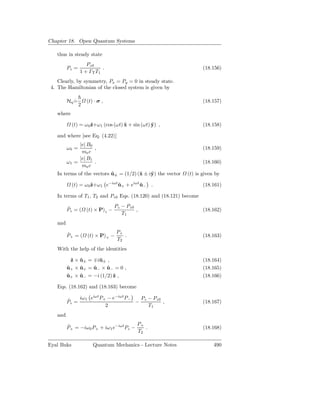
  • 117.
    5.3. Problems a) Calculate the Heisenberg representation of the position operator x(H) (t) and its canonically conjugate operator p(H) (t). b) Given that the particle at time t = 0 is in the state |0 , where the state |0 is the ground state of the potential 1 V1 (x) = mω2 x2 . (5.81) 2 Calculate the expectation value x at later times t > 0. 26. A particle having mass m is in the ground state of the one-dimensional potential well V1 (x) = (1/2) mω 2 (x − ∆x )2 for times t < 0 . At time t = 0 the potential suddenly changes and becomes V2 (x) = (1/2) mω 2 x2 . a) Calculate the expectation value x at times t > 0. b) Calculate the variance (∆x)2 at times t > 0 , where ∆x = x − x . c) The energy of the particle is measured at time t > 0 . What are the possible results and what are the probabilities to obtain any of these results. 27. Consider a particle having mass m in the ground state of the potential well Va (x) = (1/2) mω2 x2 for times t < 0 . At time t = 0 the potential suddenly changes and becomes Vb (x) = gx . (a) Calculate the expecta- tion value x at times t > 0 . (b) Calculate the variance (∆x)2 at times t > 0 , where ∆x = x − x . 28. Consider a particle of mass m in a potential of a harmonic oscillator having angular frequency ω. The operator S (r) is defined as r 2 2 S (r) = exp a − a† , (5.82) 2 where r is a real number, and a and a† are the annihilation and creation operators respectively. The operator T is defined as T = S (r) aS † (r) . (5.83) a) Find an expression for the operator T of the form T = Aa + Ba† , where both A and B are constants. b) The vector state |r is defined as |r = S † (r) |0 , (5.84) where |0 is the ground state of the harmonic oscillator. Calculate the expectation values r| x |r of the operator x (displacement) and the expectation value r| p |r of the operator p (momentum). c) Calculate the variance (∆x)2 of x and the variance (∆p)2 of p. 29. Consider one dimensional motion of a particle having mass m. The Hamil- tonian is given by Eyal Buks Quantum Mechanics - Lecture Notes 107
  • 118.
    Chapter 5. TheHarmonic Oscillator H = ω 0 a† a + ω1 a† a† aa , (5.85) where mω 0 ip a= x+ , (5.86) 2 mω0 is the annihilation operator, x is the coordinate and p is its canonical conjugate momentum. The frequencies ω 0 and ω 1 are both positive. a) Calculate the eigenenergies of the system. b) Let |0 be the ground state of the system. Calculate i. 0|x|0 ii. 0|p|0 2 iii. 0| (∆x) |0 iv. 0| (∆p)2 |0 30. The Hamiltonian of a system is given by H = ǫN , (5.87) where the real non-negative parameter ǫ has units of energy, and where the operator N is given by N = b† b . (5.88) The following holds b† b + bb† = 1 , (5.89) b2 = 0 , (5.90) 2 b† =0. (5.91) 2 a) Find the eigenvalues of H. Clue: show first that N = N . b) Let |0 be the ground state of the system, which is assumed to be non-degenerate. Define the two states |+ = A+ 1 + b† |0 , (5.92a) |− = A− 1 − b† |0 , (5.92b) where the real non-negative numbers A+ and A− are normalization constants. Calculate A+ and A− . Clue: show first that b† |0 is an eigenvector of N . c) At time t = 0 the system is in the state |α (t = 0) = |+ , (5.93) Calculate the probability p (t) to find the system in the state |− at time t > 0. Eyal Buks Quantum Mechanics - Lecture Notes 108
  • 119.
    5.3. Problems 31. Normalordering - Let f a, a† be a function of the annihilation a and creation a† operators. The normal ordering of f a, a† , which is denoted by : f a, a† : places the a operators on the right and the a† operators on the left. Some examples are given below : aa† : = a† a , (5.94) : a† a : = a† a , (5.95) n n : a† a : = a† an . (5.96) Normal ordering is linear, i.e. : f + g :=: f : + : g :. Show that the projec- tion operator Pn = |n n|, where |n is an eigenvector of the Hamiltonian of a harmonic oscillator, can be expressed as 1 n Pn = : a† exp −a† a an : . (5.97) n! 32. Consider a harmonic oscillator of angular frequency ω and mass m. A time dependent force is applied f (t). The function f (t) is assumed to vanish f (t) → 0 in the limit t → ±∞. Given that the oscillator was initially in its ground state |0 at t → −∞ calculate the probability pn to find the oscillator in the number state |n in the limit t → ∞. 33. The operator D is defined by ∞ D= dx′ |x′ −x′ | , (5.98) −∞ where |x′ is an eigenvector of the position operator x having eigenvalue x′ , i.e. x |x′ = x′ |x′ . Express the operator D as a function of the number operator N = a† a. 34. Consider a system having Hamiltonian H given by k H = ωa† a + ω 1 a† a , (5.99) † where a and a are the annihilation and creation operators, both ω and ω 1 are positive, and where k is integer. At initial time t = 0 the state of the system is an eigenstate of the operator a with eigenvalue α, i.e. |ψ (t = 0) = |α c , where a |α c = α |α c . a) Find a general expression for the state of the system |ψ (t) at time t > 0. b) Evaluate |ψ (t) at time t = 2π/ω 1 . c) Evaluate |ψ (t) at time t = π/ω1 . d) Evaluate |ψ (t) at time t = π/2ω 1 for the case where k is even. 35. Consider two normalized coherent states |α and |β , where α, β ∈ C. The operator A is defined as A = |α α| − |β β| . (5.100) Find the eigenvalues of the operator A. Eyal Buks Quantum Mechanics - Lecture Notes 109
  • 120.
    Chapter 5. TheHarmonic Oscillator 5.4 Solutions 1. The Hamiltonian is given by p2 mω2 x2 H= + . 2m 2 Using Eqs. (3.21), (3.29), (5.9) and (5.10) one has −1/2 dψn x′ | a |n = 2x2 0 x′ ψn (x′ ) + x2 0 , (5.101) dx′ −1/2 dψ x′ | a† |n = 2x2 0 x′ ψn (x′ ) − x2 n 0 , (5.102) dx′ where x0 = . (5.103) mω For the ground state |0 , according to Eq. (5.28), a |0 = 0, thus dψ0 x′ ψ0 (x′ ) + x2 0 =0. (5.104) dx′ The solution is given by 2 1 x′ ψ0 (x′ ) = A0 exp − , (5.105) 2 x0 where the normalization constant A0 is found from the requirement ∞ 2 |ψ0 (x′ )| dx = 1 , (5.106) −∞ thus ∞ 2 x |A0 |2 exp − dx = 1 . (5.107) −∞ x0 √ πx0 Choosing A0 to be real leads to 2 1 1 x′ ψ0 (x′ ) = 1/2 exp − . (5.108) π1/4 x0 2 x0 All other wavefunctions are found using Eqs. (5.32) and (5.102) Eyal Buks Quantum Mechanics - Lecture Notes 110
  • 121.
    5.4. Solutions n 1 d ψn (x′ ) = √ x′ − x2 0 ψ0 (x′ ) (2x0 )n/2 n! dx′ n 2 1 1 d 1 x′ = √ x′ − x2 0 exp − . π 1/4 2n n! n+1/2 x0 dx′ 2 x0 (5.109) Using the notation n X2 d X2 Hn (X) = exp X− exp − , (5.110) 2 dX 2 the expression for ψn (x′ ) can be rewritten as ′2 ′ x x exp − 2x2 Hn x0 ′ 0 ψn (x ) = 1/2 √ n . (5.111) π 1/4 x0 2 n! The term Hn (X), which is called the Hermite polynomial of order n, is calculated below for some low values of n H0 (X) = 1 , (5.112) H1 (X) = 2X , (5.113) H2 (X) = 4X 2 − 2 , (5.114) H3 (X) = 8X 3 − 12X , (5.115) H4 (X) = 16X 4 − 48X 2 + 12 . (5.116) 2. The relation (5.56), which is a Taylor expansion of the function f (t) = exp 2Xt − t2 around the point t = 0, implies that dn Hn (X) = exp 2Xt − t2 . (5.117) dtn t=0 The identity 2Xt − t2 = X 2 − (X − t)2 yields dn Hn (X) = exp X 2 exp − (X − t)2 . (5.118) dtn t=0 Moreover, using the relation d d exp − (X − t)2 = − exp − (X − t)2 , (5.119) dt dX one finds that dn Hn (X) = exp X 2 (−1)n exp − (X − t)2 dX n t=0 dn = exp X 2 (−1)n exp −X 2 . dX n (5.120) Eyal Buks Quantum Mechanics - Lecture Notes 111
  • 122.
    Chapter 5. TheHarmonic Oscillator Note that for an arbitrary function g (X) the following holds d d − exp X 2 exp −X 2 g = 2X − g, (5.121) dX dX and X2 d X2 d exp X− exp − g = 2X − g, (5.122) 2 dX 2 dX thus n X2 d X2 Hn (X) = exp X− exp − . (5.123) 2 dX 2 3. With the help of Eqs. (5.9), (5.10), (5.11), (5.12) and (5.13) one finds n| x |n = 0 , (5.124) n| x2 |n = n| aa† + a† a |n = (2n + 1) , (5.125) 2mω 2mω n| p |n = 0 , (5.126) m ω m ω n| p2 |n = n| aa† + a† a |n = (2n + 1) , (5.127) 2 2 thus 2 1 (∆x)2 (∆p)2 = n + 2 . 2 4. The Hamiltonian is given by p2 H= . (5.128) 2m Using Eqs. (4.37) and (5.8) one finds that dx(H) 1 p(H) (H) (H) p(H) = x(H) , H(H) = x ,p = , (5.129) dt i im m and dp(H) 1 (H) (H) = p ,H =0. (5.130) dt i The solution is thus 1 (H) x(H) (t) = x(H) (0) + p (0) t . (5.131) m With the help of Eq. (5.131) one finds that Eyal Buks Quantum Mechanics - Lecture Notes 112
  • 123.
    5.4. Solutions (∆x)2 (t) = x2 (t) − ( x (t))2 2 1 (H) = ψ0 | x(H) (0) + p (0) t |ψ0 m 2 1 (H) − ψ0 | x(H) (0) + p (0) t |ψ0 m t2 2t = (∆x)2 + 2 (∆p)2 + ((xp)0 − x0 p0 ) . 0 0 m m (5.132) 5. The Hamiltonian is given by p2 mω2 x2 H= + . (5.133) 2m 2 Using Eqs. (4.37) and (5.8) one finds that dx(H) 1 p(H) = x(H) , H(H) = , (5.134) dt i m and dp(H) 1 (H) (H) = p ,H = −mω2 x(H) . (5.135) dt i a) The solutions of the above equations are given by sin (ωt) (H) x(H) (t) = x(H) (0) cos (ωt) + p (0) , (5.136) mω and p(H) (t) = p(H) (0) cos (ωt) − mω sin (ωt) x(H) (0) . (5.137) b) Using the expressions for x(H) (t) and p(H) (t) and Eq. (5.8) one finds that p(H) (t1 ) , x(H) (t2 ) = − (cos (ωt1 ) cos (ωt2 ) + sin (ωt1 ) sin (ωt2 )) x(H) (0) , p(H) (0) = −i cos (ω (t1 − t2 )) , (5.138) (H) (H) p (t1 ) , p (t2 ) = mω (cos (ωt1 ) sin (ωt2 ) − sin (ωt1 ) cos (ωt2 )) x(H) (0) , p(H) (0) = −i mω sin (ω (t1 − t2 )) , (5.139) Eyal Buks Quantum Mechanics - Lecture Notes 113
  • 124.
    Chapter 5. TheHarmonic Oscillator and x(H) (t1 ) , x(H) (t2 ) 1 = (cos (ωt1 ) sin (ωt2 ) − sin (ωt1 ) cos (ωt2 )) x(H) (0) , p(H) (0) mω i =− sin (ω (t1 − t2 )) . mω (5.140) 6. Due to the infinite barrier for x ≤ 0 the wavefunction must vanish at x = 0. This condition is satisfied by the wavefunction of all number states |n with odd value of n (the states |n are eigenstates of the ’regu- lar’ harmonic oscillator with potential V (x) = mω 2 /2 x2 ). These wave- functions obviously satisfy the Schrödinger equation for x > 0. a) Thus the possible energy values are Ek = ω (2k + 3/2) where k = 0, 1, 2, · · · . b) The corresponding normalized wavefunctions are given by √ ˜ k (x) = 2ψ2k+1 (x) x > 0 ψ , (5.141) 0 x≤0 where ψn (x) is the wavefunction of the number states |n . Thus for a given k ∞ 2 x 2 = ˜ dx ψ k (x) x2 k 0 ∞ 2 =2 dx ψ2k+1 (x) x2 0 ∞ 2 = dx ψ2k+1 (x) x2 −∞ = 2k + 1| x2 |2k + 1 , (5.142) thus with the help of Eq. (5.125) one finds that 3 x2 k = 2k + . (5.143) mω 2 7. The potential can be written as mω2 α 2 α2 V (x) = x+ − . (5.144) 2 mω 2 2mω 2 This describes a harmonic oscillator centered at x0 = −α/mω 2 having angular resonance frequency ω. The last constant term represents energy shift. Thus, the eigenenergies are given by Eyal Buks Quantum Mechanics - Lecture Notes 114
  • 125.
    5.4. Solutions En = ω (n + 1/2) − α2 /2mω2 , (5.145) where n = 0, 1, 2, · · · . 8. In the classically forbidden region V (x) > E0 = ω/2, namely |x| > x0 where x0 = . (5.146) mω Using Eq. (5.108) one finds ∞ 2 p=2 |ψ0 (x)| dx x0 ∞ 2 2 x = exp − dx π1/2 x0 x0 x0 = 1 − erf (1) = 0.157 . (5.147) 9. The answer is [see Eqs. (4.160) and (5.19)] π2 2 n2 + n2 x y 1 Enx ,ny ,nz = 2 + ω nz + , (5.148) 2ma 2 where nx and ny are positive integers and nz is a nonnegative integer. 10. With the help of Eq. (4.14) one has 1 iω0 t |α (t) = √ e− 2 |0 + e−iω0 t |1 . (5.149) 2 Moreover, the following hold x= a + a† , (5.150) 2mω0 m ω0 p=i −a + a† , (5.151) 2 √ a |n = n |n − 1 , (5.152) √ a† |n = n + 1 |n + 1 , (5.153) a, a† = 1 , (5.154) thus a) Eyal Buks Quantum Mechanics - Lecture Notes 115
  • 126.
    Chapter 5. TheHarmonic Oscillator x = α (t)| a + a† |α (t) 2mω 0 1 = 0| + eiω0 t 1| a + a† |0 + e−iω0 t |1 2mω 0 2 1 iω0 t = e + e−iω0 t 2mω 0 2 = cos (ω 0 t) . 2mω 0 (5.155) b) m ω0 p =i α (t)| −a + a† |α (t) 2 m ω0 1 =i 0| + eiω0 t 1| −a + a† |0 + e−iω0 t |1 2 2 m ω0 =− sin (ω 0 t) . 2 (5.156) c) 2 x2 = α (t)| a + a† |α (t) 2mω 0 2 = α (t)| a2 + a† + a, a† + 2a† a |α (t) 2mω 0 1 = 1+2 2mω 0 2 = . mω 0 (5.157) d) Similarly m ω0 2 p2 = − α (t)| −a + a† |α (t) 2 m ω0 2 =− α (t)| a2 + a† − a, a† − 2a† a |α (t) 2 = m ω0 , (5.158) thus cos2 (ω 0 t) sin2 (ω0 t) ∆x∆p = 1− 1− 2 2 1 2 = 2+ sin (2ω 0 t) . 2 4 (5.159) Eyal Buks Quantum Mechanics - Lecture Notes 116
  • 127.
    5.4. Solutions 11. Thestate |ψ (t) is given by 1 iE0 t iEn t |ψ (t) = √ exp − |0 + exp − |n , (5.160) 2 where 1 En = ω n + , (5.161) 2 thus, using x= a + a† , (5.162) 2mω and √ a |n = n |n − 1 , (5.163) √ a† |n = n + 1 |n + 1 , (5.164) one finds that x (t) = 0 if n > 1, and for n = 1 x (t) = ψ (t)| a + a† |ψ (t) 2mω = cos (ωt) . 2mω (5.165) 12. Since H = ω and |ψ(0) is normalized one has 2 2 1 |c0 | = |c1 | = , (5.166) 2 thus |ψ(0) can be written as 1 |ψ(0) = |0 + eiθ |1 , (5.167) 2 where θ is real. Given that at time t = 0 1 x (t = 0) = , (5.168) 2 mω one finds using the identities x= a + a† , (5.169) 2mω √ a |n = n |n − 1 , (5.170) √ a† |n = n + 1 |n + 1 , (5.171) Eyal Buks Quantum Mechanics - Lecture Notes 117
  • 128.
    Chapter 5. TheHarmonic Oscillator that √ 2 cos θ = . (5.172) 2 Using this result one can evaluate p (t = 0), where m ω p=i −a + a† , (5.173) 2 thus √ m ω m ω 2 p (t = 0) = sin θ = ± = ±mω x (t = 0) . (5.174) 2 2 2 Using these results together with Eq. (5.136) yields 1 x (t) = (cos (ωt) ± sin (ωt)) 2 mω π = cos ωt ∓ . 2mω 4 (5.175) 13. According to identity (2.175), which states that 1 1 eA+B = eA eB e− 2 [A,B] = eB eA e 2 [A,B] , (5.176) provided that [A, [A, B]] = [B, [A, B]] = 0 , (5.177) one finds with the help of Eq. (5.13) that D (α) = exp αa† − α∗ a |α|2 † ∗ = e− 2 eαa e−α a |α|2 ∗ † =e 2 e−α a eαa . (5.178) 14. Using Eq. (5.178) one has |α|2 † ∗ |α|2 ∗ † D† (α) = e− 2 e−αa eα a =e 2 eα a e−αa , (5.179) thus D† (α) D (α) = D (α) D† (α) = 1 . (5.180) Eyal Buks Quantum Mechanics - Lecture Notes 118
  • 129.
    5.4. Solutions 15. UsingEqs. (5.35), (5.28) and (5.29) one finds that |α|2 † ∗ |α|2 † |α = e− 2 eαa e−α a |0 = e− 2 eαa |0 ∞ |α|2 αn = e− 2 √ |n . n=0 n! (5.181) 16. Using Eqs. (5.42) and (5.28) one has ∞ |α|2 αn a |α = e− 2 √ a |n n=0 n! ∞ − |α|2 αn−1 = αe 2 |n − 1 n=1 (n − 1)! = α |α . (5.182) 17. Using Eqs. (5.36), (5.9) and (5.10) one has mω 1 D (α) = exp (α − α∗ ) x − i (α + α∗ ) p , (5.183) 2 2 mω thus with the help of Eqs. (2.175) and (5.8) the desired result is obtained mω α − α∗ D (α) = exp √ x 2 i α + α∗ α∗2 − α2 × exp − √ √ p exp . m ω 2 4 (5.184) 18. Using the operator identity (2.173) 1 1 eL Ae−L = A + [L, A] + [L, [L, A]] + [L, [L, [L, A]]] + · · · , (5.185) 2! 3! and the definition (5.36) D (α) = exp αa† − α∗ a , (5.186) one finds that D† (α) aD (α) = a + α , (5.187) † † † ∗ D (α) a D (α) = a + α . (5.188) Exploiting the unitarity of D (α) Eyal Buks Quantum Mechanics - Lecture Notes 119
  • 130.
    Chapter 5. TheHarmonic Oscillator D (α) D† (α) = 1 it is straightforward to show that for any function f a, a† having a power series expansion the following holds D† (α) f a, a† D (α) = f a + α, a† + α∗ (5.189) (e.g., D† a2 D = D† aDD† aD = (a + α)2 ). 19. Using Eq. (5.74) and the following identities 1 H = ω a† a + , (5.190) 2 x= a + a† , (5.191) 2mω m ω p=i −a + a† , (5.192) 2 all these relations are easily obtained. 20. Expressing the state |α in the basis of eigenvectors of the Hamiltonian |n ∞ |α = cn |n , (5.193) n=0 using a |α = α |α , (5.194) and √ a |n = n |n − 1 , (5.195) one finds ∞ ∞ √ cn n |n − 1 = α cn |n , (5.196) n=0 n=0 thus α cn+1 = √ cn , (5.197) n+1 therefore ∞ αn |α = A √ |n . (5.198) n=0 n! The normalization constant A is found by Eyal Buks Quantum Mechanics - Lecture Notes 120
  • 131.
    5.4. Solutions n ∞ |α|2 2 1 = |A|2 2 = |A| e|α| . (5.199) n=0 n! Choosing A to be real yields |α|2 A = e− 2 , (5.200) thus |α|2 αn cn = e− 2 √ . (5.201) n! Note that this result is identical to Eq. (5.42), thus |α is a coherent state. The possible results of the measurement are 1 En = ω n + , (5.202) 2 and the corresponding probabilities, which are time independent, are given by n 2 |α|2 2 pn (t) = |cn | = e−|α| . (5.203) n! 21. Using the relations 2 x α = Re (α) , (5.204) mω √ p α = 2 mω Im (α) , (5.205) Eq. (5.73) can be written as i p αx i x αp α∗2 − α2 D (α) = exp exp − exp . (5.206) 4 Using Eqs. (3.12) and (3.19) one finds that i x αp exp − |x′ = |x′ + x α , thus i p αx i x αp α∗2 − α2 x′ |α = x′ | exp exp − exp |0 4 ′ α∗2 − α2 i p αx = exp exp x′ − x α |0 . 4 (5.207) Eyal Buks Quantum Mechanics - Lecture Notes 121
  • 132.
    Chapter 5. TheHarmonic Oscillator Using Eq. (5.108) the wavefunction of the ground state is given by 2 1 1 x′ x′ |0 = √ exp − , (5.208) (2π)1/4 ∆xα 2∆xα where ∆xα = , (5.209) 2mω thus 2 x′ − x α ∗2 2 ′ exp − 2∆xα α −α i p αx x′ |α = exp exp √ 4 (2π)1/4 ∆xα 2 α∗2 − α2 mω 1/4 x− x α x = exp exp − +i p α . 4 π 2∆xα (5.210) 22. Using Eqs. (5.36) and (2.175) this relation is easily obtained. 23. With the help of Eq. (5.42) one has 1 1 1 2 |α α| d2 α = |n m| √ e−|α| αn α∗m d2 α . π π n,m n!m! (5.211) Employing polar coordinates in the complex plane α = ρeiθ , where ρ is non-negative real and θ is real, leads to ∞ 2π 1 2 1 1 n+m+1 −ρ2 |α α| d α = |n m| √ dρρ e dθeiθ(n−m) π π n,m n!m! 0 0 2πδnm ∞ 2 2 = |n n| dρρ2n+1 e−ρ n n! 0 1 = |n n| Γ (n + 1) n n! =n! = |n n| n =1. (5.212) Eyal Buks Quantum Mechanics - Lecture Notes 122
  • 133.
    5.4. Solutions 24. UsingEqs. (5.35) and (5.41) one finds that β |α = 0| D† (β) D (α) |0 = 0| D (−β) D (α) |0 −βα∗ + β ∗ α = exp 0| D (−β + α) |0 2 −βα + β ∗ α ∗ = exp 0 |α − β . 2 (5.213) Thus, with the help of Eq. (5.42) one has −βα∗ + β ∗ α |α−β|2 β |α = exp e− 2 2 2 2 |α| |β| = exp − − + αβ ∗ 2 2 |α − β|2 = exp − + i Im (αβ ∗ ) . 2 (5.214) 25. The following holds 1 1 V1 (x) = mω2 (x + β)2 − mω 2 β 2 2 2 1 2 ′2 1 2 2 = mω x − mω β , 2 2 (5.215) where x′ = x + β . (5.216) a) Thus, using Eqs. (5.136) and (5.137) together with the relations x′(H) (t) = x(H) (t) + β , (5.217) p(H) (t) = p′(H) (t) , (5.218) one finds sin (ωt) (H) x(H) (t) = x(H) (0) + β cos (ωt) + p (0) − β , (5.219) mω p(H) (t) = p(H) (0) cos (ωt) − mω sin (ωt) x(H) (0) + β . (5.220) b) For this case at time t = 0 x(H) (0) = 0 , (5.221) p(H) (0) = 0 , (5.222) Eyal Buks Quantum Mechanics - Lecture Notes 123
  • 134.
    Chapter 5. TheHarmonic Oscillator thus x(H) (t) = β (cos (ωt) − 1) . (5.223) 26. The state of the system at time t = 0 is given by i∆x |ψ (t = 0) = exp − p |0 , (5.224) where |0 is the ground state of the potential V2 . In general a coherent state with parameter α can be written as mω α − α∗ i α + α∗ α∗2 − α2 |α = exp √ x exp − √ √ p exp |0 . 2 m ω 2 4 (5.225) a) Thus |ψ (t = 0) = |α0 , where mω α 0 = ∆x . (5.226) 2 The time evolution of a coherent state is given by |ψ (t) = e−iωt/2 α = α0 e−iωt , (5.227) and the following holds 2 x (t) = Re α0 e−iωt = ∆x cos (ωt) , (5.228) mω b) According to Eq. (5.48) (∆x)2 (t) = . (5.229) 2mω c) In general a coherent state can be expanded in the basis of number states |n 2 αn |α = e−|α| /2 √ |n , (5.230) n n! thus the probability to measure energy En = ω (N + 1/2) at time t is given by e−|α0 | α2n 2 n 2 0 1 mω∆2 x mω∆2x Pn = | n|ψ (t) | = = exp − . n! n! 2 2 (5.231) Eyal Buks Quantum Mechanics - Lecture Notes 124
  • 135.
    5.4. Solutions 27. Attime t = 0 the following holds x =0, (5.232) p =0, (5.233) (∆x)2 = x2 = , (5.234) 2mω mω (∆p)2 = p2 = . (5.235) 2 Moreover, to calculate xp it is convenient to use x= a + a† , (5.236) 2mω m ω p=i −a + a† , (5.237) 2 a, a† = 1 , (5.238) thus at time t = 0 xp = i 0| aa† − a† a |0 = i . (5.239) 2 2 The Hamiltonian for times t > 0 is given by p2 H= + gx . (5.240) 2m Using the Heisenberg equation of motion for the operators x and x2 one finds dx(H) 1 = x(H) , H , (5.241) dt i dp(H) 1 = p(H) , H , (5.242) dt i dx2(H) 1 = x2 , H , (H) (5.243) dt i or using [x, p] = i dx(H) p(H) = , (5.244) dt m dp(H) = −g , (5.245) dt dx2 (H) 1 1 = x p + p(H) x(H) = 2x(H) p(H) − i , (5.246) dt m (H) (H) m thus p(H) (t) = p(H) (0) − gt , (5.247) Eyal Buks Quantum Mechanics - Lecture Notes 125
  • 136.
    Chapter 5. TheHarmonic Oscillator p(H) (0) t gt2 x(H) (t) = x(H) (0) + − , (5.248) m 2m i t 2 t x2 (t) = x2 (0) − + x (t′ ) p(H) (t′ ) dt′ (H) (H) m m 0 (H) i t 2 t p(H) (0) t′ gt′2 = x2 (0) − (H) + x(H) (0) + − p(H) (0) − gt′ dt′ m m 0 m 2m i t = x2 (0) − (H) m 2 t p2 (0) t′ gt′2 (H) p(H) (0) gt′2 g 2 t′3 + x(H) (0) p(H) (0) + − p(H) (0) − x(H) (0) gt′ − + dt′ m 0 m 2m m 2m i t = x2 (0) − (H) m 2 p2 (0) t2 (H) p(H) (0) gt3 x(H) (0) gt2 p(H) (0) gt3 g2 t4 + x(H) (0) p(H) (0) t + − − − + . m 2m 6m 2 3m 8m (5.249) Using the initial conditions Eqs. (5.232), (5.233), (5.234), (5.235) and (5.239) one finds gt2 x (t) = − , (5.250) 2m 2g 2 t4 x (t) = , (5.251) 4m2 p (t) = −gt , (5.252) 2 2 4 i t 2 i t ωt g t x2 (t) = − + + + , (5.253) 2mω m m 2 4 8m and ωt2 (∆x)2 (t) = x2 (t) − x (t) 2 = + = 1 + ω 2 t2 . 2mω 2m 2mω (5.254) 28. Using the operator identity (2.173), which is given by 1 1 eL Oe−L = O + [L, O] + [L, [L, O]] + [L, [L, [L, O]]] + · · · , (5.255) 2! 3! for the operators O=a, (5.256) r 2 2 L= a − a† , (5.257) 2 Eyal Buks Quantum Mechanics - Lecture Notes 126
  • 137.
    5.4. Solutions and the relations a, a† = 1 , (5.258) [L, O] = ra† , (5.259) [L, [L, O]] = r2 a , (5.260) [L, [L, [L, O]]] = r3 a† , (5.261) [L, [L, [L, [L, O]]]] = r4 a , (5.262) etc., one finds r 2 r4 r3 T = 1+ + +··· a+ r+ +··· a† + · · · , (5.263) 2! 4! 3! a) Thus T = Aa + Ba† , (5.264) where A = cosh r , (5.265) B = sinh r . (5.266) b) Using the relations x= a + a† , (5.267) 2mω m ω p=i −a + a† . (5.268) 2 one finds r| x |r = 0| S (r) a + a† S † (r) |0 2mω = 0| T |0 + 0| T † |0 2mω =0, (5.269) m ω r| p |r = i 0| S (r) −a + a† S † (r) |0 2 = − 0| T |0 + 0| T † |0 2mω =0. (5.270) c) Note that S (r) is unitary, namely S † (r) S (r) = 1, since the operator 2 a2 − a† is anti Hermitian. Thus Eyal Buks Quantum Mechanics - Lecture Notes 127
  • 138.
    Chapter 5. TheHarmonic Oscillator r| x2 |r = 0| S (r) a + a† a + a† S † (r) |0 2mω = 0| S (r) a + a† S † (r) S (r) a + a† S † (r) |0 2mω 2 = 0| T + T † |0 2mω (A + B)2 2 = 0| a + a† |0 2mω (cosh r + sinh r)2 = 2mω e2r = , 2mω (5.271) and m ω 2 r| p2 |r = 0| S (r) a − a† S † (r) |0 2 m ω 2 = 0| T − T † |0 2 m ω (A − B)2 2 = 0| a − a† |0 2 m ω (cosh r − sinh r)2 = 2 m ωe−2r = . 2 (5.272) Thus e2r (∆x)2 = , (5.273) 2mω m ωe−2r (∆p)2 = , (5.274) 2 (∆x) (∆p) = . (5.275) 2 29. Using the commutation relation a, a† = 1 , (5.276) one finds H = ω0N + ω1 N 2 − N , (5.277) where N = a† a (5.278) is the number operator. Eyal Buks Quantum Mechanics - Lecture Notes 128
  • 139.
    5.4. Solutions a) The eigenvectors of N N |n = n |n , (5.279) (where n = 0, 1, · · · ) are also eigenvectors of H and the following holds H |n = En |n , (5.280) where En = ω0 n + ω1 n2 − n . (5.281) Note that En+1 − En = ω 0 + 2ω 1 n , (5.282) thus En+1 > En . b) Using the relations x= a† + a , (5.283) 2mω 0 m ω0 † p=i a −a , (5.284) 2 x2 = a† a† + aa + 2N + 1 , (5.285) 2mω 0 m ω0 p2 = −a† a† − aa + 2N + 1 , (5.286) √ 2 a |n = n |n − 1 , (5.287) √ a† |n = n + 1 |n + 1 , (5.288) one finds i. 0|x|0 = 0 ii. 0|p|0 = 0 iii. 0| (∆x)2 |0 = 2mω0 iv. 0| (∆p)2 |0 = m ω0 2 30. The proof of the clue is: 2 N = b† bb† b = b† 1 − b† b b = N . (5.289) Moreover, N is Hermitian, thus N is a projector. a) Let |n be the eigenvectors of N and n the corresponding real eigen- values (N is Hermitian) N |n = n |n . (5.290) Using the clue one finds that n2 = n, thus the possible values of n are 0 (ground state) and 1 (excited state). Thus, the eigenvalues of H are 0 and ǫ. Eyal Buks Quantum Mechanics - Lecture Notes 129
  • 140.
    Chapter 5. TheHarmonic Oscillator b) To verify the statement in the clue we calculate N b† |0 = b† bb† |0 = b† (1 − N ) |0 = b† |0 , (5.291) thus the state b† |0 is indeed an eigenvector of N with eigenvalue 1 (excited state). In what follows we use the notation |1 = b† |0 . (5.292) Note that |1 is normalized since 1|1 = 0| bb† |0 = 0| (1 − N ) |0 = 0|0 = 1 . (5.293) Moreover, since |0 and |1 are eigenvectors of an Hermitian operator with different eigenvalues they must be orthogonal to each other 0|1 = 0 . (5.294) Using Eqs. (5.292), (5.293) and (5.294) one finds +|+ = 2 |A+ |2 , (5.295) 2 −|− = 2 |A− | . (5.296) choosing the normalization constants to be non-negative real num- bers lead to 1 A+ = A− = √ . (5.297) 2 c) Using N 2 = N one finds ∞ n iHt 1 iHt exp − = 1+ − n=1 n! ∞ n 1 iǫt = 1+N − n=1 n! ∞ n 1 iǫt = 1+N −1 + − n=0 n! iǫt = 1 + N −1 + exp − . (5.298) Thus Eyal Buks Quantum Mechanics - Lecture Notes 130
  • 141.
    5.4. Solutions 2 iHt p0 (t) = −| exp − |+ 2 1 iǫt = ( 0| − 1|) 1 + N −1 + exp − (|0 + |1 ) 4 2 1 iǫt = 1 − exp − 4 ǫt = sin2 . 2 (5.299) 31. The closure relation (5.31) can be written as ∞ 1= |n m| δ n,m . (5.300) n,m=0 With the help of Eq. (5.32) together with the relation n 1 d ςm = δ n,m , (5.301) n! dς ς=0 which is obtained using the Taylor power expansion series of the function ς m , one finds that ∞ 1= |n m| δ n,m n,m=0 ∞ n 1 d = √ √ |n m| ςm n,m=0 n! m! dς ς=0 ∞ † n n a am d = |0 0| ςm n,m=0 n! m! dς ς=0 ∞ † n d n ∞ a dς am ς m = |0 0| n=0 n! m=0 m! ς=0 d † = exp a |0 0| exp (aς) . dς ς=0 (5.302) Denote the normal ordering representation of the operator |0 0| by Z, i.e. |0 0| = : Z : . (5.303) For general functions f , g and h of the operators a and a† it is easy to show that the following holds Eyal Buks Quantum Mechanics - Lecture Notes 131
  • 142.
    Chapter 5. TheHarmonic Oscillator : f g : =: gf : , (5.304) : f gh : =: f hg : , (5.305) and : f (: g : ) : = : f g : . (5.306) Thus d 1 = exp a† : Z : exp (aς) dς ς=0 d † = : exp a Z exp (aς) : dς ς=0 d = : exp a† exp (aς) Z : dς ς=0 d n a† dς (aς)m = : Z : n,m n! m! ς=0 d n † n dς m am = : a ς Z: n,m n! m! ς=0 δn,m † = : exp a a Z : = : exp a† a ( : Z : ) : , (5.307) and therefore |0 0| = : exp −a† a : . (5.308) Using again Eq. (5.32) one finds that 1 n n Pn = |n n| = : a† exp −a† a a† : . (5.309) n! 32. The Hamiltonian H, which is given by p2 mω2 x2 H= + + xf (t) , (5.310) 2m 2 can be expressed in terms of the annihilation a and creation a† operators [see Eqs. (5.11) and (5.12)] as 1 H = ω a† a + + f (t) a + a† . (5.311) 2 2mω Eyal Buks Quantum Mechanics - Lecture Notes 132
  • 143.
    5.4. Solutions The Heisenberg equation of motion for the operator a is given by [see Eq. (4.37)] da 1 = −iωa − i f (t) . (5.312) dt 2m ω The solution of this first order differential equation is given by t 1 dt′ e−iω(t−t ) f (t′ ) , ′ a (t) = e−iω(t−t0 ) a (t0 ) − i (5.313) 2m ω t0 where the initial time t0 will be taken below to be −∞. The Heisenberg operator a† (t) is found from the Hermitian conjugate of the last result. Let Pn (t) be the Heisenberg representation of the projector |n n|. The probability pn (t) to find the oscillator in the number state |n at time t is given by pn (t) = 0| Pn (t) |0 . (5.314) To evaluate pn (t) it is convenient to employ the normal ordering repre- sentation of the operator Pn (5.97). In normal ordering the first term of Eq. (5.313), which is proportional to a (t0 ) does not contribute to pn (t) since a (t0 ) |0 = 0 and also 0| a† (t0 ) = 0. To evaluate pn = pn (t → ∞) the integral in the second term of Eq. (5.313) is evaluate from t0 = −∞ to t = +∞. Thus one finds that e−µ µn pn = , (5.315) n! where ∞ 2 1 ′ µ= dt′ eiωt f (t′ ) . (5.316) 2m ω −∞ 33. As can be seen from the definition of D, the following holds ∞ ′ x | D |ψ = dx′′ x′ |x′′ −x′′ |ψ −∞ = −x′ |ψ , (5.317) thus the wave function of D |ψ is ψ (−x′ ) given that the wave function of |ψ is ψ (x′ ). For the wavefunctions ϕn (x′ ) = x′ |n of the number states |n , which satisfy N |n = n |n , the following holds −ϕn (x′ ) n odd ϕn (−x′ ) = , (5.318) ϕn (x′ ) n even Eyal Buks Quantum Mechanics - Lecture Notes 133
  • 144.
    Chapter 5. TheHarmonic Oscillator thus − |n n odd D |n = , (5.319) |n n even or D |n = (−1)n |n ,thus, the operator D can be expressed as a function of N D = eiπN . (5.320) 34. Initially, the system is in a coherent state given by Eq. (5.42) ∞ |α|2 αn |ψ (t = 0) = |α c = e− 2 √ |n . (5.321) n=0 n! The notation |α c is used to label coherent states satisfying a |α c = α |α c . k a) Since a† a commutes with a† a , the time evolution operator is given by [see Eq. (4.9)] iHt k = e−iω1 (a a) t e−iωa at , † † u (t) = exp − (5.322) thus |ψ (t) = u (t) |ψ (t = 0) ∞ † k |α| 2 αn = e−iω1 (a a) t e−iωa at e− 2 † √ |n n=0 n! ∞ n k −iω1 (a† a) t − |α| 2 αe−iωt =e 2e √ |n n=0 n! ∞ −iωt n |α|2 αe = e− 2 √ e−iφn |n , n=0 n! (5.323) where φn = ω 1 tnk . (5.324) b) At time t = 2π/ω 1 the phase factor φn is given by φn = 2πnk , thus e−iφn = 1 , (5.325) and therefore 2π 2πiω ψ = αe− ω1 . (5.326) ω1 c Eyal Buks Quantum Mechanics - Lecture Notes 134
  • 145.
    5.4. Solutions c) At time t = π/ω1 the phase factor φn is given by φn = πnk . Using the fact that 0 n is even mod nk , 2 = , (5.327) 1 n is odd one has n e−iφn = (−1) , (5.328) and therefore n πiω π 2 ∞ αe− ω1 − |α| ψ =e 2 √ (−1)n |n ω1 n=0 n! − πiω = −αe ω1 . c (5.329) d) At time t = π/2ω 1 the phase factor φn is given by φn = (π/2) nk . For the case where k is even one has 0 n is even mod nk , 4 = , (5.330) 1 n is odd thus 1 n is even e−iφn = , (5.331) −i n is odd and therefore πiω n π 2 ∞ αe− 2ω1 − |α| ψ =e 2 √ e−iφn |n . (5.332) 2ω 1 n=0 n! This state can be expressed as a superposition of two coherent states π 1 iπ πiω iπ πiω ψ = √ e− 4 αe− 2ω1 + e 4 −αe− 2ω1 . (5.333) 2ω 1 2 c c 35. Let {λn } be the set of eigenvalues of A. Clearly A is Hermitian, namely A† = A, thus the eigenvalues λn are expected to be real. Since the trace of an operator is basis independent, the following must hold Tr (A) = λn , (5.334) n and Tr A2 = λ2 . n (5.335) n Eyal Buks Quantum Mechanics - Lecture Notes 135
  • 146.
    Chapter 5. TheHarmonic Oscillator On the other hand, with the help of Eq. (2.172) one finds that Tr (A) = Tr (|α α|) − Tr (|β β|) = 0 , (5.336) and Tr A2 = Tr (|α α |α α|) + Tr (|β β |β β|) − Tr (|α α |β β|) − Tr (|β β |α α|) = 2 − α |β Tr (|α β|) − β |α Tr (|β α|) = 2 1 − | α |β |2 . (5.337) Clearly, A cannot have more than two nonzero eigenvalues, since the dimensionality of the subspace spanned by the vectors {|α , |β } is at most 2, and therefore A has three eigenvalues 0, λ+ and λ− , where [see Eq. (5.214)] λ± = ± 1 − | α |β |2 = ± 1 − e−|α−β| . 2 (5.338) Eyal Buks Quantum Mechanics - Lecture Notes 136
  • 147.
    6. Angular Momentum Considera point particle moving in three dimensional space. The orbital angular momentum L is given by   x y ˆ ˆ ˆ z L = r × p = det  x y z  , px py pz where r = (x, y, z) is the position vector and where p = (px , py , pz ) is the momentum vector. In classical physics the following holds: Claim. {Li , Lj } = εijk Lk , (6.1) where   0 i, j, k are not all different εijk = 1 i, j, k is an even permutation of x, y, z . (6.2)  −1 i, j, k is an odd permutation of x, y, z Proof. Clearly, Eq. (6.1) holds for the case i = j. Using Eq. (1.48), which reads {xi , pj } = δ ij , (6.3) one has {Lx , Ly } = {ypz − zpy , zpx − xpz } = {ypz , zpx } + {zpy , xpz } = y {pz , z} px + x {z, pz } py = −ypx + xpy = Lz . (6.4) In a similar way one finds that {Ly , Lz } = Lx and {Lz , Lx } = Ly . These results together with Eq. (1.49) complete the proof. Using the rule (4.41) {, } → (1/i ) [, ] one concludes that in quantum mechanics the following holds: [Li , Lj ] = i εijk Lk . (6.5)
  • 148.
    Chapter 6. AngularMomentum 6.1 Angular Momentum and Rotation We have seen before that the unitary operator u (t, t0 ) is the generator of time evolution [see Eq. (4.4)]. Similarly, we have seen that the unitary operator i∆ · p J (∆) = exp − (6.6) [see Eq. (3.73)] is the generator of linear translations: J (∆) |r′ = |r′ + ∆ . (6.7) Below we will see that one can define a unitary operator that generates ro- tations. Exercise 6.1.1. Show that     x x †  y  Dˆ (φ) = Rˆ  y  , Dˆ (φ) z z z (6.8) z z where iφLz Dˆ (φ) = exp − z , (6.9) and where   cos φ − sin φ 0 Rˆ =  sin φ cos φ 0  . z (6.10) 0 0 1 Solution 6.1.1. Equation (6.8) is made of 3 identities: † Dˆ (φ) xDˆ (φ) = x cos φ − y sin φ , z z (6.11) † Dˆ (φ) yDˆ (φ) z z = x sin φ + y cos φ , (6.12) † Dˆ (φ) zDˆ (φ) z z =z. (6.13) As an example, we prove below the first one. Using the identity (2.173), which is given by 1 1 eL Ae−L = A + [L, A] + [L, [L, A]] + [L, [L, [L, A]]] + · · · , (6.14) 2! 3! one has † Dˆ (φ) xDˆ (φ) z z 2 3 iφ 1 iφ 1 iφ = x+ [Lz , x] + [Lz , [Lz , x]] + [Lz , [Lz , [Lz , x]]] + · · · . 2! 3! (6.15) Eyal Buks Quantum Mechanics - Lecture Notes 138
  • 149.
    6.1. Angular Momentumand Rotation Furthermore with the help of Lz = xpy − ypx , (6.16) [xi , pj ] = i δ ij , (6.17) one finds that [Lz , x] = −y [px , x] = i y , 2 [Lz , [Lz , x]] = i x [py , y] = − (i ) x , [Lz , [Lz , [Lz , x]]] = − (i )2 [Lz , x] = − (i )3 y , 4 [Lz , [Lz , [Lz , [Lz , x]]]] = (i ) x , . . . (6.18) thus † φ2 φ4 φ3 Dˆ (φ) xDˆ (φ) = x 1 − z z + +··· −y φ− + ··· 2! 4! 3! = x cos φ − y sin φ . (6.19) The other 2 identities in Eq. (6.8) can be proven in a similar way. The matrix Rˆ [see Eq. (6.10)] represents a geometrical rotation around z the z axis with angle φ. Therefore, in view of the above result, we refer to the operator Dˆ (φ) as the generator of rotation around the z axis with angle φ. z It is straightforward to generalize the above results and to show that rotation around an arbitrary unit vector n axis with angle φ is given by ˆ iφL · n ˆ Dn (φ) = exp − ˆ . (6.20) In view of Eq. (3.73), it can be said that linear momentum p generates translations. Similarly, in view of the above equation (6.20), angular momen- tum L generates rotation. However, there is an important distinction between these two types of geometrical transformations. On one hand, according to Eq. (3.7) the observables px , py and pz commute with each other, and con- sequently translation operators with different translation vectors commute [J (∆1 ) , J (∆2 )] = 0 . (6.21) On the other hand, as can be seen from Eq. (6.5), different components of L do not commute and therefore rotation operators Dn (φ) with different rotations ˆ axes n need not commute. Both the above results, which were obtained from ˆ commutation relations between quantum operators, demonstrate two well known geometrical facts: (i) different linear translations commute, whereas (ii) generally, different rotations do not commute. Eyal Buks Quantum Mechanics - Lecture Notes 139
  • 150.
    Chapter 6. AngularMomentum 6.2 General Angular Momentum Elementary particles carry angular momentum in two different forms. The first one is the above discussed orbital angular momentum, which is com- monly labeled as L. This contribution L = r × p has a classical analogue, which was employed above to derive the commutation relations (6.5) from the corresponding Poisson’s brackets relations. The other form of angular momentum is spin, which is commonly labeled as S. Contrary to the orbital angular momentum, the spin does not have any classical analogue. In a gen- eral discussion on angular momentum in quantum mechanics the label J is commonly employed. L - orbital angular momentum S - spin angular momentum J - general angular momentum In the discussion below we derive some properties of angular momentum in quantum mechanics, where our only assumption is that the components of the angular momentum vector of operators J = (Jx , Jy , Jz ) obey the following commutation relations [Ji , Jj ] = i εijk Jk . (6.22) Namely, we assume that Eq. (6.5), which was obtained from the corresponding Poisson’s brackets relations for the case of orbital angular momentum holds for general angular momentum. 6.3 Simultaneous Diagonalization of J2 and Jz As we have seen in chapter 2, commuting operators can be simultaneously diagonalized. In this section we seek such simultaneous diagonalization of the operators J2 and Jz , where J2 = Jx + Jy + Jz . 2 2 2 (6.23) As is shown by the claim below, these operators commute. Claim. The following holds J2 , Jx = J2 , Jy = J2 , Jz = 0 . (6.24) Proof. Using Eq. (6.22) one finds that J2 , Jz = Jx , Jz + Jy , Jz 2 2 = i (−Jx Jy − Jy Jx + Jy Jx + Jx Jy ) = 0 . (6.25) In a similar way one can show that J2 , Jx = J2 , Jy = 0. Eyal Buks Quantum Mechanics - Lecture Notes 140
  • 151.
    6.3. Simultaneous Diagonalizationof J2 and Jz The common eigenvectors of the operators J2 and Jz are labeled as |a, b , and the corresponding eigenvalues are labeled as a 2 and b respectively J2 |a, b = a 2 |a, b , (6.26) Jz |a, b = b |a, b . (6.27) Recall that we have shown in chapter 5 for the case of harmonic oscillator that the ket-vectors a |n and a† |n are eigenvectors of the number operator N provided that |n is an eigenvector of N. Somewhat similar claim can be made regrading the current problem under consideration of simultaneous diagonalization of J2 and Jz : Theorem 6.3.1. Let |a, b be a normalized simultaneous eigenvector of the operators J2 and Jz with eigenvalues 2 a and b respectively, i.e. J2 |a, b = a 2 |a, b , (6.28) Jz |a, b = b |a, b , (6.29) a, b |a, b = 1 . (6.30) Then (i) the vector |a, b + 1 ≡ −1 [a − b (b + 1)]−1/2 J+ |a, b (6.31) where J+ = Jx + iJy , (6.32) is a normalized simultaneous eigenvector of the operators J2 and Jz with eigenvalues 2 a and (b + 1) respectively, namely J2 |a, b + 1 = a 2 |a, b + 1 , (6.33) Jz |a, b + 1 = (b + 1) |a, b + 1 . (6.34) (ii) The vector |a, b − 1 ≡ −1 [a − b (b − 1)]−1/2 J− |a, b (6.35) where J− = Jx − iJy , (6.36) is a normalized simultaneous eigenvector of the operators J2 and Jz with eigenvalues 2 a and (b − 1) respectively, namely J2 |a, b − 1 = a 2 |a, b − 1 , (6.37) Jz |a, b − 1 = (b − 1) |a, b − 1 . (6.38) Eyal Buks Quantum Mechanics - Lecture Notes 141
  • 152.
    Chapter 6. AngularMomentum Proof. The following holds     J2 (J± |a, b ) =  J2 , J± + J± J2  |a, b = a 2 (J± |a, b ) . (6.39) 0 Similarly Jz (J± |a, b ) = ([Jz , J± ] + J± Jz ) |a, b , (6.40) where [Jz , J± ] = [Jz , Jx ± iJy ] = (iJy ± Jx ) = ± J± , (6.41) thus Jz (J± |a, b ) = (b ± 1) (J± |a, b ) . (6.42) Using the following relations † J+ J+ = J− J+ = (Jx − iJy ) (Jx + iJy ) 2 2 = Jx + Jy + i [Jx , Jy ] = J2 − Jz − Jz , 2 (6.43) † J− J− = J+ J− = (Jx + iJy ) (Jx − iJy ) 2 2 = Jx + Jy + i [Jy , Jx ] = J2 − Jz + Jz , 2 (6.44) one finds that † a, b| J+ J+ |a, b = a, b| J2 |a, b − a, b| Jz (Jz + ) |a, b = 2 [a − b (b + 1)] , (6.45) and † a, b| J− J− |a, b = a, b| J2 |a, b − a, b| Jz (Jz − ) |a, b = 2 [a − b (b − 1)] . (6.46) Thus the states |a, b + 1 and |a, b − 1 are both normalized. Eyal Buks Quantum Mechanics - Lecture Notes 142
  • 153.
    6.3. Simultaneous Diagonalizationof J2 and Jz What are the possible values of b? Recall that we have shown in chapter 5 for the case of harmonic oscillator that the eigenvalues of the number operator N must be nonnegative since the operator N is positive-definite. Below we employ a similar approach to show that: Claim. b2 ≤ a 2 2 Proof. Both Jx and Jy are positive-definite, therefore 2 2 a, b| Jx + Jy |a, b ≥ 0 . (6.47) On the other hand, Jx + Jy = J2 − Jz , therefore a − b2 ≥ 0. 2 2 2 As we did in chapter 5 for the case of the possible eigenvalues n of the number operator N , also in the present case the requirement b2 ≤ a restricts the possible values that b can take: Claim. For a given value of a the possible values of b are {−bmax , −bmax + 1, · · · , bmax − 1, bmax } where a = bmax (bmax + 1). Moreover, the possible values of bmax are 0, 1/2, 1, 3/2, 2, · · · . Proof. There must be a maximum value bmax for which J+ |a, bmax = 0 . (6.48) Thus, also † J+ J+ |a, bmax = 0 (6.49) holds. With the help of Eq. (6.43) this can be written as J2 − Jz − Jz |a, bmax = [a − bmax (bmax + 1)] 2 2 |a, bmax = 0 . (6.50) Since |a, bmax = 0 one has a − bmax (bmax + 1) = 0 , (6.51) or a = bmax (bmax + 1) . (6.52) In a similar way with the help of Eq. (6.44) one can show that there exists a minimum value bmin for which a = bmin (bmin − 1) . (6.53) From the last two equations one finds that bmax (bmax + 1) = bmin (bmin − 1) , (6.54) or Eyal Buks Quantum Mechanics - Lecture Notes 143
  • 154.
    Chapter 6. AngularMomentum (bmax + bmin ) (bmax − bmin + 1) = 0 . (6.55) Thus, since bmax − bmin + 1 > 0 one finds that bmin = −bmax . (6.56) The formal solutions of Eqs. (6.52) and (6.53) are given by 1 1√ bmax = − ± 1 + 4a , (6.57) 2 2 and 1 1√ bmin = ∓ 1 + 4a . (6.58) 2 2 Furthermore, a is an eigenvalue of a positive-definite operator J2 , therefore a ≥ 0. Consequently, the only possible solutions for which bmax ≥ bmin are 1 1√ bmax = − + 1 + 4a ≥ 0 , (6.59) 2 2 and 1 1√ bmin = − 1 + 4a = −bmax ≤ 0 . (6.60) 2 2 That is, for a given value of a, both bmax and bmin are uniquely de- termined. The value bmin is obtained by successively applying the oper- ator J− to the state |a, bmax an integer number of times, and therefore bmax − bmin = 2bmax must be an integer. Consequently, the possible values of bmax are 0, 1/2, 1, 3/2, · · · . We now change the notation |a, b for the simultaneous eigenvectors to the more common notation |j, m , where j = bmax , (6.61) m=b. (6.62) Our results can be summarized by the following relations J2 |j, m = j (j + 1) 2 |j, m , (6.63) Jz |j, m = m |j, m , (6.64) J+ |j, m = j (j + 1) − m (m + 1) |j, m + 1 , (6.65) J− |j, m = j (j + 1) − m (m − 1) |j, m − 1 , (6.66) where the possible values j can take are 1 3 j = 0, , 1, , · · · , (6.67) 2 2 and for each given j, the quantum number m can take any of the 2j + 1 possible values m = −j, −j + 1, · · · , j − 1, j . (6.68) Eyal Buks Quantum Mechanics - Lecture Notes 144
  • 155.
    6.5. Orbital AngularMomentum 6.4 Example - Spin 1/2 The vector space of a spin 1/2 system is the subspace spanned by the ket- vectors |j = 1/2, m = −1/2 and |j = 1/2, m = 1/2 . In this subspace the spin angular momentum is labeled using the letter S, as we have discussed above. The matrix representation of some operators of interest in this basis can be easily found with the help of Eqs. (6.63), (6.64), (6.65) and (6.66): 3 2 10 S2 = ˙ , (6.69) 4 01 1 0 Sz = ˙ ≡ σz , (6.70) 2 0 −1 2 01 S+ = ˙ , (6.71) 00 00 S− = ˙ . (6.72) 10 The above results for S+ and S− together with the identities S+ + S− Sx = , (6.73) 2 S+ − S− Sy = , (6.74) 2i can be used to find the matrix representation of Sx and Sy 01 Sx = ˙ ≡ σx , (6.75) 2 10 2 0 −i Sy = ˙ ≡ σy . (6.76) 2 i 0 2 The matrices σ x , σy and σz are called Pauli’s matrices, and are related to the corresponding spin angular momentum operators by the relation Sk = σk . ˙ (6.77) 2 6.5 Orbital Angular Momentum As we have discussed above, orbital angular momentum L = r × p refers to spatial motion. For this case the states |l, m (here, the letter l is used instead of j since we are dealing with orbital angular momentum) can be described using wave functions. In this section we calculate these wave functions. For this purpose it is convenient to employ the transformation from Cartesian to spherical coordinates Eyal Buks Quantum Mechanics - Lecture Notes 145
  • 156.
    Chapter 6. AngularMomentum x = r sin θ cos φ , (6.78) y = r sin θ sin φ , (6.79) x = r cos θ , (6.80) where r≥0, (6.81) 0≤θ≤π, (6.82) 0 ≤ φ ≤ 2π . (6.83) Exercise 6.5.1. Show that: 1. ∂ r′ | Lz |α = −i x′ |α . (6.84) ∂φ 2. ∂ ∂ r′ | L± |α = −i exp (±iφ) ±i − cot θ r′ |α . (6.85) ∂θ ∂φ 3. 1 ∂2 1 ∂ ∂ r′ | L2 |α = − 2 2 2 + sin θ ∂θ sin θ r′ |α . (6.86) sin θ ∂φ ∂θ Solution 6.5.1. Using the relations   x y ˆ ˆ ˆ z L = r × p = det  x y z  , (6.87) px py pz r′ | r |α = r′ r′ |α , (6.88) r′ | p |α = ∇ r′ |α , (6.89) i [see Eqs. (3.21) and (3.29)] one finds that ∂ ∂ r′ | Lx |α = y −z ψα (r′ ) , (6.90) i ∂z ∂y ∂ ∂ r′ | Ly |α = z −x ψα (r′ ) , (6.91) i ∂x ∂z ∂ ∂ r′ | Lz |α = x −y ψα (r′ ) , (6.92) i ∂y ∂x where ψα (r′ ) = r′ |α . (6.93) Eyal Buks Quantum Mechanics - Lecture Notes 146
  • 157.
    6.5. Orbital AngularMomentum The inverse transformation is given by r= x2 + y 2 + z 2 , (6.94) z cos θ = , (6.95) x2 + y 2 + z 2 x cot φ = . (6.96) y 1. The following holds ∂ ∂x ∂ ∂y ∂ ∂z ∂ = + + ∂φ ∂φ ∂x ∂φ ∂y ∂φ ∂z ∂ ∂ = −r sin θ sin φ + r sin θ cos φ ∂x ∂y ∂ ∂ = −y +x , ∂x ∂y (6.97) thus using Eq. (6.92) one has ∂ r′ | Lz |α = −i ψ (r′ ) . (6.98) ∂φ α 2. Using Eqs. (6.90) and (6.91) together with the relation L+ = Lx + iLy one has i ′ i ′ r | L+ |α = r | Lx + iLy |α ∂ ∂ ∂ ∂ = y −z + iz − ix ψα (r′ ) ∂z ∂y ∂x ∂z ∂ ∂ ∂ = z i − − i (x + iy) ψα (r′ ) ∂x ∂y ∂z ∂ ∂ ∂ = z i − − ir sin θeiφ ψα (r′ ) . ∂x ∂y ∂z (6.99) Thus, by using the identity ∂ ∂x ∂ ∂y ∂ ∂z ∂ = + + ∂θ ∂θ ∂x ∂θ ∂y ∂θ ∂z ∂ ∂ ∂ = r cos θ cos φ + sin φ − r sin θ , ∂x ∂y ∂z (6.100) or ∂ ∂ ∂ ∂ r sin θ = r cos θ cos φ + sin φ − , (6.101) ∂z ∂x ∂y ∂θ Eyal Buks Quantum Mechanics - Lecture Notes 147
  • 158.
    Chapter 6. AngularMomentum one finds that i ′ ∂ ∂ ∂ ∂ ∂ r | L+ |α = z i − − ieiφ cot θ x+y − ψα (r′ ) ∂x ∂y ∂x ∂y ∂θ ∂ ∂ ∂ = i z − eiφ x cot θ − z + ieiφ y cot θ + ieiφ ψα (r′ ) ∂x ∂y ∂θ       ∂ ∂ ∂ = eiφ i cot θ ze−iφ tan θ − x − cot θ ze−iφ tan θ + iy  + i  ψ α (r′ ) ∂x ∂y ∂θ x−iy x−iy ∂ ∂ ∂ = eiφ cot θ y −x +i ψα (r′ ) ∂x ∂y ∂θ ∂ ∂ = eiφ i − cot θ ψα (r′ ) . ∂θ ∂φ (6.102) ′ In a similar way one evaluates r | L− |α . Both results can be expressed as ∂ ∂ r′ | L± |α = −i exp (±iφ) ±i − cot θ ψα (r′ ) . (6.103) ∂θ ∂φ 3. Using the result of the previous section one has 1 ′ r′ | Lx |α = r | (L+ + L− ) |α 2 i ∂ ∂ ∂ ∂ = eiφ cot θ −i + e−iφ cot θ +i ψα (r′ ) 2 ∂φ ∂θ ∂φ ∂θ ∂ ∂ = i cos φ cot θ + sin φ ψα (r′ ) . ∂φ ∂θ (6.104) Similarly ∂ ∂ r′ | Ly |α = i sin φ cot θ − cos φ ψα (r′ ) , (6.105) ∂φ ∂θ thus r′ | L2 |α = r′ | L2 + L2 + L2 |α x y z 2 2 2 ∂ ∂ ∂ ∂ ∂2 =− cos φ cot θ + sin φ + sin φ cot θ − cos φ + ψα (r′ ) ∂φ ∂θ ∂φ ∂θ ∂φ2 2 ∂2 ∂ ∂2 =− 1 + cot2 θ 2 + cot θ ∂θ + ψ α (r′ ) ∂φ ∂θ 2 2 1 ∂2 1 ∂ ∂ =− + sin θ ψα (r′ ) . sin2 θ ∂φ2 sin θ ∂θ ∂θ (6.106) Eyal Buks Quantum Mechanics - Lecture Notes 148
  • 159.
    6.5. Orbital AngularMomentum Spherical Harmonics. The above exercise allows translating the relations (6.63) and (6.64), which are given by L2 |l, m = l (l + 1) 2 |l, m , (6.107) Lz |l, m = m |l, m , (6.108) into differential equations for the corresponding wavefunctions 1 ∂2 1 ∂ ∂ − + sin θ ψα (r′ ) = l (l + 1) ψα (r′ ) , (6.109) sin2 θ ∂φ2 sin θ ∂θ ∂θ ∂ −i ψ (r′ ) = mψα (r′ ) , (6.110) ∂φ α where m = −l, −l + 1, · · · , l − 1, l . (6.111) We seek solutions having the form ψα (r′ ) = f (r) Ylm (θ, φ) . (6.112) We require that both f (r) and Ylm (θ, φ) are normalized ∞ 1= drr2 |f (r)|2 , (6.113) 0 π 2π 1= dθ sin θ dφ |Ylm (θ, φ)|2 . (6.114) 0 0 These normalization requirements guarantee that the total wavefunction is normalized ∞ ∞ ∞ 2 1= dx dy dz |ψα (r′ )| . (6.115) −∞ −∞ −∞ Substituting into Eqs. (6.109) and (6.110) yields ∂ 1 ∂2 1 ∂ sin θ ∂θ − + Ylm = l (l + 1) Ylm , (6.116) sin2 θ ∂φ2 sin θ ∂θ ∂ m −i Y = mYlm . (6.117) ∂φ l The functions Ylm (θ, φ) are called spherical harmonics In the previous section, which discusses the case of general angular mo- mentum, we have seen that the quantum number m can take any half integer value 0, 1/2, 1, 3/2, · · · [see Eq. (6.67)]. Recall that the only assumption em- ployed in order to obtain this result was the commutation relations (6.22). Eyal Buks Quantum Mechanics - Lecture Notes 149
  • 160.
    Chapter 6. AngularMomentum However, as is shown by the claim below, only integer values are allowed for the case of orbital angular momentum. In view of this result, one may argue that the existence of spin, which corresponds to half integer values, is in fact predicted by the commutation relations (6.22) only. Claim. The variable m must be an integer. Proof. Consider a solution having the form Ylm (θ, φ) = Flm (θ) eimφ . (6.118) Clearly, Eq. (6.117) is satisfied. The requirement Ylm (θ, φ) = Ylm (θ, φ + 2π) , (6.119) namely, the requirement that Ylm (θ, φ) is continuos, leads to e2πim = 1 , (6.120) thus m must be an integer. The spherical harmonics Ylm (θ, φ) can be obtained by solving Eqs. (6.116) and (6.117). However, we will employ an alternative approach, in which in the first step we find the spherical harmonics Yll (θ, φ) by solving the equation L+ |l, l = 0 , (6.121) which is of first order [contrary to Eq. (6.116), which is of the second order]. Using the identity (6.85), which is given by ∂ ∂ r′ | L+ |α = −i eiφ i − cot θ r′ |α , (6.122) ∂θ ∂φ one has ∂ − l cot θ Fll (θ) = 0 . (6.123) ∂θ The solution is given by Fll (θ) = Cl (sin θ)l , (6.124) where Cl is a normalization constant. Thus, Yll is given by Yll (θ, φ) = Cl (sin θ)l eilφ . (6.125) In the second step we employ the identity (6.66), which is given by J− |j, m = j (j + 1) − m (m − 1) |j, m − 1 , (6.126) Eyal Buks Quantum Mechanics - Lecture Notes 150
  • 161.
    6.6. Problems and Eq.(6.85), which is given by ∂ ∂ r′ | L± |α = −i exp (±iφ) ±i − cot θ r′ |α , (6.127) ∂θ ∂φ to derive the following recursive relation ∂ e−iφ − − m cot θ Ylm (θ, φ) = l (l + 1) − m (m − 1)Ylm−1 (θ, φ) , ∂θ (6.128) which allows finding Ylm (θ, φ) for all possible values of m provided that Yll (θ, φ) is given. The normalized spherical harmonics are found using this method to be given by (−1)l 2l + 1 (l + m)! imφ dl−m Ylm (θ, φ) = e (sin θ)−m l−m (sin θ)2l . 2l l! 4π (l − m)! d (cos θ) (6.129) As an example, closed form expressions for the cases l = 0 and l = 1 are given below 1 Y00 (θ, φ) = √ , (6.130) 4π 3 Y1±1 (θ, φ) = ∓ sin θe±iφ , (6.131) 8π 3 Y10 (θ, φ) = cos θ . (6.132) 4π 6.6 Problems 1. Let Rˆ (where i ∈ {x, y, z} ) be the 3×3 rotation matrices (as defined in ı the lecture). Show that for infinitesimal angle φ the following holds [Rx (φ) , Ry (φ)] = 1 − Rˆ φ2 , ˆ ˆ z (6.133) where [Rx (φ) , Ry (φ)] = Rx (φ) Ry (φ) − Ry (φ) Rx (φ) . ˆ ˆ ˆ ˆ ˆ ˆ (6.134) 2. Show that iJz φ iJz φ exp Jx exp − = Jx cos φ − Jy sin φ . (6.135) Eyal Buks Quantum Mechanics - Lecture Notes 151
  • 162.
    Chapter 6. AngularMomentum 3. The components of the Pauli matrix vector σ are given by: 01 0 −i 1 0 σx = , σy = , σz = . (6.136) 10 i 0 0 −1 a) Show that (σ · a) (σ · b) = a · b + iσ · (a × b) , (6.137) where a and b are vector operators which commute with σ , but not necessarily commute with each other. b) Show that iσ · nφ ˆ φ φ exp − = 1 cos − iσ · n sin , ˆ (6.138) 2 2 2 where n is a unit vector and where 1 is the 2 × 2 identity matrix. ˆ 4. Find the eigenvectors and eigenvalues of the matrix σ · n (ˆ is a unit ˆ n vector). 5. Consider an electron in a state in which the component of its spin along the z axis is + /2 . What is the probability that the component of the spin along an axis z ′ , which makes an angle θ with the z axis, will measured to be + /2 or − /2 . What is the average value of the component of the spin along this axis? 6. The 2 × 2 matrix U is given by 1 + iα (σ · n) ˆ U= , (6.139) 1 − iα (σ · n) ˆ where σ = σ x x + σ y y + σz ˆ ˆ ˆ z (6.140) is the Pauli vector matrix, n = nx x + ny y + nz ˆ ˆ ˆ ˆ z (6.141) is a unit vector, i.e. n · n = 1, and nx , ny , nz and α are all real parameters. ˆ ˆ 1 Note that generally for a matrix or an operator A ≡ A−1 . a) show that U is unitary. b) Show that dU 2i (σ · n) ˆ = U. (6.142) dα 1 + α2 c) Calculate U by solving the differential equation in the previous sec- tion. Eyal Buks Quantum Mechanics - Lecture Notes 152
  • 163.
    6.6. Problems 7.A particle is located in a box, which is divided into a left and right sections. The corresponding vector states are denoted as |L and |R respectively. The Hamiltonian of the system is given by H = EL |L L| + ER |R R| + ∆ (|L R| + |R L|) . (6.143) The particle at time t = 0 is in the left section |ψ (t = 0) = |L . (6.144) Calculate the probability pR (t) to find the particle in the state |R at time t. 8. A magnetic field given by B (t) = B0ˆ + B1 (ˆ cos (ω 1 t) + y sin (ω1 t)) z x ˆ (6.145) is applied to a spin 1/2 particle. At time t = 0 the state is given by |α (t = 0) = |+; ˆ . z (6.146) Calculate the probability P+− (t) to find the system in the state |−; ˆz at time t > 0. 9. Find the time evolution of the state vector of a spin 1/2 particle in a magnetic field along the z direction with time dependent magnitude B (t) = B (t) ˆ. z 10. A magnetic field given by B = B cos (ωt) z , where B is a constant, is ˆ applied to a spin 1/2. At time t = 0 the spin is in state |ψ (t) , which satisfies Sx |ψ (t = 0) = |ψ (t = 0) , (6.147) 2 Calculate the expectation value Sz at time t ≥ 0. 11. Consider a spin 1/2 particle. The time dependent Hamiltonian is given by 4ωSz H=− , (6.148) 1 + (ωt)2 where ω is a real non-negative constant and Sz is the z component of the angular momentum operator. Calculate the time evolution operator u of the system. 12. Consider a spin 1/2 particle in an eigenstate of the operator S · n with ˆ eigenvalue + /2 , where S is the vector operator of angular momentum and where n is a unit vector. The angle between the unit vector n and ˆ ˆ the z axis is θ . Calculate the expectation values a) Sz Eyal Buks Quantum Mechanics - Lecture Notes 153
  • 164.
    Chapter 6. AngularMomentum b) (∆Sz )2 13. An ensemble of spin 1/2 particles are in a normalized state |ψ = α |+ + β |− , where the states |+ and |− are the eigenstates of Sz (the z component of the angular momentum operator). At what direction the magnetic field should be aligned in a Stern-Gerlach experiment in order for the beam not to split. 14. Consider a spin 1/2 particle having gyromagnetic ratio γ in a magnetic field given by B (t) u . The unit vector is given by ˆ u = (sin θ cos ϕ, sin θ sin ϕ, cos θ) , ˆ (6.149) where θ, ϕ are angles in spherical coordinates. The field intensity is given by   0 t<0 B (t) = B0 0 < t < τ . (6.150)  0 t>τ At times t < 0 the spin was in state |+ , namely in eigenstate of Sz with positive eigenvalue. Calculate the probability P− (t) to find the spin in state |− at time t , where t > τ . 15. Consider a spin 1/2 particle. The Hamiltonian is given by H = ωSx , (6.151) where ω is a Larmor frequency and where Sx is the x component of the angular momentum operator. The z component of the angular momen- tum is measured at the times tn = nT /N where n = 0, 1, 2, · · · , N , N is integer and T is the time of the last measurement. a) Find the matrix representation of the time evolution operator u (t) in the basis of |±; ˆ states. z b) What is the probability psame to get the same result in all N + 1 measurements. Note that the initial state of the particle is unknown. c) For a fixed T calculate the limit lim psame . N→∞ 16. Consider a spin 1/2 particle. No external magnetic field is applied. Three measurements are done one after the other. In the first one the z com- ponent of the angular momentum is measured, in the second one the component along the direction u is measured and in the third measure- ˆ ment, again the z component is measured. The unit vector u is described ˆ using the angles θ and ϕ u = (sin θ cos ϕ, sin θ sin ϕ, cos θ) . ˆ (6.152) Calculate the probability psame to have the same result in the 1st and 3rd measurements. Eyal Buks Quantum Mechanics - Lecture Notes 154
  • 165.
    6.6. Problems 17. Letµ (t) be the expectation value of the magnetic moment associated with spin 1/2 particle (µ = γS , where S is the angular momentum and γ is the gyromagnetic ratio). Show that in the presence of a time varying magnetic field B (t) the following holds d µ (t) = γ µ (t) × B (t) . (6.153) dt 18. The Hamiltonian of an electron of mass m, charge q, spin 1/2, placed in electromagnetic field described by the vector potential A (r, t) and the scalar potential ϕ (r, t), can be written as [see Eq. (1.62)] 2 p − qA c q H= + qϕ − σ·B, (6.154) 2m 2mc where B =∇×A. Show that this Hamiltonian can also be written as 1 q 2 H= σ· p− A + qϕ . (6.155) 2m c 19. Show that j, m| (∆Jx )2 + (∆Jy )2 |j, m = 2 j 2 + j − m2 . (6.156) 20. Find the condition under which the Hamiltonian of a charged particle in a magnetic field 1 q 2 H= p− A . (6.157) 2m c can be written as 1 2 q q2 H= p − p·A+ A2 . (6.158) 2m mc 2mc2 21. Consider a point particle having mass m and charge q moving under the influence of electric field E and magnetic field B, which are related to the scalar potential ϕ and to the vector potential A by 1 ∂A E = −∇ϕ − , (6.159) c ∂t and B=∇×A. (6.160) Find the coordinates representation of the time-independent Schrödinger equation H |α = E |α . Eyal Buks Quantum Mechanics - Lecture Notes 155
  • 166.
    Chapter 6. AngularMomentum 22. A particle of mass m and charge e interacts with a vector potential Ax = Az = 0 , (6.161) Ay = Bx . (6.162) Calculate the ground state energy. Clue: Consider a wave function of the form ψ (x, y, z) = χ (x) exp (iky y) exp (ikz z) . (6.163) 23. Find the energy spectrum of a charged particle having mass m and charge q moving in uniform and time-independent magnetic field B = Bˆ and z electric field E = Eˆ. x 24. Consider a particle having mass m and charge e moving in xy plane under the influence of the potential U (y) = 1 mω 2 y 2 . A uniform and time- 2 0 independent magnetic field given by B = Bˆ is applied perpendicularly z to the xy plane. Calculate the eigenenergies of the particle. 25. Consider a particle with charge q and mass µ confined to move on a circle of radius a in the xy plane, but is otherwise free. A uniform and time independent magnetic field B is applied in the z direction. a) Find the eigenenergies. b) Calculate the current Jm for each of the eigenstates of the system. 26. The Hamiltonian of a non isotropic rigid rotator is given by L2 x L2 y L2 H= + + z , (6.164) 2Ixy 2Ixy 2Iz where L is the vector angular momentum operator. At time t = 0 the state of the system is described by the wavefunction ψ (θ, φ) = A sin θ cos φ , (6.165) where θ, φ are angles in spherical coordinates and A is a normalization constant. Calculate the expectation value Lz at time t > 0 . 27. The eigenstates of the angular momentum operators L2 and Lz with l = 1 and m = −1, 0, 1 are denoted as |1, −1 , |1, 0 and |1, 1 . a) Write the 3 × 3 matrix of the operator Lx in this l = 1 subspace. √ b) Calculate the expectation value Lx for the state 1 |1, 1 + 2 |1, 0 + |1, −1 . 2 1 c) The same as the previous section for the state √2 [|1, 1 − |1, −1 ]. d) Write the 3 × 3 matrix representation in this basis of the rotation operator at angle φ around the z axis. e) The same as in the previous section for an infinitesimal rotation with angle dφ around the x axis. 28. Consider a particle of mass m in a 3D harmonic potential 1 V (x, y, z, ) = mω 2 x2 + y 2 + z 2 . (6.166) 2 Eyal Buks Quantum Mechanics - Lecture Notes 156
  • 167.
    6.6. Problems The state vector |ψ of the particle satisfy ax |ψ = αx |ψ , (6.167) ay |ψ = αy |ψ , (6.168) az |ψ = αz |ψ , (6.169) where αx , αy and αz are complex and ax , ay and az are annihilation operators mω ipx ax = x+ , (6.170) 2 mω mω ipy ay = y+ , (6.171) 2 mω mω ipz az = z+ , (6.172) 2 mω Let L be the vector operator of the orbital angular momentum. a) Calculate Lz . b) Calculate ∆Lz . 29. A rigid rotator is prepared in a state |α = A (|1, 1 − |1, −1 ) , (6.173) where A is a normalization constant, and where the symbol |l, m denotes an angular momentum state with quantum numbers l and m. Calculate a) Lx . b) (∆Lx )2 . 30. The Hamiltonian of a top is given by L2 + L2 x y L2 H= + z , (6.174) 2I1 2I2 where L is the angular momentum vector operator. Let |ψ0 be the ground state of the system. a) Calculate the quantity Az (φ), which is defined as iLz φ iLz φ Az (φ) = ψ 0 | exp H exp − |ψ0 . (6.175) b) Calculate the quantity Ax (φ), which is defined as iLx φ iLx φ Ax (φ) = ψ0 | exp H exp − |ψ0 . (6.176) 31. The wavefunction of a point particle is given by ψ (r) = (x + y + 2z) f (r) , (6.177) where f (r) is a function of the radial coordinate r = x2 + y 2 + z 2 . Eyal Buks Quantum Mechanics - Lecture Notes 157
  • 168.
    Chapter 6. AngularMomentum a) In a measurement of L2 what are the possible outcomes and the corresponding probabilities. b) The same for a measurement of Lz . 32. Consider a system comprising of two spin 1/2 particles. a) Show that S2 , Sz = 0 , (6.178) where S = S1 + S2 , Sz = S1z + S2z and where S1 and S2 are the an- gular momentum vector operators of the first and second spin repet- itively, i.e. S1 = (S1x , S1y , S1z ) and S2 = (S2x , S2y , S2z ). b) Find an orthonormal basis of common eigenvectors of S2 and Sz [recall that the existence of such a basis is guaranteed by the result of the previous section S2 , Sz = 0, see Eqs. (2.147) and (2.148)]. 6.7 Solutions 1. By cyclic permutation of   cos φ − sin φ 0 Rˆ =  sin φ cos φ 0  , z (6.179) 0 0 1 one has   1 0 0 Rx =  0 cos φ − sin φ  , ˆ (6.180) 0 sin φ cos φ   cos φ 0 − sin φ Ry =  0 1 ˆ 0  . (6.181) sin φ 0 cos φ On one hand 1 − [Rx (φ) , Ry (φ)] ˆ ˆ   1 −1 + cos2 φ sin φ − sin φ cos φ = 1 − cos2 φ 1 sin φ cos φ − sin φ  sin φ − sin φ cos φ sin φ cos φ − sin φ 1  2  1 −φ 0 =  φ2 1 0  + O φ3 . 0 0 1 (6.182) On the other hand Eyal Buks Quantum Mechanics - Lecture Notes 158
  • 169.
    6.7. Solutions     cos φ2 − sin φ2 0 1 −φ2 0 Rˆ φ2 z =  sin φ2 cos φ2 0  =  φ2 1 0  + O φ3 , (6.183) 0 0 1 0 0 1 thus 1 − [Rx (φ) , Ry (φ)] = Rˆ φ2 + O φ3 . ˆ ˆ z (6.184) 2. Using the identity (2.173), which is given by 1 1 eL Ae−L = A + [L, A] + [L, [L, A]] + [L, [L, [L, A]]] + · · · , (6.185) 2! 3! and the commutation relations (6.22), which are given by [Ji , Jj ] = i εijk Jk , (6.186) one has iJz φ iJz φ exp Jx exp − 2 iφ 1 iφ = Jx + [Jz , Jx ] + [Jz , [Jz , Jx ]] 2! 3 1 iφ + [Jz , [Jz , [Jz , Jx ]]] + · · · 3! 1 2 1 = Jx 1 − φ + · · · − Jy φ − φ3 + · · · 2! 3! Jx cos φ − Jy sin φ . (6.187) 3. The components of the Pauli matrix vector σ are given by: 01 0 −i 1 0 σx = , σy = , σz = . (6.188) 10 i 0 0 −1 a) The following holds az ax − iay σ·a= , (6.189) ax + iay −az bz bx − iby σ·b = , (6.190) bx + iby −bz thus Eyal Buks Quantum Mechanics - Lecture Notes 159
  • 170.
    Chapter 6. AngularMomentum az bz + (ax − iay ) (bx + iby ) az (bx − iby ) − (ax − iay ) bz (σ · a) (σ · b) = (ax + iay ) bz − az (bx + iby ) az bz + (ax + iay ) (bx − iby ) 10 = a·b 01 01 +i (ay bz − az by ) 10 0 −i +i (az bx − ax bz ) i 0 1 0 +i (ax by − ay bx ) 0 −1 = a · b + iσ · (a × b) . (6.191) b) Using (a) one has (σ · n)2 = 1 , ˆ (6.192) thus with the help of the Taylor expansion of the functions cos (x) and sin (x) one finds iσ · nφ ˆ σ · nφ ˆ σ · nφ ˆ exp − = cos − i sin 2 2 2 φ φ = 1 cos − iσ · n sin . ˆ 2 2 (6.193) 4. In spherical coordinates the unit vectors n is expressed as ˆ n = (cos ϕ sin θ, sin ϕ sin θ, cos θ) , ˆ (6.194) thus cos θ sin θe−iϕ σ·n= ˆ . (6.195) sin θeiϕ − cos θ The eigen values λ+ and λ− are found solving λ+ + λ− = Tr (σ · n) = 0 , ˆ (6.196) and λ+ λ− = Det (σ · n) = −1 , ˆ (6.197) thus λ± = ±1 . (6.198) The normalized eigenvectors can be chosen to be given by Eyal Buks Quantum Mechanics - Lecture Notes 160
  • 171.
    6.7. Solutions cos θ exp − iϕ 2 2 |+ = ˙ , (6.199) sin θ exp iϕ 2 2 − sin θ exp − iϕ 2 2 |− = ˙ . (6.200) cos θ exp iϕ 2 2 5. Using Eq. (6.199) one finds the probability p+ to measure + /2 is given by 2 cos θ exp − iϕ θ p+ = 10 2 2 = cos2 , (6.201) sin θ exp iϕ 2 2 2 and the probability p− to measure − /2 is θ p− = 1 − p+ = sin2 . (6.202) 2 The average value of the component of the spin along z ′ axis is thus θ θ cos2 − sin2 = cos θ . (6.203) 2 2 2 2 6. In general, note that all smooth functions of the matrix (σ · n) commute, ˆ a fact that greatly simplifies the calculations. a) The following holds 1 = 1 + iα (σ · n) + [iα (σ · n)]2 + · · · , ˆ ˆ (6.204) 1 − iα (σ · n) ˆ thus † 1 = 1 − iα (σ · n) + [(−i) α (σ · n)]2 + · · · ˆ ˆ 1 − iα (σ · n) ˆ 1 = , 1 + iα (σ · n) ˆ (6.205) therefore 1 + iα (σ · n) 1 − iα (σ · n) ˆ ˆ UU† = =1, (6.206) 1 − iα (σ · n) 1 + iα (σ · n) ˆ ˆ and similarly U † U = 1. b) Exploiting again the fact that all smooth functions of the matrix (σ · n) commute and using Eq. (6.192) one has ˆ Eyal Buks Quantum Mechanics - Lecture Notes 161
  • 172.
    Chapter 6. AngularMomentum dU [1 − iα (σ · n)] (σ · n) + [1 + iα (σ · n)] (σ · n) ˆ ˆ ˆ ˆ =i 2 dα [1 − iα (σ · n)] ˆ 2 (σ · n) ˆ =i [1 − iα (σ · n)]2 ˆ 2 (σ · n) ˆ 1 + iα (σ · n) ˆ =i [1 − iα (σ · n)] [1 + iα (σ · n)] 1 − iα (σ · n) ˆ ˆ ˆ 2i (σ · n) ˆ = U. 1 + α2 (6.207) c) By integration one has α dα′ U = U0 exp 2i (σ · n) ˆ 0 1 + α′2 U0 exp 2i (σ · n) tan−1 α , ˆ (6.208) where U0 is a the matrix U at α = 0. With the help of Eq. (6.138) one thus finds that U = U0 1 cos 2 tan−1 α + iσ · n sin 2 tan−1 α ˆ , (6.209) Using the identities 1 − α2 cos 2 tan−1 α = , (6.210) 1 + α2 2α sin 2 tan−1 α = , (6.211) 1 + α2 and assuming U0 = 1 one finds that 1 − α2 2α U= 2 + iσ · n ˆ . (6.212) 1+α 1 + α2 7. In terms of Pauli matrices H=Ea σ0 + ∆σx + Ed σz , ˙ (6.213) where EL + ER EL − ER Ea = , Ed = , (6.214) 2 2 and 10 01 1 0 σ0 = , σx = , σz = . (6.215) 01 10 0 −1 Using Eq. (6.138), which is given by iσ · nφ ˆ φ φ exp − = cos − iσ · n sin , ˆ (6.216) 2 2 2 Eyal Buks Quantum Mechanics - Lecture Notes 162
  • 173.
    6.7. Solutions the time evolution operator u (t) can be calculated iHt u (t) = exp − iEa σ 0 t i (∆σ x + Ed σz ) t = exp − exp − 2 iσ · n ∆2 + Ed t iEa t ˆ = exp − exp − , (6.217) where (∆, 0, Ed ) σ·n=σ· ˆ 2 , (6.218) ∆2 + Ed thus 2 ∆2 + Ed t 2 t ∆2 + Ed iEa t ∆σ x + Ed σz u (t) = exp − cos −i 2 sin . ∆2 + Ed (6.219) The probability pR (t) is thus given by pR (t) = | R| u (t) |ψ (t = 0) |2 = | R| u (t) |L |2 EL −ER 2 ∆2 2 t ∆2 + 2 = sin . EL −ER 2 ∆2 + 2 (6.220) 8. The Hamiltonian is given by H = ω 0 Sz + ω1 (cos (ωt) Sx + sin (ωt) Sy ) , (6.221) where |e| B0 ω0 = , (6.222) me c |e| B1 ω1 = . (6.223) me c The matrix representation in the basis {|+ , |− } (where |+ = |+; ˆ z and |− = |−; ˆ ) is found using Eqs. (6.70), (6.75) and (6.76) z ω0 ω 1 exp (−iωt) H= ˙ . (6.224) 2 ω 1 exp (iωt) −ω 0 Eyal Buks Quantum Mechanics - Lecture Notes 163
  • 174.
    Chapter 6. AngularMomentum The Schrödinger equation is given by d i |α = H |α . (6.225) dt It is convenient to express the general solution as iωt iωt |α (t) = b+ (t) exp − |+ + b− (t) exp |− . (6.226) 2 2 Substituting into the Schrödinger equation yields iωt d e− 2 0 b+ i iωt dt 0 e 2 b− iωt 1 ω 0 ω 1 e−iωt e− 2 0 b+ = , 2 ω1 eiωt −ω0 iωt 0 e 2 b− (6.227) or iω −e− iωt 2 0 b+ iωt e− 2 0 ˙ b+ iωt + iωt ˙− 2 0 e 2 b− 0 e 2 b iωt −i ω 0 ω1 e−iωt e− 2 0 b+ = . ω 1 eiωt −ω 0 iωt 2 0 e 2 b− (6.228) By multiplying from the left by iωt e 2 0 − iωt 0 e 2 one has iω −1 0 b+ ˙ b+ −i ω0 ω1 b+ + ˙− = , (6.229) 2 0 1 b− b 2 ω 1 −ω0 b− or ˙ b+ b+ i ˙− = , (6.230) b 2 b− where ∆ω ω 1 = = ∆ωσ z + ω 1 σ x , (6.231) ω 1 −∆ω and ∆ω = ω 0 − ω . (6.232) Eyal Buks Quantum Mechanics - Lecture Notes 164
  • 175.
    6.7. Solutions At time t = 0 b+ (0) 1 = . (6.233) b− (0) 0 The time evolution is found using Eq. (6.138) b+ (t) i t b+ (0) = exp − b− (t) 2 b− (0)   cos θ − i √∆ω sin θ 2 −i √ ω21 sin θ 2 1 ω2 +(∆ω) ω1 +(∆ω) = 1  , −i √ ω21 sin θ 2 cos θ + i √∆ω sin θ 0 ω1 +(∆ω) 2 ω1 +(∆ω)2 (6.234) where ω 2 + (∆ω)2 t 1 θ= . (6.235) 2 The probability is thus given by ω21 ω2 + (∆ω)2 t 1 P+− (t) = 2 + (∆ω)2 sin2 . (6.236) ω1 2 9. The Schrödinger equation is given by d |α i = H |α , (6.237) dt where H = ωSz , (6.238) and |e| B (t) ω (t) = . (6.239) me c In the basis of the eigenvectors of Sz one has |α = c+ |+ + c− |− , (6.240) and i (c+ |+ + c− |− ) = ωSz (c+ |+ + c− |− ) , ˙ ˙ (6.241) where Sz |± = ± |± , (6.242) 2 Eyal Buks Quantum Mechanics - Lecture Notes 165
  • 176.
    Chapter 6. AngularMomentum thus one gets 2 decoupled equations iω c+ = − ˙ c+ , (6.243) 2 iω c− = ˙ c− . (6.244) 2 The solution is given by t i c± (t) = c± (0) exp ∓ ω (t′ ) dt′ 2 0 t i |e| = c± (0) exp ∓ B (t′ ) dt′ . 2me c 0 (6.245) 10. At time t = 0 1 |ψ (t = 0) = √ (|+ + |− ) . (6.246) 2 Using the result of the previous problem and the notation eB ωc = , (6.247) mc one finds   t   t   1 iω c iω c |ψ (t) = √ exp − cos (ωt′ ) dt′  |+ + exp  cos (ωt′ ) dt′  |−  2 2 2 0 0 1 iω c sin ωt iωc sin ωt = √ exp − |+ + exp |− , 2 2ω 2ω (6.248) thus Sz (t) = ψ (t)| Sz |ψ (t) = 0 . (6.249) 11. The Schrödinger equation for u is given by du i = Hu , (6.250) dt thus du 4iωSz 1 = u. (6.251) dt 1 + (ωt)2 By integration one finds Eyal Buks Quantum Mechanics - Lecture Notes 166
  • 177.
    6.7. Solutions  t   4iωSz dt′  u (t) = u (0) exp 2 1 + (ωt′ ) 0 4iSz = u (0) exp tan−1 (ωt) . (6.252) Setting an initial condition u (t = 0) = 1 yields 4iSz u (t) = exp tan−1 (ωt) . (6.253) The matrix elements of u (t) in the basis of the eigenstates |± of Sz are given by 1 + iωt +| u (t) |+ = exp 2i tan−1 (ωt) = , (6.254) 1 − iωt 1 − iωt −| u (t) |− = exp −2i tan−1 (ωt) = , (6.255) 1 + iωt +| u (t) |− = −| u (t) |+ = 0 . (6.256) 12. The eigenvector of S · n, where n = (sin θ cos ϕ, sin θ sin ϕ, cos θ) with ˆ ˆ eigenvalue + /2 is given by [see Eq. (6.199)] θ ϕ θ ϕ |+; S · n = cos e−i 2 |+ + sin ei 2 |− . ˆ (6.257) 2 2 The operator Sz is written as Sz = (|+ +| − |− −|) . (6.258) 2 a) Thus θ θ +; S · n| Sz |+; S · n = ˆ ˆ cos2 − sin 2 = cos θ . (6.259) 2 2 2 2 2 2 b) Since Sz is the identity operator times /4 one has 2 2 (∆Sz )2 = Sz − Sz 2 2 = 1 − cos2 θ = sin2 θ . (6.260) 4 4 13. We seek a unit vector n such that ˆ |ψ = |+; S · n , ˆ (6.261) where |+; S · n is given by Eq. (6.199) ˆ θ+ iϕ θ+ iϕ+ |+; S · n = cos ˆ exp − + |+ +sin exp |− , (6.262) 2 2 2 2 Eyal Buks Quantum Mechanics - Lecture Notes 167
  • 178.
    Chapter 6. AngularMomentum thus the following hold θ+ α ctg = , (6.263) 2 β and ϕ+ = arg (β) − arg (α) . (6.264) Similarly, by requiring that |ψ = |−; S · n , ˆ (6.265) where θ− iϕ θ− iϕ− |−; S · n = − sin ˆ exp − − |+ +cos exp |− , (6.266) 2 2 2 2 one finds θ− α tan = , (6.267) 2 β ϕ− = arg (β) − arg (α) + π . (6.268) 14. The Hamiltonian at the time interval 0 < t < τ is given by H = −γB0 (S · u) , ˆ (6.269) where γ is the gyromagnetic ratio and S is the angular momentum op- erator. The eigenvectors of S · u with eigenvalue ± /2 are given by [see ˆ Eqs. (6.199) and (6.200)] θ ϕ θ ϕ |+; S · u = cos e−i 2 |+ + sin ei 2 |− , ˆ (6.270) 2 2 θ ϕ θ ϕ |−; S · u = − sin e−i 2 |+ + cos ei 2 |− , ˆ (6.271) 2 2 Thus in the time interval 0 < t < τ the state vector is given by Eyal Buks Quantum Mechanics - Lecture Notes 168
  • 179.
    6.7. Solutions iγB0 t iγB0 t |α = |+; S · u +; S · u |+ exp ˆ ˆ + |−; S · u −; S · u |+ exp − ˆ ˆ 2 2 θ iϕ iγB0 t θ iϕ iγB0 t = |+; S · u cos e 2 exp ˆ − |−; S · u sin e 2 exp − ˆ 2 2 2 2 θ iγB0 t θ iγB0 t = eiϕ cos2 exp + sin2 exp − |+ 2 2 2 2 θ θ iγB0 t iγB0 t + sin cos exp − exp − |− 2 2 2 2 1 + cos θ iγB0 t 1 − cos θ iγB0 t = eiϕ exp + exp − |+ 2 2 2 2 γB0 t +i sin θ sin |− 2 γB0 t γB0 t γB0 t = eiϕ cos + i cos θ sin |+ + i sin θ sin |− . 2 2 2 (6.272) Thus for t > τ γB0 τ P− (t) = sin2 θ sin2 . (6.273) 2 An alternative solution - The Hamiltonian in the basis of |± states is given by γB0 H=− (σ · u) , ˆ (6.274) 2 where σ is the Pauli matrix vector 01 0 −i 1 0 σ1 = , σ2 = , σ3 = . (6.275) 10 i 0 0 −1 The time evolution operator is given by iHt iγB0 t u (t) = exp − = exp (σ · u) . ˆ (6.276) 2 Using the identity (6.138) one finds γB0 t γB0 t u (t) = I cos + iˆ · σ sin u 2 2   γB0 t γB0 t γB0 t cos 2 + i cos θ sin 2 i sin θe−iϕ sin 2 = γB0 t γB0 t γB0 t  , i sin θeiϕ sin 2 cos 2 − i cos θ sin 2 (6.277) thus for t > τ Eyal Buks Quantum Mechanics - Lecture Notes 169
  • 180.
    Chapter 6. AngularMomentum 2 1 γB0 τ P− (t) = 0 1 u (t) = sin2 θ sin2 . (6.278) 0 2 15. The matrix representation of the Hamiltonian in the basis of |±; Sz states is given by ω H= ˙ (ˆ · σ) , x (6.279) 2 where σ is the Pauli matrix vector 01 0 −i 1 0 σx = , σy = , σz = . (6.280) 10 i 0 0 −1 a) The time evolution operator is given by iHt iωt u (t) = exp − = exp − ˙ (ˆ · σ) x . (6.281) 2 Using the identity exp (iu · σ) = 1 cos α + iˆ · σ sin α , u (6.282) where u =αˆ is a three-dimensional real vector and u is a three- u ˆ dimensional real unit vector, one finds ωt ωt u (t) = 1 cos ˙ − iσ1 sin 2 2 cos ωt −i sin ωt 2 2 = . −i sin ωt cos ωt 2 2 (6.283) b) Let P++ (t) be the probability to measure Sz = + /2 at time t > 0 given that at time t = 0 the spin was found to have Sz = + /2. Similarly, P−− (t) is the probability to measure Sz = − /2 at time t > 0 given that at time t = 0 the spin was found to have Sz = − /2. These probabilities are given by 2 1 ωt P++ (t) = 1 0 u (t) = cos2 , (6.284) 0 2 2 0 ωt P−− (t) = 0 1 u (t) = cos2 . (6.285) 1 2 Thus, assuming that the first measurement has yielded Sz = + /2 T N one finds psame = P++ N , whereas assuming that the first mea- T N surement has yielded Sz = − /2 one finds psame = P−− N . Thus in general independently on the result of the first measurement one has ωT psame = cos2N . (6.286) 2N Eyal Buks Quantum Mechanics - Lecture Notes 170
  • 181.
    6.7. Solutions c) Using ωT psame = exp 2N log cos 2N 2 4 1 ωT 1 = exp 2N log 1 − +O 2 2N N 2 3 (ωT ) 1 = exp − +O , 4N N (6.287) one finds lim psame = 1 . (6.288) N→∞ This somewhat surprising result is called the quantum Zeno effect or the ’watched pot never boils’ effect. 16. The eigenvectors of S · u with eigenvalues ± /2 are given by ˆ θ ϕ θ ϕ |+; u = cos e−i 2 |+ + sin ei 2 |− , ˆ (6.289a) 2 2 θ ϕ θ ϕ |−; u = − sin e−i 2 |+ + cos ei 2 |− , ˆ (6.289b) 2 2 where the states |± are eigenvectors of S · ˆ. Let P (σ3 , σ 2 |σ1 ) be the z probability to measure S · u =σ 2 ( /2) in the second measurement and to ˆ measure S ·ˆ =σ3 ( /2) in the third measurement given that the result of z the first measurement was S · ˆ =σ1 ( /2), and where σn ∈ {+, −}. The z following holds θ P (+, +|+) = | +|+; u |2 | +|+; u |2 = cos4 ˆ ˆ , (6.290a) 2 θ P (+, −|+) = | +|−; u |2 | +|−; u |2 = sin 4 , ˆ ˆ (6.290b) 2 θ P (−, −|−) = | −|−; u |2 | −|−; u |2 = cos4 , ˆ ˆ (6.290c) 2 θ P (−, +|−) = | −|+; u |2 | −|+; u |2 = sin 4 , ˆ ˆ (6.290d) 2 thus independently on what was the result of the first measurement one has θ θ 1 psame = cos4 + sin 4 = 1 − sin2 θ . (6.291) 2 2 2 17. The Hamiltonian is given by H = −µ · B . (6.292) Using Eq. (4.38) for µz one has Eyal Buks Quantum Mechanics - Lecture Notes 171
  • 182.
    Chapter 6. AngularMomentum d µz 1 = [µz , H] dt i γ2 =− Bx [Sz , Sx ] + By [Sz , Sy ] i = γ 2 By Sx − Bx Sy = γ (µ × B) · ˆ . z (6.293) Similar expressions are obtained for µx and µy that together can be written in a vector form as d µ (t) = γ µ (t) × B (t) . (6.294) dt 18. Using Eq. (6.137), which is given by (σ · a) (σ · b) = a · b + iσ · (a × b) , (6.295) one has q 2 q 2 σ· p− A = p− A + iσ · ((p − qA) × (p − qA)) c c q 2 q = p− A − i σ · (A × p + p × A) . c c (6.296) The z component of the term (A × p + p × A) can be expressed as (A × p + p × A) · ˆ = Ax py − Ay px + px Ay − py Ax z = [Ax , py ] − [Ay , px ] , (6.297) thus, with the help of Eq. (3.76) one finds that dAx dAy (A × p + p × A) · ˆ = i z − = −i (∇ × A) · ˆ . (6.298) z dy dx Similar results can be obtained for the x and y components, thus q 2 q 2 q σ· p− A = p− A − σ·B. (6.299) c c c 19. Since j, m| Jx |j, m = j, m| Jy |j, m = 0 , (6.300) and Jx + Jy = J2 − Jz , 2 2 2 (6.301) Eyal Buks Quantum Mechanics - Lecture Notes 172
  • 183.
    6.7. Solutions one finds that 2 2 j, m| (∆Jx ) + (∆Jy ) |j, m = j, m| J2 |j, m − j, m| Jz |j, m 2 2 = j 2 + j − m2 . (6.302) 20. The condition is p·A=A·p, (6.303) or [px , Ax ] + [py , Ay ] + [pz , Az ] = 0 , (6.304) or using Eq. (3.76) ∂Ax ∂Ay ∂Az + + =0, (6.305) ∂x ∂y ∂z or ∇·A=0 . (6.306) 21. The Hamiltonian is given by Eq. (1.62) 2 p− q A c H= + qϕ , (6.307) 2m thus, the coordinates representation of H |α = E |α is given by r′ | H |α = E r′ |α . (6.308) Using the notation r′ |α = ψ (r′ ) (6.309) for the wavefunction together with Eqs. (3.23) and (3.29) one has 1 q 2 −i ∇ − A + qϕ ψ (r′ ) = Eψ (r′ ) . (6.310) 2m c 22. The Hamiltonian is given by 2 2 p− e A p2 + p2 py − eBx H= c = x z + c 2m 2m 2m p2 1 cpy 2 p2 = x + mω 2 x − c + z , 2m 2 eB 2m (6.311) Eyal Buks Quantum Mechanics - Lecture Notes 173
  • 184.
    Chapter 6. AngularMomentum where eB ωc = . (6.312) mc Using the clue ψ (x, y, z) = χ (x) exp (iky y) exp (ikz z) (6.313) one finds that the time independent Schrödinger equation for the wave function χ (x) is thus given by 2 p2 ˆx 1 c ky 2 2 kz + mω 2 x − c χ (x) = E − χ (x) , (6.314) 2m 2 eB 2m where px = −i ∂/∂x, thus the eigen energies are given by ˆ 2 2 1 kz En,k = ω c n + + , (6.315) 2 2m where n is integer and k is real, and the ground state energy is ωc En=0,k=0 = . (6.316) 2 23. Using the gauge A = Bxˆ the Hamiltonian is given by [see Eq. (1.62)] y 2 p− q A c H= − qEx 2m 2 p2 + p2 py − qBx c x z = + − qEx . 2m 2m (6.317) The last two terms can be written as 2 qBx py − c p2 1 y − qEx = + mω 2 (x − x0 )2 − x2 , c 0 (6.318) 2m 2m 2 where qB ωc = , (6.319) mc and mc2 qpy x0 = 2B2 qE + B . (6.320) q mc Substituting the trial wavefunction Eyal Buks Quantum Mechanics - Lecture Notes 174
  • 185.
    6.7. Solutions ψ (x, y, z) = ϕ (x) exp (iky y) exp (ikz z) , (6.321) into the three dimensional Schrödinger equation yields a one dimensional Schrödinger equation 2 2 p2 ˆx 1 1 ky + 2 kz 2 c ˜ 2 + mω 2 (x − x0 ) − mω 2 x2 + c ˜0 ϕ (x) = Eϕ (x) , 2m 2 2 2m (6.322) where px = −i ∂/∂x and where ˆ mc2 q ky x0 = ˜ qE + B . (6.323) q2 B2 mc This equation describes a harmonic oscillator with a minimum potential at x = x0 , with added constant terms that give rise to a shift in the ˜ energy level, which are thus given by 2 2 1 1 ky + 2 kz 2 En,ky ,kz = ωc n + − mω 2 x2 + c ˜0 2 2 2m 1 mc2 E 2 c ky E 2 2 kz = ωc n+ − 2 − + , 2 2B B 2m (6.324) where n = 0, 1, 2, · · · and where the momentum variables ky and kz can take any real value. 24. The Schrödinger equation reads 2 p − eA ˆ c + U (y) ψ (x, y) = Eψ (x, y) , (6.325) 2m where p = −i ∇ . ˆ Employing the gauge A = −Byˆ one has x 2 px + e By ˆ c p2 ˆy + + U (y) ψ (x, y) = Eψ (x, y) , (6.326) 2m 2m where px = −i ∂/∂x and py = −i ∂/∂y. By substituting the trial wave- ˆ ˆ function ψ (x, y) = exp (ikx) χ (y) , (6.327) one obtains a one dimensional Schrödinger equation for χ (y) Eyal Buks Quantum Mechanics - Lecture Notes 175
  • 186.
    Chapter 6. AngularMomentum 2 p2 ˆy e c By + k 1 + + mω 2 y 2 χ (y) = Eχ (y) , 0 (6.328) 2m 2m 2 or p2 ˆy 2 2 k 1 eB k + + mω2 y 2 − c0 y χ (y) = Eχ (y) , (6.329) 2m 2m 2 mc where ω 2 ≡ ω 2 + ω 2 and ω c = |e| B/mc. This can also be written as c0 c 0 2 p2 ˆy 1 eB k 2 2 k ω2 0 + mω2 y − 2 2 c0 + χ (y) = Eχ (y) . (6.330) 2m 2 m cω c0 2m ω2 c0 This is basically a one-dimensional Schrödinger equation with a parabolic potential of an harmonic oscillator and the eigenenergies are thus given by: 2 2 1 k ω20 E (n, k) = ω c0 n + + , 2 2m ω 2 c0 where n = 0, 1, 2, · · · and k is real. 25. It is convenient to choose a gauge having cylindrical symmetry, namely 1 A=− r×B. (6.331) 2 For this gauge ∇·A = 0, thus according to Eq. (6.158) the Hamiltonian is given by 1 2 q q2 H= p − p·A+ A2 . (6.332) 2µ µc 2µc2 The Schrödinger equation in cylindrical coordinates (ρ, z, φ) is given by ˆ (note that A = (ρB/2) φ) 2 2 1 ∂ ∂ψ 1 ∂2ψ ∂2ψ i qB ∂ψ q2 ρB − ρ + + 2 + + ψ = Eψ . 2µ ρ ∂ρ ∂ρ ρ2 ∂φ2 ∂z 2µc ∂φ 2µc2 2 (6.333) The particle is constrained to move along the ring, which is located at z = 0 and ρ = a, thus the effective one dimensional Schrödinger equation of the system is given by 2 ∂ 2 ψ i qB ∂ψ q 2 a2 B 2 − + + ψ = Eψ . (6.334) 2µa2 ∂φ2 2µc ∂φ 8µc2 Eyal Buks Quantum Mechanics - Lecture Notes 176
  • 187.
    6.7. Solutions a) Consider a solution of the form 1 ψ (φ) = √ exp (imφ) , (6.335) 2πa where the pre factor (2πa)−1/2 ensures normalization. The continu- ity requirement that ψ (2π) = ψ (0) implies that m must be an inte- ger. Substituting this solution into the Schrödinger equation (6.334) yields 2 2 m qBm q 2 a2 B 2 Em = − + 2µa2 2µc 8µc2 2 2 qBa2 1 qBa2 = m2 − m+ 2µa2 c 4 c 2 2 qBa2 = m− 2µa2 2c 2 2 Φ = m− , 2µa2 Φ0 (6.336) where Φ = Bπa2 , (6.337) is the magnetic flux threading the ring and ch Φ0 = . (6.338) q b) In general the current density is given by Eq. (4.174). For a wave- function having the form ψ (r) = α (r) eiβ(r) , (6.339) where both α and β are real, one has q J= Im [α (∇ (α) + α∇ (iβ))] − (ρA) µ µc α2 q = ∇ (β) − α2 A µ µc |ψ|2 q = ∇ (β) − A . µ c (6.340) In the present case one has ρB φ ˆ A= , (6.341) 2 mˆ ∇β = φ , (6.342) a Eyal Buks Quantum Mechanics - Lecture Notes 177
  • 188.
    Chapter 6. AngularMomentum and the normalized wavefunctions are 1 ψm (φ) = √ exp (imφ) , (6.343) 2πa thus 1 m q aB ˆ Φ ˆ Jm = − φ= m− φ. (6.344) 2πaµ a c 2 2πa2 µ Φ0 Note that the following holds c ∂Em |Jm | = − . (6.345) q ∂Φ 26. The Hamiltonian can be written as L2 − L2 z L2 H= + z 2Ixy 2Iz 2 L 1 1 = + − L2 , z 2Ixy 2Iz 2Ixy (6.346) Thus the states |l, m (the standard eigenstates of L2 and Lz ) are eigen- states of H and the following holds H |l, m = El,m |l, m , (6.347) where 2 l (l + 1) 1 1 El,m = + − m2 . (6.348) 2Ixy 2Iz 2Ixy Using the expression 3 Y1±1 (θ, φ) = ∓ sin θe±iφ , (6.349) 8π one finds that 2π sin θ cos φ = Y1−1 − Y11 , (6.350) 3 thus the normalized state at t = 0 can be written as 1 |ψ (0) = √ (|1, −1 − |1, 1 ) . (6.351) 2 Since E1,−1 = E1,1 the state |ψ (0) is stationary. Moreover Eyal Buks Quantum Mechanics - Lecture Notes 178
  • 189.
    6.7. Solutions ψ (t)| Lz |ψ (t) = ψ (0)| Lz |ψ (0) 1 = (( 1, −1| − 1, 1|)) Lz ((|1, −1 − |1, 1 )) 2 1 = (( 1, −1| − 1, 1|)) ((− |1, −1 − |1, 1 )) 2 =0. (6.352) 27. With the help of the relations L+ + L− Lx = , (6.353) 2 L+ |l, m = l (l + 1) − m (m + 1) |l, m + 1 , (6.354) L− |l, m = l (l + 1) − m (m − 1) |l, m − 1 . (6.355) one finds a)   010 Lx = √  1 0 1  . ˙ (6.356) 2 010 b)   1  010 2 1 √ 1 1 1 1 0 1 √  = Lx = √ 2 2 2 2 . (6.357) 2 010 1 2 c)   √  010 − 12 1 1 Lx = √ − √2 0 √ 2 1 0 1 0  = 0 . (6.358) 2 010 1 √ 2 d)   exp (−iφ) 0 0 iφLz Dˆ (φ) = exp − z = ˙ 0 1 0  . (6.359) 0 0 exp (iφ) e) In general i (dφ) L · n ˆ i (dφ) L · n ˆ Dn (dφ) = exp − ˆ =1− + O (dφ)2 , (6.360) thus Eyal Buks Quantum Mechanics - Lecture Notes 179
  • 190.
    Chapter 6. AngularMomentum   1 − i(dφ) √ 2 0   Dx (dφ) =  − i(dφ) ˆ ˙  √2 1 − i(dφ)  + O (dφ)2 √ 2  . (6.361) 0 − i(dφ) √ 2 1 28. Using Lz = xpy − ypx , (6.362) x= ax + a† , x (6.363) 2mω y= ay + a† , y (6.364) 2mω m ω px = i −ax + a† , x (6.365) 2 m ω py = i −ay + a† , y (6.366) 2 one finds i Lz = ax + a† −ay + a† − ay + a† x y y −ax + a† x 2 = i ax a† − a† ay . y x (6.367) a) Thus Lz = i αx α∗ − α∗ αy . y x (6.368) b) Using the commutation relations ax , a† = 1 , x (6.369) ay , a† y =1, (6.370) one finds L2 = − z 2 αx , αy , αz | ax α∗ − α∗ ay y x αx a† − a† αy |αx , αy , αz y x 2 = 2 |αx |2 1 + |αy |2 + |αy |2 1 + |αx |2 − αx α∗ y − (α∗ ay )2 , x (6.371) thus 2 2 (∆Lz )2 = 2 |αx |2 1 + |αy |2 + |αy |2 1 + |αx |2 + αx α∗ − α∗ αy y x − αx α∗ y − (α∗ ay )2 x = 2 |αx |2 1 + |αy |2 + |αy |2 1 + |αx |2 − 2 |αx |2 |αy |2 = 2 |αx |2 + |αy |2 , (6.372) and ∆Lz = |αx |2 + |αy |2 . (6.373) Eyal Buks Quantum Mechanics - Lecture Notes 180
  • 191.
    6.7. Solutions √ 29. The normalization constant can be chosen to be A = 1/ 2. In general: L+ + L− Lx = , (6.374) 2 L+ |l, m = l (l + 1) − m (m + 1) |l, m + 1 , (6.375) L− |l, m = l (l + 1) − m (m − 1) |l, m − 1 . (6.376) a) The following holds (L− |1, 1 − L+ |1, −1 ) Lx |α = √ 2 2 (|1, 0 − |1, 0 ) = =0, 2 (6.377) thus Lx = 0 . (6.378) b) Using Lx |α = 0 one finds (∆Lx )2 = L2 − Lx x 2 =0−0=0. (6.379) 30. The Hamiltonian can be expressed as L2 L2 L2 L2 L2 H= + z − z = + z , (6.380) 2I1 2I2 2I1 2I1 2Ie where I1 I2 Ie = . (6.381) I1 − I2 Thus, the angular momentum states |l, m , which satisfy L2 |l, m = l (l + 1) 2 |l, m , (6.382) Lz |l, m = m |l, m , (6.383) are eigenvector of H H |l, m = El,m |l, m , (6.384) where 2 l (l + 1) m2 2 2 I1 El,m = + = l (l + 1) − m2 + m2 . (6.385) 2I1 2Ie 2I1 I2 a) Since [H, Lz ] = 0 one has iLz φ iLz φ exp H exp − =H, (6.386) thus for the ground state l = m = 0 Az (φ) = ψ 0 | H |ψ0 = E0,0 = 0 . (6.387) Eyal Buks Quantum Mechanics - Lecture Notes 181
  • 192.
    Chapter 6. AngularMomentum b) The operator Lx can be expressed as L+ + L− Lx = . (6.388) 2 In general L+ |l, m = l (l + 1) − m (m + 1) |l, m + 1 , (6.389) L− |l, m = l (l + 1) − m (m − 1) |l, m − 1 , (6.390) thus L+ |0, 0 = L− |0, 0 = 0 , (6.391) and consequently iLx φ exp − |ψ0 = |ψ0 , (6.392) thus Ax (φ) = ψ0 | H |ψ0 = E0,0 = 0 . (6.393) 31. The wavefunction of a point particle is given by ψ (r) = (x + y + 2z) f (r) , (6.394) where f (r) is a function of the radial coordinate r = x2 + y 2 + z 2 . As can be see from Eqs. (6.131) and (6.132), which are given by 3 Y1±1 (θ, φ) = ∓ sin θe±iφ , (6.395) 8π 3 Y10 (θ, φ) = cos θ . (6.396) 4π the following holds 2π x=r −Y11 + Y1−1 (6.397) 3 2π y = ir Y11 + Y1−1 (6.398) 3 4π 0 z=r Y . (6.399) 3 1 and thus π −1 + i 1 1 + i −1 ψ (r) = 2 √ Y1 + √ Y1 + 2Y10 rf (r) . (6.400) 3 2 2 a) In a measurement of L2 the only possible outcome is 2 2 . Eyal Buks Quantum Mechanics - Lecture Notes 182
  • 193.
    6.7. Solutions b) In a measurement of Lz the outcome and − have both probability 1/6, whereas the outcome 0 has probability 2/3. 32. The notation |η1 , η 2 is used to label the common eigenvectors of the operator S1z , S2z , S2 and S2 , where η1 ∈ {+, −} and η2 ∈ {+, −}. The 1 2 following holds [see Eqs. (6.69) and (6.76)] S1z |η1 , η2 = η1 |η1 , η2 , (6.401) 2 S2z |η1 , η2 = η2 |η1 , η2 , (6.402) 2 and 3 2 S2 |η1 , η2 = S2 |η1 , η2 = 1 2 |η1 , η2 . (6.403) 4 a) The following holds S2 = S2 + S2 + S1 · S2 + S2 · S1 . 1 2 (6.404) Any operator of the first particle commutes with any operator of the second one thus S2 = S2 + S2 + 2S1 · S2 1 2 = S2 + S2 + 2 (S1x S2x + S1y S2y + S1z S2z ) . 1 2 (6.405) In terms of the operators S1± and S2± , which are related to S1x , S2x , S1y and S2y by S1+ + S1− S1+ − S1− S1x = , S1y = , (6.406) 2 2i S2+ + S2− S2+ − S2− S2x = , S2y = , (6.407) 2 2i 2 S is given by S2 = S2 + S2 + S1+ S2− + S1− S2+ + 2S1z S2z . 1 2 (6.408) With the help Eqs. (6.24) and (6.41) one finds that S2 , Sz = S2 + S2 + S1+ S2− + S1− S2+ + 2S1z S2z , S1z + S2z 1 2 = [S1+ S2− + S1− S2+ , S1z + S2z ] = [S1+ , S1z ] S2− + [S1− , S1z ] S2+ + S1+ [S2− , S2z ] + S1− [S2+ , S2z ] = (−S1+ S2− + S1− S2+ + S1+ S2− − S1− S2+ ) , (6.409) thus S2 , Sz = 0 . (6.410) b) The following holds [see Eqs. (6.71) and (6.72)] Eyal Buks Quantum Mechanics - Lecture Notes 183
  • 194.
    Chapter 6. AngularMomentum      |+, + 2000 |+, +  |+, −    2  0 1 1 0   |+, −  S2    |−, +  =  0 1 1 0   |−, +  ,  (6.411) |−, − 0002 |−, − and      |+, + 100 0 |+, +  |+, −   0 0 0 0   |+, −  Sz      |−, +  =  0 0 0 0   |−, +  .  (6.412) |−, − 0 0 0 −1 |−, − It is thus easy to show that the following set of 4 ket vectors |+, − − |−, + |S = 0, M = 0 = √ , (6.413) 2 |S = 1, M = 1 = |+, + , (6.414) |+, − + |−, + |S = 1, M = 0 = √ , (6.415) 2 |S = 1, M = −1 = |−, − , (6.416) forms the desired complete and orthonormal basis of common eigen- vectors of S2 and Sz , and the following holds S2 |S, M = S (S + 1) 2 |S, M , (6.417) Sz |S, M = M |S, M . (6.418) Eyal Buks Quantum Mechanics - Lecture Notes 184
  • 195.
    7. Central Potential Considera particle having mass m in a central potential, namely a potential V (r) that depends only on the distance r= x2 + y 2 + z 2 (7.1) from the origin. The Hamiltonian is given by p2 H= + V (r) . (7.2) 2m Exercise 7.0.1. Show that [H, Lz ] = 0 , (7.3) H, L2 = 0 . (7.4) Solution 7.0.1. Using [xi , pj ] = i δ ij , (7.5) Lz = xpy − ypx , (7.6) one has p2 , Lz = p2 , Lz + p2 , Lz + p2 , Lz x y z = p2 , xpy − p2 , ypx x y = i (−2px py + 2py px ) =0, (7.7) and r2 , Lz = x2 , Lz + y 2 , Lz + z 2 , Lz = −y x2 , px + y 2 , py x =0. (7.8) Thus Lz commutes with any smooth function of r2 , and consequently [H, Lz ] = 0. In a similar way one can show that [H, Lx ] = [H, Ly ] = 0, and therefore H, L2 = 0.
  • 196.
    Chapter 7. CentralPotential In classical physics the corresponding Poisson’s brackets relations hold {H, Lx } = {H, Ly } = {H, Lz } = 0 , (7.9) and H, L2 = 0 . (7.10) These relations imply that classically the angular momentum is a constant of the motion [see Eq. (1.40)]. On the other in quantum mechanics, as we have seen in section 2.12 of chapter 2, the commutation relations [H, Lz ] = 0 , (7.11) H, L2 = 0 , (7.12) imply that it is possible to find a basis for the vector space made of common eigenvectors of the operators H, L2 and Lz . 7.1 Simultaneous Diagonalization of the Operators H, L2 and Lz We start by proving some useful relations: Exercise 7.1.1. Show that L2 = r2 p2 − (r · p)2 + i r · p . (7.13) Solution 7.1.1. The following holds L2 = (xpy − ypx )2 z = x2 p2 + y 2 p2 − xpy ypx − ypx xpy y x = x2 p2 + y 2 p2 − xpx ([py , y] + ypy ) − ypy ([px , x] + xpx ) y x = x2 p2 + y 2 p2 − xpx ypy − ypy xpx + i (xpx + ypy ) . y x (7.14) Using the relation xpx xpx = x ([px , x] + xpx ) px = −i xpx + x2 p2 , x (7.15) or i xpx = x2 p2 − xpx xpx , x (7.16) one has Eyal Buks Quantum Mechanics - Lecture Notes 186
  • 197.
    7.1. Simultaneous Diagonalizationof the Operators H, L2 and Lz i L2 = x2 p2 + y 2 p2 − xpx ypy − ypy xpx + z y x (xpx + ypy ) 2 1 2 2 + x px − xpx xpx + y 2 p2 − ypy ypy . y 2 (7.17) By cyclic permutation one obtains similar expression for L2 and for L2 . Com- x y bining these expressions lead to L2 = L2 + L2 + L2 x y z i 1 2 2 = y 2 p2 + z 2 p2 − ypy zpz − zpz ypy + z y (ypy + zpz ) + y py − ypy ypy + z 2 p2 − zpz zpz z 2 2 i 1 2 2 +z 2 p2 + x2 p2 − zpz xpx − xpx zpz + (zpz + xpx ) + x z z pz − zpz zpz + x2 p2 − xpx xpx x 2 2 i 1 2 2 +x2 p2 + y 2 p2 − xpx ypy − ypy xpx + (xpx + ypy ) + y x x px − xpx xpx + y 2 p2 − ypy ypy y 2 2 2 2 2 2 2 2 2 = x +y +z px + py + pz − (xpx + ypy + zpz ) + i (xpx + ypy + zpz ) = r2 p2 − (r · p)2 + i r · p . (7.18) Exercise 7.1.2. Show that 1 ∂2 ′ ′ 1 r′ | p2 |α = − 2 r r |α − r′ | L2 |α . (7.19) r′ ∂r′2 2 r′2 Solution 7.1.2. Using the identities L2 = r2 p2 − (r · p)2 + i r · p , (7.20) r′ | r |α = r′ r′ |α , (7.21) and r′ | p |α = ∇ r′ |α , (7.22) i one finds that r′ | L2 |α = r′ | r2 p2 |α − r′ | (r · p)2 |α + i r′ | r · p |α . (7.23) The following hold ∂ r′ | r · p |α = −i r′ · ∇ r′ |α = −i r′ r′ |α , (7.24) ∂r′ 2 ∂ r′ | (r · p)2 |α = − 2 r′ r′ |α ∂r′ 2 ∂2 ∂ =− r′2 ′2 + r′ ′ r′ |α , ∂r ∂r (7.25) Eyal Buks Quantum Mechanics - Lecture Notes 187
  • 198.
    Chapter 7. CentralPotential r′ | r2 p2 |α = r′2 r′ | p2 |α , (7.26) thus ∂2 2 ∂ 1 r′ | p2 |α = − 2 + r′ |α − r′ | L2 |α , (7.27) ∂r′2 r′ ∂r′ 2 r′2 or 1 ∂2 ′ ′ 1 r′ | p2 |α = − 2 r r |α − r′ | L2 |α . (7.28) r′ ∂r′2 2 r′2 The time-independent Schrödinger equation in the coordinates represen- tation r′ | H |α = E r′ |α , (7.29) where the Hamiltonian H is given by Eq. (7.2), can thus be written using the above results as − 2 1 ∂2 ′ ′ 1 r′ | H |α = r r |α − r′ | L2 |α +V (r′ ) r′ |α . (7.30) 2m r′ ∂r′2 2 r ′2 7.2 The Radial Equation Consider a solution having the form r′ |α = ϕ (r′ ) = R (r′ ) Ylm θ′ , φ′ . (7.31) With the help of Eq. (6.107) one finds that r′ | L2 |α = 2 l (l + 1) ϕ (r′ ) . (7.32) Substituting into Eq. (7.30) yields an equation for R (r) − 2 1 d2 1 2 rR (r) − 2 l (l + 1) R (r) + V (r) R (r) = ER (r) . (7.33) 2m r dr r The above equation, which is called the radial equation, depends on the quan- tum number l, however, it is independent on the quantum number m. The different solutions for a given l are labeled using the index k − 2 1 d2 1 2 rRkl − 2 l (l + 1) Rkl + V Rkl = ERkl . (7.34) 2m r dr r It is convenient to introduce the function ukl (r), which is related to Rkl (r) by the following relation 1 Rkl (r) = ukl (r) . (7.35) r Eyal Buks Quantum Mechanics - Lecture Notes 188
  • 199.
    7.2. The RadialEquation Substituting into Eq. (7.34) yields an equation for ukl (r) − 2 d2 + Veff (r) ukl (r) = Ekl ukl (r) , (7.36) 2m dr2 where the effective potential Veff (r) is given by 2 l (l + 1) Veff (r) = + V (r) . (7.37) 2mr2 The total wave function is thus given by 1 ϕklm (r) = ukl (r) Ylm (θ, φ) . (7.38) r Since the spherical harmonic Ylm (θ, φ) is assumed to be normalized [see Eq. (6.114)], to ensure that ϕklm (r) is normalized we require that ∞ ∞ 2 1= 2 drr |Rkl (r)| = dr |ukl (r)|2 . (7.39) 0 0 In addition solutions with different k are expected to be orthogonal, thus ∞ dru∗ ′ l (r) ukl (r) = δ kk′ . k (7.40) 0 The wave functions ϕklm (r) represent common eigenstates of the operators H, Lz and L2 , which are denoted as |klm and which satisfy the following relations ϕklm (r′ ) = r′ |klm , (7.41) and H |klm = Ekl |klm , (7.42) L2 |klm = l (l + 1) 2 |klm , (7.43) Lz |klm = m |klm . (7.44) The following claim reveals an important property of the radial wavefunc- tion near the origin (r = 0): Claim. If the potential energy V (r) does not diverge more rapidly than 1/r near the origin then lim u (r) = 0 . (7.45) r→0 Eyal Buks Quantum Mechanics - Lecture Notes 189
  • 200.
    Chapter 7. CentralPotential Proof. Consider the case where near the origin u (r) has a dominant power term having the form rs (namely, all other terms are of order higher than s, and thus become negligibly small for sufficiently small r). Substituting into Eq. (7.36) and keeping only the dominant terms (of lowest order in r) lead to − 2 l (l + 1) 2 s (s − 1) rs−2 + rs−2 = 0 , (7.46) 2m 2m thus s = −l or s = l + 1. However, the solution s = −l for l ≥ 1 must be rejected since for this case the normalization condition (7.39) cannot be satisfied as the integral diverges near r = 0. Moreover, also for l = 0 the solution s = −l must be rejected. For this case ϕ (r) ≃ 1/r near the origin, however, such a solution contradicts Eq. (7.30), which can be written as 2 − ∇2 ϕ (r) + V (r) ϕ (r) = Eϕ (r) . (7.47) 2m since 1 ∇2 = −4πδ (r) . (7.48) r We thus conclude that only the solution s = l + 1 is acceptable, and conse- quently limr→0 u (r) = 0. 7.3 Hydrogen Atom The hydrogen atom is made of two particles, an electron and a proton. It is convenient to employ the center of mass coordinates system. As is shown below, in this reference frame the two body problem is reduced into a central potential problem of effectively a single particle. Exercise 7.3.1. Consider two point particles having mass m1 and m2 re- spectively. The potential energy V (r) depends only on the relative coordi- nate r = r1 − r2 . Show that the Hamiltonian of the system in the center of mass frame is given by p2 H= + V (r) , (7.49) 2µ where the reduced mass µ is given by m1 m2 µ= . (7.50) m1 + m2 Eyal Buks Quantum Mechanics - Lecture Notes 190
  • 201.
    7.3. Hydrogen Atom Solution7.3.1. The Lagrangian is given by m1 r2 m2 r2 ˙1 ˙2 L= + − V (r1 − r2 ) . (7.51) 2 2 In terms of center of mass r0 and relative r coordinates, which are given by m1 r1 + m2 r2 r0 = , (7.52) m1 + m2 r = r1 − r2 , (7.53) the Lagrangian is given by 2 2 m2 m1 m1 r0 + ˙ m1 +m2 r ˙ m2 r0 − ˙ m1 +m2 r ˙ L= + − V (r) 2 2 M r2 µ˙ 2 ˙0 r = + − V (r) , 2 2 (7.54) where the total mass M is given by M = m1 + m2 , (7.55) and the reduced mass by m1 m2 + m2 m2 2 1 m1 m2 µ= 2 = . (7.56) (m1 + m2 ) m1 + m2 Note that the Euler Lagrange equation for the coordinate r0 yields that ¨0 = 0 r (since the potential is independent on r0 ). In the center of mass frame r0 = 0. The momentum canonically conjugate to r is given by ∂L p= . (7.57) ∂r ˙ Thus the Hamiltonian is given by p2 H = p · r−L = ˙ + V (r) . (7.58) 2µ For the case of hydrogen atom the potential between the electron having charge −e and the proton having charge e is given by e2 V (r) = − . (7.59) r Since the proton’s mass mp is significantly larger than the electron’s mass me (mp ≃ 1800me ) the reduced mass is very close to me me mp µ= ≃ me . (7.60) me + mp Eyal Buks Quantum Mechanics - Lecture Notes 191
  • 202.
    Chapter 7. CentralPotential The radial equation (7.36) for the present case is given by − 2 d2 + Veff (r) ukl (r) = Ekl ukl (r) , (7.61) 2µ dr2 where e2 l (l + 1) 2 Veff (r) = − + . (7.62) r 2µr2 In terms of the dimensionless radial coordinate r ρ= , (7.63) a0 where 2 a0 = = 0.53 × 10⁻¹⁰ m , (7.64) µe2 is the Bohr’s radius, and in terms of the dimensionless parameter Ekl λkl = − , (7.65) EI where µe4 EI = = 13.6 eV , (7.66) 2 2 is the ionization energy, the radial equation becomes d2 − + Vl (ρ) + λ2 ukl = 0 kl (7.67) dρ2 where 2 l (l + 1) Vl (ρ) = − + . (7.68) ρ ρ2 10 8 6 4 2 0 1 2 3 4 5 -2 -4 -6 -8 -10 The function Vl (ρ) for l = 0 (solid line) and l = 1 (dashed line). Eyal Buks Quantum Mechanics - Lecture Notes 192
  • 203.
    7.3. Hydrogen Atom We seek solutions of Eq. (7.67) that represent bound states, for which Ekl is negative, and thus λkl is a nonvanishing real positive. In the limit ρ → ∞ the potential Vl (ρ) → 0, and thus it becomes negligibly small in comparison with λkl [see Eq. (7.67)]. Therefore, in this limit the solution is expected to be asymptotically proportional to e±λkl ρ . To ensure that the solution is nor- malizable the exponentially diverging solution e+λkl ρ is excluded. Moreover, as we have seen above, for small ρ the solution is expected to be proportional to ρl+1 . Due to these considerations we express ukl (r) as ukl (r) = y (ρ) ρl+1 e−λkl ρ . (7.69) Substituting into Eq. (7.67) yields an equation for the function y (ρ) d2 (l + 1) d 2 (1 − λkl (l + 1)) +2 − λkl + y=0. (7.70) dρ2 ρ dρ ρ Consider a power series expansion of the function y (ρ) ∞ y (ρ) = cq ρq . (7.71) q=0 Substituting into Eq. (7.70) yields ∞ ∞ q (q − 1) cq ρq−2 + 2 (l + 1) qcq ρq−2 q=0 q=0 ∞ ∞ −2λkl qcq ρq−1 + 2 (1 − λkl (l + 1)) cq ρq−1 = 0 , q=0 q=0 (7.72) thus cq 2 [λkl (q + l) − 1] = . (7.73) cq−1 q (q + 2l + 1) We argue below that for physically acceptable solutions y (ρ) must be a poly- nomial function [i.e. the series (7.71) needs to be finite]. To see this note that for large q Eq. (7.73) implies that cq 2λkl lim = . (7.74) q→∞ cq−1 q Similar recursion relation holds for the coefficients of the power series expan- sion of the function e2λkl ρ ∞ e2λkl ρ = cq ρq , ˜ (7.75) q=0 where Eyal Buks Quantum Mechanics - Lecture Notes 193
  • 204.
    Chapter 7. CentralPotential q (2λkl ) cq = ˜ , (7.76) q! thus cq ˜ 2λkl = . (7.77) cq−1 ˜ q This observation suggests that for large ρ the function ukl asymptotically becomes proportional to eλkl ρ . However, such an exponentially diverging so- lution must be excluded since it cannot be normalized. Therefore, to avoid such a discrepancy, we require that y (ρ) must be a polynomial function. As can be see from Eq. (7.73), this requirement is satisfied provided that λkl (q + l) − 1 = 0 for some q. A polynomial function of order k − 1 is ob- tained when λkl is taken to be given by 1 λkl = , (7.78) k+l where k = 1, 2, 3, · · · . With the help of Eq. (7.73) the polynomial function can be evaluated. Some examples are given below yk=1,l=0 (ρ) = c0 , (7.79) yk=1,l=1 (ρ) = c0 , (7.80) ρ yk=2,l=0 (ρ) = c0 1 − , (7.81) 2 ρ yk=2,l=1 (ρ) = c0 1 − . (7.82) 6 The coefficient c0 can be determined from the normalization condition. As can be seen from Eqs. (7.65) and (7.78), all states having the same sum k + l, which is denoted as n=k+l , (7.83) have the same energy. The index n is called the principle quantum number. Due to this degeneracy, which is sometimes called accidental degeneracy, it is common to label the states with the indices n, l and m, instead of k, l and m. In such labeling the eigenenergies are given by EI En = − , (7.84) n2 where n = 1, 2, · · · . (7.85) For a given n the quantum number l can take any of the possible values l = 0, 1, 2, · · · , n − 1 , (7.86) Eyal Buks Quantum Mechanics - Lecture Notes 194
  • 205.
    7.4. Problems and thequantum number m can take any of the possible values m = −l, −l + 1, · · · , l − 1, l . (7.87) The level of degeneracy of the level En is given by n−1 2 (n − 1) n gn = 2 (2l + 1) = 2 + n = 2n2 . (7.88) 2 l=0 Note that the factor of 2 is due to spin. The normalized radial wave functions of the states with n = 1 and n = 2 are found to be given by 3/2 1 R10 (r) = 2 e−r/a0 , (7.89) a0 3/2 r 1 r R20 (r) = 2− e− 2a0 , (7.90) a0 2a0 3/2 1 r r R21 (r) = √ e− 2a0 . (7.91) 2a0 3a0 The wavefunction ϕn,l,m (r) of an eigenstate with quantum numbers n, l and m is given by ψnlm (r, θ, φ) = Rnl (r) Ylm (θ, φ) . (7.92) While the index n labels the shell number, the index l labels the sub-shell. In spectroscopy it is common to label different sub-shells with letters: l=0 s l=1p l=2d l=3 f l=4g 7.4 Problems 1. Consider the wave function with quantum numbers n, l, and m of a hydrogen atom ϕn,l,m (r). a) Show that the probability current in spherical coordinates r, θ, ϕ is given by 2 ϕn,l,m (r) Jn,l,m (r) = m ˆ φ, (7.93) µ r sin θ ˆ where µ is the reduced mass and φ is a unit vector orthogonal to ˆ z and ˆ. r Eyal Buks Quantum Mechanics - Lecture Notes 195
  • 206.
    Chapter 7. CentralPotential b) Use the result of the previous section to show that the total angular momentum is given by L = m ˆ. z 2. Show that the average electrostatic potential in the neighborhood of an hydrogen atom in its ground state is given by 1 1 2r ϕ=e + exp − , (7.94) a0 r a0 where a0 is the Bohr radius. 3. An hydrogen atom is in its ground state. The distance r between the electron and the proton is measured. Calculate the expectation value r and the most probable value r0 (at which the probability density obtains a maximum). 4. Tritium, which is labeled as 3 H, is a radioactive isotope of hydrogen. The nucleus of tritium contains 1 proton and two neutrons. An atom of tritium is in its ground state, when the nucleus suddenly decays into a Helium nucleus, with the emission of a fast electron, which leaves the atom without perturbing the extra-nuclear electron. Find the probability that the resulting He+ ion will be left in: a) 1s state. b) 2s state. c) a state with l = 0. 5. At time t = 0 an hydrogen atom is in the state |α (t = 0) = A (|2, 1, −1 + |2, 1, 1 ) , where A is a normalization constant and where |n, l, m denotes the eigen- state with quantum numbers n, l and m. Calculate the expectation value x at time t. 6. Find the ground state energy E0 of a particle having mass m in a central potential V (r) given by 0 a≤r≤b V (r) = , (7.95) ∞ else where r = x2 + y2 + z 2 . 7. Consider a particle having mass m in a 3D potential given by V (r) = −Aδ (r − a) , (7.96) where r = x2 + y 2 + z 2 is the radial coordinate, the length a is a constant and δ () is the delta function. For what range of values of the constant A the particle has a bound state. 8. A spinless point particle is in state |γ . The state vector |γ is an eigen- vector of the operators Lx , Ly and Lz (the x, y and z components of the angular momentum vector operator). What can be said about the wavefunction ψ (r′ ) of the state |γ ? Eyal Buks Quantum Mechanics - Lecture Notes 196
  • 207.
    7.5. Solutions 9.Consider two (non-identical) particles having the same mass m moving under the influence of a potential U (r), which is given by 1 U (r) = mω 2 r2 . 2 In addition, the particles interact with each other via a potential given by 1 2 2 V (r1 , r2 ) = m (r1 − r2 ) , 2 where r1 and r2 are the (three dimensional) coordinate vectors of the first and second particle respectively. Find the eigenenergies of the system. 7.5 Solutions 1. In general the current density is given by Eq. (4.174). For a wavefunction having the form ψ (r) = α (r) eiβ(r) , (7.97) where both α and β are real, one has J= Im [α (∇α + iα∇β)] µ α2 = ∇β µ |ψ|2 = ∇β . µ (7.98) a) The wavefunction ϕn,l,m (r) is given by ψnlm (r, θ, φ) = Rnl (r) Ylm (θ, φ) = Rnl (r) Flm (θ) eimφ , (7.99) where both Rnl and Flm are real, thus 2 ϕn,l,m (r) Jn,l,m (r) = ∇ (mφ) . (7.100) µ In spherical coordinates one has ∂ ∂ ∂ ∇=x ˆ +yˆ +ˆz ∂x ∂y ∂z ∂ ˆ1 ∂ + φ 1 ˆ ∂ =ˆ +θ r , ∂r r ∂θ r sin θ ∂φ (7.101) Eyal Buks Quantum Mechanics - Lecture Notes 197
  • 208.
    Chapter 7. CentralPotential thus 2 ϕn,l,m (r) Jn,l,m (r) = m ˆ φ. (7.102) µ r sin θ b) The contribution of the volume element d3 r to the angular momen- tum with respect to the origin is given by dL = µr × Jn,l,m (r) d3 r. In spherical coordinates the total angular momentum is given by 2 ϕn,l,m (r) L= µr × Jn,l,m (r) d3 r = m r × ϕd3 r . (7.103) ˆ r sin θ By symmetry, only the component along ˆ of r × ϕ contributes, thus z ˆ L=m ˆ. z (7.104) 2. The charge density of the electron in the ground state is given by 2 e 2r ρ = −e ϕ1,0,0 (r) =− exp − . (7.105) πa30 a0 The Poisson’s equation is given by ∇2 ϕ = −4πρ . (7.106) To verify that the electrostatic potential given by Eq. (7.94) solves this equation we calculate 1 d2 ∇2 ϕ = (rϕ) r dr2 e d2 r 2r = + 1 exp − r dr2 a0 a0 2r 4e exp − a0 = a3 0 = −4πρ . (7.107) Note also that lim ϕ (r) = 0 , (7.108) r→∞ as is required for a neutral atom. 3. The radial wave function of the ground state is given by 3/2 1 r R10 (r) = 2 exp − (7.109) a0 a0 Eyal Buks Quantum Mechanics - Lecture Notes 198
  • 209.
    7.5. Solutions thus the probability density of the variable r is given by 3 4 r 2r f (r) = |rR10 (r)|2 = exp − . (7.110) r a0 a0 Thus ∞ ∞ 3 r = rf (r) dr = 4a0 x3 exp (−2x) dx = a0 . (7.111) 0 0 2 The most probable value r0 is found from the condition df 8r0 2r0 0= = 4 exp − (a0 − r0 ) , (7.112) dr a0 a0 thus r0 = a0 . (7.113) 4. The radial wave function of a hydrogen-like atom with a nucleus having charge Ze is found by substituting e2 by Ze2 in Eqs. (7.89), (7.90) and (7.91), namely 3/2 (Z) Z R10 (r) = 2 e−Zr/a0 , a0 3/2 (Z) Z Zr R20 (r) = (2 − Zr/a0 ) e− 2a0 , 2a0 3/2 (Z) Z Zr − 2a Zr R21 (r) = √ e 0 . 2a0 3a0 The change in reduced mass is neglected. Therefore a) For the 1s state ∞ 2 2 (Z=1) (Z=2)  27 2a3 0 Pr (1s) =  drr2 R10 R10 = = 0.702 . a3 33 0 0 b) For the 2s state ∞ 2 2 (Z=1) (Z=2) 16 a3 0 Pr (2s) =  drr2 R10 R20  = 6 (2 − 3) = 0.25 . a0 8 0 c) For this case the probability vanishes due to the orthogonality be- tween spherical harmonics with different l. Eyal Buks Quantum Mechanics - Lecture Notes 199
  • 210.
    Chapter 7. CentralPotential √ 5. The normalization constant is chosen to be A = 1/ 2. Since both states |2, 1, −1 and |2, 1, 1 have the same energy the state |α is stationary. The following holds ψnlm (r, θ, φ) = Rnl (r) Ylm (θ, φ) , (7.114a) 3/2 1 r − r R21 (r) = √ e 2a0 , (7.114b) 2a0 3a0 1 3 Y1−1 (θ, φ) = sin θe−iφ , (7.114c) 2 2π 1 3 Y11 (θ, φ) = − sin θeiφ , (7.114d) 2 2π x = r sin θ cos φ . (7.114e) In general ∞ 1 2π ′ ∗ ′ ′ ′ 3 n l m | x |nlm = dr r Rn′ l′ Rnl d (cos θ) dφ sin θ cos φ Ylm ′ Ylm . 0 −1 0 (7.115) thus 2π 2, 1, 1|x|2, 1, 1 ∝ dφ cos φ = 0 , (7.116) 0 2π 2, 1, −1|x|2, 1, −1 ∝ dφ cos φ = 0 , (7.117) 0 2π 2, 1, 1|x|2, 1, −1 ∝ dφ cos φe−2iφ = 0 , (7.118) 0 2π 2, 1, −1|x|2, 1, 1 ∝ dφ cos φe2iφ = 0 , (7.119) 0 and therefore x (t) = 0 . (7.120) 6. The radial equation is given by [see Eq. (7.36)] 2 d2 l (l + 1) 2 − + + V (r) uk,l (r) = Ek,l uk,l (r) . (7.121) 2m dr2 2mr2 Since the centrifugal term l (l + 1) 2 /2mr2 is non-negative the ground state is obtained with l = 0. Thus the ground state energy is [see Eq. (4.160)] Eyal Buks Quantum Mechanics - Lecture Notes 200
  • 211.
    7.5. Solutions π2 2 E0 = 2 . (7.122) 2m (b − a) 7. The radial equation is given by 2 d2 l (l + 1) 2 − + + V (r) uk,l (r) = Ek,l uk,l (r) . (7.123) 2m dr2 2mr2 The boundary conditions imposed upon u (r) by the potential are u (0) = 0 , (7.124) u a+ = u a− (7.125) du (a+ ) du (a− ) 2 − = − u (a) . (7.126) dr dr a0 where 2 a0 = . (7.127) mA Since the centrifugal term l (l + 1) 2 /2mr2 is non-negative the ground state is obtained with l = 0. We seek a solution for that case having the form sinh (κr) r<a u (r) = , (7.128) sinh (κa) exp (−κ (r − a)) r > a where √ −2mE κ= . (7.129) The condition (7.126) yields 2 −κ sinh (κa) − κ cosh (κa) = − sinh (κa) , (7.130) a0 or κa0 1 = . 2 1 + coth (κa) A real solution exists only if a0 <a, (7.131) 2 or 2 A> . (7.132) 2ma Eyal Buks Quantum Mechanics - Lecture Notes 201
  • 212.
    Chapter 7. CentralPotential 8. The state vector |γ is an eigenvector of the operators Lx , Ly , therefore it is easy to see that it consequently must be an eigenvector of the operator [Lx , Ly ] with a zero eigenvalue. Thus, since [Lx , Ly ] = i Lz , one has Lz |γ = 0. Similarly, one finds that Lx |γ = Ly |γ = 0. Therefore, |γ is also an eigenvector of the operator L2 = L2 + L2 + L2 with a zero x y z eigenvalue. Therefore the wavefunction has the form R (r′ ) ψ (r′ ) = R (r′ ) Yl=0 θ′ , φ′ = √ m=0 , (7.133) 4π where the radial function R (r′ ) is an arbitrary normalized function. 9. The Lagrangian is given by m r2 + r2 ˙1 ˙2 1 1 L= − mω2 r2 + r2 − m 1 2 2 (r1 − r2 )2 . (7.134) 2 2 2 In terms of center of mass r0 and relative r coordinates, which are given by r1 + r2 r0 = , (7.135) 2 r = r1 − r2 , (7.136) the Lagrangian is given by 2 2 m r0 + 1 r ˙ 2˙ + r0 − 1 r ˙ 2˙ L= 2 2 2 1 1 1 1 − mω 2 r0 + r + r0 − r − m 2 2 r 2 2 2 2 m 2˙ 2 + 1 r2 r0 2 ˙ 1 1 1 = − mω 2 2r2 + r2 − m 2 r2 0 2 2 2 2 2 2 M r0 1 ˙ µ˙ r 1 = − M ω2 r2 + 0 − µ ω 2 + 2 2 r2 , 2 2 2 2 (7.137) where the total mass M is given by M = 2m , (7.138) and the reduced mass [see also Eq. (7.50)] by m µ= . (7.139) 2 The Lagrangian L describes two decoupled three dimensional harmonic oscillators. The first, which is associated with the center of mass motion, has mass M = 2m and angular resonance frequency ω, whereas the Eyal Buks Quantum Mechanics - Lecture Notes 202
  • 213.
    7.5. Solutions second one, which is associated with the relative coordinate r, has mass √ µ = m/2 and angular resonance frequency ω2 + 2 2 . The quantum energy eigenvectors are denoted by |n0x , n0y , n0z , nx , ny , nz , where all six quantum numbers n0x , n0y , n0z , nx , ny and nz are integers, and the corresponding eigenenergies are given by 3 En0x ,n0y ,n0z ,nx ,ny ,nz = ω + n0x + n0y + n0z 2 3 + ω2 + 2 2 + nx + ny + nz . 2 (7.140) Eyal Buks Quantum Mechanics - Lecture Notes 203
  • 215.
    8. Density Operator Consideran ensemble of N identical copies of a quantum system. The en- semble can be divided into subsets, where all systems belonging to the same subset have the same state vector. Let N wi be the number of systems having state vector α(i) , where 0 ≤ wi ≤ 1 , (8.1) and where wi = 1 . (8.2) i The state vectors are all assumed to be normalized α(i) α(i) = 1 . (8.3) Consider a measurement of an observable A, having a set of eigenvalues {an } and corresponding set of eigenvectors {|an } A |an = an |an . (8.4) The set of eigenvectors {|an } is assumed to be orthonormal and complete am |an = δ nm , (8.5) |an an | = 1 . (8.6) n Consider a measurement of the observable A done on a system that is ran- domly chosen from the ensemble. The probability to choose a system having state vector α(i) is wi . Given that the state vector is α(i) , the expectation value of A is α(i) A α(i) [see Eq. (2.84)]. Thus, the expectation (average) value of such a measurement done on a system that is randomly chosen from the ensemble is given by 2 A = wi α(i) A α(i) = wi an α(i) an . (8.7) i i n
  • 216.
    Chapter 8. DensityOperator Claim. The expectation value can be expressed as A = Tr (ρA) , (8.8) where ρ= wi α(i) α(i) (8.9) i is the density operator. Proof. Let {|bm } be an orthonormal and complete basis for the vector space |bm bm | = 1 . (8.10) m The following holds A = wi α(i) A α(i) i = wi α(i) A |bm bm α(i) i m = bm | wi α(i) α(i) A |bm m i = Tr (ρA) , (8.11) where ρ= wi α(i) α(i) . i Below we discuss some basic properties of the density operator: Exercise 8.0.1. Show that ρ† = ρ. Solution 8.0.1. Trivial by the definition (8.9). Exercise 8.0.2. Show that Tr (ρ) = 1. Solution 8.0.2. Using a complete orthonormal basis m |bm bm | = 1 one has Eyal Buks Quantum Mechanics - Lecture Notes 206
  • 217.
    Tr (ρ) = bm | wi α(i) α(i) |bm m i = wi α(i) |bm bm | α(i) i m (i) (i) = wi α α i = wi i =1. (8.12) Exercise 8.0.3. Show that for any normalized state |β the following holds 0 ≤ β| ρ |β ≤ 1 . (8.13) Solution 8.0.3. Clearly, 0 ≤ β| ρ |β since 2 β| ρ |β = wi β α(i) α(i) |β = wi α(i) |β ≥0. (8.14) i i On the other hand, according to the Schwartz inequality [see Eq. (2.166)], which is given by | u |v | ≤ u |u v |v , (8.15) one has α(i) |β ≤ β |β α(i) α(i) = 1 . (8.16) Moreover, i wi = 1, thus 2 β| ρ |β = wi α(i) |β ≤1. (8.17) i Exercise 8.0.4. Show that Tr ρ2 ≤ 1. Solution 8.0.4. The fact that ρ is Hermitian (i.e., ρ† = ρ) guaranties the existence of a complete orthonormal basis {|qm } of eigenvectors of ρ, which satisfy qm′ |qm = δ mm′ , (8.18) |qm qm | = 1 , (8.19) m and Eyal Buks Quantum Mechanics - Lecture Notes 207
  • 218.
    Chapter 8. DensityOperator ρ |qm = qm |qm , (8.20) where the eigenvalues qm are real. Using this basis one has Tr ρ2 = qm | ρ2 |qm = 2 qm . (8.21) m m According to inequality (8.13) 0 ≤ qm = qm | ρ |qm ≤ 1 , (8.22) thus 2 Tr ρ 2 = 2 qm ≤ qm = (Tr (ρ))2 = 1 . (8.23) m m Definition 8.0.1. An ensemble is said to be pure if its density operator can be expressed as ρ = |α α| . Exercise 8.0.5. Show that Tr ρ2 = 1 iff ρ represents a pure ensemble. Solution 8.0.5. (i) Assuming that ρ represents a pure ensemble, one has ρ2 = ρ, thus Tr ρ2 = Tr (ρ) = 1. (ii) Assume that Tr ρ2 = 1. Since ρ is Hermitian (i.e., ρ† = ρ), there is a complete orthonormal basis {|qm } of eigenvectors of ρ, such that qm′ |qm = δ mm′ , (8.24) |qm qm | = 1 , (8.25) m and ρ |qm = qm |qm , (8.26) where the eigenvalues qm are real. Moreover, according to inequality (8.22) 0 ≤ qm ≤ 1 . (8.27) For this basis the assumption Tr ρ2 = 1 yields 1 = Tr ρ2 = 2 qm . (8.28) m Moreover, also Tr (ρ) = 1, thus 1= qm . (8.29) m Both equalities can be simultaneously satisfied only if 1 m = m0 qm = . (8.30) 0 m = m0 For this case ρ = |qm0 qm0 |, thus ρ represents a pure ensemble. Eyal Buks Quantum Mechanics - Lecture Notes 208
  • 219.
    8.2. Quantum StatisticalMechanics 8.1 Time Evolution Consider a density operator ρ (t) = wi α(i) (t) α(i) (t) , (8.31) i where the state vectors α(i) (t) evolve in time according to d α(i) i = H α(i) , (8.32) dt d α(i) −i = α(i) H , (8.33) dt where H is the Hamiltonian. Taking the time derivative yields dρ 1 = wi H α(i) α(i) (t) − wi α(i) (t) α(i) H , (8.34) dt i i i thus dρ 1 = − [ρ, H] . (8.35) dt i This result resembles the equation of motion (4.37) of an observable in the Heisenberg representation, however, instead of a minus sign on the right hand side, Eq. (4.37) has a plus sign. Alternatively, the time evolution of the operator ρ can be expressed in terms of the time evolution operator u (t, t0 ), which relates the state vector at time α(i) (t0 ) with its value α(i) (t) at time t [see Eq. (4.4)] α(i) (t) = u (t, t0 ) α(i) (t0 ) . (8.36) With the help of this relation Eq. (8.31) becomes ρ (t) = u (t, t0 ) ρ (t0 ) u† (t, t0 ) . (8.37) 8.2 Quantum Statistical Mechanics Consider an ensemble of identical copies of a quantum system. Let H be the Hamiltonian having a set of eigenenergies {Ei } and a corresponding set of eigenstates {|i }, which forms an orthonormal and complete basis H |i = Ei |i , (8.38) |i i| = 1 . (8.39) i Eyal Buks Quantum Mechanics - Lecture Notes 209
  • 220.
    Chapter 8. DensityOperator Consider the case where the ensemble is assumed to be a canonical ensemble in thermal equilibrium at temperature T . According to the laws of statistical mechanics the probability wi to find an arbitrary system in the ensemble in a state vector |i having energy Ei is given by 1 −βEi wi = e , (8.40) Z where β = 1/kB T , kB is Boltzmann’s constant, and where Z= e−βEi (8.41) i is the partition function. Exercise 8.2.1. Show that the density operator ρ can be written as e−βH ρ= . (8.42) Tr (e−βH ) Solution 8.2.1. According to the definition (8.9) one has 1 ρ= wi |i i| = e−βEi |i i| . (8.43) i Z i Moreover, the following hold Z= e−βEi = i| e−βH |i = Tr e−βH , (8.44) i i and e−βEi |i i| = e−βH |i i| = e−βH |i i| = e−βH , (8.45) i i i thus e−βH ρ= . (8.46) Tr (e−βH ) As will be demonstrated below [see Eq. (8.330)], the last result for ρ can also be obtained from the principle of maximum entropy. 8.3 Problems 1. Consider a spin 1/2 in a magnetic field B = Bˆ and in thermal equilib- z rium at temperature T . Calculate S · u , where S is the vector operator ˆ of the angular momentum and where u is a unit vector, which can be ˆ described using the angles θ and φ u = (sin θ cos φ, sin θ sin φ, cos θ) . ˆ (8.47) Eyal Buks Quantum Mechanics - Lecture Notes 210
  • 221.
    8.3. Problems 2.A spin 1/2 particle is an eigenstate of the operator Sy with eigenvalue + /2. a) Write the density operator in the basis of eigenvectors of the operator Sz . b) Calculate ρn , where n is integer. c) Calculate the density operator (in the same basis) of an ensemble of particles, half of them in an eigenstate of Sy with eigenvalue + /2, and half of them in an eigenstate of Sy with eigenvalue − /2. d) Calculate ρn for this case. 3. A spin 1/2 is at time t = 0 in an eigenstate of the operator Sθ = Sx sin θ+ Sz cos θ with an eigenvalue + /2, where θ is real and Sx and Sz are the x and z components, respectively, of the angular momentum vector operator. A magnetic field B is applied in the x direction between time t = 0 and time t = T . a) The z component of the angular momentum is measured at time t > T . Calculate the probability P+ to measure the value /2. b) Calculate the density operator ρ of the spin at times t = T . 4. A spin 1/2 electron is put in a constant magnetic field given by B = Bˆ, where B is a constant. The system is in thermal equilibrium at z temperature T . a) Calculate the correlation function Cz (t) = Sz (t) Sz (0) . (8.48) b) Calculate the correlation function Cx (t) = Sx (t) Sx (0) . (8.49) 5. Consider a harmonic oscillator with frequency ω. Show that the variance of the number operator ∆N = N 2 − N 2 (where N = a† a ) is given by a) ∆N = 0 for energy eigenstates. b) ∆N = N for coherent states. c) ∆N = N ( N + 1) for thermal states. 6. Consider a harmonic oscillator having angular resonance frequency ω. The oscillator is in thermal equilibrium at temperature T . Calculate the expectation value x2 . 7. Consider a harmonic oscillator in thermal equilibrium at temperature T , whose Hamiltonian is given by p2 mω2 x2 H= + . (8.50) 2m 2 Show that the density operator is given by Eyal Buks Quantum Mechanics - Lecture Notes 211
  • 222.
    Chapter 8. DensityOperator ρ= d2 α |α α| P (α) , (8.51) where |α is a coherent state, d2 α denotes infinitesimal area in the α complex plane, 1 |α|2 P (α) = exp − , (8.52) π N N and where N is the expectation value of the number operator N . 8. Consider a harmonic oscillator in thermal equilibrium at temperature T , whose Hamiltonian is given by p2 mω2 x2 H= + . (8.53) 2m 2 Calculate the probability density f (x) of the random variable x. 9. An LC oscillator (see figure) made of a capacitor C in parallel with an inductor L, is in thermal equilibrium at temperature T . The charge in the capacitor q is being measured. L C a) Calculate the expectation value q of q. b) Calculate the variance (∆q)2 . 10. Consider an observable A having a set of eigenvalues {an }. Let Pn be a projector operator onto the eigensubspace corresponding to the eigen- value an . A given physical system is initially described by the density op- erator ρ0 . A measurement of the observable A is then performed. What is the density operator ρ1 of the system immediately after the measure- ment? 11. A model that was proposed by von Neumann describes an indirect mea- surement process of a given observable A. The observable A is assumed to be a function of the degrees of freedom of a subsystem, which we refer to as the measured system (MS). The indirect measurement is performed by first letting the MS to interact with a measuring device (MD), hav- ing its own degrees of freedom, and then in the final step, performing a quantum measurement on the MD. The MS is assumed to initially be in a pure state |α (i.e. its density operator is assumed to initially be given by ρ0 = |α α|). Let A be an observable operating on the Hilbert space Eyal Buks Quantum Mechanics - Lecture Notes 212
  • 223.
    8.3. Problems of the MS. The initial state of the MS can be expanded in the basis of eigenvectors {|an } of the observable A |α = cn |an , (8.54) n where cn = an |α and where A |an = an |an . (8.55) For simplicity, the Hamiltonian of the MS is taken to be zero. The MD is assumed to be a one dimensional free particle, whose Hamiltonian van- ishes, and whose initial state is labeled by |ψi . The position wavefunction ψ (x′ ) = x′ |ψi of this state is taken to be Gaussian having width x0 2 1 1 x′ ψ (x′ ) = 1/2 exp − . (8.56) π 1/4 x0 2 x0 The interaction between the MS and the MD is taken to be given by V (t) = −f (t) xA , (8.57) where f (t) is assumed to have compact support with a peak near the time of the measurement. a) Express the vector state of the entire system |Ψ (t) at time t in the basis of states {|p′ ⊗ |an′ }. This basis spans the Hilbert space of the entire system (MS and MD). The state |p′ ⊗ |an′ is both, an eigenvector of A (with eigenvalue an ) and of the momentum p of the MD (with eigenvalue p′ ). b) In what follows the final state of the system after the measurement will be evaluated by taking the limit t → ∞. The outcome of the measurement of the observable A, which is labeled by A, is deter- mined by performing a measurement of the momentum variable p of the MD. The outcome, which is labeled by P, is related to A by P A= , (8.58) pi where ∞ pi = dt′ f (t′ ) . (8.59) Calculate the probability distribution g (A) of the random variable A. c) Consider another measurement that is performed after the entan- glement between the MS and the MD has been fully created. The Eyal Buks Quantum Mechanics - Lecture Notes 213
  • 224.
    Chapter 8. DensityOperator additional measurement is associated with the observable B, which is assumed to be a function of the degrees of freedom of the MS only. ¯ Show that the expectation value B of the observable B is given by ¯ B= an′ | BρR |an′ , (8.60) n′ where the operator ρR , which is called the reduced density operator, is given by an′ −an′′ 2 −η2 ρR = cn′ c∗ ′′ e n 2 |an′ an′′ | . (8.61) n′ ,n′′ 12. A particle having mass m moves in the xy plane under the influence of a two dimensional potential V (x, y), which is given by mω 2 2 V (x, y) = x + y 2 + λmω 2 xy , (8.62) 2 where both ω and λ are real constants. Calculate in thermal equilibrium at temperature T the expectation values x , x2 . 13. Consider a harmonic oscillator having angular resonance frequency ω and mass m. Calculate the correlation function G (t) = x(H) (t) x(H) (0) , where x(H) (t) is the Heisenberg representation of the position operator, for the cases where a) the oscillator is in its ground state. b) the oscillator is in thermal equilibrium at temperature T . 14. In general, the Wigner function of a point particle moving in one dimen- sion is given by ∞ 1 p′ x′′ x′′ x′′ W (x′ , p′ ) = exp i x′ − ρ x′ + dx′′ , (8.63) 2π −∞ 2 2 where ρ is the density operator of the system, and where |x′ represents an eigenvector of the position operator x having eigenvalue x′ , i.e. x |x′ = x′ |x′ . As can be seen from Eq. (4.187), the Wigner function is the inverse Weyl transformation of the density operator divided by the factor of 2π. Consider the case of a point particle having mass m in a potential of a harmonic oscillator having angular frequency ω. Calculate the Wigner function W (x′ , p′ ) for the case where the system is in a coherent sate |α . 15. Consider a point particle having mass m in a potential of a harmonic oscillator having angular frequency ω. Calculate the Wigner function W (x′ , p′ ) for the case where the system is in thermal equilibrium at temperature T . Eyal Buks Quantum Mechanics - Lecture Notes 214
  • 225.
    8.3. Problems 16. Considera point particle having mass m in a potential of a harmonic oscillator having angular frequency ω. Calculate the Wigner function W (x′ , p′ ) for the case where the system is in the number state |n = 1 . 17. The Wigner function of a point particle moving in one dimension is given by Eq. (8.63). Show that the marginal distributions x′ | ρ |x′ and p′ | ρ |p′ of the position x and momentum p observables, respectively, are given by ∞ x′ | ρ |x′ = −1 dp′ W (x′ , p′ ) , (8.64) −∞ ∞ p′ | ρ |p′ = −1 dx′ W (x′ , p′ ) . (8.65) −∞ 18. Homodyne Tomography - Consider a point particle having mass m in a potential of a harmonic oscillator having angular frequency ω. The normalized homodyne observable Xφ with a real phase φ is defined by a† e−iφ + aeiφ Xφ = √ , (8.66) 2 where a and a† are annihilation and creation operators [see Eqs. (5.9) ′ and (5.10)]. Let w Xφ be the normalized probability density of the observable Xφ . The technique of homodyne detection can be used to ′ measure w Xφ for any given value of the phase φ. Show that the Wigner ′ function (8.63) can be extracted from the measured distributions w Xφ for all values of φ. 19. Consider a harmonic oscillator in thermal equilibrium at temperature T , whose Hamiltonian is given by p2 mω2 x2 H= + . (8.67) 2m 2 Calculate the matrix elements x′′ | ρ |x′ of the density operator in the basis of eigenvectors of the position operator x. 20. A point particle having mass m is confined by the three dimensional potential 1 V (r) = mω2 r2 , (8.68) 2 where r = x2 + y 2 + z 2 and where ω is a real constant. Calculate x and x2 in thermal equilibrium at temperature T . 21. The entropy σ is defined by σ = − Tr (ρ log ρ) . (8.69) Show that σ is time independent. Eyal Buks Quantum Mechanics - Lecture Notes 215
  • 226.
    Chapter 8. DensityOperator 22. Consider the 2 × 2 matrix ρ, which is given by 1 ρ= (1 + k · σ) , (8.70) 2 where k = (kx , ky , kz ) is a three dimensional vector of complex numbers and where σ = (σ x , σ y , σz ) is the Pauli matrix vector. a) Under what conditions on k the matrix ρ can represent a valid density operator of a spin 1/2 particle? b) Under what conditions on k the matrix ρ can represent a valid density operator of a spin 1/2 particle in a pure state? c) Calculate the term Tr (ˆ · σρ), where u is a unit vector, i.e. u · u = 1. u ˆ ˆ ˆ 23. The matrix representation in the basis of eigenvectors of Sz of the density operator of a spin 1/2 particle is given by 1 ρ= (1 + k · σ) , (8.71) 2 where k = (kx , ky , kz ) is a three dimensional vector of real numbers, and σ = (σx , σy , σ z ) is the Pauli matrix vector. The entropy σ is defined by σ = − Tr (ρ log ρ) . (8.72) a) Calculate σ. b) A measurement of Sz is performed. Calculate the entropy after the measurement. 24. The maximum entropy principle - The entropy σ is defined by σ (ρ) = − Tr (ρ log ρ) . (8.73) Consider the case where the density matrix is assumed to satisfy a set of contrarians, which are expressed as gl (ρ) = 0 , (8.74) where l = 0, 1, · · · L. The functionals gl (ρ) maps the density operator ρ to a complex number, i,e. gl (ρ) ∈ C. a) Find an expression for a density matrix that satisfy all these con- strains, for which the entropy σ obtains a stationary point (maxi- mum, minimum or a saddle point). Assume that the constrain l = 0 is the requirement that Tr (ρ) = 1, i.e. g0 (ρ) can be taken to be given by g0 (ρ) = Tr (ρ) − 1 = 0 . (8.75) Moreover, assume that the other constrains l = 1, · · · L are the re- quirements that the expectation values of the Hermitian operators X1 , X2 · · · , XL are the following real numbers X1 , X2 , · · · ,XL respec- tively, i.e. gl (ρ) for l ≥ 1 can be taken to be given by gl (ρ) = Tr (ρXl ) − Xl = 0 . (8.76) Eyal Buks Quantum Mechanics - Lecture Notes 216
  • 227.
    8.3. Problems b) Express ρ for the case of a microcanonical ensemble, for which the only required constrain is (8.75). c) Express ρ for the case of a canonical ensemble, for which in addition to the constrain is (8.75) the expectation value of the Hamiltonian H is required to have a given value, which is labeled by H . d) Express ρ for the case of a grandcanonical ensemble, for which in ad- dition to the constrain is (8.75) the expectation values of the Hamil- tonian H and of the operator N are required to have given values, which are labeled by H and N respectively. The operator N , which will be defined in chapter 16, is called the number of particles operator. 25. Consider a point particle having mass m moving in one dimension under the influence of the potential V (x). Calculate the canonical partition function Zc [see Eq. (8.331)] in the classical limit, i.e. in the limit of high temperature. 26. Let ρ be the density operator of a given system. The system is composed of two subsystems, each having its own degrees of freedom, which are labeled as ’1’ and ’2’ (e.g. a system of two particles). Let {|n1 1 } ({|n2 2 }) be an orthonormal basis spanning the Hilbert space of subsystem ’1’ (’2’). The set of vectors {|n1 , n2 }, where |n1 , n2 = |n1 1 |n2 2 , forms an orthonormal basis spanning the Hilbert space of the combined system. For a general operator O the partial trace over subsystem ’1’ is defined by the following relation Tr1 (O) ≡ 1 n1 | O |n1 1 . (8.77) n1 Similarly, the partial trace over subsystem ’2’ is defined by Tr2 (O) ≡ 2 n2 | O |n2 2 . (8.78) n2 The observable A1 is a given Hermitian operator on the Hilbert space of subsystem ’1’. Show that the expectation value of a measurement of A1 that is performed on subsystem ’1’ is given by A1 = Tr1 (ρ1 A1 ) . (8.79) where the operator ρ1 , which is given by ρ1 = Tr2 ρ , (8.80) is called the reduced density operator of subsystem ’1’. 27. Let ρ be the density operator of a given system. The total entropy of the system σ is given by σ = − Tr (ρ log ρ) . (8.81) Eyal Buks Quantum Mechanics - Lecture Notes 217
  • 228.
    Chapter 8. DensityOperator As in the previous exercise, the system is composed of two subsystems, which are labeled as ’1’ and ’2’. Let {|n1 1 } ({|n2 2 }) be an orthonormal basis spanning the Hilbert space of subsystem ’1’ (’2’). The set of vec- tors {|n1 , n2 }, where |n1 , n2 = |n1 1 |n2 2 , forms an orthonormal basis spanning the Hilbert space of the combined system. The reduced density operators ρ1 and ρ2 of subsystems ’1’ and ’2’ respectively are giving by ρ1 = 2 n2 | ρ |n2 2 = Tr2 ρ , (8.82) n2 ρ2 = 1 n1 | ρ |n1 1 = Tr1 ρ , (8.83) n1 and the subsystems’ entropies σ1 and σ2 are given by σ1 = − Tr1 (ρ1 log ρ1 ) , (8.84) σ2 = − Tr2 (ρ2 log ρ2 ) . (8.85) Show that σ1 + σ2 ≥ σ . (8.86) 28. Consider a spin 1/2 in a magnetic field B = Bˆ and in thermal equilib- z rium at temperature T . Calculate the entropy σ, which is defined by σ = − Tr (ρ log ρ) , (8.87) where ρ is the density operator of the system. 8.4 Solutions 1. The Hamiltonian is given by H = ωSz , (8.88) where |e| B ω= (8.89) me c is the Larmor frequency. In the basis of the eigenvectors of Sz Sz |± = ± |± , (8.90) 2 one has ω H |± = ± |± , (8.91) 2 Eyal Buks Quantum Mechanics - Lecture Notes 218
  • 229.
    8.4. Solutions thus e−Hβ ρ= Tr (e−Hβ ) ωβ ωβ e− 2 |+ +| + e 2 |− −| = ωβ ωβ , e− 2 +e 2 (8.92) where β = 1/kB T , and therefore with the help of Eqs. (2.102) and (2.103), which are given by Sx = (|+ −| + |− +|) , (8.93) 2 Sy = (−i |+ −| + i |− +|) , (8.94) 2 one has Sx = Tr (ρSx ) = 0 , (8.95) Sy = Tr (ρSy ) = 0 , (8.96) and with the help of Eq. (2.99), which is given by Sz = (|+ +| − |− −|) , (8.97) 2 one has Sz = Tr (ρSz ) ωβ ωβ e− 2 |+ +| + e 2 |− −| = Tr ωβ ωβ (|+ +| − |− −|) e− 2 +e 2 2 ωβ ωβ e− 2 −e 2 = ωβ ωβ 2 e− 2 +e 2 ωβ = − tanh , 2 2 (8.98) thus cos θ ωβ S·u = − ˆ tanh . (8.99) 2 2 2. Recall that 1 |±; y = √ (|+ ± i |− ) , ˆ (8.100) 2 a) thus 1 1 1 1 −i ρ= ˙ 1 −i = . (8.101) 2 i 2 i 1 Eyal Buks Quantum Mechanics - Lecture Notes 219
  • 230.
    Chapter 8. DensityOperator b) For a pure state ρn = ρ. c) For this case   1 1 10 ρ = |+; y +; y| + |−; y −; y| = ˆ ˆ ˆ ˆ ˙ , (8.102) 2 2 01 =1 d) and 1 10 ρn = ˙ . (8.103) 2n 01 3. The state at time t = 0 is given by cos θ 2 |ψ (t = 0) = ˙ , (8.104) sin θ 2 and the one at time t = T is iωT σx |ψ (t = T ) = exp |ψ (t = 0) , (8.105) 2 where σx is a Pauli matrix, and eB ω= . (8.106) me c Using the identity iσ · nφ ˆ φ φ exp − = cos − iσ · n sin , ˆ (8.107) 2 2 2 one finds iσ · nφ ˆ ωT ωT cos ωT i sin ωT 2 2 exp − = cos +iσx sin = ˙ , (8.108) 2 2 2 i sin ωT cos ωT 2 2 thus cos ωT i sin ωT 2 2 cos θ 2 |ψ (t = T ) = ˙ i sin ωT cos ωT 2 2 sin θ 2 cos ωT cos θ + i sin ωT sin θ 2 2 2 2 = . i sin ωT cos θ + cos ωT sin θ 2 2 2 2 (8.109) a) The probabilities to measured ± /2 are thus given by ωT θ ωT θ P+ = cos2 cos2 + sin2 sin2 2 2 2 2 1 + cos (ωT ) cos θ = , (8.110) 2 Eyal Buks Quantum Mechanics - Lecture Notes 220
  • 231.
    8.4. Solutions and ωT θ ωT θ P− = cos2 sin 2 + sin2 cos 2 2 2 2 2 1 − cos (ωT ) cos θ = . (8.111) 2 b) The density operator is given by ρ11 = P+ , ρ22 = P− , ωT θ ωT θ ωT θ ωT θ ρ21 = cos cos + i sin sin −i sin cos + cos sin 2 2 2 2 2 2 2 2 sin θ i = − sin ωT cos θ , 2 2 ρ12 = ρ∗ . 21 4. The Hamiltonian is given by H = −ωSz , (8.112) where eB ω= , (8.113) me c thus, the density operator is given by   ω 1 exp 2kB T 0 ρ=  ˙  , (8.114) Z 0 exp − 2kB Tω where ω ω Z = exp + exp − . (8.115) 2kB T 2kB T a) Using iHt iHt Sz (t) = exp Sz (0) exp − = Sz (0) , (8.116) one finds 2 2 2 Cz (t) = Sz (0) = Tr ρSz (0) = . (8.117) 4 b) The following holds iωSz t iωSz t Sx (t) = exp − Sx (0) exp = Sx cos (ωt) + Sy sin (ωt) , (8.118) Eyal Buks Quantum Mechanics - Lecture Notes 221
  • 232.
    Chapter 8. DensityOperator thus 2 Cx (t) = cos (ωt) Sx (0) + sin (ωt) Sy (0) Sx (0) (8.119) 2 cos (ωt) = + sin (ωt) Sy (0) Sx (0) . 4 In terms of Pauli matrices    ω 2 exp 0 Sy (0) Sx (0) = Tr  2kB T  0 −i 01  4Z 0 ω exp − 2kB T i 0 10   ω 2 −i exp 2kB T 0 = Tr   4Z 0 ω i exp − 2kB T 2 i ω =− tanh , 4 2kB T (8.120) thus 2 ω Cx (t) = cos (ωt) − i sin (ωt) tanh . (8.121) 4 2kB T 5. The variance ∆N is given by a) For an energy eigenstate |n one has N |n = n |n , (8.122) thus N = n| N |n = n , (8.123) and N 2 = n| N 2 |n = n2 , (8.124) therefore ∆N = 0 . (8.125) b) For a coherent state |α one has a |α = α |α , (8.126) thus N = α| N |α = α| a† a |α = |α|2 , (8.127) and Eyal Buks Quantum Mechanics - Lecture Notes 222
  • 233.
    8.4. Solutions     N 2 = α| a† aa† a |α = α| a†  a, a† + a† a a |α = |α|2 + |α|4 , =1 (8.128) therefore ∆N = N . (8.129) c) In general, for a thermal state one has O = Tr (ρO) , (8.130) where O is an operator, 1 ρ = e−Hβ , (8.131) Z Z = Tr e−Hβ , (8.132) and β = 1/kB T and H is the Hamiltonian. For the present case 1 H= ω N+ , (8.133) 2 thus N = Tr (ρN ) ∞ n| e−Hβ N |n n=0 = ∞ n| e−Hβ |n n=0 ∞ ne−n ωβ n=0 = ∞ e−n ωβ n=0 ∞ ∂ log e−n ωβ 1 n=0 =− ω ∂β e−β ω = , 1 − e−β ω (8.134) and Eyal Buks Quantum Mechanics - Lecture Notes 223
  • 234.
    Chapter 8. DensityOperator N 2 = Tr ρN 2 ∞ n| e−Hβ N 2 |n n=0 = ∞ n| e−Hβ |n n=0 ∞ n2 e−n ωβ n=0 = ∞ e−n ωβ n=0 ∞ 1 2 ∂2 ω ∂β 2 e−n ωβ n=0 = ∞ e−n ωβ n=0 −β ω e + 1 e−β ω = 2 , (1 − e−β ω ) (8.135) and therefore e−β ω (∆N)2 = N 2 − N 2 = = N ( N + 1) . (8.136) (1 − e−β ω )2 6. The density operator is given by 1 −Hβ ρ= e . (8.137) Z where ∞ β ω −Hβ −β ω(n+ 1 ) e− 2 1 Z = tr e = e 2 = = , (8.138) n=0 1 − e−β ω 2 sinh ωβ 2 and β = 1/kB T . Thus using 2 x2 = a2 + a† + 2a† a + 1 , (8.139) 2mω one finds Eyal Buks Quantum Mechanics - Lecture Notes 224
  • 235.
    8.4. Solutions x2 = Tr x2 ρ ∞ 1 = n| x2 e−Hβ |n Z n=0 ∞ 1 e− ω(n+ 2 )β n| x2 |n 1 = Z n=0 ∞ 1 1 e− ω(n+ 2 )β 1 = n+ mω Z n=0 2 ∞ 1 1 d e− ω(n+ 2 )β . 1 = − mω Z ω dβ n=0 (8.140) However ∞ e− ω(n+ 2 )β = Z , 1 (8.141) n=0 thus 1 d x2 = log Z −1 mω 2 dβ d ωβ 1 dβ sinh 2 = mω 2 sinh ωβ 2 1 ω ωβ = coth . mω 2 2 2 (8.142) Note that at high temperatures ωβ ≪ 1 kB T x2 ≃ , (8.143) mω 2 as is required by the equipartition theorem of classical statistical mechan- ics. 7. In the basis of number states the density operator is given by Eyal Buks Quantum Mechanics - Lecture Notes 225
  • 236.
    Chapter 8. DensityOperator ∞ e−Hβ |n n| e−Hβ n=0 ρ= = ∞ Tr (e−Hβ ) n| e−Hβ |n n=0 ∞ e−β ω(N+ 2 ) |n n| 1 n=0 = ∞ n| e−β ω(N+ 2 ) |n 1 n=0 ∞ e−nβ ω |n n| n=0 = ∞ e−nβ ω n=0 ∞ = 1 − e−β ω e−nβ ω |n n| , n=0 (8.144) where β = 1/kB T . Thus, N is given by N = Tr (ρN ) ∞ = 1 − e−β ω ne−nβ ω n=0 ∞ ∂ = − ω 1 − e−β ω e−nβ ω ∂β n=0 −β ω ∂ 1 = − ω 1−e ∂β 1 − e−β ω −β ω e = . 1 − e−β ω (8.145) Moreover, the following holds 1 N +1 = , (8.146) 1 − e−β ω N = e−β ω , (8.147) N +1 thus, ρ can be rewritten as ∞ ρ = 1 − e−β ω e−nβ ω |n n| n=0 ∞ n 1 N = |n n| . N + 1 n=0 N +1 (8.148) Eyal Buks Quantum Mechanics - Lecture Notes 226
  • 237.
    8.4. Solutions To verify the validity of Eq. (8.51) we calculate n| ρ |m = d2 αP (α) n |α α |m . (8.149) With the help of Eq. (5.42), which is given by ∞ |α|2 αn |α = e− 2 √ |n , (8.150) n=0 n! one finds that 1 |α|2 2 α n α∗m n| ρ |m = d2 α exp − e−|α| √ √ . (8.151) π N N n! m! Employing polar coordinates in the complex plane α = reiθ , where r is non-negative real and θ is real, ∞ 2π 1 −(1+ 1 )r2 rn+m+1 n| ρ |m = √ dre N dθeiθ(n−m) π N n!m! 0 0 2πδnm ∞ 2δ nm )r2 r2n+1 , dre−(1+ 1 = N N n! 0 (8.152) and the transformation of the integration variable 1 t= 1+ r2 , (8.153) N 1 dt = 1+ 2rdr , (8.154) N lead to ∞ δ nm n| ρ |m = n+1 dte−t tn 1 N 1+ N n! 0 Γ (n+1)=n! δ nm = n+1 1 N 1+ N n N δ nm = , (1 + N )n+1 (8.155) in agreement with Eq. (8.148). Eyal Buks Quantum Mechanics - Lecture Notes 227
  • 238.
    Chapter 8. DensityOperator 8. The density operator [see Eq. (8.51)] is given by ρ= d2 α |α α| P (α) , (8.156) where |α is a coherent state, d2 α denotes infinitesimal area in the α complex plane, 2 1 |α| P (α) = exp − , (8.157) π N N and where e−β ω N = (8.158) 1 − e−β ω is the expectation value of the number operator N. Thus, f (x′ ) = x′ | ρ |x′ = d2 αP (α) x′ |α α |x′ . By employing the expression for the wave function ψα (x′ ) = x′ |α of a coherent state which is given by [see Eq. (5.51)] ψα (x′ ) = x′ |α 2 α∗2 − α2 mω 1/4 x′ − x α x′ = exp exp − +i p α , 4 π 2∆xα (8.159) where 2 x α = α| x |α = Re (α) , (8.160) mω ∆xα = α| (∆x)2 |α = , (8.161) 2mω one finds that Eyal Buks Quantum Mechanics - Lecture Notes 228
  • 239.
    8.4. Solutions 1 mω 1/2 f (x′ ) = x′ | ρ |x′ = π N π 2 |α|2 x′ − x α × d2 α exp − exp −2 N 2∆xα 1 mω 1/2 = π N π   2  2 ′ |α|  x  × d2 α exp − exp −2  − Re (α)  N 2 mω  2 ′   √x2   mω 1/2 mω π −2 = e 1+2 N 1+2 N  2 ′   √x2   1 1 mω = √ e−2 1+2 N π mω (1 + 2 N ) 2 1 − x′ = √ e ξ , ξ π where ξ= (1 + 2 N ) , mω and where e−β ω β ω 1+2 N = 1+2 = coth . (8.162) 1 − e−β ω 2 9. Recall that the LC circuit is a harmonic oscillator. a) In terms of the annihilation and creation operators Lω ip a= q+ , (8.163) 2 Lω Lω ip a† = q− , (8.164) 2 Lω one has q= a + a† , (8.165) 2Lω 1 H = ω a† a + . (8.166) 2 Eyal Buks Quantum Mechanics - Lecture Notes 229
  • 240.
    Chapter 8. DensityOperator The density operator is given by 1 −βH ρ= e , (8.167) Z where 1 β= , (8.168) kB T and ∞ β ω e− 2 1 e−β ω(n+ 2 ) = 1 Z = Tr e−βH = = , (8.169) n=0 1 − e−β ω 2 sinh β 2ω thus ∞ 1 q = Tr (qρ) = n| a + a† e−βH |n = 0 . (8.170) Z 2Lω n=0 b) Similarly q 2 = Tr q 2 ρ ∞ 1 2 −βH = n| a + a† e |n 2Lω Z n=0 ∞ 1 1 1 e−β ω(n+ 2 ) 1 = ω n+ Lω2 Z n=0 2 1 1 dZ =− 2 Lω Z dβ C ω ω = coth . 2 2kB T (8.171) 10. In general, ρ0 can be expressed as ρ0 = wi α(i) α(i) , (8.172) i where 0 ≤ wi ≤ 1, i wi = 1, and where α(i) α(i) = 1. Assume first that the system is initially in the state α(i) . The probability for this to be the case is wi . In general, the possible results of a measurement of the observable A are the eigenvalues {an }. The probability pn to measure the eigenvalue an given that the system is initially in state α(i) is given by pn = α(i) Pn α(i) . (8.173) After a measurement of A with an outcome an the state vector collapses onto the corresponding eigensubspace and becomes Eyal Buks Quantum Mechanics - Lecture Notes 230
  • 241.
    8.4. Solutions Pn α(i) α(i) → . (8.174) α(i) Pn α(i) Thus, given that the system is initially in state α(i) the final density operator is given by (i) Pn α(i) α(i) Pn ρ1 = α(i) Pn α(i) n α(i) Pn α(i) α(i) Pn α(i) = Pn α(i) α(i) Pn . n (8.175) Averaging over all possible initial states thus yields (i) ρ1 = wi ρ1 = Pn wi α(i) α(i) Pn = Pn ρ0 Pn . (8.176) i n i n 11. Since [V (t) , V (t′ )] = 0 the time evolution operator from initial time t0 to time t is given by t i u (t, t0 ) = exp − dt′ V (t′ ) t0 ipi A = exp x , (8.177) where t pi = dt′ f (t′ ) . (8.178) t0 While the initial state of the entire system at time t0 is given by |Ψ (t0 ) = |ψi ⊗ |α , the final state at time t is given by |Ψ (t) = u (t, t0 ) |Ψ (t0 ) = cn Jn |ψi ⊗ |an , n (8.179) where the operator Jn is given by ipi an Jn = exp x . (8.180) Eyal Buks Quantum Mechanics - Lecture Notes 231
  • 242.
    Chapter 8. DensityOperator a) By introducing the identity operator dp′ |p′ p′ | = 1MD on the Hilbert space of the MD, where |p′ are eigenvectors of the momen- tum operator p, which is canonically conjugate to x, the state |Ψ (t) can be expressed as |Ψ (t) = cn dp′ p′ | Jn |ψ i |p′ ⊗ |an . (8.181) n With the help of the general identity (3.76), which is given by dA [p, A (x)] = −i , (8.182) dx where A (x) is a function of the operator x, one finds that pJn |p′ = ([p, Jn ] + Jn p) |p′ = (pi an + p′ ) Jn |p′ , (8.183) thus the vector Jn |p′ is an eigenvector of p with eigenvalue pi an +p′ . Moreover, note that this vector, which is labeled as |p′ + pi an ≡ Jn |p′ , is normalized, provided that |p′ is normalized, since Jn is unitary. The momentum wavefunction φ (p′ ) = p′ |ψi of the state |ψi is related to the position wavefunction x′ |ψi by a Fourier trans- form [see Eq. (3.60)] ∞ ip′ x′ dx′ e− x′ |ψ i −∞ φ (p′ ) = √ 2π 2 1 1 p′ = 1/2 exp − , π1/4 p0 2 p0 (8.184) where p0 = . (8.185) x0 In terms of φ (p′ ) the state |Ψ (t) thus can be expressed as |Ψ (t) = cn dp′ p′ − pi an |ψi |p′ ⊗ |an n = cn dp′ φ (p′ − pi an ) |p′ ⊗ |an . n (8.186) Eyal Buks Quantum Mechanics - Lecture Notes 232
  • 243.
    8.4. Solutions b) The probability distribution g (A) of the random variable A can be calculated using Eq. (8.186) g (A) = pi |( an′ | ⊗ pi A|) |Ψ (t) |2 n′ 2 2 = pi |cn′ | |φ (pi (A − an′ ))| n′ η 2 (A−an′ )2 = |cn′ |2 e−η , π1/2 n′ (8.187) where ∞ pi x0 η= = dt′ f (t′ ) . (8.188) p0 t0 The expectation value of A is given by ∞ A = dA′ g (A′ ) A′ −∞ ∞ η ′′ 2 = |cn′ | 2 dA′′ e−(ηA ) (A′′ + an′ ) n′ π1/2 −∞ 2 = |cn′ | an′ . n′ (8.189) c) The density operator of the entire system is taken to be given by ρf = |Ψ (∞) Ψ (∞)| for this case. The additional measurement is associated with the observable B, which is assumed to be a function of the degrees of freedom of the MS only. This assumption allows ¯ expressing the expectation value B of the observable B as ¯ B = Tr (Bρf ) = dp′ an′ | ⊗ p′ | Bρf |p′ ⊗ |an′ n′ = an′ | BρR |an′ , n′ (8.190) where ρR , which is given by ρR = dp′ p′ | ρf |p′ , (8.191) Eyal Buks Quantum Mechanics - Lecture Notes 233
  • 244.
    Chapter 8. DensityOperator is called the reduced density operator. Note that ρR is an operator on the Hilbert space of the MS. With the help of the expressions |Ψ (∞) = cn′ dp′′ φ (p′′ − pi an′ ) |p′′ ⊗ |an′ , (8.192) n Ψ (∞)| = c∗ ′′ n dp′′′ φ∗ (p′′′ − pi an′′ ) an′′ | ⊗ p′′′ | , (8.193) n′ one finds that ρR = cn′ c∗ ′′ n dp′ n′ ,n′′ × φ (p′ − pi an′ ) φ∗ (p′ − pi an′′ ) |an′ an′′ | . (8.194) By employing the transformation of integration variable 2p′ − pi (an′ + an′′ ) x= , (8.195) 2p0 and its inverse pi an′ + an′′ p′ = p0 x + , (8.196) p0 2 one finds that an′ −an′′ 2 −η2 dp′ φ (p′ − pi an′ ) φ∗ (p′ − pi an′′ ) = e 2 , (8.197) thus an′ −an′′ 2 −η2 ρR = cn′ c∗ ′′ e n 2 |an′ an′′ | . (8.198) n′ ,n′′ 12. It is convenient to employ the coordinate transformation x+y x′ = √ , (8.199) 2 x−y y′ = √ . (8.200) 2 The Lagrangian of the system can be written using these coordinates [see Eq. (9.173)] as L = L+ + L− , (8.201) where Eyal Buks Quantum Mechanics - Lecture Notes 234
  • 245.
    8.4. Solutions mx′2 mω2 ˙ L+ = − (1 + λ) x′2 , (8.202) 2 2 and my ′2 mω2 ˙ L− = − (1 − λ) y ′2 . (8.203) 2 2 Thus, the system is composed of√ decoupled harmonic oscillators with two √ angular resonance frequencies ω 1 + λ (for x′ ) and ω 1 − λ (for y ′ ). In thermal equilibrium according to Eq. (8.142) one has √ ′2 ω 1 + λβ x = √ coth , (8.204) 2mω 1 + λ 2 √ ω 1 − λβ y′2 = √ coth , (8.205) 2mω 1 − λ 2 where β = 1/kB T . Moreover, due to symmetry, the following holds x′ = y ′ = 0 , (8.206) ′ ′ xy =0. (8.207) With the help of the inverse transformation, which is given by x′ + y ′ x= √ , (8.208) 2 x′ − y ′ y= √ , (8.209) 2 one thus finds x =0, (8.210) and 1 ′2 x2 = x + y′2 2  √ √  coth ω 21+λβ coth ω 1−λβ 2 =  √ + √  . 4mω 1+λ 1−λ (8.211) 13. Using Eq. (5.136), which is given by p(H) (0) x(H) (t) = x(H) (0) cos (ωt) + sin (ωt) , (8.212) mω one finds that sin (ωt) G (t) = cos (ωt) x2 (0) + (H) p(H) (0) x(H) (0) . (8.213) mω Eyal Buks Quantum Mechanics - Lecture Notes 235
  • 246.
    Chapter 8. DensityOperator Using the relations x= a + a† , (8.214) 2mω m ω p=i −a + a† , (8.215) 2 a, a† = 1 , (8.216) one finds that 2 x2 = a2 + a† + 2a† a + 1 , (8.217) 2mω px 2 =i −a2 + a† − 1 . (8.218) mω 2mω a) Thus, for the ground state [see Eqs. (5.28) and (5.29)] G (t) = [cos (ωt) − i sin (ωt)] = exp (−iωt) . (8.219) 2mω 2mω b) The density operator ρ is given by Eq. (8.148) ∞ n 1 N ρ= |n n| , (8.220) N + 1 n=0 N +1 where e−β ω N = Tr (ρN ) = , (8.221) 1 − e−β ω N = a† a, and where β = 1/kB T . Using the fact that ρ is diagonal 2 in the basis of number states one finds that a2 = a† = 0. Combining all these results leads to G (t) = [(2 N + 1) cos (ωt) − i sin (ωt)] 2mω β ω = coth cos (ωt) − i sin (ωt) . 2mω 2 (8.222) 14. The wave function of the coherent state |α is given by Eq. (5.51) ψα (x′ ) = x′ |α 2 α∗2 − α2 mω 1/4 x′ − x α x′ = exp exp − +i p α . 4 π 2∆xα (8.223) where Eyal Buks Quantum Mechanics - Lecture Notes 236
  • 247.
    8.4. Solutions 2 x α = α| x |α = α′ , (8.224) mω √ p α = α| p |α = 2 mωα′′ , (8.225) α′ = Re (α) , (8.226) α′′ = Im (α) , (8.227) 2 ∆xα = α| (∆x) |α = , (8.228) 2mω Using the definition (8.63) and the identity ∞ π 1 4ca+b2 exp −ax2 + bx + c dx = e4 a , (8.229) a −∞ one has ∞ 1 p′ x′′ x′′ x′′ W (x′ , p′ ) = exp i x′ − |α α x′ + dx′′ 2π −∞ 2 2 mω 1/2 ∞ = π dx′′ 2π −∞ ′′ 2 ′′ 2 x′ − x − x α x′ + x − x α p′ − p α − 2 2∆xα − 2 2∆xα +i x′′ ×e mω 1/2 ∞ = π dx′′ 2π −∞ ′′ 2 − (x′ − ( x α )2 + x 2 ) +i p′ − p α x′′ 2(∆xα )2 ×e , (8.230) thus 2 2 x′ − x α p′ − p α ′1 −1 ′ 2 ∆xα −1 2 ∆pα W (x , p ) = e , (8.231) π where [see Eq. (5.49)] mω ∆pα = α| (∆p)2 |α = = . (8.232) 2 2∆xα 15. The density operator [see Eq. (8.51)] is given by ρ= d2 α |α α| P (α) , (8.233) where |α is a coherent state, d2 α denotes infinitesimal area in the α complex plane, Eyal Buks Quantum Mechanics - Lecture Notes 237
  • 248.
    Chapter 8. DensityOperator 1 |α|2 P (α) = exp − , (8.234) π N N and where e−β ω N = (8.235) 1 − e−β ω is the expectation value of the number operator N. Thus W (x′ , p′ ) = d2 αP (α) Wα (x′ , p′ ) . (8.236) where ∞ 1 p′ x′′ x′′ x′′ Wα (x′ , p′ ) = exp i x′ − |α α x′ + dx′′ , 2π −∞ 2 2 (8.237) which is the Wigner function of a coherent state |α , was found to be given by [see Eq. (8.231)] 2 2 x′ − x α p′ − p α 1 −1 −1 W (x′ , p′ ) = 2 ∆xα 2 ∆pα e , (8.238) π where 2 x α = α| x |α = α′ = 2∆xα α′ , (8.239) mω √ p α = α| p |α = 2 mωα′′ = 2∆pα α′′ , (8.240) α′ = Re (α) , (8.241) α′′ = Im (α) , (8.242) ∆xα = α| (∆x)2 |α = , (8.243) 2mω mω ∆pα = α| (∆p)2 |α = = . (8.244) 2 2∆xα Thus W (x′ , p′ ) is given by 2 2 x′ − x α p′ − p α ′ ′ 1 2 − |α| 2 −1 2 ∆xα −1 2 ∆pα W (x , p ) = 2 d αe N e π N x′ −2∆xα α′ 2 p′ −2∆xα α′ 2 1 − α −1 ′2 ′′2 − αN − 1 = 2 dα′ e N 2 ∆xα dα′′ e 2 ∆pα . π N (8.245) With the help of the identity (8.229) one thus finds that Eyal Buks Quantum Mechanics - Lecture Notes 238
  • 249.
    8.4. Solutions 2 p′ 2 x′ 1 1 − 1 2 N +1 1 + W (x′ , p′ ) = 2 ∆xα ∆pα e , (8.246) π2 N +1 where e−β ω β ω 2 N +1=1+2 = coth , (8.247) 1 − e−β ω 2 and where β = 1/kB T . 16. With the help of Eqs. (5.111) one finds that the wavefunction of the number state |n = 1 is given by √ x′ x′2 2 x0 exp − 2x2 ψn=1 (x′ ) = x′ |n = 1 = 1/2 0 , (8.248) π 1/4 x0 where x0 = . (8.249) mω thus ′′ 2 ′′ 2 ′′ − (x′ − x2 ) ′′ − (x′ + x2 ) ∞ x′ − x2 2x2 x′ + x2 2x2 1 p′ x′′ x0 e 0 x0 e 0 W (x′ , p′ ) = ei dx′′ , π −∞ π1/2 x0 (8.250) or 2 x′ − ∞ 2 e x0 1 x′ X2 ip′ X2 W (x′ , p′ ) = − e p0 X− 4 dX . (8.251) π π1/2 −∞ x0 4 where X = x′′ /x0 and where p0 = /x0 . The integration, which is per- formed with the help of Eq. (8.229), yields 2 2 2 − x′ 2 − p′ 2 x′ p′ 1 W (x′ , p′ ) = e x0 p0 + − . (8.252) π x0 p0 2 Note that near the origin the Wigner function W (x′ , p′ ) becomes nega- tive. 17. The relation (8.64) is proven by ∞ −1 dp′ W (x′ , p′ ) −∞ ∞ ∞ x′′ x′′ 1 p′ x′′ = x′ − ρ x′ + dx′′ dp′ ei −∞ 2 2 2π −∞ δ(x′′ ) ′ ′ = x | ρ |x . (8.253) Eyal Buks Quantum Mechanics - Lecture Notes 239
  • 250.
    Chapter 8. DensityOperator With the help of the identities (3.45) and (3.52) W (x′ , p′ ) can be ex- pressed as W (x′ , p′ ) ′′ ′′ ∞ ∞ ∞ ( p′ x′′ +p′′ x′ − x )−p′′′ (x′ + x2 ) 1 2 = 2 dx′′ dp′′ dp′′′ ei p′′ | ρ |p′′′ (2π) −∞ −∞ −∞ p′′ p′′′ ∞ ∞ x′ (p′′ −p′′′ ) ∞ x′′ p′ − − 1 ′′ ′′′ i ′′ ′′′ 1 ′′ i 2 2 = dp dp e p | ρ |p dx e . 2π −∞ −∞ 2π −∞ ′′ ′′′ δ p′ − p2 − p2 (8.254) The above result easily leads to (8.65) ∞ −1 dx′ W (x′ , p′ ) −∞ ∞ ∞ ∞ p′′ p′′′ 1 x′ (p′′ −p′′′ ) = dp′′ dp′′′ p′′ | ρ |p′′′ δ p′ − − dx′ ei −∞ −∞ 2 2 2π −∞ δ(p′′ −p′′′ ) ′ ′ = p | ρ |p . (8.255) 18. The normalized homodyne observable Xφ can be expressed in terms of the dimensionless position and momentum operators X and P , which are given by a + a† a − a† X= √ , P = √ , (8.256) 2 i 2 and which satisfy [X, P ] = i [see Eq. (5.13)], as X − iP −iφ X + iP iφ Xφ = e + e 2 2 = X cos φ − P sin φ . (8.257) The associated dimensionless momentum operator Pφ is defined as Pφ = X sin φ + P cos φ, i.e. Xφ cos φ − sin φ X = , (8.258) Pφ sin φ cos φ P and the inverse transformation is given by X cos φ sin φ Xφ = . (8.259) P − sin φ cos φ Pφ Eyal Buks Quantum Mechanics - Lecture Notes 240
  • 251.
    8.4. Solutions The marginal distributions Pr (X ′ ) for the dimensionless position X and Pr (P ′ ) for the dimensionless momentum P are related to the Wigner function (8.63) W (X ′ , P ′ ) by [see Eqs. (8.64) and (8.65)] ∞ Pr (X ′ ) = dP ′ W (X ′ , P ′ ) , (8.260) −∞ ∞ Pr (P ′ ) = dX ′ W (X ′ , P ′ ) , (8.261) −∞ where Pr (A′ ) denotes the probability density of the random variable A′ . Thus, the probability density Pr Xφ of Xφ , which is denoted as ′ ′ ′ w Xφ , is given by ∞ ′ ′ w Xφ = dPφ −∞ ′ ′ ×W Xφ cos φ + Pφ sin φ, −Xφ sin φ + Pφ cos φ . (8.262) The last result (18) can be inverted using the so-called inverse Radon ˜ transform. The Fourier transformed Wigner function W (ξ, η) is ex- pressed as ∞ ∞ ˜ 1 ′ −iηP ′ W (ξ, η) = dX ′ dP ′ W (X ′ , P ′ ) e−iξX . (8.263) 2π −∞ −∞ ′ The Fourier transform w (ζ) of the probability distribution w Xφ ˜ is given by [see Eq. (18)] ∞ 1 ′ w (ζ) = √ ˜ dXφ w Xφ e−iζXφ ′ ′ 2π −∞ ∞ ∞ 1 ′ ′ =√ dXφ dPφ 2π −∞ −∞ ′ ×W Xφ cos φ + Pφ sin φ, −Xφ sin φ + Pφ cos φ e−iζXφ . ′ ′ (8.264) The variable transformation (8.259) leads to ∞ ∞ 1 dX ′ dP ′ W (X ′ , P ′ ) e−iζ (X cos φ−P ′ sin φ) ′ w (ζ) = √ ˜ , 2π −∞ −∞ (8.265) thus according to Eq. (8.263) the following holds Eyal Buks Quantum Mechanics - Lecture Notes 241
  • 252.
    Chapter 8. DensityOperator √ w (ζ) = ˜ ˜ 2π W (ζ cos φ, −ζ sin φ) . (8.266) The last result (8.265) allows evaluating the Wigner function by inverse Fourier transform ∞ ∞ 1 ˜ ′ ′ W (X ′ , P ′ ) = dξdη W (ξ, η) eiξX +iηP . (8.267) 2π −∞ −∞ In polar coordinates this becomes ∞ π 1 dθ |ζ| W (ζ cos θ, ζ sin θ) eiζ (X cos θ+P ′ sin θ ) ′ W (X ′ , P ′ ) = dζ ˜ , 2π −∞ 0 (8.268) thus with the help of Eq. (8.265) one finds that ∞ π 1 dθ |ζ| w (ζ) eiζ (X cos θ+P ′ sin θ ) ′ W (X ′ , P ′ ) = 3/2 dζ ˜ , (2π) −∞ 0 (8.269) thus [see Eq. (8.266)] ∞ π ∞ 1 ′ cos θ+P ′ sin θ−x′ ) W (X ′ , P ′ ) = 2 dζ dθ dXφ |ζ| w Xφ eiζ (X ′ ′ φ . (2π) −∞ 0 −∞ (8.270) 19. The density operator [see Eq. (8.51)] is given by ρ= d2 α |α α| P (α) , (8.271) where |α is a coherent state, d2 α denotes infinitesimal area in the α complex plane, 1 |α|2 P (α) = exp − , (8.272) π N N and where e−β ω N = (8.273) 1 − e−β ω is the expectation value of the number operator N . By employing the expression for the wave function ψα (x′ ) = x′ |α of a coherent state which is given by [see Eq. (5.51)] Eyal Buks Quantum Mechanics - Lecture Notes 242
  • 253.
    8.4. Solutions ψα (x′ ) = x′ |α 2 α∗2 − α2 mω 1/4 x′ − x α x′ = exp exp − +i p α , 4 π 2∆xα (8.274) where 2 x α = α| x |α = α′ , (8.275) mω √ p α = α| p |α = 2 mωα′′ , (8.276) α′ = Re (α) , (8.277) α′′ = Im (α) , (8.278) ∆xα = α| (∆x)2 |α = , (8.279) 2mω one finds that x′′ | ρ |x′ = d2 αP (α) x′′ |α α |x′ mω 1/2 |α|2 = π d2 α exp − π N N 2 2 x′ − x α x′′ − x α (x′′ − x′ ) × exp − − +i p α 2∆xα 2∆xα mω 1/2 α′2 + α′′2 = π d2 α exp − π N N 2 2 X ′ − 2α′ X ′′ − 2α′ × exp − − + iα′′ (X ′′ − X ′ ) 2 2 mω 1/2 2 N + 1 ′2 X ′2 + X ′′2 = π dα′ exp − α + (X ′ + X ′′ ) α′ − π N N 4 α′′2 × dα′′ exp − + iα′′ (X ′′ − X ′ ) . N (8.280) where 2mω X′ = x′ , (8.281) 2mω X ′′ = x′′ . (8.282) With the help of the identity Eyal Buks Quantum Mechanics - Lecture Notes 243
  • 254.
    Chapter 8. DensityOperator ∞ π 1 4ca+b2 exp −ax2 + bx + c dx = e4 a , (8.283) a −∞ one finds that −(X N (X ′ +X ′′ )2 mω 1/2 1 ) ′2 +X ′′2 − N (X ′′ −X ′ )2 + 2 N +1 ′′ ′ x | ρ |x = e 4 , π 2 N +1 (8.284) or using the identity (X ′ + X ′′ )2 + (X ′ − X ′′ )2 X ′2 + X ′′2 = , (8.285) 2 one has X ′ +X ′′ 2 X ′ −X ′′ 2 2 N +1 ′′ mω ′ 1/2 1 − 2 − x | ρ |x = e 2(2 N +1) 2 2 . π 2 N +1 (8.286) In terms of x′ and x′′ this result can be written as x′ +x′′ 2 x′ −x′′ 2 1 − −(2 N +1)2 x′′ | ρ |x′ = √ e 2ξ 2ξ , (8.287) ξ π where ξ= (2 N + 1) , (8.288) mω e−β ω β ω 2 N +1=1+2 = coth , (8.289) 1 − e−β ω 2 and where β = 1/kB T . Alternatively, the result can be expressed as x′ +x′′ 2 x′ −x′′ 2 − tanh( β 2ω ) −coth( β 2ω ) ′′ ′ e 2x0 2x0 x | ρ |x = , (8.290) β ω x0 π coth 2 where x0 = . (8.291) mω Eyal Buks Quantum Mechanics - Lecture Notes 244
  • 255.
    8.4. Solutions 20. Thedynamics along the x direction is governed by the Hamiltonian Hx of a harmonic oscillator p2 x 1 Hx = + mω 2 x2 . (8.292) 2m 2 By symmetry x = 0. The expectation value x2 was calculated in Eq. (8.142) and found to be given by 1 ω ωβ x2 = 2 2 coth . (8.293) mω 2 21. In general, for any smooth function f (ρ) of ρ the following holds f (ρ (t)) = u (t, t0 ) f (ρ (t0 )) u† (t, t0 ) . (8.294) This can be shown by Taylor expanding the function f (ρ) as a power series ∞ f (ρ (t)) = an (ρ (t))n , (8.295) n=0 using Eq. (8.37) and the fact that u† (t, t0 ) u (t, t0 ) = 1, i.e. the unitarity of the time evolution operator. By using this result for the function ρ log ρ together with the general identity Tr (XY ) = Tr (Y X) [see Eq. (2.129)] one easily finds that σ is time independent. This somewhat surprising result can be attributed to the fact that the unitary time evolution that is governed by the Schrödinger equation is symmetric under time reversal. In the language of statistical mechanics it corresponds to a reversible process, for which entropy is preserved. 22. Using the definition of the Pauli matrices (6.136) one finds that 1 1 + kz kx − iky ρ= , (8.296) 2 kx + iky 1 − kz and 1 1 + 2kz + k2 2 (kx − iky ) ρ2 = , 4 2 (kx + iky ) 1 − 2kz + k2 where k2 = kx + ky + kz . 2 2 2 a) Note that for any k the following holds Tr (ρ) = 1. The requirement that ρ is Hermitian, i.e. the requirement that ρ† = ρ, implies that ∗ ∗ ∗ kz = kz and kx − kx + i ky − ky = 0, thus kx , ky and kz are all real. Moreover, the requirement that Tr ρ2 = 1 + k2 /2 ≤ 1 implies that k2 ≤ 1. b) For this case Tr ρ2 = 1, thus k2 = 1. Eyal Buks Quantum Mechanics - Lecture Notes 245
  • 256.
    Chapter 8. DensityOperator c) With the help of Eq. (6.137), which is given by (σ · a) (σ · b) = a · b + iσ · (a × b) , (8.297) and the fact that all three Pauli matrices have a vanishing trace, one finds that 1 1 Tr (ˆ · σρ) = Tr (ˆ · σ) + Tr ((ˆ · σ) (k · σ)) u u u 2 2 1 = Tr ((ˆ · σ) (k · σ)) u 2 1 i = Tr (ˆ · k) + Tr (σ · (ˆ × k)) u u 2 2 1 = Tr (ˆ · k) u 2 = u·k . ˆ (8.298) 23. Using the definition of the Pauli matrices (6.136) one finds that 1 1 + kz kx − iky ρ= . (8.299) 2 kx + iky 1 − kz a) Let λ± be the two eigenvalues of ρ. The following holds Tr (ρ) = λ+ + λ− = 1 , (8.300) and Det (ρ) = λ+ λ− = 1 − k2 /4 , (8.301) where k2 = kx + ky + kz . Thus 2 2 2 1 ± |k| λ± = , (8.302) 2 and therefore σ = f (|k|) , (8.303) where 1−x 1−x 1+x 1+x f (x) = − log − log . (8.304) 2 2 2 2 Eyal Buks Quantum Mechanics - Lecture Notes 246
  • 257.
    8.4. Solutions 0.7 0.6 0.5 0.4 y 0.3 0.2 0.1 0.2 0.4 x 0.6 0.8 1 The function f (x) = − 1−x 2 log 1−x 2 − 1+x 2 log 1+x . 2 b) As can be seen from Eq. (8.176), after the measurement ρ becomes diagonal in the basis of eigenvectors of the measured observable, namely, after the measurement the density matrix is given by 1 1 + kz 0 ρc = , (8.305) 2 0 1 − kz and thus the entropy after the measurement is 1 − kz 1 − kz 1 + kz 1 + kz σ c = f (kz ) = − log − log . (8.306) 2 2 2 2 24. First, consider a general functional g (ρ) of the density operator having the form g (ρ) = Tr (f (ρ)) , (8.307) where the function f (ρ) can be Taylor expanded as a power series ∞ f (ρ) = ak ρk , (8.308) k=0 and where ak are complex constants. Consider an infinitesimal change in the density operator ρ → ρ + dρ. To first order in dρ the corresponding change dg in the functional g (ρ) can be expressed as dg = g (ρ + dρ) − g (ρ) ∞ = Tr ak (ρ + dρ)k − ρk k=0    ∞ = Tr  ak ρk−1 dρ + ρk−2 (dρ) ρ + ρk−3 (dρ) ρ2 + · · · + O (dρ)2 . k=0 k terms (8.309) Eyal Buks Quantum Mechanics - Lecture Notes 247
  • 258.
    Chapter 8. DensityOperator By exploiting the general identity Tr (XY ) = Tr (Y X) the above result can be simplified (note that generally ρ needs not to commute with dρ) ∞ 2 dg = Tr ak kρk−1 dρ + O (dρ) , (8.310) k=0 thus to first order in dρ the following holds df dg = Tr dρ . (8.311) dρ In the above expression the term df /dρ is calculated by simply taking the derivative of the function f (x) (where x is considered to be a number) and substituting x = ρ. Alternatively, the change dg can be expressed in terms of the infinitesimal change dρnm in the matrix elements ρnm of ρ. To first order in the infinitesimal variables dρnm one has ∂g dg = dρ . (8.312) n,m ∂ρnm nm It is convenient to rewrite the above expression as ¯ dg = ∇g · dρ , (8.313) ¯ where the vector elements of the nabla operator ∇ and of dρ are given by ¯ ∂ ∇ n,m = , (8.314) ∂ρnm and dρ n,m = dρnm . (8.315) Thus, to first order one has ¯ dσ = ∇σ · dρ , (8.316) and ¯ dgl = ∇gl · dρ , (8.317) where l = 0, 1, 2, ...L. a) In general, the technique of Lagrange multipliers is very useful for finding stationary points of a function, when constrains are applied. A stationary point of σ occurs iff for every small change dρ, which is ¯ ¯ ¯ ¯ orthogonal to all vectors ∇g0 , ∇g1 , ∇g2 , ..., ∇gL (i.e. a change which does not violate the constrains) one has Eyal Buks Quantum Mechanics - Lecture Notes 248
  • 259.
    8.4. Solutions ¯ 0 = dσ = ∇σ · dρ . (8.318) ¯ This condition is fulfilled only when the vector ∇σ belongs to the subspace spanned by the vectors ∇g¯ 0 , ∇g1 , ∇g2 , ..., ∇gL . In other ¯ ¯ ¯ words, only when ¯ ¯ ¯ ¯ ¯ ∇σ = ξ 0 ∇g0 + ξ 1 ∇g1 + ξ 2 ∇g2 + ... + ξ L ∇gL , (8.319) where the numbers ξ 0 , ξ 1 , ..., ξ L , which are called Lagrange multipli- ers, are constants. By multiplying by dρ the last result becomes dσ = ξ 0 dg0 + ξ 1 dg1 + ξ 2 dg2 + ... + ξ L dgL . (8.320) Using Eqs. (8.311), (8.73, (8.75) and (8.76) one finds that dσ = − Tr ((1 + log ρ) dρ) , (8.321) dg0 = Tr (dρ) , (8.322) dgl = Tr (Xl dρ) , (8.323) thus L 0 = Tr 1 + log ρ + ξ 0 + ξ l Xl dρ . (8.324) l=1 The requirement that the last identity holds for any dρ implies that L 1 + log ρ + ξ 0 + ξ l Xl = 0 , (8.325) l=1 thus L ρ = e−1−ξ0 exp − ξ l Xl . (8.326) l=1 The Lagrange multipliers ξ 0 , ξ 1 , ..., ξ L can be determined from Eqs. (8.75) and (8.76). The first constrain (8.75) is satisfy by replacing the factor e−1−ξ0 by the inverse of the partition function Z L 1 ρ= exp − ξ l Xl . (8.327) Z l=1 where L Z = Tr − ξ l Xl . (8.328) l=1 As can be seen from the above expression for Z, the following holds 1 ∂ log Z Xl = Tr Xl e−βH = − . (8.329) Z ∂ξ l Eyal Buks Quantum Mechanics - Lecture Notes 249
  • 260.
    Chapter 8. DensityOperator b) For the case of a microcanonical ensemble Eq. (8.327) yields ρ = 1/Z, i.e. ρ is proportional to the identity operator. c) For the case of a canonical ensemble Eq. (8.327) yields 1 −βH ρc = e , (8.330) Zc where the canonical partition function Zc is given by Zc = Tr e−βH , (8.331) and where β labels the Lagrange multiplier associated with the given expectation value H . By solving Eq. (8.76), which for this case is given by [see also Eq. (8.329)] 1 ∂ log Zc H = Tr He−βH = − . (8.332) Zc ∂β the Lagrange multiplier β can be determined. Note that the tem- perature T is defined by the relation β = 1/kB T , where kB is the Boltzmann’s constant. d) For the case of a grandcanonical ensemble Eq. (8.327) yields 1 −βH+βµN ρgc = e , (8.333) Zgc where the grandcanonical partition function Zgc is given by Zgc = Tr e−βH+βµN . (8.334) Here the Lagrange multiplier associated with the given expectation value N is given by −βµ, where µ is known as the chemical poten- tial. The average energy H is given by H = Tr Hρgc Tr He−β(H−µN) = Tr e−β(H−µN) Tr − (H − µN ) e−β(H−µN) µ β Tr N e−βH+βµN =− + , Tr e−β(H−µN) β Tr (e−βH+βµN ) thus ∂ log Zgc µ ∂ log Zgc H =− + . (8.335) ∂β µ β ∂µ β Similarly, the average number of particles N is given by Tr N e−βH+βµN N = Tr Nρgc = . (8.336) Tr (e−βH+βµN ) Eyal Buks Quantum Mechanics - Lecture Notes 250
  • 261.
    8.4. Solutions In terms of the fugacity λ , which is defined by λ = eβµ , (8.337) N can be expressed as ∂ log Zgc N =λ . (8.338) ∂λ 25. The Hamiltonian can be expressed as a function of the operators p and x as p2 H (p, x) = + V (x) . (8.339) 2m Evaluating Zc according to Eq. (8.331) by tracing over momentum states yields Zc = Tr e−βH = dp′ p′ | e−βH |p′ = dx′ dp′ p′ |x′ x′ | e−βH |p′ . (8.340) In the classical limit the parameter β, which is inversely proportional to the temperature, is considered as small. Using Eq. (12.120) from chapter 12, which states that for general operators A and B the following holds eβ(A+B) = eβA eβB + O β 2 , (8.341) one finds that p2 e−βH = e−βV (x) e−β 2m + O β 2 . (8.342) This result together with Eq. (3.52), which is given by 1 ip′ x′ x′ |p′ = √ exp , (8.343) 2π yield in the classical limit p2 Zc = dx′ dp′ p′ |x′ x′ | e−βV (x) e−β 2m |p′ p′2 dp′ e−βV (x ) e−β 2m p′ |x′ x′ |p′ ′ = dx′ 1 dp′ e−βH(p ,x ) . ′ ′ = dx′ 2π (8.344) Eyal Buks Quantum Mechanics - Lecture Notes 251
  • 262.
    Chapter 8. DensityOperator Note that the this result can be also obtained by taking the limit → 0, for which the operator x and p can be considered as commuting operators (recall that [x, p] = i ), and consequently in this limit e−βH can be factored in the same way [see Eq. (8.342)]. 26. The measurement of the observable A1 is describe by the its extension, which is given by A1 12 , where 12 is the identity operator on subsystem ’2’. Thus with the help of Eq. (8.8) one finds that A1 = Tr (ρA1 12 ) = n1 , n2 | ρA1 12 |n1 , n2 n1 ,n2 = 1 n1 | 2 n2 | ρ |n2 2 A1 |n1 1 n1 n2 = Tr1 (ρ1 A1 ) . (8.345) 27. In terms of the matrix elements ρn1 ,n2 ,m1 ,m2 of the operator ρ, which are given by ρ(n1 ,n2 ),(m1 ,m2 ) = n1 , n2 | ρ |m1 , m2 , (8.346) the matrix elements of ρ1 and ρ2 are given by (ρ1 )n1 ,m1 = ρ(n1 ,n2 ),(m1 ,n2 ) , (8.347) n2 and (ρ2 )n2 ,m2 = ρ(n1 ,n2 ),(n1 ,m2 ) . (8.348) n1 In general ρ is Hermitian, i.e. ∗ ρ(n1 ,n2 ),(m1 ,n2 ) = ρ(m1 ,n2 ),(n1 ,n2 ) , (8.349) and therefore ∗ ∗ (ρ1 )n1 ,m1 = ρ(n1 ,n2 ),(m1 ,n2 ) n2 = ρ(m1 ,n2 ),(n1 ,n2 ) n2 = (ρ1 )m1 ,n1 , (8.350) i.e. ρ1 is also Hermitian, and similarly ρ2 is also Hermitian. Thus the eigenvalues of ρ1 and ρ2 are all real. Moreover, these eigenvalues represent Eyal Buks Quantum Mechanics - Lecture Notes 252
  • 263.
    8.4. Solutions probabilities, and therefore they are expected to be all nonnegative and smaller than unity. In what follows it is assumed that the set of vectors {|n1 1 } ({|n2 2 }) are chosen to be eigenvectors of the operator ρ1 (ρ2 ). Thus ρ1 and ρ2 can be expressed as (1) ρ1 = wn1 |n1 1 1 n1 | , (8.351) n1 and (2) ρ2 = wn1 |n2 2 2 n2 | , (8.352) n2 (1) (2) where the eigenvalues satisfy 0 ≤ wn1 ≤ 1 and 0 ≤ wn1 ≤ 1. Similarly, ρ can be diagonalized as ρ= wk |k k| , (8.353) k where 0 ≤ wk ≤ 1. In terms of these eigenvalues the entropies are given by (1) (1) σ1 = − Tr1 (ρ1 log ρ1 ) = − wn1 log wn1 , (8.354) n1 (2) (2) σ2 = − Tr2 (ρ2 log ρ2 ) = − wn2 log wn2 , (8.355) n2 and σ = − Tr (ρ log ρ) = − wk log wk . (8.356) k As can be seen from Eqs. (8.346), (8.347) and (8.351), the following holds (1) wn1 = (ρ1 )n1 ,n1 = ρ(n1 ,n2 ),(n1 ,n2 ) n2 = n1 , n2 | ρ |n1 , n2 n2 = n1 , n2 |k wk k |n1 , n2 , n2 k (8.357) thus (1) wn1 = wn1 ,n2 , (8.358) n2 Eyal Buks Quantum Mechanics - Lecture Notes 253
  • 264.
    Chapter 8. DensityOperator and similarly (2) wn2 = wn1 ,n2 , (8.359) n1 where wn1 ,n2 = n1 , n2 |k wk k |n1 , n2 . (8.360) k Note that wn1 ,n2 = wk k| |n1 , n2 n1 , n2 | |k n1 ,n2 k n1 ,n2 = wk k |k , k (8.361) thus the normalization condition k |k = 1 together with the require- ment that Tr ρ = wk = 1 , (8.362) k imply that wn1 ,n2 = 1 , (8.363) n1 ,n2 i.e. (1) Tr1 ρ1 = wn1 = 1 , (8.364) n1 and (2) Tr2 ρ2 = wn2 = 1 . (8.365) n2 (1) (2) Consider the quantity y wn1 ,n2 /wn1 wn2 , where the function y (x) is given by y (x) = x log x − x + 1 . (8.366) The following holds dy = log x , (8.367) dx Eyal Buks Quantum Mechanics - Lecture Notes 254
  • 265.
    8.4. Solutions and d2 y 1 2 = , (8.368) dx x thus the function y (x) has a single stationary point at x = 1, which is a minima point. Moreover y (1) = 0, thus one concludes that y (x) ≥ 0 (8.369) (1) (2) for x ≥ 0. For x = wn1 ,n2 /wn1 wn2 the inequality (8.369) implies that wn1 ,n2 wn1 ,n2 wn1 ,n2 (1) (2) log (1) (2) − (1) (2) +1≥0. (8.370) wn1 wn2 wn1 wn2 wn1 wn2 (1) (2) Multiplying by wn1 wn2 and summing over n1 and n2 yields wn1 ,n2 (1) (2) wn1 ,n2 log (1) (2) − wn1 ,n2 + wn1 wn2 ≥ 0 , (8.371) n1 ,n2 wn1 wn2 n1 ,n2 n1 n2 thus with the help of Eqs. (8.363), (8.364) and (8.365) one finds that wn1 ,n2 wn1 ,n2 log (1) (2) ≥0, (8.372) n1 ,n2 wn1 wn2 and with the help of Eqs. (8.354) and (8.355) that σ1 + σ2 ≥ − wn1 ,n2 log wn1 ,n2 . (8.373) n1 ,n2 Using Eq. (8.360) one obtains − wn1 ,n2 log wn1 ,n2 n1 ,n2 1 = | n1 , n2 |k |2 wk log n1 ,n2 wn1 ,n2 k wk = | n1 , n2 |k |2 wk log n1 ,n2 wn1 ,n2 k − | n1 , n2 |k |2 wk log wk n1 ,n2 k wk = | n1 , n2 |k |2 wk log n1 ,n2 wn1 ,n2 k − wk log wk | n1 , n2 |k |2 , k n1 ,n2 =1 (8.374) Eyal Buks Quantum Mechanics - Lecture Notes 255
  • 266.
    Chapter 8. DensityOperator thus − wn1 ,n2 log wn1 ,n2 n1 ,n2 wk = | n1 , n2 |k |2 wk log n1 ,n2 wn1 ,n2 k +σ . (8.375) Furthermore, according to inequality (8.369) the following holds 2 wk | n1 , n2 |k | wk log wn1 ,n2 k wk wk = | n1 , n2 |k |2 wn1 ,n2 log wn1 ,n2 wn1 ,n2 k wk ≥ | n1 , n2 |k |2 wn1 ,n2 −1 , wn1 ,n2 k | n1 , n2 |k |2 wk − wn1 ,n2 | n1 , n2 |k |2 k k =0. (8.376) These results together with inequality (8.373) yield σ1 + σ2 ≥ σ . (8.377) 28. With the help of Eq. (8.92), which is given by e−Hβ ρ= = p+ |+ +| + p− |− −| , (8.378) Tr (e−Hβ ) where the probabilities p+ and p− are given by ωβ e∓ 2 p± = ωβ ωβ , (8.379) e− 2 +e 2 ω = |e| B/me c is the Larmor frequency [see Eq. (4.22)] and where β = 1/kB T , one finds that σ = −p+ log p+ − p− log p− ωβ ωβ ωβ 1 − tanh 2 1 − tanh 2 1 + tanh 2 1 + tanh ωβ2 =− log − log . 2 2 2 2 (8.380) Eyal Buks Quantum Mechanics - Lecture Notes 256
  • 267.
    9. Time IndependentPerturbation Theory Consider a Hamiltonian H0 having a set of eigenenergies {Ek }. Let gk be the degree of degeneracy of eigenenergy Ek , namely gk is the dimension of the corresponding eigensubspace , which is denoted by Fk . The set {|k, i } of eigenvectors of H0 is assumed to form an orthonormal basis for the vector space, namely H0 |k, i = Ek |k, i , (9.1) and k′ , i′ |k, i = δ kk′ δ ii′ . (9.2) For a given k the degeneracy index i can take the values 1, 2, · · · , gk . The set of vectors {|k, 1 , |k, 2 , · · · , |k, gk } forms an orthonormal basis for the eigensubspace Fk . The closure relation can be written as gk 1= |k, i k, i| = Pk , (9.3) k i=1 k where gk Pk = |k, i k, i| (9.4) i=1 is a projector onto eigen subspace Fk . The orthogonality condition (9.2) implies that Pk Pk′ = Pk δ kk′ . (9.5) ˜ A perturbation V = λV is being added to the Hamiltonian ˜ H = H0 + λV , (9.6) where λ ∈ R. We wish to find the eigenvalues and the eigenvectors of the Hamiltonian H H |α = E |α . (9.7)
  • 268.
    Chapter 9. TimeIndependent Perturbation Theory In many cases finding an analytical solution to the above equation is either very hard or impossible. In such cases one possibility is to employ numerical methods. However, another possibility arrises provided that the eigenvalues ˜ and eigenvectors of H0 are known and provided that the perturbation λV can be considered as small, namely, provided the eigenvalues and eigenvectors of H do not significantly differ from those of H0 . In such a case an approximate solution can be obtained by the time independent perturbation theory. 9.1 The Level En Consider the level En of the unperturbed Hamiltonian H0 . Let Pn be the projector onto the eigensubspace Fn , and let Qn = 1 − Pn = Pk . (9.8) k=n Equation (9.7) reads ˜ λV |α = (E − H0 ) |α . (9.9) It is useful to introduce the operator R, which is defined as Pk R= . (9.10) k=n E − Ek Claim. The eigenvector |α of the Hamiltonian H is given by −1 ˜ |α = 1 − λRV Pn |α . (9.11) Proof. Using Eq. (9.5) it is easy to show that Pn R = RPn = 0 . (9.12) Moreover, the following holds Pk Pk ′ Pk Qn R = = =R, (9.13) E − Ek′ E − Ek k=n k′ =n k=n and similarly RQn = R . (9.14) Furthermore, by expressing H0 as gk H0 = Ek |k, i k, i| = En Pn + Ek P k , (9.15) k i=1 k=n Eyal Buks Quantum Mechanics - Lecture Notes 258
  • 269.
    9.1. The LevelEn one finds that Pk E − En Pn − k′ =n Ek′ Pk′ R (E − H0 ) = E − Ek k=n Pk (E − Ek ) = k=n E − Ek = Qn , (9.16) and similarly (E − H0 ) R = Qn . (9.17) The last two results suggest that the operator R can be considered as the inverse of E − H0 in the subspace of eigenvalue zero of the projector Pn (which is the subspace of eigenvalue unity of the projector Qn ). Multiplying Eq. (9.9) from the left by R yields ˜ λRV |α = R (E − H0 ) |α . (9.18) With the help of Eq. (9.16) one finds that ˜ λRV |α = Qn |α . (9.19) Since Pn = 1 − Qn [see Eq. (9.8)] the last result implies that ˜ ˜ Pn |α = |α − λRV |α = 1 − λRV |α , (9.20) which leads to Eq. (9.11) −1 ˜ |α = 1 − λRV Pn |α . (9.21) Note that Eq. (9.11) can be expanded as power series in λ ˜ ˜ ˜ |α = 1 + λRV + λ2 RV RV + · · · Pn |α . (9.22) 9.1.1 Nondegenerate Case In this case gn = 1 and Pn = |n n| . (9.23) In general the eigenvector |α is determined up to multiplication by a con- stant. For simplicity we choose that constant to be such that Eyal Buks Quantum Mechanics - Lecture Notes 259
  • 270.
    Chapter 9. TimeIndependent Perturbation Theory Pn |α = |n , (9.24) namely n |α = 1 . (9.25) Multiplying Eq. (9.9), which is given by ˜ λV |α = (E − H0 ) |α , (9.26) from the left by n| yields ˜ n| λV |α = n| (E − H0 ) |α , (9.27) or ˜ n| E |α = n| H0 |α + n| λV |α , (9.28) thus ˜ E = En + n| λV |α . (9.29) Equation (9.22) together with Eq. (9.24) yield ˜ ˜ ˜ |α = 1 + λRV + λ2 RV RV + · · · |n ˜ |k, i k, i| V |n = |n + λ E − Ek k=n i ˜ ˜ |k, i k, i| V |k′ , i k′ , i| V |n +λ2 (E − Ek ) (E − Ek′ ) k=n k′ =n i i +··· . (9.30) Substituting Eq. (9.30) into Eq. (9.29) yields ˜ E = En + λ n| V |n ˜ ˜ n| V |k, i k, i| V |n +λ2 E − Ek k=n i ˜ ˜ ˜ n| V |k, i k, i| V |k′ , i k′ , i| V |n +λ3 (E − Ek ) (E − Ek′ ) k=n k′ =n i i +··· . (9.31) Eyal Buks Quantum Mechanics - Lecture Notes 260
  • 271.
    9.2. Example Note thatthe right hand side of Eq. (9.31) contains terms that depend on E. To second order in λ one finds | k, i| V |n |2 E = En + n| V |n + + O λ3 . (9.32) En − Ek k=n i Furthermore, to first order in λ Eq. (9.30) yields |k, i k, i| V |n |α = |n + + O λ2 . (9.33) En − Ek k=n i 9.1.2 Degenerate Case The set of vectors {|n, 1 , |n, 2 , · · · , |n, gn } forms an orthonormal basis for the eigensubspace Fn . Multiplying Eq. (9.9) from the left by Pn yields ˜ Pn λV |α = Pn (E − H0 ) |α , (9.34) thus with the help of Eq. (9.15) one has ˜ Pn λV |α = (E − En ) Pn |α . (9.35) Substituting Eq. (9.22), which is given by ˜ ˜ ˜ |α = Pn + λRV Pn + λ2 RV RV Pn + · · · |α , (9.36) 2 into this and noting that Pn = Pn yield ˜ ˜ ˜ Pn λV Pn |α + λ2 Pn V RV Pn |α + · · · = (E − En ) Pn |α . (9.37) Thus, to first order in λ the energy correction E − En is found by solving Pn V Pn |α = (E − En ) Pn |α . (9.38) The solutions are the eigenvalues of the gn × gn matrix representation of the operator V in the subspace Fn . 9.2 Example Consider a point particle having mass m whose Hamiltonian is given by H = H0 + V , (9.39) where Eyal Buks Quantum Mechanics - Lecture Notes 261
  • 272.
    Chapter 9. TimeIndependent Perturbation Theory p2 mω2 x2 H0 = + . (9.40) 2m 2 and where mω V =λ ω x. (9.41) The eigenvectors and eigenvalues of the Hamiltonian H0 , which describes a one dimensional harmonic oscillator, are given by H0 |n = En |n , (9.42) where n = 0, 1, , 2 · · · , and where 1 En (λ = 0) = ω n + . (9.43) 2 Note that, as was shown in chapter 5 [see Eq. (5.145)], the eigenvectors and eigenvalues of H can be found analytically for this particular case. For the sake of comparison we first derive this exact solution. Writing H as p2 mω 2 x2 mω H= + +λ ω x 2m 2 2 p2 mω 2 1 = + x+λ − ωλ2 , 2m 2 mω 2 (9.44) one sees that H describes a one dimensional harmonic oscillator (as H0 also does). The exact eigenenergies are given by 1 En (λ) = En (λ = 0) − ωλ2 , (9.45) 2 and the corresponding exact wavefunctions are x′ |n (λ) = x′ + λ |n . (9.46) mω Using identity (3.19), which is given by J (∆x) |x′ = |x′ + ∆x , (9.47) where J (∆x) is the translation operator, the exact solution (9.46) can be rewritten as x′ |n (λ) = x′ | J −λ |n , (9.48) mω Eyal Buks Quantum Mechanics - Lecture Notes 262
  • 273.
    9.2. Example or simplyas |n (λ) = J −λ |n . (9.49) mω Next we calculate an approximate eigenvalues and eigenvectors using per- turbation theory. Using the identity x= a + a† , (9.50) 2mω one has λ ω V = √ a + a† . (9.51) 2 Furthermore, using the identities √ a |n = n |n − 1 , (9.52) √ a† |n = n + 1 |n + 1 , (9.53) one has λ ω m| V |n = √ m| a |n + m| a† |n 2 λ ω √ √ = √ nδ m,n−1 + n + 1δ m,n+1 . 2 (9.54) Thus En (λ) can be expanded using Eq. (9.32) as | k, i| V |n |2 En (λ) = En + n| V |n + + O λ3 En − Ek k=n =0 i 2 | n − 1| V |n | | n + 1| V |n |2 = En + + + O λ3 En − En−1 En − En+1 1 nλ2 (n + 1) λ2 = ω n+ + ω − ω + O λ3 2 2 2 1 λ2 = ω n+ − ω + O λ3 , 2 2 (9.55) in agreement (to second order) with the exact result (9.45), and |n (λ) can be expanded using Eq. (9.30) as Eyal Buks Quantum Mechanics - Lecture Notes 263
  • 274.
    Chapter 9. TimeIndependent Perturbation Theory |k, i k, i| V |n |n (λ) = |n + + O λ2 En − Ek k=n i |n − 1 n − 1| V |n |n + 1 n + 1| V |n = |n + + + O λ2 En − En−1 En − En+1 √ √ |n − 1 λ 2 n |n + 1 λ 2 n + 1 √ω √ω = |n + − + O λ2 ω ω λ λ = |n + √ a |n − √ a† |n + O λ2 . 2 2 (9.56) Note that with the help of the following identify m ω p=i −a + a† , (9.57) 2 the last result can be written as ip |n (λ) = 1+λ |n + O λ2 . (9.58) mω Alternatively, in terms of the translation operator J (∆x), which is given by ip∆x J (∆x) = exp − , (9.59) one has |n (λ) = J −λ |n + O λ2 , (9.60) mω in agreement (to second order) with the exact result (9.49). 9.3 Problems 1. The volume effect: The energy spectrum of the hydrogen atom was calculated in chapter 8 by considering the proton to be a point particle. Consider a model in which the proton is instead assumed to be a sphere of radius ρ0 where ρ0 << a0 (a0 is Bohr’s radius), and the charge of the proton +e is assumed to be uniformly distributed in that sphere. Show that the energy shift due to such perturbation to lowest order in perturbation theory is given by e2 2 ∆En,l = ρ |Rn,l (0)|2 , (9.61) 10 0 where Rn,l (r) is the radial wave function. Eyal Buks Quantum Mechanics - Lecture Notes 264
  • 275.
    9.3. Problems 2.Consider an hydrogen atom. A perturbation given by V = Ar , (9.62) where r = x2 + y 2 + z 2 is the radial coordinate and A is a constant is added. a) Calculate to first order in A the energy of the ground state. b) Calculate to first order in A the energy of the first excited state. 3. A weak uniform electric field E = Eˆ, where E is a constant, is applied z to a hydrogen atom. Calculate to 1st order in perturbation theory the correction to the energy of the a) level n = 1 (n is the principle quantum number). b) level n = 2. 4. Consider two particles, both having the same mass m, moving in a one- dimensional potential with coordinates x1 and x2 respectively. The po- tential energy is given by 1 1 V (x1 , x2 ) = mω 2 (x1 − a)2 + mω 2 (x2 + a)2 + λmω2 (x1 − x2 )2 , 2 2 (9.63) where λ is real. Find the energy of the ground state to lowest non- vanishing order in λ. 5. A particle having mass m is confined in a potential well of width l, which is given by 0 for 0 ≤ x ≤ l V (x) = . (9.64) +∞ elsewhere Find to lowest order in perturbation theory the correction to the ground state energy due to a perturbation given by l W (x) = w0 δ x − , (9.65) 2 where w0 is a real constant. 6. Consider a particle having mass m in a two dimensional potential well of width a that is given by 0 if 0 ≤ x ≤ a and 0 ≤ y ≤ a V (x, y) = . (9.66) +∞ elsewhere A perturbation given by w0 if 0 ≤ x ≤ a and 0 ≤ y ≤ 2 a 2 W (x, y) = , (9.67) 0 elsewhere is added. Eyal Buks Quantum Mechanics - Lecture Notes 265
  • 276.
    Chapter 9. TimeIndependent Perturbation Theory a) Calculate to lowest non-vanishing order in w0 the energy of the ground state. b) The same for the first excite state. 7. Consider a particle having mass m moving in a potential energy given by mω 2 2 V (x, y) = x + y 2 + βmω 2 xy , (9.68) 2 where the angular frequency ω is a constant and where the dimensionless real constant β is assumed to be small. a) Calculate to first order in β the energy of the ground state. b) Calculate to first order in β the energy of the first excited state. 8. Consider an harmonic oscillator having angular resonance frequency ω. A perturbation given by V = β a† a† + aa (9.69) is added, where a is the annihilation operator and β is a real constant. Calculate the energies of the system to second order in β. 9. The Hamiltonian of a spin S = 1 is given by 2 2 2 H = αSz + β Sx − Sy , (9.70) where α and β are both constants. a) Write the matrix representation of H in the basis {|S = 1, m = −1 , |S = 1, m = 0 |S = 1, m = 1 }. b) Calculate (exactly) the eigenenergies and the corresponding eigen- vectors. c) For the case β << α use perturbation theory to calculate to lowest order in α and β the eigen energies of the system. 10. Consider a system composed of an harmonic oscillator having angular resonance frequency ω r > 0 and a two-level system. The Hamiltonian of the system is given by H = Hr + Ha + V . (9.71) The term Hr is the Hamiltonian for the harmonic oscillator 1 Hr = ω r a† a + , (9.72) 2 where a and a† are annihilation and creation operators respectively. The term Ha is the Hamiltonian for the two-level system ωa Ha = (|+ +| − |− −|) , (9.73) 2 where the ket vectors |± represent the two levels and where ω a > 0. The coupling term between the oscillator and the two-level system is given by Eyal Buks Quantum Mechanics - Lecture Notes 266
  • 277.
    9.3. Problems V = g a+ |− +| + a |+ −| . (9.74) Assume the case where |g| << ω r and where |g| << ω a . Calculate to lowest non-vanishing order in g the eigen energies of the system for the following cases: (a) ωr = ωa ; (b) ωr = ωa . 11. Consider a particle having mass m in a two-dimensional potential given by 1 V0 = mω 2 x2 + y 2 . (9.75) 2 The following perturbation is added βω V1 = L2 , z (9.76) where Lz is the z component of the angular momentum operator. a) Find to second orders in β the energy of the ground state. b) Find to first order in β the energy of the first excited level. 12. A particle having mass m moves in a one dimensional potential V0 sin 2πx 0 ≤ x ≤ l l V (x) = . (9.77) ∞ else Consider the constant V0 to be small. Calculate the system’s eigenenergies En to first order in V0 . 13. Consider a particle having mass m confines by the one-dimensional po- tential well, which is given by  ∞ x < 0 V (x) = εx 0 ≤ x ≤ L . L ∞ x>L Find to first order in ǫ the energy of the ground state. 14. A particle of mass m is trapped in an infinite 2 dimensional well of width l 0 0 ≤ x ≤ l and 0 ≤ y ≤ l V (x, y) = . (9.78) ∞ else A perturbation given by 2 2 π W (x, y) = λ δ (x − lx ) δ (y − ly ) . (9.79) m is added, where 0 ≤ lx ≤ l , (9.80) Eyal Buks Quantum Mechanics - Lecture Notes 267
  • 278.
    Chapter 9. TimeIndependent Perturbation Theory and 0 ≤ ly ≤ l . (9.81) Calculate to 1st order in perturbation theory the correction to the energy of the: a) ground state. b) first excited state. 15. Consider a rigid rotator whose Hamiltonian is given by L2 + L2 x y L2 L2 − L2 x y H= + z +λ , (9.82) 2Ixy 2Iz 2Ixy where L is the angular momentum vector operator. Use perturbation theory to calculate the energy of the ground state to second order in λ. 16. Consider two particles having the same mass m moving along the x axis. The Hamiltonian of the system is given by p2 1 p2 H= + 2 − αδ (x1 ) − αδ (x2 ) + λδ (x1 − x2 ) , (9.83) 2m 2m where x1 and x2 are the coordinates of the first and second particle respectively, p1 and p2 are the corresponding canonically conjugate mo- mentums, α and λ are both real positive constants and δ () denotes the delta function. Calculate to first order in λ the energy of the ground state of the system. 17. In this problem the main results of time independent perturbation theory are derived using an alternative approach. Consider a general square matrix W =D+ V , (9.84) where ∈ R, D is diagonal D |n0 = λn0 |n0 , (9.85a) n0 | D = λn0 n0 | , (9.85b) and we assume that none of the eigenvalues of D is degenerate. The set of eigenvectors of D is assumed to be orthonormal n0 |m0 = δ nm , (9.86) and complete (the dimensionality is assumed to be finite) 1= |n0 n0 | . (9.87) n Calculate the eigenvalues of W W |n = λ |n (9.88) to second order in . Eyal Buks Quantum Mechanics - Lecture Notes 268
  • 279.
    9.4. Solutions 18. Considerthe Hamiltonian H, which is given by ˜ H = H0 + λV , (9.89) where λ ∈ R. The set {|k } of eigenvectors of H0 with corresponding eigenvalues {Ek }, which satisfy H0 |k = Ek |k , (9.90) is assumed to form an orthonormal basis for the vector space, i.e. k′ |k = δ kk′ . (9.91) Consider the transformation HR = eL He−L , (9.92) where the operator L is assumed to be anti Hermitian, i.e. L† = −L, in order to ensure that eL is unitary. Show that to second order in λ the matrix elements k| HR |k′′ are given by λ2 ˜ ˜ 1 1 k| HR |k′′ = Ek δ k,k′ + k| V |k′′ k′′ | V |k′ − , 2 Ek − Ek ′′ Ek ′′ − Ek′ k′′ (9.93) provided that the following condition is satisfied ˜ λV + [L, H0 ] = 0 . (9.94) Note that to first order in λ the following holds k| HR |k′′ = k| H0 |k′′ , ˜ thus, in spite of the fact that the perturbation λV is first order in λ, the transformed Hamiltonian HR depends on λ only to second order. 9.4 Solutions 1. The radial force acting on the electron is found using Gauss’ theorem   e2 r2 r > ρ0 Fr (r) = e2 r 3 . (9.95)  r2 ρ r ≤ ρ0 0 The potential energy V (r) is found by integrating Fr (r) and by requiring that V (r) is continuous at r = ρ0  2  − er r > ρ0 V (r) = e2 r 2 . (9.96)  2ρ ρ − 3 r ≤ ρ0 0 0 Eyal Buks Quantum Mechanics - Lecture Notes 269
  • 280.
    Chapter 9. TimeIndependent Perturbation Theory Thus, the perturbation term in the Hamiltonian is given by  2  0 r > ρ0 e 2 Vp (r) = V (r) − − = 2 . (9.97) r e  2ρ0 r ρ0 + 2ρ0 − 3 r ≤ ρ0 r To first order one has ∆En,l = nlm| Vp |nlm . (9.98) The wavefunctions for the unperturbed case are given by ψnlm (r, θ, φ) = Rnl (r) Ylm (θ, φ) , (9.99) Since Vp depends on r only, one finds that ∞ ∆En,l = drr2 |Rnl (r)|2 Vp (r) 0 ρ0 2 e2 r 2ρ0 = drr2 |Rnl (r)|2 + −3 . 2ρ0 ρ0 r 0 (9.100) 2 In the limit where ρ0 << a0 the term |Rnl (r)| can approximately be replaced by |Rnl (0)|2 , thus ρ0 2 2 e2 r 2ρ0 ∆En,l = |Rnl (0)| drr2 + −3 2ρ0 ρ0 r 0 e2 ρ2 = 0 |Rnl (0)|2 . 10 (9.101) 2. The wavefunctions for the unperturbed case are given by ψnlm (r, θ, φ) = Rnl (r) Ylm (θ, φ) , (9.102) where for the states relevant to this problem Eyal Buks Quantum Mechanics - Lecture Notes 270
  • 281.
    9.4. Solutions 3/2 1 R10 (r) = 2 e−r/a0 , (9.103a) a0 3/2 1 r R20 (r) = (2 − r/a0 ) e− 2a0 , (9.103b) 2a0 3/2 1 r r R21 (r) = √ e− 2a0 , (9.103c) 2a0 3a0 1 Y00 (θ, φ) = , (9.103d) 4π 1 3 Y1−1 (θ, φ) = sin θe−iφ , (9.103e) 2 2π 1 3 Y10 (θ, φ) = cos θ , (9.103f) 2 π 1 3 Y11 (θ, φ) = − sin θeiφ , (9.103g) 2 2π and the corresponding eigenenergies are given by (0) EI En = − , (9.104) n2 where me e4 EI = . (9.105) 2 2 The perturbation term V in the Hamiltonian is given by V = Ar. The matrix elements of V are expressed as ∞ 1 2π ′ ∗ ′ ′ ′ 3 n l m | V |nlm = A dr r Rn′ l′ Rnl d (cos θ) dφ Ylm ′ Ylm 0 −1 0 ∞ = Aδ l,l′ δ m,m′ dr r3 Rn′ l′ Rnl . 0 (9.106) a) Thus, to first order (0) E1 = E1 + 100| V |100 + O(A2 ) , (9.107) where ∞ 3Aa0 100| V |100 = A dr r3 R10 (r) = 2 . (9.108) 2 0 Eyal Buks Quantum Mechanics - Lecture Notes 271
  • 282.
    Chapter 9. TimeIndependent Perturbation Theory b) The first excited state is degenerate, however, as can be seen from Eq. (9.106) all off-diagonal elements are zero. The diagonal elements are given by ∞ 200| V |200 = A dr r3 R2 = 6Aa0 , 20 (9.109a) 0 ∞ 21m| V |21m = A dr r3 R21 = 5Aa0 . (9.109b) 0 Thus, the degeneracy is lifted (0) E2,l=0 = E2 + 6Aa0 + O(A2 ) , (9.110) (0) E2,l=1 = E2 + 5Aa0 + O(A2 ) . (9.111) 3. The wavefunctions for the unperturbed case are given by ψnlm (r, θ, φ) = Rnl (r) Ylm (θ, φ) , (9.112) where for the states relevant to this problem 3/2 1 R10 (r) = 2 e−r/a0 , (9.113) a0 3/2 1 r R20 (r) = (2 − r/a0 ) e− 2a0 , (9.114) 2a0 3/2 1 r r R21 (r) = √ e− 2a0 , (9.115) 2a0 3a0 1 Y00 (θ, φ) = , (9.116) 4π 1 3 Y1−1 (θ, φ) = sin θe−iφ , (9.117) 2 2π 1 3 Y10 (θ, φ) = cos θ , (9.118) 2 π 1 3 Y11 (θ, φ) = − sin θeiφ , (9.119) 2 2π and the corresponding eigenenergies are given by (0) EI En = − , (9.120) n2 where me e4 EI = . (9.121) 2 2 Eyal Buks Quantum Mechanics - Lecture Notes 272
  • 283.
    9.4. Solutions The perturbation term V in the Hamiltonian is given by V = eEz = eEr cos θ . (9.122) The matrix elements of V are expressed as ∞ 1 2π ′ ∗ ′ ′ ′ 3 n l m | V |nlm = eE dr r Rn′ l′ Rnl d (cos θ) dφ cos θ Ylm ′ Ylm . 0 −1 0 (9.123) a) Disregarding spin this level is non degenerate. To 1st order (0) (0) E1 = E1 + 1, 0, 0| V |1, 0, 0 = E1 , since 1 d (cos θ) cos θ = 0 , −1 thus the energy of the ground state is unchanged to 1st order. b) The level n = 2 has degeneracy 4. The matrix of the perturbationV in thedegenerate subspace is given by  2, 0, 0| V |2, 0, 0 2, 0, 0| V |2, 1, −1 2, 0, 0| V |2, 1, 0 2, 0, 0| V |2, 1, 1  2, 1, −1| V |2, 0, 0 2, 1, −1| V |2, 1, −1 2, 1, −1| V |2, 1, 0 2, 1, −1| V |2, 1, 1  M =  2, 1, 0| V |2, 0, 0  . 2, 1, 0| V |2, 1, −1 2, 1, 0| V |2, 1, 0 2, 1, 0| V |2, 1, 1  2, 1, 1| V |2, 0, 0 2, 1, 1| V |2, 1, −1 2, 1, 1| V |2, 1, 0 2, 1, 1| V |2, 1, 1 (9.124) Using 1 d (cos θ) cos θ = 0 , (9.125) −1 1 d (cos θ) cos θ sin θ = 0 , (9.126) −1 1 d (cos θ) cos θ sin2 θ = 0 , (9.127) −1 1 d (cos θ) cos3 θ = 0 , (9.128) −1 2π dφ e±iφ = 0 , (9.129) 0 Eyal Buks Quantum Mechanics - Lecture Notes 273
  • 284.
    Chapter 9. TimeIndependent Perturbation Theory one finds   0 0γ 0  0 00 0 M = ∗ γ  , (9.130) 00 0 0 00 0 where γ = 2, 0, 0| V |2, 1, 0 ∞ 1 2π 3 ∗ = eE dr r R2,0 R2,1 d (cos θ) dφ cos θ Y00 Y10 0 −1 0 ∞ 4 eE r r r = dr 2− e− a0 8 a0 a0 0 1 2π 1 2 × d (cos θ) cos θ dφ . 4π −1 0 (9.131) Using 1 2 d (cos θ) cos2 θ = , (9.132) 3 −1 and ∞ x4 e−x dx = 24 (9.133) 0 ∞ x5 e−x dx = 120 (9.134) 0 one finds γ = 2, 0, 0| V |2, 1, 0 ∞ 4 eE r r r = dr 2− e− a0 24 a0 a0 0 ∞ a0 eE = dx (2 − x) x4 e−x 24 0 = −3a0 eE . (9.135) The eigenvalues of the matrix M are 0, 0, 3a0 eE and −3a0 eE. Thus to 1st order the degeneracy is partially lifted with subspace of dimen- (0) sion 2 having energy E2 , and another 2 nondegenerate subspaces (0) having energies E2 ± 3a0 eE. Eyal Buks Quantum Mechanics - Lecture Notes 274
  • 285.
    9.4. Solutions 4.To lowest order in perturbation theory the ground state energy is given by ∞ ∞ 2 Egs = ω+λmω 2 dx1 dx2 ϕ2 (x1 − a) ϕ2 (x2 + a) (x1 − x2 ) +O λ2 , 0 0 −∞ −∞ (9.136) where ϕ0 (x) is the ground state wavefunction of a particle having mass m confined by a potential (1/2) mω2 x2 centered at x = 0. Employing the transformation x′ = x1 − a , 1 (9.137) x′ = x2 + a , 2 (9.138) and Eq. (5.125) one finds that Egs = ω ∞ 2 2 +λmω dx′ ϕ2 (x′ ) (x′ + a) 1 0 1 1 −∞ ∞ 2 +λmω2 dx′ ϕ2 (x′ ) (x′ + a) 2 0 2 2 −∞ ∞ ∞ 2 −2λmω dx′ ϕ2 (x′ ) (x′ 1 0 1 1 + a) dx′ ϕ2 (x′ ) (x′ − a) 2 0 2 2 −∞ −∞ 2 +O λ = ω + 2λmω2 + a2 + 2λmω 2 a2 + O λ2 2mω = ω+λ ω + 4mω 2 a2 + O λ2 . (9.139) Note that this problem can be also solved exactly by employing the co- ordinate transformation x1 + x2 x+ = √ , (9.140) 2 x1 − x2 x− = √ . (9.141) 2 The inverse transformation is given by x+ + x− x1 = √ , (9.142) 2 x+ − x− x2 = √ . (9.143) 2 Eyal Buks Quantum Mechanics - Lecture Notes 275
  • 286.
    Chapter 9. TimeIndependent Perturbation Theory The following holds x2 + x2 = x2 + x2 , 1 2 + − (9.144) and x2 + x2 = x2 + x2 . ˙1 ˙2 ˙+ ˙− (9.145) Thus, the Lagrangian of the system can be written as m x2 + x2 ˙1 ˙2 L= − V (x1 , x2 ) 2 m x2 + x2 ˙+ ˙− 1 √ = − mω 2 x2 + x2 − 2a 2x− + 2a2 + 4λx2 + − − 2 2 = L+ + L− , (9.146) where mx2 ˙+ 1 L+ = − mω2 x2 , + (9.147) 2 2 and  √ 2  mx2 ˙− 1 2 a 2 8λa2  L− = − mω (1 + 4λ) x− − + . (9.148) 2 2 1 + 4λ 1 + 4λ Thus, the system is composed of two decoupled harmonic oscillators, and therefore, the exact eigenenergies are given by 1 √ 1 4λmω 2 a2 En+ ,n− = ω n+ + + ω 1 + 4λ n− + + , (9.149) 2 2 1 + 4λ where n+ , n− = 0, 1, 2, · · · . To first order in λ one thus has 1 1 En+ ,n− = ω n+ + + ω n− + +λ ω (2n− + 1) + 4mω 2 a2 +O λ2 . 2 2 (9.150) 5. For w0 = 0 the normalized wavefunctions ψ(0) (x) are given by n 2 nπx′ ψ(0) (x) = x′ |n = n sin , (9.151) l l and the corresponding eigenenergies are 2 2 2 (0) π n En = . (9.152) 2ml2 Eyal Buks Quantum Mechanics - Lecture Notes 276
  • 287.
    9.4. Solutions The matrix elements of the perturbation are given by l 2w0 nπx mπx l n|W |m = sin sin δ x− dx l l l 2 0 2w0 nπ mπ = sin sin . l 2 2 (9.153) For the ground state 2w0 1|V |1 = , (9.154) l thus 2 2 π 2w0 2 E1 = 2 + + O w0 . (9.155) 2ml l 6. For w0 = 0 the normalized wavefunctions ψ(0),ny (x, y) are given by nx 2 nx πx′ ny πy ′ ψ(0),ny (x′ , y ′ ) = x′ , y ′ |nx , ny = nx sin sin , (9.156) a a a and the corresponding eigenenergies are 2 2 (0) π n2 + n2 x y Enx ,ny = , (9.157) 2ma2 where nx = 1, 2, · · · and ny = 1, 2, · · · . a) The ground state (nx , ny ) = (1, 1) is nondegenerate, thus to first order in w0 2 2 π E0 = + 1, 1|W |1, 1 ma2 a/2 a/2 2 2 π 4w0 2 πx πy = 2 + 2 sin dx sin2 dy ma a a a 0 0 2 2 π w0 + , ma2 4 (9.158) b) The first excite state is doubly degenerate. The matrix of the per- turbation in the corresponding subspace is given by Eyal Buks Quantum Mechanics - Lecture Notes 277
  • 288.
    Chapter 9. TimeIndependent Perturbation Theory 1, 2|W |1, 2 1, 2|W |2, 1 2, 1|W |1, 2 2, 1|W |2, 1   a/2 a/2 a/2 a/2  sin2 πx dx a sin2 2πy dy a sin πx a sin 2πx a dx sin 2πy a sin πy a dy  4w0  0 0 0 0  =  a/2 a/2 a/2 a/2  a2  πy 2πy  sin 2πx sin 1πx dx a a sin a sin a dy sin2 2πx a dx sin2 πy dy a 0 0 0 0 1 16 = w0 4 9π2 , 16 1 9π2 4 (9.159) To first order in perturbation theory the eigenenergies are found by adding the eigenvalues of the above matrix to the unperturbed (0) (0) eigenenergy E1,2 = E2,1 . Thus, to first order in w0 5 2 π2 w0 16w0 2 E1,± = + ± + O w0 . (9.160) 2ma2 4 9π 2 7. For the unperturbed case β = 0 one has H0 |nx , ny = ω (nx + ny + 1) |nx , ny , (9.161) where nx , ny = 0, 1, 2, · · · . Using the identities x= ax + a† , x (9.162) 2mω y= ay + a† , y (9.163) 2mω the perturbation term V1 = βmω 2 xy can be expressed as ω V1 = β ax + a† x ay + a† . y 2 a) For the ground state |0, 0 , which is nondegenerate, one has | nx , ny | V1 |0, 0 |2 E0,0 (β) = ω + 0, 0| V1 |0, 0 + E0,0 (0) − Enx ,ny nx ,ny =0,0 =0 2 | 1, 1| V1 |0, 0 | = ω+ 2 ω 2 ωβ 2 = ω− 2 ω β2 = ω 1− . 8 (9.164) Eyal Buks Quantum Mechanics - Lecture Notes 278
  • 289.
    9.4. Solutions b) The first excited state is doubly degenerate, thus the eigenenergies are found by diagonalizing the matrix of V1 in the corresponding subspace 1, 0| V1 |1, 0 1, 0| V1 |0, 1 ωβ 01 = . (9.165) 0, 1| V1 |1, 0 0, 1| V1 |0, 1 2 10 Thus the degeneracy is lifted and the energies are given by 2 ω (1 ± β/4). Note that this problem can be also solved exactly by employing the coordinate transformation x+y x′ = √ , (9.166) 2 x−y y′ = √ . (9.167) 2 The inverse transformation is given by x′ + y ′ x= √ , (9.168) 2 x′ − y ′ y= √ . (9.169) 2 The following hold x2 + y 2 = x′2 + y ′2 , (9.170) 2 2 ′2 ′2 x +y = x +y , ˙ ˙ ˙ ˙ (9.171) 1 ′2 xy = x − y ′2 . (9.172) 2 Thus, the Lagrangian of the system can be written as m x2 + y2 ˙ ˙ L= − V (x1 , x2 ) 2 m x′2 + y ′2 ˙ ˙ mω 2 ′2 βmω 2 ′2 = − x + y ′2 − x − y ′2 2 2 2 = L+ + L− , (9.173) where mx′2 mω 2 ˙ L+ = − (1 + β) x′2 , (9.174) 2 2 and my ′2 mω 2 ˙ L− = − (1 − β) y′2 . (9.175) 2 2 Thus, the system is composed of two decoupled harmonic oscillators, and therefore, the exact eigenenergies are given by 1 1 En+ ,n− = ω 1 + β nx + + 1 − β ny + , (9.176) 2 2 where nx , ny = 0, 1, 2, · · · . To second order in β one thus has Eyal Buks Quantum Mechanics - Lecture Notes 279
  • 290.
    Chapter 9. TimeIndependent Perturbation Theory nx − ny nx + ny + 1 2 En+ ,n− = ω nx + ny + 1 + β− β + O β3 . 2 8 (9.177) 8. Using Eqs. (5.28) and (5.29) one finds that m| V |n = β n (n − 1)δ m,n−2 + β (n + 1) (n + 2)δ m,n+2 , (9.178) thus 1 | m| V |n |2 En (β) = ω n + + n| V |n + + O β3 2 En (0) − Em (0) m=n =0 2 1 β = ω n+ + [n (n − 1) − (n + 1) (n + 2)] + O β 3 2 2 ω 2 1 β = ω n+ 1−2 + O β3 . 2 ω (9.179) 9. In general the subspace of angular momentum states with J = 1 is spanned by the basis {|j = 1, m = −1 , |j = 1, m = 0 , |j = 1, m = 1 } , (9.180) and the following holds j ′ , m′ | Jz |j, m = m δ j′ ,j δ m′ ,m , (9.181) j ′ , m′ | J2 |j, m = j (j + 1) 2 δ j ′ ,j δ m′ ,m , (9.182) j ′ , m′ | J± |j, m = (j ∓ m) (j ± m + 1)δ j ′ ,j δ m′ ,m±1 , (9.183) J± = Jx ± iJy . (9.184) In matrix form   10 0 Jz =  0 0 0  , ˙ (9.185) 0 0 −1   100 J2 = 2 2  0 1 0  , ˙ (9.186) 001   √ 010 J+ =˙ 20 0 1 , (9.187) 000   √ 000 J− =˙ 21 0 0 . (9.188) 010 Eyal Buks Quantum Mechanics - Lecture Notes 280
  • 291.
    9.4. Solutions a) The Hamiltonian is given by 2 2 2 H = αSz + β Sx − Sy 2 β 2 2 = αSz + (S+ + S− ) + (S+ − S− ) 4 2 β 2 2 = αSz + S + S− . 2 + (9.189) Thus, in matrix form      100 001 000 H = α 2 0 0 0 + β ˙ 2  0 0 0  +  0 0 0  001 000 100   α0β = 20 0 0 . β0α (9.190) b) The eigenvalues and eigenvectors are given     by α0β 1 1 2 0 0 0   0  = 2 (α + β)  0  , (9.191) β0α 1 1      α0β −1 −1 2 0 0 0   0  = 2 (α − β)  0  , (9.192) β0α 1 1      α0β 0 0 2 0 0 0 1 = 2 × 01 . (9.193) β0α 0 0 c) The Hamiltonian is written as H = H0 + V where in matrix form   100 H0 = 2 α  0 0 0  , ˙ (9.194) 001   001 V = 2β  0 0 0  . ˙ (9.195) 100 0 For the nondegenerate eigenenergy Em=0 = 0 on has to second order in perturbation expansion 0 | 1, m′ | V |1, 0 |2 Em=0 = Em=0 + 1, 0| V |1, 0 + 0 0 = 0 . (9.196) Em=0 − Em′ m′ =±1 For the degenerate eigenenergy Em=±1 = 2 α the perturbation in 0 the subspace spanned by {|1, −1 , |1, 1 } is given in matrix form by 01 Vm=±1 = 2 β ˙ , (9.197) 10 Eyal Buks Quantum Mechanics - Lecture Notes 281
  • 292.
    Chapter 9. TimeIndependent Perturbation Theory thus to first order in perturbation expansion 2 Em=±1 = (α ± β) . (9.198) 10. For the unperturbed case V = 0, the eigenvectors and eigenenergies are related by 0 (Hr + Ha ) |n, σ = En,σ |n, σ , (9.199) where n = 0, 1, 2, · · · is the quantum number of the harmonic oscillator, and σ ∈ {−1, +1} is the quantum number associated with the two-level particle, and 0 1 ωa En,σ = ωr n + +σ . (9.200) 2 2 Consider first the nondegenerate case where ω r = ωa . To second order in perturbation theorem 0 | n′ , σ′ | V |n, σ |2 En,σ = En,σ + n, σ| V |n, σ + 0 0 . (9.201) En,σ − En′ ,σ′ n′ ,σ ′ =n,σ Using √ V |n, + = ga† |n, − = g n + 1 |n + 1, − , (9.202) √ V |n, − = ga |n, + = g n |n − 1, + , (9.203) one finds for σ = +1 1 ωa g2 (n + 1) En,+1 = ω r n + + + , (9.204) 2 2 ωa − ωr and for σ = −1 1 ωa g2n En,−1 = ω r n + − − . (9.205) 2 2 ωa − ωr For the general case this can be written as σg2 1 σ ωa 1 g2 En,σ = ωr + n+ + + . (9.206) ωa − ω r 2 2 2 ωa − ω r In the degenerate case ω r = ωa ≡ ω the eigenenergies for the case V = 0 are given by 0 1 σ En,σ = ω n + + , (9.207) 2 2 thus the pairs of states |n, + and |n + 1, − are degenerate. In the subset of such a pair the perturbation is given by Eyal Buks Quantum Mechanics - Lecture Notes 282
  • 293.
    9.4. Solutions √ n, +| V |n, + n, +| V |n + 1, − √0 g n+1 = , n + 1, −| V |n, + n + 1, −| V |n + 1, − g n+1 0 (9.208) thus to first order in g the eigenenergies are given by √ E = ω (n + 1) ± g n + 1 . (9.209) 11. Using creation and annihilation operators one has p2 + p2 x y 1 H0 = + mω 2 x2 + y 2 = ω (Nx + Ny + 1) , (9.210) 2m 2 where Nx = a† ax , Ny = a† ay , and x y βω V = L2 z βω = (xpy − ypx )2 βω 2 = i ax a† − a† ay y x 2 2 = −β ω a2 a† x y + a† x a2 − ax a† a† ay − a† ax ay a† y x y x y 2 2 = −β ω a2 a† x y + a† x a2 − (1 + Nx ) Ny − Nx (1 + Ny ) . y (9.211) a) For the case β = 0 the ground state |0, 0 is nondegenerate and has energy E0,0 = ω. Since V |0, 0 = 0 one finds to second order in β 1 | nx , ny | V |0, 0 |2 E0,0 = ω+ 0, 0| V |0, 0 − = ω+O β 3 . ω nx + ny nx ,ny =0,0 (9.212) b) For the case β = 0 the first excited state is doubly degenerate H0 |1, 0 = 2 ω |1, 0 , (9.213) H0 |0, 1 = 2 ω |0, 1 . (9.214) The matrix of V in the basis {|1, 0 , |0, 1 } is given by 1, 0| V |1, 0 1, 0| V |0, 1 0, 1| V |1, 0 0, 1| V |0, 1 1, 0| [(1 + Nx ) Ny + Nx (1 + Ny )] |1, 0 0 =β ω 0 0, 1| [(1 + Nx ) Ny + Nx (1 + Ny )] |0, 1 10 =β ω . 01 (9.215) Eyal Buks Quantum Mechanics - Lecture Notes 283
  • 294.
    Chapter 9. TimeIndependent Perturbation Theory Thus to first order in β the first excited state remains doubly de- generate with energy 2 ω (1 + β). Note - The exact solution can be found using the transformation 1 ad = √ (ax − iay ) , (9.216) 2 1 ag = √ (ax + iay ) . (9.217) 2 The following holds ad , a† = ag , a† = 1 , d g 1 † 1 † a† ad + a† ag = g a + ia† (ax − iay ) + a − ia† (ax + iay ) d 2 x y 2 x y † † = ax ax + ay ay , (9.218) and 1 † 1 † a† ad − a† ag = g a + ia† (ax − iay ) − a − ia† (ax + iay ) d 2 x y 2 x y † † = i ax ay − ax ay , (9.219) thus H0 = ω (Nd + Ng + 1) , (9.220) 2 V = β ω (Nd − Ng ) , (9.221) and the exact eigen vectors and eigen energies are given by (H0 + V ) |nd , ng = ω nd + ng + 1 + β (nd − ng )2 |nd , ng . (9.222) 12. For V0 = 0 the wavefunctions ψ(0) (x) are given by n 2 nπx′ ψ(0) (x) = x′ |n = n sin , (9.223) l l and the corresponding eigenenergies are 2 2 2 (0) π n En = . (9.224) 2ml2 The matrix elements of the perturbation are given by l 2V0 nπx mπx 2πx n|V |m = sin sin sin dx . (9.225) l l l l 0 For the diagonal case n = m Eyal Buks Quantum Mechanics - Lecture Notes 284
  • 295.
    9.4. Solutions l 2V0 nπx 2πx n|V |n = sin2 sin dx (9.226) l l l 0 l/2 2V0 nπy nπ 2πy = sin2 + sin + π dy (9.227) l l 2 l −l/2 l/2 2nπy 2V0 1 − cos l + nπ 2πy =− sin dy (9.228) l 2 l −l/2 =0, (9.229) (9.230) since the integrand is clearly an odd function of y. Thus to first order in V0 the energies are unchanged 2 2 2 π n En = + O V02 . (9.231) 2ml2 13. For the case ε = 0 the exact wave functions are given by 2 nπx ψ(0) (x) = n sin , (9.232) L L and the corresponding eigen energies are 2 2 2 (0) π n En = , (9.233) 2mL2 where n is integer. To first order in ε the energy of the ground state n = 1 is given by L 2 (0) ε (0) E1 = E1 + dx ψ1 (x) x + O ε2 L 0 (0) 2ε L πx = E1 + 2 dx sin2 x + O ε2 L 0 L (0) ε = E1 + + O ε2 2 (9.234) 14. For the case λ = 0 the exact wave functions of the eigenstates are given by 2 nx πx ny πy ψ(0),ny (x, y) = nx sin sin , (9.235) l l l and the corresponding eigen energies are Eyal Buks Quantum Mechanics - Lecture Notes 285
  • 296.
    Chapter 9. TimeIndependent Perturbation Theory 2 2 (0) π n2 + n2 x y Enx ,ny = , (9.236) 2ml2 where nx and ny are non-zero integers. a) The ground state is non degenerate thus to 1st order the energy is given by l l 2 (0) (0) E0 = E1,1 + ψ1,1 W dxdy 0 0 2 2 π = ml2 2 2 l l π πx 2 πy + 2 4λ sin2 sin δ (x − lx ) δ (y − ly ) dxdy ml 0 0 l l 2 2 π πlx πly = 1 + 4λ sin2 sin2 . ml2 l l (9.237) b) The first excited state is doubly degenerate. The matrix of the per- turbation W in the eigen subspace is given by 2, 1| W |2, 1 2, 1| W |1, 2 W = ˙ 1, 2| W |2, 1 1, 2| W |1, 2 π2 2 sin2 2πlx sin2 πly l l sin 2πlx sin πlx sin πly sin 2πly l l l l = 4λ 2πly πly ml2 sin πlx l 2πlx sin l sin l sin l sin2 πlx sin2 2πly l l π2 2 4 sin2 πlx cos2 πlx sin2 πly l l l 4 cos πlx sin2 πlx cos πly sin2 πly l l l l = 4λ ml2 4 cos πlx sin2 πlx cos πly sin2 πly l l l l 4 sin2 πlx sin2 πly cos2 πly l l l πly 16λ 2 π 2 sin2 πlx sin2 l l cos2 πlx l cos πlx cos πly l l = πly . ml2 πlx cos l cos l cos2 πly l (9.238) The eigenvalues of W are w1 = 0 , (9.239) and πly πly 16λ 2 π2 sin2 πlx l sin2 l cos2 πlx l + cos2 l w2 = . (9.240) ml2 15. The unperturbed Hamiltonian (λ = 0) can be written as L2 − L2z L2 H= + z 2Ixy 2Iz L2 1 1 = + − L2 , z 2Ixy 2Iz 2Ixy (9.241) Eyal Buks Quantum Mechanics - Lecture Notes 286
  • 297.
    9.4. Solutions thus the states |l, m (the standard eigenstates of L2 and Lz ) are eigen- states of H and the following holds H |l, m = El,m |l, m , (9.242) where 2 l (l + 1) 1 1 El,m = + − m2 . (9.243) 2Ixy 2Iz 2Ixy Since the unperturbed Hamiltonian is positive-definite, it is clear that the state |l = 0, m = 0 is the (nondegenerate) ground state of the system since its energy vanishes E0,0 = 0. Using L+ + L− Lx = , (9.244) 2 L+ − L− Ly = , (9.245) 2i one finds that the perturbation term V can be written as L2 + L2 + − V =λ . (9.246) 4Ixy To second order in λ the energy of the ground state is found using Eq. (9.32) | l′ , m′ | V |0, 0 |2 E0 = E0,0 + 0, 0| V |0, 0 + +O λ3 . (9.247) E0,0 − El′ ,m′ l′ ,m′ =0,0 Using the relations L+ |l, m = l (l + 1) − m (m + 1) |l, m + 1 , (9.248) L− |l, m = l (l + 1) − m (m − 1) |l, m − 1 , (9.249) it is easy to see that all terms to second order in λ vanish, thus E0 = 0 + O λ3 . (9.250) 16. The Hamiltonian can be written as H = H1 + H2 + V , (9.251) where p2 1 H1 = − αδ (x1 ) , (9.252) 2m p2 2 H2 = − αδ (x2 ) , (9.253) 2m Eyal Buks Quantum Mechanics - Lecture Notes 287
  • 298.
    Chapter 9. TimeIndependent Perturbation Theory and V = λδ (x1 − x2 ) . (9.254) First consider H1 only. A wavefunction ψ(1) (x1 ) of an eigenstate of H1 must satisfy the following Schrödinger equation d2 2m + 2 (E + αδ (x1 )) ψ(1) (x1 ) = 0 . (9.255) dx21 Integrating around x1 = 0 yields the condition dψ(1) (0+ ) dψ(1) (0− ) 2mα (1) − + 2 ψ (0) = 0 . (9.256) dx1 dx1 Requiring also that the wavefunction is normalizable leads to mα mα ψ(1) (x1 ) = 2 exp − 2 |x1 | . The corresponding eigenenergy is (1) mα2 E0 = − . 2 2 The ground state of H2 can be found in a similar way. Thus, the normal- ized wavefunction of the only bound state of H1 + H2 , which is obviously the ground state, is given by mα mα mα ψ0 (x1 , x2 ) = 2 exp − 2 |x1 | exp − 2 |x2 | , (9.257) and the corresponding energy is given by mα2 E0 = − 2 . (9.258) Therefore, to first order in λ the energy of the ground state of H is given by Eq. (9.32) mα2 Egs = − 2 ∞ ∞ +λ dx1 dx2 ψ∗ (x1 , x2 ) δ (x1 − x2 ) ψ0 (x1 , x2 ) + O λ2 0 −∞ −∞ ∞ mα2 mα 2 4mα =− 2 +λ 2 dx1 exp − 2 |x1 | + O λ2 −∞ 2 mα λmα =− 2 + + O λ2 . 2 2 (9.259) Eyal Buks Quantum Mechanics - Lecture Notes 288
  • 299.
    9.4. Solutions 17. Substitutingthe expansions 2 3 |n = |n0 + |n1 + |n2 + O , (9.260) and 2 3 λ = λn0 + λn1 + λn2 + O , (9.261) into Eq. (9.88) and collecting terms having the same order in (up to second order) yield (D − λn0 ) |n0 = 0 , (9.262) (D − λn0 ) |n1 + (V − λn1 ) |n0 = 0 , (9.263) (D − λn0 ) |n2 + (V − λn1 ) |n1 − λn2 |n0 = 0 . (9.264) We further require normalization n|n = 1 , (9.265) and choose the phase of n0 |n such that n0 |n ∈ R . (9.266) Expressing the normalization condition using Eq. (9.260) and collecting terms having the same order in yield n0 |n0 = 1 , (9.267) n0 |n1 + n1 |n0 = 0 , (9.268) n0 |n2 + n2 |n0 + n1 |n1 = 0 . (9.269) These results together with Eq. (9.266) yield n0 |n1 = n1 |n0 = 0 , (9.270) 1 n0 |n2 = n2 |n0 = − n1 |n1 . (9.271) 2 Multiplying Eq. (9.263) by m0 | yields λn1 m0 |n0 = (λm0 − λn0 ) m0 |n1 + m0 | V |n0 , (9.272) thus for m = n λn1 = n0 | V |n0 . (9.273) Using this result for m = n yields m0 | V |n0 m0 |n1 = , (9.274) λn0 − λm0 thus with the help of Eq. (9.87) one has Eyal Buks Quantum Mechanics - Lecture Notes 289
  • 300.
    Chapter 9. TimeIndependent Perturbation Theory m0 | V |n0 |n1 = |m0 . (9.275) m λn0 − λm0 Multiplying Eq. (9.264) by n0 | yields λn2 = n0 | V |n1 − λn1 n0 |n1 , (9.276) or using Eq. (9.275) n0 | V |m0 m0 | V |n0 λn2 = . (9.277) m λn0 − λm0 Thus, using this result together with Eq. (9.273) one finds λ = λn0 + n0 | V |n0 2 n0 | V |m0 m0 | V |n0 3 + +O . m λn0 − λm0 (9.278) 18. The condition [9.94] together with Eq. (9.90) can be used to evaluate the matrix elements of L ˜ k| V |k′ k| L |k′ = λ . (9.279) Ek − Ek′ With the help of Eq. (2.173) one finds that ˜ ˜ 1 ˜ HR = H0 +λV +[L, H0 ]+ L, λV + L, L, H0 + λV +· · · . (9.280) 2! Thus, for the case where condition (9.94) is satisfied the following holds [note that according to Eq. (9.279) L = O (λ)] ˜ 1 HR = H0 + L, λV + [L, [L, H0 ]] + O λ3 2! 1 ˜ + O λ3 . = H0 + L, λV 2 (9.281) where Eq. (9.94) has been employed in the last step. The last result together with Eq. (9.279) and the closure relation 1 = k′′ |k′′ k′′ | [see Eq. (2.23)] lead to 1 ˜ k| HR |k′′ = k| H0 |k′ + k| L, λV |k′ + O λ3 2 λ2 ˜ ′′ k′′ | V |k′ ′′ k| V |k ˜ 1 − 1 k Ek −Ek′′ Ek′′ −Ek′ = Ek δ k,k′ + + O λ3 . 2 (9.282) Eyal Buks Quantum Mechanics - Lecture Notes 290
  • 301.
    10. Time-Dependent PerturbationTheory Recall that the time evolution of a state vector |α is governed by the Schrödinger equation (4.1) d |α i = H |α , (10.1) dt where the Hermitian operator H = H† is the Hamiltonian of the system. The time evolution operator u (t, t0 ) [see Eq. (4.4)] relates the state vector |α (t0 ) at time t0 with its value |α (t) at time t |α (t) = u (t, t0 ) |α (t0 ) . (10.2) As we have seen in chapter 4, when the Hamiltonian is time independent u (t, t0 ) is given by i (t − t0 ) u (t, t0 ) = exp − H . (10.3) In this chapter we consider the more general case where H is allowed to vary in time. We first derive a formal expression for the time evolution operator u (t, t0 ) applicable for general H. Then we present the perturbation theory expansion of the time evolution operator, and discuss approximation schemes to evaluated u (t, t0 ). 10.1 Time Evolution Dividing the time interval (t0 , t) into N sections of equal duration allows expressing the time evolution operator as N u (t, t0 ) = u (tn , tn−1 ) , (10.4) n=1 where tn = t0 + nǫ , (10.5)
  • 302.
    Chapter 10. Time-DependentPerturbation Theory and where t − t0 ǫ= . (10.6) N Furthermore, according to the Schrödinger equation (4.7), the following holds iǫ u (tn−1 + ǫ, tn−1 ) = 1 − H (tn ) + O ǫ2 . (10.7) In the limit where N → ∞ higher than first order terms in ǫ, i.e. O ǫ2 terms, are not expected to contribute, thus the time evolution operator can be expressed as N iǫ u (t, t0 ) = lim 1− H (tn ) . (10.8) N→∞ n=1 10.2 Perturbation Expansion Consider the case where H = H0 +λH1 , (10.9) where λ is real. The perturbation expansion expresses the time evolution operator u (t, t0 ) of the full Hamiltonian H as u (t, t0 ) = u0 (t, t0 ) + λu1 (t, t0 ) + λ2 u2 (t, t0 ) + O λ3 , (10.10) where u0 (t, t0 ) is the time evolution of the Hamiltonian H0 . Such an expan- sion can be very useful for cases where u0 (t, t0 ) can be exactly calculated and where the parameter λ is small, i.e. |λ| ≪ 1. For such cases only low order terms in this expansion are needed for approximately evaluating u (t, t0 ). By employing Eq. (10.8) N iǫ u (t, t0 ) = lim 1− (H0 (tn ) + λH1 (tn )) , (10.11) N→∞ n=1 one easily obtain the terms u0 , u1 and u2 N iǫ u0 (t, t0 ) = lim 1− H0 (tn ) , (10.12) N→∞ n=1 N iǫ u1 (t, t0 ) = − lim u0 (t, tn ) H1 (tn ) u0 (tn , t0 ) N→∞ n=1 i t =− dt′ u0 (t, t′ ) H1 (t′ ) u0 (t′ , t0 ) , t0 (10.13) Eyal Buks Quantum Mechanics - Lecture Notes 292
  • 303.
    10.3. The OperatorO (t) = u† (t, t0 ) u (t, t0 ) 0 and N−1 N ǫ 2 u2 (t, t0 ) = − lim N→∞ n=1 m=n+1 × u0 (t, tn ) H1 (tn ) u0 (tn , tm ) H1 (tm ) u0 (tm , t0 ) 1 t t′ =− 2 dt′ dt′′ t0 t0 × u0 (t, t ) H1 (t′ ) u0 (t′ , t′′ ) H1 (t′′ ) u0 (t′′ , t0 ) . ′ (10.14) 10.3 The Operator O (t) = u† (t, t0 ) u (t, t0 ) 0 As can be seen from its definition, the operator O (t) = u† (t, t0 ) u (t, t0 ) 0 combines forward time evolution governed by the full Hamiltonian H from time t0 to time t, and backward time evolution governed by the unperturbed Hamiltonian H0 from time t back to time t0 . Using the above expansion one can calculate the operator O (t) to second order in λ iλ t O (t) = 1 − dt′ u0 (t0 , t′ ) H1 (t′ ) u0 (t′ , t0 ) t0 λ2 t t′ − 2 dt′ dt′′ u0 (t0 , t′ ) H1 (t′ ) u0 (t′ , t′′ ) H1 (t′′ ) u0 (t′′ , t0 ) t0 t0 3 +O λ , (10.15) or iλ t O (t) = 1 − dt′ H1I (t′ ) t0 λ2 t t′ − dt′ dt′′ H1I (t′ ) H1I (t′′ ) t0 t0 3 +O λ , (10.16) where H1I (t), which is defined by H1I (t) ≡ u† (t, t0 ) H1 (t0 ) u0 (t, t0 ) , 0 (10.17) is the so called interaction representation of H1 with respect to u0 . Exercise 10.3.1. Calculate the expectation value squared | O (t) |2 to low- est nonvanishing order in λ. Eyal Buks Quantum Mechanics - Lecture Notes 293
  • 304.
    Chapter 10. Time-DependentPerturbation Theory Solution 10.3.1. Since H1 (t) is Hermitian one finds that | O (t) |2 iλ t λ2 t t′ = 1− dt′ H1I (t′ ) − 2 dt′ dt′′ H1I (t′ ) H1I (t′′ ) t0 t0 t0 iλ t λ2 t t′ × 1+ dt′ H1I (t′ ) − 2 dt′ dt′′ H1I (t′′ ) H1I (t′ ) t0 t0 t0 2 λ2 t ′ ′ = 1+ 2 dt H1I (t ) t0 λ2 t t′ − 2 dt′ dt′′ ( H1I (t′ ) H1I (t′′ ) + H1I (t′′ ) H1I (t′ ) ) t0 t0 +O λ3 , (10.18) or 2 2 λ2 t ′ ′ | O (t) | = 1 + 2 dt H1I (t ) t0 λ2 t t − 2 dt′ dt′′ H1I (t′ ) H1I (t′′ ) , t0 t0 (10.19) thus λ2 t t | O (t) |2 = 1 − 2 dt′ dt′′ t0 t0 × [ H1I (t ) H1I (t′′ ) − H1I (t′ ) H1I (t′′ ) ] , ′ (10.20) or λ2 t t | O (t) |2 = 1 − 2 dt′ dt′′ ∆H1I (t′ ) ∆H1I (t′′ ) , (10.21) t0 t0 where ∆H1I (t) = H1I (t) − H1I (t) . (10.22) 10.4 Transition Probability Consider the case where the unperturbed Hamiltonian H0 is time indepen- dent. The eigenvectors of H0 are denoted as |an , and the corresponding eigenenergies are denoted as En Eyal Buks Quantum Mechanics - Lecture Notes 294
  • 305.
    10.4. Transition Probability H0 |an = En |an , (10.23) where an′ |an = δ nn′ . (10.24) In this basis u0 (t, t0 ) is given by i (t − t0 ) iEn (t − t0 ) u0 (t, t0 ) = exp − H0 = exp − |an an | . n (10.25) Assuming that initially at time t0 the system is in state |an , what is the probability to find it later at time t > t0 in the state |am ? The answer to this question is the transition probability pnm , which is given by pnm = | am | u (t, t0 ) |an |2 . (10.26) With the help of Eq. (10.16) one finds that iEm (t−t0 ) e− am | u (t, t0 ) |an = am | O (t) |an iλ t ′ = δ nm − dt am | H1I (t′ ) |an t0 λ2 t t′ − dt′ dt′′ am | H1I (t′ ) H1I (t′′ ) |an t0 t0 +O λ3 , (10.27) thus iλ t pnm = δ nm − dt′ am | H1I (t′ ) |an t0 2 λ2 t t′ ′ ′′ ′ ′′ 3 − dt dt am | H1I (t ) H1I (t ) |an + O λ . t0 t0 (10.28) In what follows, we calculate the transition probability pnm to lowest non- vanishing order in λ for the case where n = m, for which the dominant contribution comes from the term of order λ in Eq. (10.28). For simplicity the initial time t0 , at which the perturbation is turned on, is taken to be zero, i.e. t0 = 0. We consider below the following cases: Eyal Buks Quantum Mechanics - Lecture Notes 295
  • 306.
    Chapter 10. Time-DependentPerturbation Theory 10.4.1 The Stationary Case In this case H1 is assumed to be time independent (after being turned on at t0 = 0). To lowest nonvanishing order in λ Eq. (10.28) yields 2 λ2 t ′ 2 pnm = 2 dt′ eiωmn t | am | H1 (t′ ) |an | , (10.29) 0 where Em − En ω mn = . (10.30) Using the identity t t t′ t sin dt′ ei = 2ei 2 2 , (10.31) 0 one finds that 4 sin2 ωmn t 2 pnm = 2 2 | am | λH1 (t′ ) |an | . (10.32) ω2 mn Note that in the limit t → ∞ one finds with the help of Eq. (10.31) that 2 4 sin2 t t t′ lim 2 2 = lim ei dt′ t→∞ t→∞ 0 t t dt′′ ei (t −t ) ′ ′′ = lim dt′ t→∞ 0 0 t = 2πδ ( ) dt′ 0 = 2πtδ ( ) . (10.33) In this limit pnm is proportional to the time t, i.e. pnm can be expressed as pnm = wnm t, where wnm is the transition rate, which is given by 2π 2 wnm = 2 δ (ω mn ) | am | λH1 (t′ ) |an | . (10.34) The delta function δ (ωmn ) ensures that energy is conserved in the limit of long time, and transitions between states having different energies are excluded. However, such transitions have finite probability to occur for any finite time interval ∆t. On the other hand, as can be see from Eq. (10.32) (see also the figure below, which plots the function f (x) = sin2 x/x2 ), the probability is significant only when ω mn ∆t 1, or alternatively when ∆E∆t , (10.35) Eyal Buks Quantum Mechanics - Lecture Notes 296
  • 307.
    10.4. Transition Probability where∆E = ω mn . 0.8 0.6 0.4 0.2 -10 -8 -6 -4 -2 0 2 4 x 6 8 10 2 The function f (x) = sin x/x2 . 10.4.2 The Near-Resonance Case In this case H1 is assumed to be given by ′ ′ H1 (t′ ) = Ke−iωt + K† eiωt , (10.36) where K is an operator that is assumed to be time independent (after being turned on at t0 = 0), and where the angular frequency ω is a positive constant. The transition probability is given by [see Eq. (10.28)] (ω mn −ω)t (ωmn −ω)t i 4 e 2 sin 2 am | λK |an pnm = 2 ω mn − ω (ω mn +ω)t 2 (ωmn +ω)t ei 2 sin 2 am | λK† |an + , ω mn + ω (10.37) We refer to the case where ω = ω mn as absorption resonance, and to the case where ω = −ωmn as stimulated emission resonance. Near any of these resonances ω ≃ ±ω mn the dominant contribution to pnm comes from only one out of the two terms in Eq. (10.37), thus  2 (ω −ω)t  42 sin mn 2 | am | λK |an |2 ω mn ≃ ω 2 (ωmn −ω) pnm ≃ (ω +ω)t . (10.38)  4 sin2 mn 22 a | λK† |a 2 ω ≃ −ω 2 (ωmn +ω) m n mn In the long time limit, i.e. in the limit t → ∞, the probability pnm is found using Eq. (10.33) to be proportional to the time t, i.e. pnm = wnm t, where the transition rate wnm is given by Eyal Buks Quantum Mechanics - Lecture Notes 297
  • 308.
    Chapter 10. Time-DependentPerturbation Theory 2π 2 δ (ωmn − ω) | am | λK |an |2 ω mn ≃ ω wnm ≃ 2π 2 . (10.39) 2 δ (ω mn + ω) am | λK† |an ω mn ≃ −ω In many cases of interest the final state |am lie in a band of dense states. Let wn be the total transition rate from the initial state |an . Assume that the matrix element am | λK |an does not vary significantly as a function of the energy Em . For this case the total rate wn can be expressed in terms of the density of states g (Em ) (i.e. number of states per unit energy) in the vicinity of the final state |am [see Eq. (10.39)] as 2π wn = g (Em ) | am | λK |an |2 , (10.40) where Em = En + ω. This result is known as the Fermi’s golden rule. 10.4.3 H1 is Separable For this case it is assumed that H1 can be expressed as ¯ H1 (t′ ) = f (t′ ) H1 , (10.41) ¯ where f (t′ ) is a real function of time and where H1 is time independent Hermitian operator. To lowest nonvanishing order in λ Eq. (10.28) yields t 2 1 ′ ¯ 2 pnm = 2 dt′ eiωmn t f (t′ ) am | λH1 |an . (10.42) 0 10.5 Problems 1. Find the exact time evolution operator u (t, 0) of the Hamiltonian H, which is given by H = H0 + Hp , (10.43) where H0 = ωa† a , (10.44) Hp = i ωζ (t) e2i(ωt−φ) a2 − e−2i(ωt−φ) a†2 , (10.45) a and a† are the annihilation and creation operators (as defined in chapter 5), ω is positive, φ is real and ζ (t) is an arbitrary real function of time t. Eyal Buks Quantum Mechanics - Lecture Notes 298
  • 309.
    10.5. Problems 2.Consider a particle having mass m moving under the influence of a one dimensional potential given by mω2 x2 0 V (x) = , (10.46) 2 where the angular resonance frequency ω 0 is a constant. A perturbation given by H1 (t′ ) = 2αx cos (ωt′ ) , (10.47) where the real constant α is assumed to be small, is turned on at time t = 0. Given that the system was initially at time t = 0 in the ground state |0 of the unperturbed Hamiltonian, calculate the transition proba- bility pn0 (t) to the number state |n to lowest nonvanishing order in the perturbation expansion. 3. Repeat the previous exercise with the perturbation H1 (t′ ) = xf (t′ ) , (10.48) where the force f (t′ ) is given by ′2 exp − t 2 τ ′ f (t ) = α √ , (10.49) πτ and where both α and τ are real. Given that the system was initially at time t → −∞ in the ground state |0 of the unperturbed Hamiltonian, find the transition probability pn0 to the number state |n in the limit t → ∞. Compare your approximated result with the exact result given by Eq. (5.315). 4. Consider a spin 1/2 particle. The Hamiltonian is given by H = ωSx , (10.50) where ω is a Larmor frequency and where Sx is the x component of the angular momentum operator. Given that the spin is initially at time t = 0 in the eigenstate |+; ˆ of the operator Sz (having eigenvalue + /2), what z is the probability p++ (t) to find the spin at the same state |+; ˆ at a z later time t. Compare the exact result with the approximated value that is obtained from Eq. (10.21). 5. Consider a particle having mass m confined in a potential well given by 0 if 0 ≤ x ≤ a V (x) = . (10.51) ∞ if x < 0 or x > a The particle is initially at time t → −∞ in the ground state of the well. A small perturbation Eyal Buks Quantum Mechanics - Lecture Notes 299
  • 310.
    Chapter 10. Time-DependentPerturbation Theory 2 xe−( τ ) , t λH1 (t) = λ (10.52) τa where λ ≪ 1 and where τ is a positive constant having the dimensions of time, is applied. Calculate the probability to find the particle in the first excited state in the limit t → ∞. 10.6 Solutions 1. Expressing the ket vector state as |ψ = e−iH0 t/ |ψI , (10.53) and substituting into the Schrödinger equation, which is given by d |ψ i = (H0 + Hp ) |ψ , (10.54) dt yield d |ψI i = HI |ψI . (10.55) dt where HI , which is given by HI = eiH0 t/ Hp e−iH0 t/ , (10.56) is the interaction picture representation of Hp . With the help of the vector identity (2.173), which is given by 1 1 eL Ae−L = A + [L, A] + [L, [L, A]] + [L, [L, [L, A]]] + · · · , (10.57) 2! 3! and the relations it H0 , a2 = −2iωta2 , (10.58) and it H0 , a†2 = 2iωta†2 , (10.59) one finds that eiH0 t/ a2 e−iH0 t/ = a2 e−2iωt , (10.60) iH0 t/ †2 −iH0 t/ †2 2iωt e a e =a e , (10.61) thus Eyal Buks Quantum Mechanics - Lecture Notes 300
  • 311.
    10.6. Solutions HI = i ζ (t) e−2iφ a2 − e2iφ a†2 . (10.62) Since [HI (t) , HI (t′ )] = 0 the solution of Eq. (10.55) is given by t i |ψI (t) = exp − dt′ HI (t′ ) |ψI (0) 0 = S (ξ, φ) |ψI (0) , (10.63) where S (ξ, φ) = exp ξ e−2iφ a2 − e2iφ a†2 , (10.64) and where t ξ= dt′ ζ (t′ ) , (10.65) 0 and thus the time evolution operator is thus given by u (t, 0) = e−iH0 t/ S (ξ, φ) . (10.66) 2. To lowest nonvanishing order in the perturbation expansion one finds using Eq. (10.38) together with Eqs. (5.11), (5.28) and (5.29) that (ω −ω)t 2α2 sin2 0 2 pn0 (t) = δ n,1 . (10.67) m ω (ω 0 − ω)2 3. To lowest nonvanishing order in perturbation expansion Eq. (10.42) yields pn0 = µδ n,1 , (10.68) where ∞ 2 1 ′ µ= dt′ eiω0 t f (t′ ) 2m ω 0 −∞ α2 1 2 2 = e− 2 τ ω0 . 2m ω 0 (10.69) The exact result is found from Eq. (5.315) e−µ µn pn = . (10.70) n! To first order in µ both results agree. Eyal Buks Quantum Mechanics - Lecture Notes 301
  • 312.
    Chapter 10. Time-DependentPerturbation Theory 4. While the exact result is [see Eq. (6.284)] ωt p++ (t) = cos2 , (10.71) 2 Eq. (10.21) yields 1 t t p++ (t) = 1 − 2 dt′ dt′′ +; ˆ| (ωSx − +; ˆ| ωSx |+; ˆ )2 |+; ˆ z z z z 0 0 ω 2 +; ˆ| Sx |+; ˆ z 2 z t t = 1− 2 dt′ dt′′ 0 0 2 ωt = 1− . 2 (10.72) ′ 5. The normalized wavefunctions ψn (x ) of the well’s energy eigenstates are given by 2 nπx′ ψn (x′ ) = sin , (10.73) a a and the corresponding eigenenergies are 2 2 2 π n En = , (10.74) 2ma2 where n = 1, 2, · · · . The transition probability is calculated to lowest ˆ nonvanishing order in λ with the help of Eq. (10.42) 2 t 2 2 λ ′ i(E2 −E1 )t′ / − t′ p2,1 = dt e e τ τa 0 2 2 a 2πx′ πx′ × dx′ x′ sin sin , a 0 a a (10.75) thus [see Eq. (8.229) 256λ2 9π4 2 τ 2 p2,1 = exp − . (10.76) 81π3 8m2 a4 Eyal Buks Quantum Mechanics - Lecture Notes 302
  • 313.
    11. WKB Approximation Thetheory of geometrical optics provides an approximated solution to Maxwell’s equation that is valid for systems whose typical size scales are much larger than the wavelength λ of electromagnetic waves. In 1926 using a similar approach the physicists Wentzel, Kramers and Brillouin (WKB) in- dependently found an approximated solution to the Schrödinger equation in the coordinate representation for the case where the wavelength associated with the wavefunction (to be defined below) can be considered as short. Be- low the WKB approximation is discussed for the time independent and one dimensional case. This chapter is mainly based on Ref. [3]. 11.1 WKB Wavefunction Consider a point particle having mass m moving under the influence of a one- dimensional potential V (x). The time independent Schrödinger equation for the wavefunction ψ (x) is given by [see Eq. (4.50)] d2 ψ (x) 2m + 2 (E − V (x)) ψ (x) = 0 , (11.1) dx2 where E is the energy. In terms of the local momentum p (x), which is defined by p (x) = 2m (E − V (x)) , (11.2) the Schrödinger equation becomes d2 ψ (x) p 2 + ψ (x) = 0 . (11.3) dx2 Using the notations ψ (x) = eiW (x)/ , (11.4) and the relation 2 d2 ψ (x) i d2 W 1 dW = − ψ (x) , (11.5) dx2 dx2 dx
  • 314.
    Chapter 11. WKBApproximation one finds that the Schrödinger equation can be written as 2 d2 W dW i − + p2 = 0 . (11.6) dx2 dx In the WKB approach the Plank’s constant is treated as a small para- meter. Expanding W as a power series in 2 W = W0 + W1 + W2 + · · · (11.7) one finds that 2 dW0 d2 W0 dW0 dW1 − +i −2 + p2 + O 2 =0. (11.8) dx dx2 dx dx The terms of order zero in yield 2 dW0 − + p2 = 0 . (11.9) dx thus x W0 (x) = ± dx′ p (x′ ) , (11.10) x0 where x0 is a constant. What is the range of validity of the zero order approximation? As can be seen by comparing Eq. (11.6) with Eq. (11.9), the approximation W ≃ W0 is valid when the first term in Eq. (11.6) is negligibly small in absolute value in comparison with the second one, namely when 2 d2 W dW ≪ . (11.11) dx2 dx It is useful to express this condition in terms of the local wavelength λ (x), which is given by 2π λ (x) = . (11.12) p (x) By employing the lowest order approximation dW/dx = ±p the condition (11.11) becomes dλ ≪ 2π . (11.13) dx This means that the approximation is valid provided that the change in wavelength over a distance of one wavelength is small. Eyal Buks Quantum Mechanics - Lecture Notes 304
  • 315.
    11.1. WKB Wavefunction The terms of 1st order in of Eq. (11.8) yield an equation for W1 d2 W0 dW1 i dx2 i d dW0 = dW0 = log . (11.14) dx 2 dx 2 dx dx Using Eq. (11.9) one thus has d 1 iW1 − log √ =0. (11.15) dx p Therefor, to 1st order in the wave function is given by ψ (x) = C+ ϕ+ (x) + C− ϕ− (x) , (11.16) where  x  1 i ′ ′ ϕ± (x) = √ exp ± dx p (x ) , (11.17) p x0 and where both C+ and C− are constants. In general, the continuity equation (4.69), which is given by dρ dJ + =0, (11.18) dt dx relates the probability density ρ = |ψ|2 and the current density J = ( /m) Im (ψ∗ dψ/dx) associated with a given one dimensional wavefunction ψ (x). For a stationary ψ (x) the probability density ρ is time independent, and thus J is a constant. Consider a region where E > V (x). In such a region, which is classically accessible, the momentum p (x) is real and positive, and thus the probability density ρ (x) of the WKB wavefunctions ϕ± (x) is pro- portional to 1/p. This is exactly what is expected from a classical analysis of the dynamics, where the time spent near a point x is inversely propor- tional to the local classical velocity at that point v (x) = p (x) /m. With the help of Eq. (4.174) one finds that the current density J associated with the wavefunction (11.16) is given by dϕ+ dϕ J= Im C+ ϕ∗ + C− ϕ∗ ∗ + ∗ − + C− − C+ m dx dx dϕ+ dϕ− = |C+ |2 Im ϕ∗ + + |C− |2 Im ϕ∗ − m dx dx dϕ− dϕ+ + Im C+ C− ϕ∗ ∗ + + C+ C− ϕ∗ ∗ − . dx dx (11.19) As can be seen from Eq. (11.17), the last term vanishes since ϕ− (x) = ϕ∗ (x). + Therefor, with the help of Eq. (6.340) one finds that Eyal Buks Quantum Mechanics - Lecture Notes 305
  • 316.
    Chapter 11. WKBApproximation 1 J= |C+ |2 − |C− |2 . (11.20) m Thus, the current density J associated with the state ϕ+ (x) is positive, whereas J < 0 for ϕ− (x). Namely, ϕ+ (x) describes a state propagating from left to right, whereas ϕ− (x) describes a state propagating in the opposite direction. 11.2 Turning Point Consider a point x = a for which E = V (a), namely p (a) = 0 [see Fig. 11.1 (a)]. Such a point is called a turning point since a classical particle that reaches the point x = a momentarily stops and changes its direction. Near a turning point the local wavelength λ diverges, and consequently, as can be seen from Eq. (11.13), the WKB approximation breaks down. Consider the case where E > V (x) for x > a and where E < V (x) for x < a. In the region x > a the WKB wave function is expressed using Eq. (11.16), where, for convenient, the constant x0 is chosen to be a. However, on the other side of the turning point, namely for x < a, the momentum p (x) becomes imaginary since E < V (x). Thus, in this region, which is classically forbidden, the wave function given by Eq. (11.16) contains one exponentially decaying term in the limit x → −∞ and another exponentially diverging term in the same limit. To ensure that the wavefunction remains normalizable, the coefficient of the exponentially diverging term is required to vanish, and thus we seek a solution having the form  x   √ exp 1 dx′ |p| C x<a  |p| ψ (x) = a . (11.21) x x  C+  √ exp i dx′ p + C− exp − i dx′ p x > a √  p p a a √ Note that the pre-factor 1/ p in the classically forbidden region x < a is substituted in Eq. (11.21) by 1/ |p|. The ratio between these two factors in the region x < a is a constant, which is assumed to be absorbed by the constant C. For given value of C, what are the values of C+ and C− ? It should be kept in mine that Eq. (11.21) becomes invalid close to the turning point x = a where the WKB approximation breaks down. Thus, this question cannot be simply answered by requiring that ψ (x′ ) and its first derivative are continuous at x = a [e.g., see Eq. (4.120)]. As we have seen above, the WKB approximation breaks down near the turning point x = a. However the two regions x < a and x > a can be tailored together by the technique of analytical continuation. In the vicinity of the turning point, namely for x ≃ a, the potential V (x) can be approximated by V (x) ≃ V (a) − α (x − a) , (11.22) Eyal Buks Quantum Mechanics - Lecture Notes 306
  • 317.
    11.2. Turning Point V (x ) − E Im( x ) (a) (b) Γθ x θ a a Re( x ) Im( x ) Im( x ) (c) (d) Θ+ Θ− a Re( x ) a Re( x ) Fig. 11.1. (a) The turning point at x = a. (b) The integration trajectory Γθ . The singly connected region Θ+ (c) and Θ− (d). where dV α=− , (11.23) dx x=a and thus for x ≃ a p (x) ≃ 2mα (x − a) . (11.24) Formally, the coordinate x can be considered as complex. Consider a circle in the complex plane centered at x = a having a radius ρ. The radius ρ > 0 is assumed to be sufficiently large to ensure the validity of the WKB approx- imation outside it. On the other hand, it is also assumed to be sufficiently small to allow the employment of the approximation (11.24), namely, for any point on that circle x = a + ρeiθ , (11.25) where θ is real, it is assumed that p (x) ≃ 2mαρeiθ/2 . (11.26) Eyal Buks Quantum Mechanics - Lecture Notes 307
  • 318.
    Chapter 11. WKBApproximation We consider below analytical continuation of the wavefunction given by Eq. (11.21) for the case x > a into a region in the complex plane. Such a region must excludes the vicinity of the turning point x = a where the WKB approx- imation breaks down and in addition it is required to be singly connected to allow analytical continuation. Two such regions are considered below, the first one, which is labeled as Θ+ (see Fig. 11.1 (c)), excludes the circle |x − a| ≤ ρ and also excludes the negative imaginary line x = a − ib, whereas the sec- ond one, which is labeled as Θ− (see Fig. 11.1 (d)), also excludes the circle |x − a| ≤ ρ and in addition excludes the positive imaginary line x = a + ib, where in both cases the parameter b is assumed to be real and positive. To perform the tailoring it is convenient to define the term i I± (θ) = ± dx′ p , Γθ where the integration trajectory Γθ [see Fig. 11.1 (b)] contains two sections, the first along the real axis from x = a to x = a + ρ and the second along the ′ arc x = a + ρeiθ from θ′ = 0 to θ ′ = θ. With the help of the approximation (11.26) one finds that  ρ  √ θ i 2mα  ′ I± (θ) = ± dρ′ ρ′ + iρ3/2 dθ′ ei3θ /2  0 0   √ 3 2i e 2 iθ − 1 i 2mα  2 3/2 =± ρ − iρ3/2  3 3 √ 2i 2mαρ3/2 3 iθ =± e2 √ 3 2 2mαρ3/2 i(π(1∓ 1 )+ 3 θ) = e 2 2 , 3 (11.27) thus √ 2 2mαρ3/2 I± (π) = ± , (11.28) √ 3 3/2 2 2mαρ I± (−π) = ∓ . (11.29) 3 The last result allows expressing the analytical continuation of the wavefunc- tion given by Eq. (11.21) for the case x > a and evaluate its value at the point x = a − ρ. For the case where the singly connected region Θ+ (Θ− ) is employed, this is done using integration along the trajectory Γπ (Γ−π ), and the result is labeled as ψ+ (a − ρ) [ψ− (a − ρ)] Eyal Buks Quantum Mechanics - Lecture Notes 308
  • 319.
    11.2. Turning Point √ √ 2 2mαρ3/2 2mαρ3/2 C+ exp 3 + C− exp − 2 3 ψ+ (a − ρ) = 1/4 iπ/4 , (11.30) (2mαρ) e √ √ 2mαρ3/2 2 2mαρ3/2 C+ exp − 2 3 + C− exp 3 ψ− (a − ρ) = . (11.31) (2mαρ)1/4 e−iπ/4 Note that the denominators of Eqs. (11.30) and (11.31) are evaluated by √ analytical continuation of the factor p [see Eq. (11.26)] along the trajectories Γπ and Γ−π respectively. On the other hand, according to Eq. (11.21) in the region x < a one finds by integration along the real axis that √ 3 C 2 2mαρ 2 ψ (a − ρ) = exp − . (11.32) (2mαρ)1/4 3 Comparing Eqs. (11.30) and (11.31) with Eq. (11.32) shows that for each of the two choices Θ+ and Θ− the analytical continuation yields one exponential term having the same form as the one in Eq. (11.32), and another one, which diverges in the limit x → −∞. Excluding the diverging terms one finds that continuity of the non diverging term requires that C+ C− C= = iπ/4 , (11.33) e−iπ/4 e and thus the tailored wavefunction is given by  x  √ exp 1 dx′ |p| x < a  C  |p| ψ (x) = a . (11.34) x √  2C cos 1 dx′ p − π x > a  p 4 a The fact that analytical continuation of the wavefunction in the region x < a along the trajectory Γπ (Γ−π ) yields only the right to left (left to right) prop- agating term in the region x > a, and the other term is getting lost along the way, can be attributed to the limited accuracy of the WKB approximation. As can be seen from Eq. (11.27), along the integration trajectory Γθ near the point θ = ±π/3 one term becomes exponentially larger than the other, and consequently, within the accuracy of this approximation the small term gets lost. It is important to keep in mind that the above result (11.34) is obtained by assuming a particular form for the solution in the region x < a, namely by assuming that in the classically forbidden region the coefficient of the exponentially diverging term vanishes. This tailoring role will be employed in the next section that deals with bound states in a classically accessible region between two turning points [see Fig. 11.2(a)]. On the other hand, a modified tailoring role will be needed when dealing with quantum tunneling. For this case, which will be discussed below, we seek a wave function having the form Eyal Buks Quantum Mechanics - Lecture Notes 309
  • 320.
    Chapter 11. WKBApproximation V (x ) − E V (x ) − E (a) (b) x x a b a b Fig. 11.2. The region a ≤ x ≤ b bounded by the two turning points at x = a and x = b is classically accessible in panel (a), whereas it is classically forbidden in panel (b) .  x x  √+ exp  C 1 C dx′ |p| + √− exp − 1 dx′ |p| x<a  |p| |p| ψ (x) = a a . (11.35) x  C i iπ   √ p exp dx′ p + 4 x>a a Thus, in this case only the term describing propagation from left to right is kept in the region x > a, and the coefficient of the other term in that region that describes propagation in the opposite direction is assumed to vanish. Using the same tailoring technique as in the previous case one find that C+ = 0 and C− = C, and thus  x  √ exp − 1 dx′ |p| x < a  C  |p| ψ (x) = a . (11.36) x √  C exp i dx′ p + iπ x > a  p 4 a 11.3 Bohr-Sommerfeld Quantization Rule Consider a classical accessible region a ≤ x ≤ b bounded by two turning points at x = a and x = b, namely, consider the case where E > V (x) for a ≤ x ≤ b and where E < V (x) for x < a and for x > b [see Fig. 11.2(a)]. We seek a normalizable solution, thus the wave function in the classically forbidden regions x < a and for x > b is assumed to vanish in the limit x → ±∞. Employing the tailoring role (11.34) with respect to the turning point at x = a yields the following wave function for the region a ≤ x ≤ b  x  2Ca 1 π ψa (x) = √ cos  dx′ p − , (11.37) p 4 a Eyal Buks Quantum Mechanics - Lecture Notes 310
  • 321.
    11.3. Bohr-Sommerfeld QuantizationRule where Ca is a constant. Similarly, employing the tailoring role (11.34) with respect to the turning point at x = b yields  b  2Cb 1 π ψb (x) = √ cos  dx′ p −  . (11.38) p 4 x The requirement ψa (x) = ψb (x) can be satisfied for any x in the region a ≤ x ≤ b only if b 1 π dx′ p = + nπ . (11.39) 2 a where n is integer. Alternatively, this result, which is known as Bohr- Sommerfeld quantization rule, can be expressed as 1 1 dx′ p = n + , (11.40) 2π 2 where b ′ dx p = 2 dx′ p . (11.41) a To normalize the wavefunction ψa (x) = ψb (x) we assume that (a) only the accessible region a ≤ x ≤ b contributes, since outside this region the wavefunction exponentially decays; and (b) in the limit of large n the co- sine term rapidly oscillates and therefore the average of its squared value is approximately 1/2. Applying these assumptions to ψa (x), which is given by Eq. (11.37), implies that b b ′ 2 2 dx′ 1≃ dx |ψa (x)| ≃ 2 |Ca | . (11.42) p a a Note that the time period T of classical oscillations between the turning points x = a and x = b is given by b dx′ T =2 . (11.43) v a where v (x) = p (x) /m is the local classical velocity. Thus, by choosing the pre-factor to be real, one finds that the normalized wavefunction is given by  x  m 1 π ψ (x) = 2 cos  dx′ p − . (11.44) pT 4 a Eyal Buks Quantum Mechanics - Lecture Notes 311
  • 322.
    Chapter 11. WKBApproximation The Bohr-Sommerfeld quantization rule (11.40) can be used to relate the classical time period T with the energy spacing ∆E = En+1 − En between consecutive quantum eigen energies. As can be seen from the validity condi- tion of the WKB approximation (11.13), the integer n is required to be large to ensure the validity of Eq. (11.40). In this limit ∆E ≪ E, and thus by taking the derivative of Eq. (11.40) with respect to energy one finds that −1 ∂E ∆E dx′ = 2π . (11.45) ∂p In classical mechanics ∂E/∂p is the velocity of the particle v, therefor −1 ∂E dx′ =T , (11.46) ∂p thus 2π ∆E = . (11.47) T 11.4 Tunneling In this case we consider a classical forbidden region a ≤ x ≤ b bounded by two turning points at x = a and x = b, namely, it is assumed that E < V (x) for a ≤ x ≤ b and E > V (x) for x < a and for x > b [see Fig. 11.2(b)]. In classical mechanics a particle cannot penetrate into the potential barrier in the region a ≤ x ≤ b, however such a process is possible in quantum mechanics. Consider a solution having the form  x x   1 √ exp i dx′ p + √p exp − i dx′ p r x<a   p   a a  x x C+ C− ψ (x) = √|p| exp 1 dx′ |p| + √|p| exp − 1 dx′ |p| a ≤ x ≤ b ,   b b   x   t √ exp i ′ iπ  p dx p + 4 x>b b where we have introduced the transmission and reflection coefficients t and r respectively. Such a solution describes an incident wave of unit amplitude propagating in the region x < a from left to right, a reflected wave having amplitude r in the same region, and a transmitted wave having amplitude t in the opposite side of the barrier x > b. Employing the tailoring role (11.36) yields C+ = 0 and C− = t. Moreover, employing the tailoring role (11.34) and using the identity  x   x  1 1 exp − dx′ |p| = τ −1/2 exp − dx′ |p| , (11.48) b a Eyal Buks Quantum Mechanics - Lecture Notes 312
  • 323.
    11.6. Solutions where  b  2 τ = exp − dx′ |p| , (11.49) a −1/2 yield |t| τ = 1, thus the transmission probability is given by  b  2 2 |t| = τ = exp − dx′ |p| . (11.50) a It is important to keep in mind that this approximation is valid only when τ ≪ 1. One way of seeing this is by noticing that the second tailoring step, as can be seen from Eq. (11.34), also leads to the conclusion that |r| = 1. This apparently contradicts Eq. (11.50), which predicts a nonvanishing value for |t|, whereas current conservations, on the other hand, requires that |t|2 +|r|2 = 1. This apparent contradiction can be attributed to limited accuracy of the WKB approximation, however, Eq. (11.50) can be considered to be a good approximation only provided that τ ≪ 1. 11.5 Problems 1. Calculate the transmission probability τ of a particle having mass m and energy E through the potential barrier V (x), which vanishes in the region x < 0 and which is given by V (x) = U − ax in the region x ≥ 0, where a > 0 and where U > E. 2. Calculate the transmission probability τ of a particle having mass m and energy E through the potential barrier V (x) = −mω 2 x2 /2, where ω > 0. Consider the general case without assuming τ ≪ 1. 3. Consider a particle having mass m moving in a one dimensional double well potential (see Fig. 11.3), which is assumed to be symmetric, i.e. V (x) = V (−x). In the limit where the barrier separating the two wells can be considered as impenetrable, each well is characterized by a set of eigenstates having eigen energies {En }. To lowest nonvanishing order in the penetrability of the barrier calculate the eigenenergies of the system. 4. Employ the WKB approximation to derive the eigenenergies of the hy- drogen atom. 11.6 Solutions 1. The classical turning points are x = 0 and x = (U − E) /α. Thus with the help of Eq. (11.50) one finds that Eyal Buks Quantum Mechanics - Lecture Notes 313
  • 324.
    Chapter 11. WKBApproximation V (x ) En x −a a Fig. 11.3. Double well potential.   √ (U −E)/α  2 2mα U −E  τ = exp − dx − x α 0 √ 4 2m 3 = exp − (U − E) 2 . 3 α (11.51) 2. The factor p/ can be expressed as mω2 x2 p (x) 2m E + 2 = = x 2Ex20 = 1+ , x2 0 E0 x2 (11.52) where x0 = /mω and where E0 = ω. For sufficiently large |x|, namely for x2 ≫ Ex2 /E0 , one has 0 p (x) x E ≃ + , (11.53) x2 E0 x 0 where x is assumed to be positive. The corresponding WKB wavefunc- tions (11.17) in the same limit of large large |x| are given (up to multi- plication by a constant) by Eyal Buks Quantum Mechanics - Lecture Notes 314
  • 325.
    11.6. Solutions  x  1 i ϕ± (x) = exp ± dx′ p (x′ ) x0 p/ x x dx′ exp ± xi2 E dx′ x′ exp ±i E0 x′ 0 0 x0 ≃ 1/2 1/4 x 2Ex2 x2 1+ 0 E0 x2 0 ±i E − 1 E x 2 0 ix2 ≃ exp ± . x0 2x2 0 (11.54) Consider a solution having the asymptotic form  −i E − 1 E iE −1 E   x 0 2 ix x 2 20 ix2 ′ − x0 exp − 2x2 + r − x0 exp 2x2 x → −∞ ψ (x ) = 0 iE −1 E 0 ,   x 0 2 ix2 t x0 exp 2x2 x→∞ 0 (11.55) where t and r are transmission and reflection coefficients respectively, which can be related one to another by the technique of analytical con- tinuation. Consider x as a complex variable x = ρeiθ , (11.56) x0 where ρ > 0 and θ is real. The transmitted term in the limit x → ∞ along the upper semicircle x/x0 = ρeiθ , where 0 ≤ θ ≤ π is given by iE −1 E iρ2 e2iθ t ρeiθ 2 0 exp , (11.57) 2 thus for θ = π this term becomes identical to the reflected term at x/x0 = −ρ, which is given by E 1 iρ2 r (ρ)i E0 − 2 exp , (11.58) 2 provided that iE −1 E iρ2 e2iπ E 1 iρ2 t ρeiπ 2 0 exp = r (ρ)i E0 − 2 exp , (11.59) 2 2 or πE −ite− E0 = r . (11.60) Eyal Buks Quantum Mechanics - Lecture Notes 315
  • 326.
    Chapter 11. WKBApproximation 2 2 Moreover, current conservation requires that |t| + |r| = 1, thus πE 2 |t|2 + −ite− E0 =1, (11.61) 2 and therefor the transmission probability τ = |t| is given by 1 τ= 2πE . (11.62) 1 + e− E0 As we have seen above, the analytical continuation of the transmitted term in the region x → ∞ leads to the reflected term in the region x → −∞. What about the incident term in the region x → −∞ (the first term)? Note that this term (the incident one) becomes exponentially small compared with the reflected term in a section near θ = 3π/4 along the upper semicircle [due to the exponential factors exp ±ix2 /2x2 ]. 0 Consequently, within the accuracy of the WKB approximation it does not contribute to the analytically continued value. 3. Consider one of the single-well eigenenergies En . The associated eigen- state corresponding to the left well is labeled as |n, L and the one corre- sponding to the right well as |n, R . The effect of finite penetrability of the barrier can be evaluated using time independent perturbation theory for the degenerate case [see Eq. (9.38]. For the unperturbed case, where the barrier separating the two wells can be considered as impenetrable, the level En is doubly degenerate, and the corresponding eigen space is spanned by the vectors {|n, L , |n, R }. The projection of the Hamil- tonian of the system H = p2 /2m + V on this eigen space is represented by the 2 × 2 matrix Hn , which is given by n, L| H |n, L n, L| H |n, R Hn = . (11.63) n, R| H |n, L n, R| H |n, R Employing the approximations H |n, L ≃ En |n, L , (11.64) H |n, R ≃ En |n, R , (11.65) one finds that 1 γ Hn = En , (11.66) γ∗ 1 where γ = n, L |n, R , (11.67) or in the coordinate representation Eyal Buks Quantum Mechanics - Lecture Notes 316
  • 327.
    11.6. Solutions ∞ γ= dx ϕ∗ (x) ϕn,R (x) , n,L (11.68) −∞ where ϕn,L (x) and ϕn,R (x) are the wavefunctions of the states |n, L and |n, R respectively, i.e. ϕn,L (x) = x |n, L , (11.69) ϕn,R (x) = x |n, R . (11.70) The main contribution to the overlap integral (11.68) comes from the classically forbidden region |x| ≤ a, where x = ±a are turning points (i.e., En = V (a) = V (−a)). With the help of Eq. (11.36) one finds that x a a |C|2 exp − 1 dx′ |p| exp − 1 dx′ |p| −a x γ≃ dx (11.71) |p| −a  a  a 1 dx = |C|2 exp − ′ dx |p| , (11.72) |p| −a −a (11.73) where C is the normalization factor of the WKB wavefunction, which is approximately given by C = 2 m/T (T is the time period of classical oscillations of a particle having energy En in a well) in the limit of large n [see Eq. (11.44)], thus a dx   4 |p/m| a −a 1 γ≃ exp − dx′ |p| . (11.74) T −a Finally, By diagonalizing the matrix Hn one finds that the two eigenen- ergies are En (1 ± γ). 4. The radial equation for the case of hydrogen is given by [see Eq. (7.61)] − 2 d2 + Veff (r) ukl (r) = Ekl ukl (r) , (11.75) 2µ dr2 where µ ≃ me is the reduced mass (me is the electron’s mass), and where e2 l (l + 1) 2 Veff (r) = − + . (11.76) r 2µr2 The eigenenergies Ekl are calculated using the Bohr-Sommerfeld quanti- zation rule (11.40) Eyal Buks Quantum Mechanics - Lecture Notes 317
  • 328.
    Chapter 11. WKBApproximation r2 1 1 dr 2µ (Ekl − Veff (r)) = k + . (11.77) π 2 r1 where k is required to be an integer. The points r1,2 are classical turning points that satisfy Ekl = Veff (r1,2 ) . (11.78) Using the notation r1,2 ρ1,2 = , (11.79) a0 Ekl ε=− , (11.80) EI where 2 a0 = (11.81) µe2 is the Bohr’s radius and where µe4 EI = (11.82) 2 2 is the ionization energy, Eq. (11.78) becomes 2 l (l + 1) ε= − , (11.83) ρ ρ2 thus 1 ρ1,2 = 1± 1 − l (l + 1) ε . (11.84) ε Similarly Eq. (11.77) becomes ρ2 2 l (l + 1) 1 dρ − 2 −ε=π k+ , (11.85) ρ ρ 2 ρ1 or √ 1 εI = π k + , (11.86) 2 where the integral I, which is given by ρ2 (ρ − ρ1 ) (ρ2 − ρ) I= dρ , (11.87) ρ ρ1 Eyal Buks Quantum Mechanics - Lecture Notes 318
  • 329.
    11.6. Solutions can be calculated using the residue theorem ρ1 + ρ2 4ρ1 ρ2 I =π 1− . (11.88) 2 (ρ1 + ρ2 )2 Thus the quantization condition (11.86) becomes Ekl 1 ε=− = 2 . (11.89) EI 1 l (l + 1) + k + 2 Comparing with the exact result (7.84) shows that the WKB result is a good approximation provided that the quantum numbers are large. Eyal Buks Quantum Mechanics - Lecture Notes 319
  • 331.
    12. Path Integration Inthis chapter, which is mainly based on Ref. [4], the technique of Feynman’s path integration is briefly reviewed. 12.1 Charged Particle in Electromagnetic Field Consider a point particle having mass m and charge q moving under the influence of electric field E and magnetic field B, which are related to the scalar potential ϕ and to the vector potential A by 1 ∂A E = −∇ϕ − , (12.1) c ∂t and B=∇×A. (12.2) The classical Lagrangian of the system is given by Eq. (1.43) 1 q L = m˙ 2 − qϕ + A · r , r ˙ (12.3) 2 c and the classical Hamiltonian is given by Eq. (1.62) 2 p− q A c H= + qϕ . (12.4) 2m The solution of the Euler Lagrange equations (1.8) yields the classical equa- tion of motion of the system, which is given by Eq. (1.60) 1 m¨ = q E + r × B r ˙ . (12.5) c In what follows, we consider for simplicity the case where both ϕ and A are time independent. For this case H becomes time independent, and thus the quantum dynamics is governed by the time evolution operator, which is given by Eq. (4.9)
  • 332.
    Chapter 12. PathIntegration iHt u (t) = exp − . (12.6) The propagator K (r′ , t; r′ ) is defined by b a K (r′ , t; r′ ) = r′ | u (t) |r′ , b a b a (12.7) where |r′ denotes a common eigenvector of the position operators x, y, and z with vector of eigenvalues r′ = (x′ , y′ , z ′ ). As can be seen from the definition, the absolute value squared of the propagator K (r′ , t; r′ ) is the probability b a density to find the particle at point r′ at time t given that it was initially b localized at point r′ at time t = 0. a Dividing the time interval (0, t) into N sections of equal duration allows expressing the time evolution operator as N t u (t) = u . (12.8) N The identity operator in the position representation [see Eq. (3.65)] is given by 1r = d3 r′ |r′ r′ | . (12.9) Inserting 1r between any two factors in Eq. (12.8) and using the notation r′ = r′ , a 0 (12.10) r′ = r′ , b N (12.11) t ǫ= , (12.12) N one finds that K (r′ , t; r′ ) = r′ | u (ǫ) u (ǫ) u (ǫ) × · · · × u (ǫ) |r′ b a N 0 = d3 r′ 1 d3 r′ × · · · × 2 d3 r′ N−1 × r′ | u (ǫ) r′ N N−1 r′ ′ N−1 u (ǫ) rN−2 r′ ′ ′ ′ N−2 u (ǫ) × · · · × |r1 r1 | u (ǫ) |r0 , (12.13) thus N−1 N−1 K (r′ , t; r′ ) = b a d3 r′ n K r′ ′ m+1 , ǫ; rm . (12.14) n=1 m=0 In what follows the limit N → ∞ will be taken, and therefor it is sufficient to calculate the infinitesimal propagator K r′ ′ m+1 , ǫ; rm to first order only in ǫ. Eyal Buks Quantum Mechanics - Lecture Notes 322
  • 333.
    12.1. Charged Particlein Electromagnetic Field With the help of the relation (12.120), which is given by eǫ(A+B) = eǫA eǫB + O ǫ2 , (12.15) one has iHǫ u (ǫ) = exp − 2 iǫ p− q A iǫqϕ = exp − c exp − + O ǫ2 . 2m (12.16) Equation (12.122), which is given by iǫV2 1 ir′2 ǫ exp − = 3/2 d3 r′ exp −i V · r′ , (12.17) 2m (2πi) 2 m allows expressing the first term in Eq. (12.16) as 2 iǫ p− q A 1 ir′2 ǫ q exp − c = 3/2 d3 r′ exp −i p− A · r′ . 2m (2πi) 2 m c (12.18) Moreover, with the help of Eq. (12.121), which is given by eǫ(A+B) = eǫB/2 eǫA eǫB/2 + O ǫ3 , (12.19) one finds that ǫ q exp −i p− A · r′ m c ǫ q A · r′ ǫ ǫ q A · r′ = exp i exp −i p · r′ exp i + O ǫ3/2 . m c 2 m m c 2 (12.20) Combining these results yields K r′ ′ ′ ′ m+1 , ǫ; rm = rm+1 u (ǫ) |rm 1 ir′2 ǫ q A (r′ ) + A r′ m m+1 · r′ = d3 r′ exp exp i (2πi)3/2 2 m c 2 iǫqϕ (r′ ) m ǫ × exp − r′ m+1 exp −i p · r′ |r′ m m +O ǫ3/2 . (12.21) Eyal Buks Quantum Mechanics - Lecture Notes 323
  • 334.
    Chapter 12. PathIntegration In the next step the identity operator in the momentum representation [see Eq. (3.71)], which is given by 1p = d3 p′ |p′ p′ | , (12.22) is inserted to the left of the ket vector |r′ . With the help of Eq. (3.75), m which is given by 1 ip′ · r′ r′ |p′ = exp , (12.23) (2π )3/2 one finds that ǫ r′ m+1 exp −i p · r′ |r′ m m 1 ip′ · r′ ′ m+1 − rm ǫ ′ ′ = d3 p′ exp exp −i p ·r . (2π )3 m (12.24) Thus, by using Eq. (3.84), which is given by 1 ip′ · r′ d3 p′ exp = δ (r′ ) , (12.25) (2π )3 one finds that ǫ ǫ ′ r′ m+1 exp −i p · r′ |r′ = δ r′ m ′ m+1 − rm − r , (12.26) m m and thus m 3/2 iǫ K r′ ′ m+1 , ǫ; rm = exp Lm + O ǫ3/2 , (12.27) 2πiǫ where r′ ′ 2 m+1 −rm m q A (r′ ) + A r′ ′ ′ ǫ m m+1 rm+1 − rm Lm = −qϕ (r′ )+ m · . (12.28) 2 c 2 ǫ Comparing Eq. (12.28) with the classical Lagrangian of the system, which is given by Eq. (1.43) 1 q L = m˙ 2 − qϕ + A · r , r ˙ (12.29) 2 c shows that Lm is nothing but the Lagrangian at point r′ m Eyal Buks Quantum Mechanics - Lecture Notes 324
  • 335.
    12.2. Classical Limit Lm = L (r′ ) . m (12.30) As we have discussed above, the terms of order ǫ3/2 in Eq. (12.27) are not expected to contribute to K (r′ , t; r′ ) in the limit of N → ∞. By ignoring b a these terms Eq. (12.14) becomes N/2 N−1 N−1 Nm i t K (r′ , t; r′ ) b a = lim d3 r′ exp n L (r′ ) m . N→∞ 2πit n=1 N m=0 (12.31) Recall that the action in classical physics [see Eq. (1.4)] associated with a given path is given by S= dt L . (12.32) Thus, by defining the integral operator r′ N/2 N−1 b Nm D [r′ (t)] = lim d3 r′ , n (12.33) r′ a N→∞ 2πit n=1 the propagator K (r′ , t; r′ ) can be written as b a r′ b i K (r′ , t; r′ ) b a = D [r′ (t′ )] exp Sr′ (t′ ) , (12.34) r′ a where t Sr′ (t) = dt L [r′ (t)] . (12.35) 0 Equation (12.34), which is known as Feynman’s path integral, expresses the propagator K (r′ , t; r′ ) in terms of all possible paths r′ (t′ ) satisfying r′ (0) = b a r′ and r′ (t) = r′ , where each path r′ (t′ ) contributes a phase factor given by a b exp iSr′ (t′ ) / , where Sr′ (t′ ) is the classical action of the path r′ (t′ ). A note regarding notation: In the above derivation of Eq. (12.34) eigenval- ues and eigenvectors were denoted with prime (e.g., r′ , |r′ , r′ |, p′ ) to make them distinguishable from the corresponding operators (e.g., r and p). This distinction is no longer needed for the rest of this chapter, since no quan- tum operators are used to evaluate path integrals, and therefore, to make the notation less cumbersome, we omit the prime notation. 12.2 Classical Limit Recall that the Hamilton’s principle of least action states that the path taken by a classical system is the one for which the action S obtains a local mini- mum. This implies that for any infinitesimal change in the path the resultant Eyal Buks Quantum Mechanics - Lecture Notes 325
  • 336.
    Chapter 12. PathIntegration change in the action δS vanishes (i.e., δS = 0). As we have seen in chapter 1, this principle leads to Lagrange’s equations of motion (1.8), which are given by d ∂L ∂L = . (12.36) dt ∂ qn ˙ ∂qn While in classical mechanics a definite path is associated with the system’s dynamics, in quantum mechanics all possible paths are included in Feynman’s path integral. However, as we show below, in the classical limit the dominant contribution to the path integral comes only from paths near the classical one. The classical limit is defined to be the limit where the Plank’s constant approaches zero → 0. In this limit the exponent exp (iS/ ) in the path integral rapidly oscillates, and consequently contributions from neighboring paths tend to cancel each other. However, near the classical path, such ’av- eraging out’ does not occur since according to the principle of least action δS = 0 for the classical path. Consequently, constructive interference between neighboring paths is possible near the classical path, and as a result the main contribution to the path integral in the classical limit comes from the paths near the classical path. 1 0.8 0.6 0.4 0.2 -4 -2 0 2 x 4 -0.2 -0.4 -0.6 -0.8 -1 Graphical demonstration of the stationary phase approximation The plot shows the function cos αx2 for the case α = 1. According to the stationary phase approximation, in the limit α → ∞, the main contribution ∞ to the integral −∞ dx cos αx2 comes from the region near the point x = 0, where d x2 /dx = 0. 12.3 Aharonov-Bohm Effect Using Eq. (1.43) for the classical Lagrangian of a charged particle in station- ary electromagnetic field one finds that the classical action (12.35) associated with a path r (t) in the time interval (0, t) is given by Eyal Buks Quantum Mechanics - Lecture Notes 326
  • 337.
    12.3. Aharonov-Bohm Effect t 1 2 q S= dt m˙ − qϕ + A · r r ˙ . (12.37) 2 c 0 Consider first the case where the vector potential vanishes, i.e. A = 0. For this case, the system is said to be conservative, and therefor, as we have seen in chapter 1 [see Eq. (1.29)], the energy of the system 1 E = m˙ 2 + qϕ r (12.38) 2 is a constant of the motion (see exercise 5 below). In terms of E the action S (12.37), which is labeled as S0 for this case where A = 0, can be expressed as t 1 2 S0 = dt m˙ − qϕ r 2 0 t = dt −E + m˙ 2 r 0 rb = −Et + m dr · r . ˙ ra (12.39) where ra = r (0) and rb = r (t). Employing Eq. (12.38) again allows rewriting S0 as rb S0 = −Et + dr p (r) , (12.40) ra where p (r) is the local classical momentum p (r) = 2m (E − qϕ (r)) . (12.41) The phase factor in the path integral corresponding to S0 is given by  r  b iS0 iEt i exp = exp − exp  dr p (r) . (12.42) ra Note the similarity between the second factor in the above equation and between the WKB wavefunction [see Eq. (11.17)]. In the general case, where A can be nonzero, the phase factor in the path integral becomes [see Eq. (12.37)]  rb  iS iS0 iq exp = exp exp  dr · A . (12.43) c ra Eyal Buks Quantum Mechanics - Lecture Notes 327
  • 338.
    Chapter 12. PathIntegration collector rb , t impenetrable long coil B≠0 ra ,0 source Fig. 12.1. Two-slit interference experiment with a very long impenetrable cylinder placed near the gap between the slits. 12.3.1 Two-slit Interference Consider a two-slit interference experiment where electrons having charge q = e are injected from a point source at ra (see Fig. 12.1). A collector at point rb measures the probability density to detect an electron at that point. A very long impenetrable cylinder is placed near the gap between the slits in order to produce a magnetic field inside the cylinder in the direction normal to the plane of the figure. The field outside the cylinder, however, can be made arbitrarily small, and in what follows we assume that it vanishes. The probability density Pb to detect the electron at time t by the collector located at point rb is given by Pb = |K (rb , t; ra )|2 , (12.44) where the propagator (12.34) is given for this case by   rb iS0,r(t)  ie  K (rb , t; ra ) = D [r (t)] exp exp  dr · A , (12.45) ra c r(t) where the trajectories r (t) satisfy r (0) = ra and r (t) = rb . How Pb is modified when the magnetic field is turned on, and consequently the last factor in Eq. (12.45) starts to play a role? To answer this question it is convenient to divide the sum over all paths into two groups, one for all Eyal Buks Quantum Mechanics - Lecture Notes 328
  • 339.
    12.3. Aharonov-Bohm Effect pathsgoing through the left slit, and another for all paths going through the right one. Here we disregard paths crossing a slit more than one time, as their contribution is expected to be small. In general, the difference Θ12 between the vector potential phase factor in Eq. (12.45) associated with two different paths r1 (t) and r2 (t) is given by   e   Θ12 =  dr · A− dr · A c r1 (t) r2 (t) e = dr · A , c (12.46) where the closed path integral is evaluated along the path r1 (t) in the forward direction from ra to rb , and then along the path r2 (t) in the backward direction from rb back to ra . This integral can be calculated using Stokes’ theorem [see Eq. (12.2)] e e φ Θ12 = dr · A = ds · B = 2π , (12.47) c c φ0 where φ is the magnetic flux threaded through the area enclosed by the closed path, and where hc φ0 = (12.48) e is the so called flux quantum. While Θ12 vanishes for pairs of paths going through the same slit, it has the same value Θ12 = 2πφ/φ0 (Θ12 = −2πφ/φ0 ) for all the pairs where r1 (t) goes through the left (right) path and where r2 (t) goes through the right (left) one. Thus, we come to the somewhat surprising conclusion that the probability density Pb is expected to be dependent on the magnetic field. The expected dependence is periodic in the magnetic flux φ with flux quantum φ0 period. Such dependence cannot be classically understood, since in this example the electrons can never enter the region in which the magnetic field B is finite, and thus the Lorentz force vanishes in the entire region accessible for the electrons outside the impenetrable coil. 12.3.2 Gauge Invariance Consider the following gauge transformation ˜ A → A = A + ∇χ , (12.49) ϕ→ϕ=ϕ, ˜ (12.50) where χ = χ (r) is an arbitrary smooth and continuous function of r, which is assumed to be time independent. As can be seen from Eqs. (12.1) and Eyal Buks Quantum Mechanics - Lecture Notes 329
  • 340.
    Chapter 12. PathIntegration (12.2), this transformation leaves E and B unchanged, since ∇× (∇χ) = 0. In chapter 1 we have seen that such a gauge transformation [see Eqs. (1.44) and 1.45)] modifies the Lagrangian [see Eq. (1.43)] ˜ q L → L = L + ∇χ · r , ˙ (12.51) c and also the action [see Eq. (12.37)] t ˜ q S →S=S+ dt ∇χ · r ˙ c 0 rb q = S+ dr · ∇χ c ra q = S + [χ (rb ) − χ (ra )] , c (12.52) however, the classical motion is unaffected. In quantum mechanics, the propagator is expressed as a path integral [see Eq. (12.34)], where each path r (t) contributes a phase factor given by exp iSr(t) / . As can be seen from Eq. (12.52), this phase factor is generally not singly determined, since it depends on the chosen gauge. This result, however, should not be considered as paradoxical, since only phase difference between different paths has any physical meaning. Indeed, as we have seen above [see Eq. (12.47)], phase difference Θ12 , which determines the relative phase between two different paths, is evaluated along a closed path, which is singly determined, and therefore gauge invariant. Exercise 12.3.1. Given that the wavefunction ψ (r′ , t′ ) solves the Schrödinger equation with vector A and scalar ϕ potentials, show that the wavefunction ˜ ψ (r′ , t′ ), which is given by ˜ iqχ (r′ ) ψ (r′ , t′ ) = exp ψ (r′ , t′ ) , (12.53) c ˜ solves the Schrödinger equation with vector A = A + ∇χ and scalar ϕ = ϕ ˜ potentials. Solution 12.3.1. Using Eq. (3.76) one finds that iqχ iqχ exp − p exp c c iqχ iqχ = exp − p, exp +p c c q∇χ = p+ . c (12.54) Eyal Buks Quantum Mechanics - Lecture Notes 330
  • 341.
    12.4. One DimensionalPath Integrals This result implies that iqχ q q iqχ q exp − p− A− ∇χ exp = p− A , (12.55) c c c c c and therefore the following holds iqχ ˜ iqχ exp − H exp =H, (12.56) c c where [see Eq. (1.62)] 2 p− q A c H= + qϕ (12.57) 2m is the Hamiltonian corresponding to the vector potential A, whereas 2 ˜ p− q A− q ∇χ c c H= + qϕ , (12.58) 2m ˜ is the Hamiltonian corresponding to the vector potential A. Thus, one finds that the state vector ˜ iqχ ψ = exp |ψ (12.59) c ˜ solves the Schrödinger equation with H, provided that the state vector |ψ solves the Schrödinger equation with H, and therefore ˜ iqχ (r′ ) ψ (r′ , t′ ) = exp ψ (r′ , t′ ) . (12.60) c 12.4 One Dimensional Path Integrals Consider a point particle having mass m moving in one dimension along the x axis under the influence of the potential V (x). The path integral (12.34) for this case becomes N/2 N−1 N−1 Nm i t xm+1 − xm K (xb , t; xa ) = lim dxn exp L xm , t . N→∞ 2πit n=1 N m=0 N (12.61) where the Lagrangian is 1 L (x, x) = ˙ mx2 − V (x) . ˙ (12.62) 2 Eyal Buks Quantum Mechanics - Lecture Notes 331
  • 342.
    Chapter 12. PathIntegration The solution of the Euler Lagrange equation, which is given by Eq. (1.8) d ∂L ∂L = , (12.63) dt ∂ x ˙ ∂x yields the classical equation of motion of the system dV m¨ = − x . (12.64) dx 12.4.1 One Dimensional Free Particle For this case V (x) = 0. Exercise 12.4.1. Show that m im K (xb , t; xa ) = exp (xb − xa )2 . (12.65) 2πi t 2 t Solution 12.4.1. The path integral (12.61) for this case becomes N/2 N−1 N−1 imN imN K (xb , t; xa ) = lim − dxn exp (xm+1 − xm )2 , N→∞ 2π t n=1 2 t m=0 (12.66) or α N/2 N−1 N−1 K (xb , t; xa ) = lim dxn exp −α (xm+1 − xm )2 , N→∞ π n=1 m=0 (12.67) where imN α=− . (12.68) 2 t The first integral dx1 can be calculated using the identity ∞ π α dx1 exp −α (x2 − x1 )2 − α (x1 − x0 )2 = exp − (x2 − x0 )2 , 2α 2 −∞ (12.69) The second integral dx2 can be calculated using the identity ∞ α 2π α dx2 exp −α (x3 − x2 )2 − (x2 − x0 )2 = exp − (x3 − x0 )2 . 2 3α 3 −∞ Eyal Buks Quantum Mechanics - Lecture Notes 332
  • 343.
    12.4. One DimensionalPath Integrals (12.70) Similarly, the nth integral dxn yields nπ α exp − (xn+1 − x0 )2 . (12.71) (n + 1) α n+1 Therefor, the propagator is given by α N/2 π 2π (N − 1) π α K (xb , t; xa ) = lim ×···× exp − (xb − xa )2 , N→∞ π 2α 3α Nα N (12.72) or m im K (xb , t; xa ) = exp (xb − xa )2 . (12.73) 2πi t 2 t As can be seen from the classical equation of motion (12.64), a free particle moves at a constant velocity. Thus, the classical path satisfying x (0) = xa and x (t) = xb is given by (xb − xa ) t′ xc (t′ ) = xa + . (12.74) t The corresponding classical action Sc is m (xb − xa )2 Sc = dt′ L (x, x) = ˙ . (12.75) 2t xc (t′ ) Note that the following holds d2 Sc m =− . (12.76) dxa dxb t Thus the propagator can be expressed in terms of the classical action Sc as i d2 Sc i K (xb , t; xa ) = exp Sc . (12.77) 2π dxa dxb As we will see below, a similar expression for the propagator is obtained also for other cases. 12.4.2 Expansion Around the Classical Path Motivated by the previous example of a free particle, we attempt below to relate the propagator for the more general case, where V (x) is allowed to be Eyal Buks Quantum Mechanics - Lecture Notes 333
  • 344.
    Chapter 12. PathIntegration x dependent, with the classical path xc (t′ ) and the corresponding classical action Sc . Consider a general path x (t′ ) satisfying the boundary conditions x (0) = xa and x (t) = xb . It is convenient to express the path as x (t′ ) = xc (t′ ) + δ (t′ ) , (12.78) where the deviation δ (t′ ) from the classical path xc (t′ ) vanishes at the end points δ (0) = δ (t) = 0. The action associated with the path x (t′ ) can be expressed as S= dt′ L (x, x) , ˙ (12.79) x(t′ ) where the Lagrangian is given by Eq. (12.62). Expanding S is orders of δ yields S = Sc + S1 + S2 + · · · , (12.80) where Sc = dt′ L (x, x) , ˙ (12.81) ∂L ∂L ˙ S1 = dt′ δ+ δ , (12.82) ∂x x=xc ∂x ˙ x=xc ∂2L ∂2L ˙ ∂2L ˙2 S2 = dt′ δ2 + 2 δδ + δ . (12.83) ∂x2 x=xc ∂x∂ x ˙ x=xc ∂ x2 ˙ x=xc In the general case, higher orders in such an expansion may play an important role, however, as will be discussed below, in the classical limit the dominant contribution to the path integral comes from the lowest order terms. Claim. S1 = 0. ˙ Proof. Integrating by parts the term proportional to δ in the expression for S1 yields t ∂L ∂L d ∂L S1 = δ + dt′ − δ. (12.84) ∂x ˙ x=xc ∂x x=xc dt ∂ x ˙ x=xc 0 The first term in Eq. (12.84) vanishes due to the boundary conditions δ (0) = δ (t) = 0, whereas the second one vanishes because xc (t′ ) satisfies the Euler Lagrange equation (12.63), thus S1 = 0. The fact that S1 vanishes is a direct consequence of the principle of least action of classical mechanics that was discussed in chapter 1. Eyal Buks Quantum Mechanics - Lecture Notes 334
  • 345.
    12.4. One DimensionalPath Integrals Employing the coordinate transformation (12.78) and the expansion of S around the classical path allows rewriting the path integral (12.61) as K (xb , t; xa ) = Pc (xb , t; xa ) K (t) , (12.85) where iSc Pc (xb , t; xa ) = exp , (12.86) i K (t) = D [δ (t′ )] exp S2 + O δ 3 , (12.87) and where N/2 N−1 Nm D [δ (t′ )] = lim dδ n . (12.88) N→∞ 2πit n=1 The term K (t) is evaluated by integrating over all paths δ (t′ ) satisfying the boundary conditions δ (0) = δ (t) = 0. Exercise 12.4.2. Show that dx′ Pc (xb , t2 ; x′ ) Pc (x′ , t1 ; xa ) K (t1 + t2 ) = . (12.89) Pc (xb , t1 + t2 ; xa ) K (t1 ) K (t2 ) Solution 12.4.2. As can be seen from the definition of the propagator (12.7), the following holds dx′ K (xb , t2 ; x′ ) K (x′ , t1 ; xa ) = dx′ xb | u (t2 ) |x′ x′ | u (t1 ) |xa = xb | u (t1 + t2 ) |xa = K (xb , t1 + t2 ; xa ) . (12.90) Requiring that this property is satisfied by the propagator K (xb , t; xa ) that is given by Eq. (12.85) leads to dx′ Pc (xb , t2 ; x′ ) Pc (x′ , t1 ; xa ) K (t1 + t2 ) = . (12.91) Pc (xb , t1 + t2 ; xa ) K (t1 ) K (t2 ) 12.4.3 One Dimensional Harmonic Oscillator For this case the Lagrangian is taken to be given by mx2 mω 1 xx mω 2 x2 ˙ ˙ L (x, x) = ˙ + − , (12.92) 2 2 2 Eyal Buks Quantum Mechanics - Lecture Notes 335
  • 346.
    Chapter 12. PathIntegration where m, ω and ω 1 are assumed to be real constants. As we will see below, the term (mω1 /2) xx doesn’t affect the dynamics, however, it is taken into ˙ account in order to allows studying the more general case where the La- grangian contains all possible types of quadratic (in x and x) terms (though, ˙ for simplicity, all coefficients in the Lagrangian are assumed to be time inde- pendent). Consider a general path x (t′ ) satisfying the boundary conditions x (0) = xa and x (t) = xb . Using the notation x (t′ ) = xc (t′ ) + δ (t′ ) , the Lagrangian becomes m 2 L (x, x) = ˙ ˙ xc + δ ˙ + ω 1 (xc + δ) xc + δ − ω 2 (xc + δ)2 ˙ ˙ , (12.93) 2 thus the action associated with the path x (t′ ) can be expressed as S= dt′ L (x, x) = Sc + S1 + S2 , ˙ (12.94) x(t′ ) where t m Sc = dt′ x2 + ω1 xc xc − ω 2 x2 , ˙c ˙ c (12.95) 2 0 t ω1 S1 = m ˙ ˙ dt′ xc δ + ˙ xc δ + δ xc − ω 2 xc δ , ˙ (12.96) 2 0 t m ˙2 ˙ S2 = dt′ δ + ω1 δ δ − ω 2 δ 2 . (12.97) 2 0 As we have seen above, the principle of least action implies that S1 = 0. Note that in this case the expansion to second order in δ is exact and all higher order terms vanish. Thus, the exact solution of this problem will also provide an approximate solution for systems whose Lagrangian can be approximated by a quadratic one. Exercise 12.4.3. Find the classical action Sc of a classical path satisfying x (0) = xa and x (t) = xb . Solution 12.4.3. The Euler Lagrange equation (12.63) d ∂L ∂L = , (12.98) dt ∂ x ˙ ∂x for this case yields Eyal Buks Quantum Mechanics - Lecture Notes 336
  • 347.
    12.4. One DimensionalPath Integrals x = −ω2 x , ¨ (12.99) thus, indeed the term (mω 1 /2) xx doesn’t affect the dynamics. Requiring also ˙ boundary conditions x (0) = xa and x (t) = xb leads to xb sin (ωt′ ) − xa sin (ω (t′ − t)) xc (t′ ) = . (12.100) sin (ωt) To evaluate the corresponding action we calculate the following integrals t dt′ x2 − ω 2 x2 = ˙c c 0 t ω2 2 dt′ (xb cos (ωt′ ) − xa cos (ω (t′ − t))) sin2 (ωt) 0 2 − (xb sin (ωt′ ) − xa sin ω (t′ − t)) 2xa xb =ω x2 + x2 cot (ωt) − a b sin (ωt) ωt = ω (xa − xb )2 cot (ωt) − 2xa xb tan , 2 (12.101) and t dt′ xc xc ˙ 0 t ω dt′ (xb sin (ωt′ ) − xa sin (ω (t′ − t))) (xb cos (ωt′ ) − xa cos (ω (t′ − t))) 0 = sin2 (ωt) x2 − x2 b a = , 2 (12.102) thus, the action is given by Sc = dt′ L (x, x) ˙ xc (t′ ) mω ωt mω 1 x2 − x2 = (xa − xb )2 cot (ωt) − 2xa xb tan + b a . 2 2 4 (12.103) Eyal Buks Quantum Mechanics - Lecture Notes 337
  • 348.
    Chapter 12. PathIntegration To evaluate the propagator according to Eq. (12.85) the factor K (t) has to be determined. This can be done by employing relation (12.89) for the case where xa = xb = 0 dx′ Pc (0, t2 ; x′ ) Pc (x′ , t1 ; 0) K (t1 + t2 ) = . (12.104) Pc (0, t1 + t2 ; 0) K (t1 ) K (t2 ) Exercise 12.4.4. Show that mω K (t) = . (12.105) 2πi sin (ωt) Solution 12.4.4. By using Eqs. (12.103) and (12.104) one finds that mω K (t1 + t2 ) dx′ exp i (cot (ωt2 ) + cot (ωt1 )) x′2 = , (12.106) 2 K (t1 ) K (t2 ) thus, using the general integral identity ∞ iπ dx′ exp iαx′2 = , (12.107) −∞ α where α is real, one finds that 2πi K (t1 + t2 ) = . (12.108) mω (cot (ωt2 ) + cot (ωt1 )) K (t1 ) K (t2 ) Alternatively, using the identity 1 sin (ωt1 ) sin (ωt2 ) = , (12.109) cot (ωt2 ) + cot (ωt1 ) sin (ω (t1 + t2 )) this can be rewritten as 2πi sin (ωt1 ) sin (ωt2 ) K (t1 + t2 ) = . (12.110) mω sin (ω (t1 + t2 )) K (t1 ) K (t2 ) Consider a solution having the form mω K (t) = ef (t) , (12.111) 2πi sin (ωt) where f (t) is an arbitrary function of time. Substituting this into Eq. (12.110) yields f (t1 ) + f (t2 ) = f (t1 + t2 ) , (12.112) thus f (t) = At, where A is a constant. Combining all these results the prop- agator (12.85) for the present case becomes Eyal Buks Quantum Mechanics - Lecture Notes 338
  • 349.
    12.5. Semiclassical Limit mω K (xb , t; xa ) = eAt 2πi sin (ωt) i mω ωt mω 1 x2 − x2 × exp (xa − xb )2 cot (ωt) − 2xa xb tan + b a . 2 2 4 (12.113) In addition we require that in the limit ω, ω 1 → 0 the above result will approach the result given by Eq. (12.65) for the propagator of a free particle. This requirement yields A = 0. Note that ωt 2xa xb (xa − xb )2 cot (ωt) − 2xa xb tan = x2 + x2 cot (ωt) − a b . 2 sin (ωt) (12.114) For the case ω 1 = 0 the propagator K (xb , t; xa ) becomes mω K (xb , t; xa ) = 2πi sin (ωt) imω × exp x2 + x2 cos (ωt) − 2xa xb a b . 2 sin (ωt) (12.115) As can be seen from Eq. (12.103), the following holds d2 Sc mω =− , (12.116) dxa dxb sin (ωt) thus, similar to the case of a free particle [see Eq. (12.77)], also for the present case of a harmonic oscillator, the propagator can be expressed in terms of the classical action Sc as i d2 Sc i K (xb , t; xa ) = exp Sc . (12.117) 2π dxa dxb 12.5 Semiclassical Limit In the semiclassical limit the Plank’s constant is considered to be small. In this limit the dominant contribution to the path integral comes only from paths near the classical one, which has the least action. This implies that in the expansion of S around the classical path (12.80) terms of order O δ 3 can be approximately neglected. Thus, as can be seen from Eq. (12.87), in this limit [see also Eq. (12.85)] the propagator K (xb , t; xa ) is evaluated by path integration over the quadratic terms S2 only of the action [see Eq. Eyal Buks Quantum Mechanics - Lecture Notes 339
  • 350.
    Chapter 12. PathIntegration (12.83)]. In the previous section we have exactly calculated the propagator associated with the quadratic Lagrangian of a harmonic oscillator. The result was expressed in Eq. (12.117) in terms of the classical action Sc . As can be seen from Eq. (12.77), the same expression is applicable also for the case of a free particle. It can be shown that the same form is also applicable for expressing the propagator K (xb , t; xa ) in the semiclassical limit for the general case i d2 Sc i K (xb , t; xa ) = exp Sc . (12.118) 2π dxa dxb The proof of the above result, which requires generalization of the derivation that led to Eq. (12.117) for the case of a general quadratic Lagrangian, will not be given here. Another important result, which also is given here without a proof, generalizes Eq. (12.118) for the case of motion in n spacial dimensions i d2 Sc i K (rb , t; ra ) = det exp Sc . (12.119) 2π dra drb 12.6 Problems 1. Show that eǫ(A+B) = eǫA eǫB + O ǫ2 , (12.120) where A and B are operators. 2. Show that eǫ(A+B) = eǫB/2 eǫA eǫB/2 + O ǫ3 , (12.121) where A and B are operators. 3. Show that iǫV2 1 ir′2 ǫ exp − = 3/2 d3 r′ exp −i V · r′ , (12.122) 2m (2πi) 2 m where V is a vector operator. 4. Show that the energy (12.38) is indeed a constant of the motion. 5. Consider a quantum system having time independent Hamiltonian H and a discrete energy spectrum. Express its partition function Z in terms of the systems’s propagator K (xb , t; xa ). 6. Consider a one dimensional harmonic oscillator having mass m and res- onance angular frequency ω in thermal equilibrium at temperature T . Calculate the matrix elements x′′ | ρ |x′ of the density operator in the basis of eigenvectors |x′ of the position operator x. Eyal Buks Quantum Mechanics - Lecture Notes 340
  • 351.
    12.7. Solutions 7.Consider a free particle in one dimension having mass m. Calculate the position wavefunction ψ (x′ , t) at time t given that the position wave- function ψ (x′ , 0) at time t = 0 is given by 2 1 1 x′ ψ (x′ , 0) = 1/2 exp − . (12.123) π1/4 x0 2 x0 where x0 is a constant. 8. A particle having mass m is in the ground state of the potential well V0 (x) = (1/2) mω2 x2 for times t < 0 . At time t = 0 the potential suddenly changes and becomes V1 (x) = mgx. a) Calculate the propagator K (xb , t; xa ) from point xa to point xb in the semiclassical limit for the case where the potential is V1 (x) (i.e. for the Hamiltonian after the change at t = 0). b) Use the result of the previous section to calculate the variance 2 2 (∆x) (t) = x2 (t) − x (t) of the position operator x at time t. 12.7 Solutions 1. Consider the operator C (ǫ) = e−ǫA eǫ(A+B) e−ǫB . (12.124) Clearly, C (0) = 1. Moreover, with the help of Eq. (2.170) one finds that dC = −e−ǫA Aeǫ(A+B) e−ǫB + e−ǫA eǫ(A+B) (A + B) e−ǫB − e−ǫA eǫ(A+B) e−ǫB B , dǫ (12.125) thus dC = −A + (A + B) − B = 0 , (12.126) dǫ ǫ=0 namely C (ǫ) = 1 + O ǫ2 , and therefor eǫ(A+B) = eǫA eǫB + O ǫ2 . (12.127) 2. Consider the operator C (ǫ) = e−ǫB/2 eǫ(A+B) e−ǫB/2 e−ǫA . (12.128) Eyal Buks Quantum Mechanics - Lecture Notes 341
  • 352.
    Chapter 12. PathIntegration As in the previous exercise, it is straightforward (though, somewhat te- dious) to show that C (0) = 1 , (12.129) dC =0, (12.130) dǫ ǫ=0 d2 C =0, (12.131) dǫ2 ǫ=0 thus C (ǫ) = 1 + O ǫ3 , (12.132) and therefor eǫ(A+B) = eǫB/2 eǫA eǫB/2 + O ǫ3 . (12.133) 3. The proof is trivial using the identity ∞ ′2 +βx′ π β 2 /4α e−αx dx′ = e . (12.134) −∞ α 4. By taking the time derivative of E one has dE = m˙ · ¨ + q∇ϕ·˙ = r· (m¨ − qE) . r r r ˙ r (12.135) dt However, according to the equation of motion (1.60) the term in the brackets vanishes, and therefor dE/dt = 0. 5. Assume that the energy eigenstates of the Hamiltonian H are labeled by |an and the corresponding eigenenergies by En , i.e. H |an = En |an , (12.136) where an′ |an = δ nn′ . (12.137) With the help of the closure relation 1= |an an | , (12.138) n one finds that the propagator K (xb , t; xa ) can be expressed as iHt K (xb , t; xa ) = xb | exp − |xa iEn t = xb |an exp − an |xa . n (12.139) Eyal Buks Quantum Mechanics - Lecture Notes 342
  • 353.
    12.7. Solutions Taking xb = xa and integrating over xa yields ∞ iEn t dxa K (xa , t; xa ) = exp − . (12.140) −∞ n Thus, the partition function Z, which is given by Eq. (8.41) Z= e−βEn , (12.141) n where β = 1/kB T , can be expressed as ∞ Z= dx′ K (x′ , −i β; x′ ) . (12.142) −∞ 6. Using Eq. (8.42) one finds that x′′ | e−βH |x′ x′′ | ρ |x′ = , (12.143) Z where the partition function Z = Tr e−βH can be expressed in terms of the propagator K (x′′ , t; x′ ) [see Eq. (12.142)] ∞ Z= dx′ K (x′ , −i β; x′ ) . (12.144) −∞ Furthermore, as can be seen from the definition of the propagator [see Eq. (12.7)] iHt K (x′′ , t; x′ ) = x′′ | e− |x′ , (12.145) the following holds x′′ | e−βH |x′ = K (x′′ , −i β; x′ ) . (12.146) Thus, with the help of Eq. (12.115) one finds for the case of a harmonic oscillator that (recall that sin (ix) = i sinh x and cos (ix) = cosh x) ∞ Z= dx′ K (x′ , −i β; x′ ) −∞ ∞ mω mω [cosh (β ω) − 1] x′2 = dx′ exp − 2π sinh (β ω) −∞ sinh (β ω) 1 = 2 [cosh (β ω) − 1] 1 = , 2 sinh βℏω 2 (12.147) Eyal Buks Quantum Mechanics - Lecture Notes 343
  • 354.
    Chapter 12. PathIntegration and therefore one finds, in agreement with Eq. (8.290), that K (x′′ , −i β; x′ ) x′′ | ρ |x′ = Z βℏω 2mω = sinh 2 π sinh (β ω) mω × exp − x′2 + x′′2 cosh (β ω) − 2x′ x′′ 2 sinh (β ω) x′ +x′′ 2 x′ −x′′ 2 − tanh( β 2ω ) −coth( β 2ω ) e 2x0 2x0 = , β ω x0 π coth 2 (12.148) where x0 = . (12.149) mω 7. Denoting the state ket vector of the system by |ψ (t) and the time evo- lution operator by u (t) one has ψ (x′ , t) = x′ |ψ (t) = x′ | u (t) |ψ (0) ∞ = dx′′ x′ | u (t) |x′′ x′′ |ψ (0) −∞ ∞ = dx′′ K (x′ , t; x′′ ) ψ (x′′ , 0) , −∞ (12.150) ′ ′′ where the propagator K (x , t; x ) is given by Eq. (12.73) 1 i (x′ − x′′ )2 K (x′ , t; x′′ ) = exp , (12.151) 2πi tx2 0 2 t x2 0 and where = , (12.152) mx2 0 thus ∞ 1 1 ψ (x′ , t) = dx′′ 1/2 π 1/4 x0 2πi tx2 0 −∞ 2 2 1 i x′′ i x′ x′′ i x′ × exp − 1− − + . 2 t x0 t x20 2 t x0 (12.153) Eyal Buks Quantum Mechanics - Lecture Notes 344
  • 355.
    12.7. Solutions With the help of the identity ∞ 1 1 1 4ca+b2 √ exp −ax2 + bx + c dx = e4 a , (12.154) π a −∞ one finds that 2 1 1 1 x′ ψ (x′ , t) = 1/2 exp − . (12.155) π1/4 x0 1+i t 2 (1 + i t) x0 8. The Lagrangian for times t > 0 is given by 1 L (x, x) = mx2 − mgx . ˙ ˙ (12.156) 2 The Euler Lagrange equation yields the classical equation of motion of the system x = −g . ¨ (12.157) The general solution reads gt2 x = x0 + v0 t − , (12.158) 2 where the constants x0 and v0 are the initial values of the position and velocity at time t = 0. Given that x = xa at time t = 0 and x = xb at time t one finds that x0 = xa and xb − xa gt v0 = + , (12.159) t 2 thus the classical trajectory xc (t′ ) is given by xb − xa g g xc (t′ ) = xa + + t t′ − t′2 . (12.160) t 2 2 Using the notation gt2 xt = − , (12.161) 2 the trajectory xc (t′ ) is expressed as t′ t′2 xc (t′ ) = xa + (xb − xa − xt ) + xt 2 , (12.162) t t and the corresponding velocity xc (t′ ) is expressed as ˙ Eyal Buks Quantum Mechanics - Lecture Notes 345
  • 356.
    Chapter 12. PathIntegration xb − xa − xt 2xt t′ xc (t′ ) = ˙ + 2 . (12.163) t t The Lagrangian along the classical trajectory is given by 1 L (xc , xc ) = ˙ mx2 − mgxc ˙c 2 2 xb −xa −xt 2xt t′ m t + t2 t′ t′2 = − mg xa + (xb − xa − xt ) + xt 2 , 2 t t (12.164) and the corresponding action Sc is given by Sc = dt′ L (x, x) ˙ xc (t′ )  2  t  xb −xa −xt 2xt t′   t + t2 t′ t ′2  =m dt′ − g xa + (xb − xa − xt ) + xt 2   2 t t  0 x2 (xb − xa )2 + 2xt (xb + xa ) − 3 t =m 2t (12.165) a) In general, the propagator in the semiclassical limit is given by Eq. (12.118) i d2 Sc i K (xb , t; xa ) = exp Sc , (12.166) 2π dxa dxb where for the present case Sc is given by Eq. (12.165) and d2 Sc m =− , (12.167) dxa dxb t thus 2 x2 m im (xb − xa ) + 2xt (xb + xa ) − 3 t K (xb , t; xa ) = exp 2πi t 2t 2 x2 1 1 i (xb − xa ) + 2xt (xb + xa ) − 3 t = exp x0 2πiωt ωt 2x2 0 2 1 1 i 8 x2 + x2 + 2 (2xt − xa ) (xb − xt ) + (xb − xt ) 3 t a = exp , x0 2πiωt ωt 2x2 0 (12.168) where Eyal Buks Quantum Mechanics - Lecture Notes 346
  • 357.
    12.7. Solutions x0 = . (12.169) mω b) Initially at time t = 0 the wavefunction ψ (x′ ) is given by [see Eq. (5.108)] 2 1 1 x′′ ψ (x′′ , t = 0) = 1/2 exp − , (12.170) π 1/4 x0 2 x0 where x0 = . (12.171) mω The wave function at time t is evaluated using the propagator ∞ ψ (x′ , t) = dx′′ K (x′ , t; x′′ ) ψ (x′′ , 0) −∞ 1 1 1 = x0 2πiωt π1/4 x1/2 0 8 2 ′′ 2 ′′ ′ ′ 2 i 3 xt +(x ) +2(2xt −x )(x −xt )+(x −xt ) ∞ 2 x′′ −1 × dx′′ e ωt 2x2 0 2 x0 −∞ 8 x2 +4x (x′ −x )+(x′ −x )2 i 3 t t t t 2x2 1 1 e ωt 0 = 1/2 x0 2πiωt π1/4 x0 ′′ 2 ∞ (1− ωt )( x 0 ) i x −ix′′ (x′ −xt ) ′′ − 2 + ωtx2 × dx e 0 . −∞ (12.172) With the help of the identity ∞ 1 1 4a b2 √ exp −ax2 + bx dx = e , (12.173) π a −∞ one finds that 2 8 ix2 +4ix (x′ −x ) x′ −xt t t t −1 1 + 3 2 1+iωt x0 2ωtx2 e 0 ψ (x′ , t) = 1/2 √ . (12.174) π 1/4 x0 1 + iωt The probability density f (x′ ) = |ψ (x′ , t)|2 to find the particle near point x′ at time t is thus given by x′ −xt 2 1 − e 1+(ωt)2 x0 f (x′ ) = √ , (12.175) πx0 1 + (ωt)2 Eyal Buks Quantum Mechanics - Lecture Notes 347
  • 358.
    Chapter 12. PathIntegration therefore f (x′ ) has a Gaussian distribution with a mean value xt and variance given by 2 x2 (∆x) (t) = 0 1 + (ωt)2 . (12.176) 2 Note that this result is in agreement with Eq. (5.254). Eyal Buks Quantum Mechanics - Lecture Notes 348
  • 359.
    13. Adiabatic Approximation Theadiabatic approximation can be employed for treating systems having slowly varying Hamiltonian. This chapter is mainly based on Ref. [5]. 13.1 Momentary Diagonalization The Schrödinger equation (4.1) is given by d |α i = H |α . (13.1) dt For any given value of the time t the Hamiltonian H (t) is assumed to have a discrete spectrum H (t) |n (t) = En (t) |n (t) , (13.2) where n = 1, 2, · · · , the momentary eigenenergies En (t) are real, and the set of momentary eigenvectors is assumed to be orthonormal n (t) |m (t) = δ nm . (13.3) The general solution can be expanded using the momentary eigenvectors as a momentary basis |α (t) = an (t) eiβ n (t) |n (t) . (13.4) n The phase factors β n (t) in the expansion (13.4) are chosen to be given by β n (t) = ξ n (t) + γ n (t) , (13.5) where the phase factors t 1 ξ n (t) = − dt′ En (t′ ) (13.6) are the so-called dynamical phases, and the other phase factors
  • 360.
    Chapter 13. AdiabaticApproximation t γ n (t) = i dt′ n (t′ ) |n (t′ ) ˙ (13.7) are the so-called geometrical phases. As we will see below, choosing the phase factor β n (t) to be given by Eq. (13.5) ensures that the coefficients an (t) become constants in the adiabatic limit. Exercise 13.1.1. Show that the term n (t′ ) |n (t′ ) is pure imaginary. ˙ Solution 13.1.1. Note that by taking the derivative with respect to t (de- noted by upper-dot) of the normalization condition (13.3) one finds that n |m + n |m = 0 , ˙ ˙ (13.8) thus ∗ n |m = − m |n ˙ ˙ . (13.9) The last result for the case n = m implies that n (t′ ) |n (t′ ) is pure imagi- ˙ nary, and consequently γ n (t) are pure real. Substituting Eq. (13.4) into Eq. (13.1) leads to i an (t) eiβn (t) |n (t) ˙ n − ˙ an (t) β n (t) eiβn (t) |n (t) n +i an (t) eiβ n (t) |n (t) ˙ n = an (t) eiβn (t) En (t) |n (t) . n (13.10) −iβ m (t) Taking the inner product with m (t)| e yields ˙ Em (t) am (t)+iβ m (t) am (t)+ ˙ an (t) eiβn (t) e−iβ m (t) m (t) |n (t) = ˙ am (t) . n i (13.11) Since, by definition, the following holds ˙ Em (t) iβ m (t) = − m (t) |m (t) , ˙ (13.12) i Eq. (13.11) can be rewritten as am = − ˙ ei(βn (t)−β m (t)) m (t) |n (t) an . ˙ (13.13) n=m Eyal Buks Quantum Mechanics - Lecture Notes 350
  • 361.
    13.3. Adiabatic Limit Exercise13.1.2. Show that for n = m the following holds ˙ m (t)| H |n (t) m (t) |n (t) = ˙ . (13.14) En (t) − Em (t) Solution 13.1.2. Taking the time derivative of Eq. (13.2) ˙ ˙ ˙ H |n + H |n = En |n + En |n , ˙ (13.15) and the inner product with m (t)|, where m = n, yields the desired identity. 13.2 Gauge Transformation The momentary orthonormal basis {|n (t′ ) }n , which is made of eigenvec- tors of H (t), is clearly not singly determined. Consider the following ‘gauge transformation’ [see for comparison Eq. (12.49)] |n (t′ ) → |˜ (t′ ) = e−iΛ(t ) |n (t′ ) , ′ n (13.16) where Λ (t′ ) is arbitrary real function of time. The geometrical phase γ n (t), which is given by Eq. (13.7) t γ n (t) = i dt′ n (t′ ) |n (t′ ) , ˙ (13.17) t0 is transferred to γ n (t) → γ n (t) = γ n (t) + Λ (t) − Λ (t0 ) . ˜ (13.18) Thus, in general the geometrical phase is not singly determined. However, it becomes singly determined, and thus gauge invariant, if the path is closed, namely if H (t) = H (t0 ), since for such a case Λ (t) = Λ (t0 ). 13.3 Adiabatic Limit In the adiabatic limit the terms m (t) |n (t) are considered to be negligibly ˙ small. As can be seen from Eq. (13.14), this limit corresponds to the case where the rate of change in time of the Hamiltonian approaches zero. In this limit the coefficients an (t) become constants [see Eq. (13.13)], and the solution (13.4) thus becomes |α (t) = an eiβn (t) |n (t) . (13.19) n Eyal Buks Quantum Mechanics - Lecture Notes 351
  • 362.
    Chapter 13. AdiabaticApproximation 13.4 The Case of Two Dimensional Hilbert Space In this case the Hilbert space is two dimensional and the Hamiltonian can be represented by a 2 × 2 matrix, which is conveniently expressed as a combina- tion of Pauli matrices H=h0 I + h · σ , ˙ (13.20) where I is the 2 × 2 identity matrix, h0 is a real scalar, h = (h1 , h2 , h3 ) is a three-dimensional real vector, and the components of the Pauli matrix vector σ are given by 01 0 −i 1 0 σ1 = , σ2 = , σ3 = . (13.21) 10 i 0 0 −1 √ ˆ Using the notation h = H h, where H = ˆ h · h, and where h is a unit vector, given in spherical coordinates by ˆ h = (cos ϕ sin θ, sin ϕ sin θ, cos θ) , (13.22) one finds that cos θ sin θ exp (−iϕ) H=h0 I + H ˙ . (13.23) sin θ exp (iϕ) − cos θ The orthonormal eigenvectors are chosen to be given by [see Eqs. (6.199) and (6.200)] cos θ exp − iϕ 2 2 |+ = ˙ , (13.24) sin θ exp iϕ 2 2 − sin θ exp − iϕ 2 2 |− = ˙ , (13.25) cos θ exp iϕ 2 2 and the following holds +|+ = −|− = 1, +|− = 0, and H |± = (h0 ± H) |± . (13.26) Note that the eigenstates |± are independent of both h0 and H. The geometrical phase (13.7) can be evaluated by integration along the path h (t) t h(t) γ n (t) = i dt′ n (t′ ) |n (t′ ) = i ˙ dh · n (h)| ∇h |n (h) . (13.27) 0 h(0) Exercise 13.4.1. Show that iˆ ϕ ±| ∇h |± = ∓ ctg θ . (13.28) 2H Eyal Buks Quantum Mechanics - Lecture Notes 352
  • 363.
    13.4. The Caseof Two Dimensional Hilbert Space Solution 13.4.1. Using the expression for a gradient in spherical coordi- nates (the radial coordinate r in the present case is H) ∂f 1 ∂f ˆ 1 ∂f ∇f = ˆ+ r θ+ ϕ, ˆ (13.29) ∂r r ∂θ r sin θ ∂ϕ one finds that ˆ θ − sin θ exp − iϕ iˆ ϕ − cos θ exp − iϕ ∇h |+ = 2 2 + 2 2 , 2H cos θ exp iϕ 2 2 2H sin θ sin θ exp iϕ 2 2 (13.30) thus iˆ ϕ iϕ − cos θ exp − iϕ +| ∇h |+ = cos θ exp sin θ exp − iϕ 2 2 2H sin θ 2 2 2 2 sin θ exp iϕ 2 2 iˆ ϕ =− ctg θ . 2H (13.31) The term −| ∇h |− is calculated in a similar way. For the case of a close path, Stock’s theorem can be used to express the integral in terms of a surface integral over the surface bounded by the close curve h (t) γn = i dh · n| ∇h |n = i da · (∇ × n| ∇h |n ) . (13.32) S Exercise 13.4.2. Show that ih ∇ × ±| ∇h |± = ± . (13.33) 2 |h|3 Solution 13.4.2. Using the general expression for the curl operator in spher- ical coordinates (again, note that the radial coordinate r in the present case is H) 1 ∂ (sin θAϕ ) ∂Aθ ∇×A = − ˆ r r sin θ ∂θ ∂ϕ 1 1 ∂Ar ∂ ˆ + − (rAϕ ) θ r sin θ ∂ϕ ∂r 1 ∂ (rAθ ) ∂Ar + − ϕ, ˆ r ∂r ∂θ (13.34) one finds that ˆ ih ∂ cos θ ih ∇ × ±| ∇h |± = ∓ =∓ . (13.35) 2H 2sin θ ∂θ 2 |h|3 Eyal Buks Quantum Mechanics - Lecture Notes 353
  • 364.
    Chapter 13. AdiabaticApproximation With the help of the last result one thus finds that 1 h 1 γ± = ∓ da · =∓ , (13.36) 2 |h|3 2 S where is the solid angle subtended by the close path h (t) as seen from the origin. Due to the geometrical nature of the last result, these phase factors were given the name geometrical phases. 13.5 Transition Probability The set of equations of motion (13.13) can be rewritten in a matrix form as d i |a) = H |a) , (13.37) dt where   a1  a2  |a) =   (13.38) . . . is a column vector of the coefficients an ∈ C, and where the matrix elements of H are given by Hmn = Hnm = −iei(βn (t)−β m (t)) m (t) |n (t) ∗ ˙ (13.39) for the case n = m and Hnn = 0 otherwise. The inner product between the vectors     a1 b1  a2   b2  |a) =   , |b) =   , (13.40) . . . . . . is defined by (a |b) = (b |a)∗ = a∗ bm . m (13.41) m The set of vectors {|n)} (n = 1, 2, · · · ), having coefficients am = δ nm , forms an orthonormal basis for the vector space (n1 |n2 ) = δ n1 n2 . (13.42) Consider the case where the system is initially at time t0 in the state |n). What is the probability pnn (t) to find it later at time t > t0 at the same state |n)? The adiabatic approximation is valid only when pnn ≃ 1. Considering the matrix H as a perturbation, the probability pnn can be approximated using time dependent perturbation theory. Eyal Buks Quantum Mechanics - Lecture Notes 354
  • 365.
    13.5. Transition Probability Exercise13.5.1. Show that to lowest nonvanishing order the following holds 2 t ′ ′ pnn (t) = 1 − dt Hnm (t ) . (13.43) m t0 Solution 13.5.1. By employing Eqs. (10.21) and (10.27) one finds that (re- call that Hnn = 0) t t pnn (t) = 1 − dt′ dt′′ (n| H (t′ ) H (t′′ ) |n) . (13.44) t0 t0 Inserting the identity operator 1 = m |m) (m| between H (t′ ) and H (t′′ ) ∗ and recalling that Hmn = Hnm lead to pnn (t) = 1 − pmn (t) , (13.45) m where 2 t pmn (t) = dt′ Hnm (t′ ) . (13.46) t0 As can be seen from Eq. (13.39), the matrix elements Hnm (t′ ) are pro- portional to the oscillatory dynamical phase factors t i Hmn ∝ exp (i (ξ n (t) − ξ m (t))) = exp − dt′ (En (t′ ) − Em (t′ )) . (13.47) In the adiabatic limit these terms rapidly oscillate and consequently the prob- abilities pmn (t) are exponentially small. From the same reason, the dominant contribution to the integral is expected to come from regions where the en- ergy gap En (t′ )−Em (t′ ) is relatively small. Moreover, it is also expected that the main contribution to the total ’survival’ probability pnn will come from those states whose energy Em (t′ ) is close to En (t′ ). Having this is mind, we study below the transition probability for the case of a two level system. As we will see below, the main contribution indeed comes from the region near the point where the energy gap obtains a minimum. 13.5.1 The Case of Two Dimensional Hilbert Space We calculate below p−+ for the case H=h · σ, where h (t) is the straight line ˙ h (t) = (0, 1, γt) , (13.48) Eyal Buks Quantum Mechanics - Lecture Notes 355
  • 366.
    Chapter 13. AdiabaticApproximation where is a positive constant, γ is a real constant, and where the initial time is taken to be t0 = −∞ and the final one is taken to be t = ∞. In spherical coordinates h (t) is given by h (t) = H (0, sin θ, cos θ) , (13.49) where H= 1 + (γt)2 , (13.50) cot θ = γt , (13.51) and where ϕ = π/2. Thus, the energy gap 2H obtains a minimum at time t = 0. As can be seen from Eqs. (13.24) and (13.25), for any curve lying on a plane with a constant azimuthal angle ϕ, the following holds ˙ θ ˙ + = |− , (13.52) 2 and therefor ˙ θ ˙ − + = , (13.53) 2 and ˙ ˙ + + = − − =0. (13.54) For the present case one finds using Eq. (13.51) that 1 γ ˙ − + =− . (13.55) 2 1 + (γt)2 This together with Eqs. (13.39) and (13.46) leads to 2 ∞ ′ i(ξ+ (t′ )−ξ− (t′ )) p−+ = dt e − (t ) + (t′ ) ′˙ −∞ 2 t′ ∞ exp i −2 0 dt′′ 1 + (γt′′ )2 γ = dt′ 2 −∞ 1 + (γt′ )2 γt′ √ 2 γ ∞ exp − 2i γ 0 dτ 1 + τ2 = dt′ 2 −∞ 1 + (γt′ )2 √ √ 2 1 ∞ exp − iγ τ 1 + τ 2 − ln −τ + 1 + τ 2 = dτ . 2 −∞ 1 + τ2 (13.56) Eyal Buks Quantum Mechanics - Lecture Notes 356
  • 367.
    13.5. Transition Probability Exercise13.5.2. Show that if γ/ ≪ 1 then p−+ ≃ exp −π . γ Solution 13.5.2. The variable transformation τ = sinh z , (13.57) and the identities 1 + τ 2 = cosh z , (13.58) 1 τ 1 + τ 2 = sinh (2z) , (13.59) 2 ln −τ + 1 + τ 2 = −z , (13.60) dτ = cosh z dz , (13.61) yield 2 1 ∞ exp − iγ 1 sinh (2z) + z 2 p−+ = dz . (13.62) 2 −∞ cosh z In the limit γ/ ≪ the phase oscillates rapidly and consequently p−+ → 0. The stationary phase points zn in the complex plane are found from the condition d 1 0= sinh 2z + z = cosh 2z + 1 , (13.63) dz 2 thus 1 zn = iπ n + , (13.64) 2 where n is integer. Note, however that the term 1/ cosh z has poles at the same points. Using the Cauchy’s theorem the path of integration can be deformed to pass close to the point z−1 = −iπ/2. Since the pole at z−1 is a simple one, the principle value of the integral exists. To avoid passing through the pole at z−1 a trajectory forming a half circle "above" the pole with radius ε is chosen were ε → 0. This section gives the dominant contribution which is iπR, where R is the residue at the pole. Thus the probability p−+ is approximately given by p−+ ≃ exp −π . (13.65) γ The last result can be used to obtain a validity condition for the adia- batic approximation. In the adiabatic limit p−+ ≪ 1, and thus the condition π /γ ≫ 1 is required to ensure the validity of the approximation. Eyal Buks Quantum Mechanics - Lecture Notes 357
  • 368.
    Chapter 13. AdiabaticApproximation 13.6 Slow and Fast Coordinates Consider a system whose Hamiltonian is given by H = H0 + H1 . (13.66) The Hamiltonian H0 is assume to depend on a set of coordinates x = ¯ (x1 , x2,... ) and on their canonically conjugate variables p = (p1 , p2,... ), i.e. ¯ H0 = H0 (¯, p). In what follows the coordinates x = (x1 , x2,... ) will be con- x ¯ ¯ sidered as slow, and thus H0 will be considered as the Hamiltonian of the slow subsystem. The other part of the system is a fast subsystem, which is assumed to have a much faster dynamics and its energy spectrum is assumed to be discrete. The Hamiltonian of the fast subsystem H1 is assumed to para- metrically depend on the slow degrees of freedom x, i.e. H1 = H1 (¯). This ¯ x dependence gives rise to the coupling between the slow and fast subsystems. An adiabatic approximation can be employed in order to simplify the equations of motion of the combined system. In what follows, for simplicity, this method will be demonstrated for the case where the slow subsystem is assumed to be composed of a set of decoupled harmonic oscillators. For this case the Hamiltonian H0 is taken to be given by p2 l ml ω 2 x2 l l H0 = + , (13.67) 2ml 2 l where ml and ωl are the mass and angular frequency of mode l, respectively. The Hamiltonian of the fast subsystem H1 (¯), which depends paramet- x rically on x, has a set of eigenvectors and corresponding eigenvalues for any ¯ given value of x ¯ H1 |n (¯) = εn (¯) |n (¯) , x x x (13.68) where n = 1, 2, · · · . The set of ’local’ eigenvectors {|n (¯) } is assumed to x form an orthonormal basis of the Hilbert space of the fast subsystem, and thus the following is assumed to hold m (¯) |n (¯) = δ mn , x x (13.69) and [see Eq. (2.23)] |k (¯) k (¯)| = 1F , x x (13.70) k where 1F is the identity operator on the Hilbert space of the fast subsystem. The state of the entire system ψ (t) at time t is expanded at any point x ¯ using the ’local’ basis {|n (¯) } x ψ (t) = ξ n (¯, t) |n (¯) . x x (13.71) n Eyal Buks Quantum Mechanics - Lecture Notes 358
  • 369.
    13.6. Slow andFast Coordinates In the above expression a mixed notation is being employed. On one hand, the ket notation is used to denote the state of the fast subsystem (the terms |n (¯) ). On the other hand, a wavefunction in the position representation x (the terms ξ n (¯, t)) is employed to denote the state of the slow subsystem. x Substituting the expansion (13.71) into the Schrödinger equation (4.1) dψ i = Hψ , (13.72) dt leads to [H0 + εn (¯)] ξ n (¯, t) |n (¯) = i x x x ˙ x ξ n (¯, t) |n (¯) , x (13.73) n n where overdot represents time derivative. Projecting m (¯)| leads to x x x x x x ˙ x m (¯)| H0 ξ n (¯, t) |n (¯) + εm (¯) ξ m (¯, t) = i ξ m (¯, t) . (13.74) n By calculating the term [see Eq. (13.69)] m (¯)| p2 ξ n (¯, t) |n (¯) = ξ n (¯, t) m (¯)| p2 |n (¯) x l x x x x l x + 2 (pl ξ n (¯, t)) m (¯)| pl |n (¯) + δ mn p2 ξ n (¯, t) , x x x l x (13.75) introducing the notation Am,n;l ≡ − m (¯)| pl |n (¯) , x x (13.76) and using [see Eq. (13.70)] m (¯)| p2 |n (¯) = x l x m (¯)| pl |k (¯) k (¯)| pl |n (¯) x x x x k = −pl Am,n;l + Am,k;l Ak,n;l , (13.77) k one obtains m (¯)| p2 ξ n (¯, t) |n (¯) x l x x = ξ n (¯, t) −pl Am,n;l + x Am,k;l Ak,n;l k − 2Am,n;l pl ξ n (¯, t) + x δ mn p2 ξ n (¯, t) . l x (13.78) With the help of Eqs. (13.67) and (13.74) one finds that Eyal Buks Quantum Mechanics - Lecture Notes 359
  • 370.
    Chapter 13. AdiabaticApproximation 1 ξ n (¯, t) −pl Am,n;l + x Am,k;l Ak,n;l 2ml n l k 1 − −2Am,n;l pl ξ n (¯, t) + δ mn p2 ξ n (¯, t) x l x 2ml n l ml ω 2 x2 l l ˙ x + ξ m (¯, t) + εm (¯) ξ m (¯, t) = i ξ m (¯, t) . x x x 2 l (13.79) ˆ Defining the matrices Al = Am,n;l , (ˆ)m,n = εm δ mn , and the vector ε m,n ˘ ξ = ξ n , the above can be written in a matrix form as n · 1 2 ml ω2 x2 ˆ pl − Al + l l +ˆ ˘ = i ˘ . ε ξ ξ (13.80) 2ml 2 l ˆ To calculate the off-diagonal matrix elements of Al we apply pl to Eq. (13.68) and project m (¯)|, where m = n x m (¯)| pl H1 |n (¯) = m (¯)| pl εn (¯) |n (¯) . x x x x x (13.81) ∂ Using Eq. (13.69), the definition (13.76) and pl = −i ∂xl [see Eq. (3.29)] one finds that [compare with Eq. (13.14)] m (¯)| ∂Hl1 |n (¯) x ∂x x Am,n;l = i . (13.82) εn − εm ˆ In the adiabatic approximation the off diagonal elements of Al [see Eq. (13.82)] are considered as negligible small. In this case the set of equations of motion (13.80) becomes decoupled ˙ (pl − Am,m;l (¯))2 ml ω2 x2 x l l i ξm = + + εm (¯) ξ m . x (13.83) 2ml 2 l As can be seen from the above result (13.83), the adiabatic approximation greatly simplifies the system’s equations of motion. The effect of the fast subsystem on the dynamics of the slow one is taken into account by adding a vector potential Am,m;l (¯) and a scalar potential εm (¯) to the Schrödinger x x equation of the slow subsystem [compare with Eq. (4.168)]. However, both potential terms depend on the state m that is being occupied by the fast subsystem. Exercise 13.6.1. Show that if m (¯)| ∂/∂xl |m (¯) is pure real then x x Amm;l (¯) = 0 . x (13.84) Eyal Buks Quantum Mechanics - Lecture Notes 360
  • 371.
    13.8. Solutions Solution 13.6.1.Note that in general the diagonal elements Am,m;l are real since pl is Hermitian [see Eq. (13.76)]. On the other hand, if m (¯)| ∂/∂xl |m (¯) x x is pure real then Amm;l (¯) is pure imaginary, thus for this case Amm;l (¯) = 0. x x 13.7 Problems 1. Consider the following ’gauge transformation’ cos θ exp − iϕ 2 2 ˜ ˙ cos θ 2 |+ = ˙ → + = , (13.85) sin θ exp iϕ 2 2 θ sin exp (iϕ) 2 − sin θ exp − iϕ 2 2 ˜ ˙ − sin θ 2 |− = ˙ → − = . (13.86) cos θ exp iϕ 2 2 cos θ exp (iϕ) 2 Find an expression for the transformed geometrical phase γ ± (t). ˜ 2. Consider a particle having mass m confined by a time dependent potential well given by 0 if 0 ≤ x ≤ a V (x) = . (13.87) ∞ if x < 0 or x > a where the width of the well a oscillates in time according to a (t) = a0 1 − α sin2 (ω p t) , (13.88) where a0 , α and ω p are positive, and where α < 1. a) Under what condition the adiabatic approximation is expected to be valid. b) Calculate the geometrical phases γ n [see Eq. (13.7)] for a cyclic evo- lution from time t = 0 to time t = π/ω p . 13.8 Solutions 1. The following holds iϕ ˜ + = exp |+ , (13.89) 2 iϕ ˜ − = exp |− , (13.90) 2 thus the transformed geometrical phase γ ± (t) [see Eq. (13.18)] becomes ˜ ϕ (t) ϕ (t0 ) γ n (t) → γ n (t) = γ n (t) − ˜ + . (13.91) 2 2 Eyal Buks Quantum Mechanics - Lecture Notes 361
  • 372.
    Chapter 13. AdiabaticApproximation 2. The momentary eigenenergies of the system are given by 2 2 2 π n En (t) = 2 , (13.92) 2ma2 0 1 − α sin2 (ω p t) where n = 1, 2, · · · . The corresponding eigenvectors are denoted by |n (t) . a) In general, the main contribution to interstate transitions come from time periods when the energy gap between neighboring eigenener- gies is relatively small. At any given time the smallest energy gap between momentary eigenenergies is the one between the two lowest states H21 (t) = E2 (t) − E1 (t). Furthermore, the main contribution to the transition probability is expected to come from the regions near minima points of the energy gap H21 (t). Near the minima point at time t = 0 the energy gap H21 (t) is given by 3 2π2 H21 (t) = 2 2ma2 1 − α sin2 (ω p t) 0 3 2 π2 = 1 + 2α (ωp t)2 + O t3 2ma2 0 3 2 π2 = 1 + 4α (ω p t)2 + O t3 . 2ma2 0 (13.93) The estimated transition probability for the two dimensional case is given by Eq. (13.65). In view of the fact that all other energy gaps between momentary eigenenergies is at least 5/3 larger than H21 , it is expected that this estimate is roughly valid for the present case. The requirement that the transition probability given by Eq. (13.65) is small is taken to be the validity condition for the adiabatic approximation. Comparing the above expression for H21 (t) near t = 0 with Eq. (13.50) yields the following validity condition 3 π3 2ωp α1/2 ≪ . (13.94) 2ma2 0 b) In general, the term n (t′ ) |n (t′ ) is pure imaginary [see Eq. (13.9)]. ˙ On the other hand, the fact that the wavefunctions of one dimensional bound states can be chosen to be real (see exercise 7 of chapter 4), implies that n (t′ ) |n (t′ ) is pure real. Thus n (t′ ) |n (t′ ) = 0 and ˙ ˙ therefore all geometrical phases vanish. Eyal Buks Quantum Mechanics - Lecture Notes 362
  • 373.
    14. The QuantizedElectromagnetic Field This chapter discusses the quantization of electromagnetic (EM) field for the relatively simple case of a free space cavity. 14.1 Classical Electromagnetic Cavity Consider an empty volume surrounded by conductive walls having infinite conductivity. The Maxwell’s equations (in Gaussian units) are given by 1 ∂E ∇×B = , (14.1) c ∂t 1 ∂B ∇×E = − , (14.2) c ∂t ∇·E = 0 , (14.3) ∇·B = 0 , (14.4) where c = 2.99 × 10⁸ m s−1 is the speed of light in vacuum. In the Coulomb gauge the vector potential A is chosen such that ∇·A =0 , (14.5) and the scalar potential ϕ vanishes in the absence of sources (charge and current). In this gauge both electric and magnetic fields E and B can be expressed in terms of A only as [see Eqs. (1.41) and (1.42)] 1 ∂A E=− , (14.6) c ∂t and B=∇×A. (14.7) Exercise 14.1.1. Show that 1 ∂2A ∇2 A = . (14.8) c2 ∂t2
  • 374.
    Chapter 14. TheQuantized Electromagnetic Field Solution 14.1.1. The gauge condition (14.5) and Eqs. (14.6) and (14.7) guarantee that Maxwell’s equations (14.2), (14.3), and (14.4) are satisfied 1 ∂ (∇ × A) 1 ∂B ∇×E=− =− , (14.9) c ∂t c ∂t 1 ∂ (∇ · A) ∇·E=− =0, (14.10) c ∂t ∇ · B = ∇ · (∇ × A) = 0 , (14.11) where in the last equation the general vector identity ∇ · (∇ × A) = 0 has been employed. Substituting Eqs. (14.6) and (14.7) into the only remaining nontrivial equation, namely into Eq. (14.1), leads to 1 ∂2A ∇ × (∇ × A) = − . (14.12) c2 ∂t2 Using the vector identity ∇ × (∇ × A) = ∇ (∇ · A) − ∇2 A , (14.13) and the gauge condition (14.5) one finds that 1 ∂2A ∇2 A = . (14.14) c2 ∂t2 Exercise 14.1.2. Consider a solution having the form A = q (t) u (r) , (14.15) where q (t) is independent on position r and u (r) is independent on time t. Show that q (t) and u (r) must satisfy ∇2 u+κ2 u = 0 , (14.16) and d2 q +ω 2 q = 0 , κ (14.17) dt2 where κ is a constant and where ω κ = cκ . (14.18) Solution 14.1.2. The gauge condition (14.5) leads to ∇·u =0 . (14.19) From Eq. (14.8) one finds that Eyal Buks Quantum Mechanics - Lecture Notes 364
  • 375.
    14.1. Classical ElectromagneticCavity 1 d2 q q∇2 u = u . (14.20) c2 dt2 Multiplying by an arbitrary unit vector n leads to ˆ ∇2 u · n ˆ 1 d2 q = 2 . (14.21) u·nˆ c q dt2 The left hand side of Eq. (14.21) is a function of r only while the right hand side is a function of t only. Therefore, both should equal a constant, which is denoted as −κ2 , thus ∇2 u+κ2 u = 0 , (14.22) and d2 q +ω 2 q = 0 , κ (14.23) dt2 where ω κ = cκ . (14.24) Exercise 14.1.3. Show that the general solution can be expanded as A= qn (t) un (r) . (14.25) n where the set {un } forms a complete orthonormal basis spanning the vector space of all solutions of Eq. (14.16) satisfying the proper boundary conditions on the conductive walls having infinite conductivity. Solution 14.1.3. Equation (14.16) should be solved with the boundary con- ditions of a perfectly conductive surface. Namely, on the surface S enclosing the cavity we have B · ˆ = 0 and E × ˆ = 0, where ˆ is a unit vector normal s s s to the surface. To satisfy the boundary condition for E we require that u be normal to the surface, namely, u = ˆ (u · ˆ) on S. This condition guarantees s s also that the boundary condition for B is satisfied. To see this we calculate the integral of the normal component of B over some arbitrary portion S ′ of S. Using Eq. (14.7) and Stoke’s’ theorem one finds that (B · ˆ) dS = q s [(∇ × u) · ˆ] dS s S′ S′ =q u · dl , C (14.26) where the close curve C encloses the surface S ′ . Thus, since u is normal to the surface, one finds that the integral along the close curve C vanishes, and therefore Eyal Buks Quantum Mechanics - Lecture Notes 365
  • 376.
    Chapter 14. TheQuantized Electromagnetic Field (B · ˆ) dS = 0 . s (14.27) S′ Since S ′ is arbitrary we conclude that B · ˆ =0 on S. Each solution of Eq. s (14.16) that satisfies the boundary conditions is called an eigen mode. As can be seen from Eq. (14.23), the dynamics of a mode amplitude q is the same as the dynamics of an harmonic oscillator having angular frequency ω κ = cκ. Inner product between different solutions of Eq. (14.16) that satisfy the boundary conditions can be defined as u1 , u2 ≡ (u1 · u2 ) dV , (14.28) V where the integral is taken over the volume of the cavity. Using Eq. (14.16) one finds that κ2 − κ2 2 1 (u1 · u2 ) dV = u1 · ∇2 u2 − u2 · ∇2 u1 dV . (14.29) V V Using Green’s theorem one finds that κ2 − κ2 2 1 (u1 · u2 ) dV = (u1 · [(ˆ · ∇) u2 ] − u2 · [(ˆ · ∇) u1 ]) dS . s s V S (14.30) Using Eq. (14.19), the boundary condition u = ˆ (u · ˆ) on S, and writing ∇ = s s ˆ (ˆ · ∇) − ˆ× (ˆ × ∇), we find that the right hand side of (14.30) vanishes. s s s s Thus, solutions with different κ2 are orthogonal to each other. Let {un } be a complete orthonormal basis spanning the vector space of all solutions of Eq. (14.16) satisfying the boundary conditions. For any two vectors in this basis the orthonormality condition is un , um = (un · um ) dV = δ n,m . (14.31) V Using such a basis we can expand the general solution as A= qn (t) un (r) . (14.32) n Exercise 14.1.4. Show that the total electric energy in the cavity is given by 1 UE = ˙2 qn , (14.33) 8πc2 n and the total magnetic energy is given by 1 UB = κ2 qn . n 2 (14.34) 8π n Eyal Buks Quantum Mechanics - Lecture Notes 366
  • 377.
    14.1. Classical ElectromagneticCavity Solution 14.1.4. Using Eqs. (14.6),(14.7) and (14.25) one finds that the fields are given by 1 E=− qn un , ˙ (14.35) c n and B= qn ∇ × un . (14.36) n The total energy of the field is given by UE + UB , where UE (UB ) is the energy associated with the electric (magnetic) field, namely, 1 UE = E2 dV , (14.37) 8π V and 1 UB = B2 dV . (14.38) 8π V Using Eqs. (14.35) and (14.31) one finds that 1 UE = ˙2 qn , (14.39) 8πc2 n and using Eq. (14.36) one finds that 1 UB = qn qm (∇ × un ) · (∇ × um ) dV . (14.40) 8π n,m V The last integral can be calculated by using the vector identity ∇ · (F1 × F2 ) = (∇ × F1 ) · F2 − F1 · (∇ × F2 ) , (14.41) applied to un × (∇ × um ), thus (∇ × un )·(∇ × um ) = ∇·(un × (∇ × um ))+un ·[∇ × (∇ × um )] . (14.42) Using the divergence theorem and the fact that un and (∇ × um ) are or- thogonal to each other on S one finds that the volume integral of the first term vanishes. To calculate the integral of the second term it is convenient to use the identity ∇ × (∇ × um ) = ∇ (∇ · um ) − ∇2 um . (14.43) This together with Eqs. (14.19), (14.16), and (14.31) lead to 1 UB = κ2 qn . n 2 (14.44) 8π n Eyal Buks Quantum Mechanics - Lecture Notes 367
  • 378.
    Chapter 14. TheQuantized Electromagnetic Field The Lagrangian of the system is given by [see Eq. (1.16)] 1 qn ω 2 qn ˙2 2 L = UE −UB = − n , (14.45) 4πc2 n 2 2 where the symbol overdot is used for derivative with respect to time, and where ω n = cκn . The Euler-Lagrange equations, given by d ∂L ∂L − =0, (14.46) dt ∂ qn ˙ ∂qn lead to Eq. (14.23). The variable canonically conjugate to qn is [see Eq. (1.20)] ∂L 1 pn = = qn . ˙ (14.47) ∂ qn ˙ 4πc2 The classical Hamiltonian HF of the field is given by [see Eq. (1.22)] 4πc2 p2 n 1 ω 2 qn n 2 HF = pn qn − L = ˙ + . (14.48) n n 2 4πc2 2 The Hamilton-Jacobi equations of motion, which are given by ∂HF qn = ˙ = 4πc2 pn , (14.49) ∂pn ∂HF ω2 pn = − ˙ = − n2 qn , (14.50) ∂qn 4πc lead also to Eq. (14.23). Note that, as expected, the following holds HF = UE +UB , (14.51) namely the Hamiltonian expresses the total energy of the system. 14.2 Quantum Electromagnetic Cavity The coordinates qn and their canonically conjugate variables pn are regarded as Hermitian operators satisfying the following commutation relations [see Eqs. (3.5) and (4.41)] [qn , pm ] = i δ n,m , (14.52) and [qn , qm ] = [pn , pm ] = 0 . (14.53) Eyal Buks Quantum Mechanics - Lecture Notes 368
  • 379.
    14.2. Quantum ElectromagneticCavity In general, the Heisenberg equation of motion (4.37) of an operator A(H) is given by dA(H) 1 (H) ∂A(H) = A(H) , HF + . (14.54) dt i ∂t Thus, with the help of Eq. (14.48) one finds that qn = 4πc2 pn , ˙ (14.55) and ω2 n pn = − ˙ qn . (14.56) 4πc2 It is useful to introduce the annihilation and creation operators ωn 4πic2 pn an = eiωn t qn + , (14.57) 8πc2 ωn ωn 4πic2 pn a† = e−iωn t n qn − . (14.58) 8πc2 ωn The phase factor eiωn t in the definition of an is added in order to make it time independent. The inverse transformation is given by 2πc2 qn = e−iωn t an + eiωn t a† , n (14.59) ωn ωn pn = i −e−iωn t an + eiωn t a† . n (14.60) 8πc2 The commutation relations for the these operators are derived directly from Eqs. (14.52) and (14.53) an , a† = δ n,m , m (14.61) [an , am ] = a† , a† = 0 . n m (14.62) The Hamiltonian (14.48) can be expressed using Eqs. (14.59) and (14.60) as 1 HF = ω n a† an + n . (14.63) n 2 The eigenstates are the photon-number states |s1, s2 , ..., sn , ... , which satisfy [see chapter 5] 1 HF |s1, s2 , · · · , sn , · · · = ωn sn + |s1, s2 , · · · , sn , · · · . (14.64) n 2 The following holds [see Eqs. (5.28) and (5.29)] Eyal Buks Quantum Mechanics - Lecture Notes 369
  • 380.
    Chapter 14. TheQuantized Electromagnetic Field √ an |s1, s2 , · · · , sn , · · · = sn |s1, s2 , · · · , sn − 1, · · · , (14.65) √ a† |s1, s2 , · · · , sn , · · · = sn + 1 |s1, s2 , · · · , sn + 1, · · · n . (14.66) The non-negative integer sn is the number of photons occupying mode n. The vector potential A (14.25) becomes 2πc2 A (r, t) = e−iωn t an + eiωn t a† un (r) . n (14.67) n ωn 14.3 Periodic Boundary Conditions Consider the case where the EM field is confined to a finite volume V , which for simplicity is taken to have a cube shape with edge L = V −1/3 . The eigen modes and eigen frequencies of the EM field are found in exercise 1 of this chapter for the case where the walls of the cavity are assumed to have infinite conductance [see Eq. (14.84)]. It is however more convenient to assume instead periodic boundary conditions, since the spatial dependence of the resulting eigen modes [denoted by un (r)], can be expressed in terms of exponential functions, rather than trigonometric functions [see Eqs. (14.77), (14.78) and (14.79)]. For this case Eq. (14.63) becomes 1 HF = ω k a† ak,λ + k,λ , (14.68) 2 k,λ and Eq. (14.67) becomes 2πc2 A (r, t) = ˆk,λ ei(k·r−ωk t) ak,λ + ˆ∗ e−i(k·r−ωk t) a† ǫ ǫk,λ k,λ , (14.69) ωk V k,λ where the eigen frequencies are given by ω k = c |k|. In the limit of large volume the discrete sum over wave vectors k can be replaced by an integral ∞ ∞ ∞ V → 3 dkx dky dkz , (14.70) k (2π) −∞ −∞ −∞ and the commutation relations between field operators become [ak,λ , ak′ ,λ ] = a† , a† ′ ,λ = 0 , k,λ k (14.71) ak,λ , a† ′ ,λ′ = δ λ,λ′ δ k − k′ . k (14.72) The sum over λ contains two terms corresponding to two polarization vectors ˆk,λ , which are normalized to unity and mutually orthogonal, i,e. ǫ ˆ∗ · ˆk,λ′ = δ λ,λ′ . Furthermore, the Coulomb gauge condition requires that ǫk,λ ǫ Eyal Buks Quantum Mechanics - Lecture Notes 370
  • 381.
    14.5. Solutions ˆk,λ ·k= ˆ∗ ·k = 0, i.e. the polarization vectors are required to be orthogonal ǫ ǫk,λ to the wave vector k. Linear polarization can be represented by two mutually orthogonal real vectors ˆk,1 and ˆk,2 , which satisfy ˆk,1 × ˆk,2 = k/ |k|. For ǫ ǫ ǫ ǫ the case of circular polarization the polarization vectors can be chosen to be given by 1 ˆk,+ = − √ (ˆk,1 + iˆk,2 ) , ǫ ǫ ǫ (14.73) 2 1 ˆk,− = √ (ˆk,1 − iˆk,2 ) . ǫ ǫ ǫ (14.74) 2 For this case of circular polarization the following holds ˆ∗ · ˆk,λ′ = δ λ,λ′ , ǫk,λ ǫ (14.75) k ˆ∗ × ˆk,λ′ = iλ δ λ,λ′ . ǫk,λ ǫ (14.76) |k| where λ ∈ {+, −}. 14.4 Problems 1. Find the eigen modes and eigen frequencies of a cavity having a pizza box shape with volume V = L2 d. 2. Consider two perfectly conducting metallic plates placed in parallel to each other. The gap between the plates is d and the temperature is as- sumed to be zero. Calculate the force per unit area acting between the plates (the Casimir force). 3. Find the average energy per unit volume of the electromagnetic field in thermal equilibrium at temperature T . 14.5 Solutions 1. We seek solutions of Eq. (14.16) satisfying the boundary condition that the tangential component of u vanishes on the walls. Consider a solution having the form 8 ux (r) = ax cos (kx x) sin (ky y) sin (kz z) , (14.77) V 8 uy (r) = ay sin (kx x) cos (ky y) sin (kz z) , (14.78) V 8 uz (r) = az sin (kx x) sin (ky y) cos (kz z) . (14.79) V Eyal Buks Quantum Mechanics - Lecture Notes 371
  • 382.
    Chapter 14. TheQuantized Electromagnetic Field While the boundary condition on the walls x = 0, y = 0, and z = 0 is guaranteed to be satisfied, the boundary condition on the walls x = L, y = L, and z = d yields nx π kx = , (14.80) L ny π ky = , (14.81) L nz π kz = , (14.82) d where nx , ny and nz are integers. This solution clearly satisfies Eq. (14.16), where the eigen value κ is given by κ= 2 2 2 kx + ky + kz . (14.83) Alternatively, using the notation n = (nx , ny , nz ) one has κ = (π/L) n, where n = n2 + n2 + n2 . Using Eq. (14.24) one finds that the angular x y z frequency of a mode characterized by the vector of integers n is given by nx 2 ny 2 nz 2 ωn = cπ + + . (14.84) L L d In addition to Eq. (14.16) and the boundary condition, each solution has to satisfy also the transversality condition ∇ · u = 0 (14.19), which in the present case reads k·a= 0 , (14.85) where k = (kx , ky , kz ) and a = (ax , ay , az ). Thus, for each set of integers {nx , ny , nz } there are two orthogonal modes (polarizations), unless nx = 0 or ny = 0 or nz = 0. In the latter case, only a single solution exists. The inner product between two solutions u1 and u1 having vectors of integers n1 = (nx1 , ny1 , nz1 ) and n2 = (nx2 , ny2 , nz2 ), and vectors of amplitudes a1 = (ax1 , ay1 , az1 ) and a2 = (ax2 , ay2 , az2 ), respectively, can be calculated using Eq. (14.28) u1 , u2 = (u1 · u2 ) dV V = (ux1 ux2 + uy1 uy2 + uz1 uz2 ) dV . V (14.86) The following holds Eyal Buks Quantum Mechanics - Lecture Notes 372
  • 383.
    14.5. Solutions ux1 ux2 dV V 8 = ax1 ax2 V L nx1 π nx2 π × cos x cos x dx 0 L L L ny1 π ny2 π × sin y sin y dy 0 L L d nz1 π nz2 π × sin z sin z dz , 0 d d 8 L2 d = ax1 ax2 δ nx1 ,nx2 δ ny1 ,ny2 δ nz1 ,nz2 . V 8 (14.87) Similar results are obtained for the contribution of the y and z compo- nents. Thus u1 , u2 = (a1 · a2 ) δ nx1 ,nx2 δ ny1 ,ny2 δ nz1 ,nz2 , (14.88) and therefore the vectors of amplitudes a are required to be normalized, i.e. to satisfy a · a = 1, in order to ensure that the solutions u are normalized. 2. Employing the results of the previous exercise, the eigen frequencies ωn are taken to be given by Eq. (14.84), where L is assumed to be much larger than d. As can be seen from Eq. (14.64), each mode contributes energy of ω n /2 to the total energy of the ground state of the system, which is denoted by E (d). Let E (∞) be the ground state energy in the limit where d → ∞ and let U (d) = E (d)−E (∞) be the potential energy of the system. Formally, both E (d) and E (∞) are infinite, however, as we will show below, the divergence can be regulated when evaluating the difference U (d). The assumption that L is large allows substituting the discrete sums over nx and ny by integrals when evaluating E (d) and E (∞). Moreover the discrete sum over nz is substituted by an integral in the expression for E (∞). The prime on the summation symbol over nz in the expression for E (d) below implies that a factor of 1/2 should be inserted if nz = 0, when only one polarization exists (see previous exercise). Using these approximations and notation one has U (d) = E (d) − E (∞) 2 ′ ∞ ∞ 2 L 2 2 πnz = c dkx dky kx + ky + π nz 0 0 d 2 ∞ ∞ ∞ L d 2 2 2 − c dkx dky dkz kx + ky + kz . π π 0 0 0 (14.89) Eyal Buks Quantum Mechanics - Lecture Notes 373
  • 384.
    Chapter 14. TheQuantized Electromagnetic Field In polar coordinates u = kx + ky and θ = tan−1 (ky /kx ) one has 2 2 dkx dky = ududθ, thus 2 ′ ∞ 2 L π πnz U (d) = c du u u2 + π 2 nz 0 d 2 ∞ ∞ L dπ − c du u dkz u2 + kz . 2 π π2 0 0 (14.90) Changing the integration variables 2 ud x= , (14.91) π kz d Nz = , (14.92) π leads to ′ ∞ π 2 cL2 U (d) = F (nz ) − dNz F (Nz ) 4d3 nz 0 ∞ ∞ π 2 cL2 1 = F (0) + F (nz ) − dNz F (Nz ) , 4d3 2 n 0 z =1 (14.93) where the function F (ξ) is given by ∞ ∞ √ F (ξ) = dx x + ξ 2 = dy y . (14.94) 0 ξ2 Formally, the function F (ξ) diverges. However, the following physical argument can be employed in order to regulate this divergency. The as- sumption that the walls of the cavity perfectly conduct is applicable at low frequencies. However, any metal becomes effectively transparent in the limit of high frequencies. Thus, the contribution to the ground state energy of high frequency modes is expected to be effectively d indepen- dent, and consequently U (d) is expected to become finite. Based on this argument the divergency in F (ξ) is removed by introducing a cutoff func- tion f (y) into the integrand in Eq. (14.94) ∞ √ F (ξ) = dy yf (y) . (14.95) ξ2 While near y = 0 (low frequencies) the cutoff function is assumed to be given by f (y) = 1, in the limit of large y (high frequencies) the function f (y) is assumed to approach zero sufficiency fast to ensure that F (ξ) is Eyal Buks Quantum Mechanics - Lecture Notes 374
  • 385.
    14.5. Solutions finite for any ξ. Moreover, it is assumed that F (∞) → 0. In this case the Euler-Maclaurin summation formula, which is given by ∞ ∞ 1 1 ′ 1 ′′′ F (0) + F (n) − dN F (N) = − F (0) + F (0) + · · · , 2 n=1 0 12 720 (14.96) can be employed to evaluate U (d). The following holds F ′ (ξ) = −2ξ 2 f ξ 2 , (14.97) thus for small ξ [where the cutoff function is assumed to be given by f (y) = 1] F ′′ (ξ) = −4ξ and F ′′′ (ξ) = −4, and therefore π2 cL2 U (d) = − . (14.98) 720d3 The force per unit area (pressure) P (d) is found by taking the derivative with respect to d and by dividing by the area L2 π2 c P (d) = − . (14.99) 240d4 The minus sign indicates that the force is attractive. 3. The average energy U in thermal equilibrium is given by Eq. (8.332), which is given by ∂ log Zc U =− , (14.100) ∂β where Zc = Tr e−βH is the canonical partition function, H is the Hamiltonian [see Eq. (14.64)], β = 1/kB T and kB is the Boltzmann’s constant. The partition function is found by summing over all photon- number states |s1, s2 , ... ∞ Zc = s1, s2 , ...| e−βH |s1, s2 , ... s1, s2 ,...=0 ∞ ωn (sn + 1 ) = e−β n 2 s1, s2 ,...=0 ∞ ωn (sn + 1 ) = e−β 2 n sn =0 1 = , n 2 sinh β ωn 2 (14.101) Eyal Buks Quantum Mechanics - Lecture Notes 375
  • 386.
    Chapter 14. TheQuantized Electromagnetic Field where n labels the cavity modes. Using the last result one finds that ∂ log Zc U =− ∂β 1 ∂ log 2 sinh β ωn 2 =− n ∂β ωn β ωn = coth . n 2 2 (14.102) It is easy to see that the above sum diverges since the number of modes in the cavity is infinite. To obtain a finite result we evaluate below the difference Ud = U (T ) − U (T = 0) between the energy at temperature T and the energy at zero temperature, which is given by (recall that coth (x) → 1 in the limit x → ∞) ωn β ωn Ud = coth −1 n 2 2 ωn = . n eβ ωn −1 (14.103) The angular frequencies ω n of the modes are given by Eq. (14.84). For simplicity a cubical cavity having volume V = L3 is considered. For this case Ud is given by (the factor of 2 is due to polarization degeneracy) ∞ ∞ ∞ αn Ud = 2kB T . (14.104) nx =0 ny =0 nz =0 eαn −1 where n = n2 + n2 + n2 , and where the dimensionless parameter α is x y z given by πβ c α= . (14.105) L In the limit where α ≪ 1 (macroscopic limit) the sum can be approxi- mated by the integral Eyal Buks Quantum Mechanics - Lecture Notes 376
  • 387.
    14.5. Solutions ∞ 4π αn Ud = 2kB T dn n2 8 eαn − 1 0 ∞ πkB T x3 dx = , α3 ex − 1 0 π4 15 (14.106) thus the energy per unit volume is given by 4 Ud π2 (kB T ) = . (14.107) V 15 3 c3 Eyal Buks Quantum Mechanics - Lecture Notes 377
  • 389.
    15. Light MatterInteraction In this chapter the transitions between atomic states that result from inter- action with an electromagnetic (EM) field are discussed. 15.1 Hamiltonian Consider an atom in an EM field. The classical Hamiltonian HF of the EM field is given by Eq. (14.48). For the case of hydrogen, and in the absence of EM field, the Hamiltonian of the atom is given by Eq. (7.2). In general, the classical Hamiltonian of a point particle having charge e and mass me in an EM field having scalar potential ϕ and vector potential A is given by Eq. (1.62). In the Coulomb gauge the vector potential A is chosen such that ∇ · A = 0, and the scalar potential ϕ vanishes provided that no sources (charge and current) are present. The EM field is assumed to be sufficiently small to allows employing the following approximation e 2 e p− A ≃ p2 −2 A · p , (15.1) c c where p is the momentum vector. Recall that in the Coulomb gauge the vector operators p and A satisfy the relation p · A = A · p, as can be seen from Eqs. (6.158) and (6.303). These results and approximation allow expressing the Hamiltonian of the system as H = H0 + HF + Hp , (15.2) where H0 is the Hamiltonian of the atom in the absence of EM field, and where Hp , which is given by e Hp = − A·p , (15.3) me c is the coupling Hamiltonian between the atom and the EM field. In the quantum case The Hamiltonian HF of the EM field is given by Eq. (14.68) 1 HF = ω k a† ak,λ + k,λ , (15.4) 2 k,λ
  • 390.
    Chapter 15. LightMatter Interaction and the vector potential A is given by Eq. (14.69) 2πc2 A (r, t) = ˆk,λ ei(k·r−ωk t) ak,λ + ˆ∗ e−i(k·r−ωk t) a† ǫ ǫk,λ k,λ . (15.5) k,λ ωk V 15.2 Transition Rates While the Hamiltonian Hp is considered as a perturbation, the unperturbed Hamiltonian is taken to be H0 + HF . The eigenvectors of H0 + HF are la- beled as |{sk,λ } , η . While the integers sk,λ represent the number of photons occupying each of the modes of the EM field, the index η labels the atomic energy eigenstate. The following holds H0 |{sk,λ } , η = Eη |{sk,λ } , η , where Eη is the energy of the atomic state, and 1 HF |{sk,λ } , η = ω k sk,λ + |{sk,λ } , η . (15.6) 2 k,λ 15.2.1 Spontaneous Emission Consider the case where the system is initially in a state |i = |{sk,λ = 0} , ηi , for which all photon occupation numbers are zero, and the atomic state is la- beled by the index ηi . The final state is taken to be |f = a† |{sk,λ = 0} , ηf , k,λ for which one photon is created in mode k, λ, and the atomic state is labeled by the index η f . To lowest nonvanishing order in perturbation theory the transition rate wi,f is given by Eq. (10.34) 2π wi,f = 2 δ (ω k − ωi,f ) | f| Hp |i |2 , (15.7) where ω i,f = Eηi − Eηf / . With the help of Eqs. (14.69) and (15.3) wi,f can be rewritten as 2 e 4π2 c2 2 wi,f = δ (ω k − ω i,f ) f| ˆ∗ · pe−ik·r a† |i ǫk,λ k,λ . (15.8) me c ωk V As can be seen from Eq. (7.2), the following holds 1 [H0 , r] = (−i ) p , (15.9) me thus Eyal Buks Quantum Mechanics - Lecture Notes 380
  • 391.
    15.2. Transition Rates 4π2 e2 ωk 2 wi,f = δ (ω k − ω i,f ) f| ˆ∗ · re−ik·r a† |i ǫk,λ k,λ V 2 2 4π e ωk = δ (ω k − ω i,f ) |Mi,f |2 , V (15.10) where the atomic matrix element Mi,f is given by Mi,f = η f | ˆ∗ · re−ik·r |ηi . ǫk,λ (15.11) 15.2.2 Stimulated Emission and Absorption The process of spontaneous emission of a photon in mode k, λ can be labeled as (i,sk,λ ) → (f,sk,λ + 1), where sk,λ = 0. In the case of stimulated emission, on the other hand, the initial photon occupation is assumed to be nonzero, (e) i.e. sk,λ ≥ 1. Let w(i,sk,λ )→(f,sk,λ +1),λ be the rate of emission of photons in mode k, λ, given that the initial photon occupation number is sk,λ . With the help of Eq. (14.66) the expression for the case of spontaneous emission (15.10) can be easily generalized for arbitrary initial photon occupation sk,λ (e) 4π2 e2 ω k (sk,λ + 1) w(i,sk,λ )→(f,sk,λ +1),λ = δ (ωk − ωi,f ) |Mi,f |2 . (15.12) V Note that for the case of emission it is assumed that the energy of the atomic state i is larger than the energy of the atomic state f, i.e. ω i,f = Eηi − Eηf / > 0. (a) Absorption is the reverse process. Let w(i,sk,λ )→(f,sk,λ −1),λ be the rate of absorption of photons in mode k, λ, given that the initial photon occupation number is sk,λ . With the help of Eq. (14.65) one finds using a derivation similar to the one that was used above to obtain Eq. (15.12) that (a) 4π 2 e2 ω k sk,λ w(i,sk,λ )→(f,sk,λ −1),λ = δ (ω k + ω i,f ) |Mi,f |2 . (15.13) V Note that in this case it is assumed that ω i,f < 0. The emission (15.12) and absorption (15.13) rates provide the contribu- (e) (a) tion of a single mode of the EM field. Let dΓ(i,s)→(f,s+1),λ /d (dΓ(i,s)→(f,s−1),λ /d ) be the total emitted (absorbed) rate in the infinitesimal solid angle d having polarization λ. For both cases s denotes the photon occupation number of the initial state. To calculate these rates the contributions from all modes in the EM field should be added. In the limit of large volume the discrete sum over wave vectors k can be replaced by an integral according to Eq. (14.70). Note that both the emitted and absorbed radiations are expected to be isotropic. Thus, by using the relation ωk = ck, where k = |k|, one finds that Eyal Buks Quantum Mechanics - Lecture Notes 381
  • 392.
    Chapter 15. LightMatter Interaction (e) dΓ(i,s)→(f,s+1),λ V ∞ (e) = 3 dk k2 w(i,sk,λ )→(f,sk,λ +1),λ d (2π) 0 ∞ e2 (s + 1) = |Mi,f |2 dx x3 δ (x − ω i,f ) 2π c3 0 αfs (s + 1) ω3 i,f 2 = |Mi,f | . 2πc2 (15.14) where αfs = e2 / c ≃ 1/137 is the fine-structure constant. In a similar way, one finds for the case of absorption that (a) dΓ(i,s)→(f,s+1),λ αfs sω3 i,f = |Mi,f |2 . (15.15) d 2πc2 15.2.3 Selection Rules While the size of an atom aatom is on the order of the Bohr’s radius a0 = 0.53×10⁻¹⁰ m (7.64), the energy difference Eηi −Eηf is expected to be on the order of the ionization energy of hydrogen atom EI = 13.6 eV (7.66). Using the relation ωk = Eηi − Eηf / = ck one finds that aatom k ≃ 10−3 . Thus, to a good approximation the term e−ik·r in the expression for the matrix element Mi,f can be replaced by unity Mi,f ≃ η f | ˆ∗ · r |ηi . ǫk,λ (15.16) This approximation is called the dipole approximation. The atomic energy eigenstates |η can be chosen to be also eigenvectors of the angular momentum operators Lz and L2 . It is convenient to employ the notation |k, l, m, σ to label these states, where k, l and m are orbital quantum numbers and where σ labels the spin state. As can be seen from Eqs. (7.42), (7.43) and (7.44) the following holds H0 |k, l, m, σ = Ekl |k, l, m, σ , (15.17) L2 |k, l, m, σ = l (l + 1) 2 |k, l, m, σ , (15.18) Lz |k, l, m, σ = m |k, l, m, σ . (15.19) Since it is assumed that no magnetic field is externally applied, the eigenen- ergies Ekl are taken to be independent on the quantum numbers m and σ. Radiation transitions between a pair of states |ki , li , mi , σ i and |kf , lf , mf , σ f can occur only when the corresponding matrix element (15.16) is nonzero. This requirement yields some conditions known as selection rules. The first one refers to the spin quantum number σ. Note that Mi,f is a matrix element of an orbital operator (15.16), and consequently it vanishes unless σf = σ i , or alternatively, unless ∆σ = σf − σ i = 0. It is important to keep in mind that this selection rule is valid only when spin-orbit interaction can be neglected. Eyal Buks Quantum Mechanics - Lecture Notes 382
  • 393.
    15.2. Transition Rates Exercise15.2.1. Show that the selection rule for the magnetic quantum number m is given by ∆m = mf − mi ∈ {−1, 0, 1} . (15.20) Solution 15.2.1. Using the relations Lz = xpy − ypx and [xi , pj ] = i δ ij it is easy to show that [Lz , z] = 0 and [Lz , x ± iy] = ± (x ± iy). The first relation together with Eq. (15.19) imply that 0 = kf , lf , mf , σf | [Lz , z] |ki , li , mi , σi = (mf − mi ) kf , lf , mf , σf | z |ki , li , mi , σi , (15.21) whereas the second relation together with Eq. (15.19) imply that kf , lf , mf , σ f | [Lz , x ± iy] |ki , li , mi , σ i = (mf − mi ) kf , lf , mf , σf | x ± iy |ki , li , mi , σ i = ± kf , lf , mf , σf | (x ± iy) |ki , li , mi , σ i , (15.22) thus (mf − mi ∓ 1) kf , lf , mf , σf | x ± iy |ki , li , mi , σi = 0 . (15.23) Therefore Mi,f = 0 [see Eq. (15.16)] unless ∆m ∈ {−1, 0, 1}. The transition ∆m = 0 is associated with linear polarization in the z direction, whereas the transitions ∆m = ±1 are associated with clockwise and counterclockwise circular polarizations respectively. Exercise 15.2.2. Show that the selection rule for the quantum number l is given by ∆l = lf − li ∈ {−1, 1} . (15.24) Solution 15.2.2. Using Eq. (15.40), which is given by L2 , L2 , r =2 2 rL2 +L2 r , (15.25) together with Eq. (15.18) yield kf , lf , mf , σ f | L2 , L2 , r |ki , li , mi , σ i 4 =2 (lf (lf + 1) + li (li + 1)) kf , lf , mf , σ f | r |ki , li , mi , σ i = 4 (lf (lf + 1) − li (li + 1))2 kf , lf , mf , σf | r |ki , li , mi , σ i , (15.26) thus with the help of the identity Eyal Buks Quantum Mechanics - Lecture Notes 383
  • 394.
    Chapter 15. LightMatter Interaction 2 (lf (lf + 1) − li (li + 1)) − 2 (lf (lf + 1) + li (li + 1)) 2 = (li + lf ) (li + lf + 2) (li − lf ) − 1 , (15.27) one finds that (li + lf ) (li + lf + 2) (li − lf )2 − 1 kf , lf , mf , σf | r |ki , li , mi , σi = 0 . (15.28) Since both li and lf are non negative integers, and consequently li +lf +2 > 0, one finds that kf , lf , mf , σf | r |ki , li , mi , σ i can be nonzero only when li = lf = 0 or |∆l| = 1. However, for the first possibility, for which li = mi = lf = mf = 0, the wavefunctions of both states |ki , li , mi , σi and |kf , lf , mf , σ f is a function of the radial coordinate r only [see Eq. (6.130)], and consequently kf , lf , mf , σ f | r |ki , li , mi , σi = 0. Therefore the selection rule is given by ∆l ∈ {−1, 1}. 15.3 Semiclassical Case Consider the case where one mode of the EM field, which has angular fre- quency ω and polarization vector ˆ, is externally driven to a coherent state ǫ |α , where |α| ≫ 1. In the semiclassical approximation the annihilation op- erator of the driven mode a is substituted by the complex constant α (and the operator a† by α∗ ). Furthermore, all other modes are disregarded. When ω is close to a specific transition frequency ω a = (E+ − E− ) / between two atomic states, which are labeled by |+ and |− , the atom can be approxi- mately considered to be a two level system. In the dipole approximation the matrix element +| Hp |− is given by [see Eqs. (15.3), (15.9) and (15.16)] +| Hp |− = e−iωt − ∗ iωt e , (15.29) 2 where 2π = −2ieω a αˆ · +| r |− . ǫ (15.30) ωV It is convenient to express the complex frequency as = ω 1 e−iθ , where both ω 1 and θ are real. The frequency ω1 is called the Rabi frequency. Due to selection rules the diagonal matrix elements of Hp vanish. The Schrödinger equation is given by d i |ψ = H |ψ , (15.31) dt where the matrix representation in the basis {|+ , |− } of the Hamiltonian H is given by [see Eq. (15.29)] Eyal Buks Quantum Mechanics - Lecture Notes 384
  • 395.
    15.3. Semiclassical Case ωa ω1 e−i(ωt+θ) − ei(ωt+θ) H= ˙ i(ωt+θ) −i(ωt+θ) . (15.32) 2 ω1 e −e −ω a It is convenient to express the general solution as iωt iωt |ψ (t) = b+ (t) exp − |+ + b− (t) exp |− . (15.33) 2 2 Substituting into the Schrödinger equation yields [see Eq. (6.230)] d b+ 1 ∆ω ω 1 e−iθ − ei(2ωt+θ) b+ i = iθ −i(2ωt+θ) , dt b− 2 ω1 e −e −∆ω b− (15.34) where ∆ω = ω a − ω . (15.35) In the rotating wave approximation the rapidly oscillating terms e±i(2ωt+θ) are disregarded, since their influence in the long time limit is typically neg- ligible. This approximation is equivalent to the assumption that the second term in Eq. (15.29) can be disregarded. Furthermore, the phase factor θ can be eliminated by resetting the time zero point accordingly. Thus, the Hamil- tonian can be taken to be given by ω a ω1 e−iωt H= ˙ , (15.36) 2 ω1 eiωt −ωa and the equation of motion in the rotating frame can be taken to be given by d b+ 1 ∆ω ω1 b+ i = . (15.37) dt b− 2 ω1 −∆ω b− The time evolution is found using Eq. (6.138) [see also Eq. (6.234)] b+ (t) b− (t)   cos θ − i √∆ω sin θ −i √ ω21 sin θ b+ (0) 2 ω1 +(∆ω)2 ω1 +(∆ω)2 =  , −i √ ω21 sin θ 2 cos θ + i √∆ω sin θ 2 b− (0) ω1 +(∆ω) ω2 +(∆ω) 1 (15.38) where ω 2 + (∆ω)2 t 1 θ= . (15.39) 2 Eyal Buks Quantum Mechanics - Lecture Notes 385
  • 396.
    Chapter 15. LightMatter Interaction 15.4 Problems 1. Show that L2 , L2 , r =2 2 rL2 +L2 r . (15.40) 2. Consider an atom having a set of orthonormal energy eigenstates {|ηn }. The oscillator strength fnm associated with the transition between state |ηn to state |ηm is defined by 2me ω n,m fnm = | ηf | r |η i |2 . (15.41) 3 Show that fn,n′ = 1 . (15.42) n′ 3. Calculate the lifetime of all states of hydrogen atom having principle quantum number n = 2. 4. Consider a hydrogen atom that is initially at time t → −∞ in its ground state. An electric field in the z direction given by τ2 E (t) = E0ˆ z , (15.43) τ2 + t2 where τ is a constant having the dimension of time, is externally applied. Calculate the probability p2p to find the atom in the sub-shell 2p at time t → ∞. 5. Consider a particle having mass m and charge q moving in a one dimen- sional harmonic oscillator having angular resonance frequency ω. Cal- culate using the dipole approximation the rate of spontaneous emission from the number state |n to the ground state |0 . 15.5 Solutions 1. Using the relations [Lx , z] = −i y, [Ly , z] = i x and [Lz , z] = 0 one finds that L2 , z = L2 , z + L2 , z x y = i (−Lx y − yLx + Ly x + xLy ) = i V·ˆ,z (15.44) where V = r × L − L × r. Thus the following holds L2 , r = i V. With the help of the identities Eyal Buks Quantum Mechanics - Lecture Notes 386
  • 397.
    15.5. Solutions [Lx , Vz ] = −Lx [Lx , y] − [Lx , y] Lx + [Lx , Ly ] x + x [Lx , Ly ] = −i Vy , [Ly , Vz ] = − [Ly , Lx ] y − y [Ly , Lx ] + Ly [Ly , x] + [Ly , x] Ly = i Vx , [Lz , Vz ] = − [Lz , Lx y] − [Lz , yLx ] + [Lz , Ly x] + [Lz , xLy ] = 0 , one finds that L2 , L2 , z =i L2 , Vz 2 = (Lx Vy + Vy Lx − Ly Vx − Vx Ly ) 2 = (L × V − V × L) · ˆ , z (15.45) thus L2 , L2 , r = 2 (L × V − V × L) 2 = (L× (r × L) − L× (L × r) − (r × L) ×L+ (L × r) ×L) = 2 2 rL2 +L2 r . (15.46) 2. Trivial by the Thomas-Reiche-Kuhn sum rule (4.66). (se) 3. The rate of spontaneous emission Γi→f,λ in general is given by Eq. (15.14) (se) αfs ω 3 i,f Γi→f,λ = 4π |Mi,f |2 . (15.47) 2πc2 The transition frequency ω i,f between the levels n = 2 to n = 1 is given by [see Eq. (7.66)] me e4 1 1 ωi,f = − + , (15.48) 2 3 22 12 thus in terms of the Bohr’s radius a0 [see Eq. (7.64)] one has 2 (se) 33 α5 me c2 Mi,f fs Γi→f,λ = . 28 a0 The matrix element of z = r cos θ and of u± = 2−1/2 (x ± iy) = 2−1/2 r sin θe±iφ are given by [see Eq. (7.92)] n′ , l′ , m′ | z |n, l, m ∞ 1 2π ′ ∗ 3 = dr r Rn′ l′ Rnl d (cos θ) dφ cos θ Ylm ′ Ylm , 0 −1 0 (15.49) and Eyal Buks Quantum Mechanics - Lecture Notes 387
  • 398.
    Chapter 15. LightMatter Interaction n′ , l′ , m′ | u± |n, l, m ∞ 1 2π 1 ′ ∗ 3 = dr r Rn′ l′ Rnl d (cos θ) dφ sin θe±iφ Ylm ′ Ylm , 2 0 −1 0 (15.50) where n, l and m are the quantum members of hydrogen’s energy eigen- vectors. The final state is taken to be the ground state (n, l, m) = (1, 0, 0). In the dipole approximation the transition (2, 0, 0) → (1, 0, 0) is forbidden due to the selection rule ∆l ∈ {−1, 1}. Using the identities 3/2 1 R10 (r) = 2 e−r/a0 , (15.51) a0 3/2 1 r R20 (r) = (2 − r/a0 ) e− 2a0 , (15.52) 2a0 3/2 1 r r R21 (r) = √ e− 2a0 , (15.53) 2a0 3a0 1 Y00 (θ, φ) = , (15.54) 4π 1 3 Y1−1 (θ, φ) = sin θe−iφ , (15.55) 2 2π 1 3 Y10 (θ, φ) = cos θ , (15.56) 2 π 1 3 Y11 (θ, φ) = − sin θeiφ , (15.57) 2 2π where a0 is Bohr’s radius [see Eq. (7.64)], one finds for the radial part that ∞ √ 3 27 6 dr r R10 R21 = a0 , (15.58) 35 0 and for the angular part that 1 2π ∗ 1 d (cos θ) dφ cos θ Y00 Y10 = √ , (15.59) 3 −1 0 1 2π ∗ d (cos θ) dφ cos θ Y00 Y1±1 = 0 , (15.60) −1 0 1 2π ∗ d (cos θ) dφ sin θe±iφ Y00 Y10 = 0 , (15.61) −1 0 Eyal Buks Quantum Mechanics - Lecture Notes 388
  • 399.
    15.5. Solutions and 1 2π ∗ d (cos θ) dφ sin θe−iφ Y00 Y1−1 = 0 , (15.62) −1 0 1 2π 1 ∗ 1 d (cos θ) dφ sin θe−iφ Y00 Y11 = − , (15.63) 2 3 −1 0 1 2π 1 ∗ 1 d (cos θ) dφ sin θeiφ Y00 Y1−1 = , (15.64) 2 3 −1 0 1 2π ∗ d (cos θ) dφ sin θeiφ Y00 Y11 = 0 . (15.65) −1 0 Thus, by combining all these results one finds that the inverse lifetime of the states (2, 1, −1), (2, 1, 0) and (2, 1, 1) is given by 2 33 α5 me c2 27 √ Γ (se) = fs 2 , (15.66) 28 35 whereas the lifetime of the state (2, 0, 0) is infinite (in the dipole approx- imation). 4. The probability p2pm to find the atom in the state |n = 2, l = 1, m is calculated using Eq. (10.42) together with Eq. (7.84) 2 e2 E0 τ 2 2 ∞ 3EI ′ τ p2pm = 2 ′ i dt e 4 t 2 + t′2 | 2, 1, m| z |1, 0, 0 |2 . (15.67) −∞ τ where µe4 EI = (15.68) 2 2 is the ionization energy. The following holds ∞ 3EI ′ τ 1 ∞ dxeix dt′ ei 4 t = τ 2 + t′2 x 2 −∞ −∞ 1+ ∞ dxeix = , −∞ (x − i ) (x + i ) (15.69) where 3EI τ = , (15.70) 4 Eyal Buks Quantum Mechanics - Lecture Notes 389
  • 400.
    Chapter 15. LightMatter Interaction thus with the help of the residue theorem one finds that ∞ 3EI ′ τ dt′ ei 4 t = πe− . (15.71) −∞ τ 2 + t′2 The matrix element 2, 1, m| z |1, 0, 0 is calculated with the help of Eq. (15.49) ∞ 1 2π 2, 1, m| z |1, 0, 0 = 3 dr r R21 R10 d (cos θ) dφ cos θ (Y1m )∗ Y00 0 −1 0 √ 27 2a0 = δ m,0 , 35 (15.72) where 2 a0 = (15.73) µe2 is the Bohr’s radius, thus 2 215 eE0 a0 τ 3EI τ p2pm = π e− 2 δ m,0 . (15.74) 310 5. The oscillator is assumed to move along the z direction. The rate of (se) spontaneous emission Γ|n →|0 ,λ with polarization λ into solid angle d is given in the dipole approximation by [see Eqs. (15.14) and (15.16)] (se) q 2 (nω)3 2 dΓ|n →|0 ,λ = | 0| z |n |2 ˆ∗ · ˆ ǫk,λ z d , (15.75) 2π c3 where ˆ∗ is the polarization unit vector. With the help of Eqs. (5.11), ǫk,λ (5.28) and (5.29) one finds that (se) q 2 (nω)3 n 2 dΓ|n →|0 ,λ = δ n,1 ˆ∗ · ˆ ǫk,λ z d . (15.76) 2π c3 2mω Integrating over d in spherical coordinates θ and φ with the help of the relation π 1 4π d cos2 θ = dφ d (cos θ) cos2 θ = , (15.77) −π −1 3 and summing over the two orthogonal polarization yields the total rate of spontaneous emission (se) 2q 2 ω2 Γ|n →|0 = δ n,1 . (15.78) 3mc3 Eyal Buks Quantum Mechanics - Lecture Notes 390
  • 401.
    16. Identical Particles Thischapter reviews the identical particles postulate of quantum mechanics and second quantization formalism. It is mainly based on the first chapter of Ref. [6]. 16.1 Basis for the Hilbert Space Consider a system containing some integer number N of identical particles. For the single particle case, where N = 1, the state of the system |α can be expanded using an orthonormal basis {|ai }i that spans the single particle Hilbert space. Based on the single particle basis {|ai }i we wish to construct a basis for the Hilbert space of the system for the general case, where N can be any integer. This can be done in two different ways, depending on whether the identical particles are considered to be distinguishable or indistinguishable (see example in Fig. 16.1). Suppose that the particles can be labelled by numbers as billiard balls. In this approach the particles are considered as distinguishable. For this case a basis for the Hilbert space of the many-particle system can be constructed from all vectors having the form |1 : i1 , 2 : i2 , · · · , N : iN . The ket vector |1 : i1 , 2 : i2 , · · · , N : iN represents a state having N particles, where the particle that is labelled by the number m (m = 1, 2, · · · , N ) is in the single particle state |aim . Each ket vector |1 : i1 , 2 : i2 , · · · , N : iN can be char- acterized by a vector of occupation numbers n = (n1 , n2 , · · · ), where ni is ¯ the number of particles occupying the single particle state |ai . Let gn be ¯ the number of different ket-vectors having the form |1 : i1 , 2 : i2 , · · · , N : iN that are characterized by the same vector of occupation numbers n. It is easy ¯ to s