IMMUNITY TO VIRUSES
Presented By
Tukendra Verma
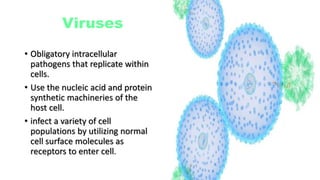
Viruses
• Obligatory intracellular
pathogens that replicate within
cells.
• Use the nucleic acid and protein
synthetic machineries of the
host cell.
• infect a variety of cell
populations by utilizing normal
cell surface molecules as
receptors to enter cell.
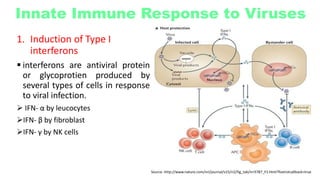
Innate Immune Response to Viruses
1. Induction of Type I
interferons
 interferons are antiviral protein
or glycoprotien produced by
several types of cells in response
to viral infection.
 IFN- α by leucocytes
IFN- β by fibroblast
IFN- γ by NK cells
Source -http://www.nature.com/nri/journal/v15/n2/fig_tab/nri3787_F2.html?foxtrotcallback=true
Mechanism of activity of interferons I
Source – owen kuby immunology chapter 5, fig. 16
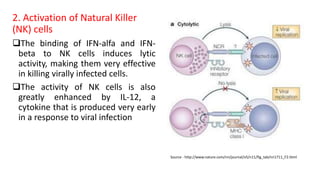
2. Activation of Natural Killer
(NK) cells
The binding of IFN-alfa and IFN-
beta to NK cells induces lytic
activity, making them very effective
in killing virally infected cells.
The activity of NK cells is also
greatly enhanced by IL-12, a
cytokine that is produced very early
in a response to viral infection
Source - http://www.nature.com/nri/journal/v5/n11/fig_tab/nri1711_F2.html
Specific Immune Response To Viruses
• Humoral mediated immune
response
• Viral Neutralization by Humoral
Antibody
• i.e. Secretory IgA in mucous secretions
• Viral Neutralization by antibody
sometimes occurs after viral attachment.
• Block viral penetration.
Specific Immune Response to Viruses
• Activated Th1 cells produce several
cytokines
 IL-2
 Acts indirectly by assisting the
development CTL precursors
 Activates NK cells
 IFN-γ
 Directly induces an antiviral
state in near by cells
 Activates NK cells
 TNF
• CTL activity
 Arises within 3-4 days after
infections
 Peaks by 7-10 days, and then
declines
 Have viral specificity
 Eliminites specific virus-
infected cells, thus getting rid
of potential new sources of
new virus
• Cell-mediated immune response
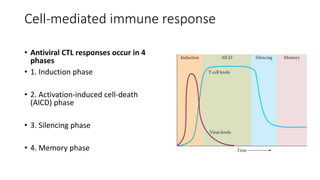
Cell-mediated immune response
• Antiviral CTL responses occur in 4
phases
• 1. Induction phase
• 2. Activation-induced cell-death
(AICD) phase
• 3. Silencing phase
• 4. Memory phase
Viruses Can Evade Host Defence
Mechanism
1. Inhibition of humoral
immune response
 Antigenic variation
• Generation and selecton of
varients with different
antigenic properties
• Genetic variability
• e.g.- influenzae virus & HIV
source -http://www.ppdictionary.com/viruses/flu_a.htm
 complement inactivation
• virus encode homologous protein to
regulatory complement compnents
• blocks secertion and activation of
complement system.
• e.g.- HIV, CMV & VV.
 fc receptor encoding
• virus encodes fc receptors
• antibody bound infected cells bound
to virus encoded fc receptors
2. Interfernce with interferons
 type I interferons (α, β)
• virus block JAK-STAT pathway which block interferon activity.
• inhibition of interferon effactor pathway by inhibiting the PKR.
• encoding soluble interferon receptors block functions of
interferons.
 type II interferons (γ)
• block the synthesis of (γ).
Some developed the strateries to avade the action of IFN-α &
IFN-β.
3. cytokine inhibition
• block cytokine expression e.g.-
ASFV- encode IkB
• block signal transduction
• mimicry of cytokine and its
receptor for its benefit
• secreting cytokine receptor
homolog
4. Some inhibit the antigen presentation
• i.g.- HSV viruses
• HSV-1 and HSV-2 both express an
immediate-early protein called ICP47.
• Inhibits the human transporter
molecule -TAP.
• Inhibition of TAP blocks antigen
delivery to class I MHC receptors on
HSV-infected cells, thus preventing
presentation of viral antigen to CD8+ T
cells.
• Some down-regulate class I MHC
expression i.g.-adenoviruses and
cytomegalovirus.
5. Inhibition of apoptosis
Immunity to virus

Immunity to virus

  • 1.
  • 2.
    Viruses • Obligatory intracellular pathogensthat replicate within cells. • Use the nucleic acid and protein synthetic machineries of the host cell. • infect a variety of cell populations by utilizing normal cell surface molecules as receptors to enter cell.
  • 3.
    Innate Immune Responseto Viruses 1. Induction of Type I interferons  interferons are antiviral protein or glycoprotien produced by several types of cells in response to viral infection.  IFN- α by leucocytes IFN- β by fibroblast IFN- γ by NK cells Source -http://www.nature.com/nri/journal/v15/n2/fig_tab/nri3787_F2.html?foxtrotcallback=true
  • 4.
    Mechanism of activityof interferons I Source – owen kuby immunology chapter 5, fig. 16
  • 5.
    2. Activation ofNatural Killer (NK) cells The binding of IFN-alfa and IFN- beta to NK cells induces lytic activity, making them very effective in killing virally infected cells. The activity of NK cells is also greatly enhanced by IL-12, a cytokine that is produced very early in a response to viral infection Source - http://www.nature.com/nri/journal/v5/n11/fig_tab/nri1711_F2.html
  • 6.
    Specific Immune ResponseTo Viruses • Humoral mediated immune response • Viral Neutralization by Humoral Antibody • i.e. Secretory IgA in mucous secretions • Viral Neutralization by antibody sometimes occurs after viral attachment. • Block viral penetration.
  • 7.
    Specific Immune Responseto Viruses • Activated Th1 cells produce several cytokines  IL-2  Acts indirectly by assisting the development CTL precursors  Activates NK cells  IFN-γ  Directly induces an antiviral state in near by cells  Activates NK cells  TNF • CTL activity  Arises within 3-4 days after infections  Peaks by 7-10 days, and then declines  Have viral specificity  Eliminites specific virus- infected cells, thus getting rid of potential new sources of new virus • Cell-mediated immune response
  • 8.
    Cell-mediated immune response •Antiviral CTL responses occur in 4 phases • 1. Induction phase • 2. Activation-induced cell-death (AICD) phase • 3. Silencing phase • 4. Memory phase
  • 10.
    Viruses Can EvadeHost Defence Mechanism 1. Inhibition of humoral immune response  Antigenic variation • Generation and selecton of varients with different antigenic properties • Genetic variability • e.g.- influenzae virus & HIV source -http://www.ppdictionary.com/viruses/flu_a.htm
  • 11.
     complement inactivation •virus encode homologous protein to regulatory complement compnents • blocks secertion and activation of complement system. • e.g.- HIV, CMV & VV.  fc receptor encoding • virus encodes fc receptors • antibody bound infected cells bound to virus encoded fc receptors
  • 12.
    2. Interfernce withinterferons  type I interferons (α, β) • virus block JAK-STAT pathway which block interferon activity. • inhibition of interferon effactor pathway by inhibiting the PKR. • encoding soluble interferon receptors block functions of interferons.  type II interferons (γ) • block the synthesis of (γ).
  • 13.
    Some developed thestrateries to avade the action of IFN-α & IFN-β.
  • 14.
    3. cytokine inhibition •block cytokine expression e.g.- ASFV- encode IkB • block signal transduction • mimicry of cytokine and its receptor for its benefit • secreting cytokine receptor homolog
  • 16.
    4. Some inhibitthe antigen presentation • i.g.- HSV viruses • HSV-1 and HSV-2 both express an immediate-early protein called ICP47. • Inhibits the human transporter molecule -TAP. • Inhibition of TAP blocks antigen delivery to class I MHC receptors on HSV-infected cells, thus preventing presentation of viral antigen to CD8+ T cells. • Some down-regulate class I MHC expression i.g.-adenoviruses and cytomegalovirus.
  • 17.