Vision of 5G wireless technology
• 5G envisions to design a real wireless world,
that is free from obstacles of the earlier
generations.
• This requires an integration of networks.
• 5G aims to design a Multi-Bandwidth Data
Path by integrating the current and future
networks for new network architecture of 5G
real wireless world.
Global efforts for a
global standard 2020
Technology Leadership
in all
5G domains
Track record in
digitalization of industri
World leading research
together with industry
and academia
Introduction
• In this presentation we will discuss 5G
wireless systems, better known as 5th
generation mobile technology.
• Mobile wireless industry had started its
technology creation, revolution and evolution
since early 1970’s.
• 5G wireless technology can change the way
we use wireless gadgets by providing very
high bandwidth
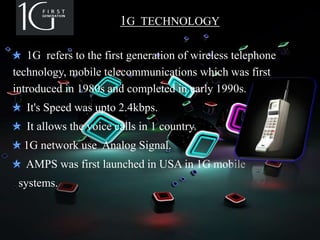
1G TECHNOLOGY
1G refers to the first generation of wireless telephone
technology, mobile telecommunications which was first
introduced in 1980s and completed in early 1990s.
It's Speed was upto 2.4kbps.
It allows the voice calls in 1 country.
1G network use Analog Signal.
AMPS was first launched in USA in 1G mobile
systems.
2G TECHNOLOGY
 2G technology refers to the 2nd generation which is
based on GSM.
 It was launched in Finland in the year 1991.
 2G network use digital signals.
 It’s data speed was upto 64kbps.
Features Includes:
 It enables services such as text messages,
picture messages and MMS (multi media message).
 It provides better quality and capacity .
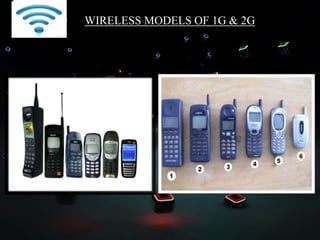
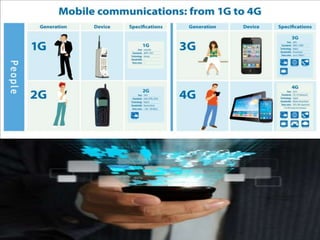
WIRELESS MODELS OF 1G & 2G
1G WIRELESS SYSTEMS 2G WIRELESS SYSTEMS
2.5G TECHNOLOGY
 2.5G is a technology between the second (2G) and
third (3G) generation of mobile telephony.
 2.5G is sometimes described as 2G Cellular
Technology combined with General
Packet Radio Service (GPRS).
Features Includes:
 Phone Calls
 Send/Receive E-mail Messages
 Web Browsing
 Speed : 64-144 kbps
 Camera Phones
 Take a time of 6-9 mins. to download a 3 mins. Mp3 song
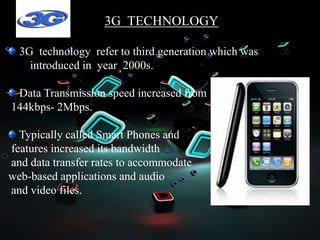
3G TECHNOLOGY
3G technology refer to third generation which was
introduced in year 2000s.
Data Transmission speed increased from
144kbps- 2Mbps.
Typically called Smart Phones and
features increased its bandwidth
and data transfer rates to accommodate
web-based applications and audio
and video files.
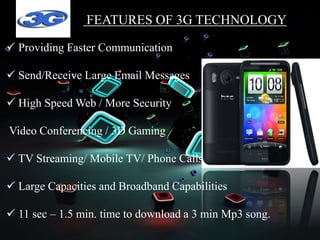
FEATURES OF 3G TECHNOLOGY
 Providing Faster Communication
 Send/Receive Large Email Messages
 High Speed Web / More Security
Video Conferencing / 3D Gaming
 TV Streaming/ Mobile TV/ Phone Calls
 Large Capacities and Broadband Capabilities
 11 sec – 1.5 min. time to download a 3 min Mp3 song.
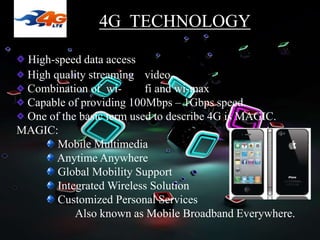
High-speed data access
High quality streaming video
Combination of wi- fi and wi-max
Capable of providing 100Mbps – 1Gbps speed.
One of the basic term used to describe 4G is MAGIC.
MAGIC:
Mobile Multimedia
Anytime Anywhere
Global Mobility Support
Integrated Wireless Solution
Customized Personal Services
Also known as Mobile Broadband Everywhere.
4G TECHNOLOGY
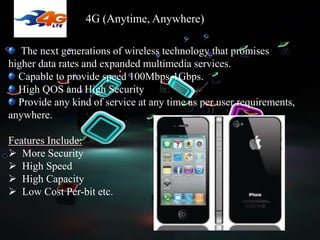
4G (Anytime, Anywhere)
The next generations of wireless technology that promises
higher data rates and expanded multimedia services.
Capable to provide speed 100Mbps-1Gbps.
High QOS and High Security
Provide any kind of service at any time as per user requirements,
anywhere.
Features Include:
 More Security
 High Speed
 High Capacity
 Low Cost Per-bit etc.
5G TECHNOLOGY
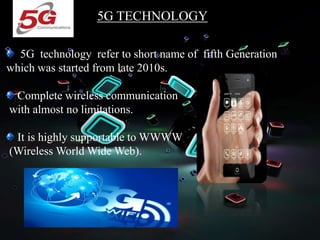
5G technology refer to short name of fifth Generation
which was started from late 2010s.
Complete wireless communication
with almost no limitations.
It is highly supportable to WWWW
(Wireless World Wide Web).
Comparison of 1G to 5G
technologies
Technology 1G 2G/2.5G 3G 4G
5G
Deployment 1970/1984 1980/1999 1990/2002 2000/2010 2014/2015
Bandwidth 2kbps 14-64kbps 2mbps 200mbps >1gbps
Technology Analog
cellular
Digital
cellular
Broadbandwidth
/cdma/ip
technology
Unified ip &seamless
combo of
LAN/WAN/WLAN/PAN 4G+WWWW
Service Mobile
telephony
Digital
voice,short
messaging
Integrated high
quality audio,
video & data
Dynamic
information access,
variable devices
Dynamic information
access, variable devices
with AI capabilities
Multiplexing FDMA TDMA/CDMA CDMA CDMA CDMA
Switching Circuit Circuit/circuit for
access network&air
interface
Packet except for
air interface
All packet All packet
Core network PSTN PSTN Packet
network
Internet Internet
Handoff Horizontal Horizontal Horizontal Horizontal&
Vertical
Horizontal&
Vertical
• The 5G wireless internet networks are real
wireless world which shall be supported by
CDMA, OFDM, MCCDMA, UWB and IPv6.
• 5G technology has extraordinary data
capabilities and has ability to tie together
unrestricted call volumes and infinite data
broadcast within latest mobile operating
system.
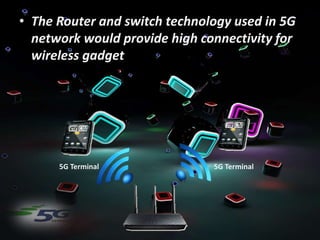
• The Router and switch technology used in 5G
network would provide high connectivity for
wireless gadget
5G Terminal 5G Terminal
• 5G Technologies will have an extraordinary
capability to support Software and
Consultancy.
• The 5G technology aims to distributes
internet access to nodes across the world
with almost seamless speed.
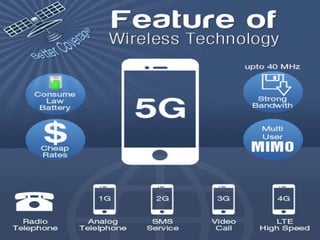
Features Of 5G Wireless
Technology
• 5G technology would offer high resolution for
wireless gadget users and bi-directional large
bandwidth shaping.
• The advanced billing interfaces of 5G
technology makes it more attractive and
effective.
• The high quality services of 5G technology is
based on Policy to avoid error.
Conclusion
• 5G technology is going to be a new
revolution in wireless systems market.
• As data traffic has tremendous growth
potential, under 4G existing voice centric
telecom hierarchies will be moving flat IP
architecture where, base stations will be
directly connected to media gateways.
• 5G will promote concept of Super Core,
where all the network operators will be
connected one single core and have one
single infrastructure, regardless of their
access technologies.
• 5G will bring evaluation of active infra
sharing and managed services and eventually
all existing network operators will be MVNOs
(Mobile virtual network operators).
5 g (fifth gen.)
5 g (fifth gen.)

5 g (fifth gen.)

  • 3.
    Vision of 5Gwireless technology • 5G envisions to design a real wireless world, that is free from obstacles of the earlier generations. • This requires an integration of networks. • 5G aims to design a Multi-Bandwidth Data Path by integrating the current and future networks for new network architecture of 5G real wireless world. Global efforts for a global standard 2020 Technology Leadership in all 5G domains Track record in digitalization of industri World leading research together with industry and academia
  • 4.
    Introduction • In thispresentation we will discuss 5G wireless systems, better known as 5th generation mobile technology. • Mobile wireless industry had started its technology creation, revolution and evolution since early 1970’s. • 5G wireless technology can change the way we use wireless gadgets by providing very high bandwidth
  • 5.
    1G TECHNOLOGY 1G refersto the first generation of wireless telephone technology, mobile telecommunications which was first introduced in 1980s and completed in early 1990s. It's Speed was upto 2.4kbps. It allows the voice calls in 1 country. 1G network use Analog Signal. AMPS was first launched in USA in 1G mobile systems.
  • 6.
    2G TECHNOLOGY  2Gtechnology refers to the 2nd generation which is based on GSM.  It was launched in Finland in the year 1991.  2G network use digital signals.  It’s data speed was upto 64kbps. Features Includes:  It enables services such as text messages, picture messages and MMS (multi media message).  It provides better quality and capacity .
  • 7.
    WIRELESS MODELS OF1G & 2G 1G WIRELESS SYSTEMS 2G WIRELESS SYSTEMS
  • 8.
    2.5G TECHNOLOGY  2.5Gis a technology between the second (2G) and third (3G) generation of mobile telephony.  2.5G is sometimes described as 2G Cellular Technology combined with General Packet Radio Service (GPRS). Features Includes:  Phone Calls  Send/Receive E-mail Messages  Web Browsing  Speed : 64-144 kbps  Camera Phones  Take a time of 6-9 mins. to download a 3 mins. Mp3 song
  • 9.
    3G TECHNOLOGY 3G technologyrefer to third generation which was introduced in year 2000s. Data Transmission speed increased from 144kbps- 2Mbps. Typically called Smart Phones and features increased its bandwidth and data transfer rates to accommodate web-based applications and audio and video files.
  • 10.
    FEATURES OF 3GTECHNOLOGY  Providing Faster Communication  Send/Receive Large Email Messages  High Speed Web / More Security Video Conferencing / 3D Gaming  TV Streaming/ Mobile TV/ Phone Calls  Large Capacities and Broadband Capabilities  11 sec – 1.5 min. time to download a 3 min Mp3 song.
  • 11.
    High-speed data access Highquality streaming video Combination of wi- fi and wi-max Capable of providing 100Mbps – 1Gbps speed. One of the basic term used to describe 4G is MAGIC. MAGIC: Mobile Multimedia Anytime Anywhere Global Mobility Support Integrated Wireless Solution Customized Personal Services Also known as Mobile Broadband Everywhere. 4G TECHNOLOGY
  • 12.
    4G (Anytime, Anywhere) Thenext generations of wireless technology that promises higher data rates and expanded multimedia services. Capable to provide speed 100Mbps-1Gbps. High QOS and High Security Provide any kind of service at any time as per user requirements, anywhere. Features Include:  More Security  High Speed  High Capacity  Low Cost Per-bit etc.
  • 13.
    5G TECHNOLOGY 5G technologyrefer to short name of fifth Generation which was started from late 2010s. Complete wireless communication with almost no limitations. It is highly supportable to WWWW (Wireless World Wide Web).
  • 14.
    Comparison of 1Gto 5G technologies Technology 1G 2G/2.5G 3G 4G 5G Deployment 1970/1984 1980/1999 1990/2002 2000/2010 2014/2015 Bandwidth 2kbps 14-64kbps 2mbps 200mbps >1gbps Technology Analog cellular Digital cellular Broadbandwidth /cdma/ip technology Unified ip &seamless combo of LAN/WAN/WLAN/PAN 4G+WWWW Service Mobile telephony Digital voice,short messaging Integrated high quality audio, video & data Dynamic information access, variable devices Dynamic information access, variable devices with AI capabilities Multiplexing FDMA TDMA/CDMA CDMA CDMA CDMA Switching Circuit Circuit/circuit for access network&air interface Packet except for air interface All packet All packet Core network PSTN PSTN Packet network Internet Internet Handoff Horizontal Horizontal Horizontal Horizontal& Vertical Horizontal& Vertical
  • 16.
    • The 5Gwireless internet networks are real wireless world which shall be supported by CDMA, OFDM, MCCDMA, UWB and IPv6. • 5G technology has extraordinary data capabilities and has ability to tie together unrestricted call volumes and infinite data broadcast within latest mobile operating system.
  • 17.
    • The Routerand switch technology used in 5G network would provide high connectivity for wireless gadget 5G Terminal 5G Terminal
  • 19.
    • 5G Technologieswill have an extraordinary capability to support Software and Consultancy. • The 5G technology aims to distributes internet access to nodes across the world with almost seamless speed.
  • 20.
    Features Of 5GWireless Technology • 5G technology would offer high resolution for wireless gadget users and bi-directional large bandwidth shaping. • The advanced billing interfaces of 5G technology makes it more attractive and effective. • The high quality services of 5G technology is based on Policy to avoid error.
  • 22.
    Conclusion • 5G technologyis going to be a new revolution in wireless systems market. • As data traffic has tremendous growth potential, under 4G existing voice centric telecom hierarchies will be moving flat IP architecture where, base stations will be directly connected to media gateways.
  • 23.
    • 5G willpromote concept of Super Core, where all the network operators will be connected one single core and have one single infrastructure, regardless of their access technologies. • 5G will bring evaluation of active infra sharing and managed services and eventually all existing network operators will be MVNOs (Mobile virtual network operators).