technology
Contents
introductionof5gwirelesstechnology
Historyofwirelesstechnology
Architectureof5gwirelesstechnology
Featuresof5gwirelesstechnology
How5gwirelesstechnologyworks
Evolutionfrom1g to5g
Comparingfrom1g to5g
Hardware& softwareof5g
Conclusion
introductionof 5g wirelesstechnology
•5G is the fifth generation
wireless technology for digital
cellular networks that began
wide deployment in 2019. As
with previous standards, the
covered areas are divided into
regions called "cells", serviced
by individual antennas.
Historyof wirelesstechnology
•The term wireless has been
used twice in communications
history, with slightly different
meaning. It was initially used
from about 1890 for the first
radio transmitting and receiving
technology, as in wireless
telegraphy, until the new word
radio replaced it around 1920.
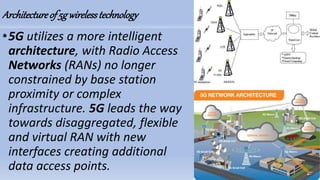
Architectureof5gwirelesstechnology
•5G utilizes a more intelligent
architecture, with Radio Access
Networks (RANs) no longer
constrained by base station
proximity or complex
infrastructure. 5G leads the way
towards disaggregated, flexible
and virtual RAN with new
interfaces creating additional
data access points.
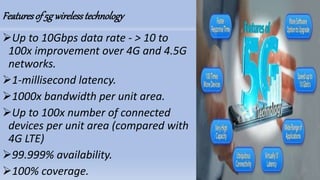
Featuresof5gwirelesstechnology
Up to 10Gbps data rate - > 10 to
100x improvement over 4G and 4.5G
networks.
1-millisecond latency.
1000x bandwidth per unit area.
Up to 100x number of connected
devices per unit area (compared with
4G LTE)
99.999% availability.
100% coverage.
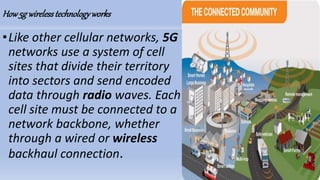
How5g wirelesstechnologyworks
•Like other cellular networks, 5G
networks use a system of cell
sites that divide their territory
into sectors and send encoded
data through radio waves. Each
cell site must be connected to a
network backbone, whether
through a wired or wireless
backhaul connection.
Evolutionfrom1g to 5g
1G
2G
3G
4G
5G
1G
1G – First generation mobile communication
system
Most popular 1G system during 1980s
Key features (technology) of 1G system
Disadvantages of 1G system
1G– Firstgenerationmobilecommunicationsystem
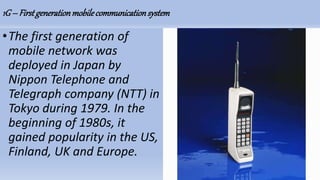
•The first generation of
mobile network was
deployed in Japan by
Nippon Telephone and
Telegraph company (NTT) in
Tokyo during 1979. In the
beginning of 1980s, it
gained popularity in the US,
Finland, UK and Europe.
Mostpopular 1G systemduring 1980s
Advanced Mobile Phone
System (AMPS)
Nordic Mobile Phone
System (NMTS)
Total Access
Communication System
(TACS)
European Total Access
Communication System
(ETACS)
Keyfeatures(technology) of 1Gsystem
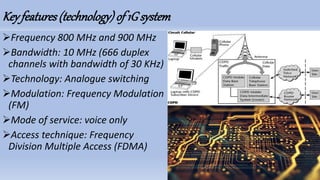
Frequency 800 MHz and 900 MHz
Bandwidth: 10 MHz (666 duplex
channels with bandwidth of 30 KHz)
Technology: Analogue switching
Modulation: Frequency Modulation
(FM)
Mode of service: voice only
Access technique: Frequency
Division Multiple Access (FDMA)
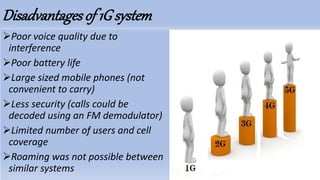
Disadvantagesof 1Gsystem
Poor voice quality due to
interference
Poor battery life
Large sized mobile phones (not
convenient to carry)
Less security (calls could be
decoded using an FM demodulator)
Limited number of users and cell
coverage
Roaming was not possible between
similar systems
2G
Second generation of mobile
communication system
Key features of 2G system
2.5G and 2.75G system
Disadvantages 2g technology
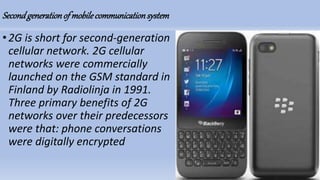
Secondgenerationof mobilecommunicationsystem
•2G is short for second-generation
cellular network. 2G cellular
networks were commercially
launched on the GSM standard in
Finland by Radiolinja in 1991.
Three primary benefits of 2G
networks over their predecessors
were that: phone conversations
were digitally encrypted
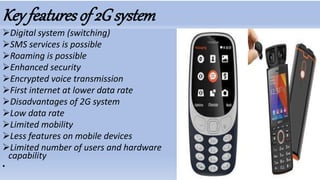
Key featuresof 2G system
Digital system (switching)
SMS services is possible
Roaming is possible
Enhanced security
Encrypted voice transmission
First internet at lower data rate
Disadvantages of 2G system
Low data rate
Limited mobility
Less features on mobile devices
Limited number of users and hardware
capability
•
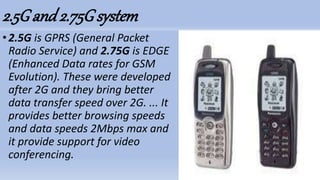
2.5Gand2.75Gsystem
•2.5G is GPRS (General Packet
Radio Service) and 2.75G is EDGE
(Enhanced Data rates for GSM
Evolution). These were developed
after 2G and they bring better
data transfer speed over 2G. ... It
provides better browsing speeds
and data speeds 2Mbps max and
it provide support for video
conferencing.
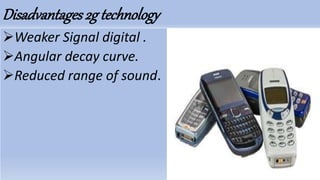
Disadvantages2g technology
Weaker Signal digital .
Angular decay curve.
Reduced range of sound.
3G
3G – Third generation mobile
communication system
Key features of 3G system
3.5G to 3.75 Systems
Disadvantages of 3G systems
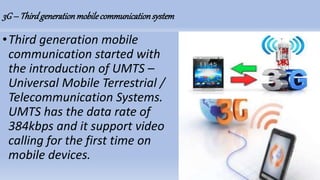
3G– Thirdgenerationmobilecommunicationsystem
•Third generation mobile
communication started with
the introduction of UMTS –
Universal Mobile Terrestrial /
Telecommunication Systems.
UMTS has the data rate of
384kbps and it support video
calling for the first time on
mobile devices.
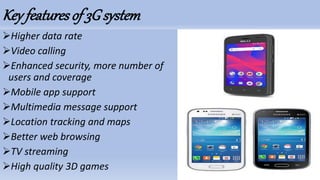
Key featuresof 3Gsystem
Higher data rate
Video calling
Enhanced security, more number of
users and coverage
Mobile app support
Multimedia message support
Location tracking and maps
Better web browsing
TV streaming
High quality 3D games
3.5Gto 3.75 Systems
• In order to enhance data rate in existing 3G
networks, another two technology
improvements are introduced to network.
HSDPA – High Speed Downlink Packet access
and HSUPA – High Speed Uplink Packet Access,
developed and deployed to the 3G networks.
3.5G network can support up to 2mbps data
rate.
3.75 system is an improved version of 3G
network with HSPA+ High Speed Packet Access
plus. Later this system will evolve into more
powerful 3.9G system known as LTE (Long
Term Evolution).
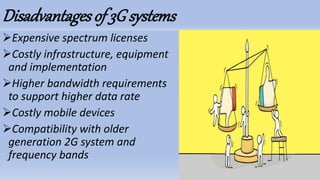
Disadvantagesof 3G systems
Expensive spectrum licenses
Costly infrastructure, equipment
and implementation
Higher bandwidth requirements
to support higher data rate
Costly mobile devices
Compatibility with older
generation 2G system and
frequency bands
4G
4G – Fourth generation communication
system
Key features of 4G system
Disadvantages of 4G system
4G– Fourthgenerationmobilecommunicationsystem
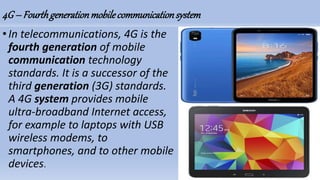
•In telecommunications, 4G is the
fourth generation of mobile
communication technology
standards. It is a successor of the
third generation (3G) standards.
A 4G system provides mobile
ultra-broadband Internet access,
for example to laptops with USB
wireless modems, to
smartphones, and to other mobile
devices.
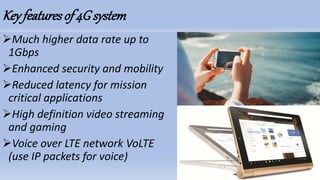
Key featuresof 4G system
Much higher data rate up to
1Gbps
Enhanced security and mobility
Reduced latency for mission
critical applications
High definition video streaming
and gaming
Voice over LTE network VoLTE
(use IP packets for voice)
Disadvantagesof 4G system
Expensive hardware and
infrastructure
Costly spectrum (most countries,
frequency bands are is too
expensive)
High end mobile devices
compatible with 4G technology
required, which is costly
Wide deployment and upgrade is
time consuming
5G
5G – Fifth generation mobile communication
system
Key features of 5G technology
Advantages of 5G technology
5G– Fifthgenerationmobilecommunicationsystem
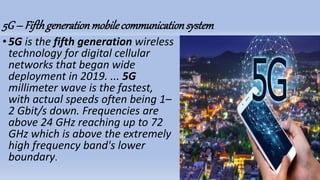
•5G is the fifth generation wireless
technology for digital cellular
networks that began wide
deployment in 2019. ... 5G
millimeter wave is the fastest,
with actual speeds often being 1–
2 Gbit/s down. Frequencies are
above 24 GHz reaching up to 72
GHz which is above the extremely
high frequency band's lower
boundary.
Key featuresof 5G technology
• Ultra fast mobile internet up to 10Gbps
• Low latency in milliseconds (significant for
mission critical applications)
• Total cost deduction for data
• Higher security and reliable network
• Uses technologies like small cells, beam
forming to improve efficiency
• Forward compatibility network offers further
enhancements in future
• Cloud based infrastructure offers power
efficiency, easy maintenance and upgrade of
hardware
Advantagesof 5Gtechnology
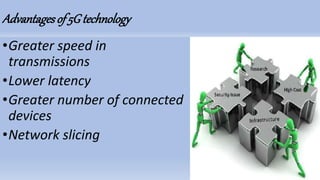
•Greater speed in
transmissions
•Lower latency
•Greater number of connected
devices
•Network slicing
Comparingfrom1g to 5g
5 g wireless technology

5 g wireless technology

  • 1.
  • 2.
  • 3.
    introductionof 5g wirelesstechnology •5Gis the fifth generation wireless technology for digital cellular networks that began wide deployment in 2019. As with previous standards, the covered areas are divided into regions called "cells", serviced by individual antennas.
  • 4.
    Historyof wirelesstechnology •The termwireless has been used twice in communications history, with slightly different meaning. It was initially used from about 1890 for the first radio transmitting and receiving technology, as in wireless telegraphy, until the new word radio replaced it around 1920.
  • 5.
    Architectureof5gwirelesstechnology •5G utilizes amore intelligent architecture, with Radio Access Networks (RANs) no longer constrained by base station proximity or complex infrastructure. 5G leads the way towards disaggregated, flexible and virtual RAN with new interfaces creating additional data access points.
  • 6.
    Featuresof5gwirelesstechnology Up to 10Gbpsdata rate - > 10 to 100x improvement over 4G and 4.5G networks. 1-millisecond latency. 1000x bandwidth per unit area. Up to 100x number of connected devices per unit area (compared with 4G LTE) 99.999% availability. 100% coverage.
  • 7.
    How5g wirelesstechnologyworks •Like othercellular networks, 5G networks use a system of cell sites that divide their territory into sectors and send encoded data through radio waves. Each cell site must be connected to a network backbone, whether through a wired or wireless backhaul connection.
  • 8.
  • 9.
    1G 1G – Firstgeneration mobile communication system Most popular 1G system during 1980s Key features (technology) of 1G system Disadvantages of 1G system
  • 10.
    1G– Firstgenerationmobilecommunicationsystem •The firstgeneration of mobile network was deployed in Japan by Nippon Telephone and Telegraph company (NTT) in Tokyo during 1979. In the beginning of 1980s, it gained popularity in the US, Finland, UK and Europe.
  • 11.
    Mostpopular 1G systemduring1980s Advanced Mobile Phone System (AMPS) Nordic Mobile Phone System (NMTS) Total Access Communication System (TACS) European Total Access Communication System (ETACS)
  • 12.
    Keyfeatures(technology) of 1Gsystem Frequency800 MHz and 900 MHz Bandwidth: 10 MHz (666 duplex channels with bandwidth of 30 KHz) Technology: Analogue switching Modulation: Frequency Modulation (FM) Mode of service: voice only Access technique: Frequency Division Multiple Access (FDMA)
  • 13.
    Disadvantagesof 1Gsystem Poor voicequality due to interference Poor battery life Large sized mobile phones (not convenient to carry) Less security (calls could be decoded using an FM demodulator) Limited number of users and cell coverage Roaming was not possible between similar systems
  • 14.
    2G Second generation ofmobile communication system Key features of 2G system 2.5G and 2.75G system Disadvantages 2g technology
  • 15.
    Secondgenerationof mobilecommunicationsystem •2G isshort for second-generation cellular network. 2G cellular networks were commercially launched on the GSM standard in Finland by Radiolinja in 1991. Three primary benefits of 2G networks over their predecessors were that: phone conversations were digitally encrypted
  • 16.
    Key featuresof 2Gsystem Digital system (switching) SMS services is possible Roaming is possible Enhanced security Encrypted voice transmission First internet at lower data rate Disadvantages of 2G system Low data rate Limited mobility Less features on mobile devices Limited number of users and hardware capability •
  • 17.
    2.5Gand2.75Gsystem •2.5G is GPRS(General Packet Radio Service) and 2.75G is EDGE (Enhanced Data rates for GSM Evolution). These were developed after 2G and they bring better data transfer speed over 2G. ... It provides better browsing speeds and data speeds 2Mbps max and it provide support for video conferencing.
  • 18.
    Disadvantages2g technology Weaker Signaldigital . Angular decay curve. Reduced range of sound.
  • 19.
    3G 3G – Thirdgeneration mobile communication system Key features of 3G system 3.5G to 3.75 Systems Disadvantages of 3G systems
  • 20.
    3G– Thirdgenerationmobilecommunicationsystem •Third generationmobile communication started with the introduction of UMTS – Universal Mobile Terrestrial / Telecommunication Systems. UMTS has the data rate of 384kbps and it support video calling for the first time on mobile devices.
  • 21.
    Key featuresof 3Gsystem Higherdata rate Video calling Enhanced security, more number of users and coverage Mobile app support Multimedia message support Location tracking and maps Better web browsing TV streaming High quality 3D games
  • 22.
    3.5Gto 3.75 Systems •In order to enhance data rate in existing 3G networks, another two technology improvements are introduced to network. HSDPA – High Speed Downlink Packet access and HSUPA – High Speed Uplink Packet Access, developed and deployed to the 3G networks. 3.5G network can support up to 2mbps data rate. 3.75 system is an improved version of 3G network with HSPA+ High Speed Packet Access plus. Later this system will evolve into more powerful 3.9G system known as LTE (Long Term Evolution).
  • 23.
    Disadvantagesof 3G systems Expensivespectrum licenses Costly infrastructure, equipment and implementation Higher bandwidth requirements to support higher data rate Costly mobile devices Compatibility with older generation 2G system and frequency bands
  • 24.
    4G 4G – Fourthgeneration communication system Key features of 4G system Disadvantages of 4G system
  • 25.
    4G– Fourthgenerationmobilecommunicationsystem •In telecommunications,4G is the fourth generation of mobile communication technology standards. It is a successor of the third generation (3G) standards. A 4G system provides mobile ultra-broadband Internet access, for example to laptops with USB wireless modems, to smartphones, and to other mobile devices.
  • 26.
    Key featuresof 4Gsystem Much higher data rate up to 1Gbps Enhanced security and mobility Reduced latency for mission critical applications High definition video streaming and gaming Voice over LTE network VoLTE (use IP packets for voice)
  • 27.
    Disadvantagesof 4G system Expensivehardware and infrastructure Costly spectrum (most countries, frequency bands are is too expensive) High end mobile devices compatible with 4G technology required, which is costly Wide deployment and upgrade is time consuming
  • 28.
    5G 5G – Fifthgeneration mobile communication system Key features of 5G technology Advantages of 5G technology
  • 29.
    5G– Fifthgenerationmobilecommunicationsystem •5G isthe fifth generation wireless technology for digital cellular networks that began wide deployment in 2019. ... 5G millimeter wave is the fastest, with actual speeds often being 1– 2 Gbit/s down. Frequencies are above 24 GHz reaching up to 72 GHz which is above the extremely high frequency band's lower boundary.
  • 30.
    Key featuresof 5Gtechnology • Ultra fast mobile internet up to 10Gbps • Low latency in milliseconds (significant for mission critical applications) • Total cost deduction for data • Higher security and reliable network • Uses technologies like small cells, beam forming to improve efficiency • Forward compatibility network offers further enhancements in future • Cloud based infrastructure offers power efficiency, easy maintenance and upgrade of hardware
  • 31.
    Advantagesof 5Gtechnology •Greater speedin transmissions •Lower latency •Greater number of connected devices •Network slicing
  • 32.