presented by :
Ritesh SaraswatRitesh Saraswat - Associate Professor, JIET , Jodhpur,India
Monika BhatiMonika Bhati - Sr. Assistant Professor, JIET, Jodhpur, India
Ankush PrajapatAnkush Prajapat - Assistant Professor, JIET , Jodhpur, India
1
June 23, 2015 2
11stst
GENERATION:GENERATION:
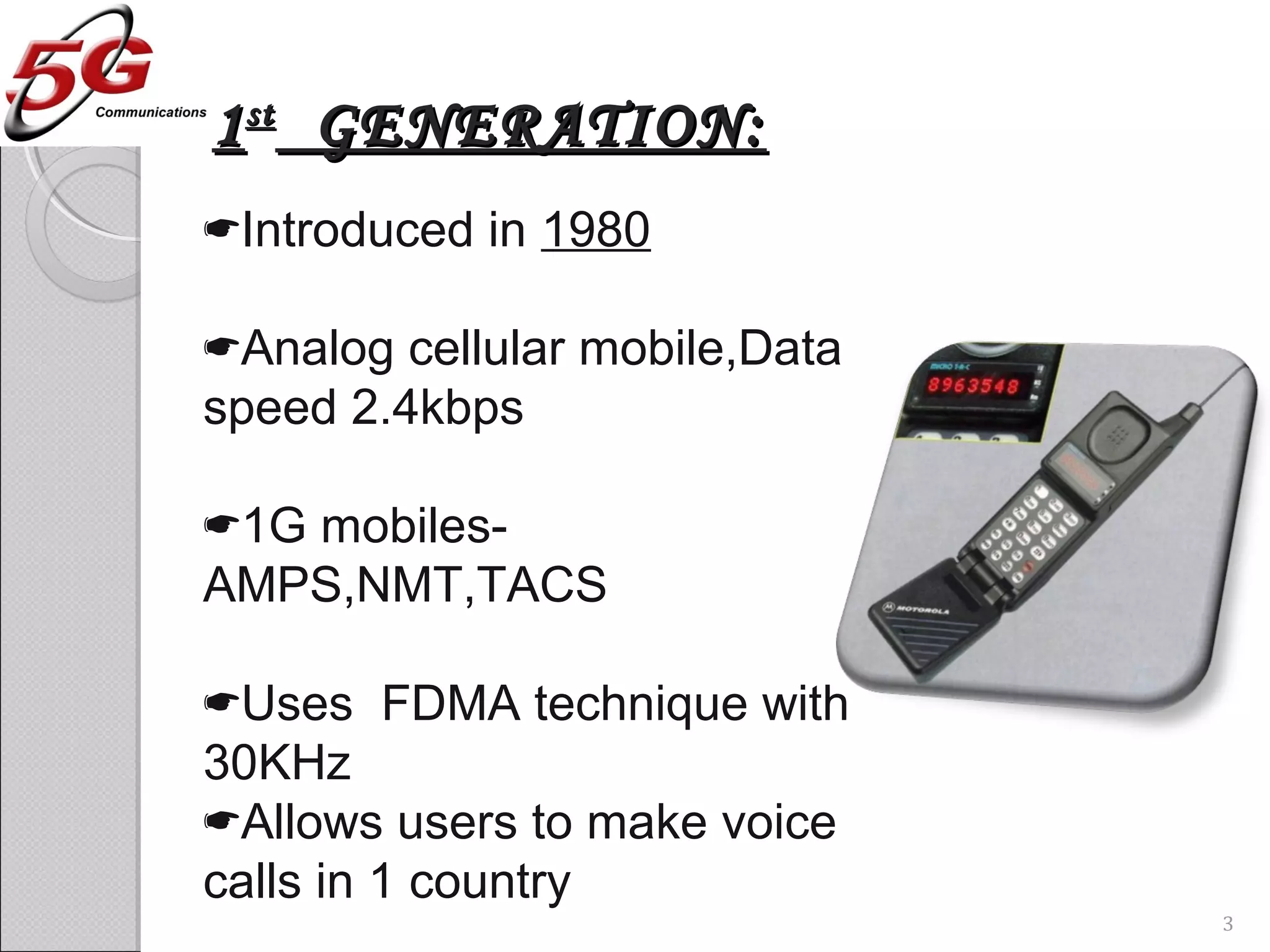
Introduced in 1980
Analog cellular mobile,Data
speed 2.4kbps
1G mobiles-
AMPS,NMT,TACS
Uses FDMA technique with
30KHz
Allows users to make voice
calls in 1 country
3
22ndnd
GENERATION:GENERATION:
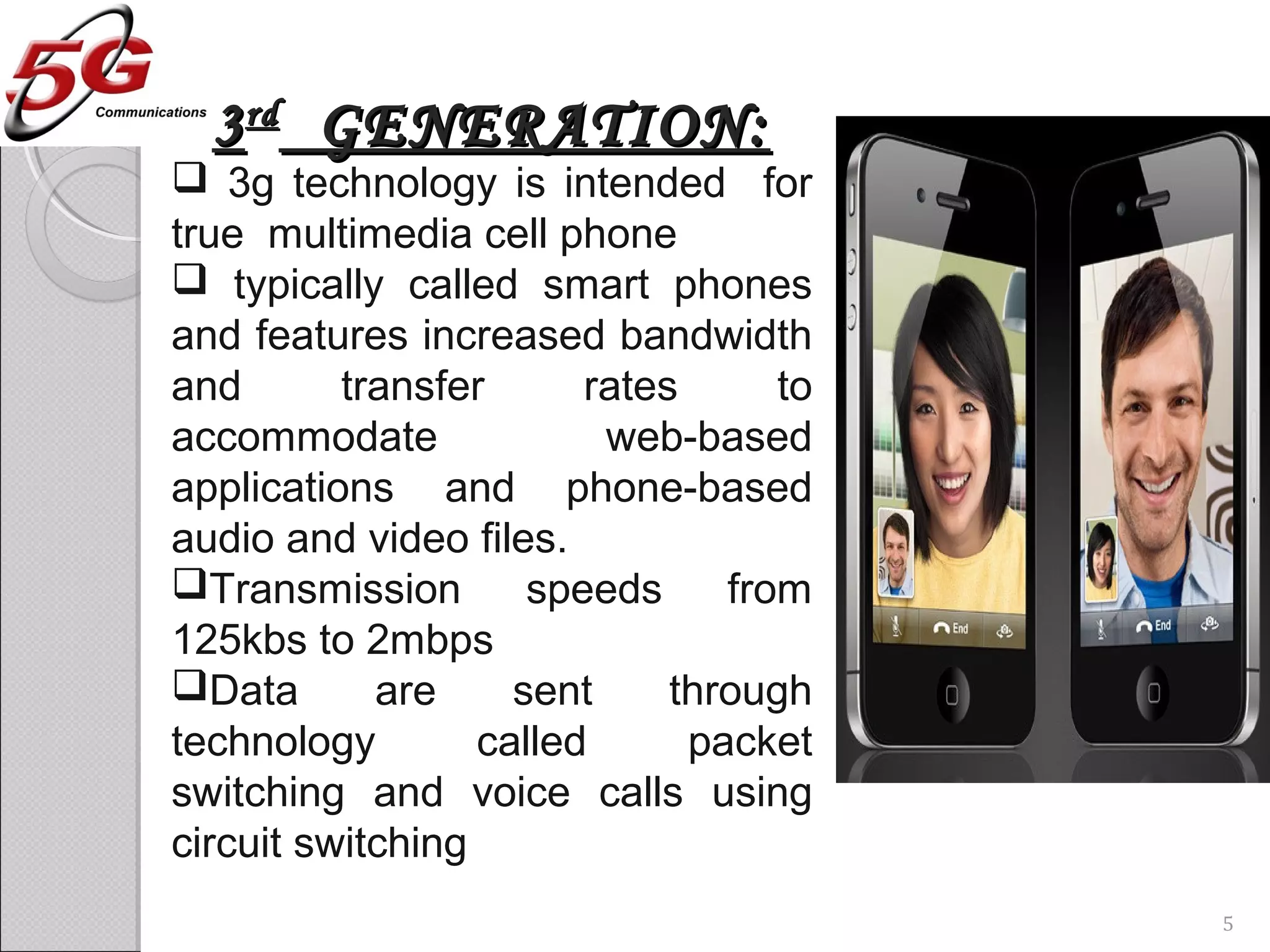
Digital cellular systems
Digital modulation schemes
TDMA,CDMA
Data speed in 2g is up to 64kbps
Data speed in 2.5g is up to
144kbps
GPRS, EDGE and CDMA 2000
were 2.5 technologies.
Planned for voice transmission
with digital signal and the speeds
up to 64kbps.
4
33rdrd
GENERATION:GENERATION:
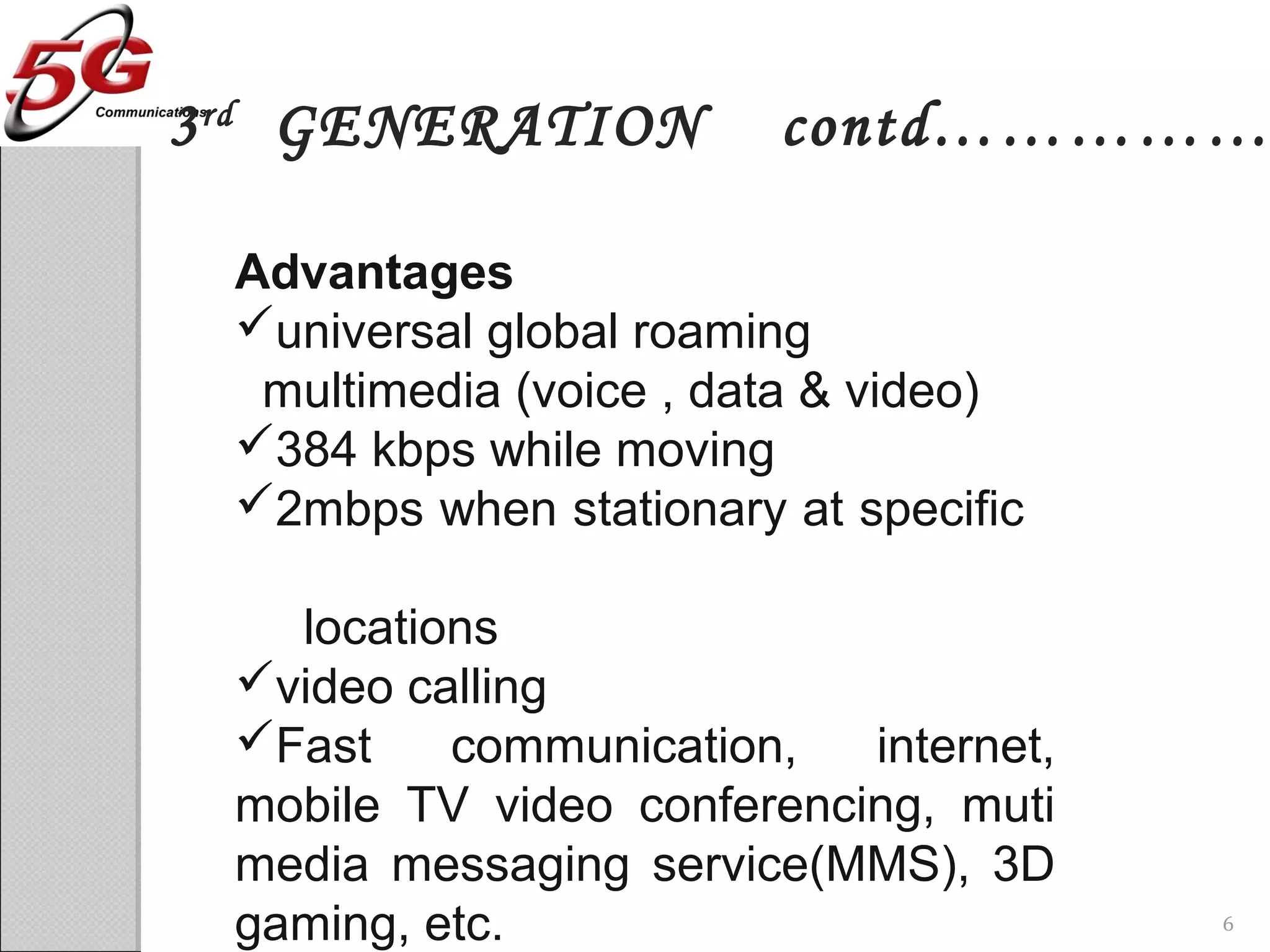
 3g technology is intended for
true multimedia cell phone
 typically called smart phones
and features increased bandwidth
and transfer rates to
accommodate web-based
applications and phone-based
audio and video files.
Transmission speeds from
125kbs to 2mbps
Data are sent through
technology called packet
switching and voice calls using
circuit switching
5
Advantages
universal global roaming
multimedia (voice , data & video)
384 kbps while moving
2mbps when stationary at specific
locations
video calling
Fast communication, internet,
mobile TV video conferencing, muti
media messaging service(MMS), 3D
gaming, etc.
3rd
GENERATION contd……………
6
44thth
GENERATION:GENERATION:
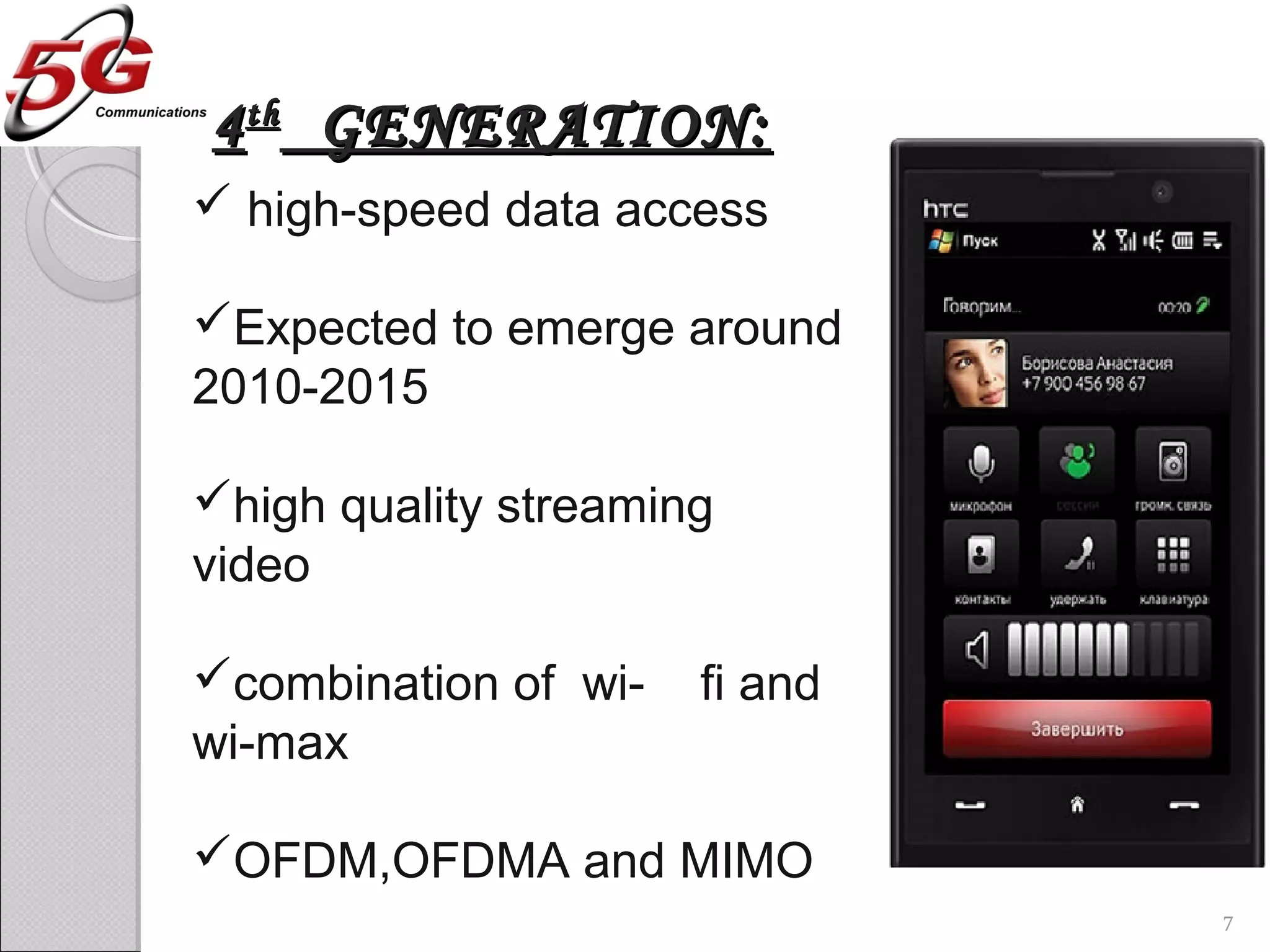
 high-speed data access
Expected to emerge around
2010-2015
high quality streaming
video
combination of wi- fi and
wi-max
OFDM,OFDMA and MIMO
7
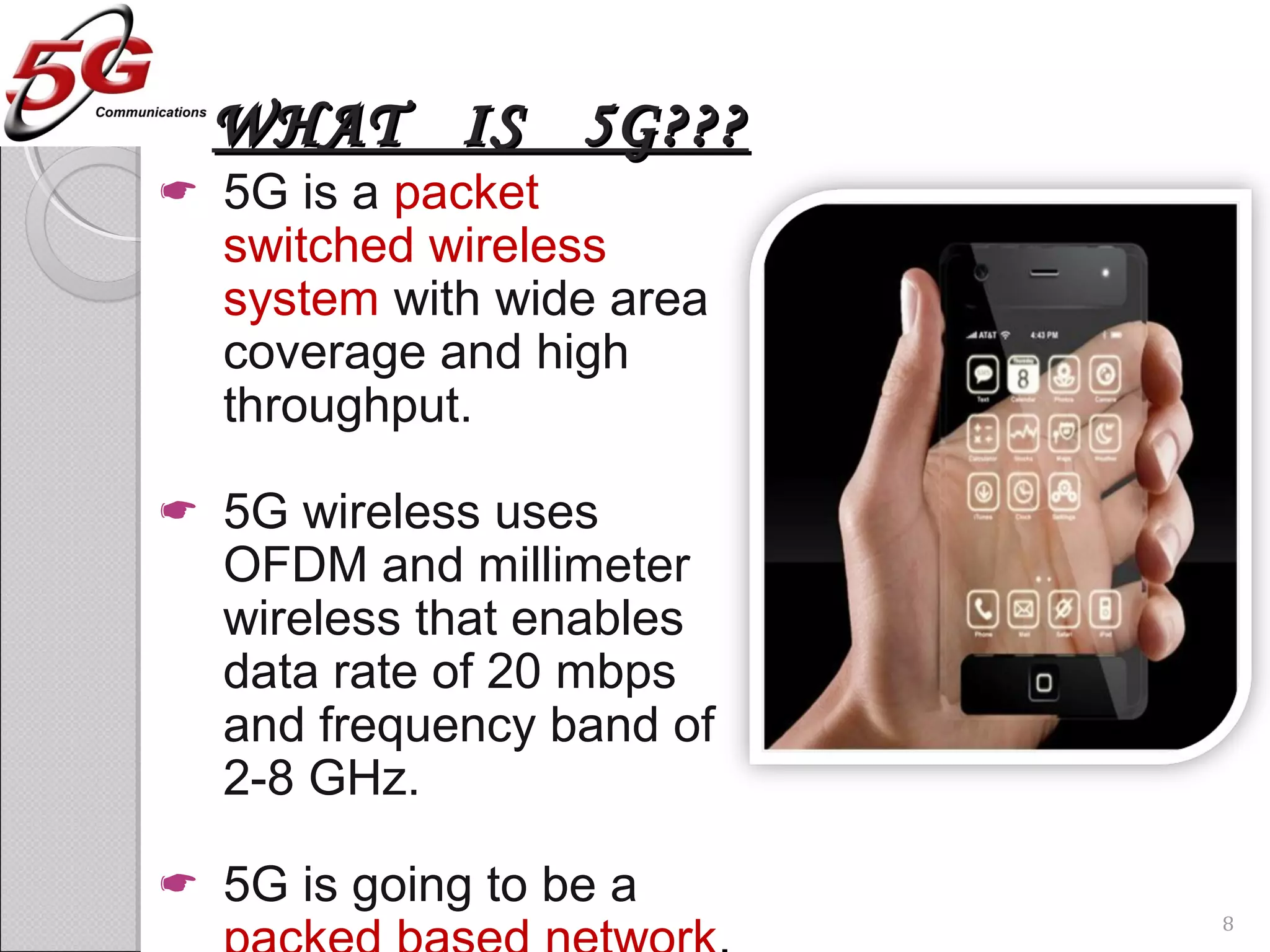
WHAT IS 5G???WHAT IS 5G???
 5G is a packet
switched wireless
system with wide area
coverage and high
throughput.
 5G wireless uses
OFDM and millimeter
wireless that enables
data rate of 20 mbps
and frequency band of
2-8 GHz.
 5G is going to be a
8
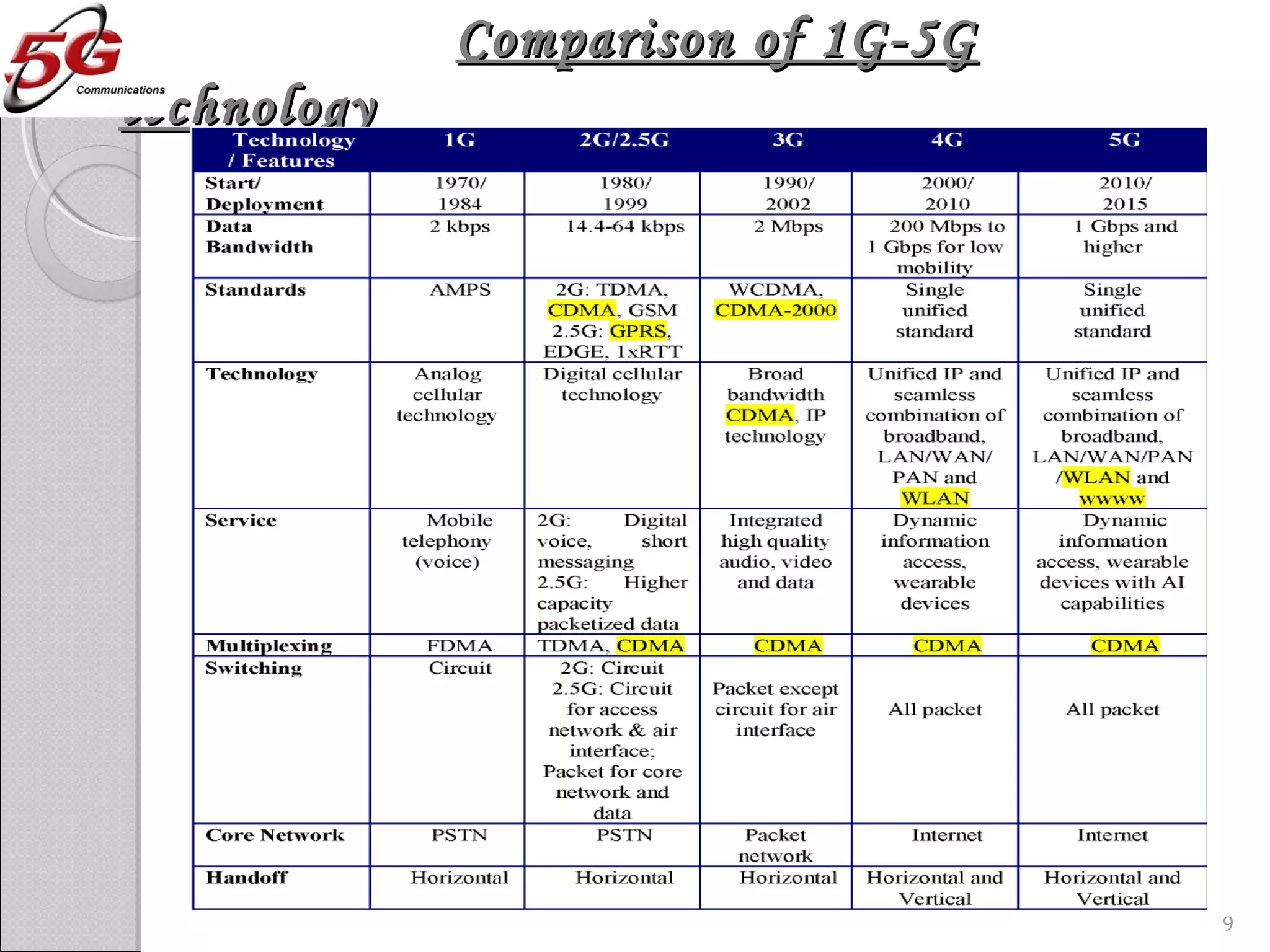
Comparison of 1G-5GComparison of 1G-5G
technologytechnology
9
OBJECTIVES OF 5G:OBJECTIVES OF 5G:
 5G being developed to accommodate QoS
rate requirements set by further development
of existing 4G applications.
 Flexible channel bandwidth between 5 and
20MHz, optionally up to 40MHz.
 Data rate of at least 1Gb/s between any two
points in the world.
 Increase system spectral efficiency of up to
3bit/s/Hz/cell in the downlink and
2.25bit/s/Hz/cell for indoor usage.
10
KEY CONCEPTS OF 5GKEY CONCEPTS OF 5G
 Real wireless world with no more limitation with access and
zone issues.
 Wearable devices with AI capabilities.
 Internet protocol version 6 (IPv6), where a visiting care-of
mobile IP address is assigned according to location and
connected network.
 One unified global standard.
 Pervasive networks providing ubiquitous computing: The user
can simultaneously be connected to several wireless access
technologies and seamlessly move between them
 Cognitive radio technology, also known as smart-radio:
allowing Different radio technologies to share the same
spectrum efficiently.
 High altitude stratospheric platform station (HAPS)
systems .The radio interface of 5G communication systems is
suggested in a Korean research and development program to
be based on beam division multiple access (BDMA) and
group cooperative relay techniques. 11
June 23, 2015 12
Flat IP architectures
• Reduce the number of network elements in
the data path to lower operations costs and
capital expenditure.
• Partially decouple the cost of delivering
service from the volume of data transmitted to
align infrastructure capabilities with emerging
application requirements.
• Minimize system latency and enable
applications with a lower tolerance for delay;
upcoming latency enhancements on the radio
link can also be fully realized.
June 23, 2015 13
• Evolve radio access and packet core
networks independently of each other to a
greater extent than in the past, creating
greater flexibility in network planning and
deployment.
• Develop a flexible core network that can
serve as the basis for service innovation
across both mobile and generic IP access
networks
• Create a platform that will enable mobile
broadband operators to be competitive, from
a price /performance perspective, with wired
networks.
June 23, 2015 14
Cognitive Radio or Software Define Radio
This new radio technologies share the same spectrum
efficiently by finding unused spectrum and adapting the
transmission scheme to the requirements of the
technologies currently sharing the spectrum.
Cognitive radio will have knowledge of free channel
and occupy channel, type of data to be transmitted,
modulation scheme, position of receiving equipment
and also aware of the environment.
June 23, 2015 15
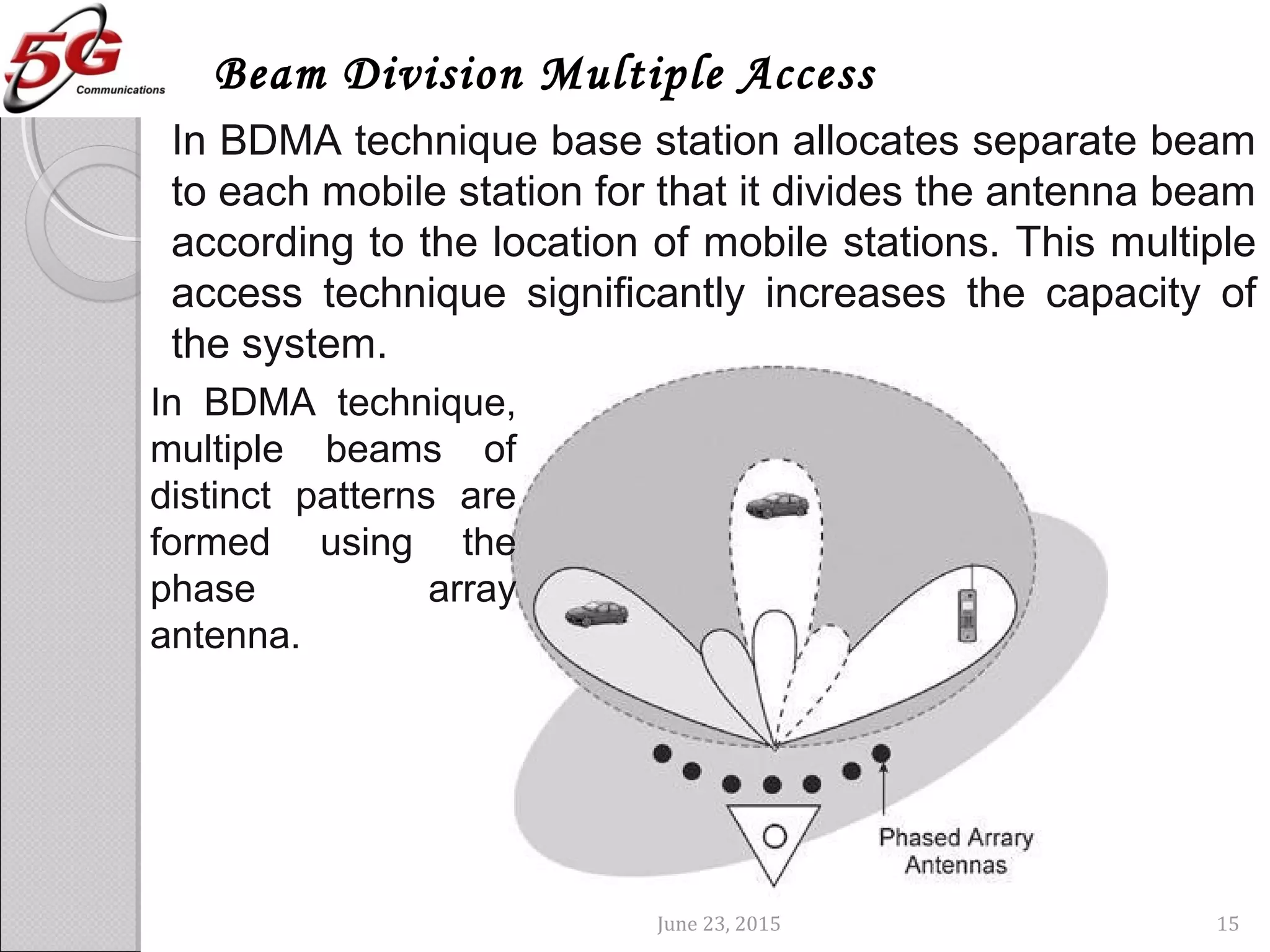
Beam Division Multiple Access
In BDMA technique base station allocates separate beam
to each mobile station for that it divides the antenna beam
according to the location of mobile stations. This multiple
access technique significantly increases the capacity of
the system.
In BDMA technique,
multiple beams of
distinct patterns are
formed using the
phase array
antenna.
IPv6 SUPPORT:IPv6 SUPPORT:
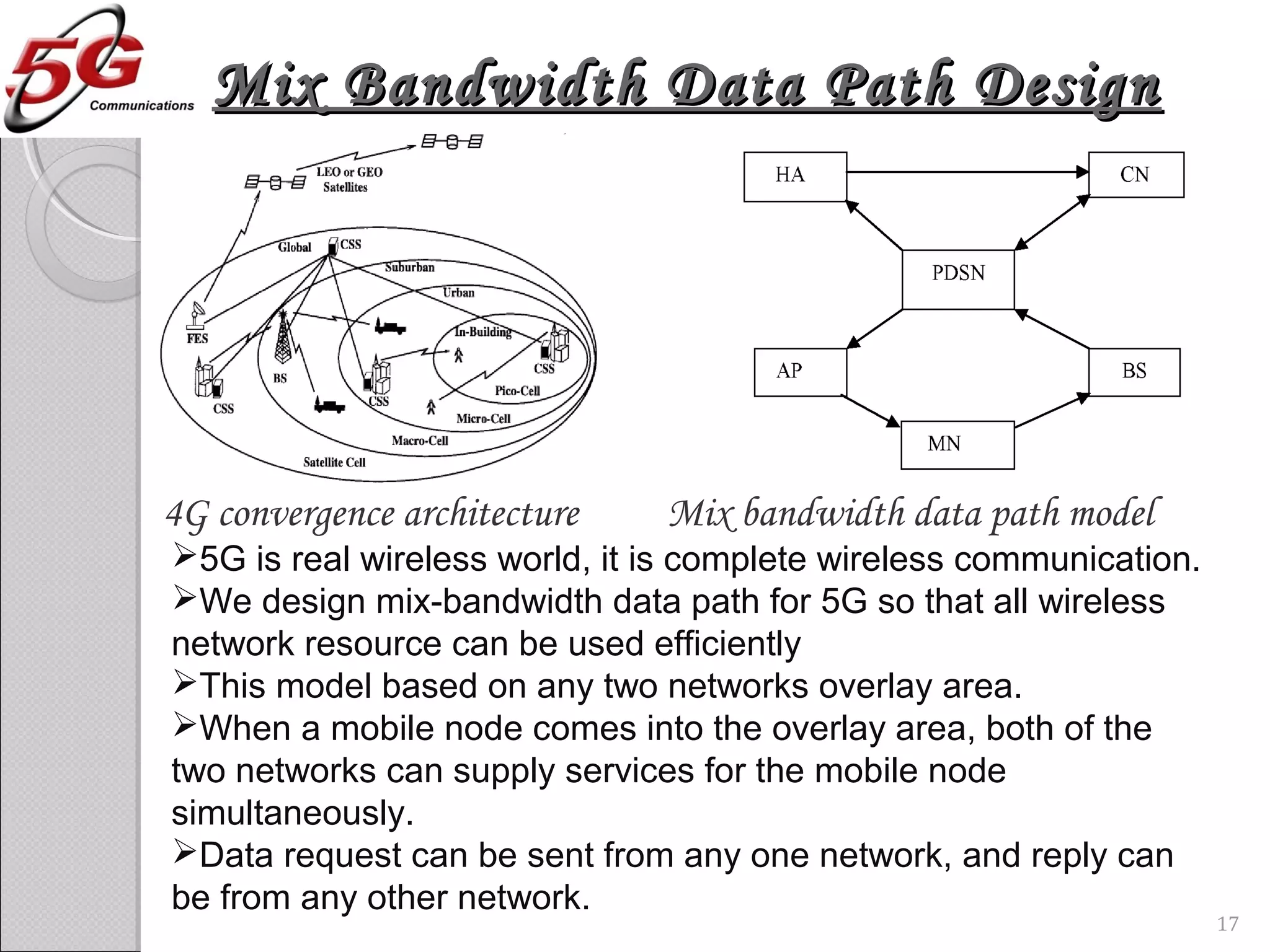
 IPv6 increases the IP addresses size from 32bit to 128
bits, to support more levels of addressing hierarchy and
much greater number of addressable node.
 IPv6 support large number of wireless enabled devices.
 IPv6 Extend the IP address space enough to offer a
unique IP address to any device.
 IPv6 Improve support for IP Mobility.
 IPv6 addresses are 128 bit, which is four times more
than 32 bit IPv4 address.
16
Mix Bandwidth Data Path DesignMix Bandwidth Data Path Design
17
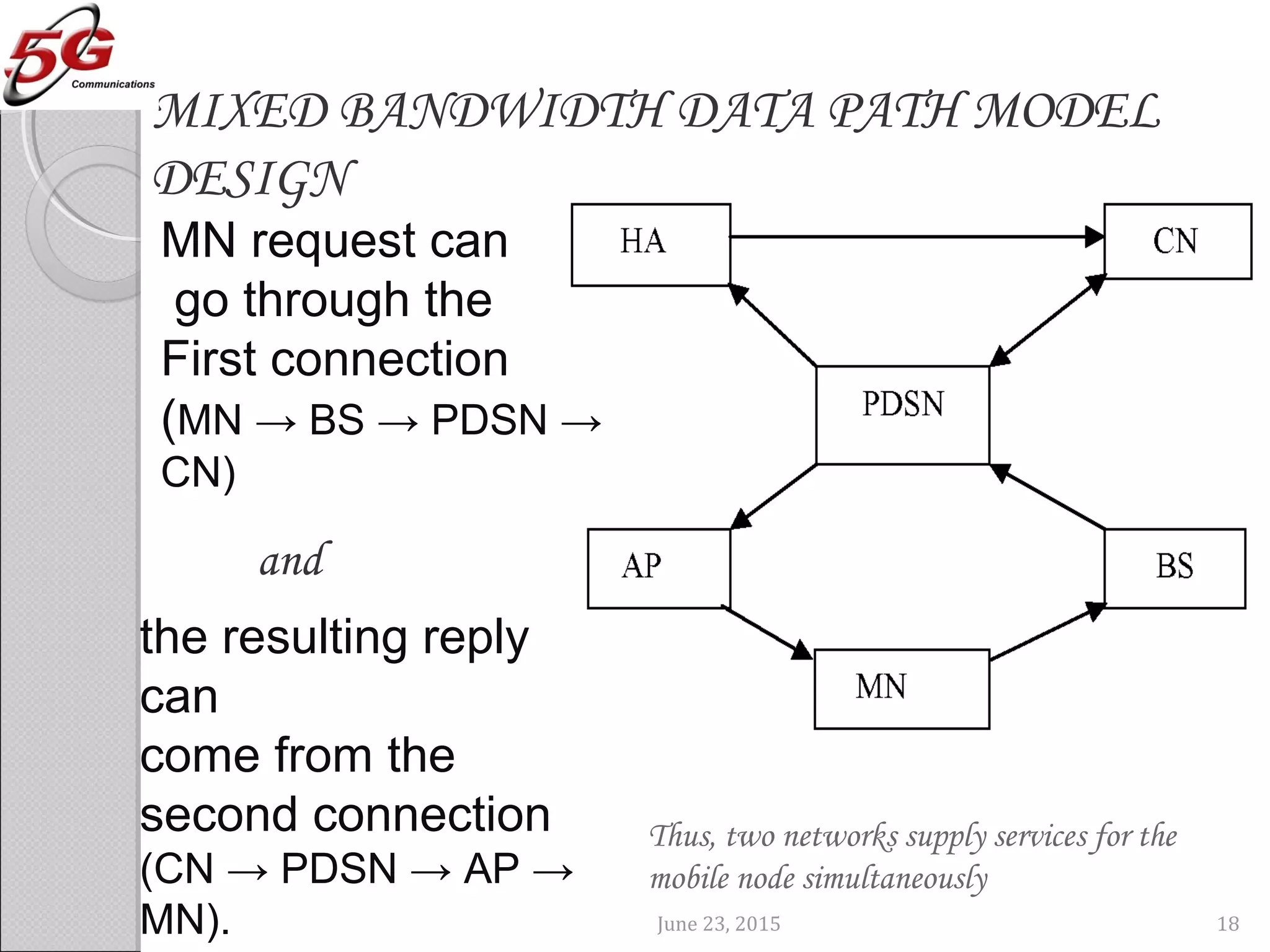
4G convergence architecture Mix bandwidth data path model
5G is real wireless world, it is complete wireless communication.
We design mix-bandwidth data path for 5G so that all wireless
network resource can be used efficiently
This model based on any two networks overlay area.
When a mobile node comes into the overlay area, both of the
two networks can supply services for the mobile node
simultaneously.
Data request can be sent from any one network, and reply can
be from any other network.
June 23, 2015 18
MIXED BANDWIDTH DATA PATH MODEL
DESIGN
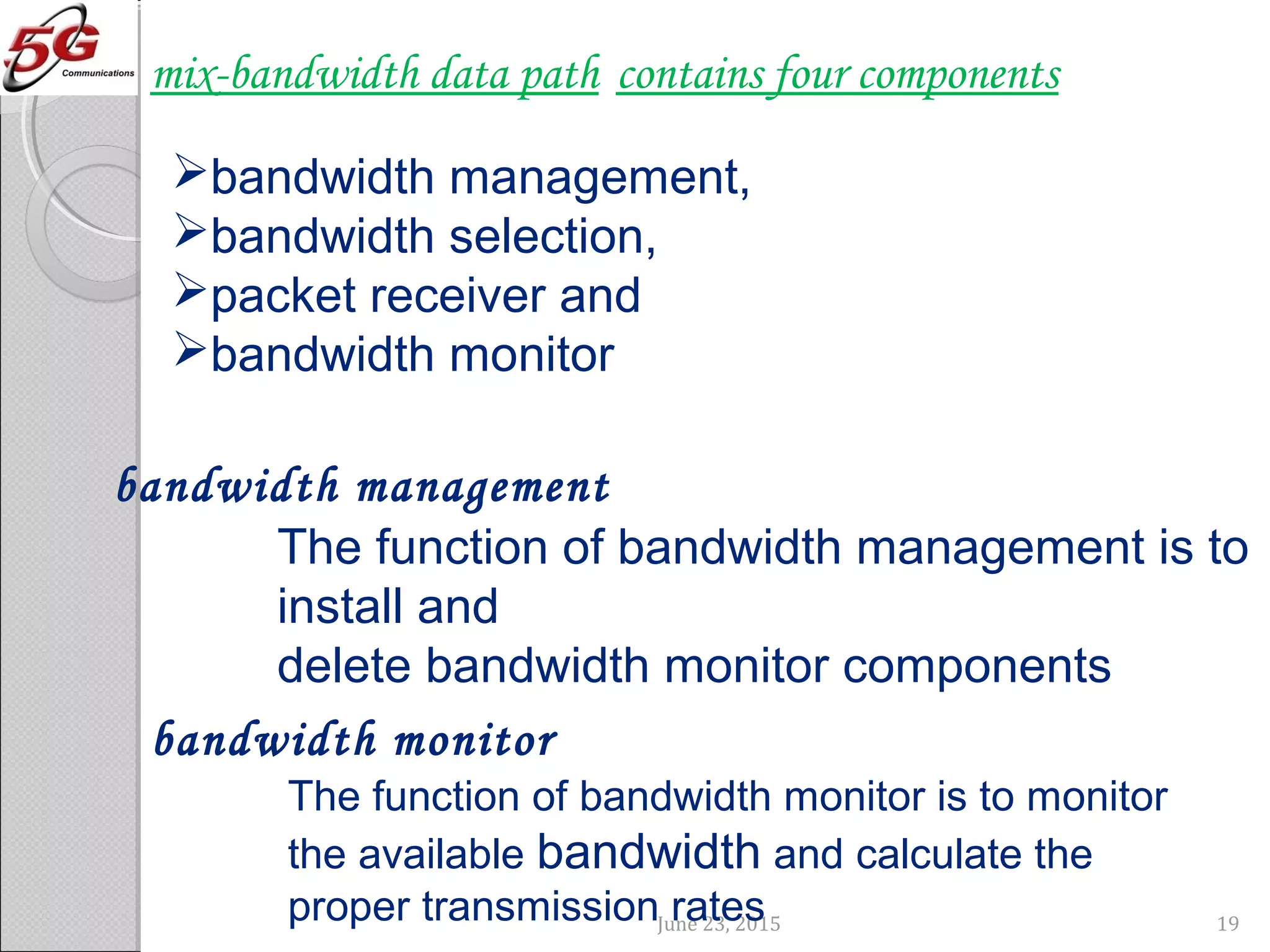
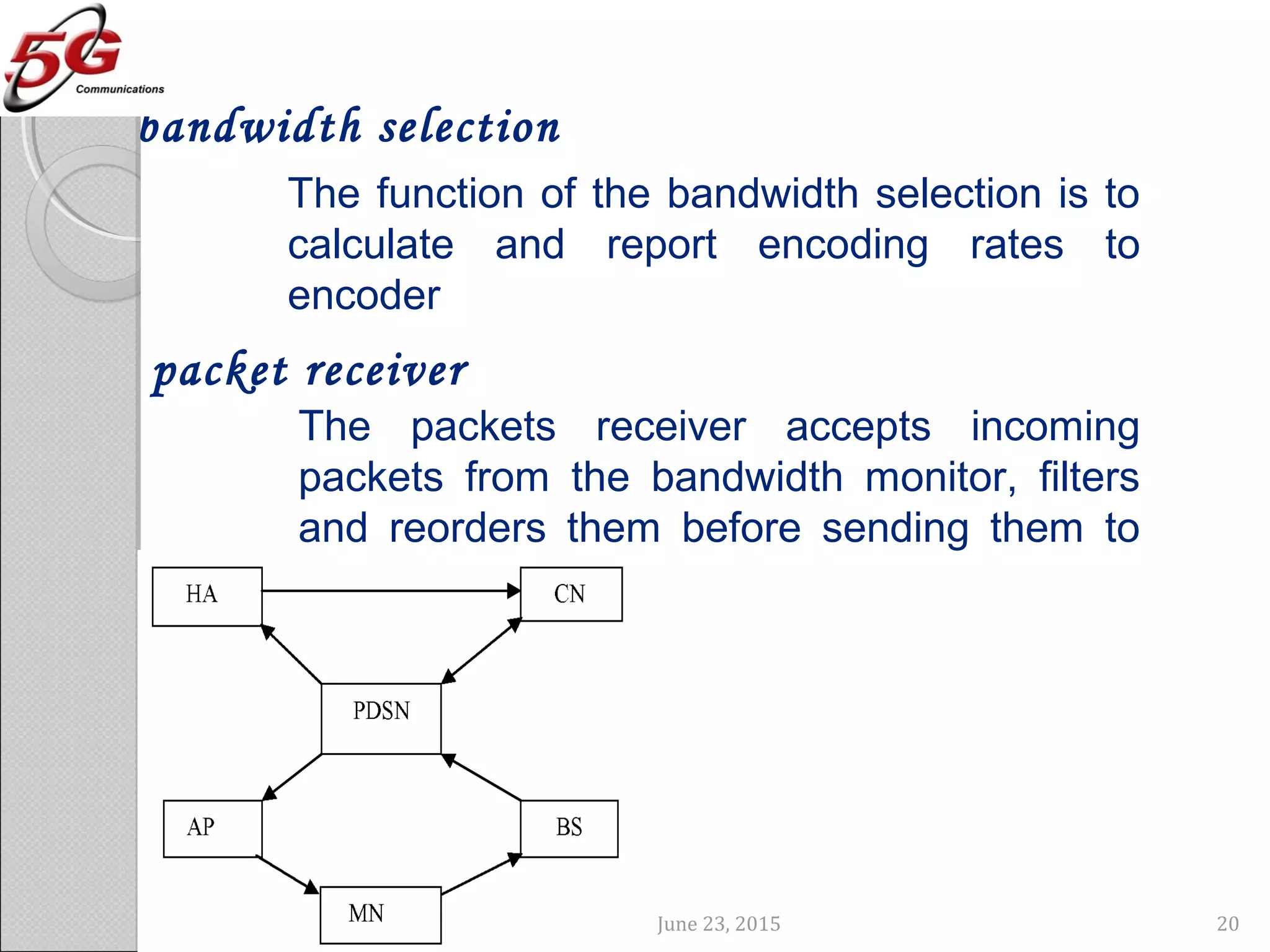
MN request can
go through the
First connection
(MN → BS → PDSN →
CN)
the resulting reply
can
come from the
second connection
(CN → PDSN → AP →
MN).
and
Thus, two networks supply services for the
mobile node simultaneously
June 23, 2015 19
contains four componentsmix-bandwidth data path
bandwidth management,
bandwidth selection,
packet receiver and
bandwidth monitor
The function of bandwidth management is to
install and
delete bandwidth monitor components
bandwidth management
The function of bandwidth monitor is to monitor
the available bandwidth and calculate the
proper transmission rates
bandwidth monitor
June 23, 2015 20
The function of the bandwidth selection is to
calculate and report encoding rates to
encoder
bandwidth selection
The packets receiver accepts incoming
packets from the bandwidth monitor, filters
and reorders them before sending them to
the decoder
packet receiver
BENEFITS OF 5G:BENEFITS OF 5G:
 High speed, high capacity, and low cost per bit.
 Support interactive multimedia, voice, streaming video, Internet, and
other broadband services ,more effective and more attractive ,Bi
directional ,accurate traffic statistics.
 Global access, service portability, and scalable mobile services.
 The high quality services of 5G technology based on Policy to avoid
error.
 5G technology is providing large broadcasting of data in Gigabit which
supporting almost 65,000 connections.
 5G technology offer transporter class gateway with unparalleled
consistency.
 Through remote management offered by 5G technology a user can get
better and fast solution.
21
FEATURES OF 5G TECHNOLOGYFEATURES OF 5G TECHNOLOGY
 5G technology offer high resolution for crazy cell phone user and bi-
directional large bandwidth shaping.
 The advanced billing interfaces of 5G technology makes it more
attractive and effective.
 The high quality services of 5G technology based on Policy to avoid
error.
 5G technology is providing large broadcasting of data in Gigabit
which supporting almost 65,000 connections.
 5G technology offer transporter class gateway with unparalleled
consistency.
 Through remote management offered by 5G technology a user can
get better and fast solution.
 The remote diagnostics also a great feature of 5G technology.
 The 5G technology is providing up to 25 Mbps connectivity speed.
 The 5G technology also support virtual private network.
 The new 5G technology will take all delivery service out of business
prospect
 The uploading and downloading speed of 5G technology touching
the peak . 22
CONCLUSION:CONCLUSION:
 Migration to 5G networks ensures convergence of
networks, technologies, applications and services.
 5G can serve as a flexible platform.
 Wireless carriers have an opportunity to shorten
Investment return, improve operating efficiency and
increase revenues.
 5G - a promising Generation of wireless
communication that will change people’s lives.
23
REFERENCESREFERENCES
 [1].Toni Janevski , 5G Mobile Phone Concept , Consumer Communications and
Networking Conference, 2009 6th IEEE.
 [2].Aleksandar Tudzarov and Toni Janevski Functional Architecture for 5g Mobile
Network International Journal of Advanced Science and Technology Vol. 32, July,
2011
 [3]. http://en.wikipedia.org/wiki/5g
 [4].5G WIRELESS ARCHITECTURE-2010” By Vadan Mehta.,2009.
 [5].Amos Edward Joel (Bell Labs), “Cellular Mobile Communication System.”
 [6].Andrew McGirr, Barry Cassidy (Novatel), 1992, “Radio telephone using
received signal strength in controlling
24
Contd…Contd…
 transmission power”.
 [7].Douglas Fougnies et al. (Freedom Wireless) 1998, “Security cellular telecommunications
system”.
 [8].Siegmund M. Redl, Matthias K. Weber, Malcolm W. Oliphant (March 1995): "An Introduction
to GSM".
 [8]. http://freewimaxinfo.com/5g-technology.html.
 [9].http://www.scribd.com/doc/22050811/5g-Wireless-Architecture-v-1.
 [10]. Information-anyone,anytime,anywhere:evolution of mobile network systems, a report of
mobile computing service practice, Babla Sharan sept.2011
 [11] 5G Technology – Redefining wireless Communication in upcoming years ,byAkhilesh
Kumar Pachauri 1 and Ompal Singh, Vol 1 Issue 1 Aug 2012 ISSN 2278 – 73
 [12]http://5g3.org/5g-“fifth generation technology”
25
26
Before You Create Future,Before You Create Future,
you must envision ityou must envision it

5g technology UPDATED 21 FEB -ankush 19 feb 2014 WITH EFFECT

  • 1.
    presented by : RiteshSaraswatRitesh Saraswat - Associate Professor, JIET , Jodhpur,India Monika BhatiMonika Bhati - Sr. Assistant Professor, JIET, Jodhpur, India Ankush PrajapatAnkush Prajapat - Assistant Professor, JIET , Jodhpur, India 1
  • 2.
  • 3.
    11stst GENERATION:GENERATION: Introduced in 1980 Analogcellular mobile,Data speed 2.4kbps 1G mobiles- AMPS,NMT,TACS Uses FDMA technique with 30KHz Allows users to make voice calls in 1 country 3
  • 4.
    22ndnd GENERATION:GENERATION: Digital cellular systems Digitalmodulation schemes TDMA,CDMA Data speed in 2g is up to 64kbps Data speed in 2.5g is up to 144kbps GPRS, EDGE and CDMA 2000 were 2.5 technologies. Planned for voice transmission with digital signal and the speeds up to 64kbps. 4
  • 5.
    33rdrd GENERATION:GENERATION:  3g technologyis intended for true multimedia cell phone  typically called smart phones and features increased bandwidth and transfer rates to accommodate web-based applications and phone-based audio and video files. Transmission speeds from 125kbs to 2mbps Data are sent through technology called packet switching and voice calls using circuit switching 5
  • 6.
    Advantages universal global roaming multimedia(voice , data & video) 384 kbps while moving 2mbps when stationary at specific locations video calling Fast communication, internet, mobile TV video conferencing, muti media messaging service(MMS), 3D gaming, etc. 3rd GENERATION contd…………… 6
  • 7.
    44thth GENERATION:GENERATION:  high-speed dataaccess Expected to emerge around 2010-2015 high quality streaming video combination of wi- fi and wi-max OFDM,OFDMA and MIMO 7
  • 8.
    WHAT IS 5G???WHATIS 5G???  5G is a packet switched wireless system with wide area coverage and high throughput.  5G wireless uses OFDM and millimeter wireless that enables data rate of 20 mbps and frequency band of 2-8 GHz.  5G is going to be a 8
  • 9.
    Comparison of 1G-5GComparisonof 1G-5G technologytechnology 9
  • 10.
    OBJECTIVES OF 5G:OBJECTIVESOF 5G:  5G being developed to accommodate QoS rate requirements set by further development of existing 4G applications.  Flexible channel bandwidth between 5 and 20MHz, optionally up to 40MHz.  Data rate of at least 1Gb/s between any two points in the world.  Increase system spectral efficiency of up to 3bit/s/Hz/cell in the downlink and 2.25bit/s/Hz/cell for indoor usage. 10
  • 11.
    KEY CONCEPTS OF5GKEY CONCEPTS OF 5G  Real wireless world with no more limitation with access and zone issues.  Wearable devices with AI capabilities.  Internet protocol version 6 (IPv6), where a visiting care-of mobile IP address is assigned according to location and connected network.  One unified global standard.  Pervasive networks providing ubiquitous computing: The user can simultaneously be connected to several wireless access technologies and seamlessly move between them  Cognitive radio technology, also known as smart-radio: allowing Different radio technologies to share the same spectrum efficiently.  High altitude stratospheric platform station (HAPS) systems .The radio interface of 5G communication systems is suggested in a Korean research and development program to be based on beam division multiple access (BDMA) and group cooperative relay techniques. 11
  • 12.
    June 23, 201512 Flat IP architectures • Reduce the number of network elements in the data path to lower operations costs and capital expenditure. • Partially decouple the cost of delivering service from the volume of data transmitted to align infrastructure capabilities with emerging application requirements. • Minimize system latency and enable applications with a lower tolerance for delay; upcoming latency enhancements on the radio link can also be fully realized.
  • 13.
    June 23, 201513 • Evolve radio access and packet core networks independently of each other to a greater extent than in the past, creating greater flexibility in network planning and deployment. • Develop a flexible core network that can serve as the basis for service innovation across both mobile and generic IP access networks • Create a platform that will enable mobile broadband operators to be competitive, from a price /performance perspective, with wired networks.
  • 14.
    June 23, 201514 Cognitive Radio or Software Define Radio This new radio technologies share the same spectrum efficiently by finding unused spectrum and adapting the transmission scheme to the requirements of the technologies currently sharing the spectrum. Cognitive radio will have knowledge of free channel and occupy channel, type of data to be transmitted, modulation scheme, position of receiving equipment and also aware of the environment.
  • 15.
    June 23, 201515 Beam Division Multiple Access In BDMA technique base station allocates separate beam to each mobile station for that it divides the antenna beam according to the location of mobile stations. This multiple access technique significantly increases the capacity of the system. In BDMA technique, multiple beams of distinct patterns are formed using the phase array antenna.
  • 16.
    IPv6 SUPPORT:IPv6 SUPPORT: IPv6 increases the IP addresses size from 32bit to 128 bits, to support more levels of addressing hierarchy and much greater number of addressable node.  IPv6 support large number of wireless enabled devices.  IPv6 Extend the IP address space enough to offer a unique IP address to any device.  IPv6 Improve support for IP Mobility.  IPv6 addresses are 128 bit, which is four times more than 32 bit IPv4 address. 16
  • 17.
    Mix Bandwidth DataPath DesignMix Bandwidth Data Path Design 17 4G convergence architecture Mix bandwidth data path model 5G is real wireless world, it is complete wireless communication. We design mix-bandwidth data path for 5G so that all wireless network resource can be used efficiently This model based on any two networks overlay area. When a mobile node comes into the overlay area, both of the two networks can supply services for the mobile node simultaneously. Data request can be sent from any one network, and reply can be from any other network.
  • 18.
    June 23, 201518 MIXED BANDWIDTH DATA PATH MODEL DESIGN MN request can go through the First connection (MN → BS → PDSN → CN) the resulting reply can come from the second connection (CN → PDSN → AP → MN). and Thus, two networks supply services for the mobile node simultaneously
  • 19.
    June 23, 201519 contains four componentsmix-bandwidth data path bandwidth management, bandwidth selection, packet receiver and bandwidth monitor The function of bandwidth management is to install and delete bandwidth monitor components bandwidth management The function of bandwidth monitor is to monitor the available bandwidth and calculate the proper transmission rates bandwidth monitor
  • 20.
    June 23, 201520 The function of the bandwidth selection is to calculate and report encoding rates to encoder bandwidth selection The packets receiver accepts incoming packets from the bandwidth monitor, filters and reorders them before sending them to the decoder packet receiver
  • 21.
    BENEFITS OF 5G:BENEFITSOF 5G:  High speed, high capacity, and low cost per bit.  Support interactive multimedia, voice, streaming video, Internet, and other broadband services ,more effective and more attractive ,Bi directional ,accurate traffic statistics.  Global access, service portability, and scalable mobile services.  The high quality services of 5G technology based on Policy to avoid error.  5G technology is providing large broadcasting of data in Gigabit which supporting almost 65,000 connections.  5G technology offer transporter class gateway with unparalleled consistency.  Through remote management offered by 5G technology a user can get better and fast solution. 21
  • 22.
    FEATURES OF 5GTECHNOLOGYFEATURES OF 5G TECHNOLOGY  5G technology offer high resolution for crazy cell phone user and bi- directional large bandwidth shaping.  The advanced billing interfaces of 5G technology makes it more attractive and effective.  The high quality services of 5G technology based on Policy to avoid error.  5G technology is providing large broadcasting of data in Gigabit which supporting almost 65,000 connections.  5G technology offer transporter class gateway with unparalleled consistency.  Through remote management offered by 5G technology a user can get better and fast solution.  The remote diagnostics also a great feature of 5G technology.  The 5G technology is providing up to 25 Mbps connectivity speed.  The 5G technology also support virtual private network.  The new 5G technology will take all delivery service out of business prospect  The uploading and downloading speed of 5G technology touching the peak . 22
  • 23.
    CONCLUSION:CONCLUSION:  Migration to5G networks ensures convergence of networks, technologies, applications and services.  5G can serve as a flexible platform.  Wireless carriers have an opportunity to shorten Investment return, improve operating efficiency and increase revenues.  5G - a promising Generation of wireless communication that will change people’s lives. 23
  • 24.
    REFERENCESREFERENCES  [1].Toni Janevski, 5G Mobile Phone Concept , Consumer Communications and Networking Conference, 2009 6th IEEE.  [2].Aleksandar Tudzarov and Toni Janevski Functional Architecture for 5g Mobile Network International Journal of Advanced Science and Technology Vol. 32, July, 2011  [3]. http://en.wikipedia.org/wiki/5g  [4].5G WIRELESS ARCHITECTURE-2010” By Vadan Mehta.,2009.  [5].Amos Edward Joel (Bell Labs), “Cellular Mobile Communication System.”  [6].Andrew McGirr, Barry Cassidy (Novatel), 1992, “Radio telephone using received signal strength in controlling 24
  • 25.
    Contd…Contd…  transmission power”. [7].Douglas Fougnies et al. (Freedom Wireless) 1998, “Security cellular telecommunications system”.  [8].Siegmund M. Redl, Matthias K. Weber, Malcolm W. Oliphant (March 1995): "An Introduction to GSM".  [8]. http://freewimaxinfo.com/5g-technology.html.  [9].http://www.scribd.com/doc/22050811/5g-Wireless-Architecture-v-1.  [10]. Information-anyone,anytime,anywhere:evolution of mobile network systems, a report of mobile computing service practice, Babla Sharan sept.2011  [11] 5G Technology – Redefining wireless Communication in upcoming years ,byAkhilesh Kumar Pachauri 1 and Ompal Singh, Vol 1 Issue 1 Aug 2012 ISSN 2278 – 73  [12]http://5g3.org/5g-“fifth generation technology” 25
  • 26.
    26 Before You CreateFuture,Before You Create Future, you must envision ityou must envision it