5G Network – It’s Architecture and
Technology
Represented by: Raj Kumar Raj
Roll no :- 73
K.K WAGH College of Engineering
1
CONTENTS
 INTRODUCTION
 1G TECHNOLOGY
 2G TECHNOLOGY
 2.5 TECHNOLOGY
 3G TECHNOLOGY
 4G TECHNOLOGY
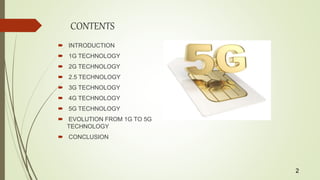
 5G TECHNOLOGY
 EVOLUTION FROM 1G TO 5G
TECHNOLOGY
 CONCLUSION
2
INTRODUCTION
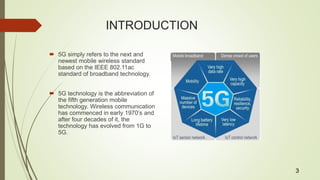
 5G simply refers to the next and
newest mobile wireless standard
based on the IEEE 802.11ac
standard of broadband technology.
 5G technology is the abbreviation of
the fifth generation mobile
technology. Wireless communication
has commenced in early 1970’s and
after four decades of it, the
technology has evolved from 1G to
5G.
3
1G TECHNOLOGY
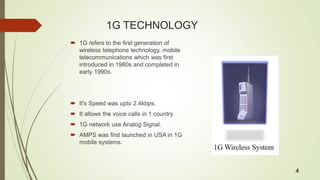
 1G refers to the first generation of
wireless telephone technology, mobile
telecommunications which was first
introduced in 1980s and completed in
early 1990s.
 It's Speed was upto 2.4kbps.
 It allows the voice calls in 1 country.
 1G network use Analog Signal.
 AMPS was first launched in USA in 1G
mobile systems.
4
DRAWBACKS OF 1G
 Poor Voice Quality
 Poor Battery Life
 Large Phone Size
 No Security
 Limited Capacity
 Poor Handoff Reliability
5
2G TECHNOLOGY
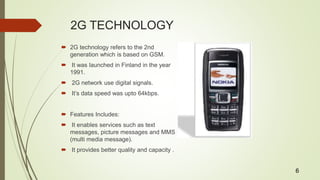
 2G technology refers to the 2nd
generation which is based on GSM.
 It was launched in Finland in the year
1991.
 2G network use digital signals.
 It’s data speed was upto 64kbps.
 Features Includes:
 It enables services such as text
messages, picture messages and MMS
(multi media message).
 It provides better quality and capacity .
6
DRAWBACKS OF 2G
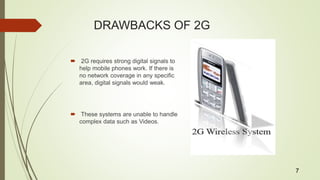
 2G requires strong digital signals to
help mobile phones work. If there is
no network coverage in any specific
area, digital signals would weak.
 These systems are unable to handle
complex data such as Videos.
7
2.5G TECHNOLOGY
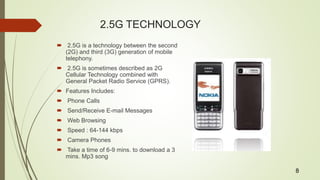
 2.5G is a technology between the second
(2G) and third (3G) generation of mobile
telephony.
 2.5G is sometimes described as 2G
Cellular Technology combined with
General Packet Radio Service (GPRS).
 Features Includes:
 Phone Calls
 Send/Receive E-mail Messages
 Web Browsing
 Speed : 64-144 kbps
 Camera Phones
 Take a time of 6-9 mins. to download a 3
mins. Mp3 song
8
3G TECHNOLOGY
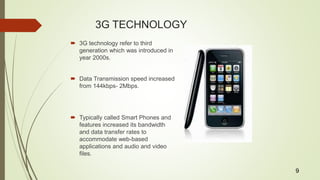
 3G technology refer to third
generation which was introduced in
year 2000s.
 Data Transmission speed increased
from 144kbps- 2Mbps.
 Typically called Smart Phones and
features increased its bandwidth
and data transfer rates to
accommodate web-based
applications and audio and video
files.
9
FEATURES OF 3G
TECHNOLOGY
 Providing Faster Communication
 Send/Receive Large Email Messages
 High Speed Web / More Security Video
Conferencing / 3D Gaming
 TV Streaming/ Mobile TV/ Phone Calls
 Large Capacities and Broadband
Capabilities
 11 sec – 1.5 min. time to download a 3
min Mp3 song.
10
DRAWBACKS OF 3G TECHNOLOGY
 Expensive fees for 3G Licenses Services
 It was challenge to build the infrastructure for
3G
 High Bandwidth Requirement
 Expensive 3G Phones.
 Large Cell Phones
11
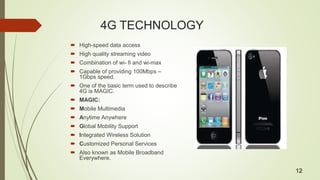
4G TECHNOLOGY
 High-speed data access
 High quality streaming video
 Combination of wi- fi and wi-max
 Capable of providing 100Mbps –
1Gbps speed.
 One of the basic term used to describe
4G is MAGIC.
 MAGIC:
 Mobile Multimedia
 Anytime Anywhere
 Global Mobility Support
 Integrated Wireless Solution
 Customized Personal Services
 Also known as Mobile Broadband
Everywhere.
12
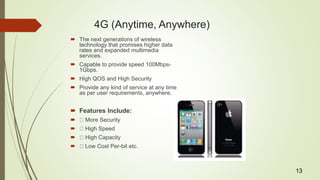
4G (Anytime, Anywhere)
 The next generations of wireless
technology that promises higher data
rates and expanded multimedia
services.
 Capable to provide speed 100Mbps-
1Gbps.
 High QOS and High Security
 Provide any kind of service at any time
as per user requirements, anywhere.
 Features Include:
 More Security
 High Speed
 High Capacity
 Low Cost Per-bit etc.
13
DRAWBACKS OF 4G
 Battery uses is more
 Hard to implement
 Need complicated hardware
 Expensive equipment required to
implement next generation network.
14
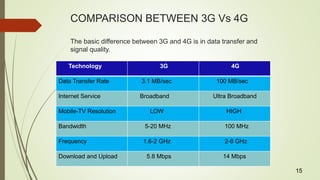
COMPARISON BETWEEN 3G Vs 4G
The basic difference between 3G and 4G is in data transfer and
signal quality.
Technology 3G 4G
Data Transfer Rate 3.1 MB/sec 100 MB/sec
Internet Service Broadband Ultra Broadband
Mobile-TV Resolution LOW HIGH
Bandwidth 5-20 MHz 100 MHz
Frequency 1.6-2 GHz 2-8 GHz
Download and Upload 5.8 Mbps 14 Mbps
15
5G TECHNOLOGY
16
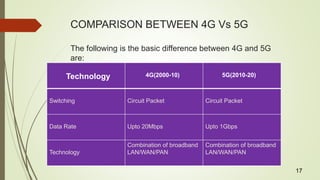
COMPARISON BETWEEN 4G Vs 5G
The following is the basic difference between 4G and 5G
are:
Technology 4G(2000-10) 5G(2010-20)
Switching Circuit Packet Circuit Packet
Data Rate Upto 20Mbps Upto 1Gbps
Technology
Combination of broadband
LAN/WAN/PAN
Combination of broadband
LAN/WAN/PAN
17
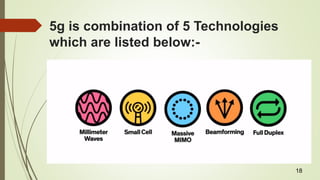
5g is combination of 5 Technologies
which are listed below:-
18
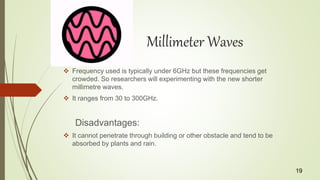
Millimeter Waves
 Frequency used is typically under 6GHz but these frequencies get
crowded. So researchers will experimenting with the new shorter
millimetre waves.
 It ranges from 30 to 300GHz.
Disadvantages:
 It cannot penetrate through building or other obstacle and tend to be
absorbed by plants and rain.
19
Small Cell
 Todays network rely on large high-powered
cell towers to broadcast their signals over
long distances but remember millimeter
waves cannot penetrate through obstacles.
 It is low-powered mini base stations. These
base stations are much closer together than
traditional towers forming a sort of rely team
to transmit signals around obstacles.
 This would be especially useful in cities as
the user move behind an obstacle his
smartphone automatically switch to new base
stations in better range of his device allowing
him to keep his connection.
20
Massive MIMO
 MIMO stands for multiple-input multiple-
output.
 It has hundreds of ports rather than dozens of
ports in todays 4G base stations.
 This could increase the capacity of today’s
network by a factor of 22.
 Today’s antenna broadcast information in all
direction this will cause interference which
brings to technology number 4.
21
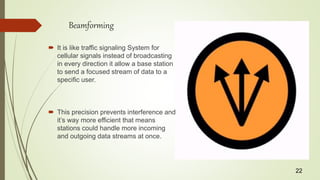
Beamforming
 It is like traffic signaling System for
cellular signals instead of broadcasting
in every direction it allow a base station
to send a focused stream of data to a
specific user.
 This precision prevents interference and
it’s way more efficient that means
stations could handle more incoming
and outgoing data streams at once.
22
Full Duplex
 With 5G, a transceiver will be able to
transmit and receive data at the same
time, on the same frequency.
 This technology is known as full duplex,
and it could double the capacity of
wireless networks.
 By using silicon transistors we can cancel
the reciprocity principle of radio waves.
 Radio waves create more signal
interferences through a pesky echo.
23
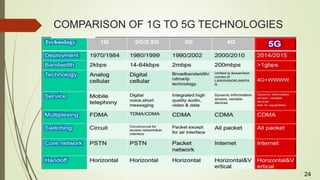
COMPARISON OF 1G TO 5G TECHNOLOGIES
24
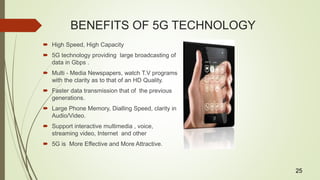
BENEFITS OF 5G TECHNOLOGY
 High Speed, High Capacity
 5G technology providing large broadcasting of
data in Gbps .
 Multi - Media Newspapers, watch T.V programs
with the clarity as to that of an HD Quality.
 Faster data transmission that of the previous
generations.
 Large Phone Memory, Dialling Speed, clarity in
Audio/Video.
 Support interactive multimedia , voice,
streaming video, Internet and other
 5G is More Effective and More Attractive.
25
CONCLUSION
 All totally the best way to help all users is to use 5G as the
next wireless system and in totally it is safety and secure for
public, this the need that demands the solution.
 Today’s wired society is going wireless and if it has problem,
5G is answer.
 5G technology is going to give tough competition to
Computers and Laptops.
 It will be available in the market 2020 at affordable cost with
more reliability than previous mobiles.
26
References
 http://ieeexplore.ieee.org/stamp/stamp.jsp?tp=&arnumber=7169508
 https://5g.ieee.org/images/files/pdf/ieee-5g-roadmap-white-paper.pdf
 https://en.wikipedia.org/wiki/5G
 https://www.tutorialspoint.com/5g/index.htm
 YouTube
 https://www.youtube.com/watch?v=GEx_d0SjvS0
27
28

5G Network - It's Architecture and Technology

  • 1.
    5G Network –It’s Architecture and Technology Represented by: Raj Kumar Raj Roll no :- 73 K.K WAGH College of Engineering 1
  • 2.
    CONTENTS  INTRODUCTION  1GTECHNOLOGY  2G TECHNOLOGY  2.5 TECHNOLOGY  3G TECHNOLOGY  4G TECHNOLOGY  5G TECHNOLOGY  EVOLUTION FROM 1G TO 5G TECHNOLOGY  CONCLUSION 2
  • 3.
    INTRODUCTION  5G simplyrefers to the next and newest mobile wireless standard based on the IEEE 802.11ac standard of broadband technology.  5G technology is the abbreviation of the fifth generation mobile technology. Wireless communication has commenced in early 1970’s and after four decades of it, the technology has evolved from 1G to 5G. 3
  • 4.
    1G TECHNOLOGY  1Grefers to the first generation of wireless telephone technology, mobile telecommunications which was first introduced in 1980s and completed in early 1990s.  It's Speed was upto 2.4kbps.  It allows the voice calls in 1 country.  1G network use Analog Signal.  AMPS was first launched in USA in 1G mobile systems. 4
  • 5.
    DRAWBACKS OF 1G Poor Voice Quality  Poor Battery Life  Large Phone Size  No Security  Limited Capacity  Poor Handoff Reliability 5
  • 6.
    2G TECHNOLOGY  2Gtechnology refers to the 2nd generation which is based on GSM.  It was launched in Finland in the year 1991.  2G network use digital signals.  It’s data speed was upto 64kbps.  Features Includes:  It enables services such as text messages, picture messages and MMS (multi media message).  It provides better quality and capacity . 6
  • 7.
    DRAWBACKS OF 2G 2G requires strong digital signals to help mobile phones work. If there is no network coverage in any specific area, digital signals would weak.  These systems are unable to handle complex data such as Videos. 7
  • 8.
    2.5G TECHNOLOGY  2.5Gis a technology between the second (2G) and third (3G) generation of mobile telephony.  2.5G is sometimes described as 2G Cellular Technology combined with General Packet Radio Service (GPRS).  Features Includes:  Phone Calls  Send/Receive E-mail Messages  Web Browsing  Speed : 64-144 kbps  Camera Phones  Take a time of 6-9 mins. to download a 3 mins. Mp3 song 8
  • 9.
    3G TECHNOLOGY  3Gtechnology refer to third generation which was introduced in year 2000s.  Data Transmission speed increased from 144kbps- 2Mbps.  Typically called Smart Phones and features increased its bandwidth and data transfer rates to accommodate web-based applications and audio and video files. 9
  • 10.
    FEATURES OF 3G TECHNOLOGY Providing Faster Communication  Send/Receive Large Email Messages  High Speed Web / More Security Video Conferencing / 3D Gaming  TV Streaming/ Mobile TV/ Phone Calls  Large Capacities and Broadband Capabilities  11 sec – 1.5 min. time to download a 3 min Mp3 song. 10
  • 11.
    DRAWBACKS OF 3GTECHNOLOGY  Expensive fees for 3G Licenses Services  It was challenge to build the infrastructure for 3G  High Bandwidth Requirement  Expensive 3G Phones.  Large Cell Phones 11
  • 12.
    4G TECHNOLOGY  High-speeddata access  High quality streaming video  Combination of wi- fi and wi-max  Capable of providing 100Mbps – 1Gbps speed.  One of the basic term used to describe 4G is MAGIC.  MAGIC:  Mobile Multimedia  Anytime Anywhere  Global Mobility Support  Integrated Wireless Solution  Customized Personal Services  Also known as Mobile Broadband Everywhere. 12
  • 13.
    4G (Anytime, Anywhere) The next generations of wireless technology that promises higher data rates and expanded multimedia services.  Capable to provide speed 100Mbps- 1Gbps.  High QOS and High Security  Provide any kind of service at any time as per user requirements, anywhere.  Features Include:  More Security  High Speed  High Capacity  Low Cost Per-bit etc. 13
  • 14.
    DRAWBACKS OF 4G Battery uses is more  Hard to implement  Need complicated hardware  Expensive equipment required to implement next generation network. 14
  • 15.
    COMPARISON BETWEEN 3GVs 4G The basic difference between 3G and 4G is in data transfer and signal quality. Technology 3G 4G Data Transfer Rate 3.1 MB/sec 100 MB/sec Internet Service Broadband Ultra Broadband Mobile-TV Resolution LOW HIGH Bandwidth 5-20 MHz 100 MHz Frequency 1.6-2 GHz 2-8 GHz Download and Upload 5.8 Mbps 14 Mbps 15
  • 16.
  • 17.
    COMPARISON BETWEEN 4GVs 5G The following is the basic difference between 4G and 5G are: Technology 4G(2000-10) 5G(2010-20) Switching Circuit Packet Circuit Packet Data Rate Upto 20Mbps Upto 1Gbps Technology Combination of broadband LAN/WAN/PAN Combination of broadband LAN/WAN/PAN 17
  • 18.
    5g is combinationof 5 Technologies which are listed below:- 18
  • 19.
    Millimeter Waves  Frequencyused is typically under 6GHz but these frequencies get crowded. So researchers will experimenting with the new shorter millimetre waves.  It ranges from 30 to 300GHz. Disadvantages:  It cannot penetrate through building or other obstacle and tend to be absorbed by plants and rain. 19
  • 20.
    Small Cell  Todaysnetwork rely on large high-powered cell towers to broadcast their signals over long distances but remember millimeter waves cannot penetrate through obstacles.  It is low-powered mini base stations. These base stations are much closer together than traditional towers forming a sort of rely team to transmit signals around obstacles.  This would be especially useful in cities as the user move behind an obstacle his smartphone automatically switch to new base stations in better range of his device allowing him to keep his connection. 20
  • 21.
    Massive MIMO  MIMOstands for multiple-input multiple- output.  It has hundreds of ports rather than dozens of ports in todays 4G base stations.  This could increase the capacity of today’s network by a factor of 22.  Today’s antenna broadcast information in all direction this will cause interference which brings to technology number 4. 21
  • 22.
    Beamforming  It islike traffic signaling System for cellular signals instead of broadcasting in every direction it allow a base station to send a focused stream of data to a specific user.  This precision prevents interference and it’s way more efficient that means stations could handle more incoming and outgoing data streams at once. 22
  • 23.
    Full Duplex  With5G, a transceiver will be able to transmit and receive data at the same time, on the same frequency.  This technology is known as full duplex, and it could double the capacity of wireless networks.  By using silicon transistors we can cancel the reciprocity principle of radio waves.  Radio waves create more signal interferences through a pesky echo. 23
  • 24.
    COMPARISON OF 1GTO 5G TECHNOLOGIES 24
  • 25.
    BENEFITS OF 5GTECHNOLOGY  High Speed, High Capacity  5G technology providing large broadcasting of data in Gbps .  Multi - Media Newspapers, watch T.V programs with the clarity as to that of an HD Quality.  Faster data transmission that of the previous generations.  Large Phone Memory, Dialling Speed, clarity in Audio/Video.  Support interactive multimedia , voice, streaming video, Internet and other  5G is More Effective and More Attractive. 25
  • 26.
    CONCLUSION  All totallythe best way to help all users is to use 5G as the next wireless system and in totally it is safety and secure for public, this the need that demands the solution.  Today’s wired society is going wireless and if it has problem, 5G is answer.  5G technology is going to give tough competition to Computers and Laptops.  It will be available in the market 2020 at affordable cost with more reliability than previous mobiles. 26
  • 27.
    References  http://ieeexplore.ieee.org/stamp/stamp.jsp?tp=&arnumber=7169508  https://5g.ieee.org/images/files/pdf/ieee-5g-roadmap-white-paper.pdf https://en.wikipedia.org/wiki/5G  https://www.tutorialspoint.com/5g/index.htm  YouTube  https://www.youtube.com/watch?v=GEx_d0SjvS0 27
  • 28.