
Fiber
Optic
Technology
Contents:
Introduction
History
Construction
Principle
Working
Classifications
Application
Advantages
Disadvantages
Introduction:
We hear about fiber-optic cables whenever people
talk about the telephone system, the cable TV system
or the Internet.
We are increasing ability to transmit more
information, more quickly and over longer distances.
An optical fiber (or fiber) is a glass or plastic fiber
that carries light along its length . Fiber Optics is
overlap of applied science and engineering.
What are Fiber Optics?
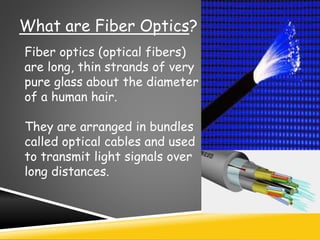
Fiber optics (optical fibers)
are long, thin strands of very
pure glass about the diameter
of a human hair.
They are arranged in bundles
called optical cables and used
to transmit light signals over
long distances.
History:
1880: Alexander G. Bell
transmit sound waves over beam of light
1930: TV image through uncoated fiber cables
Few years later image through a single glass fiber
1951: Flexible fiberscope: Medical applications
1956: The term “fiber optics” used for the first time
1960: Laser invented
1967: New Communications medium: cladded fiber
1970s & 1980s : High quality sources and detectors
1990: Deployment of SONET systems
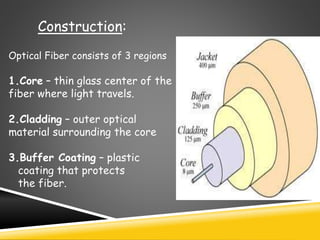
Construction:
Optical Fiber consists of 3 regions
1.Core – thin glass center of the
fiber where light travels.
2.Cladding – outer optical
material surrounding the core
3.Buffer Coating – plastic
coating that protects
the fiber.
Principle:
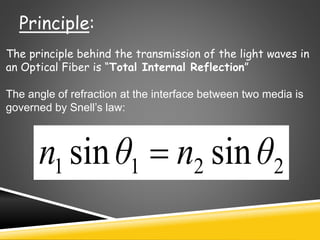
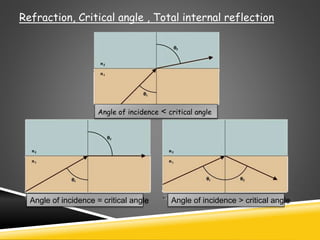
The principle behind the transmission of the light waves in
an Optical Fiber is “Total Internal Reflection”
The angle of refraction at the interface between two media is
governed by Snell’s law:
2211 sinsin θnθn 
Angle of incidence < critical angle
Angle of incidence = critical angle Angle of incidence > critical angle
Refraction, Critical angle , Total internal reflection
Working:
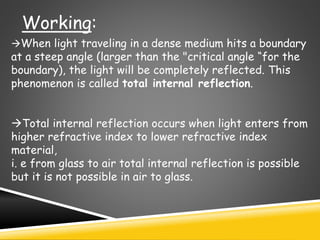
When light traveling in a dense medium hits a boundary
at a steep angle (larger than the "critical angle “for the
boundary), the light will be completely reflected. This
phenomenon is called total internal reflection.
Total internal reflection occurs when light enters from
higher refractive index to lower refractive index
material,
i. e from glass to air total internal reflection is possible
but it is not possible in air to glass.
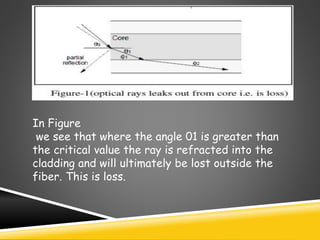
In Figure
we see that where the angle 01 is greater than
the critical value the ray is refracted into the
cladding and will ultimately be lost outside the
fiber. This is loss.
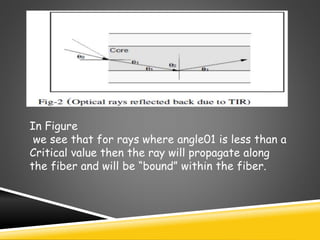
In Figure
we see that for rays where angle01 is less than a
Critical value then the ray will propagate along
the fiber and will be “bound” within the fiber.
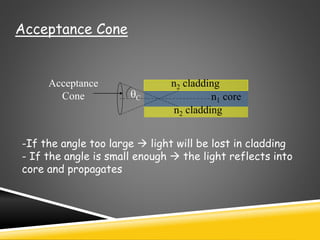
n2 cladding
n2 cladding
n1 core
Acceptance
Cone
-If the angle too large  light will be lost in cladding
- If the angle is small enough  the light reflects into
core and propagates
qC
Acceptance Cone
n2 cladding
n2 cladding
n1 core
Acceptance
Cone
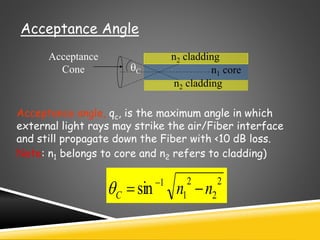
Acceptance angle, qc, is the maximum angle in which
external light rays may strike the air/Fiber interface
and still propagate down the Fiber with <10 dB loss.
Note: n1 belongs to core and n2 refers to cladding)
2
2
2
1
1
sin nnC  
q
qC
Acceptance Angle
Transmission of signal:
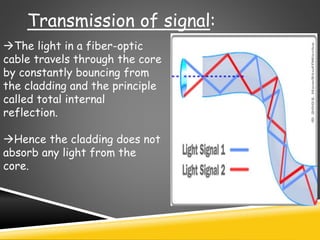
The light in a fiber-optic
cable travels through the core
by constantly bouncing from
the cladding and the principle
called total internal
reflection.
Hence the cladding does not
absorb any light from the
core.
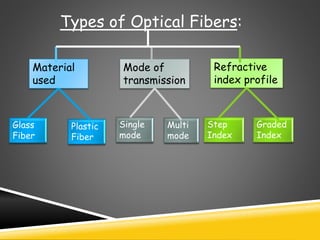
Types of Optical Fibers:
Material
used
Mode of
transmission
Refractive
index profile
Glass
Fiber
Plastic
Fiber
Single
mode
Multi
mode
Step
Index
Graded
Index
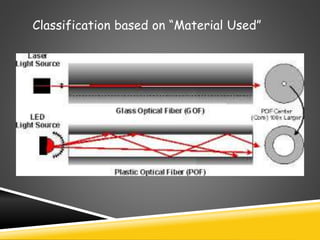
Classification based on “Material Used”
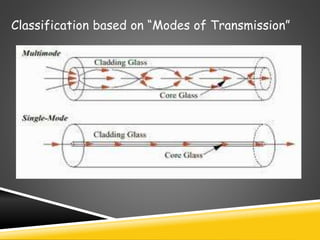
Classification based on “Modes of Transmission”
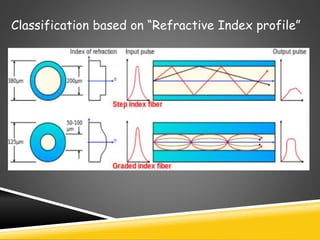
Classification based on “Refractive Index profile”
Application:
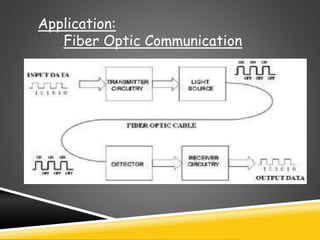
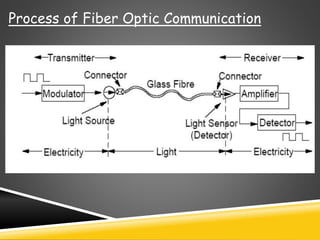
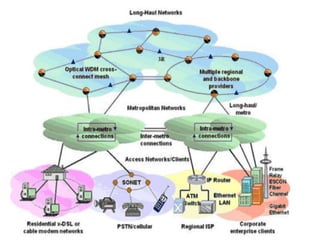
Fiber Optic Communication
Process of Fiber Optic Communication
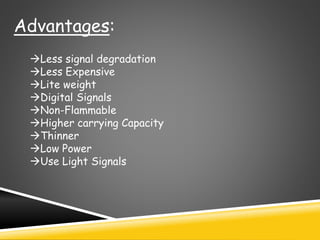
Advantages:
Less signal degradation
Less Expensive
Lite weight
Digital Signals
Non-Flammable
Higher carrying Capacity
Thinner
Low Power
Use Light Signals
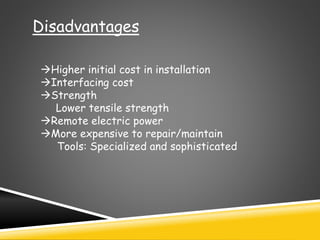
Disadvantages
Higher initial cost in installation
Interfacing cost
Strength
Lower tensile strength
Remote electric power
More expensive to repair/maintain
Tools: Specialized and sophisticated
Fiber Optic Technology

Fiber Optic Technology

  • 2.
  • 3.
  • 4.
    Introduction: We hear aboutfiber-optic cables whenever people talk about the telephone system, the cable TV system or the Internet. We are increasing ability to transmit more information, more quickly and over longer distances. An optical fiber (or fiber) is a glass or plastic fiber that carries light along its length . Fiber Optics is overlap of applied science and engineering.
  • 5.
    What are FiberOptics? Fiber optics (optical fibers) are long, thin strands of very pure glass about the diameter of a human hair. They are arranged in bundles called optical cables and used to transmit light signals over long distances.
  • 6.
    History: 1880: Alexander G.Bell transmit sound waves over beam of light 1930: TV image through uncoated fiber cables Few years later image through a single glass fiber 1951: Flexible fiberscope: Medical applications 1956: The term “fiber optics” used for the first time 1960: Laser invented 1967: New Communications medium: cladded fiber 1970s & 1980s : High quality sources and detectors 1990: Deployment of SONET systems
  • 7.
    Construction: Optical Fiber consistsof 3 regions 1.Core – thin glass center of the fiber where light travels. 2.Cladding – outer optical material surrounding the core 3.Buffer Coating – plastic coating that protects the fiber.
  • 8.
    Principle: The principle behindthe transmission of the light waves in an Optical Fiber is “Total Internal Reflection” The angle of refraction at the interface between two media is governed by Snell’s law: 2211 sinsin θnθn 
  • 9.
    Angle of incidence< critical angle Angle of incidence = critical angle Angle of incidence > critical angle Refraction, Critical angle , Total internal reflection
  • 10.
    Working: When light travelingin a dense medium hits a boundary at a steep angle (larger than the "critical angle “for the boundary), the light will be completely reflected. This phenomenon is called total internal reflection. Total internal reflection occurs when light enters from higher refractive index to lower refractive index material, i. e from glass to air total internal reflection is possible but it is not possible in air to glass.
  • 11.
    In Figure we seethat where the angle 01 is greater than the critical value the ray is refracted into the cladding and will ultimately be lost outside the fiber. This is loss.
  • 12.
    In Figure we seethat for rays where angle01 is less than a Critical value then the ray will propagate along the fiber and will be “bound” within the fiber.
  • 13.
    n2 cladding n2 cladding n1core Acceptance Cone -If the angle too large  light will be lost in cladding - If the angle is small enough  the light reflects into core and propagates qC Acceptance Cone
  • 14.
    n2 cladding n2 cladding n1core Acceptance Cone Acceptance angle, qc, is the maximum angle in which external light rays may strike the air/Fiber interface and still propagate down the Fiber with <10 dB loss. Note: n1 belongs to core and n2 refers to cladding) 2 2 2 1 1 sin nnC   q qC Acceptance Angle
  • 15.
    Transmission of signal: Thelight in a fiber-optic cable travels through the core by constantly bouncing from the cladding and the principle called total internal reflection. Hence the cladding does not absorb any light from the core.
  • 16.
    Types of OpticalFibers: Material used Mode of transmission Refractive index profile Glass Fiber Plastic Fiber Single mode Multi mode Step Index Graded Index
  • 17.
    Classification based on“Material Used”
  • 18.
    Classification based on“Modes of Transmission”
  • 19.
    Classification based on“Refractive Index profile”
  • 20.
  • 21.
    Process of FiberOptic Communication
  • 22.
    Advantages: Less signal degradation LessExpensive Lite weight Digital Signals Non-Flammable Higher carrying Capacity Thinner Low Power Use Light Signals
  • 24.
    Disadvantages Higher initial costin installation Interfacing cost Strength Lower tensile strength Remote electric power More expensive to repair/maintain Tools: Specialized and sophisticated