Submitted by :
-19N61A0570…….…………..
5-G………….
TECHNOLOGY….
• 5G Technology stands for 5th generation mobile technology.
• 5G denote the next major phase of mobile telecommunication
standards beyond the upcoming 4G standards.
• 5G technology will change the way most high bandwidth users
access their phones.
• Hence the search for new technology is Complete wireless
communication by 5-G TECHNOLOGY
CONTENTS
• INTRODUCTION
• 1G - TECHNOLOGY
• 2G - TECHNOLOGY
• 3G - TECHNOLOGY
• 4G - TECHNOLOGY
• 5G - TECHNOLOGY
• H/W & S/W OF 5G
• FEATURES & ADVANTAGES
• APPLICATIONS
• COMPARISION FROM 1G TO 5G
• CONCLUSION
• 5th generation mobile networks or 5th generation wireless systems
...abbreviated as 5G, are the proposed next telecommunications
...standards beyond the current
4G/IMT- Advanced standards.
• initial chip design by QUALCOMM in October 2016.
• It has incredible transmission speed.
• 5G planning aims at higher capacity than current 4G, supporting
device-to-device, ultra reliable, and massive machine communications.
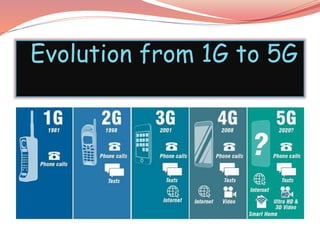
Evolution from 1G to 5G
1G TECHNOLOGY
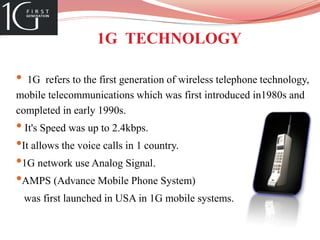
• 1G refers to the first generation of wireless telephone technology,
mobile telecommunications which was first introduced in1980s and
completed in early 1990s.
• It's Speed was up to 2.4kbps.
•It allows the voice calls in 1 country.
•1G network use Analog Signal.
•AMPS (Advance Mobile Phone System)
was first launched in USA in 1G mobile systems.
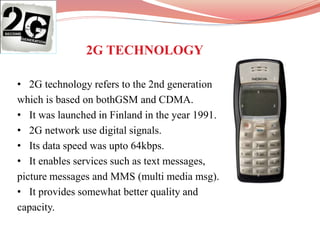
• 2G technology refers to the 2nd generation
which is based on bothGSM and CDMA.
• It was launched in Finland in the year 1991.
• 2G network use digital signals.
• Its data speed was upto 64kbps.
• It enables services such as text messages,
picture messages and MMS (multi media msg).
• It provides somewhat better quality and
capacity.
2G TECHNOLOGY
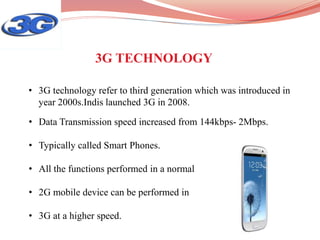
• Data Transmission speed increased from 144kbps- 2Mbps.
• Typically called Smart Phones.
• All the functions performed in a normal
• 2G mobile device can be performed in
• 3G at a higher speed.
• 3G technology refer to third generation which was introduced in
year 2000s.Indis launched 3G in 2008.
3G TECHNOLOGY
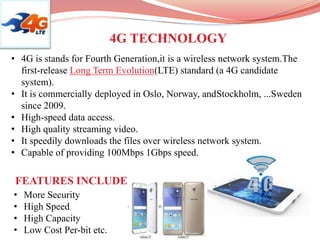
• 4G is stands for Fourth Generation,it is a wireless network system.The
first-release Long Term Evolution(LTE) standard (a 4G candidate
system).
• It is commercially deployed in Oslo, Norway, andStockholm, ...Sweden
since 2009.
• High-speed data access.
• High quality streaming video.
• It speedily downloads the files over wireless network system.
• Capable of providing 100Mbps 1Gbps speed.
4G TECHNOLOGY
FEATURES INCLUDE
• More Security
• High Speed
• High Capacity
• Low Cost Per-bit etc.
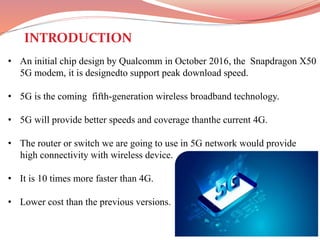
• An initial chip design by Qualcomm in October 2016, the Snapdragon X50
5G modem, it is designedto support peak download speed.
• 5G is the coming fifth-generation wireless broadband technology.
• 5G will provide better speeds and coverage thanthe current 4G.
• The router or switch we are going to use in 5G network would provide
high connectivity with wireless device.
• It is 10 times more faster than 4G.
• Lower cost than the previous versions.
INTRODUCTION
OBJECTIVES
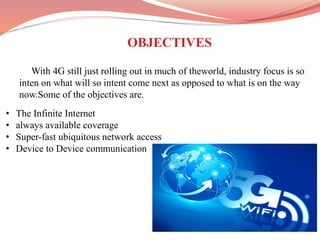
With 4G still just rolling out in much of theworld, industry focus is so
inten on what will so intent come next as opposed to what is on the way
now.Some of the objectives are.
• The Infinite Internet
• always available coverage
• Super-fast ubiquitous network access
• Device to Device communication
• 5G will be single unified standard of different wireless networks
including LAN technologies.LAN/WAN, WWWW-World Wide Wireless
Web.
• Internet Protocol version 6(IPv6).
HARDWARE AND SOFTWARE OF 5G TECHNOLOGY
HARDWARE OF 5G TECHNOLOGY:
• Uses UWB(Ultra-Wide Band) networks with higher Band Width at low
energy levels.
• BW is 4000Mbps, which is 400times faster than todays wireless networks.
• Uses CDMA(Code Division Multiple Access).
SOFTWARE OF 5G TECHNOLOGY:
• Practically possible to avail the super speed i.e. 1 to 10 Gbps.
• Latency will be 1 millisecond.
• Feasibility to connect 10 to 100 numbers of devices.
• World wide coverage.
• Battery life will be much longer.
• The uploading and downloading speed of 5G technology touching
the peak.
FEATURES
In comparison to previous radio technologies, 5G has ..following
advancement -
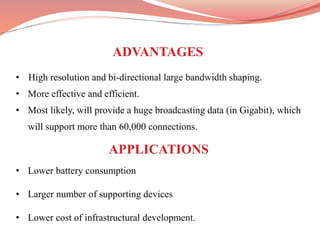
• High resolution and bi-directional large bandwidth shaping.
• More effective and efficient.
• Most likely, will provide a huge broadcasting data (in Gigabit), which
will support more than 60,000 connections.
• Lower battery consumption
• Larger number of supporting devices
• Lower cost of infrastructural development.
ADVANTAGES
APPLICATIONS
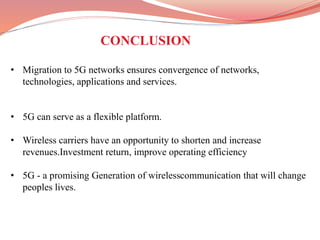
• Migration to 5G networks ensures convergence of networks,
technologies, applications and services.
• 5G can serve as a flexible platform.
• Wireless carriers have an opportunity to shorten and increase
revenues.Investment return, improve operating efficiency
• 5G - a promising Generation of wirelesscommunication that will change
peoples lives.
CONCLUSION
Refernce :
• book. 5G Explained. by .
• LTE-Advanced. by .
• 5G NR: The Next Generation Wireless Access Technology.
by Erik Dahlman, Stefan Parkvall, .
• 5G System Design. by Ömer Bulakci,
.
harika ppt.pptx

harika ppt.pptx

  • 2.
  • 3.
  • 4.
    • 5G Technologystands for 5th generation mobile technology. • 5G denote the next major phase of mobile telecommunication standards beyond the upcoming 4G standards. • 5G technology will change the way most high bandwidth users access their phones. • Hence the search for new technology is Complete wireless communication by 5-G TECHNOLOGY
  • 5.
    CONTENTS • INTRODUCTION • 1G- TECHNOLOGY • 2G - TECHNOLOGY • 3G - TECHNOLOGY • 4G - TECHNOLOGY • 5G - TECHNOLOGY • H/W & S/W OF 5G • FEATURES & ADVANTAGES • APPLICATIONS • COMPARISION FROM 1G TO 5G • CONCLUSION
  • 6.
    • 5th generationmobile networks or 5th generation wireless systems ...abbreviated as 5G, are the proposed next telecommunications ...standards beyond the current 4G/IMT- Advanced standards. • initial chip design by QUALCOMM in October 2016. • It has incredible transmission speed. • 5G planning aims at higher capacity than current 4G, supporting device-to-device, ultra reliable, and massive machine communications.
  • 7.
  • 8.
    1G TECHNOLOGY • 1Grefers to the first generation of wireless telephone technology, mobile telecommunications which was first introduced in1980s and completed in early 1990s. • It's Speed was up to 2.4kbps. •It allows the voice calls in 1 country. •1G network use Analog Signal. •AMPS (Advance Mobile Phone System) was first launched in USA in 1G mobile systems.
  • 9.
    • 2G technologyrefers to the 2nd generation which is based on bothGSM and CDMA. • It was launched in Finland in the year 1991. • 2G network use digital signals. • Its data speed was upto 64kbps. • It enables services such as text messages, picture messages and MMS (multi media msg). • It provides somewhat better quality and capacity. 2G TECHNOLOGY
  • 10.
    • Data Transmissionspeed increased from 144kbps- 2Mbps. • Typically called Smart Phones. • All the functions performed in a normal • 2G mobile device can be performed in • 3G at a higher speed. • 3G technology refer to third generation which was introduced in year 2000s.Indis launched 3G in 2008. 3G TECHNOLOGY
  • 11.
    • 4G isstands for Fourth Generation,it is a wireless network system.The first-release Long Term Evolution(LTE) standard (a 4G candidate system). • It is commercially deployed in Oslo, Norway, andStockholm, ...Sweden since 2009. • High-speed data access. • High quality streaming video. • It speedily downloads the files over wireless network system. • Capable of providing 100Mbps 1Gbps speed. 4G TECHNOLOGY FEATURES INCLUDE • More Security • High Speed • High Capacity • Low Cost Per-bit etc.
  • 12.
    • An initialchip design by Qualcomm in October 2016, the Snapdragon X50 5G modem, it is designedto support peak download speed. • 5G is the coming fifth-generation wireless broadband technology. • 5G will provide better speeds and coverage thanthe current 4G. • The router or switch we are going to use in 5G network would provide high connectivity with wireless device. • It is 10 times more faster than 4G. • Lower cost than the previous versions. INTRODUCTION
  • 13.
    OBJECTIVES With 4G stilljust rolling out in much of theworld, industry focus is so inten on what will so intent come next as opposed to what is on the way now.Some of the objectives are. • The Infinite Internet • always available coverage • Super-fast ubiquitous network access • Device to Device communication
  • 14.
    • 5G willbe single unified standard of different wireless networks including LAN technologies.LAN/WAN, WWWW-World Wide Wireless Web. • Internet Protocol version 6(IPv6). HARDWARE AND SOFTWARE OF 5G TECHNOLOGY HARDWARE OF 5G TECHNOLOGY: • Uses UWB(Ultra-Wide Band) networks with higher Band Width at low energy levels. • BW is 4000Mbps, which is 400times faster than todays wireless networks. • Uses CDMA(Code Division Multiple Access). SOFTWARE OF 5G TECHNOLOGY:
  • 15.
    • Practically possibleto avail the super speed i.e. 1 to 10 Gbps. • Latency will be 1 millisecond. • Feasibility to connect 10 to 100 numbers of devices. • World wide coverage. • Battery life will be much longer. • The uploading and downloading speed of 5G technology touching the peak. FEATURES In comparison to previous radio technologies, 5G has ..following advancement -
  • 16.
    • High resolutionand bi-directional large bandwidth shaping. • More effective and efficient. • Most likely, will provide a huge broadcasting data (in Gigabit), which will support more than 60,000 connections. • Lower battery consumption • Larger number of supporting devices • Lower cost of infrastructural development. ADVANTAGES APPLICATIONS
  • 17.
    • Migration to5G networks ensures convergence of networks, technologies, applications and services. • 5G can serve as a flexible platform. • Wireless carriers have an opportunity to shorten and increase revenues.Investment return, improve operating efficiency • 5G - a promising Generation of wirelesscommunication that will change peoples lives. CONCLUSION
  • 18.
    Refernce : • book.5G Explained. by . • LTE-Advanced. by . • 5G NR: The Next Generation Wireless Access Technology. by Erik Dahlman, Stefan Parkvall, . • 5G System Design. by Ömer Bulakci, .

Editor's Notes