The Nature of ScienceStandard of Measurement
Standard -- an exact quantity that people agree to use for comparison. Measurements made using the same standard can be compared to each otherIn the United States we use the English system of measurement with units such as pounds, ounces, gallons, quarts, pints, miles, yards, feet, and inches.Most experiments involve making measurements. Metric System – the standard system of measurement used by scientists.It is also called the International System or SI.It is a decimal system based on the number 10 and multiples of 10.
SI Prefixes:centi – 1/100 or one hundredth or 0.01milli- 1/1000 or one thousandth or 0.001kilo- 1000 or one thousanddeci- 1/10 or one tenth or 0.1micro- 1/1,000,000 or one millionth or 0.000001nano- 1/1,000,000,000 or one billionth or 0.000000001
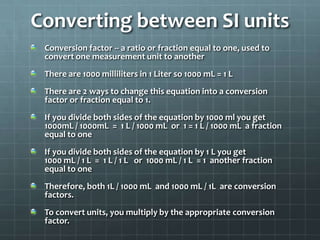
Converting between SI unitsConversion factor -- a ratio or fraction equal to one, used to convert one measurement unit to anotherThere are 1000 milliliters in 1 Liter so 1000 mL = 1 LThere are 2 ways to change this equation into a conversion factor or fraction equal to 1.If you divide both sides of the equation by 1000 ml you get1000mL / 1000mL  =  1 L / 1000 mL  or  1 = 1 L / 1000 mL  a fraction equal to oneIf you divide both sides of the equation by 1 L you get1000 mL / 1 L  =  1 L / 1 L   or  1000 mL / 1 L  = 1  another fraction equal to oneTherefore, both 1L / 1000 mL  and 1000 mL / 1L  are conversion factors.To convert units, you multiply by the appropriate conversion factor.
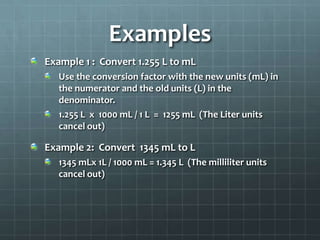
ExamplesExample 1 :  Convert 1.255 L to mLUse the conversion factor with the new units (mL) in the numerator and the old units (L) in the denominator.1.255 L  x  1000 mL / 1 L  =  1255 mL  (The Liter units cancel out)Example 2:  Convert  1345 mL to L1345 mLx 1L / 1000 mL = 1.345 L  (The milliliter units cancel out)
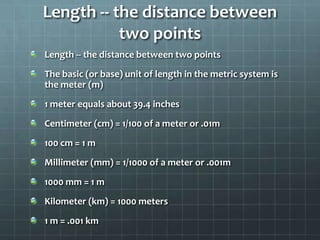
Length -- the distance between two pointsLength -- the distance between two pointsThe basic (or base) unit of length in the metric system is the meter (m)1 meter equals about 39.4 inchesCentimeter (cm) = 1/100 of a meter or .01m100 cm = 1 mMillimeter (mm) = 1/1000 of a meter or .001m1000 mm = 1 mKilometer (km) = 1000 meters1 m = .001 km
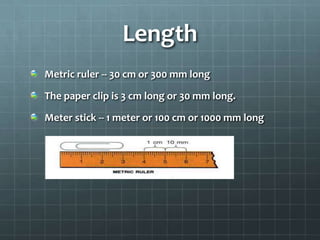
Length Metric ruler -- 30 cm or 300 mm longThe paper clip is 3 cm long or 30 mm long.Meter stick -- 1 meter or 100 cm or 1000 mm long
VolumeVolume is the amount of space an object takes upThe basic unit of volume is the liter (L)A liter is slightly more than a quart.1 milliliter (mL) = 1/1000 of a liter or .001 L1000 mL = 1 LLiters and milliliters are used to measure liquids.The volume of solids is measured in cubic centimeters (cm3)1 cm3 = 1 mL1000 cm3 = 1 L
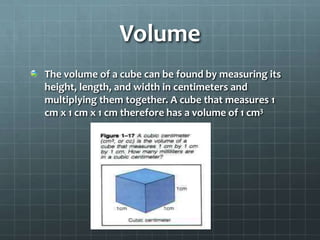
VolumeThe volume of a cube can be found by measuring its height, length, and width in centimeters and multiplying them together. A cube that measures 1 cm x 1 cm x 1 cm therefore has a volume of 1 cm3
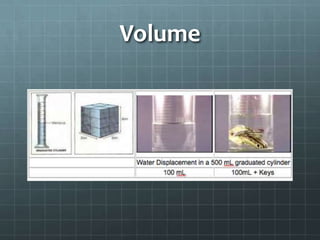
VolumeGraduated Cylinder -- use for liquids or water displacement of irregular solidsMeniscus -- the curved surface of a liquid in a graduated cylinder. Read the bottom of the meniscus.Measure liquids directly. For irregular solids, measure out some water in the cylinder. This is volume 1. Drop the solid into the liquid causing the water level to go up. This is volume 2. Subtract volume 1 from volume 2 to get the volume of the solid.If an irregular object is too large then an overflow may be used.
Volume
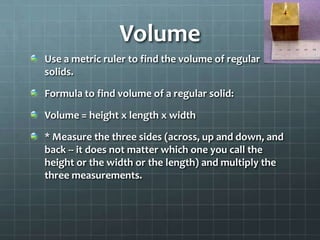
VolumeUse a metric ruler to find the volume of regular solids.Formula to find volume of a regular solid:Volume = height x length x width* Measure the three sides (across, up and down, and back -- it does not matter which one you call the height or the width or the length) and multiply the three measurements.
MassMass is a measure of the amount of matter in an object.The basic unit of mass in the metric system is the kilogram (kg).A kilogram is about 2.2 pounds.1 Gram (g) = 1/1000 or .001 kg1 Kilogram (kg) = 1000 g1 Milligram (mg) = 1/1000 or .001 g1 Gram (g) = 1000 mg
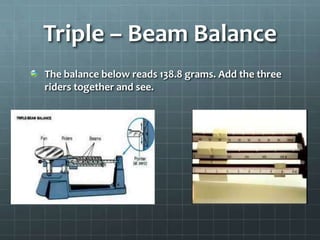
Triple – Beam BalanceThe balance below reads 138.8 grams. Add the three riders together and see.
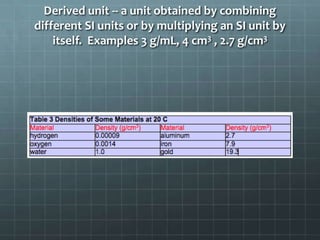
Density – the mass per unit volume of a substanceFormula: Density = mass / volume or D = M / VExample:   10 g / 10 mL = 1 g/mL densityThe density of water is 1 g/mL.Objects with density less than 1 g/mL float on water.Objects with density more than 1 g/mL sink in water.Density is an example of a derived unit. It is made by combining different SI units.
Derived unit -- a unit obtained by combining different SI units or by multiplying an SI unit by itself.  Examples 3 g/mL, 4 cm3 , 2.7 g/cm3
Time and TemperatureTime -- the interval between two events.  The SI unit of time is the secondThe SI unit of temperature is the Kelvin (K). Zero on the Kelvin scale is the coldest possible temperature, also known as absolute zero. This is equal to -273° CThe Kelvin temperature can be found by adding 273 to the Celsius readingExample:  27° C + 273 = 300 KTemperature in the metric system is measured in degrees (°) in the Celsius scale.In Celsius, water freezes at 0° C and boils at 100° C.Normal body temperature in humans is 37° C.Comfortable room temperature is about 21° C.
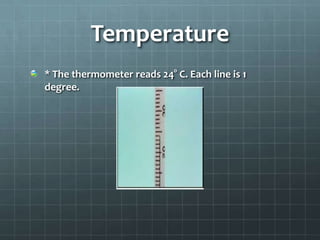
Temperature* The thermometer reads 24° C. Each line is 1 degree.   

Measurement Notes

  • 1.
    The Nature ofScienceStandard of Measurement
  • 2.
    Standard -- anexact quantity that people agree to use for comparison. Measurements made using the same standard can be compared to each otherIn the United States we use the English system of measurement with units such as pounds, ounces, gallons, quarts, pints, miles, yards, feet, and inches.Most experiments involve making measurements. Metric System – the standard system of measurement used by scientists.It is also called the International System or SI.It is a decimal system based on the number 10 and multiples of 10.
  • 3.
    SI Prefixes:centi –1/100 or one hundredth or 0.01milli- 1/1000 or one thousandth or 0.001kilo- 1000 or one thousanddeci- 1/10 or one tenth or 0.1micro- 1/1,000,000 or one millionth or 0.000001nano- 1/1,000,000,000 or one billionth or 0.000000001
  • 4.
    Converting between SIunitsConversion factor -- a ratio or fraction equal to one, used to convert one measurement unit to anotherThere are 1000 milliliters in 1 Liter so 1000 mL = 1 LThere are 2 ways to change this equation into a conversion factor or fraction equal to 1.If you divide both sides of the equation by 1000 ml you get1000mL / 1000mL  =  1 L / 1000 mL  or  1 = 1 L / 1000 mL  a fraction equal to oneIf you divide both sides of the equation by 1 L you get1000 mL / 1 L  =  1 L / 1 L   or  1000 mL / 1 L  = 1  another fraction equal to oneTherefore, both 1L / 1000 mL  and 1000 mL / 1L  are conversion factors.To convert units, you multiply by the appropriate conversion factor.
  • 5.
    ExamplesExample 1 : Convert 1.255 L to mLUse the conversion factor with the new units (mL) in the numerator and the old units (L) in the denominator.1.255 L  x  1000 mL / 1 L  =  1255 mL  (The Liter units cancel out)Example 2:  Convert  1345 mL to L1345 mLx 1L / 1000 mL = 1.345 L  (The milliliter units cancel out)
  • 6.
    Length -- thedistance between two pointsLength -- the distance between two pointsThe basic (or base) unit of length in the metric system is the meter (m)1 meter equals about 39.4 inchesCentimeter (cm) = 1/100 of a meter or .01m100 cm = 1 mMillimeter (mm) = 1/1000 of a meter or .001m1000 mm = 1 mKilometer (km) = 1000 meters1 m = .001 km
  • 7.
    Length Metric ruler-- 30 cm or 300 mm longThe paper clip is 3 cm long or 30 mm long.Meter stick -- 1 meter or 100 cm or 1000 mm long
  • 8.
    VolumeVolume is the amountof space an object takes upThe basic unit of volume is the liter (L)A liter is slightly more than a quart.1 milliliter (mL) = 1/1000 of a liter or .001 L1000 mL = 1 LLiters and milliliters are used to measure liquids.The volume of solids is measured in cubic centimeters (cm3)1 cm3 = 1 mL1000 cm3 = 1 L
  • 9.
    VolumeThe volume ofa cube can be found by measuring its height, length, and width in centimeters and multiplying them together. A cube that measures 1 cm x 1 cm x 1 cm therefore has a volume of 1 cm3
  • 10.
    VolumeGraduated Cylinder --use for liquids or water displacement of irregular solidsMeniscus -- the curved surface of a liquid in a graduated cylinder. Read the bottom of the meniscus.Measure liquids directly. For irregular solids, measure out some water in the cylinder. This is volume 1. Drop the solid into the liquid causing the water level to go up. This is volume 2. Subtract volume 1 from volume 2 to get the volume of the solid.If an irregular object is too large then an overflow may be used.
  • 11.
  • 12.
    VolumeUse a metricruler to find the volume of regular solids.Formula to find volume of a regular solid:Volume = height x length x width* Measure the three sides (across, up and down, and back -- it does not matter which one you call the height or the width or the length) and multiply the three measurements.
  • 13.
    MassMass is ameasure of the amount of matter in an object.The basic unit of mass in the metric system is the kilogram (kg).A kilogram is about 2.2 pounds.1 Gram (g) = 1/1000 or .001 kg1 Kilogram (kg) = 1000 g1 Milligram (mg) = 1/1000 or .001 g1 Gram (g) = 1000 mg
  • 14.
    Triple – BeamBalanceThe balance below reads 138.8 grams. Add the three riders together and see.
  • 15.
    Density – themass per unit volume of a substanceFormula: Density = mass / volume or D = M / VExample:   10 g / 10 mL = 1 g/mL densityThe density of water is 1 g/mL.Objects with density less than 1 g/mL float on water.Objects with density more than 1 g/mL sink in water.Density is an example of a derived unit. It is made by combining different SI units.
  • 16.
    Derived unit --a unit obtained by combining different SI units or by multiplying an SI unit by itself.  Examples 3 g/mL, 4 cm3 , 2.7 g/cm3
  • 17.
    Time and TemperatureTime-- the interval between two events.  The SI unit of time is the secondThe SI unit of temperature is the Kelvin (K). Zero on the Kelvin scale is the coldest possible temperature, also known as absolute zero. This is equal to -273° CThe Kelvin temperature can be found by adding 273 to the Celsius readingExample:  27° C + 273 = 300 KTemperature in the metric system is measured in degrees (°) in the Celsius scale.In Celsius, water freezes at 0° C and boils at 100° C.Normal body temperature in humans is 37° C.Comfortable room temperature is about 21° C.
  • 18.
    Temperature* The thermometerreads 24° C. Each line is 1 degree.