What do you mean
by Fraction?
Learning Objective
• To learn fraction and its types .
• To explain representation of fractions in a number line.
• To learn addition and subtraction of fraction.
Learning Outcomes
What is Fraction ?
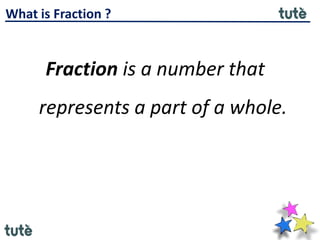
Fraction is a number that
represents a part of a whole.
What is Fraction ?
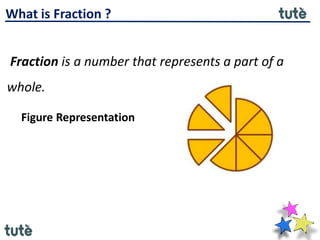
Fraction is a number that represents a part of a
whole.
Figure Representation
What is Fraction ?
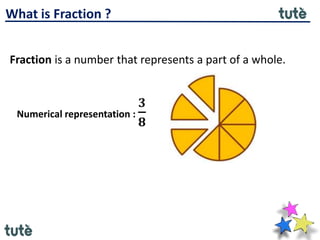
Fraction is a number that represents a part of a whole.
Numerical representation :
𝟑
𝟖
Parts of fraction
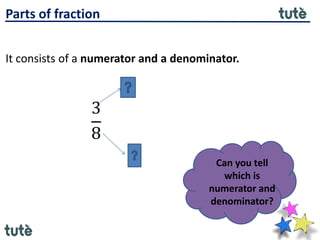
It consists of a numerator and a denominator.
Can you tell
which is
numerator and
denominator?
3
8
Parts of fraction
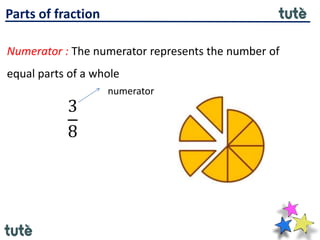
Numerator : The numerator represents the number of
equal parts of a whole
3
8
numerator
Parts of fraction
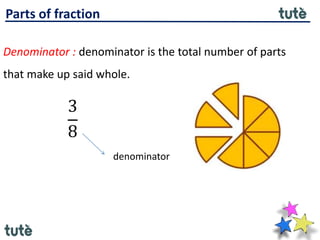
Denominator : denominator is the total number of parts
that make up said whole.
3
8
denominator
Parts of fraction
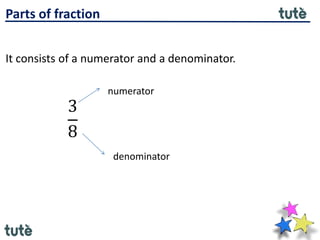
It consists of a numerator and a denominator.
3
8
numerator
denominator
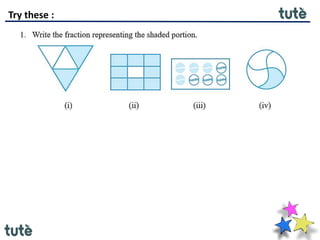
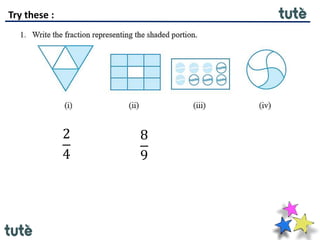
Try these :
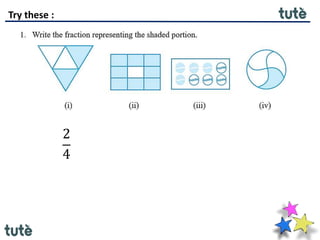
2
4
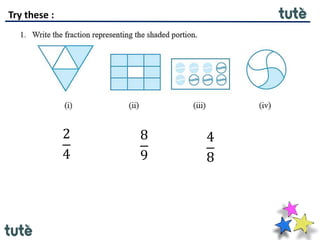
Try these :
2
4
8
9
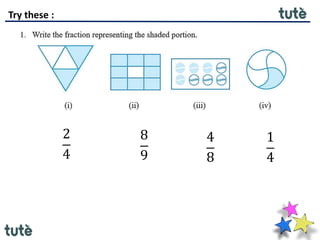
Try these :
2
4
8
9
4
8
Try these :
2
4
8
9
4
8
1
4
Try these :
Types of fraction
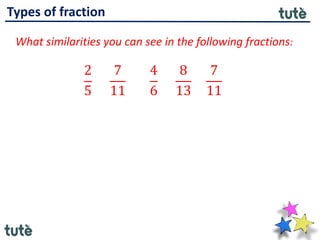
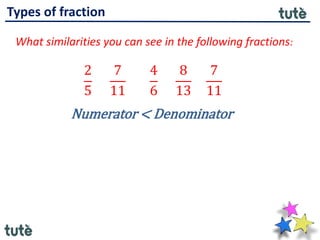
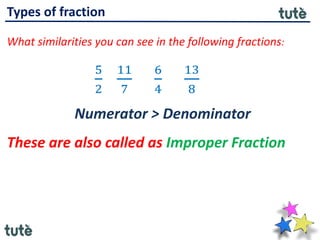
What similarities you can see in the following fractions:
2
5
7
11
4
6
8
13
7
11
Types of fraction
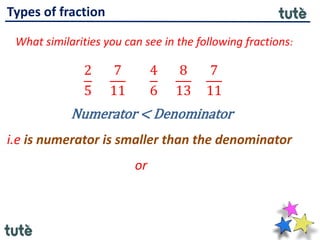
What similarities you can see in the following fractions:
2
5
7
11
4
6
8
13
7
11
Numerator < Denominator
Types of fraction
What similarities you can see in the following fractions:
2
5
7
11
4
6
8
13
7
11
Numerator < Denominator
i.e is numerator is smaller than the denominator
or
Types of fraction
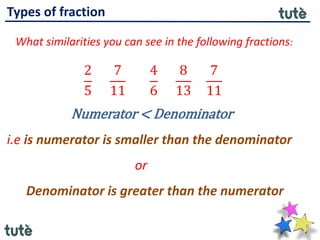
What similarities you can see in the following fractions:
2
5
7
11
4
6
8
13
7
11
Numerator < Denominator
i.e is numerator is smaller than the denominator
or
Denominator is greater than the numerator
Types of fraction
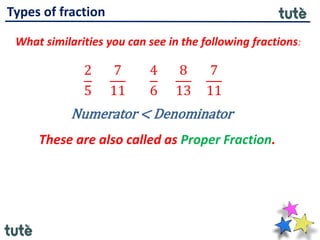
What similarities you can see in the following fractions:
2
5
7
11
4
6
8
13
7
11
Numerator < Denominator
These are also called as Proper Fraction.
Types of fraction
What similarities you can see in the following fractions:
5
2
11
7
6
4
13
8
11
7
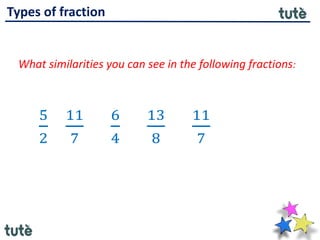
Types of fraction
What similarities you can see in the following fractions:
5
2
11
7
6
4
13
8
11
7
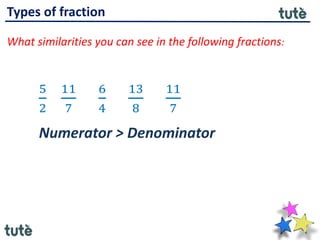
Numerator > Denominator
Types of fraction
What similarities you can see in the following fractions:
5
2
11
7
6
4
13
8
11
7
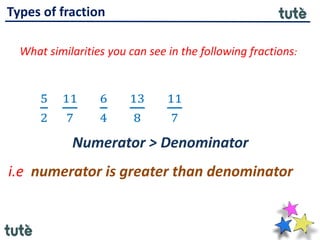
Numerator > Denominator
i.e numerator is greater than denominator
Types of fraction
What similarities you can see in the following fractions:
5
2
11
7
6
4
13
8
11
7
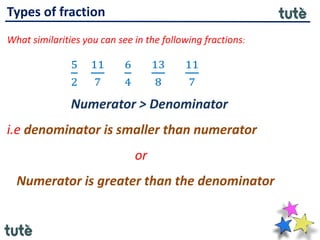
Numerator > Denominator
i.e denominator is smaller than numerator
or
Numerator is greater than the denominator
Types of fraction
What similarities you can see in the following fractions:
5
2
11
7
6
4
13
8
Numerator > Denominator
These are also called as Improper Fraction
Types of fraction
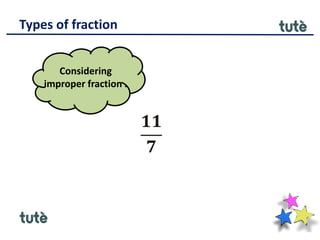
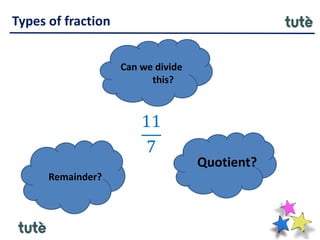
𝟏𝟏
𝟕
Considering
improper fraction .
Types of fraction
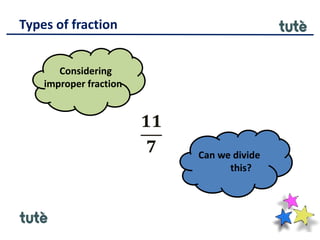
𝟏𝟏
𝟕 Can we divide
this?
Considering
improper fraction .
Types of fraction
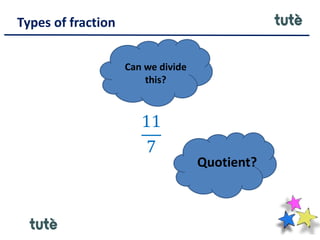
11
7
Quotient?
Can we divide
this?
Types of fraction
11
7
Quotient?
Remainder?
Can we divide
this?
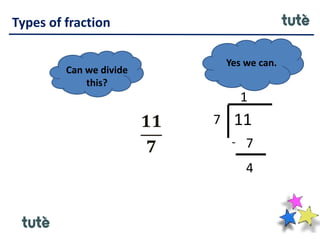
Types of fraction
𝟏𝟏
𝟕
11
7
1
7
-
4
Can we divide
this?
Yes we can.
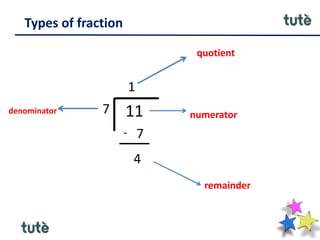
Types of fraction
11
7
1
7
-
4
quotient
numerator
denominator
remainder
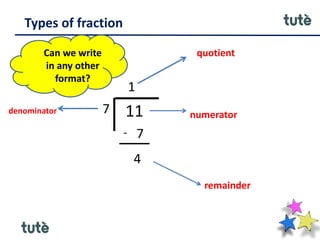
Types of fraction
11
7
1
7
-
4
quotient
numerator
denominator
remainder
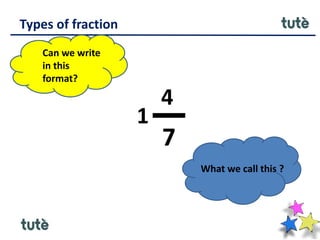
Can we write
in any other
format?
Types of fraction
Can we write
in this
format?
4
1
7
What we call this ?
Types of fraction
4
1
7
we call this as
Mixed fraction
Types of fraction
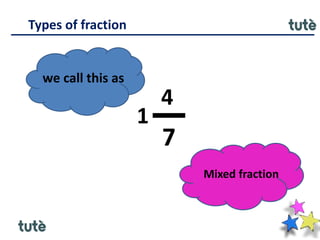
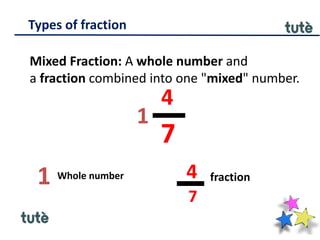
Mixed Fraction: A whole number and
a fraction combined into one "mixed" number.
4
1
7
1 Whole number
7
4 fraction
Types of fraction
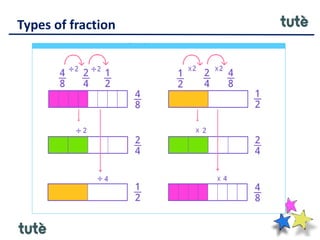
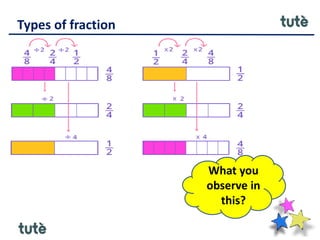
Types of fraction
What you
observe in
this?
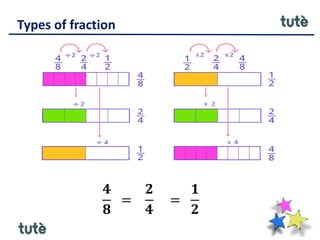
Types of fraction
𝟒
𝟖
=
𝟐
𝟒
=
𝟏
𝟐
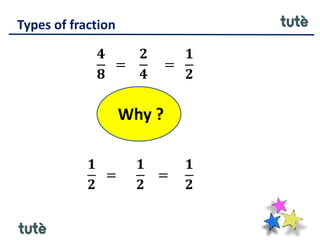
Types of fraction
𝟒
𝟖
=
𝟐
𝟒
=
𝟏
𝟐
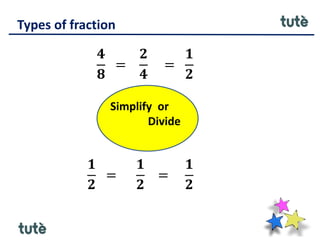
Why ?
𝟏
𝟐
=
𝟏
𝟐
=
𝟏
𝟐
Types of fraction
𝟒
𝟖
=
𝟐
𝟒
=
𝟏
𝟐
Simplify or
Divide
𝟏
𝟐
=
𝟏
𝟐
=
𝟏
𝟐
Types of fraction
𝟒
𝟖
=
𝟐
𝟒
=
𝟏
𝟐
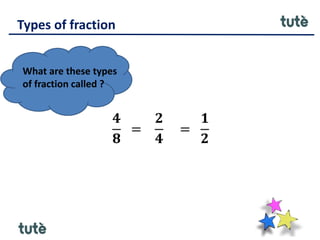
What are these types
of fraction called ?
Types of fraction
𝟒
𝟖
=
𝟐
𝟒
=
𝟏
𝟐
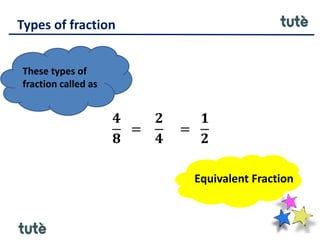
These types of
fraction called as
Equivalent Fraction
• To learn fraction and its types .
• To explain representation of fractions in a number line.
• To learn addition and subtraction of fraction.
Learning Outcomes
How confident do you feel?
• To learn fraction and its types .
• To explain representation of fractions in a number line.
• To learn addition and subtraction of fraction.
Learning Outcomes
How confident do you feel?
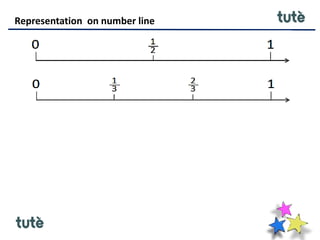
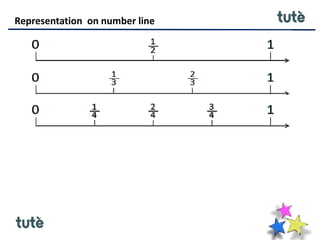
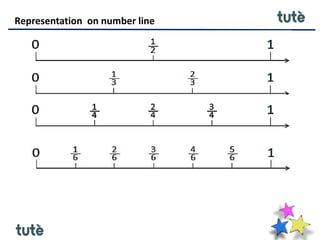
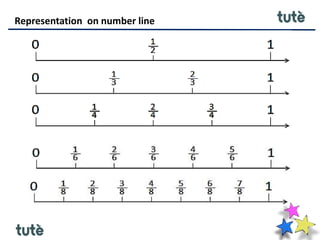
Representation of
fraction on a
number line
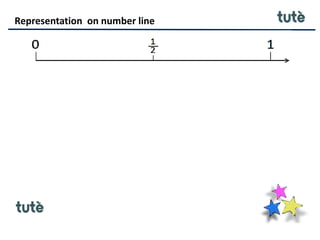
Representation on number line
• To learn fraction and its types .
• To explain representation of fractions in a number line.
• To learn addition and subtraction of fraction.
Learning Outcomes
How confident do you feel?
• To learn fraction and its types .
• To explain representation of fractions in a number line.
• To learn addition and subtraction of fraction.
Learning Outcomes
How confident do you feel?
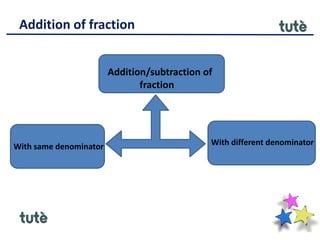
Addition of fraction
Addition/subtraction of
fraction
With same denominator With different denominator
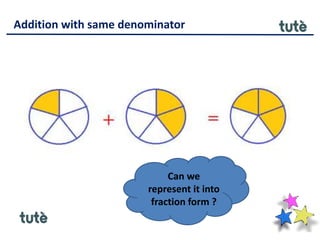
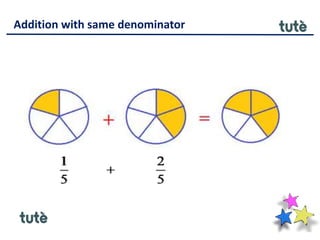
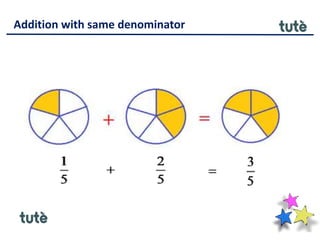
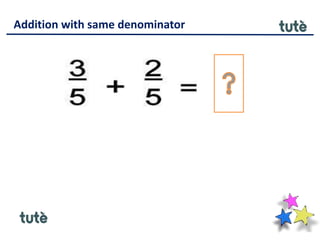
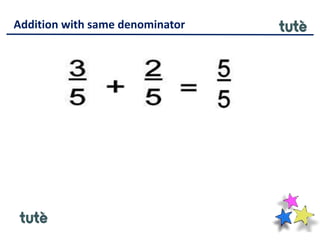
Addition with same denominator
Can we
represent it into
fraction form ?
Addition with same denominator
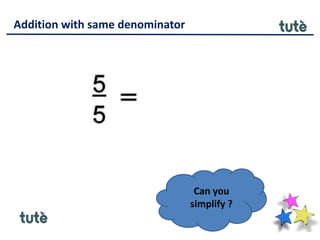
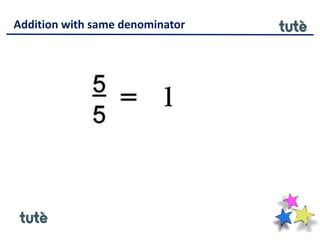
Can you
simplify ?
Addition with same denominator
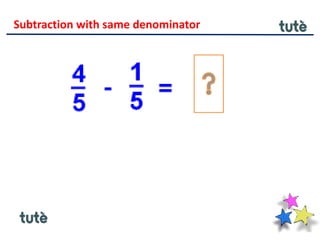
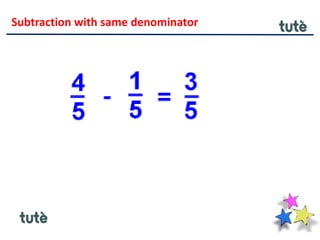
Subtraction with same denominator
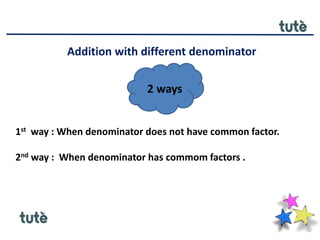
Addition with different denominator
2 ways
1st way : When denominator does not have common factor.
2nd way : When denominator has commom factors .
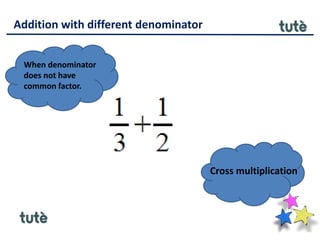
Addition with different denominator
When denominator
does not have
common factor.
Cross multiplication
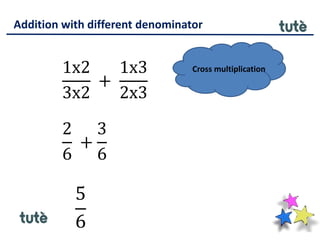
Addition with different denominator
1x2
3x2
+
1x3
2x3
2
6
+
3
6
5
6
Cross multiplication
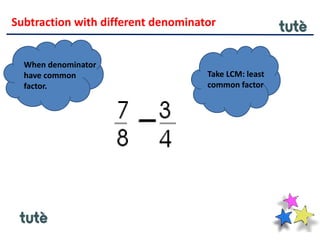
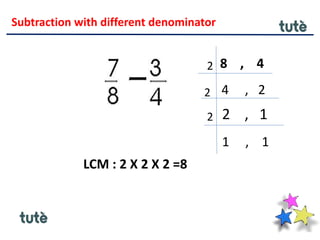
Subtraction with different denominator
When denominator
have common
factor.
Take LCM: least
common factor
Subtraction with different denominator
8 , 4
2
2 4 , 2
2 2 , 1
1 , 1
LCM : 2 X 2 X 2 =8
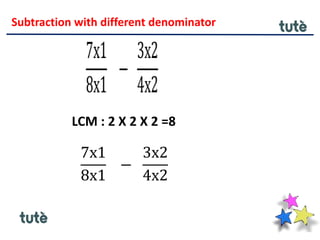
Subtraction with different denominator
LCM : 2 X 2 X 2 =8
7x1
8x1
−
3x2
4x2
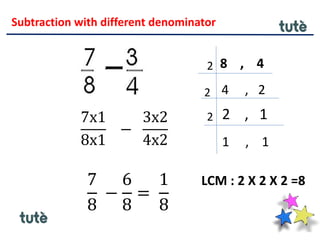
Subtraction with different denominator
8 , 4
2
2 4 , 2
2 2 , 1
1 , 1
LCM : 2 X 2 X 2 =8
7x1
8x1
−
3x2
4x2
7
8
−
6
8
=
1
8
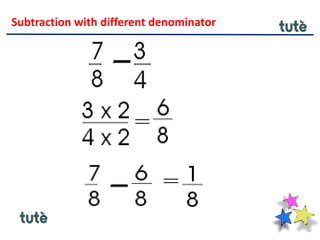
Subtraction with different denominator
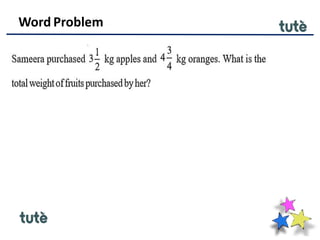
Word Problem
Let us understand problem
on mixed fraction
Word Problem
Word Problem
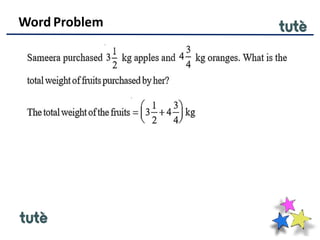
Word Problem
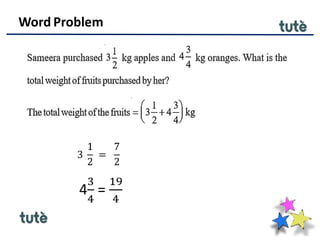
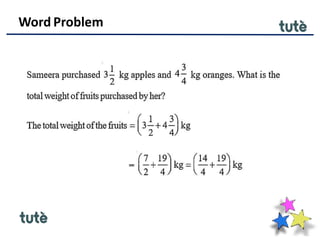
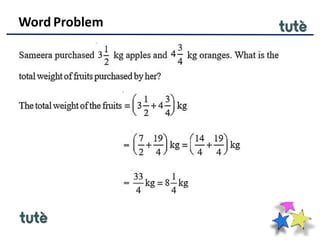
3
1
2
=
7
2
4
3
4
=
19
4
Word Problem
Word Problem
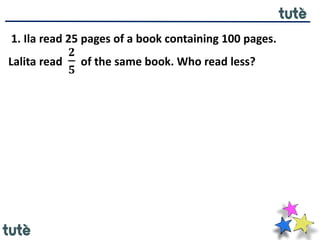
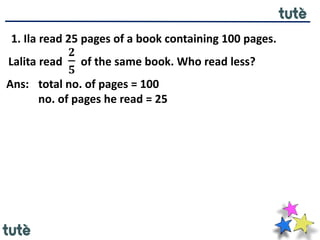
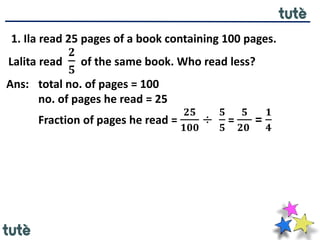
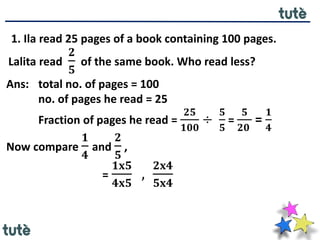
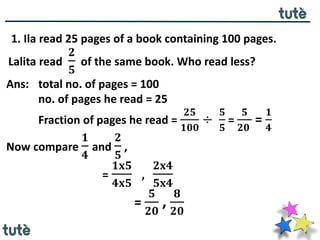
1. Ila read 25 pages of a book containing 100 pages.
Lalita read
𝟐
𝟓
of the same book. Who read less?
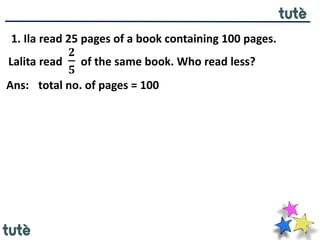
1. Ila read 25 pages of a book containing 100 pages.
Lalita read
𝟐
𝟓
of the same book. Who read less?
Ans: total no. of pages = 100
1. Ila read 25 pages of a book containing 100 pages.
Lalita read
𝟐
𝟓
of the same book. Who read less?
Ans: total no. of pages = 100
no. of pages he read = 25
1. Ila read 25 pages of a book containing 100 pages.
Lalita read
𝟐
𝟓
of the same book. Who read less?
Ans: total no. of pages = 100
no. of pages he read = 25
Fraction of pages he read =
𝟐𝟓
𝟏𝟎𝟎
÷
𝟓
𝟓
=
𝟓
𝟐𝟎
=
𝟏
𝟒
1. Ila read 25 pages of a book containing 100 pages.
Lalita read
𝟐
𝟓
of the same book. Who read less?
Ans: total no. of pages = 100
no. of pages he read = 25
Fraction of pages he read =
𝟐𝟓
𝟏𝟎𝟎
÷
𝟓
𝟓
=
𝟓
𝟐𝟎
=
𝟏
𝟒
Now compare
𝟏
𝟒
and
𝟐
𝟓
,
=
𝟏𝐱𝟓
𝟒𝐱𝟓
,
𝟐𝐱𝟒
𝟓𝐱𝟒
1. Ila read 25 pages of a book containing 100 pages.
Lalita read
𝟐
𝟓
of the same book. Who read less?
Ans: total no. of pages = 100
no. of pages he read = 25
Fraction of pages he read =
𝟐𝟓
𝟏𝟎𝟎
÷
𝟓
𝟓
=
𝟓
𝟐𝟎
=
𝟏
𝟒
Now compare
𝟏
𝟒
and
𝟐
𝟓
,
=
𝟏𝐱𝟓
𝟒𝐱𝟓
,
𝟐𝐱𝟒
𝟓𝐱𝟒
=
𝟓
𝟐𝟎
,
𝟖
𝟐𝟎
• To learn fraction and its types .
• To explain representation of fractions in a number line.
• To learn addition and subtraction of fraction.
Learning Outcomes
How confident do you feel?
• To learn fraction and its types .
• To explain representation of fractions in a number line.
• To learn addition and subtraction of fraction.
Learning Outcomes
How confident do you feel?
4th - cbse - fraction and its types - mathematics

4th - cbse - fraction and its types - mathematics

Editor's Notes

  • #2 An overview of the content of the lesson Must be in the form of a question where appropriate Students should be able to answer the question at the end - either fully, partly or in a way that demonstrates they understand what gaps in their knowledge they need to address Verbs such as to understand / to know / to gain confidence / to learn Ask students to give the question a go and point out that, at the end of the lesson, they should be able to answer fully
  • #3 Revisit the first outcome and use the polling function to allow students to privately self-assess You may feel that the students do not need privacy to self-assess and in this instance, the chat box may be used Polling must be used until you can fully assess their confidence to use the chat box and express honesty If students self-assess as a 4/5, ensure that you are fully confident in their assessment Ask questions Ask for examples Students to ask each other questions If a few students self-assesses as a 3, but others as a 4/5, discretely ask the higher ones to give examples and to explain their achievement/understanding If all students are a 3 or below, do not move on. Move to a blank page at the end of the presentation and use as a whiteboard to further explain If students are ½, go back to the beginning Always ask students what the gaps are and help them to identify these in order to promote metacognition
  • #4 The next slides should be focused on achieving first outcome Make reference to the outcome in the teaching Fill this with thinking skills activities, peer assessment, higher-order questioning, engaging activities and challenge
  • #5 The next slides should be focused on achieving first outcome Make reference to the outcome in the teaching Fill this with thinking skills activities, peer assessment, higher-order questioning, engaging activities and challenge
  • #6 The next slides should be focused on achieving first outcome Make reference to the outcome in the teaching Fill this with thinking skills activities, peer assessment, higher-order questioning, engaging activities and challenge
  • #16 previously.
  • #17 previously.
  • #18 previously.
  • #19 previously.
  • #20 previously.
  • #21 previously.
  • #22 previously.
  • #23 previously.
  • #24 previously.
  • #25 previously.
  • #26 previously.
  • #27 previously.
  • #28 previously.
  • #29 previously.
  • #30 previously.
  • #31 previously.
  • #32 previously.
  • #33 previously.
  • #34 previously.
  • #35 previously.
  • #36 previously.
  • #37 previously.
  • #38 previously.
  • #39 previously.
  • #40 previously.
  • #41 previously.
  • #42 previously.
  • #43 Revisit the first outcome and use the polling function to allow students to privately self-assess You may feel that the students do not need privacy to self-assess and in this instance, the chat box may be used Polling must be used until you can fully assess their confidence to use the chat box and express honesty If students self-assess as a 4/5, ensure that you are fully confident in their assessment Ask questions Ask for examples Students to ask each other questions If a few students self-assesses as a 3, but others as a 4/5, discretely ask the higher ones to give examples and to explain their achievement/understanding If all students are a 3 or below, do not move on. Move to a blank page at the end of the presentation and use as a whiteboard to further explain If students are ½, go back to the beginning Always ask students what the gaps are and help them to identify these in order to promote metacognition
  • #44 Revisit the first outcome and use the polling function to allow students to privately self-assess You may feel that the students do not need privacy to self-assess and in this instance, the chat box may be used Polling must be used until you can fully assess their confidence to use the chat box and express honesty If students self-assess as a 4/5, ensure that you are fully confident in their assessment Ask questions Ask for examples Students to ask each other questions If a few students self-assesses as a 3, but others as a 4/5, discretely ask the higher ones to give examples and to explain their achievement/understanding If all students are a 3 or below, do not move on. Move to a blank page at the end of the presentation and use as a whiteboard to further explain If students are ½, go back to the beginning Always ask students what the gaps are and help them to identify these in order to promote metacognition
  • #45 An overview of the content of the lesson Must be in the form of a question where appropriate Students should be able to answer the question at the end - either fully, partly or in a way that demonstrates they understand what gaps in their knowledge they need to address Verbs such as to understand / to know / to gain confidence / to learn Ask students to give the question a go and point out that, at the end of the lesson, they should be able to answer fully
  • #46 previously.
  • #47 previously.
  • #48 previously.
  • #49 previously.
  • #50 previously.
  • #51 Revisit the first outcome and use the polling function to allow students to privately self-assess You may feel that the students do not need privacy to self-assess and in this instance, the chat box may be used Polling must be used until you can fully assess their confidence to use the chat box and express honesty If students self-assess as a 4/5, ensure that you are fully confident in their assessment Ask questions Ask for examples Students to ask each other questions If a few students self-assesses as a 3, but others as a 4/5, discretely ask the higher ones to give examples and to explain their achievement/understanding If all students are a 3 or below, do not move on. Move to a blank page at the end of the presentation and use as a whiteboard to further explain If students are ½, go back to the beginning Always ask students what the gaps are and help them to identify these in order to promote metacognition
  • #52 Revisit the first outcome and use the polling function to allow students to privately self-assess You may feel that the students do not need privacy to self-assess and in this instance, the chat box may be used Polling must be used until you can fully assess their confidence to use the chat box and express honesty If students self-assess as a 4/5, ensure that you are fully confident in their assessment Ask questions Ask for examples Students to ask each other questions If a few students self-assesses as a 3, but others as a 4/5, discretely ask the higher ones to give examples and to explain their achievement/understanding If all students are a 3 or below, do not move on. Move to a blank page at the end of the presentation and use as a whiteboard to further explain If students are ½, go back to the beginning Always ask students what the gaps are and help them to identify these in order to promote metacognition
  • #53 previously.
  • #54 previously.
  • #55 previously.
  • #56 previously.
  • #57 previously.
  • #58 previously.
  • #59 previously.
  • #60 previously.
  • #61 previously.
  • #62 previously.
  • #63 previously.
  • #64 previously.
  • #65 previously.
  • #66 previously.
  • #67 previously.
  • #68 previously.
  • #69 previously.
  • #70 previously.
  • #71 previously.
  • #72 previously.
  • #73 previously.
  • #74 previously.
  • #75 previously.
  • #76 previously.
  • #77 An overview of the content of the lesson Must be in the form of a question where appropriate Students should be able to answer the question at the end - either fully, partly or in a way that demonstrates they understand what gaps in their knowledge they need to address Verbs such as to understand / to know / to gain confidence / to learn Ask students to give the question a go and point out that, at the end of the lesson, they should be able to answer fully
  • #78 An overview of the content of the lesson Must be in the form of a question where appropriate Students should be able to answer the question at the end - either fully, partly or in a way that demonstrates they understand what gaps in their knowledge they need to address Verbs such as to understand / to know / to gain confidence / to learn Ask students to give the question a go and point out that, at the end of the lesson, they should be able to answer fully
  • #79 An overview of the content of the lesson Must be in the form of a question where appropriate Students should be able to answer the question at the end - either fully, partly or in a way that demonstrates they understand what gaps in their knowledge they need to address Verbs such as to understand / to know / to gain confidence / to learn Ask students to give the question a go and point out that, at the end of the lesson, they should be able to answer fully
  • #80 An overview of the content of the lesson Must be in the form of a question where appropriate Students should be able to answer the question at the end - either fully, partly or in a way that demonstrates they understand what gaps in their knowledge they need to address Verbs such as to understand / to know / to gain confidence / to learn Ask students to give the question a go and point out that, at the end of the lesson, they should be able to answer fully
  • #81 An overview of the content of the lesson Must be in the form of a question where appropriate Students should be able to answer the question at the end - either fully, partly or in a way that demonstrates they understand what gaps in their knowledge they need to address Verbs such as to understand / to know / to gain confidence / to learn Ask students to give the question a go and point out that, at the end of the lesson, they should be able to answer fully
  • #82 An overview of the content of the lesson Must be in the form of a question where appropriate Students should be able to answer the question at the end - either fully, partly or in a way that demonstrates they understand what gaps in their knowledge they need to address Verbs such as to understand / to know / to gain confidence / to learn Ask students to give the question a go and point out that, at the end of the lesson, they should be able to answer fully
  • #83 Revisit the first outcome and use the polling function to allow students to privately self-assess You may feel that the students do not need privacy to self-assess and in this instance, the chat box may be used Polling must be used until you can fully assess their confidence to use the chat box and express honesty If students self-assess as a 4/5, ensure that you are fully confident in their assessment Ask questions Ask for examples Students to ask each other questions If a few students self-assesses as a 3, but others as a 4/5, discretely ask the higher ones to give examples and to explain their achievement/understanding If all students are a 3 or below, do not move on. Move to a blank page at the end of the presentation and use as a whiteboard to further explain If students are ½, go back to the beginning Always ask students what the gaps are and help them to identify these in order to promote metacognition
  • #84 Revisit the first outcome and use the polling function to allow students to privately self-assess You may feel that the students do not need privacy to self-assess and in this instance, the chat box may be used Polling must be used until you can fully assess their confidence to use the chat box and express honesty If students self-assess as a 4/5, ensure that you are fully confident in their assessment Ask questions Ask for examples Students to ask each other questions If a few students self-assesses as a 3, but others as a 4/5, discretely ask the higher ones to give examples and to explain their achievement/understanding If all students are a 3 or below, do not move on. Move to a blank page at the end of the presentation and use as a whiteboard to further explain If students are ½, go back to the beginning Always ask students what the gaps are and help them to identify these in order to promote metacognition