Fractions &
order
of
operations
By: Masoud Nassimi
1
Date: 02/10/2014
Fraction Basics
Types of Fractions
Division of Fractions
2
Multiplication of Fraction
Lowest Common Denominator
Addition Fraction
Subtraction of Fraction
Order of Operation
What is a Fraction – Basics
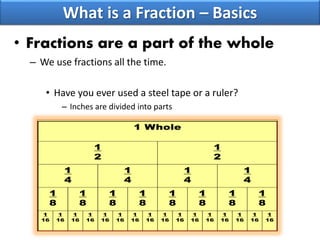
• Fractions are a part of the whole
– We use fractions all the time.
• Have you ever used a steel tape or a ruler?
– Inches are divided into parts
3
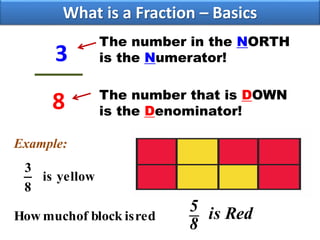
8
The number in the NORTH
is the Numerator!
The number that is DOWN
is the Denominator!
What is a Fraction – Basics
Example:
yellowis
8
3
redisblockofmuchHow Redis
8
5
Types of Fractions – Basics
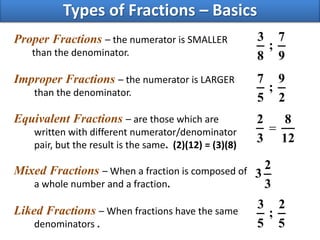
Proper Fractions – the numerator is SMALLER
than the denominator.
Improper Fractions – the numerator is LARGER
than the denominator.
Equivalent Fractions – are those which are
written with different numerator/denominator
pair, but the result is the same. (2)(12) = (3)(8)
Mixed Fractions – When a fraction is composed of
a whole number and a fraction.
Liked Fractions – When fractions have the same
denominators .
9
7
;
8
3
2
9
;
5
7
12
8
3
2

3
2
3
5
2
;
5
3
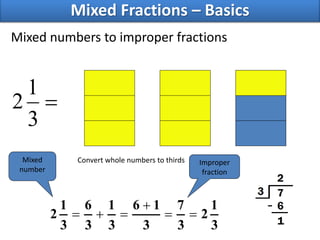
Mixed numbers to improper fractions

3
1
2
Convert whole numbers to thirds
3
1
2
3
7
3
16
3
1
3
6
3
1
2 


Mixed
number
Improper
fraction
Mixed Fractions – Basics
2
1
32
31



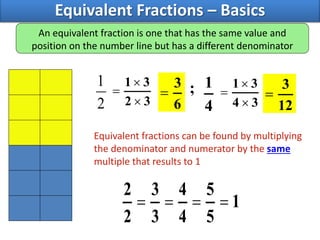
An equivalent fraction is one that has the same value and
position on the number line but has a different denominator
Equivalent fractions can be found by multiplying
the denominator and numerator by the same
multiple that results to 1
1
5
5
4
4
3
3
2
2

Equivalent Fractions – Basics
6
3

4
1
34
31



12
3
;
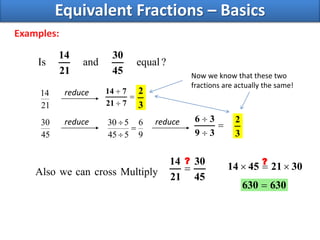
Examples:
?equalandIs
45
30
21
14
21
14 reduce 


721
714
45
30 reduce
9
6
545
530


 reduce 


39
36
Now we know that these two
fractions are actually the same!
Equivalent Fractions – Basics
3
2
3
2
MultiplycrosscanweAlso 45
30
21
14
 30214514 
630630 
? ?
2
2
6
6
7
7
8
8
9
9
10
10
11
11
17
17
25
25
20
20
50
50
125
125
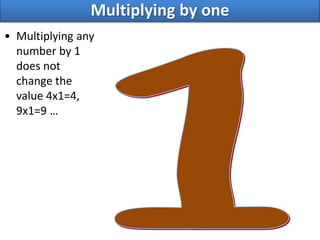
Multiplying by one
• Multiplying any
number by 1
does not
change the
value 4x1=4,
9x1=9 …
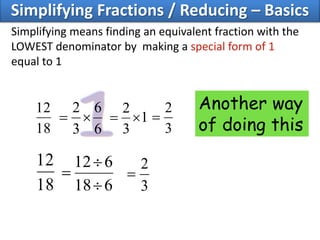
Simplifying means finding an equivalent fraction with the
LOWEST denominator by making a special form of 1
equal to 1
18
12
6
6
3
2
 1
3
2

3
2

18
12
618
612



3
2

Another way
of doing this
Simplifying Fractions / Reducing – Basics
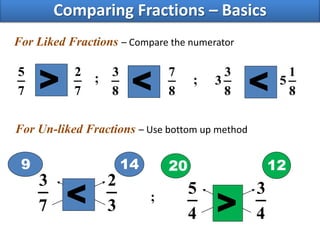
Comparing Fractions – Basics
For Un-liked Fractions – Use bottom up method
8
7
8
3
For Liked Fractions – Compare the numerator
14
< 8
1
5
8
3
3
<7
2
7
5
> ;
;
;
3
2
7
3
9 12
> 4
3
4
5
20
<
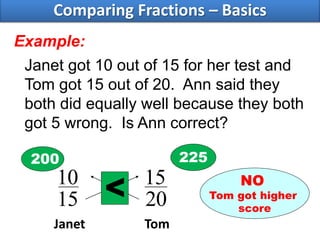
Example:
Comparing Fractions – Basics
Janet got 10 out of 15 for her test and
Tom got 15 out of 20. Ann said they
both did equally well because they both
got 5 wrong. Is Ann correct?
20
15
15
10
225
<
200
NO
Tom got higher
score
Janet Tom
5
3
20
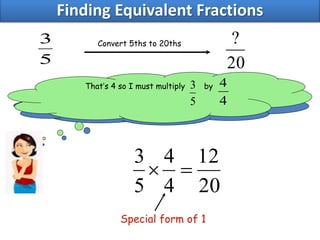
?Convert 5ths to 20ths
What do we multiply 5 by to get a product of
20?
That’s 4 so I must multiply by
4
4
5
3
20
12
4
4
5
3

Special form of 1
Finding Equivalent Fractions
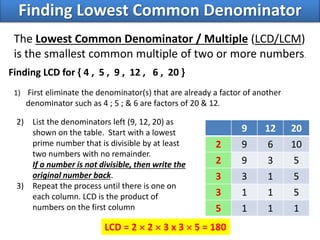
Finding LCD for { 4 , 5 , 9 , 12 , 6 , 20 }
Finding Lowest Common Denominator
The Lowest Common Denominator / Multiple (LCD/LCM)
is the smallest common multiple of two or more numbers.
1) First eliminate the denominator(s) that are already a factor of another
denominator such as 4 ; 5 ; & 6 are factors of 20 & 12.
2) List the denominators left (9, 12, 20) as
shown on the table. Start with a lowest
prime number that is divisible by at least
two numbers with no remainder.
If a number is not divisible, then write the
original number back.
3) Repeat the process until there is one on
each column. LCD is the product of
numbers on the first column
9 12 20
2 9 6 10
2 9 3 5
3 3 1 5
3 1 1 5
5 1 1 1
LCD = 2  2  3 x 3  5 = 180
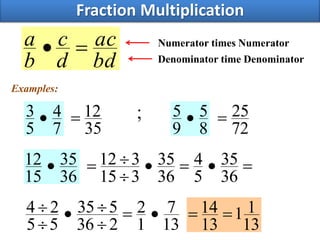
Fraction Multiplication
Numerator times Numerator
Denominator time Denominatorbd
ac
d
c
b
a 
7
4
5
3 
Examples:
72
25;



36
35
5
4
36
35
315
312
13
7
1
2
236
535
55
24 




36
35
15
12 
35
12
8
5
9
5 
13
11
13
14 
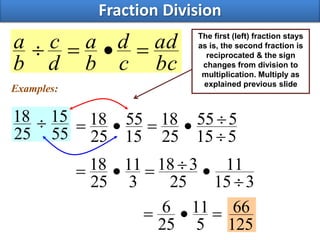
Fraction Division
bc
ad
c
d
b
a
d
c
b
a 
Examples:
515
555
25
18
15
55
25
18

55
15
25
18 
125
66
The first (left) fraction stays
as is, the second fraction is
reciprocated & the sign
changes from division to
multiplication. Multiply as
explained previous slide
315
11
25
318
3
11
25
18



5
11
25
6
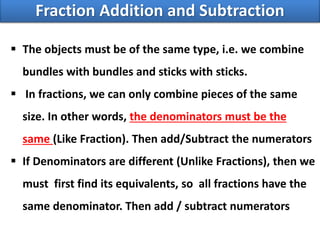
Fraction Addition and Subtraction
 The objects must be of the same type, i.e. we combine
bundles with bundles and sticks with sticks.
 In fractions, we can only combine pieces of the same
size. In other words, the denominators must be the
same (Like Fraction). Then add/Subtract the numerators
 If Denominators are different (Unlike Fractions), then we
must first find its equivalents, so all fractions have the
same denominator. Then add / subtract numerators
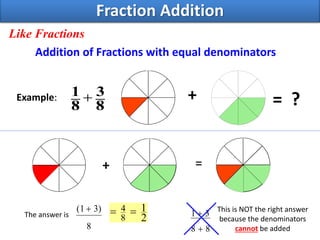
Addition of Fractions with equal denominators
+ = ?Example:
8
3
8
1 
Fraction Addition
Like Fractions
+ =
The answer is
8
3)(1 
2
1
8
4 
88
31

 This is NOT the right answer
because the denominators
cannot be added
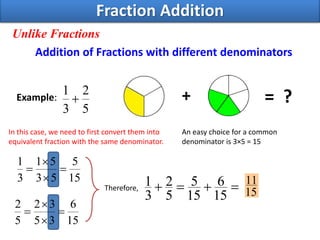
Addition of Fractions with different denominators
+ = ?Example:
Fraction Addition
Unlike Fractions
5
2
3
1

In this case, we need to first convert them into
equivalent fraction with the same denominator.
15
5
53
51
3
1




15
6
35
32
5
2




An easy choice for a common
denominator is 3×5 = 15
Therefore, 
15
6
15
5
5
2
3
1
15
11
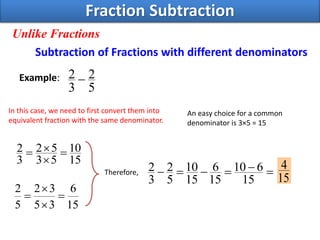
Subtraction of Fractions with different denominators
Example:
Fraction Subtraction
Unlike Fractions
5
2
3
2 
In this case, we need to first convert them into
equivalent fraction with the same denominator.
15
10
53
52
3
2 


15
6
35
32
5
2




An easy choice for a common
denominator is 3×5 = 15
Therefore, 
15
610
15
6
15
10
5
2
3
2
15
4
This is more difficult than before, so please take notes.
2
1
1
4
1
3 
Easy way to solve mixed numbers is to first convert them into
improper fraction and then perform subtraction/addition
2
121
4
143
2
1
1
4
1
3




2
3
4
13

4
6
4
13

4
3
1
4
7

Fraction Subtraction
2
3
4
13

2
2

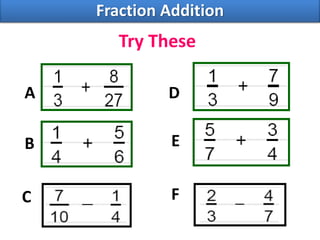
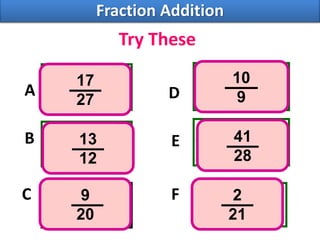
Try These
A
F
EB
C
D
Fraction Addition
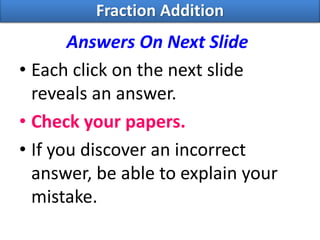
Answers On Next Slide
• Each click on the next slide
reveals an answer.
• Check your papers.
• If you discover an incorrect
answer, be able to explain your
mistake.
Fraction Addition
Try These
A
F
EB
C
D
17
27
10
9
41
28
13
12
Fraction Addition
2
21
9
20
Remember the phrase
“Please Excuse My Dear Aunt Sally” or
PEMDAS.
1. Parentheses - ( ) or [ ]
2. Exponents or Powers
3. Multiply and Divide (from left to right)
4. Add and Subtract (from left to right)
Order of Operation
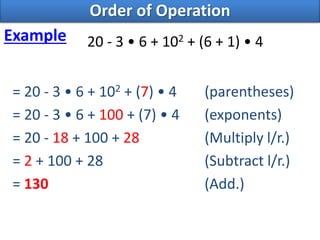
20 - 3 • 6 + 102 + (6 + 1) • 4
= 20 - 3 • 6 + 102 + (7) • 4 (parentheses)
= 20 - 3 • 6 + 100 + (7) • 4 (exponents)
= 20 - 18 + 100 + 28 (Multiply l/r.)
= 2 + 100 + 28 (Subtract l/r.)
= 130 (Add.)
Order of Operation
Example
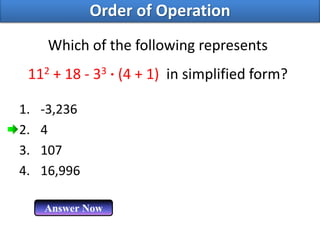
Which of the following represents
112 + 18 - 33 · (4 + 1) in simplified form?
1. -3,236
2. 4
3. 107
4. 16,996
Answer Now
Order of Operation
The
End
28

Fraction

  • 1.
  • 2.
    Fraction Basics Types ofFractions Division of Fractions 2 Multiplication of Fraction Lowest Common Denominator Addition Fraction Subtraction of Fraction Order of Operation
  • 3.
    What is aFraction – Basics • Fractions are a part of the whole – We use fractions all the time. • Have you ever used a steel tape or a ruler? – Inches are divided into parts
  • 4.
    3 8 The number inthe NORTH is the Numerator! The number that is DOWN is the Denominator! What is a Fraction – Basics Example: yellowis 8 3 redisblockofmuchHow Redis 8 5
  • 5.
    Types of Fractions– Basics Proper Fractions – the numerator is SMALLER than the denominator. Improper Fractions – the numerator is LARGER than the denominator. Equivalent Fractions – are those which are written with different numerator/denominator pair, but the result is the same. (2)(12) = (3)(8) Mixed Fractions – When a fraction is composed of a whole number and a fraction. Liked Fractions – When fractions have the same denominators . 9 7 ; 8 3 2 9 ; 5 7 12 8 3 2  3 2 3 5 2 ; 5 3
  • 6.
    Mixed numbers toimproper fractions  3 1 2 Convert whole numbers to thirds 3 1 2 3 7 3 16 3 1 3 6 3 1 2    Mixed number Improper fraction Mixed Fractions – Basics
  • 7.
    2 1 32 31    An equivalent fractionis one that has the same value and position on the number line but has a different denominator Equivalent fractions can be found by multiplying the denominator and numerator by the same multiple that results to 1 1 5 5 4 4 3 3 2 2  Equivalent Fractions – Basics 6 3  4 1 34 31    12 3 ;
  • 8.
    Examples: ?equalandIs 45 30 21 14 21 14 reduce    721 714 45 30reduce 9 6 545 530    reduce    39 36 Now we know that these two fractions are actually the same! Equivalent Fractions – Basics 3 2 3 2 MultiplycrosscanweAlso 45 30 21 14  30214514  630630  ? ?
  • 9.
    2 2 6 6 7 7 8 8 9 9 10 10 11 11 17 17 25 25 20 20 50 50 125 125 Multiplying by one •Multiplying any number by 1 does not change the value 4x1=4, 9x1=9 …
  • 10.
    Simplifying means findingan equivalent fraction with the LOWEST denominator by making a special form of 1 equal to 1 18 12 6 6 3 2  1 3 2  3 2  18 12 618 612    3 2  Another way of doing this Simplifying Fractions / Reducing – Basics
  • 11.
    Comparing Fractions –Basics For Un-liked Fractions – Use bottom up method 8 7 8 3 For Liked Fractions – Compare the numerator 14 < 8 1 5 8 3 3 <7 2 7 5 > ; ; ; 3 2 7 3 9 12 > 4 3 4 5 20 <
  • 12.
    Example: Comparing Fractions –Basics Janet got 10 out of 15 for her test and Tom got 15 out of 20. Ann said they both did equally well because they both got 5 wrong. Is Ann correct? 20 15 15 10 225 < 200 NO Tom got higher score Janet Tom
  • 13.
    5 3 20 ?Convert 5ths to20ths What do we multiply 5 by to get a product of 20? That’s 4 so I must multiply by 4 4 5 3 20 12 4 4 5 3  Special form of 1 Finding Equivalent Fractions
  • 14.
    Finding LCD for{ 4 , 5 , 9 , 12 , 6 , 20 } Finding Lowest Common Denominator The Lowest Common Denominator / Multiple (LCD/LCM) is the smallest common multiple of two or more numbers. 1) First eliminate the denominator(s) that are already a factor of another denominator such as 4 ; 5 ; & 6 are factors of 20 & 12. 2) List the denominators left (9, 12, 20) as shown on the table. Start with a lowest prime number that is divisible by at least two numbers with no remainder. If a number is not divisible, then write the original number back. 3) Repeat the process until there is one on each column. LCD is the product of numbers on the first column 9 12 20 2 9 6 10 2 9 3 5 3 3 1 5 3 1 1 5 5 1 1 1 LCD = 2  2  3 x 3  5 = 180
  • 15.
    Fraction Multiplication Numerator timesNumerator Denominator time Denominatorbd ac d c b a  7 4 5 3  Examples: 72 25;    36 35 5 4 36 35 315 312 13 7 1 2 236 535 55 24      36 35 15 12  35 12 8 5 9 5  13 11 13 14 
  • 16.
    Fraction Division bc ad c d b a d c b a  Examples: 515 555 25 18 15 55 25 18  55 15 25 18 125 66 The first (left) fraction stays as is, the second fraction is reciprocated & the sign changes from division to multiplication. Multiply as explained previous slide 315 11 25 318 3 11 25 18    5 11 25 6
  • 17.
    Fraction Addition andSubtraction  The objects must be of the same type, i.e. we combine bundles with bundles and sticks with sticks.  In fractions, we can only combine pieces of the same size. In other words, the denominators must be the same (Like Fraction). Then add/Subtract the numerators  If Denominators are different (Unlike Fractions), then we must first find its equivalents, so all fractions have the same denominator. Then add / subtract numerators
  • 18.
    Addition of Fractionswith equal denominators + = ?Example: 8 3 8 1  Fraction Addition Like Fractions + = The answer is 8 3)(1  2 1 8 4  88 31   This is NOT the right answer because the denominators cannot be added
  • 19.
    Addition of Fractionswith different denominators + = ?Example: Fraction Addition Unlike Fractions 5 2 3 1  In this case, we need to first convert them into equivalent fraction with the same denominator. 15 5 53 51 3 1     15 6 35 32 5 2     An easy choice for a common denominator is 3×5 = 15 Therefore,  15 6 15 5 5 2 3 1 15 11
  • 20.
    Subtraction of Fractionswith different denominators Example: Fraction Subtraction Unlike Fractions 5 2 3 2  In this case, we need to first convert them into equivalent fraction with the same denominator. 15 10 53 52 3 2    15 6 35 32 5 2     An easy choice for a common denominator is 3×5 = 15 Therefore,  15 610 15 6 15 10 5 2 3 2 15 4
  • 21.
    This is moredifficult than before, so please take notes. 2 1 1 4 1 3  Easy way to solve mixed numbers is to first convert them into improper fraction and then perform subtraction/addition 2 121 4 143 2 1 1 4 1 3     2 3 4 13  4 6 4 13  4 3 1 4 7  Fraction Subtraction 2 3 4 13  2 2 
  • 22.
  • 23.
    Answers On NextSlide • Each click on the next slide reveals an answer. • Check your papers. • If you discover an incorrect answer, be able to explain your mistake. Fraction Addition
  • 24.
  • 25.
    Remember the phrase “PleaseExcuse My Dear Aunt Sally” or PEMDAS. 1. Parentheses - ( ) or [ ] 2. Exponents or Powers 3. Multiply and Divide (from left to right) 4. Add and Subtract (from left to right) Order of Operation
  • 26.
    20 - 3• 6 + 102 + (6 + 1) • 4 = 20 - 3 • 6 + 102 + (7) • 4 (parentheses) = 20 - 3 • 6 + 100 + (7) • 4 (exponents) = 20 - 18 + 100 + 28 (Multiply l/r.) = 2 + 100 + 28 (Subtract l/r.) = 130 (Add.) Order of Operation Example
  • 27.
    Which of thefollowing represents 112 + 18 - 33 · (4 + 1) in simplified form? 1. -3,236 2. 4 3. 107 4. 16,996 Answer Now Order of Operation
  • 28.